For a first-time sand bath in Ibusuki, heading straight to Saraku by train or bus is the simplest option. Here are standard and New Year fares for both facilities, closure alternatives, Tamatebako seat reservations, and Yamakawa bus connections.
- Region & Focus
- Ibusuki
- Reading Scope
- 21 min read · 10 chapters · 6 Q&As
- Official Verification
- 28 official sources checkedUpdated 22 November 2026
- Key Topics
- First tripItinerariesRail travel
Chapter Route Map (tap any stop)
- Choosing Between Saraku and Sayuri Based on Your Route
- Saraku Fares, Year-End Closures, and Queue Timing
- Changing Clothes and Packing Towels Before Entering the Sand
- Families, Accessibility Needs, and Photography Rules
- Booking the Ibusuki no Tamatebako from Kagoshima-Chuo
- Planning a Day Trip Around Your Return Train
- Doing Yamakawa: Sand Bath at Sayuri First, Open-Air Onsen Second
- Adding Cape Nagasakibana—or Saving Mount Kaimon for an Overnight Stay
- Adjusting a Half-Day Itinerary for Rain and Winter Weather
- Staying Overnight: Yunohama Walkability vs. In-House Ryokan Sand Baths
- Quick Q&A
From Kagoshima-Chuo Station, first-time visitors to Ibusuki's sand baths can board the 09:56 Ibusuki no Tamatebako limited express, spend the morning at Saraku Sand Bath Hall in Yunohama, and return to Kagoshima in the afternoon. Standard adult admission at Saraku is ¥1,500, which covers yukata rental and the indoor communal baths. If you would rather pair a coastal sand bath with an open-air hot spring overlooking Mount Kaimon, head south to Sayuri in Yamakawa. Note that Saraku will close for maintenance from 14 to 18 December 2026; the city of Ibusuki has arranged for Sayuri to open every day during those five days, so travellers with train tickets for that window should route their trip via Yamakawa.
Choosing Between Saraku and Sayuri Based on Your Route
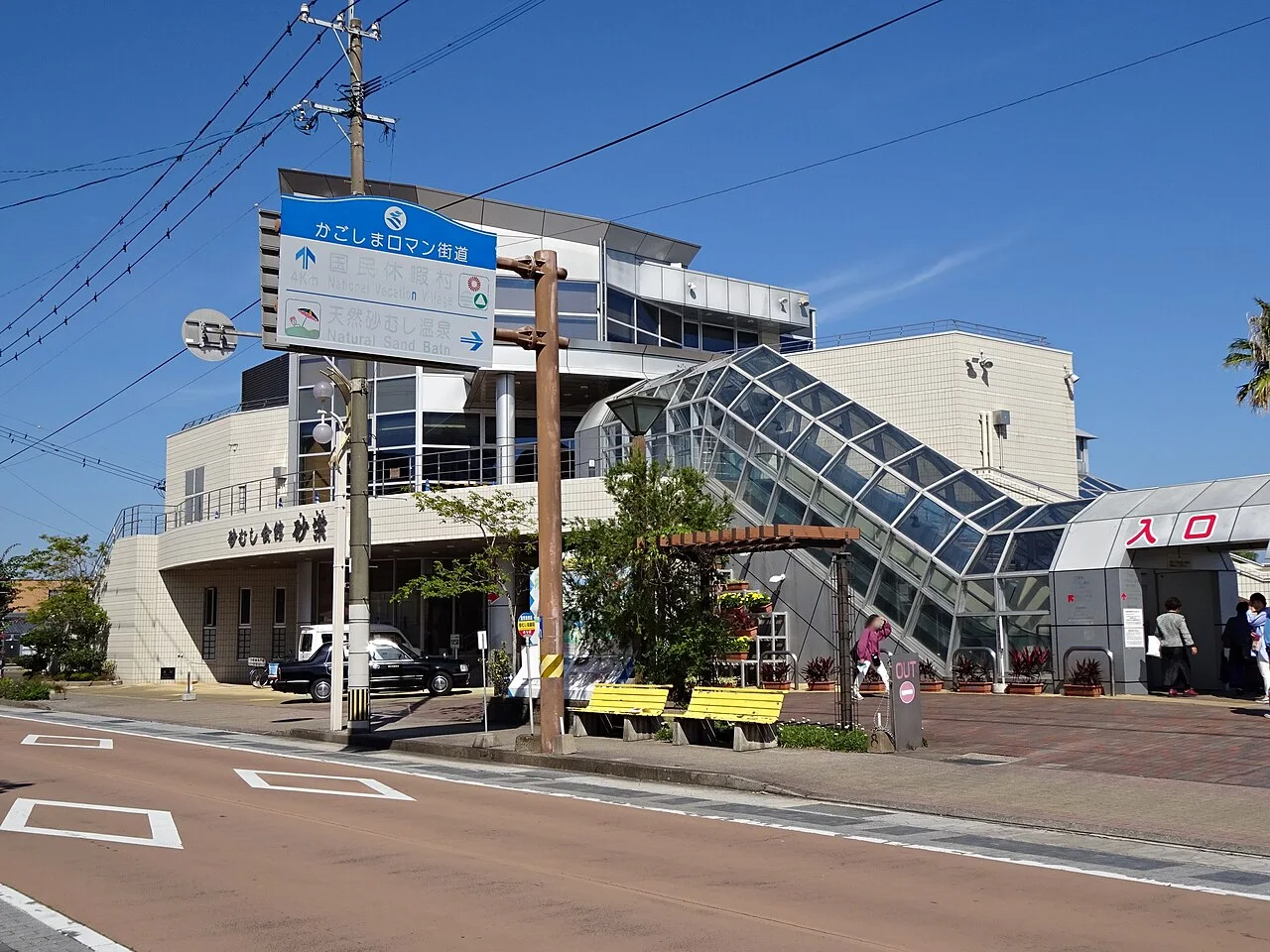
Ibusuki's two municipal sand bath facilities sit on different stretches of coast. Saraku (officially Sunamushi Kaikan Saraku) stands in Yunohama, just south of the town centre—around a 20-minute walk or 5-minute taxi ride from JR Ibusuki Station, with a Kagoshima Kotsu bus stop right outside the hall. Both facilities provide a dedicated yukata before attendants bury you in sand warmed by natural geothermal steam. At Saraku, the showers and indoor communal baths are in the same building, making it ideal if you are travelling via Ibusuki Station and heading straight back to Kagoshima afterwards.
Yamakawa Sayuri (Yamakawa Sunamushi Onsen Sayuri) lies on the Fushime coast in Yamakawa Fukumoto, roughly a 10-minute drive from JR Yamakawa Station, facing the East China Sea with views of Mount Kaimon on clear days. Sand bathing takes place either right by the shoreline or in a sheltered area beside the building. Sayuri has an indoor bath after your sand session, though house rules prohibit soap and shampoo in the washing area. Travellers hoping to wash their hair before boarding a train will find Saraku's bathing layout more convenient, whereas anyone already visiting Yamakawa Port or Cape Nagasakibana can save a detour back into town by using Sayuri.
Two separate venues in Yamakawa are frequently confused under the same name, each with its own entrance. Sayuri handles the sand baths, while Tamatebako Onsen at the far end of the coastal footpath is Healthy Land's open-air hot spring bathhouse. The sightseeing train shares the Tamatebako name too, yet the limited express terminates and turns around at Ibusuki Station, meaning you still need a bus or car to reach the hot springs. When setting up your map navigation, pin both "Yamakawa Sunamushi Onsen Sayuri" and "Healthy Land Rotenburo Tamatebako Onsen" in advance, and save the correct return bus stop separately.
The ¥400 difference in ticket price is only part of the equation. For two adults walking from Ibusuki Station to Saraku, standard admission totals ¥3,000; going via Yamakawa brings Sayuri tickets to ¥2,200, plus return bus or taxi fares. That ¥400 saving really only tips the balance if you have already planned lunch in Yamakawa and a stop at Nagasakibana in the same area. If someone in your group only wants to soak in the hot spring rather than be buried in sand, you can each buy different tickets at the same venue and agree on a meeting spot once out of the changing rooms.
| Facility | Standard / Holiday Sand Bath Fare (Adult / Child) | Regular Hours | Best-Suited Route |
|---|---|---|---|
| Saraku Sand Bath Hall (Yunohama) | Standard ¥1,500 / ¥800; Year-end & New Year ¥2,000 / ¥1,000 | 08:30–21:00 (last entry 20:00; weekday midday break 12:00–13:00) | 20-min walk from JR Ibusuki Station, or bus/taxi to the door |
| Sayuri (Yamakawa) | Standard ¥1,100 / ¥600; Year-end & New Year ¥1,500 / ¥750 | 08:30–17:00 (last entry 16:30; usually closed Wednesdays) | Bus to Tamatebako Onsen stop, then 5-min walk along the coastal path |
For a first-time sand bath in Ibusuki, heading straight to Saraku by train or bus is the simplest option. Here are standard and New Year fares for both facilities, closure alternatives, Tamatebako seat reservations, and Yamakawa bus connections.
Saraku Fares, Year-End Closures, and Queue Timing
Saraku's basic sand bath ticket covers the sand bath, indoor communal baths, and yukata rental. Age brackets follow Japanese school tiers: junior high school students and older pay the adult rate, while elementary school children and younger pay the child rate. Admission to the indoor communal baths alone costs ¥800 for adults and ¥400 for children. If you only need a small towel to protect your face and neck from the sand, opt for the souvenir-towel set (¥1,800 adult, ¥1,100 child); if you also need a bath towel, choose the full bundle (¥2,100 adult, ¥1,400 child) containing both. Bring your own towels and you only need the basic ticket.
Bought individually, a souvenir face towel is ¥300, bath towel rental is ¥300, and dedicated undergarments to wear beneath the yukata can be hired for ¥500. When companions buy different combinations at the counter, keep track of which towel goes onto the sand and which stays in your locker. Two standard adult admissions at ¥1,500 each plus individual face and bath towels come to ¥4,200—the exact same total as two full bundle tickets. The reception desk accepts credit cards and various e-payment methods, though keep your train fares and facility budget separate.
The entire Saraku building will close for equipment maintenance from 14 to 18 December 2026, with reopening scheduled for 19 December. During the year-end and New Year peak from 29 December 2026 to 3 January 2027, basic sand bath fares rise to ¥2,000 for adults and ¥1,000 for children, and bath-only admission rises to ¥1,000 and ¥500. Returning visitors who have already ridden the Tamatebako train and simply want another sand bath can plan around that holiday week. If you have non-refundable mid-December hotel bookings in Ibusuki, budget for the bus fare out to Yamakawa plus Sayuri admission, and aim to check in before the 16:30 cutoff.
Regular hours run from 08:30 to 21:00, with last reception at 20:00. On weekdays, sand bath reception pauses between 12:00 and 13:00, and individual visitors are served in order of arrival. Arriving early helps you clear the midday break cleanly and leaves more flexibility for lunch and your train home. If you take the 11:56 limited express from Kagoshima-Chuo, arriving at Ibusuki at 12:48, you will reach Saraku after 13:00 and can walk straight into the afternoon queue. Reception may close early when queues grow long, so late-afternoon visitors should do the sand bath first and leave shopping or dinner for afterwards.
Changing Clothes and Packing Towels Before Entering the Sand
Take the escalator from the street-level entrance up to the second floor, where staff hand out a yukata matched to your height. At the changing-room entrance, slip off your shoes into the bag provided and lock both shoes and street clothes inside your locker. Only the facility's yukata is worn in the sand bath—leave your own underwear and swimwear in the locker, or put on the rented innerwear underneath your yukata before stepping out. If companions are changing in separate areas, take your face towel and locker key and meet by the outdoor slippers rack so nobody ends up waiting outside the changing-room door.
Once changed, follow the short outdoor walkway, turn right, and head down the steps on the left to the sand area. Signage asks anyone who has difficulty walking or navigating stairs to inform staff beforehand; you can keep the Japanese phrase "Kaidan no nobori-ori ga muzukashii desu" ("I have difficulty with stairs") handy on a card or note to show the desk. Standard facility sandals are fine for most guests, though Saraku's FAQ notes that visitors needing extra foot support may bring well-fitting sandals of their own. A roofed sand area operates in wet weather, so simply watch your footing on damp patches along the outdoor path.
The sand along this shore is heated naturally by subterranean hot-spring water. Attendants guide you to an empty spot, have you lie on your back with your small towel tucked around your head and neck as a barrier, and shovel warm sand over your body. Make sure you are comfortable before nodding to begin—especially if you dislike heavy pressure or need one arm or leg kept free, as you can ask before they start. The weight comes from the damp, steaming sand piled over you; listen to the attendants for when it is time to sit up. Staff recommend roughly 10 minutes in the sand, and the full sequence from changing to showering typically takes around an hour, excluding any queue when tour groups arrive together.
Back inside the building, return your sandals to the rack, drop your used yukata and any rented innerwear into the collection bin along the bath corridor, and rinse every grain of sand off in the showers. Sand clings easily behind the ears, along the hairline, at the nape of the neck, and between the toes, so rinse thoroughly before stepping into the communal soaking pool. Your bath towel and dry clothes remain in your locker, while your small sand-barrier towel can be rinsed out and taken home in a waterproof pouch. Take time to rest and rehydrate in the lounge before heading back; if you are walking to the station, pack your rain jacket, outer layer, and water bottle where they are easy to reach.
Families, Accessibility Needs, and Photography Rules
According to Saraku's FAQ, children from around two to three years old can try the sand bath, subject to the facility's child bathing guidelines. Mention your child's age and the need for an accompanying adult at reception, and explain to younger children before entering the changing room that staff will cover them in warm sand and can uncover them immediately if it feels too hot or heavy. If a child is hesitant, one adult can stay inside the hall while the rest of the group goes first. Bath-only tickets cost less and work well when part of the family prefers not to be buried in sand; around lunchtime with small children, build in extra buffer so nobody is stuck waiting until the afternoon session to eat.
Let staff know about any health conditions before entering, as the facility sets specific bathing rules around menstruation, chronic illnesses, and other medical considerations. If you feel too hot, breathless, or uncomfortable under the sand, call an attendant to help you out early—there is no need for companions to stay buried for the exact same duration. Split up if needed and agree to regroup outside the communal baths so slower walkers never feel rushed. If you take a taxi from Ibusuki Station to skip the walk, plan your onward ride after changing back into street clothes as well.
Leave phones and cameras locked in the changing room: personal photography is prohibited throughout the sand area, baths, and changing rooms, including by companions waiting on the sidelines. If you want a group photo in the sand, ask the staff about their paid photo service and specify how many people will be in the shot before they start shovelling. Plenty of memorable photo opportunities await along the journey instead, from the black-and-white livery of the Ibusuki no Tamatebako train to the matching two-tone postbox outside Ibusuki Station. Write down your train times and ticket details on paper before locking your phone away so you are not guessing departure times afterwards.
Booking the Ibusuki no Tamatebako from Kagoshima-Chuo
JR Kyushu's sightseeing limited express, the Ibusuki no Tamatebako, links Kagoshima-Chuo and Ibusuki Stations. Standard adult single fares are listed at ¥2,950—comprising a ¥1,170 base fare plus a ¥1,780 regular-season reserved-seat limited express surcharge, which varies slightly by travel season. If you only want the sightseeing train one way, ride the Tamatebako outbound and return on a local or rapid service; at regular-season rates, that mixed round trip totals ¥4,120 per adult compared with ¥5,900 for limited express both ways.
All seats on the Ibusuki no Tamatebako are reserved, so you must secure a seat before boarding—none are sold on the train. Tickets go on sale one month prior to the travel date at 10:00 Japan Standard Time (JST). JR Kyushu's online booking portal requires free membership registration, and even when pre-sale requests are accepted, actual seat allocation begins at the official release time. Unfamiliar ticket-collection steps can eat into tight transfers, so check your pickup code and payment card requirements in advance; if you are transferring from a Shinkansen at Kagoshima-Chuo, allow extra time to collect physical tickets.
Alongside standard paired seats, the carriages feature window-facing counter seats overlooking Kinko Bay, so decide whether your group wants to sit facing one another or side by side facing the sea. Travellers using wheelchairs and their companions are directed by JR Kyushu to book accessible spaces via a Midori-no-Madoguchi ticket office or by phone, noting that Formation D sets do not carry these seats. Check JR Kyushu's formation calendar for the rolling stock scheduled on your date before contacting staff, and book all seats together in one transaction if families want booth-style tables or adjacent rows.
Following the 14 March 2026 timetable revision, trains depart Kagoshima-Chuo for Ibusuki at 09:56, 11:56, and 13:56, taking 51 to 53 minutes. Return services leave Ibusuki at 10:56, 12:57, and 15:07. JR Kyushu has published operating dates through February 2027, with the calendar from March 2027 onwards due around mid-January. Because the 15:07 service is the last Tamatebako back to Kagoshima, aim to be back at Ibusuki Station by around 14:45 with margin for ticket collection, crossing platforms, and a toilet stop.
| Direction | First Service | Second Service | Third Service |
|---|---|---|---|
| Kagoshima-Chuo to Ibusuki | No. 1: 09:56–10:47 | No. 3: 11:56–12:48 | No. 5: 13:56–14:49 |
| Ibusuki to Kagoshima-Chuo | No. 2: 10:56–11:48 | No. 4: 12:57–13:48 | No. 6: 15:07–16:00 |
Planning a Day Trip Around Your Return Train
Catching Train 1 at 09:56 puts you in Ibusuki at 10:47. On a typical day you can walk to Saraku or take the 11:12 Kagoshima Kotsu bus bound for Lake Ikeda from Ibusuki Ekimae stop 3, alighting at Sunamushi Kaikan at 11:16. After your sand bath, shower, and lunch, you still have roughly two hours in central Ibusuki before heading home. To catch Train 6 at 15:07, keep your afternoon stroll around the seafront and Yunohama streets and start walking back towards the station around 14:20. If you find yourself still in the queue near 12:00 on a weekday, eat lunch first while reception pauses and return at 13:00.
Train 3 at 11:56 allows a gentler start and pairs well with a one-way limited express plan: by the time you walk from the station to Saraku, the weekday midday break has finished, leaving you free to eat in town afterwards and take a local or rapid train back. If you have already booked the 15:07 return Tamatebako, however, you have only 2 hours and 19 minutes between trains, roughly 40 minutes of which goes to walking both ways. Taking a taxi back to the station for a quick meal—or switching to a later local train so you can linger over lunch and a coastal walk—makes the afternoon far less rushed.
Local trains and selected Nanohana rapid services also run along the Ibusuki-Makurazaki Line. Leaving Kagoshima-Chuo, check the final destination carefully, as trains marked for Kiire terminate partway down the peninsula. For the return journey, check the timetable headed towards Kagoshima-Chuo and note whether a train terminates at Kagoshima-Chuo or continues to Kagoshima Station—if your hotel is near the Shinkansen terminal, alight at Kagoshima-Chuo. On the 22 November 2026 station timetable, departures after the 15:07 limited express include a 15:53 local, a 16:39 rapid, and a 17:26 local; always check the timetable for your exact travel date before locking in a backup.
The regular adult single fare between Kagoshima-Chuo and Ibusuki is ¥1,170. Because this route extends beyond the Kagoshima SUGOCA IC card zone, buy a paper ticket to Ibusuki before boarding. Ibusuki Station has coin lockers and a Midori-no-Madoguchi ticket office open from 08:00 to 11:30 and 12:30 to 15:45, which handles physical ticket collection for online reservations. If you are catching the 15:07 limited express back, pick up your tickets and retrieve stored luggage before heading out to the sand bath, or collect both outbound and return tickets at Kagoshima-Chuo.
For local buses, simple back-and-forth trips between the station and Saraku are easy to pay per ride or mix with taxis and walking. If you plan to hop on and off buses to Yamakawa, Nagasakibana, or Lake Ikeda, the Nottari Oritari My Plan one-day pass (¥1,500 adult, ¥750 child) is better value and is sold at the Ibusuki Station tourist information centre, participating local hotels, and digitally. A two-day pass (¥3,000 adult) expands coverage towards Kiire, Chiran, and parts of Kagoshima City. Check the colour-coded zone map on the timetable carefully, as routes passing through Chiran still carry direction and stop restrictions.
Doing Yamakawa: Sand Bath at Sayuri First, Open-Air Onsen Second
Sayuri opens at 08:30, stops admitting guests at 16:30, and closes at 17:00. It normally closes on Wednesdays (or the following day if Wednesday is a Japanese public holiday), though it remains open during announced Year-End/New Year, Golden Week, and Obon periods. While Saraku is shut from 14 to 18 December 2026, Ibusuki City has confirmed Sayuri will operate continuously across all five days, including Wednesday. Note that JR track maintenance on 16 December will suspend certain daytime trains between Ibusuki or Yamakawa and Makurazaki, so on that day take a bus straight from Ibusuki Station to the Yamakawa coast instead of relying on a rail transfer at Yamakawa.
Under the October 2026 Kagoshima Kotsu timetable, buses towards Lake Ikeda leave Ibusuki Ekimae stop 3 at 09:12, 11:12, 13:12, and 15:12, stopping at Tamatebako Onsen, from where Kagoshima's prefectural guide estimates a 5-minute walk along the coastal path to Sayuri. Boarding at Yamakawa Station in the same direction uses the seaside stop (Yamakawa-eki Umi-gawa), while return buses drop passengers on the station side (Eki-gawa). Taking the 09:56 Tamatebako connects smoothly to the 11:12 bus, arriving at 11:38; taking the 11:56 train pushes you onto the 13:12 bus (arriving 13:38), leaving noticeably less time for both baths.
Doing the sand bath at Sayuri first before walking back up to the open-air baths fits both closing schedules cleanly. Tamatebako Onsen opens from 09:30 to 19:30 (last entry 19:00) and closes on Thursdays (or the next day after a public holiday), staggered against Sayuri's Wednesday closure. During regular periods, a ¥2,000 adult combination ticket covers both facilities plus a medium drink at the bathhouse cafe—the exact same ¥2,000 total as buying ¥1,100 and ¥900 tickets separately, so decide based on whether you want both baths and the drink. Combination tickets are suspended from 29 December 2026 to 3 January 2027, when separate adult tickets cost ¥1,500 each.
Tamatebako Onsen rotates its two open-air pools—the Japanese-style Kaimon-dake side and the Western-style Takeyama side—on odd and even calendar dates. To soak with a full view of Mount Kaimon, note that the Kaimon-dake side is assigned to women on odd-numbered days and men on even-numbered days, while the opposite pool looks across Takeyama and the sea. Guests who only want the sand bath can buy a standalone Sayuri ticket and save their coastal views for a walk at Cape Nagasakibana. If strong winds or low cloud force Sayuri to close, fall back on Saraku's covered sand area in Yunohama or an indoor ryokan bath.
For the return journey, consult the "Lake Ikeda - Nagasakibana - Ibusuki / Chiringashima" section of the same bus timetable. A bus departs Tamatebako Onsen at 13:32 and arrives at Ibusuki Ekimae stop 1 at 13:58, leaving ample time for the 15:07 Tamatebako train; the next departure at 15:32 reaches Ibusuki at 15:58, connecting to local trains. Arrivals at 11:38 hoping to enjoy both Sayuri and the open-air baths plus a relaxed cafe break will find the 15:32 bus far more realistic. Remember to leave time for changing and the coastal walk between buses, and stash large suitcases in Ibusuki Station lockers beforehand.
Adding Cape Nagasakibana—or Saving Mount Kaimon for an Overnight Stay
Cape Nagasakibana juts out from the southern tip of the Satsuma Peninsula, with Ryugu Shrine standing along the path towards the lighthouse—roughly a 4-minute walk from the Nagasakibana bus stop according to the local tourism association. Follow the headland trail for sweeping views across the curving sandy bay and Mount Kaimon to the west. Taking the 11:12 bus from Ibusuki Station drops you at Nagasakibana stop 1 at 11:51, with a 13:19 return bus from stop 2 opposite reaching Ibusuki at 13:58. Using this timing lets you enjoy the cape without rushing, then fit in a town sand bath and a local train back to Kagoshima.
Travellers with a rental car can combine Sayuri and Cape Nagasakibana easily, deciding the order by arrival time: reach Yamakawa before noon and do the sand bath first; drive in from another city in the afternoon and work backwards from Sayuri's 16:30 last entry, leaving the lighthouse for the next morning. Between the two lies Michi-no-Eki Io Kaido at Yamakawa Port, whose restaurant serves seared bonito bowls topped with soft-boiled onsen egg from 11:00 to 15:00 (normally closed the third Wednesday of each month plus 1–2 January)—a welcome indoor lunch stop when coastal winds pick up.
Climbing Mount Kaimon takes the better part of a day. The tourism association estimates 4 to 6 hours return up the 924-metre peak, where loose volcanic gravel becomes more frequent higher up the trail. In winter or after heavy rain, admiring the cone from the coast or lakeside and saving the summit hike for clear, calm weather makes for a much better day. Hikers travelling without a car should check return buses from the Kaimondake Ichigome trailhead stop in advance, set a strict turnaround deadline before the next bus, or pre-arrange a taxi back to Ibusuki or Yamakawa.
Mount Kaimon and Lake Ikeda serve different seasonal priorities. From late December to early February, Lake Ikeda takes precedence for its yellow rapeseed blossoms, with official bloom updates posted separately for the areas outside Ikeda-ko Paradise and around Apron House Ikeda. The annual Nanohana Marathon runs around Lake Ikeda and Mount Kaimon on 10 January 2027; if you are relying on trains and holding reserved Tamatebako seats that day, stick to the sand baths and central Ibusuki to avoid road disruptions, and save the flower fields for a clear morning or the day after an overnight stay.
Adjusting a Half-Day Itinerary for Rain and Winter Weather
On ordinary rainy days, Saraku moves operations into its roofed sand area, though you will still walk a short uncovered stretch getting there and back. Wave-edge sand bathing right beside the surf only opens when low tide and weather align, as judged by staff on the day, so day-trippers arriving on the Tamatebako should treat the standard covered sand bath as their baseline. During scheduled closures or severe weather, indoor attractions in town are far easier to pivot to than Yamakawa's open-air clifftop baths; check operating notices for both facilities before heading south so you do not gamble on two weather-sensitive stops.
A 10-minute walk south of Ibusuki Station brings you to Jiyukan COCCO Hashimure, the municipal archaeological museum. Its permanent galleries showcase artefacts excavated from the Hashimuregawa site, illuminating how ancient settlements adapted to Mount Kaimon's eruptions—an ideal complement if you have only seen the volcano from afar. Admission is ¥400 for adults, ¥330 for high school and university students, and ¥260 for elementary and junior high pupils. It opens 09:00 to 17:00 (last entry 16:30) and closes Mondays (or the following day after a public holiday), the fourth Wednesday of each month, and 29 December to 3 January.
If the museum is closed over New Year or you want another indoor option, consider Satsuma Denshokan to the north. Housed on the grounds of Ibusuki Hakusuikan, its opening schedule follows the hotel's closure calendar and focuses on Satsuma ware ceramics and regional heritage. From town, buses towards Chiringashima stop at Hakusuikan Iriguchi; pairing one indoor museum with a meal near Ibusuki Station easily rounds out a half-day trip. Save the exact bus stop and boarding direction near Saraku in advance so in cold weather you can wait indoors with a warm drink until just before your bus arrives.
Staying Overnight: Yunohama Walkability vs. In-House Ryokan Sand Baths
For maximum flexibility around Saraku, stay within walking distance in Yunohama. Ibusuki Syusuien is roughly a 5-minute walk from Saraku and offers accommodation packages bundled with sand bath vouchers, with Ginsho and Ibusuki Kaijo Hotel also nearby. You can drop bags at your hotel after arriving, stroll to Saraku, and retreat to your room if queues build—just keep an eye on your ryokan's dinner seating times. If dinner is included, pick your time slot at check-in and work backwards across walking, bathing, showering, and queue buffer; over busy holiday weekends, aiming for an early-afternoon session avoids a pre-dinner crunch.
If you want dining, hot springs, and sand bathing all under one roof, look at Ibusuki Hakusuikan's indoor sand bath. Around a 7-minute taxi ride from Ibusuki Station, its sand bath counter sits at the entrance to Genroku-buro and operates from 15:30 to 22:00 and again from 06:00 to 08:30, first come, first served. Separate admission costs ¥1,400 for adults and ¥1,000 for children (before tax), though Hakusuikan's FAQ notes that direct bookings on its official website include one sand bath voucher per adult per night, with children charged separately. Factor those extras into the total price when comparing room plans; for late afternoon arrivals, an evening or early-morning sand bath on site makes far better use of your time.
Hakusuikan's grounds are expansive. Genroku-buro and the indoor sand bath occupy the basement level of the Rikyu wing, whereas Iso Kyakuden lies closest to the second large bathhouse, Shoun-buro. From Satsuma Kyakuden, the hotel estimates a 300-metre, 6-minute walk to reach Genroku-buro, and opening hours differ between the two baths—early arrivals can soak in Genroku-buro from 15:00 before the sand bath opens half an hour later. Check room wing and bathroom details carefully when booking; guests wanting a private hot-spring bath in their room should look specifically at designated premium categories in Iso Kyakuden or Hana no Mune.
If you book a Yunohama hotel with external Saraku vouchers, check both the hotel entrance and Saraku's entrance on your map alongside return bus times to the station. When Saraku closes for its December maintenance, either reach Yamakawa earlier in the afternoon before dinner check-in or book a property with its own sand bath. Should someone in your party only want the hotel's communal baths, agree on a dinner meeting time while the sand-bath group completes its outing beforehand. If you plan to visit Saraku on check-out morning instead, remember the weekday 12:00–13:00 pause, go straight after check-out, and catch an afternoon train back to Kagoshima.
On a short one- or two-night stay in southern Kyushu using the Shinkansen, basing yourself around Kagoshima-Chuo keeps luggage moves to a minimum: devote one full day to Ibusuki and take the Kagoshima Port ferry to Sakurajima the next morning. If a coastal ryokan stay is a priority, devote your Ibusuki night to pairing Yamakawa and Kaimon in one direction. When combining with Kirishima, review Kagoshima, Kirishima and Ibusuki accommodation options to choose your base area first. Travelling down to Ibusuki with just an overnight bag while leaving large suitcases at your Kagoshima hotel keeps both evening check-in and morning departures straightforward, leaving energy for Lake Ikeda or an unhurried ride north.
A few useful answers
How much does an Ibusuki sand bath cost per person?
Standard admission at Saraku is ¥1,500 for adults and ¥800 for children, while Yamakawa Sayuri charges ¥1,100 for adults and ¥600 for children; both include a sand-bath yukata. From 29 December 2026 to 3 January 2027, holiday fares rise to ¥2,000 / ¥1,000 at Saraku and ¥1,500 / ¥750 at Sayuri.
Can I book admission to Saraku Sand Bath Hall in advance?
Individual visitors are served on a walk-in, first-come basis. Saraku opens at 08:30 with last admission at 20:00, pauses sand bath reception on weekdays from 12:00 to 13:00, and may close reception early if queues get long. Groups should contact the facility in advance.
Which days is Saraku closed in December 2026?
Saraku is closed for facility maintenance from 14 to 18 December 2026. During those five days, Yamakawa Sayuri will open daily until its 16:30 last-entry cutoff.
If I take the Tamatebako train to Ibusuki, do I have to take the limited express back?
No, you can mix train types between outbound and return legs. The final Tamatebako departs Ibusuki at 15:07, after which local and rapid trains on the Ibusuki-Makurazaki Line continue running back to Kagoshima-Chuo.
Can I do a sand bath at the same venue as Yamakawa's open-air hot spring?
The sand bath is at Yamakawa Sayuri, while the clifftop sea-view open-air baths are at Tamatebako Onsen at the other end of the coastal path. A ¥2,000 combination ticket covers both during regular periods, though they are priced separately during the 29 December 2026 to 3 January 2027 holiday period.
Do I wear swimwear in the sand bath, and can I take my own photos?
Saraku supplies a dedicated yukata, and you can hire special innerwear at the counter; swimwear, personal belongings, and phones stay locked in the changing room. Self-photography is banned, though staff offer a paid photo service.
Official information and references
Sources used in this guide.
- Saraku Sand Bath Hall: Official Fares, Hours, Closures and Access
- Saraku Sand Bath Hall: Sand Bath Procedure and Changing Rules
- Saraku Sand Bath Hall: FAQ, Queue Policy and Bathing Conditions
- Saraku Sand Bath Hall: Sand Area, Tides and Photography Rules
- Ibusuki Tourism Association: Saraku Regular and Special Period Fares
- City of Ibusuki: Temporary Closure of Saraku and Alternative Opening of Sayuri
- Ibusuki Tourism Association: Yamakawa Sayuri Fares and Hours
- Kagoshima Prefectural Tourism Guide: Sayuri Bus Access and Coastal Path
- Ibusuki Tourism Association: Yamakawa Tamatebako Onsen Fares and Mount Kaimon-Side Pool Schedule
- JR Kyushu: Ibusuki no Tamatebako Reserved Seats, Fares, Timetable and Operating Dates
- JR Kyushu: Pre-Sale Applications and Online Seat Reservation Guide
- JR Kyushu: Ibusuki Station Facilities, Ticket Pickup and Counter Hours
- JR Kyushu: Ibusuki Station Departures by Direction
- JR Kyushu: SUGOCA IC Card Coverage Area
- JR Kyushu: Ibusuki-Makurazaki Line Maintenance Suspension Notice (2026–2027)
- Kagoshima Kotsu: Ibusuki Area Bus Timetable (October 2026 Edition)
- City of Ibusuki: October 2026 Public Transport Guide and Base Fares
- Ibusuki Tourism Association: Local Bus Passes and Stops
- Ibusuki Tourism Association: Cape Nagasakibana and Coastal Geography
- Ibusuki Tourism Association: Yamakawa Port Dining Guide
- Ibusuki Tourism Association: Mount Kaimon Hiking Information
- Ibusuki Tourism Association: Seasonal Flower Bloom Calendar
- Ibusuki Tourism Association: 2027 Nanohana Marathon Date and Course
- City of Ibusuki: Jiyukan COCCO Hashimure Visitor Information
- Ibusuki Tourism Association: Satsuma Denshokan Museum
- Ibusuki Syusuien: Accommodation Plans Including Saraku Admission
- Ibusuki Hakusuikan: Official Accommodation, In-House Sand Bath and Pricing FAQ
- Ibusuki Hakusuikan: Access and Transport