Plan a half-day visit to Sengan-en from its new JR station. Compare the combined ticket, the house and Shoko Shuseikan, allow for gaps in return trains and glassworks breaks, and plan food, luggage and a departure-day visit.
- Region & Focus
- Kagoshima and Sakurajima
- Reading Scope
- 28 min read · 18 chapters · 7 Q&As
- Official Verification
- 26 official sources checkedUpdated 29 October 2026
- Key Topics
- ItinerariesRail travelTravel budget
Chapter Route Map (tap any stop)
- Spend half a day in Iso: gardens and Satsuma industry
- Choose two priorities, even with an all-inclusive ticket
- The ticket includes the house and museum: use school status to choose a category
- Using the new JR station: distinguish Kagoshima-Chuo, Kagoshima and Sengan-en
- Check the afternoon gap before planning your return
- Choose buses or a car according to where you start
- Start at the furnace remains, then visit the interpretation centre
- The Main Gate and Tin Gate served different eras
- See the borrowed scenery outside the house, then under its eaves
- Inside the house: reception rooms, work and everyday life
- Choose a side route: Bogakuro, Senjingan or Kyokusui Garden
- Shoko Shuseikan: inspect the stone walls before the displays
- Satsuma Kiriko glassworks: avoid the lunch break
- Allow separate time to cut glass yourself
- Meals, tea and jambo mochi need different amounts of time
- Luggage, wheelchairs and pushchairs: arrange them before entry
- A normal half-day: morning priorities and a flexible finish
- Departure day: choose the train to Kagoshima-Chuo first
- Quick Q&A
Half a day at Sengan-en gives you time for the garden, the house and the history of modern industry in Satsuma. Choose what you most want to see, then fit in lunch and the train back to town. On a departure day, choose your return train first: services from Sengan-en Station have a longer gap after midday.
Spend half a day in Iso: gardens and Satsuma industry
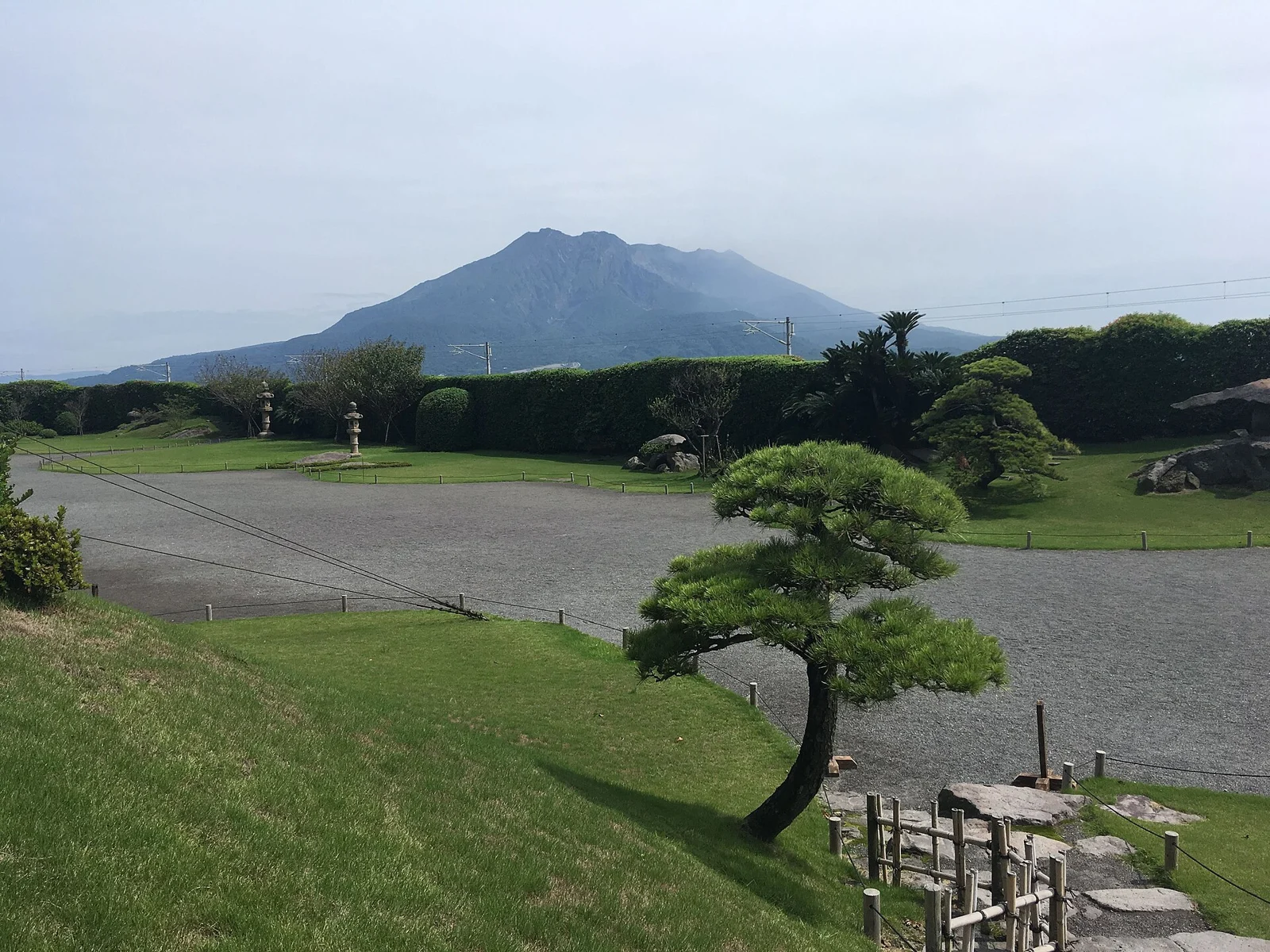
Sengan-en suits travellers who want a full half-day outing close to central Kagoshima without taking the ferry to Sakurajima. Look across Kinko Bay to the volcano, visit the Shimazu family’s living quarters, then use Shoko Shuseikan to understand the nearby industrial remains. That is enough for one outing. If volcanic terrain and the island’s viewpoints matter more, spend the half-day on Sakurajima. Each gives you a different view; fitting both into a short morning leaves little time to stop and look.
The residence was built in 1658 by Mitsuhisa, the 19th head of the Shimazu family. The official history describes its distinctive features: Sakurajima and Kinko Bay form part of the garden’s borrowed scenery. The residence also received guests and became the family’s main home for a time after the Meiji Restoration. Look at the relationship between garden and bay outside, then again from inside the house. Pillars, eaves and the open garden frame the view in different ways.
The same Iso district was the setting for the Shuseikan industrial enterprise. The reverberatory furnace remains, stone machinery factory and present-day cut-glass production give the visit more depth than a lord’s residence alone. Allow more time at the house and museum exterior if you like architecture; visit the glassworks while production is running if craft interests you. For nights and accommodation across Kagoshima, Kirishima and Ibusuki, see choosing a Kagoshima itinerary and places to stay. Keep this half-day focused on Iso.
Plan a half-day visit to Sengan-en from its new JR station. Compare the combined ticket, the house and Shoko Shuseikan, allow for gaps in return trains and glassworks breaks, and plan food, luggage and a departure-day visit.
Choose two priorities, even with an all-inclusive ticket
For a first visit focused on scenery, choose the garden and house. Read the information near the furnace, then pass the Main Gate and Tin Gate to the front of the house. Go inside to see how the rooms relate to the garden. If industrial history appeals more, make the garden and Shoko Shuseikan your priorities. Read about modernisation beside the furnace before seeing how the former machinery factory became a museum. Both routes include outdoor space and an indoor attraction worth taking slowly.
The official FAQ allows about 40 minutes for the garden, 30 for the house, 30 for Shoko Shuseikan and 20 for the glassworks. These add up to 120 minutes, before buying tickets, walking between buildings, using toilets, taking photographs or eating. Allow about 3–4 hours for a normal half-day around the grounds and adjoining facilities. Leave the afternoon free too if you want to read each display or take a workshop.
If your group has different interests, visit the house together and divide museum and shopping time by preference. Set a clear meeting point: the entrance, a named restaurant or a specific museum. “Wait outside when you finish” is too vague. A seated rest helps older relatives and children manage the second part of the visit. Decide what you can leave out before adding every side path.
The ticket includes the house and museum: use school status to choose a category
As at 28 October 2026, the Sengan-en visitor information lists standard admission at ¥1,600 and primary, junior high and senior high school admission at ¥800. Children below primary school age enter free. The standard category is for ages 15 and over, excluding junior and senior high school pupils, so senior high school pupils pay the school rate. Two adults and one primary school child pay ¥4,000 at the gate. Group younger children by whether they have started primary school, rather than choosing by age alone.
The ticket includes Sengan-en garden, the house and Shoko Shuseikan. A combined ticket has applied since October 2024; garden and museum are not sold as two separate standard admissions. You can visit only the garden, but budget for the combined ticket. There is no additional house fee under the old arrangement. Keep the ticket handy, as you must show it when entering Shoko Shuseikan.
Shoko Shuseikan’s current visitor information also lists online prices of ¥1,500 standard and ¥750 for pupils, with a link to official ticket sales. Gate prices remain ¥1,600 and ¥800. Online tickets for two adults and one primary school child total ¥3,750, a saving of ¥250. The Asoview combined ticket linked by the venue applies a 100% cancellation charge from 23:59 on the day before use and cannot be combined with other discounts. Show the QR ticket at reception. If your date is undecided, budget at the gate price and buy once you have chosen a day.
Using the new JR station: distinguish Kagoshima-Chuo, Kagoshima and Sengan-en
Sengan-en Station opened on 15 March 2025 to serve Iso. From Kagoshima-Chuo, take the Nippo Main Line via Kagoshima Station to Sengan-en. Kagoshima-Chuo is the Shinkansen hub near many travellers’ hotels; Kagoshima is a separate station. Use full station names in bookings, map searches and meeting arrangements. If you need to collect luggage and catch an airport bus, set Kagoshima-Chuo as your return destination.
A specific service is more useful than a broad journey estimate. JR Kyushu’s train details for 28 October 2026 show local service 6930M leaving Kagoshima-Chuo at 09:00, reaching Kagoshima at 09:03 and leaving at 09:04, then arriving at Sengan-en at 09:07. This example takes just seven minutes on the train. Allow separate time to leave your hotel, find the platform and walk from the station to the garden.
The Nippo Main Line timetable from Kagoshima-Chuo also includes local services terminating at Kagoshima and Kirishima limited expresses. Open the stop list for your train and find Sengan-en with an arrival time before boarding. The official Iso transport page also states that some trains do not stop there. Follow signs towards the garden after arrival and use pedestrian crossings. Allow time for the walk and road crossings if you have luggage or slower walkers. Arrival at the station is not arrival at the garden entrance.
Check the afternoon gap before planning your return
JR Kyushu’s city-bound timetables for Wednesday 28 October and Saturday 31 October list departures from Sengan-en for Kagoshima-Chuo at 11:11 and 11:50 before noon, then 13:09, 13:40, 15:07 and 15:46. The gap from 13:40 to 15:07 is 87 minutes. If you plan lunch on the basis of the short train ride alone, you may spend much of your intended city time waiting at the station.
The 13:40 local service 6947M reaches Kagoshima at 13:43 and Kagoshima-Chuo at 13:48. If you choose it, work backwards from 13:40 to allow for walking, collecting luggage and toilets before deciding on lunch inside the grounds. The 15:07 train shows Sendai as its terminus. Check intermediate stops: a city-bound service may run beyond Kagoshima-Chuo, so do not search only for trains terminating there.
These are checked examples for two specific dates. For another travel day, change the date on the JR Sengan-en Station timetable and open your chosen train. Write down a target departure and the next service together. The gap shows your group exactly how long you can stay. For a flexible outing, keep this as a normal city half-day and stay in Kagoshima that night. For a flight, use the backwards plan below.
Choose buses or a car according to where you start
JR is straightforward if you stay near Kagoshima-Chuo and Sengan-en is your only destination. If you stay in Tenmonkan or want several city stops, follow the official access page to the city transport bureau’s Kagoshima City View timetable and get off at Sengan-en-mae. This sightseeing bus spends time serving stops and following its circuit. Judge it as part of a city route, rather than on fare alone. Read outbound and return stop directions separately; a circular route does not simply retrace its path.
Sengan-en parking costs ¥500 per day for a standard car. The official access page gives about 20 minutes by car from Kagoshima-Chuo as a road journey estimate. Add parking, walking to the ticket office and returning to the car. If you are staying within the city and Sengan-en all day, compare existing public transport first. The value of hiring a car usually depends on your other destinations that day, rather than avoiding one short train ride.
There is no direct venue shuttle and taxis are not stationed there. To return by taxi, book a collection with a taxi company yourself and agree the time and pickup point. Seeing a taxi on arrival only tells you one is there at that moment. Use a planned transport option for a departure-day connection. Tell the operator your passenger and luggage requirements so the vehicle fits your group.
Start at the furnace remains, then visit the interpretation centre
The reverberatory furnace remains make a useful first stop. Both the official 60- and 90-minute routes begin here. The stone structure survives; official information describes a chimney-like furnace structure about 16 metres high that once stood above it. Compare what remains with the original height before visiting the machinery factory. It helps explain Shuseikan as a group of linked production facilities.
The nearby World Heritage interpretation centre explains Shimazu Nariakira’s plans, the furnace structure and the Sites of Japan’s Meiji Industrial Revolution. If history interests you, slow down here to understand why Satsuma needed these facilities, then look for specific objects at the museum. If scenery is your priority, read the main diagrams and continue to the garden, leaving detailed displays for Shoko Shuseikan.
Look for how the stonework supported the structure above and compare it with the missing outline on the diagram. With children who have little patience for long text, first ask them to find what is still visible, then look together at the reconstruction. They can begin to understand the industrial history from the site without memorising the Shimazu chronology.
The Main Gate and Tin Gate served different eras
Follow the official walking route towards the garden to reach the Main Gate and Tin Gate. Tadayoshi, the 29th family head, built the Main Gate in response to a new road in the Meiji period. The venue describes it as over seven metres high, made from camphor wood from the hill behind, with a cross-in-circle crest and paulownia crest above. Look at the roof, timber and crests, then back towards the road to understand its position.
The Tin Gate was the main entrance in the Edo period. Its name comes from its tin roof tiles, and official information says that only the Shimazu head and heir could pass through it. Together, the gates show how entrances to the residence changed over time. Follow the present open route. The former status restriction explains the building’s use; reading the panel beside it adds context.
Keep the main passage clear when photographing the whole gate and wait for a break in foot traffic. You can move through this part fairly quickly and save longer stops for the house and garden views.
See the borrowed scenery outside the house, then under its eaves
Sengan-en incorporates Sakurajima and Kinko Bay as borrowed scenery. The space in front of the house shows this clearly. Look at the garden foreground, bay and volcano in layers, then see how trees and buildings frame the distance. The mountain has a different sense of scale across the whole bay and between the house’s pillars. Take the broad outdoor view first if photography is your priority, leaving more indoor time for the rooms.
Visibility across the bay affects the distant view. In grey weather, look closer: the Main Gate’s timber, garden stonework, interior decoration and Shoko Shuseikan building all offer detail. You still need to walk outdoors in heavy rain; the house may operate with storm shutters closed in severe weather. If a full Sakurajima view is your main aim, keep Sengan-en on a flexible day in your city stay instead of arriving in the final hour.
You do not need to follow every garden path to its end. Start with the main view in front of the house, then decide whether you have the energy for Bogakuro and Kyokusui Garden. If you have a fixed return train, decide on the furthest extension before resting. That avoids doubling back after tea just to finish a list. A shorter route can still give you a complete visit to the garden and one building.
Inside the house: reception rooms, work and everyday life
Give the house its own time slot. The venue suggests about 30 minutes. Alongside the garden view, look at the audience room, living room, bedroom and bathroom. The audience room received guests: two rooms connect, and even the corridor has tatami. Tadayoshi used the living room for paperwork, lunch and everyday life. Compare the two uses and the way rooms connect to see how formal duties and private life were arranged.
A layer of rice husks under the bedroom floor provided insulation. Bathwater was heated elsewhere and carried in. These details make the house’s domestic functions easier to understand than room sizes alone. With children, start with questions the building can answer, such as how people kept warm in winter or where hot water came from, before returning outside to the bay.
There are also 11 types of decorative nail covers, including Sakurajima radish and bat designs. Looking for details gives visitors unfamiliar with Japanese history something to follow. Once you find a pattern, compare it with the next room rather than writing down every name. The inner courtyard pond has an octagonal recess, which the venue explains through Chinese culture and feng shui. This connects with the garden’s signs of exchange with Ryukyu.
Remove your shoes to enter. Wheelchairs, pushchairs, large luggage and umbrellas cannot be taken inside. Eating, drinking and equipment such as selfie sticks and tripods are prohibited. Families should give children water, put away wet-weather gear and store luggage before entering. Last entry is 16:50, only ten minutes before the 17:00 closure. Visit earlier if you want the suggested half-hour.
The venue’s 2018 video introduces the house, its 11 types of nail cover, the inner courtyard and garden views from the study.
Choose a side route: Bogakuro, Senjingan or Kyokusui Garden
Bogakuro is a garden pavilion for resting. Official information says it is traditionally believed to have been a gift from the Ryukyu king in the early Edo period. Its floor is laid with tiles known as sen. After the house, look at the materials underfoot and the building’s form to continue the theme of Shimazu contact with the wider world. The venue also records guests including Katsu Kaishu here. Compare this setting for receiving guests with the house’s formal rooms.
Look towards the hill behind Bogakuro for the Senjingan inscription on the rock face. The official 90-minute route describes the three characters as about 11 metres across, carved in the late Edo period by roughly 3,900 people over three months. View it from the garden at a point where you can read the characters. First compare their scale with the trees and rock, then decide whether to take a closer side path.
Kyokusui Garden changes the subject from receiving guests to poetry gatherings. It was built in the mid-Edo period for winding-stream poetry parties; its watercourse and layout are visible on an ordinary visit. Think about how flowing water and seating served the gathering as you walk. To attend an event, choose a date from that year’s official announcement. On a normal half-day, extend towards Bogakuro or Kyokusui according to interest for a change of pace between buildings, cliff and garden.
Shoko Shuseikan: inspect the stone walls before the displays
Shoko Shuseikan’s main building occupies the former Shuseikan machinery factory, completed in 1865 and converted into a museum in 1923. The museum’s building history explains how Satsuma craftspeople used local stoneworking skills to attempt a Western-style factory. The exterior uses tuff, while the wall bases and roof structure retain Japanese methods. Look at the stone, windows and roof before entering, then the roof framing inside. The building is itself an exhibit.
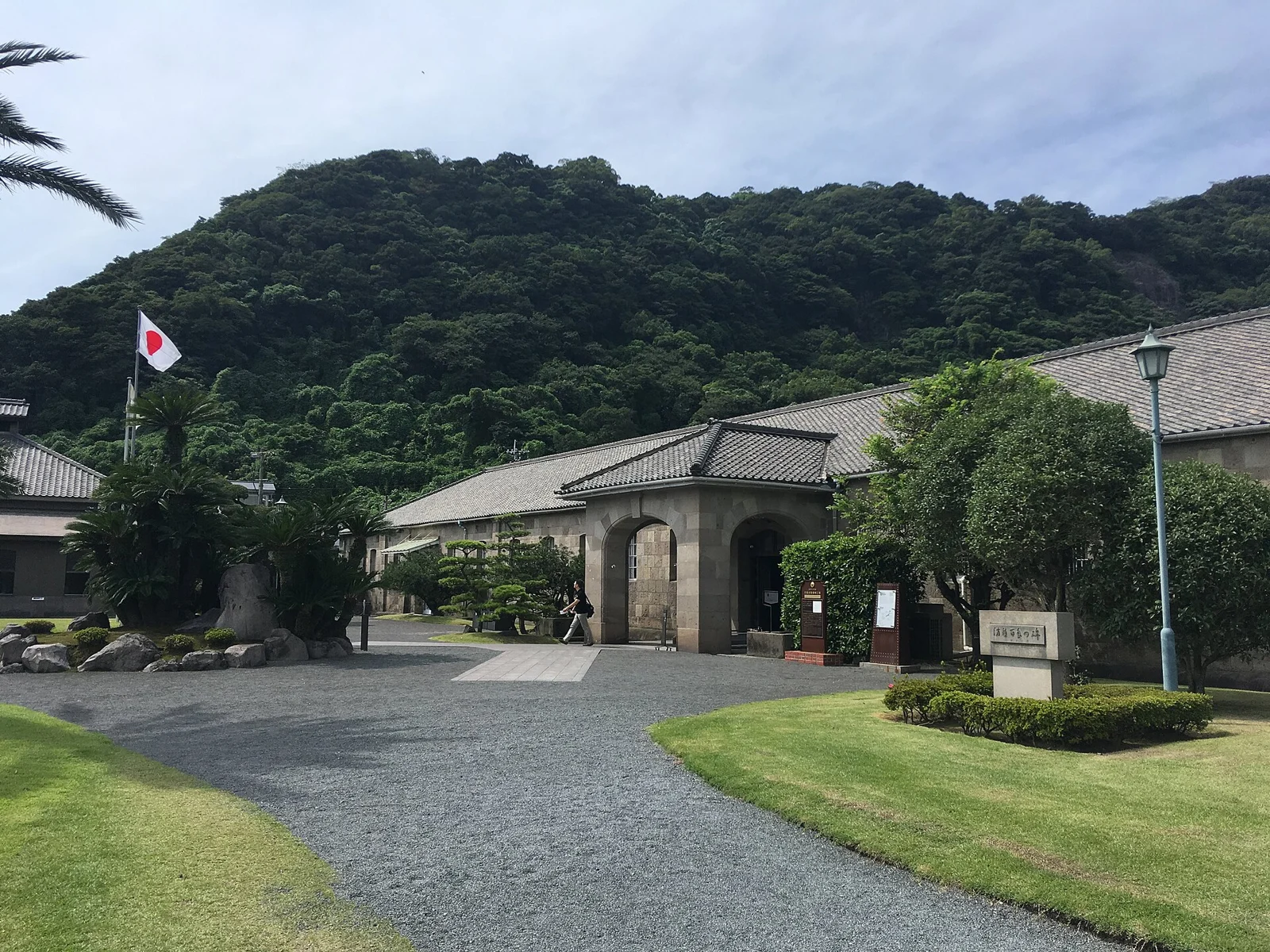
The factory once handled metalworking. Today, replicas, models, images and actual large machinery explain Shimazu trade and modernisation. The exhibition guide places the history of the trading lords in zones A–C, the Shimazu and Japanese modernisation in D–F, and special exhibitions in G. If time is short, read the zone introductions and examine one machine or model closely related to the entrance furnace before exploring further.
This sequence connects the sites: the furnace remains show where production equipment stood, the museum supplies the enterprise and technology, and the house preserves its promoters’ living and reception rooms. History enthusiasts can visit the museum before lunch while they have more energy to read. If your companions prefer gardens, keep it to a shorter visit focused on architecture and a chosen theme. Admission is included, but your interests should decide how long you stay.
Use the toilet before entering: there is none inside, so use those in the car park behind the building. Wet rain gear cannot be brought in. Eating, drinking, video recording, flash and equipment such as tripods are prohibited; some exhibits have separate no-photography signs. Deal with children’s needs before the visit to avoid leaving midway. Record zone and object names if you want to read more in the official guide on your way back.
Satsuma Kiriko glassworks: avoid the lunch break
The official glassworks page lists free visits without booking from 09:00 to 16:30, with breaks at 10:00–10:15, 12:00–13:00 and 15:00–15:15. It normally closes on Mondays and the third Sunday of the month, with rules for shifting closures around public holidays. If the glassworks is your main reason for visiting, read the monthly factory notice on the Shimazu Satsuma Kiriko website before choosing a date. Online shop closures and factory viewing closures are separate notices; distinguish them by their titles.
You can see blowing, cutting and polishing areas. Blowing shapes molten glass, cutting uses grinding machinery to carve patterns, and polishing brings out the shine. Watch how cuts of different depths produce gradients in the coloured layer. Comparing finished pieces at Iso Kogeikan afterwards helps explain the craft beyond display-window prices. The venue suggests about 20 minutes at the factory. Visit after the museum or move it to the morning to avoid the lunch break.
Iso Kogeikan, the adjoining Satsuma Kiriko display and shop, is outside the paid grounds according to the official FAQ. You can use it without paying Sengan-en admission, and the glassworks can also be visited separately. This makes a shorter craft outing if you do not need the garden or house, although parking still costs extra. With a combined ticket, treat the factory and shop as an extension and leave time to walk back to the station.
Allow separate time to cut glass yourself
To cut glass yourself, go to the traditional cultural experience facility inside the grounds. Plan this separately from watching craftspeople at the factory. The current cutting workshop is for ages 11 and over, with two machines and a maximum of two participants at once. A family of three or four who all want to take part needs time for separate turns. Agree a waiting and rest spot for those not participating so the whole group does not spend half a day standing in the workshop area.
At the source check date, the official prices were ¥17,000 for a clear glass, about 60 minutes; ¥35,000 for a gold-ruby glass, about 60 minutes; and ¥6,000 for a key ring, about 30 minutes. The gold-ruby glass includes engraving and polishing. It is dispatched about a month later, only within Japan, with a ¥1,100 delivery charge. On a short visit to Japan, arrange a delivery address and timing before choosing an available slot on the official booking page.
Adding a workshop means reallocating the 3–4 hours otherwise used for the garden, house, museum and lunch. If hands-on work is your priority, keep the garden and workshop and save the museum for another visit. To understand Satsuma Kiriko production, the free factory visit already provides concrete detail. Make this choice before booking to keep costs and waiting time reasonable for everyone.
Meals, tea and jambo mochi need different amounts of time
Ohkatei serves Satsuma regional dishes from 11:00 to 16:00, with last orders at 15:30. Sengan-en Matcha Cafe serves light meals, tea and sweets from 09:00 to 17:00, with last orders at 16:30. The official dining page shows waiting information for both. Check before deciding to sit down. Individual visitors should not plan Ohkatei as a reserved fixed lunch stop; the cafe and jambo mochi shop also do not accept reservations. Keep your eating order flexible.
The cafe currently lists matcha with a sweet for ¥1,000, with choices including sweet-potato sweets, karukan and hiryozu. Limited-quantity lunches from 11:00 include keihan chicken rice and soba at ¥1,750 each. Try the cafe for a simple meal and rest, or Ohkatei for a seated regional lunch. With a fixed return train, check the queue before sitting down. If the meal would squeeze your walk back to the station, eat near Kagoshima-Chuo instead.
Jambo mochi are bite-size rice cakes on two bamboo sticks. The venue compares the pair of sticks to a samurai’s long and short swords. A dine-in portion currently costs ¥500; six takeaway pieces cost ¥700 and should be eaten that day. Order a portion for a short rest, or finish your takeaway at the hotel the same day. On a museum-and-factory half-day, mochi can provide a break before a full meal back in town, keeping the morning from being split by lunch.
Luggage, wheelchairs and pushchairs: arrange them before entry
Large, medium and small lockers near the entrance cost ¥500, ¥400 and ¥300. The 12 large lockers listed by the venue are approximately 35 cm wide, 64 cm deep and 86 cm high. Oversize bags can be stored at reception for ¥500 each, subject to space on arrival; reservations are not accepted. On a departure day, if your hotel and onward route are near Kagoshima-Chuo, leave luggage at the hotel before Sengan-en to reduce hauling through stations and road crossings.
There are benches in the grounds. Wheelchair hire costs ¥500 each; WHILL powered mobility devices cost ¥2,000 each for all-day use. Numbers are limited and bookings are not accepted. Choose a main route from the accessibility map, compare it with the house’s entry restrictions, then select sections your group can complete together. If you need a wheelchair throughout, arrange access to the gardens and buildings at the entrance, including rest points and assistance from companions.
A pushchair reduces outdoor walking for young children but cannot be used inside the house. Dining venues admit wheelchairs; Ohkatei is on the second floor and has a lift. The cultural experience facility has no lift: use stairs or the outside ramp to reach the second floor. Match the rooms and restaurants you want with the available ways between floors before setting off, so your group need not split unexpectedly at a doorway.
A normal half-day: morning priorities and a flexible finish
For a morning outing, use the example 09:00 departure from Kagoshima-Chuo. Walk from Sengan-en Station, buy tickets, then see the furnace and interpretation centre before passing the two gates into the garden and house. Give the house about half an hour and adjust outdoor stops as you go. Towards midday, visit Shoko Shuseikan for the building and your preferred exhibition zones. This order completes the garden and house first, leaving the depth of historical reading to the second part.
To see the glassworks, avoid its 12:00–13:00 break. Shorten the first part and visit before noon, or go after lunch. Craft enthusiasts can instead follow factory, museum and garden, leaving the house as the last optional stop. Keep meals, shops and side paths in a flexible final stretch. You can then finish for your chosen 13:09, 13:40 or later train without promising the whole group every activity at the start.
The venue’s 60-, 90- and 120-minute suggested routes each select different stops. The 60-minute route includes the front of the house and Shoko Shuseikan; the 90-minute route includes the house, Bogakuro and Kyokusui Garden. The 120-minute route links the house, Bogakuro, museum and glassworks but does not list Kyokusui Garden. Use them as maps of possible stops and combine them by interest rather than stacking all three routes. Lunch and workshops need extra time. If you are staying in town, extend into the afternoon and choose dinner in Tenmonkan later.
Departure day: choose the train to Kagoshima-Chuo first
Work backwards from your airline’s required airport arrival time. Allow for the bus from Kagoshima-Chuo and its wait, then collecting luggage at the hotel and walking within and around the station. Only then choose the Sengan-en return train. Official public transport directions also route airport passengers through Kagoshima-Chuo for the airport bus. The venue’s driving estimate to the airport applies to a car journey and cannot be used for this JR-and-bus connection.
If you choose the 13:40 from Sengan-en arriving at Kagoshima-Chuo at 13:48, start the onward plan at 13:48 and add luggage collection and transfers one by one. Missing 13:40 means waiting until 15:07 and changes the whole afternoon. Decide beforehand whether to drop lunch or the factory. On a departure day, keep just the garden and house, or garden and museum, eat back in town and save glass cutting for a day without a flight.
If only a short part of the morning is free, stay in town to eat, walk and collect luggage rather than rushing to the grounds because of the new station. Sengan-en normally opens 09:00–17:00, with last admission at 16:30. It closes on the first Sunday in March each year for the Kagoshima Marathon.
A few useful answers
Does the Sengan-en ticket include the house and Shoko Shuseikan?
Yes. Gate prices are ¥1,600 standard and ¥800 for primary through senior high school pupils. Children below primary school age enter free. The house and Shoko Shuseikan are included in the combined ticket.
How do I reach Sengan-en by JR from Kagoshima-Chuo?
Take a Nippo Main Line service that stops at Sengan-en, via Kagoshima Station. On 28 October 2026, service 6930M left Kagoshima-Chuo at 09:00 and arrived at Sengan-en at 09:07. Walk from the station to the grounds.
Is half a day enough for Sengan-en?
Use the garden and house, or garden and Shoko Shuseikan, as your main route. Official visit estimates for the four main attractions total about 120 minutes. With transport, walking and food, allow about 3–4 hours.
Are trains back to Kagoshima-Chuo frequent?
On 28 and 31 October 2026, city-bound departures included 13:09 and 13:40, followed by 15:07. Choose a return before planning lunch. For other dates, select your travel day in the JR timetable.
How does the glassworks visit differ from the glass-cutting workshop?
Factory viewing is free without booking and covers blowing, cutting and polishing. Avoid breaks and closure days. The hands-on workshop inside the grounds costs extra, is for ages 11 and over, and takes at most two people at once.
Can I take luggage, a pushchair or a wheelchair into the house?
Wheelchairs and pushchairs cannot be used inside, and large luggage is not allowed. There are entrance lockers; bags that do not fit can be stored for ¥500 each, subject to available space.
When does Sengan-en close?
Normal hours are 09:00–17:00, with last garden admission at 16:30 and last house entry at 16:50. The grounds close on the first Sunday in March each year for the Kagoshima Marathon.
Official information and references
Sources used in this guide.
- Sengan-en | Current tickets, opening hours and luggage storage
- Sengan-en | Visit times, transport and facilities FAQ
- Sengan-en | History of the residence and Shuseikan enterprise
- Sengan-en | Suggested 60-minute route
- Sengan-en | Suggested 90-minute route
- Sengan-en | Suggested 120-minute route
- Sengan-en | House rooms and entry rules
- Sengan-en | Access and official timetable links
- Sengan-en | Rail, bus and airport access to Iso
- Sengan-en | Glassworks viewing hours and closures
- Sengan-en | Glass-cutting workshop ages, prices and duration
- Sengan-en | Dining and waiting information
- Sengan-en | Jambo mochi shop menu
- Sengan-en | Matcha Cafe menu, lunch and ordering times
- Shoko Shuseikan | Machinery factory building and museum history
- Shoko Shuseikan | Permanent and special exhibition zones
- Shoko Shuseikan | Online combined-ticket prices and entry rules
- Kagoshima Prefecture | Sengan-en Station opening date
- JR Kyushu | Kagoshima-Chuo Nippo Main Line departures, 28 October 2026
- JR Kyushu | Sengan-en city-bound departures, 28 October 2026
- JR Kyushu | Sengan-en city-bound departures, 31 October 2026
- JR Kyushu | 6930M: Kagoshima-Chuo 09:00 to Sengan-en 09:07
- JR Kyushu | 6947M: Sengan-en 13:40 to Kagoshima-Chuo 13:48
- Sengan-en | Grounds and accessibility map
- Shimazu Satsuma Kiriko | October 2026 factory closure notice
- Sengan-en official tickets | Asoview combined ticket and cancellation terms