How to read Goryokaku Tower's two observation decks, pair them with Goryokaku Park and the Hakodate Magistrate's Office, and compare fares before and after April 2027. Includes tram-plus-walk timings, parking rules, and winter illumination schedules.
- Region & Focus
- HakodateAttractions
- Reading Scope
- 21 min read · 15 chapters · 13 Q&As
- Official Verification
- 13 official sources checkedUpdated 22 November 2026
- Key Topics
- ItinerariesHokkaido
Chapter Route Map (tap any stop)
- Just a park stroll, or the full five-pointed star?
- Current fares vs. April 2027 pricing: budget by your travel date
- Observatory 2F: start at the scale model before looking out
- Why the fort was built here: linking the harbour to the hall
- Observatory 1F: glass floor, world star forts, and a coffee break
- 107 metres tall, yet you do not stand at 107 metres
- Tower, park, and Magistrate's Office: plan three separate entries
- Tram from Hakodate Station, plus the walk from the stop
- Driving and parking: keep private cars out of the coach zone
- Cherry blossoms and winter illuminations: check this season's dates
- Shooting through glass and deciding in rain or sea fog
- Families, vertigo, and slower walkers: tailor each person's route
- Building a half-day: history deep-dive or blossom stroll first
- Cafes and 2F dining: no need to cram every meal into one ticket
- Fitting Goryokaku into Hakodate: where this guide ends and the city guide starts
- Quick Q&A
At ground level in Goryokaku, you can stroll beneath the trees along the moat and earthen ramparts; to take in all five bastions at once, head up the tower. On a first visit, allow about an hour for the observation decks and historical exhibits before deciding whether to walk inside the fort or add the Hakodate Magistrate's Office. This guide structures a realistic half-day around how the decks work, keeping park access, tower ticketing, and winter illuminations on their own separate clocks.
Just a park stroll, or the full five-pointed star?
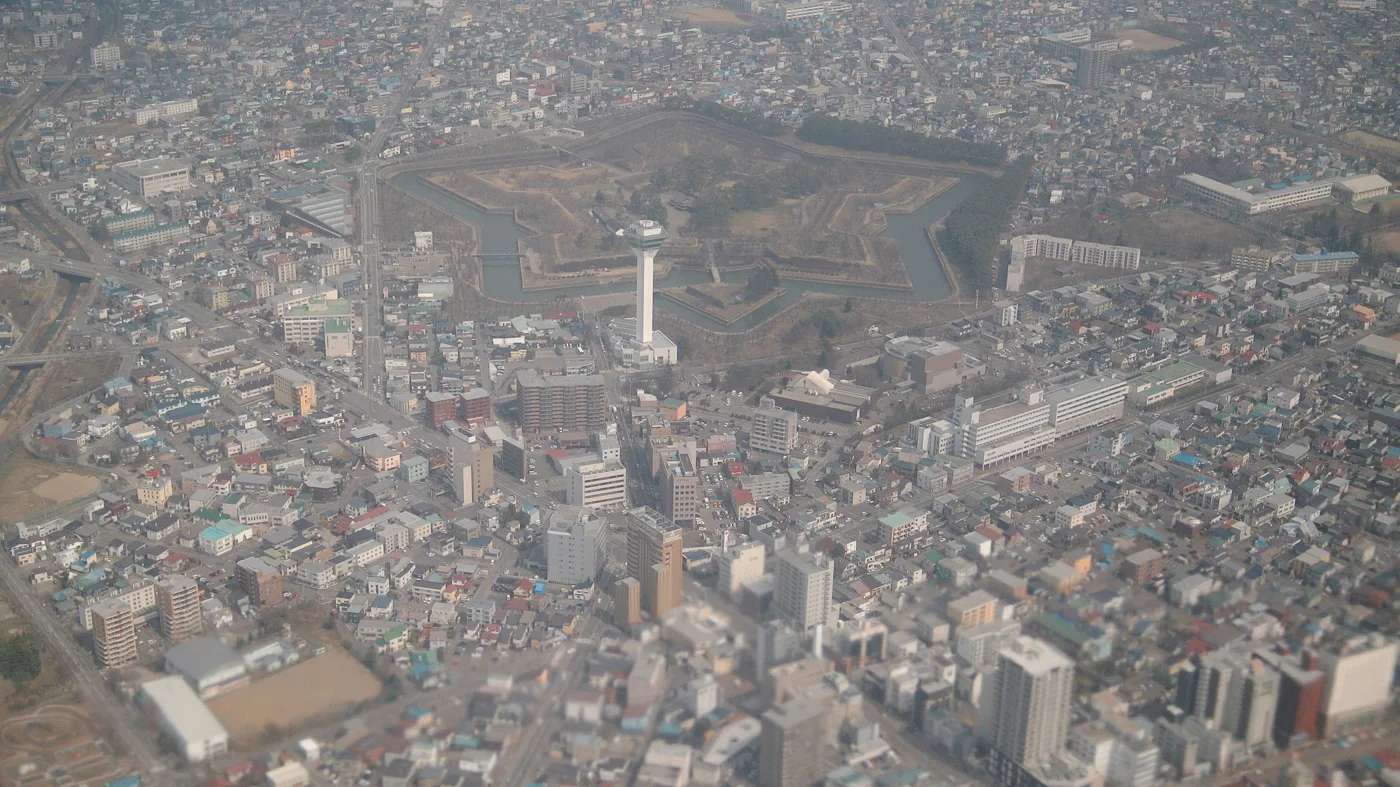
Goryokaku Park and Goryokaku Tower sit side by side as two distinct ways to experience the site. The park puts you inside the historic grounds, while the tower looks down from 90 metres and 86 metres above street level. If you only want a shaded walk beside the moat, you can stay in the park; if you want to see the full star outline and read it alongside a restoration scale model, build the ascent into your day. Both approaches stand on their own, with no rule saying you must buy a ticket for a visit to count.
Going up the tower first makes it easy to get your bearings. Once you have picked out the moat, bridges, and central hall from the windows, you can step out and walk only the stretch that interests you. Starting in the park works better if you are timing cherry blossoms or want children to burn off energy outdoors first. Let your companions and the weather set the order, rather than retracing your steps just to follow a rigid loop.
The tower offers more than window views. Its scale model, historical panels, miniature dioramas, and comparative exhibition on star forts explain why the bastion takes the shape it does. Anyone interested in late Edo-period history should budget time to read through the displays; if you only have ten minutes left before a train or booking, save the ascent for another daytime slot rather than rushing straight up and down.
How to read Goryokaku Tower's two observation decks, pair them with Goryokaku Park and the Hakodate Magistrate's Office, and compare fares before and after April 2027. Includes tram-plus-walk timings, parking rules, and winter illumination schedules.
Current fares vs. April 2027 pricing: budget by your travel date
On the tower's current price page, standard admission is ¥1,200 for adults, ¥900 for junior and senior high school students, and ¥600 for primary school pupils, with pre-school children admitted free. Separate rates apply to groups of 30 or more and visitors presenting an eligible disability certificate, whose discount extends to one accompanying carer. Because these age brackets differ from the city tram's child fare rules, calculate family transport and attraction costs separately.
The announced fare revision takes effect on 1 April 2027, raising standard tickets to ¥1,500 for adults, ¥1,130 for junior and senior high school students, and ¥750 for primary pupils; group fares become ¥1,350, ¥1,010, and ¥680, while disability concessions move to ¥750, ¥560, and ¥380. The notice also specifies that pre-school children must be accompanied by a guardian and that tickets allow one entry only with no re-admission. If you want both daylight and late-afternoon light, cover them in a single visit rather than planning to leave in the morning and return at dusk on the same ticket.
Standard opening hours are 09:00 to 18:00 year-round, with ticket sales closing at 17:50. Treat 17:50 purely as the cut-off for getting through the doors, not a sensible arrival target; if you want to read the exhibits or wait for better light, subtract your own viewing time from closing. Should the tower announce special operating hours on a given day, follow that notice instead.
For two adults and one primary-age child, standard tower tickets total ¥3,000 before the price rise and ¥3,750 afterwards - a ¥750 difference. That covers tower entry only, excluding local fares, parking, meals, or admission to the Hakodate Magistrate's Office. Separating paid attractions from free park walks in your budget makes it easy to trim a stop if energy drops or the weather turns, without upending the whole day.
Observatory 2F: start at the scale model before looking out
Observatory 2F, 90 metres above ground, holds the Goryokaku History Corridor and a 1/250 restoration scale model. The model shows the fortress at completion, letting you trace the central magistrate's office, earthen ramparts, and waterways before looking out at the grounds today. Do not assume every roof on the model still stands as an accessible building in the park - spotting what remains versus what has changed is half the point of lingering here.
Pick one question as you study the model: why the office sits inside the bastions, which side controlled access, or how the five projecting points link together. Carrying a single question over to the windows sticks far better than photographing every display and trying to decode it later at home. If people in your group have different appetites for history, each person can pick one landmark to locate and compare notes at the glass.
Wall panels on this floor trace Goryokaku's story from the arrival of Commodore Perry's fleet, alongside 16 miniature dioramas and interactive information screens. Timeline readers can work through the panels while those drawn to key figures and episodes focus on the dioramas, without forcing everyone to move at the same pace. Because everything is indoors, you can alternate between reading and window photography instead of leaving half the group waiting in one corner.
This level also features a tactile model and a seated bronze statue of Hijikata Toshizo. Keep hands strictly to the designated tactile model and view all other exhibits under gallery rules. Remember that the Hijikata statue stands inside the tower rather than along the park footpaths - if seeing it is a must, make sure you are heading up the paid observation deck.
When matching the model against the view outside, do not rush to photograph all five points in sequence. Start with the easiest bridge to recognise, trace where it leads on the model, then find that same approach from the window before moving on to the magistrate's hall and moat. If you have already walked through the park, work in reverse to spot your route from above - turning the model into a spatial key rather than a standalone display piece.
Why the fort was built here: linking the harbour to the hall
The tower's official history of Goryokaku ties the fortress directly to the opening of Hakodate Port. The shogunate's original administrative office stood close to the harbour and town, prompting a move inland for better defence, living conditions, and governance. Goryokaku was not built solely for the later Battle of Hakodate, so separating its original purpose from its wartime role keeps the exhibition timeline clear.
Designed by Takeda Ayasaburo using European star-fort engineering, the ramparts were built between 1857 and 1864, when the new office moved in. Looking down at the alternating salients and re-entrant angles before heading to Observatory 1F's world star-fort display places Hakodate inside a much broader military tradition. If you keep only one date in mind, anchor on the 1864 completion and transfer of government before following the later conflict.
The Battle of Hakodate from 1868 to 1869 forms a distinct chapter. Inside the tower, you can read the personalities and shifting regimes at leisure, while outside in the park it helps to look for physical clues in the layout and earthworks. There is no need to project dramatic battle scenes onto every cherry tree or corner; let the surviving foundations and reconstructed hall each speak to their own period.
Nor did the site's story freeze after the fighting ended. Once the original office was dismantled, the grounds saw military use and natural-ice harvesting on the moat before opening as a public park in 1914 and gaining Special Historic Site status in 1952. That later timeline explains why modern footpaths, original earthworks, and a reconstructed hall now share the same space, rather than preserving an untouched 1864 snapshot.
Observatory 1F: glass floor, world star forts, and a coffee break
Observatory 1F sits 86 metres above ground and houses the transparent glass floor panels, gift shop, and observation cafe. Anyone uneasy with heights can stick to solid flooring with a clear conscience - stepping onto the glass is completely optional. With children, explain clearly where they can stand and where to keep walkways clear, rather than coaxing a nervous child onto the panels for a photo.
The Star Forts Around the World display traces similar fortifications across different countries. Having seen Goryokaku's model upstairs, you can compare silhouettes here and notice how similar defensive problems produced matching geometry. Even casual visitors can follow the visual comparisons without memorising commanders or battle dates.
The observation cafe currently lists hours of 09:30 to 17:30, closing half an hour before the tower. Fit a drink in before you finish viewing and head down; if you arrive close to 17:30, treat the cafe as a bonus rather than a guaranteed final stop. Drinks and shop purchases are separate from your ticket and do not belong in an admission-only budget.
107 metres tall, yet you do not stand at 107 metres
Official specifications note that the current tower opened on 1 April 2006, measuring 107 metres to the lightning rod and 98 metres to the main roof, with the two viewing decks at 90 metres and 86 metres. When travel guides cite 107 metres, keep in mind that this is the structure's full height rather than the floor beneath your feet.
The original tower opened in December 1964 to mark Goryokaku's centenary before being replaced by the present building. Beyond giving you height over the moat, the new tower echoes the fort below through its pentagonal deck and star-shaped cross-section. Pairing exterior shots from the park or plaza with views from the windows above makes better use of a half-day than saving every photo for the top.
The lift takes roughly 30 seconds to reach the decks, which is only a fraction of the visit. Queuing, buying tickets, organising bags, and browsing the exhibits all sit outside that half-minute ride - especially during cherry blossom season, when you should never count backwards in lift seconds to set a late arrival. If you have a fixed booking next, set your departure time from the tower before joining the ticket queue.
Tower, park, and Magistrate's Office: plan three separate entries
Walking the park for free, riding up the tower, and touring the Hakodate Magistrate's Office each have their own entrance and hours. Visitors planning a simple park walk can decide on the spot whether to add the tower, while anyone set on seeing the reconstructed hall should check its opening notice separately rather than assuming it matches the tower's 18:00 close.
Paid admission to the Hakodate Magistrate's Office means Goryokaku is not a single-ticket site. Add its entry fee and indoor time as a distinct line if you want to go inside, or skip it for a brisker loop along the moat and footpaths. Companions with different interests can easily split up here and agree on a meeting point afterwards.
The current building is a partial reconstruction completed in 2010 using traditional materials and joinery, recreating a section of the 1864 office dismantled in 1871. Where the tower reveals the overall layout from above, stepping inside the Magistrate's Office lets you examine room proportions and timber work up close - two complementary views if you visit both.
A park walk does not require marching round the entire perimeter. Pick one stretch of moat or rampart you spotted from the tower, walk as far as feels comfortable, and turn back - sensible advice with pushchairs, older travellers, or icy winter paths. Choosing which section to see beats forcing a full circuit when lunch or a train awaits.
Standard individual tickets for the Magistrate's Office cost ¥500 for adults, ¥250 for students and children, and nothing for pre-schoolers, with group rates for 20 or more. Hours run 09:00 to 18:00 (last entry 17:45) from April to October, shortening to 09:00 to 17:00 (last entry 16:45) from November to March, with year-end closure from 31 December to 3 January. On a winter afternoon, visit the Magistrate's Office first before its earlier cut-off, then walk back to the tower rather than judging both buildings by the tower's closing clock.
You must remove outdoor shoes upon entering the Magistrate's Office, using the shoe bags provided; eating, drinking, and luggage storage are unavailable inside, and large bags may not be permitted. Have children finish snacks and sort coats beforehand, and factor in using the tower's coin lockers on your route so the whole family is not left hauling suitcases back from the hall entrance. Anyone visiting both buildings should decide up front where bags stay and which exit they will leave from.
The inner fort grounds inside the moat (Kakunai) open from 05:00 to 19:00 in April to October and 05:00 to 18:00 in November to March, which differs from the outer park boundaries. If you come down from the tower close to the inner gate's closing time, keep your stroll short or stick to open outer paths instead of counting on a late inner circuit. Four sets of public toilets are listed on site, including facilities inside the moat that follow inner-ground hours - worth noting if you are out with children near dusk.
The tower cites a moat perimeter of roughly 1.8 kilometres and an overall Special Historic Site perimeter of around 3 kilometres, referring to two distinct loops. Check the map and pick your exact route instead of treating every circuit as the same walk. After a morning tackling Motomachi's hills, a short waterside stretch may be plenty, whereas a full outer loop needs extra time for stops; runners are also asked to follow an anti-clockwise loop, so step aside before stopping for photos or checking your phone.
Tram from Hakodate Station, plus the walk from the stop
Take the Hakodate City Tram to Goryokaku Koen-mae, then walk roughly 10 minutes to reach the tower. Because the tram stop is not at the tower door, factor both the outdoor walk and tram wait times into your schedule, especially for slower walkers. Do not confuse the stop with JR Goryokaku Station either - if you are staying near Hakodate Station, there is no need to ride a JR train purely because the names sound alike.
Under the current Hakodate City Tram fare table, an adult single from Hakodate-ekimae to Goryokaku Koen-mae costs ¥270, paid when alighting, with nationwide IC cards accepted. Although the tower's own access page still lists an older ¥230 figure, go by the city operator's updated fare. If Goryokaku is your only tram trip of the day, price two singles against any day pass before buying.
The tower's access page also notes the Route 5 Tower-mae shuttle operating from 9 November 2026 to 31 March 2027: ¥300 from Hakodate-ekimae and ¥400 from Hakodate Airport, dropping about a one-minute walk from the tower, with Hakodate Bus timetables and year-end/New Year suspensions. Note that this is a bus service, so tram-only day passes are not valid on board.
If you have large suitcases, leave them at your hotel before heading out if you can. Should you rely on the tower's lockers, remember you cannot retrieve bags once the building closes - do not head down to the bay area for dinner intending to pick up luggage afterwards. Anyone connecting straight to the airport should build locker retrieval, the walk to the bus stop, and waiting time into their exit plan.
Lockers cost ¥300 for small compartments (40 x 44 x 57 cm) and ¥500 for large ones (83 x 44 x 57 cm), measured height by width by depth. Check your case dimensions including protruding handles before choosing a bay; small access hatches let you grab loose items without hauling out an entire suitcase, though everything must still be collected within tower hours.
Driving and parking: keep private cars out of the coach zone
Goryokaku Tower has no car park for private vehicles. Its access page directs drivers to nearby paid car parks around the Hakodate Hall of Arts and the Goryokaku Sightseeing Car Park, quoting ¥200 for the first hour and ¥100 per 30 minutes thereafter. Save your chosen car park location before setting off so you are not hunting for a space right before last ticket sales.
Do not mistake the 30-space coach park - charged at ¥1,000 per bus with no reservations - for family car parking. If your hotel includes parking, leaving the car behind and riding the tram can be simpler; weigh combined family fares, walking distance, and luggage handling rather than comparing hourly parking rates in isolation.
Once parked nearby, you can cover the tower and park entirely on foot without moving the car between stops. If you are driving onward afterwards, agree on a return time at the car park so those lingering over exhibits and those taking a short walk can split up without forcing the driver to circle looking for stragglers.
The tower's address is 43-9 Goryokaku-cho, Hakodate (tel. 0138-51-4785). Give both "Goryokaku Tower" and the street address when booking a taxi or asking your hotel to call one, avoiding any mix-up with JR Goryokaku Station.
Cherry blossoms and winter illuminations: check this season's dates
During spring blossom season, pick whether to start beneath the trees or up on the decks. Peak bloom shifts from year to year, so track updates from the park management authority; if you have two nights in Hakodate, save Goryokaku for the clearer half-day rather than cramming every outdoor sight into arrival day.
Winter's Hoshi no Yume (Star Illumination) lights up the moat, not the tower's late-night opening hours. The concluded notice for 1 December 2025 to 28 February 2026 shows the lights ran until 19:00 while the tower still closed at 18:00 - clear proof that the two timetables stay separate and you cannot infer last tower entry from when the moat lights go out.
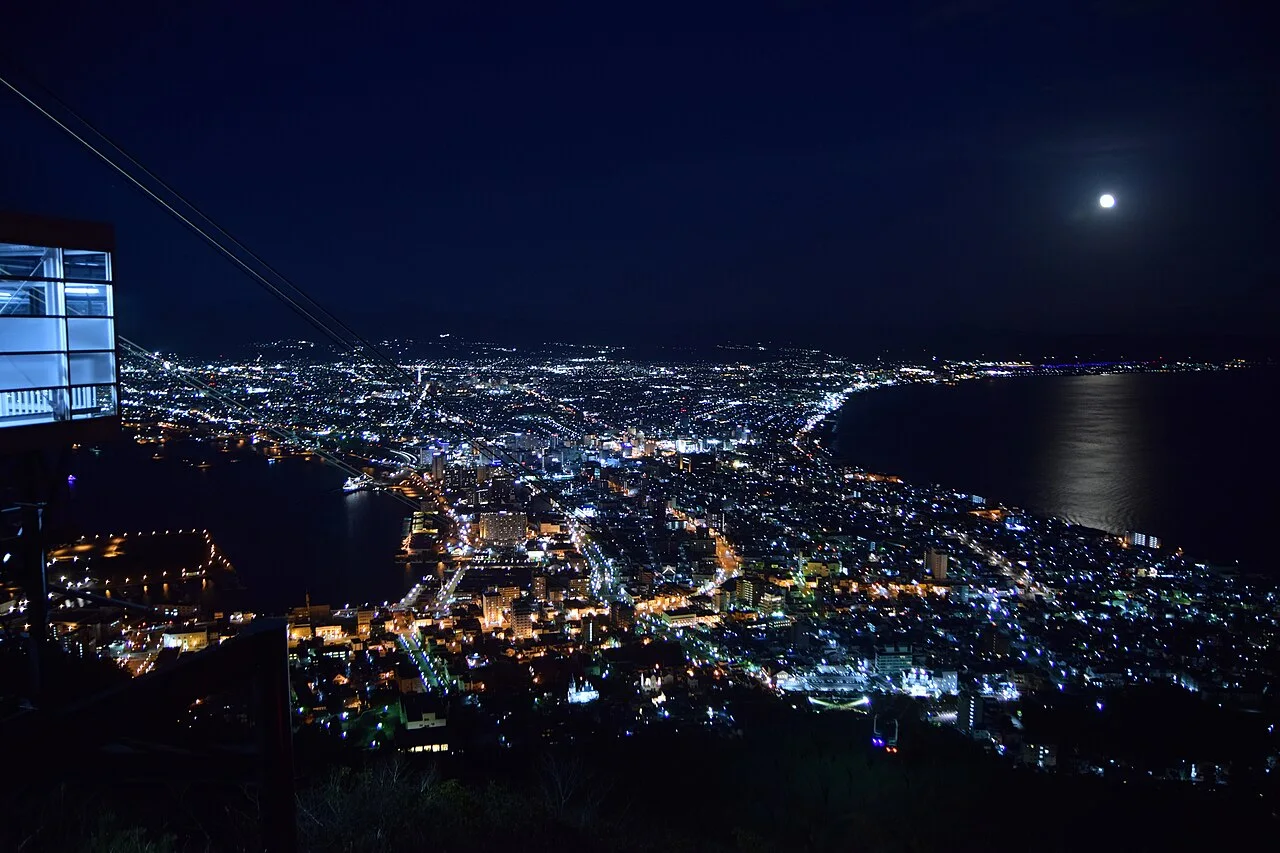
Until the current winter's exact dates are published, anchor your plan around a daytime tower visit and a short park walk, then add dusk illuminations once schedules are confirmed. Mount Hakodate's night skyline demands its own transport and weather window, so on a single-night stay choose one evening view rather than rushing both in one night.
Shooting through glass and deciding in rain or sea fog
Glare from interior lights is the main hurdle at the windows. Angle your lens carefully and step clear of bright reflections behind you rather than pressing against the pane and blocking other visitors. Take in the overall star shape with your own eyes first, then pick a few angles worth shooting instead of snapping every window panel.
Sea fog, low cloud, and heavy rain can obscure visibility even directly below the tower. If seeing the full five-pointed geometry is your sole reason to pay, gauge the cloud ceiling before buying tickets; if you already plan to study the scale model and history exhibits, there is plenty indoors to justify going up. Keep your decision tied to your interests rather than assuming an indoor deck beats bad weather.
Follow gallery rules around the scale model: no extra lighting rigs and no touching displays outside the marked tactile model. Lock onto a bridge or hall corner on the model, then match it through the glass so your photos tell a clearer story. If someone in your group just wants the view, let them head straight to the windows while history readers catch up at their own speed.
Families, vertigo, and slower walkers: tailor each person's route
With young children, turn the decks into a couple of concrete tasks: find the magistrate's hall on the model, spot it outside the window, and pick a favourite diorama scene. That keeps the visit engaging without turning it into a history lecture, and you can step away from the panels the moment attention fades.
Visitors with a fear of heights can stay comfortably back from the panes and skip the glass floor completely. Agree on a meeting spot while others take window shots instead of drafting an anxious companion into holding cameras at the edge. The easiest group visit respects where each person is happy to stand, rather than persuading everyone to try the same viewpoint.
For pushchairs or slower walkers, the outdoor approach matters just as much as the lifts inside. Add together the walk from the tram stop, the stretch into the park, and the return walk - plus slower footing on slush or ice in winter. If energy runs low, do the tower indoors and trim the park stroll to a short loop rather than treating a long outdoor walk as mandatory.
Wheelchair users and visitors with specific access needs should contact the tower ahead of time with equipment details and party size to confirm entrances, lift routing, and on-site assistance. While the tower offers lifts and a tactile model inside, step-free access from your transit stop still shapes the wider route and belongs in your transport and park-distance planning.
Building a half-day: history deep-dive or blossom stroll first
For a history-focused half-day, start at the tower to see the scale model and both observation decks, walk into the park to trace the exact features you picked out from above, and finish at the Hakodate Magistrate's Office if time and interest allow. That order moves naturally from big picture to fine detail, leaving lunch until after the core sights so no one hurries past displays for a table.
If cherry blossoms and photography lead your day, start on the park paths and decide afterwards whether to buy a tower ticket. Once you have the shots you want and tired legs, break for a nearby meal; if you still want the aerial contrast, head up then. Late-afternoon arrivals should pick either the tower or the park as their main focus before each closes.
How long a half-day runs depends on whether you enter the Magistrate's Office, read every panel, and sit down for lunch. Use roughly an hour in the tower and 30 to 60 minutes for a short park walk as a baseline, then pad for queues and meals - these are personal planning buffers, not official time limits. If the morning slips behind schedule, drop one stop instead of squeezing everyone's breaks and transit margins.
For the return leg, separate leaving the observation deck from reaching the tram stop on your timetable. Browsing the shop, collecting lockers, and rounding up your group all happen after the lift comes down, followed by the walk and crossings back to the tram. Anyone catching the Mount Hakodate ropeway, a restaurant booking, or an intercity train should count backwards from that hard deadline and cut the Magistrate's Office or long park walk first to protect the main tower visit.
Cafes and 2F dining: no need to cram every meal into one ticket
The cafe on Observatory 1F and the restaurants on the lower floors serve different purposes. Grab a drink upstairs if you want a coffee with a view mid-visit, or save proper meals for the lower podium and surrounding streets rather than assuming every eatery inside the tower overlooks the fort.
The official 2F guide lists Japanese dining at Shunka, Gotoken Hakodate Curry Express, and MILKISSIMO alongside the Soetsu Ueki Gallery. Treat these as straightforward dining or rest stops after you come back down, budgeted separately from entry; check individual restaurant hours if you have a specific dish in mind rather than relying on the tower's opening time.
If not everyone in your group wants to pay for the decks, split up for an hour and meet back in the lower-floor dining area or outside. That gives everyone far more flexibility than buying extra tower tickets just to share a coffee. Name an exact shop or doorway as your meeting point rather than saying "under the tower", so nobody waits at the park gate while someone else stands by the tram side.
The lower restaurants and upstairs cafe also help pace mixed-interest groups. Readers who want every historical panel can stay upstairs while others grab a seat downstairs and wait without hovering. For a sit-down lunch together, agree on a restaurant and rough arrival time in advance - and if a popular spot has a long queue, choose between waiting for a table or extending your sightseeing rather than shuttling back and forth to hurry each other.
Fitting Goryokaku into Hakodate: where this guide ends and the city guide starts
Goryokaku sits inland on one side of town, while Motomachi, the bay area, and Mount Hakodate cluster across another. On a first visit, pairing Goryokaku with the daytime hours and moving toward the bay or Motomachi in the afternoon flows naturally; if you have booked ryokan dinner in Yunokawa, wrap up early enough to get back for your meal rather than squeezing in an extra night view.
For where to stay, which tram passes pay off, and how to time Mount Hakodate's night views, continue to our Hakodate stays and night-view guide. This guide covers reading the star fort from the tower and linking it cleanly with the park and Magistrate's Office, so the two articles complement each other without forcing a full itinerary rewrite.
If you only have a single daytime window, lock in whichever half matters most to you first and leave an unticketed park walk as your flexible closer. Should fog or rain roll in, lean on the indoor historical displays or save the ascent for another trip - finishing comfortably and making your next train or hotel on time is the best measure of a good half-day here.
A few useful answers
How much is a ticket for Goryokaku Tower?
Until 31 March 2027, standard admission is ¥1,200 for adults, ¥900 for junior and senior high school students, and ¥600 for primary school pupils. From 1 April 2027, those rise to ¥1,500, ¥1,130, and ¥750 respectively. Pre-school children enter free of charge, and the revised rules specify they must be accompanied by a guardian. Group and disability concessions are detailed in the fares section above.
What are the opening hours and last admission time?
Standard hours are 09:00 to 18:00, with last ticket sales at 17:50. Arrive earlier if you plan to inspect the scale model and historical displays; tower closing times and winter moat illumination hours are separate schedules.
Does Goryokaku Tower have parking for private cars?
No. The tower has no dedicated car park for private vehicles, so drivers use nearby paid car parks. The 30-space, ¥1,000 coach parking arrangement applies strictly to tour buses.
How long is the walk from Goryokaku Koen-mae tram stop?
The tower lists roughly a 10-minute walk from the Goryokaku Koen-mae tram stop. The stop is not right outside the entrance, so allow extra time for waiting on the tram, crossing intersections, and your party's walking pace. JR Goryokaku Station is a different location altogether.
Should I visit the tower or the park first?
Go up the tower first if you want to get your bearings on the scale model before finding those spots on the ground; start in the park if your priority is blossom conditions or stretching your legs outdoors. Treat the tower, park, and Magistrate's Office as separate stops rather than backtracking just to follow a set order.
Are both Goryokaku Park and the Hakodate Magistrate's Office free to enter?
Entering Goryokaku Park is free and separate from the paid tower ascent, while the Hakodate Magistrate's Office also charges admission. Do not budget the area as if the tower were the only ticketed site; if you add the Magistrate's Office, factor in its own hours, entry fee, and indoor time.
What is the difference between the two observation decks?
Observatory 2F, at 90 metres, houses the Goryokaku History Corridor, a 1/250 restoration scale model, 16 miniature dioramas, and a seated bronze statue of Hijikata Toshizo. Observatory 1F, at 86 metres, features glass floor panels, an exhibition on star forts worldwide, a gift shop, and the observation cafe.
Is it still worth going up the tower in rain or fog?
Visibility can drop sharply, and even the adjacent star fort is not guaranteed to remain clear. If photography is your main goal, check sightlines from street level before buying a ticket; if you came for the scale model and historical exhibits, the indoor displays remain rewarding on a wet day.
Can I go up in the morning and re-enter at sunset on the same ticket?
No. The April 2027 fare notice explicitly states that tickets are valid for a single entry with no re-admission. Do not plan an itinerary around leaving in the morning and returning on the same ticket at dusk; cover any transition in light within one continuous visit.
Does the winter Hoshi no Yume illumination keep the tower open late?
No, the illuminations and tower hours run on separate timetables. In the concluded 2025-2026 winter notice, the moat lights stayed on until 19:00 while the tower still closed at 18:00. Always check the current season's official announcement rather than carrying over last winter's dates.
Is the Hijikata Toshizo statue inside the park?
The seated bronze statue discussed in this guide stands inside on Observatory 2F of Goryokaku Tower. If seeing it is a priority, make sure you are heading up the paid observation deck rather than searching along the park paths.
Do children have to walk on the glass floor?
Not at all. The glass floor is just one feature on Observatory 1F and can be bypassed easily. Studying the scale model, spotting landmarks from the main windows, and browsing the dioramas make for a full visit without stepping onto the glass.
Is the viewing platform really 107 metres high?
No. The 107-metre figure refers to the tip of the lightning rod, while the main structure measures 98 metres. Visitors stand on Observatory 2F at 90 metres and Observatory 1F at 86 metres, so use the deck heights when comparing viewpoints.
Official information and references
Sources used in this guide.
- Goryokaku Tower Current Fares and Opening Hours
- April 2027 Fare Revision Notice
- Observatory 2F Guide
- Observatory 1F Guide
- Goryokaku Tower Key Facts and Specifications
- History of Goryokaku
- Goryokaku Tower Access and Parking Information
- Goryokaku Tower 2F Floor Guide
- Hakodate City Tram Current Fare Schedule
- Goryokaku Park Management Information
- Hakodate Magistrate's Office Admission Information
- Architecture and Reconstruction of the Hakodate Magistrate's Office
- Concluded 2025-2026 Hoshi no Yume Winter Illumination Notice