Compare Edogawa and Ichikawa tickets, free viewing and child allowances. Plan arrival and departure via Shinozaki, Koiwa, Edogawa, Mizue, Ichikawa or Motoyawata, with 2026 prices, collection, refunds and access rules.
- Region & Focus
- TokyoFestivals and fireworks
- Reading Scope
- 33 min read · 16 chapters · 4 Q&As
- Official Verification
- 20 official sources checkedUpdated 31 October 2026
- Key Topics
- SeasonsBookingRail travel
Chapter Route Map (tap any stop)
- Choose the Tokyo or Ichikawa bank before opening the ticket page
- Edogawa reserved seats: flat-ground chairs, embankment chairs or slope mats
- Paid unreserved areas need tickets; free viewing lies outside the paid zone
- Ichikawa platform and pair spaces: different sizes and child allowances
- Resident lotteries and general sales: who can apply?
- Edogawa e-tickets and Ichikawa paper tickets: collect before reaching the river
- Entering from Shinozaki: head towards Stairway 10, then your ticket-area stairs
- Ichikawa entry: Passage C is separate from E, F and G
- Four Edogawa return stations: nearest Shinozaki may take longer
- Leaving Ichikawa: stay with the Sobu Line or disperse upstream
- Allow for phased departure instead of rushing to the first stairs
- Three accessible viewing arrangements: include companions
- Prepare food, shade and camera equipment for your ticket area
- Refunds, resale and cancellation have separate conditions
- Keep accommodation on your existing route and the daytime plan light
- Free-area place-saving differs by bank; keep routes clear
- Quick Q&A
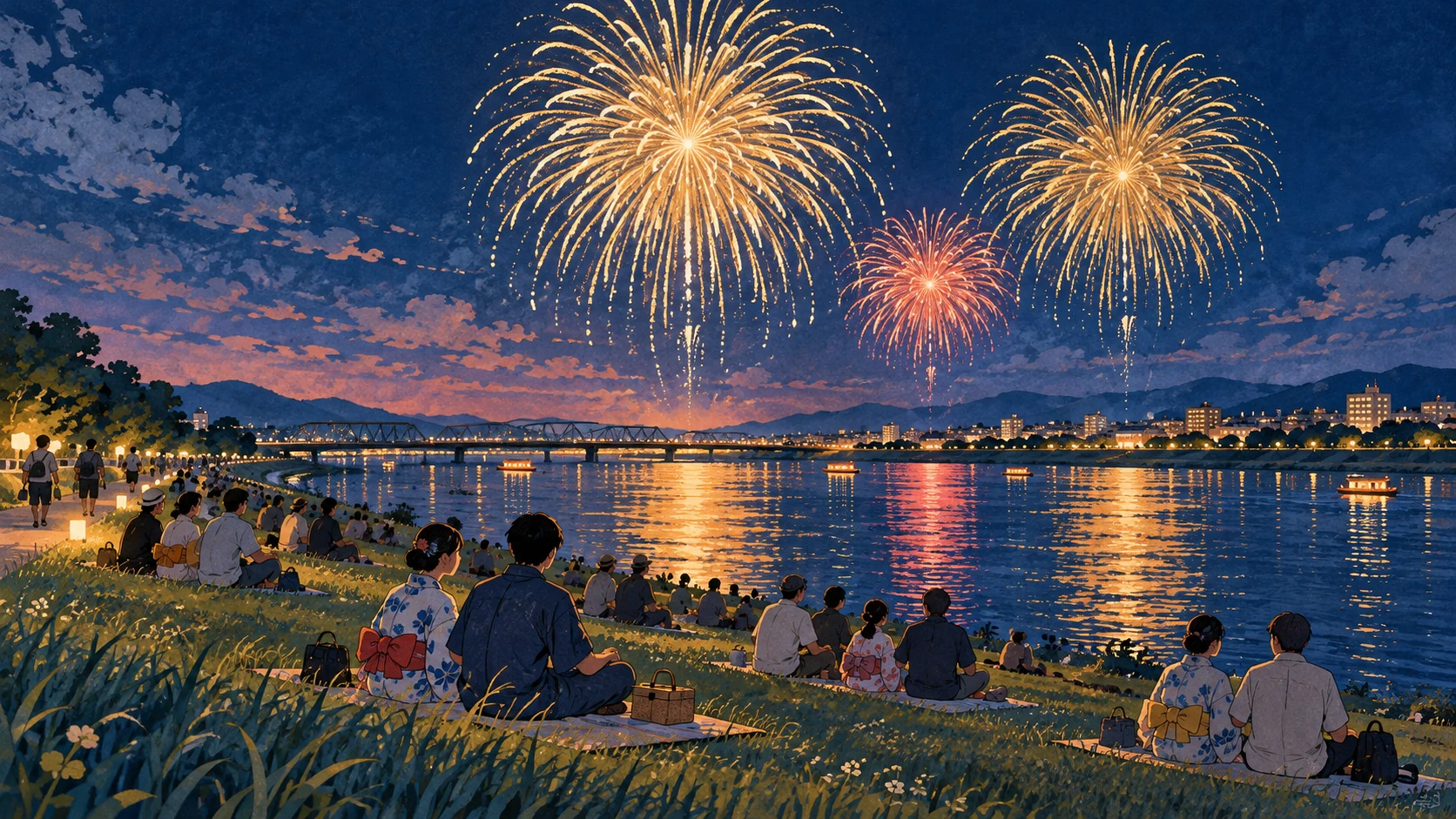
Choose your riverbank first. Tokyo’s Edogawa Ward and Ichikawa in Chiba watch the same fireworks on the same evening, but sell and check tickets separately and manage their own embankment access. An Ichikawa ticket means arriving from Ichikawa-side stations. For an Edogawa ticket, consider Shinozaki, Koiwa, Edogawa or Mizue for your return. The 51st Edogawa Fireworks Festival and 42nd Ichikawa Citizens Fireworks Festival took place on 1 August 2026 and have finished. That edition ran from 19:15 to 20:20.
Choose the Tokyo or Ichikawa bank before opening the ticket page
The two organisers across the Edogawa River have similar names, but the distinction directly affects your journey. The Edogawa side occupies the riverbed in front of Shinozaki Park; Ichikawa’s main venue is by Osu 3-chome. Both watch the same display. Your ticket buys a different location, ground surface, entrance and exit route. The official Edogawa FAQ states that the events operate separately: Ichikawa tickets do not admit you to Edogawa’s paid areas, and sponsor seating is also separate.
If you are staying in Tokyo and returning along the Toei Shinjuku Line, start with Edogawa seats. If your accommodation is further east on the JR Sobu Line or your itinerary already heads towards Chiba, Ichikawa will usually fit your route more easily. This choice follows transport direction, but also consider how far everyone can walk. A slightly cheaper ticket is rarely worthwhile if it adds a detour to the other bank. Keep the full Japanese event name on your booking, rather than writing only “Edogawa fireworks” in the itinerary.
If companions buy separately, agree on the organiser, date and seat type before choosing a meeting station. With tickets for opposite banks, meet before entry and enter on your respective ticketed sides that evening. Ichikawa also has a Gyotoku venue reached from Myoden Station on the Tokyo Metro. JR Ichikawa Station’s south exit serves the main Osu 3-chome venue. Plan around Gyotoku if leaving from Myoden. For raised platform, pair or reserved chair seats, match your ticket to the Osu venue layout. The two venues use different stations, so give the full venue name in meeting instructions.
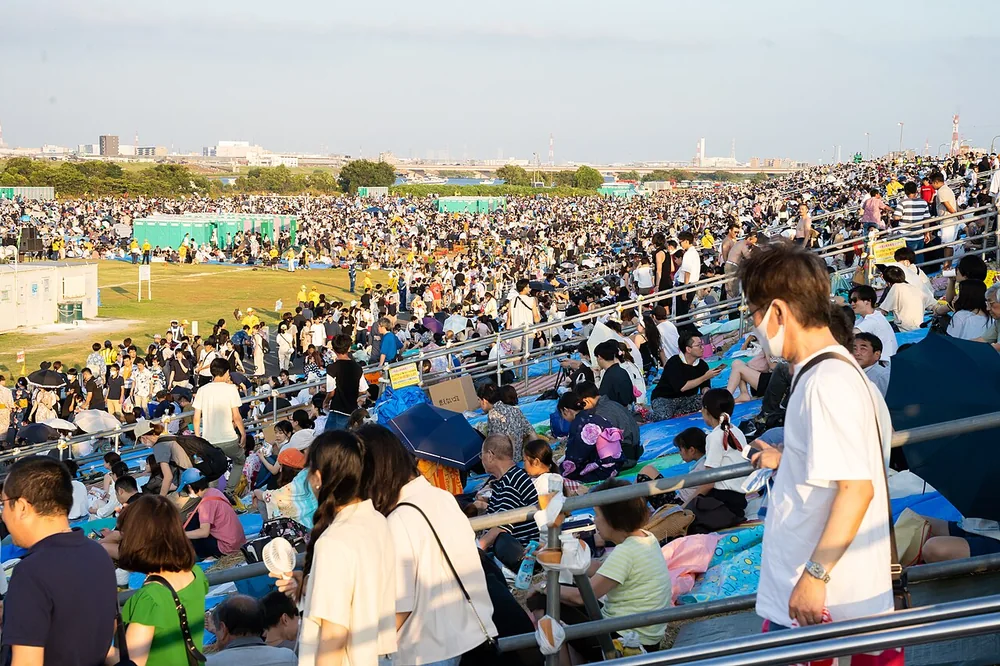
Compare Edogawa and Ichikawa tickets, free viewing and child allowances. Plan arrival and departure via Shinozaki, Koiwa, Edogawa, Mizue, Ichikawa or Motoyawata, with 2026 prices, collection, refunds and access rules.
Edogawa reserved seats: flat-ground chairs, embankment chairs or slope mats
Edogawa had reserved areas A–E in 2026. Chairs in A–D stood on the cycle path along the embankment top, one person per seat. A and D cost ¥7,000, B ¥9,000 and C ¥8,000. Area E was on flat ground at ¥5,000 per seat. The official price table also lists two- and four-person blue-sheet spaces, priced per whole space. Choose how you need to sit before comparing prices; this is more useful than asking only which area is closest.
Two-person blue-sheet spaces cost ¥12,000 in A or D, ¥15,000 in B and ¥14,000 in C, each 180 cm wide and 90 cm deep. Four-person spaces were 180 × 180 cm and cost ¥20,000 in A or D, ¥26,000 in B and ¥24,000 in C. They sit on the embankment slope, where you sit on a groundsheet. Friends sharing food may accept this, while anyone with knee or back discomfort should consider chairs first.
For two adults, two A or D chairs total ¥14,000 against ¥12,000 for one pair space, a ¥2,000 difference. For four adults, four chairs in the same areas total ¥28,000 against ¥20,000 for a four-person sheet, a difference of ¥8,000. That difference buys a chair rather than slope seating. Add food, ticket fees and transport separately. Dividing the space price by its capacity does not make the experiences equivalent.
The system allocates reserved seats; you cannot select an exact position. Edogawa states that seats bought together within the purchase limit are adjacent. Put as many companions as the limit allows in one order, agree who will book, and work out individual shares first.
Paid unreserved areas need tickets; free viewing lies outside the paid zone
Edogawa areas F, G, H and I were paid unreserved areas and still required tickets in 2026. Downstream flat-ground F and upstream flat-ground H cost ¥2,000 per person. G’s downstream embankment-top space cost ¥4,000, while G’s downstream slope and I’s upstream slope cost ¥3,000. “Unreserved” means choosing an available place within your ticketed area on arrival. Reception issues one 90 cm square blue sheet per ticket. Bringing a larger sheet to claim extra space breaches the rules.
These tickets suit people who can sit on the ground, are willing to register early and want a lower face-value price. Two adults pay ¥4,000 in F or H, but should enter together to find space together and lay out the supplied sheets as directed. Keep bags within your own area. Other people’s usable space is not luggage storage. Use your own luggage to secure the sheet in wind and return it according to the collection arrangements at the exit.
Free viewing outside sponsor and paid areas is a separate option. It has no reserved seat numbers and does not provide the paid areas’ viewing positions. Study the map for that edition, choose a legal accessible area on the upstream or downstream outskirts, then choose a station. Treating the entire embankment as free viewing leads to a blocked route at central ticket checks. A paid unreserved ticket holder following the free-viewing entrance route will also add a detour.
For fireworks with friends by the river, choose an outer free area whose view you accept and plan food and departure. If someone needs a backrest and a fixed place throughout, choose reserved chairs. For a lower budget with ground seating, compare paid unreserved areas F–I.
Ichikawa platform and pair spaces: different sizes and child allowances
Ichikawa’s 2026 raised platform spaces cost ¥25,000 for up to four adults in 180 × 90 cm. Sloped pair spaces cost ¥13,000 for up to two people in 150 × 90 cm. Chairs cost ¥8,000 per person and paid unreserved entry ¥5,000. The official ticket agent, CN Playguide, lists platform spaces as a set of four tickets and pair spaces as a set of two. Keep the number of tickets in the set alongside your actual party size.
Both Ichikawa platforms and Edogawa’s four-person blue-sheet spaces hold four adults, but measure 180 × 90 cm and 180 × 180 cm respectively. The former has half the area, and the seating surface differs too. Four people intending to sit cross-legged with bags and food need to accept the actual width and depth of Ichikawa’s platform. If chairs would reduce strain from ground seating, compare the cost of four chairs directly rather than seeking a nominal “four-person seat”.
Ichikawa’s free child allowance varies by seat type. Each platform space allows up to two extra children aged three or younger free. Pair and chair seats allow one extra child aged three or younger on a guardian’s lap. Paid unreserved entry allows one preschool child per ticket. A four- or five-year-old does not qualify under the reserved-seat age-three limit. Edogawa instead allows one preschool child on the lap of each adult; primary school pupils and older need tickets, and primary and junior high school pupils need a guardian. Ichikawa has no child fare: count everyone who exceeds the free companion age or conditions as a ticketed attendee. For family seating, record adults, children’s ages, who holds each child and who handles the journey home if a child falls asleep. Long periods holding a child affect adults’ rest. Both permitted capacity and family comfort need planning.
Resident lotteries and general sales: who can apply?
Edogawa’s 2026 resident priority sale was a lottery, with applications from 30 May to 7 June and results from 9 June. General sales began first come, first served on 13 June. The resident priority notice applies to Edogawa residents and excludes duplicate applications under the same name. A short-term Tokyo visitor with a hotel in the ward cannot use the hotel address as residence eligibility.
Ichikawa’s 2026 citizen priority sale ran from 7 to 9 June, with general sales from 10 June. A separate sponsor-funded free invitation lottery was explicitly restricted to Ichikawa residents and offered paid unreserved entry. It was not a free admission lottery open to every visitor. Travellers can choose general sales and legitimate public offers without treating a “free lottery” as an assured budget option.
Times also vary by channel. Ichikawa’s CN page lists online citizen priority sales from 7 June, while FamilyMart terminal applications started only at noon on 9 June. Telephone and website service hours also differ. If you plan to use a convenience store after arriving in Japan, choose a channel you can actually use and record its sales dates, payment deadline and ticket collection chain together.
Edogawa e-tickets and Ichikawa paper tickets: collect before reaching the river
Edogawa tickets bought from 6 July 2026 onwards were issued electronically only. They are received through the Chikepla app, require a member account and use the display phone number registered at purchase. The official rules say that number cannot be changed after registration. Collect tickets on the device you will take to Japan and make sure you can open the ticket and seating details. Carry that phone, charging equipment and order contact details.
The official Edogawa instructions start with the issue email, app installation and account creation. Collect using the receipt number and the last four digits of the account phone number. For that edition, the admission-check screen opened the day before. Staff checked it at entry and issued a paper re-entry pass. Checks can begin at the venue perimeter; do not wait until the seating area to install the app.
Earlier Edogawa paper purchases were posted, with the ticket itself serving as a neck-worn pass. Wear this, or the re-entry pass issued after an e-ticket check, as directed and keep it until the event ends. Share ticket QR codes and order details only with those who need them. Posting a personal ticket as an itinerary screenshot risks someone else using it. Ichikawa’s CN online page allows purchase without membership and collection at FamilyMart or 7-Eleven. For convenience-store payment, the system sends two emails. Payment requires the dedicated 13-digit number in the second; the first reservation number is insufficient. Keep the wristband issued after entry for re-entry. This differs from Edogawa’s e-ticket process, so companions buying for opposite banks need separate collection instructions.
Entering from Shinozaki: head towards Stairway 10, then your ticket-area stairs
Edogawa’s paid areas opened at 16:00 in 2026. From Shinozaki Station, the ticket-holder route follows Shinozaki Ekidori straight towards Stairway 10. After traffic restrictions start at 17:30, Shinozaki Kaido becomes pedestrian-only; use the dedicated stairs for your ticket area. The nearest embankment point on a map may not be an entrance for your ticket.
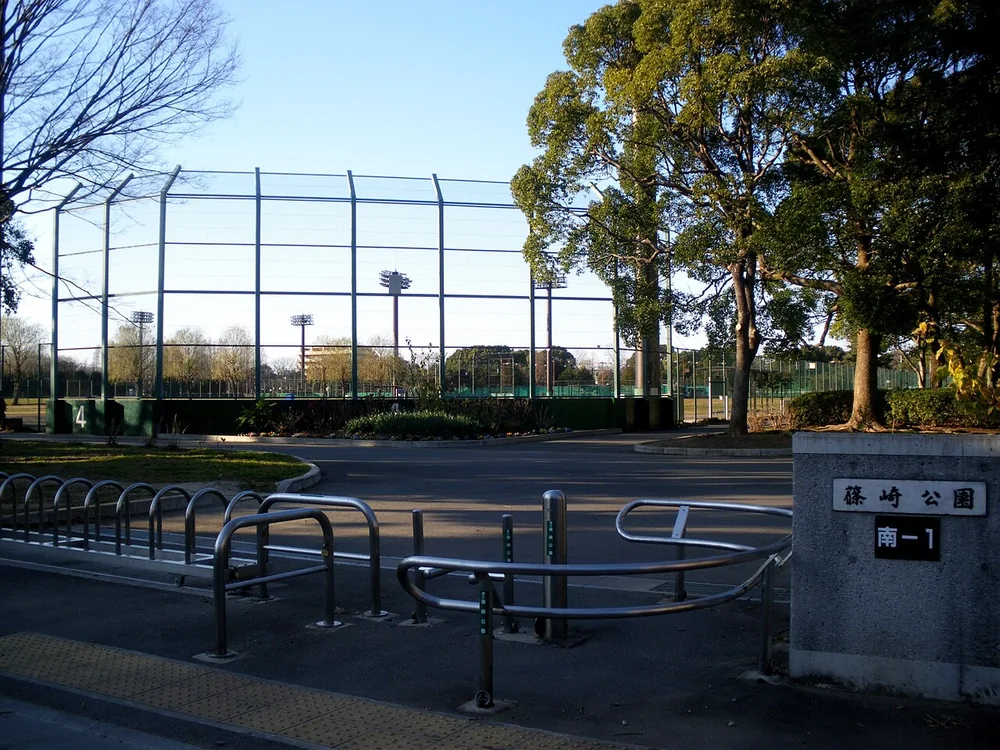
From Koiwa, follow the flag-marked route, walk south/downstream within the riverbed and climb the relevant area’s dedicated stairs to reception. These approaches have different final sections. Save the organiser’s entrance map, your area letter and reception location together rather than only a broad riverbed landmark. Use that same map on arrival.
From 17:30, access is restricted at central Stairways 3–11 and the riverbed road along that section. Without a sponsor or paid ticket, you cannot enter the central area. Stairways 3 and 11 are exit-only from the riverbed towards Shinozaki Kaido. Upstream–downstream passage on the embankment-top cycle path is also restricted. Use Shinozaki Kaido or paths inside Shinozaki Park to reach the other end. Free-area visitors trying to cross the centre to meet friends will encounter this restriction.
The Edogawa organiser designates the plaza outside Shinozaki Station’s north exit for meeting and waiting. Do not gather inside the station or at entrances. Meet everyone and buy food and water before walking to your ticket area together. If arriving separately, each person should save the actual entrance, area letter and companion contact details, then contact the group at the designated entrance. Avoid searching back and forth at the central ticket checks.
Ichikawa entry: Passage C is separate from E, F and G
Ichikawa’s paid seating opened at 17:30 in 2026, later than Edogawa’s. The main venue is about a 15-minute walk from JR Ichikawa Station’s south exit, and the organiser warns of severe crowding after 18:30. That is an ordinary walking estimate. Add time to leave the train and station, reach the embankment entrance and pass ticket checks. A family reaching the station at 19:00 squeezes all those steps into the last moments before the display.
The official Ichikawa ticket page separates entry by ticket type: platforms, pair spaces and chairs use Passages E, F and G; paid unreserved entry uses C; sponsor seats use E. Here the letters identify passages. Edogawa’s A–I identify seating areas. Match letters to the map for your own bank rather than carrying over the other bank’s area code.
Ichikawa reserved seating does not allow selection of an exact seat. Tickets bought together are usually consecutive, but if the system shows separated seats, decide whether you accept that before paying. For children or older relatives needing care, use one order within its permitted capacity. Do not buy individual tickets separately and expect to sit together at the venue.
Eat dinner outside the station before entering the central restricted area. No food or drink is sold inside Ichikawa’s paid area. Re-entry is allowed, but still means crossing crowds. If one person leaves to shop, others must watch shared bags and children, reducing time watching together. Bring basic supplies in one trip and treat stalls and food trucks as extras.
A venue walking-route video from Ichikawa City’s official channel, embedded directly in the fireworks organiser’s venue guide.
Four Edogawa return stations: nearest Shinozaki may take longer
Edogawa’s official departure guidance gives both walking and station queue estimates: Shinozaki, 15 minutes on foot plus about 60–90 minutes to enter; Koiwa, 25 minutes plus 30–60 minutes; Keisei Edogawa, 25 minutes plus 10–20 minutes; and Mizue, 45 minutes plus 0–10 minutes. These are the organiser’s dispersal estimates for that edition. Use them to compare effort; staff control actual admission on the night.
If you are happy walking and your accommodation connects to the Toei Shinjuku Line, consider Mizue first. About half an hour more walking trades against less time standing in the Shinozaki queue. That trade does not suit young children, foot injuries or anyone too tired for a long walk. Ask separately how long each person can walk continuously and how long they can stand in a crowd. The answers may differ.
Keisei Edogawa and JR Koiwa both have official 25-minute walks, but different queue estimates. Include Edogawa if the Keisei Line connects to your accommodation. If you need the JR Sobu Line, compare Koiwa’s queue with transfer time. A shorter queue is less useful if it adds an unfamiliar interchange after boarding. After 20:00, Shinozaki admission uses the south exit; the west exit closes during the departure peak. Follow the official queue along Shinozaki Ekidori rather than normal navigation to another entrance. Put away maps you keep checking before joining the organised queue and follow directions. Leaving to shop and returning also disrupts your original timing estimate.
Leaving Ichikawa: stay with the Sobu Line or disperse upstream
JR Ichikawa Station draws the largest flow on this bank. The organiser also recommends walking upstream along the Edogawa towards Keisei Konodai Station, or towards the less concentrated JR Motoyawata Station. These connect to different rail routes. For accommodation on the Sobu Line, keep Motoyawata as an alternative. For a Keisei connection, compare Konodai. Decide within the venue so you do not reach Ichikawa Station and then turn back against the crowd.
Ichikawamama Station is another nearby option listed by the organiser, with a Keisei Line connection. Find the exit from your seating area towards the chosen station on the venue map, then check services back to your accommodation. Adults travelling with children should each save interchange names and the hotel address to reduce confusion if the group splits during departure. Once you choose Motoyawata or Konodai, leave in that direction and follow your checked rail route after entering the station.
From the Gyotoku venue, base the return on Myoden Station and the Tokyo Metro Tozai Line. It suits those already staying along that line who accept a more distant view. It is a separate plan from Osu 3-chome’s paid zone. Going from Gyotoku to JR Ichikawa to collect friends adds travel that night. Friends staying on different lines can eat together by day and leave according to their ticket areas and accommodation routes.
Ichikawa’s 2026 traffic restrictions ran from 17:00 to 22:00, with some roads north of JR Ichikawa Station restricted from 20:00. Car parks inside the restricted zone could not be entered or left during that period. For a taxi, first walk outside the prohibited area and allow for surrounding congestion. Parking near the river does not solve departure. The organiser also arranges short workings for south-exit buses. Base your return on rail and a manageable walk, then check any specific usable bus.
Allow for phased departure instead of rushing to the first stairs
Edogawa’s 2026 paid areas used phased departure: sponsor seats and C/E first, then A/B/D, followed by F/G/H/I. The notice anticipated intervals of about ten minutes, with up to 30 minutes waiting in seats. Choosing cheaper unreserved entry also means accepting later release. A 20:20 fireworks finish does not mean you are already outside the embankment at 20:20.
For free viewing, the organiser suggests staying in place for 20–30 minutes afterwards, or moving along the riverbed away from the centre before heading for an available exit. This wait avoids stairway crowds and belongs in your evening plan. Use the toilet and pack rubbish and bags first. Move together when permitted, rather than sorting possessions at a narrow stair entrance.
Edogawa buses have easily missed restrictions. After the fireworks, routes can be heavily delayed or full. There are no extra buses from Shinozaki towards Ichinoe or Kasai. Funabori-bound route 船28 changes boarding point after restrictions begin, and the official transport page gives its expected last service for that edition as 20:11. That is before the display ends, so it cannot be your fallback after watching the full programme.
Avoid fixed-time long-distance transport, airport transfers or restaurant bookings afterwards. If your accommodation has a late-return or check-in deadline, tell it your expected arrival window in advance. Work backwards from the final transport leg to the hotel and include phased release, the embankment walk and station queues.
Three accessible viewing arrangements: include companions
Edogawa’s paid Area E had wheelchair spaces at ¥5,000 per person in 2026. Companion seats were bought separately at the same price, with up to two companions per wheelchair space. The organiser describes a dedicated space with the chair removed so the user remains in their wheelchair; companions use chairs beside it. If you need this arrangement, buy the wheelchair ticket and required companion tickets directly rather than requesting conversion of a normal slope mat space.
Edogawa also provides general wheelchair viewing spaces on the embankment-top cycle path near Stairways 2 and 15 in the free-viewing area. They require no reservation and allow up to two companions. The official FAQ requires an assistant to accompany the user. Their location, payment and use differ from Area E’s paid wheelchair spaces. Choose one, then connect it to a usable entrance and return route.
Ichikawa’s viewing space and parking for disabled visitors are on the grounds of Municipal Osu Junior High School. Advance applications began on 8 June 2026 and closed when full. The dedicated notice requires name, telephone number, address, vehicle type and registration, and party size; parking passes are posted separately. This is not a service you register for on arrival at ordinary paid-seat reception. Ichikawa’s general riverbed is not an accessible venue, provides no assistants and does not store pushchairs. Discuss station lifts, ground conditions, stairs or ramps, toilets and the return journey with the organiser if you have substantial mobility needs. If usable routes remain too long, compare formally ticketed indoor options or spend the evening outside the embankment area to reduce crowd crossings.
Prepare food, shade and camera equipment for your ticket area
Edogawa sold soft drinks from 16:00 to 18:30 in 2026 but no alcohol within the venue. Ichikawa’s paid areas sold no food or drink. Bring enough drinking water and an essential meal on either bank, especially for scheduled meals, food allergies or young children. Have a seated meal during the day and bring small, easy-to-pack portions for the evening. This is easier than the whole family leaving to find dinner just before the show.
Edogawa’s paid areas allow parasols and tents until 18:30, after which they must be packed away. Visitors cannot bring tables or ordinary chairs. Paid unreserved areas F–I make an exception for low-back chairs of about 30 cm. Chair areas already have organiser-provided seating. Bringing a tall chair to a mat area blocks others’ views and breaches the rules. Use a wearable raincoat in rain rather than opening something that obstructs densely packed seats.
Camera rules differ between banks. Edogawa limits tripods to seated eye level or lower and requires that they do not obstruct others. Ichikawa asks visitors not to set up tripods in paid seating. If photography is a priority, choose the bank with this distinction in mind before deciding on equipment. A tripod that stays in your bag only adds weight on the way home. Decide before booking whether short phone clips or a handheld camera will meet your needs.
Footwear matters through a long riverside wait and the departure walk. Even with a yukata, choose shoes that can complete the route. Carry only what you need that evening and leave large luggage at your accommodation. Edogawa paid-seat reception does not store pushchairs, and the organiser recommends avoiding them. Families who need one should plan folding and carrying, and choose a return journey they can manage after the child tires.
Refunds, resale and cancellation have separate conditions
Edogawa tickets cannot be voluntarily changed, cancelled or refunded after purchase. If the organiser cancels for severe weather or similar reasons, refunds follow its rules; there is no refund if the programme ends after starting. The 2026 official resale service used Chikepla Trade from noon on 10 July to 11:59 on 23 July. Tickets bought on or after 11 July were ineligible. Eligibility depends on the original purchase date, not simply whether the platform has a resale function.
The official resale listing fee is 8% of the ticket price per ticket, or a fixed ¥440 for tickets priced at ¥5,500 or less, plus paper-ticket return postage and transfer fees. Buyers also pay purchase and e-ticket usage fees. If travel may change, list the charges you can accept. Resale outside official channels breaches event rules and may lead to refused entry. Passing a ticket to a stranger does not replace the official transaction process.
Ichikawa refunds depend on cancellation by the organiser. No refund is given for cancellation after the show starts, and severe-weather cancellation has no postponement. The CN page requires you to retain the admission ticket for a refund, excludes delivery and payment fees from the amount returned, and specifies a claim period and method. Keep the original ticket after a cancellation notice and follow CN’s announced deadline and procedure. Accommodation and transport follow their own booking conditions if the fireworks are cancelled. Record the last cancellation time for each of those three costs rather than one “refundable” line in the overall budget. Edogawa’s cancellation criteria include sustained strong winds, lightning risk, warnings and special heatstroke alerts. Ordinary rain may still allow the event to proceed. Read the organiser’s event-status notice that day and follow evacuation and traffic instructions.
Keep accommodation on your existing route and the daytime plan light
If staying several nights in Tokyo, you can usually keep your hotel and connect the return to a familiar line. For Edogawa, compare the Toei Shinjuku Line from Shinozaki or Mizue, the Keisei Line from Edogawa and the JR Sobu Line from Koiwa. Staying beside a particular station does not force you to use it. If everyone can walk to an alternative, compare the whole journey to your room rather than only river-to-station distance.
For Ichikawa, accommodation along JR Ichikawa or Motoyawata can reduce transfers, but check which exit serves the hotel entrance. Returning from the main embankment towards the south exit still leaves station-area travel for a north-exit hotel. If changing hotels that day, leave bags and complete any available check-in procedures in the afternoon. Enter with a small day bag so you do not drag luggage through departure crowds.
For families, keep the day to lunch near the station, a room rest, afternoon supplies and the walk to the entrance. Friends wanting more can add an indoor activity and an early dinner on the same bank rather than crossing to another distant suburb. As areas open around 16:00–17:30, save energy for embankment walking and waiting. A full morning of shopping followed by a rush to fireworks usually costs you rest first.
Ichikawa also offers special viewing at the I-link Town observation facility. In 2026 it cost ¥6,000 per person, with limited applications and a lottery if oversubscribed. Ages four and above need a ticket. It offers indoor viewing, affected by buildings and smoke. This is a separate ticket: embankment tickets do not admit you, and normal observation-facility opening does not mean free fireworks-night admission. Choose this formal option first if you prefer indoors, then follow that edition’s sales and entry arrangements.
Free-area place-saving differs by bank; keep routes clear
For Edogawa’s 2026 free area, place-saving began at 17:00 on 31 July, the previous day, at roughly one square metre per person. Items left earlier are removed. Stakes, ropes and paint that damage the embankment are prohibited. Ichikawa bans advance place-saving and patrols to remove items left on the previous day or earlier. The same evening’s fireworks have different place-saving systems on the two banks; do not apply Edogawa’s timetable in Ichikawa.
Manage your own position in free areas without placing belongings in public walkways. If companions only want to arrive in the evening and need fixed space together, a ticket with formal seating arrangements is easier. Any plan to put down a sheet early must follow that bank’s start time. Keep arrival and departure routes clear throughout.
Pack your sheet, food wrappers and equipment together when leaving. Edogawa rubbish stations stand near temporary toilets; use the venue map. Ichikawa is entirely non-smoking and has no smoking area. To wait for friends outside an exit, first move away from narrow routes and station entrances, then meet at the agreed place. The stretch between embankment, residential streets and station remains part of the fireworks trip.
A few useful answers
Are Edogawa and Ichikawa fireworks tickets interchangeable?
No. Both banks watch the same fireworks on the same evening, but check tickets and sponsor seating separately. Enter Ichikawa tickets on the Ichikawa bank and Edogawa tickets on the Tokyo bank.
Is Edogawa paid unreserved viewing free?
No. Areas F–I require tickets and issue a 90 cm square blue sheet per person. Choose an available position within your purchased area. Free viewing is outside sponsor and paid areas.
Must I return via Shinozaki because it is nearest?
Shinozaki attracts the largest flow. The 2026 organiser also suggested Keisei Edogawa and Mizue for dispersal. Choose by walking ability, accommodation route and on-site controls. After 20:00, join the Shinozaki entry queue at the south exit.
Can preschool children enter free on both banks?
Edogawa allows one preschool child on each adult’s lap. Ichikawa reserved seats limit free companions to age three or younger: up to two per platform space, or one for pair and chair seats. Paid unreserved entry allows one preschool child per ticket.
Official information and references
Sources used in this guide.
- Edogawa official paid seats and ticket terms
- Edogawa resident priority lottery
- Edogawa paid-seat FAQ
- Edogawa ticket-holder entrances and phased departure
- Edogawa e-ticket collection
- Edogawa access and buses
- Edogawa return-station guidance
- Edogawa venue access restrictions
- Edogawa free viewing and accessibility FAQ
- Edogawa viewing rules and cancellation criteria
- Edogawa venue map
- Ichikawa 2026 event home page
- Ichikawa official seat types and passages
- Ichikawa official ticket agent CN Playguide
- Ichikawa FAQ
- Ichikawa traffic restrictions
- Ichikawa advance accessibility applications
- Ichikawa resident-only invitation lottery
- Ichikawa special observation-facility viewing
- Ichikawa official venue guide and access video