Explore the Goka papermaking villages, hosho and torinoko papers, sheet forming, decoration and drying. Visit the newly reroofed Okamoto and Otaki shrines, with museum planning and workshop choices.
- Region & Focus
- Echizen City and Washi Village
- Reading Scope
- 38 min read · 19 chapters · 4 Q&As
- Official Verification
- 14 official sources checkedUpdated 22 November 2026
- Key Topics
- ItinerariesChubu & Hokuriku
Chapter Route Map (tap any stop)
- Start with what paper must do, then watch it being formed
- Goka is a production cluster, with processing and sales beyond the vat
- Hosho and torinoko: compare whiteness, thickness and density
- Raw materials leave differences in the finished surface
- Udatsu combines workshop and home under one roof
- Repeated scooping builds a nagashizuki sheet’s thickness
- After pressing, the drying board also shapes the surface
- Uchigumo and tobikumo: patterns made of paper fibres
- Mizutama can mean adding fibres or acting with water
- Metal templates, paper layers and fibre outlines
- Watermarks use thickness as information; certificates need finishing
- Changing uses expanded paper from documents to whole sliding doors
- Compare tools, samples and current museum exhibitions
- Kawakami Gozen’s legend links papermakers in shared worship
- Read the complex roof from the joined sanctuary and worship hall
- Cypress bark, woodland and the upper shrines
- Finish museum work before walking to the foothill shrines
- Choose a short workshop or full nagashizuki by your purpose
- Finish with paper you will use
- Quick Q&A
Echizen Washi Village fills a day exploring how paper becomes documents, painting surfaces and interior materials. Follow a craftsperson’s work at Udatsu in the morning, compare finished sheets at the Paper and Culture Museum, then choose a short workshop before walking to Okamoto and Otaki shrines. On 28 October 2026, the shrines announced completion of their full roof replacement and reopening.
Start with what paper must do, then watch it being formed
At Echizen Washi Village, compare hosho for formal documents, torinoko for fine lines and patterned paper for sliding-door surfaces. Different tasks demand different fibres, surfaces and sizes. Take those uses into Udatsu Paper and Craft Museum: repeated scooping at the vat then has a purpose, building thickness, distributing fibres and creating a chosen surface.
Make Udatsu’s working craftsperson the day’s focus, use the Paper and Culture Museum for finished sheets and history, and leave a short workshop for those who want to try. Walk to Okamoto and Otaki shrines in the afternoon to connect the paper-producing district with its founding deity. Start at Udatsu for tools and movements, or at the museum for materials; a joint ticket makes either order easy.
On 28 October 2026, the shrines announced completion of the full cypress-bark roof replacement and public reopening. Include the repaired roof in this visit. Museums have demonstration and reception cut-offs, making paper activities first and shrines later practical. For a half-day, keep both museums and the foothill shrines, omitting the workshop to give demonstrations and paper comparisons proper time. Roof replacement completion notice
Explore the Goka papermaking villages, hosho and torinoko papers, sheet forming, decoration and drying. Visit the newly reroofed Okamoto and Otaki shrines, with museum planning and workshop choices.
Goka is a production cluster, with processing and sales beyond the vat
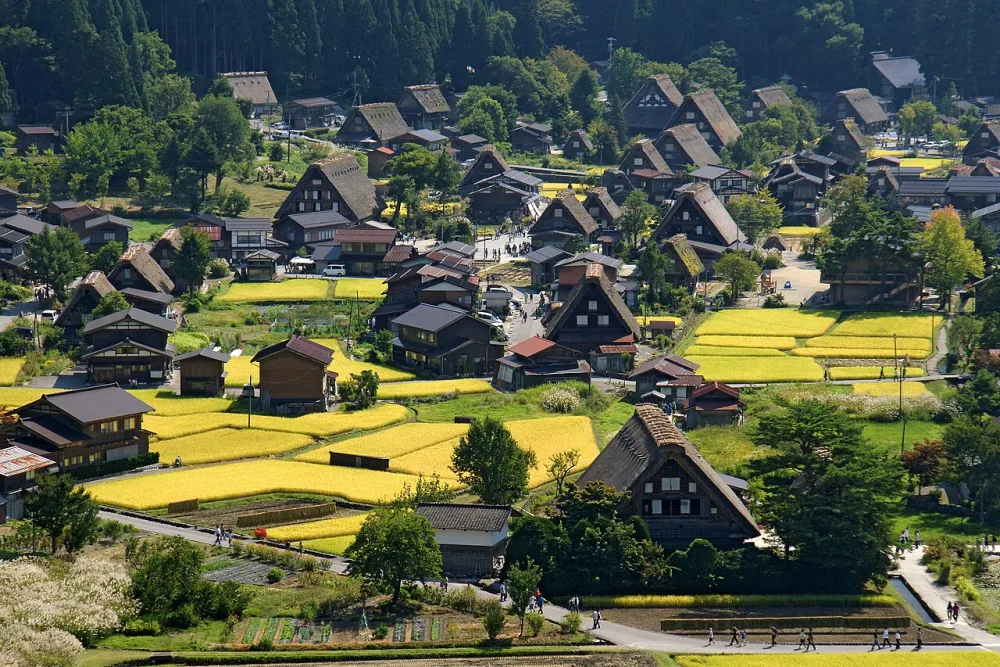
Echizen washi’s core production district is Goka in Echizen, Fukui: Oizu, Otaki, Iwamoto, Shinzaike and Sadatomo. The museum introduces these settlements with the Okamoto River. Museums cluster in Shinzaike, while the shrines stand in Otaki. Recognising the names connects a tourist facility with surrounding streets where paper is still made.
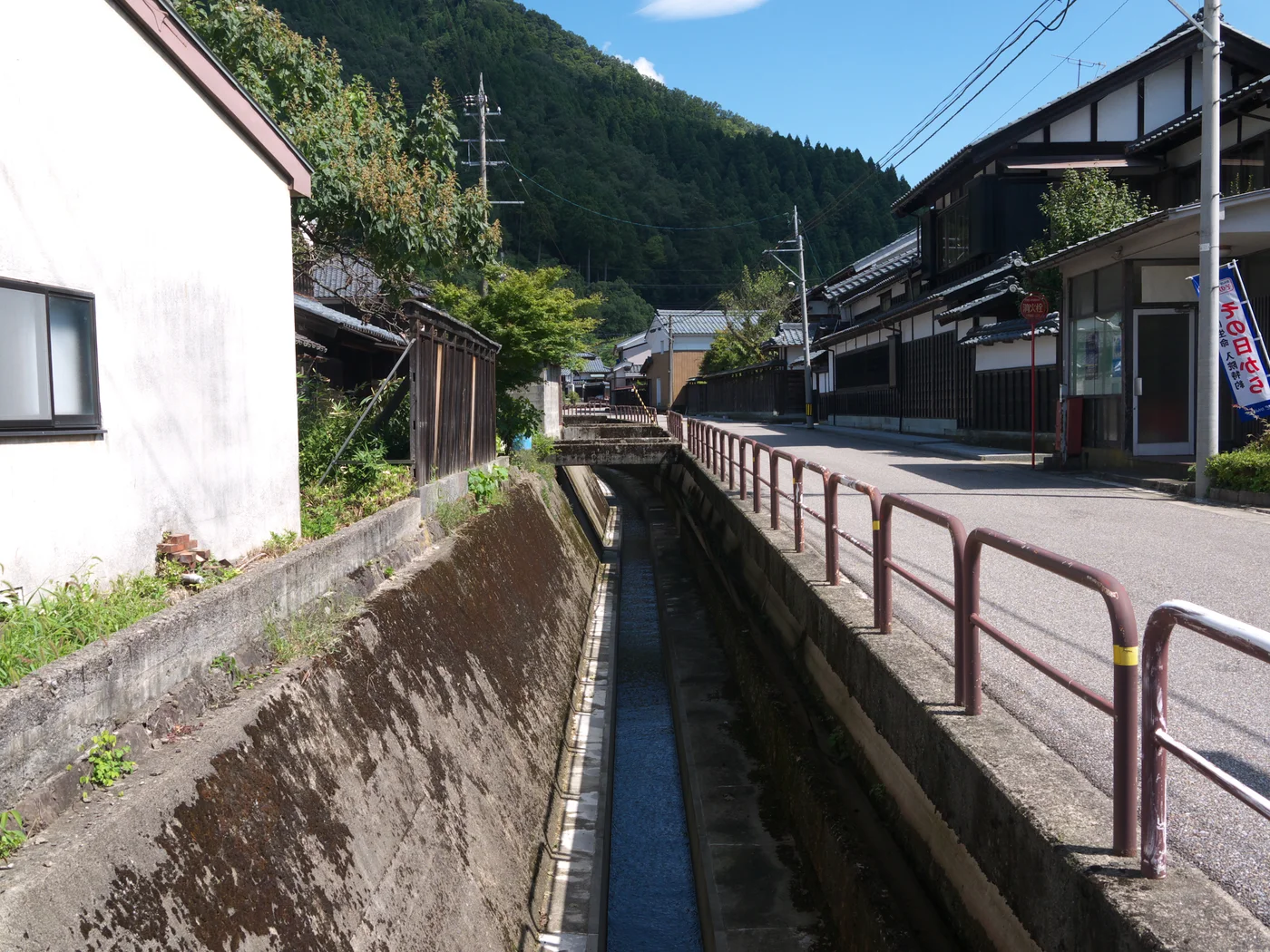
Mills have different specialities. The city tourism association’s production-area visit describes large handmade sheets at Iwano Heizaburo, handmade fusuma paper at Osada, decorative small-format paper at Yamatsugu, and hand- and machine-made paper at Igarashi. Size, decoration, small goods and production methods create specialisms within one district. Read makers and uses on labels after seeing a sheet.
Paper can then go to specialist processors. The same account describes Shimizu Paper processing through crumpling and lamination, changing feel and function. Sugihara Shoten acts as a production-area wholesaler connecting craftspeople, users and sales. Several businesses may therefore contribute to sheet forming, decoration, processing, planning and retail.
Momigami, crumpled paper, makes this division clear. Shimizu uses machines and hands, crumpling irregularly in both directions or in one direction, coarsely or finely. Stiff paper becomes soft. When viewing paper goods, distinguish creases, softness and pattern, then read whether the texture formed at the vat or in later processing.
Use this distinction in displays. For cloth-like soft paper, find processing notes; for interior sheets, read dimensions and placement; for regular patterns, look for the tools that created them. A standard day follows the three public facilities, shops and shrines, observing working premises from outside. Echizen tourism association: makers and production processes
Hosho and torinoko: compare whiteness, thickness and density
The producers’ cooperative describes hosho as thick, highly white kozo paper. Long interlocking fibres make it bulky and strong. A washing stage called kami-dashi removes non-fibrous material and affects whiteness and texture. Look at thickness and surface evenness to understand why formal documents and ceremonial uses value the whole sheet’s quality.
Hosho also carries a documentary history. The cooperative explains that it first meant a document issued in a retainer’s name on a superior’s instructions, later becoming the paper’s name. Read material and historical use separately: one explains composition, the other social function.
Torinoko is understood through gampi paper’s pale colour and dense surface. Production-area accounts link its name to eggshell-like colour. Flat gampi fibres create a dense, smooth sheet with less ink spread, suitable for fine work. Its difference from thick kozo paper includes fibre form and response to ink and colour, beyond white or pale yellow.
With modern fusuma-paper development, torinoko became a broader name for sliding-door and printing papers made from different materials. When buying, read raw material, hand- or machine-making and intended use together. Explain whether you want kana practice, printmaking or box covering to choose paper suited to your ink, printing or adhesive. Producers’ cooperative: hosho, torinoko and changing names
An Ichibei Iwano interview uploaded by the Echizen tourism association and included on its official site, accompanying this section on kozo hosho and printmaking paper uses.
Raw materials leave differences in the finished surface
Kozo, mitsumata and gampi all supply bast fibres, but lengths and shapes differ. The cooperative gives about 6–15 millimetres for kozo, 3–4 for mitsumata and 4–5 for gampi. Kozo is long and readily interlocks; mitsumata is finer and softer; gampi is flat. Relate these to strength, density and sheen before comparing finished samples.
Echizen also uses hemp for Japanese painting paper, alongside Manila hemp and wood pulp. The cooperative describes how beating adjustments give Manila-hemp paper a bulkier or firmer feel. Processing matters as well as fibre choice. Compare labels with touch to identify differences relevant to your use.
Experiments extend to food. The tourism association records Igarashi’s Food Paper as inspired by a child in the family’s long-running experiments with banana peel, peanut skins and edamame. Food materials and handmade-paper skills later became stationery. This sits alongside traditional plants: makers maintain established grades while testing other fibre sources. If relevant products are in stock, read material and name before comparing colour and feel.
Tororo-aoi roots and noriutsugi bark supply neri, used in the vat water. The cooperative explains that this mucilage disperses fibres, keeps them suspended longer and helps interlocking during forming. The vat holds an aid controlling fibre behaviour as well as water and pulp. Udatsu’s nagashizuki workshop explicitly uses 100% domestically grown kozo; compare that specific product with the museum’s broader material range. Producers’ cooperative: materials and neri
Udatsu combines workshop and home under one roof
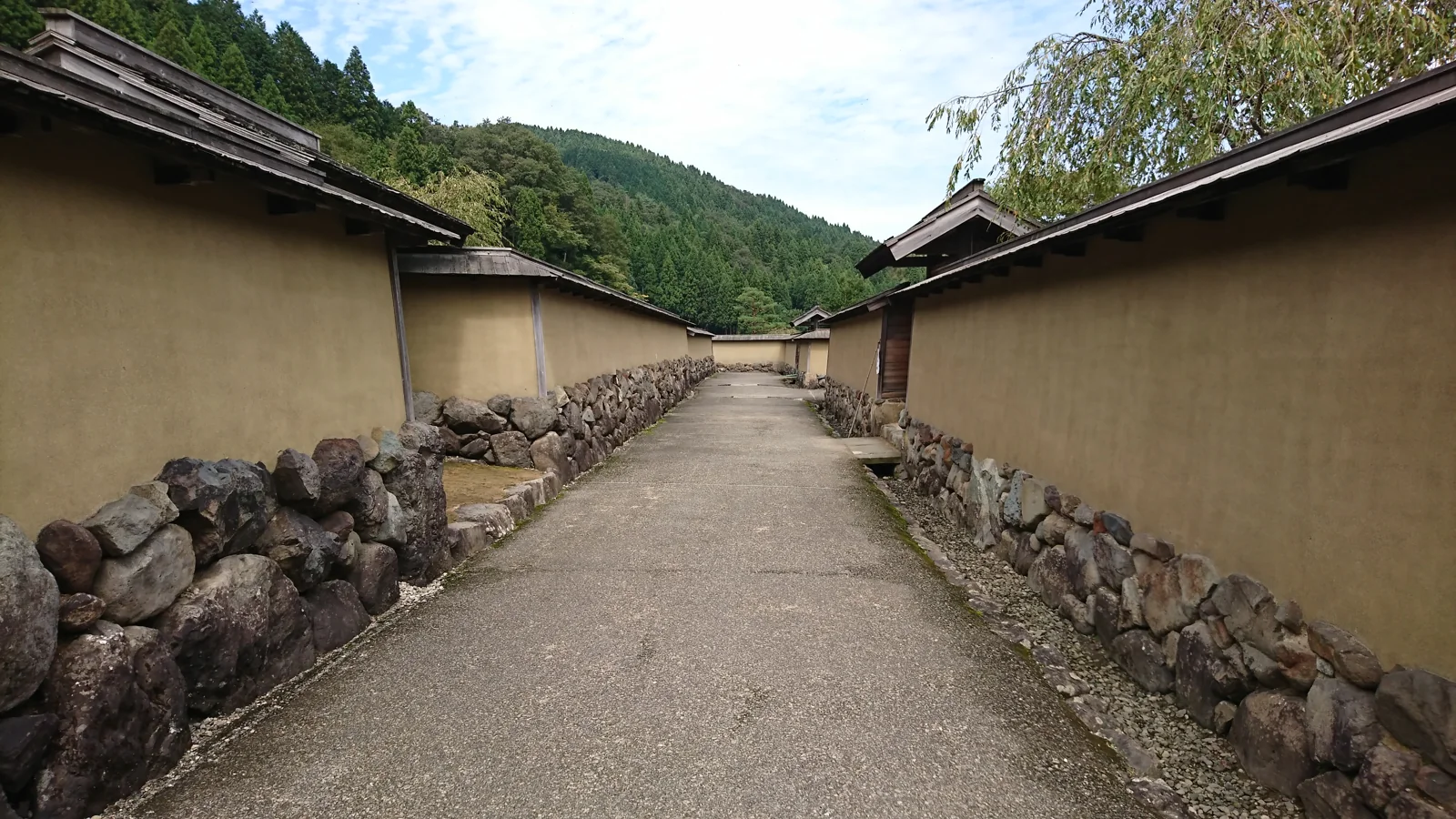
Udatsu Paper and Craft Museum was relocated and adapted from the Nishino Heiemon papermaking household in Sadatomo. The museum records the original as traditionally dated to 1748 and its relocation in 1996–1997. A gable-end entrance and raised udatsu walls typify Goka papermakers’ houses. First locate working and living areas to see how the craft fitted daily settlement life.
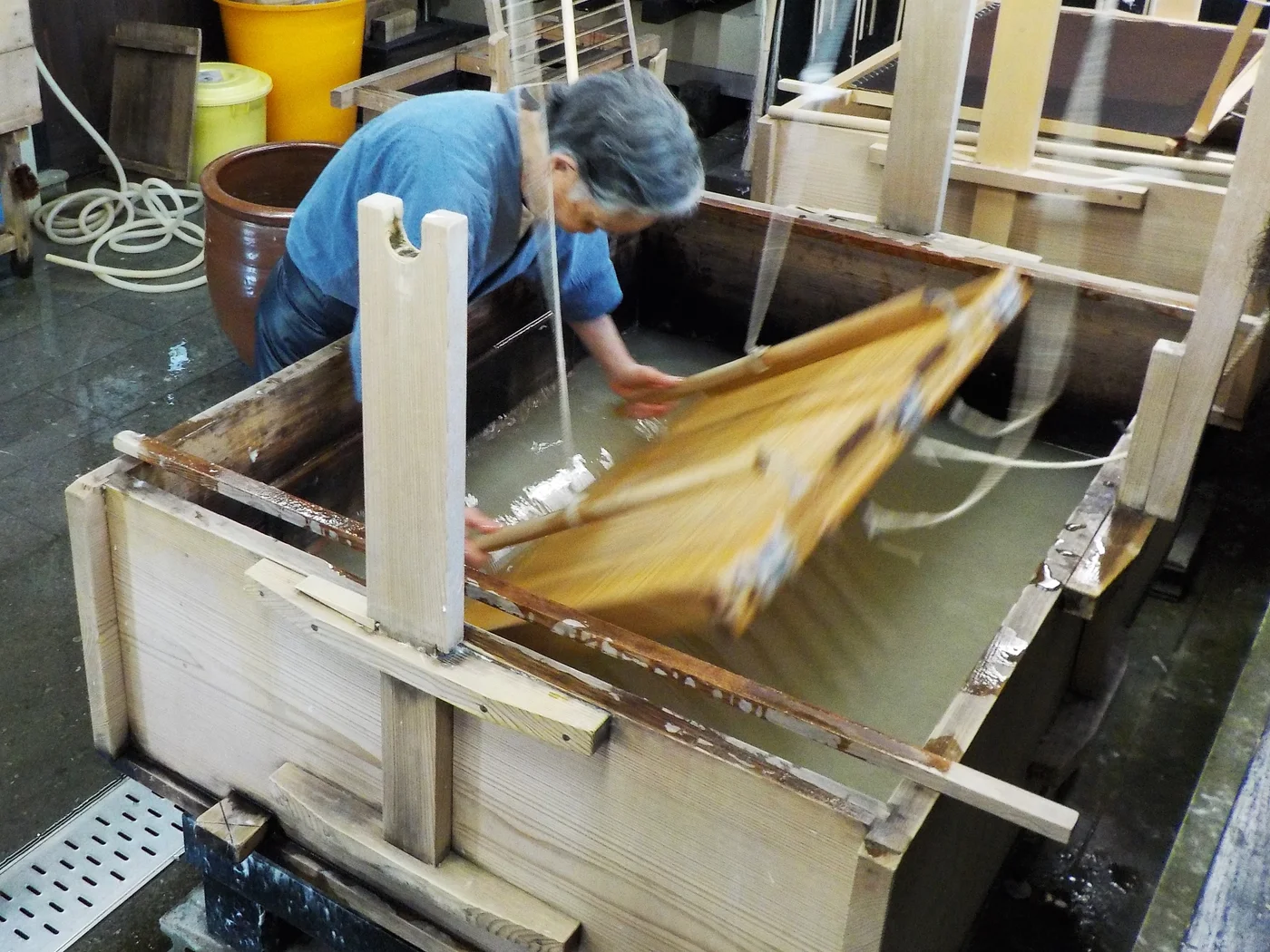
The ground floor has a working area, an earthen floor, a boarded room with a hearth and tatami reception rooms. Look from the exterior udatsu towards wet-pulp handling, boarded floors and room divisions. Upstairs hosts paper-related special exhibitions, giving a different pace from work below. Architecture enthusiasts can leave time for the house itself.
Tools were reconstructed from old documents, and craftspeople make naturally coloured washi. Public work includes preparation, forming and drying. Watch one ongoing operation fully before reading tool names. Vat pulp comes from preparation; newly formed wet sheets still need drying. Following one sheet or tool reveals continuity better than moving quickly between photographs. Udatsu: house and public work
Repeated scooping builds a nagashizuki sheet’s thickness
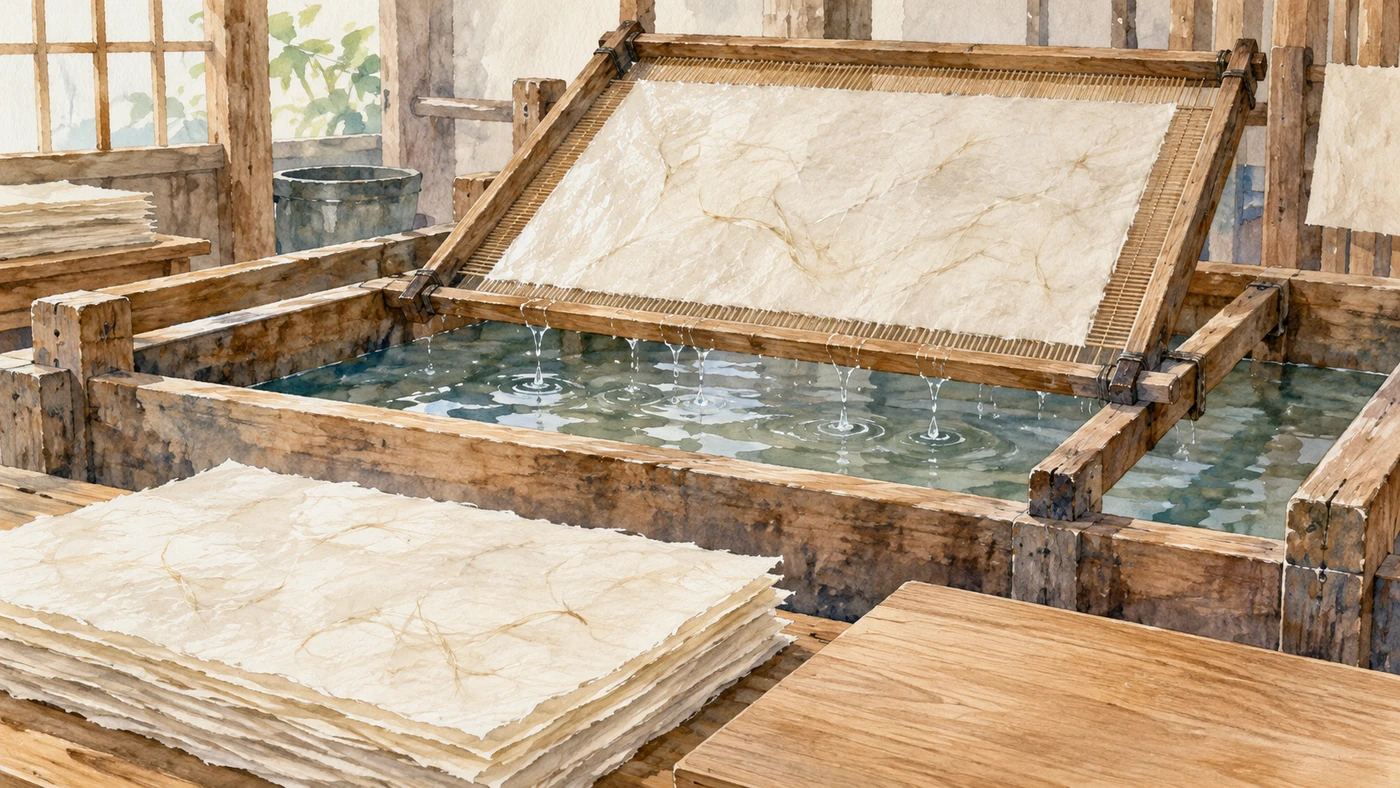
Udatsu distinguishes tamezuki from nagashizuki. Tamezuki takes one scoop in a frame with metal mesh, held level and gently shaken. Nagashizuki uses a bamboo screen, repeatedly scooping and moving forwards, backwards and sideways until the desired thickness forms. Both can look like a frame lifted from water in a still image; repetition distinguishes them. Udatsu: tamezuki and nagashizuki
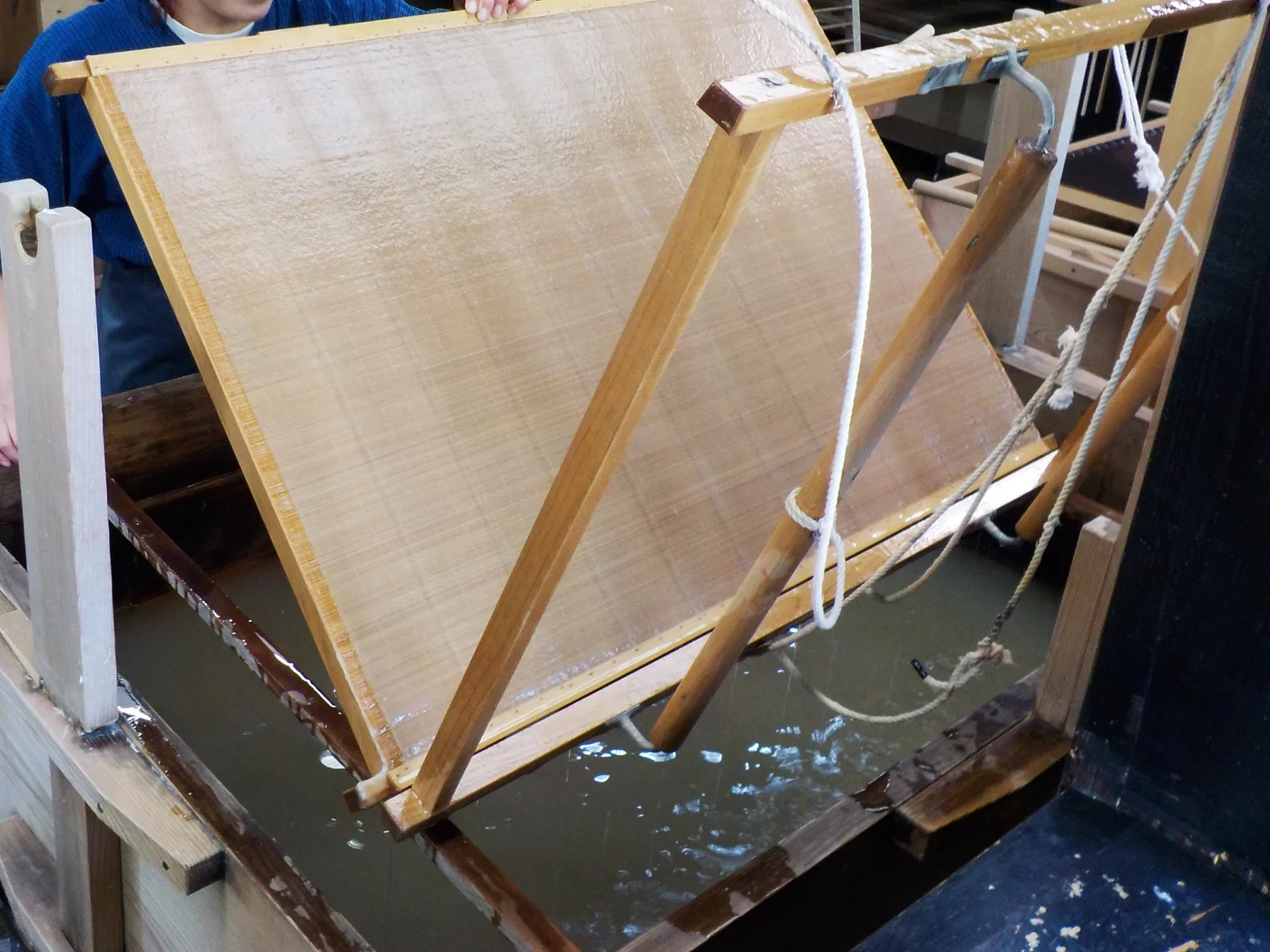
Follow a complete cycle: frame into vat, pulp lifted, shaking, then another scoop. Notice when the maker continues and stops. Thickness accumulates through repeated movements, with the frame responding to flowing liquid. Watch pulp inside the frame as well as arms to connect motion with the sheet.
Large sheets require teamwork. The tourism association records groups of four or six at Iwano Heizaburo, spreading material through lengthwise and crosswise movements. This is one mill’s large-sheet production example. After a smaller Udatsu demonstration, use it to understand how larger dimensions change staffing and workspace for a whole fusuma surface.
After pressing, the drying board also shapes the surface
Wet sheets must lose water and dry. Udatsu includes drying among visible processes. A separately documented example at Iwano Heizaburo places pressed sheets individually on ginkgo boards in a warm room. Treat the board as a production tool, extending your view from vat to finished surface.
The association records the choice of ginkgo for few knots, smoothness and reduced distortion in sunlight. It also notes that excessive heat can lift paper before it dries fully, requiring slow drying. Sheet, board and drying speed must work together, removing moisture while maintaining flatness and surface quality.
At that mill, two people remove dried paper from boards before inspection. Large sheets still need teamwork at this stage, after wetting, pressing, drying and peeling. Short visitor workshops use their own quick completion process. To understand paper for painting, mounting or interiors, consider the stages before and after forming too.
Uchigumo and tobikumo: patterns made of paper fibres
Echizen decorative paper can acquire patterns from another batch of pulp during forming. The cooperative describes sukikake as adding pulp called hana to a previously formed base sheet. One method uses neri and alum to gather fibres into petal-like shapes, helping explain visible fibres on taireishi and similar papers.
Fukui also formally designates “Echizen washi techniques: uchigumo, tobikumo and mizutama”. That entry’s hana starts as dyed, dried gampi paper, beaten into short fibres and mixed with water and neri. Two workers form a torinoko base; after suitable drainage, a skilled maker applies the decorative pulp. Base and pattern require separate preparation before meeting wet.
In the designated technique, uchigumo commonly forms continuous clouds at the sheet’s top and bottom, while tobikumo scatters cloud fragments across it. Look for placement and the boundary with the base. These choices affect central writing, image composition and cutting into smaller pieces.
The prefectural entry records the holder’s position as vacant after third-generation Iwano Heizaburo died in 2016. Read historical works by maker, date and technique; contemporary products have each mill’s own names and methods. The designation documents a specific technique within the wider range sold in shops. Fukui: designated Echizen washi techniques and processes
Mizutama can mean adding fibres or acting with water
Different accounts connect mizutama, or water-drop patterns, with different methods. The prefecturally designated technique applies drop-shaped hana pulp to a base sheet. The cooperative’s rakusui and mizukiri category describes flicking drops from bundled rice straw onto wet paper. Follow the verbs to distinguish added material from water acting on a sheet.
The cooperative records modern watering cans and perforated pipes producing fine drops, swirls and straight lines, with metal templates arranging patterns. Flow direction, holes and template position become design tools. Compare pattern direction in samples, then identify tools; wet-sheet decoration produces varied rhythms.
Papyrus House gives a clear rakusui workshop sequence: form paper, dye it, then shower it to create waves or droplets. This bookable visitor activity differs mechanically from hana-pulp mizutama in the cultural-property account. Choose according to whether you want water-made variation or to compose with fibres and colour. Producers’ cooperative: patterned-paper techniques
Metal templates, paper layers and fibre outlines
Hikkake catches fibres on thin metal templates. The cooperative describes mitsumata, rayon and other fibres adhering to metal pattern edges, then transferring to a bamboo screen or gauze and joining a base sheet. Fibres aligned along the edges give the outline a sheen. Study how lines form and relate to the base.
The association’s Yamatsugu visit places this technique within decorative komagami production: transfer the pattern to a screen, then combine it with the base. Komagami serves small paper goods. Wrapping and cutting bring pattern size and edge texture into the finished object, so consider the area needed before buying a large sheet.
Sukiire can either mix decorative fibres through the vat or arrange them on a base sheet. The cooperative says sukikake patterns mainly appear on the front, while hana mixed into pulp appears on both sides. Turn samples over when permitted. A card seen from both sides and a box with one exposed face may suit different papers.
Sukikomi and sukidashi use two layers. A cut-pattern template is fixed to screen or gauze to make a top sheet, then combined with a base. In sukikomi, openings in the upper layer reveal the base colour; in sukidashi, the upper pattern itself stands out. Identify which colour belongs below to turn terminology into visible layers.
Nagashikomi places a metal frame on a base sheet, screen or gauze and pours dyed pulp inside. Work on a screen or gauze is later joined with a separate base sheet. The cooperative distinguishes it from sukikake because the poured fibres are dispersed, giving a mottled-cloud sheen. Hikkake aligns fibres along template edges; nagashikomi fills a bounded area, despite both using metal tools.
Otoshikake drops separately dyed pulp onto wet paper. The cooperative’s tobikumo uses a ladle, while hiryu squeezes neri-containing pulp from a container to draw patterns. Hand movements leave a different character from metal templates. Compare similar patterns with different methods, examining edges before reading technique labels.
Suminagashi provides another source. The cooperative describes alternating touches of ink and pine resin onto water to spread concentric rings, disturbing them by blowing or fanning, then laying paper onto the surface. Compare three questions: how pulp clouds are added, how template fibres form outlines, and how floating ink transfers. Methods can reveal more than colour when two sheets look similar.
Watermarks use thickness as information; certificates need finishing
Sukashiire fixes a letter or pattern template to a screen or gauze. The sheet forms thinner over it, revealing a brighter image against light. The cooperative connects watermarks with share certificates, awards, licences and certificates. Here a pattern also identifies. Compare surface decoration with an image made clear by transmitted light.
Papyrus House’s school-certificate product specifies shiro-sukashi, a watermark whose patterned area is thinner. Custom school emblems require dedicated tools, making this a different product from visitors choosing a size and adding pressed flowers. Ask what information the paper needs to reveal as well as how it looks.
Its handmade graduation and completion certificate programme gives about one hour for thirty participants, with completion from around three weeks and additional printing and delivery arrangements. That delay shows the finishing work after forming. A twenty- to forty-minute travel workshop fits a single day; group certificate making plans both production and later delivery.
Changing uses expanded paper from documents to whole sliding doors
Dated sheets reveal quality and use. Citing a Shosoin paper investigation, the cooperative discusses the 730 Echizen provincial tax register, first submitted as accounts and later reused on the reverse by a sutra-copying office. The cited 2010 analysis identifies mainly kozo with a little gampi and careful beating. Manufacture, accounts and reuse form separate stages, preserved in the object, traces of use and later fibre analysis.
Hosho, torinoko and danshi served the shogunate and Fukui domain, extending into official documents, ceremony, painting and interiors. Colour and cloud patterns predate tourism. The cooperative lists Edo holdings including coloured hosho, uchigumo torinoko and other patterned papers. Read historical sheets against their uses when displayed.
Fusuma offers an easy scale comparison. Sliding doors and screens originally used several joined sheets. In mid- to late Meiji, technology for one large sheet covering a door advanced, drawing some makers from hosho towards fusuma paper. New dimensions created a market and demanded larger compositions. Recall team-operated frames to connect production scale with an interior partition.
Meiji technical exchange with the Printing Bureau supported kyokushi and improved papers for Western writing and printing. Securities and award papers developed further demand, followed by machine-made paper, decorative komagami and digital-printing grades. Trace samples from thick document sheets to full door surfaces, stationery and interiors, asking which use each served.
Markets also changed materials and tools. The cooperative records chemicals, beating equipment and machinery used to adapt kyokushi and improved paper to Western printing and writing. Taisho and Showa decorative papers entered bindings, endpapers, wrapping and box covering. Work backwards from a product: dimensions and pattern for an endpaper, cutting for a box, continuous design for a fusuma. More grades reflect different users’ needs.
Compare tools, samples and current museum exhibitions
The Paper and Culture Museum’s main-building ground floor presents Echizen washi’s worldwide reach and past and present. Establish Goka, the Okamoto River and the paper deity’s geography here. The annex displays handmade and machine-made sheets, creative fusuma paper and hanging decorations. Pick one familiar use, such as writing or partitions, and compare samples through it.
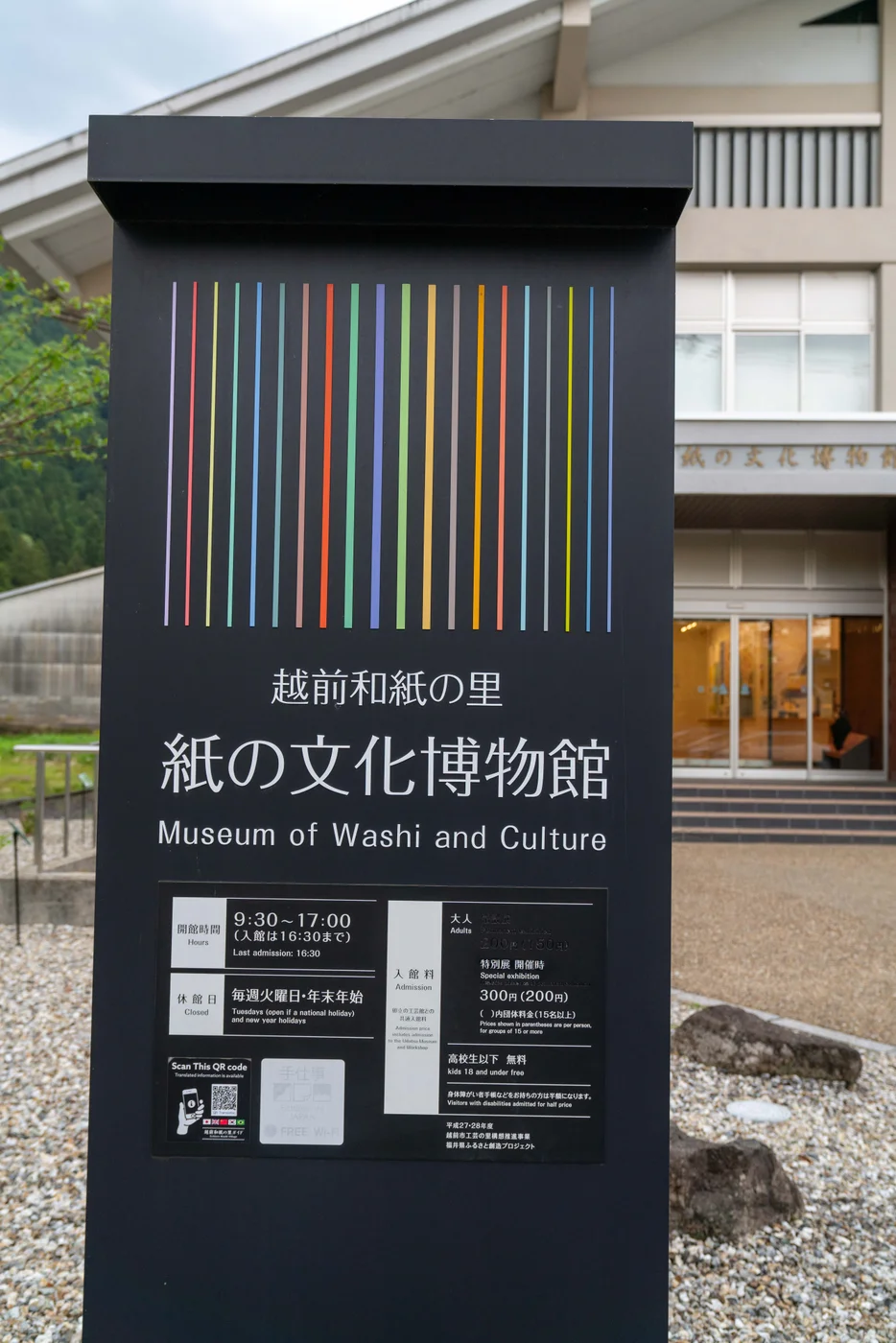
The second floor hosts special exhibitions of old papers, tools and master craftspeople. At the October 2026 check, the official homepage listed “How Echizen Washi Is Made IV: The Basics” until 23 November and “Cats Dwelling in Washi” until 11 January 2027. Udatsu separately listed Takashi Ono woodblock prints from 23 October to 30 November. Visitors interested in tools and print paper can include both exhibition programmes.
Udatsu follows movement; the museum lets you linger over finished sheets. The suggested order is forming at Udatsu, then fusuma dimensions, surfaces and patterns in the annex. Start at the museum if you prefer learning Japanese technique terms first: take a few recognisable tools and grades to compare at the demonstration. Paper and Culture Museum: floors and exhibits
Kawakami Gozen’s legend links papermakers in shared worship
Goka tradition tells of a woman appearing upstream about 1,500 years ago and teaching villagers papermaking. Asked her name, she said only that she lived upstream, then vanished. People revered her as Kawakami Gozen, enshrined at Okamoto as the founding paper deity. The cooperative’s origin account links water, taught skills and livelihood in one story.
The deity also connects with later production. The cooperative records Echizen craftspeople going to Tokyo to research banknote paper, followed in late Taisho by enshrinement of a divided spirit of Kawakami Gozen in the Printing Bureau’s papermaking department. Worship travelled beyond the district with craftspeople and technology. The walk from museum to shrine gives paper, tools and history a shared sacred place.
Knowledge travelled back too. The cooperative says craftspeople brought Printing Bureau techniques home to Goka, and the district later taught improved-paper methods elsewhere. Read the deity’s movement alongside knowledge exchange: one links shared belief, the other materials, equipment and products. Goka was a production area in continuing contact with other places.
Okamoto and Otaki have separate histories. The prefectural account records Otaki’s prosperity as the Tendai-affiliated Daitokuzan Otakiji temple, later serving as the collective tutelary deity of forty-eight villages centred on Goka. Read the paired shrine names through overlapping paper and regional worship before examining their combined building.
The shrines stand at 13-1 Otakicho, Echizen, about fifteen minutes’ walk from Washi Village. Walk slowly from Shinzaike’s museums to Otaki’s foothills, turning mapped names into real streets. Respect each business’s public areas en route, then set craft observation aside for a quiet shrine visit. Okamoto and Otaki shrines: introduction and access
Read the complex roof from the joined sanctuary and worship hall
Completed in 1843, the foothill building is nationally designated as “Otaki Shrine Main Sanctuary and Worship Hall”, with construction documents and drawings, since 21 May 1984. The prefecture records one building, with sanctuary and worship hall joined beneath connected roofs. Identify the nearer worship hall and higher sanctuary behind to establish the basic structure.
The sanctuary uses nagare-zukuri with triangular chidori and curved kara gables at the front. The worship hall is gable-entry irimoya, with a curved gable over its porch; all roofs use cypress bark. Start by distinguishing triangles and curves, then their overlap across front and rear roofs. The shrine likens the whole to peaks and waves; examine one eave or junction at a time.
Construction documents cited by the prefecture name carpenters including Okubo Kanzaemon from the Eiheiji temple town. Carving brings the view closer: the shrine describes lions, dragons, phoenixes and plants at the front, with sculpture based on Chinese stories at the sides and rear. After the roof, choose one group and locate it on the building for a second, smaller viewing scale. Fukui: Otaki sanctuary and worship hall
Cypress bark, woodland and the upper shrines
Hiwadabuki lays cypress bark in roof layers. The shrine records cypress and beech around the upper sanctuary within the Agency for Cultural Affairs’ Furusato Cultural Property Forest programme, with harvested bark also supplied to other heritage buildings. The renewed roof connects to woodland and continuing material supply. After paper fibres, roof bark shows another craft’s dependence on plants and labour.
The 2026 full replacement came thirty-six years after the 1990 work. The city’s September notice had scheduled completion by year-end; the shrine’s newer 28 October notice announced completion and reopening. Focus this visit on the repaired building and bark layers. Descriptions of moss-covered roofing belong to its pre-repair appearance.
Upper shrines on Mount Daitoku and the foothill satomiya occupy different heights. The cooperative describes separate Okamoto and Otaki sanctuaries above, with both worshipped together below; festivals bring deities down from the mountain. The foothill stop suits a standard paper day. Make the mountain path a main walking activity if visiting the upper shrines, reducing museum and workshop time accordingly.
Finish museum work before walking to the foothill shrines
The three facilities generally close Tuesdays and over New Year. Udatsu and the Paper and Culture Museum open 09:30–17:00, last entry 16:30; papermaking observation at Udatsu ends at 16:00. Papyrus House opens 09:00–16:00, last workshop reception 15:30, while its Washidokoro Echizen shop stays open until 16:30. Choose a day when the facilities open and put demonstrations and workshops first.
For arrival around 10:00, see Udatsu then the culture museum, allowing about two hours together, followed by an hour for lunch and rest. Return to Papyrus House around 13:30 for a basic workshop, then shop and walk towards the shrine around 14:30. These are suggested allowances including reading and waiting; agree your workshop start when contacting the venue. Without a workshop, give more afternoon time to samples and special exhibitions.
For the Hokuriku Shinkansen, use Echizen-Takefu Station; the venue gives about ten minutes by taxi or hire car. On Hapi-Line Fukui, alight at Takefu Station and take a Fukutetsu Nannetsu or Ikeda Line bus, about thirty minutes to Washi-no-Sato. These are different stations. Save Japanese names with your chosen route for the final connection.
Bus users should choose the return to Takefu first, then work backwards through leaving the shrine and walking to the stop. The shrine also gives a fifteen-minute walk from Washi-no-Sato. For a late morning arrival, omit optional making first and preserve Udatsu observation before 16:00. Complete timed indoor activities before the outdoor walk. Echizen Washi Village: facilities and access
Choose a short workshop or full nagashizuki by your purpose
Papyrus House’s basic process scoops pulp in a frame, adds pressed flowers and dye, removes water and dries for about ten minutes. The whole takes roughly twenty to forty minutes. General visitors are asked to contact ahead; groups of fifteen or more require reservations. Decide whether you want postcards, bookmarks or a larger sheet as a usable souvenir.
Prices checked in October 2026 list shikishi size at ¥700, two postcards at ¥700 or four at ¥1,100, and ten business cards or bookmarks at ¥1,300. Six nine-centimetre square coasters cost ¥1,100, medium sheets ¥1,300 and large sheets ¥2,500. Each price corresponds to a product format; companions can choose sizes they will use.
The water-pattern rakusui workshop costs ¥2,000 and requires booking at least two days ahead. Udatsu’s full nagashizuki uses 100% domestic kozo, requires telephone booking and costs ¥22,000 including tax: either two kiku sheets of 66 × 97 centimetres or four masa sheets of 44 × 55 centimetres. Rakusui explores water patterns on wet paper; the latter focuses on traditional forming and larger sheets. Rebuild the day around the booked full-workshop time.
General adult joint admission to Udatsu and the culture museum is ¥300; senior high school students and younger enter free. One adult taking both museums and a ¥700 basic workshop pays ¥1,000; two adults each making one pay ¥2,000. Meals, travel and purchases are additional. Museum entry is shared, while making is priced by the chosen product. Papyrus House: products, prices and reception
Finish with paper you will use
At Washidokoro Echizen, choose writing or painting paper, craft sheets or small goods. For ink, explain your brush and purpose. For a box, compare patterns at your cutting size. For a lamp-side sheet, examine transmitted light, patterns and fibre density. Morning observations of materials, templates and water become practical buying criteria.
Record maker, fibre and technique on the packaging so the information survives cutting or framing. The right purchase may be a small sheet with clear fibre outlines or postcards you will write on. A real use carries the details learned in the production district into daily life.
A few useful answers
How do I get to Echizen Washi Village from the railway station?
From Echizen-Takefu station on the Hokuriku Shinkansen, allow about 10 minutes by taxi or hire car. From Takefu station on the Hapi-Line Fukui, take a Fukutetsu bus on the Nan'etsu or Ikeda route to the Washi no Sato stop, a ride of around 30 minutes.
Where can I watch papermaking in Echizen Washi Village, and how much is entry?
Watch the papermakers at the Udatsu Craft Museum until 4pm. The museum closes at 5pm, with last entry at 4.30pm. A joint ticket for Udatsu and the Paper Culture Museum costs ¥300 per adult, and entry is free for upper secondary pupils and younger visitors.
Do I need to book papermaking at Papyrus Hall, and how long does it take?
Papyrus Hall asks visitors to get in touch in advance, and groups of 15 or more must book. A basic session takes around 20 to 40 minutes, with two postcards costing ¥700. The water-pattern workshop costs ¥2,000 and needs to be booked at least two days in advance.
Can I visit Echizen Washi Village and the Okamoto and Otaki shrines in one day?
Yes. Allow about two hours in the morning to watch papermaking at Udatsu and look through the paper samples at the Paper Culture Museum. After lunch, you can make paper at Papyrus Hall before walking roughly 15 minutes from the village to the Okamoto and Otaki shrines.
Official information and references
Sources used in this guide.
- Echizen Washi Village | Facilities, exhibitions and access
- Udatsu Paper and Craft Museum | House, work, nagashizuki and joint admission
- Papyrus House | Making, 2026 prices and certificate products
- Paper and Culture Museum | Exhibits, admission and hours
- Fukui Paper Industry Cooperative | Production area, grades and history
- Fukui Paper Industry Cooperative | Techniques
- Fukui Paper Industry Cooperative | Materials
- Udatsu Paper and Craft Museum | Sheet-forming processes
- Echizen tourism association | Makers and processes in the production district
- Fukui cultural properties | Echizen washi techniques: uchigumo, tobikumo and mizutama
- Fukui cultural properties | Otaki Shrine sanctuary and worship hall
- Okamoto and Otaki shrines | Introduction and access
- Okamoto and Otaki shrines | Roof completion notice, 28 October 2026
- Echizen City | 2026 reroofing and previous repairs