Starting November 1, 2026, Japan's tax-free shopping switches to a post-departure refund model: pay tax-inclusive prices at the register and claim your refund after customs confirms your goods upon exit. Here is the full guide to the ¥5,000 threshold, nine strict rules, and 2027 lucky bag schedules.
- Region & Focus
- Japan-wideWhen to visit
- Reading Scope
- 14 min read · 6 chapters · 4 Q&As
- Official Verification
- 14 official sources checkedUpdated November 27, 2026
- Key Topics
- ItinerariesWinter
Chapter Route Map (tap any stop)
- The New Tax-Free Core: Pay First, Refund at Exit, Valid for 90 Days
- Departure Customs Confirmation: Before Bag Drop, Green or Red Lights
- Nine Official Red Lines: Common Misconceptions Under the New Rules
- 2026–2027 Winter Sales: Official Lucky Bag and Hatsuuri Schedules
- City Winter Events: Illuminations and Markets in Tokyo and Osaka
- Airport Departure Routing and Quick FAQ Checklist
- Quick Q&A
Starting November 1, 2026, Japan's tax-free shopping system for international visitors undergoes a complete overhaul—the single most important update to know before a winter shopping trip. Decades of instant tax-free deductions at the store register ended on October 31, replaced from November 1 onward by a "refund method." Under the new system, every tax-free shop charges standard tax-inclusive prices at checkout, and the consumption tax is refunded only after customs officers confirm at your departure airport or seaport that the goods are physically leaving Japan with you. Eligibility thresholds are simpler too: spend ¥5,000 or more before tax at the same store on the same day under one buyer's name, with the old ¥10,000 general goods versus ¥5,000 consumables split, the ¥500,000 cap, and sealed plastic bags all retired. If you are planning a 2026–2027 winter sale haul, adjust your airport routine accordingly: pay full price at the register, stop at a customs confirmation terminal before checking your bags (green clears you, red sends you to bag inspection), or use Visit Japan Web's updated departure confirmation at seven supported airports. Drawn from official Japan Customs and National Tax Agency guidance, this guide maps out the new refund workflow, nine strict pitfalls, 2027 department store lucky bag dates, and winter illuminations across Tokyo and Osaka.
The New Tax-Free Core: Pay First, Refund at Exit, Valid for 90 Days
Start by marking the exact cutoff set by Japan Customs. The legacy tax-free shop system, which let visitors pay tax-excluded prices directly at the register, applied only through October 31, 2026. Beginning with purchases made on November 1, 2026, Japan implemented the refund method introduced under the FY2025 (Reiwa 7) tax reform. Under the new framework, every tax-free shop rings up the tax-inclusive price, and the consumption tax refund shifts to departure: the store issues the refund only after customs confirms the goods are genuinely exiting Japan in your possession.
The spending threshold is far simpler than before. Under current Japan Customs and National Tax Agency (NTA) regulations, you qualify whenever one eligible buyer spends at least ¥5,000 before tax at the same tax-free store on the same day. The old two-tier split of ¥10,000 for general goods and ¥5,000 for consumables has been scrapped in favor of a flat ¥5,000 pre-tax minimum. Eligibility is restricted to non-residents, covering foreign visitors entering on Temporary Visitor status as well as Japanese nationals returning temporarily after living abroad continuously for two years or more (who must carry documentation such as a My Number Card with overseas move-out notation). Gold bullion, platinum bullion, gold and platinum coins—excluded to deter resale—and items already exempt from consumption tax remain ineligible.
Three critical day counts govern the refund timeline. You must depart Japan within 90 days of the purchase date and present your passport in person for customs confirmation. If 90 days pass after the store transmits your purchase record without a matching customs exit clearance, the sale automatically converts back into a taxable transaction, forfeiting the refund. Customs retains exit confirmation records in its system for 460 days. Refunds are processed by the tax-free store or its designated provider via bank transfer, credit card refund, mobile app transfer, or cash at the departure port—whichever method you registered at checkout—so any follow-up questions about payout timing go straight to the original store.
Save the official guide to your phone before leaving home. Japan Customs, the NTA, and the Japan Tourism Agency (JTA) jointly publish a step-by-step procedural guide PDF (including the Traditional Chinese edition `refund_hantai.pdf` under the `taxrefund` directory on the Japan Customs website), and the Japan Duty-Free Shop Association (`zenmenkyo.jp`) maintains a dedicated portal on the new rules. From November 2026 onward, older blog staples—instant register deductions, sealed consumable bags, and separate customs shipping—are all obsolete.
The in-store experience at tax-free retailers looks different as well. Department stores, electronics chains, and drugstores still require official designation as tax-free shops to participate in the refund system, yet at the cash register, international visitors pay the exact same total as Japanese residents. The difference happens behind the counter, where staff log your tax-free purchase record electronically and register your preferred refund account. Before shopping, look for the official tax-free emblem at the entrance and aim for at least ¥5,000 pre-tax per store per day.
Eligibility boundaries are equally clear-cut. Overseas tourists entering Japan on Temporary Visitor status easily meet the non-resident requirement, whereas mid-to-long-term residents—such as international students and expat employees residing in Japan for six months or more—are subject to consumption tax and cannot claim refunds. One often-overlooked group is Japanese citizens who have resided overseas for at least two years and are visiting home temporarily; they qualify under the new rules if they present proof such as a My Number Card showing their overseas move-out record. Expect staff to verify three details when logging your purchase: your physical passport, your residence status, and your length of stay or overseas residency.
Starting November 1, 2026, Japan's tax-free shopping switches to a post-departure refund model: pay tax-inclusive prices at the register and claim your refund after customs confirms your goods upon exit. Here is the full guide to the ¥5,000 threshold, nine strict rules, and 2027 lucky bag schedules.
Departure Customs Confirmation: Before Bag Drop, Green or Red Lights
Timing your customs check is where most travelers slip up: the entire confirmation must happen before you check in for your flight or ferry—specifically, before handing over your checked luggage. Japan Customs explicitly states that once a suitcase is checked, confirmation cannot be processed, and travelers cannot ask airlines to pull checked bags back to the counter for tax-free verification. If you pack your haul into a large suitcase and drop it at the bag counter first, your refund for those items is gone. The right sequence at the airport is simple: skip the airline bag drop, carry your passport and tax-free goods straight to the customs confirmation area, and return to check your bags only after clearing it.
Major departure airports and seaports are equipped with Tax Refund Kiosks (self-service electronic terminals). To complete verification, scan your passport and have all purchased tax-free items physically on hand—showing a stack of receipts alone will not work. Once processed, the screen flashes one of two signals: green means confirmation is complete and you are free to go, while red directs you to the nearby customs inspection counter for physical bag inspection. Keep in mind that confirmation operates per purchase record (one receipt, one checkout). If even a single item from a receipt fails to leave Japan with you, the entire receipt loses tax-free eligibility under what officials call the "all-or-nothing" rule.
Visit Japan Web (VJW) also takes on the exact opposite role under the new system. Previously used to display a QR code at store registers instead of handing over your passport, VJW is now used on departure to complete online tax-free confirmation in place of an airport kiosk. Online confirmation is currently available only in the international departure lobbies (before security screening) of seven major international airports: Narita, Haneda, Kansai, Chubu Centrair, Fukuoka, New Chitose, and Naha. On site, connect your phone to the dedicated Customs wireless network (SSID: `Customs_WiFi_For_TaxRefund`, password: `jcustoms`), having completed your VJW tax-free profile setup ahead of time. If the Wi-Fi stalls or your setup is incomplete, head straight to a physical kiosk instead—it accomplishes the exact same step.
Plan to arrive at the airport earlier than usual on departure day. Official guidelines specify that if a traveler runs short on time and abandons inspection to catch a boarding call, customs confirmation is considered incomplete and the refund is voided. Cruise passengers face their own set of rules: those departing Japan by cruise ship to disembark abroad must complete confirmation at their final Japanese port of call (intermediate ports cannot process it), while travelers flying out of Japan to board a cruise overseas—or flying home after cruising—complete confirmation at their final departure airport.
Using a self-service kiosk is straightforward. Following the official guide, scan your passport photo page and receipt barcodes, review your item list, and display any requested items as prompted so the system can match your purchase records against your exit data and return a green or red signal. A red screen does not mean you broke a rule—the system runs random audits—so simply step over to the customs counter, open your bag for verification, and your clearance will be finalized. Budget at least 20 to 30 minutes for queueing and confirmation, and allow extra cushion during peak hours at hubs like Narita and Kansai.
Keep the 90-day clock and payout mechanism linked in your mind. A tax-free store can only release your refund once it receives the customs signal confirming your goods left Japan within 90 days of the sale. Forget to scan at departure, and after 90 days the retailer books the purchase as a standard taxed sale, ending any chance of a refund. Frequent short-term visitors to Japan should also verify every batch of purchases on the very next departure rather than holding items until a later trip.
Cruise and international ferry travelers should verify port facilities in advance. Before counting on confirmation at your final Japanese port of call, check the terminal location map on the Japan Customs website to see whether major cruise ports such as Yokohama, Nagasaki, or Kobe have permanent kiosks installed. Because cruise passengers often shop across multiple ports, keep receipts organized in separate folders by port—the "same day, same store" threshold still applies strictly to the date of purchase at each stop.
Nine Official Red Lines: Common Misconceptions Under the New Rules
Japan Customs condenses the easiest ways to forfeit a refund into nine strict rules. First, consumables used in Japan lose eligibility immediately: if you eat, drink, or use any portion of consumables—including food, beverages, medicine, and cosmetics—before leaving the country, those items fail exit verification. Do not attempt to scan them at a kiosk; declare them directly to a customs officer instead. By contrast, non-consumables such as electronics, clothing, shoes, and bags may be opened and used during your trip as long as you take them out of Japan with you.
Second, special sealed tamper-evident packaging has been officially abolished, so store clerks no longer need to tape drugstore hauls or snacks into sealed plastic bags. However, Customs cautions against tossing out outer boxes that carry model numbers, lot numbers, or identifying labels; if an item is separated from its packaging and officers cannot verify what it is at inspection, you still risk losing your refund, so keep original boxes intact until departure. Third, separate shipping is strictly banned: goods mailed home via courier, EMS, or Japan Post cannot be refunded, and all confirmed tax-free items must leave the country with you in person—the old separate-shipping (*besso*) program ended earlier on March 31, 2025.
Fourth involves legal liability: once tax-free items clear customs confirmation, you are legally obligated to take them out of Japan immediately. Anyone caught handing those items to someone else or leaving them inside Japan faces a bill for the exempted consumption tax plus statutory penalties under Japan's Consumption Tax Act. Fifth resets price expectations at the register: stores charge tax-inclusive prices across the board, meaning the familiar 10% instant tax-free markdown at checkout no longer exists from November 1 onward. Sixth catches domestic-connection flyers off guard: if your itinerary links a Japanese domestic flight to an international departure, never through-check your tax-free goods at the domestic airport—keep them with you until you clear customs at your international departure hub.
Rules seven through nine clear away the remaining legacy myths. The purchase ceiling is now effectively whatever you can personally carry out of Japan at departure, replacing the old ¥500,000 cap on consumables; the ¥5,000 same-day, same-store minimum is calculated strictly before tax; and every lingering rule from older guides—¥10,000 for general goods, the ¥500,000 consumables ceiling, and sealed plastic bags—ceases to apply on November 1, 2026.
In practice, before hauling home bulky appliances or suitcases full of cosmetics, remember that while the legal ¥500,000 cap is gone, your airline's checked-baggage weight limits and carry-on allowances become the real ceiling—every refunded item has to clear customs with you, and excess baggage fees can easily wipe out your tax savings. Likewise, if you are connecting domestically to an international flight (say, flying from Sapporo or Naha via Haneda), pack your tax-free purchases separately so you can bring them to Haneda's international terminal for customs confirmation before checking them in for the flight home.
2026–2027 Winter Sales: Official Lucky Bag and Hatsuuri Schedules
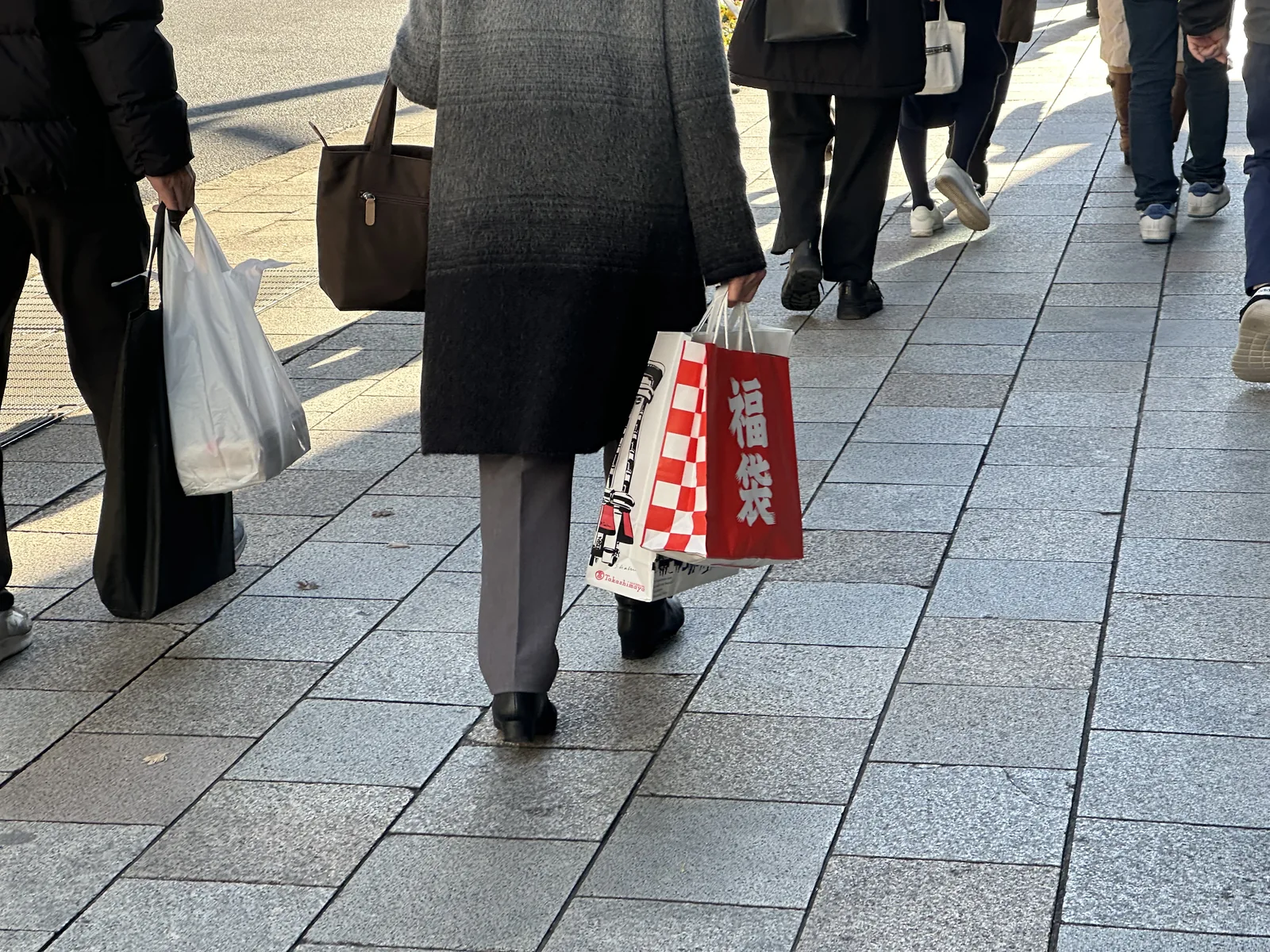
With the new tax-free workflow settled, turn your calendar to late-2026 and early-2027 department store winter sales and New Year lucky bags (*fukubukuro*). Takashimaya moved first by announcing its 2027 New Year All-Store Lucky Bags across 11 locations—Nihombashi, Shinjuku, Tamagawa, Yokohama, Omiya, Kashiwa, Takasaki, Osaka, Senboku, Kyoto, and Okayama—with in-store applications restricted to January 3 and 4, 2027. Headline offerings range from a two-person "digital detox" temple stay (*shukubo*) at Kyoto's Ninna-ji Temple (¥1,200,000 tax-included, lottery for 5 pairs / 10 guests) to a Jingisukan Special (¥2,027), Din Tai Fung xiaolongbao experiences (¥5,000 and ¥10,000), a frozen food and freezer bundle (¥20,270), and New Year beauty sets (¥25,000 and ¥65,000, with online applications open January 3 at 10:00 JST through January 11 at 23:59 JST).
Double-check New Year holiday closures before heading to any department store over New Year's Eve and New Year's Day. At Takashimaya Shinjuku, for instance, official hours are 10:00–18:00 JST on December 31 (with the B1 food hall opening at 9:30 JST), closed all day on January 1 and January 2, and reopening for *Hatsuuri* first sales on January 3 from 9:30 to 18:30 JST. At Takashimaya Nihombashi, year-end lucky bag reservations roll out starting December 1 across sought-after brands like Shiseido Parlour, MIKI HOUSE, and mezzo piano with designated pickup dates—meaning "pre-order in December, pick up in January" has largely replaced lining up overnight in the winter cold.
Daimaru Matsuzakaya's dedicated Fukubukuro 2027 site also launches early, releasing bags in staggered waves starting in early November (including November 2, 4, 10, 11, and 20). Online reservations for in-store pickup remain open until Friday, December 25, 2026 at 10:00 JST, helping shoppers bypass the January 3 crowds. Over at Isetan Mitsukoshi Group, whose website restricts access from IP addresses outside Japan, Nihombashi Mitsukoshi Main Store runs its *Fuyu-jitaku* winter campaign from November 4 to December 1, while exact 2027 *Hatsuuri* and lucky bag launch dates await formal group announcements.
Travelers frequently ask for the exact date Japan's winter sales start nationwide, but the Japan Department Stores Association (whose official domain is `depart.or.jp`—the rumored `departmentstore.jp` does not exist) sets no unified national calendar. Instead, markdowns roll out in three broad waves: suburban and urban shopping malls start earliest in late November alongside Christmas campaigns; independent apparel chains begin deeper cuts from late December into early January; and major department stores center their *Hatsuuri* sales and lucky bags on January 1 through 4. Planning your heaviest shopping around January 3 or shortly after hits the sweet spot between New Year excitement and genuine winter discounts.
One simple checkout habit prevents costly mistakes at the airport. Even though consumables and non-consumables now share the same ¥5,000 pre-tax minimum, their rules on use inside Japan remain completely different: using a cream or eating a box of cookies counts as domestic consumption and voids tax-free status, whereas wearing a coat or testing a camera does not. Never ring up gray-area items like a bottle of perfume you plan to wear or snacks you might open on the trip on the same receipt as big-ticket electronics, because the all-or-nothing rule means one opened snack box can forfeit the refund on an entire high-value receipt.
If your shopping list centers on Mitsukoshi or Isetan, plan around Isetan Mitsukoshi's geo-blocked website. While Nihombashi Mitsukoshi's *Fuyu-jitaku* campaign (November 4 to December 1) and year-end gift promotions are already underway, confirming 2027 *Hatsuuri* hours and lucky bag rules—including for Isetan Shinjuku—will require checking from a Japanese connection or following official social channels before you fly.
Shoppers eyeing Daimaru Matsuzakaya's online Fukubukuro 2027 drops need fast fingers. On each November release morning (November 2, 4, 10, 11, 20, and subsequent dates), heavy traffic floods the site at launch and popular brands or collaborations sell out within minutes. Online orders for store pickup close on December 25 at 10:00 JST, while in-store *Hatsuuri* dates and walk-in lucky bag schedules for individual branches will be announced separately.
City Winter Events: Illuminations and Markets in Tokyo and Osaka
Beyond department store counters, Tokyo and Osaka light up with seasonal illuminations and markets. In Tokyo, Marunouchi hosts the Harry Potter magical snow-themed "MARUNOUCHI BRIGHT HOLIDAY 2026," featuring roughly 1.2 kilometers of champagne-gold street trees along Marunouchi Naka-dori and the Gyoko-dori Christmas Market opening November 27 (select zones illuminate from 11:00 to 23:00 or 11:00 to 22:00 JST). Nearby Ginza connects department store campaigns through the Ginza Street Association (`ginza.jp`), including Ginza Mitsukoshi's Christmas Event PART 1 (November 11 to 24). In Osaka, the Osaka Convention & Tourism Bureau event calendar lists Hankyu Umeda Main Store's "Hankyu Christmas Market 2026" running from November 18 through December 25.
When building your evening itinerary, separate confirmed schedules from unannounced street events. Marunouchi's official page locks in the November 27 start for the Gyoko-dori Christmas Market and exact lighting hours, whereas Ginza's official portal highlights individual department store promotions rather than a single district-wide lighting calendar. Larger street displays—such as Osaka's Midosuji illumination, Kyoto shopping arcades, or Shinsaibashi-suji winter lights—should be verified directly against each organizer's current-year notice before penciling them in.
Sequencing your shopping days against your departure flight also pays off physically. Since every tax-free purchase must pass customs before bag drop, the more you buy on your final day, the heavier your carry to the airport terminal. A smoother approach is to finish major shopping on your second-to-last day so you can sort boxes and receipts calmly at your hotel and arrive at the airport with plenty of buffer. If your trip coincides with Takashimaya's in-store lucky bag applications on January 3 or 4, knock out the store registration first thing in the morning before sightseeing—or lock in Daimaru Matsuzakaya's online pre-order before December 25 to skip lines altogether.
The late-year festive arc flows cleanly into New Year's sales. Tokyo's Marunouchi (illuminations plus the Christmas market from November 27) and Ginza store windows, alongside Osaka's Hankyu Christmas Market (November 18 to December 25), all wrap up in late December, overlapping with year-end *Oseibo* gift season that begins in early November before pivoting straight into the January 3–4 *Hatsuuri* rush. Keep in mind that late December through January 3 is also Japan's peak annual window for hotel and rail prices, so book lodging early if you are targeting winter sales.
Combining Marunouchi and Ginza makes for an effortless Tokyo evening walk. The two neighborhoods sit comfortably within walking distance: after early December, stroll beneath Marunouchi Naka-dori's champagne-gold lights and browse the Christmas market, then cross into Ginza to see holiday displays at Ginza Mitsukoshi (including Xmas Collection 2026) and neighboring flagships—leaving all daytime tax-free bags safely packed for customs check on departure day.
Step into a department store basement (*depachika*) in late autumn or December and you will also encounter *Oseibo*, Japan's traditional year-end gift-giving season—spotlit by promotions such as Daimaru Matsuzakaya's 2026 *Oseibo* & Winter Gift Special and Mitsukoshi's *Oseibo* campaign running through December 26. These gift sets are overwhelmingly gourmet food and alcohol (consumables), so if you plan to present them to friends or colleagues inside Japan or enjoy them during your stay, they do not qualify for tax-free refunds; always ring them up separately from souvenirs you intend to bring home.
Airport Departure Routing and Quick FAQ Checklist
Check your departure gateway before heading to the airport. If you fly internationally out of Narita, Haneda, Kansai, Chubu Centrair, Fukuoka, New Chitose, or Naha, connect to the dedicated Wi-Fi (`Customs_WiFi_For_TaxRefund`, password `jcustoms`) in the pre-security international departure hall to complete tax-free confirmation in Visit Japan Web (provided you set up your VJW profile in advance). At regional airports—or anytime your phone hits a snag—head directly to an on-site Tax Refund Kiosk. You can verify exact floor locations for terminals and customs counters nationwide on the Japan Customs website beforehand; at smaller seaports without permanent kiosks, report straight to customs officers on duty.
Airport exit flow is straightforward once you follow the order of operations. After scanning at the terminal before bag drop and receiving a green clearance screen, pack your items into checked luggage or carry them on and proceed through security as usual. If the screen turns red, roll your bags to the adjacent customs inspection counter for a quick check before heading back to check-in. Refunds are issued afterward by the original tax-free shop via the payout channel registered at checkout (credit card reversal, bank transfer, or app credit)—not handed out in cash at an airport counter—with processing times varying by retailer. If questions come up mid-trip, the Japan Tourism Agency operates a dedicated tax-free helpline (weekdays 8:30–17:00 JST).
Before zipping up your suitcase, run through the nine essentials one last time: pay tax-inclusive prices at the register, spend at least ¥5,000 pre-tax at one store in one day, depart within 90 days of purchase, clear a kiosk or VJW with your passport and all items before checking bags, leave all consumables unopened in Japan, keep identifying product packaging intact, never mail items home via courier or EMS, remember each receipt is all-or-nothing, and always export confirmed goods to avoid back-taxes and fines. For easy shopping logistics, base yourself near Marunouchi or Ginza in Tokyo, or around Nakanoshima or Shinsaibashi in Osaka. Try our Japan 2026–2027 Tax-Free & Hotel Tax Calculator on the homepage before packing to check your estimated refund.
Boiling it down to a departure-day checklist—passport in hand, all tax-free items kept out of checked bags, departing within 90 days of purchase, all consumables untouched in Japan, original packaging preserved, and Visit Japan Web pre-configured or a kiosk stop planned—turns airport tax refunds into a smooth routine rather than guesswork. Even if a terminal flashes red on your first scan, cooperating with a quick customs bag check gets you cleared and onto your flight home.
A few useful answers
How does tax-free shopping in Japan work from November 2026 onward?
Japan is switching entirely to a refund model: stores charge tax-inclusive prices at checkout, and purchases totaling ¥5,000 or more before tax at the same store on the same day qualify. On your departure day, before checking your luggage, bring your passport and all tax-free items to a customs confirmation terminal (or use Visit Japan Web at seven major airports). A green light clears you to leave; a red light directs you to physical inspection. Once cleared, the store refunds the consumption tax via your registered method. You must depart within 90 days of purchase, and instant register discounts are no longer offered.
Do the old tax-free rules or the ¥500,000 cap still apply?
No. The legacy rules—instant in-store exemptions, the split ¥10,000 general goods and ¥5,000 consumables thresholds, the ¥500,000 consumables cap, and sealed tamper-evident bags—expire on October 31, 2026. The new system sets a unified ¥5,000 tax-excluded threshold per store per day, removes the monetary cap (limited in practice by what you can carry out in person), and eliminates sealed bags. Separate shipping (besso) was already abolished earlier on March 31, 2025.
Can I still get a tax refund if I use consumables like cosmetics or snacks in Japan?
No. If any portion of a consumable item—such as cosmetics, medicine, or food—is eaten or used inside Japan, it cannot pass customs exit confirmation; do not scan it at the kiosk, and instead declare it to a customs officer. Non-consumables like electronics, clothing, and bags may be used during your trip as long as you take them out of the country. Because eligibility is judged all-or-nothing per receipt, a single missing item voids the refund for the entire receipt, and failing to export confirmed goods triggers back-taxes and penalties.
When do 2027 lucky bags (Fukubukuro) and New Year sales start, and can overseas visitors order online?
Daimaru Matsuzakaya’s online in-store pickup reservations close December 25, 2026 at 10:00 a.m., and Takashimaya Nihonbashi begins year-end bookings December 1. In stores, Isetan Shinjuku closes January 1 and starts hatsuri on January 2 at 10:00 a.m., while Takashimaya and most Daimaru branches close January 1–2 and open January 3 (Takashimaya’s 11-store shared lucky bags run January 3–4). Most online lucky bags ship only to Japanese domestic addresses and often require Japanese-issued cards, so overseas shoppers should book in-store pickup or shop in person on January 2–3.
Official information and references
Sources used in this guide.
- Japan Customs | Tax-Free Shopping System for Foreign Visitors (Refund Method from Nov 1, 2026, ¥5,000 Threshold, 7 VJW Airports)
- National Tax Agency | Review of the Refund Method for Export Goods Salesplaces (FY2025 Tax Reform)
- National Tax Agency | Refund Method Overview Q&A (Thresholds, Eligibility, 90-Day & 460-Day Rules, All-or-Nothing)
- Japan Customs, JTA & NTA | Tax-Free (Tax Refund) Procedures Guide for Foreign Visitors (Traditional Chinese PDF)
- Japan Customs | Visit Japan Web Online Procedures (7 Airports, Dedicated Wi-Fi SSID & Password)
- Japan Customs | Nationwide Tax-Free Terminal & Customs Inspection Counter Locations
- Japan Tourism Agency | Notice on Abolition of Separate Shipping (Besso) System (Ended March 31, 2025)
- Japan Duty-Free Shop Association | Refund Method Guide (¥5,000 Pre-Tax Minimum)
- Takashimaya | 2027 New Year All-Store Lucky Bags Press Release (11 Stores, In-Store Applications Jan 3–4)
- Takashimaya Shinjuku | Year-End & New Year Operating Hours (Closed Jan 1–2, Hatsuuri Jan 3 at 9:30 JST)
- Daimaru Matsuzakaya | Fukubukuro 2027 Online Special (Store Pickup Orders Through Dec 25, 2026 at 10:00 JST)
- Marunouchi | MARUNOUCHI BRIGHT HOLIDAY 2026 (Harry Potter Theme, Gyoko-dori Christmas Market from Nov 27)
- Osaka Convention & Tourism Bureau | Hankyu Christmas Market 2026 (Nov 18–Dec 25, Hankyu Umeda Main Store)
- Japan Department Stores Association | Official Site (depart.or.jp, No Unified Sale Calendar)