From 1 November 2026, Japan's visitor tax-free system switches completely to an airport refund model: shoppers pay the tax-inclusive price in-store and receive their refund only after customs confirms the goods are leaving the country. The minimum spend is a flat ¥5,000 (excluding tax) per person, per shop, per day, while sealed bags and separate shipping are scrapped. With 2027 fukubukuro (lucky bag) reservations moving forward to November and December — and Takashimaya's 11-store joint lucky bags opening for in-store applications on 3–4 January — here is the full procedure, the nine strict rules, and key department store schedules based on the latest Japan Customs and National Tax Agency guidance.
- Region & Focus
- Japan-wideWhen to visit
- Reading Scope
- 14 min read · 6 chapters · 4 Q&As
- Official Verification
- 14 official sources checkedUpdated 27 November 2026
- Key Topics
- ItinerariesWinter
Chapter Route Map (tap any stop)
- How the New Tax-Free System Works: Pay Tax In-Store, Claim on Departure Within 90 Days
- Departure Customs Confirmation in Practice: Before Bag Drop, Green vs Red Lights
- Nine Official Red Lines: Common Myths Under the New Rules Debunked
- 2026–27 Winter Sales: Official Fukubukuro and Hatsuri Schedules
- Winter in the City: Illuminations and Christmas Markets in Tokyo and Osaka
- Airport Tax-Refund Workflow and Frequently Asked Questions
- Quick Q&A
On 1 November 2026, Japan's tax-free shopping rules for overseas visitors undergo a sweeping overhaul — and it is the single biggest change anyone planning a winter shopping trip needs to know before hitting the shops. The long-standing system of deducting consumption tax on the spot at the till ended on 31 October; for all purchases from 1 November onwards, Japan operates a refund system. Every tax-free shop now charges the full tax-inclusive price at checkout, and the retailer only refunds the tax equivalent once customs at your departure airport or port confirms that you are physically taking the goods out of the country. At the same time, the qualifying threshold is simplified to ¥5,000 or more (excluding tax) for the same shopper, at the same shop, on the same day, scrapping the old split between ¥10,000 for general goods and ¥5,000 for consumables, the ¥500,000 cap, and sealed plastic bags. If you are shopping the 2026–2027 winter sales, follow the new sequence from your very first receipt: pay the tax-inclusive price in-store, scan your passport and items at a customs confirmation terminal before checking in your luggage (green light clears you; red light means a bag inspection), or use Visit Japan Web's new departure confirmation feature at seven major airports. Drawing on official Japan Customs and National Tax Agency documents, this guide maps out the end-to-end airport workflow, the nine non-negotiable rules, 2027 New Year lucky bag schedules, and major winter illuminations in Tokyo and Osaka.
How the New Tax-Free System Works: Pay Tax In-Store, Claim on Departure Within 90 Days
Start by marking the official cut-over date set by Japan Customs. The legacy Export Goods Sales Place (Tax-Free Shop) scheme ended on 31 October 2026, meaning the familiar practice of paying the tax-free price directly at the shop counter is gone. For purchases made from 1 November 2026 onwards, the refund system introduced under the FY2025 tax reform applies across the board. Every tax-free retailer charges the standard tax-inclusive price at the till, shifting the tax refund to your departure: the shop issues the refund only after customs verifies that you are taking the tax-free items out of Japan with you.
Qualifying spend thresholds are far simpler than before. Under current Japan Customs and National Tax Agency rules, you qualify as soon as your purchases total ¥5,000 or more (excluding tax) for the same eligible buyer, on the same calendar day, at the same tax-free shop. The old two-tier split — ¥10,000 for general goods and ¥5,000 for consumables — has been abolished, leaving a single ¥5,000 pre-tax baseline. Eligibility is restricted to non-residents, covering foreign visitors entering on Temporary Visitor status as well as Japanese nationals who have lived abroad continuously for two years or more and are returning temporarily (who must present documentation such as a My Number Card noting their overseas move-out). Gold and platinum bullion, gold and platinum coins (excluded to prevent resale), and items inherently exempt from consumption tax do not qualify.
Three strict time limits govern the entire refund cycle. You must depart Japan within 90 days of the purchase date and present your passport in person for customs confirmation. If 90 days pass after the shop transmits your purchase record without a customs clearance confirmation, the sale automatically reverts to a standard taxable transaction and you forfeit the refund; customs confirmation records are retained in the system for 460 days. The refund itself is handled by the tax-free retailer or its appointed agent via bank transfer, credit card refund, mobile app transfer, or cash payout at the departure port, strictly following the method you registered at checkout. Any questions about delayed payouts must be taken up directly with the original shop.
Before you fly, save the official guidance from Japan Customs, the National Tax Agency, and the Japan Tourism Agency to your phone for quick reference (published in the taxrefund directory on the Japan Customs website, including refund_hantai.pdf for Traditional Chinese readers, alongside English-language guides and the Japan Tax-Free Shop Association's dedicated refund page at zenmenkyo.jp). From November 2026 onwards, older travel guides mentioning instant till discounts, sealed consumable bags, and separate postal shipping via customs are completely out of date.
The in-store checkout experience has changed accordingly. Department stores, electronics superstores, and chemist chains still require official certification as tax-free shops to offer the refund system, but at the register an overseas visitor now pays the exact same price as a local resident. The difference is that staff record your tax-free purchase data and register your preferred refund method at the same time. Look for the official tax-free sign at the entrance and aim for at least ¥5,000 before tax per shop, per day.
Eligibility boundaries are strictly enforced. Holidaymakers entering Japan on Temporary Visitor status easily qualify as non-residents, whereas students, seconded employees, and other mid-to-long-term residents (anyone residing in Japan for six months or more is treated as taxable) are ineligible. Often overlooked is that Japanese citizens living overseas for at least two consecutive years also qualify during temporary visits home, provided they carry proof such as a My Number Card bearing an overseas relocation record. Your physical passport, residence status, and duration of stay are the three checks every shop performs when logging a purchase.
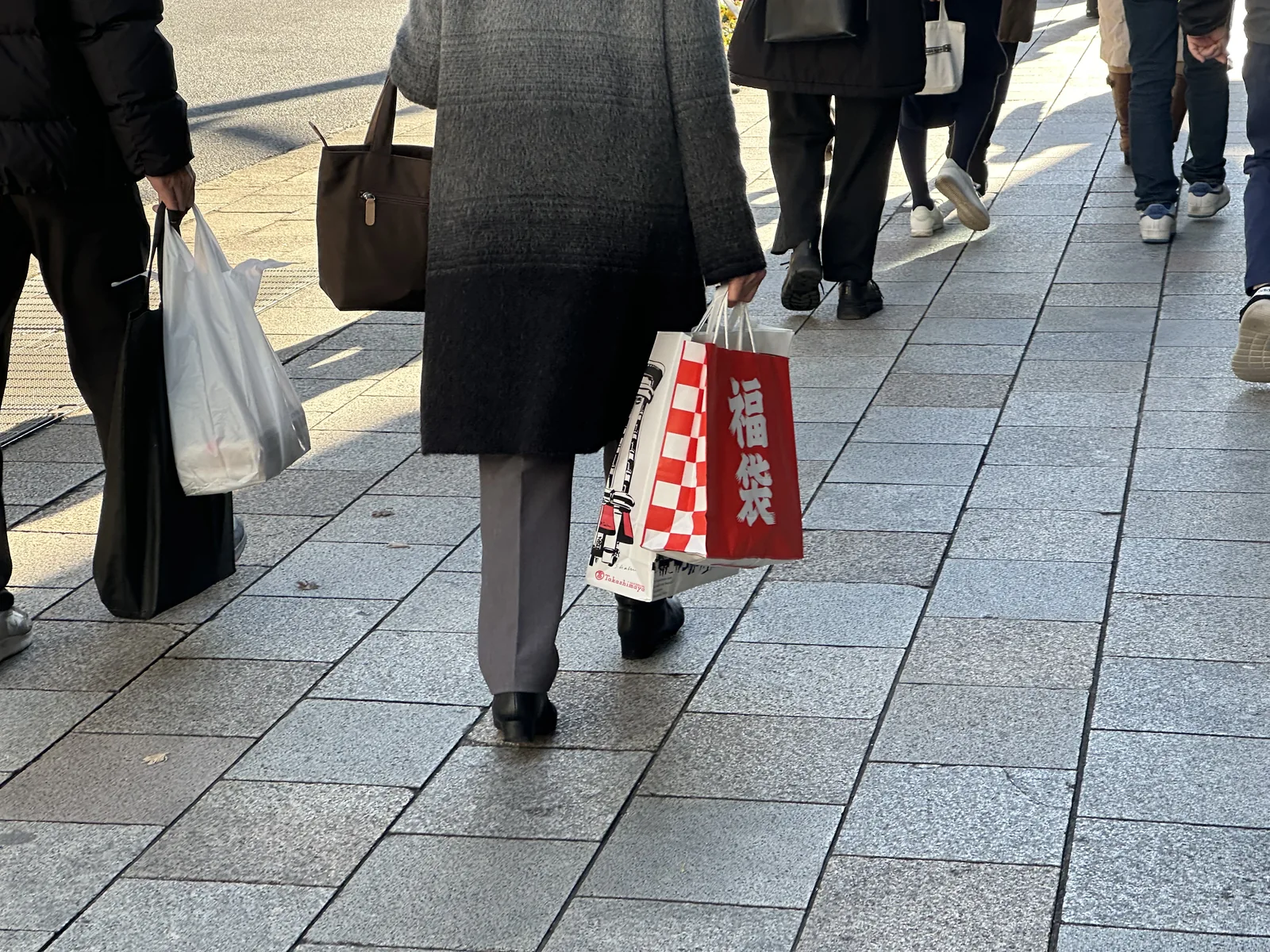
From 1 November 2026, Japan's visitor tax-free system switches completely to an airport refund model: shoppers pay the tax-inclusive price in-store and receive their refund only after customs confirms the goods are leaving the country. The minimum spend is a flat ¥5,000 (excluding tax) per person, per shop, per day, while sealed bags and separate shipping are scrapped. With 2027 fukubukuro (lucky bag) reservations moving forward to November and December — and Takashimaya's 11-store joint lucky bags opening for in-store applications on 3–4 January — here is the full procedure, the nine strict rules, and key department store schedules based on the latest Japan Customs and National Tax Agency guidance.
Departure Customs Confirmation in Practice: Before Bag Drop, Green vs Red Lights
Timing is where most travellers trip up under the new rules: customs confirmation must be completed before you check in for your flight or ferry — specifically, before your suitcases go onto the luggage belt. Japan Customs explicitly states that once luggage is checked in, confirmation will not be processed, and airlines will not pull checked bags back to the counter so you can claim a tax refund. If you pack your shopping into your suitcase and drop your bag first, you lose the refund on the spot. On arrival at the airport, head straight to the customs confirmation area with your passport and all tax-free goods in hand, and only check in your luggage after clearing the terminal.
Major airports and seaports are equipped with Tax Refund Kiosks (self-service electronic terminals). To use one, you must scan your passport and have every physical tax-free item from that trip with you — turning up with a stack of receipts alone will not work. Once scanned, the screen displays one of two outcomes: green means confirmation is complete and you may proceed; red means you must report to the nearby customs inspection counter for a physical bag check. Crucially, each confirmation is judged per individual purchase record (that is, per single receipt or transaction) under an 'all or nothing' rule: if even one item on a receipt is missing from your luggage, the entire receipt loses its tax-free eligibility.
Visit Japan Web (VJW) has taken on a completely different role. Under the old system, shoppers showed a VJW QR code at the till instead of pulling out their passport; under the new system, VJW serves as an online alternative to airport kiosks on departure. Digital confirmation via VJW is currently limited to the international departure concourses (before security) at seven major international airports: Narita, Haneda, Kansai, Chubu Centrair, Fukuoka, New Chitose, and Naha. At the airport, connect your phone to the dedicated customs Wi-Fi network (SSID: Customs_WiFi_For_TaxRefund, password: jcustoms), having already completed the tax-refund setup inside VJW beforehand. If the connection lags or your setup is incomplete, simply step over to a self-service kiosk instead.
Give yourself more time at the airport than you used to. Official guidance makes clear that if you run short on time and abandon an inspection to catch your flight, customs confirmation is treated as incomplete and your refund is voided. Cruise passengers face specific port rules: if you leave Japan by cruise ship and disembark abroad, you must complete confirmation at your final Japanese port of call (earlier ports do not count); if you leave a domestic cruise in Japan and then fly abroad, complete confirmation at your final departure airport.
Using a Tax Refund Kiosk is straightforward: scan your passport's photo page and receipt barcode, review the item list, and present goods if prompted by the screen, after which the system matches your purchase records against your departure details and flashes green or red. A red light does not mean you have broken a rule — the system performs random checks as well as targeted inspections — so simply wheel your bags to the customs counter for verification, after which your confirmation counts as complete. Allow at least 20 to 30 minutes for queuing and scanning, and build in extra buffer during peak hours at hubs like Narita and Kansai.
Keep the 90-day clock in mind when expecting your payout. A shop can only release your tax refund once it receives the 'export confirmed' signal from customs within 90 days of the sale date. If you forget to scan at the terminal before flying home, the retailer automatically books the sale as a normal tax-inclusive purchase on day 90 and the refund is gone for good. Frequent short-hop visitors should also note that every purchase must be confirmed on your very next departure from Japan — you cannot carry receipts over to a later trip.
Passengers travelling by cruise ship or international ferry should check terminal facilities in advance. Before calling at your final Japanese port — such as Yokohama, Nagasaki, or Kobe — check the terminal location map on the Japan Customs website to see whether permanent kiosks are installed. Because cruise itineraries often involve shopping across multiple port calls, store your receipts separated by port and date, as the 'same shop, same day' ¥5,000 minimum still applies strictly on each port day.
Nine Official Red Lines: Common Myths Under the New Rules Debunked
The official Japan Customs guide distils the easiest pitfalls to hit into nine hard rules, any one of which can make or break a refund. First, consumables used or opened in Japan lose eligibility immediately: if you eat, drink, or use any portion of tax-free food, beverages, medicine, or cosmetics before departing, those items cannot pass customs export confirmation. Do not try to put them through a kiosk anyway; instead, declare them directly to a customs officer. By contrast, non-consumables such as electronics, clothing, shoes, and bags may be unpacked and used during your stay, provided you physically carry them out of Japan when you leave.
Second, the old 'special sealed bag' requirement has been scrapped, so shop staff no longer need to seal cosmetics or snacks inside tamper-evident plastic bags. However, Japan Customs warns travellers not to discard outer packaging displaying model numbers, batch codes, or identifying labels: if customs officers cannot match an unboxed item against your purchase record during an inspection, you can still lose your refund, so keep original boxes intact until departure wherever practical. Third, separate shipping is strictly banned: goods posted home via courier, EMS, or Japan Post cannot be refunded, and all confirmed tax-free items must leave the country with you in person — the old 'separate delivery' system was abolished back on 31 March 2025.
Fourth, legal liability attaches once customs confirms your items: any tax-free goods cleared at the terminal must leave Japan with you immediately. Handing them over to someone else or leaving them behind inside Japan exposes you to back-collection of the consumption tax and penalties under Japan's Consumption Tax Act. Fifth, adjust your expectations at the till: shops collect the tax-inclusive price across the board, so the old '10% off at the counter' discount no longer exists from 1 November onwards. Sixth, watch out for domestic-to-international flight connections: if you fly a domestic leg before transferring to an international departure, never check tax-free purchases all the way through at the regional airport — carry them with you to the international departure airport and clear customs confirmation there first.
Rules seven through nine clear away the remaining legacy habits: there is no longer a ¥500,000 cap on consumables, replaced simply by what you can reasonably carry out of Japan with you on departure; the ¥5,000 same-day, same-shop minimum is always calculated on the pre-tax total; and all old rules still circulating online — the ¥10,000 general goods threshold, the ¥500,000 consumables ceiling, and mandatory sealed bags — became invalid on 1 November 2026.
In practice, before buying bulky appliances or bulk cosmetics, remember that while the ¥500,000 legal cap is gone, your airline's checked-baggage weight limit and cabin allowance now act as the real ceiling. Everything you claim a refund on has to accompany you to customs before boarding, and excess baggage fees can easily wipe out the tax you get back. Likewise, on a domestic-to-international transfer — such as flying from Sapporo or Naha via Haneda to catch your flight home — pull your tax-free bags out for the domestic leg and check them in only after clearing customs at Haneda's international terminal.
2026–27 Winter Sales: Official Fukubukuro and Hatsuri Schedules
With the tax rules straight, the next step is timing the year-end winter sales and New Year fukubukuro (lucky bags). Takashimaya has moved first by announcing its 2027 'Store-Wide Joint Lucky Bags' across 11 branches — Nihombashi, Shinjuku, Tamagawa, Yokohama, Omiya, Kashiwa, Takasaki, Osaka, Semboku, Kyoto, and Okayama — with in-store application models restricted to 3 and 4 January 2027. Headline sets include a 'digital detox' two-person temple-lodging stay at Ninna-ji in Kyoto (¥1,200,000 tax-included; lottery for five pairs, 10 guests total), a Genghis Khan Special (¥2,027), Din Tai Fung xiaolongbao experiences (¥5,000 or ¥10,000), a frozen-food-plus-freezer bundle (¥20,270), and New Year beauty sets (¥25,000 or ¥65,000, with online applications open from 10:00 JST on 3 January until 23:59 JST on 11 January).
Always check New Year closure dates before heading to a department store over the holidays. At Takashimaya Shinjuku, for example, official hours are 10:00–18:00 on 31 December (with the B1 food hall opening at 09:30), closed all day on 1 and 2 January, and reopening at 09:30–18:30 on 3 January for the Hatsuri first sale. Meanwhile, Takashimaya Nihombashi starts rolling out in-year lucky bag pre-orders from 1 December for popular names such as Shiseido Parlour, Miki House, and Mezzo Piano, with collection on designated dates — meaning 'order in December, pick up in January' has largely replaced queuing overnight in the freezing cold.
Daimaru Matsuzakaya has also opened its 'Fukubukuro 2027' online hub early, releasing waves of lucky bags from early November across 2, 4, 10, 11, and 20 November, with in-store pickup pre-orders open until 10:00 JST on Friday, 25 December 2026 so shoppers can skip the 3 January crowds. Over at Isetan Mitsukoshi Group, the official website restricts access from IP addresses outside Japan; Nihombashi Mitsukoshi Main Store's 'Fuyujitaku' winter campaign runs from 4 November to 1 December, while exact 2027 Hatsuri and lucky bag launch dates await the group's subsequent announcements.
Visitors often ask when Japan's winter sales start nationwide, but the Japan Department Stores Association (official domain depart.or.jp; the often-rumoured departmentstore.jp does not exist) sets no single national sale date. Instead, markdowns follow three broad waves: shopping centres and outlets kick off earliest in late November alongside Christmas campaigns, high-street fashion chains slash prices from late December into early January, and department stores concentrate their Hatsuri sales and lucky bags between 1 and 4 January. Scheduling your main shopping run from 3 January onwards usually catches both the New Year atmosphere and deep winter markdowns.
One practical till trick can save an entire receipt's refund. Although the spending threshold is now a flat ¥5,000 before tax for both consumables and non-consumables, the rule on opening items in Japan still differs sharply: opening cosmetics or eating snacks counts as domestic consumption and disqualifies them, whereas wearing a new coat or testing a camera still qualifies as long as you take it home. Never mix questionable items — like a bottle of perfume you plan to wear on holiday or snacks you might open in your hotel — onto the same receipt as big-ticket electronics, because the 'all or nothing' rule means one missing snack pack will void the tax refund on the entire receipt.
If Mitsukoshi or Isetan are high on your list, factor in the Isetan Mitsukoshi website's geo-block on overseas IPs. While Nihombashi Mitsukoshi Main Store's Fuyujitaku showcase (4 November to 1 December) and year-end Oseibo gifting runs are already underway, check 2027 Hatsuri and lucky bag schedules (including Isetan Shinjuku) via a connection inside Japan or their official social channels before heading out.
Anyone targeting Daimaru Matsuzakaya's online 'Fukubukuro 2027' releases will need quick fingers. On each November drop date (2, 4, 10, 11, 20 November, and so on), traffic surges the moment morning sales open, and sought-after brands or collaborations often sell out within minutes. Online orders for in-store collection close at 10:00 JST on 25 December, while exact 2027 in-store Hatsuri and counter lucky bag dates per branch follow later official notices.
Winter in the City: Illuminations and Christmas Markets in Tokyo and Osaka
Between shopping sprees, central Tokyo and Osaka light up for the festive season. In Tokyo, Marunouchi hosts the Harry Potter-themed 'MARUNOUCHI BRIGHT HOLIDAY 2026', pairing roughly 1.2 km of champagne-gold tree illuminations along Marunouchi Naka-dori with the Gyoko-dori Christmas Market opening from 27 November; select light zones operate 11:00–23:00 or 11:00–22:00. Nearby, the Ginza Street Association (ginza.jp) coordinates department store seasonal events such as Ginza Mitsukoshi's Christmas event Part 1 (11–24 November). In Osaka, the Osaka Convention & Tourism Bureau calendar lists the 'Hankyu Christmas Market 2026' at Hankyu Umeda Main Store running from 18 November to 25 December.
When building your itinerary, distinguish confirmed dates from events awaiting annual updates. Marunouchi's official site confirms the Gyoko-dori Christmas Market launch from 27 November and exact illumination hours, while Ginza's official portal focuses on individual store calendars rather than a single street-wide lighting period. For major street illuminations such as Osaka's Midosuji Illumination, Kyoto shopping arcades, or Shinsaibashi winter lights, verify the current season's official dates before locking them into your evening plans.
There is also a smart physical rhythm to planning your shopping days around airport customs checks. Because every tax-free item has to pass customs before bag drop, buying heavily on your very last day only creates extra airport stress. A smoother approach is to do your main haul on your penultimate day in Japan, neatly pack boxes and organise receipts that evening, and arrive at the airport unhurried on departure day. If your dates coincide with Takashimaya's 3–4 January in-store lucky bag applications, hit the department store first thing in the morning to submit your entry before sightseeing; if you prefer to skip queues, lock in Daimaru Matsuzakaya's online pre-order before 25 December.
The winter retail and festive calendar links together neatly. Tokyo's Marunouchi illuminations (plus the Christmas market from 27 November) and Ginza window displays, along with Osaka's Hankyu Christmas Market (18 November to 25 December), all wrap up in late December, overlapping with department stores' Oseibo year-end gifting seasons starting in early November before pivoting straight into the 3–4 January Hatsuri sales. Bear in mind that late December through 3 January also marks Japan's annual peak for domestic travel and hotel rates, so book accommodation early if you are targeting the winter sales.
In Tokyo, pairing Marunouchi and Ginza in a single evening makes an effortless walking route. Both districts sit comfortably on foot from one another: from early December, stroll under Marunouchi Naka-dori's champagne-gold canopy and browse the Christmas market, then walk across into Ginza for the festive window displays at Mitsukoshi (such as Ginza Mitsukoshi's Xmas Collection 2026) and neighbouring department stores — keeping all daytime tax-free purchases safely packed for departure day.
Venturing into department store food halls in late autumn and December also introduces Japan's 'Oseibo' year-end gifting tradition, spotlighted in features like Daimaru Matsuzakaya's 2026 Oseibo & Winter Gift catalogue and Mitsukoshi's year-end gift season running until 26 December. Because these gift boxes mostly contain fine foods and alcohol (consumables), anything bought to hand over to friends in Japan or enjoy during your stay is ineligible for a tax refund — keep them on a separate receipt from souvenirs bound for your flight home.
Airport Tax-Refund Workflow and Frequently Asked Questions
Check your departure airport's setup before setting off. If you are flying internationally out of Narita, Haneda, Kansai, Chubu Centrair, Fukuoka, New Chitose, or Naha, connect to the dedicated Wi-Fi in the pre-security departure hall (SSID: Customs_WiFi_For_TaxRefund, password: jcustoms) to complete confirmation on your phone via Visit Japan Web (provided you set up VJW tax-refund details beforehand). At regional airports — or if mobile signal or setup hits a snag — head straight for the physical Tax Refund Kiosks. You can check exact terminal floor maps for every airport and seaport on the Japan Customs website; at smaller ports without permanent machines, speak directly to the customs officers on duty.
The departure sequence itself is straightforward once you follow the right order. Scan at a kiosk or via VJW before bag drop: if the screen turns green, pack the goods into your checked suitcase or carry-on and proceed through check-in and security as normal. If it turns red, wheel your bags to the adjacent customs inspection desk for a quick physical check, after which you continue to check-in. Your consumption tax refund is issued afterwards by the original shop using the payment channel registered at purchase (card refund, bank transfer, app credit, and so on) once customs sends back electronic confirmation — not in cash at a random airport desk — with payout timing determined by each retailer. If you have questions about the rules while travelling, the Japan Tourism Agency's tax-free helpline operates on weekdays from 08:30 to 17:00 JST.
Before zipping up your suitcase, run through the nine core rules one last time: pay the tax-inclusive price in-store; hit at least ¥5,000 before tax per shop, per day; depart within 90 days of purchase; bring your passport and every item to a customs terminal or VJW before bag drop; never consume or open consumables inside Japan; retain identifiable original packaging; never post tax-free items separately via courier or EMS; remember each receipt is judged all-or-nothing; and never leave confirmed goods behind in Japan, which triggers tax recovery and penalties. For convenience when shopping and packing, base yourself near Marunouchi or Ginza in Tokyo, or around Nakanoshima and Shinsaibashi in Osaka. Use our Japan 2026–2027 Tax-Free & Hotel Tax Calculator on the homepage before packing to estimate your refund.
Put simply, seven pre-check items on departure day turn tax refunds into a routine airport step rather than a gamble: passport ready, all tax-free goods kept out of checked luggage, departure within 90 days of purchase, all consumables completely unopened, original packaging intact, and either VJW configured in advance or a Tax Refund Kiosk lined up before bag drop. Even if your screen flashes red on your first trip under the new system, stay calm, let customs check the contents, and you will be cleared to board as usual.
A few useful answers
How do Japan's tax-free shopping rules work from November 2026?
Japan has switched completely to an airport refund model: tax-free shops charge the full tax-inclusive price at checkout, and spending ¥5,000 or more (excluding tax) at the same shop on the same day qualifies. On departure day — before checking your luggage — you must bring your passport and all tax-free items to a customs confirmation terminal (or use Visit Japan Web at seven major airports). A green screen clears you; a red screen directs you to a quick physical bag check, after which the shop refunds the consumption tax via your registered payout method. You must depart within 90 days of purchase, and instant tax deductions at the till no longer exist.
Do the old tax-free rules or the ¥500,000 cap still apply?
No. All legacy rules — instant tax deduction at the till, the split between ¥10,000 for general goods and ¥5,000 for consumables, the ¥500,000 consumables cap, and special sealed bags — ended on 31 October 2026. The current system uses a single ¥5,000 pre-tax minimum per shop, per day, removes the monetary cap (limited in practice by what you can carry out with you on departure), and abolishes sealed bags. Separate postal shipping ('separate delivery') was already abolished on 31 March 2025.
Can I still claim a tax refund if I use consumables like cosmetics or snacks in Japan?
No. Once any part of a consumable item — including cosmetics, medicines, food, or drinks — is opened or consumed inside Japan, it cannot pass customs export confirmation; do not scan it at a kiosk, and instead declare it directly to a customs officer. Non-consumables such as electronics, clothing, and bags may be used during your stay as long as you take them out of Japan with you. Remember that each receipt is assessed on an all-or-nothing basis, so missing even one item invalidates the entire receipt's refund, and failing to take confirmed goods out of Japan incurs back-taxes and penalties.
When do 2027 lucky bags and New Year sales begin, and can overseas visitors order online?
Daimaru Matsuzakaya’s online in-store pickup reservations close at 10:00 on 25 December 2026, and Takashimaya Nihonbashi opens bookings from 1 December. For in-store sales, Isetan Shinjuku closes on 1 January and launches hatsuri at 10:00 on 2 January, while Takashimaya and most Daimaru branches close 1–2 January and open on 3 January (Takashimaya’s 11-store shared lucky bags run 3–4 January). As most official online lucky bags ship only within Japan and require domestic cards, overseas visitors are better off booking store pickup or shopping on 2–3 January.
Official information and references
Sources used in this guide.
- Japan Customs | Tax-Free Shopping System for Foreign Visitors (Refund System from 1 Nov 2026, ¥5,000 Threshold, VJW 7 Airports)
- National Tax Agency | Review of Export Goods Sales Place System to Refund Model (FY2025 Tax Reform)
- National Tax Agency | Refund System Overview Q&A (Thresholds, Eligibility, 90-Day & 460-Day Rules, All-or-Nothing Principle)
- Japan Customs x Japan Tourism Agency x National Tax Agency | Tax-Free Shopping (Refund) Guide for Foreign Visitors (Traditional Chinese PDF)
- Japan Customs | Visit Japan Web Online Confirmation (7 Airports, Dedicated Wi-Fi SSID & Password)
- Japan Customs | Nationwide Directory of Tax Refund Terminals and Customs Inspection Counters
- Japan Tourism Agency | Notice on Abolition of Separate Delivery System (Ended 31 March 2025)
- Japan Tax-Free Shop Association | Refund System Guide (¥5,000 Pre-Tax Minimum)
- Takashimaya | 2027 New Year Store-Wide Joint Fukubukuro Press Release (11 Stores, In-Store Applications 3–4 January)
- Takashimaya Shinjuku | Year-End and New Year Opening Hours (Closed 1–2 Jan, Hatsuri Opens 09:30 on 3 Jan)
- Daimaru Matsuzakaya | Fukubukuro 2027 Online Feature (In-Store Pickup Pre-Orders Until 25 Dec 2026, 10:00 JST)
- Marunouchi | MARUNOUCHI BRIGHT HOLIDAY 2026 (Harry Potter Theme, Gyoko-dori Christmas Market from 27 Nov)
- Osaka Convention & Tourism Bureau | Hankyu Christmas Market 2026 (18 Nov – 25 Dec, Hankyu Umeda Main Store)
- Japan Department Stores Association | Official Website (depart.or.jp — No Unified National Sale Calendar)