For your first ski trip to Japan, choose suitable instruction and a practice area before arranging accommodation, equipment hire and transport. This guide separates snow play, an introductory session and continued learning, using named resorts and courses to explain ages, languages, costs and cancellation limits so each person has a workable day on snow.
First decide whether you want snow play, a taste of skiing or time to learn
Start planning a first ski trip to Japan by asking what each person wants from it. Someone who only wants to touch snow, build a snowman and take photographs needs a snow-play area open to pedestrians. Someone who wants to try sliding can fit an introductory lesson into a wider trip. Someone hoping to learn speed control and turns should arrange accommodation, transport and at least two days of practice around one base. All three aims can exist within one family, but family members may need different tickets or lessons.
This guide is for people trying snow sports for the first time and learning mainly on open, marked runs. It concerns choices and reservations; written advice does not replace an instructor’s demonstration, and the itinerary does not involve off-piste terrain, jumps or challenges linking several resorts. JNTO’s beginner guide recommends lessons for first-timers and notes that rental availability differs between resorts. Finding instruction you understand and equipment that fits is therefore usually more practical than choosing the biggest mountain.
Information was checked on 22 October 2026. Offers for the coming winter are identified as 2026–2027. Do not infer current prices, availability or transport schedules from the previous season when they are not stated here. Before departure, reconfirm operating areas and your booking for your own dates. The timing examples in this guide are planning suggestions, not transfer schedules promised by a transport operator or school.
Narrow the choice between Hokkaido, Nagano, Niigata and Tohoku
Hokkaido planning need not begin with a search for the best powder. If everyone needs instruction in a foreign language, first compare lessons and accommodation around Niseko’s Hirafu area, then arrange the airport-to-accommodation journey separately. If you are mainly staying in Sapporo and adding one ski day, compare day-trip transport from Sapporo instead. These bases are not easily interchangeable simply because both are in Hokkaido. The gentle slope you can actually use on day one matters more immediately than the mountain’s advanced terrain.
In Nagano, begin with one Hakuba resort. Hakuba Goryu’s official FAQ distinguishes the difficulty of its upper area from the descent routes to the base: a beginner run at the top does not mean you can ski all the way back to your hotel. GALA Yuzawa in Niigata can connect a Tokyo itinerary with skiing, but convenient transport still needs time for rentals, changing and lesson check-in. Appi Kogen in Tohoku offers a resort-centred hotel-and-skiing option; reaching and leaving that resort requires proper planning, unlike visiting a city attraction.
Eliminate resorts that fail a necessary condition before ranking recommendations. No lesson in your required language, an ineligible child, unavailable equipment sizes or accommodation too far from the meeting point can each justify choosing somewhere else. For beginners staying several days, learning in a familiar teaching area usually makes rest and progress easier to organise than moving to another mountain every day. That is itinerary advice, not a guarantee of a particular resort’s teaching results.
| Area | What to consider first | What is easily overlooked |
|---|---|---|
| Niseko Hirafu | Foreign-language instruction and several nights in one area | Airport transfers, meals and each school’s meeting point |
| Hakuba Goryu | Practice at one resort and compare accommodation near the base | The final journey to the teaching area and the way back down |
| GALA / Echigo-Yuzawa | Add a ski day to a Tokyo trip | Rentals, changing and buffer time for the return Shinkansen |
| Appi Kogen | A multiday stay centred on the resort | Arrival and departure transport, hotel building and activities for non-skiers |
An opening date does not mean every beginner facility is available
Before booking a room for the “ski season,” read the resort’s operating notice as well as checking hotel availability. GALA lists 12–18 December 2026 for sightseeing operations, running only the gondola and sightseeing chairlift; skiing is not permitted during that period regardless of snow cover. Ski operations are scheduled for 19 December through 5 May 2027. Mistaking sightseeing opening for open slopes can undermine the purpose of lessons, rentals and train tickets. Check the dates and limits on GALA’s operating-period and ticket page.
Parts of a resort may also remain closed during an otherwise operating season. GALA has announced that its South Area will close for 2026–2027, including the connecting ropeway to Yuzawa Kogen; a shuttle bus will provide the connection instead. A first-timer learning in the Central Area need not automatically reject GALA for this reason, but experienced companions’ plans to move between areas may change. Do not plan the group’s route from an old map. Read the South Area closure announcement and current operating information before booking.
Near the start or end of the season, beginners should ask whether the teaching area and return route will be open, not just how much snow is at the summit. Resort opening, a lesson going ahead, children’s facilities opening and skiable terrain at the base are separate conditions. If your only possible dates are early or late season, choose accommodation and transport with cancellation terms you can afford, and accept in advance that the day may become sightseeing or an indoor activity.
What a one-day introduction and two days of learning can offer
With only one day, aim to become familiar with the equipment, start sliding under instruction and learn basic control. A day pass is not a reason to ski continuously from opening to closing. Arrival, finding the counter, fitting equipment, changing and reaching the meeting point all take time. If the morning is already tight, a later lesson you can reliably check in for leaves more room than taking the first transport and rushing every step afterward.
Two days mean you do not have to relearn the layout or start boot fitting from scratch on the second morning, and you can adjust to your actual first-day experience. At the end of day one, note the instructor’s advice, where you may practice independently and terrain you should avoid. Decide whether to take another lesson according to control and stamina. One completed lesson is not automatic qualification to ride every chairlift alone.
If the group is unsure about skiing, consider two nights with one main introductory day and one flexible day. If learning is the reason for the trip, reserve two complete days and treat arrival and departure as travel days. That space costs more in accommodation, but prevents a half-day transfer from cutting into paid instruction. Compare the money saved by dropping a night with the learning and rest time you would lose.
Without a car, plan transport all the way to the instructor
When searching train arrival times, make the lesson meeting point your real destination. Station to resort, resort entrance to rental counter and counter to teaching area may each involve a shuttle, walking or a gondola. Assuming that twenty minutes after the train arrives is enough often means overlooking all the on-site procedures. Ask the school what must be completed before meeting, then work backward to acceptable transport services.
GALA’s station connects directly with its resort facilities, a major advantage from Tokyo, but not every train from Tokyo to Echigo-Yuzawa calls at GALA. Hakuba Goryu’s official access FAQ puts Kamishiro Station about 1.6 kilometres from Escal Plaza and describes winter shuttles. With ski boots, skis or a board and luggage, do not convert that distance into an ordinary flat-city walking time. Check the applicable seasonal timetable separately.
For a car-free plan, verify the arrival station, whether the shuttle needs booking, the exact exit or stop, the last return service and an affordable alternative if you miss it. At Hokkaido or Tohoku resorts, include flight delays and road conditions in the arrival day. If you lack winter-driving experience, a hire car should not be the default answer to transfer difficulties. First choose a base you can reach by public transport or confirmed transfers.
Choose accommodation by the meeting point, building and companions’ daytime needs
A slopeside stay and a station-area stay serve different purposes. If skiing is the main event and lessons start early every day, compare accommodation near the teaching area first. If you will ski once and spend other days eating out, walking and taking trains, the station area may fit better. Straight-line map distance does not prove an easy walk: consider gradients, snowy roads and whether you can reach rentals in ordinary shoes before changing.
A named example is The Vale Niseko’s location description. The property is in Upper Hirafu near the Ace Family Quad Lift and describes itself as ski-in/ski-out. That layout merits comparison if your lessons meet in the same base area, but a beginner should still confirm the walking entrance and instructor meeting point. Ski-in/ski-out does not establish that you can ski directly back to your door. Check separately whether accommodation, instruction and rentals form one booking.
At Appi, the official hotel introduction includes ANA Crowne Plaza Resort Appi Kogen among properties directly connected to the slopes; Holiday Inn’s Onsen and Hills buildings have different location characteristics. Keep the actual building, room type and entrance details, not only the hotel brand. This guide does not compare undated starting room rates or assume meals, passes or transfers are included. When requesting a quote, specify the party size, children’s ages, beds and cancellation deadline together.
Confirm Chinese, English or Japanese instruction before paying
A course page in Chinese does not prove a Chinese-speaking instructor will teach on your date. Confirm the actual teaching language, any interpretation, the check-in counter and lesson location, and the safety instructions participants must understand. If a child only understands Chinese, an adult’s English ability does not automatically bridge that gap. Ask whether a parent may interpret nearby and how that affects grouping.
Send each school the same needs: everyone’s age, skiing or snowboarding, whether they have ever worn ski boots, intended number of learning days, preferred language, accommodation location and any care or learning needs that should be disclosed early. If the school can only offer an unsuitable level or language, changing dates, booking privately or choosing another resort is more sensible than forcing an unsuitable lesson on arrival.
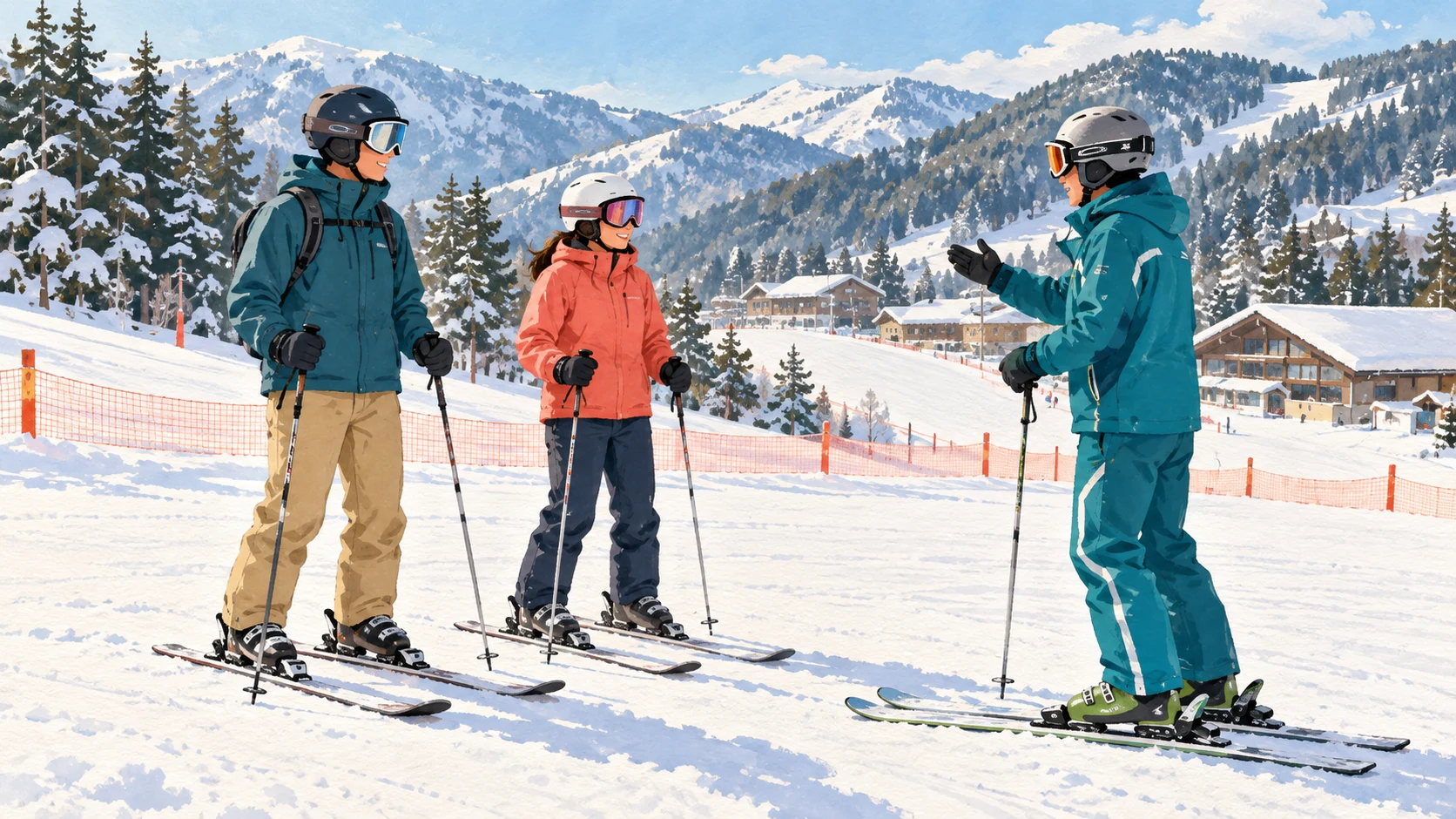
Group lessons generally follow the group’s ability and pace. Private lessons allow more adjustment within the booked time, but prices and participant limits depend on the product. A friend’s ability to ski does not establish teaching skill. If using an outside instructor, also confirm permission to teach at that resort. The school, operator, meeting point and payment recipient should all be identifiable and consistent, rather than resting on a messaging-app nickname.
Private lesson prices: use NBS to distinguish a group rate from a per-person rate
The 2026–2027 prices for NBS Niseko private lessons are per group of up to five people. A two-hour lesson is listed at ¥39,000 in the regular period, ¥44,000 at peak and ¥31,200 in spring. Regular dates are 1–19 December 2026 and 4 January–28 February 2027; peak dates are 20 December–3 January; spring runs 1 March–10 April. These are the school’s own price periods, not evidence that resort lift prices use the same dates.
This private product offers English instruction and cannot mix skiers and snowboarders in the same lesson. The school recommends similar ages and abilities within a group; lift passes are bought separately. Three adults of similar ability splitting a regular-period two-hour lesson pay ¥13,000 each for instruction, but a solo participant still pays the full ¥39,000 group rate. A five-person maximum does not make combining five very different abilities good value: helping the participant who needs most assistance also takes teaching time.
These are the amounts displayed on 22 October 2026. The price section does not separately specify whether tax is included or excluded, and promotional references to rentals do not prove rental equipment is part of the lesson price. Before paying, check the confirmation for tax treatment, equipment, lift passes and possible payment charges. If you only want a two-hour introduction, do not commit to uncertain additional days just because a multiday offer looks attractive.
Children’s lessons: separate age, lunch and handover responsibilities
NBS Kids Club provides a concrete comparison. Its 2026–2027 dates are listed as 14 December–28 February. Ages 5–7 take skiing; ages 8–14 can choose skiing or snowboarding. Instruction is in English, the full day runs 9:30–15:30 and lunch is included. The page lists ¥24,000 for ages 5–7 and ¥23,000 for ages 8–14 in PROGRAM OPTIONS; do not mix these course prices with the separate Super Saver package table. Rentals are optional and lift passes are excluded. A five-day minimum is separately listed for peak dates, so the displayed daily price does not establish that a single day can be booked over New Year.
The NBS terms separately set a minimum age of 5 for group skiing and 8 for group snowboarding and require children to be toilet trained. Group sizes of around four or six are targets, not guaranteed caps. A younger child cannot simply join an older sibling’s class. Willingness to separate from parents, understanding the teaching language and how staff contact a parent when a child tires deserve as much attention as the minimum age.
Include drop-off and collection in the parents’ own itinerary; do not hand a child over and leave on a distant activity from which you cannot return promptly. Included lunch does not mean every allergy, dietary or medication requirement can be handled: obtain a response in advance. With one child in lessons and a toddler playing in snow, assign a supervising adult before deciding whether adults can take lessons too. A ski school, childcare and a snow-play area are different services.
Cancellation, lateness and closures: read beyond “refundable”
Accommodation, transport tickets, lessons and rentals often have four different sets of change and cancellation rules. Some closed chairlifts do not necessarily mean the whole mountain is closed, and a cancelled lesson does not automatically cancel your hotel. Save each booking’s deadline, time zone, contact details and handling rules, and identify who takes payment. If paying through a travel platform, also check how its offer and the supplier’s terms interact.
NBS’s current terms contain a discrepancy to resolve before paying. An early section says products and services are non-transferable and non-refundable, but a later cancellation table lists 0% at least 15 days before travel, 50% at 14–7 days and 100% within 7 days. Day 7 also appears in overlapping bands. Do not select whichever wording favours you. Ask NBS in writing which terms apply to the chosen product, which date they count back from and how day 7 is charged, then keep the reply.
NBS also states that a guest cancellation because of bad weather receives no rescheduling, refund or credit, and the school is not responsible for lesson time lost to partial mountain closures. Ask separately how your booking handles a whole-mountain closure or operator cancellation. Late arrival does not guarantee an extension of a fixed lesson. Compare the maximum loss you can tolerate before comparing discounts. Families unsure how a child will respond may prefer staged booking or more flexible terms.
Lift passes: first establish what the lesson requires
A lift pass buys use of specified gondolas and chairlifts, not an instructor, equipment or every activity. A first lesson may use only one teaching area or may require a gondola to reach the meeting point. Choose the pass around the lesson route. Ask the school first, then compare day, timed, area or package tickets, rather than buying a whole-resort pass you later discover you do not need.
GALA’s current list includes a Gondola & Lift ticket (ゴンドラ&リフト券), a Gondola & Barouche ticket (ゴンドラ&バルーシュ券) and a four-hour ticket, with separate on-site and online prices. Similar names do not establish access to the same facilities. A four-hour pass also does not mean any four rides or four separate time slots. Match the lesson requirements to the ticket, then read validity, activation and cancellation conditions on the official purchase page. There is no single pass this guide prescribes for every beginner.
Even free child admission may require collecting a pass card or meeting adult-accompaniment rules. GALA currently allows up to two preschool children free per adult; a third child onward pays the primary-school rate. This is not a common rule for every Japanese resort. Match each person’s age, skiing plans or sightseeing-only gondola use to the ticket. Someone waiting in a restaurant does not automatically need the same whole-resort pass as a skier.
GALA provides one example with verifiable prices. The comparison below uses the official current-season price list checked on 22 October 2026, separating regular listed prices and WEB prices for adults and pupils at Japan’s primary-school stage. The page schedules skiing from 19 December 2026 to 5 May 2027; 12–18 December is for sightseeing only. However, the price list does not separately specify early-season, regular-season and spring prices or every ticket’s full validity period. Do not substitute last year’s spring prices or an early-booking offer from another sales channel for the amounts below.
Compare the equipment using GALA’s mountain information: Diligence (ディリジャンス) is the eight-person gondola used to go up the mountain, while Barouche (バルーシュ) is a four-person chairlift whose upper station serves the Love Bell observation deck (愛の鐘展望台). Visitors who are not wearing ski equipment can also ride this sightseeing chairlift. The official Traditional Chinese price list labels the Gondola & Barouche Ticket as a return sightseeing chairlift combination, so it is a starting point for people who simply want snow views and this observation deck. For a ski lesson, first ask the school which chairlifts you need and have ticket staff confirm the appropriate ticket. The adult WEB price being ¥2,000 lower does not establish that this is a restricted-area beginner ski pass. This article has not verified whether skiing with equipment is permitted on that ticket, nor the full activation, ride-count, change and refund terms for each ticket. Check your selected product before payment, and in particular do not apply early-booking ticket rules to an ordinary WEB ticket.
| Ticket | Adult: listed / WEB | Japan’s primary-school stage: listed / WEB | Equipment use and how to choose |
|---|---|---|---|
| Gondola & Lift Ticket (ゴンドラ&リフト券) | ¥8,000 / ¥7,500 | ¥4,000 / ¥3,500 | Ticket category for the uphill gondola and mountain ski chairlifts. Confirm with the school and ticket staff which lifts the lesson needs and which equipment is operating that day. |
| Gondola & Barouche Ticket (ゴンドラ&バルーシュ券) | ¥6,500 / ¥5,500 | ¥3,400 / ¥2,900 | The official Traditional Chinese list labels this as a return sightseeing chairlift combination. Compare it for the uphill gondola and Barouche viewing trip; it is not a verified restricted-area ski pass suitable for lessons. |
| Four-Hour Ticket (4時間券) | ¥7,500 / ¥7,000 | ¥3,500 / ¥3,000 | The adult WEB price is ¥500 below the Gondola & Lift Ticket. Check activation and timing for the chosen product; this does not mean four separate time slots. |
Equipment hire: separate the equipment package from clothing
Ski equipment usually comprises skis, bindings, boots and poles; snowboarding uses a board, bindings and boots. A rental page may sell both skis or board alone and complete equipment packages. Booking a cheaper “skis/board only” option and adding boots at the counter may not save money. Children, adults, standard equipment and performance equipment may have different rates. A higher price alone does not make advanced equipment easier for a first-timer.
The current NBS Niseko rental list shows an adult Standard equipment package at ¥7,000 for one day, an adult jacket-and-trousers set at ¥4,500 and a helmet at ¥1,500. Those displayed amounts total ¥13,000, excluding gloves, goggles and inner layers. This is not a Japan-wide average. The price section does not separately state its tax basis, so confirm the final amount at payment.
Hakuba Goryu’s FAQ lists skis or boards, boots, outerwear and helmets for rent, while gloves, knit hats and goggles must be brought or bought. That illustrates why “come empty-handed” needs to be unpacked: some places offer more items, others only the main equipment. Tick off every item in your own booking rather than filling gaps with experience from another resort. Sizes and on-site stocks of extra accessories are not guaranteed either.
Fitting and collection: resolve discomfort at the counter
Enter your height, weight, age, shoe size and ability level accurately on the rental form. The NBS rental FAQ explains that height, weight and birth information are used to set bindings according to manufacturers’ recommendations. Do not understate your weight to obtain a preferred ski length or turn adjustment screws yourself. Leave settings and sizing to the on-site technician.
Try boots with the long ski socks you will wear in the lesson. Arrange trouser cuffs, smooth sock folds and remove anything inside the boot before fastening and moving as staff instruct. Explain obvious pressure points, numbness, significant heel movement or uncertainty after trying them, and ask staff to check again. Do not leave with discomfort just because the queue is growing, or apply the space allowance you normally use for sports shoes.
At collection, confirm item counts, identification numbers, return location and deadline. Photograph your skis’ or board’s markings to avoid taking someone else’s after lunch. For two-day rentals, ask who stores equipment overnight, what can stay at the shop and what must return to your accommodation. Hakuba Goryu’s FAQ says multiday rentals are generally the renter’s responsibility: skis or boards can use separate paid lockers, but boots and clothing must be taken back. Leaving equipment in a corridor or by a door is not a completed return.
Clothing: divide the jobs of moisture management, insulation and waterproofing
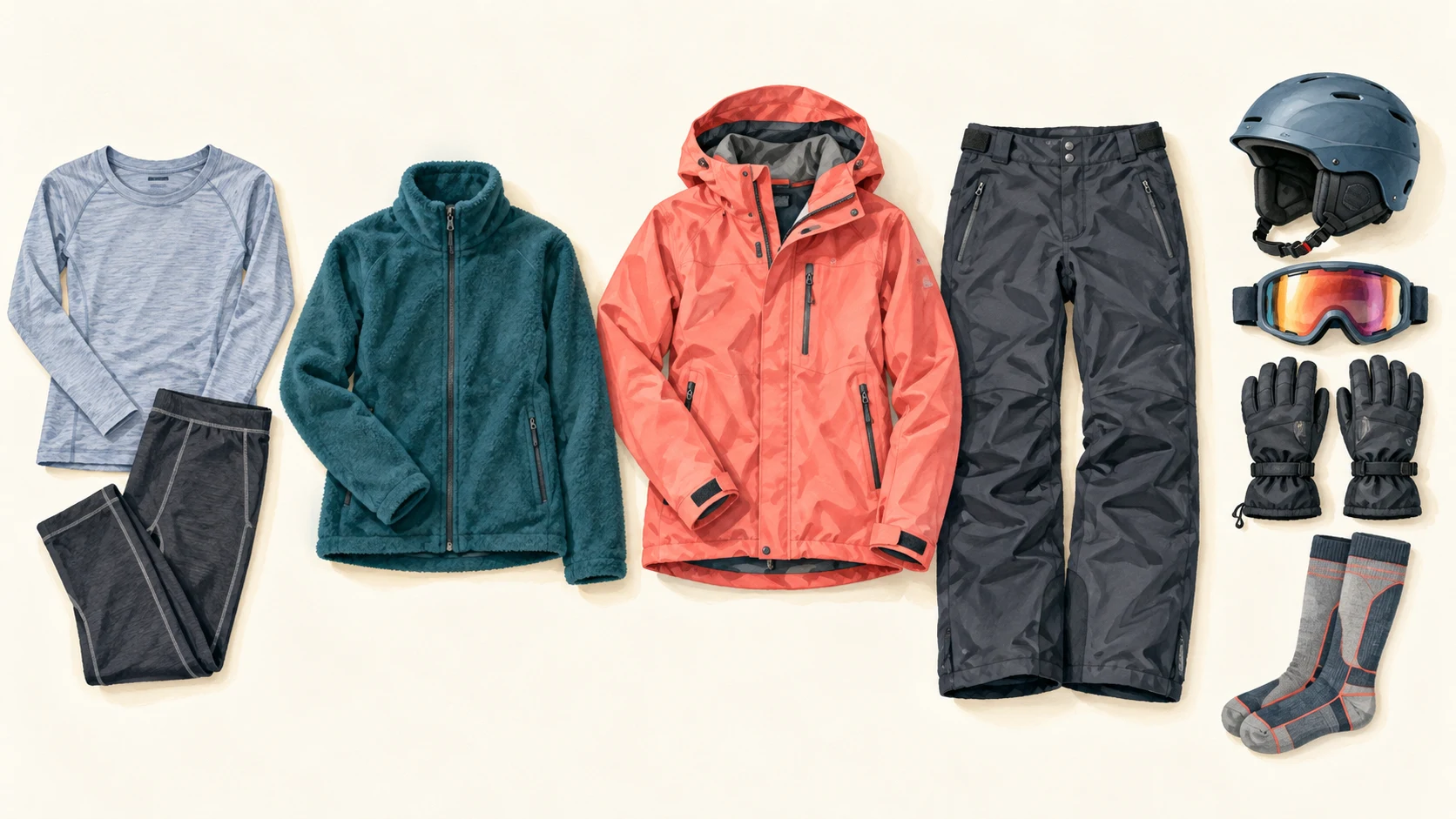
Ski clothing must handle sweat during activity, cooling while resting and contact with wet snow. Simply wearing the thickest coat may be uncomfortable. Takasu’s beginner clothing guide describes base, middle and outer layers: the base layer manages moisture and drying, the middle layer provides warmth and the outer layer protects against wind and moisture from snow. Adjust to temperature, wind and your own response rather than treating a fixed number of layers as a formula for every day.
Avoid bulky folds against the skin, choose a middle layer that permits movement and fit the jacket and trousers so you can crouch, stand and put boots on. An ordinary city down jacket may not have waterproofing suited to repeated snow contact, and jeans are not a substitute for ski trousers. Before renting clothing, inspect the size chart and whether your own middle layer will fit beneath it, then still try it on after arrival.
Prioritise waterproofing and warmth for gloves. Socks should be long enough without bunching inside the boot, and goggles should be tried with the helmet. A neck warmer is easier to manage than a trailing scarf; phones, keys and passes belong in pockets that close. A helmet is protective equipment, not interchangeable with a knit hat. Protective gear does not make terrain beyond your ability suitable for a beginner.
Pack the ski-day checklist by when you will use each item
Divide luggage into items accessible during travel, one set to take out when changing and dry clothes for the return journey. Store passports and valuables according to your accommodation, locker arrangements and personal needs; do not take everything onto the slopes for photographs. If leaving large luggage at a station or hotel, confirm collection hours first. Discovering the storage desk has closed after skiing can disrupt the return journey.
The list below identifies items to check, not an identical equipment requirement at every resort. Rent what is available and try the fit of items you bring before departure. Spare children’s gloves, socks and inner layers, clearly labelled, are particularly useful. Replacing wet clothing has more practical value than an extra coat intended only for photographs.
- Reservations and contacts: lesson confirmation, rental booking, pass conditions, meeting location, return transport and school and accommodation contacts, with an offline copy.
- Before going on snow: a properly fitting helmet, goggles, waterproof gloves, long ski socks, moisture-wicking base layer, weather-appropriate middle layer, ski jacket and trousers and neck warmer. First check which are already rented.
- Rest and return: dry replacement socks and inner layers, water, suitable snacks, sun protection, lip care, a little cash, ordinary walking shoes and a bag for wet clothing.
- Personal needs: keep routine medication and necessary contact information appropriately managed. Agree in advance how the lesson provider will handle children’s medication, allergies or assistance needs.
Build a budget beyond the lift pass and one night’s room rate
Use six categories: travel into and out of the region; accommodation and meals; lessons; equipment and clothing; lift passes and activities; and insurance plus contingency money. Then distinguish per-person from per-group charges. A private lesson may cost one amount for the whole group, while a room depends on actual beds and occupancy. Transport and lift tickets usually require each person’s age to be checked. Adding advertised adult starting prices can easily underestimate the family total.
Using the NBS example above, three adults of similar ability sharing a regular-period two-hour private lesson at ¥39,000 pay ¥13,000 each for instruction. Add one day’s Standard equipment package at ¥7,000, jacket and trousers at ¥4,500 and helmet at ¥1,500 per person: the displayed subtotal is ¥26,000 each, or ¥78,000 for three. This only adds the specified lesson and rentals. It excludes lift passes, transport, accommodation, meals, gloves, goggles, insurance and any tax or fees requiring confirmation at payment.
If money is tight, first compare fewer accommodation moves, a stay close to the meeting point, sharing a private lesson with friends of similar ability or a group lesson in an appropriate language and level. Do not begin by removing protective equipment or all introductory instruction. Complete the same checklist for competing offers before comparing prices. A cheap flight-and-hotel package does not establish that the skiing portion is cheap too. Organise other costs using fixed and adjustable costs in a Japan travel budget.
Day one: work backward from check-in instead of filling every hour
Suppose you stayed nearby the previous night and booked a morning lesson. After waking, check resort operations and school notices, have breakfast, take your confirmation and complete equipment collection and changing. Ask the school and rental shop how much preparation time to allow before meeting. Someone else’s twenty-minute experience is no guarantee for you: first-time boot fitting, children changing and weekend queues can all take longer. If evening collection is offered, fit equipment then, but check whether it adds a day’s rental charge.
Build the morning around the booked lesson. At lunch, check whether gloves are soaked, boots are uncomfortable or concentration is fading. The afternoon can be a short practice in an instructor-approved area, rest or another lesson slot. Paying for a pass is not a reason to keep skiing regardless. Stopping when your condition calls for it is part of planning the day.
Work back from the return departure to allow for equipment return, dry clothing, luggage collection and the journey to transport. Finishing skiing does not mean you are ready to board. If rentals are near your accommodation and the lesson is at the opposite end of the area, you need an extra return route. Anyone leaving the snow area that day should confirm this route in the morning, not shortly before the last shuttle.
A reasonable first-lesson goal: control, stopping and suitable terrain
A form’s “beginner” label may include someone who has never skied or someone already turning on gentle slopes. Describe actual ability: never worn ski boots, completed one lesson but cannot stop consistently, or able to control speed only on a particular gentle slope. Do not overstate ability to join friends. A mismatch can make the lesson’s terrain and pace unsuitable throughout.
NBS places complete first-timers at Level 1, with separate learning content for skiing and snowboarding. A first lesson need not promise a trip to the summit. Useful goals include understanding equipment, starting and stopping on terrain chosen by the instructor, knowing how to seek help and understanding where you may practice that day. Two people in the same two-hour lesson may progress differently; lesson length is not a certificate of skill.
Before finishing, ask the instructor where to repeat exercises, how to return to the meeting point and which level to book next. If advised against a chairlift or descent run, do not override that because a companion says going slowly will be fine. A written guide helps organise the trip, but slope, snow surface and fatigue must be judged on site. If uncertain, return to a place where staff or an instructor can assist.
Run and chairlift rules: leave space even within your own group
Niseko Annupuri’s terms of use require control, attention ahead and compliance with signs and staff instructions. Before starting, merging or crossing a run, watch for people approaching from uphill. Lesson participants have no priority simply because they follow an instructor. For photographs, equipment adjustments or waiting, choose a visible place that does not obstruct others.
If you do not know how to board or leave a chairlift, tell the instructor or staff and ask for help before boarding rather than trying to copy others afterward. Use safety features as directed; do not rock the chair, jump off or enter restricted areas to retrieve dropped items. Remember the location or nearby tower and let staff handle retrieval after you leave the lift. Follow resort and instructor directions for ski poles, snowboard bindings and devices that prevent equipment sliding away.
Do not cross closure lines, follow strangers into trees or off marked runs, or treat a powder photograph as permission to enter. After a collision or injury, promptly notify patrol, explain the location and situation and cooperate with identification and incident-information checks. Stop and seek on-site help if you are in pain, dizzy or unable to see clearly. This guide does not substitute self-assessment of an injury for professional assistance.
Summit views and a beginner’s descent are separate questions
A “beginner run” describes one graded trail, not a continuous easy route from every lift exit to the foot of the mountain. Hakuba Goryu’s FAQ explicitly says the descent from Alps Daira is intermediate or advanced; beginners can ride the Telecabin down instead of forcing a ski descent. Apply that question to every resort you consider: establish the return from the practice area before deciding to go up.
A sightseeing companion who wants to share the gondola for views should check whether pedestrians are allowed, which ticket applies and the final uphill and downhill services. A route used by skiers in equipment may not be open to walkers. Choose a lunch restaurant both parties can actually reach, not simply one on the same mountain.
With experienced companions, agree on lunch and finishing meeting points and spend other time separately if useful. Experienced skiers also need time to return from higher terrain; do not ask a beginner at the last moment to travel uphill alone to meet them. If using different areas, passes or night-skiing sessions, clarify return transport and equipment returns in the morning.
Non-skiers and toddlers need their own daytime plan
A non-skier may not want to wait all day in the rental hall. Before choosing accommodation, check whether they can remain in the room or a lounge or reach a restaurant independently, and what space remains available on checkout day. Pools, day-use hot springs, childcare rooms and indoor play areas may charge extra, impose age limits or operate only on certain dates. A listed facility does not mean every guest can use it at any time.
Hakuba Goryu’s Escal Plaza describes a wooden parent-and-child play space and baby facilities. Its FAQ also notes that some places to rest without shoes require using the hot-spring rest area or renting a room. An adult caring for a toddler should therefore confirm a place to stay, change nappies, eat and nap before deciding to follow the group uphill. “Family friendly” alone does not make those arrangements.
Snow play, sledding and ski practice belong in their designated areas. Do not build snowmen or let children sled on an ordinary ski run. If a child only wants to play in snow, a short activity with warm rest breaks can be a successful day. A family does not need identical progress to prove everyone enjoyed it. Supervision, timely indoor breaks and knowing when to finish matter more.
Change the plan for heavy snow, wind or low energy
Read resort, transport and school notices both the previous evening and the morning of departure. A snow icon on your phone does not mean every lift can operate. More snowfall does not necessarily improve visibility or transport for a beginner that day. Check the teaching area, access route and return options before deciding to set out; the resort-wide snow-depth figure is not enough on its own.
If some facilities close but lessons continue, ask whether the meeting or teaching location changes, whether your pass remains appropriate and how to get back. If transport is disrupted, contact the school and accommodation promptly, save operating notices and bookings and follow each provider’s terms. Do not assume travel insurance will necessarily pay. At purchase, ask the insurer whether the actual snow sport, medical costs, personal liability, equipment and rescue costs are covered.
A backup day need not involve another, more distant resort. Resting at your base, using an indoor facility confirmed open or visiting nearby places to eat and walk if transport allows may be more workable than crossing regions at short notice. Fatigue, soaked clothing or loss of control also justify stopping. The purpose of a backup is to prevent one unsuitable ski day from disrupting later transport and accommodation.
Make a two-day/one-night or three-day/two-night trip workable
Two days and one night can mean arrival plus a short introduction on day one, followed by more time on snow on day two, provided equipment can still be returned before departure. A midday arrival cannot fit a full-day children’s course requiring morning check-in. Choose an afternoon introduction, or just collect equipment and learn the layout. Coordinate the second morning’s breakfast, checkout, luggage storage and lesson order with the property in advance.
With three days and two nights, use day one for arrival and preparation, day two for the main lesson and day three for another lesson or suitable practice before leaving. Add a third night if you want two complete learning days and a simpler departure day. Each extra night should have a clear purpose, such as avoiding a rushed train, letting children rest or allowing weather adjustments, rather than filling a sightseeing list.
From Tokyo, read the comparison of Tokyo ski days and stays in Yuzawa or Naeba before choosing a day return or overnight stay. If Hokkaido plans mainly involve Sapporo sightseeing, compare Sapporo and Otaru bases rather than forcing a Niseko stay into a half-day city excursion. This article explains a first learning trip; use the regional itinerary to recheck current local transport.
Before booking, make one checklist connect every person’s arrangements
Put the whole party in one table: name, age, skiing or snowboarding, ability, language, height and shoe size, lesson time, rental items, pass, meeting point and supervising adult. If a field is unknown for one person, do not fill it with someone else’s answer. For example, if a parent also plans to take an adult private ski lesson and their eight-year-old child will take a snowboard class, first check both lessons’ times and meeting points. Make sure the parent can hand the child over to the instructor before the child’s lesson and collect the child afterward, then arrange the parent’s own lesson.
Start reservations with the hardest-to-replace lesson and language, establish that transport can reach it on time, then coordinate accommodation, rentals and the appropriate pass. Read each cancellation policy before payment and check afterward that confirmations match your selections. If someone changes a hotel, lesson or number of ski days, recheck transfers and returns. Changing one item does not leave all the other arrangements compatible.
A successful first ski trip does not require a distance total, a count of chairlifts or completion of a mountain. More useful results are discovering whether you enjoy the sport, finding suitable equipment, understanding which terrain still needs an instructor and returning to your accommodation or station with dry clothes and enough time. Next time, choose lessons and terrain around the ability you have gained rather than buying the largest package on your first visit.
A few useful answers
Do I need to go to Hokkaido for a first ski trip?
No. Start with lesson language, teaching terrain and whether transport and accommodation connect. A Tokyo trip can include GALA or Echigo-Yuzawa; in Nagano, start with one Hakuba resort. In Hokkaido, distinguish a day trip from Sapporo from several nights in Niseko.
Should a beginner choose skiing or snowboarding?
Choose according to your interests, available lessons and children’s ages; neither is guaranteed to be easier for everyone. State that you have never tried it, and check that skiing and snowboarding cannot simply be combined in one class.
Can I hire everything I need to ski in Japan?
Not necessarily. Equipment, clothing, helmets and smaller items may be separate. Hakuba Goryu says gloves, knit hats and goggles must be brought or bought. Check every item before leaving; “come empty-handed” does not mean everything is included.
How old must a child be for a ski lesson?
It depends on the school and discipline. NBS group skiing starts at age 5 and snowboarding at age 8, with a toilet-training requirement. Do not apply those ages to other schools. Meeting the age limit still leaves language, stamina and drop-off arrangements to check.
Is instruction included in a one-day lift pass?
A pass name alone does not establish that lessons or rentals are included. Ask the school which equipment and pass you need, then inspect the package contents. Sightseeing, area, timed and whole-resort passes can cover different things.
Can I cancel a lesson free of charge if it snows heavily?
Do not assume so. Distinguish a guest cancellation, a partial lift closure and an operator cancellation. NBS restricts refunds and other remedies when guests cancel because of bad weather; accommodation and transport have separate terms.
Can I ski at GALA on 12 December 2026?
The official schedule currently lists 12–18 December as sightseeing operations, with no skiing even if there is snow. Skiing is scheduled to start on 19 December. Check the latest announcement before travelling.
If a beginner takes a gondola up, must they ski back down?
Not necessarily, but do not assume a return ride is allowed. Hakuba Goryu explicitly permits downhill travel on the Telecabin, while its descent runs are intermediate or advanced. At other resorts, check downhill boarding and the last service first.
Can I use every beginner run independently after one day?
Lesson hours do not guarantee ability. Before the lesson ends, ask the instructor which area is suitable for practice, how to return and which level to book next. Decide according to that day’s snow and your ability to stay in control.
Check with the source
Schedules, availability and rules can change. These official sources are the place to confirm details before you book.
- Japan National Tourism Organization | beginner lessons and rentals
- GALA | 2026–2027 operating periods and ticket types
- GALA | 2026–2027 South Area and connecting ropeway closure
- Hakuba Goryu | access, rentals, children’s facilities and downhill travel FAQ
- The Vale Niseko | location and access to the slopes
- Appi Kogen | hotel and ski-area layout
- NBS Niseko | private lessons and 2026–2027 seasonal dates
- NBS Niseko | Kids Club ages, dates and disciplines
- NBS | lesson, cancellation and rental terms
- NBS Niseko | rental prices
- NBS Niseko | equipment settings, rental items and storage FAQ
- Takasu Snow Park | beginner clothing and resort rules
- Niseko Annupuri | resort terms of use and safety
- GALA | Current-season equipment, observation decks and sightseeing rides