Explore Owari Tokugawa swords, a tea room, reception rooms, Noh masks and Hatsune lacquerware. Match autumn 2026 rotations, original Genji scrolls and Yoshichika’s travels to the ¥2,000 combined or ¥600 library ticket and its entrance.
- Region & Focus
- Nagoya
- Reading Scope
- 32 min read · 13 chapters · 4 Q&As
- Official Verification
- 13 official sources checkedUpdated November 22, 2026
- Key Topics
- ItinerariesChubu & Hokuriku
Chapter Route Map (tap any stop)
- The ¥2,000 combined ticket and ¥600 library ticket use different entrances
- Read dates on the object list before memorizing National Treasures
- Gallery 1: New Year armor displays explain function and status
- Gallery 2: the Sarumen tea room places utensils in a setting for guests
- Reception-room decoration: look at placement before individual objects
- Noh stage and masks: view them as parts of one performance
- Private furnishings and the Hatsune trousseau: literature on wedding objects
- November 14–29 originals: leave time for Genji paintings and calligraphy
- Library exhibition only: cameras, toys and carved bears from Yoshichika's travels
- The concurrent Tokimeku Hako exhibition: notice lids and collection labels
- Two half-day plans: give time to what you want to see
- The reading room is free; rare-book consultation follows a separate process
- Station exits, bags and photography: details that affect your visit
- Quick Q&A
Allow half a day for the Owari Tokugawa family’s objects at the Tokugawa Art Museum: armor and swords, tea utensils for guests, reception-room furnishings, Noh masks and wedding lacquerware make sense along one route. Original National Treasure Tale of Genji scrolls are on view November 14–29, 2026: Yokobue and Yadorigi II. For only Hosa Library’s current Traveling Marquis: Tokugawa Yoshichika exhibition, a separate library ticket introduced in October is available. Choose the exhibition, then the entrance, before comparing prices on arrival at Tokugawaen. Exhibition dates, admission rights and object lists below follow official information dated October 28, 2026.
The ¥2,000 combined ticket and ¥600 library ticket use different entrances
For a first visit focused on swords and daimyo life, choose combined admission to the Tokugawa Art Museum and Hosa Library: ¥2,000 for adults, ¥1,200 for high school and university students, free for junior high school students and younger children. Buy and enter through the museum's main entrance. The galleries connect inside, so you need not return to the street for a second ticket office. Online tickets are also offered, but during changes of temporary or special exhibitions, buy tickets on site.
From October 1, 2026, Hosa Library also offers separate admission: ¥600 for adults, ¥400 for high school and university students, ¥200 for Nagoya residents aged 65 or over, and free for junior high school students and younger children. Enter its galleries through the reading building. This ticket applies to temporary exhibitions held entirely in the library galleries and covers those galleries only. For armor, the reconstructed tea room and original National Treasures in the museum's Masterpieces galleries, buy the combined ticket.
Special exhibitions using both institutions have a clear boundary: if an exhibition spans the library and museum main-building galleries, only combined admission is sold. Read the venue field on the library website. Joint organization and use of both buildings' galleries are different facts. The current Traveling Marquis: Tokugawa Yoshichika exhibition explicitly lists Hosa Library's galleries as its venue, making the separate entrance suitable for visitors interested only in that exhibition.
For two adults, combined tickets total ¥4,000 and separate library tickets ¥1,200. Accompanying children of junior high school age or younger enter free under either option. The price difference corresponds to the content. Do not plan around the cheapest ticket and expect access to the other building afterward. Budget for combined admission to cover all five Masterpieces themes; choose the ¥600 library ticket if Yoshichika's travels and collecting are your only interest.
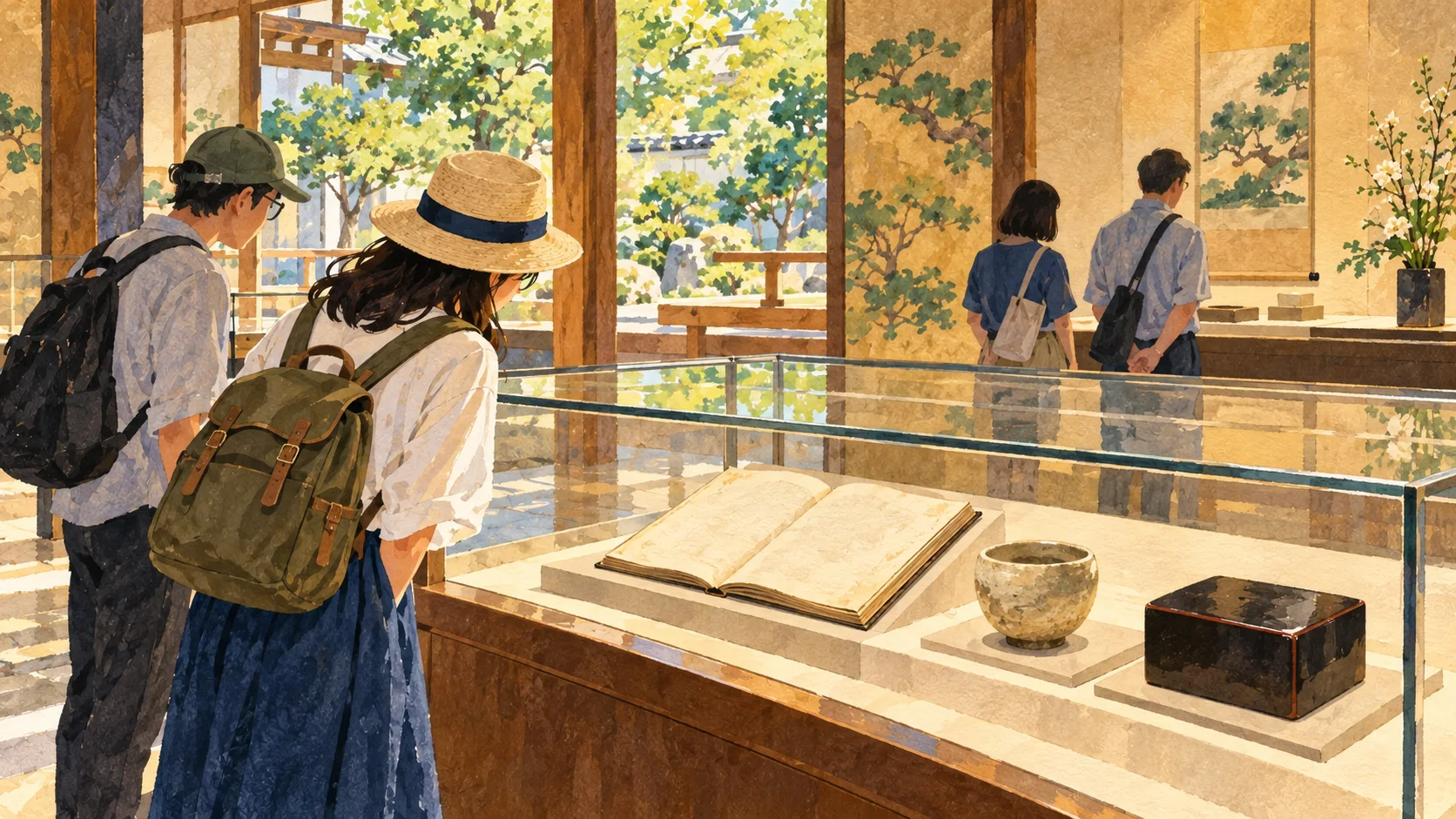
Explore Owari Tokugawa swords, a tea room, reception rooms, Noh masks and Hatsune lacquerware. Match autumn 2026 rotations, original Genji scrolls and Yoshichika’s travels to the ¥2,000 combined or ¥600 library ticket and its entrance.
Read dates on the object list before memorizing National Treasures
The Masterpieces collection display runs year-round, with objects changing roughly monthly across five themes: arms and armor, tea, reception-room decoration, Noh and private-life furnishings. The autumn 2026 official list covers September 15–December 13: period A is September 15–October 14, B October 15–November 13, C November 14–December 13, with an additional D period December 1–13. D separately lists Extracts from Matsuura no Miya Monogatari in Gallery 5. The Genji scrolls have their own November 14–29 dates. Match your date to the individual object's row.
October 28, for example, falls in B. In Gallery 1, look for tachi mountings with hollyhock-crested maki-e and a basket-weave-patterned tame-lacquer command fan; Gallery 5 lists the Hatsune maki-e jinko box. From November 14, period C replaces the sword mountings with nashiji lacquer mountings and the command fan with a gold-and-silver-painted wheel-motif fan used by Yoshinao, the first Owari lord. The Hatsune box spans B and C. Choosing two or three objects gives you concrete targets in the galleries.
Another useful field distinguishes maker, user, collector and donor. A swordsmith's name on a blade, its later owner and its route into the museum answer different questions. An object inherited by successive family heads carries more than a production date. Read the object first, then its users and provenance, to connect an attractive antique with how the family preserved, exchanged and used possessions.
Gallery 1: New Year armor displays explain function and status
Gallery 1, Symbols of the Warrior, currently uses a daimyo family's New Year armor ceremony as its organizing idea. Armor stands centrally, surrounded by tachi and spear mountings, command equipment and a standard marking the commander's position, forming a symbolic battle-departure display. Step back to read the group: what was worn, what directed troops and what identified the leader at a distance. This is more complete than focusing only on the central suit.
The autumn 2026 list includes black-lacquered armor laced with dark-blue cord, made by Myochin Munesada in 1849 and worn by Yoshikatsu, the 14th Owari head. Examine the dark lacquer and cords joining the plates, then compare the long-handled weapons and sword mountings. Edo-period arms served readiness for war, ceremony and status. Fine decoration has a place in the full display; every gold detail need not be read as a practical battlefield device.
For a closer sword study, choose the unsigned Sukezane katana. The list identifies it as an Important Cultural Property from the 13th-century Kamakura period, formerly held by Yoshikatsu and the 15th head, Mochinaga. It also lists an accompanying 1710 appraisal by Hon'ami Kochu. The blade and appraisal offer two scales of reading: the object and how later generations identified and transmitted it. Visitors interested in documents can give these associated records a few extra minutes.
The museum FAQ explains that its swords have not received the cosmetic polishing now prevalent, to preserve their Edo-period polish as far as possible. The temper pattern can therefore appear differently from other displays. First examine curvature, length and outline, then find the pattern from permitted viewing positions. If it looks faint at first, the preservation method is itself a clue. There is no need to move immediately to the next blade.
Gallery 2: the Sarumen tea room places utensils in a setting for guests
Gallery 2, A Daimyo's Refined Pursuits, places tea in the context of daimyo hospitality. Official shogunal visits and exchanges between lords could include tea gatherings. Famous utensils carried craft value and histories of ownership and transfer. Read bowls, tea caddies and flower vessels through both shape and who would use them on what occasion. The objects then relate to one another.
The gallery reconstructs part of the Sarumen tea room from Nagoya Castle's Ninomaru Palace using surviving plans, placing seasonal utensils in their corresponding positions. The official list says the name, “monkey face,” traditionally refers to knots near the top of the alcove pillar resembling a monkey's face. The original room was destroyed in the war in 1945. Find the pillar and hanging scroll, then the spacing of flower vessel, caddy and bowl to understand what the reconstruction explains.
For B, the Sarumen list includes Eicho calligraphy by Emperor Go-Mizunoo, an antique bronze broken-pestle-shaped flower vessel, the bamboo tea scoop Mushikui attributed to Sen no Rikyu, the Seto katatsuki caddy Kanno and the Ido bowl Todaiji. Choose a hanging work and one utensil, reading name, material and provenance, then look back at their placement. Companions less interested in swords may find familiar vessel shapes an easier starting point here.
From November 14, C replaces the hanging scroll with Emperor Go-Mizunoo's waka sheet Sekiji no Yuki, and the tea scoop with Yamabiko by Oda Sadamochi. Different calligraphy and objects change the rhythm of the same reconstructed room. On an autumn return visit, compare this corner. On a single visit, use the column for your actual date rather than an earlier period's photographs as a finding guide.
Reception-room decoration: look at placement before individual objects
Gallery 3, A Daimyo's Formal Furnishings, reconstructs parts of the Ninomaru Palace great hall, raised room and Kusari-no-ma. The oshiita display ledge, staggered shelves and study alcove each have furnishings; partition paintings were reconstructed from Kinjo Onkoroku, a record of Nagoya Castle. Move from space to objects: where paintings hang, where incense burners and flower vessels stand, then writing tools beside the desk. The subject is what guests saw and how objects formed a reception setting.
In B, the great-hall display ledge has a three-part Kannon, plum and bamboo work attributed to Kao, with celadon candle stand, incense burner and flower vessel. The study alcove lists an antique bronze rain-dragon brush rest, lion paperweight, mandarin-duck water dropper and Jian'an tile inkstone. Start with familiar functions: a rest holds a brush, a weight holds paper and a dropper supplies water to the inkstone. Then see how animal forms and patterns connect craft to use.
The official account traces these arrangements to Muromachi shogunal precedent. Edo daimyo inherited an aesthetic and value system that prized Chinese objects. Chinese dynasties, Ryukyu and Southeast Asian origins on labels can therefore be read alongside the Japanese palace setting. Not everything in the room was made in Japan. Compare one Southern Song object and one Edo object to see a broader collection than the label “Tokugawa Japanese antiques” suggests.
The Kusari-no-ma presents a quieter tea setting, described officially as a place to serve tea to a visiting shogun or envoy. Traditions connect its name either to linking the great hall and a smaller room or to a chain suspending a kettle from the ceiling. You need not settle the name first. Observe the shift in scale from great hall to small space, then the kettle and bowls, to distinguish formal reception from close tea service.
Noh stage and masks: view them as parts of one performance
Gallery 4, Ceremonial Performing Arts of the Warrior, focuses on Noh and reconstructs part of the Ninomaru Palace stage. The Edo shogunate made Noh the warriors' ceremonial music. Daimyo families kept Noh and kyogen masks, costumes and props for different plays and schools. Read these with the stage: masks supply faces, costumes reshape bodies, and props and stage place the characters in a performance space.
The official list describes a stage about three ken, or roughly six meters, square, with corner pillars and an old pine painted on the rear panel. The roof continues the form of early outdoor stages. Find pillars and pine before studying costumes to understand why silhouettes and patterns need to read at a distance. This space supplies context for Noh objects. For a live performance, choose an actual event and its ticket separately.
In B, October 15–November 13, masks include Fukai by Omiya Yamato Masamori and Kasshiki by Kawachi Daijo Ieshige. Costumes include a dark-blue gold-brocade dance robe with paulownia and phoenix roundels, and a red-and-pale-blue karaori with autumn grasses. Compare brows, eyes and mouths on two masks, then colors and patterns in the weaving. Even without knowing the plots, you can start with the visual work done by face and costume.
From November 14, masks rotate to Yamanba attributed to Deme Eiman and Ko-beshimi attributed to Miyata Chikugo, with costumes also changing. For a child with limited attention, choose one mask, one fabric pattern and the pine behind the stage, then move on. The five galleries need not receive equal time. A few extra minutes with objects that interest you suit a half-day visit better than identical stops at every case.
Private furnishings and the Hatsune trousseau: literature on wedding objects
Gallery 5, A Daimyo's Elegance, presents furnishings from the private lives of lords, wives and children: incense, cosmetics, writing, dining and games. Their use differs from reception-room display. The latter faced formal guests; these objects were closer to family life and education. Beyond distant splendor, ask what each small box, incense tool and writing implement did in daily life.
The National Treasure Hatsune trousseau was commissioned for Chiyohime, daughter of shogun Iemitsu, on her 1639 marriage to Mitsutomo, the second Owari lord. Maki-e artist Koami Nagashige participated. Its name comes from a poem in the Hatsune chapter of The Tale of Genji. The museum collection page lists 47 Hatsune-related objects, 10 Kocho-related objects and other pieces, totaling 70 surviving items. This describes the whole collection. For autumn, find the Hatsune maki-e jinko box listed in both B and C.
At the box, remember its purpose and user before reading the label's patterns. Literature supplied the decoration's subject at commissioning, rather than merely a later background story. One narrative can become both a picture scroll and wedding furnishings. If you visit for the original Genji scrolls in November, view this lacquer piece in the same stretch of time to compare how Heian painting and Edo craft use the tale.
Autumn 2026 also offers the Chrysanthemum and White Dew maki-e wedding trousseau for Ohime, who married into the Kaga Maeda family. Dated 1633, it precedes Hatsune. The official list records its 2026 designation as an Important Cultural Property. Writing stand, comb box, incense tray and small boxes are specially displayed through November 13. Late-October visitors can compare two women's wedding objects. From November 14, shift time to Genji scrolls and C-period writing implements.
In this short interview published by the museum in 2023, Living National Treasure Kazumi Murose discusses the difficulty of making maki-e, offering a craftsperson’s perspective.
November 14–29 originals: leave time for Genji paintings and calligraphy
The 2026 special display of the National Treasure Tale of Genji Illustrated Scrolls presents two scrolls: Yokobue, chapter 37, and Yadorigi II, chapter 49, November 14–29, in the current Gallery 5 list. Both date to the 12th-century Heian period. If they are your main reason to travel, choose dates within that window and exclude Monday and post-holiday closures. The museum opens on the November 23 holiday and closes November 24.
These scrolls entered the Owari Tokugawa family as three scrolls. In 1932 they were mounted as panels for preservation. Recent repairs reunited each scene's painting and text into a scroll, restoring a 15-scroll format. Read image and text together: first how people relate across architectural divisions, then the adjacent calligraphy and paper. The collection page describes slit eyes and hooked noses, and roofless architectural views. Beyond clothing, follow the overhead composition to find relationships between figures.
The autumn list describes Yokobue as Yugiri dreaming of Kashiwagi's spirit. Kumoi no Kari nurses a frightened, crying infant while Yugiri looks on. Before approaching the case, hold onto dream, infant, caregiver and observer as a starting map. Where faces look similar, divide your attention among posture, separation and gaze to see how the painting accommodates the episode.
Yadorigi II shows the morning after the third wedding night following Niou's marriage to Yugiri's daughter Roku no Kimi. One scroll concerns a dream and an infant at home; the other a marriage. Remember this difference, then compare interiors, rather than require yourself to read the whole novel before departure. Pause at the calligraphy too. Letter forms, writing rhythm and decorated paper belong to the work; even without reading every old character, you can see text and image alternate.
For all 15 scrolls, the museum FAQ gives 2035 as the next planned full display. Make these two your 2026 target. Distinguish the library's Kawachi-bon Tale of Genji, a 13th-century manuscript of 54 textual volumes in 23 bound books, from the museum's 12th-century illustrated scrolls on this occasion. Buy combined admission and reach the special-display gallery to see the intended originals.
Library exhibition only: cameras, toys and carved bears from Yoshichika's travels
Hosa Library presents Traveling Marquis: Tokugawa Yoshichika from October 8 to December 13, 2026. Its subject is the 19th Owari head and founder of the Tokugawa Art Museum. This is a later period than the Edo daimyo objects. Travel photographs, belongings and collections show a modern collector's encounters with Hokkaido, Southeast Asia and Europe. A separate library ticket lets visitors interested only in modern travel history take their time here.
The object list has four chapters: departure, Southeast Asia, Europe and travel memories. A bag and two compasses in the first bring travel down to equipment, followed by Borobudur photographs from 1921 and 1929 and Southeast Asian clothes, containers and performance objects. Choose a photograph with a date and place, then find collections from nearby regions. Distinguish travel records from objects brought home; images from different years need not represent one journey.
The Southeast Asia list supports comparison of performance objects: six of 51 Wayang Kulit figures, two Wayang Golek figures and seven of 39 Wayang Topeng masks, plus batik-making process samples. Compare form, material and use through the labels, then relate them to Japanese Noh masks in Gallery 4. Visitors interested in cross-cultural art may want to study these before the photographs.
The Europe chapter includes Italian glass animal ornaments, German painted glass and Swiss containers. It places a Swiss Crawling Bear beside one made around 1924 by Ito Masao; both are designated Yakumo Town cultural properties. Compare posture and surface before dates to connect Yoshichika's European travels with the history of Hokkaido's Yakumo woodcarving bears. These objects turn a question about souvenirs into a local craft story.
Chapter 4 includes a 1922 photograph of Yoshichika and his wife aboard their return ship, and another of Einstein and Yoshichika on the Kitano Maru that year, as well as his writings. Use photographs for personal connections and routes, and texts for how he recorded and organized travel. The museum exhibition page links to a special website on his 1921–1922 European journey for more historical photographs after your visit.
The concurrent Tokimeku Hako exhibition: notice lids and collection labels
The museum main-building special exhibition Tokimeku Hako runs through November 15, 2026, exploring boxes' functions, decoration and inscriptions. The official introduction highlights writing on lids and their interiors, and collection labels preserving objects' histories. First ask what a container holds, then find lid, inscription or label. Provenance may be on the outer box. This extends the Masterpieces galleries' question of who used an object and makes everyday storage worth examining.
Featured works include the Southern Song–Yuan celadon incense burner Chidori, Hon'ami Koetsu's black Raku bowl Shigure, the Chinese round tea caddy Karamarutsubo formerly held by Katagiri Sekishu, and the lower volume of the Kabuki Picture Scroll. Notice their storage boxes, inscriptions and collection labels to trace preservation and transmission. Tea enthusiasts can continue from Gallery 2 to explore the relationship between utensil and box.
November 14–15 overlaps this exhibition with the Genji originals. Choose that weekend for both, adding Yoshichika under combined admission. November 17–29 still offers Genji and Yoshichika, but Tokimeku Hako has ended. If Genji is your sole priority, shift former special-exhibition time to Gallery 5 in the later period. December 1–13 still has Yoshichika, but the Genji originals have finished, changing the focus of a half-day visit.
Two half-day plans: give time to what you want to see
The museum gives 60–90 minutes as a general visit estimate, or about 30–40 minutes when only Masterpieces galleries open during exhibition changes. To read labels in each room, compare Genji originals with Hatsune lacquerware or see the whole Yoshichika exhibition, our editorial suggestion is about two hours indoors, plus walking to the museum, storing bags and resting. Decide whether to add the nearby garden after your main exhibition, according to remaining time.
For a combined-ticket morning, enter after the 10:00 opening and use the five themes to understand daimyo possessions. If Genji is your purpose, start with the current Gallery 5 display and then add a tea or reception room that interests you. The entrance hall offers an approximately 15-minute overview without reservation at 10:30, 11:30, 13:30 and 14:30. Make one a planned stop if you want it, rather than rush through cases to catch the first.
For library-only admission, enter through the reading building and focus on Yoshichika's photographs, performance objects and carved bears. Afterward, choose food or a walk nearby. The museum shop and cafe require museum admission, so plan library-ticket breaks outside. Combined admission also permits no re-entry. Put lunch after the complete visit; leaving to eat and returning will not let you back in on the same ticket.
Both institutions' galleries open 10:00–17:00, with last entry at 16:30. Afternoon visitors should count 90 minutes backward from closing. Arrival at 15:30 suits combined viewing better than the last-entry moment at 16:30. Both announce a maintenance and year-end closure December 14, 2026–January 4, 2027. Move a winter museum half-day within those dates to another open day.
The reading room is free; rare-book consultation follows a separate process
Hosa Library provides both exhibitions and collection consultation. Its free reading room supports research and reference, with no loans outside the building. Closed-stack retrieval hours are 9:30–12:00 and 13:00–17:00; open-shelf books are available 9:30–17:00. Library materials generally require advance reservation. Supply your preferred date, morning or afternoon, number of people, call number and material title. Staff check the material's condition before replying.
The Kawachi-bon Tale of Genji is a listed Important Cultural Property. Important books and non-book formats such as hanging scrolls, handscrolls and drawings require advance inquiry. Staff determine consultation access from use and preservation conditions. Use reproductions where available; old maps are consulted through the database. For research, find the call number and title before reserving a session. Collections such as Shoku Nihongi and the Nara illustrated Tsurezuregusa can guide research, while current paid displays follow the exhibition object list.
For historical maps, the reading room database supports zoom, rotation, comparison of two maps, text information and comparison with modern Nagoya. Official information lists more than 1,700 maps. For one themed exhibition during a trip, Yoshichika is the direct choice. For Owari history or rare-book research, finish the search and reservation before departure to make the on-site time useful.
Station exits, bags and photography: details that affect your visit
By rail, the museum lists about 10 minutes on foot from the south exit of JR Chuo Line Ozone Station, or about 15 minutes from E5 at the Meijo subway line's Ozone Station. These are different exits; meet at the same one. At the complex, follow your ticket to the museum's main entrance or library reading building. The garden entrance is not a common ticket counter for both. Return by your original station exit; see the two-day Nagoya itinerary for onward areas.
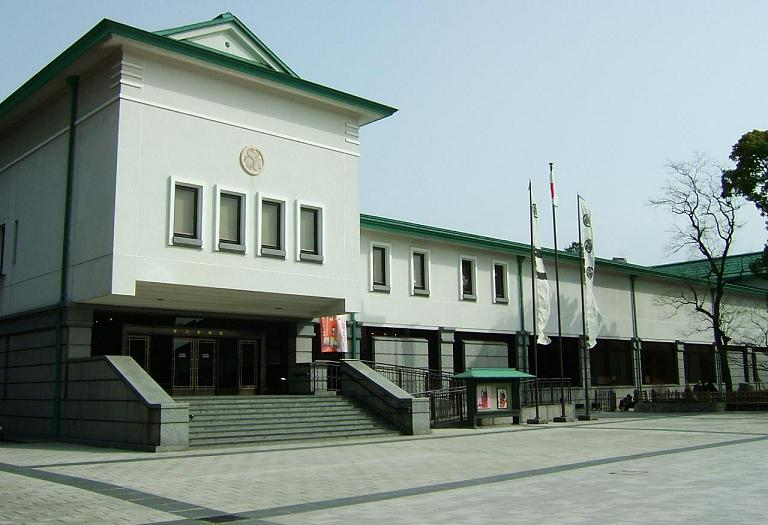
The museum has free lockers. Ask shop staff about bags too large for them. Wheelchairs and strollers are allowed, with free loans, accessible toilets and a nursing room available. With children or older companions, store heavy items first, choose two main gallery themes and add the library with remaining time. Vending machines are in the west hall. Eat and drink only in permitted rest areas. No food or drink is allowed in galleries, and boxed meals cannot be brought in for eating.
Gallery photography generally permits phones, tablets and compact cameras; follow entrance and on-site signs for individual prohibited works. Use a pencil for notes. Ballpoint and mechanical pencils are not allowed. Browse the shop for catalogs after finishing all galleries. Leaving shopping and weight until last keeps your hands freer for examining blades, box inscriptions and calligraphy.
A few useful answers
Which ticket should I buy for the Tokugawa Art Museum and Hosa Library, and where do I enter?
The ¥2,000 adult combination ticket covers both venues. Enter through the museum’s main entrance. If you’re only seeing an exhibition held entirely at Hosa Library, buy the ¥600 adult ticket and enter through the library’s reading room building.
When can I see the original Tale of Genji picture scrolls at the Tokugawa Art Museum in 2026?
The original Yokobue and Yadorigi II scrolls are on display in Gallery 5 from November 14 to 29, 2026. The museum is open on the November 23 public holiday and closed on November 24.
How much time should I allow for both venues, and when is last admission?
A typical visit takes 60 to 90 minutes. Allow about two hours to see both venues and read the exhibit labels at your own pace. Both venues’ galleries are open from 10 a.m. to 5 p.m., with last admission at 4:30 p.m.
Which Ōzone Station exit should I use for the Tokugawa Art Museum?
From Ōzone Station on the JR Chūō Line, use the south exit for a walk of about 10 minutes. If you take the Meijō subway line to Ōzone, use exit E5 and walk about 15 minutes.
Official information and references
Sources used in this guide.
- Tokugawa Art Museum: FAQ, preservation and visitor services
- Tokugawa Art Museum: 2026 special display of Genji illustrated scrolls
- Nagoya Hosa Library: 2026 combined and separate admission, and reading services
- Tokugawa Art Museum: hours, admission, access and floor plan
- Tokugawa Art Museum: exhibition schedule and five Masterpieces themes
- Nagoya Hosa Library: current exhibitions
- Nagoya Hosa Library: collections
- Tokugawa Art Museum: Masterpieces display list, September 15–December 13, 2026
- Hosa Library: Traveling Marquis, Tokugawa Yoshichika object list
- Tokugawa Art Museum: Tokimeku Hako
- Tokugawa Art Museum: Traveling Marquis, Tokugawa Yoshichika
- Tokugawa Art Museum: National Treasure Genji illustrated scrolls collection record
- Tokugawa Art Museum: National Treasure Hatsune trousseau collection record