A half-day to full-day guide to Tokoname’s pottery district. Read reused materials, mixed fuels and kiln loading at Dokanzaka, Toei Kiln and Saheiji Kiln, then compare waste-heat drying, flue conservation and a trolley tunnel kiln at INAX. Includes admission and return buses.
- Region & Focus
- Tokoname
- Reading Scope
- 31 min read · 12 chapters · 4 Q&As
- Official Verification
- 21 official sources checkedUpdated November 22, 2026
- Key Topics
- NeighborhoodsItinerariesChubu & Hokuriku
Chapter Route Map (tap any stop)
- Half a day for neighborhood kilns; add INAX for a full day
- At Dokanzaka, look at both walls and the rings underfoot
- Read Toei Kiln’s eight chambers and ten chimneys with the slope
- Inside Saheiji Kiln: twin entrances and fixed shelving
- Plaza sculptures and ceramic walls: from production tools to public art
- Takita House’s ship model adds the pottery district’s shipping history
- At INAX, see the whole pipe factory before entering the brick kiln
- Follow the underground flue to the 22-meter chimney and read its repairs
- The preserved tunnel kiln is 16 meters long; follow trolleys through temperature zones
- Allow time to compare manufacturing tools with photographs from 1963–1964
- Calculate opening days and admission separately, especially Wednesdays
- Choose bus directions first; shop after collecting luggage
- Quick Q&A
Tokoname’s clay pipes survive beyond museum displays: they line slope-side walls, while ring-shaped kiln furniture once used to fire pipes forms the paving underfoot. Walk from Dokanzaka to Toei Kiln and into the Climbing Kiln Plaza Exhibition Workshop. In half a day, you can see how products, fuel and loading methods left different spaces behind. For a fuller sequence of drying, firing and smoke discharge, save the afternoon for INAX Museums. Its preserved pipe factory and trolley tunnel kiln extend the walk from brick chimneys to continuous production.
Half a day for neighborhood kilns; add INAX for a full day
On a first visit, if you like sloping lanes and old factory exteriors, choose Pottery Footpath Route A. The tourism association gives 1.6 kilometers and about 60 minutes, starting at Tokoname Ceramic Hall and passing Takita House, Dokanzaka, Climbing Kiln Plaza and Toei Kiln. Entering two venues and reading kiln structures needs extra visiting and lunch time. Half a day is more suitable than one hour. After the kilns, use remaining time for workshops in the same district.
The strongest reasons to add INAX are the relationship between pipe drying upstairs and firing downstairs in one factory, and a different production method in which products move through the kiln. For those interests, take a full day: Route A highlights in the morning and INAX in the afternoon. For Dokanzaka photographs, teapot shopping and coffee, Route A alone works. The number of museums on a combined ticket need not expand your itinerary.
Official Route B is about four kilometers, estimated at two and a half hours in the footpath guide. The linked extended sample itinerary includes INAX, Tou-no-Mori and other stops and gives three to seven hours. These figures describe routes and variable stays separately. Do not add Route A’s 60 minutes to Route B’s two and a half hours and assume all exhibitions fit. To compare kilns, choose a few core Route A stops plus INAX, leaving Tou-no-Mori for another day.
Start at Meitetsu Tokoname Station. Ceramic Hall is at 3-8 Sakaemachi, about five minutes away on foot. Collect a walking map there before entering the hills on public routes. Tourism information and shopping run 09:00–16:30; the gallery and rest area close at 16:00. If leaving luggage, collect it before 16:00 as required in the official itinerary. For an afternoon at INAX, retrieving bags after the morning route makes the return easier.
A half-day to full-day guide to Tokoname’s pottery district. Read reused materials, mixed fuels and kiln loading at Dokanzaka, Toei Kiln and Saheiji Kiln, then compare waste-heat drying, flue conservation and a trolley tunnel kiln at INAX. Includes admission and return buses.
At Dokanzaka, look at both walls and the rings underfoot
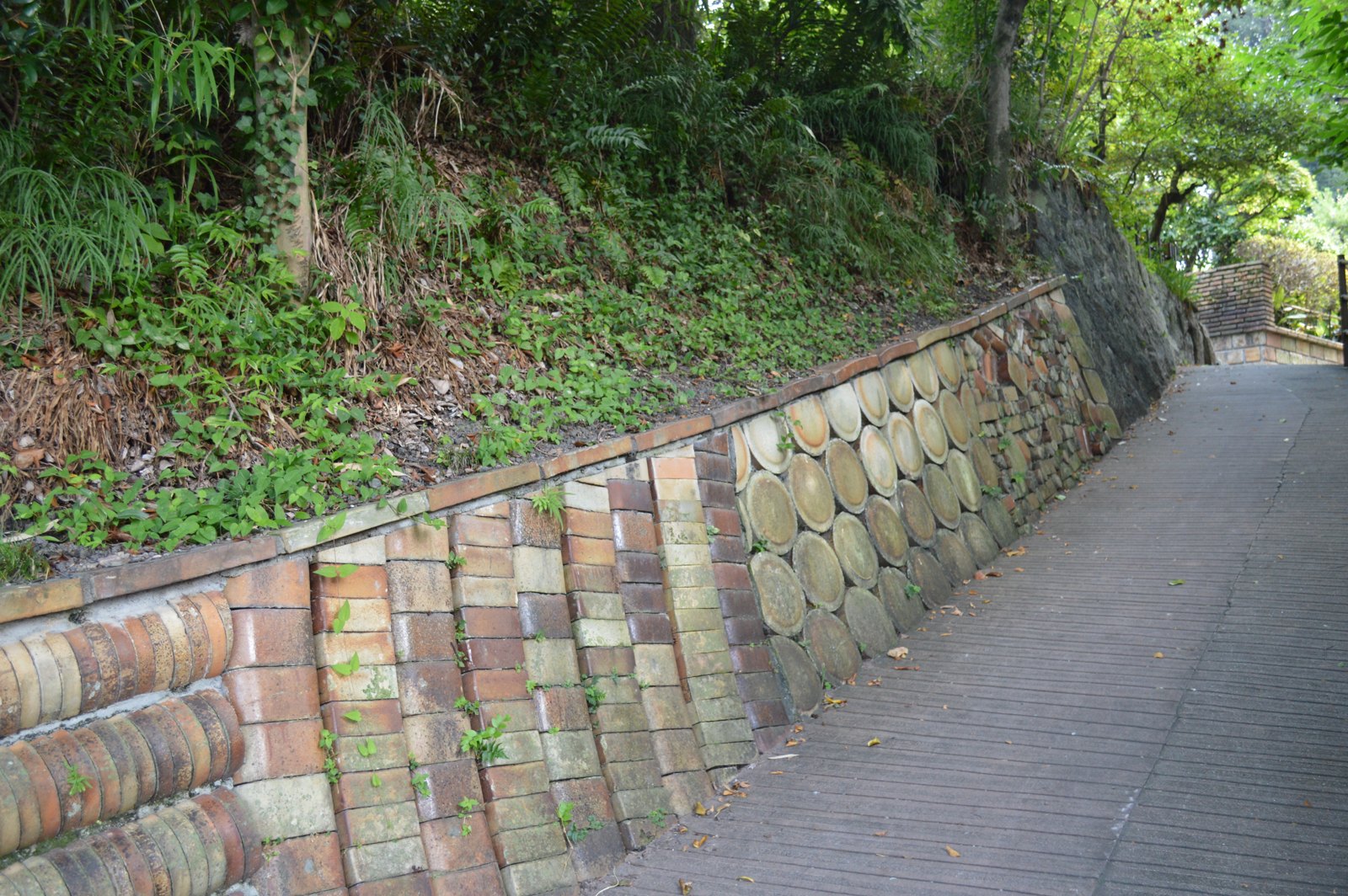
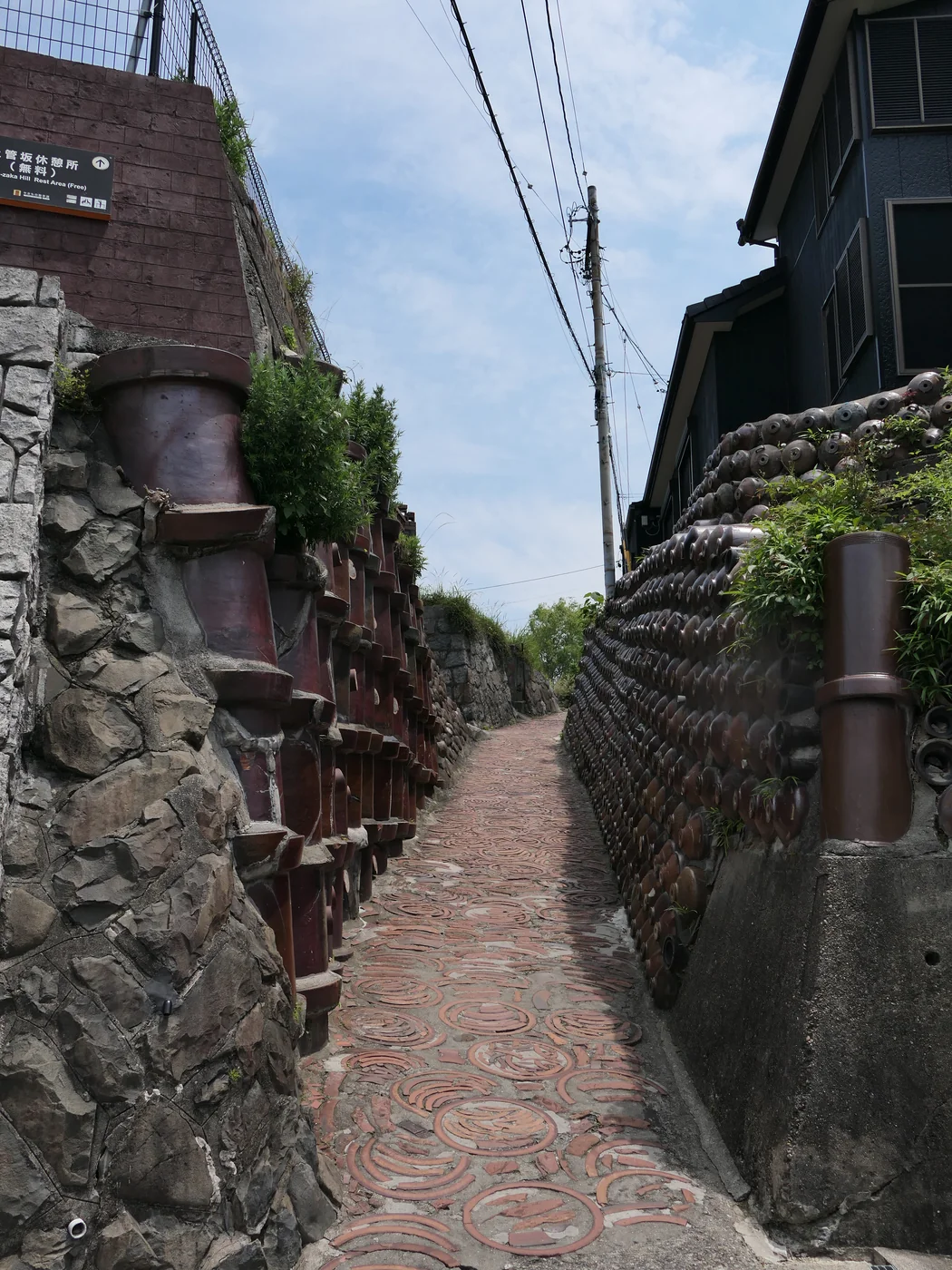
Dokanzaka lies about 10 meters south of Takita House. The circular openings packed into its walls come from Meiji-era clay pipes and early-Showa shochu bottles. Products originally made for different uses became retaining walls and streetscape beside the slope. At the entrance, compare the outlines on both sides, distinguishing pipe mouths from bottle forms, then follow their repeated arrangement uphill. Photographing only the densest wall misses the other material.
Another circular form lies underfoot. Officially called kesawa, these discarded rings are spent kiln furniture from pipe firing, reused in paving for grip and easier walking. Their original use differs from the finished pipes in the walls. Shift your gaze down to see finished products and production aids reused within one short slope. This gives Dokanzaka more to read than an old-street exterior alone.
Pause at three positions: the entrance wall, the arrangement midway along the slope, and the joins between rings and paving underfoot. This needs little distance and lets children join in. Find pipes, bottles and ring-shaped kiln furniture, then visit a kiln to see their production setting. With a stroller or a companion with sore knees, let energy decide how far to climb. Looking at materials from the entrance still captures the main point.
The footpath remains a place to live and work. Stay on public roads and in open venues; leave residential yards and workshops without business signs to residents and workers. Keep doors and narrow lanes clear when photographing. Walk slowly in rain, especially on slopes and corners. Grip paving still depends on footwear and pace. Make this a short stop before entering a venue rather than waiting for every other visitor to disappear.
Read Toei Kiln’s eight chambers and ten chimneys with the slope
Built around 1887 and used until 1974, Toei Kiln is a surviving Tokoname climbing kiln. The tourism association gives a slope of about 17 degrees, eight connected firing chambers and ten chimneys of different heights behind them. From one side, follow the chambers uphill, then move to an angle where chimneys are visible. Their connections and changing heights show how the building used the hillside for firing.
The Exhibition Workshop’s kiln guide records conversion in 1905 to a hybrid kiln using both coal and wood. First, coal burned for five to six days at the lowest firebox, called hokubo, using about six tonnes. Pine needles and wood then burned for roughly five days through side openings in the second chamber from the bottom. The tourism association’s kiln feature summarizes total firing as about 11 days. Against the eight-chamber slope, this extended staged firing is easier to understand than a construction date alone.
The kiln was jointly owned and mainly fired high-fired wares such as teapots and bonsai pots. Several users sharing one large kiln differs in scale from today’s separate footpath workshops. Look at capacity and working positions: the lowest firebox, chambers along the slope and rear chimneys indicate different tasks. Eight chambers and ten chimneys are separate structural counts and need not match one for one.
The tourism association explains that taller end chimneys draw flames upward to help even firing inside. Compare heights from public paths, then look back at the whole kiln. This stop focuses on the exterior. The nearby Exhibition Workshop’s preserved Saheiji Kiln is where you can go inside to study twin entrances, fire screens and kiln walls. Keep the names separate to find each structure on site.
Inside Saheiji Kiln: twin entrances and fixed shelving
The ground floor of the Climbing Kiln Plaza Exhibition Workshop preserves Saheiji Kiln, a rectangular downdraft kiln fired from both sides. Its operator dates construction to around 1921, major repair to around 1948 and use until 1980. Coal was its first fuel; heavy oil replaced it during 1955–1964. Its form differs from outdoor Toei Kiln. For moving from exterior views to reading an interior, this is one of Route A’s most valuable stops.
The two front entrances relate to fixed shelving in the center. Efficient loading had to work around shelves that could not simply be moved. The venue says loading took about two days, oxidizing firing three to four days, then cooling seven to 10 days before unloading. Connect those periods to see that firing production includes loading and a long cooling wait. Extinguishing the fire did not allow immediate removal of the batch.
Inside, look for the fire screens on both sides. The tourism association’s kiln feature explains that flames from side fireboxes rose over the screens, met near the ceiling, were drawn down and passed through underfloor flues to the chimney. Follow sides, ceiling and floor in that order for a clearer understanding of downdraft operation. The displayed kiln has been shortened for exhibition; originally, four fireboxes stood on each side.
Marks on the walls are thought to come from contact with shochu-bottle shoulders. Outside, black column-like braces are old railway rails holding the heated brick structure together. These details answer different questions: how bottles filled the kiln, and how it endured repeated heating. The venue lists sulfuric-acid bottles, shochu bottles, clay pipes and teapots before the war, mainly bonsai pots afterward. Read the product list after the wall marks to connect objects with space.
The venue is at 6-145 Sakaemachi. The current operator lists 09:30–16:30, closed Wednesdays, or the following day when Wednesday is a public holiday, plus the New Year period. The ground floor also has young artists’ work and monthly displays; upstairs is a painting-experience space. For kiln viewing, see the ground floor before deciding on shopping. Book painting through the venue’s course page and schedule its check-in separately.
Plaza sculptures and ceramic walls: from production tools to public art
After the workshop, find Masaaki Shibata’s “Space and Time” and Junpei Sugie’s “Radiance” in Climbing Kiln Plaza. The Japan Tourism Agency’s multilingual guide describes the former as a blue ceramic sculpture and the latter as a mosaic wall, both visible outdoor works. Look first at how the sculpture occupies central space, then at the wall’s small-piece surface. Attention shifts from kiln working structures to public art.
This fits a rest after the indoor visit without a separate detour. Dokanzaka places products and kiln furniture in a road; Saheiji preserves production equipment; the plaza works make ceramics into forms for viewing. All lie on the same walk but began with different purposes. With children, find one freestanding sculpture and one ceramic wall, then decide whether to continue to Takita House or return to Ceramic Hall.
Takita House’s ship model adds the pottery district’s shipping history
Near Dokanzaka, Takita House was the home of a Tokoname shipowner. Built around 1850, it was restored by the city and opened in April 2000. Tokoname also had a shipping industry from the Edo through early Meiji periods. Many shipowners lived in harbor areas including Tokoname, Hojo and Taya. Ships traded around Ise Bay with Owari, Ise, Mino and Mikawa and connected Edo and the Kamigata region. After kilns and products, this house turns attention to transport and the owners’ lives.
Choose two named objects inside. First is a 1:15 model of an 800-koku benzaisen cargo vessel. The house says the family’s vessels carried about 700–1,000 koku. An 800-koku ship had roughly nine crew, with captain, navigation, administrative and ordinary crew duties. Compare hull, hold and sail proportions before reading the division of work. This reveals shipping’s workload rather than treating the model only as a fine ornament.
Second is the Karakuri Giemon mujinto lamp, made of copper and brass and fueled by rapeseed oil. This type of lighting was used from the late Edo to mid-Meiji period. The venue says its preserved lamp remains capable of use. Examine the metal body and detailed mechanism in the context of lighting and life in the house.
This stop suits shipping, model and old-house interests. For kiln comparison alone, give the time to the Exhibition Workshop and INAX and save Takita House for another visit. Current ordinary admission is ¥300, free for junior-high-school age and below. Hours are 09:30–16:30, closed Wednesdays but open when Wednesday is a holiday, plus New Year closures.
At INAX, see the whole pipe factory before entering the brick kiln
INAX’s Kiln Plaza and Museum preserves a factory built in 1921. It made clay pipes, shochu bottles and tiles until 1971, then opened to the public after refurbishment in 1986. See the black building and chimney from the plaza before entering to compare kiln and roof framing with that outline. The focus is the kiln together with the building around it, rather than an isolated brick furnace.
The building enclosing the kiln is called a kamazaya. The museum highlights timber trusses spanning a large interior. Look up at heavy beams, columns and framing, then down at the arched brick kiln. Timber shell and refractory brick have different functions. Retired railway rails reinforce the kiln and can be compared with rails at Saheiji that morning. Here, reused material remains part of production equipment’s structure; Dokanzaka’s discarded rings have become road paving.
A factory illustration best explains the floors. Formed pipes dried upstairs using waste heat from the kiln, then were loaded into the brick kiln below. Find the pipes in the illustration and compare their position above the kiln. The large building did more than shelter production from rain. Drying and firing followed one another, with the architecture itself participating in manufacture.
LIXIL’s kiln-museum restoration report records removal of about half the second-floor flooring during the 2019 refurbishment, allowing ground-floor visitors to see the whole kiln and roof frame. Find the boundary between surviving floor and open space to understand the display conversion. Some flooring retains the pipe-drying story; some was opened to reveal kiln and timber structure together. Architecture enthusiasts can read this section from the entrance before entering the kiln.
Flame projections inside recreate firing. Look first at the brick vault and interior scale, then wait as projected firelight enters the same space. This is an exhibition inside a preserved kiln. After Saheiji’s fire screens and flue explanation in the morning, focus here on the relationship between a full load of pipes and factory space. The two kiln interiors then serve different viewing purposes.
LIXIL’s introduction to the INAX Museums site.
Follow the underground flue to the 22-meter chimney and read its repairs
Outside, a display underfoot reveals the underground flue between kiln and chimney. Locate the brick kiln inside, then find flue and chimney in the plaza to extend the smoke route outdoors. The familiar street chimney gains a visible connecting section here. Look down at the flue before looking up to the top; the two viewing heights complete each other.
The roughly 22-meter chimney underwent major conservation. The museum’s architecture tour describes about three years of work on kiln, building and chimney from 2016, reopening in its current form in October 2019. Surface bricks were numbered and removed individually. A reinforced-concrete core was rebuilt inside, then original bricks were returned to their previous positions. The appearance retains the old brick order with a new supporting method.
The brick kiln also faced salt weathering. LIXIL’s restoration report says underground brickwork drew up groundwater. Sodium, calcium and other components associated with salt added during firing moved through the bricks and crystallized at the surface, causing powdering. Breathable resin strengthened some weathered surfaces. Read this before looking at the walls to connect production materials with conservation after firing ceased.
The 2019 interior work also added a protective shelter of steel framing and wire mesh, extending about 4.8 meters inward from the entrance. Visitors can view deeper parts of the kiln from the protected area. Remain within the open sheltered zone and keep passage space clear while watching projections. Like the chimney’s rebuilt core, this intervention enables visits while retaining a readable kiln scale.
Read brick surfaces with the repair diagrams rather than searching only for the oldest brick. The specific conservation choice was to retain original surface positions while rebuilding internal support. Cedar cladding, roof tiles and exposed timber framing also have places in the conservation account. Walk around the exterior again to notice surfaces and joints you may have missed before entering.
The covered rest area beside the chimney is called Chimney Terrace. Pause here between the kiln museum and tunnel kiln. Companions who do not want to examine every tool can rest before moving north of the chimney together. Those interested in conservation can make the plaza and building their main visit rather than rushing to the next museum.
The preserved tunnel kiln is 16 meters long; follow trolleys through temperature zones
The tunnel kiln north of the chimney came from Kiln No. 2 at Ina Seito’s former Ueno exterior-tile factory, built in 1972 and originally 80 meters long. Firing stopped in February 2005. A section was relocated and opened in 2006; the preserved length is 16 meters. Read that difference before examining the trolleys and passage, so the original continuous-production scale is not reduced to the shorter display in front of you.
The museum’s detailed guide describes tile-loaded trolleys linked like beads. A hydraulic pusher at the entrance advances them from behind through successive preheating, firing and cooling zones. Treat the trolley as the moving unit and read along its direction rather than only looking into the kiln mouth for depth.
This directly contrasts with the morning’s rectangular kiln. Saheiji took two days to load, then fired and cooled before unloading. The tunnel kiln moves trolleys through temperature zones for continuous production. One preserves a batch that waits; the other preserves movement along a line. Even without kiln terminology, whether products move during firing explains the working difference.
The museum says the postwar growth in tiled building exteriors required large quantities of uniform tiles, prompting tunnel-kiln adoption. This kiln mainly fired dry-pressed small rectangular exterior tiles, mosaics and special-surface mosaics. The reconstructed kiln specifications list liquefied natural gas as fuel. Compared with Route A’s teapots, bonsai pots and clay pipes, product use, supply scale and kiln layout change together here.
For a focused comparison, remember the morning kiln’s twin entrances, fixed shelving and cooling days. At the tunnel kiln, find trolleys, pushing direction and temperature-zone order. Children more interested in machinery than products can follow how a trolley advances, which may hold attention better than another row of shop cups and plates.
Allow time to compare manufacturing tools with photographs from 1963–1964
The kiln museum’s permanent exhibition includes pipe-making tools and machinery as well as the kiln, with films of firing and pipe transport. Place each tool within forming, drying or handling, then compare it with the factory illustration. Even without remembering a tool’s name, you can identify its task. This suits a first encounter with pipe manufacture better than reading every label in entrance order.
Specific machines in the ground-floor south gallery include a clay kneader, a pipe-forming extrusion machine and a transport cart. Follow these through clay preparation, forming and handling, then connect them with upstairs waste-heat drying and the kiln below. The production sequence gains identifiable equipment. Machinery enthusiasts can linger here rather than limiting interest to the large kiln at the end.
The permanent photographs “Tokoname, a Pottery Town, Showa 38–39” cover 1963–1964, a peak period for pipe production. Look for how people and products occupied the narrow lanes, workshops and chimney spaces you walked through that morning. The preserved kiln is static, while photographs and handling films return workers to the scene and reveal labor that building dimensions alone cannot show.
An animated Tokoname pictorial map depicts the town during peak pipe production. After the footpath, try connecting the morning’s hillside district, dense chimneys and factory positions. Even if companions skip some museums, this group of map, photographs, machinery and kiln offers one coherent focus. Complete it first at INAX, then choose other exhibitions according to energy.
“Scope of Soul” reduces the view to a peep-view device. A 2019 exhibition report describes reenacted coal and salt loading and pipe handling, with experienced workers guiding performers and directional speakers delivering sound to the viewer. Beside the tools and kiln, these reenactments connect static equipment with workers’ positions. The large kiln projection explains space; this small view explains actions.
The combined exhibition ticket covers displays across the museums, but for this trip, prioritize the kiln museum and tunnel kiln north of the chimney. Spending most of the afternoon elsewhere or on an activity before returning to the kilns interrupts the comparison built that morning. See the industrial spaces you most want to understand first, then shop or rest with the remaining time. This also makes the visit easier to match with the return bus.
Calculate opening days and admission separately, especially Wednesdays
INAX opens 10:00–17:00, with last admission at 16:30. It closes Wednesdays but opens when Wednesday is a public holiday. Year-end closure runs December 26, 2026–January 4, 2027. Wednesdays January 6 and 13, 2027 are exceptional opening days. A short street walk can follow your own arrival time. A day centered on the Exhibition Workshop, Takita House and INAX needs a day when all are open; an ordinary Wednesday does not suit that combination.
INAX’s tax-inclusive combined exhibition ticket costs ¥1,000 for adults, ¥800 for students, ¥500 for junior- and senior-high-school students, ¥250 for elementary-school children and ¥900 for people aged 70 and over. Preschool children enter free. Holders of disability documentation meeting museum rules and one companion enter free. Ordinary visitors buy at the kiln museum’s general reception. Groups of 20 or more must reserve one week ahead and report to the World Tile Museum.
Two adults pay ¥2,000 for INAX exhibition admission alone. Adding Takita House at ¥300 each brings the two-venue total to ¥2,600. Two adults and one elementary-school child pay ¥2,250 at INAX. The child enters Takita House free, and the adults add ¥600, bringing the total to ¥2,850. Budget transport, food and shopping separately. The combined exhibition ticket does not pay for painting or pottery-making activities.
For an INAX activity, choose from the official making menu. Some require advance online booking; check in at the kiln museum 10 minutes before the start. If a kiln-focused day leaves only two or three afternoon hours, prioritize exhibitions. For a definite activity booking, shorten the morning district walk or omit Takita House. Same-day lockers use a refundable ¥100 coin. Multipurpose toilets are in the World Tile Museum and Clay Works building; ask staff for nursing arrangements.
Choose bus directions first; shop after collecting luggage
To avoid walking all the way between the district and INAX, use Chita Bus’s Handa–Tokoname Line. The Tokoname Station page lists boarding point 4 for Chita-Handa, Chubu Centrair International Airport and other destinations. For INAX, choose the Chita-Handa direction and get off at INAX Live Museum-mae. For the return, switch to the Tokoname Station/Chubu Centrair Airport direction and choose a service reaching Tokoname Station. Read direction before time to avoid boarding toward Chita-Handa on the other side.
Both official stop pages currently show a November 1, 2025 revision. After Route A in the morning and lunch, an ordinary weekday fixed point is Tokoname Station at 12:35, arriving at INAX at 12:40. Saturdays and holidays have a 12:15–12:20 pairing. To enter Takita House and the Exhibition Workshop that morning, start after their 09:30 opening and place luggage collection and lunch before boarding. Set your museum departure and return-bus waiting time before getting on.
With Route A in the morning and INAX in the afternoon, choose the return in advance. Weekday INAX departures toward Tokoname include 15:33 and 17:08; Saturdays and holidays have 15:28, 16:28 and 17:28. To visit until near the 17:00 weekday close and take 17:08, leave for the stop before closing. Leave earlier for less rushing. The timetable’s “空” airport mark means the bus continues via Tokoname Station to the airport. Other buses terminating at Tokoname also reach the station; you need not wait only for airport services.
Save the official Tokoname Station and INAX stop pages and use the weekday or Saturday/holiday columns. Gaps between services mean waiting until arrival to choose a return can change exhibition time. If collecting luggage from Ceramic Hall that afternoon, choose a return after 15:00 and allow the walk back. To stay until evening, collect bags after the morning route instead.
For companions with greater mobility needs, focus the day on INAX and take only Dokanzaka or Toei Kiln from the district. Drivers cannot pass through Route A’s narrow lanes; use the footpath parking lot or Ceramic Hall. INAX has 80 free passenger-car spaces across parking lots 1, 2 and Yamanoue. Finish the morning district, collect luggage and move before deciding how long to visit in the afternoon. Leave heavier pottery purchases until you no longer need to climb slopes.
A few useful answers
How much time should I allow for Tokoname’s Pottery Footpath Route A?
The 1.6 km route takes about an hour to walk from Tokoname Ceramics Hall, five minutes from Meitetsu Tokoname Station on foot. Allow half a day for the walk, kiln visits, and lunch. With a full day, walk Route A in the morning and visit the INAX museums in the afternoon.
Which kiln can I go inside along Tokoname’s Route A?
You can enter the Saheiji Kiln on the ground floor of the exhibition workshop at Noborigama Square and see its two front entrances and fixed shelves in the center. From the public path outside, you can see the Toei Kiln’s eight firing chambers and ten chimneys of varying heights.
When are the INAX museums open, and how much is adult admission?
The museums are open from 10 a.m. to 5 p.m., with last entry at 4:30 p.m. They usually close on Wednesdays and open when Wednesday is a national holiday. An adult exhibition pass costs ¥1,000 at the main reception desk in the kiln museum.
How do I get to the INAX museums by bus from Tokoname Station?
At Tokoname Station, take the Handa–Tokoname bus operated by Chita Bus from bay 4 toward Chita-Handa and get off at INAX Live Museum-mae. For the ride back, take a bus toward Tokoname Station, including airport buses that stop there.
Official information and references
Sources used in this guide.
- INAX Museums | About Kiln Plaza and Museum
- INAX Museums | Tunnel kiln exhibition
- About Tokoname Climbing Kiln Plaza Exhibition Workshop
- Tokoname pottery portal | The appeal of kilns
- Japan Tourism Agency multilingual guide | Climbing Kiln Plaza
- INAX Museums | Kiln Plaza and Museum permanent exhibition
- Tokoname tourism | Toei climbing kiln
- Tokoname tourism | Takita shipping merchant house
- Tokoname tourism | Dokanzaka
- Takita House | Tokoname designated tangible cultural property
- About Takita shipping merchant house
- Tokoname tourism | Extended outing itinerary
- Chita Bus | Tokoname Station timetable
- Chita Bus | INAX Live Museum-mae timetable
- LIXIL | Kiln Plaza and Museum renewal report 2
- Tokoname tourism | Pottery Footpath
- INAX Museums | Kiln Plaza and Museum architecture tour
- Tokoname tourism | Nostalgic town sights itinerary
- INAX Museums | Kiln Plaza and Museum facilities
- INAX Museums | Visitor guide
- LIXIL | Official INAX Museums YouTube introduction announcement, May 29, 2020