Plan Koishikawa Korakuen via the West Gate from Iidabashi or the East Gate from Suidobashi. Compare ¥300 daytime admission with 2026 evening tickets and adjust for Tsutenkyo construction while exploring Daisensui, Engetsukyo, the maple grove, and Inner Garden.
- Region & Focus
- TokyoFall foliage
- Reading Scope
- 38 min read · 16 chapters · 6 Q&As
- Official Verification
- 11 official sources checkedUpdated November 7, 2026
- Key Topics
- SeasonsTokyo & Kanto
Chapter Route Map (tap any stop)
- Choose daytime garden views or an evening light show
- Fall 2026 dates: separate natural foliage from scheduled events
- Use the West Gate from Iidabashi, or the East Gate from Suidobashi
- Daytime admission is ¥300; evening entry needs a separate ticket
- Tsutenkyo construction changes the red-bridge route in older photos
- Use Daisensui pond to find your way among sea, mountain, river, and rural scenes
- From the West Gate, start with Horai Island and Hitotsumatsu beside the pond
- Slow down in the north: Engetsukyo, rice fields, and rural scenery
- The southern maple grove offers a closer look at leaves
- The Inner Garden and Karamon Gate make a good daytime finish
- Separate one-hour and two-hour routes
- At night, follow West Gate to East Gate and pause at the lit features
- Tea at Kantokutei: regular food service and formal tea gatherings differ
- Children, wheelchairs, and strollers: include the terrain in your choice
- For garden design, take a tour and then walk on your own
- Use handheld photography and leave the paths open
- Quick Q&A
For a first fall visit to Koishikawa Korakuen, allow two daylight hours. Enter the West Gate from Iidabashi, start at Daisensui, then follow paths open during Tsutenkyo construction to Engetsukyo and the southern maple grove, finishing through the Inner Garden at the East Gate. The 2026 special evening opening runs November 13–24, with separate tickets and a fixed West Gate–East Gate route. Choose between natural leaf color and garden details by day, or lighting and projections at night.
Choose daytime garden views or an evening light show
For natural leaf color, pond reflections, and stone-bridge details, choose a daytime visit. The appeal of Koishikawa Korakuen lies in how woods, open water, and rural scenes alternate as you walk around the pond. Some views appear when you turn back; others emerge beyond a stand of trees. Allow about two hours, with extra time for tea or a tour. With just one hour, keep the main pond and the area you most want to see, then leave through the gate nearest your next stop.
The special evening opening combines paths, lighting, and projections into a different experience. The 2026 event, Miyama “Ko”yo o Tanoshimu, runs November 13–24. It starts before the daytime foliage event, and the official description uses light to evoke autumn color arriving early. Choose these dates for night views and projections. If the leaves’ natural colors are your priority, favor a daytime foliage visit.
The two admissions are charged separately. The garden closes and clears visitors at 17:00, then reopens at 18:00. You cannot stay inside after a daytime sunset visit to wait for the lights. For both on the same day, allow dinner, another queue, and a second ticket. For a first visit with only half a day, I would choose an unhurried daytime walk. An evening visit suits those who want to see illuminated Horai Island and Karamon Gate.
Plan Koishikawa Korakuen via the West Gate from Iidabashi or the East Gate from Suidobashi. Compare ¥300 daytime admission with 2026 evening tickets and adjust for Tsutenkyo construction while exploring Daisensui, Engetsukyo, the maple grove, and Inner Garden.
Fall 2026 dates: separate natural foliage from scheduled events
The 2026 daytime Miyama Momiji o Tanoshimu event runs November 21–December 6, with opening hours of 9:00–17:00 and last entry at 16:30. These dates define the cultural program and seasonal walking period. Match your available dates with recent garden highlights and tree photos from the operator. In early November, the ponds, stone bridges, and garden structure offer more to see than searching only for a mass of red leaves.
For a performance alongside the foliage, Hosho-school Noh takes place at Matsubara on November 28 at 11:30 and 13:30, about 30 minutes each. Watching is free; garden admission is separate. In rain, it moves to Kantokutei, with 55 places per performance accepted first come, first served from 20 minutes before the start. An afternoon route can begin at Matsubara and continue toward the pond instead of rushing across the garden afterward.
Gagaku court music and bugaku dance are also at Matsubara on December 5, starting at 11:30 and 13:30 for about 30 minutes each. If it rains, they move to December 6; if it rains again that day, they are canceled. If the dance is your main reason to visit, choose December 5 with flexibility for the 6th. For a quiet walk, choose a weekday without a performance. The daytime event notice gives each start time and rain arrangement; match your plans to the specific program.
A Sekishu-school tea gathering takes place November 22, hourly from 11:00–15:00, about 40 minutes per session, with 25 participants each. It costs ¥1,500 plus garden admission. Advance registration opens at 9:00 on November 15 and closes when full. A small number of same-day places are accepted at Kantokutei from 9:00. Choose it if you want to devote half a day to the tea gathering. For a simple rest with matcha, the regular tea room is easier to fit in.
Use the West Gate from Iidabashi, or the East Gate from Suidobashi
The most direct rail approach to Koishikawa Korakuen’s West Gate is exit C3 at Iidabashi Station on the Toei Oedo Line, a listed three-minute walk. From JR Sobu Line Iidabashi’s East Exit, allow about eight minutes. Tokyo Metro Tozai, Yurakucho, and Namboku Line exits A1 or A3 are also listed at about eight minutes. These are different station exits. Include West Gate in your navigation destination to avoid following the garden wall to the wrong side.
For the East Gate, walk about five minutes from JR Sobu Line Suidobashi Station’s West Exit, or about six minutes from exit 2 at Korakuen Station on the Marunouchi or Namboku Line. Toei Mita Line Suidobashi exit A2 is listed at about eight minutes. From Suidobashi or Korakuen, navigate to the East Gate and follow the garden perimeter to its ticket office.
Your gate also shapes the first view. The West Gate is near the service center and Kantokutei, useful for asking about construction detours or having tea before the main pond. The East Gate begins around the Inner Garden and Karamon Gate, good for a daytime arrival from Suidobashi and a finish toward Iidabashi. Karamon on the garden map is a historic structure inside, not a street-side ticket entrance.
The evening event requires entry at the West Gate and exit at the East Gate, so let transport follow that direction. Arrive via Iidabashi and leave toward Suidobashi or Korakuen rather than walking around the whole garden to your original station. The garden has no car park. Rail is the simplest approach for a city walking day. Leave large bags at your accommodation or suitable storage and make the garden a walking stop.
Daytime admission is ¥300; evening entry needs a separate ticket
Regular daytime admission is ¥300, or ¥150 for ages 65 and over. Elementary school children and younger enter free, as do junior high school students who live or attend school in Tokyo. A visiting junior high school student from outside Tokyo without those local qualifications pays the regular rate. The senior discount requires proof of age. Regular daytime tickets are sold on site and online. Webket tickets are now valid only on the selected visit date. You can cancel the entire original payment order before 16:30 on that date, provided none of its tickets have been used.
For two adults, a visiting junior high school student, and an elementary school child, daytime admission totals ¥900. Advance evening tickets for the same group total ¥3,000; both visits together cost ¥3,900. Use that difference when deciding whether to allocate the evening budget to the light event.
A single-garden annual pass costs ¥1,200, or ¥600 for ages 65 and over. The nine metropolitan gardens annual pass costs ¥4,000, or ¥2,000 for ages 65 and over. A regular ticket suits a single foliage visit. Four regular adult admissions within a year equal the single-garden annual pass price; savings begin with the fifth visit. Compare the combined pass with the actual admission total for the gardens you plan, rather than just counting how many you want to visit.
Advance online tickets for the 2026 evening opening cost ¥1,000 and are sold until November 12 at 23:59. Online same-day tickets during the event cost ¥1,200, with sales ending November 24 at 19:30. A limited number of same-day tickets are also sold at the West Gate from 18:00–20:00 on event days, cash only. Follow a ticket link from the official evening event page and check that the purchase screen names this special evening opening. Tickets for this evening event bought through Seven Ticket cannot be canceled, changed, or refunded for personal reasons. Asoview’s 2026 advance tickets carry the same restriction.
Evening tickets are required from junior high school age, including students who live or study in Tokyo. Annual passes and other admission tickets do not substitute for evening tickets. The operator lists a discounted evening price of ¥500 each for disability certificate holders and one caregiver, available at the counter or through the specified Mirairo Ticket method. Daytime free-entry qualifications and evening discounts operate separately. Calculate the family total by each person’s age and ticket type.
Tsutenkyo construction changes the red-bridge route in older photos
The structure of Tsutenkyo Bridge has been removed. The operator’s construction notice, updated March 20, 2026, states that replacement work has continued since May 1, 2025, with some paths closed. The current construction notice shows a northern detour.
The closure affects the area between Ryukyu-yama, the Kiyomizu Kannon-do ruins, Tsutenkyo, and Tokujindo. The alternative connects via a temporary Sawatari path. For a daytime walk north from the west side, ask the service center on entry and follow the open detour. Time once reserved for this section can go to Engetsukyo or the pond shore.
The garden map retains Tsutenkyo’s historic location and photos with autumn leaves, useful for understanding the original scenery. For the actual walk, follow construction notices. Evening projections on the Tsukiji wall specifically include autumn imagery of Tsutenkyo and Oi River, which cannot be viewed during construction. See the terrain from the daytime detour and the area’s projected foliage at the wall in the evening.
Use Daisensui pond to find your way among sea, mountain, river, and rural scenes
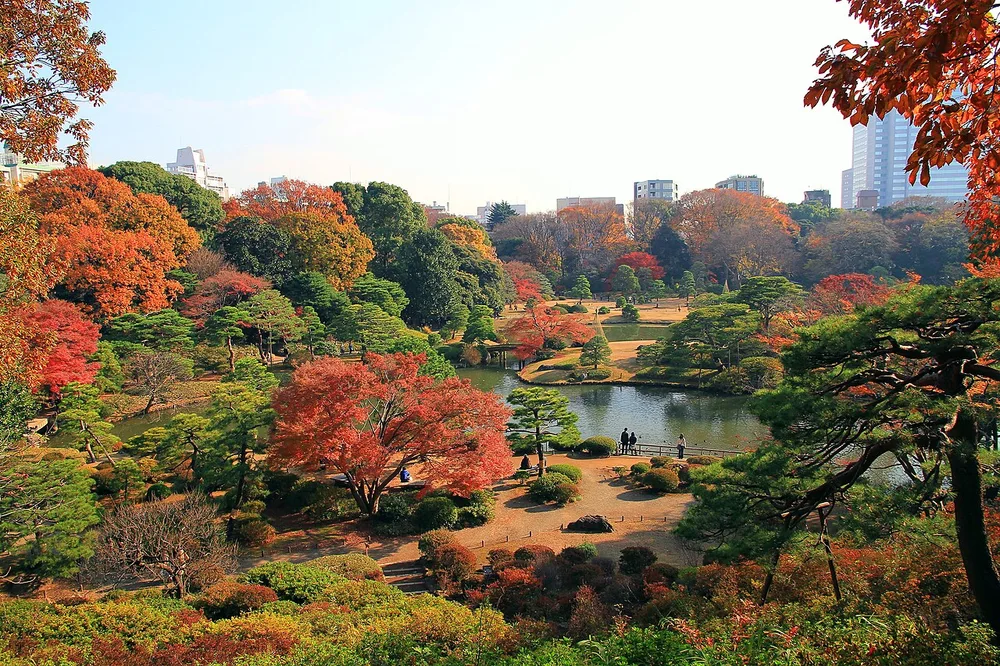
Use Daisensui as your center of orientation when reading the official garden map. The West Gate is at the lower left, the East Gate at the lower right. The southern maple grove runs below the main pond; the rice field, iris field, and plum grove lie north. Engetsukyo is northwest, and the more separate Inner Garden sits beside the East Gate. Choose north or south first rather than returning to the main pond after every named feature.
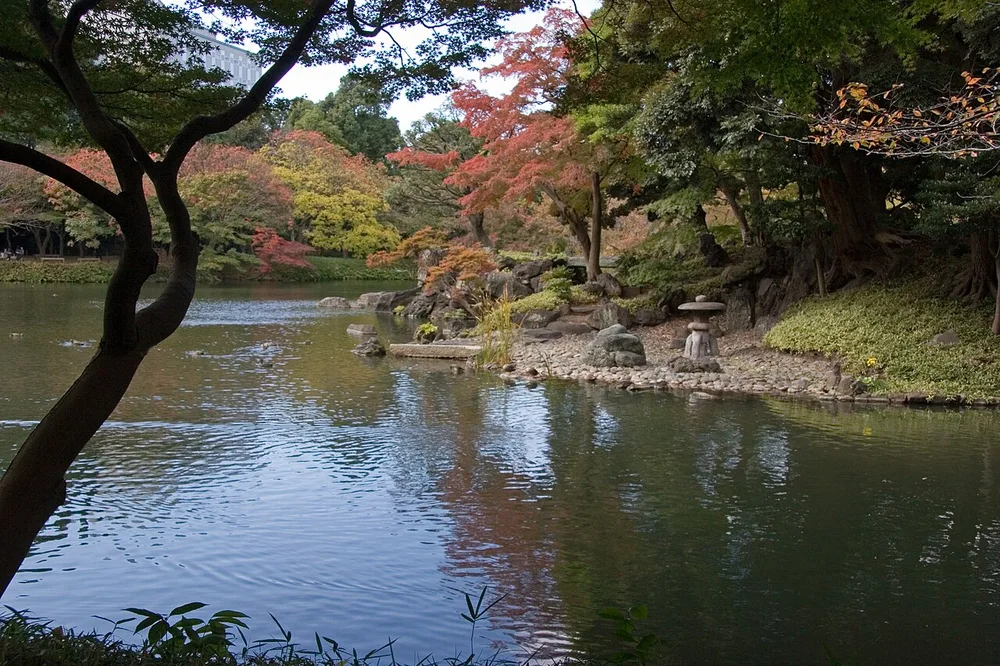
Tokugawa Yorifusa of the Mito Tokugawa family began the garden in 1629, and Mitsukuni completed it. Bunkyo city’s history describes it as a strolling pond garden and records Chinese influences introduced by Zhu Shunshui. Pond views, paths evoking famous mountains and rivers, and farmland share one circuit. The way to appreciate it is to move between viewpoints rather than seek a single endpoint beyond the entrance.
Daisensui represents the sea, linked with mountain, river, and rural scenes. For broad views, spend more time on either side of the main pond. For winding stone paths, shade, and nearby leaves, extend the northern branches. Returning to the pond when tired restores your bearings and reveals islands, pines, and water that were hidden by the woods.
The name Korakuen draws on the idea of worrying before others and enjoying happiness after them from the Yueyang Tower essay. Koishikawa was added in 1923 to distinguish it from Okayama Korakuen. Keep the full name Koishikawa Korakuen in ticket searches, photos, and itineraries. Korakuen Station, Tokyo Dome City, and the similarly named Okayama garden are separate destinations.
From the West Gate, start with Horai Island and Hitotsumatsu beside the pond
After entering the West Gate, reach the open west side of Daisensui and frame your first views around Hitotsumatsu pine and Horai Island. The pine’s branches take their form from Karasaki’s pine at Lake Biwa; the island and water give depth to the compact garden. Take a wide view with shoreline and water, then walk along the edge to see leaves overlap the island differently. This explains the garden better than repeated close-ups from one spot.
Horai Island represents immortality in the tradition of the immortals. It is shaped like a turtle, with the turtle-head stone called Tokudaiji-ishi visible near its shore. General visitors cannot enter the island, so view it from paths and pond edges. For children curious about the interior, the Tokyo Metropolitan Park Association’s Horai Island video includes island interiors and views back from the island side, filling in what the shore cannot show.
Leaf color and reflections change with viewing angle. For water photos, do not line everyone up at the very edge. Find a wide enough path and let companions stop in turns. If wind breaks the reflection, look at the island outline and layers between branches and shore. Still-water reflections are only one view; walking the shore is rewarding in itself.
The southwestern Seiko-no-Tsutsumi brings the idea of Hangzhou West Lake’s Su Causeway into the garden, near Kantokutei and Oi River. Link it with the pond for a short daytime visit: broad water first, then the causeway, stones, and narrow channels. At construction barriers, follow open paths back to the main pond.
The Tokyo Metropolitan Park Association’s official video introduces Horai Island, which general visitors cannot enter, with views from the island and water to complement the pond-side perspective.
Slow down in the north: Engetsukyo, rice fields, and rural scenery
For a deeper daytime walk, follow open northern paths from the pond toward Engetsukyo Bridge. Its stone arch and reflection form a full moon, giving it its name. Stay on a bank open to visitors and align your view with the arch and water. Front and side angles change the shapes of the opening, stone railings, and reflection. Stop where you will not obstruct others.
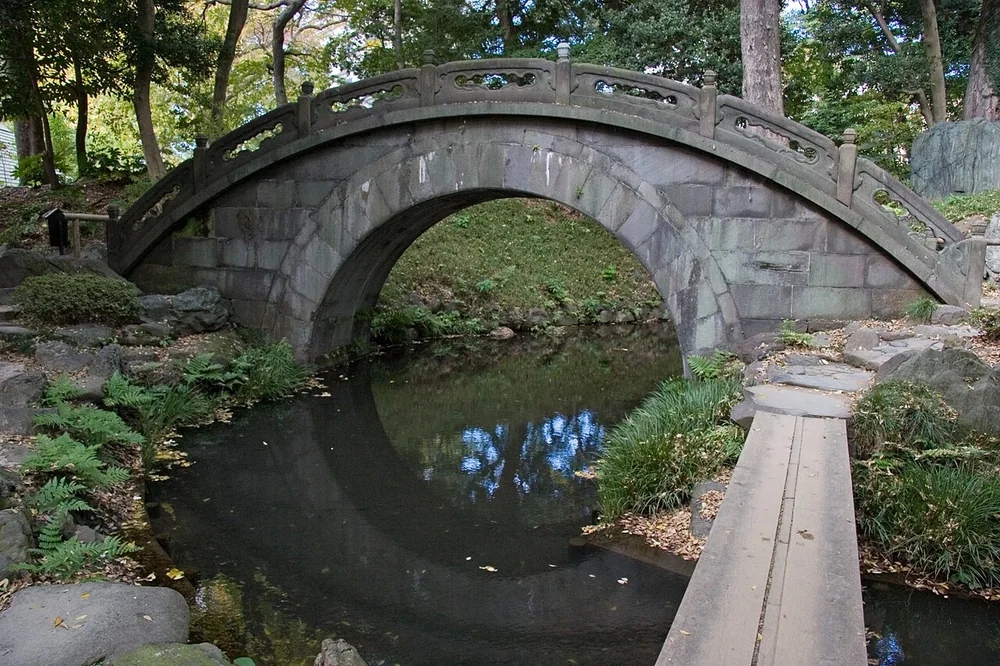
Near Engetsukyo, look first at stone and arch, then at leaves screening the water. In strong sun, try metering your phone on the bridge, then another exposure preserving the water. Operate the camera from a safe position beside the path and move aside afterward. Close views and small details make a different pace from the broad scene at Daisensui.
Continue north and east toward the rice field, iris field, and wisteria trellis. The rice field forms part of the rural scene. Tradition says Mitsukuni used it to teach his heir Tsunaeda’s wife about farming labor. Bunkyo elementary school children still plant and harvest rice here. In late fall, look at harvested fields, ridges, and surrounding channels. For rice ears, visit before harvest.
This branch suits an interest in garden design, plants, or waterways. Companions who only want foliage can rest near the main pond and meet at a clear agreed point. Northern walkers follow open paths back to Matsubara, then the east shore. With a wheelchair or stroller, choose an accessible main route from the accessibility map before deciding whether to split off onto terrain with greater height changes.
The southern maple grove offers a closer look at leaves
The maple grove on Daisensui’s south shore and the Tatsuta River area can be the daytime foliage focus. Moving from the pond beneath the trees shifts the view from distant islands to leaves, branches, and streams. Put away the wide-angle view and look at green, yellow, orange, and red on one tree. Before everything turns red, these nearby differences often show more clearly than a distant canopy photograph.
Visit this section early or late in the route. On a West Gate–East Gate walk, circle north first and leave the south shore for foliage near the finish. With one hour, enter from the West Gate, see the main pond, pass through the grove, and leave at the East Gate, saving Engetsukyo and northern rural scenes for another visit. A shorter visit reduces the branches, while retaining pond, woodland, and Inner Garden.
After rain, leaves stick to stone and shoe grip matters more than camera equipment. In light rain when the garden remains open, favor easier main paths and return to the pond after the woods. If using an umbrella, let oncoming walkers pass at narrow points. Wet leaves and fallen leaves gathered beside the water offer other details to observe.
The Inner Garden and Karamon Gate make a good daytime finish
As you follow the pond toward the East Gate, leave time for the Inner Garden and Karamon Gate. The Inner Garden was around the Mito domain’s shoin reception buildings, and Karamon separated this more private area from the Daisensui garden. The scale narrows from the large pond to smaller water and buildings. Find the gate, then turn back to the pond to understand the relationship better than from a gate photo alone.
Karamon burned in the war and its reconstruction was completed at the end of 2020. Look at roof curves, carving, and gate decoration from the paths on an ordinary visit. A Culture Day special opening runs November 3, 2026 from 10:00–16:00, allowing passage through Karamon and views into Tokujindo from outside. Fixed-point commentary that day suits visitors interested in architecture. The 11:00 and 14:00 garden tours meet near the East Gate entrance instead.
The East Gate is close to Suidobashi, convenient for a city meal after the Inner Garden. To stay around Tokyo Dome City, finish the garden walk here and plan the city activities separately. Historic garden paths give way to shops, entertainment, and food. For a return to the garden that evening, go back to the West Gate queue: the East Gate is exit-only for this event.
Separate one-hour and two-hour routes
For one hour, start with West Gate, Daisensui’s west shore, southern maple grove, Inner Garden, and East Gate. This keeps time for pond and trees while leaving out the longer northern branch. See the pond first, linger in the grove if the color is good, or move earlier to the Inner Garden if it appeals more. The low admission price makes a small visit reasonable; you need not speed up.
Two hours leaves room for Engetsukyo and the northern rural scene. A suggested order is West Gate, main pond for orientation, northern construction detour, Engetsukyo, rice field, Matsubara, pond shore, southern grove, then Karamon and Inner Garden. For a Japanese-language tour, use 11:00 or 14:00 as the meeting time and fit other stops around it. The tour lasts about an hour; add your own photo time.
For an afternoon arrival, work backward from last entry at 16:30 and closure at 17:00. Arriving at 16:00 allows a short walk, but not a northern branch and tea. Enter before 15:00 for more time to see the full garden. If you arrive too late and already hold an evening ticket, eat first and follow the designated evening route after the 18:00 reopening.
A group need not keep the same pace everywhere. Split in broad, recognizable areas and agree on a meeting time and gate name. In front of Karamon and outside the East Gate are different places: state the full location. A late photographer should add only the nearest section rather than making the group repeatedly cross the garden for one tree.
At night, follow West Gate to East Gate and pause at the lit features
The 2026 special evening hours are 18:00–21:00, with last entry at 20:00. Queues start at the West Gate; the operator warns of waits at busy times. Arrive before your desired entry time. An 18:00 opening does not put you at the first feature at 18:00. For a break midway, use designated sales or rest areas instead of sitting on a dark, narrow path.
That year’s illuminated features include Hitotsumatsu, Horai Island, and Karamon and snow-support ropes in the Inner Garden. See the pine branches and island outline by the pond first, then leave the Inner Garden for the section near the East Gate. Light concentrates attention at night. Pause at each feature and let your eyes adjust before framing a picture; this often reveals more than watching your phone screen throughout.
Engetsukyo and the Tsukiji wall have projections. Engetsukyo uses autumn foliage themes, while the wall shows Edo scenery and autumn imagery of Tsutenkyo and Oi River. Watch from the designated area and wait until a sequence ends before moving. Avoid crossing in front of other cameras or waiting in the center of a path to retake every scene.
Some areas close at night, so do not reuse the daytime northern branches. Get that evening’s route information on arrival and follow staff guidance from west to east. Allow about 1.5 hours flexibly for entry, viewing, and exit. Add another interval for matcha at Kantokutei, with its last orders in mind.
Tea at Kantokutei: regular food service and formal tea gatherings differ
Kantokutei near the West Gate serves both meetings and dining. General visitors can use its Biidoro Saryo for matcha or a meal. Formal Sekishu-school tea gatherings have set dates, sessions, and fees. For a seated garden view, use the regular tea room. For preparation rituals and cultural participation, book the event. The two do not need to fit on the same day.
Regular tea service is listed at 10:00–16:00, with last orders at 15:30. Opening dates change with Kantokutei’s meeting use, so check the monthly calendar on the official facilities page when planning lunch. If it does not fit, eat outside before arriving and leave tea and walking for the garden.
During the evening event, Biidoro Chaya at Kantokutei opens 18:00–20:30, with last orders at 20:00, cash only. The special Tsukiyo no Nishiki confection is limited each day. For tea during the night visit, stop nearby after entering the West Gate, then follow the light route, avoiding a return from the east side for last orders. Food trucks at Matsubara offer light food and drinks, with payment methods varying by vendor.
Children, wheelchairs, and strollers: include the terrain in your choice
Koishikawa Korakuen uses changes in plateau height for its scenery; mountain areas, stone paths, and pond edges differ. For a wheelchair or stroller, download the accessible route map and link areas such as Daisensui and the Inner Garden along marked accessible paths. Do not choose a shortcut from straight-line distance alone. Companions wanting slopes can briefly take a branch and rejoin at the same pond-side point.
The East Gate has an accessible restroom, and the operator provides a foldable adult changing bed at the East Gate ticket office for use in that restroom only. If you need it, using the East Gate as your daytime start and finish is more direct. The evening West Gate–East Gate rule is fixed. Tell staff your access needs on entry if you require easily reached toilets and rests throughout, and use that night’s open areas.
Elementary school children and younger must enter with a parent or equivalent adult. Give children concrete things to find: a turtle-shaped island, a full-moon stone bridge, or a rice field inside the garden. After two, take a rest rather than learning every building name. For family photos by ponds and bridges, adults should choose stable footing, keep children on the inner side, and move in turns.
Pets are not admitted. Collecting plants or animals, picnic mats, and bringing alcohol are prohibited, and the whole garden is smoke-free. Eat and rest in permitted places; photograph fallen leaves instead of taking them. These rules affect plans with pets, picnics, or long rests on grass. Arrange those activities outside the garden and meet afterward if anyone in the group needs them.
For garden design, take a tour and then walk on your own
Free Japanese garden tours normally leave at 11:00 and 14:00 on Saturdays, Sundays, Mondays, and public holidays. English tours are on Saturdays at 10:30 and 13:30. For plants, stone scenery, and history, put a tour in the first half of your visit, then return to favorite places after learning their stories. For foliage photos alone, walk independently rather than leaving a tour for pictures and missing both.
The daytime foliage notice gives about 60 minutes per tour and cancellation in rain. For an 11:00 tour, arrive around 10:00 to see the main pond before reaching the mapped meeting point. A 14:00 tour leaves the morning for another neighborhood and lunch before arrival. Ask the service center for the meeting point and that day’s operation on entry, saving a search inside.
For five or more people wanting shared commentary, special group tours start between 10:00 and 14:00 and last about an hour. Submit the application form from six months before your intended visit through the last day of the month two months before it. Travel agencies and commercial groups are excluded, with further limits during special seasonal tours. Families and groups of friends should submit their group size and preferred time within that application period. If you miss the deadline, join a scheduled tour or walk independently.
For both day and night, take the tour in daylight and spend the evening seeing the same scenes through lighting and projections. The two 2026 fall events overlap November 21–24, making those four days easiest for a same-day combination. Noh on November 28 and bugaku on December 5 come after the evening event has ended. Combining either performance with a night visit therefore requires two days.
Use handheld photography and leave the paths open
Photography equipment restrictions apply throughout Culture Day, November 3, 2026. Daytime foliage restrictions also run November 21–December 20, longer than the daytime event itself. Evening restrictions apply November 13–24 from 18:00–21:00. They cover sketching, monopods, tripods, selfie sticks, stabilizers, folding chairs, and mats. Foliage-season and evening rules also prohibit livestreaming in the garden and photography that obstructs passage or viewing. Use the daytime notice and evening notice to prepare a handheld setup.
To show the garden’s variety, combine a broad pond view, close foliage, and a bridge or gate detail. Keep shoreline in the wide shot, look for backlight and texture in leaves, and stand far enough back to include the top of a gate. This reduces time occupying one popular spot. When someone needs to pass, lower the camera, let them through, and wait for another gap.
At night, shoot handheld in the available light. Brace your phone against your body and keep bursts short. For video, record a short clip from a permitted standing position, then move away. Use handheld equipment during the restriction periods above. Model shoots and pre-wedding photography require an application to the service center and review, whether commercial or not, professional or amateur. Applications may not be accepted during busy periods and events.
A few useful answers
How much is daytime admission to Koishikawa Korakuen?
Regular admission is ¥300, or ¥150 for ages 65 and over. Elementary school children and younger enter free, as do junior high school students who live or attend school in Tokyo. The special evening opening requires a separate ticket.
When is the 2026 Koishikawa Korakuen evening opening?
November 13–24, 18:00–21:00, with last entry at 20:00. Enter at the West Gate and exit at the East Gate. Advance online tickets cost ¥1,000; same-day tickets cost ¥1,200.
Can I stay inside from daytime until the lights come on?
The garden closes and clears visitors at 17:00, then reopens at 18:00. You must re-enter with an evening ticket for the special opening.
Which Iidabashi exit should I use?
For the West Gate, walk about three minutes from Oedo Line Iidabashi exit C3, or about eight minutes from JR Iidabashi’s East Exit or Tokyo Metro exits A1 or A3.
Can I photograph the red Tsutenkyo Bridge in fall 2026?
Tsutenkyo has been removed and replacement work continues, with some paths closed. See Daisensui, Engetsukyo, the maple grove, and Inner Garden instead, using the signed northern detour.
How long should I allow for the foliage?
One hour covers the main pond, southern maple grove, and Inner Garden. Two hours adds Engetsukyo and the northern rural scene. Allow extra time for a tour or tea.
Official information and references
Sources used in this guide.
- Tokyo Metropolitan Park Association: Koishikawa Korakuen information and access
- Tokyo Metropolitan Park Association: Japanese garden map
- Bunkyo city: history of Koishikawa Korakuen
- Tokyo Metropolitan Park Association: 2026 daytime foliage event and photography restrictions
- Tokyo Metropolitan Park Association: 2026 special evening opening, tickets, and one-way route
- Tokyo Metropolitan Park Association: 2026 evening photography rules
- Tokyo Metropolitan Park Association: Tsutenkyo replacement and detour
- Tokyo Metropolitan Park Association: Kantokutei and dining facilities
- Tokyo Metropolitan Park Association: accessible route map
- Tokyo Metropolitan Park Association: Culture Day 2026 Karamon opening and Tokujindo viewing
- Tokyo Metropolitan Park Association: official Horai Island video