Plan Koishikawa Korakuen from Iidabashi’s West Gate or Suidobashi’s East Gate. Compare ¥300 daytime entry with separate 2026 evening tickets, and link the pond, Engetsu-kyo, maple grove and inner garden around Tsuten-kyo works.
- Region & Focus
- TokyoAutumn leaves
- Reading Scope
- 38 min read · 16 chapters · 6 Q&As
- Official Verification
- 11 official sources checkedUpdated 7 November 2026
- Key Topics
- SeasonsTokyo & Kanto
Chapter Route Map (tap any stop)
- Choose daylight for the garden or evening for light displays
- Autumn 2026 dates: distinguish leaf colour from scheduled performances
- Use the West Gate from Iidabashi or the East Gate from Suidobashi
- Daytime entry is ¥300; evening entry needs a separate ticket
- Tsuten-kyo works: change routes shown in old red-bridge photographs
- Use the main pond to locate the sea, mountains, rivers and fields
- From the West Gate: start with Horaijima and Hitotsu-matsu beside the pond
- Slow down in the north: Engetsu-kyo, rice fields and rural scenery
- The southern maple grove: leave time for leaves close up
- The eastern inner garden and Karamon: a natural daytime finish
- One hour and two hours need different routes
- Evening visits: enter west, leave east and pause at the lighting points
- Tea at Kantoku-tei: distinguish regular food service from a tea ceremony
- Children, wheelchairs and pushchairs: include the terrain in your choice
- For garden design, take a tour and then walk independently
- Photograph autumn leaves handheld and keep paths clear
- Quick Q&A
For a first autumn visit to Koishikawa Korakuen, allow two daylight hours. Enter through the West Gate from Iidabashi, start with the main pond, then follow open routes around the Tsuten-kyo works to Engetsu-kyo, the southern maple grove and the inner garden before the East Gate. The special evening opening runs from 13 to 24 November 2026, with separate tickets and a fixed West Gate entrance and East Gate exit. Choose daylight for natural leaf colour and path details, or an evening visit for lighting and projections.
Choose daylight for the garden or evening for light displays
For natural autumn leaves, pond reflections and stone-bridge details, choose daytime entry. Koishikawa Korakuen changes as you walk around its pond, with woodland, open water and rural scenery appearing in turn. Some views need a backward glance; others emerge only after rounding shrubs. Allow around two hours, adding tea or a guided walk separately. With only an hour, keep the main pond and your preferred area, then leave through the gate nearest your next stop.
The special evening opening combines paths, lighting and projections into a different visit. The 2026 event, Miyama “Hikari” Momiji o Tanoshimu, runs from 13 to 24 November. It starts before the daytime foliage event, with the official description using light to create an early autumn-colour scene. Choose these dates for night views and projections. If actual leaf colour is the priority, put daylight viewing first.
The tickets are charged separately. The garden closes and clears visitors at 17:00, then reopens at 18:00. You cannot simply stay after sunset to see the lights. For two visits on one day, include dinner, another queue and a second ticket. For a first visit with only half a day, I would choose an unhurried daytime walk. The evening suits those wanting illuminated Horaijima Island and the Karamon gate.
Plan Koishikawa Korakuen from Iidabashi’s West Gate or Suidobashi’s East Gate. Compare ¥300 daytime entry with separate 2026 evening tickets, and link the pond, Engetsu-kyo, maple grove and inner garden around Tsuten-kyo works.
Autumn 2026 dates: distinguish leaf colour from scheduled performances
The daytime Miyama Momiji o Tanoshimu event runs from 21 November to 6 December 2026. Hours are 09:00–17:00, with last entry at 16:30. These dates define the cultural programme and seasonal walks. Match your available days with recent official garden highlights and tree photographs. In early November, ponds, stone bridges and the garden's structure give you more to see than searching only for a solid mass of red leaves.
For a performance alongside the foliage, Hosho-school Noh takes place on 28 November at Matsubara, at 11:30 and 13:30, each about 30 minutes. Viewing is free; garden admission is separate. In rain it moves to Kantoku-tei, with 55 places per performance, allocated first come, first served from 20 minutes before the start. Plan the afternoon walk from Matsubara towards the pond rather than rushing elsewhere after the performance.
Gagaku court music and bugaku dance also take place at Matsubara on 5 December, at 11:30 and 13:30, around 30 minutes each. Rain postpones them to 6 December; rain that day cancels them. If the dance is your priority, choose the 5th and leave room to move to the 6th. For a quiet walk, choose a weekday without performances. Match your intended programme to the times and wet-weather arrangements in the daytime event notice.
A Sekishu-school tea ceremony takes place on 22 November, hourly from 11:00 to 15:00, around 40 minutes per session, with 25 participants each. It costs ¥1,500 plus garden entry. Advance registration opens at 09:00 on 15 November until full. A small number of same-day places are accepted at Kantoku-tei from 09:00. Choose it if you want to give a half-day to the ceremony. For a simple matcha break, the regular tea room is easier to fit in.
Use the West Gate from Iidabashi or the East Gate from Suidobashi
The most direct rail approach to Koishikawa Korakuen West Gate is exit C3 at Iidabashi Station on the Toei Oedo Line, around three minutes on foot according to the official access page. From JR Sobu Line Iidabashi East Exit, allow around eight minutes. Tokyo Metro Tozai, Yurakucho and Namboku line exits A1 or A3 are also listed at around eight minutes. These are different station exits. Include West Gate in your navigation destination to avoid following the wall to the wrong side.
For Koishikawa Korakuen East Gate, walk around five minutes from the West Exit of JR Sobu Line Suidobashi Station, or around six minutes from exit 2 at Korakuen Station on the Marunouchi and Namboku lines. Toei Mita Line Suidobashi exit A2 is listed at around eight minutes. From Suidobashi or Korakuen, navigate specifically to the East Gate and its ticket office along the garden perimeter.
Your gate also determines the first view. The West Gate is near the service centre and Kantoku-tei, useful for asking about works diversions, having tea and then reaching the main pond. The East Gate starts near the inner garden and Karamon, suiting a daytime visit from Suidobashi that ends towards Iidabashi. Karamon on the garden map is a historic structure inside, not a street-side ticket entrance.
Evening entry is fixed at the West Gate, with exit through the East Gate, so let rail travel follow that direction. Arrive via Iidabashi and leave towards Suidobashi or Korakuen instead of circling the whole perimeter to the original station. The garden has no car park. Rail is easiest for a city walking day. Leave large luggage at your accommodation or suitable storage before making this a walking stop.
Daytime entry is ¥300; evening entry needs a separate ticket
Standard daytime admission is ¥300, or ¥150 for those aged 65 and over. Primary-school children and younger enter free, as do junior-high pupils living or studying in Tokyo. A junior-high pupil visiting from outside Tokyo without Tokyo residence or school eligibility should be budgeted at the standard rate. The senior discount requires proof of age. Ordinary daytime tickets are available at the gate and online. Webket tickets now require a specified visit date and are valid only on that date. You can cancel the entire original payment order before 16:30 on the visit date; cancellation is unavailable if any tickets in the order have already been used.
For two adults, one visiting junior-high pupil and one primary-school child, daytime admission totals ¥900. Advance evening tickets for the same group total ¥3,000, or ¥3,900 for both visits. Use this difference to decide whether to reserve the evening budget for the light event.
An annual pass for this garden costs ¥1,200, or ¥600 for visitors aged 65 and over. The nine metropolitan gardens' annual pass costs ¥4,000 or ¥2,000 respectively. Buy ordinary admission for a single autumn visit. Four standard adult visits to Koishikawa within a year equal the single-garden annual pass; savings begin with the fifth. For the combined pass, add the intended gardens' actual admission charges rather than judging only by the number of gardens.
Advance online tickets for the 2026 special evening opening cost ¥1,000 and are sold until 23:59 on 12 November. Online same-day tickets during the event cost ¥1,200, sold until 19:30 on 24 November. A limited number of same-day tickets are also sold at the West Gate from 18:00 to 20:00 each event day, for cash only. Follow ticket links from the official evening event page and check that the purchase screen names this special evening opening. Tickets for this evening event bought through Seven Ticket cannot be cancelled, changed or refunded for personal reasons. Asoview’s 2026 advance tickets list the same restrictions.
Evening tickets are required from junior-high school age, including pupils living or studying in Tokyo. Annual passes and other garden admission tickets cannot replace an evening ticket. The official concession for disability certificate holders and one carer is ¥500 each, through the gate or specified Mirairo Ticket method. Daytime free-entry eligibility and evening discounts are separate systems. Calculate the total by each person's age and ticket type.
Tsuten-kyo works: change routes shown in old red-bridge photographs
The Tsuten-kyo bridge has been dismantled. The works notice updated on 20 March 2026 states that replacement work has continued since 1 May 2025, with some paths closed. The current works notice shows the northern diversion.
The closed section lies between Ryukyu-yama, the former Kiyomizu Kannon-do site, Tsuten-kyo and Tokujin-do. The alternative uses a temporary route through Sawatari. Before heading north from the western side by day, ask the service centre for that day's directions and follow the open diversion. Reallocate the time you would have spent here to Engetsu-kyo or the pond edge.
Garden maps retain Tsuten-kyo's historic location, and photographs show it with autumn leaves, helping explain the original layout. Follow works signs for the actual walk. Evening projections on the Tsukiji-bei wall specifically include autumn imagery of Tsuten-kyo and Oi River, unavailable to view during construction. See the terrain by the daytime diversion and these autumn images on the wall at night.
Use the main pond to locate the sea, mountains, rivers and fields
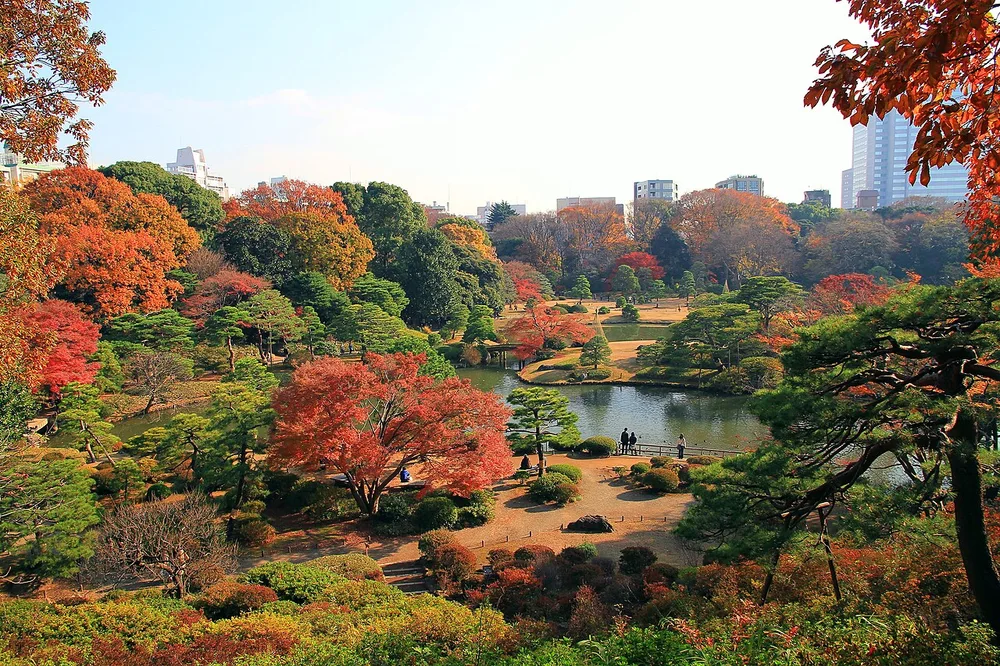
Treat Daisensui, the main pond, as your centre to read the official garden map. The West Gate is at the lower left and the East Gate at the lower right. The maple grove runs south of the pond; rice fields, iris beds and the plum grove are to the north. Engetsu-kyo is northwest, with the more separate inner garden beside the East Gate. Choose north or south first rather than returning to the pond for every name you notice.
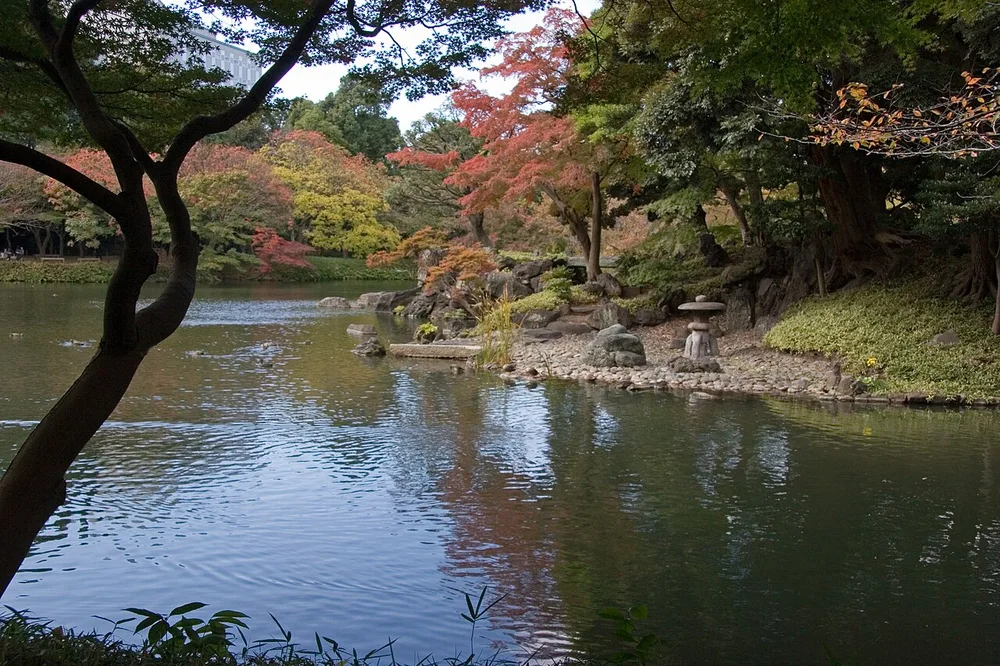
Tokugawa Yorifusa of the Mito Tokugawa family began the garden in 1629, and Mitsukuni continued it. Bunkyo City's history describes a strolling pond garden and records Chinese influences introduced by Zhu Shunshui. Pond views, routes evoking famous mountains and rivers, and farmland share the circuit. Explore by changing viewpoint rather than marching from the entrance to a single final attraction.
Daisensui represents the sea, with mountain, river and rural scenes around it. For open views, spend longer on either side of the main pond. For winding stone paths, shade and close leaves, extend the northern branch. Return to the pond when tired to regain your bearings and see islands, pines and water previously hidden by woodland.
The name refers to the idea of worrying before others and enjoying happiness after others in the Yueyang Tower essay. Koishikawa was added in 1923 to distinguish it from Korakuen in Okayama. Keep the full name Koishikawa Korakuen when booking travel, searching images or naming your itinerary. Korakuen Station, Tokyo Dome City and the garden in Okayama are separate destinations.
From the West Gate: start with Horaijima and Hitotsu-matsu beside the pond
From the West Gate, reach open ground west of Daisensui and use Hitotsu-matsu pine and Horaijima Island for your first view. The pine's branching form takes inspiration from the Karasaki pine at Lake Biwa; the island and water create depth within a relatively compact garden. Start with a wide photograph retaining water and shoreline, then move along the bank to see leaves overlap the island differently. This explains the layout better than repeated close-ups from one spot.
Horaijima symbolises the immortals’ promise of eternal life and takes a turtle shape, with the turtle-head Tokudaiji Stone visible by the shore. Ordinary visitors cannot land on the island; stay on paths and banks. For children curious about its interior, the Tokyo Metropolitan Park Association video includes island views and views back from the island side, adding what cannot be seen from shore.
Leaf colour and reflected light change with your angle. For water photographs, do not line everyone up at the very edge. Find a wide enough path and take turns stopping. If wind breaks the reflection, look instead at the island outline, branches and layers along the bank. Still-water reflections are one view among several; walking the shore has its own rewards.
The southwestern Seiko no Tsutsumi embankment brings an image of Hangzhou West Lake's Su Causeway into the garden, near Kantoku-tei and Oi River. Link it with the pond for a short daytime route: after open water, turn towards the embankment, stones and narrow channels. At works barriers, follow the open path back to the main pond.
An official Tokyo Metropolitan Park Association video introduces Horaijima, closed to ordinary visitors, from inside the island and the water, adding to the views from the pond bank.
Slow down in the north: Engetsu-kyo, rice fields and rural scenery
For a fuller daytime walk, follow open northern routes from the pond towards Engetsu-kyo. The stone arch and its reflection form the full moon that gives it its name. View it from an accessible bank, aligning the arch opening and water. Front and side views change the arch, stone rail and reflection. Stop where you will not obstruct others.
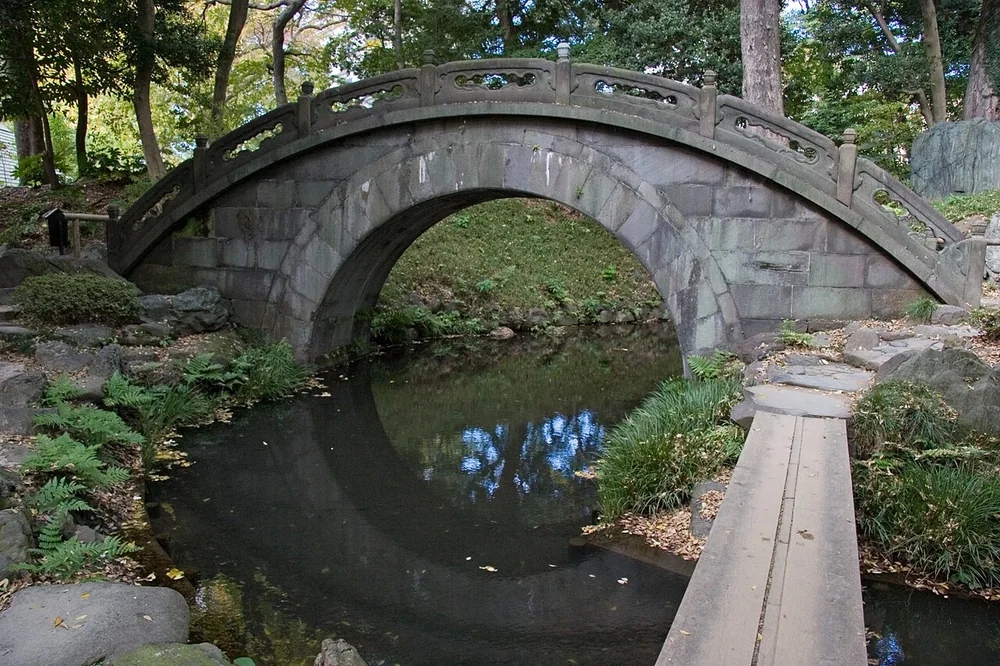
Near Engetsu-kyo, slow down for the stonework and arch before checking how leaves frame the water. Bright sunlight brings stronger contrast. On a phone, try exposing for the bridge, then for the water. Adjust the camera from a safe position beside the route and move aside afterwards. These close views and details make a different pace from Daisensui's broad outlook.
Continue north and east towards the rice field, iris beds and wisteria trellis. The field is part of the rural scene. Tradition says Mitsukuni used it to teach his heir Tsunaeda's wife about agricultural labour; Bunkyo primary-school pupils still take part in planting and harvesting. Late autumn offers harvested fields, banks and channels. To see ears of rice, choose a date before harvest.
This branch suits an interest in garden design, plants or waterways. Companions focused on leaves can rest near the main pond and meet at a clearly agreed point. Northern walkers return by open paths to Matsubara, then the eastern pond shore. With wheelchairs or pushchairs, use the accessibility map for a main route before splitting off onto ground with greater height changes.
The southern maple grove: leave time for leaves close up
The maple grove on Daisensui's southern bank and the Tatsuta River area make a daytime foliage focus. Moving beneath the trees changes your view from distant islands to leaves, branches and water. Put away the wide angle and look at green, yellow, orange and red on one tree. Before everything turns red, these close differences can be clearer than a distant canopy photograph.
Put this section early or late. On a West-to-East Gate route, loop north first and save the southern shore for foliage near the end. With one hour, enter at the West Gate, see the main pond and cross the maple grove to the East Gate, leaving Engetsu-kyo and northern fields for another visit. Shorten the number of branches, while keeping some pond, woodland and inner-garden time.
After rain, fallen leaves stick to stone. Grippy shoes matter more than camera equipment. In light rain while the garden remains open, focus on easier main paths and return to the pond after the trees. With an umbrella, let oncoming visitors through narrow sections first. Wet leaves and fallen foliage gathered at the bank offer different details to observe.
The eastern inner garden and Karamon: a natural daytime finish
As you head towards the East Gate, leave time for the inner garden and Karamon gate. The inner garden was the Mito domain's shoin area, with Karamon separating this more private space from the main pond garden. From the large pond, the smaller water and buildings change the scale. Locate the gate, then look back at the pond to understand the two spaces better than a photograph of the gate alone would show.
Karamon was destroyed in wartime and reconstructed by late 2020. Look at the roof curves, carvings and decoration from the normal paths. On 3 November 2026, from 10:00 to 16:00, a Culture Day special opening allows passage through Karamon and views into Tokujin-do from outside. Fixed-point explanations also suit visitors interested in buildings. For the 11:00 or 14:00 garden tour that day, the meeting point moves near the East Gate entrance.
The East Gate is close to Suidobashi, making a city meal easy after the inner garden. For more time around Tokyo Dome City, finish the garden walk here and plan city activities separately. The settings differ: historic garden paths on one side, shops, entertainment and food on the other. For a second evening visit, return to the West Gate queue; the East Gate is exit-only during this event.
One hour and two hours need different routes
For an hour, start with West Gate, western Daisensui shore, southern maple grove, inner garden and East Gate. This reserves time for the main pond and trees, leaving out the longer northern branches. See the pond first, linger in the grove if colour is good or move earlier to the inner garden if it appeals more. Modest admission makes a small visit reasonable; you need not hurry to cover everything.
Two hours allow Engetsu-kyo and the northern fields. Enter at the West Gate, orientate at the pond, follow works signs north to Engetsu-kyo, the rice field and Matsubara, then return along the shore to the southern maple grove before Karamon and the inner garden. For a Japanese guided tour, use 11:00 or 14:00 as your anchor and place independent viewing around it. The tour takes around an hour; add your own photography time.
For an afternoon arrival, work backwards from last admission at 16:30 and closure at 17:00. Arriving at 16:00 still permits a short walk, but not a northern branch plus tea. Enter before 15:00 for a fuller garden visit. If arriving very late with an evening ticket, eat first and follow the designated route after reopening at 18:00.
Groups need not keep one pace throughout. Split only in broad, recognisable areas and agree the meeting time and full gate name. In front of Karamon and outside the East Gate are different places. A late photographer can cover the nearest section without making the whole party cross the garden repeatedly for one tree.
Evening visits: enter west, leave east and pause at the lighting points
The 2026 special evening opening is 18:00–21:00, last entry 20:00. Queues begin at the West Gate, and the operator warns of waits at busy times. Arrive before your intended entry time: opening at 18:00 does not put you at the first attraction then. For a rest en route, use designated sales and resting areas rather than sitting on a dark, narrow path.
That year's illuminated features include Hitotsu-matsu, Horaijima and the inner garden's Karamon and yukitsuri ropes supporting trees against snow. Start with pine branches and the island silhouette beside the pond, then leave the inner garden for the final stretch towards the East Gate. Light concentrates attention more than in daytime. Pause at each point and let your eyes adjust before taking photographs, rather than watching a phone screen throughout.
Engetsu-kyo and the Tsukiji-bei wall have projections. The bridge uses autumn leaves as its theme; the wall presents Edo scenery and autumn imagery of Tsuten-kyo and Oi River. To see a sequence before moving on, stay in the designated viewing area until a segment ends. Avoid crossing the front of others' cameras or waiting in the middle of the route to retake every scene.
Some areas close at night, so the daytime northern branches do not transfer directly. Collect that evening's route information and follow staff from west to east. Allow around 1.5 hours for entry, viewing and exit flexibility. Add more for matcha at Kantoku-tei, considering last orders first.
Tea at Kantoku-tei: distinguish regular food service from a tea ceremony
Kantoku-tei near the West Gate serves both gatherings and food. Ordinary visitors can use its Biidoro Saryo for matcha or meals. The formal Sekishu-school tea ceremony has a separate date, sessions and fee. Choose the regular tea room to sit with a garden view, or book the event for tea preparation and a cultural experience. You need not fit both into one day.
Regular tea service is listed as 10:00–16:00, last orders 15:30. Opening days change with Kantoku-tei gatherings. For lunch, check the month's calendar on the official facilities page. If no suitable opening fits, eat outside before arriving and keep garden time for tea and walking.
During the evening event, Biidoro Chaya at Kantoku-tei opens 18:00–20:30, last orders 20:00, cash only. The special Tsukiyo no Nishiki sweet has limited daily quantities. For evening tea, do this near the West Gate first, then follow the lights, avoiding a return from the east for last orders. Food trucks at Matsubara serve light food and drinks, with payment methods varying by stall.
Children, wheelchairs and pushchairs: include the terrain in your choice
Koishikawa Korakuen uses plateau height differences in its design. Mountain scenes, stone paths and pond shores have different conditions. With a wheelchair or pushchair, download the accessible route map and link areas such as Daisensui and the inner garden on marked accessible main paths. Do not choose only by straight-line distance. Companions wanting slopes can briefly take a branch and meet again at the same pond-side point.
The East Gate has a wheelchair-accessible toilet. The ticket office also provides an adult-sized folding care bed, for use only in that toilet. Those needing it can use the East Gate for daytime arrival and departure. Evening west-to-east travel is fixed. Explain route needs to staff on entry if you need accessible toilets and resting points, and plan within that night's open areas.
Primary-school children and younger must enter with a parent or equivalent adult. Give children concrete things to find: the turtle-shaped island, full-moon stone bridge or rice field. Two are enough before a rest; there is no need to learn every building name. For family photographs beside ponds and bridges, adults should choose stable footing, keep children on the inner side and move in turn.
Pets, collecting plants or animals, picnic mats and bringing alcohol are prohibited; the whole garden is non-smoking. Eat and rest in permitted places, and photograph fallen leaves rather than collecting them. These rules affect plans with pets, picnics or long grass-side rests. If someone needs those activities, choose a separate place and time outside and meet afterwards.
For garden design, take a tour and then walk independently
Free Japanese garden tours usually depart at 11:00 and 14:00 on Saturdays, Sundays, Mondays and public holidays. English tours are on Saturdays at 10:30 and 13:30. If plants, stones and history interest you, put a tour in the first half of the visit, learn the stories behind names and revisit favourite places. For autumn photography alone, walk independently rather than leaving a tour for pictures and completing neither properly.
The daytime autumn notice gives about 60 minutes per tour, cancelled in rain. For an 11:00 tour, arrive around 10:00 for the main pond, then go to the map's meeting point. A 14:00 tour leaves the morning for another neighbourhood and lunch first. Ask the service centre about that day's meeting point and operation on entry rather than searching for a group inside.
For groups of five or more wanting shared explanations, a special group tour can start between 10:00 and 14:00 and takes around 60 minutes. Submit the application form between six months before the intended visit and the end of the month two months before it. The service does not accept travel agencies or commercial groups, and special festival tour periods have additional limits. Family or friend groups should apply within this period with their numbers and preferred time. If you miss the application period, choose a scheduled tour or walk independently.
For both daylight and evening, take the tour by day and focus at night on how the same scenes change under lighting and projections. The two autumn events overlap on 21–24 November 2026, making these four days easiest for combining both. Noh on 28 November and bugaku on 5 December fall after evening openings end. Choose separate days for a performance and night visit.
Photograph autumn leaves handheld and keep paths clear
Equipment restrictions apply all day on Culture Day, 3 November 2026. Daytime foliage restrictions run from 21 November to 20 December, longer than the daytime event itself. Evening restrictions apply 18:00–21:00 on 13–24 November. They cover sketching, monopods, tripods, selfie sticks, stabilisers, folding chairs and ground mats. The foliage and evening periods also prohibit live streaming and photography that obstructs passage or viewing. Pack for handheld photography according to the daytime notice and evening notice.
Show the garden's differences with a broad pond view, close leaves and a stone-bridge or gate detail. Keep the shoreline in wide views, look at backlighting and texture in leaves, and stand far enough back to include the gate roof. This reduces time occupying one popular spot. If someone needs to pass, lower your camera and let them through before finding another gap.
At night, photograph handheld in available light. Brace the phone against your body and shorten each burst. For video, make a short clip from a permitted standing spot and move on. Use handheld equipment in the restricted periods above. Model or wedding photography requires advance application and service-centre review, whether commercial or non-commercial, professional or amateur. Applications may not be accepted during busy or event periods.
A few useful answers
How much is daytime admission to Koishikawa Korakuen?
Standard admission is ¥300, or ¥150 for visitors aged 65 and over. Primary-school children and younger, and junior-high pupils living or studying in Tokyo, enter free. The special evening opening requires a separate ticket.
When is the 2026 evening opening?
13–24 November, 18:00–21:00, last entry 20:00. Enter through the West Gate and leave through the East Gate. Advance online tickets cost ¥1,000; same-day tickets cost ¥1,200.
Can I stay inside after daytime opening for the lights?
The garden closes and clears visitors at 17:00, reopening at 18:00. Re-enter with an evening ticket for the special opening.
Which Iidabashi exit should I use?
The West Gate is around three minutes from Oedo Line exit C3, or around eight minutes from JR Iidabashi East Exit and Tokyo Metro exits A1 or A3.
Can I photograph the red Tsuten-kyo bridge in autumn 2026?
Tsuten-kyo has been dismantled and replacement work continues, with some paths closed. Visit Daisensui, Engetsu-kyo, the maple grove and inner garden instead, following the signed northern diversion.
How long should I allow for autumn leaves?
One hour covers the main pond, southern maple grove and inner garden. Two hours allow Engetsu-kyo and the northern fields as well. Add time for a guided tour or tea.
Official information and references
Sources used in this guide.
- Tokyo Metropolitan Park Association: Koishikawa Korakuen information and access
- Tokyo Metropolitan Park Association: Japanese garden map
- Bunkyo City: history of Koishikawa Korakuen
- Tokyo Metropolitan Park Association: 2026 autumn foliage event and daytime photography restrictions
- Tokyo Metropolitan Park Association: 2026 special evening opening, tickets and one-way route
- Tokyo Metropolitan Park Association: 2026 evening photography rules
- Tokyo Metropolitan Park Association: Tsuten-kyo replacement works and diversion
- Tokyo Metropolitan Park Association: Kantoku-tei and dining facilities
- Tokyo Metropolitan Park Association: accessible route map
- Tokyo Metropolitan Park Association: 2026 Culture Day Karamon and Tokujin-do special opening
- Tokyo Metropolitan Park Association: official Horaijima video