Start with the evening: will you return to Osaka or sleep near the harbor? An ordinary waterfront walk, winter Luminarie and autumn minato HANABI need different tickets, clothing and ways home. Use the three-base comparison to decide where your bags belong, then choose one day or two days. For an event, start with the correct year and ticket branch. Event conditions and prices were checked as of October 21, 2026. Suggested schedules are planning examples, without individual confirmation of departures, rooms or seat inventory.
Day trip or overnight: protect the evening you actually want
A Kobe day trip from Osaka works well as a one-way route through Motomachi, the harbor and one indoor attraction. There is no need to move hotels just to collect a photo. Staying a night becomes useful when you want a leisurely Kobe beef meal, a waterfront rest after dark, or a visit specifically for lights or fireworks: it removes an intercity journey after the crowd leaves. Write down the one experience you cannot drop, then remove distant attractions competing for that time. Sannomiya, Kitano, Arima and Mount Rokko do not all need to share one day.
With a toddler, wheelchair user or easily tired companion, choose the farthest walking point and an early exit first. A harbor-only day can enter through Motomachi and leave from JR Kobe; put Kitano’s slopes in a separate half day. When combining cities, fix your Osaka bases and moving days, then leave a full day for Kobe. Avoid an important fixed reservation on the afternoon after landing at Kansai Airport.
Two days do not mean twice the sights. Put timed or reservable places on day one, and walking, shopping and departure on day two. If Arima bathing, Suma’s aquarium or the Akashi Strait is the real purpose, research that area’s transport and tickets separately. Replace an existing half day or day when adding them, rather than squeezing the southern waterfront, Kitano’s climb and outlying transport into one afternoon.
Sannomiya, Motomachi or the harbor: connect dinner with tomorrow’s departure
Sannomiya combines several railways, airport connections and restaurants, making it practical for a first Kobe stay or a city change the next day. Motomachi puts Nankinmachi, the former foreign settlement and shopping within walking range, but some intercity trips need another connection. Harbor hotels suit visitors prioritizing waterfront evenings and hotel downtime. Their value is not explained by distance from a station alone: view direction, room type, meals and shuttle arrangements matter.
All three bases can reach the harbor; a waterfront room is not required for a waterfront walk. If the room difference pays for two short rides you are happy to take, do not sacrifice sleep merely to avoid them. Conversely, a harbor premium may do little if you spend only twenty waking minutes in the room that evening. Draw a line between the hotel entrance, dinner and the next morning’s first stop, once with bags and once without. Straight-line distance misses the useful comparison.
The table is a decision tool, not an equipment list guaranteed for every hotel in the area. Named room examples later distinguish third beds, children sharing a bed and accessibility; details cannot be transferred between categories. Choose the base, then filter total price, cancellation deadline and bed arrangement. That produces two or three acceptable options faster than twenty unstructured booking tabs.
Arima Onsen suits travelers who want bathing, a ryokan dinner and a restful next morning to be the focus of their stay, and can leave the afternoon free to arrive. It offers a different pace from Sannomiya, Motomachi and the waterfront. If Kobe's harbor views, fireworks or a city dinner matter most, keep your city base and visit Arima on another day: choose one bathhouse, lunch and a walk through the hot-spring streets, leaving enough time to return comfortably before your evening reservation. A day visit does not automatically include overnight guests' room or private-bath privileges. Compare Arima day visits and overnight stays, including baths, rooms and meal conditions before deciding to move your luggage.
For an Arima stay with dinner and breakfast, work backward from dinner time to set your arrival, rather than deciding when to head up after a harbor event. For example, Arima Grand Hotel's official FAQ requires dinner-included plans to start dinner between 17:30 and 20:00, and a start after 20:00 cannot be accommodated; day visitors also cannot use its private baths. These are this hotel's conditions, not rules for every Arima property. To keep dinner, bathing and a full waterfront evening, spend one night in the city and another in Arima, or keep your city room and bathe on a separate day, so two reservations do not compete for the same evening.
| Base | Prioritize for | Trade-off | Check before booking |
|---|---|---|---|
| Sannomiya | Intercity travel, early starts, dining choice | Complex station group; direct access is not to every railway | Operator, ticket gates, late-night entrance |
| Motomachi / former foreign settlement | Nankinmachi and urban walking | Extra connection for airports and some intercity routes | Room size, street entrance, bag route |
| Meriken Park / harbor | Waterfront evenings and hotel rest | Station walk and event controls affect shuttles | View direction, shuttle times, alternative if the shuttle is full |
From Osaka: Kobe does not mean a single station
First compare JR Osaka, Hankyu Osaka-Umeda or a nearby Hanshin entrance with your Osaka hotel, then check actual travel and transfers to Kobe. Do not detour to an inconvenient station just to use a pass. JR Sannomiya, Hankyu/Hanshin Kobe-Sannomiya and municipal subway Sannomiya are separate stations in the same center. Walking, ticket gates and elevators remain part of the trip. Shin-Kobe is the Shinkansen station and still requires a connection into town.
To enter the harbor directly, search for JR Kobe and head from its central exit toward the sea. Harborland’s official access instructions also list Kosoku-Kobe’s east gates and Harborland station on the Kaigan Line. If Nankinmachi lunch comes first, start at Motomachi instead. Both make sense: match the arrival station to the first stop, rather than looking for one station named Kobe.
On a Kansai Airport arrival day, allow for immigration, baggage and possible delay. A cross-bay boat does not put you in Sannomiya immediately after the plane. Read the Kansai transfer comparison for bags and connections, then link it to the hotel. Kobe’s official transport gateway leads to operators, but minimum journey figures omit your hotel-to-platform walk, waiting and station exit.
CITY LOOP passes: calculate the trips, without the old contactless cap
CITY LOOP single fares are JPY 300 for adults and 150 for the operator’s child category. Kobe Loop passes cost 800/400 for one day and 1,200/600 for two. Check child ages and free accompanying young children in Shinki Bus’s ticket conditions; not every age is automatically half price. The valid routes are specified. These passes do not cover every Kobe train, cable car, airport connection and attraction.
Using CITY LOOP alone, two adult rides cost 300 × 2 = JPY 600, below the one-day pass; three cost 900, or 100 more than the 800 pass. Recalculate individual segments when adding other valid lines. Crucially, the operator announced the end of the JPY 800 daily credit-card contactless cap on March 31, 2026. Contactless payment continues from April, but does not turn itself into a day pass.
A good-value ticket and a useful route are separate questions. A bus uphill to Kitano followed by walking down may help; for Motomachi and the harbor alone, do not circle back to Sannomiya to manufacture a third ride. Scratch the date on a paper ticket; activate digital tickets through their platform and show the valid date screen. Read two-day validity rather than assuming any two dates or 48 hours. Fireworks diversions and suspensions are separate: a pass does not guarantee a bus after the show.
Walk one way: enter through Motomachi and leave through Kobe station
An ordinary daytime route can link Motomachi, Nankinmachi, Meriken Park, Port Tower and Harborland in order. At the waterfront, decide whether to continue west to MOSAIC, without returning to Sannomiya between sections. The tower’s official walking approaches include around five minutes from Minatomotomachi exit 2, fifteen from JR/Hanshin Motomachi’s west exit and fifteen from JR Kobe’s south exit. Those are tower approaches, not fifteen minutes for the whole photo walk.
Allowing 30–45 minutes from Motomachi to the water, including finding the way, crossings and brief stops, is a conservative planning margin rather than an official measurement. Store bags first. Discovering at the tower that large luggage cannot enter creates a return trip. Wind, rain, construction and event controls can close the shortest path. Follow barriers and directions on arrival; do not climb a fence for a photograph.
Choosing a station endpoint beforehand is more dependable than improvising a waterfront taxi. For Osaka, compare JR Kobe or the private railway you planned to use; for Sannomiya accommodation, return to the center early. If someone cannot finish the walk, cut the Harborland extension first rather than forcing a booked tower slot later. During events, this everyday one-way route must yield to the entrances and exits permitted that day.
Kitano in the morning: choose a house interior or the neighborhood
Kitano is on the slopes north of Sannomiya, not one flat district with the southern waterfront. For domestic architecture, decoration and street history, give one house and nearby streets a morning, eat in Sannomiya, then head toward the sea. If you only want an exterior photograph, the pass with the most houses is not automatically best. Admission you cannot use remains a cost. Compare the sites through the official Kitano and Shin-Kobe area guide.
Hills and steps are real parts of the visit. A suitable bus can take you nearby before a slow descent on open paths. If continuous wheelchair access is essential, ask each house about entrance, thresholds and reachable floors: a nearby bus stop does not guarantee an accessible interior. Rain changes speed on stone and slopes. With a stroller, retain one confirmed place rather than assuming carrying the child upstairs is the solution.
For one day combining a fixed beef lunch, maritime museum and evening event, drop Kitano instead. With two days, place it on the second morning. Nunobiki Ropeway or a mountain night view should replace an existing half day, not become another evening with an unknown return. This makes the choice between urban harbor and hillside houses clear, instead of spending all day crossing north and south.
Kazamidori House: current tickets, closing day and toilets first
Kazamidori House alone costs JPY 500 for adults; admission is free through Japanese high-school level. The combined ticket with Moegi House has been 800 since April 1, 2026, replacing the old 650. Normal hours are 9:00–17:00, last admission 16:45; closed the third Tuesday monthly, shifted to the following day for a holiday. Use the current admission guide, not an old renovation closure, to decide whether entry is available.
The value is in residential space and interior details. If only twenty minutes remain before lunch, an exterior street walk may be preferable to buying just because you reached the door. Tickets are sold only at the house’s own counter, not online or through other facilities. The two-house ticket is not a private multi-ijinkan bundle. Read the explanation of counter sales and the paired ticket, then buy only the visits you will take.
Changes of level and stairs exist inside and outside, and there is no toilet inside. Use Kitano Tourist Information Center’s toilet before entering. Toileting and putting food away first directly help family visits. For handrails, wide passages or a floor where someone can sit, ask what is actually reachable. Free age bands and admission prices do not answer mobility needs.
Motomachi and Nankinmachi: a meal and an item, rather than a day of queues
Motomachi makes a useful transition from lunch to harbor: Nankinmachi focuses on snacks and Chinese dining, the former foreign settlement on streetscapes, and shopping arcades on grouped shopping or rainy stops. Decide between a proper seated meal and several shared snacks. The latter is not necessarily cheaper: buns, dessert, drinks and queue time add up individually.
For seated Nankinmachi dining, compare Minsei’s current monthly business information: shared dishes such as fried squid, or individual noodles and rice. It currently accepts no reservations; lunch 11:30–14:30, last order 14:00; dinner 17:00–20:00, last order 19:00. Closed Monday, next day if a holiday, with other monthly exceptions. It serves a different purpose from Roushouki’s takeaway snacks. If beef lunch is booked, use Nankinmachi as a walk. Guaranteed seating, high chairs and allergy arrangements require confirmation: having seats does not mean a vacant table on arrival.
Motomachi station is not immediately at the harbor, and not every lane has a roof. In rain, shorten shopping to indoor or covered stretches and head down when it eases. If museum last admission approaches, go there first and return to town for dinner. Matching meal times with opening times is more useful than insisting lunch must happen at one particular stop.
Roushouki by month: a November 11, 2026 return is announced
Roushouki’s official shop page lists Motomachidori 1-3-7, 10:00–18:30 until sold out and irregular closures. However, its October 1, 2026 notice plans a new shop opening on November 11 and a return to its founding location; the current shop will revert to Soke Paozu-kan. For November onward, the relocation and opening notice matters more than an old map’s queue point. Do not make the current address permanently stand for the new shop.
For October 2026, Roushouki can be a Nankinmachi stop. Around November 11, recheck the month’s notice, actual sales point and transition closures. The shiitake pork buns mentioned for October 5, 13, 19 and 26 are not available every day and are not a November menu. For a particular filling, verify its date instead of waiting an hour because of an old trip report.
The current shop and queue information applies to that version; average waiting is no guarantee. A personal twenty-minute queue limit is a practical itinerary choice: when time is up, choose another confirmed-open food option and preserve a tower or museum booking. Follow that day’s posted prices, items and minimum purchase, rather than carrying forward an old takeaway bundle price.
Choosing Kobe beef: name, cut and complete meal first
Wagyu, domestic Japanese beef or the same restaurant name does not mean every menu item is Kobe beef. Look for explicit Kobe beef labeling, then cut, weight and meal contents. Lean inner-round meat and more marbled sirloin should not be compared solely by price per gram. If someone dislikes rich fat, a suitable cut and serving matter more than reluctantly buying the highest grade.
Budget for a complete meal. Lunch may include soup, salad and bread or rice, while dinner at the same weight has different accompaniments. Drinks, extras and garlic rice upgrades cost more. Agree a per-person ceiling and check alternatives for someone not eating beef before sitting at the grill. Allergies, vegetarian food and children’s seating must be confirmed with the chosen branch, with an acceptable arrangement before booking.
The public Mouriya Honten menu below compares cuts, weights and lunch/dinner contents for readers wanting a clear meal total. If you only need a quick meal, decide whether that money belongs in accommodation, museum visits or the evening instead. If beef is the main purpose, make lunch the fixed booking and adjust Kitano or shopping. A restaurant name cannot choose your cut, grams or worthwhile upgrade.
Mouriya Honten: the JPY 8,020 lunch is not the same dinner package
Mouriya Honten’s official lunch menu lists Kobe beef inner round at JPY 8,020 for 120 g or 9,130 for 150 g, including soup, salad, grilled vegetables, bread or rice, and coffee or tea. Garlic rice replacement adds 1,100. This is the main restaurant’s currently published menu, not a shared minimum across branches or a price for all Kobe beef cuts.
Two adults choosing 120 g each pay 8,020 × 2 = JPY 16,040. Both upgrading rice adds 2,200, totaling 18,240 before extra drinks or seafood. One 150 g and one 120 g meal total 17,150. Recording grams and accompaniments shows the difference within the same meal, rather than just a restaurant name and broad spending range.
At dinner, 120 g inner round costs 6,940 in combination A or 9,090 in set B, with different accompaniments. A lower A price does not prove dinner is always cheaper than lunch. Confirm date, branch, menu, children and cancellation terms, and allow an unhurried teppanyaki meal. This article does not check your seat availability or treat a listed price as a completed reservation. Fix later timing only after actual confirmation.
Maritime Museum and Kawasaki World: an indoor explanation of the harbor
Kobe Maritime Museum is more than its sail-shaped roof. The permanent exhibition includes ship models, port history and port operations; adjoining Kawasaki World focuses on the company’s technology and manufacturing. For visitors wanting to understand the waterfront they just walked, or for a child who likes transport, this can be more worthwhile than another photographic stretch of quay. Pick two priorities using the exhibition and visitor-services guide, without chasing every device.
Normal hours are 10:00–18:00, last admission 17:30. Closed Monday, the next weekday after a national-holiday Monday, and around New Year. Regular adults JPY 900, Japanese elementary through high-school categories 400, preschool children free, including Kawasaki World. Check special-exhibition terms against current hours and prices. A local student-card exemption must not be applied to every overseas high-school student.
Families can start with ship models then follow the child’s interest in technology. One to two hours is planning advice, not an imposed duration. Ramps, handrails, elevators and loan wheelchairs are provided, with a baby room including a bed and water point on the ground floor, labeled 1F. These support a steadier indoor alternative, not guaranteed availability of every popular hands-on activity, repair-affected display or special exhibition. Ask staff first if one particular activity is essential.
Port Tower tickets: separate indoor floors, rooftop and entry time
Ordinary adult admission starts at Japanese high-school level: JPY 1,000 for indoor observation floors or 1,200 with the rooftop terrace. Elementary through junior-high categories pay 400 or 500 respectively. Preschool children are free, including six-year-olds not yet in elementary school. These standard tickets and age conditions do not cover every partner bundle or discount. Do not assume a mistaken purchase will produce a counter refund of the difference.
The observation area normally opens 9:00–23:00, last entry 22:30, with maintenance, private-hire and event exceptions. A ticket slot is the entry window, not a demand to leave when that window ends, though everyone must exit before closing. For a dusk ticket, keep earlier lunch and shopping adjustable instead of relying on late acceptance. Once a slot sells out, ordinary same-day tickets are not added. Reaching the tower does not guarantee an ascent.
Indoor floors offer views, light installations and shopping; the roof is additional outdoor space not everyone needs. Personal changes and cancellations are unavailable after purchase confirmation, and you cannot reenter after leaving the observation area. Café products and queues are separate; admission is not a window-seat reservation. For the tower’s exterior and lower shops, skip observation admission and keep the money for something more useful.
Strollers, wheelchairs and stairs: settle the limits before ascending
Narrow observation passages prohibit strollers, push carts, large luggage and rolling suitcases. There is a stroller area and paid lockers on the ground floor (1F). If lockers fill, the service counter does not hold large bags, making advance hotel or station storage easier. Arrange stroller placement yourself and carry valuables. An available area is not a guarded baggage service.
Indoor floors normally connect by stairs. Wheelchair users or visitors genuinely unable to take stairs should inform ground-level staff before ascending for a staff member to accompany them and switch the elevator to manual operation. Busy times can mean waiting, and narrow passages limit wheelchair dimensions. The rooftop requires stairs from observation 5F; wheelchairs cannot enter it. Read the accessibility, bags and stroller answers, not just a homepage elevator icon.
A family may split: one adult rests at ground level with a child not ascending, while others use indoor observation and return to an agreed meeting point. Do not expect staff to supervise children. If a child cannot leave the stroller or be carried safely, the museum or ground-level harbor still makes a full visit. Umbrellas and tripods have rooftop restrictions; fireworks week has special closure rules, which an ordinary rainy-day FAQ cannot override.
Harborland after dark: let MOSAIC finish the walk
Continuing from Meriken Park toward Harborland changes the angle from beside the tower to across the harbor. Arrive before dark, eat and walk briefly afterward, without also trying to fit in a tower visit, boat trip and Ferris wheel ride. After several indoor visits, MOSAIC is useful for drinking water, having dinner and ending the walk. Reservable restaurant tables or water views still depend on the actual business.
JR Kobe is different from Sannomiya. Use Harborland’s official entrances and underground routes from JR Kobe’s central exit toward the sea. With strollers or wheelchairs, follow elevators rather than only the shortest surface line. Not all waterfront is roofed: underground access to some retail buildings does not promise a dry walk around the whole harbor.
Quality of time matters more than more stops. For a photograph together, choose a place that does not obstruct traffic and move aside afterward. For a seated conversation, book food at a sensible time rather than relying on an empty public bench. Strong wind, rain or event closures can justify finishing indoors. With an early train tomorrow, the final photo need not push the return toward the last service.
Should you cruise? Replace a land section with an hour on the water
A Kobe harbor cruise suits visitors wanting the city from the sea and willing to leave room for boarding and waves. A boat at the waterfront is not an immediate departure. boh boh KOBE normally lists 60 minutes, with 90 minutes mainly for events, charters and specific cases; Tuesdays and Wednesdays are generally non-operating days. Special sailings can differ. Check the itinerary and operating calendar for your date, rather than treating normal closures as proof no special sailing can run.
Use the cruise instead of a long Harborland walk or tower stay, rather than fitting all three before sunset. Ordinary sightseeing, dining cruises and fireworks packages are different products. Price, included food, boarding and cancellation depend on the selected departure. Identify the product first, then add meals and fees. An ordinary daytime fare does not budget an event-night sailing.
boh boh KOBE’s boarding procedure requires purchase completed fifteen minutes before departure; boarding can begin thirty minutes before, at pier 5 in front of Kamomeria. That deadline is not your station arrival time. Include collection, toilets and finding the pier. With seasickness, a tired child or a tight return, a land walk is enough. Having already reached the port is not a reason to board regardless.
One-day itinerary: fixed opening times and flexible alternatives
Assuming a regular opening day without a major event, arrive at Motomachi around 10:00, walk Nankinmachi and the former foreign settlement, eat at 11:30, enter the museum around 13:00, use a 15:00 tower slot, then continue to Harborland for dinner and night views if energy allows. These are planning examples; restaurant seating, tower ticket availability and the time it gets dark have not been checked. Sunset times differ between winter and summer; check your own date for evening light.
If Mouriya at noon is essential, start at Sannomiya and go to Motomachi and the water after lunch. If Kitano is essential, move the museum to tomorrow or remove it. Both changes keep a clear priority, avoiding a rushed descent from Kitano, a museum sprint and a missed tower slot. First-time visitors who underestimate station walking can use Japan reservation and buffer planning to allow enough room.
If rain arrives, move indoors first and see the harbor when conditions permit. If someone tires by noon, cut the Harborland extension first. Leave from Motomachi or JR Kobe according to your position, without walking back to Sannomiya for a perfect loop. Save tickets, hotel address and early-return paths on your phone. This route should work with three possible endpoints, not just one perfect outcome.
| Example time | Main stop | Easiest replacement |
|---|---|---|
| 10:00 | Motomachi and Nankinmachi walk | Start Sannomiya for a reserved lunch |
| 11:30 | Seated lunch | Choose only one popular snack |
| 13:00 | Maritime Museum and Kawasaki World | Shopping or food on a closed Monday |
| 15:00 | Purchased Port Tower slot | Ground-level harbor for non-climbers |
| Late afternoon to dinner | Harborland and return | Shorten for fatigue, weather or controls |
Two days: give Kitano, meals and harbor different rhythms
One night allows harbor on day one and Kitano on day two: deposit bags on arrival, eat, visit museum and tower, rest at the hotel before dinner. Visit Kazamidori’s area around checkout the next day, then depart after lunch. A Sannomiya hotel can reverse the sequence. Do not drag a full suitcase uphill after checkout. Confirm post-checkout storage and place collection on the route toward the station.
For Luminarie, save energy on the first morning for evening queues and cold, then do indoor culture or shopping next day. For October fireworks, fix arrival in the viewing area around 17:00, with early dinner or food back in the center afterward. The events do not share season or timing, so the same festival guide without a year cannot organize both stays.
For Kyoto next, leaving after lunch preserves travel margin. For a ryokan dinner that evening, work backward from the inn’s dinner and arrival deadlines. Depth over two days means space for food, exhibits and rest, not adding Arima, Rokko and other outlying areas to the same checklist.
Sannomiya room example: remm plus rail access and twin-bed details
For a morning train or avoiding street-level suitcase hauling, compare remm plus Kobe Sannomiya. The official site names direct connections to Hankyu Kobe-Sannomiya’s east gates and JR Sannomiya’s west exit. Routes from the different railway entrances vary; Hanshin and Port Liner are not automatically the same direct corridor. Save the correct entrance map after booking and recheck hotel directions for late-night or early-morning entry.
The standard Twin is 26 m², with two 110 × 195 cm beds, separate toilet and bathroom, and a bathtub. That helps two people each wanting a bed. The official basic rate is not a live quote for your date, and room photographs and plans are examples. Use the actual Twin specifications first, then check dates and cancellation. A high-floor photograph does not give every room a harbor-facing view.
Two beds do not automatically authorize three adults. Choose another category or property with an explicit third bed for three travelers. Enter actual children and ages too, then confirm bed sharing, breakfast and amenities; a two-adult search result does not permit an extra child without agreement. This example combines station entrance, two beds and bath, without claiming cheapest price or suitability for every family.
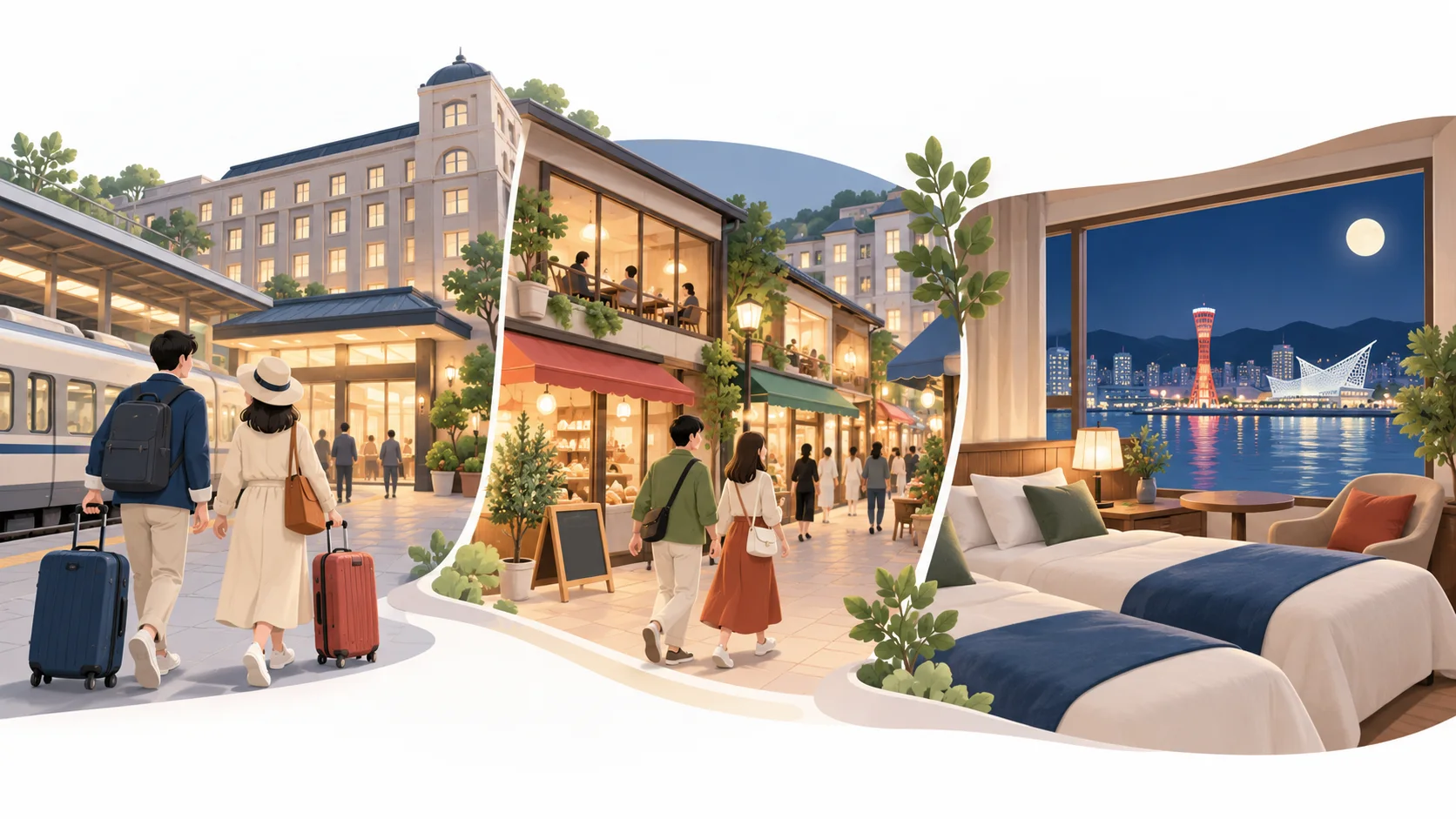
Three people in town: Daiwa PREMIER’s third bed is only 181 cm long
For walking between Sannomiya and the former foreign settlement with a third bed, compare Daiwa Roynet Kobe Sannomiya PREMIER at Sannomiyacho 1-2-2, Chuo-ku. Check this address, not room details from the similarly named Gokodori hotel. This PREMIER’s Moderate Twin is 27.2 m² for one to three people, with two 110 × 195 cm beds and a 97 × 181 cm extra bed.
The third bed’s length matters to tall adults; a triple label does not mean three identical beds. The same-sized Relax Twin has a massage chair and capacity one to two, rather than being another name for Moderate Twin. Separate bathroom and toilet in ordinary rooms do not establish accessibility. Universal Double separately lists a lower basin and grab rails; confirm room type, doorway width and your mobility equipment dimensions directly.
The child bed-sharing conditions combine Japanese elementary school or younger with the stated age range 0–12, one per bed, up to two in a twin, meals extra and some rooms excluded. A single adult using a twin with a bed-sharing child can also trigger a two-person rate. Ask the operator to interpret school-stage and age conditions, rather than substituting your home education system. No added bedding does not mean another bed.
Harbor room example: Hotel Okura’s direction and usable shuttle
Hotel Okura Kobe suits linking harbor time to hotel rest. Main Floor Standard Twin is 29 m² with two 110 × 200 cm beds. The site distinguishes standard east-facing harbor/Osaka Bay and west-facing Harborland views from Deluxe south-facing sea or north-facing city and mountain views. Confirm the actual category and direction. A seafront hotel does not promise fireworks or a front-on tower view from every room.
A daily shuttle runs to Sannomiya Bus Terminal, listed at stop 8 on M-INT Kobe’s ground floor (1F). On weekends and holidays, the shuttle also extends to Shin-Kobe. It is a shared service and may be full, delayed or rerouted. Check your stay date’s timetable and boarding point before relying on an early train connection. Do not assume normal operation under fireworks road controls; keep a walking or separately confirmed alternative.
Children through elementary school, with the hotel indicating age twelve, incur no lodging charge when sharing existing bedding; meals cost extra. Cribs are charged according to the children’s service page and limited by number and room type. Free bed sharing is not a free crib. Bed guards have suitable age ranges too. Request children’s services and loan items, and confirm occupancy, third bed and safe bed joining. Advance requests still need hotel confirmation.
Compare hotel offers on the same basis: total, children, kitchen and deadline
Comparable room totals use the same dates, people, category and similar cancellation terms. Record whether breakfast, taxes, service, extra beds and bed-sharing children’s meals are included, then calculate per night. If checkout separately lists lodging-related taxes, ask the hotel for location, stay date and calculation basis. This guide supplies no single Kobe lodging-tax rate; do not add Osaka or Kyoto brackets to Kobe rooms.
For cooking, washing feeding bottles or managing dietary restrictions, filter room types explicitly offering a kitchen. The three ordinary room examples above are not self-catering apartment recommendations. A fridge, kettle and dishes do not authorize cooking. Food delivery to the room and microwave location need separate confirmation. If a kitchen is essential, obtain an equipment list and ask about washing, heating and cookware before booking.
Keeping accommodation under acceptable cancellation terms while awaiting event-ticket details is more resilient than committing immediately to a nonrefundable room. Read the actual Japanese-time deadline. Lights or fireworks being canceled does not automatically release an independent hotel booking. Third-party bookings follow the original platform, rather than reception overturning agreed terms. At similar quotes, favor a property that answers children, bags and arrival questions clearly.
Separate the editions: 2027 Luminarie and October 2026 fireworks
Kobe Luminarie began after the 1995 Great Hanshin-Awaji Earthquake for remembrance, passing on memory and hope of recovery. It is not generic Christmas lighting movable to any date. The 32nd edition is announced for January 29–February 7, 2027 at Meriken Park, Higashi Yuenchi and the former foreign settlement. Start winter plans with the 32nd edition’s official announcement.
January 30–February 8, 2026 was the previous completed edition, not a 2027 sales period. Fiscal 2025 and an actual 2026 event can both appear in historical materials. Photographs from 2025 or 2026 provide background, not the next edition’s ticket price, artwork positions, lighting hours or entrance queue. This history follows the organizer’s account, without treating old pictures as the final 2027 scene.
As of October 21, 2026, the 2027 dates and sites can guide accommodation, but full sales, entry windows and on-site routing still need later details. Outside winter use an ordinary harbor night; in October 2026 use the fireworks section below. Even without a festival, exhibits, meals and waterfront make a Kobe day. Do not book nonrefundable travel around event arrangements that you have not yet confirmed.
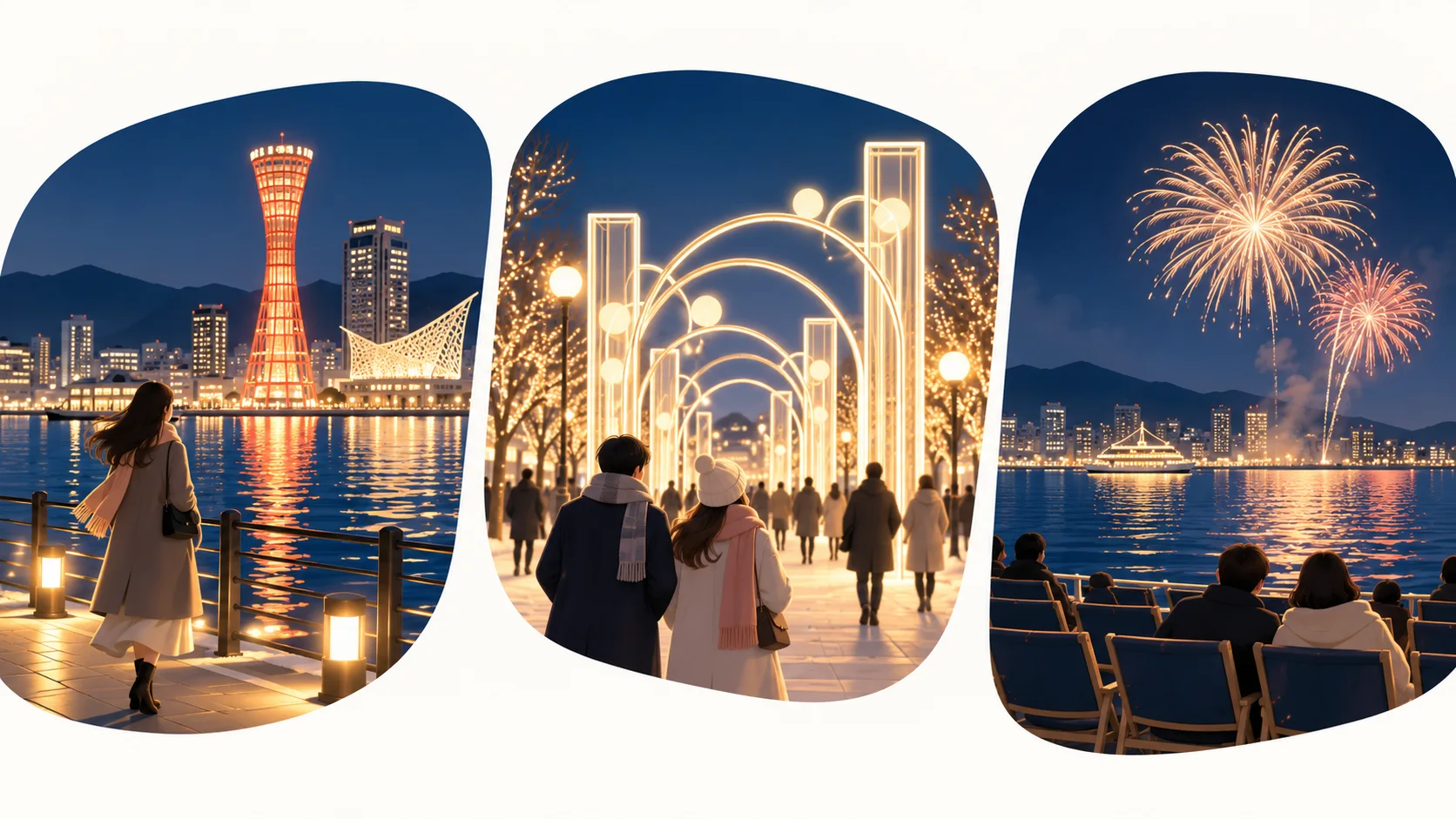
Luminarie 2027 tickets: published prices do not establish an open sale
The 32nd edition’s homepage lists special viewing tickets for the paid Meriken Park area: advance weekdays JPY 500, weekends 750; same-day weekdays 1,000, weekends 1,500. Group rates have eligibility and are not an automatic two-person discount. The site still says paid-ticket details will follow in autumn. A known price does not confirm opening of sales, child conditions, changes/refunds or stock for any time slot.
Two adults have face-value totals of JPY 1,000 weekday advance or 1,500 weekend advance; same-day totals are 2,000 or 3,000. Platform charges follow the actual sales announcement. With children, wait for current conditions rather than assume free or half price. Avoid buying the wrong edition through old ticket links, and do not confuse event donations with paid-area admission.
For walking, separate Higashi Yuenchi near Sannomiya, the former foreign settlement and the harbor, leaving an evening rest. This guide does not specify 2027’s final one-way entrance, queue line or fixed lighting time. When announced, make your paid entry window the fixed point and connect at most two areas around it, rather than push backward through crowds to complete all three. The official video gives visual context, not guarantees of current works, ticket types or visibility from every angle.
| Standard ticket | Face value each | Two-person example | Still to confirm |
|---|---|---|---|
| Weekday advance | JPY 500 | JPY 1,000 | Sale opening, fees, entry conditions |
| Weekend advance | JPY 750 | JPY 1,500 | Chosen date and slot |
| Weekday same-day | JPY 1,000 | JPY 2,000 | Remaining ticket availability |
| Weekend same-day | JPY 1,500 | JPY 3,000 | Remaining ticket availability |
Minato HANABI 2026: October 19–23, with twenty minutes of fireworks
Announced dates are October 19–23, 2026, with fireworks, music and lasers from 18:30 to 18:50 daily. Other performances and music surround them; the whole 16:30–19:30 period is not continuous fireworks. At the October 21 check this is the announced current week, still requiring a daily decision check. After October 23 it is past information; the next edition cannot be assumed without announcement.
The 2026 official viewing-area description identifies Meriken Park as free and Shinko Dai-1 Tottei as sponsorship/paid viewing. Not every open harbor space has equivalent fireworks, music and lasers. Harborland or a hotel room may have partial angles, without being organizer-guaranteed zones. Choose the official area for the full production; accept obstruction for incidental harbor views. The official free-area approaches list about thirteen minutes from JR/Hanshin Motomachi east exit and eight from Minatomotomachi exit 2. These are event approaches, not interchangeable with ordinary tower access.
No stalls or food trucks are provided this year. Eat in town, bring enough water and locate toilets; do not arrive hungry expecting a nonexistent night market. Free-area crowding can still produce temporary admission limits. No ticket price does not guarantee space. The organizer has not published a nightly launch count. Choosing date, area and workable return helps more than comparing scale using an uncertain number.
Paid fireworks seats: JPY 2,200 plus fees, age rules and app conditions
In 2026, regular paid Shinko Dai-1 Tottei tickets are JPY 2,200 each, all seats assigned. Paper issuing fee is 165 per ticket; digital service fee 110. Two digital tickets cost 2 × (2,200 + 110) = 4,620, paper 4,730. Other chosen payment or delivery fees may apply. Check the purchase methods linked by the organizer instead of treating face value as the final bill.
Paid-area entry begins at 17:00. Children three and younger enter free with a guardian when sitting on their lap during the show; age four and up need one ticket each. Strollers go in a designated area, not to seats. Wheelchair users can ask staff about Universal Space, without assuming the free area provides the same dedicated zone. For a young child’s own seat, confirm the product rather than use the lap exemption to occupy one. Shinko Dai-1 Tottei’s paid entrance differs from Meriken Park: roughly twenty minutes from JR Sannomiya and Hankyu/Hanshin Kobe-Sannomiya, eighteen from Kaigan Line Kyukyoryuchi-Daimarumae. Follow the current arrival route and staff; exits may be released by area.
General sales run to 17:00 that day. Online applications choosing convenience-store payment must finish before 16:30. Sold out means no same-day tickets, and none are sold at the venue. Digital tickets require the ローチケ電子チケット app; install and distribute in advance. Purchase history does not replace a forgotten valid ticket. Read the 2026 sales and entry FAQ and personally verify overseas-phone authentication and collection before paying. Seeing a product page is not proof you can enter.
Rain and refunds: event cancellation, your decision and rooftop closure differ
The 2026 FAQ states that the event is canceled for thunderstorms, strong wind and severe weather without postponement. A decision is planned around 16:00, but rapid changes can still cause cancellation after that. Check the current weather decision and announcement route. Fine weather at noon is no reason to lock every restaurant, room and intercity ticket into unchangeable terms. Ordinary rain does not automatically mean cancellation; use a raincoat rather than block others with an umbrella.
Personal cancellation is nonrefundable. If the organizer cancels for severe weather, ordinary viewing tickets are identified for refunds, with procedures following the announcement and original sales channel. Tickets are not reissued, and the printed date cannot be moved by the holder to the next evening. A refund for fireworks tickets does not automatically cover independently booked beef, hotel or transport: this is no package covering every loss.
Port Tower has separate limits. Its October 19–23 notice closes the rooftop in rain for safety and allows crowd controls; even if light rain permits opening, umbrellas remain prohibited. That is more specific than the general FAQ saying it may open in rain. The tower’s current notices are not the paid fireworks seat refund terms. A tower ticket cannot guarantee rooftop fireworks that night. Choose an official ground area if that difference is unacceptable. For sudden rooftop closure, ask the ground-floor (1F) service desk based on the actual ticket and situation, without presuming a full or surcharge refund.
Leaving the fireworks: save a walking route, without imaginary extra buses
Road controls around the 2026 show generally run about 18:00–19:30 each day, adjustable on site, including taxis and tour buses; some parking access also stops. The organizer’s FAQ states no additional trains, buses or shuttles for the event. Do not expect a taxi at the gate the instant the show ends at 18:50. Read the official traffic-control area, choose a station reachable on foot, then allow margin against your own evening trains.
The bus operator’s October 18 update shortens CITY LOOP departures from Kamomeria at 16:17–17:15 to Subway Sannomiya Station Northbound and suspends those from 17:45. Port Loop departures at 16:16–17:21 divert to Shin-Kobe, then suspend from 17:47. These conditions concern departures from a specific origin, not simultaneous shutdown of all Kobe buses. Recheck Shinki Bus’s current operating information, not another year’s leftover popup timetable.
Do not race the first departure wave. Organize children and clothing in a safe place, follow staff, then check trains on a wider street. Agree a recognizable meeting point away from the water’s edge and save the hotel’s Japanese address. If children fear noise, a stroller is hard to move or someone cannot stand waiting, leave early or skip the show. Wheelchair viewing, hotel shuttles and ordinary buses are different services; none automatically backs up the others without confirmation.
Rain and families: check the weekday before choosing an indoor substitute
Think in three branches: steady light rain without warnings, keep the museum and a short harbor view; wind making the waterfront uncomfortable, use town dining and a mall rest; Monday museum closure, choose shopping, a confirmed restaurant or the hotel before reaching the door. The word indoor does not make Port Tower stroller-friendly or every floor stair-free.
Harborland’s official video shows rain and accessible route choices from JR Kobe to umie. It helps you recognize options, without promising every entrance at every hour or an elevator free of maintenance that day. Follow signs and staff after arrival. Already at the harbor with children, find a seated indoor rest first, then decide what remains.
A family day may keep only an indoor exhibit, seated lunch and short waterfront section. Water, diaper changes, snacks and rest belong before an event, rather than competing with every queue. If older siblings want the tower while a toddler needs the stroller, split as above or all choose the museum. There is no need to force every attraction to prove the day was worth its cost.
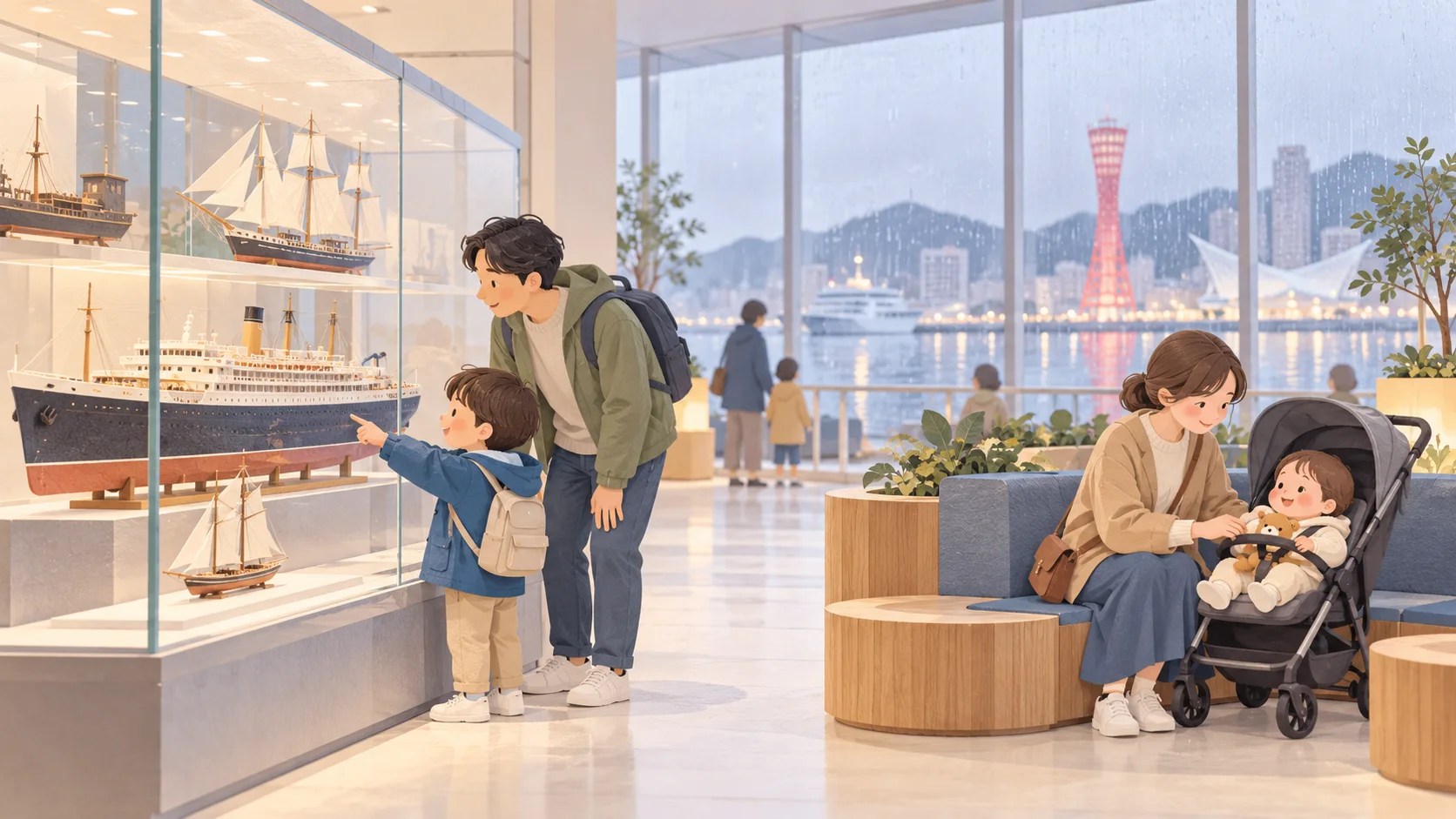
Budget 1: two adults on an ordinary harbor day
All examples use yen and editable spending assumptions, not tour quotations or hotel promises. Two adults each buying an 800 Kobe Loop pass, 900 museum entry and 1,000 indoor tower entry cost 1,600 + 1,800 + 2,000 = JPY 5,400. If each also allows 1,500 lunch, 2,000 dinner and 800 drinks/snacks, food totals 8,600 and the day 14,000.
That 14,000 excludes Osaka/Kyoto return travel, rooms, shopping and cruises. Meal figures are your assumptions, not guaranteed named-restaurant sets. With only two CITY LOOP rides each, singles cost 600 per person, cutting 400 overall to 13,600. If using another fare route, recalculate that segment; the saving cannot be transferred to every bus.
This budget sets a controllable ceiling for an ordinary harbor day. Add roof, event or steak by explicitly replacing a line. A closed museum removes its ticket cost, without obliging you to spend the saving on another unwanted attraction. For the whole Japan trip, use the breakdown of lodging, meals and contingency to place this day back in the larger budget.
Budget 2: beef and a room, marking the hypothetical price
Two 120 g Kobe beef lunches at Mouriya Honten total JPY 16,040. Add 5,400 for ordinary-day transport and the two admissions, assumed dinner at 2,000 each and drinks at 800 each: 27,040. A hypothetical double room at 22,000 per room per night makes 49,040. The 22,000 only demonstrates a per-room addition, not an actual event-date quote from any hotel above.
Two garlic rice upgrades add 2,200 to make 51,240. For 2027 Luminarie advance tickets, two weekday tickets add 1,000 to 52,240; weekend adds 1,500 to 52,740, before platform fees. Those event versions require travel during the 2027 dates and successful purchase of the correct product. They are not budgets for October 2026 fireworks.
To reduce the total, remove something you truly accept giving up: no overnight removes the assumed room, no steak returns to ordinary meal assumptions. Do not silently erase service, taxes or extra-bed costs. Replace 22,000 with a final inclusive hotel quote and confirm two-person occupancy, meals and cancellation. Equal totals do not give equal value when one is nonrefundable and another includes breakfast and flexibility.
Budget 3: fireworks with two adults and one child
For two adults and an eight-year-old meeting the operators’ child/elementary categories: three digital fireworks tickets at 2,200 + 110 total JPY 6,930. Day passes 800 + 800 + 400 = 2,000; museum 900 + 900 + 400 = 2,200; indoor tower 1,000 + 1,000 + 400 = 2,400. Transport and three admission types total 13,530. Event bus suspensions still apply, so this is not a package with every ride already scheduled.
Assumed family lunch 4,000, early dinner 5,000 and drinks/snacks 1,500 produce 24,030. Add 2,000 for possible transport or other contingency: prepare 26,030 without expecting to spend it all. This excludes intercity return, hotel, shopping and a Kobe beef lunch. A child three or younger meeting lap conditions changes fireworks ticket numbers, but museum, bus and lodging still need separate checks, not automatic all-day freedom from charges.
These examples serve ordinary walking, steak plus hotel, and a family event evening. They are not an average Kobe cost per day. Keep the formulas and replace headcounts and ticket categories to see where the difference arises. Then circle expenses still payable after cancellation: bought admission, dinner cancellation and a nonrefundable room matter more than an attractively low total.
Before departure: check the most changeable part first
Fix dates and the city for the night, then verify the edition: the 32nd Luminarie’s new notice or the October fireworks’ daily decision. Accommodation, beef and timed admission follow. For an ordinary day trip, check museum weekdays and restaurant opening first, leaving the harbor walk adjustable. This avoids nonrefundable spending for an old year’s event.
Save three things offline: hotel Japanese address and entrance, formal valid tickets or platform instructions, and the return station plus an earlier exit option. An offline purchase history does not replace a valid ticket that must be shown in an app. Prepare battery and connectivity where needed. If a ticket will not open, a bus stops or weather worsens, stand safely out of the way, then use the original platform and staff guidance rather than repeatedly pay while walking at an entrance.
Take a plan with one sight you can drop, one walk you can shorten and contingency you need not spend. To align dates with seasons, read Japan’s seasons and event-date planning. This guide records official conditions at the check date and explicit assumptions, not a replacement for departure-day weather, controls, sellouts or individual eligibility.
A few useful answers
Does a Kobe day trip from Osaka require an overnight stay?
No. Motomachi, museum, tower and harbor can form a one-way day. Compare staying for dinner, late rest or an event exit. Use the railway near your Osaka hotel and real return services, without assuming a hotel move.
Where should first-time visitors stay in Kobe?
Sannomiya for intercity and airport connections; Motomachi for Nankinmachi, former foreign settlement and walking; harbor for waterfront evenings and hotel rest. Then compare actual entrance, room, children, direction and cancellation rather than area names alone. Choose a separate night in Arima if bathing and a ryokan dinner are the priority; for harbor events, stay in the city and visit Arima on another day.
What are the Kobe Luminarie 2027 dates?
The 32nd edition is announced for January 29–February 7, 2027 at Meriken Park, Higashi Yuenchi and the former foreign settlement. January 30–February 8, 2026 was the completed previous edition. Follow 2027 sales, age and route announcements.
Do known Luminarie prices mean tickets are already on sale?
No. The 32nd homepage lists advance weekdays JPY 500/weekends 750 and same-day 1,000/1,500, but detailed sales notices remain pending as of October 21, 2026. Do not reuse previous child, slot, change or platform-fee conditions.
Are Kobe fireworks held every night throughout 2026?
No. Announced dates are October 19–23, daily 18:30–18:50, with possible severe-weather cancellation. Afterward these are historical dates, not an unannounced next edition. Ordinary harbor night views are not a fireworks event.
At what age do children need fireworks tickets?
In 2026’s paid Shinko Dai-1 Tottei area, age four and older need one ticket each. Three and younger are free with a guardian while on their lap during the show. Strollers stay in the designated area, not seats. Other transport, hotel and attraction ages differ.
If rain cancels fireworks, is the hotel refunded too?
Not automatically. Canceled ordinary viewing tickets follow the official announcement and original channel. Personal cancellation, hotels, restaurants and other transport follow their own terms. No postponement; the planned 16:00 decision can change later with sudden weather.
Can strollers or wheelchairs reach Port Tower’s rooftop?
Strollers cannot enter the observation area; arrange ground-floor (1F) storage. Ask staff about indoor wheelchair dimensions and staff-assisted elevator operation before ascending. The roof requires stairs from observation 5F, without wheelchair access. Admission does not guarantee an open event-day rooftop in rain.
Does CITY LOOP contactless payment automatically become a day pass?
No. The JPY 800 daily credit-card cap ended March 31, 2026. Contactless continues, but buy the applicable pass for its coverage and fare. Three adult CITY LOOP rides cost 900, above the 800 pass; two cost 600.
Can I go straight to the maritime museum on a rainy Monday?
Check closure first: normally Monday, next weekday after a national holiday, plus New Year closures. Usually 10:00–18:00, last admission 17:30. Regular admission includes Kawasaki World; special exhibitions and individual experiences need separate checks.
Is the JPY 8,020 Kobe beef lunch a citywide price?
No. It is Mouriya Honten’s current public price for 120 g Kobe inner round with defined accompaniments. Cut, weight, branch and lunch/dinner package differ. Two identical lunches total 16,040 before extras.
Can I follow the old Roushouki address in November 2026?
Check new notices first. On October 1 the shop announced a planned November 11 opening and return to its founding location, with the current store reverting to Soke Paozu-kan. Old address and hours are not permanent. Recheck special filling dates, closures and actual sales point.
Check with the source
Schedules, availability and rules can change. These official sources are the place to confirm details before you book.
- Kobe Harborland | Station entrances, underground and rain routes
- Kobe Tourism Bureau | Access and local transport
- Shinki Bus | CITY LOOP fares and one/two-day tickets
- Shinki Bus | Credit-card daily cap ended March 2026
- Port Tower | Location, station exits and walking
- Kobe Tourism Bureau | Kitano and Shin-Kobe
- Kazamidori House | Hours, prices and visitor notes
- Kazamidori House | Counter sales and paired admission
- Minsei | Hours, closures, seats and reservations
- Roushouki | October notice and planned November 11 opening
- Roushouki | Current shop and queue information
- Mouriya Honten | Kobe beef lunch/dinner and sides
- Maritime Museum | Permanent displays and services
- Maritime Museum | Hours, prices and children
- Port Tower | Standard tickets, roof and purchase terms
- Port Tower | Strollers, wheelchairs, lifts and tickets
- boh boh KOBE | Duration, calendar and exceptions
- boh boh KOBE | Purchase deadline and boarding
- remm plus | Railway entrances and hotel access
- remm plus | Twin size, beds and bathroom
- Daiwa Roynet PREMIER | Rooms, occupancy and bed sizes
- Daiwa Roynet PREMIER | Child bed sharing and loan items
- Hotel Okura Kobe | Main Floor rooms and view directions
- Hotel Okura Kobe | Sannomiya and Shin-Kobe shuttle
- Hotel Okura Kobe | Children and baby items
- 32nd Kobe Luminarie | 2027 dates, sites and listed prices
- Kobe Luminarie | Earthquake remembrance and past editions
- Minato HANABI 2026 | Dates, show times and areas
- Minato HANABI 2026 | Assigned seats, fees and entry
- Minato HANABI 2026 | Rain, cancellation, children and transport
- Port Tower | Fireworks-week rooftop and traffic notices
- Minato HANABI 2026 | Road controls
- Shinki Bus | Current CITY LOOP and Port Loop changes
- Minato HANABI 2026 | Free Meriken Park station approaches
- Minato HANABI 2026 | Paid Shinko Dai-1 entry and exit
- Kobe Tourism Bureau | Official 32nd Luminarie video
- Official Harborland | Rain route from JR Kobe to umie
- Arima Grand Hotel: dinner start times and restrictions on private baths for day visitors