Watch the green Hayabusa and red Komachi couple in Morioka, pick Mt. Fuji window seats on the Tokaido Shinkansen, and see Doctor Yellow in Nagoya. Covers the Pikachu Train, Aso Boy!, kids' fares, and visiting the Omiya, Kyoto, and Nagoya rail museums.
- Region & Focus
- Japan-wideFamily attractions
- Reading Scope
- 20 min read · 7 chapters · 6 Q&As
- Official Verification
- 35 official sources checkedUpdated November 22, 2026
- Key Topics
- Rail travelFirst tripBooking
Chapter Route Map (tap any stop)
- Two Long Noses at Morioka: Coupling on Platform 11, Splitting on Platform 14
- Mt. Fuji Sits on the E-Seat Side, Whether Bound for Kyoto or Tokyo
- See the Retired Doctor Yellow T4 in Nagoya
- Ride with Pikachu to Kesennuma, or Climb Mt. Aso with Kuro-chan
- Saying Goodbye to Hello Kitty, While the Tokyo Monorail and Enoden Roll On
- Omiya, Kyoto, and Nagoya: Half a Day at Japan's Best Hands-On Rail Museums
- Buying Kids' Tickets and Shinkansen Ekiben Together
- Quick Q&A
The red Komachi glides to a stop behind the green Hayabusa, creeps forward a few feet, and halts again. Then comes the moment everyone on the Morioka platform is waiting for: the two long noses lock together, and the combined train heads south for Tokyo. On a Tohoku itinerary, you can catch the coupling at Morioka or dedicate a day to the Pikachu Train between Ichinoseki and Kesennuma. Along the Tokyo-Kyoto-Osaka corridor, fold Mt. Fuji window seats and a railway museum into your transit days. And if your kids simply want to stand nose-to-nose with a real yellow Shinkansen, head straight to Nagoya's SCMAGLEV and Railway Park to see the retired Doctor Yellow.
Two Long Noses at Morioka: Coupling on Platform 11, Splitting on Platform 14
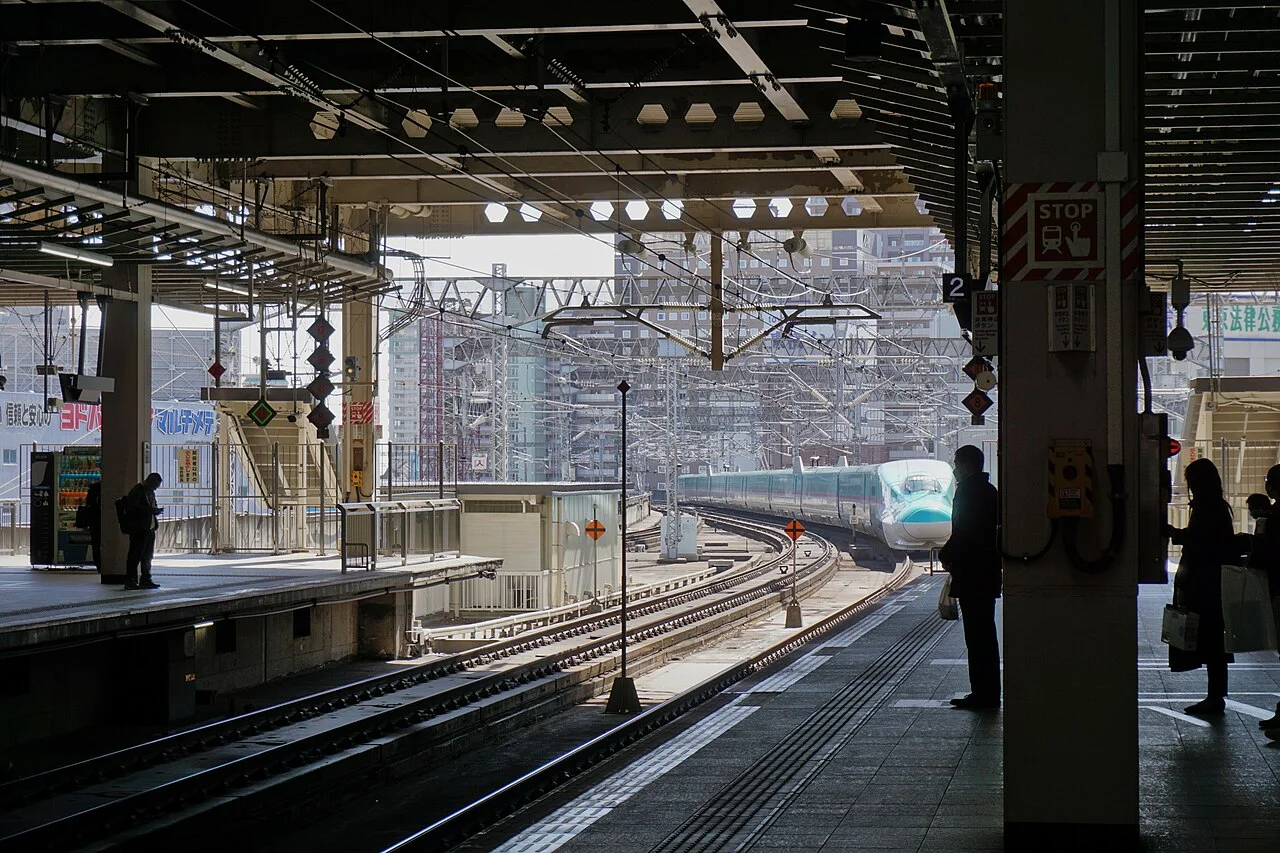
Spot the colors from down the track. The E5 Series Hayabusa wears teal across its upper body with a thin pink stripe along the waist. The E6 Series Komachi is red up top with a noticeably narrower car body. Several Tohoku Shinkansen departures run coupled between Tokyo and Morioka — 10 cars for the green Hayabusa plus 7 cars for the red Komachi, making a 17-car train. Measuring back from its tip, the E5's streamlined nose alone stretches roughly 15 meters (about 49 feet) to soften pressure waves and tunnel boom at high speed. At Morioka, that nose reveals a second trick: a coupler extends from under the snout so both trains can share the track together.
To film the red nose creeping in to connect, pick a Tokyo-bound coupling. Enter through the second-floor Shinkansen Ticket Gate at Morioka Station, head up to Platform 11 on the third floor, follow the Komachi boarding arrows painted on the floor, turn beside the elevator, and look for the overhead mirror shown in JR East's platform diagrams. Stand where you can see both noses at once. The Komachi stops twice behind the Hayabusa before easing forward on the third move to lock in. Seeing the noses meet is the main event, so leave a bit of room in your phone frame to capture both colors together.
To watch them uncouple, pick a southbound paired train arriving from Tokyo. Go through the same Shinkansen gate up to Platform 14 on the third floor, and look past the elevator on the opposite side for the uncoupling mirror. After passengers board and alight, the Akita-bound Komachi pulls out first, leaving behind the Hayabusa bound for Shin-Aomori or Shin-Hakodate-Hokuto. As the destination signs on the train sides roll off in separate directions, have your kids call out a station name. Beyond Morioka, the Akita leg switches onto conventional lines like the Tazawako Line, which is why the red cars are built narrower to clear tighter curves and standard platforms.
Open the JR East Morioka Station Timetable, choose your direction plus Weekdays or Weekends & Holidays, and tap a departure to expand its stops. For uncoupling, look for paired trains arriving together from the south before splitting toward Aomori and Akita. For coupling, look for two trains arriving from separate northern branches and continuing together toward Sendai and Tokyo. Aim for one primary pair and keep the next one as a backup. Coming from outside the station with kids, allow about 20 minutes to pick up tickets, take the stairs or elevator, and locate the mirrors — far easier than sprinting down the platform.
Routes inside Morioka Station sit close together, though signage clearly separates them. Returning from shopping via the East Exit, head up to the second floor and look for the gates marked Shinkansen rather than following Local/Conventional Line signs to commuter trains. If you want to watch both operations, check the timetable order before entering the gates. When there is a long gap between pairs, leave the paid area for lunch and re-enter later. Travelers who already hold Shinkansen tickets and are transferring between lines can use the dedicated Shinkansen transfer gates — just factor in extra minutes to find the elevators if you have a stroller.
If you are only entering the station to watch the trains, a same-day JR Morioka admission ticket costs ¥160 for adults and ¥80 for children and is valid for two hours from issue. It covers platform access only, not riding. JR East specifically notes that passengers boarding a southbound Komachi cannot step onto the platform at Morioka to watch their own train uncouple. Schedule the uncoupling watch on an earlier paired arrival and take the following train so kids and luggage stay unhurried. When riding a newly coupled train back to Tokyo, check how far your assigned car door is from the viewing spot.
On busy holiday weekends, station staff set up ropes around the coupling zone. Stay behind the ropes and the yellow tactile paving, pack away mini tripods, turn off camera flash, and keep bags tucked close so walkways stay clear. Shorter kids can often get a clear, angled view of the red train's full approach by stepping a few paces to the side of the crowd. Step away from the platform edge before replaying your video. Once the two-tone train pulls out, there is plenty of time in the concourse for a bowl of Morioka reimen noodles or an easy connection to a southbound train before dinner.
| What You Want to See | JR East Platform | Timetable Direction to Check | What Happens at the Platform |
|---|---|---|---|
| Red train coupling onto green train | 3F Platform 11 | Northbound-to-southbound paired departures for Sendai and Tokyo | Hayabusa stops first; Komachi inches forward in stages to connect |
| Two trains departing separately | 3F Platform 14 | Downbound paired arrivals from Tokyo | After boarding/alighting, Komachi departs first for Akita |
Watch the green Hayabusa and red Komachi couple in Morioka, pick Mt. Fuji window seats on the Tokaido Shinkansen, and see Doctor Yellow in Nagoya. Covers the Pikachu Train, Aso Boy!, kids' fares, and visiting the Omiya, Kyoto, and Nagoya rail museums.
Mt. Fuji Sits on the E-Seat Side, Whether Bound for Kyoto or Tokyo
Heading west from Tokyo toward Nagoya, Kyoto, and Shin-Osaka, Mt. Fuji appears on the right side in your direction of travel. Returning to Tokyo, it sits on your left — yet the seat letters stay the same. Standard Tokaido Shinkansen cars use a 3+2 layout: seat E is the mountain-side window seat, and seat D is the adjacent aisle-side seat in the 2-seat block. Green Cars use a 2+2 layout, making seat D the Mt. Fuji window seat. A family of two adults and one child who want three seats together can book A+B+C, or prioritize the view by booking D+E plus C across the aisle so you can still pass snacks back and forth.
Your ticket will list the service name — Nozomi, Hikari, or Kodama — while N700S refers to the train model. Your origin and destination set the base fare, and the service name determines how many stops you make, while Mt. Fuji seat orientation stays identical across the entire Tokaido Shinkansen. Look for the gold emblem on an N700S and the subtly flared nose wings. Every seat on an N700S has a power outlet, so parents can top up the phone holding digital return tickets while kids snap photos out the window.
The easiest landmark for timing your Mt. Fuji watch is Shin-Fuji Station. Westbound toward Kyoto, look up from your tray table after passing Mishima and scan for the peak as you near Shin-Fuji. Eastbound toward Tokyo, start watching for the Shin-Fuji stretch right after Shizuoka. Nozomi trains pass straight through Shin-Fuji without stopping, so drop a pin on an offline map app ahead of time to track where you are. Nearby houses, embankments, and power poles often block the mountain's base; once the horizon opens up, raise your eyes higher to catch the snowline. JR Central Tours pegs the prime viewing window at roughly three minutes around passing Shin-Fuji Station — if half the mountain pops into view while you are digging for a fork in your bento bag, set the fork down first.
When the seat map opens on SmartEX, check that everyone is in the same car and row, and double-check each child's fare category and boarding station. Select SmartEX products can be reserved up to one year in advance under provisional schedules, with exact train times and seat assignments confirmed starting around 8:00 AM JST one month before travel. General reserved-seat sales open at 10:00 AM JST one month ahead. Families who pre-book a year out and care about window seats should open their reservation right after receiving the confirmation notice and adjust seats according to their ticket rules.
Carrying large suitcases straight from the airport? Measure length, width, and height first. On the Tokaido Shinkansen, bags whose three dimensions total more than 160 cm and up to 250 cm require a reservation with an oversized baggage space. On SmartEX, select the Oversized Baggage Area option before picking seats. If the Mt. Fuji side has no adjacent seats left, lock in your baggage seats and keep the family together first, then pick a daylight departure so any glimpse of the mountain is a bonus.
To combine Mt. Fuji views with trainspotting in one transit day, ride a daytime train from Tokyo to Nagoya, drop heavy bags in a Nagoya Station locker, and take the Aonami Line out to Kinjofuto to see Doctor Yellow. Keep the priorities simple: if only early-morning or evening trains fit your schedule, secure side-by-side seats and comfortable transfer times first. Watch for the silhouette when skies are clear and the sun hits the right angle; on overcast days, hand kids an in-car game like logging every station passed or coloring in each prefecture crossed on a printed map.
| Car Class | Mt. Fuji Window Seat | Family Seating Strategy |
|---|---|---|
| Ordinary Car | Seat E | Book D+E for two. For three in one row, take C+D+E with C across the aisle |
| Green Car | Seat D | Book C+D on the same side for two |
| Ordinary Car (3 side-by-side) | Mt. Fuji is across the aisle | Book A+B+C so a toddler or younger child can sit in the middle |
See the Retired Doctor Yellow T4 in Nagoya
Right inside the first-floor rolling-stock hall at Nagoya's SCMAGLEV and Railway Park stands the bright-yellow 923 Series Shinkansen, complete with its signature long blue stripe. This is Car 7 of JR Central's retired T4 inspection trainset, which went on permanent public display in June 2025. Walk from the headlights, cab windows, and nose tip down the flank to the car number, then step back to compare its silhouette against the passenger trains beside it. The wall placards answer the question almost every kid asks first: "Who used to ride on this train?"
Doctor Yellow's job was inspecting the Tokaido and Sanyo Shinkansen corridors — rolling down the tracks to measure rail geometry, overhead catenary wires, and signaling equipment. While regular bullet trains focus on getting passengers to their stops on time, Doctor Yellow brought back diagnostic data so maintenance crews knew exactly where to send repair teams. Step back to admire the full exterior, then pick one close-up detail from the display board — such as the overhead power line above the windows — so kids connect what they saw while eating bento on the train with what "inspection" means.
JR Central's T4 set retired from active inspection duty in January 2025. JR West operates the sister T5 set, which is slated to retire from inspection runs in January 2027. Aside from specially announced events, JR West does not publish Doctor Yellow's operating schedule, and that includes its final run. For a guaranteed visit, build your itinerary around seeing T4 in Nagoya alongside multiple generations of Shinkansen. Note that the older T3 car previously exhibited at the Nagoya museum was removed when T4 moved in — if you spot old blog photos online, check the trainset number before planning your stop.
While walking the hall, sketch a quick comparison linking each train's exterior shape to its job. Start by finding the pointed cab end, then look underneath at how the steel wheels sit on the rails. Because Doctor Yellow ran on the exact same tracks as passenger trains, kids can spot the shared undercarriage DNA right away. Move to the next car over and, even without reading Japanese, kids can pick out which nose shapes repeat and which models sit taller or lower. Seeing full-size rolling stock up close makes the sheer length of that yellow nose click in a way photos never do.
After Doctor Yellow, walk over to the rounded nose of the original 0 Series, then loop toward the Symbolic Rolling Stock zone to see the 300X test train and the superconducting maglev. Keep your route linear without too much backtracking, asking just one question at each stop — which nose looks roundest, or which body sits closest to the floor? If your kids are genuinely curious about how the wheels work, pause by the maglev cutaway model and explanation panels. Learning to recognize train generations and how they glide down straightaways beats reading every plaque word-for-word.
To get there, walk from JR Nagoya Station to the Aonami Line gates and ride to the terminal stop, Kinjofuto — the museum sits about a two-minute walk from the exit. Factor in the transfer walk between Nagoya's Shinkansen platforms and the Aonami Line, especially if you are visiting on a Kyoto day trip and storing luggage at the station. The Shinkansen and conventional-line simulators use separate entry rules and time slots, so check reservation procedures as soon as you enter before touring the floor. On rainy days, swap out outdoor sightseeing for two to three unhurried hours among the trains and an indoor lunch, leaving plenty of cushion to catch your next long-distance train from Nagoya Station.
Ride with Pikachu to Kesennuma, or Climb Mt. Aso with Kuro-chan
The POKEMON with YOU Train runs along the Ofunato Line between Ichinoseki and Kesennuma, threading past small rural stations in the Tohoku mountains. Car 1 hides Pikachu details across the seatbacks, curtains, and yellow trim, while Car 2 is a playroom car anchored by a giant reclining Pikachu plush and a mock driver's cab. Head to Car 1 first to locate your seats and stow coats, then walk over to the play car together. Hand a child who is learning to read tickets the job of leading parents to the right row — once they realize the destination name on the ticket matches the Shinkansen stop you just stepped off, they can follow every station sign on their own.
On the official schedule, the outbound train leaves Ichinoseki at 11:00 AM and arrives in Kesennuma at 1:14 PM; the return departs Kesennuma at 2:50 PM and arrives back in Ichinoseki at 4:51 PM. Both legs are all-reserved and require a base fare ticket plus a reserved-seat fee of ¥840 for adults and ¥420 for children, bookable via Ekinet or a JR ticket counter. If you want a full sit-down lunch and time to stroll Kesennuma's waterfront, book the Pikachu Train one way and ride a standard Ofunato Line train back. If you ride the themed train both ways, you will have roughly 90 minutes between trips, so pick a lunch spot near Kesennuma Station beforehand. Stamp the Pokemon collector sheet at Ichinoseki before boarding and hit the photo spot at Kesennuma on arrival so kids leave with two extra souvenirs for their ticket folder.
Coming from Tokyo or Sendai, you can time a Tohoku Shinkansen arrival at Ichinoseki with an easy transfer to the Ofunato Line. Check dates, directions, and train numbers separately for your Shinkansen seats and the Pikachu Train reservations. On peak weekends, spending a night in Sendai or Ichinoseki takes the pressure off stroller transfers and bathroom stops. Mark 10:00 AM JST one month before departure on your calendar for seat releases. JR East runs different themed routes — including Kesennuma, Miyako, and Kamaishi services — depending on the month, so match the exact train name and origin station on the operating calendar before booking.
For winter-break trips, compare dates carefully before locking in hotels: for example, the 2027 calendar schedules the Kesennuma service on January 2–4, whereas February 27–28 runs the Kamaishi route instead. A quick search for "Pikachu Train" shows trains operating on both weekends, so always click through to check the departure station before booking non-refundable lodging. If your outbound run pauses at Geibikei Station, step to the safe viewing zone beside the tracks to see the platform's optical-illusion mural snap into a full Pokemon character from an angle.
In Kyushu, the Limited Express Aso Boy! runs between Kumamoto and Aso with its mascot — a black-and-white dog named Kuro-chan — painted across the exterior. Car 3 houses the White Kuro-chan Family Seats, toddler play spaces, and a kids' area. The famous wooden ball pool sits inside the Kuro Club play area, separate from the White family seat section; the play zone also stocks wooden toys and picture books (parental supervision required). Car 3's floor is raised 25 cm so younger riders get unobstructed mountain views. Parents can spot the small window-facing child chair paired next to each adult seat — a design that puts kids next to the glass regardless of travel direction. One adult traveling with one preschool child under age 6 can book a Family Seat pair for the price of a single adult reserved-seat fare, while an 8-year-old books a standard child seat.
Start any Aso trip by checking the operating calendar on the JR Kyushu Aso Boy! train page. Trains run between Kumamoto and Miyaji via Tateno and Aso, though some dates feature only a single afternoon round-trip or substitute the Kawasemi Yamasemi trainset. Those two trains look completely different inside, so make sure the booking screen specifies Aso Boy! when hunting for the White Family Seats. As a sample schedule, Aso Boy! 1 departs Kumamoto at 9:57 AM and reaches Aso at 11:27 AM; Aso Boy! 4 leaves Miyaji at 3:48 PM, calls at Aso at 3:56 PM, and returns to Kumamoto at 5:08 PM. A regular-season one-way adult reserved seat between Kumamoto and Aso totals ¥3,080. If you plan to catch the mountain bus up toward the crater, match your return train to the bus timetable at Aso Station.
JR Kyushu reserved seats go on sale at 10:00 AM JST one month ahead. Register a free JR Kyushu Web account in advance and use the train dropdown menu to select Family Seats or Panorama Seats. Operating dates from March 2027 onward are scheduled to be announced in mid-January 2027. Even if the Family Seats sell out, booking regular reserved seats on the same train still lets kids enjoy Kuro-chan's livery and visit the Car 3 kids' zone with an adult. And if your priority is exploring Mt. Aso's crater and grasslands, you can simply pick departure and return times that align best with the Aso Station buses.
| Train | Route | Top Kid Highlight | How to Book |
|---|---|---|---|
| POKEMON with YOU Train (Kesennuma) | Ichinoseki to Kesennuma (or reverse) | Giant Pikachu and play driver's cab in Car 2 | Pick an operating date and book reserved seats via Ekinet or a JR ticket counter |
| Limited Express Aso Boy! | Kumamoto to Aso/Miyaji (or reverse) | Car 3 White Family Seats and kids' play zone | Check the operating calendar, then select your seat type on JR Kyushu Web |
Saying Goodbye to Hello Kitty, While the Tokyo Monorail and Enoden Roll On
The Hello Kitty Shinkansen — a pink-and-white 500 Series train covered in ribbons — used to run the Sanyo Shinkansen between Shin-Osaka and Hakata as a top family bucket-list ride. Its final run was May 17, 2026. If you come across older Kansai or Hokuriku trip reports still featuring photos of it, separate the retired pink train from routes currently on sale. If a character train is non-negotiable, swap in the Pikachu Train on a Tohoku trip; if your kids just want to see the 500 Series' ultra-sharp nose up close, the Kyoto Railway Museum displays a retired 500 Series car, and frequent local trains connect Shin-Osaka and Kyoto.
Arriving in Tokyo via Haneda Airport gives you an easy novelty ride right out of the gate. The Tokyo Monorail straddles an elevated concrete beam high above the bay, so settle into your seats heading toward Monorail Hamamatsucho and look out the front or side as the track cuts straight beneath the train. The line skims over water, bridges, and airport hangars, with Haneda Express trains reaching Terminal 3 from Hamamatsucho in about 13 minutes. On your flight home, double-check signage for Haneda Airport Terminal 3 or your specific terminal number — trains stop at Terminal 3, Terminal 1, and Terminal 2 in that order, not numerically, so jot your airline's terminal inside your ticket holder before leaving the hotel.
If you have half a day for the coast, trade the monorail's skyline views for Kanagawa's Enoden line. Transfer from JR Kamakura Station to the Enoden Kamakura platform and board a Fujisawa-bound tram passing Shichirigahama, Kamakurakoko-mae, Koshigoe, and Enoshima. Along Shichirigahama, the ocean fills the window frame; near Koshigoe, the green-and-cream cars rumble right down the middle of a neighborhood street. Kids get to watch a tram share pavement with regular cars, then spot the next train's retro paint scheme on the return platform. Running the route in reverse from Fujisawa to Kamakura works just as well depending on which JR station suits your ride back.
The Enoden "Noriorikun" 1-day pass costs ¥800 for adults and ¥400 for children and pays off if you hop on and off multiple times. If the whole family wants to stay seated by the window from Kamakura straight to Enoshima, check the official point-to-point fare table before buying passes. Picking just two stops — say, beach views at Shichirigahama and a stroll around Hase — leaves afternoon energy for exploring beyond the rails. At busy street crossings, keep sidewalks and traffic lanes clear for local residents; capture those classic coastal framing shots from inside the moving train window and stick to marked pedestrian paths at intersections.
Omiya, Kyoto, and Nagoya: Half a Day at Japan's Best Hands-On Rail Museums
Staying in Tokyo with kids who want to grip real throttle levers? Transfer at Omiya Station to the Saitama New Shuttle and ride one stop to Tetsudo-Hakubutsukan (Onari). The Omiya Railway Museum fills its main hall's ground floor with historic rolling stock while the South Wing focuses on railway jobs — save the E5 Shinkansen simulator and conductor experiences for kids keen on hands-on controls. With half a day, check which timed activities are running before wandering the main floor. Toddlers can ride the Mini Hayabusa, while older kids who want to drive miniature trains on an outdoor track should check the age rules, lottery windows, and passenger limits for the Mini Driving Train first. Once you land a timed slot, cluster nearby exhibits around it to save little legs.
The Omiya museum generally closes on Tuesdays and over the New Year holidays, opening 10:00 AM to 5:00 PM (last entry at 4:30 PM). Advance tickets purchased at least one day prior cost ¥1,500 for adults, ¥500 for elementary through high school students, and ¥200 for preschoolers aged 3 and up; same-day tickets add ¥100 to each tier. Buy basic admission on the museum website ahead of time, or — starting at 10:00 AM JST seven days prior — look on Seven Ticket for Admission Tickets with Experience Reservations to lock in a popular simulator. For same-day lottery activities, download the official Railway Museum Lottery App as soon as you arrive and watch the entry windows. The trains themselves aren't going anywhere, so put timed simulator slots straight into your phone calendar.
Starting October 28, 2026, Omiya split its on-site Mini Driving Train lottery into two rounds at 10:00 AM and 1:00 PM: the morning round covers sessions from 10:00 AM to 2:05 PM, and the afternoon round covers 2:20 PM to 4:20 PM. Elementary-school-age kids and older can drive the mini trains, and each car seats up to three riders, so younger siblings can tag along as passengers. If two parents and two kids are traveling together, decide ahead of time which three will board while the fourth adult browses the main hall and sets a recognizable locomotive as your meetup spot.
In Kyoto, ride the Sagano Line one stop from Kyoto Station to Umekoji-Kyotonishi and walk two minutes to the Kyoto Railway Museum. Lead kids straight out to the iconic roundhouse, where black steam locomotives fan out around the central turntable. The on-site SL Steam train, pulled by an authentic coal-fired locomotive, runs roughly a 1-kilometer round-trip taking about 10 minutes — encourage kids to listen for the whistle and hiss before watching the drive rods start to turn. If your family prefers sleek modern expresses over steam engines, head up to the third-floor Sky Terrace to watch active JR and Shinkansen trains speed past outside, with indoor rest and water stations one floor down.
Kyoto's museum opens 10:00 AM to 5:00 PM (last entry at 4:30 PM) and typically closes Wednesdays, though it stays open on Wednesdays during national holidays and school breaks; avoid December 30 through January 1 over year-end. Through February 28, 2027, admission is ¥1,500 for adults and ¥500 for elementary/junior-high/high school students (wait until March 1, 2027, and rates adjust to ¥1,900 and ¥600, while preschoolers aged 3+ rise from ¥200 to ¥300). The SL Steam ride costs extra: ¥300 for high schoolers and adults and ¥100 for ages 3 through junior high (under 3 free) before the March 2027 revision, when high school and adult tickets rise to ¥500 while child and preschool SL fares stay unchanged. Check your exact visit date around the end of February before paying.
Nagoya's SCMAGLEV and Railway Park is built for kids who love guessing a Shinkansen's era at first glance. Walk two minutes from Kinjofuto Station on the Aonami Line. Admission is ¥1,200 for adults, ¥500 for elementary through high school students, and ¥200 for preschoolers aged 3 and up. Hours run 10:00 AM to 5:30 PM (last entry at 5:00 PM); the museum typically closes Tuesdays (or the next day if Tuesday is a holiday, plus extra Tuesday openings during peak breaks) and closes December 28 through January 1. Since Doctor Yellow T4 sits right in the main hall, budget generous time around it and the adjacent Shinkansen lineup on a first family visit before deciding whether to queue for simulators.
Before picking among the three, ask your kids whether they most want to drive, ride, or inspect noses up close. Pick Omiya for driving simulators and an easy commuter train ride back into Tokyo. Pick Kyoto to ride behind a real steam locomotive — walking back through Umekoji Park to Kyoto Station afterward often rewards you with extra passing trains. Pick Nagoya if Doctor Yellow and a chronological Shinkansen timeline top the wish list. If you are switching cities that morning, aim to arrive well before last entry so you still have breathing room for luggage storage, lunch, and unhurried trainspotting.
| Museum | Adult / Elementary Admission | Regular Closures | Station Access | Start Here with Kids |
|---|---|---|---|---|
| The Railway Museum (Omiya) | Advance: ¥1,500 / ¥500. Same-day: ¥1,600 / ¥600 | Tuesdays & New Year holidays | New Shuttle from Omiya to Tetsudo-Hakubutsukan | Main Hall trains & South Wing E5 simulator |
| Kyoto Railway Museum | ¥1,500 / ¥500 through Feb 28, 2027; ¥1,900 / ¥600 from Mar 1, 2027 | Usually Wednesdays & New Year holidays | 2-min walk from Umekoji-Kyotonishi Station | Roundhouse & SL Steam ride |
| SCMAGLEV and Railway Park (Nagoya) | ¥1,200 / ¥500 | Usually Tuesdays (shifts if holiday) & New Year holidays | 2-min walk from Aonami Line Kinjofuto Station | Doctor Yellow T4, test Shinkansen & maglevs |
Buying Kids' Tickets and Shinkansen Ekiben Together
An 8-year-old elementary school student rides JR on a child fare, which halves the adult base fare, limited express surcharge, and ordinary reserved-seat fee (paper ticket calculations round down to the nearest ¥5). Children aged 6 who have not yet started elementary school still count as preschool infants, while 12-year-olds still in elementary school qualify for child fares. Generally, each ticketed adult or child can bring up to two infants for free; a third infant requires a child ticket. Any infant or baby occupying their own reserved seat also needs a child ticket. Note that Green Car and GranClass surcharges are billed at full adult rates regardless of age, so check the combined total on the checkout screen before confirming.
When two adults travel with an 8-year-old and a 4-year-old on a short hop where lap-sitting works, decide upfront whether the 4-year-old needs a seat. If both kids want window views, you may want two window seats across consecutive rows — which means buying a child ticket for the 4-year-old's seat. For digital tickets across multiple devices, link each fare to its assigned IC card or QR method before leaving your hotel, screenshot every car and seat number, and agree on who taps through first and who shepherds the kids. With paper tickets, keep the whole bundle in one folder until you clear the ticket gates, then let each child hold a card or slip showing their seat number.
Booking channels split cleanly by region. JR East handles the Tohoku Shinkansen, Akita Shinkansen, and the Pikachu Train; SmartEX or JR Central ticket windows cover the Tokaido Shinkansen; JR Kyushu handles Aso Boy!. When combining a Morioka coupling watch with a limited-run scenic train on another day, book the scenic train with fewer operating dates first and build your Shinkansen connections around it. Standard JR reserved seats open at 10:00 AM JST one month prior to travel. Around Japanese holiday weekends, create your accounts ahead of time and jot down passenger counts and exact station names so you can pick seats the moment sales open.
Teach kids to read their own tickets using four quick checkpoints: verify the month and day, scan the origin and destination names, locate the car number ("Car"), and read out the row number and seat letter. Platform floor markings vary by train length, so check the overhead departure board to confirm your train's name before lining up at a car marker. Station staff can point you straight to the right boarding door from the date, train name, and car number on a paper ticket or booking screen. Once kids know which car is theirs, they can focus on watching the train nose glide into the station.
For Shinkansen-shaped ekiben lunch boxes, read the paper sleeve to check which train model it portrays. JR East's 2026 ekiben lineup includes an E7 Series-shaped bento sold at shops such as Ekibenya Matsuri Select inside Omiya Station — lift off the sculpted train nose lid to find the meal inside. In Kansai, keep an eye out for Awajiya's rail-themed boxes, including special 2026 commemorative sets honoring Doctor Yellow T5 and the 500 Series retirement. Take a minute before lunch to check the label: kids pick for the plastic keepsake shell, while adults need to check the main ingredients, allergens, and use-by time. If only one shaped box is left on the shelf, grab it for the kids to share and pick regional specialties for everyone else.
Pack your bento bag at the very top of your daypack, tighten cold drink caps securely, and wait until everyone is seated before opening trays. Passing Mishima and Shin-Fuji, pause lunch for the mountain view, then let kids finish eating at an easy pace. Before stepping off the train, snap the empty Shinkansen box lid shut to reuse it as a travel caddy for ticket stubs and station stamps. If your child wants two copies of every station stamp, press one into a travel journal and tuck the second beside the tickets inside the keepsake box.
A few useful answers
Can we watch the two trains couple at Morioka Station without buying Shinkansen tickets?
Yes. Buy a same-day platform admission ticket (¥160 for adults, ¥80 for children), valid for two hours from purchase. Tokyo-bound couplings usually take place on 3F Platform 11, while southbound uncouplings happen on Platform 14. Check the JR East timetable beforehand to find paired Hayabusa and Komachi trains.
If I am riding a southbound Komachi, can I step out at Morioka to watch my own train uncouple?
JR East asks passengers riding that southbound Komachi train to board directly or remain inside the train. Plan to watch the uncoupling of the previous paired train, then board the next departure to Akita.
Does a 4-year-old need a Shinkansen ticket?
Children traveling with a ticketed family member usually ride free as long as they do not occupy a separate reserved seat. If you want your 4-year-old to have her own reserved seat, buy a child ticket. Each ticketed adult or child can bring up to two preschool-age infants free of charge; a third infant requires a child ticket.
Do we have to ride an N700S to see Mt. Fuji?
You just need a mountain-side seat on any Tokaido Shinkansen train. Book seat E in Ordinary cars or seat D in Green Cars — the same letters apply in both directions, toward Osaka or back to Tokyo. Look out the window around Shin-Fuji Station.
Can we still ride the Hello Kitty Shinkansen or see Doctor Yellow?
The Hello Kitty Shinkansen made its final run on May 17, 2026. To see a real Doctor Yellow train, visit the SCMAGLEV and Railway Park in Nagoya, where Car 7 of the retired T4 set is on display. JR West's T5 set is scheduled to end inspection runs in January 2027.
Can we ride the Pikachu Train in just one direction?
Yes. The Ichinoseki-to-Kesennuma and return legs each require separate reserved-seat tickets, so you can book whichever direction fits your schedule. If you want time for a relaxed lunch and harbor walk in Kesennuma, you can ride a regular Ofunato Line train back.
Official information and references
Sources used in this guide.
- JR East Morioka Station Staff Guide | Coupling, Uncoupling Spots & Platform Rules
- JR East | Morioka Station Timetable
- JR East | Platform Admission Ticket Fares & Validity
- JR East | E5 Series Hayabusa Exterior & Seating
- JR East | E6 Series Komachi Exterior & Seating
- JR East | Shinkansen Long Nose & Tunnel Pressure Waves
- JR East | Child Fare Rules
- JR East | Reserved-Seat Ticket Release Dates
- JR Central Tours | Tokaido Shinkansen Mt. Fuji Window Seats
- SmartEX | One-Year Advance Reservation Rules
- JR Central | N700S Seating & Power Outlets
- JR Central | Doctor Yellow T4 Exhibition Announcement
- JR West | 500 Series & Doctor Yellow T5 Retirement Announcement
- JR East | POKEMON with YOU Train Schedule & Interior
- JR Kyushu | Aso Boy! Timetable, Operating Calendar & Reservations
- JR Kyushu | Aso Boy! Wooden Ball Pool & Family Seat Design
- JR West | Hello Kitty Shinkansen Final Run Announcement
- Tokyo Monorail | Hamamatsucho & Haneda Terminal Access
- Enoshima Electric Railway | Stations & Route Map
- Enoshima Electric Railway | Noriorikun 1-Day Pass
- The Railway Museum (Omiya) | Admission, Hours & Simulator Reservations
- Kyoto Railway Museum | Fares, Hours & SL Steam Ride
- Kyoto Railway Museum | March 2027 Fee Revision
- SCMAGLEV and Railway Park (Nagoya) | Fares, Hours & Simulators
- SCMAGLEV and Railway Park (Nagoya) | Kinjofuto Access
- JR East | E7 Series Shinkansen Ekiben & Omiya Station Sales Locations
- Awajiya | Doctor Yellow & 500 Series Retirement Commemorative Ekiben
- JR East | Morioka Station Map & Transfer Routes
- JR East | Sightseeing Rapid Train Reserved-Seat Fees
- SmartEX | Oversized Baggage Seats
- The Railway Museum (Omiya) | Mini Driving Train Lottery Windows
- Kyoto Railway Museum | Rolling Stock Exhibit List
- Kyoto Railway Museum | Walking Route from Umekoji-Kyotonishi Station
- JR East | 2026–2027 Winter Extra Trains
- JR Central | SCMAGLEV and Railway Park Rolling Stock Exhibits