Watch the green Hayabusa and red Komachi couple at Morioka, book the Mount Fuji window seats on the Tokaido Shinkansen, and see Doctor Yellow in Nagoya. Includes Pikachu and Aso Boy! trains, child fares, and museum guides for Omiya, Kyoto and Nagoya.
- Region & Focus
- Japan-wideFamily attractions
- Reading Scope
- 20 min read · 7 chapters · 6 Q&As
- Official Verification
- 35 official sources checkedUpdated 22 November 2026
- Key Topics
- Rail travelFirst tripBooking
Chapter Route Map (tap any stop)
- Two long noses at Morioka: coupling on Platform 11, parting on Platform 14
- Mount Fuji sits on the E-seat side, whether heading to Kyoto or Tokyo
- See the retired Doctor Yellow T4 in Nagoya
- Pikachu to Kesennuma, and Kuro-chan climbing Mount Aso
- Goodbye Hello Kitty; Tokyo Monorail and Enoden are still running
- Omiya, Kyoto and Nagoya: half a day for trains kids can actually touch
- Buying an eight-year-old's ticket and picking a train-shaped ekiben
- Quick Q&A
The red Komachi glides to a halt behind the green Hayabusa, creeps forward a touch, and stops once more. Then comes the moment everyone on the Morioka platform has been waiting for: the two long noses meet and lock together, ready to race south to Tokyo as one train. On a Tohoku itinerary, you can stop at Morioka for the coupling or devote a day to the Pikachu train running between Ichinoseki and Kesennuma. Travelling the Tokyo-Kyoto-Osaka route instead? Build a Mount Fuji window seat and a railway museum into your existing transfer day. And if your children simply want to stand nose-to-nose with a yellow Shinkansen, go straight to Nagoya's SCMAGLEV and Railway Park to see the retired Doctor Yellow.
Two long noses at Morioka: coupling on Platform 11, parting on Platform 14
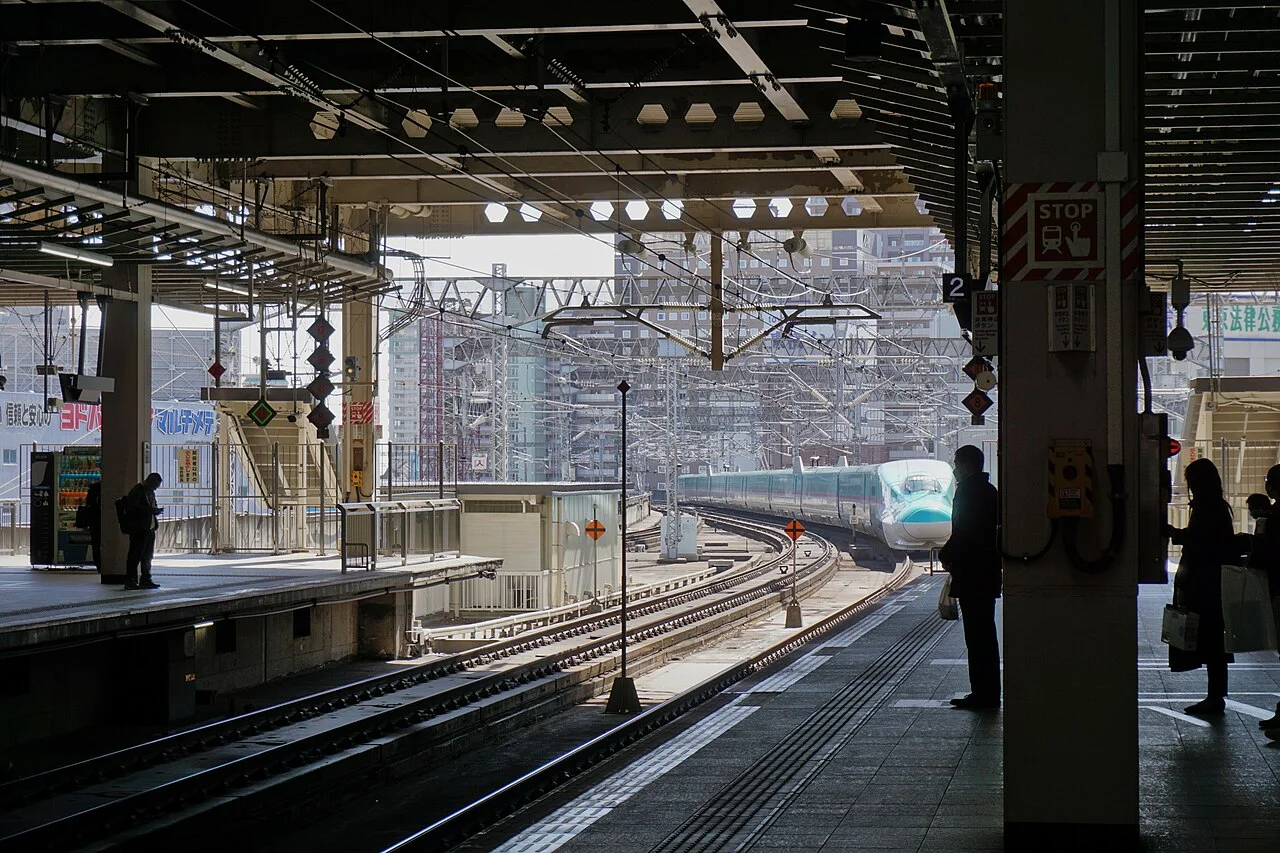
Start by spotting the colours from afar. The E5 series Hayabusa has a teal-green upper body with a thin pink stripe along its waist, while the E6 series Komachi stands out in bright crimson with a noticeably narrower profile. Certain Tohoku Shinkansen services run coupled together between Tokyo and Morioka: ten green Hayabusa carriages joined to seven red Komachi carriages, making seventeen in total. Measured back from its tip, the E5's streamlined nose stretches roughly 15 metres to soften pressure waves and noise when plunging into tunnels at high speed. At Morioka, that nose reveals a second trick: a coupler swings out from inside so the two trains can share the track south.
To film the red nose creeping forward to meet the green one, pick a Tokyo-bound coupling. Pass through the second-floor Shinkansen Ticket Gate at Morioka Station, head up to Platform 11 on the third floor, and follow the Komachi boarding arrows painted on the floor until you turn by the lift and spot the alignment mirror marked in JR East's station diagrams. Stand where both noses are visible at once: the Komachi stops twice behind the Hayabusa before easing in on the third move to lock together. Seeing the noses alone is great fun, though leave a little breathing room in your phone frame so you capture both liveries together.
For the split, choose a southbound-from-Tokyo coupled service arriving on the downward line. Enter through the same ticket gate, go up to Platform 14 on the third floor, and walk to the opposite side of the lift to find the uncoupling mirror. Once the train arrives and passengers finish boarding and alighting, the Komachi pulls out first towards Akita, leaving the Hayabusa behind to continue towards Shin-Aomori or Shin-Hakodate-Hokuto. As the destination displays on the carriage sides diverge, challenge younger children to spot a station name they recognise. The Akita leg runs onto conventional tracks along the Tazawako Line, which is why the red train is built narrower to clear tighter curves and smaller platforms.
Open the JR East Morioka Station timetable, select your direction plus Weekday or Saturday/Holiday, and tap any service to expand its stops. For an uncoupling, look for a pair arriving together from the south before heading separately to Aomori and Akita; for a coupling, look for two trains arriving from separate directions before departing together towards Sendai and Tokyo. Pick one pair as your main target and keep the next pair as a backup. If you are coming in from outside the station with children, allow around 20 minutes to collect tickets, take the stairs or lift, and locate the mirror rather than sprinting down the platform.
Although the station's concourses sit close together, the signage is very clear. Walking back into Morioka Station from the East Exit after shopping, head up to the second floor and look specifically for the Shinkansen gates rather than following signs for local conventional lines. If you want to watch both operations, map out the sequence from the timetable before tapping in; if there is a long gap between pairs, exit for lunch and buy another platform ticket later. Passengers who already hold Shinkansen tickets can use the dedicated transfer gates between lines, though allow a few extra minutes to find the lifts if you have a pushchair.
To watch from the platform without travelling, a same-day JR platform ticket at Morioka costs ¥160 for adults and ¥80 for children, valid for two hours from the time of issue. It covers platform access only. JR East specifically notes that passengers travelling on a southbound Komachi cannot step off at Morioka to watch their own train uncouple. Instead, watch the previous paired train separate and board the next service. Likewise, if you plan to ride the same coupled train back to Tokyo after watching it join, gauge the walk from your viewing spot back to your carriage door beforehand.
At busy holiday periods, staff set up barrier ropes around the coupling zone. Stay on the safe side of both the ropes and the yellow tactile paving, fold away small tripods, switch off your flash, and keep bags tucked neatly beside you out of the walkway. Shorter children often get a much clearer angled view of the red nose gliding in if you shift a few paces to the side of the crowd. Once the action is over, step away from the congestion along the platform before replaying your video. After the two-tone train pulls away, there is still plenty of time for a bowl of Morioka cold noodles on the concourse, or to catch a southbound train timed nicely for family dinner.
| What to see | JR East platform | Timetable direction to check | Highlight on arrival |
|---|---|---|---|
| Red train joining green train | 3F Platform 11 | Northbound/Southbound paired services heading to Sendai and Tokyo | Hayabusa stops first; Komachi inches forward in stages to couple |
| Two trains departing separately | 3F Platform 14 | Downbound paired services arriving from Tokyo | After passengers board and alight, Komachi departs first for Akita |
Watch the green Hayabusa and red Komachi couple at Morioka, book the Mount Fuji window seats on the Tokaido Shinkansen, and see Doctor Yellow in Nagoya. Includes Pikachu and Aso Boy! trains, child fares, and museum guides for Omiya, Kyoto and Nagoya.
Mount Fuji sits on the E-seat side, whether heading to Kyoto or Tokyo
Riding west from Tokyo towards Nagoya, Kyoto and Shin-Osaka, Mount Fuji usually appears on the right-hand side in the direction of travel. Coming back towards Tokyo, the mountain switches to the left, yet the seat letters remain identical when booking. Standard Ordinary carriages on the Tokaido Shinkansen follow a 3+2 layout: Seat E is the mountain-side window seat, with Seat D next to it on the aisle. In Green Cars, which use a 2+2 layout, Seat D becomes the mountain-side window seat. A family of two adults and one child can sit together in the three-seat ABC block, or book D and E plus Seat C across the aisle if the view takes top priority.
Your ticket may show Nozomi, Hikari or Kodama as the train name, while N700S refers to the rolling stock. Origin and destination govern the fare and overall journey time, whereas the service type determines how many stations you stop at, and the Mount Fuji side applies across the entire Tokaido Shinkansen fleet. If you spot the gold emblem on an N700S carriage, point out the slightly flared wings on the train's nose cone. Every seat on an N700S has its own power socket, handy for keeping a parent's phone topped up for mobile return tickets while the children snap photos out of the window.
The easiest landmark to track near Mount Fuji is Shin-Fuji Station. Heading towards Kyoto, look up from your tray table after passing Mishima and scan for the summit as you near Shin-Fuji; heading back to Tokyo, start watching from Shizuoka onwards. Nozomi services blast straight through Shin-Fuji without stopping, so save the station pin on a phone map beforehand to gauge your position. Nearby buildings, embankments and trackside gantries often mask the lower slopes, so look slightly higher once the view opens up to catch the ridge line. JR Central Tours highlights a window of roughly three minutes around passing Shin-Fuji as the prime viewing stretch—if you are still rummaging for a fork in your bento box when half the mountain appears, set the cutlery aside for a moment.
Once the seat map opens on SmartEX, check the carriage number, row and seat letters side by side, and double-check your child's fare category and boarding station. Selected SmartEX fares go on sale up to a year in advance based on provisional timetables, with specific train numbers and seats usually confirmed from 08:00 JST one month before travel. Standard reserved seats open at 10:00 JST one month ahead. Families who register early for window and adjacent seats should reopen their booking once confirmation arrives and adjust seats within their fare rules from the general release window onwards.
If you are boarding the Shinkansen straight from the airport with large suitcases, measure the combined length, width and height of each bag first. On the Tokaido Shinkansen, luggage with total dimensions over 160 cm and up to 250 cm requires a seat reservation with an oversized baggage area. Look for the option labelled Oversized Baggage Area (seats inside the cabin) on SmartEX before browsing available seats. If there are no adjacent seats left on the mountain side with baggage space, secure your luggage spots and family seating first, and pick a daytime departure so the scenery stays a bonus rather than a stress.
To combine Mount Fuji and a train museum on the same transfer day, take a daytime train from Tokyo to Nagoya, stash your large suitcases in lockers or left-luggage at Nagoya Station, and hop on the Aonami Line out to Kinjo-futo for Doctor Yellow. Keep expectations practical: if only early-morning or evening trains fit your schedule, lock in seats together and allow comfortable transfer buffers first. Save mountain-spotting for clear skies and favourable light, and keep an easy carriage game up your sleeve for overcast days, such as ticking off stations on a map or colouring in the prefectures you cross.
| Carriage class | Mount Fuji window seat | Family seating combinations |
|---|---|---|
| Ordinary Car | E | D + E for two; C + D + E for three in the same row with C across the aisle |
| Green Car | D | C + D on the same side for two |
| Ordinary Car (3 together) | Mount Fuji is across the aisle | A + B + C keeps everyone in one block, putting a younger child in the middle |
See the retired Doctor Yellow T4 in Nagoya
Right inside the first-floor rolling-stock hall at Nagoya's SCMAGLEV and Railway Park stands the bright yellow Class 923 Shinkansen, marked by a long blue stripe sweeping down its flank. This is Car 7 of JR Central's retired T4 set, placed on permanent public display from June 2025. Walk from the headlights, cab windows and nose tip down to the car number along the side, then step back to compare its profile with the neighbouring trains. The display boards nearby answer the very first question children usually ask: who used to ride inside this train?
Doctor Yellow's job was to inspect the tracks and overhead power lines along the Tokaido and Sanyo Shinkansen corridors. While passenger trains focused on running to the second, Doctor Yellow collected diagnostic data on the move so maintenance crews knew exactly where to look. Its bold livery looks best from a few paces back, whereas reading the panels gives you an excuse to point out something close at hand—such as the overhead catenary wires visible from train windows—so children can connect what they saw while eating lunch on board with the idea of track inspection.
JR Central retired the T4 set from active inspection service in January 2025. JR West still operates set T5, which is scheduled to end its inspection runs in January 2027, though apart from specially announced events, JR West never publishes Doctor Yellow schedules—and that includes its final run. For a guaranteed sighting, build time into your itinerary for T4 at the Nagoya museum alongside other Shinkansen generations. Note that set T3, which previously stood in Nagoya, was removed when T4 arrived, so if you come across older blog photos online, check the set number before planning your visit.
While walking the hall, try sketching a single outline comparing a Shinkansen's exterior nose with its purpose inside. Point out the pointy cab end first, then look down at how the steel wheels sit on the rails underneath. Because Doctor Yellow ran on the exact same tracks as passenger Shinkansen, its basic proportions match closely. Move straight to the next carriage beside it: even without reading Japanese, children quickly notice which silhouettes repeat across eras and which trains differ even in body height. Standing beside real full-size carriages brings home just how long that yellow nose truly is.
After Doctor Yellow, walk over to the rounded nose of the Series 0 Shinkansen, then visit the Symbolic Rolling Stock display for the 300X experimental train and the superconducting maglev. Loop through in one direction with minimal backtracking and ask a single playful question at each train—which nose is the roundest, or which one looks like it skims flat along the ground? If your children show genuine curiosity about how the wheels work, linger over the cutaway maglev diagrams. Spotting designs from the outside and grasping how they run in a straight line beats reading every plaque on the wall.
To get there, enter the Aonami Line gates at Nagoya Station and ride to the terminus at Kinjo-futo, from which the museum is a two-minute walk. Factor in the transfer walk between Nagoya Station's Shinkansen platforms and the Aonami Line, especially on a day trip from Kyoto when you also need time to drop bags. Both the Shinkansen and conventional-line simulators have their own entry procedures, so check booking rules as soon as you arrive and lock in a slot before wandering the main hall. On a rainy day, swap out outdoor sightseeing and spend two or three unhurried hours among the trains and having lunch, still leaving ample time back at Nagoya Station for your onward express.
Pikachu to Kesennuma, and Kuro-chan climbing Mount Aso
The POKÉMON with YOU Train runs along the Ofunato Line, framing quiet mountain stops in Tohoku between Ichinoseki and Kesennuma. Car 1 hides Pikachu motifs across the seat backs, curtains and colour scheme, while Car 2 is a dedicated playroom featuring a giant lounging Pikachu and toy driver controls. Head to Car 1 first to find your seats and stow coats before walking through together to the play carriage. Hand ticket-reading duty to a child old enough to match letters and numbers: the moment they realise Ichinoseki on their ticket matches the Shinkansen station you just stepped off, every stop along the line turns into a game.
On standard timetables, the outbound service leaves Ichinoseki at 11:00 and reaches Kesennuma at 13:14, returning at 14:50 to arrive back in Ichinoseki at 16:51. Both legs require reserved-seat tickets alongside a base fare ticket; the reserved-seat supplement is ¥840 for adults and ¥420 for children on top of the distance fare, bookable via Ekinet or station ticket offices. If you want a proper sit-down lunch in Kesennuma and a stroll along the harbour, ride the Pikachu train one way and catch a regular Ofunato Line train back. Riding both legs leaves roughly 90 minutes between trains, so pick a lunch spot near the station in advance. Before boarding at Ichinoseki, grab the Pokemon station stamp, then hunt down the photo spot at Kesennuma for two extra souvenirs to tuck into the ticket wallet.
Coming from Tokyo or Sendai, you can time a Tohoku Shinkansen stop at Ichinoseki to connect straight onto the Ofunato Line, keeping in mind that your Shinkansen tickets and Pikachu train reservations are booked separately by date, direction and train number. On popular travel days, staying overnight in Sendai or Ichinoseki takes the pressure off, particularly with younger children needing pushchairs or toilet breaks. Mark 10:00 JST one month before departure for ticket release. JR East runs three themed services—Kesennuma, Miyako and Kamaishi—depending on the month, so verify both the train name and departure station on the operating calendar before paying.
A winter-holiday trip shows why checking dates matters: for example, the 2–4 January 2027 timetable lists the Kesennuma service, whereas 27–28 February 2027 shows the Kamaishi service instead. Searching online for the Pikachu train might suggest services are running on both weekends, so always click through to check the exact route before splurging on nearby hotels. If your outbound train pauses at Geibikei Station, step onto the safe viewing area beside the track to see the station's perspective-illusion artwork, which reveals a hidden Pokemon only when viewed from the right angle.
Down in Kyushu, the Limited Express Aso Boy! between Kumamoto and Aso features the cheerful black-and-white mascot dog Kuro-chan painted across its exterior. Car 3 houses the White Kuro Parent-Child Seats, toddler play space and children's area: the wooden ball pool sits inside Kuro Club, while the white seats refer to the family seating zone nearby, stocked with wooden toys and picture books (parental supervision required). The floor is raised by 25 cm so children sit high enough to enjoy the mountain views, and adults can spot their row by the miniature child-sized seat positioned right beside the window regardless of travel direction. One adult and one child under six may share a Parent-Child Seat for a single adult reserved-seat fare, whereas an eight-year-old requires their own child seat.
Start your Aso planning on the JR Kyushu Aso Boy! train page to check its operating calendar. Trains run between Kumamoto and Miyaji via Tateno and Aso, though on certain dates only a single afternoon round trip runs, and on others the Kawasemi Yamasemi train substitutes instead. As the two trains look completely different inside, make sure the train name reads Aso Boy! before booking the White Parent-Child Seats. As a reference schedule, Aso Boy! 1 departs Kumamoto at 09:57 and arrives at Aso at 11:27; Aso Boy! 4 leaves Miyaji at 15:48, calls at Aso at 15:56, and returns to Kumamoto at 17:08. A regular-season one-way adult reserved seat between Kumamoto and Aso costs ¥3,080 in total. If you are taking the mountain bus up from Aso Station, time your return train around the bus connections.
JR Kyushu reserved seats open at 10:00 JST one month before the travel date. Register for a JR Kyushu Web account in advance and pick Parent-Child Seats or Panorama Seats from the train drop-down menu; operating dates from March 2027 onwards are scheduled for release in mid-January 2027. If Parent-Child Seats sell out, book ordinary reserved seats on the same service—children can still admire Kuro-chan on the exterior and use the play area with a parent. If your priority is seeing the volcano crater and grasslands, you can equally build your outward and return train times around the Aso bus timetable.
| Train | Where to board | Best onboard highlight | Booking steps |
|---|---|---|---|
| POKÉMON with YOU (Kesennuma) | Ichinoseki to Kesennuma, or the reverse | Giant Pikachu and play driving cab in Car 2 | Check operating dates, then reserve seats via Ekinet or a ticket office |
| Limited Express Aso Boy! | Kumamoto to Aso/Miyaji, or the reverse | White Parent-Child Seats and kids' play area in Car 3 | Match dates on the JR Kyushu calendar, then choose your seat type on JR Kyushu Web |
Goodbye Hello Kitty; Tokyo Monorail and Enoden are still running
For years, the pink-and-white 500 series Hello Kitty Shinkansen with its giant ribbon running along the Sanyo Shinkansen between Shin-Osaka and Hakata topped family wish lists. Its final day in service was 17 May 2026. If you come across older Hokuriku or Kansai blogs still featuring photos of the pink train, separate the nostalgia from what is actually bookable today. Families keen on a character train can shift that slot to the Pikachu train on a Tohoku leg, while anyone wanting to see the 500 series' sharp needle nose in person can visit the Kyoto Railway Museum, easily reached via frequent conventional trains between Shin-Osaka and Kyoto.
You can ride something completely different straight from Haneda Airport into central Tokyo. The Tokyo Monorail straddles an elevated concrete beam above the bay; once seated on the train from Haneda to Monorail Hamamatsucho, look for a seat where you can watch the single track stretching forward beneath the centre of the carriage. The route skims over water, bridges and airport aprons, with Haneda Express services taking around 13 minutes between Hamamatsucho and Terminal 3. On your return flight, check whether your airline uses Terminal 3, Terminal 1 or Terminal 2—trains call in 3-1-2 order rather than numerical sequence, so jot your terminal down in your ticket wallet before setting off.
For a half-day beside the sea, swap the monorail's elevated skyline for Kanagawa's vintage Enoden tramway. Transfer from JR Kamakura Station to the Enoden platform and take a Fujisawa-bound train through Shichirigahama and Kamakurakokomae to Koshigoe and Enoshima. Along Shichirigahama the coastline opens out beside the window, while near Koshigoe the green carriages squeeze straight down the middle of an ordinary neighbourhood street. Children love seeing road traffic share space with rail tracks, and waiting at stations gives them time to spot the livery of the oncoming train. Running the route in reverse from Fujisawa to Kamakura works just as well if another JR return station suits your evening better.
Enoden's Noriorikun one-day pass costs ¥800 for adults and ¥400 for children, making sense if you plan several hop-on, hop-off stops. If everyone stays happily glued to the window all the way from Kamakura to Enoshima, compare single point-to-point fares on the official fare chart first. Picking just two stops—say, Shichirigahama for the beach and Hase for a wander—leaves room to explore beyond the tracks in the afternoon. Keep pedestrian crossings clear for local residents at busy photo spots: you can catch plenty of classic coastal angles straight from the moving train window and stick to marked pavements when walking through junctions.
Omiya, Kyoto and Nagoya: half a day for trains kids can actually touch
Staying in Tokyo with children eager to grip a real driver's handle? Take the Saitama New Shuttle one stop from Omiya to Tetsudo-Hakubutsukan (Onari). The Railway Museum in Omiya houses full-size rolling stock on the first floor of the Main Building and career-themed zones in the South Building, where older kids interested in hands-on operations can tackle the E5 Shinkansen simulator or conductor experience. When planning a half-day visit, check which activities are open first and build your carriage viewing around them. Toddlers can ride the Mini Hayabusa, while older children aiming to drive a miniature train on outdoor tracks should read the age, lottery and accompaniment rules for the Mini Driving Train beforehand—once you secure a time slot, explore neighbouring galleries to save walking back and forth.
Omiya is normally closed on Tuesdays and over the New Year period, opening 10:00 to 17:00 with last admission at 16:30. Advance tickets bought at least one day ahead cost ¥1,500 for adults, ¥500 for primary to high school pupils, and ¥200 for pre-schoolers aged three and over; same-day tickets add ¥100 to each tier. Standard admission can be bought online via the museum website. To lock in a popular simulator slot ahead of time, look for the experience-bundled admission tickets released on Seven Ticket at 10:00 JST seven days before your visit. For same-day lottery activities inside the museum, download the Teppaku Lottery App and check the draw windows—locomotives stay put all day, whereas booked slots go straight into your phone calendar.
From 28 October 2026 onwards, the Omiya museum splits its on-site miniature train lottery into two windows at 10:00 and 13:00: the morning round covers sessions from 10:00 to 14:05, while the afternoon round covers 14:20 to 16:20. Mini Driving Trains must be driven by a primary-school child or older, seating up to three people per car including younger children as passengers. If you are two parents with two children, decide beforehand which three are riding; the fourth person can browse the Main Building and meet back at an unmistakable locomotive nose.
In Kyoto, ride the Sagano Line one stop from Kyoto Station to Umekoji-Kyotonishi, two minutes on foot from the museum gate. Stand with the children in front of the historic roundhouse, where black steam locomotives fan out like spokes towards the central turntable. The museum's SL Steam ride is hauled by a real steam locomotive along a roughly 1 km round trip taking about ten minutes—ask your children to listen for the hiss of steam first, then watch closely for the exact moment the driving wheels start to turn. If the family prefers modern express trains to coal tenders, head up to the third-floor outdoor Sky Terrace to watch live JR and Shinkansen trains racing past outside before pausing on the second floor for a drink.
Kyoto Railway Museum opens 10:00 to 17:00 (last entry 16:30) and usually closes on Wednesdays, though it stays open on public holidays and during school breaks; over the 2026-27 New Year break, avoid 30 December to 1 January. Up to 28 February 2027, admission is ¥1,500 for adults and ¥500 for primary/junior-high pupils, rising from 1 March 2027 to ¥1,900 and ¥600 respectively, while children aged three and over rise from ¥200 to ¥300. The SL Steam ride carries a separate ticket: ¥300 for high schoolers and adults and ¥100 for ages three through junior high (free under three), with the high-school/adult fare increasing to ¥500 from March while child and toddler steam tickets stay unchanged. Double-check your visit date carefully around the turn of the month.
Nagoya's SCMAGLEV and Railway Park is tailor-made for children who want to guess the era of every Shinkansen nose on sight. Located two minutes from Kinjo-futo Station on the Aonami Line, it charges ¥1,200 for adults, ¥500 for school pupils, and ¥200 for pre-schoolers aged three and over. Hours run 10:00 to 17:30 (last entry 17:00), closed Tuesdays (shifted if Tuesday is a public holiday, plus selected holiday Tuesdays) and 28 December to 1 January. With Doctor Yellow T4 housed under the same roof, first-time families should devote generous time to T4 and the neighbouring Shinkansen fleet before deciding whether to queue for simulators.
Before choosing between the three museums, ask your children whether they most want to drive a train, ride a real steam train, or stand beside iconic noses. Pick Omiya for driving experiences with an easy local-train hop back into Tokyo; choose Kyoto for genuine steam traction, followed by a walk back through Umekoji Park where passing trains rumble alongside; or head to Nagoya for Doctor Yellow and the full Shinkansen lineage. If you are travelling between cities that morning, aim to arrive well ahead of last entry rather than cutting it fine, leaving breathing room for lockers, lunch and simply watching trains in peace.
| Museum | Adult / primary pupil | Regular closures | How to get there | First stop for kids |
|---|---|---|---|---|
| The Railway Museum (Omiya) | Advance ¥1,500 / ¥500; same-day ¥1,600 / ¥600 | Tuesdays, New Year holidays | New Shuttle from Omiya to Tetsudo-Hakubutsukan Station | Main Building rolling stock, South Building E5 simulator |
| Kyoto Railway Museum | ¥1,500 / ¥500 until 28 Feb 2027; ¥1,900 / ¥600 from 1 Mar 2027 | Usually Wednesdays, plus New Year holidays | 2-minute walk from Umekoji-Kyotonishi Station | Roundhouse turntable, SL Steam ride |
| SCMAGLEV and Railway Park (Nagoya) | ¥1,200 / ¥500 | Usually Tuesdays (shifted on holidays), plus New Year holidays | 2-minute walk from Kinjo-futo Station (Aonami Line) | Doctor Yellow T4, experimental Shinkansen and maglev |
Buying an eight-year-old's ticket and picking a train-shaped ekiben
An eight-year-old primary-school pupil travels on JR with a child ticket, paying half the adult rate across the base fare, limited-express surcharge and ordinary reserved-seat fee, rounded down to the nearest ¥10 under paper-ticket rules. Children aged six who have not yet started primary school still count as infants, while twelve-year-olds still in primary school continue to qualify for child fares. As a rule, each paying adult or child may bring up to two infants free of charge, with a child ticket required from the third infant onwards—though any infant or baby occupying their own reserved seat needs a child ticket. Green Car and GranClass surcharges are charged at full adult rates regardless of age, so check the combined family total on the checkout screen before paying.
Suppose two adults are travelling with an eight-year-old and a four-year-old on a short hop where sharing a lap feels comfortable: decide upfront whether the four-year-old really needs a separate seat. If both children insist on looking out of a window, you may prefer two separate rows with a window seat each, in which case book a child ticket for the younger one too. When using multiple mobile tickets, link each pass to its designated IC card or follow the service's tap-in instructions; take screenshots of everyone's carriage and seat numbers before leaving the hotel, and agree who scans first and who holds whose hand. With paper tickets, keep the whole bundle in one wallet until you clear the ticket barrier, then hand each child a card showing their seat number.
When booking, split east from west: JR East handles the Tohoku and Akita Shinkansen plus the Pikachu train; SmartEX or JR ticket offices cover the Tokaido Shinkansen; and JR Kyushu handles Aso Boy!. If your trip pairs Morioka's coupling with a scenic tourist train on another day, book the rarer seasonal train first and build your Shinkansen connections around it. Standard JR reserved seats go on sale at 10:00 JST one month before departure. Over busy public holidays, set up your accounts ahead of time and keep passenger counts and station names ready by your keyboard so you can jump straight to the seat map at release time.
Teaching children to read a paper train ticket takes four quick checks: confirm the month and day first, read both the departure and arrival stations aloud, find the carriage number, and finish with the seat number and letter. Because platform markings vary depending on train length, look up at the electronic departure board first to match your train name before lining up. Station staff can point you straight to the right escalator from a glance at your paper ticket or booking screen. Once children know exactly which carriage door is theirs, they can relax by the platform line and watch the incoming train nose instead of worrying about missing the doors.
When hunting for Shinkansen-shaped ekiben lunchboxes, check the paper sleeve for the train series first. JR East's 2026 station bento line-up includes an E7 series shaped lunchbox sold at outlets such as Ekibenya Matsuri Select inside Omiya Station, where lifting the nose-cone lid reveals the meal inside. In Kansai, look out for Awajiya's railway-themed bento boxes—in 2026 the maker released commemorative tiered boxes marking the retirements of Doctor Yellow T5 and the 500 series. Take a moment before lunch to turn over the box and check the main dish, allergens and use-by time alongside the novelty shape; if only one character box remains on the shelf, buy it for the children to share and let the adults pick regional specialities.
Pack your bento bag near the top of your daypack, tighten cold bottle caps securely, and wait until everyone is seated before opening lids. Passing Mishima and Shin-Fuji, pause for the mountain view first and let children finish their train-shaped lunch at their own pace afterwards. Snap the empty plastic box shut before stepping off so it doubles as a travel keepsake case for ticket stubs and station stamp cards—and if a child stamps two identical ink prints at a station, stick one into their travel journal and tuck the spare inside the train box with their ticket.
A few useful answers
Can we watch the trains couple at Morioka Station without a Shinkansen ticket?
Yes. Just buy a same-day platform ticket (¥160 for adults, ¥80 for children), valid for two hours from issue. Tokyo-bound couplings usually happen at Platform 11 on the third floor, while southbound separations use Platform 14. Check the JR East timetable beforehand to find a paired Hayabusa and Komachi service.
If I am travelling on a southbound Komachi, can I step off at Morioka to watch my own train separate?
JR East asks passengers boarding or travelling on that southbound Komachi to get straight on or stay seated inside the carriage. Plan to watch the uncoupling of an earlier paired train instead, then catch the following service towards Akita.
Does a four-year-old need a Shinkansen ticket?
Usually no, provided she travels with a ticket-holding family member and does not occupy a separate reserved seat. If you want her to have her own assigned seat, buy a child ticket. Each paying adult or child may bring up to two infants free of charge; a third infant onwards requires a child ticket.
Do we have to ride an N700S to see Mount Fuji?
No, any Tokaido Shinkansen service works as long as you pick the mountain-side seat: Seat E in Ordinary cars or Seat D in Green Cars, in both the Osaka and Tokyo directions. Keep an eye on the window as you pass Shin-Fuji Station.
Can we still ride the Hello Kitty Shinkansen or see Doctor Yellow?
The Hello Kitty Shinkansen made its final run on 17 May 2026. To see a real Doctor Yellow train, head to SCMAGLEV and Railway Park in Nagoya to view Car 7 of the retired T4 set. JR West's T5 set is scheduled to end inspection runs in January 2027.
Can we ride the Pikachu train in one direction only?
Yes. The Ichinoseki-Kesennuma and return legs each require separate seat reservations, so simply book whichever direction suits your plans. If you want a leisurely lunch or walk around Kesennuma harbour, you can return on a regular Ofunato Line train.
Official information and references
Sources used in this guide.
- JR East Morioka Station Staff Guide: Coupling, Uncoupling Spots and Platform Rules
- JR East: Morioka Station Timetable
- JR East: Platform Ticket Fares and Validity
- JR East: E5 Series Hayabusa Carriage Layout and Seating
- JR East: E6 Series Komachi Carriage Layout and Seating
- JR East: Shinkansen Long Noses and Tunnel Pressure Waves
- JR East: Child Passenger Fare Rules
- JR East: Reserved Seat Ticket Release Times
- JR Central Tours: Mount Fuji Window Seats on the Tokaido Shinkansen
- SmartEX: Advance Booking Rules One Year Ahead
- JR Central: N700S Seating and Power Outlets
- JR Central: Doctor Yellow T4 Exhibition Announcement
- JR West: 500 Series and Doctor Yellow T5 Retirement Notice
- JR East: POKÉMON with YOU Train, Operating Dates and Interior
- JR Kyushu: Aso Boy! Timetable, Operating Calendar and Seat Reservations
- JR Kyushu: Aso Boy! Wooden Ball Pool and Parent-Child Seat Design
- JR West: Hello Kitty Shinkansen Final Run Announcement
- Tokyo Monorail: Connections Between Hamamatsucho and Haneda Terminals
- Enoden: Stations and Route Map
- Enoden: Noriorikun One-Day Pass
- The Railway Museum (Omiya): Admission, Opening Days and Experience Bookings
- Kyoto Railway Museum: Fares, Opening Hours and SL Steam Ride
- Kyoto Railway Museum: March 2027 Fare Revision Notice
- SCMAGLEV and Railway Park (Nagoya): Fares, Hours and Attractions
- SCMAGLEV and Railway Park (Nagoya): Access via Kinjo-futo Station
- JR East: E7 Series Shinkansen Bento and Omiya Station Outlet
- Awajiya: Commemorative Doctor Yellow and 500 Series Retirement Ekiben
- JR East: Morioka Station Map and Transfer Layout
- JR East: Reserved Seat Fees for Scenic Rapid Trains
- SmartEX: Seats with Oversized Baggage Space
- The Railway Museum (Omiya): Mini Driving Train Lottery Windows
- Kyoto Railway Museum: Rolling Stock Collection List
- Kyoto Railway Museum: Walking Route from Umekoji-Kyotonishi Station
- JR East: 2026–2027 Winter Seasonal Trains
- JR Central: Rolling Stock Display at SCMAGLEV and Railway Park