Plan an autumn stroll through Inokashira Park from Nanai Bridge to Inokashira Benzaiten and Gotenyama. Covers Kichijoji and Inokashira-koen station access, fall/winter boat hours and fares, plus pairing with Inokashira Park Zoo and the Ghibli Museum.
- Region & Focus
- TokyoFall foliage
- Reading Scope
- 24 min read · 8 chapters · 5 Q&As
- Official Verification
- 35 official sources checkedUpdated November 22, 2026
- Key Topics
- SeasonsNeighborhoodsTokyo & Kanto
Chapter Route Map (tap any stop)
- Peak Timing and How to Pace a Half-Day Visit
- Entering via Kichijoji Station vs. Inokashira-koen Station
- Walking the Loop: Nanai Bridge, Benzaiten, and Gotenyama
- Reflections, Fallen Leaves, and Winter Waterfowl
- Rowboats, Pedal Boats, and Swan Boat Fares
- Visiting with Kids or Older Relatives: Choosing a Zoo Area
- Book Ghibli Museum Tickets First, Then Pick Your Entry Gate
- Wrapping Up in Kichijoji and Rainy-Day Alternatives
- Quick Q&A
Target late November through early December for fall color in Inokashira Park. On a first visit, head onto Nanai Bridge for a wide view across Inokashira Pond, then follow the shore west toward Benzaiten and Gotenyama at an unhurried one-hour pace. If you plan to take out a swan boat, last ticket sales run until 15:50 from November through February, and the boathouse closes Wednesdays from December through February. Coming from Shinjuku, Kichijoji Station is the most direct gateway; from Shibuya, a Keio Inokashira Line local train drops you right at the pond's eastern tip so you can walk west and finish with food and transit in Kichijoji.
Peak Timing and How to Pace a Half-Day Visit
Mitaka City has previously documented Japanese maples turning red in Inokashira Park in late November and lists late November to early December as the city's autumn foliage window. For 2026, the Musashino City Tourism Organization scheduled its official autumn foliage walking tour for November 29, covering Nanai Bridge, Benzaiten, and Gotenyama. If you have several days in Tokyo, pencil in two open half-day slots and pick the better weather day once recent pondside photos start appearing—searching 'Inokashira Park autumn leaves' or 'Inokashira Pond Nanai Bridge' with date-stamped posts gives a reliable read on current canopy color.
Start around Nanai Bridge for water reflections, then shift along the shoreline for tighter angles. Low branches hanging closest to the pond often put vivid leaves and their mirror image in the same frame. If a breeze ripples the water, keep walking until you find a sheltered pocket along the bank or continue to the western end. The vermilion railings at Bentendo Hall and the deciduous woods on Gotenyama offer two distinct looks, so visiting both in a half-day gives you far more variety than waiting on the bridge for a single calm reflection.
The two ends of the pond feel completely different. Entering from Inokashira-koen Station puts you right by the Kanda River headwaters, where water spills out of the pond toward central Tokyo. Benzaiten and the Ochanomizu spring area sit on the western side, pairing vermilion shrine buildings with wooded banks. The western end also leads naturally toward the Ghibli Museum, Mitaka, via the West Garden, while heading back into Kichijoji is easiest by turning north off Nanai Bridge toward the station's South Exit.
Budget about an hour for a full loop around the pond with brief stops, and add extra time if you want to linger with a camera or walk the Benzaiten approach. Starting near Nanai Bridge makes it easy to split the park into two halves—east to Suimon Bridge and west to Benzaiten—so anyone tired mid-walk can peel off back to a station. For a single half-day trip, pick just one ticketed add-on (boating, Inokashira Park Zoo, or the Ghibli Museum) so the trails never feel rushed. Lock in your timed Ghibli entry first, plan around last admission at the zoo and boathouse, and save Kichijoji's shopping arcades for dusk.
The official November 29, 2026 guided foliage walk covers roughly 4 kilometers from Kichijoji Station to the main gate of Inokashira Park Zoo over two hours (¥1,000 per person; registration listed through November 23 or until full). Even on a self-guided stroll, that sequence works well: survey the pond from the bridge, walk east to the Kanda River headwaters, then loop back toward Benten Pond and the wooded hill. If you only have one hour, skip the eastern out-and-back and focus on the bridge and western shoreline.
Plan an autumn stroll through Inokashira Park from Nanai Bridge to Inokashira Benzaiten and Gotenyama. Covers Kichijoji and Inokashira-koen station access, fall/winter boat hours and fares, plus pairing with Inokashira Park Zoo and the Ghibli Museum.
Entering via Kichijoji Station vs. Inokashira-koen Station
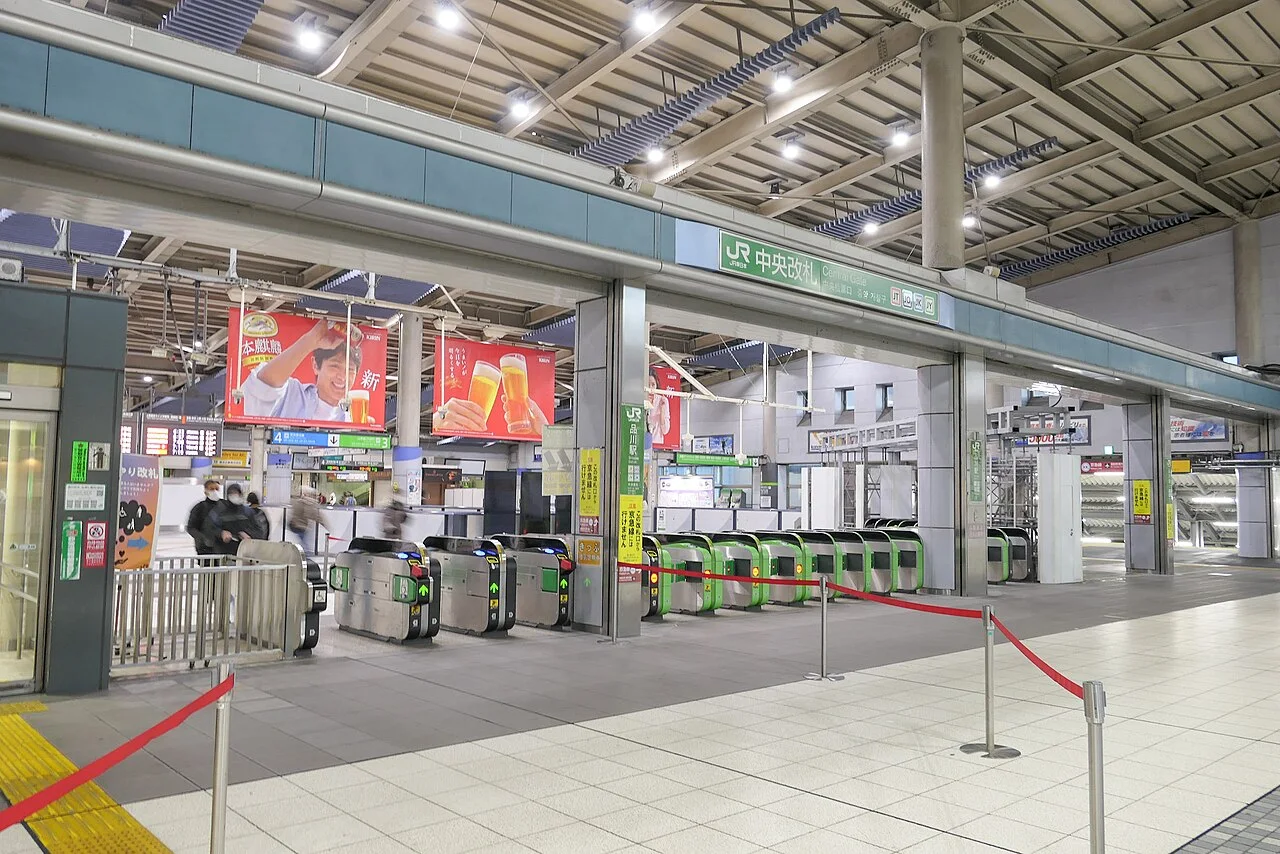
From Shinjuku or anywhere along the JR Chuo Line, board a Chuo Line Rapid train that stops at Kichijoji or take a local Chuo-Sobu Line train. Check the station stop diagram before boarding, as limited express and special rapid services vary in their stops. Exit JR Kichijoji via the South Exit (signed as the Park Exit), step out onto Nanai-bashi-dori, and follow the shop-lined street straight to the park. Park guidelines put the walk from the station at about 5 minutes, though that gets you only to the park edge—allow extra time to reach the western end of the pond.
Coming from Shibuya, the Keio Inokashira Line gives you two distinct drop-off points. Riding the Express to the Kichijoji terminus works best if you want coffee, breakfast, or a clean station meetup first. Taking a Local train lets you hop off one stop earlier at Inokashira-koen Station (IN16), listed by the park at roughly a 1-minute walk from the gate. Keio Express trains skip IN16, so check the train type on the Shibuya platform board before stepping on; if you accidentally board an Express, just ride it to Kichijoji and walk down Nanai-bashi-dori rather than backtracking.
A one-way route connects the two halves of the park cleanly. Start at Inokashira-koen Station on the east side, check the Kanda River headwaters near the sluice gate, walk across Nanai Bridge, and continue west to Benzaiten. Afterward, eat in Kichijoji and catch either the Keio Line back toward Shibuya or JR toward Shinjuku. If you arrive from Shinjuku and plan to stop in Shimokitazawa later, reverse the direction: enter from Kichijoji and exit via Inokashira-koen Station on a Shibuya-bound Keio local. If anyone in your group wants to leave early, agree on a meetup spot by the pond or at Kichijoji Station, since the two stations sit at opposite ends.
Note that the Tokyo Subway Ticket covers only Tokyo Metro and Toei Subway lines; both the JR Chuo Line and the Keio Inokashira Line require separate fares. For a simple out-and-back day in this area, tap a Suica or PASMO card or buy standard point-to-point tickets, and save subway passes for days packed with central Tokyo transfers. On the Keio Line from Shibuya, both Kichijoji and Inokashira-koen cost ¥230 one-way (paper ticket and IC fare are the same), so splitting up at different stations won't change the fare.
JR Kichijoji Station has coin lockers—check the station floor map for exact banks. If you are visiting on a hotel-change day, leave luggage at your hotel or budget extra minutes to retrieve bags from the station before leaving. Inokashira Park Zoo explicitly notes that it has no coin lockers inside, so anyone walking one-way from Inokashira-koen Station to Kichijoji should travel light to avoid doubling back for bags. Both JR Kichijoji's South Exit and Keio Inokashira-koen Station provide elevator locations on their official station maps for step-free access.
If you are driving or dropping off family members with limited mobility, distinguish carefully between the two Tokyo Metropolitan parking lots. Parking Lot 1 sits on the Gotenyama side, convenient for the park information center and the western pond, and operates 24 hours. Parking Lot 2 sits near the West Garden and the Ghibli Museum, with entry from 8:00 to 19:00 and exit until 21:00. Both charge ¥400 for the first hour and ¥200 per additional 30 minutes for standard cars, capped at ¥1,600 for 12 hours after entry. Official access rules prohibit right turns into the lots from Kichijoji-dori and forbid queuing on the street—set your GPS to your chosen lot and keep moving if it is full.
Walking the Loop: Nanai Bridge, Benzaiten, and Gotenyama
Nanai Bridge spans the middle of Inokashira Pond. Arriving from Kichijoji, the bridge sits right at the water's edge below the park entrance, making it a natural first stop to get your bearings. Looking east, the water stretches toward the boat dock and the Kanda River headwaters; looking west, it narrows past the Ochanomizu basin into tree-shaded Benten Pond. Once you spot the Nanai Bridge sign, you are at the midpoint of the pond—and if you only want a half-loop walk, crossing here is the shortest way to switch banks.
Nanai Bridge takes its name from Inokashira Pond's historical moniker, Nanai-no-Ike (Pond of Seven Wells). Tokyo Metropolitan Bureau of Construction records note the pond was once fed by multiple natural springs, while Tokyo Metropolitan Park Association archives trace the bridge's current name to a public naming contest held during its 1953 reconstruction. While crossing, the water looks like one continuous lake, though park maps label distinct sections such as Ochanomizu Pond and the Boat Pond. Glance over both railings for wide views, then step off to the bridge ends if you want to linger without blocking foot traffic.
Walking in from Inokashira-koen Station, the first landmark you hit is the Kanda River headwaters beside Suimon Bridge, where the pond narrows into a canal flowing toward the city. During the Edo period, Inokashira Pond served as the source for the Kanda Aqueduct supplying Edo Castle and surrounding neighborhoods until modern waterworks replaced it in 1898. Looking back toward the pond from the sluice gate clearly shows where the channel opens up. Families with kids can make a quick game of finding the 'Kanda River Origin' marker on the map before starting the shoreline loop.
At the western end of the pond, look for the Ochanomizu marker on the park map. Citing the Edo Meisho Zue, the Bureau of Construction links the name to a legend that Tokugawa Ieyasu brewed tea with spring water drawn here; today, well water is pumped in to maintain the flow where natural springs once bubbled beneath the trees. Follow the marked path onto Benten Pond to see the vermilion Bentendo Hall reflected across the water. Walk around to the shrine side and look back at the red railings and wooded banks for close-up compositions you cannot get from Nanai Bridge.
After visiting the shrine, if you are heading into Mitaka's residential streets, climb the historic Benzaiten approach past the Kuromon (Black Gate). Mitaka City records note that the current hall on the island was rebuilt in 1927, and stone bridges and water basins donated by Edo merchants still carry their inscriptions. Beside the Black Gate stands a 1745 stone marker noting the distance to the shrine, with base stones inscribed with Edo-period theater and actor names. Viewing the shrine from the pond first makes it much easier to picture how pilgrims once arrived. With a stroller, stay on the flat lakeside path or trade off while one adult climbs the stone steps.
Gotenyama rises just west of the pond—check the park map for the zoo's Main Area and the park information center to locate the trails heading uphill. After walking the flat shoreline, it is worth climbing into the autumn woodland. The Bureau of Construction notes that this grove consists mainly of hornbeams, konara oaks, and sawtooth oaks, creating layered shades of gold and russet. Angle your camera low to catch fallen leaves along the dirt paths, or look up into gaps in the canopy. Anyone wanting to spare their knees can wait by the pond and meet at the park path beside Benzaiten.
On the park's official accessibility map, a solid red route runs from near Inokashira-koen Station upstream along the Kanda River, continues along the pond's north shore, and crosses Nanai Bridge to the south bank. A dashed red line near the Kichijoji-dori entrance on the Gotenyama side flags a steeper grade where wheelchair users may need assistance. If you are navigating with a wheelchair or stroller, entering and exiting via Keio Inokashira-koen Station cuts out the steepest climb. On the Kichijoji side, check the slope at the park edge before deciding whether to drop down near Nanai Bridge or use an alternate entrance.
Reflections, Fallen Leaves, and Winter Waterfowl
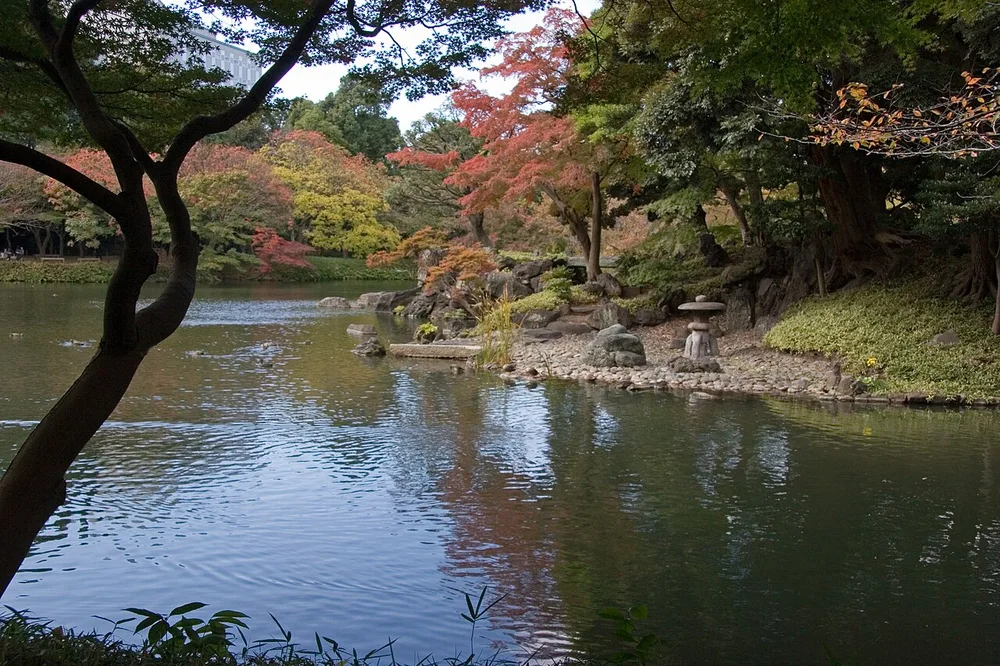
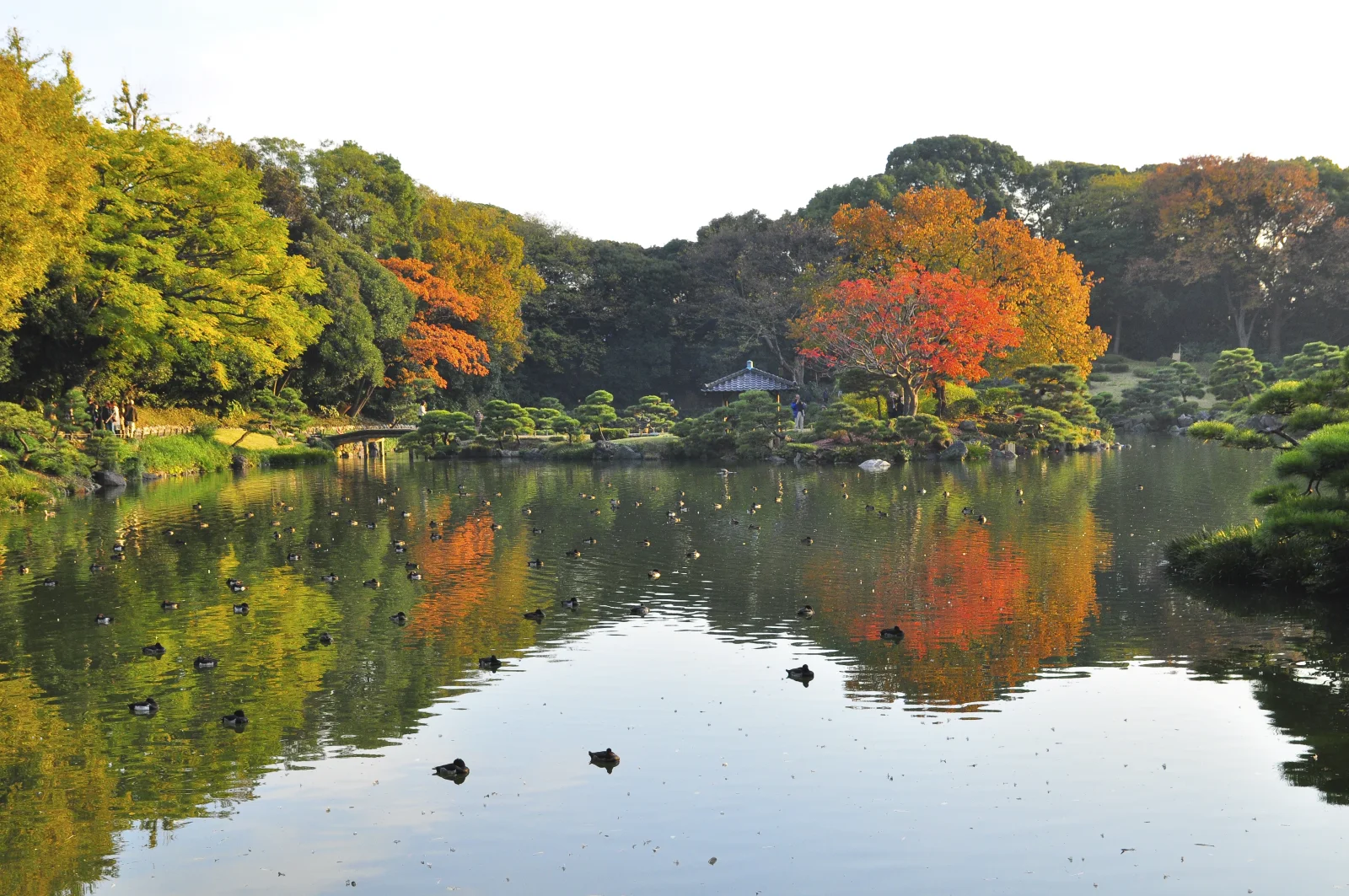
Japanese maples, ginkgoes, and zelkovas line the shore, so early peak season often shows multiple colors side by side. When leaves are just starting to turn, shoot tight details: a single maple branch dipping toward the water, or yellow leaves framing the dark surface near the bridge. Once color fills the canopy, shoot across to the opposite bank so the pond splits the treeline into upper and lower halves. Sunlight hitting the far bank makes red foliage pop against shadowed trunks behind it. If surface glare washes out a sunny shot, move to a lower spot near the bridge abutment or wait for boat wakes to settle.
Overcast skies soften glare and make it easier to distinguish reds, russets, and yellows beneath the trees. Walking over damp fallen leaves with a large umbrella can get slippery—and crowded—so on busy bridge decks, snap a quick handheld shot and keep moving toward wider sections of the path. Tokyo park rules allow tripods only where there is ample room, forbid blocking walkways side by side, and prohibit moving stones, breaking branches, or feeding birds for photos. Always pause before checking your phone screen, especially near open stone embankments and bridge approaches.
Even after peak leaves drop, the pond stays lively with waterfowl. The Bureau of Construction lists eastern spot-billed ducks and little grebes as year-round regulars, joined in fall and winter by northern pintails, northern shovelers, and tufted ducks. Little grebes dive abruptly and pop back up yards away—kids love standing along the low wall to guess where one will surface next. Shallow margins along the bank serve as feeding and resting zones, and the park asks visitors never to feed wild birds.
In recent years, Inokashira Pond has undergone kaibori ecological restoration—draining the pond, clearing sediment, and removing invasive fish—allowing native aquatic plants to regenerate. A September 2026 pond bulletin also noted phytoplankton blooms that temporarily give the water a greenish tint in certain periods. When the water looks opaque green from the bridge, shift your focus to the shoreline reeds, shallows, and waterbirds. For a closer look at native pond life, pair your walk with the Aquatic Life Garden at the zoo, where glass tanks showcase fish, amphibians, and diving birds up close.
If a brief break in the rain clears the sky, stick to whichever end of the pond sits closest to your station. On the east side, stroll between Inokashira-koen Station and Nanai Bridge; from Kichijoji, drop straight down from the Park Exit to the bridge and head back. Photographers carrying extra gear should save the western woods for dry footing rather than chasing treetop angles on slick slopes. If you linger at dusk waiting for calm water, stick to the main paved paths on your walk out—especially if you are keeping a dinner reservation in Kichijoji.
Rowboats, Pedal Boats, and Swan Boat Fares
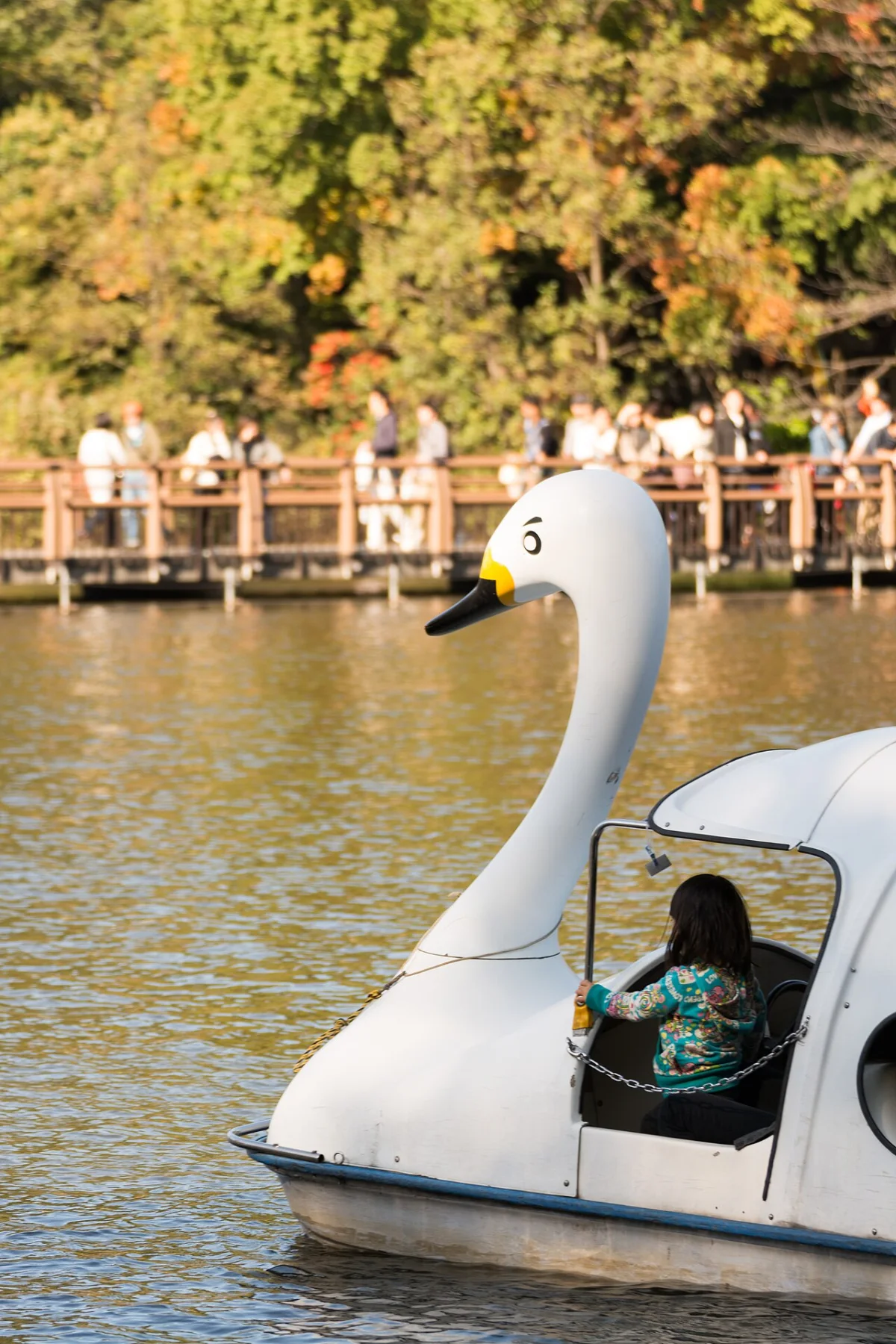
The Inokashira Pond boathouse sits just off the south end of Nanai Bridge—cross over and look for the boat dock signs. Tokyo Metropolitan Park Association rates are ¥800 per 30 minutes for a rowboat, and ¥1,000 per 30 minutes for either a standard pedal boat or a swan boat. Fares are charged per boat, not per person, so two adults sharing a swan boat split that to ¥500 each. If three adults want to ride together in one boat, only the rowboat accommodates three adults.
Official boathouse guidelines cap both standard pedal boats and swan boats at two adults plus one child. A family of two adults and two children should budget for two boats and let dock staff assign vessels at the ticket window. For a rowboat, put whoever is comfortable with oars on the center bench; on a pedal boat, agree beforehand who handles steering. Boarding and docking areas get busy quickly, so save camera shots until you are clear of the pier.
From November through February, the boathouse operates 9:30–16:50 with last ticket sales at 15:50, and closes every Wednesday from December through February. In October and March, hours extend to 17:20 with last sales at 16:20. Work backward from that ticket cutoff time when planning your day: if you expect a leisurely lunch or plan to tour the main zoo first, put boating before lunch and walk uphill through Gotenyama to the zoo afterward.
Your 30-minute rental includes pushing off and returning to the pier, so practice turning within sight of the dock and stay inside the zones marked by staff. Riding out with a tailwind feels effortless, while paddling or pedaling back into a headwind takes noticeably longer. Keep camera straps looped securely over your neck, tuck long coat hems and umbrella handles inside the hull, and board children from a spot where an adult can steady them while listening to the safety briefing.
If boating is your main goal for a half-day visit, glance down at the dock from Nanai Bridge first to check queue lengths and which boat types are moving. If someone in your group prefers to stay on land, set a clear meetup spot near the south-bank dock so they can photograph your boat from the bridge or wander along the opposite shore instead of standing in the ticket line.
When weather, maintenance, or closures pause boat rentals, walk directly across the bridge for pond photos and continue west to Benzaiten, shifting that half-hour into exploring the western bank. Afternoon visitors arriving after 15:50 can pivot straight into a shoreline loop and an early dinner in Kichijoji. If boating is the centerpiece of your trip, call the dock line listed by the Park Association (0422-42-3712) before setting out to confirm same-day operations.
| Months | Operating Hours | Last Ticket | Regular Closure |
|---|---|---|---|
| Oct & Mar | 9:30–17:20 | 16:20 | No regular closure |
| Nov | 9:30–16:50 | 15:50 | No regular closure |
| Dec–Feb | 9:30–16:50 | 15:50 | Wednesdays |
Visiting with Kids or Older Relatives: Choosing a Zoo Area
Inokashira Park Zoo is a separately ticketed facility split into two zones: the Main Park (Zoo) bordering Kichijoji-dori, and the Aquatic Life Garden right beside the pond. To start at the pondside Aquatic Life Garden from Nanai Bridge, look for the Nanai Gate or Benten Gate. The Main Park entrance sits along the street on the western edge of the park—start there if seeing Japanese squirrels is your top priority. Because the two zones have separate gates inside and outside the lakeside path, tell your group to meet specifically at the Main Gate or Nanai Gate rather than just 'the zoo entrance.'
One admission ticket covers both the Main Park and the Aquatic Life Garden. Moving between them requires exiting one gate and walking roughly 5 minutes along public park paths to the other—keep your ticket handy to show at the second entrance. Hours run 9:30–17:00, with last entry into either zone at 16:00, so arrive at your first gate before 15:00 if you want at least half an hour in each section. Admission is ¥400 for adults, ¥200 for seniors 65+, ¥150 for junior high students, and free for elementary school age and younger (plus junior high students living or attending school in Tokyo with student ID).
The zoo normally closes Mondays, shifting to Tuesday when Monday is a national holiday. In 2026, Monday, November 23 is Labor Thanksgiving Day (with a Japanese squirrel keeper talk scheduled at the Main Park), so the zoo closes Tuesday, November 24 instead; year-end closure runs Monday, December 28, 2026 through Friday, January 1, 2027, reopening January 2. The free outer park stays open every day, so if you are combining the Ghibli Museum, the zoo, and the boathouse in late December, double-check each venue's holiday calendar separately.
The Main Park's Squirrel Trail (Risu no Komichi) walk-through enclosure is scheduled to close December 15–20, 2026 for facility maintenance and animal health checks. Even during that week, you can still view Japanese squirrels through the mesh at the breeding building or visit the Seibo Kitamura Sculpture Gallery, which preserves the atelier where the Nagasaki Peace Statue was sculpted alongside indoor and outdoor works—a handy indoor fallback if rain moves in.
Inside the Aquatic Life Garden, the indoor Aquatic Life Hall extends what kids see along the pond. After spotting diving little grebes from Nanai Bridge, step inside to see the little grebe tank alongside exhibits of native stream, pond, and wetland wildlife. Because this annex sits right by the water, it makes an easy one-hour afternoon stop before walking straight back to Kichijoji. Kids eyeing rides can visit Sports Land inside the Main Park, where the carousel and select coin-operated rides cost ¥100 per ride (paid separately from zoo admission)—have them pick one favorite ride ahead of time to keep the pace smooth.
Watching little grebes and looking for swans happen at different spots inside the Aquatic Life Garden. Note that starting November 10, 2026, the zoo suspended its Whooper Swan display at the swan deck as an avian biosecurity precaution, so head straight into the indoor Aquatic Life Hall for water-edge wildlife—including its permanent diving-bell spider exhibit—alongside shoreline birdwatching. To continue on to the squirrels or carousel afterward, exit via Nanai Gate and follow zoo directional signs uphill to the Main Park.
Dogs on short, hand-controlled leashes are welcome along the main paths of the free park. When one person steps away to buy snacks or drinks, have the rest of the group wait in a wide spot near a bridge or park gate rather than blocking narrow path bends. With toddlers who tire quickly, stick to two short segments—Nanai Bridge out-and-back plus the Aquatic Life Garden—and exit via the closer station rather than retracing your steps.
Book Ghibli Museum Tickets First, Then Pick Your Entry Gate
The Ghibli Museum, Mitaka sits inside Inokashira Park's West Garden. From the western end of the pond, follow signs for the West Garden (Nishien) and the museum—expect a noticeable walk beyond the water. If you score a 10:00 entry slot, the cleanest route is exiting JR Mitaka Station's South Exit and walking about 15 minutes along the Tamagawa Aqueduct straight to the museum, then strolling east afterward past Benzaiten and Nanai Bridge to finish at Kichijoji Station.
A community bus also runs from JR Mitaka Station's South Exit. The museum lists the ride at about 5 minutes each way, costing ¥230 for adults (cash or IC card) and ¥120 cash or ¥50 with a child IC card for children. Round-trip discount tickets are discontinued, and the museum shuttle route does not operate on days the museum is closed. Taking the bus in and walking back through the park to Kichijoji—especially if rain hits before your timed entry—splits the trip efficiently.
All Ghibli Museum admissions require advance date- and time-specific reservations; no tickets are sold at the door. International visitors can book via the English-language Lawson Ticket portal linked from the museum's official English site. Tickets for the following calendar month go on sale on the 10th of each month at 10:00 JST. Museum entry rules allow admission within one hour of your designated slot, so pad your transit time accordingly—that printed date and entry window dictate the whole half-day schedule.
Standard admission is ¥1,000 for adults and university students, ¥700 for junior and senior high school students, ¥400 for elementary school students, ¥100 for children ages 4–6, and free for children under 4. Starting with November 2026 entries, the museum introduced a QR-code ticketing system, with the domestic Lawson portal charging a ¥110 system fee per ticket (offering mobile QR links or paper pickup at Lawson Loppi kiosks). If you are visiting from abroad, purchase through the English overseas page and follow the confirmation instructions for your specific booking.
The museum generally closes on Tuesdays, with seasonal exceptions posted on its official calendar. In late 2026, it closes November 4–18 for maintenance (reopening November 19), and closes for the winter break from December 27, 2026 through January 2, 2027. Ticket holders visiting between late November and December 26 can catch seasonal holiday decorations paired with the 'Yuriko Yamawaki's Studio' exhibition. If your Mitaka visit falls at the very end of December, separate your autumn park walk from any museum plans.
With a 13:00 or 14:00 museum slot, walk from Kichijoji to the pond in the morning, circle the western half, grab lunch, and head over to the West Garden; if you want to boat beforehand, check the dock queue at the bridge before committing. If you only land the 16:00 slot, use peak midday light for the pond and treat the museum as your late-afternoon finale. For more character-themed itineraries around Tokyo without overlapping timed bookings, see our Tokyo Character and Studio Days guide.
Wrapping Up in Kichijoji and Rainy-Day Alternatives
Kichijoji Station's South Exit connects directly to the streets leading down to the park. If you just want a meal after your walk, you will find plenty of casual spots along Nanai-bashi-dori heading back toward the tracks—set a cutoff time with your group so you can keep moving toward the station if a restaurant has a long wait. To pick up prepared food or snacks for your hotel, duck into Atre inside the South Exit concourse right before boarding your train, and save supermarket or boutique shopping for after the walk so you only carry water and a camera around the pond.
To browse more shops, cross through the station to the North Exit. Look across the plaza for the Sunroad covered shopping arcade or step into Harmonica Yokocho right beside the North Exit. Sunroad gives you a wide, straight sheltered promenade, while Harmonica Yokocho packs tiny bars and shops into tight alleys—the Musashino City Tourism Organization even notes a commemorative manhole cover beneath the yellow entrance sign, which doubles as a clear meetup landmark. If you continue down Nakamichi-dori for independent boutiques, hitting the stores last spares you from hauling bags through the park.
If heavy rain hits while you are in the park, walk out to the North Exit and head into Coppice Kichijoji, taking the elevator to the 7th floor of the FF Building for the Musashino City Kichijoji Art Museum. Regular hours are 10:00–19:30 (closed the last Wednesday of each month, December 29–January 3, and between exhibitions), with ¥100 admission for permanent galleries and ¥300 for special exhibitions. From November 12, 2026 to February 28, 2027, the Yozo Hamaguchi Memorial Room presents 'Hibi no Mukogawa,' showcasing his copperplate mezzotints. If a rainy Wednesday happens to fall on the last Wednesday of the month, stick to the station mall and covered Sunroad arcade instead.
When you only have a short gap before an afternoon train, heading from the North Exit to the Kichijoji Art Museum is much easier to time than walking down to the pond and back. Take a close look at the fine black lines and emerging color tones in Hamaguchi's mezzotints, and step into the adjacent Hideo Hagiwara Memorial Room if you have extra minutes. Shoppers in your group can browse different floors inside Coppice Kichijoji and reconvene at the ground-floor entrance—close to the station and completely dry.
On days that start rainy, flip your sequence: handle lunch, shopping, or pre-booked museum visits first. If the sky clears briefly with a little daylight left, Nanai Bridge is just minutes from Kichijoji's South Exit for a quick look at the pond before heading back, or you can walk the short eastern stretch from Inokashira-koen Station to the bridge to see the Kanda River headwaters without committing to a full loop. On a rainy Tuesday without Ghibli Museum tickets, check whether Inokashira Park Zoo's Aquatic Life Hall is open or settle in for a meal near the North Exit.
Still have energy for browsing on the way back? Take the Keio Inokashira Line straight to Shimokitazawa for vintage shops, or ride all the way to the Shibuya terminus for department stores and major malls. To add more autumn color elsewhere in Tokyo, split lakeside strolls, ginkgo avenues, and walled gardens across separate half-days using our Tokyo Autumn Leaves Area Plans to pick stops near your hotel or next train line.
A few useful answers
When is the best time to see autumn foliage at Inokashira Park?
Target late November through early December and check recent photos around Inokashira Pond and Nanai Bridge the week you go. If you only have time for one stretch, walk from Kichijoji to Nanai Bridge and head west to cover the pondside maples, Benten Pond, and Gotenyama in a single pass.
Is Inokashira Park free to enter?
Yes, the park itself is free and open 24 hours. Boat rentals, Inokashira Park Zoo, and the Ghibli Museum operate separately and require their own tickets.
Do Keio Line Express trains from Shibuya stop at Inokashira-koen Station?
No, Express trains skip Inokashira-koen Station. Ride a Local train to get off at IN16 right by the pond's eastern end, or stay on the Express to Kichijoji and walk about 5 minutes south to the park.
What is the latest time to rent a swan boat during autumn foliage season?
From November through February, last ticket sales are at 15:50 and the boathouse closes at 16:50. Swan boats cost ¥1,000 per boat for 30 minutes, and the boathouse is closed on Wednesdays from December through February.
Can I visit Inokashira Park Zoo and the Ghibli Museum in the same afternoon?
Inokashira Park Zoo stops admitting visitors at 16:00, while the Ghibli Museum uses timed entry slots. If you only have an afternoon, anchor your schedule around your Ghibli entry time and fit in either the Main Park or the Aquatic Life Garden—if you want to see both zoo zones comfortably, start in the morning.
Official information and references
Sources used in this guide.
- Tokyo Metropolitan Bureau of Construction | Inokashira Onshi Park Facilities & Park Map
- Tokyo Metropolitan Bureau of Construction | Barrier-Free Route Map
- Mitaka City | Inokashira Benzaiten, Stone Markers & Black Gate
- Tokyo Metropolitan Bureau of Construction | Nanai Bridge, Gotenyama, Inokashira Pond & Kanda River Headwaters
- Tokyo Metropolitan Bureau of Construction | Park Autumn Tree Species
- Tokyo Metropolitan Bureau of Construction | Park Rules & Etiquette
- Tokyo Metropolitan Bureau of Construction | Inokashira Pond September 2026 Pond Bulletin
- Tokyo Metropolitan Park Association | Inokashira Park Hours, Access & Parking
- Tokyo Metropolitan Park Association | Boat Capacities, Current Fares & Last Ticket Times
- Tokyo Metropolitan Park Association | History of Nanai Bridge & Aquatic Life Garden
- Musashino City Tourism Organization | 2026 Inokashira Park Autumn Foliage Walking Tour
- Mitaka City Public Bulletin | 2023 City Foliage Timing & Inokashira Park
- Mitaka City Public Bulletin | November 22, 2017 Inokashira Park Foliage Record
- Musashino City Tourism Organization | Kichijoji Shopping Streets & Inokashira Park Visitor Map
- Musashino City Tourism Organization | Kichijoji Harmonica Yokocho
- Keio Corporation | Inokashira-koen Station Train Stops, Timetable & Accessibility
- Keio Corporation | Inokashira Line Fares from Shibuya Station
- JR East | Kichijoji Station Map & Coin Lockers
- Tokyo Metro | Tokyo Subway Ticket Valid Lines
- Inokashira Park Zoo | Main Park & Aquatic Life Garden Hours & Admission
- Inokashira Park Zoo | April 2026 to March 2027 Operating Calendar
- Inokashira Park Zoo | November 2026 Keeper Talks & Events
- Inokashira Park Zoo | Exhibits & Park Facilities Guide
- Inokashira Park Zoo | Squirrel Trail (Risu no Komichi) Temporary Closure Notice
- Inokashira Park Zoo | Autumn Exhibit Adjustments & Zoo Announcements
- Tokyo Zoological Park Society | Inokashira Park Zoo 2026 Animal Exhibits Pamphlet
- Ghibli Museum, Mitaka | Tickets, Entry Slots & Admission Fees
- Ghibli Museum, Mitaka | International Sales via Lawson Ticket (English)
- Ghibli Museum, Mitaka | QR Ticketing & System Fee Starting November 2026
- Lawson Ticket | Ghibli Museum Domestic & International Ticketing FAQ
- Ghibli Museum, Mitaka | Access, Walking Route & Community Bus
- Ghibli Museum, Mitaka & Lawson Ticket | Operating Calendar
- Ghibli Museum, Mitaka | 2026 Christmas Decorations Notice
- Musashino City Kichijoji Art Museum | Hours & Admission Fees
- Musashino City Kichijoji Art Museum | Yozo Hamaguchi Memorial Room 2026–27 Exhibition