How to choose where to stay in Ikebukuro—comparing hotel entrances, station elevators, Narita and Haneda airport buses, four-bed family rooms, connecting rooms, and apartment hotels across the East Exit, West Exit, and Sunshine City.
- Region & Focus
- TokyoHotels and stays
- Reading Scope
- 18 min read · 11 chapters · 7 Q&As
- Official Verification
- 29 official sources checkedUpdated November 22, 2026
- Key Topics
- Where to stayNeighborhoodsBooking
Chapter Route Map (tap any stop)
- Three Zones That Define the Ikebukuro Hotel Map
- East Exit Station Access vs. Staying Inside Sunshine City
- West Exit Central vs. South: Two Different Routines
- Estimating Your Real Walk from Platform to Lobby
- Narita to Ikebukuro: Factoring In Transfers and Final Walks
- Haneda to Ikebukuro: West Exit Buses vs. Train Connections
- Comparing Room Rates: Bed Layouts First, Nightly Price Second
- Apartment Hotels, Business Hotels, and Public Baths
- Planning Around Strollers, Older Travelers, and Late Nights
- Tokyo Itineraries Where Ikebukuro Makes a Smart Base
- Should You Switch Hotels on Your Final Night?
- Quick Q&A
Choosing a hotel in Ikebukuro comes down to three distinct zones. If you plan to catch JR trains every morning and shop or dine near the station, stick to the East Exit. Families spending half a day at Sunshine City—especially with kids who need midday naps or rain-free access—do better inside the complex or around Higashi-Ikebukuro Station. If your itinerary leans on the Tobu Tojo Line to Kawagoe, shows at Tokyo Metropolitan Theatre, or airport buses departing from the West Exit, book on the west side. Before booking, compare your daily station entrance, the late-night walk back, and the actual bed count for everyone in your group.
Three Zones That Define the Ikebukuro Hotel Map
Hotels cluster on both the east and west sides of Ikebukuro Station, and your daily walking time starts the moment you step onto the train platform. Stay at Sunshine City and you can easily drop off shopping bags midday, but catching a JR train the next morning means walking back to the main station. Stay on the south side of the West Exit and the airport bus drops you steps from the lobby, yet reaching Sunshine City takes a longer trek. On a multi-night stay, weigh the walk you will make twice a day more heavily than the arrival route you only walk once.
On the East Exit side, orient yourself by Seibu Department Store, Ikebukuro PARCO, and Meiji-dori, which leads south toward Green Boulevard and Minami-Ikebukuro Park. If you want anime shops, drugstores, and department stores alongside a day or two of JR day trips, your routine naturally splits into morning train departures and evening shopping back in Ikebukuro. Measure the walk from your hotel to the specific stores you care about—commercial streets stretch all the way from the East Exit to Sunshine City, making the 'East Exit area' on booking maps much larger than it looks.
At the Sunshine City end, look to Higashi-Ikebukuro Station on the Tokyo Metro Yurakucho Line. It works directly for morning trips to Toyosu or Yurakucho and afternoon returns near the aquarium. If you plan two Yamanote Line rides a day, a hotel near the East Exit (Central or South) cuts down on daily walks. When searching booking maps, pull up separate pins for Ikebukuro Station and Higashi-Ikebukuro Station and match prices against the train line you will ride most. The two names differ by one word, yet connect to completely different lines and exits.
From the West Exit (Central), streets fan out toward Ikebukuro Nishiguchi Park, Tokyo Metropolitan Theatre, and Rikkyo University, while the West Exit (South) borders LUMINE and Metropolitan Plaza. Once you spot Rikkyo-dori on the map, check whether a hotel entrance faces a main avenue, a side alley, or sits around the back of the building. Light sleepers should compare window orientation, floor height, and street-facing layouts—plenty of convenient late-night blocks still offer quiet rooms facing away from the road.
| Zone | Best For These Plans | Anchor Point on Booking Maps |
|---|---|---|
| Ikebukuro Station East Exit (Central & South) | Frequent Yamanote or Seibu Ikebukuro Line rides, department stores, Minami-Ikebukuro | Ikebukuro Station East Exit (Central) or East Exit (South) |
| Sunshine City & Higashi-Ikebukuro Station | Families visiting the aquarium, midday nap breaks, frequent Yurakucho Line rides | Higashi-Ikebukuro Station Exits 6 & 7 or Sunshine City entrance |
| Ikebukuro Station West Exit (Central) | Tobu Tojo Line trips, performances at Tokyo Metropolitan Theatre | Ikebukuro Station West Exit (Central) |
| Ikebukuro Station West Exit (South) | Airport buses stopping at Hotel Metropolitan Tokyo, JR Metropolitan Ticket Gate access | Ikebukuro Station West Exit (South) |
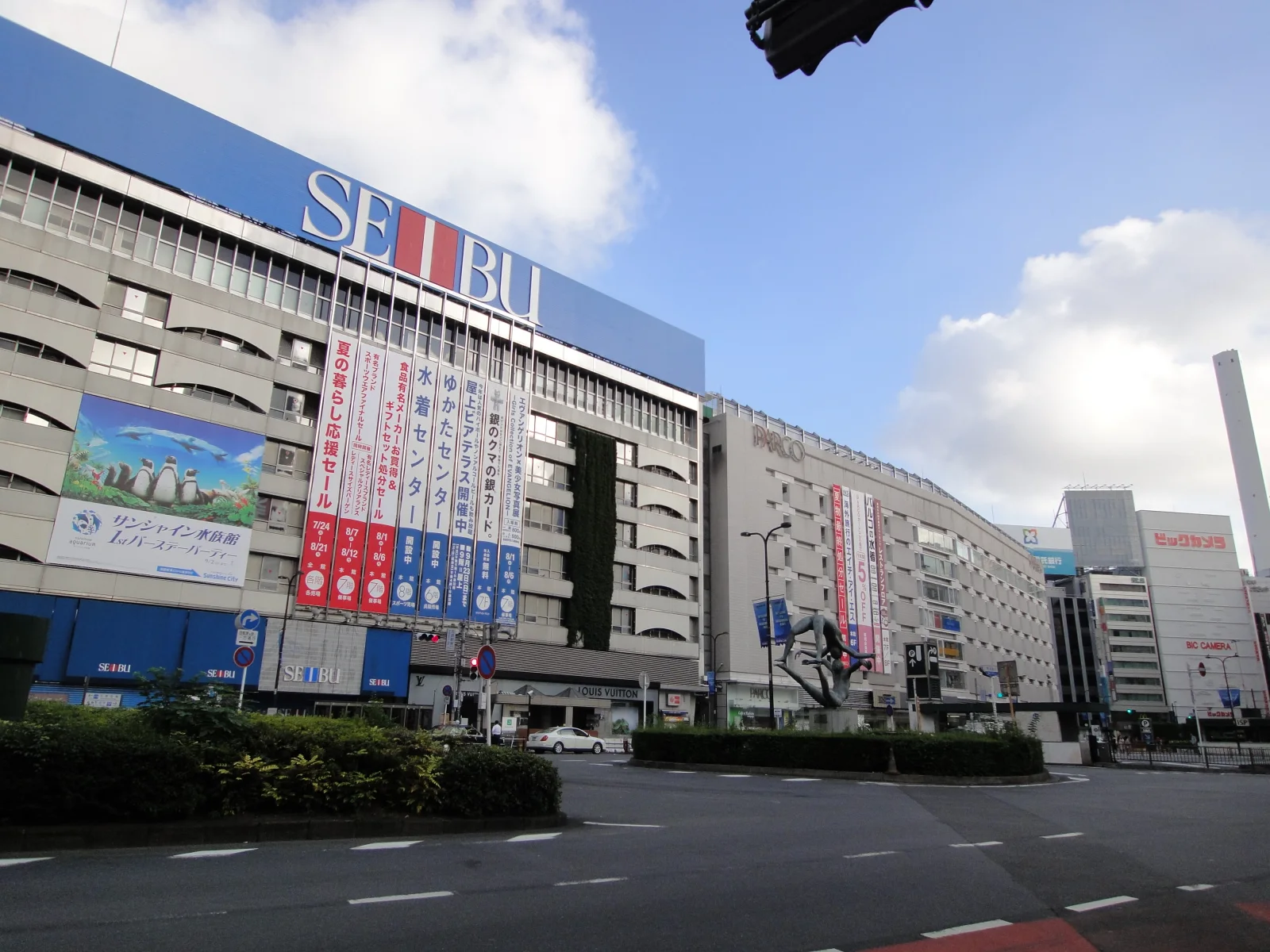
How to choose where to stay in Ikebukuro—comparing hotel entrances, station elevators, Narita and Haneda airport buses, four-bed family rooms, connecting rooms, and apartment hotels across the East Exit, West Exit, and Sunshine City.
East Exit Station Access vs. Staying Inside Sunshine City
On your first walk to Sunshine City with luggage, leave Ikebukuro Station via East Exit 35, head down Sunshine 60-dori, and take the escalators or stairs down beside the Sunshine Vision screen into the underground passage. Sunshine City lists the walk from Exit 35 to the complex entrance at about 8 minutes, including an open-air stretch along the street. That 8-minute clock starts at street level—if you arrive on the Yamanote Line, add the walk down from the platform, through the ticket gates, and out to Exit 35. If you stay near Sunshine City with an early train to catch, test the route to the station gates the night before.
In the rain, or whenever you want full overhead cover, Higashi-Ikebukuro Station is the smoother option. Ride the Tokyo Metro Yurakucho Line to Higashi-Ikebukuro, exit via the West Ticket Gate, and follow signs for Exits 6 and 7 into the Sunshine City underground passageway, which stays indoors all the way to the complex entrance. This direct connector is open from 7:00 AM to 11:00 PM; the underground entrance by the Sunshine Vision screen on the East Exit side is open from 7:00 AM to 11:30 PM. Keep track of both entrances and their closing hours, and save a street-level walking route on your phone for early departures or late-night check-ins.
Sunshine City Prince Hotel sits right inside the complex. The hotel lists its walking time at roughly 8 minutes from Ikebukuro Station and 3 minutes from Higashi-Ikebukuro Station, or about 4 minutes via the underground passage from Higashi-Ikebukuro. Arriving from JR means rolling bags down a busy shopping street, though once checked in you can split the aquarium, observatory, and dinner across different parts of the day. If you specifically want four separate beds, check the Panorama Floor quadruple rooms and compare one four-bed room against two twin rooms—especially if two separate rooms would complicate supervising young kids.
For a short stay focused on quick daily access to JR platforms, compare DEL style Ikebukuro Higashiguchi in Minami-Ikebukuro. Its access page lists about 2 minutes from East Exit (South) or Exit 38, and roughly 3 minutes from East Exit (Central); Exit 40 is only about 30 seconds from the door, though it closes between 9:00 PM and 7:00 AM. On late arrivals, save the route from Exit 38 directly. If you need an elevator for luggage, map both exits alongside the hotel and factor in the extra walk to an elevator-equipped exit.
Minami-Ikebukuro also keeps lunch spots and errands close at hand. You can save the East Exit (South) streets and Minami-Ikebukuro Park for buffer time before check-in or after check-out, letting the family eat or rest inside Sunshine City when tired and saving dedicated shopping for another block of time. Each side serves a different rhythm, especially when you are rushing to drop bags. For help deciding between the aquarium, observatory, and character shops, see our Sunshine City family attractions guide.
West Exit Central vs. South: Two Different Routines
Tokyo Metropolitan Theatre sits about a 2-minute walk from Ikebukuro Station's West Exit, with direct underground access via Exit 2b. For evening performances, staying near the West Exit (Central) lets you drop bags in your room before curtain time. If your group splits up beforehand, agree to meet at the main street-level entrance or inside on the lobby floor so anyone arriving underground or on foot finds the same spot—texting 'West Exit plaza' often leaves people waiting at different corners.
Hotel Metropolitan Tokyo occupies the south side of the West Exit. The hotel lists a 1-minute walk from the JR Metropolitan Ticket Gate, which operates from 7:00 AM to 11:00 PM, and about 3 minutes from the West Exit (South). If you catch late trains or head out before dawn, save the West Exit (South) route on your phone. For wheelchairs or strollers, plan around station elevators—the Tokyo Metro station map marks Exit 4 as elevator-equipped to street level, with directional signage toward Hotel Metropolitan Tokyo and Metropolitan Plaza.
Head further west toward Rikkyo University and you enter the residential and dining blocks along Rikkyo-dori. Trace three daily routes on the map before booking: daytime shopping stops, the walk back after dinner, and your morning station entrance. When all three follow the same straightforward avenue, a slightly farther hotel remains easy to use. By contrast, listings marked only 'Ikebukuro 2-chome' or 'near West Exit' require checking the exact block, and because the West Exit still has traffic, restaurants, and late-night venues, light sleepers should check room placement rather than assuming one side of the station is quieter than the other.
For four travelers on different schedules, Hotel Metropolitan Tokyo's guaranteed connecting room plan pairs two twin rooms with an interior connecting door, giving you two full bathrooms and two toilets. The official booking system requires selecting '1 room' for this plan, with the displayed rate covering both rooms. For multi-generational trips or groups with early risers and night owls, this layout avoids bathroom bottlenecks far better than a single quad room. Save Sunshine City's four-bed rooms or dining-table apartments for families who want everyone sleeping in one shared space.
Estimating Your Real Walk from Platform to Lobby
Read JR East and Tokyo Metro station maps separately. Exiting a JR train, head for the North, Central, or South Ticket Gates first, then orient yourself east or west once outside the gates. Tokyo Metro's three lines each have separate gates, and corridors from the Fukutoshin or Yurakucho lines let you out at different points than Yamanote Line exits. Matching hotel directions against Japanese station signage makes the distinction clear: 'East Exit (South)' describes the direction out of the station complex, while 'JR South Gate' is the actual ticket barrier leaving the paid JR area.
One reliable landmark rule helps prevent wrong turns: Seibu Department Store and the Seibu Ikebukuro Line are on the east side, while Tobu Department Store and the Tobu Tojo Line are on the west side. Do not assume 'Tobu' (which starts with the kanji for 'east') sits at the East Exit—that trips up countless first-timers. If you emerge on the wrong side, look for an indoor east-west connecting passage or check the station map for the right landmark exit before hauling suitcases up to street level. Regrouping underground also spares you from backtracking across busy station-front intersections in the rain.
When a hotel advertises a '3-minute walk,' verify where the timer starts. Trace three separate segments on the map: arrival platform to ticket gate, ticket gate to an elevator-equipped street exit, and street exit to the front desk. Hotel listings almost always measure only that final segment, leaving out weekend crowds, elevator waits, and detours to step-free entrances. Reverse the route on paper for your morning departures too, since heading toward a train platform often uses a different entrance than walking back at night.
If anyone in your group avoids stairs, rely on official JR and Tokyo Metro barrier-free maps. JR Ikebukuro Station provides step-free access to every platform via the Central 1 and South Ticket Gates. JR lists the Metropolitan Plaza side center elevator as operating from 6:10 AM to 11:00 PM, and another elevator outside the Central 1 Gate toward the West Exit from 5:00 AM to 12:30 AM. If you exit on the east side and plan to use the Tokyo Metro elevator across Meiji-dori, official station maps list its hours as 4:45 AM to 12:30 AM. Save both rail maps on your phone when traveling with strollers or multiple large suitcases.
Transfers at Ikebukuro between the Marunouchi, Fukutoshin, and Yurakucho lines sometimes require passing outside the ticket gates and re-entering. Tokyo Metro allows a 60-minute window for out-of-gate transfers between these three lines at Ikebukuro; IC cards recalculate a new fare if you exceed 60 minutes, and paper tickets expire and require a new purchase (always use the orange transfer gates with paper tickets). If you are only switching lines on the way to dinner, follow the transfer signs directly—if you plan to drop bags at your hotel first, budget the trip as two separate fares.
Narita to Ikebukuro: Factoring In Transfers and Final Walks
By train from Narita Airport, you can take the Keisei Skyliner to Nippori and switch through the JR transfer gates onto the inner-loop Yamanote Line toward Ikebukuro and Shinjuku—Keisei publishes dedicated Nippori transfer guides showing which gates to use with paper tickets or IC cards. Alternatively, take the Narita Express (N'EX) bound for Shinjuku and transfer to JR there for Ikebukuro. If you travel with slow walkers or heavy bags, add the platform transfers and the final walk from Ikebukuro Station before comparing total door-to-door time against an airport bus.
Airport Limousine Buses between Narita and the Ikebukuro area list Sunshine City Prince Hotel, Ikebukuro Sunshine Bus Terminal, and Hotel Metropolitan Tokyo as separate stops. Check the stop order for both outbound and return trips, since lobby drop-offs, curbside stops, and bus terminal boarding bays follow different layouts. If you are staying near Sunshine City, pull up the operator's stop map to see whether your hotel sits closer to the Prince Hotel entrance or requires walking out a different wing to the bus terminal—and for your return flight, verify that departure times are actually listed for your chosen stop.
If your flight lands at Narita late in the evening, check the last train and bus connections for your arrival terminal first. Terminal 1 uses Narita Airport Station, while Terminals 2 and 3 both use Airport Terminal 2 Station (with an extra walk from Terminal 3). When baggage claim runs close to the last departure, save your hotel's address and night-entrance route on everyone's phones before leaving the terminal. Families with kids can split roles in the arrivals hall—one adult checks the next departure while the other watches bags and children—so you pick the right route before moving.
For your flight home, work backward from airline check-in deadlines: subtract the walk from the bus drop-off or rail platform to the terminal counter, then travel time, transfers, and wait buffers to find when you must leave your hotel door. If an early morning flight leaves before convenient Ikebukuro departures start, consider spending your final night near the airport or at a station with an earlier first train. Whenever you switch hotels on the second-to-last day, keep that day's itinerary light and leave the afternoon open for moving luggage rather than cramming in three separate neighborhoods.
Haneda to Ikebukuro: West Exit Buses vs. Train Connections
Airport buses between Haneda and Ikebukuro are operated by Kokusai Kogyo Bus, Airport Limousine (Tokyo Airport Transport), and partner carriers. Haneda-bound pickups include Stop 91 at Ikebukuro Station West Exit, alongside direct hotel stops at Hotel Metropolitan Tokyo and Sunshine City Prince Hotel. Staying at the West Exit (Central), check the distance from your lobby to Stop 91; on the West Exit (South), compare schedules from Hotel Metropolitan. Guests at Sunshine City Prince Hotel can pick a bus that stops directly at the hotel entrance and wheel luggage straight to the front desk for bag storage, skipping station transfers entirely.
If you just missed a bus, two single-transfer rail routes work well from Haneda: ride the Keikyu Line to Shinagawa and switch to the JR Yamanote Line via Shibuya and Shinjuku to Ikebukuro, or take the Tokyo Monorail to Hamamatsucho and transfer to the Yamanote Line via Tokyo and Ueno. Both take one transfer, so pick whichever train leaves next when you clear arrivals. On the return trip, search specifically by your Haneda terminal number rather than 'Haneda Airport' in general, since each terminal has different station stops and check-in counters.
Keep dinner and errands on the same side of the station as your hotel on arrival night. By the time you clear the airport and reach Ikebukuro, peak dinner hours may already be over—picking a sit-down spot that stays open along your main street is far easier than dropping bags and crossing back through the station complex. When booking a Haneda-bound bus in advance, save both the ticketing deadline and the exact boarding stop on your trip note: booking pages group everything under 'Ikebukuro area,' but the stop printed on your ticket is the exact curb you need in the morning.
Comparing Room Rates: Bed Layouts First, Nightly Price Second
For two adults on a short stay, check whether a room has one bed or two and whether there is floor space to open two suitcases. Labels like Double, Twin, and Semi-double give you a rough category, so check exact bed widths and floor plans on the hotel's own site next. If you book one large bed, look at whether one side sits flush against a wall—awkward if one person gets up at night—and check doorway clearance if you plan to leave two large suitcases open at once. Those details tell you far more about day-to-day comfort than a room category name.
For families, enter the exact number of adults and children's ages first so search results filter by legal occupancy. Co-sleeping (soine) means a child shares an existing bed with an adult; if a child needs their own mattress, search specifically for paid bed occupancy and include kids in breakfast totals. On Hotel Metropolitan Tokyo's connecting room plan, preschool-age children may co-sleep at one child per bed with no extra bedding or amenities provided, while breakfast plans charge a separate child fee for ages 4 to 6. Listing adults, children, bed count, and breakfast side by side helps everyone in the group agree on the right room.
Look past the headline nightly average down to the checkout total. Break out the number of nights, room count, individual breakfast fees, extra bed charges, and any fees payable at the property, then note the free cancellation cutoff. A cheap non-refundable rate serves a very different purpose than a slightly pricier flexible booking if flight times might shift. Compare quotes across identical dates, guest counts, and bed types—and on stays spanning a Saturday or holiday, check whether one or two peak nights are driving up the average.
Deciding between one quad room and two twin rooms often comes down to bedtime and shower routines. If young kids need help falling asleep or wake up looking for parents at night, a four-bed or Japanese-Western room keeps everyone together. If two pairs of travelers will head out at different hours the next morning, two separate bathrooms matter far more than an extra sofa. When booking two rooms that must connect, pick a guaranteed connecting-room plan and reserve the exact room count specified on the page, and double-check whether breakfast is included for both rooms or only one.
Apartment Hotels, Business Hotels, and Public Baths
For longer stays, MIMARU Tokyo Ikebukuro is a practical benchmark for apartment-style lodging on the West Exit side. The property lists a roughly 5-minute walk from JR Ikebukuro Station's West Exit, with its barrier-free map routed via the West Exit (Central). Suites include kitchens, dining tables, and full-size refrigerators in layouts mixing single beds, bunk beds, and two-bedroom configurations. Its 58-square-meter high-floor two-bedroom suite lists four single beds and an in-room washer-dryer, while other room types rely on shared on-site laundry. If you plan to wash kids' clothes every evening, check the laundry column on each room's spec sheet before booking.
Before paying extra for a kitchen, picture what you will actually eat in the room. With early-rising toddlers, warming milk or prepping quick breakfasts saves morning stress, whereas travelers eating every meal out only really need a microwave and fridge. For two sets of friends traveling together, a dining table that seats everyone turns convenience-store or depachika takeout into an easy group dinner, and a two-bedroom floor plan lets adults pack after kids go to sleep. Match the room premium to the habits you will actually use.
Business hotels work best when your room is purely for sleeping, showering, and repacking. On one- or two-night stays, prioritize quick proximity to your morning train line and either hotel breakfast or nearby cafes that open before your departure time. On multi-night business hotel stays, factor in laundry logistics: if you plan to wash clothes every other day, check the shared laundry room's operating hours, whether washers and dryers are separate machines, and how far the laundry room sits from your floor before turning in for the night.
If soaking in a public bath is a priority, look at Dormy Inn Ikebukuro in Higashi-Ikebukuro 3-chome. Its 15th-floor gender-separated bathhouse, Hojo no Yu, features indoor pools filled with natural dark mineral water trucked in from Sosa City in Chiba Prefecture, plus an open-air bath and sauna. Bath hours run from 3:00 PM to 10:00 AM the next morning, with the sauna closed from 1:00 AM to 5:00 AM. It fits neatly after a late return or before breakfast, though travelers rushing for early trains—or guests with tattoos, which Dormy Inn's bath rules restrict—should verify whether the room itself includes a private bathtub rather than just a shower.
Planning Around Strollers, Older Travelers, and Late Nights
Families with strollers staying in Higashi-Ikebukuro can split Sunshine City across two half-days: browse the shops and grab a bite in the room on your first afternoon, then tackle the aquarium or observatory the next day. If you commute in by train with a stroller, grouping your Sunshine City time into one continuous block avoids making the station walk twice just for a short nap. Book timed-entry tickets for whatever hour your family reliably gets out the door—and even if you stay inside the complex, allow extra minutes for hotel elevators and moving between wings.
Stroller-friendly stays also work well from a spacious West Exit room by dedicating one clean half-day to Sunshine City. Pack the stroller, rain gear, and spare kids' clothes in the room each morning, and after dinner head back to the West Exit along one main street. If one adult takes tired kids back early, save offline maps of both the street-level exit and the hotel entrance on their phone so they do not have to wait for the whole group. The same works for older travelers using wheelchairs or walking slowly: pick an entrance with nearby seating so part of the group can rest while others finish shopping.
If an older traveler in your party struggles stepping into high bathtubs, zoom in on bathroom shower photos, read accessible-room specs carefully, and trace step-free ramps and elevators from the station to the lobby. MIMARU Tokyo Ikebukuro's accessible one-bedroom apartment includes four single beds with wide aisles and wheelchair turning space. Travelers using walkers should check that enough room remains to turn and store bags once the door closes, and anyone taking airport buses should confirm boarding assistance and wheelchair storage rules in advance. Eliminating one street crossing on the map often makes every outing feel easier.
For late-night ramen, izakaya dinners, or casual sit-down meals, pick one spot directly along your walk back to the hotel. Department-store dining floors, basement food halls, and street-level restaurants all keep different closing and last-order hours, so check last-entry times before boarding a late train back to Ikebukuro—and if kitchens have closed, pick up bentos or simple food near the station instead. Groups planning multiple takeout dinners in the room should check table and chair counts before booking, while anyone grabbing dinner just on arrival night will benefit most from shops right outside their exit. Pair your arrival window with our Ikebukuro food guide.
Tokyo Itineraries Where Ikebukuro Makes a Smart Base
Ikebukuro's station hub pays off most when a single week sends you in different directions every day. JR lines cover Shinjuku and Shibuya directly, while the Fukutoshin Line also reaches Shinjuku-sanchome and Shibuya; the Marunouchi Line heads straight to Tokyo Station and Ginza, and the Yurakucho Line runs to Yurakucho, Toyosu, and Shin-Kiba. If you commute to the same neighborhood daily, judge hotels by that single line—getting off at Shinjuku-sanchome for shops versus JR Shinjuku for highway buses leaves you on completely different walks. Likewise, the Yurakucho Line directly serves Higashi-Ikebukuro for Sunshine City, while West Exit guests riding it should note the closest underground gate.
For a day trip to Kawagoe, take the Tobu Tojo Line from Ikebukuro to Kawagoe or Kawagoeshi Station and walk toward the historic district. Watch out for 'Hon-Kawagoe' in bookings or maps, which is a separate Seibu Railway station—if your group arrives separately, pick a landmark or shop in the old town as your meeting point rather than 'the station.' Staying on the West Exit side puts you right next to the Tobu departure gates, which saves real time on an early-morning round trip. Once you arrive, plan your route through the warehouse district and museums with our Kawagoe Kurazukuri walking guide.
For Chichibu, ride the Seibu Limited Express Laview 'Chichibu' from Seibu-Ikebukuro Station to Seibu-Chichibu Station; all seats are reserved. When checking rental cars or hotels there, do not confuse Seibu-Chichibu Station with Chichibu Railway's Chichibu Station. Book your return seat when you buy the outbound ticket—or on summer festival and weekend trips with uncertain end times, build in a cushion to browse or eat around Seibu-Chichibu Station before reserving. Families with kids or slow walkers staying on the east side should locate the Seibu Ikebukuro Line entrance beforehand, and allow extra minutes at the ticket machines if buying limited express seats on the spot.
To reach Tokyo Disney Resort, head across town via the east side. From Higashi-Ikebukuro on the Yurakucho Line, ride to Shin-Kiba and transfer to the JR Keiyo Line for Maihama. Alternatively, take the Yamanote Line from Ikebukuro to Tokyo Station and follow the long transfer corridor to the Keiyo Line platforms. Tokyo Disneyland is a walk from JR Maihama Station, while Tokyo DisneySea connects via the Disney Resort Line monorail. Ikebukuro works smoothly as a base for a single Disney day when you still want dinner back in town or a Kawagoe day trip, though anyone aiming for rope-drop entry two days in a row should compare hotel rates near Maihama for those dates.
On a five-night Tokyo trip, different schedules point to different corners of Ikebukuro. If two evenings involve Sunshine City and daytime plans rely on the Yurakucho Line, Higashi-Ikebukuro trims repeated walks back to JR Ikebukuro. If your schedule centers on two theater nights plus Kawagoe, the West Exit keeps late returns and early trains on the same side. Splitting days between Chichibu and Disney comes down to your group's morning pace—travelers rushing out early benefit most from staying steps from the station so the whole group isn't crossing multiple intersections before the first train.
Should You Switch Hotels on Your Final Night?
If you head straight from the airport to Ikebukuro on night one, check front-desk check-in hours and find the hotel's late-night entrance before you fly. Add your flight number to your booking notes, and if you will arrive after midnight, message the hotel through your booking channel with both your original check-in date and the post-midnight calendar date—for instance, checking in for November 22 with an expected arrival at 12:30 AM on November 23—so staff do not mark you as a no-show. Keep the guest name, Japanese street address, and hotel phone number handy on your phone to show a taxi driver if needed.
If you plan to shop on checkout day before flying out, ask how late the hotel holds luggage and trace the route from bag pickup to your airport train or bus. Guests staying at the East Exit who are catching a West Exit airport bus can plan their final meal on the west side or move bags into station lockers near their departure gate right after checkout. Both JR and Tokyo Metro Ikebukuro stations have coin lockers, though large suitcases need oversized compartments—if sharing lockers with travel companions, snap a photo of the receipt alongside the nearest gate name or floor sign so everyone knows where to regroup.
Before switching hotels solely for your final flight, weigh the time spent packing, hauling bags, storing them, and checking in again. If your Ikebukuro hotel still reaches your departure train or bus comfortably, keeping the same room frees up your final afternoon for shopping and packing. Only move to an airport hotel on the last night if your flight departs before city trains start running—and when you do split a stay, record both cancellation deadlines and exact check-in and check-out times so you know which items stay in your daypack.
A few useful answers
East Exit vs. West Exit: which side is better for a first stay in Ikebukuro?
Pick a hotel near the East Exit if you will ride JR trains often and want department stores and anime shops nearby. Choose the West Exit (Central) for Tokyo Metropolitan Theatre or Tobu Tojo Line day trips to Kawagoe. Families planning long blocks at Sunshine City with midday nap breaks should compare hotels inside the complex or around Higashi-Ikebukuro Station.
Can I walk completely indoors from Ikebukuro Station to Sunshine City when it rains?
From Ikebukuro Station East Exit 35, you still walk outdoors along Sunshine 60-dori before reaching the underground entrance beside the Sunshine Vision screen. To stay underground the entire way to the complex entrance, take the Yurakucho Line to Higashi-Ikebukuro Station, exit the West Ticket Gate, and follow Exits 6 and 7 through the direct passageway, open 7:00 AM to 11:00 PM.
How can a group of four book four separate beds in Ikebukuro?
Sunshine City Prince Hotel offers Panorama Floor quadruple rooms, and MIMARU Tokyo Ikebukuro has apartment suites with four single beds. If you want two bathrooms for two pairs of travelers, Hotel Metropolitan Tokyo offers a guaranteed connecting-room plan pairing two twin rooms, booked by selecting 1 room on its official site.
With heavy luggage from Narita, is the train or airport bus better for Ikebukuro?
Take the airport bus whenever a stop drops directly at your hotel entrance. By rail, ride the Keisei Skyliner to Nippori and transfer to the inner-loop JR Yamanote Line, or take the Narita Express (N'EX) to Shinjuku and switch to JR there. Compare the final walk from your bus stop or JR exit to the hotel lobby.
Where do Haneda Airport buses pick up in Ikebukuro?
Haneda-bound buses pick up at Stop 91 outside Ikebukuro Station West Exit, as well as direct hotel stops at Hotel Metropolitan Tokyo and Sunshine City Prince Hotel. Always board at the exact stop printed on your ticket, as hotel curbs and the West Exit bus stop are in separate locations.
How do you get from Ikebukuro to Tokyo Disney Resort?
From Higashi-Ikebukuro or the Yurakucho Line, ride to Shin-Kiba and transfer to the JR Keiyo Line to Maihama. Alternatively, take the JR Yamanote Line from Ikebukuro to Tokyo Station and transfer to the Keiyo Line. Tokyo Disneyland is walkable from Maihama Station, while Tokyo DisneySea connects via the Disney Resort Line.
Is Ikebukuro a good base for a full week in Tokyo?
Yes—especially if your week spans multiple neighborhoods using JR, Tokyo Metro, and private rail lines. Apartment hotels also add kitchens and laundry for longer stays. Pin the train lines you will ride most on a map first, then compare laundry setups, bed layouts, and total weekly rates across rooms.
Official information and references
Sources used in this guide.
- JR East Ikebukuro Station Map & Barrier-Free Routes
- JR East Ikebukuro Station Ticket Gates & Facilities
- Tokyo Metro Ikebukuro Station Exit Numbers & Elevators
- Tokyo Metro Out-of-Gate Transfer Rules
- Tokyo Metro Yurakucho Line Stations
- Sunshine City Rail Access & Underground Passageway
- Sunshine City Prince Hotel Access Guide
- Sunshine City Prince Hotel Guest Rooms
- DEL style Ikebukuro Higashiguchi Access Guide
- Tokyo Metropolitan Theatre Access Guide
- Toshima City Minami-Ikebukuro Park Information
- Rikkyo University Ikebukuro Campus Area Map
- Hotel Metropolitan Tokyo Station & Airport Access
- Hotel Metropolitan Tokyo Quad Connecting Room Plan & Child Policy
- MIMARU Tokyo Ikebukuro Room Types & Amenities
- MIMARU Tokyo Ikebukuro Barrier-Free Walking Map
- Dormy Inn Ikebukuro Public Bath Facilities & Hours
- Dormy Inn Accommodation Terms & Public Bath Rules
- Narita International Airport Rail Access & Terminal Connections
- Keisei Electric Railway Nippori JR Transfer Guide
- JR East Narita Express (N'EX) Route Map
- Airport Limousine Bus Ikebukuro Area to Narita Airport Timetable
- Kokusai Kogyo Bus Ikebukuro Area & Haneda Airport Limousine Bus
- Haneda Airport Train & Monorail Access
- Tobu Railway Ikebukuro to Kawagoe & Kawagoeshi Routes
- Seibu Railway Chichibu Laview Limited Express Routes & Reserved Seats
- Chichibu Railway Chichibu Station Information
- JR East Shin-Kiba Station Timetable for Maihama
- Tokyo Disney Resort Rail Access Guide