Read Ichibangai’s shop-storehouses through box ridges, ornamental tiles, thick shutters and seam-sealing platforms. Compare Edo and Meiji forms at Osawa House, then see the Nobutsuna and Shojo floats, with music times, tickets, closures and three shopping finishes.
- Region & Focus
- Kawagoe
- Reading Scope
- 30 min read · 12 chapters · 3 Q&As
- Official Verification
- 13 official sources checkedUpdated October 28, 2026
- Key Topics
- ItinerariesTokyo & Kanto
Chapter Route Map (tap any stop)
- First allow time to look up, then decide on a live performance
- Read the “warehouse” as a shop facing the street
- Start at the box ridge: there is more behind the ornamental end tile
- Upper-floor shutter joints lead to the platform below
- Look down for lower walls and hooks: not every projection is ornament
- Osawa House: use its 1792 windows and eaves to reset your impression
- The continuous street also reflects modern preservation
- At the museum, start with real floats, then bring in the street through film
- The current Nobutsuna and Shojo floats: identify both first
- Listen for flute, drums, gong and dancer
- Museum tickets, closures and assistance
- Choose one shopping finish by location and activity
- Quick Q&A
On Kawagoe’s Ichibangai, slow down at rooflines and upper-floor windows. Heavy ridges, the mass behind ornamental end tiles and narrow platforms below shutters each have fire-protection and craft functions. Continue north into the Kawagoe Festival Museum to connect merchant shops, neighborhood festivals and the street outside. For architecture, spend more of the morning outdoors. For live hayashi music, choose a Sunday or Japanese national holiday and reserve 13:30 or 14:30 for the museum.
First allow time to look up, then decide on a live performance
If Kawagoe is already your choice, divide an old-town half-day into Ichibangai exteriors, the museum and one shopping stop or seated break. Our editorial suggestion is three to four hours for this section, excluding travel from the station, lunch and the return. This suits people who stop for architectural details. For only the Time Bell and a snack, shorten the street portion and use the museum as the main indoor stop of about 30 minutes.
The museum website gives about 30 minutes as a visit estimate. Its roughly eight-minute, three-screen film plays every 20 minutes. To add an approximately 20-minute hayashi performance, plan around one show. Our suggestion is about an hour inside, including waiting and floats. Choose 13:30 or 14:30 first, then put lunch before it, rather than decide at the door and lose part of the performance.
Use Ichibangai as the main axis. The museum is at 2-1-10 Motomachi and Osawa House at 1-15-2 Motomachi. For architecture, examine several shops first and use Osawa House for comparison. If your chosen performance is about to begin when you arrive, enter the museum first and return to the exteriors afterward. Both routes focus on the same old-town area without inserting another distant attraction mid-walk.
For station choices from Tokyo, see Tokyo side trips and overnight stays. In the old town, first choose the kind of viewing: outdoor building details, the structure of real floats inside, or live hayashi at a set time. Favor shops and architecture in fine weather. In heavy rain, shorten outdoor observation and retain the museum and one shop you want to browse.
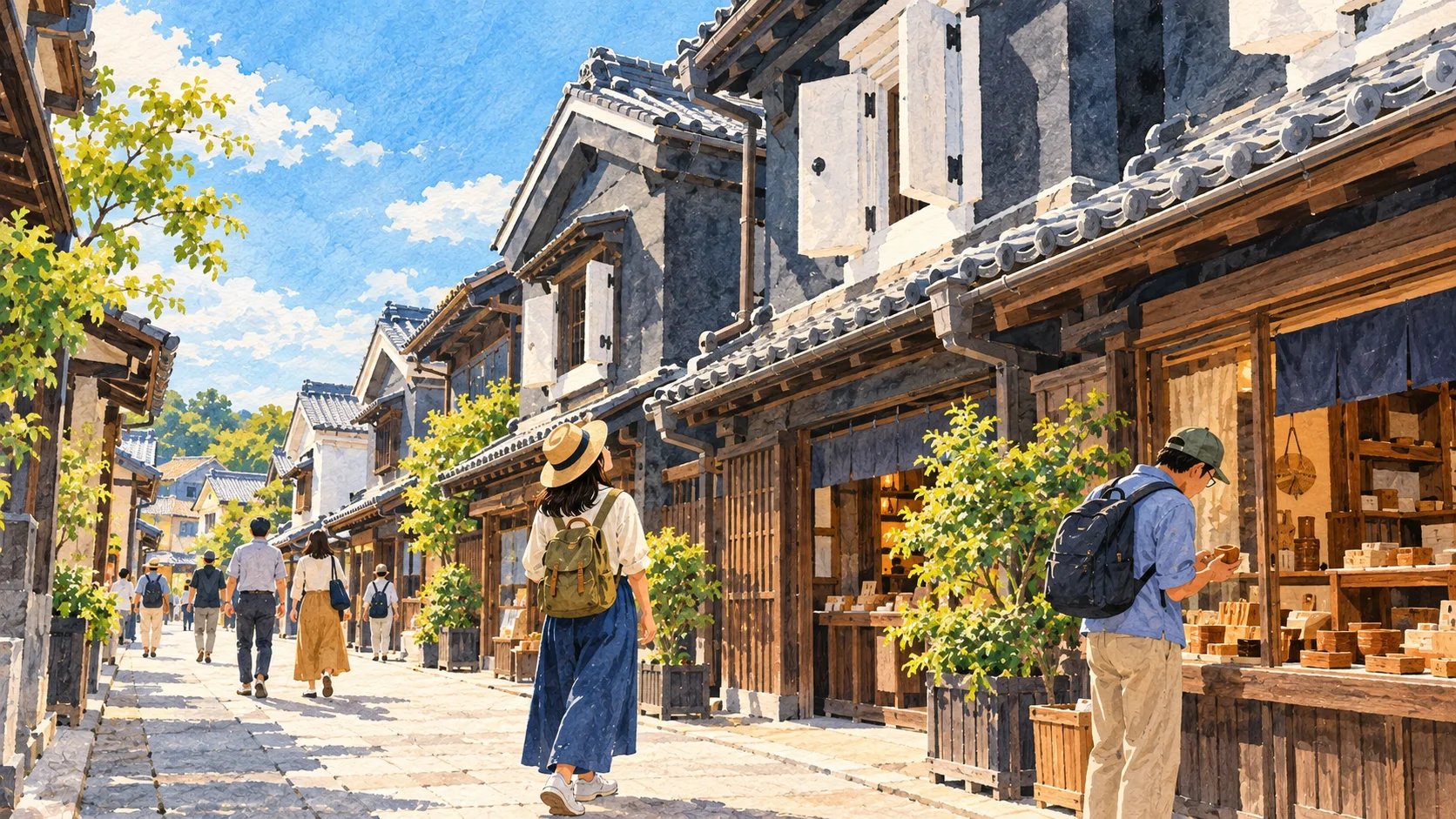
Read Ichibangai’s shop-storehouses through box ridges, ornamental tiles, thick shutters and seam-sealing platforms. Compare Edo and Meiji forms at Osawa House, then see the Nobutsuna and Shojo floats, with music times, tickets, closures and three shopping finishes.
Read the “warehouse” as a shop facing the street
The Kawagoe City Museum's architectural explanation is specific: merchants made the shop itself a misegura, a fire-resistant shop-storehouse, to stop neighboring fires spreading. Together with earthen storehouses behind, it protected the whole plot. Read thick walls, tiled roofs and openings through commercial use. The street frontage served business, customer attraction and fire protection at once.
Black plaster and huge roof tiles also displayed a merchant's public face. Fire resistance supplied the basic form; ridge size, window and door detail and ornament gave each shop a different expression. Compare two or three neighboring buildings. Find their common roof, upper openings and ground-floor shop, then what each enlarges. This reveals more architectural difference than recording every shop name.
Today's street has a clear rebuilding background. The Ichibangai shopping street records that the March 1893 Kawagoe fire destroyed more than 1,300 households, about a third of the town then. Surviving warehouse-style buildings including Osawa House encouraged merchants to rebuild with fire-resistant shops. The tourism association also notes that most surviving examples followed this fire. The Edo-style view therefore includes Meiji merchants' rebuilding choices.
That history explains why Osawa House is useful later in the walk. Learn the heavy outlines of post-fire shops first, then compare its 1792 eaves and windows. You need not memorize a full chronology. Ask how merchants changed their shops after fire, and thick walls and shutters gain practical meaning.
Start at the box ridge: there is more behind the ornamental end tile
Look first for the high ridge like a low wall along the roof's top. The museum calls it hakomune: a wooden box-shaped core covered with plaster and other materials, originally protecting the ridge timber. Kawagoe shop-storehouses developed it as prominent decoration. Its height, thickness and end shapes strongly affect a building's visual weight.
Onigawara sit at both ridge ends. Despite “demon” in the name, designs vary. The museum gives family crests, the character for water as a fire-protection wish and lucky wealth mallets as examples. See the tile's outline, central motif and lines extending sideways. If detail is unclear at a distance, choose another roof that is easier to view. Do not enter the road to read one character.
Behind the onigawara, a larger raised mass often appears, called kagemori. As box ridges grew, their ends needed matching volume to balance the junction with the tile. A wooden frame, plaster and tiles create a large but relatively light form, finished with trowels. Distinguish the end tile from the mass behind to see the roof's layered construction.
A straight-on photograph can overlap these details. Our suggestion is to begin from a safe stopping place on the same sidewalk for an oblique view, then cross at a safe intersection for overall proportions. An angle separates onigawara and kagemori; the front view compares ridge and shop width. Study one building, then compare the next, rather than take the same photograph of every facade.
Upper-floor shutter joints lead to the platform below
Many shop-storehouses have thick double shutters called kannon-biraki doors. Their key feature is the joint between shutter and frame: stepped edges interlock tightly when closed. Earth and plaster shrink as they dry, yet plasterers must make these joints precise. This is craft you can read directly in the facade. Open shutters reveal their thickness and edge layers from outside.
Now look lower. A narrow box-like platform below the upper window and above the ground-floor roof may be a menuridai. In a fire, shutters were first closed, then this facility helped workers seal the joints with mud or similar material.
Menuridai may have white-plaster or copper-faced decorative finishes. An emergency facility remained part of the everyday shopfront, with fire protection and appearance considered together. Some shutters and platforms have similar colors; others make a strong line. Compare placement before surface material. Every difference need not indicate a different date.
When observing an operating shop, stay within public circulation space and leave its entrance to customers. Examine shutter details with your eyes; do not pull, touch or try closing them. Save the museum explanation on your phone and match shutter, frame and menuridai on site to learn the joints more easily than guessing each function.
Look down for lower walls and hooks: not every projection is ornament
The lower ground-floor wall is called koshimaki. The museum explains that it prevents ground moisture entering the earthen wall and reduces fire spreading from below after a neighboring building collapses. Heavy warehouse-style buildings also need stable foundations. After the roof, return to this level to see how their weight extends down to the ground.
Lower-wall surfaces vary. The museum uses the Warehouse-style Architecture Museum's washed artificial-stone finish as an example: sand and small gravel are mixed into mortar, applied, then brushed with water to expose a stone-like texture. Other buildings use stone. Compare grains, joints and colors, describing the differences you see. For a particular stone type, use that building's official account.
Hemispherical plaster projections with thick hooked nails are called tsubu and orekugi respectively by the museum. Hooks with projections can secure ropes and ladders during repairs. Separating the projection from the main wall helps contain stress damage in the projection. Exposed iron is also limited to reduce rust-related moisture entering the earth. These small parts are easier to find closer up.
Short walls projecting from upper-floor sides above the ground-floor roof are called sodekabe in the museum's Kawagoe context. It distinguishes them from hon-udatsu and sode-udatsu common elsewhere. To compare two shops, note whether they have these walls and on which side. This records differences without applying another historic town's terminology.
Some hooks lack the hemispherical projection. The museum associates these with later eaves, rain covers, boards and other attachments. Thick earthen walls are hard to nail into after completion, so hooks were driven into the wall core before finishing. Compare rows of metal fittings by whether they have plaster projections and what equipment joins them. Repairs, added shelter and the original wall meet in these unobtrusive places.
Osawa House: use its 1792 windows and eaves to reset your impression
Osawa House at 1-15-2 Motomachi is a nationally designated Important Cultural Property. Kawagoe City records its construction by kimono and cloth merchant Nishimura Han'emon, trading as Omiya. Prayer tablets and writing on the household shrine date it to 1792. It survived the 1893 fire. The tourism association identifies it as Ichibangai's oldest warehouse-style building, a named comparison point for the walk.
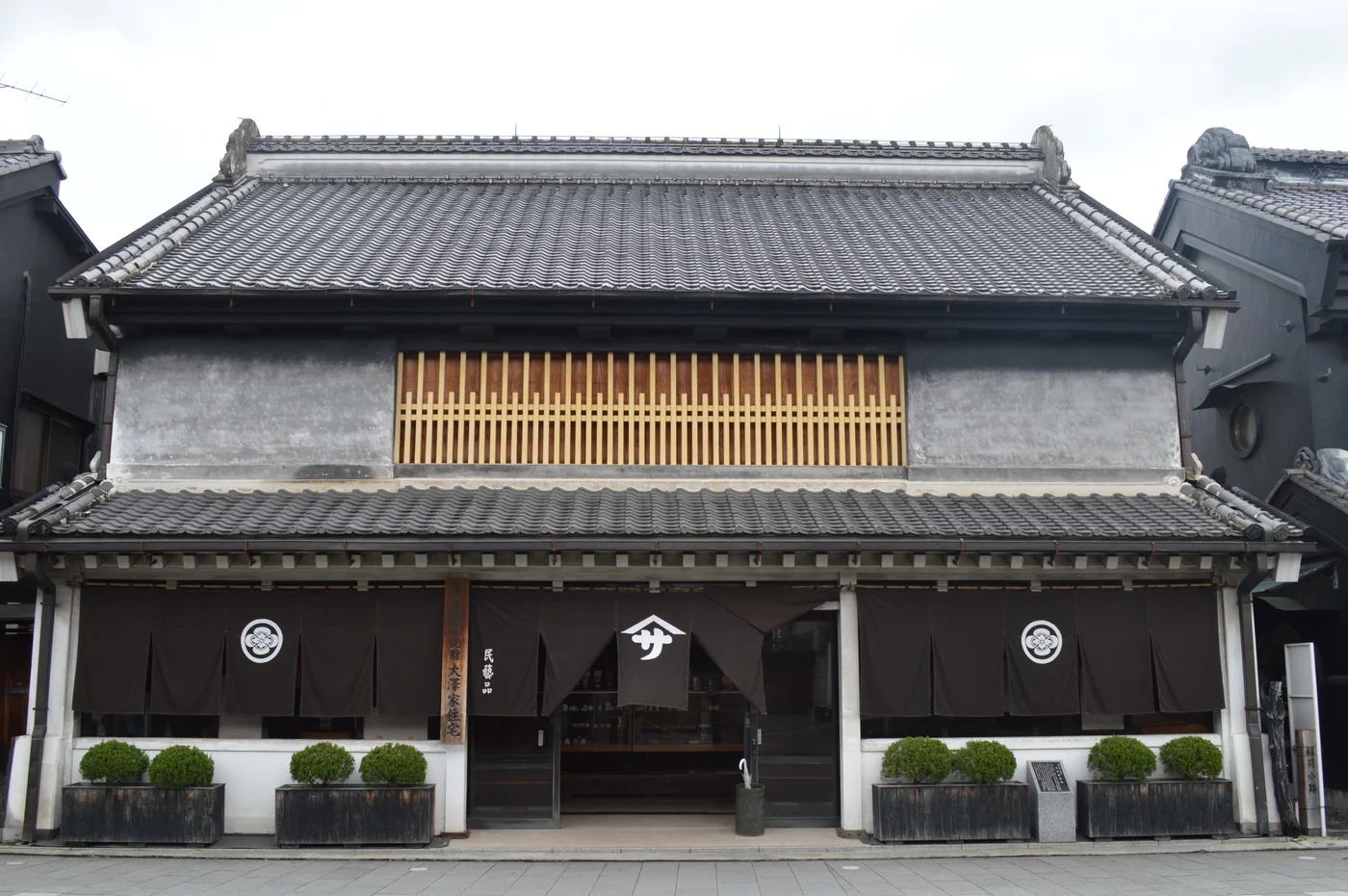
The city's cultural-property account notes eaves supported by projecting beams, without the eaves cornice common on shops after the Meiji fire. The upper front windows have plastered latticework with large and small members. From outside, examine the eaves' projection and lattice, then compare the thick double shutters seen earlier. Period differences become identifiable components.
The city describes its form as closer to a plaster-coated townhouse. Buildings grouped under Kawagoe's warehouse-style street still have different construction and development stages. For a companion who wants just one architectural memory, keep two images: thick shutters and box ridge on a post-fire shop, and lattice windows and eaves at Osawa House.
Fire protection also divided the shop from living quarters behind. The city records double earthen doors on both sides of the rear household shrine to separate the residential area in a fire. Use this to understand combined shop and home layouts. Keep the street walk exterior-focused, without routing freely through private interiors. Imagine the plot front to back, then reconsider why the street-facing shop valued its openings so much.
The original business floor also has a readable arrangement. The city records a half-ken-deep earthen strip at the front, raised flooring behind and one overall room. Under the front eaves, the center was open with low walls at both sides, originally allowing fire doors inside the eave posts. This shows how customer entry and closing up were managed together. At the entrance, compare shop openings with upper windows to read the trading floor and upper level together.
The continuous street also reflects modern preservation
Ichibangai's Kurazukuri Story describes stations built outside the district, trade moving toward them, and some warehouse-style buildings demolished during inheritance or ownership transfers. Kawagoe Kura-no-Kai, founded in 1983, and later shopping-street planning brought preservation and commercial use into the same discussion. Today's operating street has a history of care by residents and businesses.
Underground wiring was completed in April 1992, making roof and facade outlines easier to see. In 1999, the Ichibangai area was selected as an Important Preservation District for Groups of Traditional Buildings. Compare newer and Western-style buildings within that long change. The tourism association dates the former Saitama Resona Bank Kawagoe branch to 1918, a different architectural vocabulary beside black-plaster shops.
The shopping street records that its townscape committee's guidelines use proposals: heights responding to surroundings, restrained colors, and discussion of new buildings through boundary walls. This gives another viewing distance. After one shop's details, step back to see how neighboring roof heights and colors continue. Individual richness and street-wide continuity require different distances to distinguish.
For indoor architectural learning, distinguish two museums. The Kawagoe Festival Museum presents festivals and floats; the Kawagoe Warehouse-style Architecture Museum is separate. The city's seismic-work page, updated June 2026, lists shop-storehouse work for fiscal 2023–2026. For this trip, pair the City Museum's online architectural explanation with street exteriors and concentrate indoor time at the Festival Museum.
At the museum, start with real floats, then bring in the street through film
The Kawagoe Festival Museum displays two real floats on rotation. It also has a passage evoking Ichibangai's warehouse-style streetscape, festival footage, a meeting-house scene and historical material. Borrow a multilingual audio guide at reception before following the route. Choose an available language there rather than begin looking for text panels after entering the gallery.
At the floats, step back for the full height. Find the upper figure, two-tier tower and lower music platform, then move closer for railings, waist carvings and curtains. Separating large form from small craft explains how a procession float works as both moving stage and a complete character-themed construction. LED footage between the two floats can be viewed with the objects.
The three-screen display measures 4.7 meters high and 8.7 meters wide. Its approximately eight-minute festival film plays every 20 minutes. Real floats show scale and making; film adds movement, encounters and crowds on the street. Note the next screening, browse nearby and return rather than wait through the entire interval. If a hayashi show is near, reserve that time first.
Other displays offer different viewpoints. Looking through Tenko and Hyottoko masks gives a dancer's view of festival scenes. Interviews and city-centenary documentary footage add participants' accounts. A wall-filling hikkawase experience is also available. With children, first find a figure on a float, then choose the mask viewpoint or moving images for a concrete focus.
The current Nobutsuna and Shojo floats: identify both first
The display schedule read on October 28, 2026, lists Asahicho 3-chome's Nobutsuna float from October 19, 2026 to April 27, 2027, and Kawagoe City's Shojo float from the same start to June 22, 2027. Their ending dates differ. For travel after April 27, use the schedule page to choose the actual display pairing.
The official float accounts identify Nobutsuna as owned by the Asahicho 3-chome neighborhood association and completed in 2002. Its figure is Matsudaira Izu-no-kami Nobutsuna, made by Kawasaki Katsuhisa. Shojo belongs to Kawagoe City and dates to 1990. Match neighborhood, production year and figure name to see each as a float with its own owner and making history, and understand the span of continuing craft and transmission.
Read both through the Edo-derived Kawagoe float construction guide. The official general description gives four or three wheels, a two-tier tower above a base, and separate lifting mechanisms for the upper tier and figure originally used to pass castle gates. Trace the levels vertically inside the museum. Understand lifting as a design principle; the display's focus is the relationship between parts.
The lower music platform may have a curved karahafu gable or carved transom at the front. The official account also says most floats can rotate horizontally through 360 degrees above the base. This relates to floats facing each other at the festival. When watching encounters on film, think back to the music platform's orientation to connect static structure and movement.
Leave extra time for carvings and curtains. Floats generally combine black and red lacquer with gold leaf, zelkova carvings on railings and lower body, and vivid embroidered curtains on both tower levels. Many designs relate to the figure's subject. Compare colors, characters and placement between the two, then confirm names on labels. Reading one or two subjects closely is more practical than decoding every carving at once.
The zelkova carvings also reveal assembly craft. The official account describes the railing and lower carvings as fitted-in construction. Follow component edges for joints and compare relief with base. This contrasts with the street's plaster-shaped kagemori: shop roofs use plasterwork, while floats join woodcarving, lacquer, gold leaf and embroidery on a moving stage.
Form changed over time too. Official festival history records Takazawacho introducing a dancing platform in 1698 after Edo festivals. By 1844, ten neighborhoods standardized floats to a single-pillar form with figures above railings, recorded in that year's Hikawa festival picture tablet. Place today's two-tier and lifting structures along that development. In historical images, compare figure position and lower stage before reading every date to connect them to the real floats.
Listen for flute, drums, gong and dancer
The official festival account gives the basic hayashi ensemble as one flute, one large drum, two shime drums and one gong, plus a dancer. During a first roughly 20-minute show, find the flute melody, distinguish drum and metal percussion, then watch the dancer interact with the music. This is a practical listening sequence without memorizing tune names.
The official hayashi account says Kawagoe music came from Edo, merged with local satokagura and developed through transmission. Common schools include Ozo, Shiba-Kanasugi and Tsutsumizaki; the group table also lists Wakasa and Komurai, among others. Ensembles differ in rhythm and melody, so the group's name is useful visit information. If you have heard one, compare a later performance by another.
The museum holds live shows on Sundays and Japanese national holidays. The schedule lists 13:30 and 14:30, about 20 minutes each. Recent entries give Aoi Hayashi-ren on November 1, 2026, Arajukumachi Hayashi Preservation Society on November 3 and Furuya Hongo Hayashi-ren on November 8. These suit early-November planning. Use the same schedule for later months rather than assume both weekend days have shows.
These dates also connect to the school guide. The official transmission table lists Aoi as Ozo school, learned from Otsuka Shinden in 1974. Arajukumachi is Wakasa school, as is Shinkikai, associated with the Nobutsuna float. For November 1 or 3, note the day's group, then begin with tone, rhythm and dancer. For deeper study afterward, search the group name and transmission table rather than only “Kawagoe festival music.”
In footage, hikkawase means several floats facing each other in competitive music and dance. Festival history records Matsudaira Nobutsuna donating ritual equipment to Hikawa Shrine and encouraging the festival in 1648, with elaborate processions through town from 1651. After seeing his figure, this connects person, neighborhood and street performance. The 2016 intangible cultural heritage listing is the Kawagoe Hikawa Festival float event within Yama, Hoko, Yatai, float festivals in Japan.
Festival dates have different levels. The official history identifies Hikawa Shrine's October 14 annual grand festival as the root, followed by the sacred procession and float events. The street Kawagoe Festival usually takes place on October's third Sunday and the preceding day. Museum ritual footage, floats and hayashi each present part of it. Distinguish portable-shrine processions from float groups in the film to understand shrine ceremony and neighborhood participation.
Kawagoe City’s 2020 festival documentary covers the sacred procession, evening floats and hikkawase, for comparison with the music and scenes of floats facing each other.
Museum tickets, closures and assistance
General admission is ¥300, or ¥100 for elementary and junior high school students. Groups of 20 or more pay ¥240 and ¥80 respectively. October–March hours are 9:30–17:30, last entry 17:00; April–September closes at 18:30, last entry 18:00. Arrive before evening for floats plus one film screening. For live music, plan around the afternoon shows.
Regular closures are the second and fourth Wednesdays each month, moving to the following day when they fall on a Japanese national holiday, plus December 29–January 1. In November 2026, those Wednesdays are November 11 and 25. Avoid them for a weekday plan, then choose an open date on the schedule. Separate performance dates from opening dates: ordinary open days offer real floats and film.
For elevators, wheelchair routes or other assistance, tell the museum your actual date and needs at 049-225-2727. Ask which entrance and floor routes will be available that day so the plan follows specific facilities.
For two adults and one elementary school child, standard individual admission totals ¥300 × 2 + ¥100 = ¥700. Street exteriors can be planned separately from this indoor ticket. Shopping and experiences cost according to the chosen business.
Drivers have eight ordinary spaces, three for wheelchair users and two bus spaces, with free parking limited to two hours. Buses need reservations. Spaces are limited, and the two hours include any street walk after leaving. For architecture, lunch and shopping on Ichibangai, calculate museum parking separately from the whole old-town stay to avoid rushing to move the car before finishing inside.
Choose one shopping finish by location and activity
For blending your own seasoning, choose Fukushichimi on the second floor of Koedo Yokocho, 2-1-3 Motomachi. The official shopping-street listing describes making and tasting your own shichimi mix, with same-day individual experiences requiring no reservation. Hours are 10:30–16:30, with irregular closures. Put it earlier in shopping time. After a 14:30 hayashi show, allow for the walk and shop service time.
For objects to use at home, Kawagoe Hokusai Graphic at 2-13 Saiwaicho specializes in Japanese umbrellas and miscellaneous goods. The shopping-street listing gives 10:00–18:00. Choose by pattern, umbrella type and carrying method if clothing or everyday objects interest you. Before a long onward train journey, assess packing and luggage space before choosing a size.
Tokigoe Yubin, on the second floor of Kawagoe Building at 2-3 Saiwaicho, is an experiential stationery shop where original letters are sent a year later to yourself or someone important. It also has a self-service photo studio. The shop listing gives 10:30–18:00, last reception 17:00, closed Thursdays. For a written travel memory, allow a longer indoor stop and writing time before the final exterior walk.
The products and activities differ; one you want is enough. Fukushichimi and Tokigoe Yubin are upstairs. To reduce stairs, shop at ground-level street businesses and keep the main indoor activity at the museum after clarifying its route. Before leaving, put your chosen address, closing time and intended purchase on one list. Ask the shop about payment before checkout.
Finish by passing the shop-storehouse that stayed most clearly in your mind. Look once more at its box ridge, under-window platform or wall hooks to bring museum and street knowledge back to one specific place.
A few useful answers
What can I see at the Kawagoe Festival Museum on weekdays?
On ordinary open days, see two rotating real floats, an approximately eight-minute three-screen film and festival materials. Live hayashi follows the Sunday and Japanese national holiday schedule.
Which two floats are currently displayed?
The schedule read on October 28, 2026 lists Nobutsuna and Shojo, both from October 19. Nobutsuna runs through April 27, 2027, and Shojo through June 22, 2027.
How long should I allow for the street and museum?
For detailed architecture, the museum and one shopping stop, our editorial suggestion is three to four hours in the old town, excluding station travel and lunch. Fix the 13:30 or 14:30 show first if adding live music.
Official information and references
Sources used in this guide.
- Koedo Kawagoe Tourism Association: Ichibangai
- Kawagoe Festival Museum: exhibits and visitor information
- Kawagoe Festival Museum: display and performance schedule
- Kawagoe Ichibangai Shopping Street: Kurazukuri Story
- Kawagoe City Museum: warehouse-style architectural details
- Kawagoe City: Osawa House, nationally designated Important Cultural Property
- Kawagoe City: Warehouse-style Architecture Museum seismic work
- Kawagoe Festival: floats
- Kawagoe Festival: overview and history
- Kawagoe Festival: hayashi music
- Kawagoe Ichibangai Shopping Street: Fukushichimi
- Kawagoe Ichibangai Shopping Street: Kawagoe Hokusai Graphic
- Kawagoe Ichibangai Shopping Street: Tokigoe Yubin