Standing 102.5 meters tall, Hoheikyo Dam is a parabolic arch dam whose reservoir, Lake Jozan, earned spots on both Japan's Top 100 Dam Lakes and Top 100 Water Source Forests. Sightseeing water discharges run June 1 through October 31 (peaking at 2.0 m³/s on July and August weekends), while electric buses operate May 2 to November 3, 2026 (¥1,000 round-trip). Located roughly one hour from Sapporo via Jozankei, private vehicles must stop at Hiyamizu Parking Lot—here is your complete guide to discharge schedules, electric bus access, and winter closures.
- Region & Focus
- SapporoTransportation and passes
- Reading Scope
- 12 min read · 5 chapters · 4 Q&As
- Official Verification
- 12 official sources checkedUpdated November 20, 2026
- Key Topics
- ItinerariesSeasonsHokkaido
Chapter Route Map (tap any stop)
- Dam Basics: Arch Engineering, Lake Jozan, and Sapporo's Water Supply
- Sightseeing Discharge: Flood-Control Demos and June–October Timetable
- The Electric Bus: Schedules and Fares for the Only Ride to the Dam
- Access: Complete Routes from Sapporo to the Dam Crest
- Itinerary Frameworks: Half-Day Standard and Autumn Foliage Upgrades
- Quick Q&A
Tucked deep inside a national park gorge upstream from Jozankei Onsen, Hoheikyo Dam is one of only two parabolic concrete arch dams in all of Hokkaido. Rising 102.5 meters—roughly the height of a 34-story building—it impounds Lake Jozan, a reservoir recognized on both Japan's Top 100 Water Source Forests and Top 100 Dam Lakes lists. Travelers make the trip here for two distinct draws. First is the annual sightseeing discharge from June 1 to October 31, when spillway gates release timed torrents up to 2.0 cubic meters per second on summer weekends to demonstrate flood control. Second is the park's strict environmental rule: private vehicles must stop year-round at Hiyamizu Parking Lot, leaving electric buses or foot power as the only ways up the final 2 kilometers to the crest. Because no bus from Sapporo runs straight to the dam—and snow shuts the entire road down in winter—planning the connection matters. Drawing on the latest schedules from the Ministry of Land, Infrastructure, Transport and Tourism (MLIT) and the electric bus operator, this guide breaks down discharge timetables, bus fares, the autumn Dam Liner, and winter closure dates.
Dam Basics: Arch Engineering, Lake Jozan, and Sapporo's Water Supply
Start with the official engineering specs from the Ministry of Land, Infrastructure, Transport and Tourism (MLIT). Located in Jozankei 7-ku, Minami-ku, Sapporo along the Toyohira River in the Ishikari River system, Hoheikyo Dam is a concrete arch dam standing 102.5 meters high with a 305-meter crest length and a total volume of 285,000 cubic meters. Construction began in 1967 and wrapped up in October 1972 as a multipurpose dam. Hokkaido has only two arch dams—this one and Hokkaido Electric Power's Okuniikappu Dam. In 2008, engineers added Kamui Nisei Bridge directly atop the dam structure, the first bridge ever built on top of a dam in Japan, alongside an exhibition hall observation deck overlooking the upper valley of Lake Jozan.
The dam carries enormous weight in Sapporo's municipal water supply. While the electric bus operator notes that the Toyohira River system covers 98% of Sapporo's tap water demand, MLIT states that Jozankei Dam and Hoheikyo Dam together secure roughly 80% of the city's water supply—two official figures using different measurement scopes. Beyond drinking water, Hoheikyo handles flood control and hydroelectric power generation, with the Hoheikyo Power Station delivering a maximum output of 51,900 kW. Inside the dam body, the Rim Tunnel holds a steady year-round temperature of around 10°C and nearly 100% humidity, serving since 2015 as a joint Sapporo City aging cellar for wine and tea leaves.
Scenic honors back up the engineering pedigree. Lake Jozan is a designated Top 100 Dam Lake, and the surrounding woods belong to the Forestry Agency's Top 100 Water Source Forests. Hoheikyo Dam Tour Day even won the Event Prize at the Japan Dam Awards 2014 for letting visitors walk along the maintenance catwalk directly beside the sightseeing discharge spouts—an unusually close-range experience among Japanese dams.
Dam enthusiasts have two standout keepsakes and experiences waiting on-site. First is the free Dam Card handed out at both the Hoheikyo Dam Exhibition Hall and the Management Branch Office, limited to one per person (in 2026, the exhibition hall opens April 30 to October 30 on weekdays from 9:00 to 16:30 and closes on weekends and holidays; the branch office distributes cards through November 3). Second is that Japan Dam Award-winning Dam Tour Day on the catwalk right in the spray zone. Paired with the 10°C, 100%-humidity Rim Tunnel wine and tea experiment, this infrastructure site packs far more character than most visitors expect.
Building an arch dam here came down to local geology. Upstream along the Toyohira River, solid bedrock pinches into a tight V-shaped gorge. An arch design channels massive water pressure outward into the canyon walls, achieving maximum holding strength with just 285,000 cubic meters of concrete. That wall holds back 47.1 million cubic meters of total water volume across a 1.5-square-kilometer surface area with a usable depth of 37.2 meters, supporting flood control, municipal water intake (up to 528,000 cubic meters per day for Sapporo), and hydropower since 1972.
Before researching further or calling ahead, separate the two agencies running the site. The dam structure, water releases, and exhibition hall fall under the MLIT Hokkaido Regional Development Bureau, Sapporo Development and Construction Department, Toyohira River Dams Integrated Management Office (on-site Hoheikyo Dam Management Branch Office tel: 011-598-2621). Park visitor services, the electric bus, and Hiyamizu Parking Lot are operated by Sapporo Resort Development Corporation (houheikyou.jp). Contact the corporation for transit and visitor logistics, and MLIT for dam operations or hydrology data.
Set your pacing expectations before heading up. Civil engineering and hydrology buffs can easily spend half a day between the exhibition hall and dam crest, while general travelers only need one to two hours timed around the 10:00–15:00 discharge window. Families with toddlers should note that neither the electric bus nor the crest walkways have dedicated stroller lanes, making a baby carrier far easier to manage. Hoheikyo is built around quiet mountain scenery and hands-on engineering rather than commercial amusements—once you calibrate for that, it often becomes the calmest highlight of a Jozankei trip.
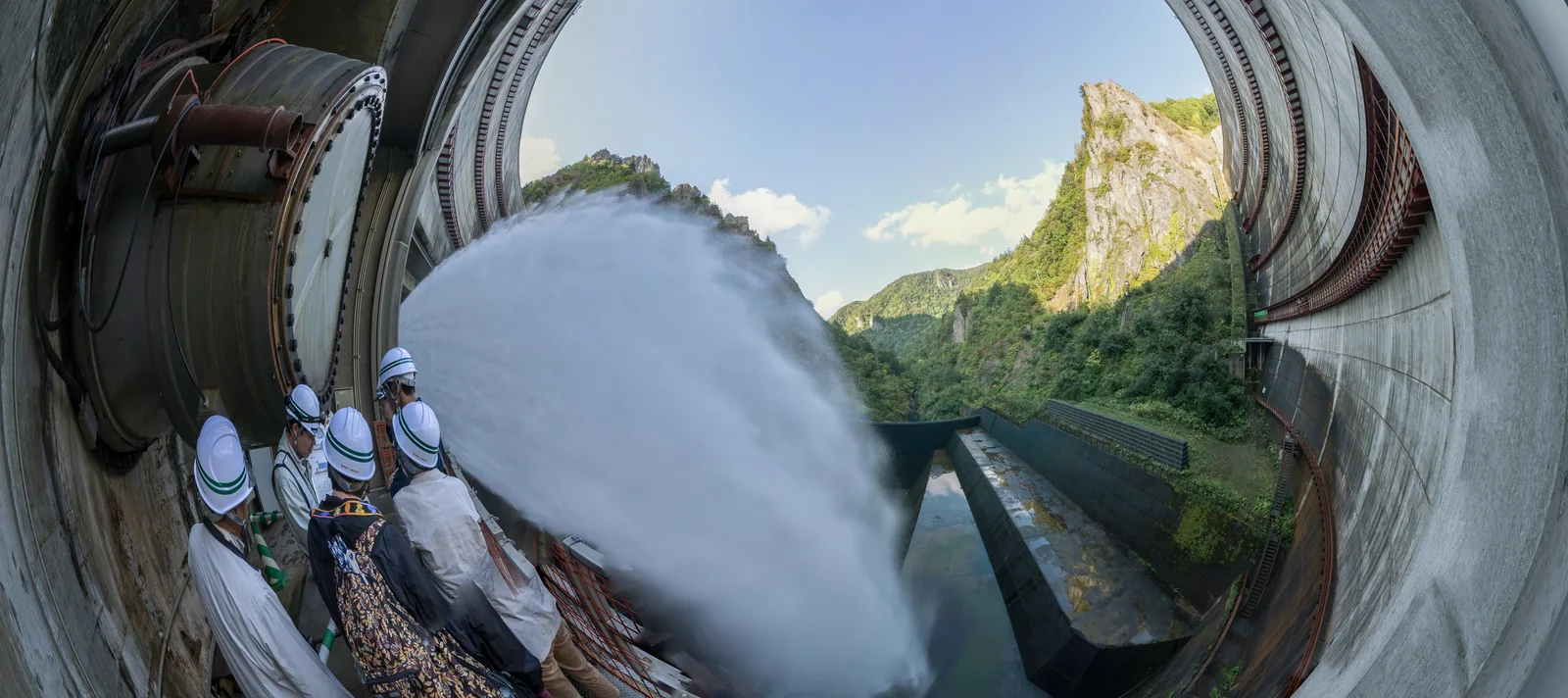
Standing 102.5 meters tall, Hoheikyo Dam is a parabolic arch dam whose reservoir, Lake Jozan, earned spots on both Japan's Top 100 Dam Lakes and Top 100 Water Source Forests. Sightseeing water discharges run June 1 through October 31 (peaking at 2.0 m³/s on July and August weekends), while electric buses operate May 2 to November 3, 2026 (¥1,000 round-trip). Located roughly one hour from Sapporo via Jozankei, private vehicles must stop at Hiyamizu Parking Lot—here is your complete guide to discharge schedules, electric bus access, and winter closures.
Sightseeing Discharge: Flood-Control Demos and June–October Timetable
Running annually from June 1 to October 31, the sightseeing discharge is not an artificial fountain show—it is a scheduled public display of routine flood-regulation releases from the spillway gates. According to MLIT's official discharge table (measured in cubic meters per second), weekends and holidays in June, September, and October release 0.3 from 9:00 to 10:00, 1.0 from 10:00 to 15:00, and 0.3 from 15:00 to 16:00; weekdays in those months release only 0.3 between 10:00 and 15:00. During peak summer in July and August, weekend and holiday releases surge to 2.0 cubic meters per second from 10:00 to 15:00, the highest flow of the entire year.
MLIT lists full operating hours from 9:00 to 16:00 (the Jozankei Tourist Association page rounds this to 10:00–16:00, though MLIT's table is authoritative). During the autumn foliage season when the Dam Liner operates, the tourist association explicitly notes daily sightseeing discharges. If heavy rainfall or flooding triggers an actual flood-control release, sightseeing discharges stop immediately and warning sirens sound ahead of gate movement; the rocky riverbed directly below the dam is strictly off-limits year-round with no access road.
Skip inflated internet rumors when judging how dramatic the spillways will look and check MLIT's cubic-meters-per-second figures instead. Midday on July and August weekends (2.0 m³/s) delivers the biggest roar, whereas weekday visits show a noticeably gentler demonstration flow. For pre-trip questions, call the Toyohira River Dams Integrated Management Office (011-583-8110) or the Hoheikyo Dam Management Branch Office (011-598-2621).
Working backward from the flow chart makes picking your travel date straightforward. Weekend and holiday discharge volumes run three to ten times higher than weekdays (0.3 weekday midday vs. 1.0 weekend in June; 1.0 weekday midday vs. 2.0 weekend in July and August). Go on a July or August weekend at midday for maximum power, pick a June or September weekday for uncrowded views, or join photographers on an October weekend for 1.0 m³/s framed by autumn leaves. Because main flows concentrate between 10:00 and 15:00, catching the 8:45 first electric bus gets you up top right on cue.
Up on the crest, opening gates bring booming echoes and drifting spray. If you join a special Dam Tour Day catwalk walk right beside the spouts, expect to get wet and pack a light rain jacket. Hearing the warning siren means the gates are about to activate—clear all downstream caution zones immediately. For photos, lock in three angles: looking down at the plunging water columns from the dam crest, sweeping panoramas of Lake Jozan from Kamui Nisei Bridge, and upstream valley views from the exhibition hall deck.
Most dam tours in Japan keep visitors stuck on a distant overlook. Hoheikyo earned its Japan Dam Award Event Prize precisely because Dam Tour Days open its maintenance catwalk, guiding guests right beside the sightseeing jets with staff-issued safety gear and routing. Even on regular days, the dam crest and Kamui Nisei Bridge sit close enough to feel the full 2.0 m³/s rush.
Beyond the spillways, Lake Jozan's shifting waterline rewards repeat visits. A 37.2-meter usable water depth creates dramatic contrasts between full pool and drawdown: water peaks in June after spring snowmelt refills the basin, gradually drops across summer municipal draws, and by autumn often exposes long sloped access ramps along the banks. Standing on the same overlook in different months reveals an entirely different lake silhouette.
Understanding the operating rules changes how you read the water. Hoheikyo never wastes extra reservoir water purely to entertain crowds; it simply opens scheduled river-maintenance and storage-regulation releases to public view. Volume rises and falls strictly with seasonal supply needs rather than visitor turnout—treating the timetable as a window into real water management makes the stop far richer than staring at falling water alone.
The Electric Bus: Schedules and Fares for the Only Ride to the Dam
Rules for reaching the dam site are airtight. To protect the national park environment, private cars, motorcycles, and bicycles are banned year-round beyond the free Hiyamizu Parking Lot (250 spaces). From there, the final ~2 kilometers of forest road and tunnels are open exclusively to electric buses or pedestrians (a 20-to-30-minute walk). Operated by Sapporo Resort Development Corporation, electric buses have served this route since 1976 and are now in their third generation: five BYD J6 compact electric buses seating about 30 passengers each with a ~200-kilometer range, including one bus fitted with a wheelchair lift.
For 2026, electric buses run from May 2 through November 3 (weekends and holidays only in May), operating daily from 8:45 to 16:00 with the final uphill departure at 15:30. Buses run every 15 to 30 minutes, adding extra departures as needed during late September and October foliage crowds, and the ride takes 7 to 8 minutes. Official fares are ¥1,000 round-trip (¥600 one-way) for adults during regular season (May 2–September 30) and ¥1,200 round-trip (¥700 one-way) during peak season (October 1–November 3). Children ride half price, seniors 65+ with ID pay ¥900 round-trip (¥1,100 peak), and visitors with disability certificates plus one companion pay ¥500 round-trip. Note that the Jozankei Tourist Association site misprints the October–November one-way fare as ¥600—on-site tickets follow the official ¥700 rate.
The bus ride itself doubles as a sightseeing highlight. Grab a left-side seat on the way up to spot Kudan-no-Taki Waterfall, and sit on the left side again coming down to look up at Senjo-iwa Cliff—neither landmark has a walking trail, so the electric bus offers the only vantage point. At the crest, loop across Kamui Nisei Bridge, the exhibition hall deck, and the Hoheikyo Dam Exhibition Hall inside the branch office building (open April 30 to October 30, 2026 on weekdays 9:00–16:30, closed weekends and holidays) to pick up your Dam Card.
Each BYD J6 carries up to roughly 40 riders including standing room; while capable of 70 km/h, buses are strictly capped below 30 km/h inside the park. Pioneering electric buses in Hokkaido back in 1976 earned the fleet an Environment Minister's Commendation in 2007. Official FAQs spell out access policies clearly: Bus #5 features a wheelchair lift (with free loaner wheelchairs at the crest), pets must remain inside carriers, and bicycles are prohibited aboard at all times. Aim for a left window seat both ways for waterfall and cliff views.
Sapporo Resort Development Corporation's Hoheikyo Office runs the bus line (tel: 011-598-3452, fax: 011-598-3454). Groups of 15 or more seeking round-trip discounts starting from ¥950 must fax reservations in advance, and disability discounts (¥500) require presenting a valid certificate. The base boarding terminal offers public restrooms, 250 free parking spaces, and free wheelchairs. Keep in mind that the autumn Dam Liner arriving from Jozankei Onsen departs from the Jozankei Tourist Information Center—not the Hiyamizu electric bus stop—so line up at the appropriate stop when transferring.
Budgeting your time inside the park is simple. With a 7-to-8-minute ride and 15-to-30-minute headways, 40 to 60 minutes on the crest feels unhurried. A popular hybrid plan is riding the bus uphill to skip the 2-kilometer climb, then strolling 20 to 30 minutes back down on foot. There are no restaurants in the park—and no restrooms inside the exhibition hall—so pack drinking water and light snacks, and carry all trash back out per national park rules.
Put on a historical timeline, this bus route stands out even more. Switching to electric transit in 1976 predated mainstream EV adoption by decades, and the current third-generation fleet received a national environmental commendation in 2007. Keeping tailpipe exhaust out of Sapporo's water supply and barring private vehicles follow the same principle—riding this quiet bus uphill puts you inside a 50-year watershed protection effort.
Access: Complete Routes from Sapporo to the Dam Crest
Reaching the dam crest from Sapporo by public transit takes three separate legs. First, travel from Sapporo Station to Jozankei on Jotetsu's express Kappa Liner (departs Sapporo Station Stop 27, ~60 minutes, ¥1,700, reservation required, nine daily trips continuing directly to Hoheikyo Onsen), a regular Jotetsu local bus (~80 minutes), or the Namboku Subway Line to Makomanai Station followed by a local bus (47–50 minutes). Second, cover the gap from Jozankei Onsen town to Hiyamizu Parking Lot—about 15 minutes by car, whereas transit riders alight at Hoheikyo Onsen (the end of Kappa Liner service) and face roughly 3 kilometers of uphill mountain road (official guides list 30 and 60 minutes on foot; allow 30–60 minutes). Third, ride the electric bus 7–8 minutes to the crest.
In short, no bus from Sapporo Station runs straight to the dam, making that 3-kilometer stretch past Hoheikyo Onsen the biggest hurdle for car-free visitors. Officials offer two practical fixes: book the autumn-only Hoheikyo Dam Liner (running October 3–25, 2026), which runs nonstop from the Jozankei Tourist Information Center to the dam parking lot (skipping Hoheikyo Onsen) three round-trips daily for ¥1,000 round-trip—or ¥2,200 as an adult combo including the electric bus—or drive directly to Hiyamizu Parking Lot.
Your travel month dictates whether the site is even open. MLIT states unequivocally that the road to Hoheikyo Dam closes completely from early November through April with zero visitor access, and the 2026 schedule aligns tightly: electric buses wrap up November 3, the exhibition hall closes October 30, and Dam Cards stop November 3. Cross Hoheikyo off winter itineraries completely. Also note that the "Hokkaido Chuo Bus Rapid 7" occasionally cited online is absent from Jozankei Tourist Association's current transit listings—stick to the Kappa Liner and Jotetsu local routes.
Driving times to Hiyamizu Parking Lot (250 free spaces) are easy to gauge: roughly 60 minutes from JR Sapporo Station, 70 minutes from Otaru, 15 minutes from Jozankei Onsen town, 70 minutes from Lake Toya, and 30 minutes from Nakayama Pass (taking Hokkaido Prefectural Road 18 off National Route 230). If you plan to soak and eat afterward, Hoheikyo Onsen sells adult combo packages through September 30—such as curry plus hot spring entry for ¥3,250—making a dam-and-onsen pairing great value.
Budget travelers can cut transit costs with the subway-plus-bus route. Take the Sapporo Subway Namboku Line to Makomanai Station Stop 4 and transfer to a Jotetsu local bus (47–50 minutes to Jozankei; check Bus Kita for distance-based fares) before continuing toward Hiyamizu. It undercuts the Kappa Liner fare, though officials note subway and bus schedules do not always line up seamlessly at Makomanai. Travelers continuing onward to Lake Toya can also link with the Donan Bus Sapporo–Toyako line via Nakayama Pass (~60 minutes).
Watch the Kappa Liner timetable closely when booking. Out of 11 daily round-trips, only nine extend all the way to Hoheikyo Onsen while two terminate earlier at Jozankei Onsen. All seats require reservations (open from the same date one month prior until 17:00 the day before) and sell out quickly during foliage season, so make sure your ticket selects Hoheikyo Onsen as the stop. Never drag heavy luggage along the 3-kilometer road between Hoheikyo Onsen and Hiyamizu—stash bags at your Jozankei ryokan or town lockers first.
Finally, note two key rules from the official FAQ. Bicycles are completely banned on the 2-kilometer road between Hiyamizu Parking Lot and the dam crest, meaning cyclists entering Jozankei must lock up at the lot and walk. Pets are welcome in the park but must travel inside a carrier on the electric bus—prep ahead so you are not turned away at boarding.
Itinerary Frameworks: Half-Day Standard and Autumn Foliage Upgrades
From May through October, a smooth half-day blueprint falls right into place. Catch the 9:10 first Kappa Liner from Sapporo Station (confirming it extends to Hoheikyo Onsen and avoiding departures after 14:30) or drive straight to Hiyamizu Parking Lot. Ride the electric bus up before 10:00, spend about 40 minutes touring the arch dam, Lake Jozan, and Kamui Nisei Bridge, and catch the 10:00–15:00 sightseeing discharge from the crest or catwalk. Head down to Hoheikyo Onsen for a soak and lunch, then cruise back to Sapporo by evening. The single hard deadline to watch is the 15:30 last uphill electric bus.
Early-to-mid October foliage peak unlocks Hoheikyo's premium seasonal edition. Electric buses shift to peak fares (¥1,200 round-trip), joined by the October 3–25 Dam Liner (¥1,000 round-trip) and Jozankei's Five Great Autumn Foliage Tour Buses, while sightseeing discharges run daily (1.0 m³/s on weekends and holidays). Fares and crowds both climb, yet few places match a canyon ablaze with maples alongside roaring spillway jets.
Timing your season prevents wasted trips. Road closures block all access from early November through April, ruling out winter visits, while July and August midday weekend releases (2.0 m³/s) deliver peak drama alongside summer heat and crowds. Decide first whether you want maximum water volume or peak autumn color, then plug this stop into our Jozankei Onsen guide for stays and hot springs.
At the crest, follow the walking map downloadable from the official homepage: cross Kamui Nisei Bridge (Japan's first dam-top bridge), scan the reservoir from the exhibition hall deck, and join a Dam Tour Day catwalk if scheduled, before heading down for the Hoheikyo Onsen adult combo (curry plus soak for ¥3,250 through September 30). Follow one absolute safety rule on-site: the rocky riverbed directly below the dam is permanently closed with no path down—never scramble closer for a shot.
Putting Hoheikyo and greater Jozankei on one annual calendar highlights a clean summer-water, winter-snow split. Once snow seals Hoheikyo in winter, action shifts 30 minutes away to Sapporo Kokusai Ski Resort. From late September through mid-October, early foliage at Hoheikyo overlaps with Sapporo Kokusai's autumn gondola, turning those three weeks into the valley's highest-value window of the year.
Breaking the half-day down hour by hour keeps logistics effortless. Drivers reach Hiyamizu Parking Lot before the 8:45 first electric bus (transit riders finish the 3-kilometer walk before 9:00) to catch the 0.3 m³/s preview from 9:00 to 10:00 before peak flow kicks in. Tour the crest until 11:30, take the bus down for lunch and hot springs at Hoheikyo Onsen, and return to the stop before 14:00—always keeping the 15:30 final uphill bus in mind so every step aligns with official timetables.
Many travelers mix up the two big dams upstream: Hoheikyo Dam (Lake Jozan) and Jozankei Dam (Lake Sapporo). While both dams partner to secure about 80% of Sapporo's water, the electric bus, exhibition hall, and sightseeing discharge all belong exclusively to Hoheikyo. Jozankei Dam focuses on water supply and flood control without a dedicated visitor circuit, so keep your itinerary focused on Hoheikyo.
If you are already overnighting in Jozankei Onsen, the smoothest pairing starts in town: linger over free morning footbaths and lunch, catch transit toward Hoheikyo Onsen and Hiyamizu Parking Lot before 13:00, ride the electric bus up before 14:00 for the afternoon discharge, return to the parking lot before the 15:30 cutoff, and get back to your ryokan just in time for an evening soak and dinner. Slotting Hoheikyo into the afternoon of a Jozankei overnight links both guides seamlessly.
Overall, Hoheikyo Dam rewards three kinds of travelers: engineering fans drawn to arch dams, spillway discharges, and catwalk tours; Jozankei overnight guests exploring upstream valleys; and October leaf-peepers chaining the Dam Liner, electric bus, and Five Great Autumn Foliage buses. Conversely, winter closures shut it down completely, and shoppers expecting big visitor malls will find it sparse. Take it on its own terms—pure mountain canyon, reservoir water, and a quiet electric bus—and it stands out as one of the highest-value half-day trips near Sapporo.
A few useful answers
When is the sightseeing discharge at Hoheikyo Dam, and when is the water flow strongest?
Sightseeing discharges run annually from June 1 to October 31 across three daily time blocks between 9:00 and 16:00, per the Ministry of Land, Infrastructure, Transport and Tourism (MLIT) flow table. Peak volume hits 2.0 cubic meters per second during the 10:00–15:00 window on July and August weekends and holidays. On June and September–October weekdays, releases are limited to 0.3 cubic meters per second at midday. If heavy rain requires an official flood-control release, sightseeing discharge is canceled immediately and warning sirens sound beforehand.
How do you reach Hoheikyo Dam, and can you drive up to the dam crest?
No. Under national park conservation rules, private cars, motorcycles, and bicycles are restricted year-round to the free Hiyamizu Parking Lot (250 spaces). For the final 2 kilometers to the dam crest, everyone must ride the dedicated electric bus (7–8 minutes) or walk (20–30 minutes). In 2026, the electric bus runs May 2 through November 3 (weekends and holidays only in May) from 8:45 to 16:00. Adult round-trip fares are ¥1,000 during regular season and ¥1,200 during October peak season.
How do you get from Sapporo to Hoheikyo Dam by public transit?
Public transit requires three legs: first, take the reservation-only Kappa Liner from Sapporo Station to Jozankei (~60 minutes, ¥1,700; nine daily buses continue directly to Hoheikyo Onsen). Next, walk the ~3-kilometer mountain road (30–60 minutes) from Hoheikyo Onsen to the electric bus boarding area—or drive directly to Hiyamizu Parking Lot. Finally, ride the electric bus up. There is no direct public bus from Sapporo to the dam itself, though the autumn-only Dam Liner runs October 3–25 from Jozankei Tourist Information Center straight to the dam parking lot (¥1,000 round-trip, or ¥2,200 bundled with the electric bus).
Can you visit Hoheikyo Dam in winter?
No. MLIT officially closes the access road to Hoheikyo Dam from early November through April, making winter visits impossible. In 2026, the electric bus ends service on November 3 and the exhibition hall closes October 30. Skip Hoheikyo on winter itineraries and head to Sapporo Kokusai Ski Resort (~30 minutes away) or the Jozankei Snow Candle Way instead.
Official information and references
Sources used in this guide.
- Hokkaido Regional Development Bureau, MLIT | Hoheikyo Dam Specifications (Arch Dam, 102.5m Height, Lake Jozan)
- Ministry of Land, Infrastructure, Transport and Tourism | Sightseeing Discharge Schedule (June 1–October 31, Official Flow Table)
- Ministry of Land, Infrastructure, Transport and Tourism | Dam Tour Guide (Winter Closure Notice, Hiyamizu Parking Lot, Electric Bus Route)
- Ministry of Land, Infrastructure, Transport and Tourism | Visitor Guidelines (Lake Jozan, ~80% Water Supply, Restricted Downstream Zone, Discharge Sirens)
- Ministry of Land, Infrastructure, Transport and Tourism | Dam Card Distribution (Exhibition Hall and Management Branch Office Hours)
- Ministry of Land, Infrastructure, Transport and Tourism | Wine and Tea Storage Utilization in the Rim Tunnel
- Hoheikyo Electric Bus Official | Operating Season and Schedule (May 2–November 3, 2026, 8:45–16:00)
- Hoheikyo Electric Bus Official | Fare Table (Regular Season ¥1,000 Round-Trip, Peak Season ¥1,200, Discounts)
- Hoheikyo Electric Bus Official | End of 2026 Operating Season Notice (Closes November 3, 2027 Schedule TBD)
- Jotetsu | Kappa Liner (Sapporo Station Stop 27, Direct Buses to Hoheikyo Onsen, ¥1,700)
- Jozankei Tourist Association | Hoheikyo Dam Spot Guide (Five Great Autumn Foliage Spots, Dam Liner)
- Jozankei Tourist Association | Five Great Autumn Foliage (Dam Liner Oct 3–25, ¥1,000 Round-Trip)