Walk from JR Ashikaga or Tobu Ashikagashi to school gates, a Confucian temple, historic books and Bannaji’s moat. Includes 2026 repairs, admission, closures and Orihime Shrine’s 229 steps.
- Region & Focus
- Ashikaga
- Reading Scope
- 27 min read · 15 chapters · 4 Q&As
- Official Verification
- 12 official sources checkedUpdated November 22, 2026
- Key Topics
- ItinerariesNeighborhoodsTokyo & Kanto
Chapter Route Map (tap any stop)
- Give old Ashikaga a day, and check the school repair area first
- JR Ashikaga is on the north bank; Tobu Ashikagashi is on the south
- Follow pedestrian signs through the Nakabashi works
- Read the school’s three gates in order
- Start with the revival of 1439 and the preserved books
- Use the map to locate living quarters and gardens during Hojo repairs
- Pause at the Jifuri pine and the Chinese pistache
- Leave time for the streets between the school and Bannaji
- Follow Bannaji’s boundary to see the warrior residence within the temple
- Distinguish exterior viewing from entry to the halls
- Stop among the ginkgo and open grounds to read the layout
- For a river afternoon, distinguish Watarase Bridge from Nakabashi
- Orihime Shrine adds a climb: weigh the 229 steps against Enmusubi-zaka
- A day’s schedule: school first, then choose one afternoon
- School tickets, closure dates and a shorter family route
- Quick Q&A
Old Ashikaga fills a relaxed day on foot. Start with Ashikaga School’s gates, Confucian temple and book preservation, then walk through the streets to Bannaji at lunchtime. Its moat and earthworks reveal the layout of the Ashikaga clan residence. In the afternoon, choose the river or Orihime Shrine. The school’s Hojo is under repair in autumn and winter 2026, so focus on the open gates, temple and grounds. Your arrival and departure route also depends on which station you use: the two stand on opposite banks of the Watarase River.
Give old Ashikaga a day, and check the school repair area first
Ashikaga School and Bannaji fit well into the same day. The school’s gates, Confucian temple and preserved books explain its role as a place of learning. At Bannaji, cross the moat and earthworks to enter the Ashikaga clan’s family temple. Walk between them, with lunch and small shops along the way, then choose the Watarase riverbank or a climb to Orihime Shrine to the west. For visitors who enjoy historic buildings and stop to read interpretation panels, this works better than squeezing the town into an hour before flower viewing.
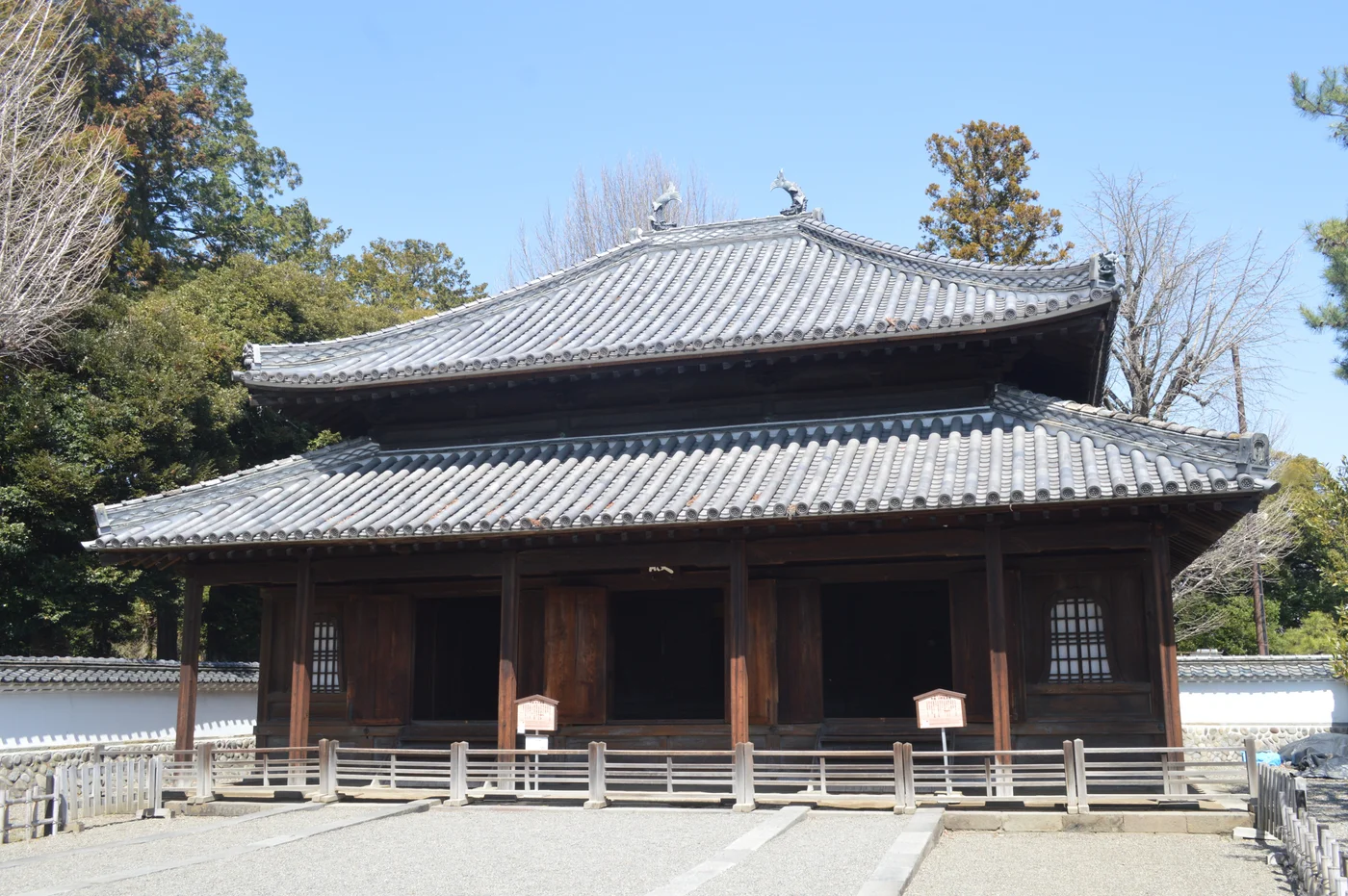
For autumn and winter 2026, first check the works area. Ashikaga City’s historic-site map lists Hojo roof rethatching from August 21, 2026, to March 25, 2027. Access is restricted inside the Hojo, along the path in front of the south garden and around the north side. The entrance hall is also marked under construction, and views of the south garden and vegetable garden are obstructed. During this period, focus on the gates, Confucian temple, historic library building and public information. If you wanted to sit in the Hojo and see the whole garden, spend longer at Bannaji instead, or visit after the work finishes and access resumes.
Allow five to six hours in town for the school and temple, a meal, the streets and the riverbank. Add Orihime Shrine and allow six to seven hours. These are suggested time budgets; rail travel to and from Tokyo is additional. With only three hours, visit the school and Bannaji, have a quick meal and return to your arrival station. To compare other directions near Tokyo, read Tokyo day trips and overnight stays before reserving this day for old Ashikaga.
Walk from JR Ashikaga or Tobu Ashikagashi to school gates, a Confucian temple, historic books and Bannaji’s moat. Includes 2026 repairs, admission, closures and Orihime Shrine’s 229 steps.
JR Ashikaga is on the north bank; Tobu Ashikagashi is on the south
Save both stations under their full names. JR Ashikaga Station is on the Ryomo Line, north of the Watarase River, on the same bank as the school and Bannaji. Tobu Ashikagashi Station is on the Isesaki Line, on the south bank, so reaching the old town involves crossing the river. The school’s official access guide gives about ten minutes on foot from JR Ashikaga and fifteen from Tobu Ashikagashi. JR lets you head straight to the school; Tobu puts the crossing and a broad view of town at the start.
From Asakusa or Kita-senju, compare Tobu’s Ryomo limited express to Ashikagashi. The Ashikaga Tourism Association access page gives about seventy minutes from Asakusa and sixty from Kita-senju as reference rail times to Ashikagashi. Add travel from your accommodation to the departure station, waiting and the river crossing. To start at the school around 10:00, look for a train arriving at Ashikagashi around 9:30, with room to find your way and cross the river. When choosing a limited express, check the basic fare ticket and limited-express ticket separately on the booking page.
By JR, change at Oyama for the Ryomo Line; the association gives about forty minutes from Oyama to Ashikaga, or sixty from Takasaki. These times start at the transfer station. Travel from Tokyo to Oyama or Takasaki comes first. If you are already visiting Tochigi, Sano or Kiryu, the Ryomo Line can fit your existing route. From a Tokyo base, compare the complete journey from your accommodation with the Tobu option.
Return through the same station, or arrive by JR and leave by Tobu to finish with the river. If you use different stations, plan your return ticket, luggage and afternoon walk together. A backpack makes a one-way route easier. If you leave a large case on the JR side, return there to collect it. The stations are separated by a walk through town. A departure shown for the other station is not the next train from the platform in front of you.
Follow pedestrian signs through the Nakabashi works
Walking north from Tobu Ashikagashi brings you to the Watarase River and Nakabashi. Levee and bridge reconstruction is in progress, so follow the pedestrian signs on site. A May 2025 city opening notice records that pedestrians and cyclists moved from the temporary passage onto the relocated three-arch bridge. The city works index consulted in October 2026 also lists construction of the northern overpass and changes to the access area. Together, the notices explain the relocation and subsequent work. On arrival, follow the pedestrian route and include barriers and turns around entrances in your walking time.
For this itinerary, allow twenty-five to thirty minutes from Tobu station to the school, including walking and finding the entrance. This adds a buffer to the official fifteen-minute benchmark. For a first visit, children or river photos, treat it as part of the outing rather than a direct dash north from the station. Allow the same crossing time on the way back. Reach the station first, then buy a drink or wait for the train.
From a place where stopping is permitted, look at the repeated outline of the three arches, the river’s width and the streets on both banks. This makes the two stations’ positions clear: the trains arrive on different banks, while the main cultural sites are north of the river. Pedestrians and cyclists share the bridge. Step out of the flow for photos, and stay outside work areas and restricted river flats.
Read the school’s three gates in order
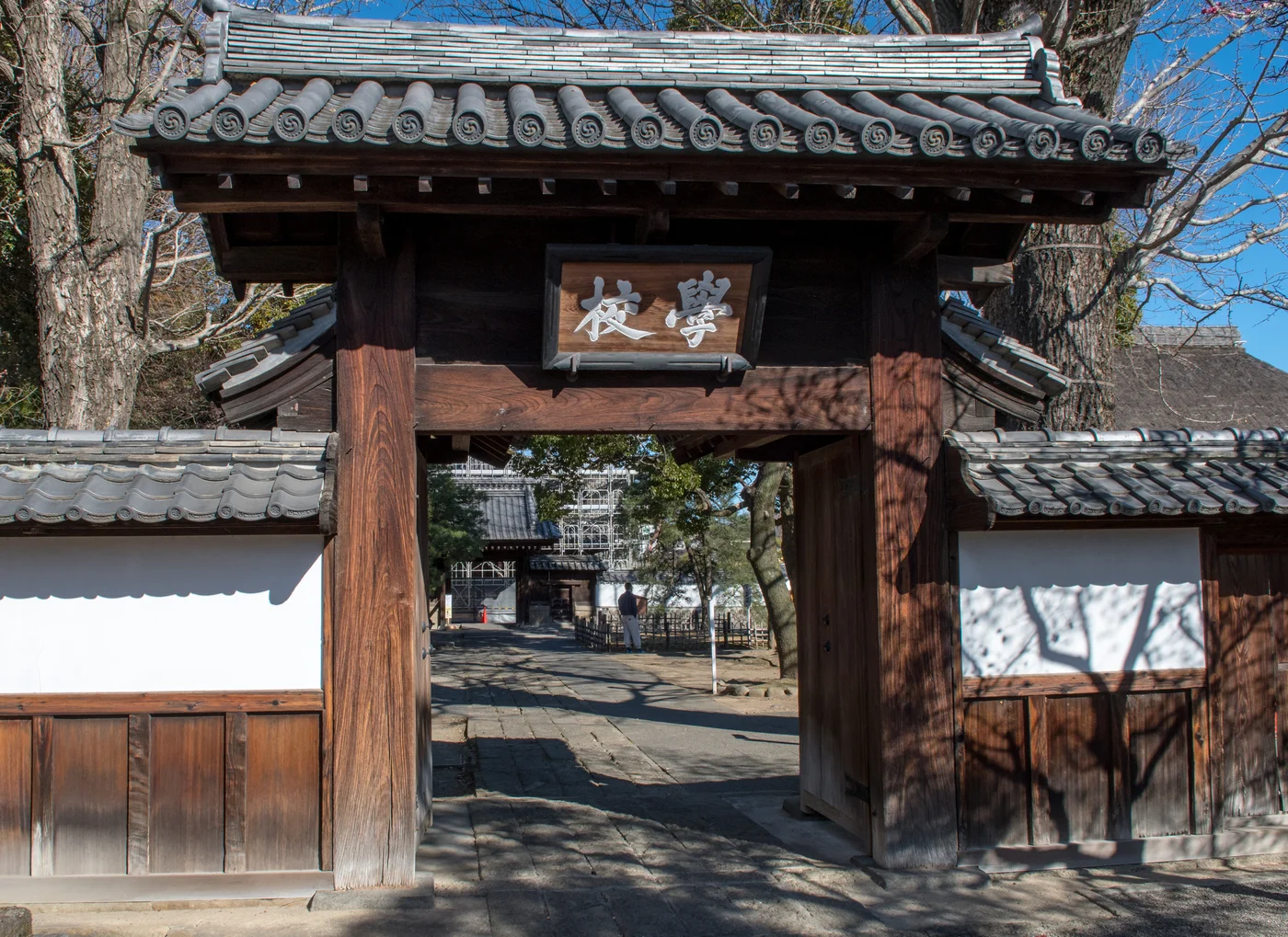
As you enter, note the gates’ names. First comes Nyutoku-mon, then Gakko-mon with its school-name plaque, and finally Kyodan-mon in front of the Confucian temple. From street to temple, each gate marks another part of the grounds, and the plaques change the focus. Learn the three names together to distinguish the school’s symbol from the gate leading to the worship space.
Gakko-mon was founded in 1668. The city explains that its prominent school-name characters were copied at a reduced scale from the writing of Ming calligrapher Jiang Longxi. Look at the plaque’s position, then step back to see how the frame, roof and buildings beyond overlap. Face it to read the characters, and view it at an angle for its depth and the space behind. A few minutes here can leave a clear image; the site need not become a photo backdrop you hurry through.
Kyodan-mon was also founded in 1668. Its roof and doors were rebuilt after an 1892 fire, and the city notes that fire marks remain on the pillars. Compare the surviving parts with the interpretation panel. Do not touch the wooden pillars or assume every dark patch is a fire scar. Parts retained through successive repairs give the gate a history you can read.
The Confucian temple beyond is formally called Taiseiden. Built in 1668, its form is said in the city’s account to follow a Ming sacred temple. Use the open visitor route to see its front, plaque and forecourt, and understand the place of Confucian worship within the school. Compare this area with buildings used for receiving guests, eating and sleeping to see how study, daily life and worship occupied separate spaces.
Start with the revival of 1439 and the preserved books
Ashikaga School is often described as Japan’s oldest school. The city lists different founding traditions in the Nara, Heian and Kamakura periods. A clearly documented starting point is its revival in 1439, when Uesugi Norizane donated books and invited the monk Kaigen from Engakuji in Kamakura to serve as shoshu and reorganize the school. Shoshu means head of the school. Knowing the term helps connect the people and buildings you encounter.
This revival involved both books and a person to run the school. Remember both. When you see “National Treasure,” first establish whether it refers to a book or a building. The school’s National Treasure texts and neighboring Bannaji’s National Treasure main hall are different objects. Read the full cultural-property name, then decide whether to spend time at a display panel or outside studying a structure, rather than remembering both places simply as sites with National Treasures.
The historic library adds another chapter in preservation. It was established in 1903 to preserve books passed down by the school. Its present building was completed and opened in 1915. Look at the library building and interpretation on the grounds to learn why the books needed a separate preservation institution. After the Confucian temple, put this modern building into the site’s sequence: medieval books and modern preservation then each have a clear place.
The school ended its original teaching role in 1872. Local people later worked to preserve it, and restoration was completed in 1990. These dates distinguish the old buildings, the later library and reconstructed facilities. Read the dates on building signs to see the work of different periods, rather than imagining everything as an unchanged survival from centuries ago. Book enthusiasts can spend longer at displays; architecture enthusiasts can study the relationship between gates and temple.
Ashikaga City’s introduction to the school’s history, accompanying the section on revival and preservation of books.
Use the map to locate living quarters and gardens during Hojo repairs
The hojo is a building form common in Zen temples. The school’s Hojo has a hipped, thatched roof, now being rethatched. During the work, its interior, the path in front of the south garden and the northern area are restricted. Check the boundary shown at the entrance and follow open routes. The map’s explanations of historic uses help you understand areas temporarily out of view.
The city describes the kuri as a sequence from an earthen-floored cooking area with a hearth to a wooden-floored kitchen and tatami rooms, where the head and students lived. Inside the thatched roof, round pine beams overlap, with thatch tied to bamboo. These details make the school a place of daily life: where food was prepared, where people moved and how the roof stood above them. Locate these areas on the map during construction, then visit only the open parts to understand each building’s role.
The shoin received the school head’s guests. The city lists a tokonoma alcove, staggered shelves and an attached study desk. The shuryo housed monks or students. Look at them alongside the kuri on one map: reception, lodging and meals each had a place. If floor plans interest you, spend a few minutes marking the names before comparing them with the Confucian worship space. There is no need to keep your companions waiting at one panel while you read every line of Japanese.
The gardens differ too. The north garden has hills, water and a turtle-shaped central island; the south garden features large rocks and old pines. Autumn and winter 2026 works obstruct the south garden and vegetable garden, with restrictions on the north side as well. Do not make seeing both complete gardens the day’s goal. Garden enthusiasts can shorten this stop and leave more time for the river. For reconstructed buildings, compare uses on the city map and return for a full visit after access resumes.
Pause at the Jifuri pine and the Chinese pistache
The school map also marks the Jifuri pine and Chinese pistache. The pine’s story concerns Kyuka, the seventh head: students are said to have written unfamiliar characters or words on paper, tied them to a branch and found readings or explanations the next day. Read the legend with the place name, rather than treating it as an activity in which visitors can tie paper today. From the sign, look at the tree and its surroundings to see how a story about asking questions became a recognizable place.
The Chinese pistache has another connection. The city says it was grown from seed from a tree beside Confucius’s tomb in China, planted here in 1922 and designated a Tochigi Prefecture Natural Monument. Alongside the Confucian temple and Kyodan-mon, it carries memories of Confucius from buildings into plants. Look at its shape and seasonal leaves as a short pause after the gates and temple. Autumn color in a photograph belongs to its shooting date; your visit centers on the tree you see that day.
With children, start by finding the school-name characters, then identify the temple and living areas, and finish with one tree story. School-age children need not read every historical panel. One gate, one building and a question they want to ask give you plenty to discuss at lunch. If interests differ, let keen readers stay ten minutes longer while others wait in a permitted rest area, then walk to Bannaji together.
Leave time for the streets between the school and Bannaji
The Ashikaga Chamber of Commerce walking route gives about 200 meters and three minutes between the school and Bannaji, or 300 meters and five minutes by another route, depending on the connection points. Budget fifteen to twenty minutes to look at shopfronts and find your bearings at junctions. Their proximity does not make three minutes enough for the whole transition from school visit to temple entry.
Head from the school toward the temple’s south side and look at the gates, boundaries, shops and lanes together. Near the temple, the view shifts from shopfronts to water and the gate, giving the street a clear endpoint. For an entrance photograph, find a safe place to stand and frame bridge, gate and buildings beyond. Vehicles and pedestrians still use the street, so avoid standing in its center waiting for an empty scene.
Have lunch in this area; soba is one local option. The chamber’s walk connects Yasuo Katakura’s postwar establishment in Ashikaga with the town’s soba culture. Choose a restaurant that is open that day with a suitable menu. Allow forty-five to sixty minutes for noodles, or some free browsing time after lunch if shops interest you, so shopping and cultural visits each have their own time.
Matsumura Memorial Hall is also on this walking route, about 100 meters from Bannaji in the chamber’s guide. If you want another building to visit, add it separately according to its public opening dates and ticket system. For a standard day, finish the school and temple and enjoy street exteriors along the way. Adding an indoor visit is easiest if you reduce riverbank or shrine time, rather than rushing lunch or reducing the school to a gate photo.
Follow Bannaji’s boundary to see the warrior residence within the temple
Bannaji stands at 2220 Ietomicho. The tourism association explains that Yoshikane, the second generation of the Minamoto-line Ashikaga clan, built a private Buddhist hall in his residence in 1196 to enshrine Dainichi Nyorai. The third generation, Yoshiuji, added temple buildings, making it the clan’s family temple. Before entering, look at the surrounding moat and earthworks to understand why this temple also appears in the history of the Ashikaga residence.
The roughly 40,000-square-meter precinct is approximately square, enclosed by earthworks and a water moat. You need not hurry around the entire perimeter. Near the entrance, follow the direction of the water along the boundary and see how the banks separate grounds from street. Cross the entrance bridge and the scale shifts to a more open precinct with a clearer worship route. This approach from outside to inside explains part of the residence layout.
The Ashikaga residence site became a National Historic Site in 1922. If you come looking for a castle site, focus on this lowland residence’s outline, entrances and surrounding boundaries. There is no need to look first for an imagined high tower. Visitors familiar with Japanese temples can compare it with hillside temples that rise in stages: Bannaji begins with boundaries on a flat plan, then turns to halls and towers inside. The south entrance and one adjacent side already show how that outline works.
Bring your memory of the school across and the differences become clear. Its gates lead in order toward Confucian worship and education. Bannaji first explains its origins through moat, earthworks and clan-residence boundaries, with temple activity within. Close on the map, they each merit time to study entrances and internal positions, beyond a single label of “old buildings.”
Distinguish exterior viewing from entry to the halls
Inside, start with the main hall, then follow open paths toward the bell tower, sutra hall and Tahoto pagoda. The tourism association’s cultural-property list identifies the main hall as a National Treasure, the bell tower and sutra hall as National Important Cultural Properties, and the Tahoto, tower gate, east and west gates and arched bridge as prefectural cultural properties. Match the names with signs to identify each building.
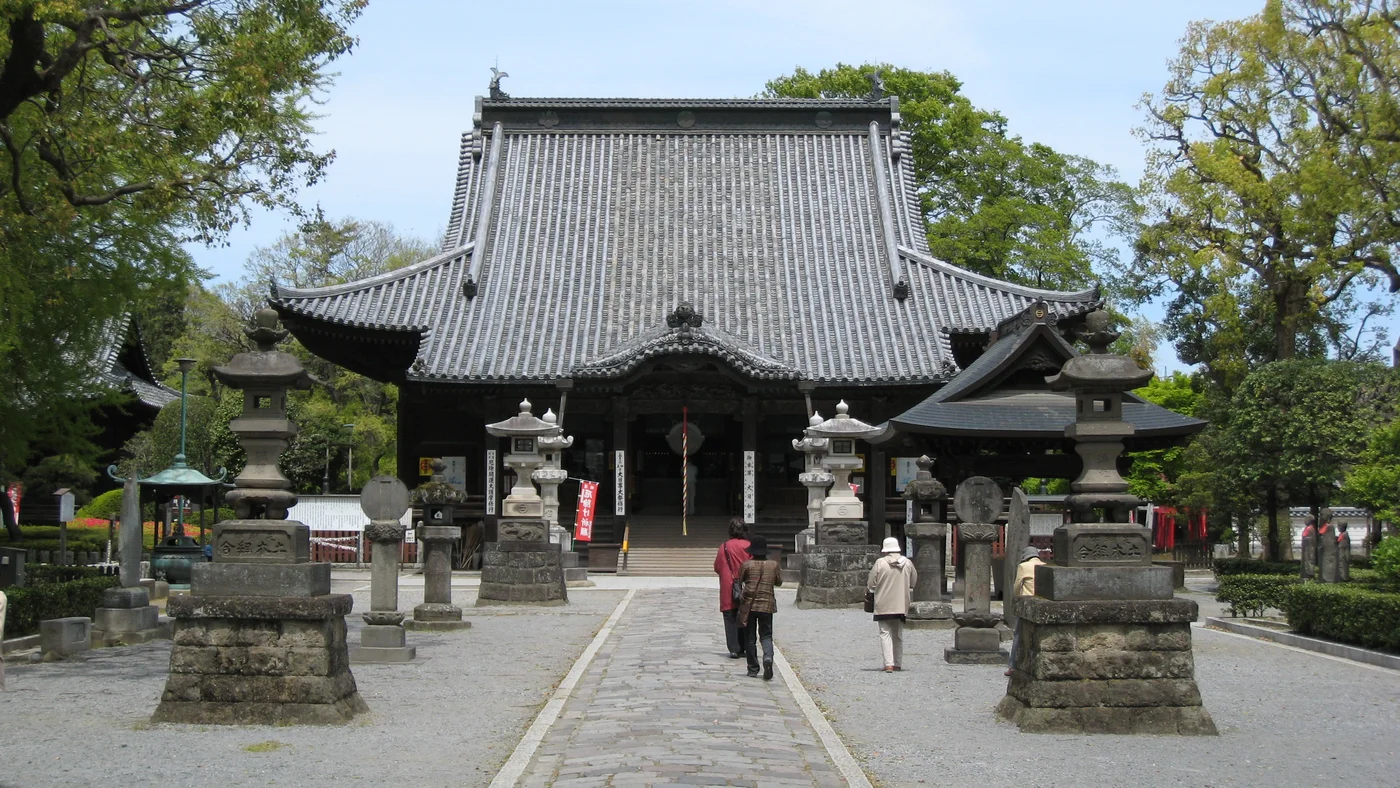
Look first at the main hall’s roof and worship space, then move to the side for the depth of the eaves, rows of pillars and overall mass. Stepping back for the whole front and approaching permitted areas for pillars and under-eave details offer two different viewing distances. If your companions have little interest in details, make one full stop in front. Architecture enthusiasts can add time for side views and neighboring halls along the public route.
The sutra hall’s book-storage role makes a concrete connection with the school’s texts that morning. Both preserve a book culture, with different institutions, uses and preservation histories. In the interpretation, look for book names, building functions and repair records. Outside, see the sutra hall as a building in its own right, noting its distance from the main hall and entrance direction. A place often passed quickly can then offer more to see.
Entry to the grounds is free. Main-hall interior visits require advance booking and a separate fee. For a regular walk, focus on grounds and exteriors; arrange ahead if you have a specific interest in statues or interiors. The association lists the Issaikyodo sutra hall at ¥300 per person, only on Sundays and holidays when it is open that day. A Sunday on the calendar is a starting point for choosing a date; the visit depends on the temple’s actual admission that day. This ¥300 is not a combined school-and-temple ticket.
For a tour of the main hall and Issaikyodo led by the chief priest, the association lists a flat ¥5,000 for one to ten people. Weekdays are for groups only, advance booking is required, and acceptance depends on temple services and events. A two-person booking still costs ¥5,000. It suits visitors who want detailed interior access and will plan around the appointment. For a first town walk, the free grounds already show the residence boundary and positions of the main halls.
Stop among the ginkgo and open grounds to read the layout
Bannaji’s ginkgo is a Tochigi Prefecture Natural Monument. Start with the trunk and branching points, then step back to see the canopy with nearby buildings. This gives a fuller impression than simply waiting for yellow leaves on the ground. Leaf color varies with season and weather. Treat the historic buildings as the fixed reason for choosing a date, and the ginkgo as an extra chance to observe plants that day.
The precinct also serves as an urban park called Dainichien, allowing a slower pace than a paid museum visit. After the main hall, sit briefly where resting is permitted and look back at the spaces between buildings. This break helps on a family trip: after reading at the school in the morning, the temple offers outdoor, broader views after lunch. You can then judge whether an afternoon climb suits everyone.
Temple worship and park walks share the grounds. Keep active hall fronts, reception areas and worship routes available for their intended uses. Choose photo positions that do not obstruct people. If one angle has a queue, visit other buildings first and return. Allow forty-five to sixty minutes for the main-hall exterior, surrounding buildings, earthworks, moat and a short break. Add time for booked interiors or detailed cultural-property reading.
For a river afternoon, distinguish Watarase Bridge from Nakabashi
For an easier afternoon, return to the Watarase riverbank after the temple and leave time for river views and streets. Nakabashi connects Tobu station with the old town. Watarase Bridge is a different bridge farther west; use its full name when searching for the song landmark or monument. The distance west affects your final walk to either station, so choose your return direction before reaching the bridge.
The chamber’s half-day route gives about 800 meters and ten minutes from the Watarase Bridge song monument to Tobu Ashikagashi, or one kilometer and twelve minutes to JR Ashikaga. These are movement-only references. Allow twenty to thirty minutes for crossings, construction routes and river views; add the earlier walk from the old town to the monument separately. If tired, stop briefly on the riverbank nearer your departure station and head back.
Use the river stop to see the relative positions of town, bridges and channel, opening out the view after a morning within enclosed sites. On a cold autumn or winter afternoon, choose a short viewing stop and return to the streets for a hot drink. Daylight is shorter, so take river photos before dark. Stay on designated walking areas rather than descending every stretch to the water. In heavy rain, strong wind or river restrictions, skip this part and rest in town.
If leaving by Tobu, cross south from the old town and finish on the other bank. For JR, remain north and walk toward the station. Choosing this ending before departure saves backtracking. Visitors to Watarase Bridge need not make a long extra loop simply to pass Nakabashi. Use the bridges and signed roads actually open that day.
Orihime Shrine adds a climb: weigh the 229 steps against Enmusubi-zaka
If you still have energy and want a hillside view, choose Ashikaga Orihime Shrine as the other afternoon route. Connected with Ashikaga’s weaving industry, it enshrines deities of industrial prosperity and relationships. Its vermilion buildings stand partway up Mount Orihime, a different setting from Bannaji’s flat grounds. The chamber’s route runs from Bannaji via Kofukuji, a church and Hogenji to the foot of the shrine steps. Its listed segments total about 800 meters and eleven minutes, only as far as the foot of the hill.
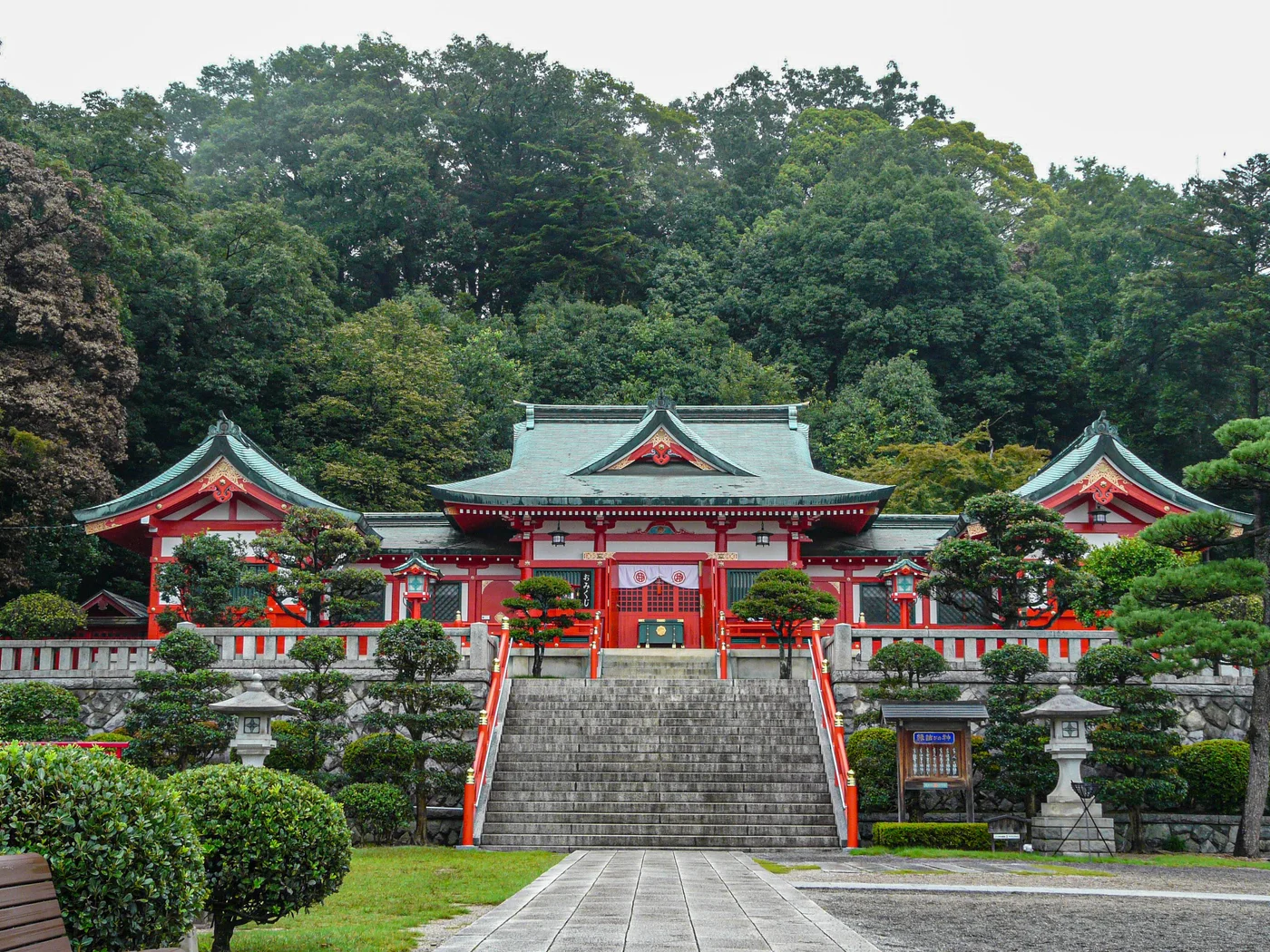
The official shrine grounds guide lists 229 steps on the main slope from the first torii to the precinct, with handrails. Enmusubi-zaka is a gentler mountain path without handrails. The shrine actually recommends the main slope with handrails for those less confident in their leg strength. “Gentler” alone is therefore not enough to choose: handrail needs, shoe grip and stability going up and down also matter.
The seven-colored torii stand on Enmusubi-zaka, with colors linked by the shrine to seven divine benefits. Choose it for torii and plants, or the main steps if you want a railing and staged rests. Save energy and time for descent. With knee discomfort or a stroller, stay in the old town and by the river. For vehicle access to a hillside parking area, arrange the actual drop-off and onward walking with the shrine separately. This walking itinerary does not treat the mountain path as a stroller route.
Allow a separate seventy-five to ninety minutes from Bannaji for the climb, worship, view and return to the foot, then about thirty minutes back to the station. Adding the shrine replaces longer riverside and shopping stops. In rain or late in the day, omit the hill; school and temple still form a complete theme. For night views, plan lighting, descent and station access separately rather than climbing at the end of a daytime route to wait for darkness.
A day’s schedule: school first, then choose one afternoon
For a 10:00 school start, aim to reach Tobu Ashikagashi around 9:30 and allow thirty minutes to cross and find the entrance. From JR Ashikaga, aim around 9:40, with twenty minutes for walking and tickets. These are arrival targets for selecting trains, not named services. Give the school 10:00–11:15, allocating time to open areas during construction. Keen readers can stay at public displays; if you finish early, head into the streets.
After 11:15, use twenty minutes for the streets and eat from 11:35 to 12:35. Leave 12:35–13:45 for Bannaji and the moat, including the approach, worship and rest. Both main sites are then complete early in the afternoon. Later choices can follow your energy, without rushing to reach the first paid historic site just before school admission ends.
For the river version, browse after 13:45, head toward the river around 14:30 and return to your chosen station between 15:00 and 15:30. To sit longer, reduce the distance west. For the shrine version, leave at 13:45, finish the climb, visit and descent around 15:15, then allow thirty minutes to the station and search departures after 16:00. Once you select an actual train, move the station arrival target earlier for waiting and platform access.
If you reach Ashikaga in the afternoon, reduce the route to the school, temple and one meal. School admission ends at 16:00 from October to March. For about an hour inside, reach the entrance before 15:00; arrive earlier for detailed reading and gates. Getting off at Tobu station at 15:00 leaves little school time after the crossing, so temple and streets make an easier main route.
Choose either the river or shrine as the main afternoon, then use any spare time. Ashikaga Flower Park lies in the direction of another station. For flowers or illuminations, choose another day or reduce town to a half-day; Ashikaga night transport and overnight planning covers park arrangements. Nikko’s shrines and temples, Oya’s quarry and shopping in Sano each need their own travel and visit time. Let this day cover old Ashikaga.
School tickets, closure dates and a shorter family route
The city visitor information consulted on October 29, 2026, lists individual school tickets at ¥480 for general admission, ¥240 for high-school students and ¥120 for elementary and junior-high students from outside the city. Preschool children enter free. Payment options include Suica, PASMO and PayPay. Two adults and one elementary-school child from outside the city pay ¥480 × 2 + ¥120 = ¥1,080. Follow with Bannaji’s free grounds for a clear main-route admission budget. List food, rail and separately booked interiors apart.
School admission runs 9:00–16:30 from April to September and 9:00–16:00 from October to March. The city table gives the admission cutoff, so count your desired visit time backward from it. The 2026 fiscal-year closure list extends through March 2027. Remaining 2026 dates are November 18, December 16 and December 29–31; 2027 dates are January 20, February 17 and March 17. Use this announced annual schedule to choose a date rather than relying only on a third-Wednesday rule.
Bannaji and the streets remain options on school closure days. If the school’s gates and temple are your main aim, choose an opening day. A shorter route with older relatives or young children can allow sixty to seventy-five minutes at the school, an hour for lunch and forty-five minutes at Bannaji, plus station walks. Skip the hill and include rest near the temple. For a step-free entrance or wheelchair route, tell the school office your date and needs and plan around the construction-period route. At the temple, establish access separately across the bridge, gate and hall front.
In light rain, shorten the streets between sites and keep the school’s open areas, temple exteriors and a seated meal. The school entrance and parts of the visit are outdoors, so use shoes and rain gear suitable for wet ground. In heavier rain, skip Orihime Shrine and the river and return to the station.
A few useful answers
Which station should I use for Ashikaga School?
JR Ashikaga Station is on the north bank of the Watarase River, about a 10-minute walk from the school. Tobu Ashikagashi Station is on the south bank, normally about 15 minutes away on foot. During work around Nakabashi Bridge, allow 25 to 30 minutes from the Tobu station and follow the pedestrian signs.
What can I see at Ashikaga School during the roof repairs?
You can see the gates, the Confucius Temple, and the historic library building. The Hōjō roof is due to be rethatched from August 21, 2026, to March 25, 2027. During the work, access is restricted inside the Hōjō, along the path in front of the south garden, and north of the building.
Do Ashikaga School and Bannaji Temple charge admission?
Ashikaga School costs ¥480 for adults, ¥240 for high school students, and ¥120 for elementary and middle school students from outside the city. Preschoolers get in free. Bannaji’s grounds are free, and a visit inside the main hall requires advance booking and a separate fee.
Can I visit Ashikaga School, Bannaji Temple, and the Watarase River in one day?
Visit Ashikaga School in the morning, have lunch in the old town, then walk to Bannaji Temple. Allow 5 to 6 hours in town with an afternoon stroll along the Watarase River, or 6 to 7 hours if you head to Orihime Shrine in the afternoon. Add train travel to and from Tokyo separately.
Official information and references
Sources used in this guide.
- Ashikaga City | School site map, buildings and 2026–2027 Hojo works
- Ashikaga City | School revival, preservation and visitor information
- Ashikaga City | School tickets and admission hours
- Ashikaga City | Fiscal 2026 school closures, April 2026–March 2027
- Ashikaga Tourism Association | Bannaji cultural properties, grounds and paid visits
- Ashikaga City | Visitor guide index and walks from both stations
- Ashikaga Tourism Association | Access from Asakusa, Kita-senju, Oyama and Takasaki
- Ashikaga City | 2025 pedestrian and cycle opening of relocated Nakabashi arches
- Ashikaga City | Nakabashi replacement and northern overpass works index
- Ashikaga Chamber of Commerce | Writing, language and Sakasagawa walk
- Ashikaga Orihime Shrine | 229 main steps, handrails and Enmusubi-zaka
- Ashikaga Orihime Shrine | Industry, relationships and seven-colored torii