Reach Yunokawa Onsen by tram from Hakodate Station or direct bus from the airport. Compare morning and afternoon day-use baths, towel hire, bookings, Yumeguri Butai, Yukura Shrine, the Tropical Botanical Garden, and tram-side or seafront hotels.
- Region & Focus
- Hakodate
- Reading Scope
- 24 min read · 8 chapters · 5 Q&As
- Official Verification
- 38 official sources checkedUpdated 22 November 2026
- Key Topics
- Hot springsWhere to stayWinter
Chapter Route Map (tap any stop)
- From Hakodate Station: One Stop Apart for Shrine and Footbath
- Three Airport Bus Stands: Which Stops Closest to Your Hotel
- Choosing a Day-Use Bath: Check Last Entry First
- Strolling the Spa Town: From Yukura Shrine to the Footbath
- Monkey Pool Closes Earlier: Botanical Garden Before Your Afternoon Bath
- Booking Your Stay: Tram Proximity, Sea Views and Dinner Times
- Winter Lights Along the Samegawa and Fireworks at Matsukura River
- Slotting Half a Day In: Arrival, Departure or After Goryokaku
- Quick Q&A
Take the tram from Hakodate-ekimae to Yunokawa-onsen, and within a minute's walk you can soak your feet for free. For a full bath, afternoon brings the widest choice, with both Yumoto Takubokutei's rooftop open-air bath and Yunohama Hotel's seafront outdoor pools open to day visitors. With only half a day, pick a day-use bathhouse first, then pair it with either Yukura Shrine or the Tropical Botanical Garden. If you plan to enjoy a ryokan dinner before catching a flight from Hakodate Airport the next morning, Yunokawa makes an ideal final night. When planning your route, pin your hotel's entrance on the map: the Yunokawa-onsen tram stop and the seafront bus stop of the same name sit in different parts of the spa town.
From Hakodate Station: One Stop Apart for Shrine and Footbath
Outside JR Hakodate Station, head to the Hakodate-ekimae tram stop in the middle of the road. Both Route 2 and Route 5 bound for Yunokawa work. The tram reaches Yunokawa-onsen first, then terminates one stop later at Yunokawa. Get off at Yunokawa-onsen for the footbath, a stroll along the Samegawa River, or stays at Hanabishi Hotel and Hotel Banso. Stay on until the terminus for Yukura Shrine, which the shrine lists as roughly a one-minute walk from the stop. If your group is arriving separately, agree to meet under the footbath canopy rather than simply saying 'Yunokawa Station' — it avoids confusion.
The ride from Hakodate-ekimae to either stop costs ¥290 for adults and ¥150 for children, taking around half an hour. Trams normally board via the centre doors and exit at the front, where you pay. With a Suica or another nationwide IC transit card, tap both on boarding and alighting. Paying cash means taking a numbered boarding ticket as you step on and dropping the exact fare shown on the onboard display when you leave; an onboard machine changes ¥1,000 notes into coins. Westbound Routes 2 and 5 diverge after Jujigai, though both take you back from Yunokawa to Hakodate-ekimae. To go straight to Suehirocho near the Red Brick Warehouses, board Route 5 bound for Hakodate Dock-mae.
An adult one-day tram pass costs ¥800. A simple return trip between Hakodate-ekimae and Yunokawa totals ¥580, so tapping per ride works out cheaper. If you are staying near Hakodate Station, visiting Goryokaku Park first, continuing by tram to Yunokawa, and then returning to Hakodate Station, the three adult legs cost ¥270, ¥270 and ¥290 — ¥830 in all, just tipping past the day-pass price. Fares are calculated per continuous ride between boarding and alighting stops, so tapping off to explore starts a new leg when you reboard. Paper day passes can be bought from the driver while the tram is stationary; scratch off the travel date to ride until the last tram. Primary-school pupils pay ¥140, ¥140 and ¥150 on that same three-leg loop (¥430 total) against a ¥400 children's day pass, while each accompanying fare-paying passenger may bring up to four pre-school children free of charge.
When the Tropical Botanical Garden comes first, taking the bus cuts out a walk. Hakodate Bus lists Routes 95, 95A and 96 from Stand 3 outside Hakodate Station, reaching the Nettai Shokubutsuen-mae area in about 15 to 17 minutes for ¥310 (adult). From the Nettai Shokubutsuen-mae stop, the city puts the walk at around two minutes, compared with roughly 15 minutes on foot from the tram terminus. If you have a pushchair, are travelling in snow, or want more time for the monkey pool and glasshouse, take the bus.
The Hokkaido Shinkansen stops at Shin-Hakodate-Hokuto, requiring a transfer onto the JR Hakodate Liner to reach Hakodate Station before joining the tram. JR Hokkaido lists the fastest Liner journey at 15 minutes, on top of platform transfers, walking to the tram stop and waiting. If you are eating near the Morning Market, stashing bags or meeting companions in the afternoon, changing at Hakodate Station makes sense. If you arrive late with a half-board ryokan booking in Yunokawa, note your hotel's latest dinner seating before deciding whether to take a taxi straight from Shin-Hakodate-Hokuto.
Reach Yunokawa Onsen by tram from Hakodate Station or direct bus from the airport. Compare morning and afternoon day-use baths, towel hire, bookings, Yumeguri Butai, Yukura Shrine, the Tropical Botanical Garden, and tram-side or seafront hotels.
Three Airport Bus Stands: Which Stops Closest to Your Hotel
Hakodate Airport sits just minutes from the hot spring district, so waiting for the next departure and wheeling luggage from the stop often affect your arrival time more than the drive itself. From Stand 3 outside Arrivals, the Hakodate Teisan Airport Shuttle heads towards the city via the seafront Yunokawa-onsen stop for ¥300 (adult), half price for primary-school pupils. Hanabishi Hotel's access page quotes around eight minutes on the bus followed by an eight-minute walk from that stop — a more realistic benchmark than applying the ryokan association's 'five minutes by car from the airport' estimate to every property.
For the tram-stop area, board Hakodate Bus 7A or 7B at airport Stand 1; it takes roughly 14 to 18 minutes to Yunokawa-onsen Dentei for ¥280 (adult), putting you about three minutes on foot from Hanabishi Hotel. Routes 96 and 5 from airport Stand 2 follow the coast and also call at Nettai Shokubutsuen-mae, with published adult fares of ¥280 on Route 96 and ¥300 on Route 5. If you plan to visit the botanical garden straight after landing, alighting at Nettai Shokubutsuen-mae saves hunting for directions from the Teisan shuttle stop.
Teisan and Hakodate Bus follow different payment rules. Hakodate City confirms that nationwide transit IC cards work on both city trams and Hakodate Bus routes. On Teisan's airport shuttle, bring coins or ¥1,000 notes, or pay by contactless credit card; Suica and other transit IC cards are not accepted. Combined tram-and-bus passes cover city trams and designated Hakodate Bus lines, whereas Teisan charges separately. As you step out of the terminal, check both the stand number and operator — the two-word difference between 'Yunokawa-onsen' and 'Yunokawa-onsen Dentei' means a noticeably different walk.
Guests at Hanabishi also have Teisan's Goryokaku line, which stops right outside the hotel. For 1 December 2026 to 31 January 2027, scheduled departures leave the airport at 09:45 and 12:50, reaching Yunokawa-onsen in seven minutes and Yunokawa Hanabishi Hotel-mae in nine. In the reverse direction, buses depart outside Hanabishi at 10:31 and 12:11, arriving at the airport at 10:46 and 12:26 respectively, for ¥300 each way (adult). This twice-daily service suits flights that line up with its timetable; for early departures, timetable gaps or two adults and two children with luggage, ask reception to book a taxi from the hotel door before check-out.
For the journey home, start from your airline's check-in and bag-drop cut-off, work backwards to time your bus or taxi, and see what slack remains. Yunokawa's proximity to the airport means staying overnight here lets you take a morning soak, dress in your room and roll straight to the terminal. If your luggage is stored near Hakodate Station and you would have to double back from Yunokawa to collect it, the return turns into two separate rides — in that case, save the hot springs for the previous afternoon.
Choosing a Day-Use Bath: Check Last Entry First
Match your bathhouse to the side of town you are already visiting. Hotel Tetora Yunokawa Onsen charges ¥550 for adults and opens 13:00–22:00 with free-flowing natural spring water; if you are staying in central Hakodate and just want an afternoon soak after the botanical garden, slot it in then. Hotel Amemiyakan costs ¥800 for adults and ¥400 for children, listed by the ryokan association as open 06:00–22:00 with free-flowing rock baths and a sauna — handy for an early start arriving from the tram side. Although the association's summary still shows an old tariff column for Hanabishi Hotel, the hotel announced that day-use bathing is suspended from 1 September 2026, leaving Hanabishi for overnight guests.
Some travellers want a late-night soak, others a bath before breakfast. Hotel Kamomekan splits day-use hours into 05:30–09:30 and 13:00–23:00, at ¥800 for adults and ¥300 for children. Leaving Yukura Shrine around 10:00 catches Kamomekan between sessions, so head instead to KKR Hakodate, which opens at 11:00 (¥1,000 adults, ¥500 junior-high pupils and younger, free for pre-schoolers). If you are staying near the coast and fancy another dip next morning, using your own hotel's guest baths saves dressing up, packing a bag, walking out and trekking back before check-out.
Yumoto Takubokutei places its open-air sky bath on the 11th floor, ideal if you want elevated views over the town. Its bathing page lists a morning session from 06:00 to 09:00 (last entry 08:00) and an afternoon session from 13:00 to 21:00 (last entry 20:00). Admission is ¥1,200 for adults, ¥600 for primary-school pupils and free for toddlers, with bath and face towel hire at ¥300 — budget ¥3,000 for two adults renting towels. That morning window is wider than the association summary implies, and is easily missed when drafting an itinerary. The hotel also offers two private hire baths at ¥3,300 for 50 minutes, including the 'Heisei Modern' bath equipped with a baby cot; check availability when booking if your family wants to bathe together.
Down by the sea, Yunohama Hotel opens to day visitors 13:00–20:00 at ¥1,200 for adults and ¥900 for primary-school age and under, with bath towels (¥200) and face towels (¥100) hired separately. Its ocean-facing open-air pools, main indoor bath and town-side baths alternate between men and women; if you are coming specifically for the sea view, ask at reception which side is assigned to you before buying a ticket. The ryokan association notes two distinct spring sources on site, so check the mineral sign beside each tub to compare the waters. Drivers should note one practical catch: the hotel may turn away day-trippers arriving by car during busy periods, so keep this stop on foot or public transport from the botanical garden.
Hotel Banso suits anyone who wants to pick up towels, change and step straight into the water, as bath and face towels are lent free at reception. Monday to Friday, morning entry runs 06:00–08:30 (out by 09:30), and afternoon entry opens at 15:00 with last admission at 21:00 (out by 22:00). Weekends keep the same morning hours while bringing afternoon opening forward to 12:30. Adult admission (from junior-high age upwards) is ¥1,800 on weekdays, ¥2,200 at weekends and public holidays, and ¥2,600 during Golden Week and peak periods. Reception may halt day-use entry when busy, and guests with tattoos are not permitted.
To pair the botanical garden with a seafront view bath in a single afternoon, look next door at Imagine Hotel & Resort Hakodate. The ryokan association notes that it requires advance booking via Yunobura, with day-use hours from 15:00 to 19:00. Adults pay ¥1,300 bringing their own towels or ¥1,800 with a rental set; children pay ¥900 or ¥1,300 respectively. Alongside the first-floor main bath, 'Usukeshi no Yu' on the eighth floor serves as a panorama bath. If this is the centrepiece of your half-day, reserve your slot first and visit the botanical garden beforehand, as the garden closes at 16:30 in winter.
Two sample budgets show how costs stack up. Taking the ¥310 bus from Hakodate-ekimae to the botanical garden (¥300 entry), walking to Yunohama for a ¥1,200 soak, and catching the ¥290 tram back comes to ¥2,100 per adult with your own towel. To keep spending down, take the tram both ways from Hakodate-ekimae and soak at Tetora in the afternoon for ¥1,130 total. If saving steps matters more, use buses on both legs and choose whichever stop sits closest to your chosen bathhouse, paying per route.
| Bathhouse | Adult Admission | Regular Hours |
|---|---|---|
| Hotel Tetora Yunokawa Onsen | ¥550 | 13:00–22:00 |
| Hotel Amemiyakan | ¥800 | 06:00–22:00 |
| Hotel Kamomekan | ¥800 | 05:30–09:30, 13:00–23:00 |
| KKR Hakodate | ¥1,000 | 11:00–21:00 |
| Yumoto Takubokutei | ¥1,200 | 06:00–09:00 (last entry 08:00), 13:00–21:00 (last entry 20:00) |
| Yunohama Hotel | ¥1,200 | 13:00–20:00 |
| Hotel Banso | ¥1,800 weekdays, ¥2,200 weekends/public holidays, ¥2,600 peak season | 06:00–09:30; from 15:00 weekdays or 12:30 weekends until 22:00 (check last entry above) |
| Imagine Hotel & Resort Hakodate | ¥1,300 own towel, ¥1,800 with towel set | 15:00–19:00, advance booking required |
Strolling the Spa Town: From Yukura Shrine to the Footbath
Yukura Shrine sits right beside the tram terminus at 2-28-1 Yunokawacho. According to the ryokan association, it enshrines deities associated with medicine and hot springs, and the large trees within its grounds reward an unhurried pause. To trace how Yunokawa got its name, spot the stone monument marking the hot spring's origin at the street entrance before reading the boards beside the shrine. The walk itself can be kept very brief: pay your respects, then stroll back along the tram line to the preceding stop, or hop back on the tram between the two when pavements are icy or you have a pushchair.
Along the tramway avenue, drop into Yakidango Gingetsu at 2-22-5 Yunokawacho for a snack. This traditional sweet shop makes skewered rice dumplings from Hokkaido rice, typically offering sweet soy glaze, sesame and red bean paste. Hakodate's tourism guide lists hours as 08:30–17:30 with irregular closing days, and dumplings can sell out early; it is roughly a three-minute walk from the footbath tram stop. If you visit the shrine in the morning, pick up sweets on your way down the same tramway street towards the footbath.
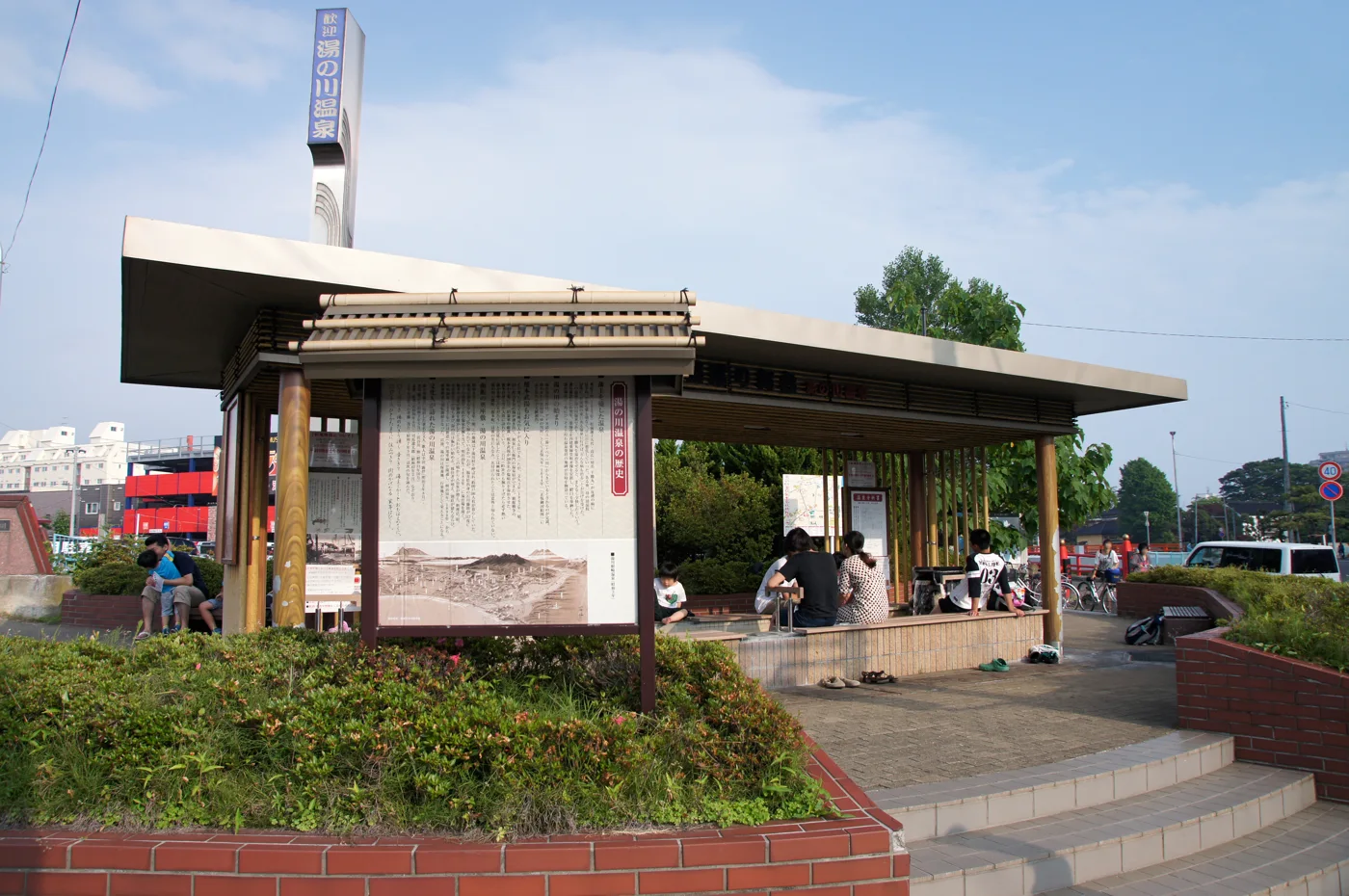
The free Yumeguri Butai footbath is at 1-16-5 Yunokawacho, one minute on foot from the Yunokawa-onsen tram stop. It opens 09:00–21:00 unless closed for maintenance. Though covered by a roof, the sides remain open to the air: it is pleasant in light drizzle, while in brisk sea winds or snow flurries you will want to keep your coat on and carry a small towel for drying your feet. With a road junction right alongside, towel dry and put your socks and shoes back on before packing the damp cloth into a pouch. Travellers detouring here on the way back from Goryokaku can simply step back onto the tram for town once they finish.
For groups eating lunch near the tram stop before an afternoon bath, Yumeguri Butai makes a clean rendezvous point between walkers and bathers. The platform is a one-minute stroll from the shelter, so nobody has to wander blocks looking for each other after splitting up. There is no car park at the footbath itself; if you drove in and are staying by the sea, leave the car at your hotel and walk over before continuing to the shrine or shops.
In changing rooms and lounges, small items come in handy all at once, so pack a face towel, glasses case and spare underwear in a grab bag rather than rummaging through suitcases at reception. Wash thoroughly at the shower stations before entering the tubs, and keep towels out of the water. Save group photos for outside the building. Overnight guests with large suitcases can leave them at reception before heading out; day visitors heading straight to the airport afterwards should check beforehand whether the bathhouse holds luggage, or route via their hotel to collect bags.
Monkey Pool Closes Earlier: Botanical Garden Before Your Afternoon Bath
Hakodate Tropical Botanical Garden lies at 3-1-15 Yunokawacho, some distance along the coast from the tram line. The garden channels hot spring water into its macaque enclosure from December through to Japan's Golden Week in early May. The monkeys enter and leave the steaming pool as they please, so allow time to watch rather than dashing in just before closing. On cold days, watch the monkeys outdoors first, then warm up inside the tropical glasshouse and on-site footbath; keep an outer layer on you or in your daypack for the walk back out.
From April to October the garden opens 09:30–18:00, shortening to 16:30 between November and March, and closing for New Year from 29 December to 1 January. Entry is ¥300 for adults, ¥100 for primary and junior-high pupils, and free for pre-schoolers, paid in cash at the gate. In winter with children, arrive straight after lunch to allow plenty of time for photos and the glasshouse before walking over as seafront hotels open to day bathers around 15:00. Over the four-day New Year closure, skip the garden in favour of the shrine and footbath, and book a separate afternoon bath slot.
From April, closing extends from 16:30 to 18:00 while the hot-spring monkey season winds down through Golden Week. That leaves two ways to structure an April half-day: if you want sunlit ocean views, soak in Yunohama's outdoor baths first and still reach the garden before 18:00; if the monkeys are your priority, visit the garden first and enjoy a full afternoon at the baths afterwards. From mid-May onwards, swap the monkey pool for the glasshouse, lawns or a coastal walk.
Three wheelchairs can be borrowed from the main gate desk, and free parking is available in both the east and west car parks. If someone in your party walks slowly, choose one of the hotels right outside the garden afterwards. Heading back to Hakodate Station, a two-minute walk to the Nettai Shokubutsuen-mae bus stop avoids the longer outdoor trek to the tram terminus — especially welcome in winter, when you can save the footbath for another visit near the tram stops.
Should heavy rain hit along the coast, take a bus or taxi straight from the glasshouse to your next stop rather than walking the shoreline. In fair weather, pick a short coastal stretch on foot to your hotel. Families booked on half-board who also plan to bathe at their hotel can return straight to their room to rest after the garden, then separate breakfast, packing and check-out the next morning so children have time to stop by the street-side footbath and compare it with the monkeys' pool.
Booking Your Stay: Tram Proximity, Sea Views and Dinner Times
If you want two full days for Motomachi and the Bay Area, staying right through near Hakodate Station and making a half-day trip to Yunokawa spares you repacking and shifting bags. If a night on tatami mats with a hot soak straight after dinner appeals, spend the earlier night around Mount Hakodate and save Yunokawa for your final night. Even though town and coast are close, changing hotels leaves a midday gap between check-out, bag drop and check-in — fill that window with Goryokaku Park or the botanical garden. When companions leave on different schedules, say an early train and an afternoon flight, staying near Hakodate Station cuts out an extra transfer.
Travelling with older relatives, heavy suitcases and relying on trams, start your hotel search around the tram stops. Hanabishi Hotel stands roughly two minutes from the Yunokawa-onsen stop, offering Japanese tatami rooms, Western-bed rooms, accessible rooms and rooms with private open-air baths. Its ground-floor garden open-air bath stays open to guests from 15:00 to 01:00, and again from 05:00 to 10:00 — ideal if an early flight pushes your soak to after dinner. When booking as a family, enter every child's exact age on the reservation page to confirm whether they get an extra futon, share existing beds or need a larger Japanese-Western suite.
If dinner matters most, reverse your search order: pick the meal plan and check-in deadline before choosing a room type. Hanabishi offers kaiseki dinner plans, while Banso centres its dining on a buffet featuring sushi and local coastal seafood. To keep your evening free for Mount Hakodate's night view, schedule dinner-inclusive stays for a different night; on a two-night stay, booking half-board for one night and bed-and-breakfast or room-only for the other frees up one evening to dine in town without rushing. Guests with food allergies should send the hotel exact ingredients and headcount to confirm what their chosen plan can accommodate.
Sea views and in-room open-air baths can be booked separately. Seafront Heiseikan Shiosaitei, for example, splits standard Japanese rooms into ocean-side and town-side, alongside Japanese rooms with private open-air baths. If waking up to the water is enough, an ocean-side standard room does the job; if you want a private soak at night, search specifically for a room with an open-air bath, and check the room details if you care whether the tub uses free-flowing spring water. Preferring tram proximity with an in-room soak, Hanabishi's Gagyutei wing opened 'Japanese-Modern Suites with Open-Air Bath' in May 2026, featuring free-flowing hot spring tubs overlooking Yunokawa's rooftops and mountains.
Check floor plans and gender-swap hours for the main communal baths too. At Shiosaitei, the seventh-floor panorama bath looks out over the Tsugaru Strait, while the fourth floor has garden-view baths and an open-air pool. Men use the seventh floor from 14:00 to 03:00 and women from 04:00 to 09:30, with the fourth floor swapped, closing 03:00–04:00 for changeover and cleaning. Even in a town-side room, timing your bath lets you catch the sea view — just cross-check your floor's hours against breakfast and check-out if you want an early-morning coastal vista.
When comparing room rates, check meal inclusions, occupancy per room and extra local taxes. From 1 April 2026, Hakodate City and Hokkaido levy a combined tiered accommodation tax per person per night based on the room-only rate (excluding meals): ¥200 under ¥20,000, ¥400 from ¥20,000 to ¥49,999, ¥1,000 from ¥50,000 to ¥99,999, and ¥2,500 at ¥100,000 or more. Hakodate City also collects a ¥100 bathing tax from guests aged 15 and over (exempt under 15). For two adults sharing one night at under ¥20,000 per person, set aside ¥600 in combined local taxes.
Winter Lights Along the Samegawa and Fireworks at Matsukura River
The easiest winter event to fold into an evening walk is Yunokawa Winter Lights. Running from 1 December 2026 to 28 February 2027, illuminations switch on from sunset until 22:00. The trail starts right at the Yumeguri Butai footbath beside the tram stop, leading along the Samegawa River towards the sea past lanterns patterned with traditional kumiko woodwork. Arriving from central Hakodate by tram, warm your feet first and wander a stretch of the riverbank, or step out after dinner if you are staying in the spa town without worrying about missing meal service.
Winter fireworks launch from a different river. Organisers list shows around 18:00 for roughly ten minutes near the mouth of the Matsukura River on 8, 9, 15, 16, 22, 23, 29 and 30 January 2027, free to watch. To catch the full display, follow the viewing map on the official fireworks page to the seafront and allow walking time from the footbath, saving station-area or Bay Area night views for another evening. If your hotel dinner begins right at 18:00, ask about a later seating or bathe early, step outside for the fireworks and sit down to eat straight afterwards.
On nights with heavy snow or biting coastal winds, keep your walk between the footbath and the nearest tram stop. Because fireworks may be cancelled in poor weather, check the event website's latest updates before setting out for the river mouth. The lantern illuminations run every evening from sunset, so if older companions want just a brief look, a short stroll from the tram stop along the lit Samegawa River and back to the hotel is far more comfortable than waiting down on the exposed coast. Since the footbath closes at 21:00 while lights stay on until 22:00, soak your feet first.
Summer's Yunokawa Onsen Fireworks Festival is a separate occasion, held after Obon in August according to the ryokan association. Earlier in the day comes the Kentoshiki ceremony offering hot spring water to Yukura Shrine, followed by evening fireworks launched near the lower Matsukura River. The 61st edition in 2026 has already taken place; when planning next year's stay and transport, watch the association's events page for confirmed dates, or pick a quiet weekday if you simply want seafront bathing and dinner near your hotel.
Slotting Half a Day In: Arrival, Departure or After Goryokaku
On a two-day trip based near Hakodate Station, pair Yunokawa with Goryokaku. Have lunch around Goryokaku, board the tram at Goryokaku-koen-mae towards Yunokawa, alight at the terminus for Yukura Shrine, and walk back to Yunokawa-onsen for the footbath. To add a full afternoon soak, choose between Yumoto Takubokutei for its rooftop open-air bath or Hotel Banso if you want free towel hire and comfortable lounges while waiting for companions. Save the Tropical Botanical Garden for another day or an airport transfer so this half-day keeps breathing room for lunch and transit.
Landing before noon with a seafront hotel booked, drop your bags at reception first, grab lunch and spend the afternoon at the Tropical Botanical Garden seeing the monkeys and glasshouse before closing. Back at your coastal hotel, enjoy the guest baths before dinner. If your flight runs late, protect dinner and your soak first — the garden opens at 09:30 next morning if you still want to go. At Imagine Hotel & Resort Hakodate, for example, luggage storage before check-in and after check-out is free, and reception asks dinner-plan guests arriving after 19:00 to call ahead.
For an early morning flight out, keep departure morning simple with hotel breakfast and an early guest bath. With an afternoon flight, check out, walk to Yukura Shrine, pause at the Yumeguri Butai footbath and collect your bags from the hotel. Afternoon-only day bathhouses suit later departures poorly: if you need to be at the airport by 13:00, Yunohama does not even open until 13:00, so rely on your hotel's morning bath or a morning-opening bathhouse. Note your target departure time as the moment you step out of the hotel lobby, leaving margin beforehand for lifts, luggage pick-up and settling local taxes at reception.
If you plan to visit Yunokawa after taking in the night view from Mount Hakodate, check descent times against bathhouse last-entry cut-offs. The tram from Jujigai to Yunokawa-onsen costs ¥300 for adults plus the walk at the far end; even though Banso closes at 22:00, last admission is 21:00, and Takubokutei stops taking day guests earlier still. If you are already on the western side near Mount Hakodate and want a late soak, stay local with Yachigashira Onsen: ride Route 2 from Jujigai to the Yachigashira terminus and walk five minutes (¥490 adult, last entry 21:00, closes 22:00, closed the second Tuesday of each month), saving a cross-town tram ride. If you are staying in Yunokawa, simply head back to your hotel and wait for the morning bath. For pairing other Hakodate neighbourhoods and overnight bases, continue to Hakodate stays and seasonal night itineraries.
A few useful answers
Which tram goes from Hakodate Station to Yunokawa Onsen?
Take Route 2 or Route 5 bound for Yunokawa. Alight at Yunokawa-onsen for the Yumeguri Butai footbath, or ride one stop further to the Yunokawa terminus for Yukura Shrine. The adult fare from Hakodate-ekimae to either stop is ¥290.
How much is the bus from Hakodate Airport to Yunokawa Onsen?
The Teisan Airport Shuttle departs from airport Stand 3 to the seafront Yunokawa-onsen stop for ¥300 (adult). If you are staying near the tram stops, take Hakodate Bus 7A or 7B from Stand 1 to Yunokawa-onsen Dentei for ¥280 (adult).
Are any day-use hot springs in Yunokawa open early in the morning?
Yes. Hotel Kamomekan runs a morning session from 05:30 to 09:30, and Hotel Amemiyakan opens at 06:00. Yumoto Takubokutei and Hotel Banso also open at 06:00, with last morning entry at 08:00 and 08:30 respectively.
What ticket do I need to see the hot-spring monkeys?
Standard admission to Hakodate Tropical Botanical Garden includes the macaque enclosure: ¥300 for adults, ¥100 for primary and junior-high pupils, and free for pre-schoolers, paid in cash at the gate. The monkeys' hot-spring season runs from December through Golden Week in May, and the garden closes annually from 29 December to 1 January.
Where are Yunokawa's winter lights and winter fireworks held?
Yunokawa Winter Lights runs from the Yumeguri Butai footbath along the Samegawa River from 1 December 2026 to 28 February 2027, lit from sunset until 22:00. Winter fireworks launch near the mouth of the Matsukura River on Fridays and Saturdays from 8 to 30 January 2027, around 18:00 for roughly ten minutes.
Official information and references
Sources used in this guide.
- Hakodate Yunokawa Onsen Ryokan Cooperative (Day-Use Onsen & Hanabishi Suspension Notice)
- City of Hakodate (City Tram Fare Zones)
- City of Hakodate (City Tram Routes & Timetables)
- City of Hakodate (City Tram One-Day Pass)
- City of Hakodate (How to Ride and Pay on Trams & Route Buses)
- Hakodate Bus (Hakodate Station to Spa District & Botanical Garden)
- Hakodate Bus (Hakodate Airport Routes, Stands & Fares)
- Hakodate Teisan Bus (Hakodate Airport to Hakodate Station Shuttle)
- Hakodate Teisan Bus (Goryokaku Park Line 2026–27 Winter Timetable)
- Hakodate Teisan Bus (Payment Methods & Fares)
- JR Hokkaido (Hokkaido Shinkansen & Hakodate Liner)
- Yumoto Takubokutei (Morning Day-Use Hours, Last Entry, Towel Hire & Private Baths)
- Hakodate Yunokawa Onsen Hotel Banso (Day-Use Hours, Fees, Towel Loan & Bathing Rules)
- Yunohama Hotel (Day-Use Baths & Hours)
- Yukura Shrine (Address & Access)
- Hakodate Yunokawa Onsen Ryokan Cooperative (Yukura Shrine & Spa District)
- Hakodate Official Travel Guide (Yumeguri Butai Footbath)
- Hakodate Tropical Botanical Garden (Opening Days, Admission, Cash Payment & Monkey Season)
- City of Hakodate (Tropical Botanical Garden Access & Facilities)
- Hanabishi Hotel (Room Types, Dining & Garden Baths)
- Hanabishi Hotel (Walking Times from Bus & Tram Stops)
- Heiseikan Shiosaitei (Ocean-Side, Town-Side & Open-Air Bath Rooms)
- Heiseikan Shiosaitei (Panorama Bath Floors & Gender Rotation Hours)
- City of Hakodate (Accommodation Tax & Bathing Tax)
- Hakodate Winter Lights Organiser (Yunokawa Winter Lights)
- Hakodate Winter Lights Organiser (Yunokawa Winter Fireworks Dates & Venue)
- Hakodate Official Travel Guide (Yunokawa Winter Fireworks Weather & Viewing Info)
- KKR Hakodate (Day-Use Bathing & Child Fare Rules)
- Hakodate & Southern Hokkaido Tourism Guide (Yakidango Gingetsu near Tram Stop)
- Hakodate Yunokawa Onsen Ryokan Cooperative (Summer Onsen Fireworks Festival & Kentoshiki)
- Hakodate Official Travel Guide (Yachigashira Onsen Fees, Last Entry & Closed Days)
- Hakodate Yunokawa Onsen Ryokan Cooperative (Spa District Access Overview)
- Hanabishi Hotel (Guest Baths & Garden Open-Air Bath Hours)
- City of Hakodate (Accommodation Tax Scope & Calculation)
- Hakodate Official Travel Guide (Tram Routes 2 & 5 and Major Stops)
- Hanabishi Hotel (Notice of Day-Use Bath Suspension)
- Hanabishi Hotel (Gagyutei 2026 New Open-Air Bath Suites)
- Imagine Hotel & Resort Hakodate (Day-Use Bookings, Luggage Storage & Late Arrival Notice)