How to walk from Yufuin Station across Shirataki Bridge and along Yunotsubo Street to Lake Kinrin, with half-day and overnight plans for morning mist. Includes 2026 temporary station details, Yufuin no Mori trains, highway buses, luggage storage and lakeside day-trip onsen.
- Region & Focus
- Yufuin
- Reading Scope
- 16 min read · 10 chapters · 5 Q&As
- Official Verification
- 39 official sources checkedUpdated 22 November 2026
- Key Topics
- ItinerariesNeighbourhoodsHot springs
Chapter Route Map (tap any stop)
- From the station to Lake Kinrin, start at Shirataki Bridge
- Temporary station, ticket collection and luggage storage
- Staying overnight for morning mist: lakeside vs basin views
- Exploring Yunotsubo Street and choosing your route back
- Three ways to pace it: two hours, half a day or overnight
- Bussanji Temple, Unagihime Shrine and sightseeing rides
- Save the Yufuin Stained Glass Museum for a rainy afternoon
- Day-trip onsen: lakeside vs near the station
- From Fukuoka by JR or highway bus, and connections to Beppu
- Where to stay, parking if driving and next-day departures
- Quick Q&A
On a first visit to Yufuin, walk straight out of the station along Yufumi-dori, cross Shirataki Bridge into Yunotsubo Street and continue to Lake Kinrin. The Japan National Tourism Organization puts the one-way walk from station to lake at roughly 25 minutes, making half a day enough for day-trippers to browse the shops, stop for lunch and stroll along the shore. To catch autumn or winter morning mist rising off the water, stay overnight and walk out before breakfast. At the end of 2026, JR passengers pass through a temporary station building and the platform footbath is closed for renovation, so use a lakeside day-trip bathhouse instead.
From the station to Lake Kinrin, start at Shirataki Bridge
JR spells the station name "Yufuin", while local street addresses use "Yufuin-cho" (written with the character for hot water). Yufu City's Hot Spring Reader traces this distinction back to 1955, when Yufuin Town merged with Yunohira Village to form Yufuin-cho. Today, the basin around the station and Lake Kinrin is usually written as Yufuin, while the wider area taking in Yunohira and Tsukahara often uses the older municipal spelling. When setting routes in navigation apps, search for Yufuin Station for trains, or Yufuin Ekimae Bus Centre for highway buses from Fukuoka. If your ryokan is in Yunohira or Tsukahara, factor in the extra transfer from the station when planning luggage and dinner times.
Step out of the station onto Yufumi-dori, the main approach road, and Mount Yufu rises straight ahead on a clear day. Shirataki Bridge is your main landmark along the way: just beyond it begins Yunotsubo Street, an 800-metre stretch lined with sweet shops and souvenir stores. To walk straight to Lake Kinrin, follow signs for Yunotsubo Street and Lake Kinrin first, then open your map at the water's edge to locate Tenso Shrine. You can always browse tempting shops on the return leg—particularly sensible if you arrive later in the day and want to keep an eye on your train home.
Twenty-five minutes is only the baseline one-way walk from station to lake. Returning along the same route puts total walking time close to an hour before you even pause. Stopping for pastries, queuing for a table or wandering along the shoreline soon stretches the outing. A two-hour window allows a look at the lake and one snack; three to four hours leaves room for a proper sit-down lunch. Visitors arriving from Beppu follow the exact same route from the station forecourt—just step off the bus and start walking, with no local bus transfer required.
Stick to the main drag on the way out to get your bearings, and save the riverside paths or back lanes for the walk back. Printed walking maps are available at the tourist information counter next to the station, while digital copies are hosted on Yufuin Tourist Information's brochure download page. One map covers the central town streets; the other zooms out across the wider basin. Use the street map if you are sticking to the shops and the lake, and add the basin map if you plan to continue to Bussanji Temple or Unagihime Shrine.
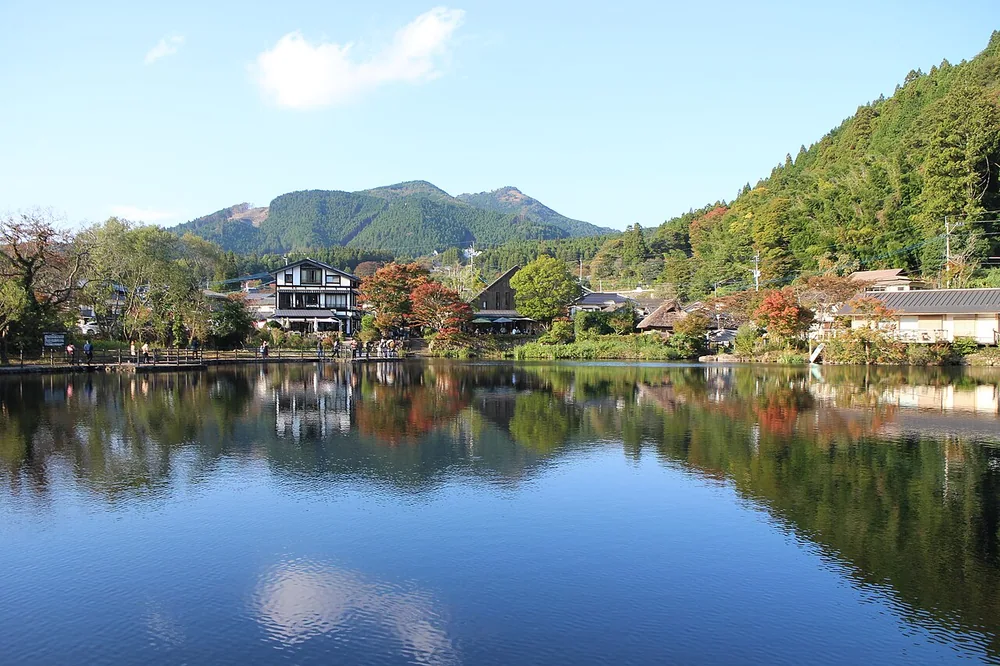
How to walk from Yufuin Station across Shirataki Bridge and along Yunotsubo Street to Lake Kinrin, with half-day and overnight plans for morning mist. Includes 2026 temporary station details, Yufuin no Mori trains, highway buses, luggage storage and lakeside day-trip onsen.
Temporary station, ticket collection and luggage storage
Since 26 March 2026, JR Yufuin Station has operated out of a temporary building between the old station and the Yufuin Tourist Information Centre (TIC) while the original station is closed for renovation. The ticket office opens from 07:00 to 18:00, and the temporary building handles ticket sales, gates and station toilets as usual, with JR expecting completion in winter 2026. The platform footbath closed on 14 March, and the station gallery used as a waiting lounge is also out of service. JR Kyushu online bookings can be collected from the designated ticket machine between 05:20 and 23:00. SUGOCA IC cards cannot be used at Yufuin Station, so buy your ticket before boarding local trains.
Right beside the station stands the Yufuin Tourist Information Centre (TIC), a timber-framed building designed by Shigeru Ban, open daily from 09:00 to 17:30 except New Year's Day. The ground floor houses the tourist desk and the Yufuin Chikki luggage service; a gentle ramp leads up to a travel library and a viewing terrace facing Mount Yufu. If it rains while you wait for a train, you can watch the platforms from indoors behind floor-to-ceiling glass. Anyone walking back from the lake for an evening bus should keep the 17:30 closing time in mind and head straight for the station-front bus centre shown on their ticket.
For same-day luggage storage, the TIC offers both coin lockers and a staffed counter. Large lockers cost ¥600 and small lockers ¥500. At the staffed counter, bags 60 cm or taller cost ¥800, medium bags under 60 cm cost ¥600 and small bags cost ¥500. Both lockers and the counter operate from 09:00 to 17:00—do not confuse the centre's 17:30 closing time with the luggage pick-up cut-off. Hauling a large suitcase all the way to the lake and back adds needless effort, so leave bags at the end of town from which you plan to depart.
Overnight guests who want to explore hands-free straight off the train can forward bags to their accommodation. Yufuin Chikki accepts bags at the station between 09:00 and 15:00 for delivery to participating properties by around 16:00. Base rates are ¥1,000 for cases between 60 cm and under 80 cm tall, and ¥1,200 for 80 cm or larger, with an extra weight charge from 20 kg. On check-out day, participating ryokan accept return deliveries between 09:00 and 11:30—at least two hours before your planned pick-up—with collection at the station from 11:30 onwards, payable in cash. Early-morning departures are better off bringing bags to the station themselves; check the November 2026 accommodation list linked from the official page to confirm coverage.
Staying overnight for morning mist: lakeside vs basin views
Lake Kinrin is at its most atmospheric on chilly autumn and winter mornings. According to Yufu City, both cool spring water and hot spring water feed the lake, producing white mist over the surface on cold winter dawns. Seeing wisps of vapour drift across the water is one perspective; seeing the entire Yufuin basin wrapped in mist requires elevation. Sagiridai Observatory, listed by Yufuin Tourist Information along the Kyushu Trans-Island Road in the foothills, has its own car park. If you are staying in town and want close-up lake mist, walk to the shore around sunrise; if you are driving in good weather and road conditions and want the full basin panorama, stop at Sagiridai on your way out of town. Day-trippers on foot still get clear views of Mount Yufu from the station forecourt and the riverbanks.
Mist shifts constantly with temperature and wind, so there is no fixed showtime. If you want photographs, walk the route from your ryokan to the lake the afternoon before so you can head straight to the water in the dark or half-light next morning. Conditions change minute by minute, so scan the wind direction and reflections along the public footpath first. When the mist is thick, foreground trees and waterfowl anchor the frame; when the water is still and the distant peaks are clear, leave plenty of open surface for reflections. For the torii gate standing in the water, move round to the Tenso Shrine side and give way on narrow stretches. Remember there are private homes and inns along the shore, so keep doorways and driveways clear when stopping to frame a shot.
If your ryokan includes dinner and breakfast, build your morning walk around the breakfast slot. Staying near the lake lets you walk over for ten minutes, linger by the water and return in time to eat, then catch any shops you missed later in the morning. From the station side, the official one-way walk is about 25 minutes, so allow a relaxed hour or more for the round trip and lakeside stops. If someone in your group prefers to sleep in, agree to meet back at the ryokan so early risers can slip out to the lake without delaying everyone's breakfast.
By the shore, CAFE LA RUCHE opens at 09:00 on operating days for waterside breakfasts until 10:30; it closes on Wednesdays and seats walk-ins only. On Thursdays it opens as a café with no bread service, though baked sweets and scones remain available. In autumn and winter, take in the mist outside first before heading in, or eat breakfast back at your ryokan. Passengers arriving at 11:31 on Yufuin no Mori No. 1 from Hakata can save this spot for a mid-afternoon coffee after their walk and have lunch in town first.
In summer, head to the lake early, browse the streets before midday and move indoors after lunch. In spring, Yufuin Tourist Information recommends following the river for cherry blossom and rapeseed flowers—loop downstream past the bridge before rejoining Yunotsubo Street. In autumn, daytime visits are plenty if you are mainly after foliage and calm reflections. When winter frost leaves pavements slick, turn back once you reach a safe, open stretch of shore; how long you linger by the water determines whether you make it back comfortably for breakfast.
Exploring Yunotsubo Street and choosing your route back
If you plan to buy souvenirs or pastries, walk out to Lake Kinrin along Yunotsubo Street first and leave shopping for the return leg. For chilled cakes or puddings ordered in advance, check the pick-up window and collect them on the way back to the station—that keeps your hands free at the lake and cuts down time in an insulated bag. If you prefer lunch on arrival, choose a restaurant in the first half of the walk and carry on in the same direction afterwards so your lakeside timing stays predictable. Save the cluster of shops right outside the station for after you collect your luggage before boarding.
Shops along Yunotsubo Street keep varying opening hours and midweek closing days. Reaching the lake early lets you browse each storefront systematically on the way back. If you arrive from Fukuoka in the afternoon with a specific shop in mind, check its closing time first. Travelling with children or older relatives, sitting down together for a proper meal is usually far more practical than splitting up to queue at street-food stalls along narrow lanes. Over busy holiday weekends, simply pick another sit-down restaurant nearby if your first choice is full.
For lunch before crossing Shirataki Bridge, Yufuin Sanshoro on the station side serves walk-in diners from 11:00 to 14:00 (closed Tuesdays and Wednesdays), known for its seasonal awasebako assortment box. If you would rather walk to the lake first, Yunotakean inside the grounds of Kamenoi Besso opens at 11:00 and serves mountain vegetables and local free-range chicken, with an easy onward walk to Bussanji Temple afterwards. Both restaurants bookend the main strolling corridor, so let your arrival time and your group's stamina for another half-hour walk decide which end you eat at.
Side alleys off the main street drop down to the upper reaches of the Oita River. Walking beside the water makes a pleasant route back towards Shirataki Bridge or a chance to look back towards the mountains, offering a very different rhythm from the shopfronts of the main drag. If a path narrows into farm ridges or private residential entrances without public signage, turn back onto a marked road. Yufu City's walking map labels the main thoroughfare as Yunotsubo Street / Takemoto-dori, and the riverside path along the Shirataki River as Shiratakigawa-dori / Nanohana Embankment. If your group splits up to browse, pick a clear spot by Shirataki Bridge or the TIC next to the station as your meeting point rather than messaging back and forth about street corners in a crowd.
Both shopping lanes and residential side streets carry local traffic. Yufu City asks visitors not to walk abreast blocking the road or step onto private property and farmland. The area around Yunotsubo Street is also a strict no-littering and no-street-smoking zone, with shared street bins marked "Otagai-bako". Eat takeaway snacks in the area provided by the shop or carry them to somewhere you can sit down. With a pushchair, pull over onto a wider verge when stopping to sort change, fold umbrellas or check directions so others can pass easily.
Three ways to pace it: two hours, half a day or overnight
If you arrive in the afternoon with two hours before your train, walk straight to Lake Kinrin, spend 20 to 30 minutes by the water and pick one snack along Yunotsubo Street on the way back. Factor luggage drop-off and pick-up into that clock if you have large bags. In heavy rain, shorten the lakeside stop and stick to the main street both ways. With little more than an hour to spare, go as far as Shirataki Bridge, grab a bite in the first section of shops and retrace your steps—remembering to leave a few extra minutes at the station to find the right platform position for reserved-seat trains.
A classic half-day trip pairs Yufuin no Mori No. 1 and No. 6. Under JR Kyushu's 14 March 2026 timetable revision, the outbound train leaves Hakata at 09:17 and reaches Yufuin at 11:31, while the return departs at 17:17 and arrives back in Hakata at 19:27. Locking in both trains leaves the afternoon free for the shops, the lake and either one day-trip onsen or a museum. If only No. 4 at 15:56 suits your schedule, you have just over four hours in town—skip an extra stop if lunch queues run long. On certain dates, the Limited Express Yufu runs in place of Yufuin no Mori No. 4 at the same departure time, which works just as well for the return journey.
Arriving before noon with a later departure gives you time to step away from the main street in the afternoon. Walk to Lake Kinrin first, have lunch, then pick one detour towards Bussanji Temple or Unagihime Shrine before heading back to the station or your ryokan. Bussanji connects neatly from the lakeside, and if you still have time when you circle back to the water, you can return to the station via a quieter parallel lane. If you prefer indoor sights, group the Yufuin Stained Glass Museum and the shrine area on the same side of town before deciding whether to rejoin the busy shopping street.
Staying overnight splits the walk cleanly into pre-check-in and post-breakfast halves, making even an afternoon arrival feel unhurried. Stay near the lake and you can forward your bags on arrival, wander up to check in, then stroll slowly back towards the station after the morning mist clears. Stay near the station and you can cover more ground on the first afternoon while it is still light—seeing the lake or a shrine—then choose your pre-breakfast walk according to the morning weather. If your ryokan stay includes private or communal bathing, leave time to return and change before dinner rather than making a special detour to a public day-trip bath.
Bussanji Temple, Unagihime Shrine and sightseeing rides
Beyond Tenso Shrine along the lake, walkers with energy to spare can continue to Bussanji Temple. Yufuin Tourist Information's 2026 back-lane walking guide pairs it with Unagihime Shrine on a single loop, though both take time to reach on foot. Bussanji features a thatched temple gate and opens from 08:00 to 17:00 according to tourist office listings, with a footpath marked Tsue Lane linking into the area on the official map. You can treat the thatched gate as your turnaround point from the lake and follow the water back towards the main street. Unagihime Shrine stands on the south side of town as the local guardian shrine, set amid ponds and mature trees. If the main street grows crowded after lunch, looping back to the station via this southern side avoids retracing the busiest stretch of shops.
For less walking, the Tourist Horse-Drawn Carriage (Kanko Tsuji Basha) departs from outside the station on an approximately one-hour loop taking in Bussanji Temple and Unagihime Shrine. Fares are ¥2,500 for junior high school students and adults, and ¥1,800 for children aged four to elementary school age; under-fours ride free on an adult's lap or pay the child fare for a seat. Same-day bookings open at the TIC from 09:00 in person and by telephone on a first-come, first-served basis, with in-person queues served first at opening. If you arrive near midday on the first sightseeing train, ask at the desk about remaining departures; if none fit, stick to your walking plan. Regular listings note a winter suspension from 1 January to 1 March, and departures may also be cancelled for rain, high winds, icy roads or the horses' condition.
The nolc sightseeing electric shuttle loops past Kozenin Temple and Unagihime Shrine in about 50 minutes, starting and ending at the station. For 2026, services run from April to November on Mondays, Fridays, weekends and public holidays at 10:30, 11:30 and 13:30, with fares of ¥1,800 for junior high school students and adults, and ¥1,300 for elementary school children and younger. Same-day bookings also open at the TIC from 09:00, with winter suspension from December to March. If someone in your party can only manage a short walk, save their steps for the stretch you most want to see on foot and use a carriage or shuttle for the rural lanes. Keep in mind that neither fixed route stops at Lake Kinrin—if the lake and its torii gate are the priority, plan separate transport or walking time there.
Save the Yufuin Stained Glass Museum for a rainy afternoon
Located in the Kawakami area, the Yufuin Stained Glass Museum is an ideal fallback when you have seen the lake and want to cut down outdoor time. The museum comprises two buildings: St Robert's Church, where stained glass is viewed in natural daylight, and Neil's House, which uses interior lighting to display European pieces from various regions. Neil's House remains easy to appreciate in gloomy rain, while the church is best visited earlier in the afternoon in winter to catch natural daylight. The museum posts private wedding closure times on its admissions page, during which only Neil's House stays open.
The museum opens from 09:00 to 17:00 (last entry 16:30), with admission at ¥1,000 for high school students and adults and ¥500 for elementary and junior high school pupils; photography is not permitted inside. On 13 November 2026, the museum announced plans to open daily throughout November and December. Stained-glass workshop sessions accept last entries at 15:00 and require same-day museum admission. If you want to try the workshop, make the museum your first stop after lunch and adjust your lakeside or shopping time around what remains; if you are only viewing the collection, check wedding closures alongside your return train time before setting out.
If you have young children or the rain turns gusty, duck back into the TIC to check train times, pick up a map and choose an indoor stop near the station. The TIC offers paid pushchair hire (bookable via Babycal) and free wheelchair loans arranged on site. Note that boarding the Yufuin no Mori involves steps at the carriage doors, and JR states its interior aisle width is 550 mm, so wheelchair users should coordinate with station staff in advance. When puddles, ice or windblown rain make the lakeside path unpleasant, skip the side lanes and stick to warm, seated stops.
Day-trip onsen: lakeside vs near the station
To soak straight after seeing the lake, head to Oyado Nurukawa Onsen nearby. Yufuin Tourist Information lists day-trip hours from 08:00 to 19:00 (last entry 18:00), closed on Tuesdays and the second Wednesday of each month. Under updated prices effective 1 October 2026, the separate-sex main baths cost ¥800 for junior high school students and adults and ¥400 for children aged two to elementary school age. Private family baths are priced per 60 minutes at ¥2,200 for two in an indoor bath or ¥2,800 for two in an open-air bath, plus ¥800 per additional adult and no extra charge for children. If choosing a family bath, allow extra time for check-in, changing and the walk back to the station.
If you want a soak just before heading home, Otomaru Onsen near the station cuts out a long walk afterwards. This local communal bathhouse has indoor pools open from 06:30 to 22:00, closed on the third Thursday of each month. Yufuin Tourist Information's January 2026 listing gives admission as ¥300 for both adults and children, paid into the offertory box in front of the Yakushi Nyorai statue inside. Pull out small change, a bag for wet towels and a change of clothes before putting large luggage into storage. Collect your bags beside the station after bathing—if time is tight, pick just one bathhouse and leave a few minutes to repack before boarding.
Family baths work best when bathing with young children, as a couple or when older relatives need a hand. If you only want to warm your feet while the station footbath is closed, Hinoshin in front of the station offers a free footbath—just bring your own towel. Wear slip-on shoes and fit it in while browsing souvenirs near the station, or head straight to the waiting area if it is raining and you are short on time.
From Fukuoka by JR or highway bus, and connections to Beppu
From Hakata, book JR Kyushu's Limited Express Yufuin no Mori for the scenic train route. All seats are reserved and normally go on sale one month before travel at 10:00 JST. Official adult fares for a standard reserved seat from Hakata to Yufuin combine the base fare and limited express surcharge at ¥6,130, varying slightly with seasonal seat fees, while the online Kyushu Net Kippu fare is ¥5,600. The running calendar is published through December 2026 to February 2027, with details from March onwards due in mid-January 2027. Where the calendar shows the Limited Express Yufu substituting at the same departure time, look under that train name on the booking page.
If direct train times do not suit, there is a rail alternative via Oita. JR Kyushu's Kocchi demo Ikeru yo! Yufuin Kippu runs from 1 July 2026 to 31 March 2027 at ¥4,300 for a one-way adult standard reserved-seat ticket, routing from Hakata via Kokura to Oita before connecting onto a local Kyudai Main Line train to Yufuin. The reserved limited express portion covers Hakata to Oita, followed by unreserved local seating. Make sure the Oita connection lines up cleanly—stretching both legs solely to save on the fare can easily eat into lunch or lakeside time.
Travellers staying in Tenjin, departing from Hakata Bus Terminal or heading straight from Fukuoka Airport International Terminal can take the Yufuin-go highway bus, which terminates at Yufuin Ekimae Bus Centre and requires a reserved seat. Nishitetsu lists the standard adult single from Fukuoka to Yufuin at ¥3,250, or ¥2,880 with the WEB Hayawari 7 online early-bird fare for designated departures paid by credit card within three days of booking and at least eight days before travel. Seats open for booking one month ahead at 08:00 JST. Nishitetsu's standard journey time from Tenjin is around 2 hours 25 minutes; leave extra margin for traffic if connecting from an arriving flight.
Between Beppu and Yufuin, take Kamenoi Bus Route 36 from Stop 1 at JR Beppu Station West Exit via Kijima to Yufuin Ekimae Bus Centre. Kamenoi's Yufurin sightseeing rapid bus has been suspended across the entire route since 17 October 2026, so guests staying in Kannawa should follow official advice and head to Beppu Station West Exit for Route 36. If travelling from Yufuin to a ryokan dinner in Beppu, lock in the bus to Beppu Station first, then check whether you need a connecting bus to your hotel. For ideas on pairing both towns, see our guide to where to stay and eat in Yufuin and Beppu.
For an earlier start from Beppu, a seasonal direct express bus runs from 1 October 2026 to 31 March 2027, departing Beppu Station East Exit Stop 5 at 09:30 straight to Yufuin Ekimae Bus Centre. Fares are ¥1,100 for adults and ¥550 for children, payable by cash, transport IC card or SUNQ Pass; contactless credit card tap-to-pay is not accepted on this seasonal service. If it is full, walk through the station to the West Exit for regular Route 36, which runs to separate weekday and weekend/holiday timetables.
For mountain views along the way, Kamenoi Bus operates the Yunokaze open-top double-decker bus between Beppu and Yufuin until 13 December 2026, taking roughly 65 minutes past the foot of Mount Yufu and Sagiridai. It departs from Beppu Station East Exit Stop 4 at ¥2,200 per adult one way, or ¥2,000 when booked and paid online via the designated site, with a full-day maintenance suspension on 3 December. From 14 December 2026 to 19 March 2027 the bus switches to a Beppu city loop route, leaving Route 36, the morning seasonal direct bus or JR trains as your options between the two towns.
Where to stay, parking if driving and next-day departures
If morning mist is your priority, measure the walking route from Lake Kinrin back to your accommodation. Lakeside ryokan Kamenoi Besso lists room hours from 15:00 to 11:00 the next day, with breakfast served between 08:00 and 10:00. After an early walk to the water and breakfast, you can still browse nearby lanes before packing up to check out. Staying outside the central basin works too, provided you coordinate morning transport to the lake with breakfast and check-out times.
If you have an early train or bus the next morning, measure the walk from the temporary JR station or bus centre instead. Yufuin Iyotomi in Kawaminami lists a roughly seven-minute walk from both the station and bus centre, with check-out at 10:00 and no routine station shuttle. At check-in, guests choose breakfast at 07:30, 08:00, 08:30 or 09:00. For a departure just after nine, take the earliest breakfast slot and walk straight to the station afterwards, saving your lakeside walk for the day you arrive.
Drivers staying overnight should check in advance when hotel parking opens on arrival day. Yufuin Tourist Information points day visitors for Lake Kinrin and Yunotsubo Street towards nearby paid car parks. On a half-day visit, park on the same side as your main stop and cover the shops and lake on foot. Streets in the centre are narrow, so driving between souvenir stops only wastes time waiting to pass oncoming cars and hunting for fresh spaces. If you plan to visit Sagiridai Observatory on your way out, collect your car after walking the town and drive up the hill as a separate leg.
When driving up to Sagiridai for photos, weigh visibility on the mountain road alongside the light. If thick mist makes driving tricky, leave the car in town and walk along Yufumi-dori towards the bridge to gauge how much of the mountain is visible. Down at the lake, keep to public paths wide enough to step aside when framing water reflections, and turn back at bends so walkers behind you can pass smoothly.
A few useful answers
How long does it take to walk from Yufuin Station to Lake Kinrin on a first visit?
The Japan National Tourism Organization lists the walk as roughly 25 minutes. Leave the station onto Yufumi-dori, cross around Shirataki Bridge and continue into Yunotsubo Street. Allow half a day if you want to browse the shops, linger by the lake and walk back at a comfortable pace.
What is the best season to see morning mist on Lake Kinrin?
Cold autumn and winter mornings offer the best chance of mist. Visit the lake before breakfast, then return later in the day for clear reflections of the mountains and lakeside buildings. Under the 2026 timetable, the first Yufuin no Mori arrives at 11:31, so staying overnight is the simplest way to see the mist.
Is the Yufuin Station footbath still open at the end of 2026?
No. The JR platform footbath is closed during the station renovation works, and trains use a temporary station building between the old station and the Tourist Information Centre (TIC). For a footbath, head instead to Hinoshin outside the station, where use is free if you bring your own towel.
Can you use a day-trip onsen near Lake Kinrin without staying overnight?
Yes. Oyado Nurukawa Onsen near the lake offers day-trip bathing. From 1 October 2026, entry to the separate-sex main baths is ¥800 for junior high school students and adults; if you want to bathe together, private family baths are charged by the hour.
Is there somewhere to store large luggage at Yufuin Station?
Yes. Yufuin Chikki inside the Tourist Information Centre next to the station provides staffed luggage storage from 09:00 to 17:00, charging ¥800 for bags 60 cm or taller. Luggage delivery to participating ryokan is a separate service, with drop-offs accepted until 15:00.
Official information and references
Sources used in this guide.
- Japan National Tourism Organization (JNTO) | Lake Kinrin and station walking time
- Yufu City | Lake Kinrin
- Yufu City | Hot Spring Reader and the Yufuin place name
- Yufuin Tourist Information | Yunotsubo Street
- Yufuin Tourist Information | Yufuin walking maps and day-trip onsen guide
- Yufuin Tourist Information | 2026 temporary station building and footbath closure
- JR Kyushu | Yufuin Station ticketing and IC card information
- Yufuin Tourist Information | Tourist Information Centre and rental services
- Yufuin Tourist Information | Yufuin Chikki luggage storage and delivery
- Yufuin Tourist Information | Sagiridai Observatory
- Yufuin Tourist Information | Four seasons in Yufuin
- CAFE LA RUCHE | Breakfast hours and opening days
- Yufu City | Yunotsubo Street walking etiquette and public bins
- Yufuin Tourist Information | Bussanji Temple, Unagihime Shrine and back-lane walks
- Yufuin Tourist Information | Around Bussanji Temple and Lake Kinrin
- Yufuin Tourist Information | Bussanji Temple opening hours
- Kamenoi Besso | Yunotakean Restaurant
- Yufuin Tourist Information | Sightseeing Horse-Drawn Carriage (Tsuji Basha)
- Yufuin Tourist Information | 2026 nolc sightseeing electric shuttle
- Yufuin Stained Glass Museum | Admission, workshops and wedding closures
- Yufuin Stained Glass Museum | Monthly opening calendar
- Oyado Nurukawa Onsen | October 2026 updated day-trip bath prices
- Yufuin Tourist Information | Oyado Nurukawa Onsen bathing hours
- Yufuin Tourist Information | Otomaru Onsen
- Yufuin Tourist Information | Hinoshin footbath
- JR Kyushu | Yufuin no Mori timetable, running calendar and fares
- JR Kyushu | Reserved-seat ticket release times
- JR Kyushu | Yufuin via Oita one-way discount ticket
- Nishitetsu Bus | Highway bus from Fukuoka and Fukuoka Airport to Yufuin
- Kamenoi Bus | Beppu Station West Exit and Yufuin Bus Centre stops
- Kamenoi Bus | Route 36 weekday and weekend/holiday timetables
- Kamenoi Bus | Yufurin sightseeing rapid bus suspension notice
- Kamenoi Bus | Beppu to Yufuin seasonal direct express bus
- Kamenoi Bus | Open-top bus Beppu to Yufuin route
- Kamenoi Bus | Open-top bus suspension on 3 December
- Kamenoi Bus | Open-top bus winter diversion to Beppu loop route
- Kamenoi Besso | Room hours and meal times
- Yufuin Iyotomi | Check-in, meal times and transfers
- Yufuin Iyotomi | Walking time from the station to the ryokan