Emerging after a 1910 volcanic eruption, Toyako Onsen lines Lake Toya with 16 hotels and 9 guesthouses, hosting nightly fireworks at 20:45 JST from late April to late October. The district offers 8 day-trip hot springs (from ¥500) and 2 free footbaths, alongside Manseikaku's hotel shuttle from Sapporo Station (¥1,100) and reservation-only Donan Bus services (¥3,700). Here is how to choose a lakefront stay, watch the fireworks in four ways, ride the Usuzan Ropeway and get there.
- Region & Focus
- Lake Toya
- Reading Scope
- 14 min read · 6 chapters · 4 Q&As
- Official Verification
- 12 official sources checkedUpdated 20 November 2026
- Key Topics
- Where to stayHot springsHokkaido
Chapter Route Map (tap any stop)
- Origins and Geology: A Century-Old Spa Born from Volcanic Eruption
- The Long-Run Fireworks Display: Nightly Lakefront Shows at 20:45
- Choosing Where to Stay: Front-Row Lakefront, Ridge Resorts and Budget Inns
- Day-Trip Onsen and Free Baths: Soaking Without Staying Overnight
- Usuzan Ropeway and G8 Legacy: Living Volcanoes Meet World Diplomacy
- Getting There: Direct Sapporo Buses, JR Connections and Airport Routes
- Quick Q&A
Toyako Onsen is a lakeside hot-spring town built right against an active volcano. Its century-old thermal history began in 1910, when an eruption on Mount Yosomiyama sent 42°C spring water surging to the surface. Today, 16 hotels and 9 guesthouses line the shore, looking straight across a caldera lake roughly 10 kilometres wide towards Nakajima Island at its centre. Its signature draw is a rarity in Japan: the Toyako Long-Run Fireworks Display. Now in its 45th edition, it runs nightly from 28 April to 31 October 2026, lighting up the sky for around 20 minutes from 20:45 JST — a show you can watch from your own room at a lakefront hotel without even stepping outside. Beneath the town lie 12 thermal source wells reaching 60 to 150 metres underground, feeding 10 free hand baths and 2 free footbaths along the waterfront, while the slopes behind lead straight up to the Usuzan Ropeway and the volcanic dome of Showa Shinzan. Drawing on the latest tourism association and hotel listings, this guide covers how to pick a lake-view stay, four ways to watch the fireworks, day-trip bathing rates, direct Sapporo buses, JR connections, and the 2008 G8 Summit memorial sites.
Origins and Geology: A Century-Old Spa Born from Volcanic Eruption
The story of Toyako Onsen reads like a living geological record. After Mount Yosomiyama erupted in 1910 (Meiji 43), locals discovered a 42°C hot spring on the northern foot of Nishimaruyama. According to the Town History of Toyako, the first hot-spring inn opened seven years later in 1917 (Taisho 6), and the resort marked its centenary in 2010. Tourism association geopark records note that a massive eruption around 110,000 years ago carved out the roughly 10-kilometre-wide Toya Caldera — one of only nine eruptions of that magnitude in the Japanese archipelago over the past 120,000 years — before volcanic activity at the lake's centre around 50,000 years ago built up 11 volcanic domes including Nakajima Island. The 1910 eruption not only gave rise to both Toyako Onsen and Sobetsu Onsen, it also marked the first time in Japan that seismographs were deployed in the field to observe an eruption in real time, earning the area its reputation as the birthplace of modern volcanology.
Beneath the spa quarter, 12 source wells drilled to depths of 60 to 150 metres draw sodium-calcium chloride water. Along the lakeside promenade, visitors can pause at 10 free hand baths and 2 free footbaths (Toryu-no-Yu and Yakushi-no-Yu) to warm up mid-stroll. Official tourism pages do not publish exact flow volumes or aggregate well temperatures, so treat unverified figures cited elsewhere with caution.
The official tourism association directory divides accommodation into two tiers: 16 hotels and 9 guesthouses and hostels, spanning long-established lakefront properties, hilltop resorts and budget-friendly lodgings. The Toyako Onsen Tourism Association sits at 142 Toyako Onsen (next to the Visitor Centre), while the Tourist Information Centre right beside the bus terminal operates daily from 09:00 to 17:00 JST in Japanese and English — ideal for picking up maps and checking daily event updates as soon as you step off the coach.
Alongside its volcanic scenery, the town preserves a notable chapter of diplomatic history. It hosted the 2008 Hokkaido Toyako Summit (the G8 leaders' meeting), and the Summit Memorial Museum in town still displays the original round conference table used by world leaders (open 09:00–17:00 JST, free entry, closed 31 December to 3 January). A floral 'Site of the Opening Declaration' monument stands by the water, and The Windsor Hotel Toya up on the ridge maintains a commemorative 'G8 Summit Suite'. Few hot-spring towns pair active volcanic terrain with modern international summit history quite like this.
With the entire town of Toyako home to only around 7,600 residents across just over 4,700 households, the hot-spring quarter forms the backbone of the local economy. Circling the shore, the 36.5-kilometre Lake Toya Sculpture Park places 58 outdoor works along the waterfront, adding an open-air art trail to the geothermal and geological walks.
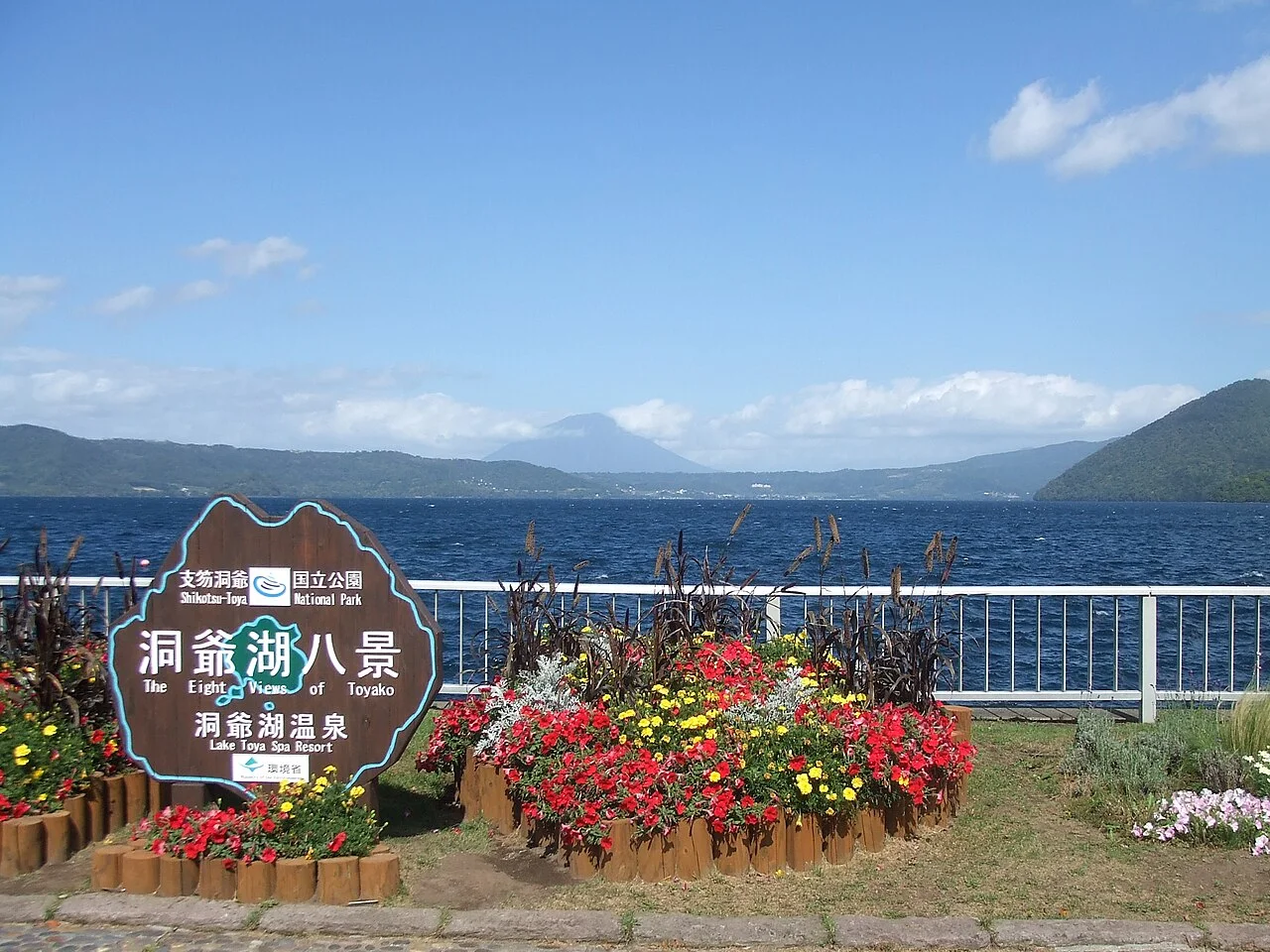
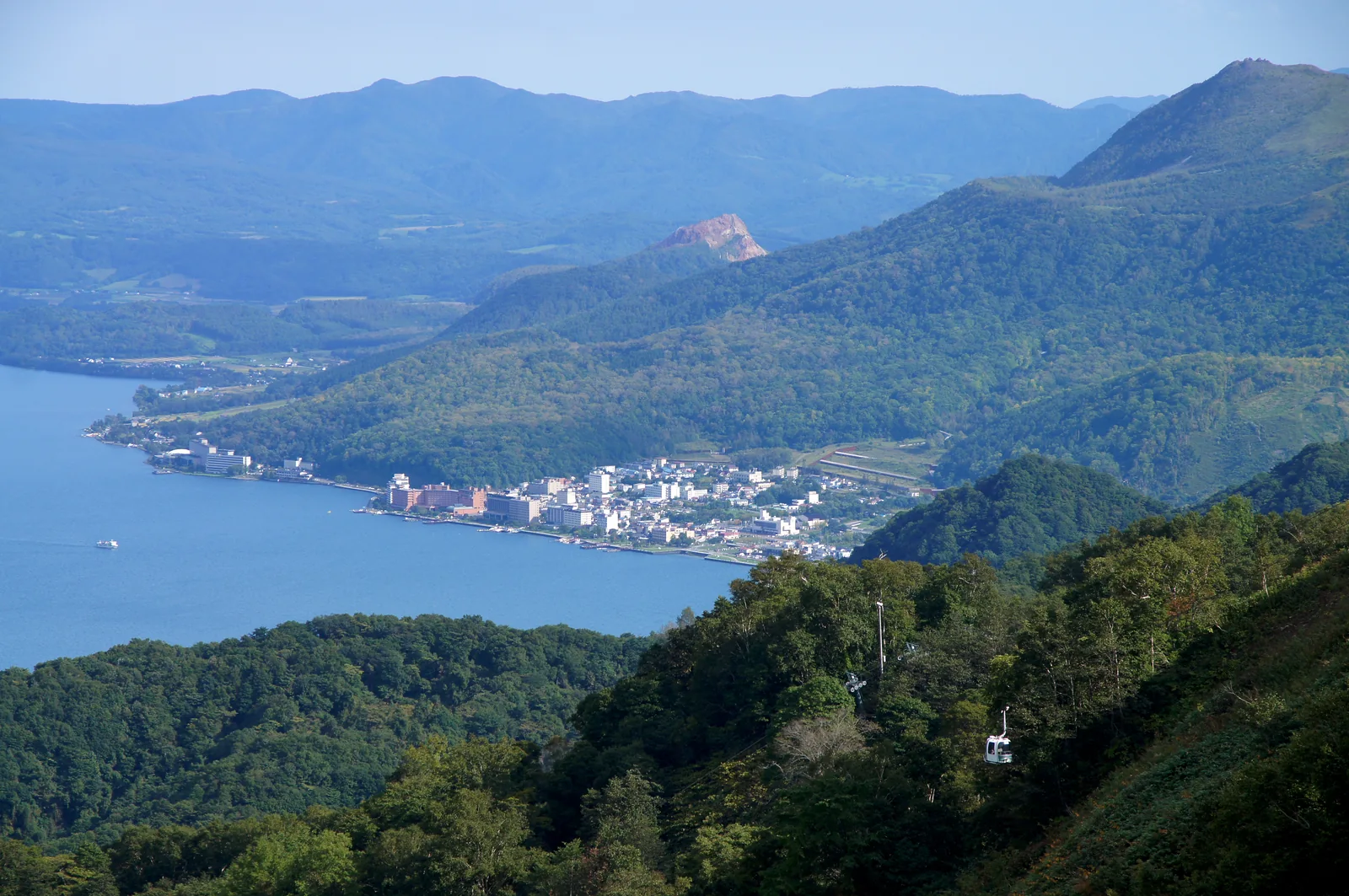
Understanding the geography makes choosing a lake-view room straightforward. Toyako Onsen curves along the southern bay facing the water and Nakajima Island, with Mount Usu and Showa Shinzan rising immediately behind it. Front-row properties such as Manseikaku, Nonokaze and Kohantei look straight across the lake towards Nakajima, while The Windsor commands sweeping views over the entire caldera from the ridge above. All-lake-view layouts are the town's defining selling point, letting guests watch both the shifting water and the nightly fireworks from indoors. Because most hotels tap and regulate water from the town's 12 underground wells independently, bath temperatures and mineral feel vary slightly from one property to another.
Emerging after a 1910 volcanic eruption, Toyako Onsen lines Lake Toya with 16 hotels and 9 guesthouses, hosting nightly fireworks at 20:45 JST from late April to late October. The district offers 8 day-trip hot springs (from ¥500) and 2 free footbaths, alongside Manseikaku's hotel shuttle from Sapporo Station (¥1,100) and reservation-only Donan Bus services (¥3,700). Here is how to choose a lakefront stay, watch the fireworks in four ways, ride the Usuzan Ropeway and get there.
The Long-Run Fireworks Display: Nightly Lakefront Shows at 20:45
From spring through autumn, the star attraction is the Toyako Long-Run Fireworks Display. In its 45th season from 28 April to 31 October 2026, around 450 shells are launched nightly above the lake from 20:45 to 21:05 JST for roughly 20 minutes. Shows go ahead in the rain and are cancelled only when wind speed or direction becomes unsafe; carbon emissions from the display are offset via J-Credits through the Toyako Onsen Thermal Utility Cooperative. Best of all, there is no need to plan around specific festival dates — stay by the lake on any night between late April and late October and you simply open your curtains for the show.
Following the four viewing angles highlighted by Nonokaze Resort, you can match the evening to your energy and budget. First, board the Fireworks Viewing Boat: departing at 20:30 JST from a pier roughly two minutes on foot from the main hotels, the 40-minute cruise requires no advance booking (check fares and sailings with Lake Toya Kisen on 0142-75-2137). Second, watch for free from the lakeside promenade. Third, soak in a rooftop open-air sky bath while bursts bloom overhead (open to staying guests or day-trip bathers). Fourth, stay put in an all-lake-view guest room. Because the launch barge drifts slowly along the shoreline, it passes directly in front of the main hotels at around 20:50 JST.
On summer nights during the fireworks season, a seasonal illumination tunnel lights up the waterfront, giving the town a lively evening buzz. Once the quiet winter-to-spring off-season arrives from November to late April, the fireworks pause and the nights belong to snow-dusted open-air baths and still water. That seasonal rhythm shapes where to book: choose a front-row lakefront hotel during fireworks season, and consider an elevated hilltop resort for broad wintry panoramas.
Working backwards from bus-stop locations makes fireworks-season booking clear. Manseikaku, Nonokaze, Kohantei, Hanabi and Hotel Grand Toya sit right beside the Honmachi and Chuo-dori stops, placing both guest rooms and outdoor baths squarely opposite the launch zone — peak-season weekends often sell out weeks ahead. The Windsor up on the plateau offers wider vistas from further away, while budget guesthouses lie a few minutes' walk back from the shore. Visiting off-season between November and late April means no fireworks, yet lakefront room rates drop considerably and snow-rimmed outdoor baths feel wonderfully serene.
Whether the Fireworks Viewing Boat is worth paying for comes down to perspective. Sailing close to the launch barge captures wide reflections across the water that cannot be framed from shore. Boarding at 20:30 JST requires no reservation and tickets are paid on site, though queues build rapidly in the half-hour before departure during busy months. For zero hassle, stand along the public promenade for free or stay comfortably in a lake-view room; as the barge reaches the main hotel strip around 20:50 JST, anyone checking in before 20:45 JST still catches the full show.
Do not write off the evening if rain moves in: the fireworks still run in wet weather and are cancelled only for strong or unfavourable winds, with updates posted by early evening on the tourism association homepage and official social channels. Should high winds force a cancellation, lean into an unhurried soak in your hotel's open-air bath, and save the Volcano Science Museum (open until 16:00 JST) for the daytime.
Travellers on a tighter budget who do not insist on a front-row balcony can look to the 9 smaller guesthouses and hostels listed on the official directory along the edges of town or towards the hillside: Nishiyama Kogen Petit Hotel Koizumi, Guesthouse Coco, HiDE, Kojima, TOYA CENTER VILLAGE, LAKE HOUSE AT TOYAKO, THE TOYA, Kamonoya and Mori-goya Nuchi. Walking to the water takes a few extra minutes, but nightly rates are far friendlier — a strong option for affordable stays during fireworks season (several small inns lack standalone websites and are booked by phone via the association list).
The two most talked-about lakefront flagships — Nonokaze Resort and Manseikaku — excel in different areas. Nonokaze is split into the Spa Resort wing and the Nonokaze Club wing, pairing all-lake-view rooms with infinity outdoor baths, a rooftop sky bath and private reservable baths, alongside four dining formats highlighting local Funka Bay seafood: a lake-view buffet, private kaiseki rooms, pet-friendly dining and French-Japanese kaiseki. Manseikaku counters with a dedicated lakeside sauna area and its own direct shuttle from Sapporo Station North Exit. Choose Nonokaze for top-tier views and dining variety, or Manseikaku for seamless transport and sauna culture.
Choosing Where to Stay: Front-Row Lakefront, Ridge Resorts and Budget Inns
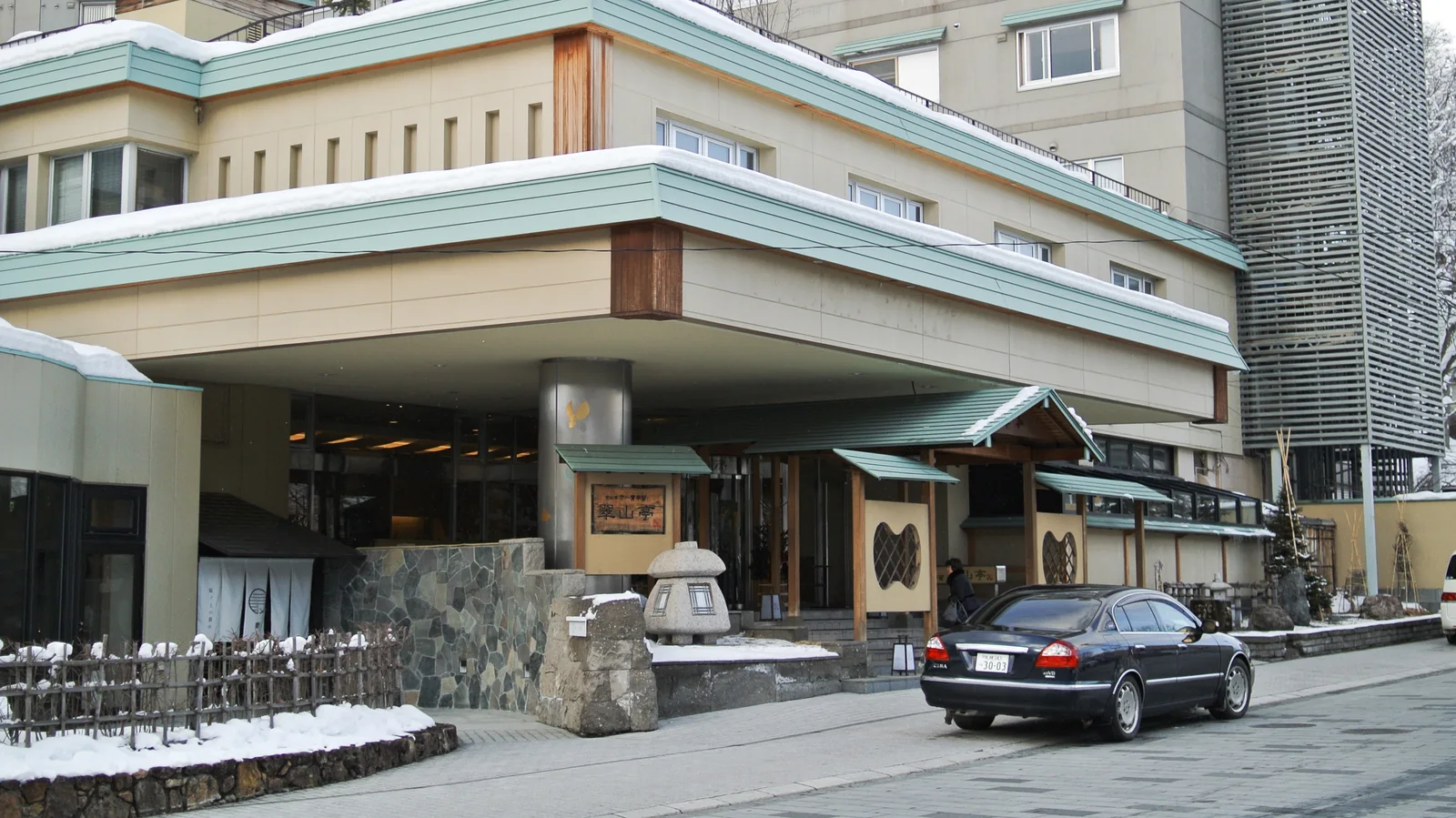
The district's 16 hotels fall naturally into three geographical zones. The front-row lakefront strip sits closest to the water and fireworks, led by Toyako Manseikaku Hotel Lakeside Terrace (21 Toyako Onsen; all-lake-view rooms, main baths aligned flush with the lake surface and a lakeside sauna zone) and The Lake View TOYA Nonokaze Resort (29-1 Toyako Onsen; all rooms facing Lake Toya and Mount Yotei from 36.8-square-metre standards to 112-square-metre suites, with infinity baths, a sky bath, private baths and pet-friendly rooms), joined by Toya Kanko Hotel, Hotel Grand Toya, Hokkai Hotel, Toya Kohantei, Gokirakutei, Toya Onsen Hotel Hanabi and Yutorelo Toyako — all sharing the appeal of watching the fireworks from bed.
Elevated and hillside properties trade proximity to the boardwalk for grander resort grounds. Perched on the eastern ridge (336 Shimizu), The Windsor Hotel Toya — now part of IHG's Vignette Collection — houses the 'Yamaizumi' hot spring, 9 dining venues, a golf course and the commemorative 'G8 Summit Suite', paired with the area's most generous schedule (15:00 JST check-in, 12:00 JST check-out). At the eastern end on the Sobetsu Town side (7-1 Toyako Onsen), Toya Sun Palace Resort & Spa, operated by the GRANBELL Group and marking its 20th anniversary in 2026, pairs all-lake-view rooms with its heated Water Land pool complex (closed for scheduled maintenance from 2 November to 18 December 2026 and 18 January to 28 February 2027). Newer upscale options include HOTEL COCOA RESORT, BOUROU LAKE TOYA and Premium Lake Toya.
Budget and hostel travellers are served by the 9 smaller properties on the official list, including TOYA CENTER VILLAGE, LAKE HOUSE AT TOYAKO, THE TOYA, KAMONOYA and Lakeside Inn Kojima. With free footbaths and hand baths dotted right along the shore, even guests skipping luxury resorts can enjoy lakeside soaking with ease. Because the association directory does not publish tariffs, check individual hotel websites or booking platforms for live availability and rates.
When comparing room rates, factor in the savings from hotel-operated shuttles. Manseikaku runs the 'Express Toya' coach for staying guests by advance reservation only, departing Sapporo Station North Exit at 13:15 JST (arriving 15:45 JST) and returning at 10:00 JST (arriving 12:30 JST) for just ¥1,100 one way or ¥2,200 return. Nonokaze operates a direct New Chitose Airport shuttle departing the airport at 14:00 JST and returning at 10:15 JST for ¥1,500 one way (discounted to ¥1,000 for guests booking via the official website or by phone; reservation required). Booking either property eliminates transfers and cuts transport costs substantially.
For a day-trip soak without staying overnight, matching the bath to your timetable and budget is straightforward: head to Hanabi for an early-morning lake view (05:00–09:00 JST), pick Manseikaku or Hotel Grand Toya for dusk views until 21:00 JST, choose Hokkai Hotel at ¥500 for the lowest entry price in town, or consider Sun Palace on weekends if travelling with children who want the pool. Most baths charge extra for towel rental (typically ¥300–¥400, often pricing face and bath towels separately), so keep small change handy if travelling light.
Each hotel's day-bathing offer has a clear niche. Yutorelo Toyako welcomes bathers from 15:00 to 20:00 JST with complimentary towels included, ideal for afternoon arrivals. Hanabi's 05:00 JST session lets you watch sunrise over the water. Manseikaku offers the fullest facilities across two windows (07:00–10:00 JST and 13:00–21:00 JST) including sauna and pool access, while Sun Palace charges ¥2,000 on weekends including its water park. The spread from ¥500 to ¥2,000 pays for amenities, views and hours — every bath draws from the same soothing chloride spring water.
If you pair your stay with a half-day trip up Mount Usu, sequencing saves energy and deepens the visit. The lower ropeway station has a 400-space car park (¥500 per day), and walking both summit trails (40 minutes and 60 minutes) takes roughly two hours; visitors short on time or stamina can stick to the 40-minute walk to the Toyako Observation Deck for full-lake views. Visiting the Volcano Science Museum in town first to trace the 1977 and 2000 eruptions makes seeing the actual craters from the summit all the more striking.
One geographical quirk to note for Sun Palace: despite its '7-1 Toyako Onsen' street address, it lies just across the municipal boundary in neighbouring Sobetsu Town rather than Toyako Town. Opened in 2006 and celebrating its 20th year in 2026, this large family favourite pairs the heated Water Land pool with all-lake-view baths, though families planning a swim trip should avoid the two winter pool-maintenance closures (2 November–18 December 2026 and 18 January–28 February 2027) and note that day-trip entry is restricted to weekends and selected public holidays.
Day-Trip Onsen and Free Baths: Soaking Without Staying Overnight
According to the tourism association's April 2026 day-bathing directory, 8 hotels welcome non-staying visitors: Manseikaku (07:00–10:00 JST and 13:00–21:00 JST; ¥1,200 weekdays, ¥1,500 weekends and holidays, including sauna and pool), Kohantei (13:00–19:00 JST; ¥1,200), Yutorelo Toyako (15:00–20:00 JST; ¥1,000 with free towel), Toya Kanko Hotel (¥700 morning, ¥1,000 afternoon), Hokkai Hotel (14:00–21:00 JST; ¥500 — the best-value entry in town), Hotel Grand Toya (13:00–21:00 JST; ¥600), Hanabi (05:00–09:00 JST and 12:00–20:00 JST; ¥800, a rare dawn option) and Sun Palace (weekends and holidays only, 10:00–15:00 JST; ¥2,000 with pool access). Expect ¥300–¥400 extra for towel hire at most properties, and check hours on arrival in case of scheduled bath maintenance.
You need not pay an admission fee to enjoy the water along the lake. Toryu-no-Yu, a 100% source-fed footbath opened in December 2003 right by the lakeside promenade, lets you soak your feet while gazing across the lake, complete with an original-towel vending machine beside it. Nearby, the Yakushi-no-Yu pocket park opened in November 2004 next to Yakushi Nyorai Hall, housing both a footbath and hand bath under an umbrella-shaped pavilion. Together with 10 roadside hand baths dotted through town, warm-up stops line the entire waterfront. Toryu-no-Yu closed briefly from 13 to 30 October 2026 for protective timber recoating (now reopened); any similar temporary maintenance notices are posted on the association's news page.
Step just behind the spa streets before or after a bath and you walk straight into an active volcanic landscape. The Konpira Crater Disaster Heritage Walking Path preserves buildings damaged in the March 2000 eruption, while the Nishiyama Sanroku Crater Walking Path runs along raised boardwalks past vents still wreathed in steam (currently safe and open for self-guided walks). Together with the Fountain Plaza at the town entrance and the Mount Usu Eruption Memorial Park to the west, the whole walking route turns into a hands-on geology trail across living volcanic ground.
Linking the free baths and crater trails makes an effortless half-day circuit: start along the shore at Toryu-no-Yu and Yakushi-no-Yu plus the street-side hand baths, then head up on foot while your legs are fresh to the Konpira and Nishiyama Sanroku crater paths to see how the 2000 eruption reshaped the hillside.
After walking the steaming Nishiyama boardwalks and the preserved ruins at Konpira, returning to the waterfront to sink into hot chloride spring water connects volcano and bathhouse not as museum plaques, but as something you feel from the soles of your feet upwards.
Usuzan Ropeway and G8 Legacy: Living Volcanoes Meet World Diplomacy
Riding the Usuzan Ropeway to the summit is the classic highlight of any Lake Toya itinerary. Located at 184-5 Showa Shinzan, Sobetsu Town (tel. 0142-75-2401), gondolas depart every 15 minutes roughly between 08:00 and 18:00 JST depending on the season, taking about 6 minutes each way. Return fares are ¥2,000 for adults (junior high school age and above) and ¥1,000 for children (with group and disability concessions), backed by a 400-space car park at the base. At the summit 'Volcano Village', visitors find a restaurant, a free eruption-simulation theatre and two scenic trails — roughly 40 minutes to the Toyako Observation Deck and around 60 minutes onwards to the Crater Basin Observation Deck. Overlooking both the caldera lake and smoking craters recalls Mount Usu's four 20th-century eruptions: 1910 (Meiji Shinzan), 1943–1945 (when Showa Shinzan rose straight out of wheat fields), 1977–1978, and 2000 (when accurate forecasting and early evacuation achieved zero fatalities).
At the foot of Showa Shinzan, the Mimatsu Masao Memorial Museum is equally worth a stop. Local postmaster and amateur volcanologist Masao Mimatsu documented the birth of Showa Shinzan from day one using his self-devised 'Mimatsu Diagram', recording the full growth profile of a lava dome rising out of flat farmland before presenting his work to the International Volcanological Congress in 1948 — a landmark of citizen science in global volcanology.
Back in the hot-spring quarter, the Volcano Science Museum beside the Visitor Centre (142-5 Toyako Onsen) focuses on the 1977 and 2000 eruptions; current opening hours are 10:00–16:00 JST (closed Mondays, or the following day if Monday is a public holiday, plus the New Year period), with admission at ¥800 for adults and ¥400 for children (disregard older municipal web pages still citing 09:00–17:00 and ¥600). Just steps away stands the free Hokkaido Toyako Summit Memorial Museum (09:00–17:00 JST; closed 31 December–3 January), housing the 2008 G8 conference table alongside the waterfront declaration monument — a striking juxtaposition of global summitry and active geology on the same street.
Getting There: Direct Sapporo Buses, JR Connections and Airport Routes
The easiest way from Sapporo straight into the hot-spring quarter is the Donan Bus Sapporo–Toyako Line (via Rusutsu and Nakayama Pass). Services are strictly reservation-only at ¥3,700 one way for adults, taking around 2 hours 40 minutes. Four daily return departures run from Sapporo Station-mae (07:40, 11:30, 14:10, 16:10 JST) and Toyako Onsen Bus Terminal (07:10, 09:50, 12:50, 17:10 JST); seats can be booked by phone (Toya Depot 0142-75-2351) or online up to two hours before the day's first departure. The official timetable PDF maps each hotel to its nearest stop: alight at Chuo-dori for Manseikaku and Yutorelo; Honmachi for Kohantei, Hanabi, Hotel Grand Toya and Nonokaze; Sakuramachi for Toya Kanko Hotel; and Toyako Onsen Terminal for Sun Palace, sparing you a long luggage haul.
By rail, take the JR Hokuto limited express from Sapporo Station to Toya Station (listed by Manseikaku as roughly 1 hour 54 minutes), then transfer to a Donan Bus for around 20 minutes to Toyako Onsen Bus Terminal (a taxi takes roughly 20 minutes and costs around ¥2,000). From New Chitose Airport via Minami-Chitose, the limited express takes around 1 hour 30 minutes; travelling north from Hakodate takes around 1 hour 30 minutes (another section of the tourism association's access page quotes roughly 2 hours depending on stopping patterns). By car, allow roughly 2 hours 10 minutes from Sapporo via National Route 230 and Nakayama Pass, or around 1 hour 45 minutes via the Do-O Expressway from Sapporo-Minami IC; from New Chitose Airport via the expressway, the drive takes about 1 hour 20 minutes.
Toyako Onsen Bus Terminal serves as the district's transport hub, bringing together Donan Bus routes, local connections and the Tourist Information Centre (open 09:00–17:00 JST, Japanese and English, tel. 0142-75-2446). Stepping inside upon arrival to confirm evening fireworks status and Usuzan Ropeway operations is the smartest start to your visit; paired with Noboribetsu Onsen, the two towns form central Hokkaido's classic twin hot-spring circuit.
If arriving by JR at Toya Station, note that the final 20-minute shuttle bus typically runs every 30 to 60 minutes — check the Toya Station departure timetable on the tourism association's access page beforehand to avoid a long wait on the forecourt. Parties of three or four will often save time by taking a ¥2,000 taxi straight to their hotel. Once in town, pick up walking maps and daily notices at the Tourist Information Centre beside the terminal before setting out.
Drivers pay ¥500 per day at the Usuzan Ropeway car park, and most hotels along the spa strip provide dedicated guest parking. During fireworks season, waterfront traffic builds sharply around the 20:45–21:05 JST show, so leave your car at the hotel and walk down to the lake; post-show traffic takes roughly 30 minutes to clear. In winter, National Route 230 over Nakayama Pass is prone to heavy snow and black ice — taking the Do-O Expressway between Sapporo-Minami IC and Abuta-Toyako IC is far safer.
Across the calendar, the 28 April–31 October fireworks season is peak time, requiring early booking for both lakefront hotels and reservation-only coaches. From November to late April, quieter off-season rates invite unhurried snowy outdoor soaks and crater walks, while summer evenings add the lakeside illumination tunnel. Whenever you visit, the free waterfront paths and footbaths remain open year-round, keeping Lake Toya one of central Hokkaido's most dependable hot-spring retreats.
A few useful answers
When do the Toyako Long-Run Fireworks take place, and how can you watch them?
The 45th edition runs nightly from 28 April to 31 October 2026 between 20:45 and 21:05 JST for roughly 20 minutes, going ahead in rain and cancelled only for unsafe wind speed or direction. You can watch in four ways: aboard the Fireworks Viewing Boat (departing 20:30 JST from a pier roughly two minutes' walk from lakefront hotels, no booking required; contact Lake Toya Kisen for fares), for free along the lakeside promenade, from a hotel rooftop open-air bath, or directly from an all-lake-view guest room (the launch barge passes directly in front of the main hotels around 20:50 JST).
How should you choose accommodation in Toyako Onsen?
The official directory covers 16 hotels and 9 guesthouses. For front-row fireworks views, pick the lakefront strip — such as Manseikaku Hotel Lakeside Terrace (all-lake-view rooms plus a lakeside sauna) or Nonokaze Resort (all-lake-view rooms, infinity baths and 36.8–112-square-metre layouts). Up on the ridge, The Windsor Hotel Toya offers the G8 Summit Suite, while Sun Palace on the Sobetsu side pairs lake-view rooms with a heated pool (note scheduled winter maintenance closures). Factor in shuttle savings too: Manseikaku runs a Sapporo Station coach (¥1,100) and Nonokaze operates a New Chitose Airport shuttle (¥1,500, or ¥1,000 when booking direct by website or phone).
Can day visitors use the hot springs without staying overnight, and how much does it cost?
Yes. Eight properties offer day-trip bathing on the official list: Hokkai Hotel at ¥500 (the lowest rate), Hotel Grand Toya at ¥600, Hanabi at ¥800 (with an 05:00 JST morning session), Toya Kanko Hotel at ¥700 morning / ¥1,000 afternoon, Manseikaku at ¥1,200 weekdays / ¥1,500 weekends and holidays, Kohantei at ¥1,200, Yutorelo at ¥1,000 (towel included), and Sun Palace on weekends and holidays only at ¥2,000 (with pool access). In addition, 2 footbaths (Toryu-no-Yu and Yakushi-no-Yu) and 10 hand baths are completely free.
How do you get to Toyako Onsen from Sapporo or New Chitose Airport?
The most convenient option from Sapporo Station-mae is the reservation-only Donan Bus Sapporo–Toyako Line (¥3,700 one way, around 2 hours 40 minutes), with four daily departures (07:40, 11:30, 14:10 and 16:10 JST) dropping passengers at hotel-specific stops listed on the official timetable. By rail, take the JR Hokuto limited express to Toya Station (roughly 1 hour 54 minutes) and transfer to a 20-minute Donan Bus into town. From New Chitose Airport, the rail journey via Minami-Chitose takes roughly 1 hour 30 minutes, or about 1 hour 20 minutes by car via the Do-O Expressway.
Official information and references
Sources used in this guide.
- Toyako Onsen Tourism Association | Long-Run Fireworks Display (45th Edition, 28 Apr–31 Oct, Nightly at 20:45 JST, J-Credit Offset)
- Toyako Onsen Tourism Association | Accommodation Directory (16 Hotels, 9 Guesthouses & Official Links)
- Toyako Onsen Tourism Association | Hot Spring Facts (Opened 1910, 12 Source Wells, 10 Hand Baths & 2 Footbaths)
- Toyako Onsen Tourism Association | Toya-Usu UNESCO Global Geopark (Toya Caldera & Birthplace of Modern Volcanology)
- Toyako Onsen Tourism Association | Day-Trip Bathing Guide PDF (8 Properties, Hours & Rates, April 2026)
- Toyako Manseikaku | Hotel & Express Toya Shuttle (Departs Sapporo Station North Exit 13:15 JST, ¥1,100)
- The Lake View TOYA Nonokaze Resort | Rooms & Seasonal Guide (All-Lake-View, Four Fireworks Views & Airport Shuttle)
- Usuzan Ropeway | Hours & Fares (¥2,000 Return, Summit Volcano Village & Observation Decks)
- Toyako Volcano Science Museum | Current Visitor Information (10:00–16:00 JST, Closed Mondays, Adults ¥800)
- Donan Bus | Sapporo–Toyako Line Timetable PDF (Reservation-Only, ¥3,700, Hotel-Specific Stops)
- Toyako Onsen Tourism Association | Access Guide (JR, Bus, Car & Tourist Information Centre)
- Toyako Onsen Tourism Association | News (Toryu-no-Yu Footbath Temporary Closure Notice)