Wondering which month to visit Showa Kinen Park and which gate to use? Here is how to reach it via Tachikawa, Nishi-Tachikawa, and Sunagawa, plan half-day walks around tulips, hydrangeas, cosmos, or winter plum blossoms, and choose between cycling, children's play areas, or lakeside strolls.
- Region & Focus
- Tokyo
- Reading Scope
- 16 min read · 13 chapters · 6 Q&As
- Official Verification
- 23 official sources checkedUpdated 22 November 2026
- Key Topics
- SeasonsItinerariesRail travel
Chapter Route Map (tap any stop)
- Pick the Month First, Then Match the Flower Zone on the Map
- Three Acts of Spring: Cherry Blossoms, Tulips, and Flower Hill
- June in the Flower & Tree Garden, and Keeping Midsummer Near Nishi-Tachikawa
- Golden Slopes in September, Pink Cosmos and Kochia in October
- Ginkgo Gold in November, Then Simple Winter Strolls
- By JR from Shinjuku: Pick Your Station and Gate Before Setting Off
- One-Way Half-Days vs. Same-Gate Loops
- Cycling Covers Ground Fast—Budget Time for Parking and Returning Bikes
- Park Train and Step-Free Routes
- Toddlers on the Southern Lawn, Older Kids in the Children's Forest
- The Japanese Garden, Bonsai, and Musashino Farmhouses as Standalone Highlights
- Tickets, Opening Hours, and Lunch on One Timeline
- Linking Your Half-Day Back to Central Tachikawa via the Tachikawa Gate
- Quick Q&A
For a first visit to Showa Kinen Park when you can choose your dates, early to mid-April pairs the tulips near the Nishi-Tachikawa Gate with a picnic on the central lawn. In September, yellow cosmos blanket the slopes just minutes from the Sunagawa Gate on the park's north side. Travelling with toddlers or older relatives, you can easily build a half-day around the Waterfowl Pond, Flower & Tree Garden, and the play area on the southern edge of the Great Lawn. Because the main flower fields sit well inside the paid gates, factor in the post-entry walk from the station when planning your route.
Pick the Month First, Then Match the Flower Zone on the Map
Straddling Tachikawa and Akishima on the site of the former Tachikawa Airfield, Showa Kinen Park covers around 180 hectares according to official figures. Entering from the Tachikawa side brings you straight to the formal canal and fountains, while the Nishi-Tachikawa side meets the Waterfowl Pond. Three flower zones surround the central Minna no Harappa (Great Lawn), with Flower Hill, the Japanese Garden, and the Children's Forest tucked further north. Navigating to the specific garden area you want to see is far easier than searching for the park's main street address.
Use an annual bloom calendar to pick your travel month, then during the week of your trip open the park's Hanadayori flower report to choose your entrance by the latest photo dates, named zones, and peak status. When an update notes flowers are just beginning to open, hold off for fresher photos before committing a half-day; once a display is marked past peak, switch to whatever neighbouring plot is coming into bloom. If a single post lists several flowers, check the location label under each image rather than assuming they share the same path.
A sensible half-day pairs one headline display with a nearby rest stop, adding another field on the same side of the park if you have time. For a full day, tackle the furthest or highest-priority zone in the morning, pause near the central lawn for lunch, and work back towards your exit gate in the afternoon. The Flower & Tree Garden and Waterfowl Pond make easy turn-around loops, whereas Flower Hill sits far enough north that walking there and back from Nishi-Tachikawa takes over an hour gate to gate.
| Timing | What to See | Where to Check First |
|---|---|---|
| Late March to mid-April | Somei-Yoshino cherry blossoms followed by tulips | Sakura no Sono, Kyu-Sakura no Sono, Stream Square |
| Mid-April to May | Nemophila or poppies, depending on the year's planting | Harappa West Flower Field, Flower Hill |
| June to August | Japanese irises, hydrangeas, lotuses, or sunflowers | Flower & Tree Garden, Waterfowl Pond area, designated seasonal fields |
| September to October | Yellow cosmos, pink cosmos, and kochia (summer cypress) | Flower Hill, Harappa East Flower Field, Herb Hill |
| November | Golden ginkgo trees and crimson maples in the Japanese Garden | Canal, Katarai Ginkgo Avenue, Japanese Garden |
| December to February | Wintersweet and plum blossoms, plus winter aconite and Amur adonis in late winter | Around Waterfowl Pond, Flower & Tree Garden Plum Grove, Komorebi no Sato |
Wondering which month to visit Showa Kinen Park and which gate to use? Here is how to reach it via Tachikawa, Nishi-Tachikawa, and Sunagawa, plan half-day walks around tulips, hydrangeas, cosmos, or winter plum blossoms, and choose between cycling, children's play areas, or lakeside strolls.
Three Acts of Spring: Cherry Blossoms, Tulips, and Flower Hill
From late March to mid-April, the park's headline cherry blossom spots are Sakura no Sono beside the Great Lawn and Kyu-Sakura no Sono near the Flower & Tree Garden. In Sakura no Sono, low-hanging branches on mature trees make an easy spot to pause, meet up, or spread a picnic sheet, which suits families with children keen to run around the adjacent lawn. For a lakeside stroll alongside the blossoms, enter via the Nishi-Tachikawa Gate and follow the Waterfowl Pond towards Kyu-Sakura no Sono.
For tulips, head straight for the Tulip Garden at Stream Square (Keiryu Hiroba). For the 2026 Flower Festival, the park scheduled tulips for early to mid-April with 260 varieties planted; by 9 April, the official flower report showed tulips at peak while the Somei-Yoshino cherries had already passed theirs, leaving late-blooming varieties for blossom hunters. Colour bands wind along the curved stream so standing on the opposite bank frames water, greenery, and petals together. Official walking estimates are about 10 minutes from the Nishi-Tachikawa Gate or 25 minutes from the Tachikawa Gate, counted after ticket entry. Starting at Nishi-Tachikawa lets you enjoy the stream first and continue to the central lawn for family photos or lunch if the blooms are at their best.
From late April into May, shift your attention to the Harappa West Flower Field and Flower Hill to the north. In 2026, spring reports placed nemophila in the west lawn field from roughly mid-April to mid-May, while Flower Hill featured May-blooming corn poppies and baby's breath. Check the current season's planting map before you set off: when nemophila is at its best, linking Nishi-Tachikawa, Stream Square, and the central lawn flows naturally, whereas a hillside of poppies in full bloom makes a half-day from the Sunagawa Gate much easier than marching north across the whole park.
Cherry blossoms and tulips occasionally overlap in early April. If one is your main reason for visiting, put it first after the gate so you can linger on the lawn and shorten your second stop if needed, rather than looping the far side of the park first and running short on time along the canal. Stream-side paths can get slick after rain, so wear grippy shoes and keep out of the main walkway when pausing for photos.
June in the Flower & Tree Garden, and Keeping Midsummer Near Nishi-Tachikawa
Once the rainy season arrives, a walk from the Nishi-Tachikawa Gate into the Flower & Tree Garden (Kabokuen) rewards you with waterside blooms. The park's calendar places Japanese irises from mid-May to mid-June in both the Flower & Tree Garden iris field and the Japanese Garden, while the hydrangea path running from the northern slope of Fureai Hiroba to the Flower & Tree Garden Exhibition Building typically blooms from mid-June to mid-July. When the two overlap, use the exhibition building as a midpoint, follow the hydrangea path to Fureai Hiroba, and loop back towards the Waterfowl Pond.
From mid-June to mid-July, many visitors come specifically for lotus flowers. Look for pond-grown lotuses at Komorebi no Sato, alongside potted displays at Sazanami Hiroba. The Flower & Tree Garden iris pond also grows water lilies, distinguished by their notched floating leaves. Because the park recommends viewing both lotuses and water lilies in the morning, put them first on your itinerary and head for shade or step out for lunch before midday—especially handy if children need an afternoon nap.
Sunflowers are worth checking against that year's field notice before you go. In 2026, large-headed varieties were planted in part of the Harappa South Flower Field and had already passed their peak by the 6 August report, while smaller multi-headed 'Apollo' sunflowers lasted longer. Always verify recent photos for the large varieties if a golden wall of blooms is what you want. For a shorter midsummer walk from late July onwards, the crape myrtles on the northern slope of the Canal make a quick one-hour out-and-back from the Tachikawa Gate.
Both the former Rainbow Pool and Water Play Square are permanently closed, with new waterside play facilities currently planned around the Akishima Gate. For a summer family half-day, focus instead on the lakeside, playgrounds, and shaded lunch tables. In the Children's Forest, the Mist Forest and spraying entrance plaza offer cooling relief when operating—pack a small towel and a spare set of clothes, or plan a dedicated swimming pool trip elsewhere if the children want proper swimming. On hot days, staying close to the Nishi-Tachikawa Gate makes an early return to the train far easier than trekking across Flower Hill and the full lawn.
Golden Slopes in September, Pink Cosmos and Kochia in October
The park's 2026 cosmos guide splits autumn displays across separate zones. Yellow 'Lemon Bright' cosmos on Flower Hill are forecast from mid-September to early October and offer the clearest sweeping hillside view. Reaching the base takes roughly four minutes from the Sunagawa Gate, letting you judge the floral carpet from below before deciding whether to climb the open paths. Even with a pushchair or limited time, the foot of the slope delivers huge swathes of colour, and Komorebi no Sato lies nearby if you want a change of scenery without crossing the Great Lawn.
Pink 'Sensation' cosmos were planted alongside red buckwheat in the Harappa East Flower Field for October in 2026. In early October that year, however, prolonged rain and low sunshine prompted the park to relocate related field events elsewhere—another reason to rely on current-week photos rather than seasonal calendars alone. Meanwhile, the mixed autumn beds along the southern edge of the Great Lawn bloom from late August into October, making them an easy check if you are already near the southern play equipment.
Kochia (summer cypress) grows on Herb Hill, where timing depends on which colour stage you prefer. The 2026 schedule spans August to mid-October, with foliage shifting from lime green to crimson from mid-September onwards. If recent photos show only scattered red patches, green-orb fans will still enjoy the view, whereas anyone holding out for a solid red hillside should wait for updated reports or pivot to another field already at peak.
To see two autumn zones in one day, circle Flower Hill, Herb Hill, and the Great Lawn on the park map first. If Flower Hill is peaking, start at the Sunagawa Gate and walk south to decide whether to exit via Nishi-Tachikawa or Tachikawa. If the east flower field and a lawn picnic are your priority, enter at Nishi-Tachikawa, head east after lunch, and return the same way. Keen photographers can linger in one field for better light while keeping the second spot optional for anyone still keen to walk.
Ginkgo Gold in November, Then Simple Winter Strolls
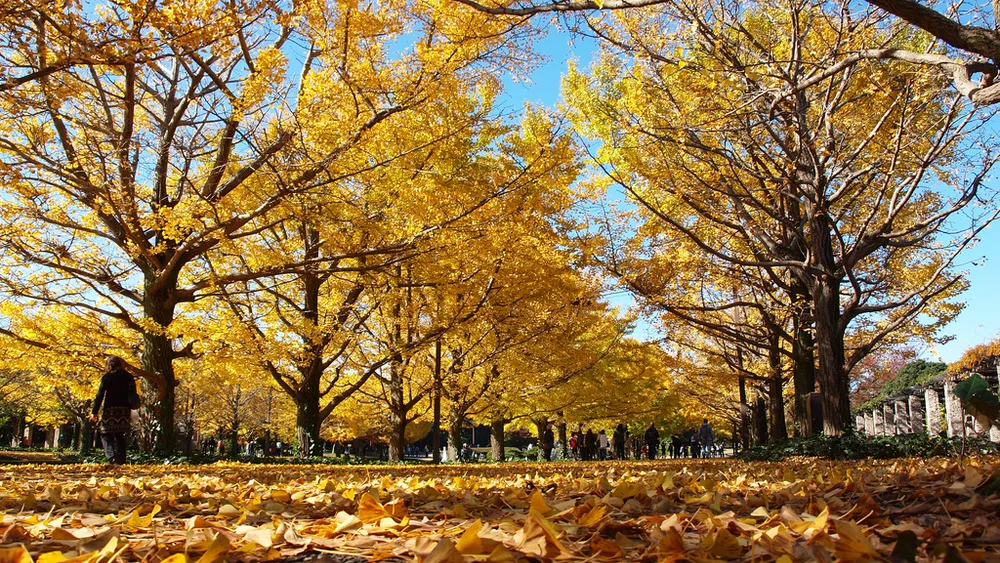
Checking autumn foliage requires watching three distinct spots: the Canal ginkgo avenues near the Tachikawa Gate, Katarai Ginkgo Avenue accessed more easily from Nishi-Tachikawa, and the maples framing the ponds and wooden bridges of the Japanese Garden. On 19 November 2026, the park's report noted that wind and rain had pushed both main ginkgo avenues past peak with heavy leaf fall, yet ginkgos by the play zone and maples in the Japanese Garden remained vibrant. Visit earlier for glowing canopies, or slightly later for golden carpets underfoot and lakeside reflections.
In 2026, the Autumn Night Walk ran from 29 October to 29 November, with illuminations from 16:30 to 20:30 and closing at 21:00. Only the Tachikawa and Nishi-Tachikawa gates stay open in the evening; standard park admission covers both illuminated ginkgo avenues, while Japanese Garden night entry is included on 29–31 October and requires a separate viewing ticket on all other dates. If you are planning an evening visit, read our Showa Kinen Park ginkgo and Autumn Night Walk ticket guide to sequence open gates, timed garden slots, and walking distances—especially if you arrive via Sunagawa by day and need to exit at the south end after dark.
From December through February, plan shorter walks around winter blooms. Wintersweet (soshin robai) typically flowers from late December to mid-February near Komorebi Pond and south of the barbecue area. Plum blossoms in the Flower & Tree Garden run from mid-January to mid-March across early and late cultivars, with low-growing yellow Amur adonis appearing beneath them in February. Tiny winter aconite blooms can also be spotted around the Komorebi no Sato rest house, about a five-minute walk from the Sunagawa Gate—check recent flower-report photos to pinpoint exact patches.
Winter itineraries work best kept simple. Enter via Nishi-Tachikawa for the Waterfowl Pond and Plum Grove, turning back early if a cold wind picks up or extending to the Japanese Garden if the weather is mild. Alternatively, enter at Sunagawa for winter aconite, fields, woodland, and restored farmhouses. From November to February the main park generally closes at 16:30, and both the Japanese Garden and Bonsai Garden shut 30 minutes earlier, so visit those around lunchtime and save a lakeside or Flower & Tree Garden stroll near the exit for last.
By JR from Shinjuku: Pick Your Station and Gate Before Setting Off
From Shinjuku, take the JR Chuo Line Rapid to Tachikawa and change to the Ome Line one stop to Nishi-Tachikawa for the shortest walk to the park; selected trains run straight through onto the Ome Line, so check platform and carriage boards before boarding. Exiting Nishi-Tachikawa Station via the Park Exit puts you at the Nishi-Tachikawa Gate in about two minutes, making it ideal for the pond, tulips, plum grove, central lawn, and families wanting to reach play space fast. Store bulky luggage in station lockers first, as walking inside the park far exceeds the trip from the platform.
Get off at Tachikawa Station instead if you want to pick up bento boxes, dine locally afterwards, or focus on the Canal. Official walking times from Tachikawa's North Exit are roughly 10 minutes to the free Midori no Bunka Zone via the Akebono Gate, and about 18 minutes to the paid Tachikawa Gate. If your map app routes you to the free lawn first, you have reached the eastern edge of the park—follow signs for Tachikawa Gate to reach the ginkgo canal and cycle hire.
For Flower Hill or Komorebi no Sato without a long cross-park trek, catch a bus from Tachikawa Station North Exit. Park guidance directs travellers to Bus Stop 2 for services stopping at Showa Kinen Park Sunagawa-guchi, followed by a two-minute walk to the gate. You can also take the Seibu Haijima Line to Musashi-Sunagawa Station, roughly 20 minutes on foot from the Sunagawa Gate. If anyone in your group dislikes waiting at bus stops, saving the return timetable and stop name in advance avoids more fatigue than a slightly longer walk.
Drivers should likewise pick a car park to match their route. Tachikawa, Nishi-Tachikawa, and Sunagawa gates each have car parks charging ¥900 per day for standard cars; none accept advance bookings, though live space availability is posted on the park's homepage during peak spring and autumn weekends. If your plans centre on the north end, parking at Sunagawa avoids pushing a pram across the whole grounds; stick to Tachikawa for the free zone and canal, or Nishi-Tachikawa for the pond and Flower & Tree Garden. On the day, presenting your dated parking receipt lets you move between car parks or re-enter.
One-Way Half-Days vs. Same-Gate Loops
To minimise train changes and walking, enter and leave via Nishi-Tachikawa and choose two highlights from the Waterfowl Pond, Stream Square, and the Flower & Tree Garden. Official gate-to-spot estimates from Nishi-Tachikawa are roughly three minutes to the pond, nine minutes to the Flower & Tree Garden, and ten minutes to Stream Square. Remember those timings start from the gate rather than measuring distances between sights—the pond itself is wide, so pinpoint the boathouse, restaurant, or iris beds on the map before setting off.
If everyone is happy walking, a classic spring route enters at Nishi-Tachikawa for the tulips, pauses on the Great Lawn at midday, and exits along the Canal through the Tachikawa Gate in time for dinner near the station. Each stop brings you closer to your train home, and even a long lawn picnic leaves the Canal as a gentle farewell stroll. If you decide after lunch to climb north to Flower Hill and still return south, consider dedicating a separate morning from the Sunagawa Gate instead.
A northern-focused day pairs Flower Hill and Komorebi no Sato from the Sunagawa Gate in the morning, adding the Japanese Garden or Children's Forest in the afternoon if energy holds. Before committing to exit at Nishi-Tachikawa at the far end, factor in the return leg: Flower Hill is officially a four-minute walk from Sunagawa versus around 33 minutes from Nishi-Tachikawa. If the afternoon turns chilly or children and older relatives tire, a quick snack and return via Sunagawa is far kinder than forcing a full north-to-south traverse.
Even with just three hours to spare after morning plans in central Tokyo, a visit is still worthwhile. Subtract gate-to-bloom walking time and your return buffer first, leaving the remainder for photos and drinks. Right up to closing time—especially in winter or with pushchairs and older companions—working backwards from your final stop on the official park map avoids an extra crossing of the Great Lawn.
Cycling Covers Ground Fast—Budget Time for Parking and Returning Bikes
Hire bikes are ideal for linking the western flower fields, central lawn, and northern gardens. Around 14 kilometres of dedicated cycle paths wind through the park, marked separately from pedestrian walkways and numbered bicycle bays on the park map. Before pedalling off, note the two 'P' parking bay numbers near your targets, lock your bike strictly inside marked zones before walking into the Japanese Garden, tulip beds, playgrounds, or lawn, and never ride on foot-only paths.
Cycle hire centres operate at the Tachikawa, Nishi-Tachikawa, and Sunagawa gates, and every bike must be returned to the exact station where you hired it. Standard adult bikes cost ¥600 for three hours (¥350 for junior high school age and under), with overtime charged per 30 minutes at ¥100 and ¥50 respectively. Counters normally open at 09:30, with last hire one hour before park closing and mandatory return 30 minutes before closing; on a 16:30 winter closing day, that means hiring by 15:30 and returning by 16:00, so set an alarm for whichever cut-off comes first.
Use a three-hour rental to ride out to your furthest stop first, then drift back towards your home gate. From Nishi-Tachikawa, start at either the Japanese Garden or Flower Hill, park to explore on foot, and ride back to the Great Lawn for a picnic. If part of your group wants to stay on after lunch, return all bikes together first and switch to an easy lakeside stroll—remember the three-hour clock keeps ticking while you look for bike racks, queue for drinks, or eat.
Parent-and-child bikes carry weight limits of 15 kg on the front seat and 21 kg on the rear, while solo children's bikes start at 18-inch frames and tandems require riders at least 140 cm tall. Hire centres can store folded pushchairs, though helmet stock is limited so bringing your own saves time. Children who need stabilisers or are still learning cannot use the cycle lanes—stick to walking and playgrounds instead, and check live fleet availability by gate on the park's homepage before you arrive.
Park Train and Step-Free Routes
To save legs, ride the Park Train after checking the day's timetable and stop map. Single-ride fares are ¥400 for adults and ¥200 for children aged four through junior high, valid for one circuit from your boarding stop; getting off mid-way requires another ticket to reboard. Check whether day passes are on sale if you plan multiple hops, as they can be suspended on busy days and you will still need to queue in order. Carry cash for daytime Park Train fares, noting that Autumn Night Walk shuttle buses follow separate payment rules.
Folded pushchairs and wheelchairs fit aboard the Park Train, and each train can carry one passenger seated in their wheelchair. For wheelchair users, treat the train as an optional boost rather than a necessity by starting at the gate closest to your top sight—just three minutes from Nishi-Tachikawa to the Waterfowl Pond—and checking the park's gradient map and accessible toilet locations beforehand so no one gets stranded waiting for a ride.
Free wheelchairs are lent first-come, first-served at entry gates and must be returned to the same gate, making single-gate itineraries best. From Nishi-Tachikawa, you can comfortably link the lakeside, rest pavilions, and Flower & Tree Garden; extending north to the Japanese Garden adds roughly a 20-minute walk from the gate plus the pond circuit inside. If the Japanese Garden is your primary target, Sunagawa sits about 15 minutes away on the official map, where the gradient chart helps you choose smoother paths.
For multi-generational groups, agree on a sharper meeting point than 'by the Great Lawn', which stretches roughly 400 metres across. Pick the iconic single zelkova tree, the southern kiosk, or a named Park Train stop, set a clear return time when splitting between the Japanese Garden and the lakeside, and regroup near your exit gate so nobody has to trek back across the park for a single stray photographer.
Toddlers on the Southern Lawn, Older Kids in the Children's Forest
With a pushchair, head first to the Wanpaku Yugu playground beside the Great Lawn, roughly a 13-minute walk from the Nishi-Tachikawa Gate. Multi-play structures, slides, and swings sit close together right next to grass where parents can rest. If a little one is still napping on arrival, stroll along the Waterfowl Pond first before deciding whether to continue to the lawn; small packs of nappies are sold at the lawn's southern kiosk and selected gates, and family facility listings show the nearest changing and nursing rooms.
School-age children keen to climb or bounce should head straight for the Children's Forest (Kodomo no Mori), about 25 minutes from Nishi-Tachikawa, 23 minutes from Sunagawa, and 35 minutes from Tachikawa. The giant white Cloud Sea Trampoline is open to junior high students and younger, while the Rainbow Hammock is limited to primary school age and under; both may close when surfaces are wet. Pair them with the Forest Fortress, slides, Moon Hill, and family rest rooms inside Mori no Ie, tackling the forest first if playground time is top priority and saving flower beds for later.
The Children's Forest generally closes 30 minutes before the main park, and the Cloud Sea Trampoline shuts 45 minutes early, so count backwards from those cut-offs if arriving in the afternoon. When damp weather closes the trampoline, check the Woodcraft Workshop—open to primary and junior high pupils on a first-come basis on weekdays, with volunteer-led craft sessions on weekends and public holidays—while younger siblings relax at Mori no Ie or return to the closer lawn playground rather than waiting around.
Keep summer family bags light: water, hand towels, and spare clothes cover lakeside and lawn stops, adding spare shoes and socks if lingering in the Mist Forest. At the Waterfowl Pond boathouse, children aged nine and under must ride with someone aged 16 or over; rowing boats seat three and pedal boats seat two, so a family of four should plan boat pairings ahead of time. With wide age gaps, one adult can take older children boating while the rest wait comfortably beside the boathouse near the Nishi-Tachikawa Gate.
The Japanese Garden, Bonsai, and Musashino Farmhouses as Standalone Highlights
Between peak flower seasons, build your visit around the six-hectare strolling Japanese Garden, laid out around a central pond with bridges, pavilions, and sculpted trees visible from every angle. Save daytime hours for the adjacent Bonsai Garden to study five-needle pine trunks, surface roots, and silhouettes before looping back to the wooden bridges. Picnic mats, tents, and pets are barred inside the Japanese Garden; bring water for hydration, and eat proper meals outside at the lawn or nearby kiosks.
For a taste of rural Musashino between 1955 and 1964, walk beside Flower Hill to Komorebi no Sato, where paddy fields, embankments, farmhouses, and homestead groves contrast sharply with formal flower beds. The farmhouse area closes on Mondays (or the following weekday if Monday is a public holiday) and opens from 10:00 until 16:00 March–October and 15:30 November–February; arriving late afternoon still lets you see seasonal blooms along the fields and rest house.
If woodland paths appeal more than open lawns, climb the gentle slopes of Komorebi no Oka, a restored Musashino coppice hill paired with wildflower displays at nearby Komorebi no Ie. Stepping from bright flower fields into shaded understorey flora makes a refreshing change of pace, and at roughly 10 minutes from the Sunagawa Gate it forms a tidy finale before catching a bus back to Tachikawa.
Tickets, Opening Hours, and Lunch on One Timeline
Standard admission is ¥450 for senior high school students and adults, ¥210 for seniors aged 65 and over (proof of age may be requested), and free for junior high school students and younger. Two-day consecutive passes cost ¥500 for adults and ¥250 for seniors 65+, letting you split flower viewing and the Children's Forest across two days or revisit a display hitting peak. Ask gate staff for a same-day re-entry stamp or slip if stepping out for lunch, and note that trains, parking, bike hire, and the Park Train are charged separately.
Paid zones normally open at 09:30 and close at 17:00 on most days from March to October, extending to 18:00 on weekends and public holidays from April to September, and closing at 16:30 from November to February. The park closes on 31 December, 1 January, and the third Monday to Friday of January. Because individual facilities close earlier and events can alter gates or hours, check the opening calendar and homepage notices on the morning of your visit.
The simplest lawn picnic pairs easy-to-share rice balls, bento boxes, and bottled drinks picked up around Tachikawa Station with a picnic sheet pitched clear of walkways. Carrying lunch one stop on the Ome Line to Nishi-Tachikawa saves hauling food all the way to Flower Hill. Prefer to travel light? Cafés and kiosks operate near the lake, south edge of the Great Lawn, and Stream Square, with extra shops at the Children's Forest and Sunagawa Gate if heading north after lunch.
If rain threatens, pair indoor galleries in the free Midori no Bunka Zone on the Tachikawa side—such as the Hanamidori Cultural Centre—with a short walk near the gate. Inside the paid park, match a sheltered seating area with an adjacent loop so you can duck out quickly, or wait for rain to clear and enter via Nishi-Tachikawa for the pond and Flower & Tree Garden, saving a proper lawn picnic for a sunny day.
Dogs are welcome on leads after completing a pet entry pledge at the gate, using lakeside and permitted paths while staying out of the Japanese Garden. Small dome tents up to two metres wide are permitted in designated lawn areas, provided they use no ground pegs and are not open tarps; for shade and lunch without extra gear, existing tree cover or park cafés remain the easiest option.
Linking Your Half-Day Back to Central Tachikawa via the Tachikawa Gate
When pairing a morning in the park with afternoon shopping or dining in Tachikawa, enter at Nishi-Tachikawa and exit via the Tachikawa Gate around lunchtime. From the Great Lawn, follow the Canal past the paid gate straight into the free Midori no Bunka Zone, home to the Yume Hiroba lawn and the Hanamidori Cultural Centre depending on the day's schedule. Anyone heading back to the city early can also walk straight to Tachikawa Station North Exit via the Akebono Gate without needing to regroup inside the paid zone.
If you only have two or three hours for flowers, enter and exit via the Sunagawa Gate to cover Flower Hill and Komorebi no Sato before riding back to Tachikawa for a meal. Planning Mount Takao on the same trip? Keep them on separate mornings—blossoms and a picnic easily fill half a day, leaving fresh legs for choosing your trail turnaround on Takao another day.
With time to spare between trains, the Akebono Gate is a 10-minute walk from Tachikawa Station North Exit, putting Yume Hiroba two minutes beyond it and the Hanamidori Cultural Centre five minutes inside. The centre generally opens until 17:00 from March to October and 16:30 from November to February, offering Tachikawa sightseeing leaflets and exhibition space—handy as a dry meeting point before walking back to the station together.
A few useful answers
Which gate should first-time visitors use for Showa Kinen Park?
For a typical half-day, use the Nishi-Tachikawa Gate, a two-minute walk from JR Ome Line Nishi-Tachikawa Station. Choose the Sunagawa Gate for Flower Hill, or the Tachikawa Gate if you want Tachikawa shopping or the Canal ginkgos first.
When is the best time to see tulips?
Aim for early to mid-April and check the park's Hanadayori flower report beforehand. The Tulip Garden sits at Stream Square, about a 10-minute walk inside from the Nishi-Tachikawa Gate.
Do you need to hire a bicycle?
Walking is fine if you are sticking to the pond, Flower & Tree Garden, or Great Lawn. If you want to add Flower Hill or the Japanese Garden to the north, hiring a bike cuts transit time—just remember you must return it to the same hire centre.
Is the Rainbow Pool still open at Showa Kinen Park?
No—both the Rainbow Pool and Water Play Square are permanently closed. For a summer family visit, the Children's Forest features the seasonal Mist Forest and spraying water plaza alongside lawns and playgrounds.
Are there winter illuminations at the park?
For 2026, ginkgo and Japanese Garden illuminations take place during the Autumn Night Walk from 29 October to 29 November. From December to February, visit during daytime hours for plum blossoms, wintersweet, winter aconite, or the Bonsai Garden.
Do senior high and junior high students pay the same admission?
No. Standard admission is ¥450 for senior high school students and adults, while junior high school students and younger enter free. Bike hire, boating, and the Park Train cost extra.
Official information and references
Sources used in this guide.
- Showa Kinen Park | Park History and Zones
- Showa Kinen Park | Gate Access and Parking
- JR East | Tachikawa Station Chuo and Ome Line Timetables
- Showa Kinen Park | Park Map and Walking Times
- Showa Kinen Park | Opening Hours and Closed Days
- Showa Kinen Park | Individual Facility Closing Times
- Showa Kinen Park | Admission, Bike Hire, Park Train, and Boating Fees
- Showa Kinen Park | Seasonal Flowers and Plants
- Showa Kinen Park | Hanadayori Bloom and Foliage Updates
- Showa Kinen Park | 2026 Spring Flower Festival Field Map
- Showa Kinen Park | 9 April 2026 Spring Bloom Report
- Showa Kinen Park | 6 August 2026 Sunflower Bloom Report
- Showa Kinen Park | 2026 Cosmos Bloom Schedule and Field Map
- Showa Kinen Park | 2026 Autumn Night Walk and Japanese Garden Night Entry
- Showa Kinen Park | 19 November 2026 Ginkgo and Maple Foliage Report
- Showa Kinen Park | Cycle Hire and Dedicated Bike Paths
- Showa Kinen Park | Children's Forest (Kodomo no Mori)
- Showa Kinen Park | Park Train Timetable and Route
- Showa Kinen Park | Closure of Water Play Square and Rainbow Pool
- Showa Kinen Park | Accessibility and Wheelchair Loans
- Showa Kinen Park | Pet Entry and Park Rules
- Showa Kinen Park | Komorebi no Sato Musashino Farmhouse Area
- Showa Kinen Park | Hanamidori Cultural Centre