A practical evening route through Shimbashi: meet at SL Square outside JR Hibiya Exit, visit Karasumori Shrine, and pick an izakaya along Nishiguchi-dori. Includes exits, closing days, cover charges, and how to reach the Former Shimbashi Station site in Shiodome.
- Region & Focus
- TokyoNeighbourhoods and shopping
- Reading Scope
- 19 min read · 11 chapters · 6 Q&As
- Official Verification
- 26 official sources checkedUpdated 22 November 2026
- Key Topics
- NeighbourhoodsFoodRail travel
Chapter Route Map (tap any stop)
- Learn the Hibiya and Shiodome Exits First
- From the Steam Locomotive into Nishiguchi-dori
- Karasumori Shrine: Approach and Shrine Office
- Picking an Izakaya to Sit Down In
- Ordering Yakitori, Oden and Hoppy
- Otoshi, All-You-Can-Drink and Paying the Bill
- Shaping Weekday Evenings, Sundays and Free Afternoons
- Why 1872 Shimbashi Stands in Shiodome
- Adding Tea Museums or a Garden Walk in Shiodome
- Rainy-Day Indoor Pivots and Sunny Walks to Yurakucho
- Check Your Last Train Back to the Hotel First
- Quick Q&A
For a first evening in Shimbashi, meet at SL Square just outside the JR Hibiya Exit. Walking past the steam locomotive to Karasumori Shrine and browsing menus along Nishiguchi-dori easily fits a two-hour dinner. If you want a goshuin stamp, schedule the shrine before 16:00. To see the site of Japan's original 1872 railway terminus, begin on the Shiodome side at the Former Shimbashi Station, enter the exhibition hall before its 16:45 last admission, and cross back to the west side of the station for dinner.
Learn the Hibiya and Shiodome Exits First
JR Shimbashi Station has two main exits you will use on the west side. The North Gate leads to the Hibiya Exit and opens directly onto SL Square, the standard meeting point. The South Gate leads to the Karasumori Exit, which drops you straight into the dining streets of Shimbashi 2-chome and 3-chome. If you already have a dinner reservation, follow the exact exit and floor number given by the restaurant. Inside the station, simply following signs for "Shimbashi" gets you nowhere; look specifically for "Hibiya Exit" or "Karasumori Exit".
On the east side, look for the Ginza Exit or the Shiodome Exit. The JR Ginza Exit on the north side is handy for Ginza 7-chome, Ginza 8-chome, and the Former Shimbashi Station. If you are heading to Shiodome, the Nippon TV complex, or transferring to the Yurikamome Line, follow the Shiodome signs on the east side. The North Gate, South Gate, and Shiodome Underground Gate sit in separate parts of the complex. If one person is inside the JR station and another is in the Shiodome underground passage, agreeing on a street-level landmark saves endless back-and-forth with floor-plan screenshots.
Arriving on the Tokyo Metro Ginza Line (G08), the station map clearly marks SL Square and Karasumori Shrine via Exit 6. For a first meet-up, a message saying "take Ginza Line Exit 6 and walk out to the street-level train" works best. Coming off the Toei Asakusa Line (A10), follow signs for "JR Shimbashi Station / Shiodome" first, then orient yourself towards the west side once you reach the JR concourse. The Yurikamome Line (U01) uses an elevated station, so returning from Odaiba means exiting the Yurikamome gates and walking across through the JR station area to reach the west side.
The JR Yamanote, Keihin-Tohoku, Tokaido, and Yokosuka lines all stop at Shimbashi, with the Yokosuka Line platforms deep underground. Travellers arriving on the Yokosuka Line should check the station map in advance for lifts leading up to the North or South Gate. If a group is arriving on two different JR lines, meeting outside by the locomotive railings avoids searching across multiple platform levels. Visitors with wheelchairs, pushchairs, or heavy luggage can check lift routes on the JR East station map.
If you are staying along the Toei Oedo Line, Shiodome Station (E19) makes a sensible starting point. It is well placed for exploring Higashi-Shimbashi before walking over to the west side for dinner. Save Shiodome Station and Shimbashi Station as two separate map pins. On the way back, walking directly to Shiodome Station in the direction of your hotel is often shorter than trailing friends back to the main JR entrance and hunting for an underground link.
A practical evening route through Shimbashi: meet at SL Square outside JR Hibiya Exit, visit Karasumori Shrine, and pick an izakaya along Nishiguchi-dori. Includes exits, closing days, cover charges, and how to reach the Former Shimbashi Station site in Shiodome.
From the Steam Locomotive into Nishiguchi-dori
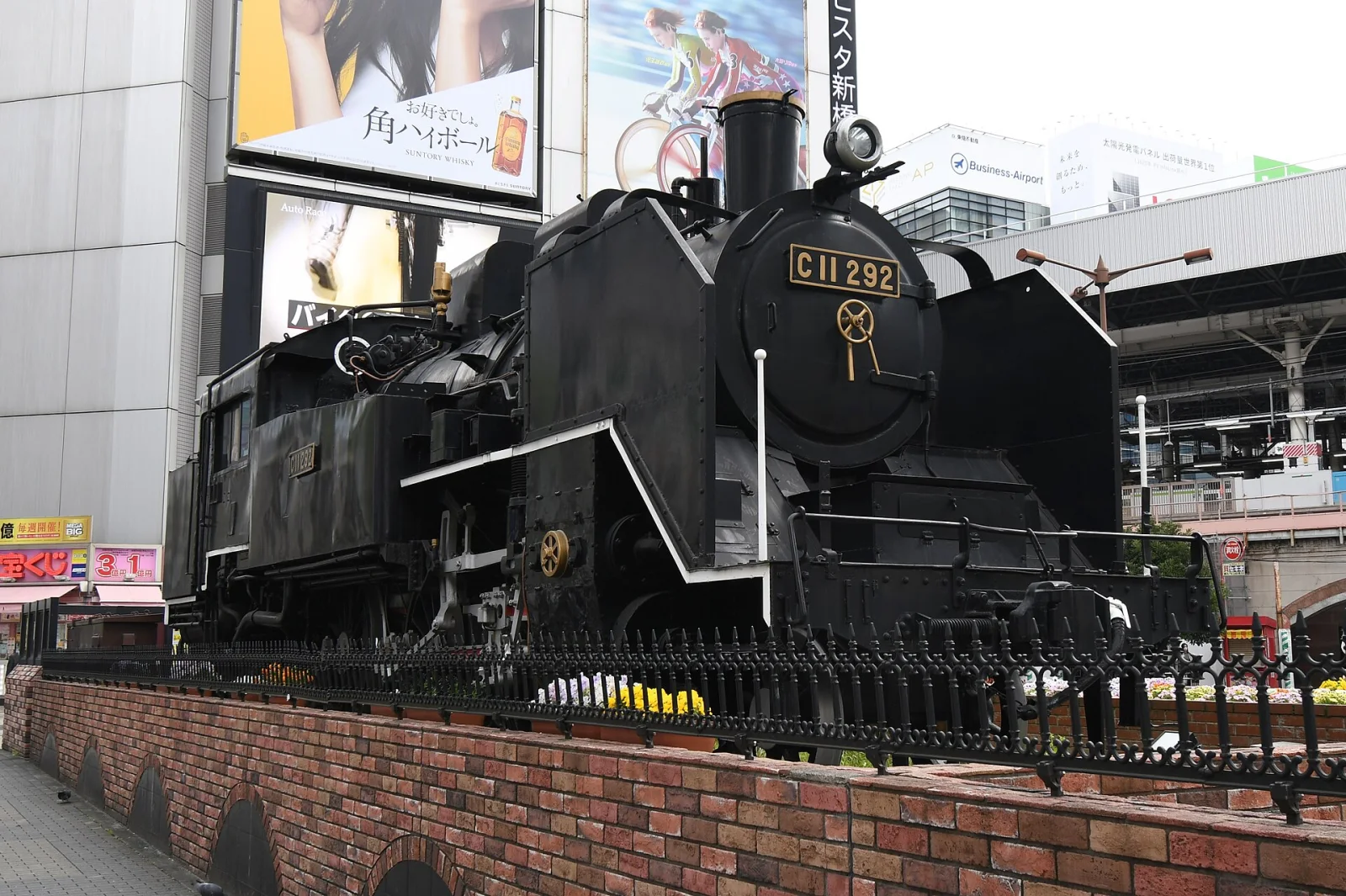
The black locomotive sits in the plaza right outside the JR Hibiya Exit, bearing the number plate C11 292. If you want to admire the driving wheels and connecting rods in daylight, stop by the square before dinner. While waiting for friends, stand towards the outer edge of the plaza so commuters and local shop staff still have room to pass. If an event is taking over the square, shift your meeting spot to a ground-floor entrance of the neighbouring New Shimbashi Building—and specify which side of the building you mean.
As you leave the plaza, pay attention to two similar-sounding building names. The "New Shimbashi Building" (Nyuu Shimbashi Biru) stands on the west side right next to SL Square, packed with independent shops and eateries from basement level B1 upwards. The "Shimbashi Ekimae Building" stands on the east side near the Shiodome Exit. Both have basement dining floors and look deceptively alike in translation, so if a friend messages "Ekimae Building No. 1 B1", check the full Japanese address before heading across to the east side.
On the west side, most evening wandering centres on Shimbashi Nishiguchi-dori and its adjoining lanes. Use the locomotive and Karasumori Shrine as your anchors, then duck into one or two side streets where you can read your bearings. Narrow alleys lined with small bars and restaurants are commonly called yokocho. When heading to a specific booking, search by the restaurant's exact name alongside its street number. Two venues on the same block may sit one in a basement and the next upstairs; snapping a photo of the building's ground-floor directory board saves checking every floor in turn.
If someone in your group arrives early, you can split up to browse, stow bags, or photograph the train and reconvene at an agreed time. There are plenty of ways to fill half an hour here: anyone already hungry can look over menus inside the New Shimbashi Building, while those saving their appetite for dinner can stroll to Karasumori Shrine and back. Latecomers should set their navigation pin to SL Square rather than "Shimbashi Station" as a whole so everyone surfaces on the same side.
While reading menu boards outside, check next to the restaurant name and floor listing for a sign reading "Honjitsu kashikiri", which means the venue is booked out for a private event that evening. Even places that appear open may be about to stop taking food orders, so if you arrive late, ask straight away whether the kitchen is still serving what you fancy. If you spot empty tables, state your party size at the door and wait to be seated; unused tables are often held for bookings, and asking saves an awkward shuffle.
Karasumori Shrine: Approach and Shrine Office
Karasumori Shrine is at 2-15-5 Shimbashi, Minato-ku, Tokyo. The shrine's official website puts the walk at around two minutes from the JR Hibiya Exit and three minutes from the Karasumori Exit. A few steps off the station plaza bring you into a short, shop-lined approach where the stone torii gate stands out immediately. If a friend simply drops a red map pin, open the full address together with "Karasumori Shrine" and walk in from the main approach entrance.
If you plan to collect a goshuin stamp or buy an amulet, visit the shrine before sitting down for dinner. The grounds remain open 24 hours a day for prayers, while the shrine office typically opens from 09:00 to 16:00, subject to occasional notices. Travellers who only reach Shimbashi in the evening can still walk down the approach to the worship hall. If anyone in your group wants to draw a fortune slip, aim to meet around 15:30 so there is breathing room between the shrine and dinner.
Shrine records trace the origin story to 940, when Fujiwara no Hidesato prayed to Inari for victory during Taira no Masakado's rebellion and later built a shrine where a flock of crows appeared in a dream. Historically known as Karasumori Inari, it adopted its current name in 1873 (Meiji 6). Pairing the shrine, the old Karasumori Station name, and today's Karasumori Exit on one walk shows how the name has lingered across maps from different eras.
At the shrine office, look out for the colour-coded "Kokoronegai-iro omikuji" fortunes. Red corresponds to love and relationships, yellow to wealth and business, blue to studies and career, and green to health and family. After choosing your colour, write your wish on the prayer slip and tie it onto the rack as instructed. In a group, those not participating can wait just outside the narrow approach so everyone praying or writing can take their time.
Because the approach is tight, glance at your footing for any waiting queue before framing photos of the torii gate. Angle upwards to capture the gate itself, or look back towards the street signs at the alley entrance while keeping worshippers out of shot. Ask permission before photographing the small shops along the lane. During dinner hours, treat the shrine as a brief stop at the start of the evening rather than walking back after your meal.
Picking an Izakaya to Sit Down In
If you are dining alone or simply want a quick bite before moving on, look for signs reading "counter" (kaunta) or "standing bar" (tachinomi). Counters offer proper stools, whereas standing bars mean staying on your feet. If you want to linger over oden, are wearing a bulky coat, or have walked all day, a seated spot is far more comfortable. Standing bars shine when you want a couple of small plates and a drink before heading off. Bags and large carrier bags quickly crowd the floor space, so drop heavy luggage in a locker first.
For seafood or a sheltered meal right by the station on a rainy night, Izakaya Fumi in basement B1 of the New Shimbashi Building offers tables for two and welcomes solo diners. The venue lists an average dinner budget of ¥2,001 to ¥3,000, with an otoshi cover charge of ¥440—a useful benchmark for a casual Shimbashi meal. It is closed on Sundays and public holidays, and opens Monday to Saturday until midnight, with last food orders at 22:30 and last drinks at 23:30. Arriving around 23:00 means you should already have eaten dinner elsewhere.
For a proper sit-down meal with friends, bookmark Tsukune Yamamoto in Shimbashi 2-chome towards Uchisaiwaicho. Located on the ground floor of the Fuji Building Shimbashi, it is roughly a four-minute walk from the Hibiya Exit or accessible via Exit A1 of Uchisaiwaicho Station on the Mita Line. Official hours are 17:00 to 23:00 (last orders 22:30), closed Sundays, with counter and sofa seating. Two-hour courses with all-you-can-drink start from ¥5,980, making it practical when a group wants the budget settled upfront.
If you fancy yakitori on a Sunday evening, the Torikizoku Shimbashi Plaza Building branch takes online bookings and sits on the third floor roughly four minutes southwest of the JR Karasumori Exit. Its regular hours are 16:00 to 04:00 daily, though it closes early at 22:00 on 3 December 2026. Seating includes counter spots, indoor tables, and terrace seats. When searching on a map, double-check the full branch suffix and street number "4-9-1 Shimbashi", and make sure your reservation matches that exact branch.
Travellers with children or anyone after a straightforward meal can head to Karayama Shimbashi on the ground floor of the New Shimbashi Building for fried-chicken set meals. Listed hours are 10:30 to 22:30 (last orders 22:00), closing on the second Sunday of odd-numbered months for building maintenance, with takeaway available. If you have a train to catch straight after eating, compare last-order times alongside the short walk back to the ticket gates.
For Friday night gatherings or year-end bonenkai parties of four or more, book ahead somewhere that can seat the entire group together, confirming headcount, arrival time, and whether you want a set course or a la carte. Walking up without a booking has its own appeal for pairs: you can browse menus as you stroll and simply move on to the next corner if a place is closed. If you are with older relatives or a pushchair, ask in advance about entrance steps, pushchair space, and seat height.
Ordering Yakitori, Oden and Hoppy
On menus, "yakitori" generally covers grilled chicken skewers, while "yakiton" refers to pork skewers, often including offal. To sample a few varieties without guessing, check how many skewers come in a "moriawase" platter and whether the kitchen chooses the cuts. For individual orders, verify whether the price is per skewer, for two skewers, or per plate. Look out for "momo" (chicken thigh), "tsukune" (minced chicken meatballs), and "sunagimo" (gizzard). When sharing, start with familiar cuts and add more once you know the house seasoning.
"Oden" denotes slow-simmered hotpot items. Daikon radish appears as "daikon", and boiled egg as "tamago". Some kitchens sell pieces individually while others offer a daily assortment. Light eaters can pick two or three items; if you need something filling, check whether rice or noodles are on the menu. Those with dietary restrictions should ask what the broth is simmered in and whether miso glaze, egg, or soy products are already included—dishes listing clear base ingredients are easiest to specify to staff.
Hoppy is a bottled beer-flavoured beverage. In traditional bars, a "Hoppy Set" arrives with a glass of shochu alongside the bottle. Where refills are ordered separately, "naka" tops up the shochu in your glass and "soto" brings a fresh bottle of Hoppy, so order whichever half runs out first. For non-alcoholic choices, look under "soft drinks" (sofutodorinku) or options clearly marked 0.00%; oolong tea and ginger ale also pair cleanly with grilled skewers.
Some venues use QR-code table ordering, while others take orders verbally. Faced with handwritten daily specials on a Japanese menu, point to the line and ask "Kore wa nan desu ka?" ("What is this?"), followed by "Kore o hitotsu onegaishimasu" ("One of these, please"). If you can read the quantity column, state the number of portions first. Ask permission before snapping a phone-translation photo of the table menu, and point directly to the original Japanese text if an ingredient translates ambiguously.
Anyone with food allergies should ask at the door whether the kitchen can accommodate them. Keep the Japanese names of trigger ingredients written on your phone and ask specifically about dashi stocks, sauces, shared frying oil, and utensils. Travellers avoiding certain meats may find set meals with clearly listed components easier to navigate. Even vegetable dishes warrant checking: potato salad often contains ham, and hot soups or stir-fries frequently use fish-based dashi.
Otoshi, All-You-Can-Drink and Paying the Bill
Soon after you sit down at an izakaya, staff often bring a small dish to the table. Japan National Tourism Organization dining etiquette notes explain this otoshi as an appetiser that functions as a seating charge. It is routinely added to the bill, so you can ask "Otoshi wa ikura desu ka?" ("How much is the otoshi?") before taking a seat. If you are watching your budget, factor the cover dish and a drink into the prices on the door board—hopping between two bars means paying two separate cover charges.
Menu signs showing "zeikomi" include consumption tax, whereas "zeinuki" means tax will be added on top. If a group plans to split the bill, ask on arrival whether separate payments are accepted. Alternatively, one person can settle by card, photograph the itemised receipt for the table, and divide dishes and drinks afterwards—putting each person's otoshi back onto their own share. For weekday meet-ups where numbers fluctuate, agree on a per-person budget limit beforehand and stick to individual orders or single-portion sets.
"Nomihodai" means timed all-you-can-drink, sold either bundled with a course meal or occasionally on its own. Read booking pages closely for the time limit, eligible drinks, last-order cutoff, and whether the entire table must join the same plan. If some friends do not drink alcohol or only want a single glass of sake, paying per drink works out better. A two-hour course also leaves time for plating and settling up, so anyone with plans afterwards should book an earlier seating.
Many spots accept credit cards, transit IC cards, and QR payments together, though supported brands vary. Izakaya Fumi's official page, for instance, lists Suica, PASMO, and major credit cards; if you rely on mobile QR payment, check first that your app is accepted. Walking into a small unbooked bar, ask "Kaado wa tsukaemasu ka?" ("Do you take cards?") at the entrance—and keep a physical card or cash handy in case your phone battery runs low.
When you are ready to leave, ask "Okaikei onegaishimasu" ("The bill, please"). Staff may take payment at your table or hand over a slip to settle at the door. During peak hours, especially if you have a set time to leave, ask for the bill a few minutes early. If you need to catch a last train after dinner, calculate your departure time from the moment you finish paying and step back onto the street, then count the walk to the station from there.
Shaping Weekday Evenings, Sundays and Free Afternoons
With only a weekday evening free, meeting at 17:30 and sitting down around 18:00 makes an easy template. Take in the steam locomotive, duck down the approach to Karasumori Shrine, and head to your chosen restaurant. Allow roughly 90 minutes for food and conversation, and save any appealing spots you pass along the street for next time. Eating on the earlier side also leaves plenty of time to hop on the Ginza Line to another neighbourhood afterwards.
If your afternoon is open, begin on the east side. Aim to reach the Former Shimbashi Station around 15:00 so you have ample time inside the exhibition hall and around the exterior platform remains. Should you also want a goshuin stamp from Karasumori Shrine that same afternoon, visit the shrine first before heading over to Shiodome, otherwise the shrine office may close while you are walking back across the tracks. Because today's Shimbashi Station sits right between them, allow extra minutes for the walk through the concourse.
Sunday plans are best built backwards from a venue you know is open. For a 18:30 dinner, book a Sunday-opening restaurant first, arrive early for photos around the plaza, and stroll over at dusk. Since both Izakaya Fumi and Tsukune Yamamoto close on Sundays, do not waste time hunting down their basement stairs or building numbers on a walk-in. If your group prefers brunch and a daytime wander, shift Shimbashi to the afternoon instead of waiting for evening shutters to roll up.
For a two-stop evening, eat a proper dinner at the first venue and save the second for a nightcap or dessert. Check the second spot's location and closing time in advance, ideally picking somewhere back along the walk towards the station. If conversation is flowing at the first table, there is no harm in staying put. Treating the second bar as optional lets latecomers meet straight at the first restaurant without juggling minimum-order rules across multiple stops.
Why 1872 Shimbashi Stands in Shiodome
Japan's first railway opened in 1872 between Shimbashi and Yokohama, with its Tokyo terminus standing in what is now Higashi-Shimbashi. Today's JR Shimbashi Station opened in 1909 as Karasumori Station. Once Tokyo Station opened in December 1914, the Tokaido Main Line terminus shifted there; nearby Karasumori Station was renamed Shimbashi Station, while the original 1872 terminus became Shiodome Station and handled freight. Walking between the two sides of the complex today traces that exact historical handover on the ground.
The locomotive on the west side arrived much later in the story. Minato City records note that C11 292 was built in 1945, served at the Himeji Depot, and was retired in 1972 before being placed in Shimbashi's West Exit plaza to mark the railway centenary. Look at the gold lettering on its smokebox plate as a preserved Japanese National Railways engine placed outside a newer station; to see where the 1872 tracks and platforms actually lay, walk east to the original site.
The Former Shimbashi Station stands at 1-5-3 Higashi-Shimbashi, reconstructed in 2003 to match the exterior of the original station building. Inside, start by the stairs with the woodblock print (nishiki-e) reproductions depicting the Meiji-era station and its passengers. Move on to excavated finds such as ticket punches, railway tools, and ceramic teapots once used aboard trains—great details for children before diving into maps and dates. Under the glass floor of the ground-floor gallery lie the original building foundation stones; study the wall-mounted station model first so the stone layout makes instant sense. Outside, preserved sections of the old platform edge remain in plain view.
Admission to the Railway History Exhibition Hall is free, open 10:00 to 17:00 with last entry at 16:45. It normally closes on Mondays, or on the following Tuesday when Monday is a public holiday, as well as from 29 December to 3 January, and for exhibition changes or maintenance. Its official calendar also lists a closure from 24 November to 7 December 2026. During closures, you can still view the exterior station facade and spend indoor time at the neighbouring tea museums instead, or walk back to SL Square.
On the east side of the tracks, the site is roughly a five-minute walk from the JR Ginza Exit or three minutes from Tokyo Metro Ginza Line Exit 2. Framed by modern skyscrapers, the low brick station replica only reveals its true scale once you stand close. Before heading back west for dinner, save two separate map pins: "Former Shimbashi Station" on the east side and "SL Square" on the west.
Visitors needing step-free ramp access should telephone the Railway History Exhibition Hall on 03-3572-1872 ahead of arrival. The main entrance has steps only, and the alternative ramp is located separately and cannot be used between 12:00 and 14:00. Groups travelling with slower-moving companions will find an afternoon visit after 14:00 much smoother, and parties of 15 or more are asked to contact the hall in advance.
Adding Tea Museums or a Garden Walk in Shiodome
The easiest indoor backup next to the Former Shimbashi Station is the pair of museums sharing the site: the Tea Culture Creation Museum and the Oi Ocha Museum. The first showcases teaware and brewing traditions across eras, while the second charts the evolution of tea drinking in Japan. Estimated visit times are around 40 minutes and 30 minutes respectively, plus extra if you stop for photos or workshops. Both stay open until 17:00 (last entry 16:30). Unlike the free railway hall, the tea museums charge ¥500 for adults and ¥300 for students, with free entry for high-school age and under as well as visitors aged 70 and over.
General admission to the tea museums requires no advance booking. Free lockers sit near the reception desk, though they are too small for pushchairs or suitcases. Travellers arriving straight from the airport or after hotel check-out should use coin lockers at Shimbashi Station before walking east. Like the railway hall, the tea museums close on Mondays, shifting to Tuesday when Monday falls on a public holiday. If rain coincides with that closing day, spend the afternoon browsing under the arches towards Hibiya or go straight to an early dinner.
In dry weather, an outdoor stroll leads from the JR Shiodome Exit to the Otemon Gate of Hama-rikyu Gardens. The Tokyo Metropolitan Park Association puts the walk at 12 minutes from Shimbashi Station and around seven minutes from Shiodome Station on the Yurikamome or Oedo lines. The gardens open from 09:00 to 17:00, with last entry at 16:30. Admission is ¥300 for adults and ¥150 for visitors aged 65 and over; primary-school children and younger enter free when accompanied by a guardian. To pair the gardens with dinner, enter early in the afternoon and walk back towards Shimbashi's west side afterwards.
For late-December visits to Shiodome, check year-end closures carefully. Hama-rikyu Gardens normally closes from 29 December to 1 January, whereas the Former Shimbashi Station railway hall stays closed two days longer until 3 January. With only one spare afternoon, let the opening calendar decide your stop. Walking all the way around the tidal pond inside the gardens stretches out the distance, so if you have an early dinner reservation, keep to a shorter loop from the Otemon Gate.
Odaiba and Shimbashi also pair smoothly into an afternoon-to-dinner route. Riding the Yurikamome Line back into town lets you walk straight through Shimbashi Station to the west side for dinner. If you have a table booked, add the station walk onto your Yurikamome arrival time; otherwise, linger freely in Shiodome before picking a spot on the night. Should you need to return to Odaiba after eating, make sure you board a train bound for Toyosu.
Rainy-Day Indoor Pivots and Sunny Walks to Yurakucho
On a wet evening, the shortest route keeps you to the Hibiya Exit, the covered edge of SL Square, and the New Shimbashi Building. To wait out a downpour, step straight inside the building to browse menus; if you arranged to meet at Karasumori Shrine, make a brief visit and duck back towards the station concourse. Arriving from the Shiodome underground passages, you can pick a spot in the Shimbashi Ekimae Building instead and meet friends at the ground floor of the right wing. Stow bulky bags before eating, leave wet umbrellas in entrance racks at tight bars, and watch your footing on stairs.
In fair weather, the stroll north towards Yurakucho runs neatly through Hibiya OKUROJI. This 300-metre arcade tucks restaurants, cafes, and craft shops beneath historic brick railway arches that still carry active tracks overhead. Continue straight towards Yurakucho and across into Ginza if you fancy shopping afterwards. If your dinner booking sits on Shimbashi's west side, eat there first and walk north later so you can head home via Yurakucho or Hibiya stations around Ginza.
Shimbashi's yokocho alleys are made for unhurried drinks and shared skewers, while Ginza leans towards patisseries, boutiques, and architecture—divide your evening by what you actually want to do. If half your group wants to shop and the rest want yakitori, split up in Ginza and regroup at SL Square at a set time. For more pairings across nearby districts, see Tokyo neighbourhood half-day itineraries.
Stepping out of a restaurant after a shower, check your phone map before heading back into the station. The tight blocks on the west side sit close to the Karasumori Exit for JR lines. For the Ginza Line, walking back towards the Hibiya Exit on the north side puts you right beside the subway signs. If you need the Shiodome Exit, cut through the station passage to the east side before surfacing rather than following the viaduct to the wrong street crossing.
Check Your Last Train Back to the Hotel First
For Tokyo Station, Shinagawa, or Ueno, check JR departures first; for Ginza, Akasaka-mitsuke, or Shibuya, use the Ginza Line; and for Asakusa, Oshiage, or through-services onto the Keikyu Line, verify direction and terminus on the Toei Asakusa Line. Anyone staying in Shinjuku should check both the direct Yamanote Line and faster transfer routes, choosing fewer changes late at night. Since late-evening trains sometimes terminate early, enter your hotel's nearest station and travel date in a route app and check the arrival station column before noting the time.
The Toei Asakusa Line revised its timetable from 21 November 2026, with weekday schedules updated from 24 November. Travellers using this line should check Toei Transportation's Shimbashi Station page by date, weekday or weekend/holiday, and travel direction. Services towards Oshiage can continue onto the Keisei or Hokuso lines, while trains via Daimon may run through onto the Keikyu Line or terminate at Nishi-magome—always check the destination and stopping pattern even from the same platform.
If your journey home requires a transfer, look up both your departure from Shimbashi and the last connecting train, then plan around whichever forces an earlier exit. Groups returning to different neighbourhoods should check individual last trains before sitting down so everyone knows who leaves first. Save final food and drink rounds for those with time to spare, and walk straight to the gates on leaving rather than lingering at the plaza for group photos and hunting for an unfamiliar underground entrance afterwards.
If your evening will run past the last trains, sort out your ride home before ordering dinner. Guests staying near southern Ginza can weigh up the walk back, while those further out should save their hotel's Japanese address and a safe pick-up spot on their phone. Because the station is surrounded by one-way lanes and narrow alleys, walk out to a wider avenue where a taxi can pull over safely. Collecting bags from a coin locker takes extra minutes too—keep the exit name, locker number, and digital receipt in one note so you can grab your things straight after paying the bill.
A few useful answers
Which exit should I take for a first-time izakaya evening in Shimbashi?
On JR lines, head through the North Gate to the Hibiya Exit, meet at SL Square, then walk towards Karasumori Shrine and Nishiguchi-dori. On the Ginza Line, Exit 6 brings you straight out on the same side. If you have booked a restaurant in Shimbashi 4-chome, the Karasumori Exit is more direct.
Can I visit Karasumori Shrine in the evening?
Yes, the grounds are open 24 hours a day for prayers. However, if you want to buy amulets or collect a goshuin temple stamp, arrive during shrine office hours, typically 09:00 to 16:00.
Are Shimbashi izakayas open on Sundays?
Opening days vary by venue. Izakaya Fumi and Tsukune Yamamoto are closed on Sundays, whereas the Torikizoku Shimbashi Plaza Building branch normally operates on Sundays as well.
Will otoshi be added to the bill?
Many izakayas serve a small appetiser called otoshi as a table charge and add it to the bill—for example, Izakaya Fumi lists ¥440. You can ask staff how much it is before taking a seat.
How should I combine the steam locomotive and the Former Shimbashi Station?
The steam locomotive stands outside the West Exit of today's JR Shimbashi Station. The Former Shimbashi Station sits on the Shiodome side at 1-5-3 Higashi-Shimbashi, with last entry to the free exhibition hall at 16:45. Visit the historic station first, then cross through the station concourse to SL Square, Karasumori Shrine, and the izakayas.
Where can I go in Shimbashi on a rainy evening?
On the west side, head straight into the New Shimbashi Building for indoor dining; on the east side, use the Shiodome Exit to reach the Shimbashi Ekimae Building. For an indoor exhibition earlier in the day, visit the Former Shimbashi Station in Shiodome in the afternoon.
Official information and references
Sources used in this guide.
- JR East Shimbashi Station Information and Station Code
- JR East Shimbashi Station Map and Step-Free Routes
- Tokyo Metro Ginza Line Shimbashi Station Exit Map
- Toei Transportation Asakusa Line Shimbashi Station and Timetables
- Toei Transportation November 2026 Asakusa Line Timetable Revision
- Yurikamome Shimbashi Station Map and Timetable
- Minato City History of West Exit Plaza and Locomotive C11 292
- Karasumori Shrine Access, Office Hours and Worship Hours
- Karasumori Shrine History
- Karasumori Shrine Kokoronegai-iro Omikuji Fortunes
- Tokyo Metropolitan Government Shimbashi East and West Station-Front Urban Redevelopment Overview
- East Japan Railway Culture Foundation Former Shimbashi Station Exhibitions and Opening Hours
- East Japan Railway Culture Foundation Former Shimbashi Station Exhibition Facilities
- East Japan Railway Culture Foundation Tokyo Station Centenary Archive
- Tea Culture Creation Museum Visitor Information
- Tea Museum Access and Visitor FAQ
- Tokyo Metropolitan Park Association Hama-rikyu Gardens Access, Admission and Opening Hours
- GO TOKYO Official Guide to Hibiya OKUROJI
- Izakaya Fumi Official Restaurant Information
- Tsukune Yamamoto Official Restaurant Information
- Torikizoku Shimbashi Plaza Building Branch Official Information
- Karayama Shimbashi Official Store Information
- Japan National Tourism Organization Japanese Dining Customs and Etiquette
- Hoppy Beverage Guide and Mixing Instructions
- East Japan Railway Culture Foundation Former Shimbashi Station Access and Step-Free Entrance
- East Japan Railway Culture Foundation Former Shimbashi Station Restoration Record