Start at JR Shimbashi Station's Hibiya Exit to see SL Square and Karasumori Shrine, then browse izakayas along Nishi-guchi-dori. Includes station exits, closing days, cover charges, and directions to the Old Shimbashi Station in Shiodome.
- Region & Focus
- TokyoNeighborhoods and shopping
- Reading Scope
- 19 min read · 11 chapters · 6 Q&As
- Official Verification
- 26 official sources checkedUpdated November 22, 2026
- Key Topics
- NeighborhoodsFoodRail travel
Chapter Route Map (tap any stop)
- Find the Hibiya and Shiodome Exits First
- Walking from the Locomotive into Nishi-guchi-dori
- Karasumori Shrine's Approach and Shrine Office
- Picking an Izakaya to Sit Down In
- How to Order Yakitori, Oden, and Hoppy
- Understanding Otoshi, Nomihodai, and Paying the Bill
- Planning a Weeknight, Sunday, or Free Afternoon
- The 1872 Shimbashi Station Was in Shiodome
- Adding Tea or a Garden Stroll in Shiodome
- Swapping Spots in the Rain, or Walking to Yurakucho in the Sun
- Check the Last Train to Your Hotel Station Before Ordering Another Round
- Quick Q&A
For a first evening in Shimbashi, meet at SL Square right outside the JR Hibiya Exit. From the steam locomotive, walk to Karasumori Shrine, pay your respects, and browse menus along Nishi-guchi-dori—two hours is plenty for a relaxed dinner. If you want a goshuin shrine stamp, move the shrine visit before 4:00 PM. To see the original 1872 railway terminus site, start on the Shiodome side at Old Shimbashi Station, enter the exhibition room before the 4:45 PM last admission, and cross back to the west side of the station for dinner.
Find the Hibiya and Shiodome Exits First
JR Shimbashi Station has two practical exits on the west side. The North Gate leads to the Hibiya Exit, which opens straight onto SL Square, the classic meetup spot. The South Gate leads to the Karasumori Exit, putting you directly into the dining alleys of Shimbashi 2-chome and 3-chome. If you already have a dinner reservation, follow the exact exit and floor level listed by the restaurant. Inside the concourse, following generic 'Shimbashi' signs only keeps you in station corridors; watch for exit-level signs reading 'Hibiya Exit' or 'Karasumori Exit.'
For the east side, look for the Ginza Exit or Shiodome Exit. The Ginza Exit on the JR north side is convenient for Ginza 7-chome, 8-chome, and Old Shimbashi Station. If you are heading to Shiodome, the Nippon TV complex, or the Yurikamome Line transfer, follow the east-side Shiodome signs first. The North Gate, South Gate, and Shiodome Underground Gate sit in different spots. If one person in your group is inside the JR station and another is in the Shiodome underground passage, picking a street-level landmark beats trading screenshots of floor maps.
Arriving on the Tokyo Metro Ginza Line (G08), the station map for Exit 6 lists both SL Square and Karasumori Shrine. For a first-time meetup, a simple message like 'Take Ginza Line Exit 6 and walk to the street-level steam train' works well. From the Toei Asakusa Line (A10), follow signs for 'JR Shimbashi Station / Shiodome' first, then orient toward the west side once you reach the JR area. The Yurikamome Line (U01) is an elevated station; coming back from Odaiba, exit the Yurikamome gates first and cross through the JR station complex to reach the west side.
JR Yamanote, Keihin-Tohoku, Tokaido, and Yokosuka line trains all stop at Shimbashi, with the Yokosuka Line platforms located underground. Riders arriving on the Yokosuka Line should check the station map early to locate elevators toward the North or South Gate. If your group is arriving on two different JR lines, meet outside the locomotive railing instead of hunting across platforms on different levels. Travelers with wheelchairs, strollers, or large suitcases can check elevator routes on the JR East station map.
If you are staying along the Toei Oedo Line, you can also use Shiodome Station (E19) as your starting point, which works well for exploring Higashi-Shimbashi before walking to the west exit for dinner. Save Shiodome Station and Shimbashi Station as two separate map pins. On the way back, if you are taking the Oedo Line, walk directly toward Shiodome Station in the direction of your accommodation instead of following friends back to the main JR entrance and searching for a subway stairwell all over again.
Start at JR Shimbashi Station's Hibiya Exit to see SL Square and Karasumori Shrine, then browse izakayas along Nishi-guchi-dori. Includes station exits, closing days, cover charges, and directions to the Old Shimbashi Station in Shiodome.
Walking from the Locomotive into Nishi-guchi-dori
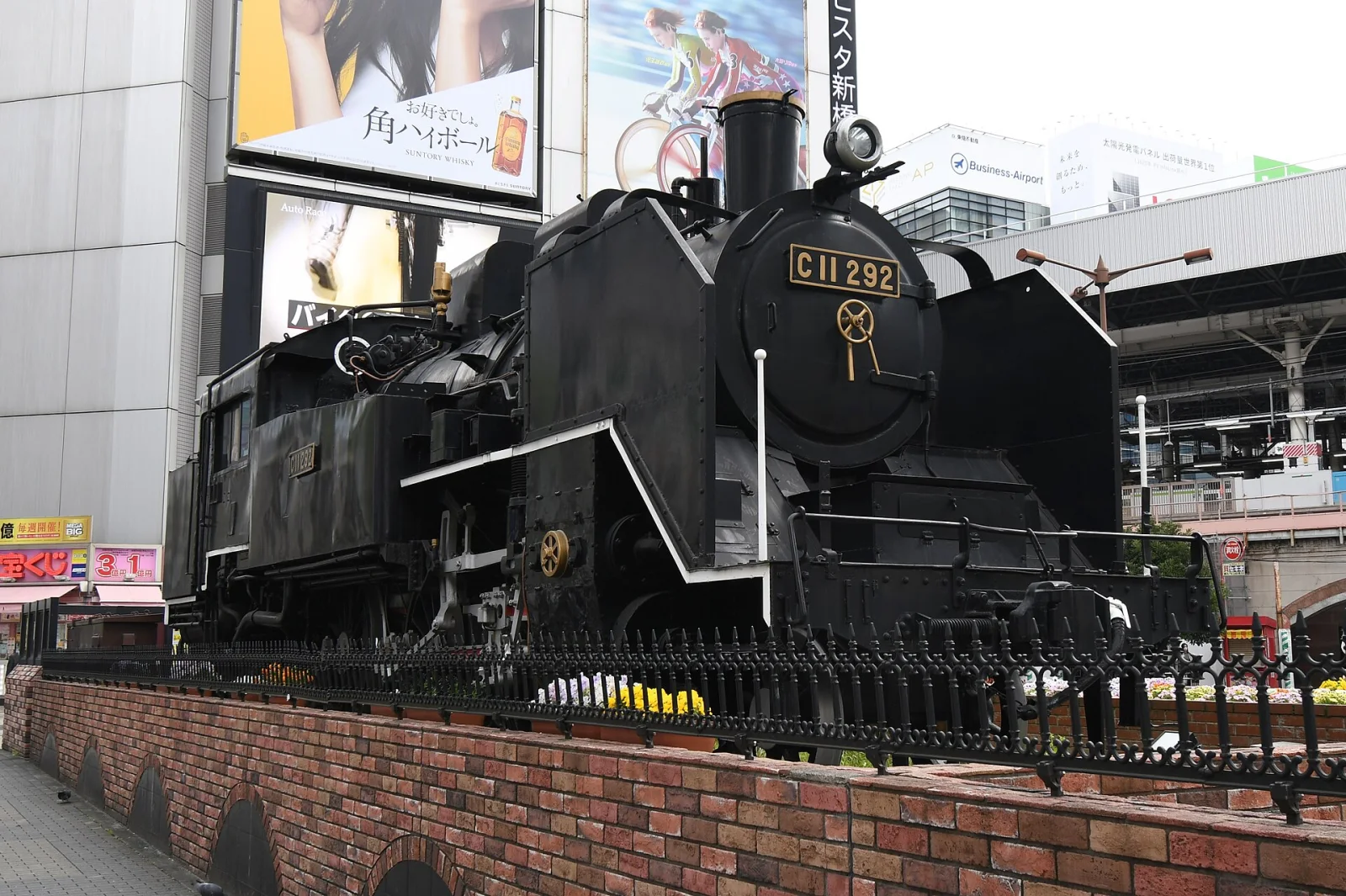
The black steam locomotive sits in the plaza right outside the JR Hibiya Exit, bearing engine number C11 292 on the front plate. To see the wheels and connecting rods in daylight, arrive at the plaza before dinner. When waiting for friends, stand along the outer edge of the plaza so commuters and restaurant staff have room to pass. If an event is occupying the square, shift your meetup beside the train to the ground-floor entrance of the adjacent New Shimbashi Building—just specify which side of the building.
As you walk away from the plaza, pay attention to two building names. 'New Shimbashi Building' sits on the west side, right next to SL Square, with merchant associations spanning from B1 up to the upper floors. 'Shimbashi Ekimae Building' is on the east side toward the Shiodome Exit. Their names sound similar, and both have basement dining levels. If a friend texts 'Ekimae Building No. 1 B1,' check the full Japanese street address before heading east.
On the west side, picking a spot mostly means strolling along Shimbashi Nishi-guchi-dori and the side alleys nearby. Use the locomotive and Karasumori Shrine as your anchors and turn into one or two narrow lanes where the layout makes sense. The term 'yokocho' is commonly used for these tight alleys lined with small eateries. If you are meeting at a specific restaurant, search by its full name plus the street number. Two spots on the same block may sit one floor down in a basement or up on an upper level—snap a photo of the building's main tenant board before taking the elevator or stairs.
If someone in your group arrives early, you can split up to run errands, drop bags in a locker, or photograph the locomotive, then regroup at a set time to enter the alleys together. There are easy ways to spend half an hour waiting here: hungry arrivals can browse menu boards inside the New Shimbashi Building, while those saving room for dinner can take a quick loop to Karasumori Shrine and back. Latecomers should pin SL Square in their map app rather than the whole Shimbashi Station complex so everyone lands on the same side.
When checking menu boards outside a door, look near the restaurant name for the floor number and watch for 'Honjitsu Kashikiri,' which means the place is booked out for a private party that evening. Spots that are still open may also be nearing last order, so if you arrive late, ask first whether you can still order what you want. Even if you see open tables, state your party size at the entrance and wait to be seated; empty seats are often held for reservations, and checking first saves awkwardness.
Karasumori Shrine's Approach and Shrine Office
Karasumori Shrine is located at 2-15-5 Shimbashi, Minato-ku, Tokyo. The shrine's official site lists it as about a two-minute walk from the JR Hibiya Exit and about three minutes from the Karasumori Exit. A few steps from the station plaza lead you into a short approach flanked by storefronts, where the stone torii gate stands out clearly in the alley. If a friend sends only a bare map pin, search for 'Karasumori Shrine' along with the address so you enter from the main approach.
To pick up a goshuin stamp or buy omamori charms, visit the shrine before heading into a restaurant. The shrine notes that grounds are open for worship all day, while the shrine office (juyosho) typically operates from 9:00 AM to 4:00 PM, subject to shrine-announced changes. Even if you consistently arrive in Shimbashi after dusk, you can still walk down the approach to the worship hall. If anyone in your group wants to draw a fortune slip, set the meetup around 3:30 PM to leave a buffer before dinner.
The shrine's lore traces its founding to 940, when warrior Fujiwara no Hidesato prayed to Inari for victory during Taira no Masakado's rebellion and built a shrine where crows gathered as revealed in a dream. Its history also notes it was originally called Karasumori Inari before adopting its current name in 1873 (Meiji 6). Linking the shrine, the former Karasumori Station name, and today's Karasumori Exit on one walk shows how the name 'Karasumori' endures across different eras on the map.
At the shrine office, you will find color-coded wish fortunes called Shingan-iro Mikuji. Wishes are divided into red (love and relationships), yellow (wealth and business), blue (academics and work), and green (health and family). After picking a color, fill out your wish slip and tie it as instructed by the shrine. In a group, companions can wait just outside the narrow approach so anyone praying or writing a wish slip can move at their own pace.
Because the approach is short, check for any line on the pavement before stopping to photograph the torii gate. Tilt upward to frame the gate itself, or step toward the entrance to capture the alley signs while keeping worshipers out of the shot, and ask before photographing small shops along the lane. For a quick evening stop, walk the approach and head straight toward Nishi-guchi-dori for a table—there is no need to save the shrine as an extra detour after dinner.
Picking an Izakaya to Sit Down In
If you are dining solo or just want a quick bite before another stop, look for signs mentioning counter seating or tachinomi (standing bars). Counters give you a stool, while tachinomi spots are standing-only. If you plan to linger over oden, are wearing a heavy coat, or have been walking all day, a seated spot is far more comfortable. Standing bars shine when you want a couple of small plates and a drink before heading out. Backpacks and shopping bags at your feet eat up floor space, so stash bulky luggage in a coin locker first.
For seafood or a rainy-night meal right by the station, Izakaya Fumi on B1 of the New Shimbashi Building has two-person tables and welcomes solo diners. Its official listing puts average dinner spend at ¥2,001 to ¥3,000, with an otoshi cover charge of ¥440—a solid baseline for budgeting one stop. It is closed on Sundays and national holidays and runs Monday through Saturday until midnight, with last food order at 10:30 PM and last drinks at 11:30 PM. If you arrive at 11:00 PM, eat dinner elsewhere first.
For a proper sit-down meal with a small group, save Tsukune Yamamoto in Shimbashi 2-chome near Uchisaiwaicho. Located on the first floor of the Fuji Building Shimbashi, it is about a four-minute walk from the Hibiya Exit or accessible via Exit A1 of Uchisaiwaicho Station on the Toei Mita Line. Official hours are 5:00 PM to 11:00 PM (last order 10:30 PM), closed Sundays, with counter and sofa seating. Two-hour courses with all-you-can-drink start from ¥5,980, making it easy to lock in a group budget before booking.
If you crave yakitori on a Sunday night, Torikizoku Shimbashi Plaza Building offers online reservations on the third floor, about a four-minute walk southwest from the JR Karasumori Exit. Its regular hours are 4:00 PM to 4:00 AM daily, with an early 10:00 PM closing scheduled for December 3, 2026. The branch lists counter, indoor table, and terrace seating. When searching maps, verify the full branch name and the address '4-9-1 Shimbashi,' and make sure you book the exact same location.
If you just want a straightforward meal or have kids in tow, head to Karayama Shimbashi on the first floor of the New Shimbashi Building for fried chicken set meals. Listed hours are 10:30 AM to 10:30 PM (last order 10:00 PM), closed on the second Sunday of odd-numbered months due to building maintenance, with takeout available. Travelers catching an evening train should check last-order times alongside the walk back to the ticket gates.
For Friday gatherings or year-end parties of four or more, book ahead at a restaurant that can seat your entire group together. Confirm headcount, arrival time, and whether you want a la carte ordering or a set course when reserving. Walking up without a reservation has its own perks for two people: you can browse menus as you stroll and simply move to the next corner if a spot is closed. If traveling with older relatives or a stroller, ask in advance about entrance steps, stroller storage, and table height.
How to Order Yakitori, Oden, and Hoppy
On menus, 'yakitori' usually indicates chicken skewers, while 'yakiton' refers to pork skewers, often including offal cuts. To sample a variety, check how many skewers come in an assorted platter (moriawase) and whether the chef chooses the cuts. For single items, check whether the price covers one skewer, two skewers, or a plate. Look for 'momo' (chicken thigh), 'tsukune' (chicken meatball), and 'sunagimo' (gizzard). When sharing, start with cuts you recognize and add more once you know the style.
When you see 'oden,' that is simmered winter hotpot dishes. Key items include 'daikon' (radish) and 'tamago' (boiled egg). Some shops let you pick pieces one by one, while others serve a daily assortment. Smaller appetites can start with a few pieces, while hungrier diners can check for rice or noodle add-ons. If you have dietary restrictions, ask what the broth is simmered in and whether miso sauce, egg, or soy products are already included—dishes that list main ingredients clearly make pointing out preferences easier.
Bottled Hoppy is a beer-flavored mixer beverage. At izakayas, a 'Hoppy set' arrives alongside a glass of shochu. Where refills are ordered separately, 'naka' on the menu means more shochu for your glass and 'soto' means another bottle of Hoppy, so refill whichever half runs out first. For non-alcoholic choices, look for 'soft drinks' or beverages explicitly labeled 0.00%; oolong tea and ginger ale also pair cleanly with skewers.
Some restaurants use QR-code table ordering, while others take orders verbally. If a daily specials sheet is handwritten in Japanese, point to your menu and ask 'Kore wa nan desu ka?' ('What is this?'), then say 'Kore o hitotsu onegaishimasu' ('One of these, please'). When there is a quantity column, state how many portions you want upfront. Ask staff before snapping photos of tabletop menus for translation, and if a translation app mangles an ingredient name, point directly at the original Japanese text for the server.
If anyone has food allergies, check whether the kitchen can accommodate them before sitting down. Keep the Japanese names of trigger ingredients written on your phone, and ask specifically about dashi broth, sauces, shared fryer oil, and utensils. Diners avoiding certain meats can start with set meals whose base ingredients are clearly stated. Even with vegetable dishes, check the mix-ins—Japanese potato salad often contains ham, and hot soups or stir-fries frequently use fish-based dashi.
Understanding Otoshi, Nomihodai, and Paying the Bill
Shortly after you sit down at an izakaya, staff may bring a small starter dish. Japan National Tourism Organization (JNTO) dining etiquette guides explain this 'otoshi' as a small appetizer tied to a per-person seating charge. It is normally added to the bill according to house policy, so you can ask 'Otoshi wa ikura desu ka?' ('How much is the otoshi?') before taking a seat. On a tight budget, factor the cover charge and a first drink into the posted menu prices—bar-hopping means paying that seating fee at each stop.
Prices outside the door marked 'zeikomi' include tax, while 'zeinuki' means tax is added at checkout. If a group wants to pay separately, ask at the entrance whether split checks are allowed. Alternatively, one person can pay by card, snap a photo of the itemized receipt for everyone, and settle up per dish and drink afterward—keeping each person's otoshi charge under their own share. For casual weeknight meetups where headcount fluctuates, agree on a per-person cap upfront and stick to individual orders or individual set courses.
'Nomihodai' means time-limited all-you-can-drink, sold either alongside a food course or occasionally as a standalone drink plan. Check the booking page for the time limit, eligible drink list, last-call cutoff, and whether the entire table must join the same plan. If some companions do not drink alcohol or only want one glass of sake, paying per drink is much easier. Two-hour courses also require pacing for food arrival and checkout, so anyone with evening plans afterward should book an earlier seating.
A single shop may accept credit cards, transit IC cards, and QR payments, though supported brands vary by venue. For example, Izakaya Fumi's official page lists Suica, PASMO, and major credit cards; if you plan to scan a QR code on your phone, verify that your specific payment app is listed. Walking into a small spot without a reservation, ask at the door 'Kaado wa tsukaemasu ka?' ('Can I pay by card?'), and carry a physical card or cash in case your phone battery runs low.
To ask for the bill, say 'O-kaikei onegaishimasu.' Depending on the shop, staff may collect payment at your table or bring the slip for you to pay at the register near the exit. When the dining room is slammed—especially if you have a deadline—ask for the check a few minutes early. If you need to catch a last train after dinner, calculate your departure time from the moment you finish paying and step onto the street, then add the walk back to the station.
Planning a Weeknight, Sunday, or Free Afternoon
If you only have a weeknight evening free, try meeting at 5:30 PM and sitting down to eat around 6:00 PM. Start at the locomotive, walk through the plaza to Karasumori Shrine, and head to your chosen restaurant. About 90 minutes covers dinner and conversation, and any other intriguing alley spots you pass can wait for next time. Eating on the earlier side also makes it easy to hop on the Ginza Line toward another neighborhood afterward.
With a free afternoon, start on the east side. To explore railway history, plan your visit to Old Shimbashi Station around 3:00 PM so you have plenty of time inside and out at the outdoor track remnants. If you want a Karasumori Shrine goshuin stamp on the same afternoon, visit the shrine first and head to the railway exhibition afterward—otherwise the shrine office may already be closed by the time you walk back to the west exit. Since the two sit on opposite sides of modern Shimbashi Station, factor the cross-station walk into your schedule.
Sundays work best when planned backward from a restaurant you know is open. For a 6:30 PM group dinner, book a Sunday-open venue first, arrive early for photos around the plaza, and stroll over by dusk. Izakaya Fumi and Tsukune Yamamoto mentioned above are both closed on Sundays, so don't waste walk-up time hunting down their basements or street numbers. If your group prefers a daytime walk with an early lunch, shift Shimbashi to the afternoon instead of waiting around for dinner spots to open.
If you plan to hit two places, eat your main dinner at the first stop and save the second for one drink or dessert. Check the second spot's location and closing time in advance, ideally picking somewhere along the walk back to the station. And if the conversation is flowing at the first table, staying put is completely fine—treating the second stop as optional lets latecomers meet directly at stop one without juggling ordering rules at multiple places.
The 1872 Shimbashi Station Was in Shiodome
In 1872, Japan's first railway opened between Shimbashi and Yokohama, with the Tokyo terminus standing in what is now Higashi-Shimbashi. The current JR Shimbashi Station opened in 1909 under the name Karasumori Station. After Tokyo Station opened in December 1914, the starting point of the Tokaido Main Line shifted there; nearby Karasumori Station was renamed Shimbashi Station, while the original terminus became Shiodome Station and was later used for freight. Walking between the two ends of today's station maps that shift in history right onto the city blocks.
The locomotive outside the west exit arrived much later in the timeline of these two stations. According to Minato City records, engine C11 292 was built in 1945, served at the Himeji Locomotive Depot, and was retired and placed on display at Shimbashi's west plaza in 1972 to mark the railway centennial. When you look at the gold-lettered nameplate on its smokebox door, think of it as a preserved JNR locomotive installed a century later—and head east to see where the 1872 platforms and tracks actually met the ground.
Old Shimbashi Station stands at 1-5-3 Higashi-Shimbashi. The current building was reconstructed in 2003 to match the exterior of the original opening-day station house. Inside, look near the stairs for reproductions of Meiji-era woodblock prints showing the station and its early passengers, then examine excavated artifacts including ticket punches, maintenance tools, and ceramic teapots used on board trains. Kids often connect with how tickets were clipped and how tea was poured en route before diving into the maps and dates. On the first floor, glass floor panels reveal the original station's stone foundation—check the wall model of the station first so spotting the stones beneath the glass makes immediate sense. Outside, preserved remnants of the original platform edge remain visible.
The Railway History Exhibition Hall is free to enter and open from 10:00 AM to 5:00 PM, with last admission at 4:45 PM. It is generally closed on Mondays, or on the following Tuesday when a Monday falls on a national holiday. It also closes for year-end holidays from December 29 to January 3, plus occasional exhibition swaps and facility inspections; the official calendar marks a closure from November 24 to December 7, 2026. During closures, you can still view the exterior station house, move indoors to the adjacent tea museum, or walk back to SL Square.
Arriving on the east side, Old Shimbashi Station is roughly a five-minute walk from the JR Ginza Exit or three minutes from Exit 2 of the Tokyo Metro Ginza Line. Sitting right beside modern skyscrapers, the historic station house only reveals its contrasting scale when you see it up close. Before walking over to the west side for dinner, drop two separate pins on your map—one at Old Shimbashi Station on the east side and one at SL Square on the west.
Visitors who need step-free ramp access should call the Railway History Exhibition Hall ahead at 03-3572-1872. The main entrance has stairs only, and the alternative ramp is located separately and cannot be used between 12:00 PM and 2:00 PM. If anyone in your group moves at a slower pace, aiming for an entry after 2:00 PM is easiest. Groups of 15 or more are also asked to contact the hall in advance.
Adding Tea or a Garden Stroll in Shiodome
The easiest indoor pairing next to Old Shimbashi Station is the Tea Culture Museum and Oi Ocha Museum right in the same complex. The first showcases historical tea vessels and brewing methods across eras, while the second traces the evolution of Japanese tea drinks. Museum estimates suggest about 40 minutes and 30 minutes respectively, plus extra time for photos or hands-on experiences. Hours run until 5:00 PM with last entry at 4:30 PM. While the railway hall is free, the tea museums charge separate admission: ¥500 for adults, ¥300 for students, and free for high school students and younger as well as visitors aged 70 and over.
General visitors can walk into the tea museums without advance booking. Free coin lockers are located near the reception desk, though they are too small for strollers and suitcases. If you are stopping by straight from the airport or after hotel checkout, store large bags in Shimbashi Station lockers first and walk over from the east side. The tea museums close on Mondays (or Tuesday if Monday is a national holiday). If rain coincides with a Monday closure, spend your afternoon under the Hibiya elevated tracks or save your energy for dinner.
In clear weather, walk from the JR Shiodome Exit toward the Otemon Gate of Hamarikyu Gardens. The Tokyo Metropolitan Park Association lists it as a 12-minute walk from Shimbashi Station, or about seven minutes from Yurikamome or Oedo Line Shiodome Station. The garden is open from 9:00 AM to 5:00 PM (last entry 4:30 PM). Admission is ¥300 for general visitors, ¥150 for ages 65 and over, and free for elementary school age and younger when accompanied by a guardian. To pair the garden with dinner, enter earlier in the afternoon and walk back toward Shimbashi Station's west exit afterward.
For late-December trips in Shiodome, check holiday dates before locking in your route. Hamarikyu Gardens typically closes from December 29 to January 1, whereas the Old Shimbashi Station exhibition hall stays closed two extra days through January 3. If you only have one free afternoon, pick whichever venue is open on your date. Walking out around the tidal pond inside the garden also adds distance, so if you have an early dinner reservation, enter and exit via the Otemon Gate to keep the loop manageable.
Odaiba and Shimbashi pair smoothly into an afternoon-to-dinner route. Coming back on the Yurikamome Line, you can cut through Shimbashi Station straight to the west exit for dinner. If you have a table booked, match your Yurikamome departure to the cross-station walk time, and leave casual Shiodome browsing for unbooked evenings. If you need to return to Odaiba after dinner, double-check that you board the train bound for Toyosu.
Swapping Spots in the Rain, or Walking to Yurakucho in the Sun
The shortest rainy-weather route links the Hibiya Exit, the covered edge of SL Square, and the New Shimbashi Building. If you are just waiting out a downpour, step straight into the building from the station plaza to browse menus; if you are meeting at Karasumori Shrine, walk over quickly to pay respects and duck back toward the station. Arriving via the Shiodome underground concourse, you can pick restaurants in the Shimbashi Ekimae Building instead and meet dinner companions at the ground-floor lobby of the matching wing. Store bulky bags before eating, use umbrella racks outside tight shops, and hold handrails on indoor stairs.
On a clear day, walk north from Shimbashi toward Yurakucho through Hibiya OKUROJI. This roughly 300-meter corridor tucks restaurants, cafes, and specialty shops underneath the historic brick railway arches that still carry active trains overhead. To continue shopping in Ginza, follow the arches toward Yurakucho and cut east into Ginza. If your dinner reservation is at Shimbashi's west exit, eat there first and stroll north afterward so you can catch trains back from Yurakucho or Hibiya near Ginza.
Shimbashi's yokocho alleys are built for a drink and a slow spread of small plates, while Ginza works better for desserts, shopping, and architecture—split your stops around what you actually want to do. If part of your group wants to shop while others want yakitori, split up in Ginza and set a meetup time back at SL Square. For more neighborhood walking and dining combinations, see Tokyo Neighborhood Half-Day Plans.
When stepping out of a restaurant after recent rain, open your map to check orientation before walking into a station entrance. Inside the west-side dining blocks, the Karasumori Exit is only a short walk away for JR trains. For the Ginza Line, head toward the north-side Hibiya Exit where subway signs sit closer together. If you are heading to the Shiodome Exit, use the station passage to cross to the east side before coming back up to street level rather than walking along the elevated tracks and hitting the wrong intersection.
Check the Last Train to Your Hotel Station Before Ordering Another Round
Check JR lines first if returning to Tokyo, Shinagawa, or Ueno; check the Ginza Line for Ginza, Akasaka-mitsuke, or Shibuya; and check the Toei Asakusa Line's direction and final destination if heading toward Asakusa, Oshiage, or onto the Keikyu Line. Anyone staying in Shinjuku should look up both the direct Yamanote Line ride and transfer options, favoring fewer transfers late at night. Late trains sometimes terminate early at intermediate stops. When checking on your phone, enter your hotel's nearest station and the exact date, and check the arrival column before noting your cutoff time.
The Toei Asakusa Line updated its timetable starting November 21, 2026, with the weekday schedule marked effective November 24. Riders using this line can check the Toei Transportation Shimbashi Station page and select the right table for the date, weekday or weekend/holiday service, and direction. Trains toward Oshiage include through-services onto the Keisei and Hokuso lines, while trains toward Daimon include through-services onto the Keikyu Line alongside trains terminating at Nishi-magome. When different services share a platform, check both the final destination and intermediate stops before boarding.
If your trip home includes a transfer, look up both the departure from Shimbashi and the last connecting train, and leave based on whichever cutoff comes earlier. When companions are heading in different directions, check everyone's last train before sitting down and note who needs to leave first, leaving the final round of orders to people with time to spare. When it is time to go, head straight to the station instead of gathering everyone back at SL Square for photos before hunting for an unfamiliar subway entrance.
If your night might run past the last train, plan your backup ride home before dinner. Those staying around southern Ginza can check whether walking is feasible, while travelers staying farther out should save their hotel's Japanese address and a convenient pickup spot on their phone. Because the blocks around Shimbashi Station are packed with narrow one-way lanes, walk out to a wider street where a taxi can safely pull over. Retrieving items from a coin locker takes extra minutes too—keep your exit name, locker number, and digital receipt in one note so you can grab your bags and head straight out.
A few useful answers
Which exit should first-time visitors use to explore Shimbashi's izakayas?
On JR lines, take the North Gate to the Hibiya Exit, meet at SL Square, and walk toward Karasumori Shrine and Nishi-guchi-dori. On the Ginza Line, Exit 6 brings you to the same side. If you already booked a restaurant in Shimbashi 4-chome, the Karasumori Exit is more direct.
Can you visit Karasumori Shrine at night?
Yes, the grounds are open for worship all day. However, if you want to buy omamori charms or get a goshuin stamp, arrive during shrine office hours, which are typically 9:00 AM to 4:00 PM.
Are Shimbashi izakayas open on Sundays?
Closing days vary by restaurant. Izakaya Fumi and Tsukune Yamamoto are closed on Sundays, whereas Torikizoku Shimbashi Plaza Building operates on Sundays as part of its regular schedule.
Is otoshi included on the bill?
Many izakayas add an otoshi appetizer as a per-person seating charge on the bill—for example, Izakaya Fumi lists a ¥440 otoshi fee. You can ask the staff how much it costs before taking a seat.
How do I combine the steam locomotive and Old Shimbashi Station in one trip?
The steam locomotive sits outside the west exit of modern JR Shimbashi Station, while Old Shimbashi Station is on the Shiodome side at 1-5-3 Higashi-Shimbashi (free exhibition hall, last entry at 4:45 PM). Visit the old station first, then cross the station complex to SL Square, Karasumori Shrine, and the izakaya alleys.
Where can I go in Shimbashi on a rainy evening?
On the west side, browse indoor restaurants inside the New Shimbashi Building; on the east side, head out the Shiodome Exit into the Shimbashi Ekimae Building. For an indoor museum stop beforehand, visit Old Shimbashi Station in Shiodome during the afternoon.
Official information and references
Sources used in this guide.
- JR East Shimbashi Station Information and Station Code
- JR East Shimbashi Station Map and Accessibility Routes
- Tokyo Metro Ginza Line Shimbashi Station Exit Map
- Tokyo Metropolitan Bureau of Transportation Asakusa Line Shimbashi Station and Timetable
- Tokyo Metropolitan Bureau of Transportation November 2026 Asakusa Line Timetable Revision
- Yurikamome Line Shimbashi Station Map and Timetable
- Minato City History of West Exit Plaza and Locomotive C11 292
- Karasumori Shrine Access, Shrine Office, and Worship Hours
- Karasumori Shrine History
- Karasumori Shrine Shingan-iro Mikuji Color Fortunes
- Tokyo Metropolitan Government Shimbashi Station East and West Urban Redevelopment Overview
- East Japan Railway Culture Foundation Old Shimbashi Station Exhibition and Hours
- East Japan Railway Culture Foundation Old Shimbashi Station Facilities
- East Japan Railway Culture Foundation Tokyo Station Centennial Exhibition Archive
- Tea Culture Museum Visitor Information
- Tea Museum Access and Visitor FAQ
- Tokyo Metropolitan Park Association Hamarikyu Gardens Access, Admission, and Hours
- GO TOKYO Official Guide Hibiya OKUROJI
- Izakaya Fumi Official Store Information
- Tsukune Yamamoto Official Store Information
- Torikizoku Shimbashi Plaza Building Official Store Information
- Karayama Shimbashi Official Store Information
- Japan National Tourism Organization Japanese Dining Customs and Etiquette
- Hoppy Beverage Official Drink and Mixing Guide
- East Japan Railway Culture Foundation Old Shimbashi Station Access and Step-Free Entrance
- East Japan Railway Culture Foundation Old Shimbashi Station Restoration Record