Shikoku's autumn leaves shift from Mount Ishizuchi in October to Iya, Kankakei Gorge and Ritsurin Garden in November. Covers peak foliage across all four prefectures, car-free transfers, driving trade-offs, Ritsurin's 2026 night illumination and JR's 2027 reserved-seat changes.
- Region & Focus
- Shikoku
- Reading Scope
- 25 min read · 10 chapters · 5 Q&As
- Official Verification
- 28 official sources checkedUpdated 22 November 2026
- Key Topics
- SeasonsItinerariesChugoku & Shikoku
Chapter Route Map (tap any stop)
- How to choose your month for Shikoku's autumn leaves
- Ritsurin Garden in Takamatsu: South Garden by day, reflections by night
- Kankakei Gorge on Shodoshima: check the Kountei return bus first
- Iya and Oboke in Tokushima: tell the vine bridge and boat bus stops apart
- Mount Ishizuchi in Ehime: ropeway views, Jojusha or the summit?
- Befu Gorge in Kochi and Takanose Gorge in Tokushima: save a separate driving day
- Car-free from Takamatsu: decide which two nights belong together
- Where is hiring a car actually worth it?
- Four-day sample itineraries: Ehime in October, Takamatsu in November
- Before booking tickets: one final filter by dates and photos
- Quick Q&A
Visit Shikoku in mid-October and give your daytime hours to Mount Ishizuchi in Ehime; arrive in mid-to-late November and stay two nights in Takamatsu, splitting one day for Ritsurin Garden and another for the ferry to Kankakei Gorge on Shodoshima. Between those two windows, enter the Iya Valley in Tokushima from JR Oboke Station for river-gorge colour. Once you have chosen your seasonal anchor, lock in the final bus or ferry connection first, then decide whether to stay in Takamatsu, Iyo-Saijo or overnight in the valley.
How to choose your month for Shikoku's autumn leaves
On Mount Ishizuchi, peak autumn colour shifts by several weeks between the summit and the base. According to the typical progression listed by the Ishizuchi Mountain Ropeway, the summit begins turning in early October, peaking around 10 October, followed by Jojusha from mid-October to around 20 October; lower Nishinokawa waits until late October through mid-November. Whenever you see reports of autumn colour on Mount Ishizuchi, check the exact elevation of the photo. The summit may be blazing red while the lower ropeway station is still green, and once the peak drops its leaves, the lower river valley often still holds colour.
If you want sweeping valley hillsides in early November, check same-week photos from the Iya Valley and Oboke. Miyoshi City lists typical peak colour for the Iya Valley from late October to mid-November, while the Oku-Iya Double Vine Bridges turn earlier, usually between late October and early November. The Iya Valley, Koboke Observatory and Ochiai Village each have distinct viewpoints. Arriving in mid-November lets you compare same-day photos and pick the stop with the best colour and easiest bus link.
Mid-to-late November is the simplest window for car-free travellers. Kankakei Gorge officially lists peak colour from early to late November, advancing from the mountaintop toward the foot, while the Kagawa Prefecture Tourism Association puts Ritsurin Garden's typical peak around early December. On a late-November weekend, save the island trip for the day with calmer sea conditions and keep the garden day in Takamatsu. If your trip falls in early December, put Ritsurin Garden into your itinerary first, then judge Shodoshima from current photos of the upper slopes and Kountei.
In 2026, Shodoshima Town relayed the ropeway operator's 19 November mountain report showing all areas of Kankakei Gorge at peak colour, with foliage expected to last into late November or early December. A day later, on 20 November, Kami City in Kochi Prefecture reported that Befu Gorge had passed its peak, though broad swathes of red and yellow remained even after wind and rain. Just one day apart, the two spots sat in completely different phases of the season. When planning for 2027, use the table below to choose your accommodation base, then wait for that year's photos before committing to exact mountain days.
| Location | Typical foliage window | Stop to look for when planning transport |
|---|---|---|
| Mount Ishizuchi (Ehime) | Summit from early Oct, Jojusha mid-Oct, lower slopes through mid-Nov | Nishinokawa Line from JR Iyo-Saijo Station; alight at Ropeway-mae |
| Iya Valley (Tokushima) | Late Oct to mid-Nov | Transfer at Kazurabashi Yumebutai to the Iya Valley Line; pick stop by current photos |
| Takanose Gorge (Tokushima) | Late Oct to mid-Nov | Best by car; navigate to Takanose Gorge in Kito, Naka Town |
| Befu Gorge (Kochi) | Recent peaks mostly early to mid-Nov | Best by car; navigate to Befu, Monobe Town, Kami City |
| Kankakei Gorge, Shodoshima (Kagawa) | Early to late Nov, starting from the summit | Kankakei Line from Kusakabe Port; alight at Kountei |
| Ritsurin Garden (Kagawa) | Mid-Nov to around early Dec | Kotoden Ritsurin-Koen Station for East Gate, or JR Ritsurin-Koen Kitaguchi Station for North Gate |
Shikoku's autumn leaves shift from Mount Ishizuchi in October to Iya, Kankakei Gorge and Ritsurin Garden in November. Covers peak foliage across all four prefectures, car-free transfers, driving trade-offs, Ritsurin's 2026 night illumination and JR's 2027 reserved-seat changes.
Ritsurin Garden in Takamatsu: South Garden by day, reflections by night
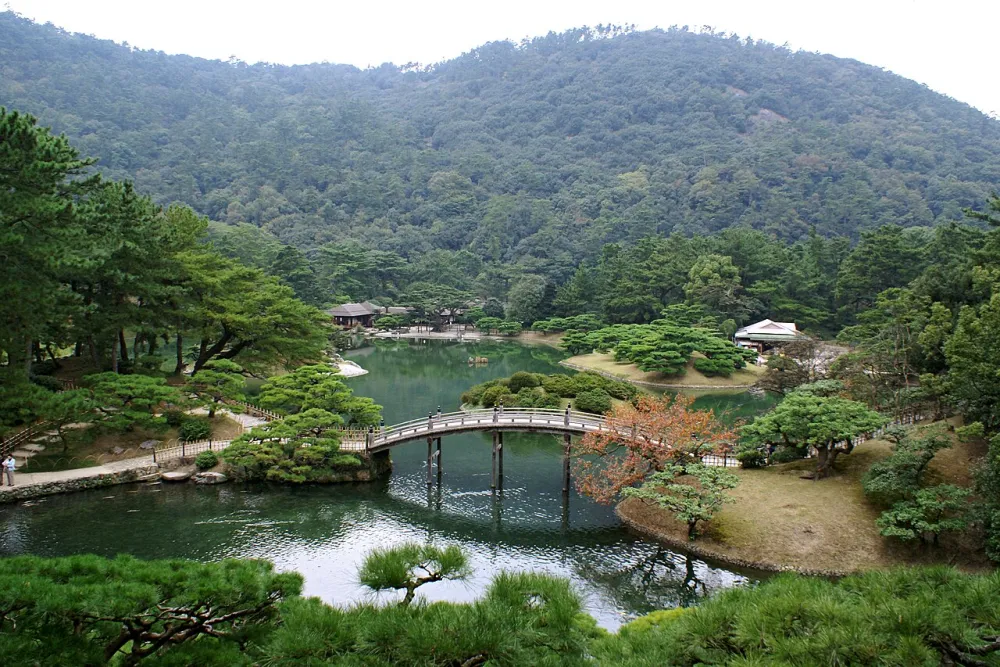
On a first visit, enter the South Garden via the East Gate and follow the South Lake past Engetsu-kyo Bridge and Kaede-kishi (Maple Shore). To take in the shoreline, bridge and Mount Shiun in one frame, climb Hirai-ho Mound. Crossing the bridge puts the branches right beside you, whereas the higher viewpoint reveals how the span narrows the water. Save Kikugetsu-tei Teahouse for the second half of your walk as a tea stop; if anyone in your party prefers an easier pace, staying lakeside for reflections still makes a complete circuit. With only one daytime hour, focus on the South Lake; allow two hours if you want tea, the North Garden or time to wait for the wind to settle on the water.
From central Takamatsu, JR Ritsurin-Koen Kitaguchi Station is handiest for the North Gate, whereas taking the Kotoden train to Ritsurin-Koen Station puts you closer to the East Gate and the South Lake. Enter the full station name when searching timetables, as JR Ritsurin and JR Ritsurin-Koen Kitaguchi are two separate stations, and the Kotoden stop is simply called Ritsurin-Koen. Travellers staying around Kawaramachi can hop straight onto the Kotoden line, while those staying near Takamatsu Port for an early ferry next morning have a straightforward urban trip back at night. See Takamatsu transport and dining for how the station, port and shopping arcades connect.
Daytime hours are 06:30-17:00 in November and 07:00-17:00 in December. The Kagawa Prefecture Tourism Association lists daytime admission at ¥500 for high school students and adults, and ¥170 for primary and junior high students. Wheelchairs and pushchairs can be borrowed free at both the East and North Gate ticket offices. The garden provides a recommended step-free route, and visitors heading to Kikugetsu-tei can also enter via the paved emergency gate by the East Gate car park. Hirai-ho Mound is best left to those happy with steps, so groups can split briefly and meet back below. Photographers carrying heavy gear should decide upfront between water-level shots or the climb to avoid unnecessary hill repeats.
If you arrive in Takamatsu without time to drop bags at your hotel, start from the East Gate. Garden facilities list 30 coin lockers at the East Gate and 6 at the North Gate, while oversized luggage can be stored at the tourist information office for ¥400 per piece. Bring only a small daypack inside if you have a train or ferry to catch straight after, and exit through the same gate where your bags are held. Afternoon arrivals staying for the evening lights can store large suitcases around Takamatsu Station, have dinner first and enter afterwards, saving a second locker trip at closing time.
The 2026 autumn illumination runs from 20 to 29 November, 17:00-21:00 (last entry 20:30), with lighting concentrated around the South Lake. If you can only pick one session, go by day to appreciate the rockwork, pruned pines and water layout clearly; go at night for lit branches and mirror reflections along the shore. Travellers with booked night-boat tickets should head straight to the South Lake pier first and use any remaining time to stroll the perimeter.
During the illumination, traditional wasen wooden boats depart the South Lake every 15 minutes from 17:30 until the final departure at 20:00. Evening rides are restricted to primary school age and above, requiring a separate ticket of ¥850 for adults and ¥420 for primary and junior high students. Families with pre-schoolers can admire the lights from the paths together, or take turns riding on the water while the rest wait at the pier. Match your entrance, lakeside loop and boat slot using our Ritsurin Garden day and night route.
Kankakei Gorge on Shodoshima: check the Kountei return bus first
On a day trip from Takamatsu, the car ferry to Tonosho takes roughly 60 minutes and the high-speed boat around 35 minutes. Each uses its own pier and timetable, and drivers must take the car ferry. On the 2026 Tonosho ferry schedule, the 15:10 departure from Takamatsu and 19:30 departure from Tonosho are designated dangerous-goods sailings, meaning they do not carry general passengers on weekdays, though they run normally on weekends and public holidays. The alternative crossing runs between Takamatsu and Ikeda Port; choose your arrival port based on the bus connection awaiting on shore. In November 2026, the Kankakei Line runs between Kusakabe Port and Kountei, so arrivals at Ikeda still connect through Kusakabe, while from Tonosho you take the Sakate Line or Minami-mawari Fukuda Line to Kusakabe Port.
Check the bus back from Kountei to Kusakabe Port first, then match Kusakabe to your return ferry port. Under the November 2026 operating schedule, buses leave Kountei at 15:20 and 16:00, whereas the ropeway's autumn last descent is 17:00. Waiting for the final cable car down leaves you stranded after the last bus has gone. Plan around the 15:20 departure as your target and treat 16:00 as backup, so you know how far you can wander on top before turning back. Securing a clean connection at Kusakabe Port matters far more than scrambling onto the earliest morning boat from Takamatsu. Travellers visiting in early December should check the Shodoshima Town municipal Kankakei Line timetable instead.
Beyond ferry tickets, budget for island buses and the ropeway. November Kankakei Ropeway fares are ¥2,700 return and ¥1,500 single for junior high students and adults, or ¥1,350 return and ¥750 single for primary school children. In November 2026, the Olive Bus one-day pass costs ¥2,000 for adults and ¥1,000 for children and covers the Kankakei Line for that month. If you plan to add Olive Park or switch ports, total up the individual single fares before buying the pass; motorists bringing a car aboard should tally driver, passengers and vehicle deck fare together.
The ropeway takes around five minutes from Koun Station to Summit Station. Cabins glide above tree canopies framed by steep rock faces, while the summit observation decks pair the colourful slopes with views out across the Seto Inland Sea. To hike the Omote Twelve Views trail, ride the ropeway up and walk down to Kountei. The official trail map puts the descent at roughly 45 minutes and the ascent at around an hour, with unpaved mountain sections along the way. If you plan to linger for photos of rock formations or leaves, do not rely on that 45-minute estimate to catch the last bus. After rain, with young children, unsteady footing or an afternoon arrival, ride the ropeway both ways.
Drivers also need to decide where to park upfront. Leave your car at Kountei, ride the ropeway up and walk back down, and your vehicle is waiting at the trailhead. Drive straight to the summit car park instead, and taking a one-way cable car down to Koun Station means climbing back up or sending the driver alone to fetch the car. If you only want summit views, drive straight to the top observatory; if you want photos of cabins crossing the gorge cliffs, allow time to walk to a viewpoint rather than having passengers wait at opposite ends. If high winds suspend the ropeway or close roads, stay near the ports that day or swap your Shodoshima and Takamatsu days.
Iya and Oboke in Tokushima: tell the vine bridge and boat bus stops apart
Before planning foliage stops around Iya, separate the two rivers. The Iya Vine Bridge spans the Iya River, and continuing round to Hinoji Gorge looks straight down onto the river's hairpin bend; the Oboke Gorge pleasure boat sails the Yoshino River, keeping you level with the rock strata and water. On a day trip from Takamatsu, making the vine bridge your main anchor leaves plenty of time for bridge photos and a riverside stroll. If the boat cruise is your priority, head straight to Oboke Gorge and skip the extra transfer deeper into Iya.
Take the JR train to Oboke Station, walk out to the Oboke Ekimae bus stop and board the Nishi-Iya Line to Kazurabashi Yumebutai. Under the timetable revised on 1 October 2026, a bus departs Oboke Ekimae at 10:08 and reaches Kazurabashi Yumebutai at 10:29. The vine bridge is roughly a five-minute walk from Yumebutai, with a crossing fee of ¥550 for junior high students and adults and ¥350 for primary school children. You can decide at the bridge entrance who wants to cross, as anyone uncomfortable with heights can wait comfortably on the bank. To add viewpoints high above the valley, transfer at Yumebutai onto the Iya Valley Line for Hinoji Gorge or Hotel Iya Onsen.
On the way back, distinguish carefully between two stops. Oboke Ekimae connects to JR trains, whereas Oboke Gorge (Obokekyo) is the stop for the pleasure boat. On the October 2026 timetable, the 13:11 bus from Kazurabashi Yumebutai reaches the railway station at 13:34 and the boat landing at 13:38, with a 15:11 departure following the same order. Those two buses leave very different cushions for boarding, as boats operate 09:00-17:00 with the final sailing at 16:30. Lock in your onward bus or taxi from the boat landing alongside your return JR train to Takamatsu before adding any extra riverside walking.
From 1 September 2026, the Oboke Gorge pleasure boat charges ¥1,800 for adults and ¥900 for children aged three through primary school. If river conditions cancel sailings, alight one stop earlier at Michi-no-Eki Oboke (Roadside Station Oboke) to visit the indoor Yokai Yashiki folk-monster gallery and Stone Museum. The former displays handmade yokai figures from the Yamashiro area, while the latter pairs local Oboke rock formations with geological specimens from further afield. From March to November the roadside station stays open until 17:00 and sits a little over 20 minutes on foot from JR Oboke Station. With children, heavy rain or a tight train connection, use the same bus timetable to get off there directly rather than riding out to a closed pier.
To include Ochiai Village, staying overnight works far better than cramming it into one day. A mountain road separates the vine bridge in Nishi-Iya from Ochiai Village in Higashi-Iya, served by the Higashi-Iya Line from Kazurabashi Yumebutai towards Kubo. Going deeper to the Oku-Iya Double Vine Bridges requires checking operating dates for the Miyoshi municipal bus from Kubo: in autumn 2026 it runs daily until 3 November, then only on weekends and public holidays through 23 November. Never rely solely on map driving estimates without confirming the return buses to Kubo and Nishi-Iya. Use our two-day car-free Oboke and Iya route to balance overnight bases.
Mount Ishizuchi in Ehime: ropeway views, Jojusha or the summit?
For mid-October colour, make the ropeway and Jojusha your day's objective. Departing Shimotani Station at the base, the eight-minute cable car climbs to Sancho Jojusha Station at around 1,300 metres. Despite the word "Sancho" (summit) in its name, the upper station sits midway up the mountain; from there it is a 20-to-25-minute walk to Ishizuchi Shrine's middle sanctuary, Jojusha, at roughly 1,450 metres. The shrine approach offers woodland foliage and you simply retrace your steps to the ropeway. Your day divides neatly between valley views from the cabin, the forest path to Jojusha and a break at mid-mountain, making it easy to cut short if mist rolls in.
Do not confuse the two higher peaks. Mount Ishizuchi's true summit is Tengudake at 1,982 metres; the standard hiking trail reaches Misen first, climbing steeply from Jojusha through junctions, chain-assisted rock sections and bypass trails marked on official route maps. Treating the summit as a full mountain hike requires checking alpine weather, daylight hours, the last downward ropeway and proper cold-weather, non-slip footwear and layers. Families riding the cable car casually for foliage should turn back at the upper station or Jojusha to leave ample margin for the return bus.
Without a car, transfer from JR Iyo-Saijo Station on the Yosan Line to the Setouchi Bus Nishinokawa Line, riding to Ropeway-mae. As an example from the October 2026 timetable, a bus leaves Iyo-Saijo Station at 10:27 to arrive at Ropeway-mae at 11:21, with a return departure at 15:26 getting back to the station at 16:20. Once you factor in bus and ropeway transit, walking to Jojusha fits comfortably. For earlier or later mountain runs, staying in Iyo-Saijo removes an extra morning rail transfer from Matsuyama. Also watch the station name: do not get off at JR Ishizuchiyama Station, which is a completely different stop.
Driving from central Matsuyama to Shimotani Station on the Saijo side takes roughly 1 hour 30 minutes according to the ropeway operator. Staying in Matsuyama lets you drive up early, return for an evening bath in Dogo and still have plenty of daylight on the mountainside, though check castle keep last-entry times if you hope to visit Matsuyama Castle afterwards. Hikers tackling the southern Tsuchigoya trailhead need separate road and access planning, distinct from the Saijo ropeway side. See our Ishizuchi Ropeway and Jojusha half-day route for a step-by-step breakdown of the lower station and mid-mountain walk.
If low cloud hits Iyo-Saijo or you have time before your limited express train back, walk over to the Shikoku Railway Cultural Centre on the east side of the station. The North Hall houses a Series 0 Shinkansen and the South Hall displays a C57 steam locomotive; one combined ticket covers both at ¥300 for high school students and adults, or ¥100 for primary and junior high students. It opens until 17:00 (last entry 16:30), closing Wednesdays or the following day when Wednesday is a public holiday. Taking the 15:26 bus back puts you at the station at 16:20, so visit the museum before heading up the mountain or catch an earlier bus down if you want an unhurried look. It gives you a solid fallback in fog without changing rail lines.
For late-November Ehime days, shift your focus into Matsuyama itself. From Shinonomeguchi on Matsuyama Castle, the ropeway climbs to Chojagadaira, followed by a walk up to the main bailey. In November, the castle keep closes at 17:00 (last entry 16:30) and the Shiroyama Ropeway runs until 17:30, while single chairlifts suspend in rain. Arrive at Shinonomeguchi early in the afternoon to photograph autumn trees along the stone walls and take in the city panorama from the keep; on a late arrival day, push the castle to the next morning. Keep the evening for a soak using our Dogo Onsen Honkan day-use guide, then take the tram or limited express out the following day.
Befu Gorge in Kochi and Takanose Gorge in Tokushima: save a separate driving day
When Kochi is your main foliage target, head directly to Befu Gorge in Monobe Town, Kami City. Pale limestone, clear headwaters and wooded slopes frame the autumn colours clearly, and Kami City records recent decade peaks clustering in early to mid-November. Use historical ranges to pick your month, then rely on current-week photos to decide whether to stroll along the gorge or give the day to another valley. Most drivers approach from Kochi or Nankoku along Route 195 beside the Monobe River, parking near the gorge rest area for a walk while sunlight reaches the canyon walls.
Continuing east along the same highway into Tokushima leads to another standalone day destination: Takanose Gorge in Kito, Naka Town. The Tokushima Prefecture Tourism Association lists its typical season from late October to mid-November, estimating around 210 minutes by car from the Tokushima Interchange. On 13 November 2026, Naka Town reported peak foliage around Hideri-iso and Hira-no-sato. Based in either Tokushima City or Kochi City, treat Takanose as your sole mountain valley for the day and time your arrival for midday sun inside the gorge. The roadside foliage on the approach is worth stopping for, provided you pull into safe parking bays and keep daylight for the mountain drive back.
Because the two gorges look close on a map, it is easy to mistake mountain forestry roads for a continuous through-route. Heavy rain on 25 October 2026 washed out the roadbed toward Nishikuma Valley, and Kami City announced that Befu Gorge cannot connect through to Nishikuma Valley; the city also issued a bear-cub sighting alert along the route from Befu Gorge Teahouse toward Mount Shiraga. Both notices directly affect any plan to push beyond the teahouse. Treat the gorge as a single out-and-back stop on the main highway, turning back whenever road controls require. If you want to combine it with Kochi City, return by evening to dine around Kochi Castle and Hirome Market and save the castle grounds walk for the next morning.
Car-free from Takamatsu: decide which two nights belong together
With Takamatsu Port right beside JR Takamatsu Station, basing yourself in the station-and-port district for two nights lets you swap Ritsurin Garden and Shodoshima depending on the weather. Arriving from Honshu on Day 1 via the Marine Liner from Okayama, drop bags in town and visit Ritsurin Garden straight away. Keep Day 2 open for Kankakei Gorge: even on a mid-morning ferry, there is plenty of time for the ropeway and summit viewpoints. Anyone flying or taking an early train out of Shikoku on Day 3 should already be back in Takamatsu the night before, keeping sea crossings off departure day.
Routes from Takamatsu to Oboke and Matsuyama head in completely different directions. JR Dosan Line trains serve Oboke, sometimes requiring a transfer at Tadotsu onto Kochi-bound limited express services, whereas the Yosan Line leads west to Iyo-Saijo and Matsuyama. Moving straight from Matsuyama to Iya eats into foliage hours through rail transfers, bus waits and locker stops. If your focus is western Tokushima, enter and exit via Takamatsu and consider putting your final night at Oboke or in Iya: staying in Oboke simplifies the next morning's train, while a valley ryokan rewards you with quiet morning scenery before the ride down. For Mount Ishizuchi, anchor around the outbound bus from Iyo-Saijo first, then decide between an early departure from Matsuyama or sleeping in Saijo.
Watch for a 2027 rail rule change when entering Shikoku from Okayama. JR Shikoku and JR West have announced that from spring 2027, the Shiokaze limited express (Okayama-Matsuyama) and Nanpu limited express (Okayama-Kochi) will become all-reserved seating, while the coupled Ishizuchi service will retain non-reserved cars. If you plan to ride the Nanpu to Oboke next autumn, match your train to your Iya bus schedule first and buy a reserved-seat limited express ticket for that specific departure. Travellers starting from Takamatsu and changing at Utazu or Tadotsu should also check which train appears on their ticket. Before committing to a rail pass, tally individual express fares, local buses, ropeways and ferries separately to see where a pass actually pays off.
Before comparing ticket prices, check which connection disappears if you miss one departure. Miss a train from Takamatsu to Oboke and a later JR service may still get you there, yet your workable same-day bus combinations on the Iya Valley Line shrink fast. By contrast, losing half an hour at a castle or garden still leaves plenty of time inside opening hours. When changing hotels, shift luggage on the day with the fewest transfers. Adding one extra night in Takamatsu spares early check-outs and station lockers, letting morning weather and ferry schedules set your pace.
Where is hiring a car actually worth it?
A car earns its keep in mountain areas where you want two or three stops in one day that buses cannot link smoothly. In the Iya Valley, roadside lookouts, the vine bridge and Ochiai Village sit miles apart; driving lets you skip any stop that has already dropped its leaves. On Mount Ishizuchi, a car cuts out long waits between buses, though the paid car parks around Shimotani Station are run independently by separate operators, and your day's start and finish remain dictated by ropeway hours. If you travel between Takamatsu and Matsuyama by JR, renting a car strictly for your mountain day keeps winding roads and evening drop-offs within one prefecture.
On Shodoshima, driving carries two distinct costs. Taking a Takamatsu rental onto the ferry adds vehicle deck fares, reservation constraints and return sailing schedules; renting on the island saves vehicle ferry fees, though pickup and return cut into sightseeing time. If you are only visiting Kankakei Gorge, buses from Kusakabe Port work well; compare a one-day island rental against bringing a car across only if you are adding coastal sights or staying far from the ports. In Takamatsu city for Ritsurin Garden, return the car first so you are not paying for hotel parking while walking around town.
The tightest pinch point when driving mountain roads is getting back before dusk. Schedule winding canyon drives from morning into early afternoon, saving dinner and expressway transfers for later. Several Iya viewpoints are roadside pull-offs—if spaces are full, carry on to the next signed bay rather than forcing a stop; bus passengers can at least enjoy the scenery without watching blind bends. Having two drivers share the wheel, or passengers prone to travel sickness, also changes how many switchbacks belong in a day. Hit your top-priority gorge first thing after leaving the hotel, then decide on a second valley based on daylight and energy.
Four-day sample itineraries: Ehime in October, Takamatsu in November
For four days in mid-to-late October, use Matsuyama or Iyo-Saijo for the first two nights. On Day 1 afternoon visit Matsuyama Castle, staying in Dogo for dinner and hot springs; on Day 2 take the bus from Iyo-Saijo up Mount Ishizuchi, walking to Jojusha or turning back near the upper ropeway station. Move to Awa-Ikeda, Oboke or Iya on Day 3—drivers can stop at an early-turning gorge en route, while rail travellers should aim to reach their valley accommodation before dark. On Day 4 choose either the vine bridge or the Oboke boat cruise before taking the train out via Takamatsu or Okayama. If you must fly home from Matsuyama, spend Days 3 and 4 inside Ehime instead of rushing back across the Tokushima mountains.
For four days in mid-to-late November, start with Ritsurin Garden on Day 1, staying on for the evening lights if your dates match the 2026 illumination. Spend Day 2 on Shodoshima for Kankakei Gorge, sleeping back at the same Takamatsu hotel. On Day 3 take the Dosan Line to Oboke and choose between the vine bridge or the boat based on that week's leaf photos. On Day 4, if departing from Takamatsu or Okayama, save the morning for a town stroll, udon and your airport or rail transfer. Should you stay overnight in Iya on Day 3, lock down your morning descent transport first before heading on to Kochi or back to Takamatsu; that extra night buys quiet early-morning valley air, though morning mist depends entirely on the day's weather.
With just two days when both destinations are in season, stay both nights in Takamatsu and swap days according to marine forecasts. If only one day promises clear skies, give it to Kankakei Gorge's ropeway and save the cloudier half-day for ground-level Ritsurin Garden. For a two-day mid-October trip, base around Matsuyama and Iyo-Saijo for mountain leaves by day and onsen at night. Keeping a short break along a single rail corridor avoids the logistical squeeze of stepping off an island ferry and rushing inland to Iya on the same afternoon.
A three-day break lets you experience one location's morning and evening contrasts. Keep your Takamatsu room, leave bags at reception on Day 3 for a day trip to Oboke Gorge, or hold Day 3 in reserve as a weather buffer for Shodoshima. When travelling with older relatives, use Day 3 for Takamatsu Port and the covered shopping arcades so the first two days stay unhurried. If you plan to continue on to Hiroshima or Miyajima, give that cross-sea transfer its own block of time: pairing a Tonosho-Takamatsu ferry with a long-distance inter-prefectural connection leaves little margin once luggage and pier walks are factored in.
Before booking tickets: one final filter by dates and photos
When reading Japanese autumn foliage forecasts, look for three status tags: *irozuki-hajime* (starting to turn), *migoro* (peak colour) and *rakuyo* (fallen leaves). Once you spot *migoro*, check recent photos and exact shooting locations from the past few days. On Kankakei Gorge, the summit, ropeway line and Kountei differ in outlook and tree mix, and Iya websites often display photos from completely different valleys on the same date. Wide hillside shots show overall canopy colour, whereas for easy walks with children, photos taken near the bus drop-off tell you far more than a prefecture-wide status label.
Adjust your camera plans to match how long you can linger at each spot. Along Ritsurin Garden's South Lake, work round the banks out of direct wind while waiting for clean reflections, and frame Engetsu-kyo Bridge from the mound or further back along the shore without blocking foot traffic on the span. Kankakei's ropeway crossing lasts only minutes—if one side of the cabin is crowded, save your compositions for the summit decks where you have ample time. At roadside viewpoints in the Iya Valley, shoot only from behind guardrails where it is safe to stand; for limestone strata and leaves along the Yoshino River, wait until you are out on the water.
The evening before each leg, write three times onto a single itinerary note: the opening hour of your main sight, your first return bus or boat connection, and your onward long-distance train. Where a transfer is tight, leave the valley or summit early and shift a flexible lunch to a stop beside your next boarding point. If rough seas trim ferry sailings, check the operator's remaining departures in the same direction first; if you end up relying on mountain taxis, save the pickup point, pre-booked return and Japanese place names for your driver before setting out. Once in Takamatsu, let that morning's leaf photos decide whether to head straight for the South Lake or push your hillside day to tomorrow.
A few useful answers
When is the best time to see autumn leaves in Shikoku?
Head to Mount Ishizuchi in October, or pick dates from late October to mid-November for the Iya Valley and Oboke Gorge. Pair Ritsurin Garden with Kankakei Gorge in mid-to-late November, using Takamatsu as a base so you can swap your two days around.
Until what date does the 2026 Ritsurin Garden autumn illumination run?
It runs from 20 to 29 November, 17:00-21:00 nightly, with last entry at 20:30. Traditional evening wasen boat rides operate during the illumination, with the final departure at 20:00; passengers must be primary school age or older.
Which port is most convenient for Kankakei Gorge on Shodoshima?
From Takamatsu, compare onward connections after landing at Tonosho or Ikeda ports. In November 2026, routes from both ports require transferring at Kusakabe Port onto the Kankakei Line bus, which terminates at Kountei; there is no scheduled bus service to the Summit Station.
Can you do the Oboke Gorge pleasure boat and Iya Vine Bridge on the same day?
Yes. From JR Oboke Station, take the bus to the vine bridge first, then ride on to the Oboke Gorge (Obokekyo) bus stop for the boat. If you only enter the mountains late in the afternoon, choose either the bridge or the cruise and save the earlier bus for your return journey.
Does the Mount Ishizuchi Ropeway go all the way to the summit?
No. The ropeway terminates at Sancho Jojusha Station on the mountainside at roughly 1,300 metres, from which it is a 20-to-25-minute walk to Jojusha Shrine. Reaching Misen and Tengudake requires proper mountain hiking trails; for relaxed leaf-peeping, turn back at Jojusha.
Official information and references
Sources used in this guide.
- Kagawa Prefecture Tourism Association | Ritsurin Garden Autumn Peak Foliage
- Kagawa Prefecture Tourism Association | Ritsurin Garden Opening Hours, Admission and Facilities
- Kagawa Prefecture Tourism Association | 2026 Ritsurin Garden Autumn Illumination and Evening Wasen Boat
- Shodoshima Town | 2026 Kankakei Autumn Foliage Observation (19 November)
- Kankakei Ropeway | Fares, Seasonal Timetable and Typical Peak Foliage
- Kankakei Ropeway | Official Trail Map
- Shodoshima Town | Municipal Bus and November Kankakei Line Operations
- Shodoshima Olive Bus | Kusakabe Port and Kountei Timetable
- Shodoshima Olive Bus | November 2026 One-Day Pass
- Shodoshima Ferry | Takamatsu-Tonosho Ferry and Designated Sailing Restrictions
- Shodoshima Ferry | Takamatsu-Tonosho High-Speed Boat Timetable
- Shodoshima Tourism Association | Island Ports, Ferries and Access
- Miyoshi City Tourism | Iya and Oboke Autumn Foliage Report (19 November 2026)
- Miyoshi City Tourism | Iya Map and Typical Autumn Foliage Season
- Miyoshi City Tourism | Iya Bus Timetable (Revised October 2026)
- Miyoshi City Tourism | Iya Vine Bridge Access and Crossing Fee
- Oboke Gorge Pleasure Boat | Operating Hours and Current Fares
- Miyoshi City Tourism | Michi-no-Eki Oboke Yokai Yashiki and Stone Museum
- Ishizuchi Mountain Ropeway | Mount Ishizuchi Typical Autumn Foliage Progression
- Ishizuchi Mountain Range Collaboration Council | Mountain Information and Jojusha Route
- Ishizuchi Mountain Ropeway | Shimotani Station Access, Driving Times and Parking
- Setouchi Bus | October 2026 Nishinokawa Line Timetable
- Saijo Railway History Park | Shikoku Railway Cultural Centre Opening Hours and Visitor Information
- Matsuyama Castle | Main Keep and Shiroyama Ropeway Opening Hours
- Kami City | Befu Gorge Historical Foliage, November 2026 Photos and Road Advisories
- Tokushima Prefecture Tourism Association | Takanose Gorge Location, Season and Driving Time
- Naka Town | 2026 Takanose Gorge Autumn Foliage Observation
- JR Shikoku and JR West | Spring 2027 All-Reserved Seating on Shiokaze and Nanpu Limited Express Trains