Walk from Sendai Station through Chuo-dori to Ichibancho, recognise sets of five streamers and the seven decorations, and plan a half-day, overnight or wet-weather visit. Includes 2026 information-point examples and subway routes back.
- Region & Focus
- Sendai and Matsushima
- Reading Scope
- 30 min read · 16 chapters · 4 Q&As
- Official Verification
- 10 official sources checkedUpdated 22 November 2026
- Key Topics
- SeasonsItinerariesRail travel
Chapter Route Map (tap any stop)
- An afternoon arrival still leaves time for Chuo-dori
- Hanging takes place on the morning of 6 August; look for awards in the afternoon
- Streamers come in sets of five: look beyond the one at the front
- Recognising the seven decorations: start with tanzaku and paper clothing
- Cranes, purses, nets and baskets: wishes expressed through shape
- Look separately at streamers and flower balls
- Why the shopping streets matter: bamboo decorations and the city’s revival
- From Chuo-dori to Ichibancho: choose one direction at the junction
- A half-day plan: Chuo-dori first, favourite displays last
- Staying overnight gives you two separate walks
- Rain protection and arcade roofs are separate considerations
- The 2026 information-point example: directions, first aid and police have different hours
- Subway return: Tozai Line to the south, Namboku Line to the north
- Photograph the whole set, then details, and check behind before stopping
- With family, put a rest stop before the turn
- Let the last display lead back towards Sendai Station
- Quick Q&A
For a visit focused on paper decorations, allow an afternoon to walk along Chuo-dori to Ichibancho. Stay overnight if you enjoy examining the paper craft. The festival takes place every year from 6 to 8 August. Hanging begins at about 08:00 on the first day, and award plaques can be found in the afternoon. In rain, shops put their washi decorations into plastic bags. Eat first, ask at an information point, then choose streets where decorations can still be viewed. Finish at Aoba-dori Ichibancho Station to the south, or Hirose-dori or Kotodai-koen to the north, for a clear route back.
An afternoon arrival still leaves time for Chuo-dori
The main decoration walk runs from the area outside Sendai Station along Chuo-dori to the Ichibancho shopping streets. For a first dedicated visit, allow an afternoon for walking, looking closely and sitting down for a break. Stay overnight if you enjoy photography or want to identify the decorations slowly, then explore another stretch the next day. Give a half-day visit a specific aim: walk through Chuo-dori, choose one direction in Ichibancho, study a favourite display and return from a point chosen in advance.
The organiser’s festival outline gives the dates as 6–8 August every year. Tanabata was originally celebrated on the seventh day of the seventh lunar month. Sendai uses a date one month after the modern calendar date, known as the intermediate calendar, which places the trip in August. If your Tohoku itinerary passes through Sendai only once, identify the day you can actually enter the city before booking intercity trains. A short change of trains calls for a brief look near the station. Keep enough time for the connection.
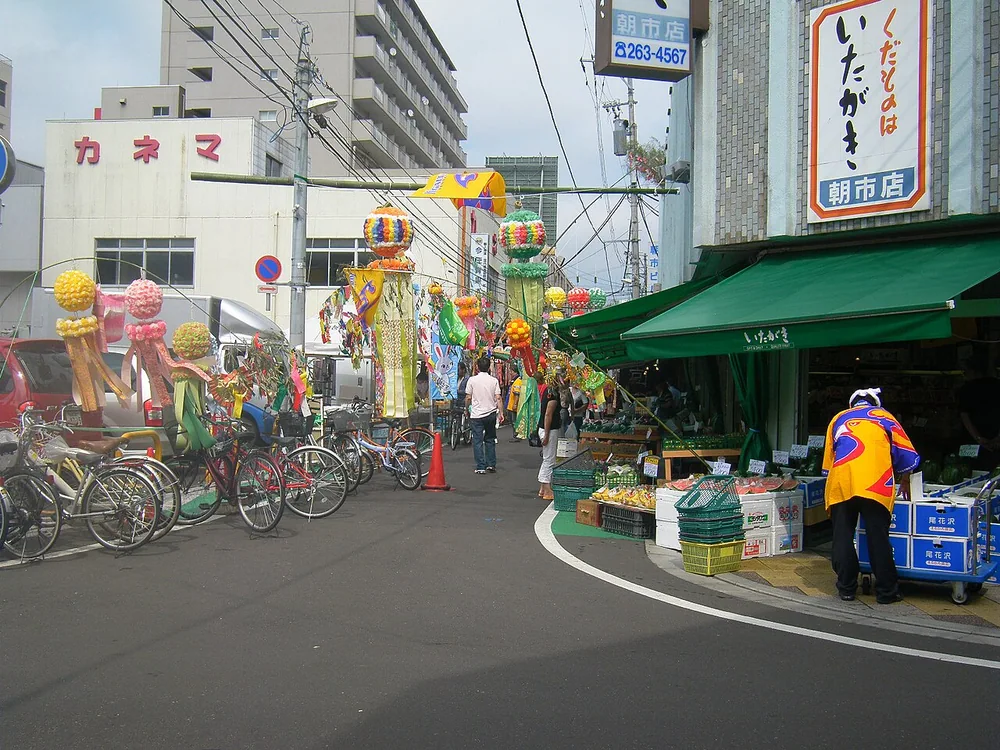
The shopping streets remain open for business during the displays. People commute and shop while others stop to look, so viewing affects the pace of movement. Use the first part of the afternoon to head towards Ichibancho and the second for a break and the return journey. This gives dinner or a train departure a manageable place in the plan. For food and architecture on another day, use the Sendai food and neighbourhood walks guide. Keep this Tanabata afternoon for the new paper decorations made each year.
Walk from Sendai Station through Chuo-dori to Ichibancho, recognise sets of five streamers and the seven decorations, and plan a half-day, overnight or wet-weather visit. Includes 2026 information-point examples and subway routes back.
Hanging takes place on the morning of 6 August; look for awards in the afternoon
The organiser’s decoration guide says installation starts at about 08:00 on 6 August. Each shopping street holds judging, with gold, silver and bronze awards announced in the afternoon and plaques attached at the base of the decorations. For completed displays and award plaques together, make the first afternoon your main visit. Early arrivals can leave luggage and have breakfast before starting the decoration walk.
This timing also affects an overnight stay. Staying on 5 August allows a relaxed start the next morning, but keep outside work areas when displays are being installed. Staff under the bamboo supports are carrying and hanging decorations, so leave access clear. Staying on 6 August lets you see award-winning work that afternoon and another stretch the following day, with more time for detail. Compare arrival, check-out and departure trains together before booking. The useful difference is the viewing time each stay provides.
Use award plaques as clues along the route. At a display, look first at the paper flowers and streamers together, then find the plaque at its base and read any nearby explanation. Gold, silver and bronze awards are judged by shopping street. Choose a display you like and compare its colours and details with another on the same street. This offers more than rushing after a winners’ list. If plaques are not yet visible on the first afternoon, enjoy the work itself and look again when you return.
Streamers come in sets of five: look beyond the one at the front
Sendai Tanabata traditionally groups five streamers together. Shops make the decorations by hand, starting months ahead and creating new work every year. Stand where you can see the whole set. Compare colours, flower-ball sizes and strip lengths before moving closer to the folded paper. Photographing only the front streamer can miss designs behind it. A different angle shows whether all five repeat one design or vary within the set.
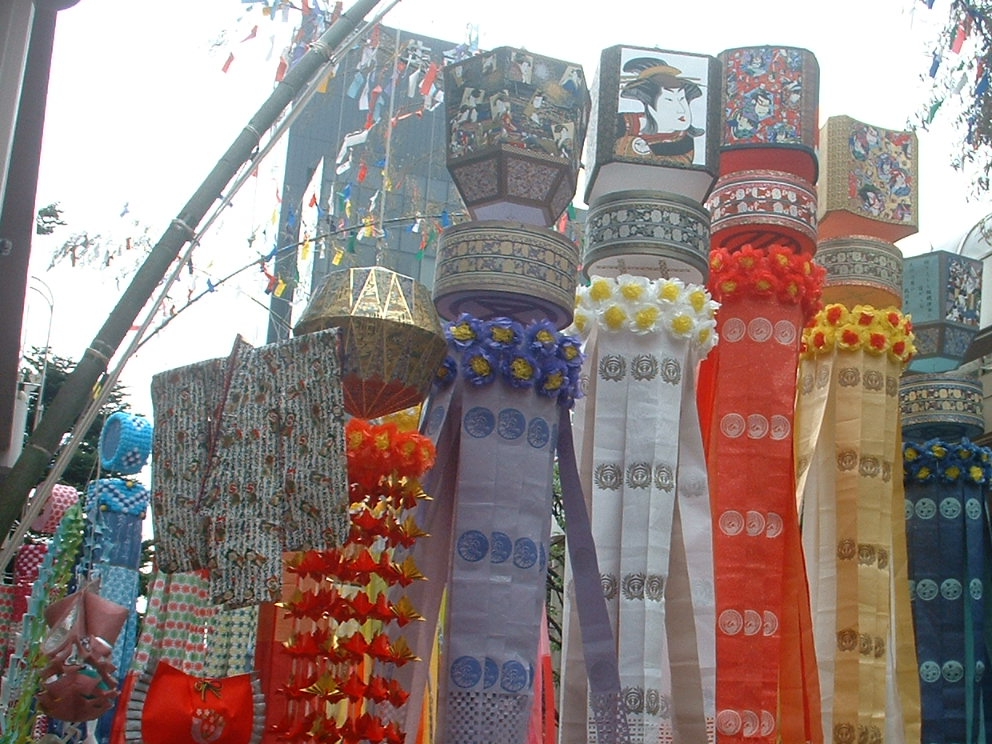
The upper ball is called a kusudama, or paper flower ball. The hanging fukinagashi below represents weaving threads. From a distance, colour blocks and vertical lines stand out; close up, paper flowers, patterns and attached ornaments become distinct. After viewing a set, consider what first drew your eye: strong colour, fine paper work or the display’s relationship with the street. Take that observation to the next set and the walk will naturally slow down.
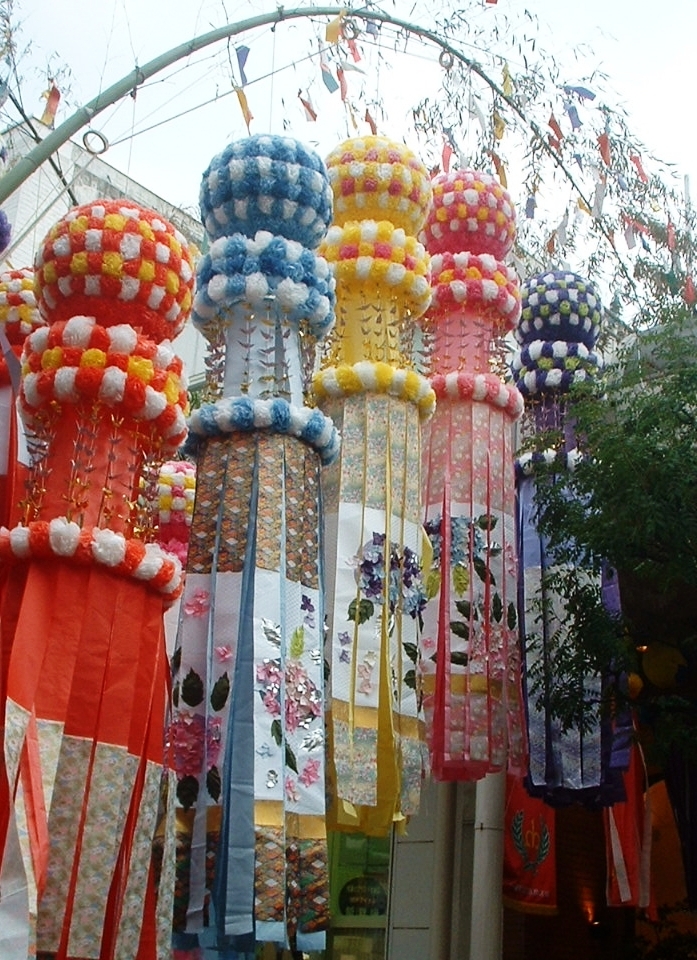
The two photographs from 2005 can help you practise looking. The main image’s coloured flower balls and hanging ornaments show how a set is assembled. In the body photograph, compare the upper motifs, flower rings and long paper streamers below. The work on your trip will be that year’s new designs. Use the historical photographs to remember the components, then look for different arrangements on site.
Preparation takes much longer than the three festival days. The organiser explains that shops start months ahead. Early on 4 August, shopping streets bring bamboo more than 10 metres long from the mountains and trim its small branches for hanging. The designs are revealed on the display day. Look first at how the bamboo carries several decorations, then at the paper craft, to understand both support and ornament. If you see installation on the first morning, watch from outside the work area and return later to compare the completed set with the previously bare support.
See Tanabata decorations hanging in the shopping streets, then a closer view of paper flowers being made by hand.
Recognising the seven decorations: start with tanzaku and paper clothing
The organiser groups tanzaku, kamigoromo, orizuru, kinchaku, toami, kuzukago and fukinagashi as the seven decorations. These small objects hang around the larger displays and carry wishes linked to daily life. Start with the recognisable strips and clothing shapes, then look for nets and small containers. With children, ask them to describe the shape before reading the name together. This makes recognition at the next display easier than memorising seven Japanese names first.
Tanzaku are long paper strips for writing. The organiser links them to wishes for learning and better calligraphy. In the past, morning dew from taro leaves was used to grind ink for writing waka poems; wishes are also written today. Read the words and notice how the writing contributes to the display’s colours. Lettering, paper colour and hanging direction change the effect of the same strip shape. Comparing them with the bundled streamers below helps distinguish their uses.
Kamigoromo are washi garments carrying wishes for better sewing skills, protection from illness and misfortune, and children’s healthy growth. Identify the outline through its collar and sleeves rather than guessing from colour. Remember it alongside tanzaku: one is recognised through writing, the other through its clothing shape. Even without reading every explanation, you can identify two different small ornaments beside the large streamers.
To try making decorations before travelling, use the organiser’s guides and videos supervised by origami artist Yoshimaro Ito. The official decoration page also has a tanzaku tutorial. See how the paper is folded and assembled, then find the real objects on the streets. Make one at home with children and let them look for the same type during the trip. For an on-site workshop, use the relevant year’s event page for venues and registration arrangements.
Cranes, purses, nets and baskets: wishes expressed through shape
Orizuru, folded cranes, express wishes for household safety, health and long life. The organiser also describes a custom of folding as many cranes as the age of the oldest family member to wish them longevity. In a string of cranes, identify the beak, wings and tail of one bird, then step back to see the field of colour they form. Separate close and distant viewing to appreciate both the folded unit and the whole display. In crowds, look from the side and leave room for others to pass.
Kinchaku resemble drawstring purses. They express wishes for business success and plentiful money, as well as thrift and saving. The organiser specifically mentions closing the mouth tightly to reflect avoiding waste. Look for the gathered opening and bag-shaped body. When its colour resembles a round flower ball, distinguish it by outline. You can recognise it without reading Japanese. Craft enthusiasts can also study how paper becomes a three-dimensional bag, a different skill from making flat tanzaku.
Toami depict fishing nets and express wishes for plentiful coastal catches, good harvests and gathering good fortune. Kuzukago contain scraps left from making Tanabata decorations and express cleanliness, thrift and care for possessions. Both can look net-like, so examine their use and outline. Think of an opened net for toami; for kuzukago, look for a container and the paper pieces inside. Scraps incorporated into the work show how everyday habits become part of festival decoration.
You need not name all seven ornaments again at every display. Find the types you recognise in one set, then look for missing ones in the next. Stay longer at a favourite display to see how its small ornaments sit beside the streamers. By Ichibancho, your attention will have shifted from the sheer quantity of decorations to the differences between sets. It also becomes easier to remember which work you want to revisit.
Look separately at streamers and flower balls
Fukinagashi symbolise the weaving threads of the Weaver Girl and wishes for better craft and weaving skills. That meaning helps explain why long strips of hanging washi are the most prominent part of Sendai Tanabata. Watch them separate and come together in the breeze, then trace their connection to the flower ball above. Allow a little time to look directly at how the paper occupies the space, as well as taking photographs.
Examine the two parts in turn. Look first at the density, shapes and colours of the upper flowers, then see whether patterns below continue the same theme. Some details require a closer view. Keep a gap from the work so the strips can hang naturally. Move to the side for a fuller view instead of reaching through streamers in front. When it is busy, wait for the previous visitors to move before approaching.
Choose one subject if you prefer. Compare related colours with strong contrasts, spend time on cranes and small folded objects, or study the five-part grouping and the variations within it. Following your interest can make a half-day visit rewarding without treating every shopping street as a list to complete.
Why the shopping streets matter: bamboo decorations and the city’s revival
Sendai Tanabata is closely tied to its shopping streets. The organiser’s history records merchants restoring elaborate decorations in 1927 to revive streets affected by an economic downturn. The following year, the event moved to 6–8 August and introduced a decoration competition. Walking Chuo-dori and Ichibancho today, you see work prepared by individual shops. Their combined handwork and ideas create the street-wide display, which rewards a slow walk.
This history adds meaning to the plaques. The 1928 competition was jointly organised by the Sendai Chamber of Commerce and Industry and the Sendai Kyosankai. Participating neighbourhood associations included Higashi-Ichibancho, Nakakecho and Omachi-dori. Look beyond a single streamer at how neighbouring sets express different ideas. Compare work along one stretch before moving to the next to see differences between the shopping streets.
War caused the paper decorations to disappear from the streets for a time. The official history records 52 bamboo decorations being raised again in 1946 in the burnt-out area along Ichibancho-dori. With that background in mind, pause in Ichibancho to see how displays hang over streets still used for everyday life. Festival and city occupy the same space, another reason to explore on foot.
The flower-ball story also comes from the post-war period. The official history describes Gengoro Mori, around 1946, wanting to bring the beauty of dahlias in his garden into Tanabata. He combined paper flowers with a light spherical bamboo basket and promoted the kusudama now commonly seen. In a photograph or on site, identify the round outline, then the flowers covering it. A bright block of colour becomes individual handmade pieces you can study.
Connect the history with things visible today. In Ichibancho, think of the bamboo decorations raised after the war. Award plaques recall the shopping-street competition; flower balls invite a closer look at flowers covering a sphere. Linking these stories with the work in front of you leaves concrete memories of paper, bamboo and streets, and helps you decide where to spend more time.
From Chuo-dori to Ichibancho: choose one direction at the junction
Sendai’s central shopping-street directory lists Hapina Nakakecho, Clis Road, Marble Road Omachi, Sun Mall Ichibancho, Vlandome Ichibancho and Ichibancho 4-chome as separate stretches. Walking west from Sendai Station along Chuo-dori, remember Nakakecho, Clis Road and Omachi as the route towards Ichibancho. Save their full Japanese names on your phone to match signs and identify each stretch.
At Ichibancho, decide whether to turn south or north. For a shorter route to the subway back to Sendai Station, head south towards Sun Mall and Aoba-dori Ichibancho Station. To continue viewing, head north through Vlandome Ichibancho and Ichibancho 4-chome, then return via the subway near Hirose-dori or Kotodai-koen. Treat the turn as a real itinerary decision. Taking every side street can leave you tired and rushing back.
Shopping-street names also help organise photographs. Photograph a street name or junction before each new stretch, then its decorations. This identifies where each part of the walk took place when sorting pictures later. For meeting arrangements, give the full shopping-street name and a named building. Avoid vague locations such as “the Ichibancho entrance”. A fixed place and time lets people view at their own pace.
A half-day plan: Chuo-dori first, favourite displays last
For an afternoon focused on decorations, leave luggage and eat after arriving, then walk from the station into Chuo-dori. Study the seven small ornaments at one display along the way and decide north or south when you reach Ichibancho. Include a seated break and use spare time to revisit your favourite set. Arrival, viewing, rest and return follow one route, so an afternoon arrival can still provide a complete visit.
Meal location changes the second half. If hungry on arrival, eat near the station and concentrate on decorations afterwards. If you have already eaten, walk to Ichibancho, eat at that end and take the subway back. Where appetites and pace differ, use a restaurant as a meeting point. Some can sit down while others make a short extra walk nearby. Work backwards from any restaurant booking to set your walking range.
If you have only a few hours before a Shinkansen, put luggage collection on the return route and finish viewing in the station’s direction. A map’s direct walking time estimates distance; the visit also includes stops, crossings and movement inside the station. Turn back when your chosen return time approaches. Save any remaining display’s location for another visit or an overnight itinerary.
Staying overnight gives you two separate walks
The main benefit of a night in Sendai is splitting the viewing into two periods. Walk from Chuo-dori to Ichibancho on the first afternoon to see the route and displays. Return to a favourite stretch the following day for paper-craft details, or choose another branch. With your bearings established, the second walk can be shorter and focus on a few works. If rain closes displays on day one, the next day gives another chance to go out.
Stay near Sendai Station for late arrivals, early departures or luggage-heavy travel. Collecting bags after check-out and joining a train is straightforward. Staying near Ichibancho places dinner and the next morning’s walk closer to the decorations. Compare hotel entrances, luggage-storage hours and cancellation terms alongside rooms, and mark the two walks you will actually need. Put any cancellation deadline in your calendar so weather changes have a clear decision point.
Before going out again after dinner, ask a nearby information point or shop about that evening’s displays and choose your walking range accordingly. Each shop manages its own work, so base the route on streets where it remains on show. With an early train the next morning, eat near your accommodation. The daytime viewing can be the focus of the stay. Leave the following morning for bags and the station instead of crossing the city again after check-out.
Rain protection and arcade roofs are separate considerations
The main wet-weather issue is that decorations may be placed in plastic bags. The organiser explicitly describes shops protecting them this way in rain. Even beneath a shopping arcade roof, look at the actual state of each display. If it is raining before arrival, eat, store bags and organise the route in the station first. Ask an information point which streets are suitable for viewing before deciding how far along Chuo-dori to go.
Give staff room while they put decorations away. Do not stand below bamboo supports to photograph the work or touch protective bags to improve your view. Move on from a wrapped set to another stretch. If most are being covered, bring your break forward and decide whether to continue after the rain and work settle. Overnight visitors can move detailed viewing to the next day and use the first for finding their way and eating.
For a rainy day trip, make the backup plan together with the return time. Set the latest time you can remain in the city, then choose whether to wait or shorten the walk. With children or older relatives, use a restaurant with seats as a base. Those who want to continue can make a short outing and return to meet the others. Carry rain protection for crossings and open sections. Put umbrellas away before entering dense crowds to free your hands and protect your belongings.
The 2026 information-point example: directions, first aid and police have different hours
The official guide page retains the 2026 edition, with temporary information points at Sendai Station, outside Fujisaki First Tower and outside Sendai Forus. In that year’s layout, the station point is useful on arrival, while Fujisaki and Forus help locate you in Ichibancho. When downloading the official guide, save its year and service locations together on your phone for reference during the walk.
In 2026, the Tanabata information point inside Sendai Station operated 09:00–20:00 and first aid 10:00–18:00. Outside Fujisaki First Tower on the Higashi-Nibancho-dori side, information also ran 09:00–20:00, first aid 10:00–18:00 and the temporary police post 10:00–20:00. Outside Forus along Hirose-dori, information ran 09:00–20:00 and the temporary police post 10:00–20:00. For medical help, use the first-aid locations and hours. The information desk’s closing time does not apply to every service.
Keep two useful screens on your phone: a map of the area you are walking and the relevant year’s service-point details. When asking for directions, show your location, destination station and needs such as a lift entrance. This helps staff give specific guidance. Passing a service point before dinner also offers a chance to ask about the route back and rain-affected displays together, reducing repeated map checks at junctions.
Subway return: Tozai Line to the south, Namboku Line to the north
The Sendai Transportation Bureau map places Aoba-dori Ichibancho on the Tozai Line, and Hirose-dori and Kotodai-koen on the Namboku Line. Both lines serve Sendai. After southern Ichibancho, take the Tozai Line from Aoba-dori Ichibancho towards Sendai. At the northern end, choose Hirose-dori or Kotodai-koen according to your position and use the Namboku Line. Check platform directions towards Sendai rather than following crowds or similar station names.
Save return options before setting out, then choose from where your viewing ends. Walk back along Chuo-dori for a second look, or use a nearby subway when you have seen enough, rain starts or feet tire. For a walk followed by one subway journey, budget for the actual ride. Compare passes only if you have other city journeys too, using the full set of trips. Avoid adding detours merely to use a pass.
With a pushchair, wheelchair or walking aid, find lifts on official station plans and mark the street entrance and destination together. The exit you choose changes the real walk. Shinkansen passengers returning to subway Sendai Station still need to reach the JR area, collect bags and pass the gates. On a first visit, remember your storage point and Shinkansen entrance on arrival, then follow familiar station routes on the way back.
Photograph the whole set, then details, and check behind before stopping
Take one photograph showing the set in relation to the street, then photograph favourite ornaments. Portrait orientation suits the vertical structure from flower ball to streamers. Landscape can compare neighbouring displays or show bamboo supports within the street. Check your position before shooting, stand to one side and keep bags in front of you rather than in the passage. Take turns: while one person photographs, the others can wait aside so passers-by do not have to go around the whole group.
Paper strips move in the wind. Wait for them to separate naturally before photographing details. To read text above, lower the phone and look directly first, then decide what to frame. Layers may be clearer from the side; move yourself rather than arranging the work by hand. Step aside when focusing or reviewing images too, so stopping does not block the main passage.
The historical photographs show different approaches. One uses coloured flower balls and fine folded paper; the other places motifs above long streamers. In your own pictures, record the overall colour scheme and how upper patterns connect to the lower part. These give you details to explain when sorting photographs at home. Note the date and street stretch alongside them to connect the work with your trip.
With family, put a rest stop before the turn
Start with shapes children can recognise: clothing-shaped kamigoromo, bag-like kinchaku and winged cranes. Move on after one display rather than asking them to find all seven types every time. Stop the search when they tire and eat or rest. Watch the tanzaku-making video together before travel; recognising a familiar decoration on site is enough to connect with that preparation.
If a group has very different walking speeds, meet once after Chuo-dori before turning into Ichibancho. Decide who will continue north and who will eat or return to the accommodation. Splitting the second part is easier than keeping everyone together with different needs. Agree a named place and time, and make sure carers have bags and water. Those taking an extra walk should keep their own return route and meet again for dinner.
Pushchairs and large bags need turning space. Store cases you do not need before starting the display walk. Keep water, rain gear and children’s items easy to reach, and avoid opening all your luggage beside the decorations. Make seated breaks part of the itinerary and remove later branches when needed. North and south Ichibancho can be visited separately. Finish where the whole family can return comfortably.
Let the last display lead back towards Sendai Station
With a fixed train departure, check your position, luggage location and station entrance before the final viewing stop. If you have not eaten, choose a meal along the return route or eat at the station. If dinner is booked in Ichibancho, include the journey to the station afterwards. Keep decoration locations, luggage-collection details and tickets on your phone so the return steps can be completed in order.
If companions walked separately, meet before collecting luggage to check bags, rain gear and onward tickets together. For souvenir shopping near the station, collect luggage and establish the gate-entry time first, then shop with the time remaining. Choose a final display in the direction of your return. After photographing it, put the phone away and follow the familiar route to Sendai Station.
A few useful answers
When is the Sendai Tanabata Festival, and when are the winning decorations on display?
The Sendai Tanabata Festival runs from 6 to 8 August every year, and the winning decorations are marked on the afternoon of 6 August. Shops start putting up decorations at about 8 am that day. Gold, silver and bronze award tags hang from the top of the winning displays.
What's a good half-day walking route from Sendai Station for the Tanabata Festival?
Start on the west side of Sendai Station and follow Chuo-dori through Nakakecho, Clis Road and Omachi to Ichibancho. Turn south for Sun Mall Ichibancho, or go north through Vlandome Ichibancho and Ichibancho 4-chome if you fancy a longer walk.
Can I still see the Sendai Tanabata decorations in the rain?
Shops cover the paper decorations with plastic bags when it rains, even in covered shopping arcades. Ask at an information point where the decorations are still on show. If most are being packed away, stop for a bite to eat.
Which underground line takes me from Ichibancho back to Sendai Station?
From the south end of Ichibancho, take the Tozai line from Aoba-dori Ichibancho. From the north end, take the Namboku line from whichever is nearer, Hirose-dori or Kotodai-koen. Both lines serve Sendai Station.
Official information and references
Sources used in this guide.
- Sendai Tanabata Festival: a Tanabata tradition since the time of Date Masamune
- Sendai Tanabata Festival: event outline
- Sendai Tanabata Festival: the decorations
- Sendai Tanabata Festival: guidebooks
- Sendai Tanabata Festival: transport and access
- Sendai City: central shopping-street directory
- Sendai Transportation Bureau: subway map and station information
- Sendai Tanabata organiser: history and shopping-street revival
- Sendai Tanabata organiser: making the paper decorations (released in 2019)
- Official: The making of SENDAI TANABATA FESTIVAL — Sendai Tanabata Festival Support Association