A two-day autumn foliage itinerary in Aizu, Fukushima, pairing the thatched roofs of Ouchi-juku with the volcanic lakes of Goshikinuma in Urabandai. Covers peak foliage windows, Saruyu-go bus bookings and fares, Inawashiro buses, trail hours, and staying in Aizu-Wakamatsu versus Yunokami-Onsen.
- Region & Focus
- TohokuAutumn leaves
- Reading Scope
- 25 min read · 7 chapters · 5 Q&As
- Official Verification
- 39 official sources checkedUpdated 22 November 2026
- Key Topics
- SeasonsItinerariesRail travel
Chapter Route Map (tap any stop)
- When to combine Ouchi-juku and Goshikinuma for autumn colour
- Half a day in Ouchi-juku: start at the far end and work back
- Getting to Ouchi-juku without a car: lock in your Saruyu-go return first
- Picking the right Goshikinuma bus stop before you set off
- Choosing which end of the Goshikinuma Nature Trail to walk
- How to split two days and where to stay overnight
- Driving tips: parking, mountain roads, and wet-weather plans
- Quick Q&A
If you want Ouchi-juku's thatched roofs and Goshikinuma's lakeside autumn colours on a single trip, start looking at late October for accommodation, give each spot half a day, and make Aizu-Wakamatsu your overnight base for straightforward rail links. On day one, head to Ouchi-juku, walk straight to the far end of the street for the rooftop view, and double back for green-onion soba. On day two, ride JR to Inawashiro and transfer by bus to walk from Bishamon-numa to Urabandai Kogen Station. If the forecast splits into one sunny day and one wet one, save the clear weather for the full Goshikinuma trail and keep Ouchi-juku's main street and townscape museum for the rain.
When to combine Ouchi-juku and Goshikinuma for autumn colour
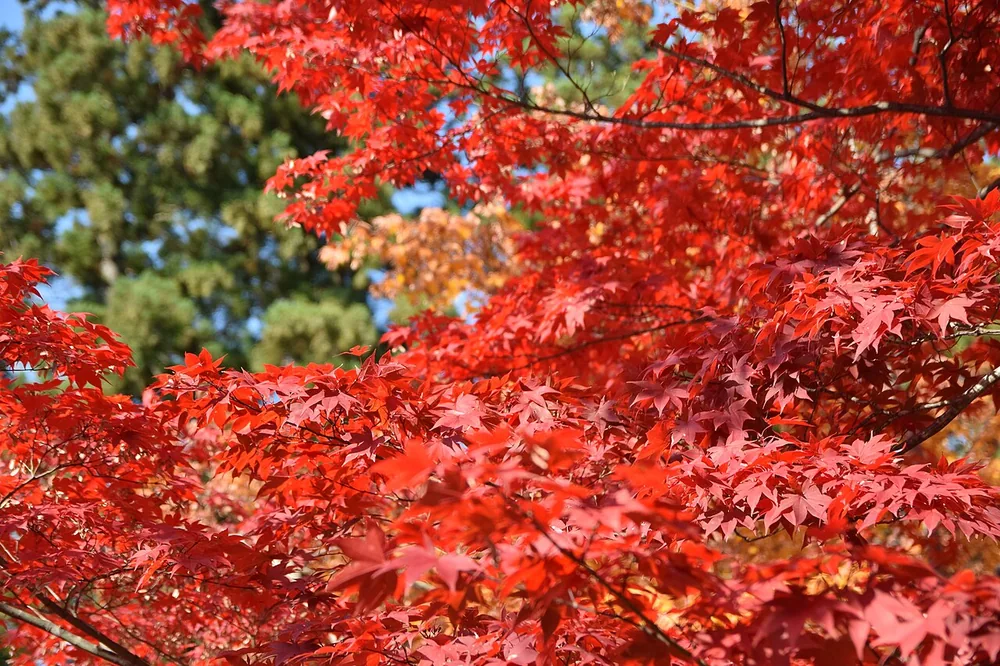
The Fukushima Prefecture Tourism and Local Products Association lists Ouchi-juku's typical autumn foliage season from late October to early November. You can enjoy the colours here from two distinct vantage points. Down on the main street, maple and deciduous leaves cluster around front gardens, courtyards, and the roadside, often framed or broken up by overhanging eaves. Climb to the Miharashidai viewpoint at the far end of the village, and the whole sweep of the main street, thatched roofs, and surrounding hills opens up in one view. If you are timing your trip around the hillside colours, check recent photos of the slopes first; if you are after close-ups of red leaves against timber fronts, it pays to take your time along the street.
For Goshikinuma, timing depends on which stretch of water you want to see. Kitashiobara Village's autumn guide places the Goshikinuma lakes as a whole from mid- to late October, while the Urabandai Tourism Association puts Aka-numa's usual peak slightly later, from late October to early November. Their overlap falls cleanly in late October, making it the sweet spot for an overnight trip. Kitashiobara Village's 2026 foliage page features photos of Goshikinuma taken on 16 October, and the visitor centre photographed each pond along the trail on 18 October. Checking pond-by-pond updates like these gives a much clearer picture than relying on a broad Urabandai peak forecast.
If you travel in mid-October, give Goshikinuma the lion's share of your time and treat Ouchi-juku as a heritage post-town walk and lunch stop. By early November, when you want to reserve the brighter of two days for the lakes, check fresh photos from both ends of the trail. Even if broadleaf trees along the water have shed many of their leaves, the western end still offers conifers and still reflections, while the eastern end lets you focus on the broad expanse of Bishamon-numa. If full-hillside autumn colour is your priority, the upper viewpoint at Ouchi-juku remains a rewarding first stop before lunch.
Midweek visits from Tuesday to Thursday call for a quick check on closing days. Ouchi-juku's Machinami Exhibition Hall is normally open on Tuesdays, whereas the Urabandai Visitor Centre at the eastern end of Goshikinuma generally closes on Tuesdays (or the following day if a Tuesday falls on a public holiday). To pick up maps, browse exhibits, and ask about current trail conditions at the centre, visit Ouchi-juku on Tuesday and head up to Urabandai on Wednesday. If you can only go at the weekend, arrive on Ouchi-juku's main street early in the morning and do not plan on driving straight out at midday — Shimogo Town flags autumn weekends and public holidays as periods of heavy traffic.
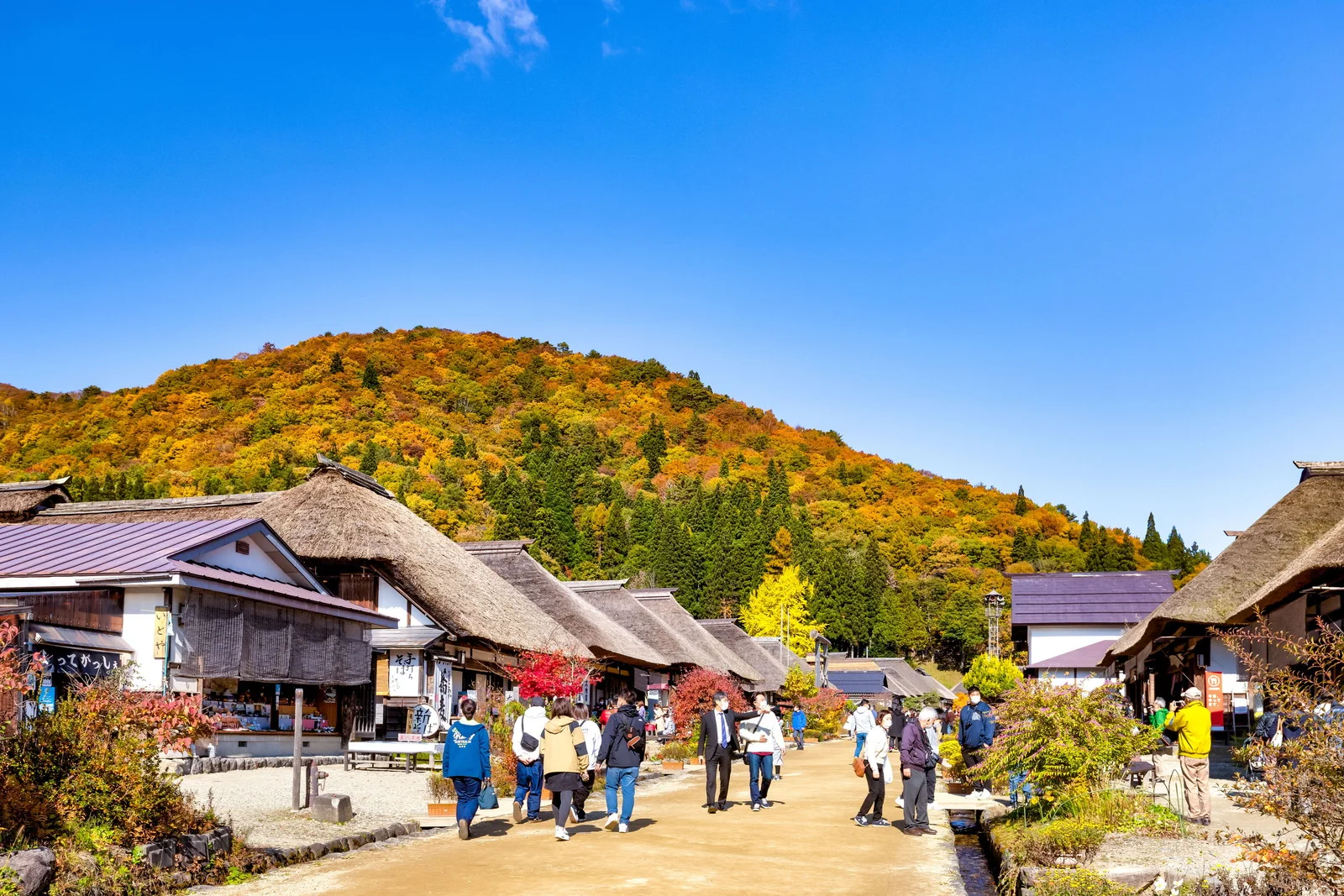
A two-day autumn foliage itinerary in Aizu, Fukushima, pairing the thatched roofs of Ouchi-juku with the volcanic lakes of Goshikinuma in Urabandai. Covers peak foliage windows, Saruyu-go bus bookings and fares, Inawashiro buses, trail hours, and staying in Aizu-Wakamatsu versus Yunokami-Onsen.
Half a day in Ouchi-juku: start at the far end and work back
Aloft from the bus at Ouchi-juku Iriguchi, walk straight down the main street past the cluster of shops until you reach the stone steps leading up to the Miharashidai viewpoint. Look back once before climbing and you will see how the thatched roofs align neatly with the road. Older travellers who would rather skip damp or steep stone steps can still take in the eaves and autumn hills from street level. Leave a clear path when pausing outside shopfronts, step into open gaps to take street photos, and avoid standing on the stone kerbs of the roadside water channels to let people pass. In wet weather, the main street and exhibition hall are easier for a family group to explore together, while anyone keen on the viewpoint can head up once a shower clears.
Halfway along the street sits the Ouchi-juku Machinami Exhibition Hall, a reconstructed honjin (official Edo-period inn) where you can see the separate entrance, raised upper chamber, and bathhouse once reserved for high-ranking travellers. Take in the scale of the facade before stepping inside to trace how the entrances and rooms connect. With many other thatched buildings still functioning as private homes or shops, this hall is the one place where you can properly inspect the interior layout. Shimogo Town lists opening hours as 09:00–16:30, with admission at ¥250 for adults, ¥150 for primary and junior high school pupils, and free entry for pre-school children; it closes from 29 December to 3 January. It also makes a convenient meeting point if anyone in your group gets tired midway down the street.
On the walk back from the far end, look up to notice the thickness of the thatch and the deep overhang of the eaves before checking out the shopfronts. During the Edo period, Ouchi-juku served as a post town on the Aizu Nishi Kaido highway, and its appeal as a preservation district lies in how daily life and small businesses still share the same historic street. Wait until your return walk to buy pickles, rice cakes, or snacks so you are not carrying bags up the stone steps. If you arrive in the afternoon and need to catch the last bus, pick the viewpoint and just one shop to browse. To fit in both the exhibition hall and a relaxed lunch, leave yourself a choice of at least two return bus departures.
At Misawaya, the signature Takato soba pairs 100% buckwheat noodles with grated daikon radish and a whole spring onion, listed at ¥1,500 on the official menu (open 09:30–16:00). You use the spring onion both to scoop up the noodles and to bite into as a sharp condiment. For something warm, there is seasonal kenchin soba, allowing everyone in a family group to pick between cold spring-onion soba and hot broth noodles. Misawaya accepts booking enquiries via its official LINE account or by phone; walk-in diners collect a numbered ticket at the door and browse neighbouring thatched shops while waiting. If you have a bus to catch, grab your ticket before walking the street, build in proper meal time, and cut your shopping short or switch to another eatery rather than waiting until just before the final bus to join the queue.
Travellers staying overnight in Aizu-Wakamatsu can save dinner for the town centre. Look out for restaurants serving local Aizu specialities such as kozuyu (a traditional celebratory broth) or a hearty bowl of sauce katsudon; after eating soba in the mountains at midday, you will not feel obliged to hunt down another noodle shop at night. If you are travelling with older relatives and prefer to rest straight after the village walk, book a dinner-inclusive ryokan in Yunokami-Onsen for your first night. On days you check into a ryokan, work backwards from its agreed check-in and dinner times when scheduling your afternoon in Ouchi-juku.
If you still have half a day to spare in Shimogo Town, add a river gorge stop at To-no-Hetsuri. According to the Shimogo Town Tourism Association, the scenic rock formations lie around a 5-minute walk from To-no-Hetsuri Station on the Aizu Railway. It is just one stop south from Yunokami-Onsen towards Aizu-Tajima — check the return timetable on the same platform as soon as you step off the train. Only cross the suspension bridge if you have ample time; even from the shop-lined side, you get clear views of the white stratified cliffs and autumn foliage across the river. The Shimogo Town Tourism Association announced the reopening of the suspension bridge in March 2026, though it may still close in winter due to snow or ice, so families with children can comfortably stick to the viewing area near the bridgehead.
Both To-no-Hetsuri and Ouchi-juku lie along the southern stretch of the Aizu Railway. If you are starting from Aizu-Wakamatsu and returning to the same base, bear in mind that the round-trip Ouchi-juku rail-and-bus discount ticket only covers travel as far as Yunokami-Onsen, so riding one extra stop south requires a separate fare. By contrast, if you bought the one-way pass between Nishi-Wakamatsu and Aizu-Tajima, To-no-Hetsuri sits right along your route and pairs well with a later Tobu connection back to Tokyo. If you are carrying large luggage and not switching hotels for the night, picking one stop rather than both keeps things manageable; if you plan to follow the full two-day Goshikinuma trail the next morning, keep the post-Ouchi-juku train ride strictly for heading back to your accommodation.
Getting to Ouchi-juku without a car: lock in your Saruyu-go return first
From Tokyo, take the Shinkansen to Koriyama, change to the JR Ban-etsu West Line for Aizu-Wakamatsu, and board a train bound for Aizu-Tajima that stops at Yunokami-Onsen. When buying tickets at Aizu-Wakamatsu Station, keep "Yunokami-Onsen" written clearly on your phone to show at the counter. While the Aizu Railway section technically begins at Nishi-Wakamatsu, selected services start from Aizu-Wakamatsu and run straight through to Yunokami-Onsen without a transfer. From Asakusa, you can also take the Tobu Revaty Aizu limited express to Aizu-Tajima and switch northbound onto the Aizu Railway. That route works nicely if you are spending night one in Yunokami-Onsen or continuing to Aizu-Wakamatsu before tackling Goshikinuma on day two and returning to Tokyo via Inawashiro and Koriyama.
Step out at Yunokami-Onsen Station to catch the Saruyu-go shuttle bus operated by Hirota Taxi. Ouchi-juku sits about 6 km from the station, a 20-minute ride on the timetable. For the period running from 14 March 2026 until the next Aizu Railway timetable revision, outbound buses depart at 09:45, 10:30, 11:30, 12:15, 13:35, and 14:55, while the final return departure from Ouchi-juku Iriguchi leaves at 15:15. Passengers who reserve by the previous day receive boarding priority (Hirota Taxi phone: 0242-75-2321). When booking, confirm your return date, direction, departure time, and party size — especially if you are travelling with children or need your group to board together. Remember that rail and bus tickets only cover transport fares; seat reservations must be arranged separately.
On the March 2026 Aizu Railway timetable, the 09:02 train from Aizu-Wakamatsu reaches Yunokami-Onsen at around 09:42, leaving just 3 minutes to catch the 09:45 bus. On weekends or on a first visit, it is much safer to book the 10:30 bus instead. Use the interval to admire the thatched-roof station building, dip your feet in the station-side footbath, and give everyone a toilet break. Taking the 10:30 bus in and the 13:55 bus back gives you roughly three hours in the village; the 13:55 bus reaches the station at 14:15 in good time for the 14:51 train towards Aizu-Wakamatsu. Build in extra buffer on rainy days and weekends, and avoid relying on the last connection of the day.
If you only need transport between Yunokami-Onsen and Ouchi-juku, you can buy a two-day unlimited Saruyu-go bus pass on board for ¥1,100 (adults) or ¥500 (children). Anyone travelling by rail from Aizu-Wakamatsu or Aizu-Tajima will usually save with the Ouchi-juku Combined Discount Ticket at ¥2,200 for adults and ¥1,100 for children. The rail portion covers either a return trip between Nishi-Wakamatsu or Aizu-Tajima and Yunokami-Onsen, or a one-way journey between Nishi-Wakamatsu and Aizu-Tajima — ideal if you are entering from one end and exiting from the other. You can complete your single or return rail trip across two days while riding the Saruyu-go bus freely throughout both days, which suits overnight stays in Yunokami-Onsen, though multiple rail hops back and forth on the same stretch require separate tickets.
Starting from Aizu-Wakamatsu Station adds ¥200 each way (¥400 return) for adults to cover the short hop to Nishi-Wakamatsu. Based on Aizu Railway's published calculation from Nishi-Wakamatsu, buying a separate return train ticket plus the bus pass costs ¥2,820, so the combined ticket saves an adult ¥620. JR Ban-etsu West Line fares and Goshikinuma buses are paid separately. You can buy paper tickets on the Aizu Line or use the mobile ticketing channels listed by Aizu Railway. Check train staffing before counting on buying a pass from a conductor, as driver-only trains do not sell combined tickets on board; buying at a staffed station or on your phone is far more reliable.
If you are already staying in Nikko and want a side trip to Ouchi-juku, Tobu offers the Nikko-Ouchi-juku Free Pass at ¥4,860 for adults and ¥2,410 for children, sold at the tourist information centres in Tobu-Nikko and Kinugawa-Onsen stations. It grants two days of rail travel between Tobu-Nikko and Yunokami-Onsen plus unlimited Saruyu-go rides on either the day of purchase or the following day, with limited express surcharges payable separately. If your route continues north from Ouchi-juku to Aizu-Wakamatsu and Goshikinuma before returning via Koriyama, rail travel north of Yunokami-Onsen and Urabandai buses are not included. Those heading straight from Asakusa and continuing north the same night should compare the Aizu-Tajima route with a one-way discount ticket rather than detouring into Nikko or Kinugawa just for a pass.
Picking the right Goshikinuma bus stop before you set off
To reach Goshikinuma in Urabandai, take the JR Ban-etsu West Line to Inawashiro Station and walk out to Bus Stop 3 in front of the station for Fukushima Transportation's Aizu-area services towards Urabandai. The eastern stop is named Goshikinuma Iriguchi, right beside the visitor service area, with a paved path leading to the Bishamon-numa Observatory. The western stop is called Urabandai Kogen Station, next to the Urabandai Bussankan (products hall) and Yanagi-numa; here, "station" simply means a bus terminal rather than a railway platform. Use the exact stop names when checking timetables and save both ends of the trail on your map so you do not waste time looking for train tracks at the western exit.
Fukushima Transportation's Konan and Inawashiro timetable (revised 1 November 2026) includes Routes 26 and 55. On the current weekday schedule, Route 55 leaves Inawashiro Station at 10:20 and reaches Goshikinuma Iriguchi at 10:51 for ¥920 (adult). Walking east to west, you can catch Route 26 from Stop 2 at Urabandai Kogen Station at 13:26, arriving back at Inawashiro Station at 14:05 for ¥1,060 (adult) — ¥1,980 in total. That pairing gives you 2 hours and 35 minutes between stops, enough for photos and locating the return stand; if you want a sit-down meal as well, test the following bus against your onward JR train.
Weekday, Saturday, and Sunday/public holiday timetables are listed separately. Always select the matching day type on Fukushima Transportation's website and note both the bus stop number and route number. Some Inawashiro-to-Urabandai buses terminate partway — if the destination board reads Onogawako Iriguchi, check the route before boarding on the eastern side, and verify both the terminus and intermediate stops if catching a bus from the western end. Coming from Aizu-Wakamatsu, board a JR train heading towards Koriyama; for your journey back to Tokyo, you can carry on straight from Inawashiro to Koriyama, though bags left in Aizu-Wakamatsu Station lockers will mean doubling back first.
Drivers planning a one-way hike can use the same bus link. Park at the eastern end, ride the bus to the western trailhead, and walk back to your car if you are driving south in the afternoon. Alternatively, if you want Bishamon-numa first, leave the car at the western end and take the bus east. Eastern parking sits at the visitor centre and neighbouring tourism association car parks, while the western end uses the Hibara-ko Daiichi and Daini car parks opposite the Bussankan. Riding the bus before the walk takes the pressure off your pace so you are not rushing through the woods for the last bus; if timings do not line up, a short out-and-back walk from one side still reaches one or two lakes easily.
Choosing which end of the Goshikinuma Nature Trail to walk
The Urabandai Visitor Centre grades the Goshikinuma Nature Trail as a beginner route covering roughly 4 km one way in about 1 hour and 30 minutes. That figure reflects steady walking only; allowing for observatory stops, browsing the visitor centre, and waiting for the return bus at the western end, 2 to 2.5 hours is a more realistic window. Because buses serve both trailheads, walking there and back on foot means nearly 8 km. If you are with older travellers, young children, or a mixed-pace group, agree to walk together to the first observatory and decide there whether to press on or turn back.
Entering from the east brings you straight to Bishamon-numa, the largest body of water on the route. Between Bishamon-numa and Aka-numa, the path enters woodland with patches of loose stones and exposed tree roots. Next comes Midoro-numa, followed midway by Benten-numa, where an elevated platform overlooks a wide stretch of water. Ruri-numa pairs water colour with distant mountain views, while Ao-numa's shoreline shows off vivid mineral blues up close, before the western end emerges beside Yanagi-numa and the Bussankan. Follow the main trail and signed viewpoints at junctions, and stay on the main track if a side spur is closed. Because Kitashiobara Village notices and visitor centre maps use Japanese place names, keep a full trail map saved offline to match junctions in the forest.
If you only have a morning and want the broadest lake view on a paved path, choose the eastern visitor centre and Bishamon-numa; if you want a shorter woodland approach to Ao-numa and Ruri-numa, enter from the Bussankan next to Urabandai Kogen Station. The trail from the visitor centre to the Bishamon-numa Observatory is paved, whereas the middle and western sections switch to wooden boardwalks, gravel, and uneven ground. Groups with pushchairs or wheelchairs can use the eastern side as a fixed meeting point while stronger walkers continue and return the same way. If meeting at the western end, agree clearly on either the Bussankan or the bus stop, and check where the bus stand sits before browsing the shops.
From 25 July 2026, Kitashiobara Village restricts passage between the Bishamon-numa Observatory and the Benten-numa Observatory to 09:00–16:00 to avoid peak bear activity hours. Wait around the trailhead facilities if an early bus drops you off before opening, and calculate your crossing time carefully for afternoon starts. Stick together on the trail, carry a bear bell or make noise as advised by the village, and never approach bears or cubs. If you spot tracks, droppings, or a closure notice, retrace your steps to a busy area and switch to a bus ride or indoor attraction. The Urabandai Visitor Centre also publishes bear guidelines and a sighting map, which are worth checking even for short lakeside strolls or nearby paths.
Goshikinuma's ponds display markedly different hues even under identical skies. Following Mount Bandai's 1888 eruption, volcanic debris dammed local waterways and created this cluster of lakes. Microscopic mineral particles suspended in certain ponds scatter sunlight, while water depth, aquatic plants, sky conditions, and surrounding trees shift the colours you see. On clear days, linger at open Benten-numa to compare near and far water tones; in breezy weather, head for tree-sheltered smaller ponds along the shore, or frame red branches at the water's edge from an observatory once ripples break the reflections. Note that Mount Bandai's crater has another pond read as Aka-numa (Copper Pond), and Mount Azuma in Fukushima City has its own Goshikinuma, so add "Urabandai" or "Kitashiobara" to any map search.
Rowing boats operate on Bishamon-numa; if you want to get out on the water, fit it into a shorter eastern-end visit with enough time for life jackets, queuing, and returning to the jetty. The Urabandai Tourism Association directs current operating status and rental rate enquiries to the Goshikiso shop (0241-32-2346). When afternoon bus times or the 16:00 trail curfew are tight, stick to the observatories. The trail lies within a National Park Special Protection Zone where picking plants, collecting stones, or disturbing wildlife is prohibited — stay out of lakeside vegetation for photos and leave fallen autumn leaves untouched along the shore, framing your shots from the boardwalks instead.
How to split two days and where to stay overnight
Arriving by Shinkansen from Tokyo or Sendai on day one, an early morning arrival in Aizu-Wakamatsu lets you head straight to Ouchi-juku, whereas a later arrival is better spent exploring Aizu-Wakamatsu town first. Squeezing Ouchi-juku into late afternoon leaves you racing against closing soba shops and the final shuttle bus, while pushing it to day two means either adding a third day for Goshikinuma or travelling up from Tokyo the night before. The smoothest car-free two-day plan is arriving in Aizu-Wakamatsu to visit Ouchi-juku on day one, sleeping in Aizu-Wakamatsu, catching the morning JR Ban-etsu West Line to Inawashiro on day two, and heading home via Koriyama in the afternoon.
Staying right outside Aizu-Wakamatsu Station keeps both mornings' and evenings' departures in one hub, cuts down on walking, and makes it easy to grab breakfast for day two. Properties such as Hotel Alpha-1 Aizu-Wakamatsu list roughly a 3-minute walk from the JR station, keeping early departures and luggage handling simple. If you prefer wandering Nanokamachi and dining in the castle town, stay in the central district and take local transport back to Aizu-Wakamatsu Station before boarding for Inawashiro. Always check morning JR departure times before picking between the station front and the town centre, and verify exact map pins for listings labelled "Aizu-Wakamatsu", as hot-spring areas sit much further out than a post-dinner stroll.
To soak in a mountain valley hot spring, stay overnight on your Ouchi-juku day. In Yunokami-Onsen, Toryukan is around a 10-minute walk from the station and offers a free station shuttle, with check-in from 15:00 to 19:00. If booking a half-board plan, plan your afternoon in Ouchi-juku backwards from your check-in and dinner slot. On day two for Goshikinuma, ride the Aizu Railway north from Yunokami-Onsen to Aizu-Wakamatsu before switching to JR and the bus. Because that adds an extra rail leg compared with staying by Aizu-Wakamatsu Station, guests leaving after breakfast can opt for a half-day visit to Goshikinuma's eastern end or add a night in Urabandai. Guests arriving via Shin-Shirakawa who want Toryukan's shuttle must book one day ahead.
If your priority is walking the full Goshikinuma trail in quiet morning light, shift night one up to Urabandai so you enter the forest well within the daytime opening window. At the western end beside Lake Hibara, Urabandai Lake Resort runs a free shuttle from Inawashiro Station (reservation required for groups of 10 or more, with no intermediate stops). The hotel shuttle drops you straight at the resort, so check public bus times if you intend to start walking from the eastern Goshikinuma Iriguchi stop. Alternatively, staying near Inawashiro Station simplifies early-morning mountain departures and afternoon Shinkansen transfers, with shops nearby to pick up trail snacks the night before.
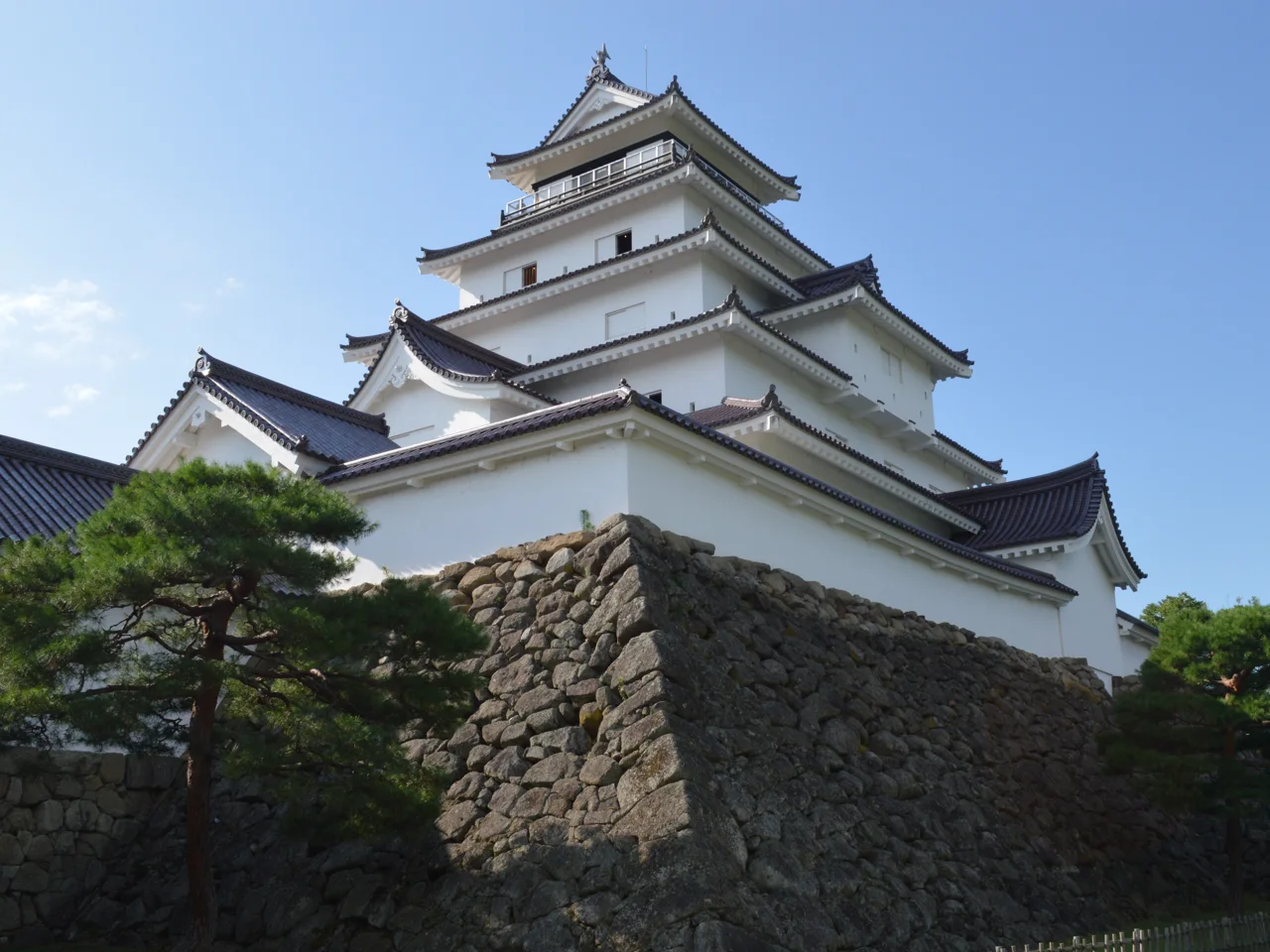
Basing yourself in Aizu-Wakamatsu for both nights has a handy rainy-day advantage: you can pivot straight to Tsuruga Castle and the Fukushima Museum. Tsuruga Castle Keep opens 08:30–17:00 (last entry 16:30) at ¥410 for adults and ¥150 for children, or ¥520 for an adult combined ticket with Rinkaku Tea House. Inside the castle are indoor exhibition rooms, and if you want matcha at Rinkaku, arrive before 16:00 (the tea service fee rises to ¥700 per sitting from 1 December 2026). Nearby on the Sannomaru side, the Fukushima Museum opens 09:30–17:00 (last admission 16:30) and generally closes on Mondays and the day after selected public holidays. Watch each venue's closing time when fitting one in before your train, or use our two-day car-free Aizu-Wakamatsu guide to map out a full town itinerary.
Whenever you switch hotels between days, decide what happens to your bags at checkout. Coin lockers at JR Aizu-Wakamatsu Station work well if you are returning through the station later in the day. If you plan to board straight towards Koriyama from Inawashiro in the afternoon, courier your suitcase to your next hotel or pick an inn that holds bags near the end of your trail. Carry only a small daypack that fits by your feet on the bus and keeps your hands free on Goshikinuma's narrow boardwalks. Aizu-Wakamatsu's station-to-ryokan hands-free delivery service only covers selected inns in Higashiyama and Ashinomaki Onsen — enquire at the station before heading to Ouchi-juku, and use standard courier delivery if sending luggage onward to Urabandai.
For a budget benchmark, take two adults starting from Aizu-Wakamatsu with combined Ouchi-juku tickets on day one and walking Goshikinuma east-to-west on day two: each pays ¥2,600 for the Ouchi-juku rail-and-bus combo (including the Aizu-Wakamatsu supplement) plus ¥1,980 for the Inawashiro buses, coming to ¥9,160 for two people before adding JR Ban-etsu West fares, long-distance trains from Tokyo or Sendai, and accommodation. When weighing up car hire, include rental rates, winter tyres if needed, fuel, parking, and any one-way drop-off fees across the same scope. Sharing a car among three or four travellers makes it easy to adjust pick-up points between the eastern and western trailheads and swap drivers, though late departures still have to respect Goshikinuma's gated hours and Ouchi-juku's lunch closing times.
Driving tips: parking, mountain roads, and wet-weather plans
Splitting Ouchi-juku and Goshikinuma across two days makes driving far less tiring, especially at weekends. Standard car parking at Ouchi-juku costs ¥500. On busy days, Shimogo Town recommends approaching via Prefectural Route 131 (the Ouchi Kobushi Line) from the Aizu-Misato side. After breakfast at your inn, check the live car park and road webcams linked on the town hall website before setting off. If queues are already forming, arrive later and have lunch first, or save Tsuruga Castle in town for another day. Because local buses use the same approach roads, leaving tight transfer margins back to Yunokami-Onsen can let village tailbacks derail the rest of your schedule.
Between the two destinations, drop back towards the Aizu side before taking National Route 49 and National Route 459 from Inawashiro up to Urabandai. Use these main trunk roads when estimating drive times before booking accommodation, particularly if you expect to arrive after dark. For a scenic autumn drive, add either the Bandai-san Gold Line (linking the Aizu basin to Urabandai) or the Bandai-Azuma Lake Line (running past Nakatsugawa Gorge and Lake Akimoto). The Bandai-Azuma Skyline through Jododaira towards Fukushima City is a full-day outing in its own right and worth skipping on a tight two-day itinerary focused on Ouchi-juku and Goshikinuma.
A road bulletin from the Urabandai Visitor Centre dated 14 November 2026 lists the Gold Line, Lake Line, Nishi-Azuma Sky Valley, and Bandai-Azuma Skyline as closed for winter until roughly late April 2027. Check winter closures in your satnav and stick to snow-cleared national highways even if a mountain pass looks a few kilometres shorter on the map. The visitor centre advises fitting winter tyres from mid-November onwards. Late-autumn drivers using rural roads should travel in daylight and slow down on shaded stretches, particularly early morning or dusk; if snow falls while you are on summer tyres, switch to JR trains and buses or focus on sights inside Aizu-Wakamatsu.
In light rain, walk the paved eastern path to Bishamon-numa, take in the lake and a short stretch of shoreline, and turn back — shoes with decent grip and free hands for handrails beat wrestling with a large umbrella. Even right after a shower stops, gravel and timber boardwalks stay slippery and puddles can block narrow sections; turn back to the trailhead if you cannot judge water depth. In heavy rain, thick fog, or icy conditions, swap the walk for the Urabandai Visitor Centre exhibitions. The centre opens 09:00–17:00 from April to November and 09:00–16:00 from December to March, closing on Tuesdays (or the next day after a Tuesday public holiday) and over New Year. Outdoor public toilets stay open 24 hours, so you can separate a car-park toilet stop from an exhibition visit.
The Morohashi Museum of Modern Art is currently closed for major renovations and is scheduled to reopen around April 2027, with its gardens also shut in the meantime. If you are eyeing it as a wet-weather backup for autumn 2027, the museum plans to run its reopening exhibition until early November 2027, with published hours of 09:30–17:00 (last admission 16:30). Until it reopens, stay in Aizu-Wakamatsu for the morning if the visitor centre is also closed; otherwise, the visitor centre's volcano and natural history displays tie straight into how Goshikinuma was formed and make a smoother fallback than turning up at a shut museum gate based on an old map.
Once snow settles, following the autumn trail markers becomes unreliable as boardwalks, shorelines, and junctions disappear under snow. Without winter hiking experience, limit yourself to a short visit around the visitor centre and save the full crossing for clear conditions with proper gear — or book a local snowshoe guide. Even in late November, the same pair of walking shoes must cope with wet stone steps in Ouchi-juku, cold lakeside winds, and waiting at bus stops. Keep spare dry socks and waterproofs in the boot of your car, or pack rain gear and warm layers into your daypack rather than leaving them back at the hotel: sunny skies in Aizu can still mean damp, chilly air along the lakes of Urabandai.
A few useful answers
Can I travel from Ouchi-juku to Goshikinuma without a car?
Yes. Take the Saruyu-go shuttle bus from Ouchi-juku back to Yunokami-Onsen, ride the train via Aizu-Wakamatsu to Inawashiro, and transfer to a Fukushima Transportation bus. Giving each spot half a day and overnighting in Aizu-Wakamatsu avoids rushed connections.
Which end is better if I only have time for a short walk at Goshikinuma?
For the widest lake surface and paved access, start from the Goshikinuma Iriguchi stop for Bishamon-numa. If you want to reach Ao-numa and Ruri-numa quickly, enter from the Urabandai Bussankan side at Urabandai Kogen Station and walk back to the same bus stop.
Do I still need to reserve the Saruyu-go bus after buying a pass?
Yes. During the autumn foliage season, passengers who book ahead with Hirota Taxi at least one day in advance take priority in both directions. The two-day adult bus pass costs ¥1,100 and the combined rail-and-bus ticket costs ¥2,200; buying a pass is separate from reserving a seat.
When is the best time to see both thatched roofs and autumn leaves at Ouchi-juku?
The Fukushima Prefecture Tourism and Local Products Association lists the typical peak window as late October to early November. Late October is the easiest time to combine Ouchi-juku with Goshikinuma, though it is worth checking recent photos of the hillsides and lakeshores before locking in your dates.
Goshikinuma is graded as an easy trail, so can I take a pushchair all the way through?
The eastern path from the Urabandai Visitor Centre to the Bishamon-numa Observatory is paved. Beyond that point, the Goshikinuma Nature Trail shifts to gravel, wooden boardwalks, and uneven ground that can puddle after rain, so pushchairs are best turned back at Bishamon-numa.
Official information and references
Sources used in this guide.
- Fukushima Prefecture Tourism and Local Products Association: Ouchi-juku autumn foliage window and access
- Kitashiobara Village: Autumn foliage season and 2026 Goshikinuma photos
- Urabandai Tourism Association: Typical peak foliage timing at Aka-numa
- Shimogo Town: Ouchi-juku Machinami Exhibition Hall hours and admission
- Shimogo Town: Ouchi-juku traffic access and road webcams
- Shimogo Town Tourism Association: Ouchi-juku overview and parking fees
- Misawaya: Takato soba, opening hours, and menu
- Misawaya: Reservations and on-site numbered ticket system
- Aizu Railway: Ouchi-juku Combined Discount Ticket details
- Aizu Railway: 2026 Saruyu-go bus timetable and passes
- Aizu Railway: March 2026 timetable revision notice and train schedules
- Yugawa Village: 2026 Aizu Railway guide and Saruyu-go advance booking priority
- Tobu Railway: Asakusa to Aizu-Tajima limited express timetable
- Fukushima Transportation: Konan and Inawashiro bus timetable (effective 1 November 2026)
- Fukushima Transportation: Inawashiro Station to Goshikinuma Iriguchi bus route
- Fukushima Transportation: Urabandai Kogen Station to Inawashiro Station bus route
- Urabandai Visitor Centre: Goshikinuma Nature Trail guide and map
- Urabandai Visitor Centre: Eastern paved access, parking, and FAQs
- Urabandai Visitor Centre: 18 October 2026 Goshikinuma trail conditions report
- Kitashiobara Village: Goshikinuma trail access hours and bear safety guidelines
- Urabandai Visitor Centre: Bear sighting map and visitor guidelines
- Urabandai Visitor Centre: Lake formation and water colours explained
- Urabandai Tourism Association: Bishamon-numa boat rentals
- Toryukan: Check-in times and station shuttle service
- Hotel Alpha-1 Aizu-Wakamatsu: Walking distance from JR station
- Urabandai Lake Resort: Free shuttle from Inawashiro Station
- Aizu-Wakamatsu Tourism Development Corporation: Tsuruga Castle Keep admission and hours
- Aizu-Wakamatsu Tourism Development Corporation: Rinkaku Tea House entry and matcha service
- Aizu-Wakamatsu Tourism Bureau: Fukushima Museum hours and access
- Urabandai Visitor Centre: Winter closures for scenic toll and mountain roads
- Urabandai Visitor Centre: Opening hours and visitor facilities
- Morohashi Museum of Modern Art: Long-term renovation closure and garden closure notice
- Morohashi Museum of Modern Art: 2027 reopening commemorative exhibition plan
- Shimogo Town Tourism Association: To-no-Hetsuri and nearby walking times
- Shimogo Town Tourism Association: March 2026 reopening of To-no-Hetsuri suspension bridge
- JR East: Aizu-Wakamatsu Station map and coin lockers
- Aizu-Wakamatsu Official Tourism: Hands-free luggage delivery and local cuisine
- Urabandai Visitor Centre: Road access and public transport routes
- Tobu Railway: Nikko-Ouchi-juku Free Pass fares and coverage area