Compare winter cherry blossom, steps, mountain roads and transport at Nakijin Castle, Nago Castle Park and Mount Yaedake. Plan driving or car-free visits and a northern base, with announced 2027 Nago festival dates.
- Region & Focus
- Okinawa Main Island
- Reading Scope
- 32 min read · 12 chapters · 6 Q&As
- Official Verification
- 19 official sources checkedUpdated 30 October 2026
- Key Topics
- SeasonsItinerariesBooking
Chapter Route Map (tap any stop)
- Choose the scenery first, then one place or two
- Winter blossom and announced 2027 dates
- Nakijin Castle: stone walls and sea views beyond the blossom
- Nakijin admission, steps and the walk after the bus
- Nago Castle Park: southern stairs or northern flowering-tree access
- Yaedake: plan the road, mid-slope park and summit separately
- Without a car: separate long-distance bus, local bus and final walk
- Based in Nago without a car: one place each day
- Nago festival day: separate park and town activities
- A driving day: two blossom stops with lunch between
- Nago, Motobu or Nakijin: dinner and transfers decide your base
- Shorten for rain and stamina, keeping a manageable section
- Quick Q&A
One cherry-blossom stop is enough for a winter Okinawa trip. Choose Nakijin Castle for kanhizakura, curving stone walls and sea views; Nago Castle Park for a bus-based outing and town walk from Nago; or Mount Yaedake if you have a car and enjoy flowers along a mountain road. The practical differences are the walk after you alight and how smoothly you can return to your accommodation afterwards.
Choose the scenery first, then one place or two
For a first blossom trip to northern Okinawa, I would put Nakijin Castle first. Even with only a few flowering trees, the gate, walls, open spaces and views give the visit variety. History enthusiasts can add the History and Culture Center. It suits visitors able to walk stone steps and give a castle time. If steps are a burden for companions, prioritise Nago's flowering-tree area or the mid-slope park at Yaedake, shortening the walk through suitable drop-off and pickup arrangements.
Nago Castle Park combines with central Nago for a half-day. Staying in town avoids changing hotels just for blossom. Return to the streets for lunch and leave the afternoon for rest. The park occupies mountain ground. The southern stairs to the castle site and the upper flowering-tree area are different approaches. Entering “Nago Castle Park” on a map does not bring you to one shared entrance. Decide how much to walk before choosing where to alight.
Yaedake suits visitors who include driving in the blossom experience. The road from the foot upwards offers a continuous view. Midway, Yaedake Sakura no Mori Park provides parking, toilets and a place to walk and rest. If you only want a quick photograph, you need not continue to the summit. If you enjoy wooded hills and several stops, allow more than a brief parking pause. Without a car, resolve both ascent and return before making it your main destination.
For contrasting scenery, pair Yaedake with Nakijin: mountain road in one, castle remains in the other. From Nago, keen walkers can pair Nago Castle Park with Nakijin. All three in a day suit only short stops by drivers already based in the north. For castle interpretation, photographs or a slower park visit with children, retain two. On a return day trip from Naha, one main destination is easier.
| Place | Main scenery | Walking and arrival | Best use |
|---|---|---|---|
| Nakijin Castle | Kanhizakura, stone walls and sea views inside the castle | Repeated stone steps; about 15 minutes on foot from the entrance bus stop | For visitors able to use stairs who also want the ruins |
| Nago Castle Park | Blossom paths, Nago city and sea views | Southern castle approach uses stairs; drive through the north entrance for upper areas | Half-day walk from Nago or a vehicle-assisted visit to one area |
| Mount Yaedake | Roadside blossom and wooded hills | About 4 km of uphill road; Sakura no Mori Park midway | Several driving stops; arrange uphill transfers first without a car |

Compare winter cherry blossom, steps, mountain roads and transport at Nakijin Castle, Nago Castle Park and Mount Yaedake. Plan driving or car-free visits and a northern base, with announced 2027 Nago festival dates.
Winter blossom and announced 2027 dates
Northern Okinawa's cherry blossom belongs to winter. The Nakijin Castle guide gives mid-January to early February as the usual kanhizakura season inside the castle. Nago Tourism Association describes deep-pink blossom around Nago Castle from late January to mid-February. The periods overlap, but there is no need to visit all three on one day. Reserve a northern daytime period, then choose the main site after arrival using dated bloom reports.
As compiled on 30 October 2026, the 64th Nago Cherry Blossom Festival was announced for 30 and 31 January 2027. Main venues include Nago Castle Park, the event stage in Sakura Park and Nago Jujiro Odori. The association page still retains some previous-year programme details and says the new stage programme is undecided. Use the announced dates for accommodation, then add parades, performances and traffic-control times when the new programme is complete.
The same Nago tourism page, updated in October, lists the 2027 Nakijin and Yaedake festival periods as undecided. Yaedake's complete previous-season record is 17 January–8 February 2026; Motobu Tourism Association explicitly records an extension. An old poster giving 17 January–1 February shows that year's original plan. Do not use it to book 2027 festival travel or shuttles.
Choose blossom and festival separately. For city performances and stalls, use Nago's announced weekend. For walking and flower photographs, a weekday northern stay removes one event-timing constraint. Decide whether you want close-up branches or the relationship between trees, road and stone walls. Deep-pink flowers stand out against green woodland. You need not seek a whole canopy in bloom; frame flowering branches with the green hills on the day.
Nakijin Castle: stone walls and sea views beyond the blossom
Nakijin combines blossom and reading a castle site in one walk. Start at the exchange centre for tickets and guide information, enter through Heiro Gate, then follow the main route towards Umiya and Uuchibaru. First see how gate and walls enclose spaces, then photograph trees and distant views from open areas. You need not stop with the crowd immediately inside. Flowers and ruins reward different viewing distances. Leave some camera-free time for interpretation.
The official guide explains that today's Heiro Gate was restored in 1962. Umiya was an important ceremonial square, once surrounded by main buildings. Moving through these locations reveals different uses of now-empty spaces. A blossom visit need not cover every listed feature. Gate, central square and viewpoint already make the ruins a readable place rather than a photograph backdrop.
Uuchibaru is said to have housed female attendants and is a sacred castle space, with a sea view to the north. Pause for the view while leaving room for worship and visitors. Follow on-site boundaries around sacred utaki areas; do not cross a barrier to include a branch in a photograph. If one companion wants flowers and another history, agree to meet at a named square rather than searching among branches and stairs.
The old path right of Heiro Gate uses a gap in the bedrock. The official description calls it narrow and steeply uphill. It suits sure-footed visitors interested in defensive terrain. With young children, someone needing support or slippery weather, the main route is easier to manage. Do not use the old path as a shortcut. Features occupy different levels, and the descent also uses your knees. Choose the extent at entry according to what everyone can complete.
If blossom is sparse, add the culture centre. It displays ceramics excavated from the castle and introduces village life and beliefs. The Chiyoganemaru sword on display is a replica. After walls and squares, objects connect outdoor spaces with people who lived here. During a brief shower, move this indoor reading to the wetter period and fit outdoor time around what remains.
Nakijin admission, steps and the walk after the bus
Current general individual admission is ¥1,000 for adults, ¥500 for junior and senior high school pupils, and free for primary school children and younger. The History and Culture Center is free. In the standard period covering winter, castle hours are 08:00–18:00, with last entry at 17:30. This guide suggests about two hours including parking, tickets, castle time and photographs. Add time for the culture centre and account for its closing time if arriving in the afternoon.
The culture centre opens 09:00–17:00, with last entry at 16:30. It closes Mondays, or the next day if Monday is a public holiday or Okinawa Memorial Day, and from 29 December to 3 January. Castle and centre have different schedules: a Monday castle visit may lack the indoor exhibition. If some companions stay inside while others climb, choose a day when both open to make waiting and meeting comfortable.
The castle has repeated stone steps. Management explicitly says wheelchair and pushchair passage is difficult; the culture centre has a lift. Families should separate pushchair needs from the castle walk. Enter only if an adult can carry the child and the rest of the party can manage the steps. Wheelchair users mainly seeking blossom should choose a park area with arranged vehicle access and known ground conditions, using the culture centre as the indoor Nakijin stop.
Drivers should use car parks 2, 3 and 4 under the notice effective from 1 September 2026. Car park 1 is temporarily closed for surrounding works. After parking, buy tickets at the exchange centre before entering. Eating and drinking are prohibited inside the castle but allowed in the rest area, so have water and a snack outside before the stairs. Bus passengers must distinguish Nakijin Castle from Nakijin Castle Entrance stops. The latter leaves a walk: bus arrival is not castle entry time.
Nago Castle Park: southern stairs or northern flowering-tree access
Nago Castle Park, also called Nago Central Park, spreads around Mount Nago. Despite sharing “castle” with Nakijin, it works differently: several squares, paths and nature areas let you choose one section and extend if you enjoy walking. Decide between walking uphill from town and taking a vehicle into the upper park before trying to cover the whole area.
For the castle site, the park access page directs visitors from the southern or nearby car parks onto stairs. This suits town-based visitors who want stair climbing as part of a walk. At the ruins, decide how much farther to climb. With a pushchair throughout, or knees unsuited to repeated steps, proximity to town does not make the route easy. Save energy for the descent too.
For the visitor centre, management office and upper park by car, official guidance recommends the north entrance via Nago town, which is easier for vehicles. The southern road is narrower; large buses also use the north. For split family groups, name subaco Visitor Center or a specific square as the meeting point, rather than “the park car park”. North and south have different parking and walking starts. A wrong meeting point adds needless climbing.
In the flowering-tree area, Sakura no Sono has a blossom path and a gazebo near its entrance overlooking Nago and the East China Sea. Tenjo Square has parking, toilets, rest space and a viewing tower. Combine the blossom path and viewpoints for city and sea scenery. For a short relaxed stop, walk around your chosen square and return to the same car park without extending into a Mount Nago hike.
Subaco Visitor Center offers rest space. Official café hours are 10:00–17:00, last order 16:30, with irregular closing days. It is useful midway through a walk or for regrouping when companions view flowers at different speeds. On an early arrival, walk outdoors first and come later. Eat in town to keep café hours separate from the periods when park routes can be used.
Yaedake: plan the road, mid-slope park and summit separately
Motobu Tourism Association gives Mount Yaedake's elevation as 453.4 metres, with around 7,000 or more kanhizakura along roughly 4 km of uphill road towards the summit. The practical meaning is to choose your section: road entrance, mid-slope park and summit are different places. Alighting at the foot still leaves an ascent. The short distance beside Yaedake Iriguchi stop is not arrival at the blossom venue.
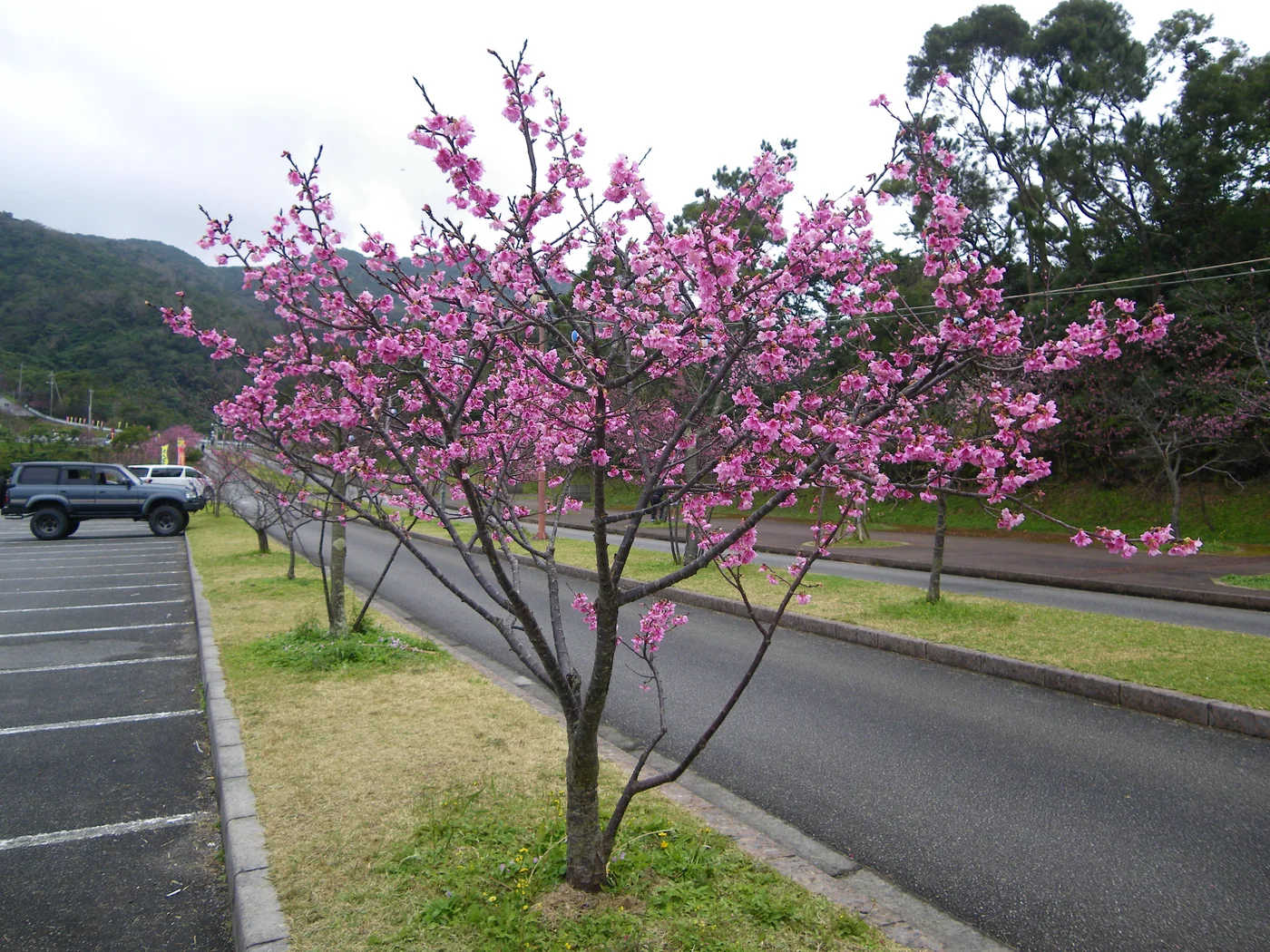
Yaedake Sakura no Mori Park is midway up, at 921 Namizato, Motobu. It has play equipment, rest facilities, toilets and a multipurpose square. Driving with children or older relatives, I would make it the main stop: park, use toilets, walk a section, then decide whether to continue according to everyone. Facilities in the park do not mean the whole mountain road suits parking or walking. Choose a safe parking place before getting out for photographs.
If you enjoy the road scenery, note flowering sections on the ascent, then plan a short walk after reaching a parking place. Drivers and passengers view at different rhythms. Do not ask the driver to search for flowers or take photographs while turning. Save photographs until parked, and do not stop in the middle of the road at traffic meeting points. Where road conditions or staff instructions require you to continue, view that section through the window and rest at the next permitted stop.
The summit can be an extension, but need not be everyone's endpoint. Woodland enthusiasts can spend longer along the road; families may already fill their time at the mid-slope park. With half a day, ending at the park makes lunch and return easier to connect.
Yaedake's blossom space spans road and park. Use the relevant year's festival vehicle guidance. The 2026 event was extended, but that year's free blossom shuttle cannot be carried into the next season. Motobu Tourism Association's current sightseeing-bus page describes its general town touring service for fiscal 2026. Before formalising a car-free mountain day, obtain a stop or transfer arrangement explicitly naming Yaedake Sakura no Mori Park.
Okinawa Convention and Visitors Bureau’s Okinawa Story site features this short Yaedake festival drone film, released on 26 March 2021, introducing Motobu’s rows of kanhizakura.
Without a car: separate long-distance bus, local bus and final walk
Naha to the north is one leg; northern towns to blossom sites are another. For Nago, use express bus 111. Okinawa Bus's current fare table lists adult singles at ¥2,520 from Naha Airport Domestic Terminal to Nago Bus Terminal, or ¥2,420 from Asahibashi/Naha Bus Terminal. Two adults' return long-distance fares approach ¥10,000 before local travel. Compare that cost and daily travel time with an overnight northern stay.
For Nago Castle Park, reach town first, then connect to the southern entrance or take a taxi. Route 70 Bise Line's operator fare table lists Nago Castle Entrance (名護城入口), ¥190 adult single from Nago Bus Terminal. This is the castle-site side and still involves stairs. For subaco or the flowering-tree area, give the taxi a named destination and arrange return pickup there to avoid retracing the wrong mountain approach.
For Nakijin, take route 66 Motobu Peninsula Line from Nago towards Nakijin, or Yanbaru Express Airport Line from Naha, alighting at Nakijin Castle Entrance. Castle management gives about 15 minutes on foot from the stop. The express bus stop guide places the Unten Port-bound stop beside the approach to the old castle path, marked by an Imadomari walking-path sign. The Naha-bound stop is roughly opposite. Identify the return position when you alight.
For Yaedake, route 70's fare table lists ¥720 adult single from Nago Bus Terminal to Yaedake Iriguchi. This reaches only the stop at the foot. If taking a taxi uphill, arrange descent pickup too and specify Sakura no Mori Park or a point farther up. Use the same clear location for drop-off and pickup. Route 70's published main-stop timetable has only a few morning and afternoon departures from Nago, with different outward and return routing. Do not plan it like a frequent city bus.
Motobu's general free sightseeing loop bus is currently announced until 31 January 2027. It serves ports, markets, some hotels and the Ocean Expo Park area. Its stop list does not include Yaedake Sakura no Mori Park. It can connect accommodation or markets, but not replace the mountain section. For Yaedake and Nakijin in one car-free day, a charter or prearranged transfers between both is easier. Relying only on scheduled buses, I would make Nakijin the main day and leave Yaedake another day.
Based in Nago without a car: one place each day
On the first day in central Nago, make Nago Castle Park a half-day walk. After breakfast, head towards the castle side and turn back on the stairs according to stamina. To avoid a long stair section, take a taxi to the flowering-tree area and agree a pickup for town. Lunch in town leaves the afternoon for laundry, supplies or rest. There is no need to hurry to another mountain; save energy for Nakijin next day.
Use route 66 for Nakijin on day two. The weekend timetable effective 26 October 2026, for example, leaves Nago Bus Terminal at 09:00 and reaches Nakijin Castle Entrance at 09:41. After the approach walk, give the morning to gate, walls and blossom. This is a current ordinary-weekend example. For diversions and temporary stops on the 2027 Nago festival weekend, use that festival's transport notice.
Return to Nago on route 65 in the opposite direction, also named Motobu Peninsula Line. The weekend table effective the same day lists Nakijin Castle Entrance 13:48 to Nago Terminal 14:32, then 14:58 to 15:42. Work backwards from these for a morning entry and afternoon departure. Continuing on route 66 loops around the other side of the peninsula before Nago. The destination name is the same, but the route differs. Check number and direction before boarding to meet lunch or your next bus.
The route 66 fare table gives ¥900 adult single from Nago Terminal to Nakijin Castle Entrance. Add adult castle admission for an initial outbound-plus-entry total of ¥1,900 per person, with the return fare separate. Budget long-distance buses, local buses and castle tickets independently. For two people, this also helps compare a taxi's cost with the walk saved between stop and entrance, or a half-day remaining in Nago instead.
Give the castle one uninterrupted walk, then visit the culture centre. Eat in the rest area outside the castle or at a separately chosen restaurant. Select your Nago return first and include downhill walking, toilets and waiting in your exit time. With a long gap between services, extend exhibition reading rather than adding a stop that means carrying luggage to an unfamiliar junction.
For a return day from Naha, reduce the plan to one place. A direct express bus suits a full Nakijin visit before returning. Nago can combine blossom with town dining. For Yaedake, settle both mountain connections before selecting it. With an evening restaurant booking in Naha, allow enough long-distance return time and finish blossom viewing well before the last usable bus.
Nago festival day: separate park and town activities
For the Nago festival on 30 or 31 January 2027, decide whether flowers or events matter most. Nago Castle Park, the Sakura Park stage and Nago Jujiro Odori are separate stops. After hilltop blossom, allow time to reach the streets, eat and wait for programmes. Walk the park in the morning and return to your accommodation if that is enough. For events, leave the afternoon to town rather than booking a Yaedake transfer at the same time.
If some companions enjoy the stage and others only flowers, use lunch as the whole group's meeting point. Stair climbers can go uphill while others walk town at their pace, then decide together after lunch how long to stay. This is easier than making less mobile companions wait throughout. Meet at the booked restaurant or hotel lobby and write its full name, rather than “the festival entrance”.
Drivers staying centrally can park at their accommodation first, then walk to the event area. Ask the hotel about festival-day access roads and parking, especially for afternoon car arrivals. If parked and staying for later programmes, eat nearby. Driving back across regions to Onna or Naha afterwards makes a long day for the driver. For the atmosphere, another night is worthwhile. For flowers alone, another weekday daytime visit works.
Before the full programme appears, arrange confirmed accommodation, meals and travel, leaving the afternoon open. Add chosen performances later. If one conflicts with your castle visit, keep whichever matters most to this trip. Families with toddlers can choose one daytime event and return to rest without waiting for the full programme to end.
A driving day: two blossom stops with lunch between
Already based in Nago or Motobu, you can give Yaedake and Nakijin one section each. This guide suggests Yaedake in the morning, with the mid-slope park as the main stop and flowers viewed from permitted parking points. Return to Motobu town for lunch, then head to Nakijin in the afternoon. Mountain road first and a site with a defined last-entry time second makes the allocation clear. Staying in Nakijin the previous night, reverse it: use your freshest energy for stone steps, then make a shorter Yaedake stop.
As this guide's planning suggestion, allow about two hours at each for walking and photographs, plus lunch, travel and parking between. Seeking light or waiting for crowds to clear can take half a day in one place. If companions want the culture centre in detail, give the afternoon only to Nakijin and save Yaedake for another day. Dropping a short stop often works better than squeezing everyone's meal.
Between Nago and Motobu, Motobu's access guide lists coastal National Routes 449 and 505 and mountain-crossing Prefectural Route 84. Yaedake is in the mountain direction; Nakijin is on the peninsula's north side. Navigate to the actual parking destination, not just an administrative area. After Yaedake, do not return to Nago merely to add its park before looping back to Nakijin. Link stops along the day's driving direction.
From Naha, calculate reaching the north separately from travel between northern sites. Returning that day, choose one main morning sight and reassess a second after lunch. If parking queues, tired companions or worsening weather intervene, return directly. If both northern sites are priorities, stay north the night before. Early blossom time is more comfortable than stairs immediately after a long cross-region drive.
Nago, Motobu or Nakijin: dinner and transfers decide your base
Without a car, compare central Nago first. The bus terminal area suits interregional connections; the town centre suits walking to food and streets. Check them separately rather than treating “Nago” as one walking area. Accommodation near the stop you need saves effort both ways. With large luggage, leave it at the hotel before blossom viewing instead of extending a suitcase route onto a mountain road.
For Nago town events on festival weekend, a central stay keeps dinner and activities within walking range. Compare hotel door to venue, traffic controls on the walk back, and vehicle access to parking. The 2027 dates are announced, so decide whether you want to stay in the event area that weekend. For quiet, view flowers on another day and choose accommodation away from that evening's main activity route.
Driving with Yaedake and Nakijin as priorities, Motobu can be a two-night base. Start with dinner: a town stay within walking distance of restaurants makes it easier to leave the car in the evening. For a coastal resort or standalone property, arrange restaurant opening, booking or a dinner plan first. Hotels near Churaumi can connect another day's visit, but Yaedake still requires an uphill drive. The same town boundary does not remove the final mountain road.
Nakijin suits an early castle arrival if you plan dinner and transport together. Drivers can finish the castle walk in the morning and move elsewhere slowly. Without a car, choose a property with a clear arrival route and an arrangeable return pickup. Compare actual roads, slopes and bus stops rather than straight-line distance to the castle. If planning a future announced evening event, settle how to return to your room after it as part of the accommodation choice.
Changing hotels daily just to add one blossom site usually adds checkout, luggage and check-in waiting. Two nights at one northern base give a nearby park on the first day and different scenery on the second. For Onna, Chatan and Naha comparisons, see where to stay on Okinawa’s main island, then choose how many northern nights this trip actually needs.
Shorten for rain and stamina, keeping a manageable section
All three are mainly outdoors. Grippy soles, a pack that frees your hands and removable outer layers are more useful than several outfits for photographs. Before Nakijin's steps with children, have water and snacks outside. Include the descent in your stamina allowance for Nago's southern stairs. Walking uphill along Yaedake's road, know how to return to the original parking point. If uncomfortable midway, turn back as planned rather than changing the pickup place too.
In rain, put Nakijin's culture centre first, subject to its closing days. At Nago, shorten to the flowering-tree area and rest at the visitor centre if open. With slippery roads, poor visibility or difficult stopping at Yaedake, retain only the mid-slope park. For other winter rain options, see Okinawa rainy-day family plans and replace an all-outdoor day with one outdoor and one indoor section.
Even a short walk needs a clear endpoint. At Nakijin, turn back from your chosen square; at Nago, stay within the selected blossom path or square; at Yaedake, return to the park parking point. Agree who walks, who rests and where to meet. People view flowers at different speeds. Photographers can stay longer while those needing a seat return to the rest area. The whole group need not wait together at every tree.
A few useful answers
Which northern Okinawa blossom site should I choose if I can visit only one?
Choose Nakijin Castle if you can manage stone steps and want kanhizakura, walls and sea views. Choose Nago Castle Park for a half-day town walk from Nago, or Yaedake with a car for roadside blossom. With a pushchair or limited stamina, choose a park area with arranged drop-off and pickup and avoid repeated stairs.
Have the 2027 northern Okinawa blossom festival dates been announced?
As of 30 October 2026, Nago Tourism Association announced the 64th Nago Cherry Blossom Festival for 30 and 31 January 2027, with parts of the new programme undecided. The same page lists the 2027 Nakijin and Yaedake festival periods as undecided. Yaedake’s extension to 8 February 2026 is a previous-season record.
Which is easier without a hire car?
From a Nago stay, make Nago Castle Park a half-day, using a taxi for the upper flowering-tree area. For Nakijin, take route 66 or Yanbaru Express to Nakijin Castle Entrance, then walk about 15 minutes. Yaedake Iriguchi is at the foot of the mountain, with ascent and descent transfers separate; it better suits a day of its own.
What is Nakijin Castle admission, and can I take a pushchair inside?
General individual admission is ¥1,000 for adults, ¥500 for junior and senior high school pupils, and free for primary school children and younger. Management says repeated stone steps make wheelchair and pushchair passage difficult. The free History and Culture Center has a lift; plan around its hours and closing days.
Does Motobu’s free loop bus reach Yaedake Sakura no Mori Park?
The announced general sightseeing service for fiscal 2026 runs until 31 January 2027 and serves ports, markets, some hotels and Ocean Expo Park. Yaedake Sakura no Mori Park is not on its stop list. Seasonal blossom shuttles are separate: use the relevant year’s route explicitly listing Yaedake.
Where should I stay for two blossom days?
Without a car, compare the Nago terminal area and town centre, visiting Nago park and Nakijin on separate days. Driving with Yaedake and Nakijin as priorities, stay two nights in Motobu. For early castle arrival, stay in Nakijin and arrange dinner and transfers together.
Official information and references
Sources used in this guide.
- Nakijin Castle: site guide, kanhizakura and History and Culture Center
- Nakijin Castle: hours, admission, access and FAQ
- Nakijin Castle: car park 1 works and eating and drinking notice
- Nago Tourism Association: 64th Nago Cherry Blossom Festival (updated 6 October 2026)
- Nago Castle Park: north and south entrances and access
- Nago Castle Park: flowering-tree area, Sakura no Sono and subaco
- Motobu Tourism Association: Yaedake and Sakura no Mori Park
- Motobu Tourism Association: 48th Yaedake festival extension in 2026
- Motobu Tourism Association: driving and bus access
- Motobu Tourism Association: free town sightseeing bus for fiscal 2026
- Yanbaru Express: Nakijin Castle Entrance stops in both directions
- Okinawa Bus: route 111 express fares
- Ryukyu Bus Kotsu: route 70 Bise Line fares towards Jana
- Okinawa Bus: currently published route 70 timetable
- Okinawa Bus: route 66 Motobu Peninsula timetable (effective 26 October 2026)
- Okinawa Bus: route 65 Motobu Peninsula timetable (effective 26 October 2026)
- Okinawa Bus: route 66 fares towards Nakijin
- Okinawa Convention and Visitors Bureau: Yaedake festival drone film (released 2021)
- YouTube: Motobu Yaedake Cherry Blossom Festival drone film