Walk from Shin-Kobe to the ropeway and choose tickets for daytime gardens, ordinary autumn nights or the 2026 Christmas whole-garden evenings. Plan the summit-to-Kaze-no-Oka route, food deadlines, slopes, rainy-day alternatives and return times, with couple and family budgets.
- Region & Focus
- Kobe
- Reading Scope
- 30 min read · 19 chapters · 8 Q&As
- Official Verification
- 12 official sources checkedUpdated 27 October 2026
- Key Topics
- ItinerariesSeasonsWinter
Chapter Route Map (tap any stop)
- Choose daytime gardens or an evening on the mountain, and give it half a day
- Walk from Shin-Kobe to the lower station; do not navigate to the summit
- Six-seat cabins take about ten minutes; learn the three stations
- Day, night and intermediate-station tickets suit different visits
- Read last ascent, garden closing and last descent separately
- Spend 20–40 minutes at the summit: plaza, gardens and lunch
- Slow down in the middle section: herb collection and kitchen garden
- Glasshouse and The Veranda: separate plant time from café time
- Finish on the lower lawns at Kaze-no-Oka, then leave from the intermediate station
- Daytime example: lunch at the summit, then walk downhill
- Ordinary autumn evenings: gardens first, upper area after 17:00
- Christmas 2026 whole-garden evenings: market, forest tree and night routes
- See autumn colour by day and illuminated paths by night
- Summit lunch and evening snacks follow a different clock from the ropeway
- Pushchairs and wheelchairs can use the ropeway; the gardens still have slopes
- In rain, check ropeway operation before planning the glasshouse
- Keep hiking to daylight and use the ropeway home after dark
- Couple and family budgets: tickets first, then one mountain meal or treat
- Finish at Shin-Kobe and keep one city option after the descent
- Quick Q&A
The return trip is the easiest part to misjudge at Nunobiki Herb Gardens. A weekday last descent at 17:15 and an evening-service last descent at 21:00 correspond to different areas being open. For the gardens, walk downhill from the summit to Kaze-no-Oka in daylight. For illuminations, choose the date first, then your departure station. From 7 November 2026, Christmas-season fares apply, with afternoon gardens and whole-garden evening access on selected dates.
Choose daytime gardens or an evening on the mountain, and give it half a day
Nunobiki Herb Gardens suits a full afternoon of gardens, ropeway travel and rest. Walk downhill from the summit to Kaze-no-Oka intermediate station, passing the herb collection, glasshouse and lawns, then return to Shin-Kobe for the city. For night views, choose an evening-service date and decide whether to stay in the summit viewing area or visit during Christmas whole-garden evenings. The walking and departure points differ considerably.
For a first visit, buy a return ticket to the summit and start walking after lunch or in the afternoon. Plant enthusiasts can spend longer on the middle paths; those who prefer the city view can allow coffee time. To avoid the full hillside, stay near the summit and descend from the same station. At night, make the departure station your fixed endpoint. Do not add a hiking trail after dark.
Keep Kitano’s foreign houses and the waterfront for another half-day. After a morning in Kitano and afternoon on the mountain, return to Sannomiya for dinner. If arriving from Osaka in the afternoon and waiting for illuminations, omit Kitano. For harbour accommodation, Nankinmachi or Luminarie, see the one- to two-day Kobe guide and replace one of its half-days with this visit.
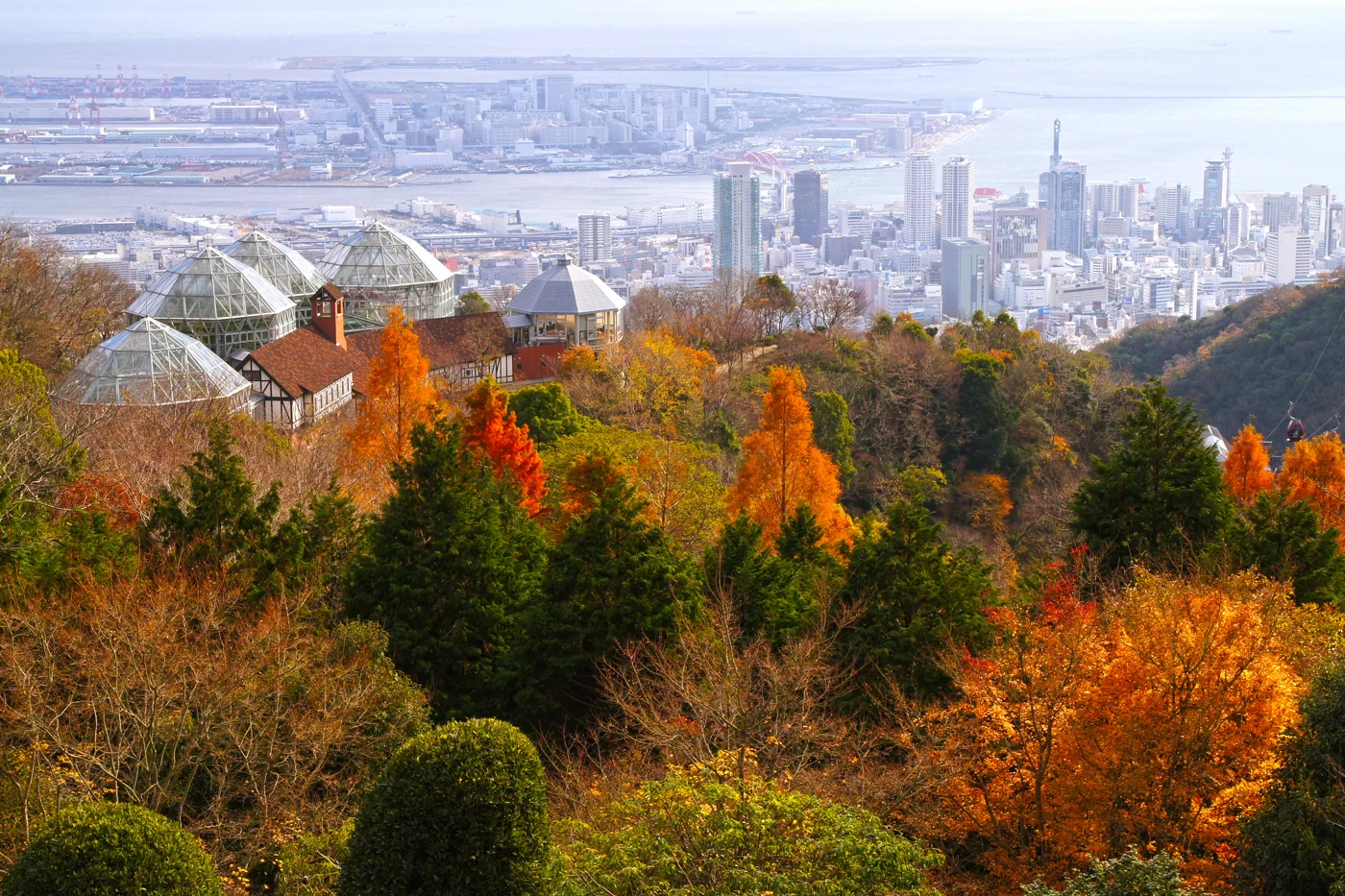
Walk from Shin-Kobe to the ropeway and choose tickets for daytime gardens, ordinary autumn nights or the 2026 Christmas whole-garden evenings. Plan the summit-to-Kaze-no-Oka route, food deadlines, slopes, rainy-day alternatives and return times, with couple and family budgets.
Walk from Shin-Kobe to the lower station; do not navigate to the summit
Whether arriving by city subway or Shinkansen at Shin-Kobe, the operator gives about five minutes’ walk after leaving the station to Herb Gardens Lower Station. Arriving at JR Sannomiya on conventional lines requires a subway or other city connection: Shin-Kobe and Sannomiya are different stations. Save the lower station as your destination and follow the entrance map. A taxi cannot take you to the mountaintop garden entrance. The official access page places the lower station west of ANA Crowne Plaza Kobe.
The five-minute estimate starts outside the station. Add time for lifts from platforms, exits, luggage storage and ropeway queues. With a pushchair, follow the lifts rather than carrying it up steps to match the shortest map time. A plan to go up at 14:00 should mean reaching the ropeway entrance, not the train arriving at Shin-Kobe at 14:00.
The gardens have no private-car parking, and ordinary vehicles and buses cannot drive directly to the top. On busy 2026 Christmas market dates, the operator expects full car parks and congestion around Shin-Kobe. Prefer public transport. Drivers can park in the city and connect, arranging car collection alongside dinner. Do not wait until the ropeway closes to seek a mountaintop pick-up.
Six-seat cabins take about ten minutes; learn the three stations
The ropeway takes about ten minutes from the lower station to the summit and five to Kaze-no-Oka intermediate station. Six-seat cabins depart about every 30 seconds throughout operating hours. There is no need to find an hourly departure timetable, though you must still queue when busy. The official ropeway guide lists a length of 1,460 m and height difference of 330 m. Windows overlook Nunobiki Falls and Nunobiki Gohonmatsu Dam before opening towards the city and bay.
Identify all three stations: the lower station is the city entrance, the summit station stands beside the viewing plaza, and Kaze-no-Oka intermediate station serves the lower lawns. For less climbing by day, ride to the top and walk down to the intermediate station. To wait for night views at the summit, include the time needed to return uphill. The intermediate station is not the city exit; another ropeway section remains.
Before taking photographs in a cabin, secure straps and small items. Take turns at the windows so everyone has a seat and a view. Look at the city and terrain on the ascent and use the other side on the descent. There is no need to move repeatedly over a missed glimpse of the falls. Walking to the falls needs separate hiking time. Seeing a sight through the window does not put it a few steps from a station.
Red ropeway cabins cross the wooded mountain. The video shows ropeway equipment and views along the route.
Day, night and intermediate-station tickets suit different visits
From 1 April 2026, an ordinary return costs ¥2,500 for adults and ¥1,250 for children, including ropeway travel and garden entry. “Children” means primary and junior high school pupils; preschool children enter free. An ordinary full-route single costs ¥1,900 or ¥950. For an easy garden visit with a ride back, choose a return. The single-ticket saving comes with walking the other direction. The fare page also lists a lower-to-intermediate-station single at ¥1,700 for adults or ¥850 for children, without garden entry.
On selected spring and autumn evening-service dates, night tickets purchased after 17:00 are return-only, at ¥2,000 for adults or ¥1,200 for children. Two adults save ¥1,000 against ordinary day tickets, but arrival time and open areas differ. For the herb gardens, glasshouse and Kaze-no-Oka, buy ordinary returns by day, finish the garden paths, then see night views as operations allow. This better serves a garden visit than missing its main areas to save ¥500 each.
This night ticket is unavailable in summer and the Christmas season. From 7 November to 28 December 2026, returns cost ¥3,300 for adults and ¥1,650 for children. Christmas prices also apply after 17:00. Select the fare by date, then choose arrival time by the areas you want. Using the ordinary ¥2,000 night fare for the Christmas market underestimates two adults’ tickets by ¥2,600.
| Ticket | Adult / child | Included and conditions | Suitable plan |
|---|---|---|---|
| Ordinary return | 2,500 / 1,250 | Return ropeway + garden entry; children are primary and junior high school pupils | Enter at summit, leave at intermediate station by day |
| Ordinary full-route single | 1,900 / 950 | One ropeway direction + garden entry | Planned daytime hike |
| Selected spring/autumn evening return | 2,000 / 1,200 | Purchased after 17:00; return only | Summit viewing area at night |
| Lower–intermediate single | 1,700 / 850 | No garden entry | Separate ropeway transport need |
| Christmas 2026 return | 3,300 / 1,650 | 7 November–28 December; no night fare | Market and areas open that day |
Read last ascent, garden closing and last descent separately
For ordinary autumn, 4 September–6 November 2026, weekdays have last ascent at 16:45, garden closing at 17:00 and last descent at 17:15. On Saturdays, Sundays and Japanese public holidays, these are 20:15, 20:30 and 21:00. Friday evenings need care: ordinary autumn Fridays before Christmas season still follow weekday daytime hours.
From 7 November to 10 December 2026, ordinary Monday–Thursday weekdays retain the 16:45 last ascent and 17:15 last descent. Fridays, Saturdays, Sundays and public holidays have extended evening operation. From 11 to 28 December, evening operation runs daily. Winter daytime hours start on 29 December. Compare your date with Japanese holidays and the specific notice before choosing.
A 20:15 last ascent only means you can still ride uphill. The gardens close at 20:30, so those 15 minutes are not a full evening visit. For the market, snacks and photographs, aim to reach the lower station at least one or two hours earlier. Head towards the return station early too.
| Date / day | Last ascent | Gardens close | Last descent | Area open after 17:00 |
|---|---|---|---|---|
| 4 September–6 November, weekdays | 16:45 | 17:00 | 17:15 | No evening operation |
| 4 September–6 November, weekends and public holidays | 20:15 | 20:30 | 21:00 | Viewing area |
| 7 November–10 December, ordinary Monday–Thursday weekdays | 16:45 | 17:00 | 17:15 | No evening operation |
| 7 November–10 December, Friday–Sunday and public holidays | 20:15 | 20:30 | 21:00 | Whole garden, using open paths |
| 11–28 December, daily | 20:15 | 20:30 | 21:00 | Whole garden, using open paths |
| 29 December–12 March 2027 | 16:45 | 17:00 | 17:15 | Winter daytime operation |
Spend 20–40 minutes at the summit: plaza, gardens and lunch
Use the viewing plaza as your meeting point after leaving the summit station. The gate and viewing rest house draw on Germany’s Wartburg Castle. The Welcome Garden changes planting with the season. This upper area is a good place for views, toilets and lunch decisions before descending. Allow 20–40 minutes, adding any booked meal rather than walking downhill and climbing back. The garden guide explains plant uses in the themed areas.
The Rose Symphony Garden focuses on English roses, while the Fragrant Garden combines stone paths, herbs and mountain views. Compare flowers and leaves between varieties before entering the middle section. When roses are not flowering, shorten this stop and give time to the herb collection or glasshouse. A named garden does not have identical flowers every day.
Decide at the summit how far to walk. If older companions want to avoid the descent, stay in the upper gardens, sit down and leave from the summit station. Head into the middle section only if everyone wants about an hour of walking. When splitting up, write down the meeting time and station. Avoid one group descending to the intermediate station while another waits at the summit until closing.
Slow down in the middle section: herb collection and kitchen garden
The Herb Museum is a living collection of about 100 herbs, according to the operator. Its focus is recognising plants and their uses. Instead of photographing every label, choose familiar cooking ingredients or scents and compare plants, leaf shapes and signs. Do not pick plants, enter beds or treat observation as a basis for eating them. Allow 30–45 minutes here, longer if plants are your main interest.
The neighbouring Potager mixes vegetables and herbs. Read it differently from a mass flower display: notice which plants sit together, how different heights are used and how edible plants fit into a garden. For balcony growers, this may be more interesting than another viewpoint. With children, try finding one familiar vegetable rather than memorising every name.
Smaller themed gardens line the route. The Garden of the Four Seasons has a cottage, pergolas, terraced beds and rest areas, showing how herbs enter everyday gardens. After the collection, these settings return the identified plants to a domestic scale. If rain begins, shorten the exposed stops and head to the glasshouse or return station. Do not double back just to complete every garden name.
Glasshouse and The Veranda: separate plant time from café time
The Glasshouse focuses on tropical plants, including spices and fruit. The garden also has the “Statue of Love”, donated by Terni in Italy. This is an indoor stop on the daytime route for observing leaves, fruit and growing conditions. Compared with the upper herb collection, the focus shifts to warmer-climate plants. In light rain, pause indoors before deciding how much outdoor garden to continue.
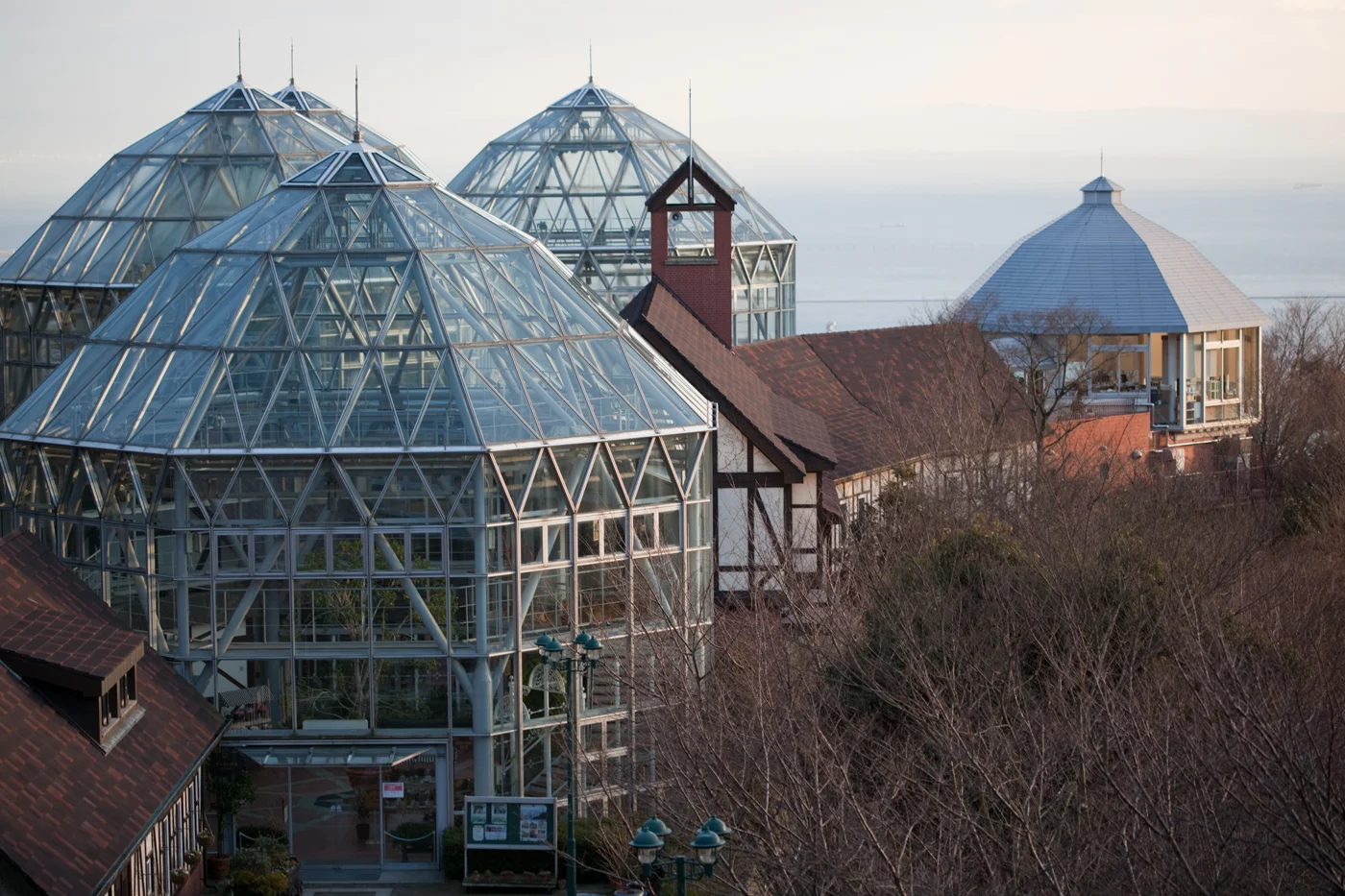
The Veranda in the Glasshouse area reopened on 25 April 2026. The updated facilities page lists the first-floor Garden Terrace, Emerald Lounge, Sky Bar and Hammock Sanctuary, plus the second-floor Herbal Café. Allow 30–60 minutes if sitting down for herbal tea and dessert. With only half an hour before you must descend, complete the return first rather than squeezing a queue and service into the final five minutes.
Older travel photographs may show a different seating layout. The first-floor Sky Bar closes in strong wind or rain. The Christmas notice lists Herbal Café at 10:30–16:30, with last orders at 16:00. Even on whole-garden evenings, the second-floor café closes earlier. Choose daytime for tea. For a Christmas evening terrace visit, use the first-floor night menu available that day. Plan these uses separately.
Finish on the lower lawns at Kaze-no-Oka, then leave from the intermediate station
Kaze-no-Oka is the lower section, with lawns, seasonal flowerbeds and an orchard. The operator gives about 20 minutes for a direct descent from the summit plaza to the lawn. Add stops in the herb collection, glasshouse and small gardens. Treat this as the end of a one-way daytime walk: photograph flowers or sit with water, then ride from Kaze-no-Oka intermediate station to the lower station. This avoids climbing back to the summit.
The orchard includes citrus, kiwi, apple and feijoa. Compare the fruit trees as seasons change. Picnics are allowed at garden picnic tables, shelters and the Kaze-no-Oka lawn, where you may spread a mat. The Veranda’s tables and chairs may not be used for your own brought-in food. Choose a picnic area for a packed lunch and take rubbish away afterwards.
Deciding to return uphill for night views only after reaching the intermediate station can expose direction and time limits. On ordinary evening-service days, intermediate-to-summit ascents end around garden closing. The official reference is 17:15–17:30, adjusted to daily conditions. The 2026 Christmas page specifically lists uphill travel from the intermediate station until 18:00. Ask about that direction’s deadline on arrival before walking all the way down or staying above. A 21:00 last descent does not mean every direction runs until 21:00.
Daytime example: lunch at the summit, then walk downhill
For a daytime visit with lunch in the gardens, reach the lower station at 10:30. After queuing and riding up, pause in the viewing plaza and eat at 11:00 or 11:15. Then visit the herb collection, Potager and glasshouse, rest at Kaze-no-Oka and descend from the intermediate station around 15:00. This example is more generous than the operator’s roughly 90-minute return-visit reference, allowing food, plants and rest.
Without lunch in the gardens, eat in the city before noon and arrive at the lower station at 13:00, leaving about three hours above. If ticket or boarding queues are long, shorten the café or lower lawn rest rather than the return allowance. After a 14:30 arrival on a 17:00 closing day, choose the summit and a shorter middle section. If companions are already tired, remain in the upper area.
There are two clear decision points: assess energy before leaving the summit, then time and weather at the glasshouse. At the first, switch to an upper-area return. At the second, shorten exposed stops and head towards a station. If a fixed evening booking is the day’s priority, choose either lunch or café time rather than making every mountain purchase compulsory.
| Example time | Place and activity | What to shorten |
|---|---|---|
| 10:30 | Arrive at lower station, queue and ascend | Earlier city activities |
| 11:00–12:15 | Summit plaza and planned lunch | Shop browsing |
| 12:15–13:15 | Herb collection and Potager | Scattered photo stops |
| 13:15–14:15 | Glasshouse; tea if wanted | Long café stop |
| 14:15–15:00 | Kaze-no-Oka and descent from intermediate station | Long lawn rest |
Ordinary autumn evenings: gardens first, upper area after 17:00
On ordinary autumn Saturdays, Sundays and public holidays before 7 November 2026, only the viewing area opens after 17:00. To combine daytime gardens with darkness, ascend early, complete the middle and lower sections, then return uphill before the intermediate station’s ascent deadline. To avoid that return, stay in the upper and nearby gardens, sit down later in the afternoon and wait for city lights.
For night views alone, buy a night ticket after 17:00, ride to the summit viewing area and descend from the same station. The full daytime garden route does not apply, and glasshouse food should not form the dinner plan. The focus is the city from the summit and cabins, so less time may be needed than by day. After returning to Shin-Kobe, eat in the city for easier onward connections.
With only one Kobe evening, choose the mountain or harbour night view. Waiting for darkness above, crossing the city to the waterfront, keeping a dinner booking and returning to Osaka turns the relaxed part into a rush. Staying in Sannomiya leaves more mountain time. For a Shinkansen departure that night, write down the required platform arrival first and work backwards through descent and walking.
Christmas 2026 whole-garden evenings: market, forest tree and night routes
The 2026 Kobe Christmas Market, “Christmas at the Old Castle”, runs from 7 November to 28 December. The viewing plaza has natural-material decorations and market stalls. A 25 m metasequoia, the Forest Christmas Tree, stands on the mountain side of the Lavender Garden about five minutes downhill from the summit. The official event page for that year maps the illuminations and areas. Choose two or three priorities to avoid repeatedly climbing for every decoration.
To combine plants and lights, see the middle section in the afternoon, reach the forest tree around dusk, then choose either the Glasshouse area or upper market. The event page gives ordinary switch-on times of 16:30 for the forest tree and 16:00 for the plaza’s Christmas tower. Opening day, 7 November, has ceremonies scheduled for 17:20 at the plaza and 17:45 at the forest tree. Use those ceremony times when planning an opening-day position rather than the usual lighting times.
On whole-garden evenings, stair routes close for safety. Use open paths. Neither the north nor south hiking gate permits entry or exit after 17:30, and intermediate-to-summit ropeway travel ends at 18:00. To return from below to the market, complete the ascent before 18:00. If you miss it, descend according to your location and staff directions. Do not detour through hiking gates. These closing times also set the limits for night photography.
Market closing at 20:00, garden closing at 20:30 and last descent at 21:00 are separate deadlines. Finish food and final purchases before 20:00, then follow an open route towards the station. With children, descend earlier so transport and warm clothing do not wait until stalls close. For less walking on slopes, the upper market area alone makes an evening visit.
See autumn colour by day and illuminated paths by night
The operator’s notice of 23 October 2026 gives early November to early December as the autumn-leaf season, including maples, mountain cherries, metasequoia and bald cypress. View the hillside from the ropeway in daylight, then compare leaf colour and tree shape on the paths. This suits the gardens better than seeking one reddest tree. The seasonal autumn notice lists foliage and lighting areas. Reach current flower information through the website on the day.
The roughly 150 m path from the forest tree towards the Glasshouse becomes part of the light corridor at night. Daytime leaves and evening illumination offer different views. For one visit, enter in the afternoon to observe plants in natural light, choosing an evening-service date to continue into the lights. Rain or strong wind shortens outdoor time, so keep time for sitting down and returning to a station.
Ordinary winter daytime operation begins on 29 December 2026. A maintenance closure is also scheduled for 23 January–19 February 2027, with the ropeway and gardens closed. For a late-January Kobe trip, avoid that period and choose city exhibitions or the harbour. One event’s seasonal hours do not apply to another. Christmas evenings do not continue through late winter.
Summit lunch and evening snacks follow a different clock from the ropeway
The Herb Dining, on the second floor of the summit viewing rest house, normally opens 11:00–15:00, with last orders at 14:00. The adult set costs ¥3,190, with eight starters on a three-tier stand, a main and bread; some mains carry a supplement. The ¥1,210 primary school children’s meal excludes starters and includes ice cream. Children under six may also enter. Reservations are accepted only for 11:00 or 11:15. The official FAQ says to enquire about availability by phone. Arrive uphill before your booking.
The restaurant does not accept drinks-only visits. For a drink and dessert, use The Veranda in the Glasshouse area. If you have eaten in the city, you need not buy another full set just to see the building. The restaurant menu says a special Christmas menu replaces the ordinary one from 19 to 28 December 2026. Do not use the regular ¥3,190 lunch budget for those dates.
On Christmas evenings, choose food at the viewing-plaza market or check the first-floor terrace night menu. For a full seated dinner with a fixed start, the easiest plan is to eat in the city after descending. Mountain snacks can cover hunger until then. Agree before ascending whether you want a main meal or shared snacks, so one person is not waiting for a main while another only intends to buy a hot drink.
Pushchairs and wheelchairs can use the ropeway; the gardens still have slopes
Ropeway boarding is step-free and wheelchair users can remain seated. Each cabin accommodates one wheelchair user and up to three companions, with staff assistance. Step-free garden routes exist, but some slopes are steep. Explain wheelchair use and group size before ascending. At the summit information desk, ask about powered-assist wheelchair loans and suitable routes before deciding to descend through the gardens.
Pushchairs can use the ropeway and gardens; no pushchair hire is available. An adult able to control the pushchair steadily should handle descents. Find level ground for stops and do not let go on a slope to take photographs. If a sleeping child would otherwise need repeated lifting, a summit-area route is more practical than walking to the lower section to complete the whole garden.
The nursing room is in the summit viewing rest house; ask at its information desk. Nappy-changing tables are listed at lower station 4F, summit station, viewing rest house 2F, Mori no Hall 1F, Glasshouse 1F and the women’s toilet at intermediate station 1F. Attend to young children’s needs before leaving the summit, then walk slowly. Stair routes close at night. Decide before dark whether everyone can manage the sloping paths.
In rain, check ropeway operation before planning the glasshouse
Light rain, strong wind and thunder are different conditions. Strong wind or thunder may stop the ropeway and close the gardens. The Veranda’s Sky Bar also closes in wind or rain; outdoor café seats may be unavailable even with the ropeway running. Check daily operation before reaching Shin-Kobe. If service is suspended, move the whole mountain half-day to city interiors, rather than reaching the entrance and looking for a road alternative that does not exist.
In light rain with normal operation, shorten plant stops and spend longer in the glasshouse. Wear shoes with grip suitable for slopes. Reaching the glasshouse in the middle section still involves outdoor paths from the summit, so bring rainwear. If weather changes inside the gardens, ask staff about return routes and service. Do not enter hiking trails or pass closed stairs yourself.
Article 14 of the ropeway conditions distinguishes refunds when natural disaster or company circumstances prevent operation from temporary safety suspensions for wind, rain, snow or fog. The latter do not use the same refund provision. If service stops after purchase, keep the ticket and tell the original ticket office which journeys you have used. For online tickets, retain the product name and order and use the original channel. Do not buy again because of a temporary stop. Dinner or accommodation cancellation costs after a delay are separate from the ropeway ticket refund.
Keep hiking to daylight and use the ropeway home after dark
The operator’s FAQ gives about one hour on foot from Shin-Kobe via Nunobiki Falls and Miharashi viewpoint to the Kaze-no-Oka intermediate-station gate. After entry, walking to the summit viewing plaza takes another 30 minutes. This includes climbing and outdoor trails, unlike a half-day reached by a ten-minute ropeway ride. For falls and trails, plan a daytime hike with suitable shoes, water, weather and closing times.
For ordinary sightseeing, do not switch to walking downhill at the last minute to save one direction’s fare. If tired in the evening with children or luggage, cut an optional city stop and keep a safe return. The 2026 Christmas event closes hiking gates after 17:30. A single ticket therefore cannot serve as an evening exit plan.
If a planned daytime hike starts in rain or mist that makes trail conditions unsuitable, switch to return ropeway travel and a shorter outdoor garden route. If the ropeway also stops, choose the city. Change the route before ascending rather than entering a trail and forcing the pace with the time left. Stop for photographs only in open places that leave the way clear. Separate walking from photography to keep both hands available on slopes.
Couple and family budgets: tickets first, then one mountain meal or treat
Two adult ordinary returns total ¥5,000. Add two regular lunches at ¥3,190 each for ¥11,380. In Christmas season, two returns cost ¥6,600, or ¥12,980 with the same lunches. From 19 to 28 December, replace the meal allowance with your chosen special-menu price. These figures cover tickets and specified food. Budget separately for intercity transport, city dinner and shopping.
Two adults and one primary school pupil pay ¥2,500 × 2 + ¥1,250 = ¥6,250 for ordinary returns. Two adult regular lunches and one children’s meal bring it to ¥6,250 + ¥6,380 + ¥1,210 = ¥13,840. In Christmas season, tickets become ¥3,300 × 2 + ¥1,650 = ¥8,250, totalling ¥15,840 with the same regular lunches. Junior high school pupils still use child garden admission, but the restaurant’s children’s menu is for primary school pupils. Calculate these two age rules separately.
To spend less on set meals, eat lunch in the city and choose one drink and dessert above, or bring a packed lunch to a picnic area. Agree each person’s budget before choosing food. Arriving early for lunch and arriving in the afternoon for market lights are both reasonable plans. Neither requires every extra. Set a separate shopping limit and retain return tickets until the descent is complete.
Finish at Shin-Kobe and keep one city option after the descent
After a daytime descent, with enough time and energy, choose a short Kitano walk. After the full garden slopes, return to Sannomiya for food. Mountain tiredness often becomes clear only below. A seated dinner is easier for the group to enjoy than another uphill viewpoint. Save the harbour for a different evening or end the mountain visit earlier.
After an evening descent, make Shin-Kobe to Sannomiya or your accommodation the main route. For Osaka, check your railway operator and return services. Summit-to-platform travel includes queuing, riding, the outdoor walk and station entry. The ten-minute ropeway ride is not the whole connection. Put dinner reservations at a time that allows an early descent rather than making the last cabin compulsory.
Before setting off, save the day’s schedule, valid tickets and lower-station entrance map, and note your return station. Groups splitting up should choose either the summit or intermediate station as one meeting point. At the end of the mountain visit, put away the camera and put on a jacket before heading to board. Leave the remaining city time for dinner and rest.
A few useful answers
Can I take a taxi directly from Shin-Kobe to Nunobiki Herb Gardens?
Ordinary vehicles cannot drive straight to the mountain gardens. Go to Herb Gardens Lower Station and take the ropeway. The operator gives about five minutes on foot after leaving Shin-Kobe Station and ten minutes by ropeway to the summit.
How much is a 2026 return ticket?
Ordinary returns cost ¥2,500 for adults and ¥1,250 for primary and junior high school pupils. From 7 November to 28 December, Christmas returns cost ¥3,300 and ¥1,650, with no ordinary night fare.
Can I visit the glasshouse with a night ticket after 17:00?
Ordinary selected spring and autumn evenings open only the viewing area. Summer evenings extend to the Glasshouse area, and selected Christmas 2026 evenings open the whole garden. Summer and Christmas have no ordinary ¥2,000 adult night ticket.
Can I ride from Kaze-no-Oka back to the summit at any time?
No. On ordinary evening-service days, uphill travel from the intermediate station ends around garden closing, with an official reference of 17:15–17:30. The Christmas 2026 page lists 18:00. A 21:00 last descent does not mean uphill service also continues until 21:00.
Are the gardens suitable for pushchairs and wheelchairs?
They can use the ropeway and step-free garden routes, but some slopes are steep. A cabin takes one wheelchair user and up to three companions, with the user remaining seated. Ask about powered-assist wheelchair loans. There is no pushchair hire.
Can I walk the trail back to Shin-Kobe after an evening visit?
The Christmas 2026 event closes north and south hiking gates after 17:30, and night stair routes also close. Use the ropeway for an evening return and plan hiking separately by day.
Do mountain restaurants stay open until the last ropeway?
The Herb Dining normally closes at 15:00, with last orders at 14:00. Christmas-season Herbal Café closes at 16:30, with last orders at 16:00. Check market and first-floor terrace openings for evening food, or plan a full dinner after descending.
Can I visit in late January 2027?
The operator schedules maintenance closure of the ropeway and gardens from 23 January to 19 February 2027. Choose city exhibitions or the harbour then, and visit the gardens outside the maintenance period.
Official information and references
Sources used in this guide.
- Kobe Nunobiki Herb Gardens | 2026–2027 hours and fares
- Kobe Nunobiki Herb Gardens | Entrance access and parking
- Kobe Nunobiki Herb Gardens | Ropeway, slopes, wheelchairs and family FAQ
- Kobe Nunobiki Herb Gardens | Themed gardens and plant uses
- Kobe Nunobiki Herb Gardens | Ropeway specifications and views
- Kobe Nunobiki Herb Gardens | 2026 Christmas market, fares and evening closures
- Kobe Nunobiki Herb Gardens | Christmas 2026 outlet hours
- Kobe Nunobiki Herb Gardens | Autumn 2026 foliage and illuminated paths
- The Herb Dining | Regular lunch and last orders
- The Veranda Kobe | Facilities reopened in 2026
- Kobe Nunobiki Ropeway | Conditions of carriage, Articles 12–14
- Kobe Nunobiki Herb Gardens official video: ropeway and mountain views