Compare permanent and special exhibitions, fossil research and field tours at Fukui Dinosaur Museum by age and autumn or winter date, with prices, check-in and cancellation deadlines, Katsuyama connections and family budgets.
- Region & Focus
- ChubuAttractions
- Reading Scope
- 29 min read · 15 chapters · 4 Q&As
- Official Verification
- 10 official sources checkedUpdated 22 November 2026
- Key Topics
- BookingRail travelChubu & Hokuriku
Chapter Route Map (tap any stop)
- Choose the day’s main focus before opening the ticket page
- Compare age categories, keeping research and field-tour costs separate
- Budget for two adults and one primary-school child
- Three autumn and winter dates change the choices in 2026
- Start with the big skeletons, then follow how fossils form
- Details worth stopping for among the newer specimens
- Choose new-building displays, Dino Lab and the three-screen theatre by interest
- Two hours of indoor research, for primary-school children and older
- Keep research start times separate from museum entry times
- The Field Station tour takes a dedicated bus from the main museum to Kitadani
- Plan for young children, pushchairs and wheelchairs from the third-floor entrance
- Fukui to Katsuyama: distinguish the transport pass from the Dinosaur Train
- For the last leg from Katsuyama, identify D-Line and C-Line buses
- A practical full-day plan with research
- Reservations, changes and cancellations: keep two deadlines separate
- Quick Q&A
Fukui Prefectural Dinosaur Museum offers two activities lasting about 120 minutes, but they create different days. The indoor Fossil Research Experience includes cleaning and CT observation, with permanent exhibition admission in its package. The Field Station tour takes a dedicated bus to the Kitadani excavation site and excludes the main museum galleries. For a first visit with preschool children, start with a timed permanent exhibition ticket and leave time for the skeleton hall and new building. Primary-school children and older who want hands-on research can add one indoor session. The 2026 field season ends on 3 November; plan winter visits around the indoor museum. Choose the product and check-in time first, then work backwards through the museum bus, Katsuyama and Fukui connections.
Choose the day’s main focus before opening the ticket page
For large skeletons, dinosaurs found in Fukui and the museum displays, permanent exhibition admission can be your main ticket. The one-hour window on it is an entry window, not a requirement to leave after an hour. Same-day re-entry is possible. Families with small children can see part of the exhibition, eat and rest, then return, rather than squeezing everything into their child’s most tired period. Adults with a strong interest in dinosaurs can also allow at least half a day for the permanent galleries and set their own reading and viewing pace.
For hands-on research tools, buy the Fossil Research Experience plus permanent exhibition package. For strata and the excavation site, choose the Field Station tour, then add permanent admission if you want the main museum too. Both last around two hours, but indoor research includes three activities and room changes, while the field tour includes a return bus ride, site viewing and rock splitting. Adding only one leaves more room for lunch, galleries and the journey back. Research package holders do not need a second permanent ticket for the same participant.
The special exhibition is a fourth choice, with its own subject and dates. The 2026 exhibition, Sauropods: The Largest Land Animals That Shook the Earth, runs from 10 July to 3 November, with a special-plus-permanent ticket. Holders of permanent admission or a research package can pay the special exhibition supplement inside on the day. If sauropods are your main reason for visiting, use the exhibition dates to choose your day. For travel after its 3 November closing date, focus on the permanent galleries and the research programme then offered. Museum ticket types and reservations
In the museum’s 2026 My Special Exhibition video, chief researcher Sekiya introduces the sauropod exhibition.
Compare permanent and special exhibitions, fossil research and field tours at Fukui Dinosaur Museum by age and autumn or winter date, with prices, check-in and cancellation deadlines, Katsuyama connections and family budgets.
Compare age categories, keeping research and field-tour costs separate
These are the museum’s individual prices listed on 28 October 2026, in yen. The general category is separate from senior-high-school and university students, and visitors aged 70 or over have their own rate. Preschool children enter the permanent and special exhibitions free. The field tour is also free for them, but they must be included in the booking. Indoor research starts at primary-school age. List each person’s age and chosen activities before buying, rather than selecting one product for the whole family automatically.
An advance research-only ticket is not sold. Visitors already holding that day’s permanent ticket can buy a same-day research ticket at general reception only if places remain: ¥1,200 general, ¥1,000 for senior-high-school and university students, and ¥600 for primary/junior-high-school pupils or visitors aged 70 or over. If research is central to the trip, buy the package ahead. If you want to judge your child’s energy first, accept that participation depends on remaining places. The museum does not operate a waiting list.
During a special exhibition, the supplement is ¥800 for both general visitors and senior-high-school/university students, and ¥500 for primary/junior-high-school pupils or visitors aged 70 or over. Add this to a research package rather than buying another full special-plus-permanent ticket. Visitors eligible for reductions through disability certificates or similar documents should use the museum’s concession booking route and bring proof to the designated reception point. Permanent and special exhibitions, research and field tours have separate concession rules. Museum price list
| Product | General | Senior-high-school / university student | Primary / junior-high-school pupil or age 70+ | Includes |
|---|---|---|---|---|
| Permanent exhibition | 1,000 | 800 | 500 | Main museum permanent galleries |
| 2026 special + permanent exhibitions | 1,800 | 1,600 | 1,000 | Current special exhibition and permanent galleries |
| Fossil Research Experience + permanent exhibition | 2,200 | 1,800 | 1,100 | One research session and same-day permanent admission |
| Field Station tour | 1,300 | 1,100 | 650 | Dedicated bus, site visit and activity; main museum extra |
Budget for two adults and one primary-school child
For two general-category adults and one primary-school child, all choosing the same product, permanent admission alone is ¥1,000 × 2 + ¥500 = ¥2,500. Indoor research for all three is ¥2,200 × 2 + ¥1,100 = ¥5,500, including permanent admission for all three. The field tour is ¥1,300 × 2 + ¥650 = ¥3,250. Add ¥2,500 if all three also enter the main museum, giving ¥5,750. These totals cover admission and the selected activity; transport, food and special exhibitions are extra.
Adults can also divide responsibilities. If one accompanies the child in research and the other visits only the permanent galleries, the total is ¥2,200 + ¥1,100 + ¥1,000 = ¥4,300. The participating adult and child must book together. This works when another adult can take a younger child through the permanent exhibition or rest with them, meeting the research group afterwards. With just one adult, one primary-school child and one preschool child, make the permanent exhibition the main plan: preschool children cannot enter or wait inside the research room.
For the same three people, the Dinosaur Museum Transport Set Ticket costs ¥1,700 × 2 for adults plus ¥900 for the child, or ¥4,300. With permanent admission the total is ¥6,800; with research packages for everyone, ¥9,800; with the field tour and permanent galleries, ¥10,050. The transport ticket includes a day on Echizen Railway and specified Katsuyama buses. Keeping transport and museum tickets separate makes the day’s budget easier to compare, apart from accommodation and food.
Three autumn and winter dates change the choices in 2026
The 2026 Field Station season runs from 17 April to 3 November, excluding announced closure days. 28 October itself is a listed closure date. For the last days of autumn, select an open date using the museum’s visit planner and ticket calendar before choosing a field-tour session. 3 November is also the final day of the sauropod exhibition. To combine both, allow a full day and distinguish the two tickets and meeting times.
Indoor research pauses on 12 November for preparations to change the programme. From 13 November 2026 to 5 April 2027, Fossil Excavation Plus replaces T. rex Skull Reconstruction. Fossil Cleaning and CT Fossil Observation run throughout the year. Winter still offers hands-on activities, with different content. Dates directly affect expectations if your child particularly wants to assemble a T. rex skull. Children interested in finding and identifying fossils can consider the winter Excavation Plus programme.
Normal opening is 09:00–17:00, with last admission, including re-entry, at 16:30. Closures are generally the second and fourth Wednesday each month, moving to the following day when a national holiday falls on that Wednesday, with separate summer-holiday arrangements. The museum closes on 31 December and 1 January. Extended summer hours from 18 July to 16 August 2026 were a separate schedule; do not apply their 08:30 opening and 18:00 closing to autumn or winter. Use the calendar for your actual visit date before buying, covering both routine closures and exhibition changes. Opening and closure rules
Start with the big skeletons, then follow how fossils form
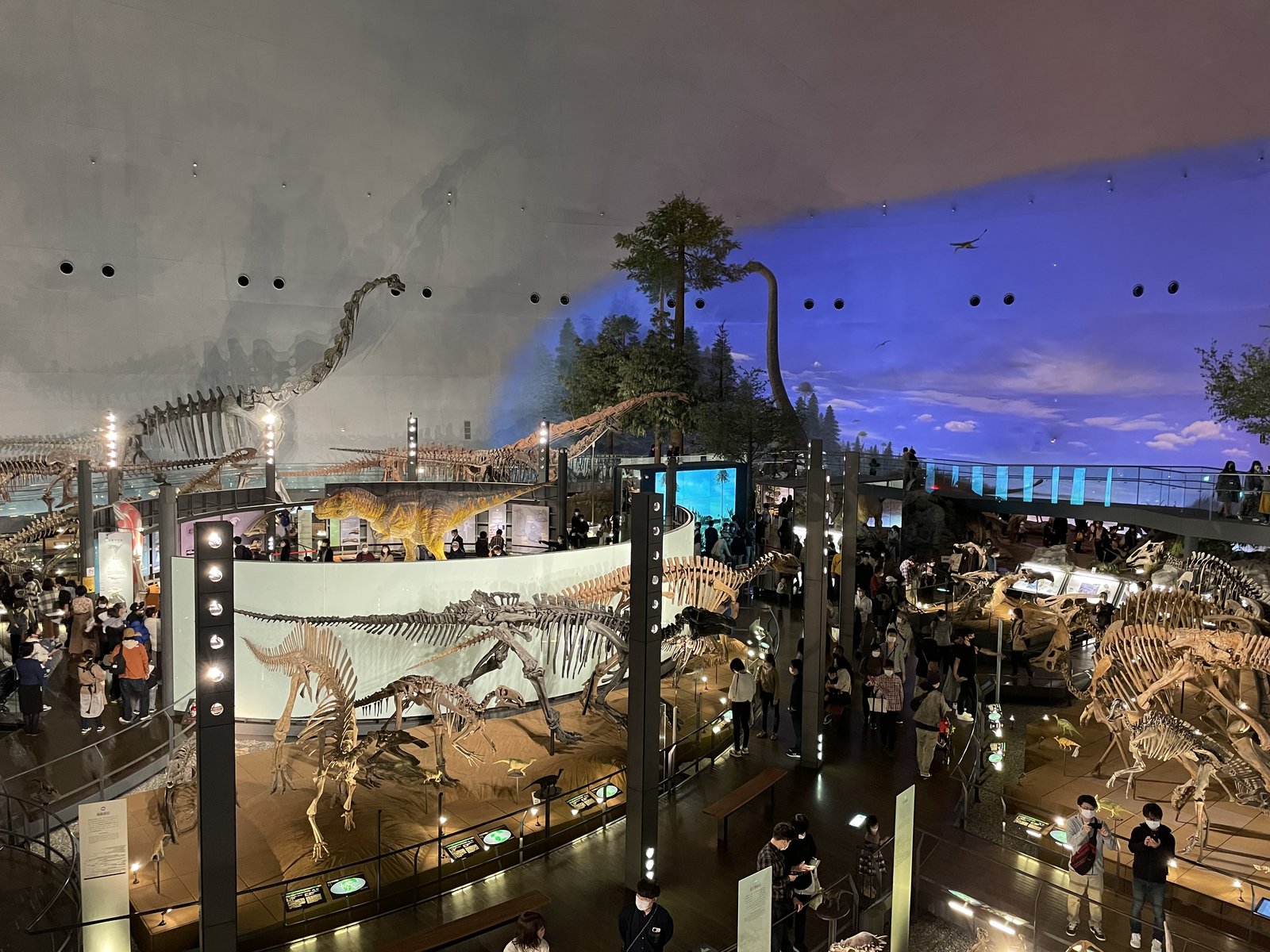
The permanent exhibition beneath the dome has three parts: Dinosaur World, Earth Sciences and History of Life. Dinosaur World has 51 complete skeletons, ten using real fossils. If huge skeletons are your priority, spend longer here and compare a few specimens with very different shapes: skull position, forelimb and hindlimb lengths, and the extension of neck and tail. This leaves more of an impression than rushing to count all 51. A full-scale diorama of Mesozoic Sichuan in China places individual skeletons back in their living environment.
Dinosaurs of Japan and Asia presents six new dinosaur species discovered through Fukui excavations, other animal and plant fossils, and dinosaur fossils from elsewhere in Japan, China and Thailand. Seeing this before a field tour helps connect Kitadani’s rock layers with museum specimens. Visitors staying indoors can still use discovery locations and excavation information to understand why the museum is in Katsuyama. With primary-school children, first find labels identifying Fukui discoveries, then read about the specimens that interest them.
Earth Sciences brings together land and marine sediments, the fossils buried in them, and rocks and minerals formed by the Earth’s activity. It follows the skeletons well, answering how bones survived until today. Before research or field rock splitting, children can look at the relationship between fossils and surrounding rock. Adults who prefer geology can reserve reading time here instead of following the pace of the skeleton-hall crowds.
History of Life follows 4.6 billion years of Earth history, from life’s origins through environmental change, repeated evolution and extinction, to humans. The large marine reptile Tylosaurus appears here, offering another body-shape comparison with land dinosaurs. The permanent exhibition extends beyond dinosaur skeletons. Giving it just an hour, including finding the entrance, toilets and souvenir shopping, leaves little time for an unhurried view of this timeline. Museum permanent exhibition guide
Details worth stopping for among the newer specimens
The museum’s new-display guide describes a larger viewing space around the robotic Tyrannosaurus, with complete Tarbosaurus and Saurolophus skeletons to either side and the spinosaurid Suchomimus nearby. Looking at the robot and adjacent skeletons together helps connect an animal’s reconstructed appearance with its bone structure. After photographs, choose a skeleton to compare from the side, front and rear. Your view changes again as you ascend the ramp, so there is no need to chase every photographic angle from one level.
Another specimen worth close attention is the Brachylophosaurus mummy fossil. The museum describes preserved skin traces and soft tissues such as muscle, on long-term loan from an overseas museum. It calls for a different viewing distance from a tall complete skeleton: step back for a skeleton’s outline, then come closer to the mummy’s preserved surface. For a child wondering whether fossils are only stone and bone, this makes the question more concrete.
The museum also lists adult, subadult and juvenile Pachycephalosaurus skulls, and a juvenile Brachiosaurus. To explore growth, focus on skulls, body size and development stages without first memorising every Latin name. From the third-floor Dino Terrace overlooking History of Life, compare Tylosaurus with Basilosaurus from the Cenozoic seas. The museum specifically identifies the latter as a mammal. Comparing two sea-dwellers with different body structures continues the approach of understanding animals through their skeletons. New displays and specimen list
Choose new-building displays, Dino Lab and the three-screen theatre by interest
The roughly 13-metre Dinosaur Tower combines five dinosaurs and one bird discovered in Fukui, with lighting presentations at different times. Pause here in the new building to connect Fukui specimens with an overall image. Behind glass, the visible storage area shows where fossils, skeletons and other specimens are kept. It suits visitors interested in museum work behind the scenes. These are separate from hands-on research classes, giving permanent-admission visitors their own subjects to observe.
Dino Lab uses a complete Tyrannosaurus skeleton to introduce its body and life, with projection mapping showing inside the skull. The museum also has a fossil preparation laboratory where visitors can watch rock being removed from fossils. Observing professional preparation is separate from paying to operate tools in a research room. For children interested in tools and research methods, viewing the displays before research gives the activity more continuity than treating it simply as making a souvenir.
For images and reading, include dinosaur paintings, original artwork or models in Dino Gallery, and books on dinosaurs, geology and palaeontology in Dino Library. The library has a different pace from the big skeleton hall and offers a change between dense exhibition sections. If interests differ, agree a meeting time and let family members choose parts of the museum, with the research group meeting after its class.
The new building’s three-screen Dino Theater shares its space arrangements with the special exhibition room. During the 2026 sauropod exhibition through 3 November, three-screen screenings are suspended. In that period, the museum loops the Fukui, Laramidia and Night-time Exhibition Room films on an LCD screen in the new building’s third-floor lobby. When buying autumn special-exhibition admission, make that exhibition the focus here, rather than planning three-screen viewing as a simultaneous next stop. Other facing screens and the video library have separate locations; use the museum’s own names to find them. Current screening notices
Two hours of indoor research, for primary-school children and older
The Fossil Research Experience covers three activities in one session, with content changing by season. T. rex Skull Reconstruction assembles a life-size skull and teaches anatomical features. Fossil Cleaning uses tools to extract a replica dinosaur tooth. CT Fossil Observation uses CT images for non-destructive study. The winter replacement, Fossil Excavation Plus, focuses on finding and identifying fossils. Children who enjoy solving problems and can follow operating instructions are better suited to it than very young children interested mainly in large dinosaur models.
Participation starts at primary-school age. Primary-school pupils must book at the same time as a guardian or equivalent responsible person. Preschool children cannot enter the research room, which has no space for them to wait. With children of different ages, decide who will look after the youngest before selecting research participants. The research group cannot bring an unregistered preschool child to sit beside them. Wheelchair users must telephone before buying so the museum can arrange seating and working space.
Classes 1 and 2 have the same content, with a maximum of 12 people per class. Advance purchases allow up to four tickets at once, with four people per table. Staff prioritise seating primary-school children with their guardians where possible, but a single booking may still be split between tables, and skull reconstruction may involve working with other participants. Small families can book together. Families of five or six need to arrange booking groups first, rather than treating one order as a reserved table for everyone.
You may take home the replica and surrounding rock from cleaning, but not other fossils or materials. Work produces dust and may dirty clothes. Bring a mask if dust bothers you; masks are neither provided nor sold on site. Rooms can be cool in spring and autumn, so bring a jacket. Comfortable clothes that allow movement and a little dust are more useful here than restrictive clothes chosen for photographs. Research activities and participation conditions
Keep research start times separate from museum entry times
Normal weekdays have four research starts: 09:20, 10:30, 12:50 and 14:00. Weekends, public holidays, summer holidays and other busy periods use 09:20, 10:30, 12:30, 13:40 and 14:50. Each session lasts about 120 minutes, including three activities and room changes. Complete check-in at the research counter ten minutes before the start. For 12:50, aim to finish checking in by 12:40, rather than reaching the museum door at 12:50.
The research-plus-permanent package allows museum entry during that day’s opening hours, without restriction to the time printed on the ticket. Class starts and check-in deadlines still apply. With afternoon research, you can see the permanent galleries in the morning, locate the counter, then eat and check in. With an early session, put most gallery viewing afterwards. For a same-day public-transport journey from Fukui, midday or afternoon sessions make trains and the museum bus easier to arrange.
Joining late may mean missing part of the experience. The museum also prohibits leaving early to attend a subsequent session. After the roughly two-hour class, you still need to walk to the exit or bus stop, so do not book onward travel tight against its finish. Morning viewing and whether lunch is already done affect how long you can stay afterwards. Put the fixed class into the itinerary first, then fill the time before and after with flexible gallery visits.
The Field Station tour takes a dedicated bus from the main museum to Kitadani
The Field Station is at the dinosaur fossil excavation site in Kitadani, Katsuyama. Tours leave the main museum by dedicated bus. Around 120 minutes includes roughly 40 minutes of return bus travel, 60 minutes of viewing and activities, and transfers. The observation area offers close views of the excavation site and strata. The exhibition area introduces fossil discoveries and investigation history. In the fossil excavation activity area, visitors search fossil-bearing rock brought from the site. To understand where fossils come from, this route brings you closer to their origin than museum specimens alone.
Field-tour tickets exclude the main museum’s permanent and special exhibitions. Treat the meeting point at the main museum separately from the admission product. With field and permanent tickets, view indoors before departure or continue after returning, depending on the session. Normal 2026 weekdays list 11:00–13:00 and 13:30–15:30. Weekends, public holidays and 17–31 August add 10:00–12:00 and 14:30–16:30; the extended summer opening period has its own departures. Use the autumn column for an autumn visit rather than applying a summer 15:00 final departure to November.
Complete procedures at the Field Station window at general reception 30 minutes before departure. For an 11:00 bus, treat 10:30 as the check-in deadline. The D-Line leaving Katsuyama at 10:00 reaches the museum at 10:12, leaving only 18 scheduled minutes, including the walk from the bus to reception. With young children, unfamiliar routes or lift needs, aim to arrive earlier or choose 13:30 and spend the morning inside at an easier pace.
Preschool children travel free but must be registered, including infants. Children of primary-school age and younger must book with a guardian. Infants unable to wear safety goggles and work gloves cannot enter the rock-splitting area. One advance purchase allows up to six people, of whom at most four may be primary-school age or younger. Classes 1 and 2 have the same content, but use different buses and visiting orders. To stay together, distinguish the number of young children from those who can actually split rocks before choosing booking groups.
Bring work gloves and drinking water, and wear clothes that allow movement. Wheelchair users must telephone before buying here too. Weather or other conditions can cancel the tour, so permanent-ticket holders can make indoor exhibitions the day’s main plan instead. Rainwear is useful: the museum says the route from the car park to the entrance has no roof for rain or shade. Field buses, season and check-in
Plan for young children, pushchairs and wheelchairs from the third-floor entrance
The entrance and exit are on the third floor, with galleries extending downwards. To borrow a wheelchair or pushchair, go first to general reception on the main building’s third floor; numbers are limited. Request the nursing room and hot water for feeding there too. The third floor also has a Kids Room for young children to rest and a Baby Room for nappy changing. Deal with family needs on the entrance level before descending, reducing return trips for facilities.
The main-building lift runs from floor 3 to basement 1, the new-building lift from floor 3 to floor 1, and the permanent-exhibition lift from floor 2 to basement 1. Earth Sciences has small level changes with ramps. Between floors 1 and 2 of the permanent exhibition, choose the lift or the circular ramp around the dome’s inner edge. The ramp is longer but gives changing views of skeletons. With limited stamina, use the lift and save walking for galleries. Published lift dimensions are 136 cm deep, 160 cm wide and a 90 cm door, useful for visitors with large mobility aids.
There are toilets on each floor of the main and new buildings, including multipurpose toilets for both sexes with changing tables. The third-floor multipurpose toilet has ostomy facilities. The galleries provide Braille guides and touchable bronze dinosaur models; Dino Lab also has touchable specimens. Tyrannosaurus, Mamenchisaurus and Probactrosaurus emit sounds from head and tail to convey approximate length. Choose displays according to companions’ senses and mobility to give the shared visit a clearer focus. Accessibility and family facilities
Fukui to Katsuyama: distinguish the transport pass from the Dinosaur Train
At JR Fukui Station, change to Echizen Railway’s Katsuyama Eiheiji Line, travel to its terminus at Katsuyama, then take a bus or taxi to the museum. Ordinary trains plus the museum bus let you choose departures around admission and research slots. The museum also introduces Echizen Railway’s named Dinosaur Train, whose products include packages with museum admission. To ride the themed train, follow the museum access page to its product details, check dates and inclusions, then see whether you still need a separate activity.
The Dinosaur Museum Transport Set Ticket is a different product: ¥1,700 adult and ¥900 child, valid on museum opening days. It includes a day of unlimited Echizen Railway travel and Daifuku Kotsu buses within Katsuyama, but excludes museum admission. Buy it at staffed station counters or from on-board staff. Arrange museum tickets first, then this transport ticket and its eligible buses at Katsuyama. Despite its museum name, its role is transport.
Echizen Railway’s ordinary one-day free ticket costs ¥1,200 adult or ¥600 child and covers the full railway only on weekends, public holidays and 29 December–3 January. Its valid days and bus coverage differ from the museum transport package. For an autumn weekday, compare products usable that day, rather than pricing the whole journey with a holiday rail ticket. If you already bought a Dinosaur Train package including admission, check its contents before buying duplicate permanent admission. Echizen Railway special tickets
For the last leg from Katsuyama, identify D-Line and C-Line buses
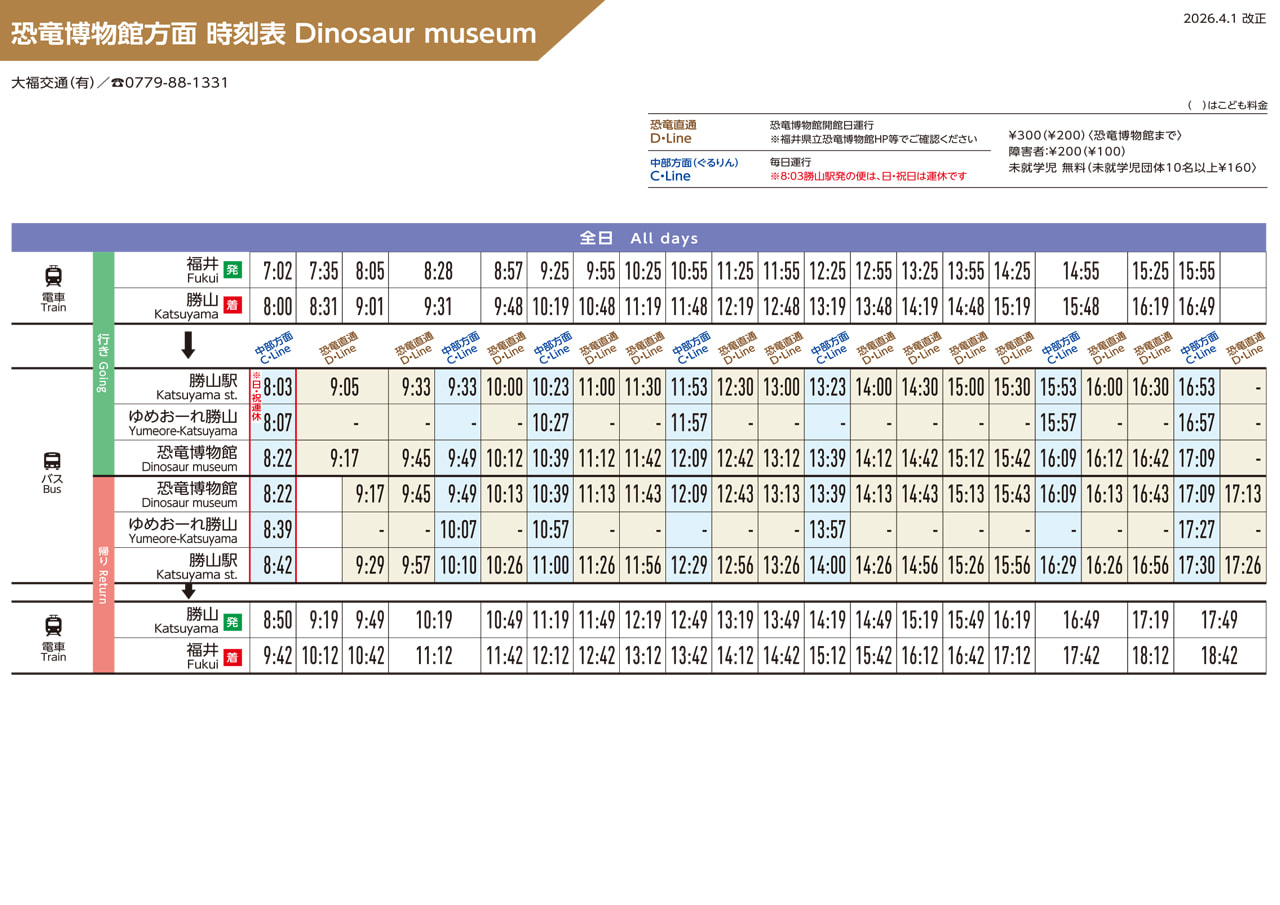
Echizen Railway’s timetable revised on 1 April 2026 divides museum buses into the direct D-Line and the central-area C-Line Gururin. D-Line runs only on museum opening days. C-Line runs daily, but its 08:03 departure from Katsuyama Station does not run on Sundays or national holidays. Ordinary single fares for the museum section are ¥300 adult and ¥200 child. The listed child price is not half the ¥300 adult fare.
For example, leave Fukui at 08:57, reach Katsuyama at 09:48, then take the 10:00 D-Line to reach the museum at 10:12. The station transfer has 12 scheduled minutes; after arrival you still walk to the third-floor entrance and reception. With ordinary permanent admission, choose the 10:00–11:00 entry window. Research package holders can enter first and check in before a midday class. This suits visitors who do not need to start at the first minute of opening.
There are different return routes too. The final two listed museum departures are C-Line at 17:09, reaching Katsuyama at 17:30, and opening-day D-Line at 17:13, arriving at 17:26. Both connect with the 17:49 train from Katsuyama, reaching Fukui at 18:42. The 17:49 train is the one in this connection example; plan around your own complete return journey. To stay close to closing, allow the walk from the exit to the bus stop before deciding when to leave the final gallery. Bus connections and current timetable
A practical full-day plan with research
On a normal weekday, use arrival at 10:12 and research at 12:50 as an example. Take the 08:57 train from Fukui, arrive at Katsuyama at 09:48 and connect with the 10:00 bus. See skeletons and Fukui discoveries first, eat before research, and check in by 12:40. Research ends around 14:50. A 15:13 D-Line reaches Katsuyama at 15:26, connecting with the 15:49 train and arriving in Fukui at 16:42. Around 23 minutes between class and bus suits a direct exit, with souvenirs and longer rests handled in the morning.
To keep viewing the new building after research, choose a later return and leave History of Life, visible storage or Dino Lab for the afternoon. Do not postpone lunch, shopping and research together, leaving little time after class. The normal-weekday 12:50 example depends on that day’s published research sessions. In busy periods the third session starts at 12:30, with check-in at 12:20, cutting morning time by 20 minutes and requiring transport and lunch to be rearranged too.
Permanent-ticket visitors can use the same morning transport, enter after 10:00, see the galleries slowly, go out for lunch and return, then choose an afternoon bus according to interest. Skeleton and geology enthusiasts need not add paid activities. A thorough visit to the hall, detailed specimens and History of Life can fill a day. Save Eiheiji and Ichijodani for a separate day on the Fukui temples and Asakura ruins route, letting each day follow its own transport and viewing pace.
Reservations, changes and cancellations: keep two deadlines separate
Tickets go on sale 60 days ahead, generally with advance payment and a specified date and time. Ordinary permanent and special-plus-permanent tickets are sold until 15 minutes before each entry window ends. Online advance sales for research packages and field tours close at 23:59 the previous day. Same-day tickets are available only when advance allocations leave space; busy days may have none at the counter. Once dates are fixed, buy museum tickets before planning the rest, avoiding a journey to the door on a sold-out day.
To change numbers, dates or times, the purchaser must cancel and buy again. Online repurchases for research and field tours remain subject to the previous-day deadline. Permanent and special-plus-permanent tickets can be cancelled until 16:30 on the visit date; research packages and field tours close cancellation at 07:00 that day. If deciding on an activity on departure morning, handle cancellation before breakfast or leaving. Do not apply ordinary admission’s 16:30 deadline to activities.
A research package cannot be cancelled only in part for the research activity. To switch to gallery-only viewing, reserve permanent admission separately first, then cancel the whole research-plus-permanent package. If only some family members change activities, deal with the actual order accordingly. The museum does not take telephone reservations or sell tickets by phone. Buy through the official page and retain each person’s date, session and product name for clearer meeting and check-in arrangements.
Same-day re-entry allows lunch to be separate, but return before last admission at 16:30. If transport delays you beyond an ordinary entry window, the museum asks you to explain to entry-gate staff. Research and field tours have fixed check-in requirements, respectively ten and 30 minutes early at their designated counters. Write arrival at Katsuyama, arrival at the museum and completed check-in separately in your itinerary, leaving a day with time to view, rest and catch the return journey.
A few useful answers
How much is admission to the Fukui Dinosaur Museum’s permanent exhibition, and can I go back in?
On 28 October 2026, admission was ¥1,000 at the standard rate, ¥800 for upper secondary and university students, and ¥500 for primary and lower secondary pupils and visitors aged 70 or over. Preschool children go free. The one-hour slot is for arrival, and you can stay longer and go back in on the same day.
Should I book the fossil workshop or the field trip at the Fukui Dinosaur Museum?
The indoor fossil workshop includes the permanent exhibition and is open from primary school age. Primary school pupils must book with a guardian. The field trip takes you to the Kitadani dig by dedicated bus to try breaking rocks, and you’ll need a separate ticket for the permanent exhibition.
Do I need to book ahead for the Fukui Dinosaur Museum, or can I buy tickets on the day?
Advance booking is the norm at the Fukui Dinosaur Museum. Tickets go on sale 60 days before your visit, and online sales for the fossil workshop package and the field trip close at 23:59 the night before. Tickets are sold on the day only if there are places left.
How do I get from JR Fukui Station to the Fukui Dinosaur Museum by train and bus?
From JR Fukui Station, change to the Echizen Railway’s Katsuyama–Eiheiji Line and get off at the terminus, Katsuyama. The D-Line bus runs direct from Katsuyama Station on days the museum is open. A single costs ¥300 for adults and ¥200 for children.
Official information and references
Sources used in this guide.
- Fukui Prefectural Dinosaur Museum
- Fukui Prefectural Dinosaur Museum: ticket sales and reservations
- Fukui Prefectural Dinosaur Museum: access
- Fukui Prefectural Dinosaur Museum: opening hours and fees
- Fukui Prefectural Dinosaur Museum: permanent exhibition
- Fukui Prefectural Dinosaur Museum: new displays
- Fukui Prefectural Dinosaur Museum: accessibility
- Echizen Railway: station bus connections
- Echizen Railway: special tickets
- Echizen Railway: Dinosaur Museum connection timetable from 1 April 2026