General entry to Atsuta Shrine is free. Take the Meitetsu Line from Nagoya Station to the East Gate, or the underground to the South Gate for the main approach. Includes worship tips for the Main Sanctuary and Betsugu Hakkengu, Treasure Hall and Kusanagi-kan ticket prices, year-end closures, Miya Kishimen and combining with Nagoya Castle.
- Region & Focus
- Nagoya
- Reading Scope
- 24 min read · 12 chapters · 5 Q&As
- Official Verification
- 28 official sources checkedUpdated 22 November 2026
- Key Topics
- ItinerariesFirst tripChubu & Hokuriku
Chapter Route Map (tap any stop)
- Choose Your Shrine Gate Before Picking Your Train
- South Gate to the Main Sanctuary: Walking the Full Approach
- Paying Respects at the Main Sanctuary and Collecting Goshin-in
- Kokoro no Komichi Behind the Main Sanctuary
- Nobunaga's Wall: A Historic Stop on the Return Walk
- The Kusanagi Sword Is in the Sanctuary—What Blades Can You Actually See?
- Treasure Hall and Kusanagi-kan Admission and Month-End Closures
- Miya Kishimen: Tell the Jingu Branch Apart from Jingu-Higashi
- Shortening the Route with Pushchairs, Older Visitors or in Rain
- Hatsumode, Hatsu-Ebisu and the June Atsuta Festival
- Walking from the South Gate to the Old Tokaido Ferry Landing
- After the Shrine: Stay in Atsuta or Head to Nagoya Castle?
- Quick Q&A
From Nagoya Station, take the Meitetsu Line to Jingumae Station for a 3-minute walk to Atsuta Shrine's East Gate. If you prefer walking the entire main approach from the first torii gate, take the underground to Atsuta-jingu Tenmacho Station and enter via the South Gate. General admission to the shrine grounds is free; allow an hour if you are only visiting the Main Sanctuary, or two to three hours to browse the sword collection and sit down for a bowl of Miya Kishimen. The sacred Kusanagi Sword is enshrined in the Main Sanctuary and never displayed publicly, while the Kusanagi-kan exhibits other blades from the shrine's collection. Combination tickets for both halls stop selling at 15:30, so plan your afternoon arrival around that cutoff.
Choose Your Shrine Gate Before Picking Your Train
If you are staying around Nagoya Station, the easiest route with no transfers is the Meitetsu Line from Meitetsu Nagoya Station to Jingumae. Meitetsu and JR each operate separate stations and ticket gates, so set your navigation origin to Meitetsu Nagoya and destination to Jingumae. Trains bound for different directions share the same platform, so check the electronic display board before boarding to make sure Jingumae is on the stopping list. Outside Jingumae Station, walk towards the shrine and cross the road to reach the East Gate. Parts of the walk are uncovered, so keep an umbrella handy in wet weather.
If you are already travelling on JR, take the Tokaido Main Line to Atsuta Station and look for services that stop at Atsuta. The official walking time from the station to the East Gate is around 8 minutes, making it convenient if your previous stop is along the JR line. If you are meeting friends coming from different directions, arrange to meet right at the East Gate entrance rather than simply saying 'Atsuta Station'. JR Atsuta Station, Meitetsu Jingumae Station and the municipal underground stations are three distinct meeting points.
From Sakae or Kanayama, take the Meijo Underground Line anti-clockwise (hidari-mawari). At Sakae Station, platforms heading towards Kanayama also serve Meiko Line trains bound for Nagoyako, so board only trains marked Meijo Line anti-clockwise (Meijo-sen Hidari-mawari). For the traditional order along the main approach, get off at Atsuta-jingu Tenmacho and use Exit 1 for the South Gate. If you are short on time and want to head straight to the Main Sanctuary, ride to Atsuta-jingu Nishi and take Exit 2 to the West Gate. Older photos and travel blogs may still refer to Tenmacho or Jingu Nishi, as 'Atsuta-jingu' was added to both station names. Saving the current station names in your maps app makes it straightforward to match platform signs and station boards.
Walking times in the table below measure from the station exit to the shrine gate, and it is still a walk from each gate to the Main Sanctuary. Entering via the South Gate and leaving through the East Gate works neatly if you want to link different stations at each end. If you have left large luggage in lockers at your arrival station, returning through the same gate saves backtracking. To continue on to Nagoya Castle or Sakae, leave from whichever underground station sits closest to your exit and look for the Meijo Line platform heading towards Kanayama and Sakae.
If you are only travelling back and forth between Nagoya Station and Jingumae that day, simply pay per ride on the Meitetsu Line. If you plan to link Atsuta Shrine with Nagoya Castle, Sakae or Osu during the day, tally your municipal underground rides before choosing a pass. The Nagoya City Transportation Bureau's 24-Hour Subway Ticket costs ¥760 for adults and runs for 24 hours from first use. On Saturdays, Sundays, public holidays and the 8th of each month, the Donichi Eco Kippu costs ¥620 for adults and covers unlimited municipal underground and city bus rides for that calendar day. The two passes calculate validity differently, and neither covers Meitetsu or JR trains.
| Line & Station | Walk to Shrine Gate | Best Route Strategy |
|---|---|---|
| Meitetsu Jingumae | Approx. 3 mins to East Gate | Best from Meitetsu Nagoya; visit Main Sanctuary first or eat near the station |
| JR Atsuta | Approx. 8 mins to East Gate | Convenient if already riding the JR Tokaido Main Line |
| Meijo Line Atsuta-jingu Tenmacho | Approx. 7 mins from Exit 1 to South Gate | Walk the full main approach from the first torii and visit the sub-shrines |
| Meijo Line Atsuta-jingu Nishi | Approx. 7 mins from Exit 2 to West Gate | Quickest to the Main Sanctuary; handy for Shirotori Garden or city centre |
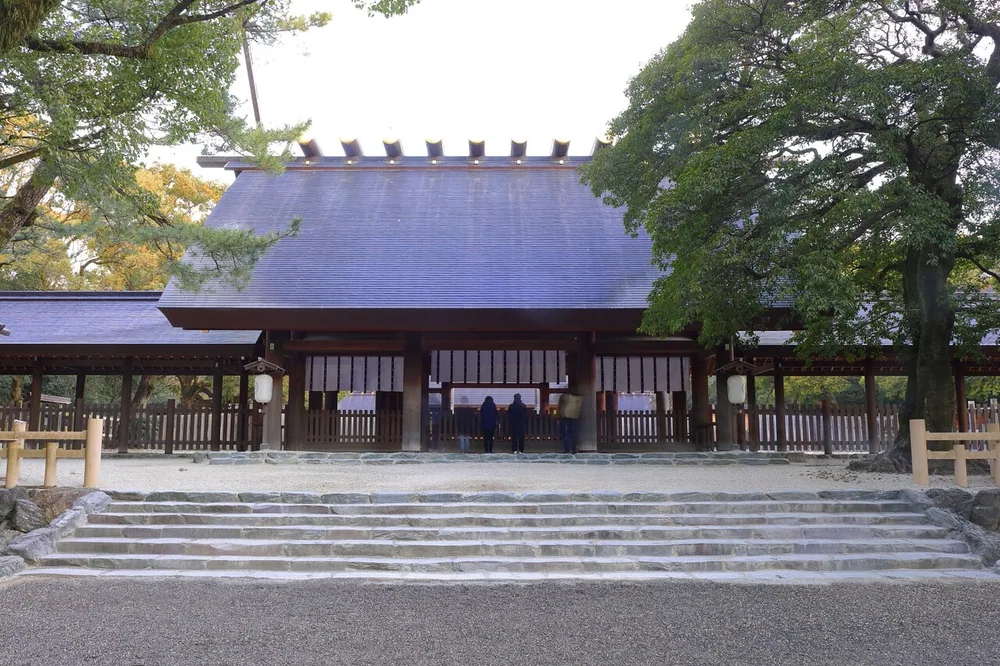
General entry to Atsuta Shrine is free. Take the Meitetsu Line from Nagoya Station to the East Gate, or the underground to the South Gate for the main approach. Includes worship tips for the Main Sanctuary and Betsugu Hakkengu, Treasure Hall and Kusanagi-kan ticket prices, year-end closures, Miya Kishimen and combining with Nagoya Castle.
South Gate to the Main Sanctuary: Walking the Full Approach
The South Gate is also the main entrance, labelled Main Gate (South Gate) or First Torii (Ichi no Torii) on maps. Step under the first torii gate and the main approach leads north through wooded grounds, with worthwhile stops right near the start. Follow signs near the South Gate to Betsugu Hakkengu and the neighbouring Kamichikama-jinja. If you prefer to pay your respects at the Main Sanctuary first, continue straight north and visit these two sub-shrines on the way back. If you intend to leave via the East Gate, seeing both southern shrines on arrival avoids doubling back.
Hakkengu enshrines the same deity as the Main Sanctuary and was historically revered by samurai clans. Shrine records note that Oda Nobunaga ordered repairs to its buildings before marching to the Battle of Nagashino, and Tokugawa Ieyasu later restored the Worship Hall and other structures. Sitting within the same forested precinct, this southern sub-shrine carries a distinct history of its own. Next door, Kamichikama-jinja is dedicated to Owari-no-kuni-no-miyatsuko Okoto-no-mikoto. If you collect shrine stamps (goshuin, called goshin-in here) for Betsugu Hakkengu or Kamichikama-jinja, pick them up in this southern area rather than walking all the way to the Main Sanctuary first.
Returning north along the main approach, fine gravel paths and tree shade continue all the way to the Main Sanctuary. If some of your group want to photograph the shaded avenue while others prefer to head straight to worship, agree to meet at the purification pavilion (temizuya) before walking up to the Worship Hall together. Along the route stands a giant camphor tree (Okusu) said to be over a thousand years old; step to the edge of the path to take in its canopy. Pushchairs move more slowly on the loose gravel, so allow extra time along this stretch. Visitors entering from the East Gate can also see the giant camphor tree by following the grounds map onto the main approach and turning north towards the Main Sanctuary.
As you pass Kusanagi Square, note the locations of the Kusanagi-kan sword hall and the Miya Kishimen Jingu branch. They sit at an easy crossroads to return to: arrive in the morning, pay your respects at the Main Sanctuary first, then swing back to the square for an exhibition or lunch. If you arrive in the afternoon, check how much time remains before closing. Anyone aiming for the two-hall combination ticket should make sure to reach the counter before the 15:30 cutoff. Deciding beforehand whether to stop at the square first or after worship saves stopping to rethink the route at every junction.
Paying Respects at the Main Sanctuary and Collecting Goshin-in
At the end of the approach, the path opens onto the Worship Hall (Haiden), where general visitors offer prayers. Look past the fence into the innermost sanctuary to spot the Main Hall (Honden), topped with forked roof finials (chigi) and horizontal ridge billets (katsuogi), where Atsuta-no-Okami is enshrined. Telling these two buildings apart helps you read the grounds map and know where to queue. If a family prayer ceremony is under way or priests are passing through, keep the central pathway clear and step to either side to admire or photograph the roofline.
When the purification basin is open, rinse your hands first, then cup water in your palm to rinse your mouth—never drink the water directly or touch your lips to the shared ladle. Standard shrine etiquette is two bows, two claps, one bow: bow deeply twice in front of the Worship Hall, clap your hands twice at chest level, hold your palms together to make a quiet wish, then bow once more. Simply follow the queue moving forward. During major festivals, follow staff directions on which side to join.
Nagoya's official tourism guide notes that Atsuta Shrine calls its red-ink stamp seal 'goshin-in' rather than goshuin. The Main Sanctuary seal is issued beside the Main Sanctuary, whereas seals for Betsugu Hakkengu and Kamichikama-jinja are handled over by Kamichikama-jinja. When handing your stamp book to the counter, stating the exact shrine name avoids confusion. Paper talismans (ofuda) and lucky charms (omamori) can be selected by purpose at the Main Sanctuary distribution office. Visitors focusing solely on the Main Sanctuary only need to enter and exit around the Worship Hall; only go down to the south end if you want both stamp counters.
Adjacent to the east side of the Main Sanctuary sits the Kagura-den, where formal booked prayer rituals take place. If someone in your group has arranged a formal prayer, set your meeting point near the distribution office so others can worship at the Worship Hall and walk round the outside to rejoin. For a straightforward visit, simply follow the signs marked 'Main Sanctuary' (Hongu) and 'Distribution Office' (Juyosho) at the key forks.
Kokoro no Komichi Behind the Main Sanctuary
If you have time after visiting the Main Sanctuary, shift from the wide plaza to the quiet woodland path behind it, marked 'Kokoro no Komichi' on the grounds map. Along the trail lies Ichinomisaki-jinja, enshrining the rough spirit (aramitama) of Atsuta-no-Okami. According to Aichi Prefecture's official tourism guide, this once-restricted area only opened to the general public in 2012. Set among close-knit trees and small shrines extending behind the Main Sanctuary, the path encourages a much slower pace than the main approach.
Check the grounds map near the Kagura-den side to locate Shimizu-sha and Mita-jinja along the way. If you only want to visit Ichinomisaki-jinja, look for the path entrance just beside the Main Sanctuary. If you plan to walk the full loop, agree to regroup in the plaza in front of the Main Sanctuary so anyone who tires can wait by the main avenue. Walk this trail during daylight hours; if the entrance happens to be closed, stick to the public approach and stop by the Nobunaga Wall or the giant camphor tree on the way back.
Photography is strictly prohibited inside the fenced sanctuary areas and shrine buildings, and you must ask permission before photographing other worshippers. Watch the signs at the trailhead and along Kokoro no Komichi for camera restrictions; for souvenir shots, stick to the torii gates and tree-lined avenues of the main approach. Step aside to the edge of the path when checking your photos so you do not block people coming up behind you. Any commercial or public-distribution photography requires prior permission from the shrine office.
Nobunaga's Wall: A Historic Stop on the Return Walk
On your walk back down the main approach from the Main Sanctuary, look out for the Nobunaga Wall (Nobunaga-bei). Shrine records state that Oda Nobunaga prayed at Atsuta in 1560 before the Battle of Okehazama and donated this earthen wall in gratitude afterwards. Clay roof tiles are layered into the rammed earth, with rows of exposed tile edges forming tight horizontal stripes across the surface. Stopping to inspect the alternating layers of earth and tile up close makes this Sengoku-era relic far more memorable than just snapping a quick backdrop photo.
Pairing Nobunaga's Wall with Betsugu Hakkengu reveals two separate chapters of Oda Nobunaga's ties to Atsuta. The wall dates to his prayers and victory at Okehazama, whereas his restoration of Hakkengu came years later before the campaign at Nagashino—separated by both distance along the approach and time. After seeing both, heading to Nagoya Castle provides a natural follow-on into Tokugawa-era fortress architecture. If you are combining both in one day, budget your time around whichever exhibition matters most to you, as both shrine halls and Nagoya Castle's Honmaru Palace require afternoon entry before their cutoffs.
The Kusanagi Sword Is in the Sanctuary—What Blades Can You Actually See?
Atsuta-no-Okami is Amaterasu Omikami embodied in the sacred Kusanagi Sword (Kusanagi-no-Tsurugi). According to the shrine's founding tradition, after the death of Prince Yamato Takeru, his consort Miyazu-hime enshrined the sword at Atsuta. Also known as Ame-no-Murakumo-no-Tsurugi, it is one of Japan's Three Imperial Regalia. Although the exhibition hall on the map shares the Kusanagi name—linking it to the shrine's founding faith—the Kusanagi Sword itself is never put on public display. Even so, visiting the Kusanagi-kan after paying your respects at the Main Sanctuary explains why Atsuta holds such an extraordinary blade collection.
The Sword Treasure Hall Kusanagi-kan focuses on blades donated to the shrine over the centuries, with permanent displays rotating periodically. On a first visit, pick a few swords in the same display case to compare their length and curvature, then check the labels for their dates. When tachi long swords and tanto daggers appear in the same rotation, note the differences in blade profile and mountings. Head next to the hands-on corner, where full-scale, full-weight replicas of great odachi swords turn museum measurements into something tangible. Aichi Prefecture's official museum listing highlights this tactile corner, making it ideal for families picking just one hall to visit with children.
In the gallery, the Magara Odachi is a standout reference point for sheer scale. According to exhibition notes published by Nagoya Railroad, one blade signed 'Sue no Aoe' measures 340 cm in total length and weighs roughly 10 kg. Read 'total length' separately from 'blade length' on the placard before testing the replicas in the hands-on zone—on a sword this long, merely gripping the hilt and supporting the blade is a feat in itself. If anyone in your group is less interested in historical eras, turn it into a game by guessing a blade's length before reading the label.
The Treasure Hall (Homotsukan) widens the lens beyond weaponry. Drawn from offerings sent from across Japan, its collection spans historical documents, decorative crafts and ritual implements. Paying attention to how an object was used, who donated it and when is often more rewarding than tallying highlights between the two halls. Readers of Sengoku history can check current exhibition titles for notable figures and periods, while visitors drawn to ritual objects and craftsmanship may want to linger longer in the Treasure Hall.
Before buying tickets, decide which displays you want to linger over. If you want time to read every sword label carefully, visit the Kusanagi-kan first and save the Treasure Hall for specific highlights. If the Treasure Hall is running a special exhibition you want to see, prioritise that earlier in the day and finish both halls before sitting down for noodles. When only one person in your party wants to visit a museum, they can buy a single-hall ticket and meet the rest of the group back at Kusanagi Square while the others explore the shrines near the South Gate.
Treasure Hall and Kusanagi-kan Admission and Month-End Closures
On regular days, the two halls charge separate admission: ¥500 for adults and ¥200 for primary and junior high school pupils for either the Treasure Hall permanent exhibition or the Kusanagi-kan alone. Visiting both on individual tickets comes to ¥1,000 for adults and ¥400 for pupils, whereas the two-hall combination ticket normally costs ¥800 for adults and ¥300 for pupils. Note that the Japanese child rate applies to primary and junior high school students. When the Treasure Hall stages a themed or special exhibition, admission and combination ticket prices adjust according to that exhibition's schedule.
Both halls normally open from 9:00 to 16:30, with last entry at 16:00 and combination ticket sales ending at 15:30. The 15:30 cutoff matters far more to your schedule than the 16:30 closing time—even if you buy a combined ticket at 15:20, walking between buildings and reading labels quickly eats into your remaining hour. If you only leave Nagoya Station in the afternoon, pick the single hall that matters most and decide whether to visit before or after worship depending on when you reach the door. After 16:00, focus on the Main Sanctuary and the wooded approach.
The Treasure Hall typically closes on the last Thursday of each month and the preceding Wednesday, while the Kusanagi-kan normally closes two days earlier—on the Tuesday before that last Thursday. If your group hopes to see both halls, avoid that Tuesday-to-Thursday window at the end of the month. When a holiday trip spans month-end, mark the last Thursday and the two days before it on your calendar so you can schedule the halls earlier in the week. Even when one hall is shut, the outdoor shrine grounds remain open as usual.
Official tourism pages for both Nagoya City and Aichi Prefecture list both halls as closed from 25 to 31 December. During that final week of 2026, focus on the outdoor shrines, the main approach and eating on the grounds. According to the Treasure Hall's annual schedule, a New Year special exhibition on Nanboku-cho figures and history is scheduled to run from 1 to 26 January 2027. If you want to combine this exhibition with hatsumode (first shrine visit of the year), go during daytime hours and note that special exhibition pricing will apply.
If you are visiting with a sword enthusiast around the year-end or New Year, check the exhibition titles before locking in your dates. The Kusanagi-kan's annual calendar lists 'Hokurikudo and San'indo' from 25 November to 24 December 2026, followed by 'Mononofu (Samurai) and Atsuta' from 1 to 25 January 2027. Each hall sets its own changeover dates: 26 January still falls within the Treasure Hall's scheduled New Year show, while the Kusanagi-kan's next rotation is scheduled to start on 27 January. If you only have one New Year visit and want both halls, choose a regular overlapping date rather than the final day of an exhibition.
| Ticket Type | Adult / Pupil | Hours & Cutoffs |
|---|---|---|
| Treasure Hall (Permanent) | ¥500 / ¥200 | 9:00–16:30 (last entry 16:00) |
| Kusanagi-kan (Single Hall) | ¥500 / ¥200 | 9:00–16:30 (last entry 16:00) |
| Two-Hall Combination Ticket | ¥800 / ¥300 | Sold until 15:30; prices may vary for special exhibitions |
Miya Kishimen: Tell the Jingu Branch Apart from Jingu-Higashi
Inside the shrine grounds sits Miya Kishimen Jingu Branch in Kusanagi Square, right near the Kusanagi-kan. Kishimen are flat, wide wheat noodles—thinner and broader than standard udon—and the classic bowl on the menu is simply called 'Miya Kishimen'. If you arrive before lunchtime, you can worship first in the morning and return to the square for an early lunch or brunch. The branch lists opening hours from 9:00 with last orders at 16:30, and does not take bookings. Some cashless payment methods may be paused during New Year or Golden Week, so carry some yen cash.
If you finish worship around the midday rush and are heading back into central Nagoya, check the queue at Kusanagi Square before joining it. If you still plan to visit the museum halls, prioritise buying tickets and getting inside before the cutoffs. Heading back via the Meitetsu Line instead, you can eat at the Miya Kishimen Jingu-Higashi branch on the 3rd-floor food court of μPLAT Jingumae, directly connected to Jingumae Station. Official listings give hours from 11:00 to 20:30 (last orders 20:00), which suits a later return or groups wanting different dining options in the same food court. Because the branch names sound similar, check the address carefully for 'Kusanagi Square' inside the grounds or 'μPLAT Jingumae'.
Both branches updated their menus in October 2026; check the official branch pages ahead of time to estimate family meal costs. For dietary concerns, the Jingu branch posts an allergen chart outside the entrance, and partial ingredient details appear on the official website. Match broth and toppings together, and if you see seasonal specials at the counter, show the Japanese dish name to staff to confirm ingredients. If you only want packaged noodles to take back to your accommodation, buy souvenir packs inside the shop rather than making an extra stop at the station shopping arcade.
If your family wants a seated meal inside the shrine grounds, allow extra time to wait for a table and food. Eating early suits families planning just one museum hall in the morning. If you need to make the afternoon admission cutoff at Nagoya Castle's Honmaru Palace and find a long queue at the shrine noodle shop, take the underground straight to the castle first and eat later in Sakae or Osu.
Shortening the Route with Pushchairs, Older Visitors or in Rain
Gate-to-gate distances tell only half the story. The main approach is paved with deep loose gravel (tamajari), and there are stone steps in front of the Main Sanctuary's Worship Hall. Walking the entire South Gate route, backtracking to the museums and walking back to a station takes noticeably more effort on wheels than flat pavement. If anyone in your group tires easily, enter through the West Gate closer to the Main Sanctuary and decide on rest stops and meeting points early. To buy charms, one faster walker can go to the distribution office while others wait at an easy-to-spot point along the main avenue.
Aichi Prefecture's official tourism page notes accessible multi-purpose toilets, baby-changing facilities, a nursing room and wheelchair loans on site. Ask shrine staff when borrowing a wheelchair, and plan to enter and exit via the same gate so returning it is straightforward. If you are considering an East-in, West-out route while using loaned equipment, confirm where it must be returned before committing to your exit. Visitors with mobility needs can also check the Nagoya City Transportation Bureau's station accessibility guides in advance to locate lifts and the easiest underground exit.
In passing showers, stick to a short outdoor walk to the Main Sanctuary before heading inside the Kusanagi-kan or Treasure Hall. In heavy rain, switch to a Meitetsu Jingumae round trip, eat inside the station building and keep your outdoor time to the stretch between the East Gate and the Worship Hall. Wear shoes with good grip, as wet gravel and stone steps slow you down. When carrying both a pushchair and long umbrellas, fold rain gear neatly before entering the museum halls and divide tasks—one adult watching children and bags, another handling the pushchair—rather than blocking the doorway.
If young children need space to run around, save active play for Atsuta-jingu Park outside the precinct and keep to a calm walking pace inside the shrine grounds. Atsuta-jingu Park is a separate municipal park outside the shrine walls, not the wooded avenue in front of the Main Sanctuary. To keep children engaged inside the shrine without wearing them out, point out the Betsugu rooftops near the South Gate, spot the giant camphor tree and torii gates along the stroll, then compare blade lengths inside the Kusanagi-kan. Pick just one or two stops so anyone who gets tired can slip out via the nearest gate.
Drivers will find car parks corresponding to the East, West and South Gates. The shrine's access page notes that precinct car parks normally close at 17:00, so factor in returning for your car if you plan to visit a garden, the old ferry dock or stay nearby for dinner. Parking arrangements and road closures also change during major holidays such as New Year. On ordinary weekdays, if a passenger needs dropping off close to the Main Sanctuary, the West Gate approach is the most direct before the driver follows staff directions to park.
Hatsumode, Hatsu-Ebisu and the June Atsuta Festival
Over the New Year period, decide upfront whether you are coming for the hatsumode crowd experience or the museum halls. General worship is free and the grounds are usually open round the clock; on New Year's Day, follow staff marshalling for one-way entry and exit queues. For a quiet woodland walk instead, wait until a regular weekday after 3 January. On 5 January, the Hatsu-Ebisu festival centres on Kamichikama-jinja near the South Gate—keep that date in mind if you want to avoid festival crowds along the southern approach.
In past New Year seasons, Atsuta Police Station and the shrine have issued dedicated street-closure maps. If visiting around midnight, check operators' year-end and New Year timetables separately for regular last trains and overnight special services, and factor in the walk from the station exit to the back of the queue. If you are staying around Nagoya Station, allow enough time after midnight not just for the train ride from Jingumae back to Meitetsu Nagoya, but also for the walk from the ticket gates back to your hotel.
The Atsuta Festival (also known as Shobu-sai) is the shrine's annual grand festival held on 5 June, featuring votive lanterns, martial arts demonstrations and fireworks. If you are travelling specifically for the lanterns or fireworks, mark 5 June on the annual calendar first, then verify viewing areas and entry times against that year's official event notice. Visitors looking only for a quick morning prayer may prefer avoiding festival day to skip detours and queues, leaving the grounds quieter for admiring the shrine buildings and Nobunaga's Wall.
Outside 5 June, Atsuta Shrine also hosts sword-related ritual offerings. A Nagoya Railroad feature notes master swordsmiths offering their forging craft before the deity, and the annual schedule lists dedicated dates for sword forging and polishing demonstrations. If you are keen to see how blades are made, aim for one of those demonstration dates and times; if you prefer examining blade geometry and smith signatures up close, pick a standard museum day matching the Kusanagi-kan rotation that interests you. When an outdoor demonstration coincides with your museum day, arrive for the scheduled ritual start time first and fit general worship around it.
Walking from the South Gate to the Old Tokaido Ferry Landing
To spend an afternoon exploring Atsuta beyond the shrine, walk from the South Gate down to Miya-no-Watashi Park, allowing about 20 minutes on foot. Once you step past the main approach, the leafy grounds give way to quiet streets leading towards the old harbour. If you simply want a short stroll to the water, just remember Miya-no-Watashi Park and the historic 'Shichiri-no-Watashi' crossing. To trace post-town place names along the way, bring the Atsuta Ward walking map and loop back towards Atsuta-jingu Tenmacho Station at the end.
In the Edo period, travellers arriving at Miya-juku just outside the shrine gates boarded boats at Atsuta Port for Kuwana in modern-day Mie Prefecture—a sea crossing along the Tokaido known as the Seven-Ri Ferry (Shichiri-no-Watashi). Today the waterside park preserves a small jetty, a bell tower and an all-night beacon lantern (Joyato), listed by Nagoya City as a 1955 reconstruction; standing by the water and looking back shows how it once guided boats in after dark. The park marks the site and memory of the old landing, after which you can simply follow the streets back to the underground.
Walking back towards Atsuta-jingu Tenmacho Station, look on the ward office map for the old Tokaido milestone (Tokaido Dohyo). The weathered stone marker points out the forks where the Tokaido branched onto the Minoji and Saya-kaido roads, and notes that Atsuta Shrine lies two cho—just over 200 metres—away. As Miya-juku's historic streets now blend into modern city roads, this stone post explains where the old highways split far better than guessing at a busy junction. You can keep things simple with just the ferry park and milestone, or follow all ten stops on the ward map if you enjoy post-town history.
If you are also visiting Nagoya Castle on the same day, the ferry landing and castle pair naturally as the Owari Domain's historic port and seat of power. Over the year-end days when Nagoya Castle is shut, walk Atsuta's old port streets instead and save the Honmaru Palace for an open day. Shirotori Garden lies in the opposite direction off the shrine's west side, so on a half-day schedule it usually makes sense to add either the ferry landing or the garden, not both.
After the Shrine: Stay in Atsuta or Head to Nagoya Castle?
With just one hour, arrive at Jingumae, enter via the East Gate, visit the Main Sanctuary and pick either the giant camphor tree or Nobunaga's Wall for the walk back. If the southern sub-shrines and their goshin-in seals are your priority, start from Atsuta-jingu Tenmacho on the underground instead and leave by the East or West Gate. That one-hour estimate covers walking inside the precinct, excluding travel time from your hotel. If you have a train to catch or dinner plans afterwards, decide which sights to skip before stepping through the gate so you are not watching the clock inside a museum.
With two to three hours, entering via the South Gate, visiting the Main Sanctuary, touring one or both museum halls, eating Miya Kishimen and leaving via the East Gate for the Meitetsu Line makes an adaptable half-day plan. If someone in your group prefers gardens to museums, swap the second hall for Shirotori Garden. Shirotori Garden opens from 9:00 to 17:00 (last entry 16:30) and costs ¥300 for adults, with junior high school pupils and younger free; it normally closes on Mondays (or the following weekday if Monday is a public holiday) and from 29 December to 3 January. Take Exit 2 at Atsuta-jingu Nishi Underground Station for the shrine, and Exit 4 for the garden so you do not accidentally follow the shrine crowd in the wrong direction.
To continue to Nagoya Castle, board the Meijo Line clockwise (migi-mawari) towards Kanayama and Sakae from Atsuta-jingu Nishi or Atsuta-jingu Tenmacho for a direct ride to Nagoyajo Station. The castle grounds normally open from 9:00 to 16:30, with last admission to both the grounds and the Honmaru Palace at 16:00. Because it takes a walk from the castle gate to reach the Honmaru Palace, do not aim to arrive at the station at 16:00. The main keep remains closed to entry, so view it from outside and focus your time on the Honmaru Palace and stone walls; from 1 October 2026, adult castle admission rises to ¥1,000 (junior high school pupils and younger free)—see our Nagoya Castle Honmaru Palace guide for details.
If you finish both shrine halls late in the afternoon, ride up to Kamimaezu for the Osu Shopping District and spend the evening grazing street food instead of rushing to beat Nagoya Castle's last entry. Nagoya Castle closes from 29 December to 1 January, making Osu an ideal pairing after Atsuta Shrine during year-end trips. If you are still mapping out hotels and city transit across Nagoya, use our two-day Nagoya itinerary to split southern Atsuta and central Nagoya cleanly across separate half-days.
If you want to visit Shirotori Garden in the morning, arrive right at opening time before walking across to enter Atsuta Shrine through the West Gate. Designed with artificial hills representing Mount Ontake and streams echoing the Kiso River flowing into an Ise Bay pond, the garden sits an easy walk from the West Gate. Doing the pair in reverse—visiting the garden in the afternoon—still leaves time for outdoor worship at the Main Sanctuary, though the museum halls and the shrine's noodle shop may already be past last entry or last orders. If museum exhibitions are high on your list, visit Atsuta Shrine in the morning and stroll the garden in the afternoon.
A few useful answers
Do you need a ticket to visit Atsuta Shrine?
General entry to the shrine grounds and Main Sanctuary is free. Admission to the Treasure Hall permanent exhibition or the Kusanagi-kan alone is ¥500 for adults and ¥200 for primary and junior high school pupils. A two-hall combination ticket normally costs ¥800 for adults and ¥300 for pupils, though prices may adjust when the Treasure Hall holds themed or special exhibitions.
Which station should I get off at from Nagoya Station to reach Atsuta Shrine?
Take the Meitetsu Line to Jingumae Station for a 3-minute walk to the East Gate, or take the JR Tokaido Main Line to Atsuta Station for an 8-minute walk to the East Gate. To walk the full main approach from the South Gate, ride the Meijo Underground Line to Atsuta-jingu Tenmacho Station and take Exit 1 for a 7-minute walk.
Can you see the Kusanagi Sword inside the Kusanagi-kan?
No—the sacred Kusanagi Sword is enshrined in the Main Sanctuary and is never displayed publicly. The Kusanagi-kan exhibits other historical swords and blades from Atsuta Shrine's collection on a rotating basis, alongside a hands-on corner where you can feel the weight of replica blades.
Where do you get a goshuin stamp at Atsuta Shrine?
At Atsuta Shrine, these red-ink seals are called goshin-in. Collect the Main Sanctuary seal at the distribution office beside the Main Sanctuary, and collect the seals for Betsugu Hakkengu and Kamichikama-jinja over by Kamichikama-jinja near the South Gate.
If I arrive in the afternoon, can I still visit the Kusanagi-kan and eat Miya Kishimen?
The Kusanagi-kan normally stops admitting visitors at 16:00, and the two-hall combination ticket stops selling at 15:30. Miya Kishimen's Jingu branch inside the grounds takes last orders at 16:30; if you finish the museums after that, walk over to the Jingu-Higashi branch on the 3rd floor of μPLAT Jingumae (directly linked to Meitetsu Jingumae Station), which usually takes last orders until 20:00.
Official information and references
Sources used in this guide.
- Aichi Now (Official Aichi Prefecture Tourism) | Atsuta Shrine History, Year-End Closures & Accessibility
- Nagoya Info (Official Nagoya City Tourism) | Treasure Hall, Kusanagi-kan, Ticket Prices & Three-Gate Access
- Aichi Now (Official Aichi Prefecture Tourism) | Kusanagi-kan Tickets, Closures & Sword Handling Experience
- Atsuta Shrine | Precinct Grounds Map
- Nagoya Info (Official Nagoya City Tourism) | Goshin-in Stamp Distribution Locations
- Miyagi Prefecture Association of Shinto Shrines | Basic Shrine Worship Etiquette
- Miya Kishimen | Jingu Branch Hours & Menu
- Miya Kishimen | Jingu Branch Booking, Payment & Allergen Information
- Miya Kishimen | Jingu-Higashi Branch Hours & Menu
- Atsuta Shrine | Treasure Hall Annual Exhibition Schedule
- Aichi Prefectural Museum Association | Treasure Hall New Year Special Exhibition Schedule
- Nagoya City Transportation Bureau | Meijo Line Stations
- Nagoya Castle Official Website | Opening Hours, Closures & Admission
- Nagoya Castle Official Website | Main Keep Closure Notice
- Shirotori Garden | Opening Hours, Admission & Year-End/New Year Closures
- Atsuta Shrine | 5 June Annual Grand Festival (Atsuta Festival)
- Atsuta Shrine | Worship Etiquette & Photography Guidelines
- Nagoya City Transportation Bureau | 24-Hour Subway Ticket & Donichi Eco Kippu
- Atsuta Ward Office | Miya-no-Watashi Walking Map & Tokaido Milestone
- City of Nagoya | Reconstruction Record of the Miya-no-Watashi Park Beacon Lantern
- Meitetsu Wind | Magara Odachi & Sword Offerings at Kusanagi-kan
- Atsuta Shrine | Kusanagi-kan Annual Exhibition Schedule
- Naka Ward Office, City of Nagoya | Nobunaga Wall & the Battle of Okehazama
- Shirotori Garden | Water Feature Design & Garden Layout
- Atsuta Shrine | Gate Car Parks & Access Notices
- Nagoya City Transportation Bureau | Sakae Station Meijo & Meiko Line Platform Directions
- Nagoya Info (Official Nagoya City Tourism) | Atsuta Area Walking Guide & General Shrine Worship Hours
- Nagoya Info (Official Nagoya City Tourism) | 2026 Atsuta Festival Offerings & Event Locations