Understand central-reservation seating, S/A/B prices and six-person boxes using the 2026 official arrangements. Plan daytime skills, evening interaction, crossings, food stalls and departure, including child, wheelchair and wet-weather terms.
- Region & Focus
- Akita and Nyuto Onsen
- Reading Scope
- 29 min read · 16 chapters · 7 Q&As
- Official Verification
- 10 official sources checkedUpdated 29 October 2026
- Key Topics
- ItinerariesBookingSeasons
Chapter Route Map (tap any stop)
- Save both venues: daytime and evening show different things
- The 2026 festival has ended: use its arrangements to plan
- Four nights in one year had two timetables
- Paid seats are central: check which way they face
- S, A, B and six-person boxes: compare seat form and total cost
- Find the block before the seat number
- Without paid seats, follow pavements and crossing windows
- From the 50 kg owaka to five skills: follow the pole to its support
- Daytime competition: stability and the musicians’ own scores
- Midday hands-on sessions have a limit and an earlier start on the 6th
- Food-stall villages lie east and west: eat before crossing
- Wet-weather performances and ticket refunds have separate rules
- Arrange children’s seats and wheelchair needs before arrival
- Connect Akita Station, dinner, seats and your return
- One daytime session and one evening with a real break
- Keep modori Kanto on your existing route home
- Quick Q&A
For an evening at Akita Kanto Festival, decide whether you need a seat based on stamina and how long you want to stay. Once you have your ticket, plan which side of the road to enter from. Daytime skills at Area Nakaichi and evening lanterns on Kanto Odori can fit the same day. Calculate the return from your own seating block. This guide uses official arrangements for the completed 2026 festival to explain viewing, tickets and routes for comparison when planning another visit.
Save both venues: daytime and evening show different things
The main evening performances take place on Kanto Odori in Akita, between Sanno Crossroads and Nichome Bridge. The daytime skills competition is at Nigiwai Square in Area Nakaichi. Both are central, but save separate map pins: for morning competition, go to the square; for evening seats, find the block and seat printed on your ticket along the avenue. This is more useful than saving only the festival name.
Daytime lets you focus on the sashite, the pole balancer: changing hands, moving the pole to a shoulder, adjusting steps and steadying bending bamboo. Evening adds lights and the whole street view. After seeing daytime skills, you know when to look down from the lanterns to the performer rather than looking upwards all night.
For a first visit with a full day available, keep some daytime competition and one evening performance. If arriving only towards evening, allow for dinner, finding a viewing position and departure without rushing to another venue to complete the festival. The organiser’s FAQ describes day and night separately. Treat them as events with their own starts, finishes and rain arrangements.
Understand central-reservation seating, S/A/B prices and six-person boxes using the 2026 official arrangements. Plan daytime skills, evening interaction, crossings, food stalls and departure, including child, wheelchair and wet-weather terms.
The 2026 festival has ended: use its arrangements to plan
The official FAQ gives the annual festival dates as 3–6 August. In 2026, these were Monday 3 to Thursday 6 August. By 28 October 2026, the official seating page marked that year’s reservations and sales as closed. Research now can settle whether companions need fixed seats, whether to watch one or two nights, and whether to stay near the station or venue.
Do not copy 2026 ticket dates straight into a 2027 calendar before the next sale is announced. In 2026, groups meant 15 or more, with applications opening at 10:00 on 16 April. Individuals of 14 or fewer started at 10:00 on 14 May. Follow the official viewing-seat application page and add the announced dates to your chosen travel plan.
Check the full programme for the year when choosing an evening. The drone show added in 2026 ran on 3 and 6 August, with different performance timing on the other nights. Prioritise the main pole performances if that is your aim. For extra events, include their actual venues and transfers; sharing a timetable does not mean everything is visible from one seat.
Four nights in one year had two timetables
The detailed 2026 schedule grouped 3 and 6 August separately from 4 and 5 August. On 3 and 6, poles entered at 18:45, performances ran 19:10–20:25 and fureai Kanto interaction followed 20:25–20:35. On 4 and 5, entry was 18:50, performances 19:15–20:35 and interaction continued to 20:50. Both groups listed pole departure at 20:50, the event ending at 21:00 and traffic restrictions lifting at 21:30.
The five-minute start difference need not dominate your trip, but it matters when reading older guides. Remembering only 19:15 could miss the opening on 3 or 6; remembering only 20:35 for interaction also gives the wrong timing on those nights. Record entry, performance, interaction and departure separately rather than one broad 19:00–21:00 slot.
The detailed official 2026 timetable shows the length of each stage. The ticket page separately lists spectator admission at 18:35. Traffic restrictions start at 18:15, not permission to cross into the central seating. Arrive outside, identify your direction and wait for staff to announce admission.
Paid seats are central: check which way they face
The organiser’s FAQ describes an avenue about 800 metres long, with paid viewing seats mainly on the central reservation. Two rows sit back to back, facing the roads on either side. Benches are used at junctions or where there is no central reservation. A central seat gives you an assigned place facing one side’s performances, rather than a circular-stage position with an unrestricted view of both sides.
On the seating map, find north first, then your row and nearest cross street. If companions hold separate tickets, compare sides and blocks, not just nearby numbers. Back-to-back rows may be separated by one line on the map, yet moving between them can require a designated crossing window.
A fixed seat suits people who want to watch a full performance, rest seated or avoid finding new stopping places all evening. If you want to follow different neighbourhood groups with a camera, weigh the fixed direction and location against the price. Choose for how you want to watch, rather than assuming the highest price gives everyone the best view.
S, A, B and six-person boxes: compare seat form and total cost
In 2026, S seats cost ¥4,500 per person on stepped seating on the walls at the Akita Central Road entrance and exit. A seats cost ¥4,000 and included other stepped seats and folding chairs. B seats cost ¥3,500 and were benches. A itself covers two seating forms, so check the category before paying and the actual seating map after receiving tickets.
For two adults, upgrading B to A adds ¥1,000 in total; A to S adds another ¥1,000, using 2026 prices. If your party can sit on benches and would rather save for a second night or accommodation, include B. If seating height and form matter more, compare the S location with A’s different arrangements.
The individual application terms say specific seat locations cannot be reserved. Choosing a class differs from choosing a block or seat number. Do not build a fixed plan around an unallocated seat for a particular shop, camera angle or departure direction.
In 2026, a masu box cost ¥28,000 for up to six, in front of LAWSON Omachi 2-chome. Shared by six, that is about ¥4,667 each; by four, ¥7,000; by two, ¥14,000. It is sold as a whole box, without automatic reduction to a normal individual price for fewer people. Budget the full ¥28,000 before considering space and group arrangements.
There were only 14 boxes each day. Applications closed at 17:00 on 15 May, with a lottery if oversubscribed. Boxes released after cancellations were then reopened first come, first served. Plans need to allow for the lottery result and another acceptable seat class.
Families or friends can compare a box with individual S or A tickets. Six S seats cost ¥27,000, just ¥1,000 less than a box; four S seats cost ¥18,000, ¥10,000 less. The same year’s prices give different decisions according to headcount.
Find the block before the seat number
The 2026 seating map labels blocks 1–126, with seat numbers within each block. Find your block first, then your seat. Treating 126 as the final chair could send you the wrong way through a venue hundreds of metres long and give companions the wrong meeting point.
The west side joins Sanno Crossroads; the east leads towards Nichome Bridge and Akita Station. Blocks 1–28 were benches and 59–64 were boxes in the 2026 layout. Save both pages, which divide the eastern and western sections. A screenshot of page one alone may omit your eastern block.
All viewing seats are assigned. Each traveller should carry their own ticket; the map warns that proof may be requested at entry. One person holding all group tickets can delay people leaving, arriving late or entering separately. Distribute them before setting off and describe the meeting point by junction, side and block.
Without paid seats, follow pavements and crossing windows
Watching from the outside of the road differs from entering the central assigned seating. The official map separates pavements, performance roads and central seats and marks crossing junctions. Without a ticket, stay where stopping is permitted and leave passage for walkers. A road closed to cars is not wholly available for standing or crossing.
An unticketed plan suits flexible viewing: watch part of a performance, then move by permitted routes. Photographing both lantern rows and the sashite needs different sightlines. If people obscure the body, more upward photographs capture lights but not the balancing movements. For palm-to-shoulder or forehead-to-waist changes, prioritise daytime competition rather than waiting all night for a gap.
Without a reservation you save the seat fee and can adjust your stay, but have no fixed seat or allocated view. Anyone unable to stand for long should arrange seats or another workable viewing option alongside accommodation. With children, decide how long they can manage. Half an evening is still a workable plan.
The 2026 map marks two five-minute pedestrian crossing windows between performances, at five junctions. Follow staff releases when moving from pavement to central seats or between sides. These windows move people across; they are not breaks for stopping in the road to take a series of photographs.
Once seats are allocated, plan dinner and meeting points around them. For a north-side ticket, approach from that side before the performance. Toilet trips also need the full route: a short straight-line distance may include waiting to cross. Mark toilets, meeting points and seats together to see which small moves need time.
In 2026, benches were installed during 18:15–18:35 after traffic restrictions began, and admission awaited an announcement. Arriving early did not mean sitting early while the road became a performance venue. Identify the entrance and landmarks, let staff finish setting up and enter as directed.
From the 50 kg owaka to five skills: follow the pole to its support
The organiser divides Kanto into owaka, chuwaka, kowaka and yowaka. Owaka is 12 metres, 50 kg and 46 lanterns; chuwaka 9 metres, 30 kg and 46 lanterns; kowaka 7 metres, 15 kg and 24 lanterns; yowaka 5 metres, 5 kg and 24 lanterns. Dimensions, weight and lantern count do not shrink in the same ratio, so lantern count alone does not identify the class.
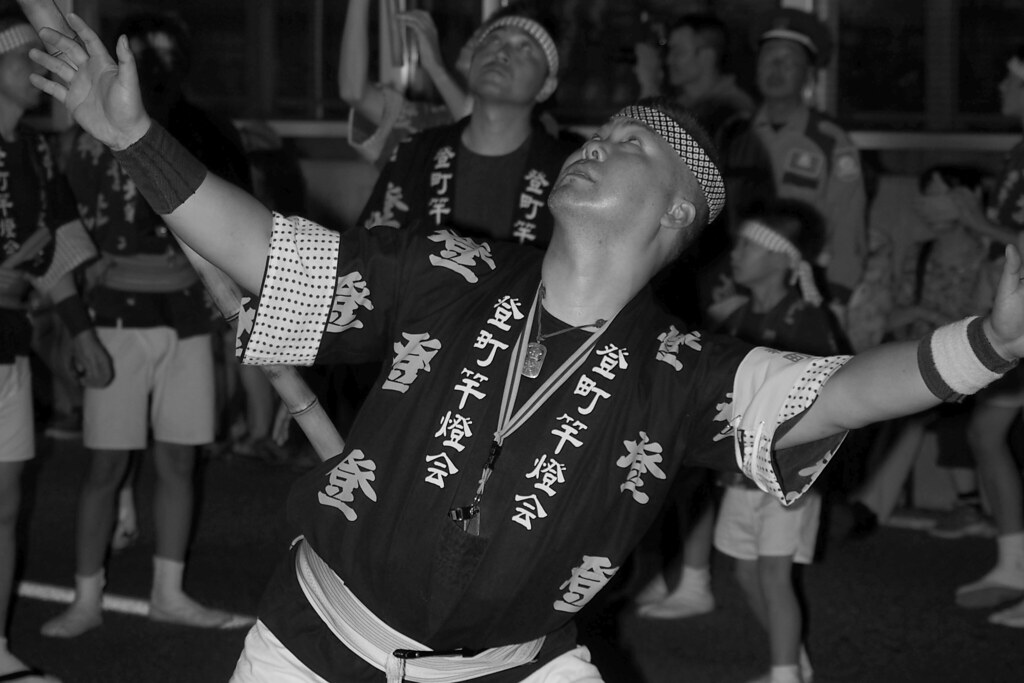
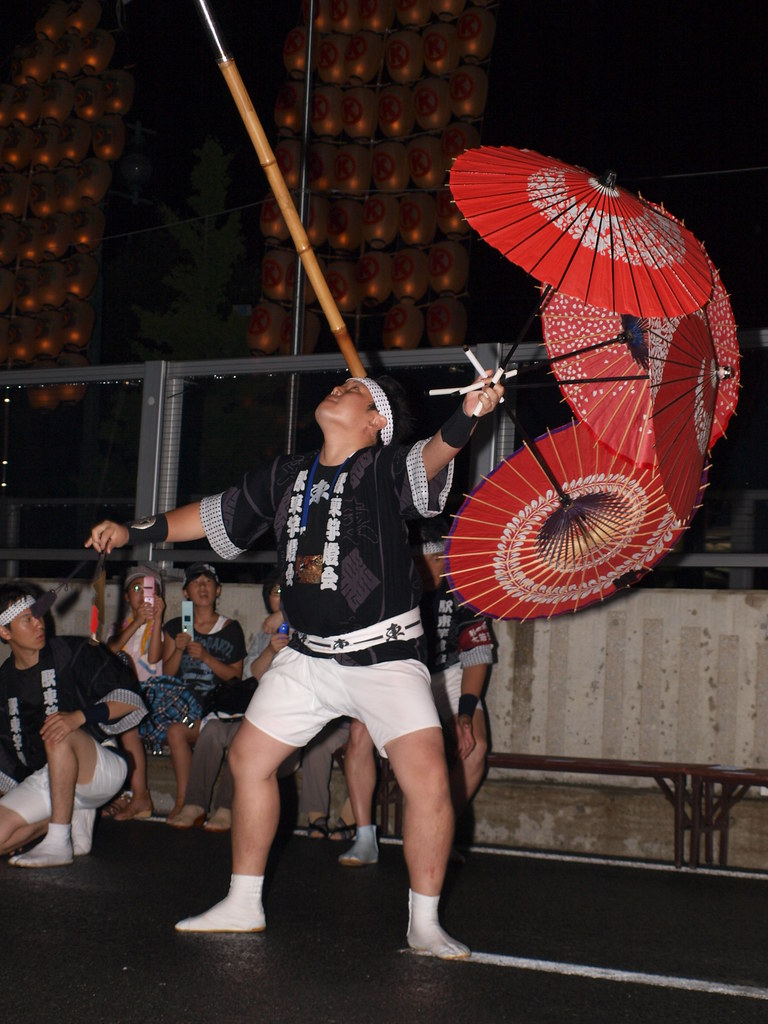
The height of an owaka is striking, but its support point explains the skill. The performer moves the assembly to palm, forehead, shoulder or waist, using posture and steps to balance bending bamboo. Follow the pole down to the support to see how a movement works. Watching only the top misses the few seconds when support changes.
The official full dimensions table helps distinguish classes. Families seeing kowaka or yowaka by day can watch stability and transitions rather than treating smaller poles as a wait for owaka. Training and difficulty involve more than maximum height and weight.
Nagashi supports the Kanto so the next sashite can add bamboo extensions. It keeps the performance going and shows teamwork. Hirate lifts it high on the palm and is an easy basic skill to recognise. Find the relationship between pole base and palm first, then move on to forehead, shoulder and waist.
The forehead technique steadies the pole on the forehead with arms spread. The shoulder technique receives it from the palm and transfers it to a shoulder; the official explanation highlights the supporting leg aligned with the pole. A full-body photograph keeps both support and footwork. A tight forehead or shoulder crop loses the lower body’s balance.
The waist technique uses a sideways lean and spread feet; skilled performers add movements with fans and other items. Its effect comes from the whole posture, not only the instant the base touches the waist. Use one round to recognise five skills and the next to follow a favourite transition.
A film of the 2025 event, released by Kanto Akita in February 2026 and selected for the festival’s official homepage, showing night-time pole balancing and rows of lanterns.
Daytime competition: stability and the musicians’ own scores
In 2026, daytime competition ran 09:00–15:40 on 4 and 5 August, with finals 09:20–15:00 on 6 August. The 3rd was not in this skills-competition schedule. Preliminaries included owaka teams, individuals and hayashi musicians; finals also included kowaka. Read the running order for a specific category before choosing morning or afternoon.
The official FAQ’s judging points include form, stance, staying within a six-metre-diameter circle, touching the pole with both hands, stability and force through the feet. A steady performance with less movement may deserve more attention than large gestures. Use the circle, hand positions and steps to understand the comparison.
Hayashi judging considers upper and lower drum rhythm and balance, stick movements, sustained flute sound, traditional melody and flute-drum coordination. Watch musicians too rather than treating them as background. Read the official skills and music judging explanation before arrival and choose one or two points to follow.
Midday hands-on sessions have a limit and an earlier start on the 6th
The official 2026 activity page limited hands-on Kanto sessions to the first 100 applicants each day, at the daytime headquarters at the skills venue. Registration opened one hour before the session. Sessions were 12:00–13:00 on 4 and 5 August and 11:50–12:50 on 6 August, with CNA Arena Akita planned for rain. Allow registration time rather than expecting a place after a leisurely lunch.
The activity uses yowaka or miniature Kanto. For beginners, feeling how the pole rests on the hand is a better start than copying a skilled night performer’s waist technique. Follow staff instructions. Do not infer age eligibility from the dimensions table or let a child operate alone because a yowaka is lighter.
The year’s leaflet summarised sessions from 12:00 on 4–6 August, while the detailed page put the 6th at 11:50. Use the detailed activity schedule for arrival. For a photograph with a miniature pole instead, the 2026 commemorative photo corner at Agora Square outside Akita Station’s west exit ran 10:00–17:00 on 3–6 August, separately from the competition activity.
Food-stall villages lie east and west: eat before crossing
The 2026 Kanto food-stall villages had City Hall and Central venues, respectively towards the west and east of the main performance area. Omachi Event Square also hosted a local-food event. These are separate places, so locate dinner relative to your allocated seats to reduce crossings before the show.
The year’s food-stall hours were 15:00–21:30, with a pre-festival event at City Hall on 2 August. Eat before taking seats and bring enough drinking water. Food and drink are allowed in seats, with rubbish taken home. This helps families fit children’s meals, but carrying several soup bowls and drinks through dense seating is harder than eating in the food area first.
For another meal in Kawabata or Omachi afterwards, choose between eating after the show and eating first then returning directly to your room. Food stalls close at 21:30, near the lifting of traffic restrictions. Do not treat that as the start of relaxed stall browsing after leaving your seat. Work backwards from closing.
Wet-weather performances and ticket refunds have separate rules
The organiser’s evening rain policy is to perform during breaks in the weather, with possible shortening. Individual-seat terms state no refunds even if rain cancels the event, and no cancellation after payment. Accept those ticket conditions before buying. Free hotel cancellation or changeable trains do not change the seat refund terms.
The planned daytime rain venue is CNA Arena Akita, the Akita Municipal Gymnasium. The 2026 map places it towards Yabase, away from central Nigiwai Square. Read the day’s organiser notice before heading to competition. Waiting at the original square in rain may miss an event moved to the gymnasium.
The 2026 seating map warns that bamboo poles may fall in wind. Keep space to move and avoid tripods or luggage blocking the front of seats. Move as staff direct. Choose camera distance accordingly rather than moving continually towards the performance road to fill the frame with lanterns.
Arrange children’s seats and wheelchair needs before arrival
In 2026, adults and children paid the same seat price. Only infants and young children not needing a seat were free. Two adults and a child needing a separate A seat cost ¥12,000 for three tickets, without an automatic half-price child fare. If carrying an infant without a seat, consider the physical burden for the evening separately from the free-ticket condition.
Wheelchair users have dedicated space, which the official guidance says cannot be arranged online. Request it by telephone, fax or at the counter. Dedicated wheelchair parking must be reserved separately with the executive committee. Arrange both to connect parking, venue access and viewing.
The map marks temporary toilets, wheelchair-accessible toilets and children’s priority toilets. Convenience depends on the side of your seat too. Pets cannot enter paid seating. Before paying, settle children’s seat needs, steps, wheelchair space and pet care, then choose headcount and class.
Connect Akita Station, dinner, seats and your return
Akita Station is east of the main venue, which extends west from Nichome Bridge to Sanno Crossroads. From the west exit, pass Agora Square, then follow the venue map to Nigiwai Square or Kanto Odori. These daytime landmarks help at night: the station is east, not further west along the performance road.
Distance from the station is not the departure time. Seats near the eastern end and Sanno Crossroads are different distances from Nichome Bridge. Leaving your block, waiting to cross and following pavements to the station add stages. Start the return calculation at your seat rather than the bridge.
If leaving Akita by train, work backwards from your actual service to decide when to leave. Pole departure at 20:50, event finish at 21:00 and roads reopening at 21:30 are different events. Pedestrians do not necessarily have to wait until the last one to walk to the station. For an early return, choose between performance and interaction and follow permitted exit routes.
For one night before a train with luggage, a station-area base keeps storage and departure together. For dinner in Kawabata or Omachi afterwards, compare the full walk to your accommodation. The official venue map shows station, performance area, dining streets and hotels. Choose an area first, then compare rooms and rates for your dates.
For accommodation beside the venue, check which side holds the entrance. A short straight-line distance does not allow you to cross from central seats whenever you want. An entrance across the performance road still requires a crossing window. Pack what you need in your room before dinner.
If Kanto is the focus, avoid putting a mountain ryokan stay with dinner and breakfast on the same night simply because it appeared on an Akita hot-spring list. Evening performances and departure fill the evening. Put Nyuto Onsen baths, dinner and mountain transfers on another day. For winter travel, see Nyuto Onsen and Yokote snow-hut festival accommodation and plan for that season.
One daytime session and one evening with a real break
Using 4 or 5 August 2026 as an example, watch some owaka preliminaries or hayashi at Nigiwai Square in the morning. Stay for registration if joining the activity. After lunch, leave afternoon time indoors to rest and prepare. Eat early, approach the correct seat side and wait for admission. Watch the main evening performance, then choose interaction or a direct return according to energy.
The purpose is to separate daytime technique from night-time lanterns with a real rest between. The 2026 activity page listed a free cooling rest area on Level 3 (3F) of Seibu Akita, 09:30–19:00 on 3–6 August, as a station-area stop. A rain move to the gymnasium changes the whole daytime route; do not keep the central-city sequence unchanged.
For evening only, keep arrival, luggage storage, dinner and finding your block. If staying another day, watch competition then. Seeing lanterns first and understanding technique later also works. Two nights let you spread interests without repeating the same route and every event each evening.
Keep modori Kanto on your existing route home
After the main evening show, some neighbourhoods hold modori Kanto. The official 2026 leaflet says many of the 38 participating neighbourhood groups are in Omachi on both sides of the avenue, with performances different from the main venue. Consider a stop if you have energy and it is on your way. For a train, follow your original departure plan first.
The full 2026 venue map divides related Kawabata road restrictions into two zones, one 18:15–22:00 and the other 21:00–22:00. These are traffic-control periods, not continuous performances by every neighbourhood. Follow staff and activity on side streets rather than treating coloured map areas as a fixed multi-stop programme.
Meet at clear landmarks such as Nichome Bridge, Nigiwai Square or the station west exit. If some people stay for neighbourhood performances while others return to their rooms, agree a final meeting point before separating. As poles leave and roads reopen, put away tickets and maps and walk in the direction you already know.
A few useful answers
Must I buy a seat for Akita Kanto Festival?
Decide by how long you can stand and whether you want a full performance or a brief visit. Without a ticket, stay in permitted outside viewing places. Follow staff for central seating and road crossings.
What did 2026 Kanto Festival seats cost?
S seats were ¥4,500, A ¥4,000 and B ¥3,500. A six-person box was ¥28,000 for the whole space. Sales for 2026 have ended.
Can I choose a particular seat location?
The 2026 individual terms did not allow reservation of specific positions. On receiving your ticket, find the block, then the seat within it.
Do children need tickets?
In 2026, adults and children paid the same price. Infants and young children not needing seats were free; a separate child seat cost the full price for that class.
Are tickets refunded if rain cancels the event?
The 2026 individual terms stated no refund for rain cancellation and no cancellation after payment. The planned daytime rain venue was CNA Arena Akita.
Did all four 2026 evenings start at 19:15?
The detailed official timetable and seating map listed 19:10 on 3 and 6 August and 19:15 on 4 and 5 August. Interaction periods also differed.
Can wheelchair spaces be booked online?
Official guidance says wheelchair space cannot be arranged online; request it by telephone, fax or at the counter. Reserve wheelchair parking separately with the executive committee.
Official information and references
Sources used in this guide.
- Organiser: day and night venues, seat directions, children, wheelchairs and judging
- Organiser: four Kanto classes and five techniques
- Organiser: detailed 2026 timetable and daytime sessions
- Organiser: 2026 prices, sales categories and closure
- Organiser: 2026 individual applications, seat allocation and cancellation terms
- Organiser: 2026 activities, Agora, food stalls and cooling rest area
- Organiser: 2026 seating map, blocks, crossings and guidance (two-page PDF)
- Organiser: 2026 venue surroundings, access and return routes (PDF)
- Organiser: 2026 leaflet front, daytime categories and techniques (PDF)
- Organiser: 2026 leaflet inside, food stalls and modori Kanto (PDF)