Choose Shinjuku, Okido, or Sendagaya Gate for different routes through Shinjuku Gyoen. Compare the Japanese Garden, roses, greenhouse, chrysanthemum exhibition, and family facilities, with station connections and meals for 90 minutes, three hours, or half a day.
- Region & Focus
- TokyoAttractions
- Reading Scope
- 31 min read · 19 chapters · 4 Q&As
- Official Verification
- 25 official sources checkedUpdated November 22, 2026
- Key Topics
- ItinerariesSeasonsRail travel
Chapter Route Map (tap any stop)
- Choose an entrance by looking at both ends of the garden
- The final connection: Shinjuku, Shinjuku-sanchome, and Sendagaya stations
- Tickets and seasonal hours: work backward from an afternoon arrival
- The Landscape Garden: give yourself time on the lawn
- The Japanese Garden and Taiwan Pavilion: ponds and architecture
- The Formal Garden: roses, symmetrical beds, and plane-tree avenues
- Okido Gate and the greenhouse: focused plant observation with less walking
- Tamamo Pond and the eastern short route: an older garden on a smaller scale
- With children: choose the Mother and Child Forest or the Children’s Square
- Feeding, diaper changes, and strollers: mark facilities before drawing the route
- Eating inside: distinguish meals, sweets, and free rest areas
- Spring flowers: check this week’s varieties before choosing lawns or ponds
- Autumn: follow the chrysanthemum route or choose ponds and avenues for leaves
- Summer and winter: reorder the walk around shade and indoor displays
- A 90-minute route: enter and leave the same gate for one garden area
- A three-hour crossing: connect both ends with a rest in the middle
- A half day with children or older adults: rest is part of the visit
- Luggage and accessibility: connect returns and collection to your exit
- Finishing the walk and photographs: keep the exit on your final stretch
- Quick Q&A
With only 90 minutes at Shinjuku Gyoen, enter through Shinjuku Gate and visit the Japanese Garden rather than rushing around every pond. For the greenhouse first, choose Okido Gate. This paid garden brings open lawns, formal flower beds, waterside buildings, and woodland for nature observation into one site. Its three entrances offer different walks. Choose the two landscapes you most want to see, allow time to eat, feed a baby, or sit down, and your half day has a clear direction.
Choose an entrance by looking at both ends of the garden
Shinjuku Gyoen spans Shinjuku and Shibuya wards and covers about 58.3 hectares. It may look like one patch of green on a map, but the walks lead in different directions: the Japanese Garden lies to the west, the Landscape Garden’s broad lawn in the center, the Formal Garden to the east, and Tamamo Pond in the northeast. The three public entrances are Shinjuku Gate, Okido Gate, and Sendagaya Gate. Pair your entrance with your first destination to decide whether to stay on one side or cross the grounds.
For ponds, bridges, and the Taiwan Pavilion, start at Shinjuku or Sendagaya Gate. Okido Gate is more direct for the greenhouse and Tamamo Pond. If roses and plane-tree avenues are your priority, focus on the eastern Formal Garden. The Ministry of the Environment garden map shows these areas, rest houses, and toilets together. Download it and mark your entrance, meal stop, and exit. This makes decisions inside easier than saving only a single Shinjuku Gyoen map pin.
The station-to-gate walk and the walk inside are separate. If your chosen flower beds are across the grounds from the entrance, add the crossing time. With three hours, a route entering one gate and leaving another is reasonable; with only an hour, keep entry and exit on the same side. If companions separate to take photos, choose a named rest house or gate as a meeting point. “Beside the big lawn” has several possible answers.
Choose Shinjuku, Okido, or Sendagaya Gate for different routes through Shinjuku Gyoen. Compare the Japanese Garden, roses, greenhouse, chrysanthemum exhibition, and family facilities, with station connections and meals for 90 minutes, three hours, or half a day.
The final connection: Shinjuku, Shinjuku-sanchome, and Sendagaya stations
The ministry’s access page gives about 10 minutes on foot from JR Shinjuku Station’s South Exit to Shinjuku Gate, or about five minutes from either Exit E5 of Shinjuku-sanchome on the Fukutoshin Line or Exit C5 on the Toei Shinjuku Line. These estimates begin at the station exit. Allow extra time to leave the train, find the exit, and wait at crossings. If you are staying east of Shinjuku or want gardens before shopping in Shinjuku-sanchome, use Shinjuku Gate for both entry and exit, then continue to restaurants and shops.
Okido Gate is also about five minutes from Shinjuku-gyoenmae Station on the Marunouchi Line. Check the station map for the correct direction above ground, then follow the northern edge of the garden. If you need an elevator, use the official accessible approach routes to connect the elevator and street sections. From Okido Gate, you can go straight toward the greenhouse without first detouring to meet at Shinjuku Gate.
Sendagaya Gate is about five minutes from JR Sendagaya Station or Exit A5 of Kokuritsu-kyogijo Station on the Toei Oedo Line, according to official estimates. JR Sendagaya is served by Chuo-Sobu local trains; Chuo Line rapid trains do not provide the same stopping pattern. Entering from the south for pond views in the morning and leaving by Shinjuku Gate in the afternoon gives the walk a direction. If you leave belongings in a locker at Sendagaya Gate, include the return to collect them in your walking total.
Tickets and seasonal hours: work backward from an afternoon arrival
The ministry’s admission information as of October 2026 lists ¥500 for adults, ¥250 for visitors aged 65 and over, ¥250 for students at high school level or above, and free entry for junior high school children and younger. Bring proof of age or student status for reduced admission. Holders of the disability certificates listed by the garden and one accompanying caregiver enter free after showing the certificate at a staffed counter. For an adult visiting once a year, a single ticket is sufficient. A standard annual pass costs ¥2,000 and suits repeated visits; there is no need to obtain one for a single Tokyo vacation.
From October 1 to March 14, the garden opens at 9:00 a.m., admits visitors until 4:00 p.m., and closes at 4:30 p.m. From March 15 to September 30, it usually closes at 6:00 p.m., with last entry at 5:30 p.m. From June 11 to July 31, those times extend to 7:00 p.m. and 6:30 p.m. Arriving at 3:45 p.m. in winter still allows entry, but leaves only 45 minutes before closing, enough for a nearby area. Move a planned greenhouse, pond, and teahouse visit earlier.
The garden generally closes on Mondays, or the next weekday when Monday is a holiday, and from December 29 to January 3. It opens daily from March 25 to April 24 and November 1 to 15. Busy cherry blossom dates may require advance reservations. Once your travel date is set, read that year’s notice and buy a ticket or obtain the required reservation. Plan announced evening events as separate visits from daytime admission; end a normal day-ticket visit at that day’s closing time.
You can buy online through the garden’s linked ticket service. The ministry also lists transport IC payment at entrance gates. If anyone qualifies for free or reduced admission, complete the staffed-counter check before entering together. Annual passes are nonrefundable and cannot be replaced if lost. They are issued on open days from 9:00 a.m. until one hour before closing. Compare those conditions when planning repeated use; a single walk does not need an extra pass application stop.
| Dates | Garden: last entry / closing | Greenhouse: last entry / closing |
|---|---|---|
| October 1–March 14 | 4:00 p.m. / 4:30 p.m. | 3:30 p.m. / 4:00 p.m. |
| March 15–June 10; August 1–September 30 | 5:30 p.m. / 6:00 p.m. | 5:00 p.m. / 5:30 p.m. |
| June 11–July 31 | 6:30 p.m. / 7:00 p.m. | 6:00 p.m. / 6:30 p.m. |
The Landscape Garden: give yourself time on the lawn
The Landscape Garden is defined by broad lawns and large surrounding trees. Looking from the Shinjuku Gate side toward the Formal Garden reveals the garden’s sightline across the grass to the beds and trees at the far end. Stop in the center and look at how near and distant canopies frame the space. You will understand the design better than by constantly hurrying along the edge. With children, this can also be time to sit down for a simple snack.
Trees highlighted by the garden include tulip trees and Himalayan cedars. Begin with tree labels, leaf shapes, and the canopy rather than identifying every tree. Let a child choose one tree to see, then regroup at a bench or on the lawn: that gives a family visit a small goal. Respect ropes and closures protecting planted areas. The paths still offer wide views without crossing barriers for a different angle.
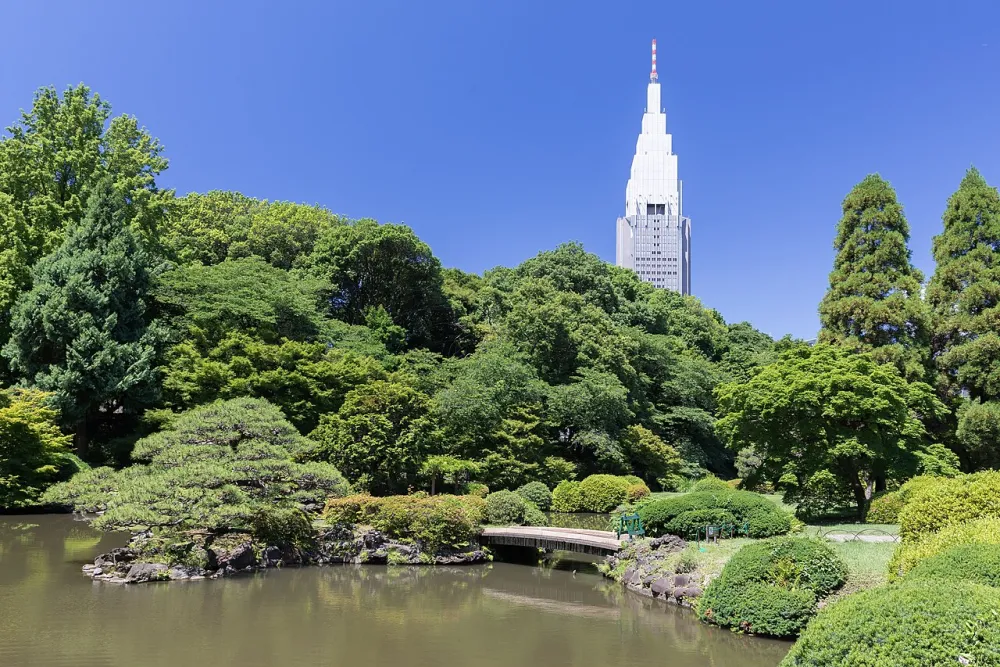
For a photograph combining city and garden, look for the distant NTT Docomo Yoyogi Building from pond edges and open spaces. Keep trees, water, or a bridge in the foreground, take your photograph, then continue your walk.
Open lawns and large surrounding trees show the layout of the Landscape Garden.
The Japanese Garden and Taiwan Pavilion: ponds and architecture
The Japanese Garden centers on the Upper Pond. Paths change the view along the water, with bridges, clipped planting, and buildings forming the scene together. From Shinjuku Gate, visit the western Japanese Garden before returning to the Landscape Garden for a first visit that is easier to keep short than an immediate crossing east. From Sendagaya Gate, begin along the southern ponds, continue to the Japanese Garden if energy allows, then leave toward Shinjuku Gate.
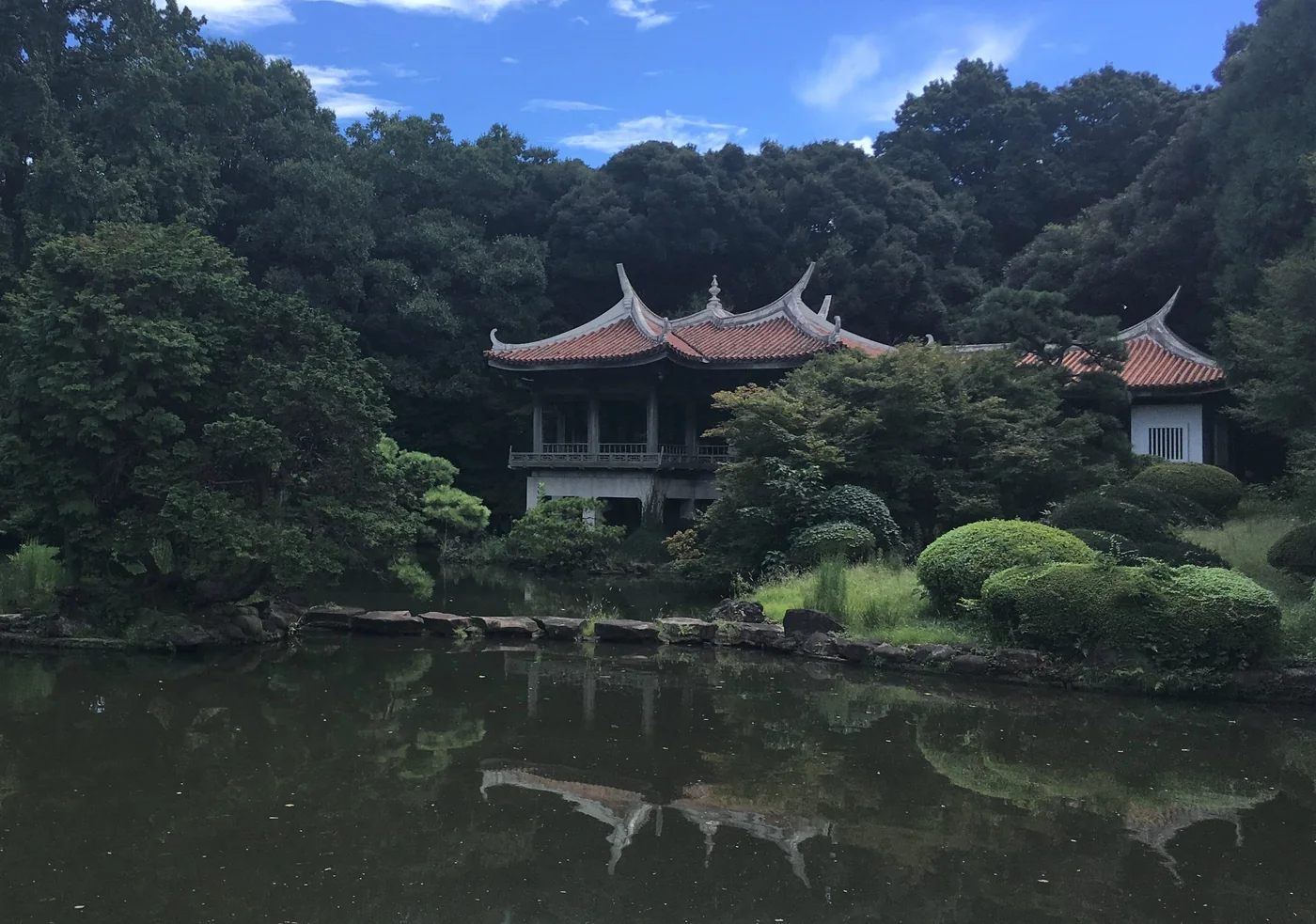
The Taiwan Pavilion, also called Kyu Goryotei, appears in the ministry’s historic buildings guide. It was built in 1927 and donated by a group of Japanese residents of Taiwan to commemorate the Crown Prince’s wedding. It has southern Fujian architectural features and uses materials such as Taiwan cedar and Taiwan cypress. Look at how the eaves and circular windows connect with views of the pond, combining architecture and garden in one stop. If the building or part of it is closed, continue along the open pond paths.
For tea, choose either Shoten-tei or Rakuutei in the Japanese Garden area rather than making both compulsory stops. With only 90 minutes, see the pond and the pavilion exterior first, then decide whether time remains for a teahouse. If you have already eaten outside, sitting nearby to watch the water is a worthwhile stop itself. Check direction signs before returning to your entrance. The pond paths branch, and following a distant bridge can turn a small loop into a longer one.
The Formal Garden: roses, symmetrical beds, and plane-tree avenues
The eastern Formal Garden combines straight paths, symmetry, rose beds, and plane-tree avenues, a different experience from the open central lawn. Enter along one avenue, pass the beds, then look back from the other side to see the design with little walking. If you came to photograph an avenue covered in fallen leaves, stay longer here rather than rushing back across to the Japanese Garden for one more pond photograph.
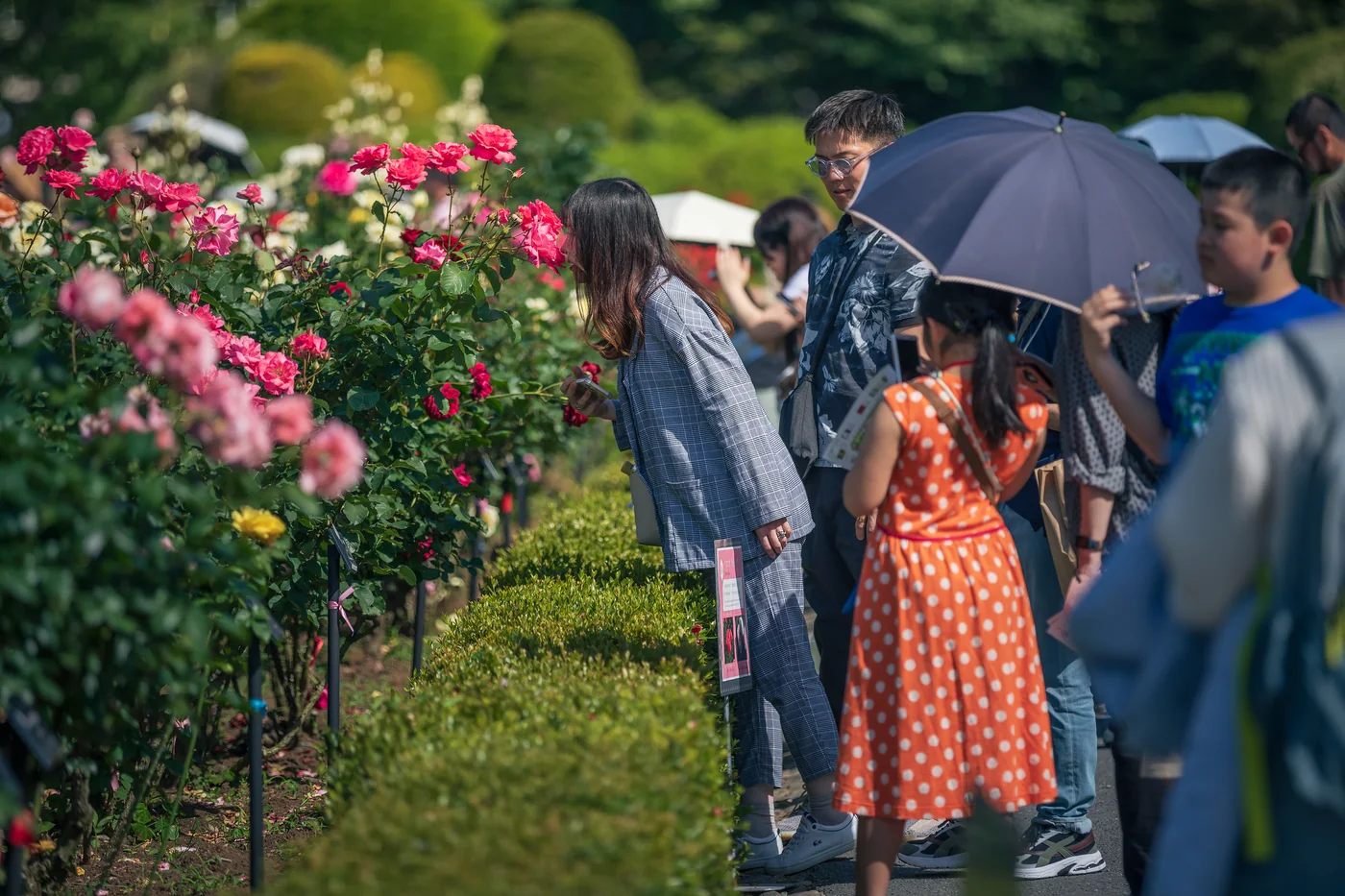
The ministry’s rose guide lists about 100 varieties and 500 plants, with different varieties in the eastern and western beds. When roses are flowering in spring or autumn, read the labels and compare flower shapes, colors, and scents from the paths outside the beds. If you visit Tokyo after cherry blossom season, roses and fresh foliage can anchor this area. Walking from the beds to a seat under the trees makes a garden morning distinct from spring’s cherry blossoms.
The plane trees offer more than fallen leaves. Summer shade gives you a line to follow and pause along; winter reveals the arrangement of trunks and branches. For companions who want less sun, plan a return route around the avenues and seats. To see the overall geometry, stop at a junction without obstructing others. Signs use “整形式庭園” for the Formal Garden and “プラタナス並木” for the plane-tree avenues; noting these Japanese names can help with directions.
Okido Gate and the greenhouse: focused plant observation with less walking
The greenhouse near Okido Gate is useful on cold days, in light rain, or when you want to concentrate on plants. The greenhouse guide lists tropical lowland, tropical mountain, Okinawan, and dryland displays, with over 1,000 plant species cultivated inside. Moving from broad leaves in humid habitats to dryland succulents and cacti provides plenty to study for anyone interested in leaf shapes and growing environments.
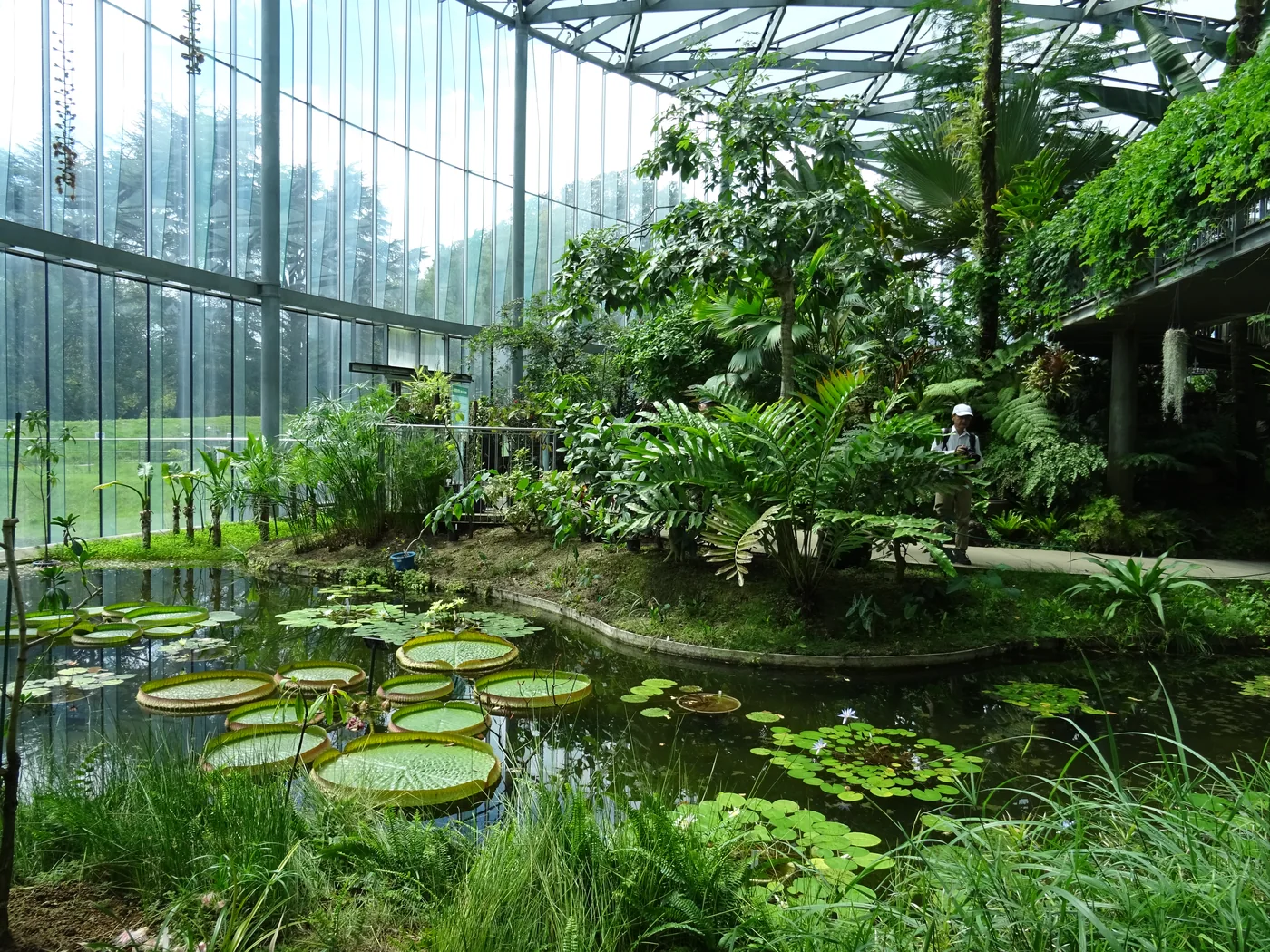
Rather than photographing every label, choose two familiar food plants, such as cacao and bananas, and see how they grow. With school-age children, looking for an especially large leaf or differently shaped stems is easier to join in than an explanation of every display. Read the signs for protected plant species and orchids. Behind-the-scenes tours take place on separate dates; choose a session through the official tour page if interested.
The greenhouse opens at 9:30 a.m. In winter, last entry is 3:30 p.m. and closing is 4:00 p.m., earlier than the garden. If you enter Okido Gate at 2:30 p.m., visit it first, then the central lawn. A long detour for tea may cost you the entry window. The display is indoors, but reaching it still means walking outside. In heavy rain, replace the whole garden visit with another indoor plan. For light rain, keep to one area near the gate and leave afterward. From November 4 to December 25, 2026 (planned), access to the embankment in front of the greenhouse and the surrounding pond area is restricted during construction. Use the open garden paths to reach and leave the greenhouse.
Tamamo Pond and the eastern short route: an older garden on a smaller scale
Tamamo Pond in the northeast comes from Tamagawa-en, the garden of the Naito family’s Edo-period residence. Its scale is more contained than the central lawn, suited to a slow look at the shoreline and planting. Normally, you can enter Okido Gate, see the greenhouse, then circle Tamamo Pond to combine the plant display and garden history on the same side. From November 4 to December 25, 2026 (planned), Tamamo Pond is being drained and dredged, so the pond looks different from usual. During this period, head to the central lawn after the greenhouse.
If historic buildings interest you, locate the Old Okido Gate Guardhouse and the Old Imperial Rest House. The latter was built in 1896 as a greenhouse annex, later used by the imperial family, and is now an Important Cultural Property. Look at the exteriors as you pass, and arrange interior visits for announced opening dates. You can keep the sequence of greenhouse, pond, and exit without waiting for a building that is closed that day.
The map also marks the “Main Gate” at the eastern end. This historic entrance is not a current public entrance. If you are heading for the roses or staying to the east, choose an open entrance such as Okido or Sendagaya Gate, then calculate the walk around the perimeter. If navigation leads toward the historic Main Gate, return to the official map’s three public entrances before you end up dragging luggage along a wall.
With children: choose the Mother and Child Forest or the Children’s Square
The Mother and Child Forest is woodland for observing trees, flowers, and insects. Nearby Mori no Ie has nature picture books and displays, making it a useful rest stop before or after a walk. With a young child, make this the main activity and add a short stretch of lawn. If the child wants to observe something, pause along the path; when tired, return to a rest house rather than crossing to another end just to see all three garden styles.
The Children’s Square serves a different purpose. Under the garden rules, children of elementary school age and younger can use items there that do not endanger others, such as toddler rubber balls and jump ropes. Hard balls such as soccer balls, baseball equipment, skateboards, and remote-control toys remain prohibited. Ball games and flying discs are not allowed elsewhere in the garden, and balance bikes and tricycles cannot be brought in. For a day centered on balance-bike riding, choose a suitable venue and save Gyoen for walking and observation.
For a small picnic, find somewhere children can sit before unpacking food. Alcohol and cooking fires are prohibited, as are feeding fish, catching insects, climbing trees, and collecting plants. Turn these rules into activities: crouch to observe an insect and take a photo instead of using a net; watch waterbirds from the pond path without attracting them with food. Even with fewer activities, children still have plenty to observe.
Feeding, diaper changes, and strollers: mark facilities before drawing the route
The garden’s 2026 facilities notice lists four nursing spaces: the women’s toilet behind the restaurant, the greenhouse women’s toilet, beside Starbucks, and Shinjuku Gyoen Museum. The nursing room guide restricts use to women and says there is no hot-water equipment inside; the restaurant can help with hot water for formula. For a heated or air-conditioned nursing space, locate the museum or the space beside Starbucks first. Connect the first feeding time to these facilities when choosing an entrance to avoid an unplanned search inside.
You do not need to use a nursing room for every diaper change. The facilities page separately maps changing tables, baby seats, and accessible toilets. Their locations differ. Fathers accompanying young children, or families needing facilities for a larger person, should find the equipment that meets their needs rather than only noting a generic “family toilet.” Passing a toilet during the walk before continuing to ponds or flowers is often easier than searching after the final area.
Use the main paths for a stroller route. At bridges, gravel, or narrow sections, another adult can check passage ahead before you decide which way to go. For a nap, a short stretch you can keep walking is easier to plan than repeated bridges and crowded photo stops. Adults need seating too. If three garden hours include feeding and a nap, reduce the scenery to two areas and reserve the remaining time for care.
Eating inside: distinguish meals, sweets, and free rest areas
Between Shinjuku Gate and the Japanese Garden, Restaurant Yurinoki Tsuburano suits visitors who need a seated lunch inside. The official restaurant page lists food service from 11:00 a.m. to 3:30 p.m. and the shop from 9:00 a.m. to 4:00 p.m.; the free rest area has separately listed hours. Visit the Japanese Garden in the morning, eat here, then decide whether you have energy to continue east. If everyone has eaten well earlier, save a full lunch for after leaving and have only a snack and water inside.
SASAYAIORI+ Shinjuku Gyoen at the Central Rest House serves Japanese sweets and takeout food. It is about 10 minutes on foot from each entrance and makes a middle stop on a crossing route. The Central Rest House information lists shop hours of 9:00 a.m.–4:00 p.m., last orders 3:30 p.m., from October 1 to March 14. In other seasons, it usually closes at 4:30 p.m., with last orders at 4:00 p.m. The garden’s summer closing of 7:00 p.m. does not extend this shop’s food service into the evening. Eat before an afternoon visit or bring a modest amount of food.
NATIONAL PARKS CAFÉ Under the Tree, in the Information Center outside Shinjuku Gate, offers coffee, curry, chicken rice, panini, and other food that can also be taken into the garden. Its location suits a meal before entry, separately from the Central Rest House inside. Shoten-tei, Rakuutei, and the pondside Starbucks have their own uses as stops. Choose one along your route: ordering, queuing, and finding seats all take walking time.
Spring flowers: check this week’s varieties before choosing lawns or ponds
Do not judge a spring visit only by Somei-yoshino’s peak date. Gyoen has many cherry varieties. The official cherry blossom page gives late March to early April for Somei-yoshino, early to mid-April for Ichiyo, and mid- to late April for Kanzan as typical flowering periods. For broad blossom and lawn views on a first visit, choose the Landscape Garden; for reflections, add the Middle Pond area. If only a few early or late trees are flowering, focusing on those is still a clear plan.
Ichiyo and Kanzan differ in shape and color. Children and plant photographers can compare two trees, then sit down. If you simply want a walk, there is no need to chase every variety; stay longer with a view you like. For cherry blossom areas across Tokyo, the Tokyo cherry blossom routes include waterfronts and parks. Keep this half day centered on one route inside Gyoen.
Allow more time than usual for entry and rest during blossom season. If you have a reserved entry slot, arrive at the gate early and enter before deciding which extra trees to see. Around lunchtime, either eat before entry or bring small portions that are easy to clear away. Treating a large lawn area as a place to hold for a long group gathering conflicts with the garden’s restrictions.
Autumn: follow the chrysanthemum route or choose ponds and avenues for leaves
The annual chrysanthemum exhibition runs November 1–15 in the Japanese Garden. The official chrysanthemum guide explains that the beds follow a viewing sequence, each with a shelter called an uwaya. Follow the signs rather than entering backward through the nearest shelter for a fuller view. For chrysanthemums, start at Shinjuku Gate and give most of your time to the Japanese Garden. If you also want the greenhouse, finish the flowers in the morning and head northeast in the afternoon. Do not leave both ends until closing approaches.
The exhibition rewards a look at how whole plants are trained and displayed. Kengai arrangements train small chrysanthemums into cascading forms. Ozukuri develops branches from one plant over a long period into a dome bearing many flowers at once. Study the supports, flower arrangement, and differences in form before moving to the next shelter. This offers more than a quick record of every color. The Information Center has an explanatory display too, useful before or after entry for visitors new to horticulture.
For autumn leaves, choose by landscape: pondside color and buildings in the Japanese Garden, Momijiyama to the south, or seasonal changes along the Formal Garden’s plane-tree avenues. These produce different views and may peak at different times. Read the garden’s latest “季節のみどころ” seasonal highlights before leaving, choose the area you most want that week, and add another stretch after seeing the trees. Early November’s chrysanthemums and late-autumn foliage follow their own schedules. For three hours, let one be the main focus.
Earlier autumn and winter closing times mean an afternoon route must include light and refreshment stops. For slow photography in the Japanese Garden, enter straight after lunch. For the avenues, approach from the south or east and leave through a gate convenient for your train. If you stop often for photos, treat the walk back to the exit as the final garden stretch, rather than discovering at the closing announcement that you are at the opposite end.
Summer and winter: reorder the walk around shade and indoor displays
Summer brings longer opening hours, but the central lawn remains broad open outdoor space. See it in the morning, then move toward the avenues, a rest house, or the greenhouse to break up the walk. Tropical plant displays have their own temperature and humidity needs, so the greenhouse is not a guaranteed cool refuge. For a proper seated break, choose an open rest facility. With a young child, dropping one end of the garden and keeping an indoor rest is easier than completing a full circuit.
In winter, begin with the greenhouse, then look at tree shapes around the central lawn or the Japanese Garden. Leaf fall makes the avenues’ arrangement and pondside buildings clearer, giving garden-design enthusiasts plenty to observe. Use the winter and weekly updates to add currently visible plants such as plum blossoms and narcissus to your route. A spring cherry blossom map is not a winter viewing list.
In rain, replace an east–west crossing with a small loop near one entrance. Enter Okido Gate for the greenhouse, add the central lawn if the rain eases, then leave for a meal. A western version can focus on the Japanese Garden and a rest stop. For thunderstorms, strong winds, or extreme heat, read the operating notices before leaving and decide whether to keep the outdoor plan. An alternative near your accommodation avoids crossing the city for another attraction as the weather worsens.
A 90-minute route: enter and leave the same gate for one garden area
With 90 minutes including admission, walking, photographs, and returning to the exit, choose either the west or northeast. From Shinjuku Gate, see the near side of the Landscape Garden, walk part of the Japanese Garden’s pond edge, and pass a rest house on the return. Keep the Taiwan Pavilion as an extension if energy allows. If you have already lingered by the pond, finish toward Shinjuku Gate instead. This connects easily to lunch in Shinjuku-sanchome and can swap order with morning shopping.
From Okido Gate, visit the greenhouse and give the remaining time to the central lawn. After dredging at Tamamo Pond is complete, you can walk by the pond instead. If you enter at the garden’s 9:00 a.m. opening, the greenhouse opens at 9:30 a.m., so take a short walk on the nearby lawn first and return. Reverse the order in the afternoon near the greenhouse’s last entry. Both versions make a complete walk from nearby sights, with another area only if time remains. Choose before arriving so the family does not need a route discussion just inside the gate.
A three-hour crossing: connect both ends with a rest in the middle
To compare garden styles in one visit, enter Sendagaya Gate, follow the southern ponds toward Momijiyama, continue to the eastern Formal Garden, then cross the Landscape Garden and leave through Shinjuku Gate. This involves more walking and suits people comfortable with sustained walking who have not left luggage at the entrance. If the first pond stop takes a long time, drop the east and turn toward the Japanese Garden and Shinjuku Gate. The exit direction stays clear.
Another version starts at Okido Gate with the greenhouse, continues to the Formal Garden, pauses at the Central Rest House, and finishes toward the Japanese Garden and Shinjuku Gate. Allow about 30–45 minutes for the greenhouse and 20 minutes for a rest, leaving the rest for walking and photos. If companions want to read plant labels closely, give them more time and shorten the gardens afterward.
Adjust a crossing route during the middle rest. If tired, head for the exit; if you want more garden time, first calculate the return to the gate and station. With an afternoon restaurant reservation, work backward from your exit. Navigation from an internal landmark to the restaurant includes the walk out of the garden.
A half day with children or older adults: rest is part of the visit
If half a day includes feeding, lunch, and a nap, you may see less scenery than on the 90-minute route. Enter Shinjuku Gate, visit the Mother and Child Forest and Mori no Ie, then sit on the nearby lawn. Continue to the Japanese Garden only if the child has energy. With older adults, include toilets, lunch, and benches in the route. Stay longer at a favorite pond view without urging everyone to the next area every ten minutes.
Families entering Okido Gate can start with the greenhouse, then the central lawn and the Central Rest House. If feeding and a nap are part of the visit, shorten the route on this side and have a full meal after leaving.
For shopping in Shinjuku afterward, leave through Shinjuku Gate to connect restaurants and shops on the same side. Choose one seated meal stop or one shop for the afternoon to bring extensive walking to an end. If staying in Shinjuku, you can make Gyoen the morning outing, return to your accommodation for an afternoon rest, then go out for dinner.
Luggage and accessibility: connect returns and collection to your exit
Lockers at all three ticket offices are inside the garden, accessible only after admission. The official locker notice lists large lockers at ¥500 and small ones at ¥300, cash only; large lockers take ¥500 coins. A large compartment is about 41 cm wide, 81 cm high, and 48 cm deep, but its opening is about 36 cm wide and 77 cm high. Measure the opening as well when checking a rigid suitcase. If you check out in the morning and take a train in the evening, storing large luggage at your accommodation or station first gives more freedom to leave through another garden gate.
The garden offers free wheelchair loans and an accessible facilities and route map. Borrow at the Shinjuku, Okido, or Sendagaya ticket office, or the Service Center after completing an application, then return it to any of those four locations. This suits routes leaving through another gate. The map also marks wheelchair-accessible toilets and adult changing beds. Identify the facility that meets your care needs, then connect two nearby sights.
Do not leave stroller, wheelchair, and luggage requirements entirely to a navigation app’s shortest walk. Subway exit elevators, street crossings, gravel, and pond bridges together determine a comfortable route. Save both the accessible approach map and the internal garden map: use the former for reaching the grounds and the latter for facilities inside. Choose entrance and exit before leaving, while remaining ready to follow staff advice for easier paths.
Finishing the walk and photographs: keep the exit on your final stretch
For ordinary souvenir photographs, keep paths clear, stay out of protected planting, avoid dangerous pond-edge positions, and do not occupy benches or lawns for long periods. Drones cannot be brought in. Hiring a paid photographer for private commemorative photographs and commercial livestreaming are prohibited. Only photography or filming that meets the specified conditions, such as introducing Gyoen’s nature, history, or facilities, or having particular academic, cultural, or social significance, is eligible to apply for permission under the garden’s rules.
Shinjuku Gate connects to Shinjuku-sanchome, Okido Gate to Shinjuku-gyoenmae Station, and Sendagaya Gate to Sendagaya or Kokuritsu-kyogijo Station. If your luggage is at the entrance gate, return there to collect it and leave.
A few useful answers
Which stations are closest to Shinjuku Gyoen’s three gates?
Shinjuku Gate is about a 10-minute walk from JR Shinjuku Station’s South Exit. Okido Gate is about five minutes from Shinjuku-gyoemmae on the Marunouchi Line. Sendagaya Gate is about five minutes from either JR Sendagaya Station or exit A5 of Kokuritsu-kyogijo Station on the Toei Oedo Line.
How much is admission to Shinjuku Gyoen, and do I need to book during cherry blossom season?
General admission is ¥500. Visitors 65 and older and students in high school or above pay ¥250 with proof, while middle school students and younger children get in free. Check the dates announced each year for busy cherry blossom days that may require advance reservations.
When does the Shinjuku Gyoen greenhouse open, and what is the last entry time in winter?
The greenhouse opens at 9:30 a.m. From October 1 to March 14, last entry is at 3:30 p.m. and it closes at 4 p.m. If you arrive in the afternoon, use Okido Gate and visit the greenhouse before heading to the central lawn.
When and where can I see cherry blossoms at Shinjuku Gyoen?
Somei Yoshino usually blooms from late March to early April, Ichiyo from early to mid-April, and Kanzan from mid- to late April. Head to the Landscape Garden for cherry blossoms and wide lawns, or to Naka-no-ike Pond to photograph the reflections.
Official information and references
Sources used in this guide.
- Ministry of the Environment: admission information
- National Gardens Association: garden and greenhouse hours
- Ministry of the Environment: access
- Ministry of the Environment: garden map
- Ministry of the Environment: main gardens
- Ministry of the Environment: historic buildings
- Ministry of the Environment: greenhouse
- Ministry of the Environment: cherry blossoms
- Ministry of the Environment: roses
- Ministry of the Environment: chrysanthemum exhibition
- Ministry of the Environment: garden rules
- Ministry of the Environment: facilities
- National Gardens Association: family and accessible facilities
- National Gardens Association: nursing rooms
- National Gardens Association: lockers
- National Gardens Association: accessible approach routes
- National Gardens Association: restaurant
- National Gardens Association: Central Rest House
- Ministry of the Environment: official video album
- National Gardens Association: four wheelchair loan and return locations
- Ministry of the Environment: filming rules
- Ministry of the Environment: photography equipment and paid private photography conditions
- TokyoStreetView: Shinjuku Gyoen (video published in 2014)
- National Gardens Association: access restrictions around the greenhouse, November 4–December 25, 2026
- National Gardens Association: Tamamo Pond dredging, November 4–December 25, 2026