Choose the east or north gate for your arrival station, then link South Pond, Hiraiho, Kikugetsu-tei and the north garden into a half-day. Includes 2026 autumn lighting, daytime and evening boat age rules, updated tea prices, breakfast bookings and Takamatsu transport.
- Region & Focus
- Takamatsu
- Reading Scope
- 34 min read · 18 chapters · 4 Q&As
- Official Verification
- 11 official sources checkedUpdated November 7, 2026
- Key Topics
- ItinerariesSeasonsBooking
Chapter Route Map (tap any stop)
- Choose two hours or half a day, with separate time for tea and a boat
- Match your arrival station to the east or north gate
- Use different routes from JR Takamatsu, Kawaramachi and the airport
- From the east gate, start with pines and continue toward South Pond
- See South Pond and Engetsukyo from the shore and Hiraiho separately
- At Kikugetsu-tei, adult matcha is ¥800 and sencha ¥600 in 2026
- Distinguish Higurashi-tei, Old Higurashi-tei and Hanazono-tei
- Book breakfast porridge by 17:00 the day before; choose chair or floor seating
- Daytime South Pond boats accept ages 3 and over
- Use the north garden for Fuyoho and Gun-o-chi after the south
- Fit craft museums and Ritsurinan into your exit route
- Autumn 2026 illumination runs November 20–29, 17:00–21:00
- Evening boat booking opens November 1 at 13:00; preschoolers cannot ride
- Two half-day routes: morning tea or afternoon into evening
- Families and visitors with mobility needs can see the main garden without hill climbs
- Add admission, tea and boat fares separately
- Store bags at your return gate; parking is charged per 25 minutes
- Adjust the walk for the month and weather, while keeping time for pines and water
- Quick Q&A
On a first visit to Ritsurin Garden, start in the south garden and use tea, a boat ride and the north garden to decide how long to stay. Arriving by Kotoden or bus usually makes the east gate simplest. By JR to Ritsurinkoen-Kitaguchi, use the north gate during daytime. For the classic South Pond and Engetsukyo Bridge view, leave a morning without a tight onward connection. To add the autumn illumination on November 20–29, 2026, plan dinner and an evening boat reservation on a day you stay in Takamatsu. South and north refer to areas inside the garden; east and north identify the entrances. Keep those distinct when booking transport.
Choose two hours or half a day, with separate time for tea and a boat
For a first introduction, make the south garden your main route and allow about two hours. Walk from the east gate through pines, teahouses and South Pond, then return to the same gate. This is an itinerary allowance including pauses and navigation. If you walk slowly, enjoy photography or want seated tea, leave three hours to half a day. Squeezing admission, a boat and tea into the official walking-route time can leave you checking your watch as soon as you sit down.
The south garden combines ponds, stonework, pines and artificial hills, making it the first area to explore. The north garden has broader water views and more modern park spaces, useful for extra time, waterbird watching or fewer rapid changes of scene. Takamatsu City’s cultural-property information explains their origins separately: the south retains the layout of a daimyo garden, while the north was a duck-hunting ground later redeveloped. They are not two parks requiring separate tickets.
With one full day in Takamatsu, give the morning to Ritsurin and return downtown in the afternoon. During autumn illumination, visit from afternoon into evening and leave the port or a longer outing for the next day. Yashima and the islands have their own final transport connections, so avoid squeezing them between the daytime garden and evening boat. Fit accommodation and other city activities around the two-day Takamatsu guide. For an evening boat, stay in central Takamatsu and return directly to your room afterward.
Choose the east or north gate for your arrival station, then link South Pond, Hiraiho, Kikugetsu-tei and the north garden into a half-day. Includes 2026 autumn lighting, daytime and evening boat age rules, updated tea prices, breakfast bookings and Takamatsu transport.
Match your arrival station to the east or north gate
The east gate is on the garden’s east side and suits Kotoden Ritsurinkoen Station or Ritsurin Koen-mae bus stop. It is also convenient for luggage storage and a garden map before entering the south garden. The north gate is close to JR Ritsurinkoen-Kitaguchi Station for daytime arrivals. Choose by the whole transport route, not just the shortest distance from a station to the boundary wall.
Three names cause confusion: JR Ritsurinkoen-Kitaguchi, JR Ritsurin and Kotoden Ritsurinkoen. The first two are different stations on JR’s Kotoku Line; Kotoden Ritsurinkoen is on another railway. Garden operating information gives about 3 minutes on foot from Kitaguchi and 10 minutes from the Kotoden station. Allow more with children, traffic lights or a slower pace. Save the station-and-gate route directly rather than entering only “Ritsurin” and taking the first result.
Entering east and leaving north reduces some backtracking, but luggage and the return route must fit. With bags stored east, return there after the north garden and use a loop. With only a small bag and JR Takamatsu Station next, a daytime north-gate exit connects more easily to JR. Write entrance, exit and luggage location together so companions know where to gather at the end.
Evening events use the east gate only for entry and exit, as stated in the operating information. Arrange evening meetings and return transport on the east side, connecting to the bus stop in front of the garden. Daytime north-gate entrants also need to leave east at night. After the evening boat, allow time to walk out, identify the junction and wait at the stop. For a stay in Kawaramachi, a taxi allowance can remove an extra transfer after the event.
Use different routes from JR Takamatsu, Kawaramachi and the airport
From accommodation near JR Takamatsu Station, compare local Kotoku Line trains to Ritsurinkoen-Kitaguchi. Official garden operating information gives a walk of about 3 minutes from Ritsurinkoen-Kitaguchi Station to the garden; allow separately for waiting for a train. Visitors returning from Takamatsu Port can walk to JR first too. If the next train is some way off, compare a city bus to Ritsurin Koen-mae rather than waiting solely because the ride itself is short.
From Kawaramachi, Kotoden’s Kotohira Line to Ritsurinkoen connects easily with the east gate. From Takamatsu-Chikko, head south on the same line. Check the line and station name. For dinner in Kawaramachi afterward, get off there rather than riding back to the port and retracing your route. For garden-to-downtown travel alone, calculate single fares or use your existing IC card. A short ride does not justify a multi-day pass; the rest of your actual itinerary determines whether a pass helps.
Ritsurin Koen-mae bus stop is near the east gate. Official operating information specifies the westbound Rainbow Loop bus from Takamatsu Station to the garden and the eastbound service back. Other routes stopping here can also be compared. The wrong loop direction may take you around another part of the city first. After getting off, note the return stop, direction and junction so you do not need to search among evening crowds.
From Takamatsu Airport, the airport bus stops at Ritsurin Koen-mae. The airport’s official access page gives a reference ride of about 23 minutes. From October 1, 2026, the fare is ¥1,000 for adults and ¥500 for children. Landing, immigration, baggage collection and bus waiting are outside those 23 minutes. If arriving late in the afternoon, store bags at your accommodation and leave a full garden visit for the next day. For a reserved evening boat, prefer a plan that already has you staying in Takamatsu the previous night.
From the east gate, start with pines and continue toward South Pond
Take a map after entering the east gate. Locate the Shoko Shoreikan and the south garden, then follow the paths past shaped pines such as Tsurukame-matsu and Hako-matsu. Although “Ritsurin” refers to chestnuts, many of the main views feature pines. Compare branch direction, canopy height and the mountain behind them rather than searching only for a red maple. If planning tea, save your seated rest for Kikugetsu-tei.
A useful first route continues from the pines toward Old Higurashi-tei and Oke-doi Waterfall, then Kikugetsu-tei and South Pond. The standard sequence in garden guides links these points too. If tired, skip the artificial hills and continue along flatter pond paths. Before a stairway branch, check the map’s access markings and decide whether to climb.
Small paths and pond edges turn frequently. At junctions, use the map, buildings and water to find your direction. For photographs or while waiting for a tour group, stand clear of the main path and leave bridges and passages open.
If garden design interests you, choose a guided day. Operating information says reserved volunteer guides need at least one week’s notice, with no more than 10 people per group and tours arranged between 9:00 and 16:00. A regular Sunday tour also meets in front of the east-gate ticket office at 10:30 for about 60 minutes, except certain Sundays during the Obon and year-end periods. Build the visit around the meeting time if you want explanations. For a flexible walk, explore independently without trying to do both.
See South Pond and Engetsukyo from the shore and Hiraiho separately
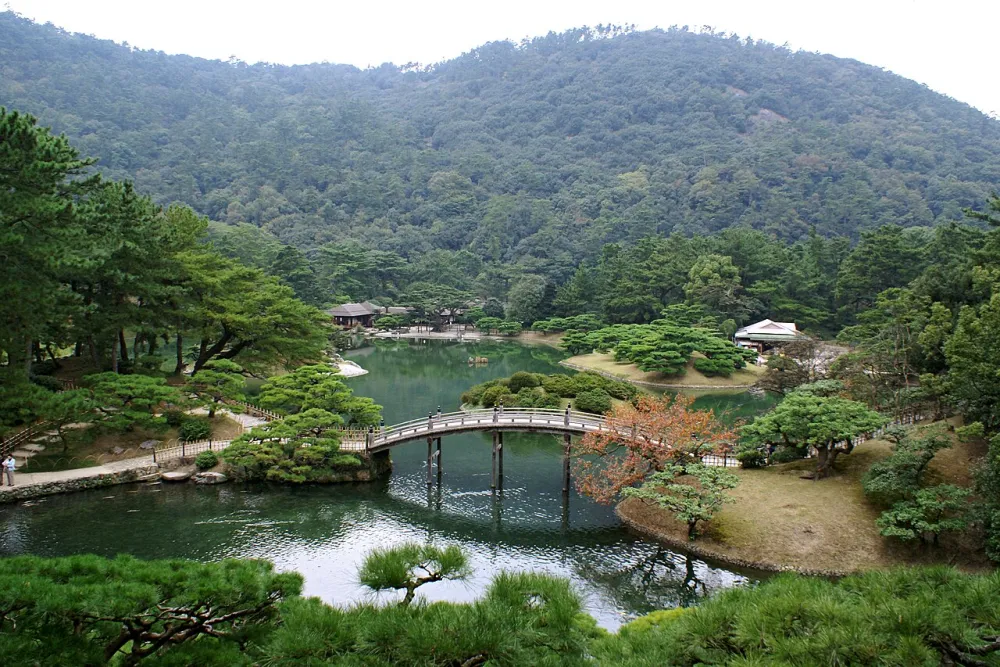
South Pond deserves time on a first visit. From one shore you see islands and pines; another path reveals the relationship between teahouse, bridge and Mount Shiun behind. The curve of Engetsukyo Bridge is an easy landmark. Rather than standing on the bridge for long, cross it and look back at how it joins the banks. Autumn is a combination of pines, maples and water, so you need not chase red leaves all the way.
For a view down over South Pond and Engetsukyo, choose Hiraiho. This artificial-hill viewpoint adds slopes and climbing. Companions with strollers, wheelchairs or sore knees can stay by the pond while others make a short climb and return to the same spot. A plan for one panorama and one close pond view gives everyone more room to see the garden in their own way than a goal of covering everything.
After the panorama, leave time to walk beside the water without searching for another angle. Close up, you can see pine pruning, stone placement and the teahouse’s distance from the pond. If a boat passes, wait and watch how the surface changes. Reflections move with wind and boats; photography need not become a fixed checklist. Companions who do not take pictures can use these minutes to rest.
For both day and evening views in foliage season, finish climbs and paths needing clear footing during daylight. Save evening time for the illuminated route and water. The stretch from South Pond toward Fugan suits watching the canopy, but stay out of closed side paths when seeking an empty view. Follow the event’s evening route. Saved daytime locations help orientation rather than justifying walking against the route.
Kagawa Prefecture’s 360-degree Ritsurin film lets you drag the view in your browser to look around the garden.
At Kikugetsu-tei, adult matcha is ¥800 and sencha ¥600 in 2026
Kikugetsu-tei is a place to stop the garden walk properly. Look at the building’s relationship with South Pond before deciding to enter. Once seated, lower your viewpoint and see how doorframes and eaves define different garden views. Its value lies in spending time there. If a boat is reserved, tea after check-in and the ride lets you sit without watching the clock.
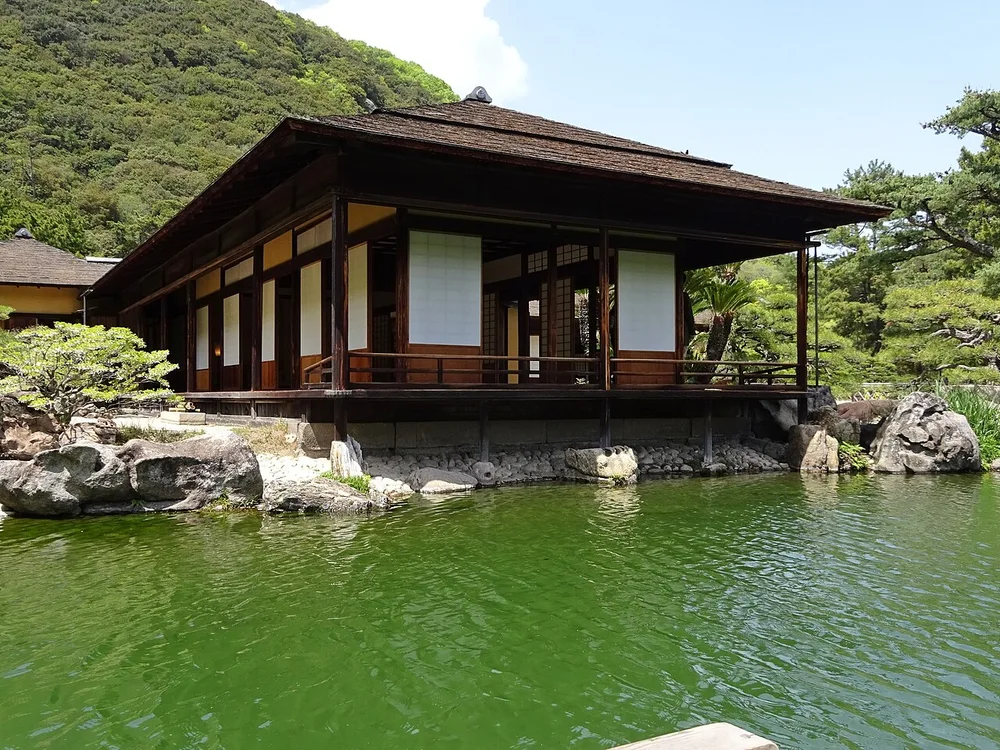
The April 2026 notice from Ryotei Nicho, operating on behalf of Kagawa Prefecture, lists matcha with sweets at ¥800 for adults or ¥500 for elementary and junior high school students. Sencha with sweets is ¥600 or ¥400 respectively. Regular hours are 9:00–16:30, with last entry at 16:00; garden admission is separate. Choose matcha for a stronger tea flavor or sencha for a lower-cost seated break. Family members can choose by taste.
The teahouse is not a regular lunch restaurant. Nicho separately offers reserved lunches in spring, March–June, and autumn, September–November, served 11:00–15:00. The website lists a seasonal bento with matcha and sweets for ¥3,500, or a tenmaki bento with matcha and sweets for ¥3,000. Book by phone or online by the previous morning; from 12:00 to 17:00 the day before, use the phone. If lunch is the main activity, arrange the walk around it rather than adding another udon queue after leaving.
Distinguish Higurashi-tei, Old Higurashi-tei and Hanazono-tei
Higurashi-tei and Old Higurashi-tei are different buildings. Higurashi-tei is a thatched tea room built in 1898. Nicho lists weekend and holiday hours of 10:00–16:00, with last entry at 15:30. Matcha with sweets costs ¥700, with cold desserts and drinks also available. On weekdays, Kikugetsu-tei is easier as the main tea stop. On weekends, choose by architecture and route. Old Higurashi-tei is principally for viewing the historic building; the similar names do not mean the same meal venue.
Hanazono-tei is a separate dining facility. Its official information places it about 50 meters south along the pine avenue from the east-gate ticket office. Breakfast porridge, lunch and dinner have their own booking arrangements. For dessert before leaving, choose from that day’s café service. Decide whether you need tea, breakfast or a main meal before finding the correct business, so you do not ask Kikugetsu-tei about Hanazono-tei seating.
A two-hour garden walk is easiest to manage with one seated stop. After a reserved porridge breakfast, you can skip a second tea service following South Pond. For an afternoon arrival, see sunlit pond paths first, then enter Kikugetsu-tei before last admission. Each business’s final reception is earlier than garden closing. Recording “last teahouse entry 16:00” helps choose the afternoon route more than knowing only the November garden closing time of 17:00.
Book breakfast porridge by 17:00 the day before; choose chair or floor seating
For an early Takamatsu garden visit, book breakfast porridge at Hanazono-tei. The official menu lists 7:15, 8:00, 8:45 and 9:30 slots, with last porridge orders at 9:30. Reserve by 17:00 the previous day; solo bookings are accepted. In November, a 7:15 breakfast leaves a short walk after the 6:30 garden opening. For a less hurried start, choose 8:45 or 9:30 and time departure from your accommodation accordingly.
There are two meal and seating choices. Goishicha tea porridge in the main building’s hall costs ¥1,650, with tables and chairs. The special breakfast set in the separate Hankatei tea room costs ¥2,500, beside North Pond with floor cushions. For sore knees or discomfort sitting on tatami, reserve chairs in the main building. For the pondside tea room, specify Hankatei. These are different breakfasts, and garden admission is extra for both.
With breakfast booked, attend the meal first and decide the full walking direction afterward. With only half an hour beforehand, stay among the east-gate pines and leave South Pond and climbs until after eating. In winter, the garden opens at 7:00, making ticket purchase and walking especially relevant for 7:15 breakfast. Wear socks for tatami dining. Use the restaurant phone for cancellation or party-size changes so food preparation and seating can be adjusted.
Daytime South Pond boats accept ages 3 and over
Daytime traditional boats circle South Pond with a boatman’s commentary. Including boarding and disembarking, the ride takes about 30 minutes, with capacity for six. Operating information lists ¥850 for adults and ¥420 for junior high school age and below, plus garden admission. Children under 3 cannot ride; elementary school children and younger need a guardian. Preschoolers aged 3 and over enter the garden free but still pay the child boat fare, so calculate the two separately. Anyone not riding can walk the bank and meet at the landing.
Reservations open on the first day of the preceding month and remain available until the day before. The daytime number is 087-833-7413, accepted 8:30–17:00, with an official online booking option too. No same-day phone or online reservations are accepted. Go to the boat ticket office for remaining places; same-day tickets go on sale at 8:30 until sold out. Reserve if the boat is your main activity. For a spontaneous visit, accept that a suitable slot may be unavailable.
Reserved passengers must pay and collect tickets at the boat ticket office 30 minutes before departure. Miss that deadline and the reservation expires. Write “10:30 ticket collection, 11:00 sailing” in the plan rather than arriving at the east gate at 11:00. Collect tickets, then walk nearby or use the toilet. Rushing back from a distant teahouse turns a relaxed boat ride into a deadline chase.
A boat offers another garden viewpoint, and you can give it time instead of completing every walking path. If an older adult has difficulty boarding, explain the assistance needed to staff. Companions should not pull at the boat edge or rush aboard. If rain or strong wind affects operation, walk open pondside paths instead. One adult can ask about conditions while another watches the children, reducing distraction beside the boat.
Use the north garden for Fuyoho and Gun-o-chi after the south
After seeing enough of the south garden, decide whether to continue north. From Fuyoho, look toward North Pond and the red Bairin Bridge against the pines. This is a different viewpoint from Hiraiho above South Pond. To compare garden viewpoints, you can climb both; with limited stamina, choose one and view the other pond from ground level. Picking the composition you most want makes a family route easier than requiring both climbs.
Continue toward Gun-o-chi and Kankakukaku for a more open feeling than the south garden. Kagawa’s official feature explains that this was a duck-hunting area. The water suits bird watching, especially as a winter activity. With children, first find where the birds gather, then compare how they swim. Observe from the paths without chasing, catching or entering pondside vegetation.
After the north garden, leave by the north gate for JR Ritsurinkoen-Kitaguchi. With luggage at the east gate, follow the map back east instead. Finish any south-garden teahouse stop before heading toward Gun-o-chi and the north gate.
Fit craft museums and Ritsurinan into your exit route
After the outdoor scenery, the Sanuki Folk Craft Museum offers an indoor stop near the east gate. Kagawa’s official feature describes folk crafts, the roof-tile hall and the old folk-craft hall, with free entry. Shoko Shoreikan has garden- and craft-related exhibitions. Choose according to your interest in objects or buildings rather than entering every hall on a first visit. If rain increases slightly, a short visit to one is easier than changing transport to another district.
For Kagawa foods and gifts, Ritsurinan is outside the garden beside the east gate. Its official access page states that no garden ticket is needed to shop. Shoppers can go directly; garden visitors can buy after leaving to avoid carrying purchases throughout the walk. Check room-temperature or chilled storage, best-before dates and onward travel. With a train or boat still ahead, choose items that pack easily.
For exhibitions and shopping, visit indoor garden halls during the day, then leave east for Ritsurinan. If bags are at the north gate, collect them there first. Keep exhibitions and shops in the daytime plan, leaving evening illumination for garden views.
Autumn 2026 illumination runs November 20–29, 17:00–21:00
Kagawa Prefecture’s autumn 2026 notice lists ten days of illumination, from Friday, November 20 through Sunday, November 29. The September 28 evening-boat announcement gives 17:00–21:00, with last garden entry at 20:30. These are special autumn evening hours; regular November opening remains 6:30–17:00. Choose one of those ten dates for night views. Daytime-only visits follow ordinary admission and hours.
For a first illumination visit, arrive before full darkness. Identify the east gate, main south-garden path and toilets, then follow that event’s lit route. Lighting directs attention differently across the water, pines and bridges seen in daylight. There is no need to repeat the whole daytime circuit. Complete slopes and viewpoints needing clear footing in daylight, and focus at night on pond edges and bridges along the open route.
With older adults or children, eat before entry or visit early in the evening and return downtown for dinner. The 20:30 last-entry time is too late to start a leisurely family walk. Closing at 21:00 still leaves the exit walk and journey back to accommodation. With an evening boat reserved, arrange the night around ticket collection and sailing, fitting tea and dinner into compatible times.
When stopping for photographs, keep paths and bridges clear and put your phone away before moving. If companions split up for pictures, meet at the next named junction, away from the pond edge. Leave through the east gate for city transport.
Evening boat booking opens November 1 at 13:00; preschoolers cannot ride
Reservations for the autumn 2026 South Pond evening boats open Sunday, November 1 at 13:00, online or on the dedicated number 087-833-7414. On November 1, phone hours are 13:00–17:00; from November 2, they are 8:30–17:00. This differs from the regular daytime number. Prepare the evening date, time and adult and child numbers. Agree on one departure for the family, then have one person book to avoid splitting the party.
Boats leave every 15 minutes from 17:30, with 11 departures ending at 20:00. Adults pay ¥850; elementary and junior high school students pay ¥420, plus garden entry. This year’s evening boats accept elementary school age and above only. Even preschoolers aged 3 or over must use a daytime boat under its own age rules; at night, view from the shore. Two adults and one elementary school child pay ¥1,170 garden admission plus ¥2,120 boat fares, totaling ¥3,290. A daytime boat is more suitable for preschool families.
A 17:30 or 17:45 ride puts the boat early in the evening, leaving a slow walk toward the exit and dinner near your stay afterward. For a departure after 19:00, eat first. After disembarking from the final 20:00 boat, little time remains for a full garden walk; make the water view the evening’s focus. Avoid booking a late dinner while also filling the night with the boat, tea and the entire illuminated route.
Save the confirmation screen, booking name and contact details, and add its ticket-collection deadline to your calendar. If the party changes or cannot come, change or cancel through the booking channel rather than having another companion hold a second booking. Treat the limited boat slot as the fixed activity and fit the rest of the garden around it.
Two half-day routes: morning tea or afternoon into evening
For daytime garden and tea, an example starts at the east gate at 9:00. See the pines and south garden, reach South Pond around 10:00, choose the shore or Hiraiho, then sit at Kikugetsu-tei. Return toward the east gate around 11:30 for shopping and lunch outside. These are suggested time allowances. For long photography stops, skip the north garden. For birds, skip tea and give the latter part to Gun-o-chi, then leave north.
For a boat-centered visit, choose a departure and its 30-minute-ahead ticket collection first. Split the 9:00–11:30 walk into time before collection, before departure and after the ride. For an 11:00 daytime boat, complete payment at 10:30 and stay nearby, then go to Kikugetsu-tei after landing so tea is unhurried. A porridge breakfast works the opposite way: eat at your reserved time, then start the full south-garden walk. There is no need to combine both versions in one morning.
For autumn evenings, arrive around 14:30, walk the south garden and Hiraiho, and enter Kikugetsu-tei before its 16:00 last admission if desired. Wait for lighting at 17:00. Have a late lunch before entry and bring a simple, easy-to-eat meal to keep the evening in the garden. With a 17:30 boat, leave separate time for ticket collection and assembly. For a restaurant dinner, choose an early night-view visit, then return downtown to eat.
With young children, older adults or family who feel the cold, choose either the morning or early-evening version. Daytime tea and night views are both attractive, but there can be a long wait between them. If staying nearby, split them over two days to conserve energy. On an intercity arrival day with uncertain timing, reserve night views for an evening when you are already staying in Takamatsu.
Families and visitors with mobility needs can see the main garden without hill climbs
Ritsurin has gravel, slopes and changes in level. Operating information offers free loans of wheelchairs, strollers and walking support carts at admission ticket offices. The map marks some difficult routes. Start at the ticket office if you need equipment, ask staff to indicate a suitable route, then enter the south garden. Make pond edges, pines and teahouses the main route, adding Hiraiho and other climbs only if suitable. The main garden remains visible without them.
For young children, alternate a stretch of walking, one viewing target and a seated break. Find the direction of pine branches, then bridges and boats on South Pond, then birds in the north, followed by snacks or rest. Running, jogging and bringing balls or play equipment are prohibited under the cultural-property garden’s rules. Plan active play elsewhere and stay together on the permitted paths inside.
Nursing spaces can be requested at Shoko Shoreikan’s east building, the Kobusha toilets and the tourism office. Mark them on entry, and handle changing and toilet needs before walking far. Ordinary pets cannot enter; assistance dogs are excepted. Arrange pet care beforehand. For older adults, consider teahouse seating before the drink choice: breakfast at a table and tea on tatami require different physical effort.
Add admission, tea and boat fares separately
Regular admission is ¥500 for adults, ¥170 for elementary and junior high school students, and free for preschoolers. Groups of 20 or more pay ¥400 for adults and ¥140 for children. Entry is free on New Year’s Day and March 16, the garden’s opening anniversary. Short-stay visitors can calculate single entry first, comparing multiple-entry or annual tickets only for repeated visits. Local free admission for ages 65 and over has conditions such as Kagawa residency. Overseas visitors should not budget it based on age alone.
One adult pays ¥500 for a garden walk, ¥1,100 including Kikugetsu-tei sencha and sweets, or ¥1,300 with matcha. Adding one boat ride makes those tea combinations ¥1,950 and ¥2,150. Two adults and one elementary school child pay ¥1,170 for garden entry. Matcha for all three adds ¥2,100, totaling ¥3,270. Transport and lunch are extra. Add only the activities you want to keep the family budget clear.
For breakfast, one adult’s main-building porridge at ¥1,650 plus ¥500 admission totals ¥2,150. Hankatei’s ¥2,500 special breakfast plus entry totals ¥3,000. A seated breakfast can replace accommodation breakfast and tea instead of adding all three. If autumn scenery is the main aim, admission and walking time are enough; you need not buy a full activity package to enjoy it.
Store bags at your return gate; parking is charged per 25 minutes
Store suitcases at your hotel or entrance lockers before walking the gravel paths. Dragging them adds resistance and makes yielding on narrow paths harder. Operating information lists 30 lockers beside the east gate and six beside the north, costing ¥200, ¥300 or ¥400 by size. For oversized bags or full lockers, paid storage at the tourism office is ¥400 per item. On a one-way route, consider collection first. Bags at the east gate mean finishing there.
Drivers can use the prefectural east-gate or north-gate-front car parks. Ordinary cars cost ¥100 per 25 minutes. For a two-hour estimate, 120 minutes uses five billing units, so allow ¥500. Tea, bag collection and shopping count toward parking time too. Listed capacity is 30 ordinary cars east and 32 north; these small lots do not reserve space for autumn evening crowds. From central accommodation, public transport reduces parking arrangements on lighting days.
Check parking use separately from evening event access. After parking, note the entrance, space and exit route before entering the garden. Operating information also says regular overnight parking has separate charges and no nighttime vehicle access, requiring advance contact with the tourism office. If driving away that evening, choose parking compatible with your actual exit time. Leave shop parking for customers and use another legal lot when full, rather than waiting on the road to hold a space.
Adjust the walk for the month and weather, while keeping time for pines and water
October hours are 6:00–17:30, November 6:30–17:00, and December–January 7:00–17:00; spring and summer open earlier and close later. In autumn, the issue is how much uninterrupted garden time shorter daylight permits. Mornings suit slow walks and tea. In the afternoon, start with the South Pond view you most want rather than saving every side route for closing time. Illumination takes place on specific dates, separately from ordinary daytime hours.
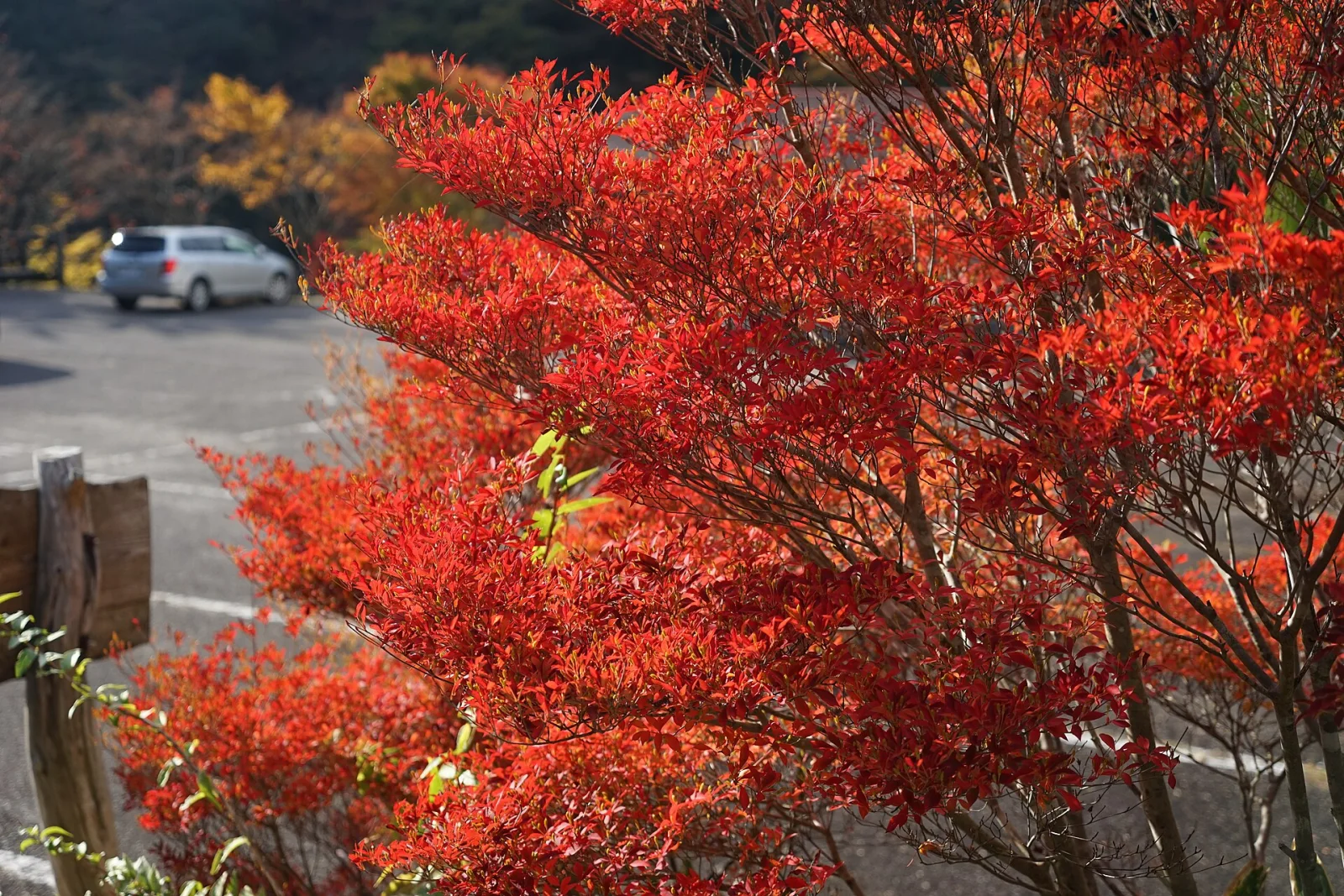
Autumn leaves bring depth to South Pond, teahouses and Fugan, while pines and Mount Shiun remain the garden’s background. On arrival, notice which color and light attract you most before deciding how long to stop. After the main view, leave time simply to walk beside the pond. On days without widespread color, look at branch shapes, water and stonework to see the differences between south and north.
In light rain, shorten hills and stairs and keep pond paths, teahouses and available exhibition halls. Keep the path visible below your umbrella and yield on narrow stretches. The garden closes temporarily when a storm or blizzard warning is issued for the Takamatsu area. Stay near your accommodation then and handle reserved activities separately. Before a flight, return to the luggage-collection and airport-bus route, ending the garden visit while there is still time for a calm journey.
A few useful answers
Does Ritsurin Garden have a south gate? Where should a first-time visitor enter?
For regular visits, identify the east and north gates; south and north gardens are areas inside. Kotoden Ritsurinkoen Station and Ritsurin Koen-mae bus stop suit the east gate. JR Ritsurinkoen-Kitaguchi suits the north gate during daytime.
How do I arrange the 2026 autumn illumination and evening boat?
Lighting runs November 20–29, 17:00–21:00, with last entry at 20:30. Evening boat bookings open November 1 at 13:00 online or on 087-833-7414. Boats depart every 15 minutes from 17:30, with the final departure at 20:00.
Can young children ride Ritsurin Garden’s boats?
Daytime boats exclude under-3s, and elementary school children and younger need a guardian. The 2026 autumn evening boats accept elementary school age and above only. Preschoolers can use daytime rides according to age, then enjoy night views from the shore.
Do I need a Takamatsu transport pass just for Ritsurin Garden?
First add the one-way fares between your accommodation and the garden. For that return trip alone, use regular tickets or an existing IC card. Compare a relevant pass if also taking Kotoden elsewhere.
Official information and references
Sources used in this guide.
- Takamatsu City: Ritsurin’s cultural-property status and south and north gardens
- Ritsurin Garden operations: hours, admission, boats, access and facilities
- Kagawa Prefecture: autumn 2026 illumination dates
- Kagawa Prefecture: autumn 2026 South Pond evening boat bookings and age rules
- Ryotei Nicho: Kikugetsu-tei, Higurashi-tei and lunch in 2026
- Hanazono-tei: porridge breakfast, Hankatei and bookings
- Takamatsu Airport: bus times and fares from October 2026
- Kotoden Bus: current airport-bus fares by stop
- Official Kagawa feature: Ritsurin teahouses, South Pond and north garden
- Ritsurinan: access, location outside the garden and shop entry
- Kagawa Prefecture: official Ritsurin information and notices