Choose Katsurazaka, Mayumizaka or Kodatsuno Gate for a Kenrokuen route through Kasumigaike, Hisagoike, the winding stream and Yamazakiyama. Plan admission, free early entry, 2026 autumn illuminations and a half-day with Kanazawa Castle.
- Region & Focus
- Kanazawa
- Reading Scope
- 35 min read · 17 chapters · 4 Q&As
- Official Verification
- 11 official sources checkedUpdated October 26, 2026
- Key Topics
- SeasonsItinerariesFirst trip
Chapter Route Map (tap any stop)
- Choose a main route: ponds, waterways or seasonal paths
- Choose an entrance using your bus stop and next destination
- Admission: adults, children and the castle combination ticket
- Early morning and daytime: leave before regular opening begins
- Kasumigaike: see the lantern, pine and shoreline from different angles
- Hisagoike, a waterfall and a fountain: a different pace in the lower garden
- The winding stream and Hanamibashi: continue toward Yamazakiyama in flower season
- Spring: plan separately for plum blossoms and cherry blossoms
- May and summer: streamside flowers, Hisagoike and tea breaks
- Autumn by day: Yamazakiyama, pond shores and the 2026 yukitsuri schedule
- Winter: see ropes and tree shapes, and finish an easy return route first
- Shiguretei or a teahouse: a seated garden visit with a midday closure
- Wheelchairs, strollers and older companions: count the slope to the gate too
- Continue to Kanazawa Castle: cross Ishikawa Bridge and choose outdoors or turrets
- Plan a half-day around one garden route and one castle theme
- Autumn nights in 2026: seven November dates and a separate entry map
- After the illumination: separate night-bus dates and daytime tickets
- Quick Q&A
For a first Kenrokuen visit, make Kasumigaike Pond your main circuit, then add Hisagoike, the winding stream or Yamazakiyama according to the season. Allow a half-day for the garden and castle area if you also want Kanazawa Castle’s wooden turret interiors. Your entrance shapes the route: Katsurazaka connects bus arrivals from the station with Ishikawamon; Mayumizaka works from Hirosaka and downtown; Kodatsuno offers a more level start. Free early-morning entry, paid daytime hours and designated night illuminations each have separate entry and exit arrangements.
Choose a main route: ponds, waterways or seasonal paths
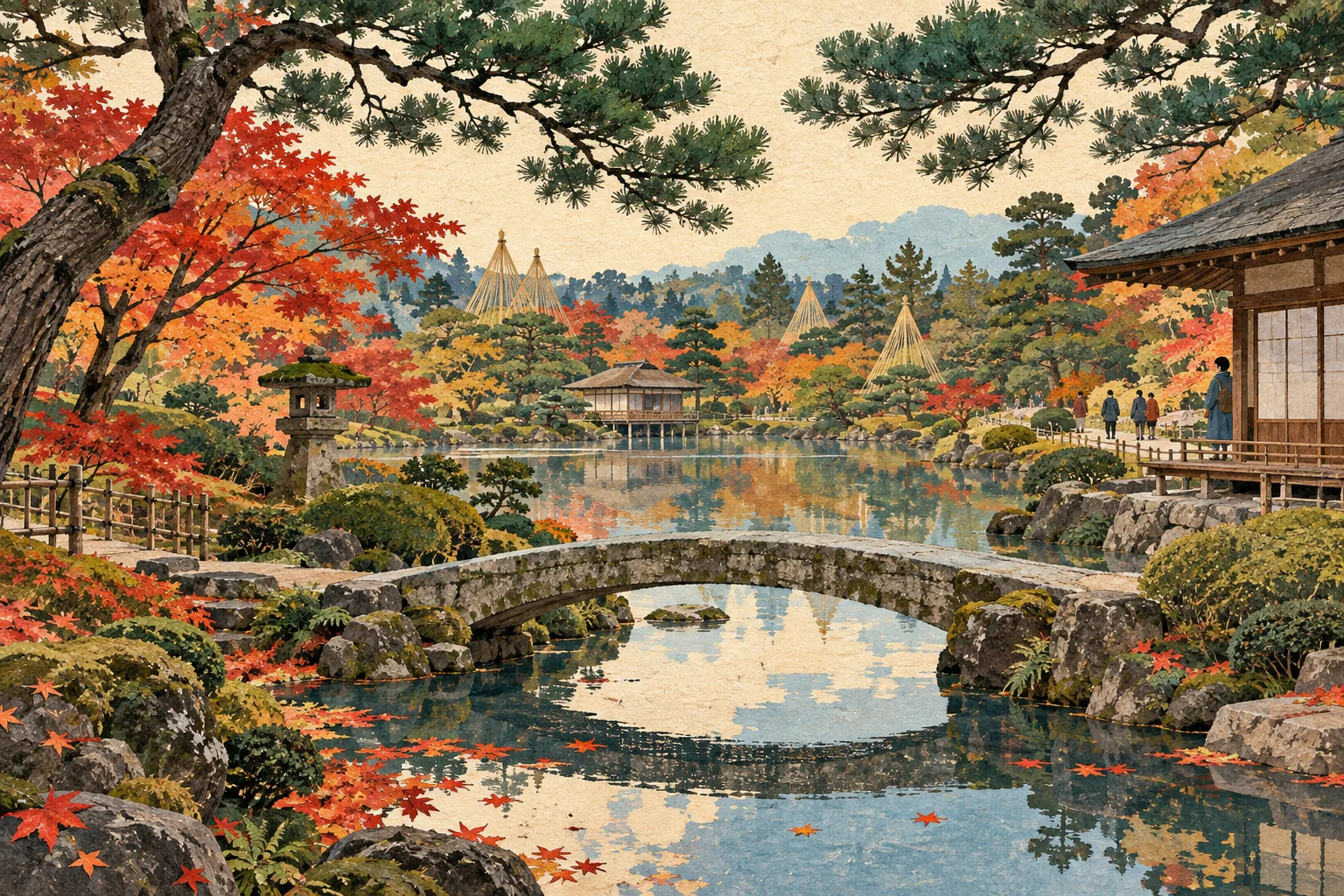
Kenrokuen is a stroll garden, designed to be seen from changing angles as you move through it. Instead of memorizing more than 20 names, decide what you want to see today. A route around Kasumigaike Pond connects Kotojitoro Lantern, Karasaki Pine, Gankobashi Bridge and Uchihashitei. Downhill toward Hisagoike Pond, you find water sounds, a waterfall and the early garden. Toward Hanamibashi Bridge and Yamazakiyama, follow flowers and autumn leaves along the winding stream. Treat each direction as a separate stretch. Finish one before adding another to keep time for looking.
The management’s level route is about 500 meters, with a standard time of 30 minutes. The fuller route is about 1,300 meters and 90 minutes. These figures cover movement within the garden. Add the climb from the bus stop, tickets, photo queues, tea and visits to nearby buildings. With only an hour, choose the main pond route. With two hours and an interest in gardens, add one seasonal area and a rest.
You can enter and leave by different gates. If Kanazawa Castle is next, finish near Katsurazaka or Renchimon. For Hirosaka, end around Hisagoike or Shiguretei. Forcing a circular route back to its starting point often repeats a path you have already seen. For accommodation, intercity transport and teahouse districts in a fuller trip, see the two-day Kanazawa guide.
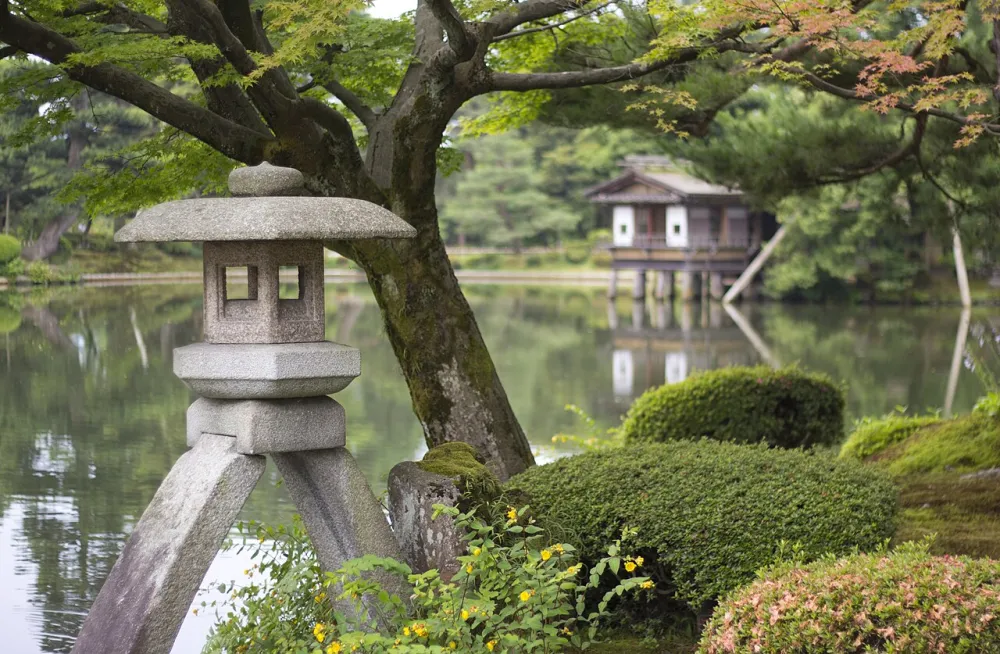
Choose Katsurazaka, Mayumizaka or Kodatsuno Gate for a Kenrokuen route through Kasumigaike, Hisagoike, the winding stream and Yamazakiyama. Plan admission, free early entry, 2026 autumn illuminations and a half-day with Kanazawa Castle.
Choose an entrance using your bus stop and next destination
From Kanazawa Station, the official Kenrokuen access page lists two straightforward approaches. Get off at Kenrokuen-shita/Kanazawa Castle for Katsurazaka Gate and Ishikawamon, or at Hirosaka/21st Century Museum for Mayumizaka Gate. Both walks from the bus stop are listed at about five minutes. Bus journeys are about 12 minutes for the former and ten for the latter. Traffic at busy times adds to the journey.
Katsurazaka Gate suits first-time visitors who want to reach Kotojitoro Lantern and Kasumigaike Pond quickly. It is also convenient from the castle across Ishikawa Bridge. Head for the main pond after entering, then walk clockwise around it. A short version is easy from here if some companions only want the classic views. The approach from the road still slopes uphill, so plan wheelchair or stroller visits from the Kodatsuno side instead.
Mayumizaka Gate faces Hirosaka and connects downtown, museums and the garden. From here, see Hisagoike’s waterside scenery first, then climb toward Kasumigaike. In the opposite direction, leave the pond via Mayumizaka for Hirosaka. Coming from Korinbo, check which side of the garden you are already on rather than going around to Kenrokuen-shita to find an entrance.
Kodatsuno Gate is near Yamazakiyama and the winding stream. The official information specifically identifies the area around this ticket gate as relatively level. Start here for spring flowers, autumn leaves or companions who should avoid an immediate climb. Renchimon Gate is by the teahouse street and is also used for early-morning and autumn night openings. Check the separate opening map for mornings, ordinary daytime visits and night events; one gate name does not apply throughout the day.
Admission: adults, children and the castle combination ticket
Standard individual admission is ¥320 for ages 18 and over and ¥100 from age six to under 18. Groups of at least 30 paying visitors have rates of ¥250 for adults and ¥80 for children. Visitors aged 65 and over enter free with an official document proving age; overseas visitors can bring a passport. Disability exemptions require a specified certificate, such as a physical disability, mental disability health and welfare, or rehabilitation certificate. The holder and one caregiver enter free. Present documents at the counter before buying tickets, and calculate eligibility separately for each family member. Counters accept cash, credit cards and listed transit e-money services. See the official visitor information for current fees and the complete payment list.
If you also plan to enter Kanazawa Castle’s Hishi Yagura, Gojikken Nagaya, Hashizumemon Tsuzuki Yagura and Hashizumemon, compare the Kenrokuen Plus One ticket. The current individual price is ¥500, covering Kenrokuen and one designated cultural facility. Against two separate standard adult admissions of ¥320, it saves ¥140. The combined ticket is valid for two days; admission to each facility is valid only on the day it is used. Special exhibitions and additional charges follow the ticket’s scope. Garden walks, turret interiors and museums are different kinds of stops. Choose the cultural facility you actually want before buying the combination.
If you only plan to walk through Kanazawa Castle’s outdoor park, buy a Kenrokuen single ticket. If you only visit Kenrokuen on a free autumn evening, you do not need an extra daytime ticket. Calculate separate tickets or free entry first for children and companions aged 65 and over. The adult combination saving does not automatically apply to the whole family. The Ishikawa Prefecture combination-ticket page lists current coverage and facility closure information. Buy at the counters of participating facilities.
Early morning and daytime: leave before regular opening begins
Regular Kenrokuen hours are 7:00–18:00 from March 1 through October 15, with last admission at 17:30. From October 16 through the end of February, hours are 8:00–17:00, with last admission at 16:30. For an autumn or winter afternoon arrival, set your departure time first. Entry at 16:30 leaves only half an hour before closing at 17:00, suitable for a very short stretch rather than a full garden route.
Free early-morning entry uses only Renchimon and Zuishinzaka Gate. It starts at 5:00 in March, 4:00 from April through August, 5:00 in September and October, and 6:00 from November through the end of February. You must leave by 6:45 from March 1 through October 15, or by 7:45 from October 16 through the end of February. The tourism association also gives last early entry as 15 minutes before the required exit time. To continue visiting during regular hours, leave after your early walk and re-enter under the ordinary admission procedure.
Early morning works best if you stay downtown and can walk or have transport arranged. Before bus services, teahouses and Shiguretei open, treat it as a garden walk alone. If you want tea, a guided explanation or a fuller visit to the areas, regular opening hours are simpler.
For Culture Day on November 3, 2026, the management has announced free daytime entry from 8:00 to 17:00. This is separate from the seven November autumn illumination evenings. Free cherry-blossom days are announced according to that year’s bloom. For a trip the following year, use regular hours first, then adjust once that year’s event notices are published.
Kasumigaike: see the lantern, pine and shoreline from different angles
Kasumigaike Pond is the garden’s largest pond and the easiest central landmark on a first visit. From Katsurazaka, start around Kotojitoro Lantern. Look at how its two stone legs meet the shore, then continue toward Karasaki Pine. Nijibashi Bridge in front of the lantern lets you frame a person, the lantern and water together, but it is also a passage. Take your set of photos and move on. Other shore angles are worth stopping for too.
The branches of Karasaki Pine spread toward the water. Approaching from the lantern and looking back from the opposite shore reveal different shapes. Continue around the pond and choose views among trees, the island and buildings across the water. Horaijima island, shoreline pines and stone arrangements form the main composition. Half a circuit already lets you compare near and distant layers.
On the southwest shore, Uchihashitei rests on stone supports at the water’s edge. From outside, look at the junction between building and pond. Nearby Sazaeyama is an artificial hill with a spiraling ascent that changes your viewing height. Add the climb if you have time and the ground is dry and secure. To reduce changes in level, stay on the main pond paths.
Gankobashi Bridge on the east side consists of a line of stone slabs, named for geese flying in formation. It is closed to foot traffic to protect the stones; view it from the garden path. Compare it with the wooden Hanamibashi Bridge, which can be crossed. At one, study the slab pattern and waterside composition; at the other, stand above the winding stream. They serve different purposes in the route.
Watch the management’s short film to see the scenery around Kasumigaike, then decide whether to take a slow pondside walk or continue to other garden areas.
Hisagoike, a waterfall and a fountain: a different pace in the lower garden
Hisagoike Pond lies at a different level from Kasumigaike. Its shoreline is more enclosed, bringing trees and water closer together. This was the early Renchi garden. Look at the narrowing in the middle of the pond, then walk opposite the waterfall to understand how it differs from the openness of the main pond. If you have photographed Kotojitoro and are about to leave with time remaining, this is often the best short addition.
Midoritaki Waterfall carries water from Kasumigaike into Hisagoike. Approaching along the path, you hear it before seeing the drop. Changing position on the shore changes how branches frame the waterfall and pond. Fresh-green season brings varied leaves and flowing water; autumn adds fallen leaves on the surface. Focus on close layers here. You do not need to step back into other visitors’ route to photograph the whole waterfall.
Across the pond, Yugaotei is a surviving tea pavilion built in 1774. Shiguretei elsewhere in the garden offers paid tea service. Keep the names and functions separate: at Yugaotei, focus on the exterior and surrounding garden, then go to an operating teahouse when you want to sit for a drink.
The nearby fountain uses the height difference from Kasumigaike’s water surface to create natural water pressure. Seeing the upper pond first makes the garden’s water system clearer than photographing the jet alone. You can also enter through Mayumizaka, visit Hisagoike first and climb toward the main pond to experience the change in height in reverse. The route has slopes. With a stroller or wheelchair, follow usable paths on the accessibility map.
The winding stream and Hanamibashi: continue toward Yamazakiyama in flower season
Southeast of the main pond, Hanamibashi Bridge crosses the winding stream and gives views along its banks. Spring cherry blossoms, early-summer irises and azaleas bring seasonal colors. Outside peak bloom, the curves of the water and tree shade still offer a different scale from Kasumigaike.
Nearby Neagari Pine exposes bundles of roots, contrasting with Karasaki Pine’s spreading branches. View the two differently: Karasaki suits a whole-tree view from the shore, while Neagari invites a closer look at the structure between ground and trunk.
Yamazakiyama, near Kodatsuno Gate, is an artificial hill with a concentration of deciduous broadleaf trees, including maples. If autumn color is the main aim, start at Kodatsuno, spend time here, then follow the stream to the main pond. For a general Kenrokuen visit, assess energy near Hanamibashi before adding the hill. Its paths differ from the level pond circuit. In rain or snow, use the lower streamside paths as the main route.
Spring: plan separately for plum blossoms and cherry blossoms
In March, make the plum grove a main stop. The association’s March introduction points to the plum grove and Shiguretei side, combining blossoms, paths and tea. Entering or leaving from the Zuishinzaka or Kodatsuno side keeps time around the grove. From Katsurazaka, circle the main pond first, then follow paths toward it. Snow can remain in March. If plum blossoms and snow appear together, spend time with the scene before you rather than doubling back in search of a whole grove in full bloom.
For April cherry blossoms, start around Mayumizaka, Katsurazaka and Renchimon-dori, then visit the main pond. These places combine slopes, stone walls and cherry trees, unlike the close view of fallen petals along the stream. To include the castle, see blossoms near Ishikawamon before entering the garden. If plants matter more that day, shorten the castle park to Ishikawamon and Sannomaru and leave longer in the garden.
The late-flowering Kenrokuen Kikuzakura is another target. Management’s garden introduction gives its usual season as late April to early May. Its dense, chrysanthemum-like petals follow a different schedule from Somei Yoshino cherries. Early April and the end of the month may call for different trees. Use the week’s bloom report and tree labels to choose the plum grove, main pond or Kikuzakura area, rather than planning the whole garden around one “full bloom” date.
Management announces free entry and night openings for cherry-blossom season separately. See flowers from the garden paths by day and eat at teahouses. The association prohibits spreading picnic mats in the garden; free blossom entry does not permit private parties. For families or groups, schedule a seated meal so the garden does not also have to accommodate lunch, naps and everyone waiting for photos.
May and summer: streamside flowers, Hisagoike and tea breaks
In May, turn to fresh leaves, azaleas and waterside irises. The association’s May viewing page recommends Midoritaki and Hanamibashi. Build a route from Hisagoike’s water scenery to the main pond and winding stream. If you want both banks around Hanamibashi, put that stretch in the first half rather than finding it is lunchtime after the main pond. You do not need the same complete pond circuit every visit. Start where the seasonal interest is.
In June rain, moss, leaves and stream details can be clearer than distant views. If rain is light and the garden remains open, shorten the walk to one waterside stretch, then rest. Hisagoike, already full of water sounds, also suits a pause by the waterfall. Yamazakiyama has fresh-green interest too, but the main paths offer layers of green when hill paths are slippery. Umbrellas can block narrow bridges; stop in wider areas beside them.
To avoid summer heat, take an early walk, then return to your accommodation or downtown for breakfast. For tea or building visits, arrive after regular opening, walk first and rest at Shiguretei or a teahouse. You can see part of the garden in the morning, then buy admission for another visit in the afternoon; choose a different area on the second route. Splitting outdoor time is more practical than pushing through every corner during the hottest hours.
Autumn by day: Yamazakiyama, pond shores and the 2026 yukitsuri schedule
There are two approaches to autumn scenery. Kasumigaike and Hisagoike combine leaf colors, water and pines; Yamazakiyama concentrates maples and other deciduous trees. The ponds reward changing angles along their shores, while the hill needs more time for paths and changes in level. If autumn leaves are the main purpose, enter from Kodatsuno, see Yamazakiyama and Hanamibashi first, then Kasumigaike in the afternoon. With companions of limited stamina, the main pond alone combines evergreen pines and seasonal color.
The association’s November viewing page lists Yamazakiyama, Kasumigaike, Hisagoike and the observation point. Leaves beginning to turn, fallen leaves covering the ground and peak color on branches are different scenes; the same path changes over a few days. Choose using the conditions you see. Where leaves have fallen, look at the ground and trunks. Where trees remain green, include water and pines. These choices are easier to use than expecting the entire garden to turn red on one day.
Management has announced this year’s yukitsuri work: it begins at 9:00 on November 1, 2026, with Karasaki Pine planned first. If it rains, work starts on shorter trees, with Karasaki Pine provisionally moved to 8:00 on November 2 and further rain postponements possible. Work across the garden is expected to continue until mid-December. To watch gardeners install the ropes, include it in a daytime visit during this period. Stay in open visitor areas and keep work routes clear.
Yukitsuri supports branches with ropes to prevent breakage under Hokuriku’s heavy, wet snow. In November, ropes and autumn leaves may appear together. December better suits the finished tree shapes. The first workday and completion across the garden are more than a month apart. Choose the early period for the process or dates after completion for the full, orderly rope outlines.
Winter: see ropes and tree shapes, and finish an easy return route first
Keep Kasumigaike, Karasaki Pine and Kotojitoro Lantern on a winter route. Look first at the relationship between ropes, branches, water and evergreens. Snow changes the outlines of branches and stones; without snow, the yukitsuri lines can be clearer. The association’s December page also introduces camellias and remaining late-autumn leaves.
Winter opening ends at 17:00. Concentrate outdoor walking in daylight, then add tea or a castle building. From Katsurazaka, circle the main pond and return toward the castle. From Kodatsuno, follow the more level route to the pond, then decide from the ground conditions whether to return or use another exit. Wear shoes with soles suited to wet paths and slush. For strollers, wheelchairs or anyone who cannot stand for long, mark slopes, rest points and the return gate before setting out.
If management closes a path, follow the alternative on site. Bus-stop waiting is outdoors too, so leave earlier as well when shortening the walk.
Shiguretei or a teahouse: a seated garden visit with a midday closure
Shiguretei suits visitors who want to sit and view another small garden. Current management information lists opening from 9:00 to 16:30, with last reception at 16:00, and no admission during cleaning from 12:00 to 13:00. It closes December 29–January 3 and may suspend general admission for private bookings. Tea service costs an additional ¥1,000 for matcha with an original fresh Japanese sweet, or ¥500 for sencha with a Japanese sweet. This is tea service and garden viewing; the venue does not offer a tea-preparation ceremony experience.
If you see the main pond and stream first and reach Shiguretei around noon, you may arrive during the cleaning closure. For a half-day visit, arrive around 11:00 or eat lunch first and come after 13:00. Hase Pond and the indoor view differ from walking around Kasumigaike. For limited stamina, this is also a reason to turn continuous walking into seated viewing.
For a meal, choose a teahouse inside or outside the garden. Check whether it serves tea, sweets or full meals and align the location with your exit. The 2026 autumn evening event also offers a special Kenrokutei meal with nigiri sushi, soup and one drink, currently ¥3,800. It starts at 18:15 and can be used until 19:30, with reservations required by the previous day. Shorten the night walk if choosing it. It overlaps the 18:15 performance, so choose between the two.
Use teahouses for food; do not spread a mat for a meal on lawns or beside paths. Families can eat before entering and leave only a short tea break inside. If garden views and Japanese sweets are a priority, make Shiguretei the focus and plan the paths around reaching tea on time.
Wheelchairs, strollers and older companions: count the slope to the gate too
Free wheelchair loans are available at four ticket gates: Katsurazaka, Renchimon, Kodatsuno and Zuishinzaka. The Kodatsuno area is relatively level. Choose your entrance first, then use the official level route. This saves effort compared with starting at popular Katsurazaka and searching for a shortcut afterward. The level route is still a garden path. Visitors differ in what stone surfaces, gradients and turns they can manage. Before visiting, explain equipment collection, the return gate and assistance arrangements to management.
A more level route can include Kotojitoro Lantern, Karasaki Pine, Gankobashi, Neagari Pine and Hanamibashi, with the exit chosen according to energy. Leave Hisagoike’s changes in level, Yamazakiyama and Sazaeyama for those who want more walking. Everyone need not climb together; arrange to meet on a main path. If also visiting Kanazawa Castle, decide after lunch how far to cross the grounds and which exit to use. This is easier to adjust than filling the day with the garden, turrets and another garden from the start.
With young children, make the walk about small questions: where are this pine’s roots, which way does this water flow, and how do the stone and wooden bridges differ? Stop when they are interested, or finish with one pondside stretch when they are not. There is no need to explain every bloom, historical detail and famous tree at once. Adults should supervise around water, bridges and work areas. Stay off moss and behind cordons. A short route can still make a complete visit. Smoking and pets are prohibited in the garden.
Continue to Kanazawa Castle: cross Ishikawa Bridge and choose outdoors or turrets
The Katsurazaka and Renchimon side of Kenrokuen is near Ishikawamon Gate. Cross the bridge into Kanazawa Castle Park, then walk through Sannomaru to see gates, stone walls and white turret buildings. For a light half-day, go far enough to see the buildings clearly, then head toward an exit for lunch. The outdoor park is free. Stonework patterns, corners and gate layouts already offer a different subject from Kenrokuen.
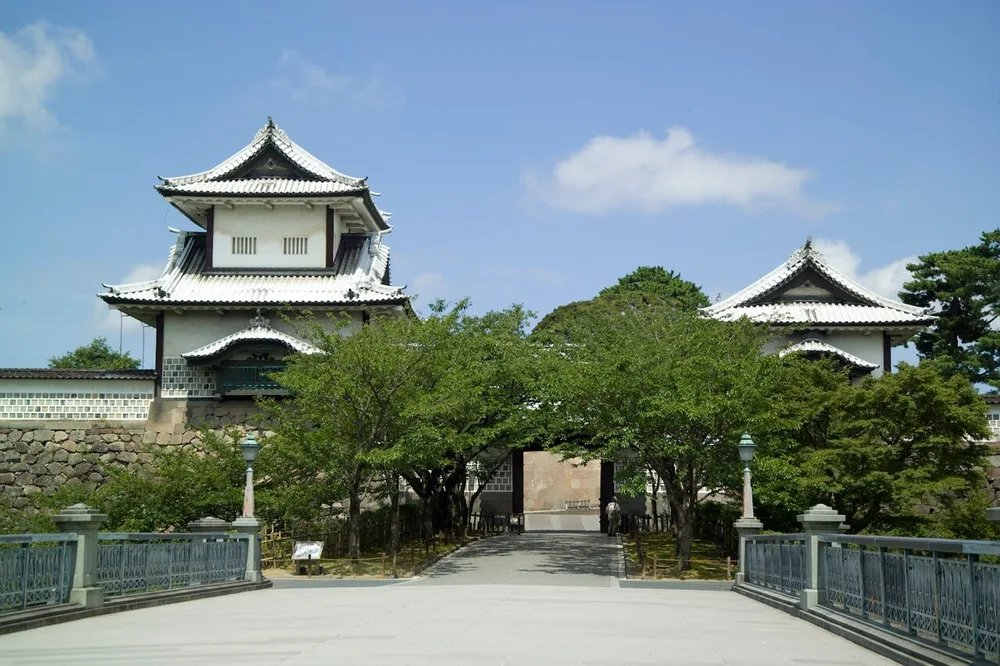
For wooden reconstruction and structure, enter Hishi Yagura, Gojikken Nagaya and Hashizumemon Tsuzuki Yagura. These buildings were reconstructed in 2001, followed by Hashizumemon’s second gate in 2015. Inside are displays on structure, history and traditional building methods. Treat this as one indoor focus for the day. Choose a garden route of about 90 minutes and avoid another lengthy museum stop.
The castle facilities ticket page lists hours of 9:00–16:30, with last entry at 16:00, for this group of buildings. Standard individual admission is ¥320 from age 18 and ¥100 from age six to under 18. The interiors of Kahokumon and Nezumitamon also open 9:00–16:30, with last entry at 16:00, and are free. If you visit the garden first in the afternoon, reach any desired interior before 16:00 and leave outdoor paths for later.
To add another garden, continue to Gyokuseninmaru Garden, then leave toward Nezumitamon Gate and Bridge. Here, a garden beside the castle’s tall stone walls provides a comparison with Kenrokuen’s pond circuit. This extends time in the castle area. If you have already had tea in Kenrokuen and visited the turrets, make Gyokuseninmaru an optional afternoon stop rather than a final compulsory stop squeezed in before lunch.
Plan a half-day around one garden route and one castle theme
A first visit can use 9:00–13:00 as a four-hour example. Enter at Katsurazaka at 9:00, pass Kotojitoro Lantern and Karasaki Pine to the stream, and choose a short stretch around Hanamibashi or Yamazakiyama. Around 10:30, turn toward Hisagoike for water scenery. Leave toward the castle around 11:00 and cross Ishikawa Bridge to Sannomaru. Architecture enthusiasts can enter the turrets; walkers can use outdoor paths, with lunch around 13:00. This is a sample plan. Drop one area to retain the pace when photos, tea or flower-season crowds take longer.
For spring flowers or autumn leaves, start at Kodatsuno with Yamazakiyama, Hanamibashi and the stream, put the main pond in the middle and exit at Katsurazaka for the castle park. If gardens interest you more than castles, give Kenrokuen about two hours and keep the castle to Ishikawamon and Sannomaru. With different preferences, agree to meet at the garden exit after the main pond. One person can visit Yamazakiyama while the other rests at a teahouse.
In rain, visit a castle building that interests you first, then choose a short Kenrokuen walk. See wooden structures and displays after 9:00 and enter the garden if rain eases before noon. If heavy rain continues all morning, move the garden to the afternoon. From October 16 through the end of February, enter by 16:30 and leave by 17:00; from March 1 through October 15, last entry is 17:30 and closing is 18:00. Combination-ticket holders can split use across its two-day validity and give the better weather to outdoor paths, rather than staying in rain to use everything in one day.
With only an afternoon, first decide whether to enter the turrets. For example, see the castle interiors from 13:00 and move to Kenrokuen around 15:00 for a pondside stretch. If you only reach the area near 16:00, complete one side. For a garden priority, enter directly, then see Ishikawamon’s exterior and a short outdoor castle route afterward. On autumn illumination dates, the 17:00 daytime closing leaves time for dinner and the next opening. Return to your hotel for a rest if useful, rather than standing outside the garden throughout.
Autumn nights in 2026: seven November dates and a separate entry map
The November 2026 autumn illumination dates are the 7th, 14th, 15th, 21st, 22nd, 28th and 29th. Opening starts at 18:00, last entry is 20:45 and closing is 21:00. Night admission is free. After daytime closing at 17:00, the garden is temporarily closed for preparation until 18:00. To see both day and night views, finish the daytime garden and castle visit, leave for food or rest, then re-enter through a night entrance at 18:00. Severe weather may cause cancellation or changes.
The official 2026 night-walk map marks Renchimon, Mayumizaka and Kodatsuno entrances and highlights viewing routes. From the Kenrokuen-shita/Kanazawa Castle bus stop, follow the teahouse street to Renchimon. From Hirosaka or Korinbo, Mayumizaka is more direct. From the southeast, use Kodatsuno. Night routes follow open paths; save hill paths and side routes for daytime visits.
Near Kotojitoro Lantern, crowding requires one-way movement. Check the line and arrows before entering, then follow the route toward Karasaki Pine, Kasumigaike and Uchihashitei. Organizers ask visitors not to use tripods in the garden or on bridges. Keep bridge traffic moving. For reflections, make a short stop on a wider shore section. If the popular viewpoint has a long queue, follow other open paths first instead of using the whole evening in one place.
Performances from Uchihashitei carry across Kasumigaike. On November 7, 14, 21 and 28, there are two performances, at 18:15 and 19:00, each about 15 minutes. To listen, reach a suitable pondside spot early; you do not need to enter the pavilion. November 15, 22 and 29 have illuminations but are not listed on the announced performance schedule. For the 19:00 performance, complete part of the walk first, pause beside the pond, then continue toward the exit afterward.
After the illumination: separate night-bus dates and daytime tickets
Under the April 2026 revision, the Kanazawa Light-up Bus runs on Saturdays, with an extra service on November 22, 2026, and no service throughout January 2027. Kenrokuen has illuminations on November 15 and 29, but returns on those nights require another regular bus, walking or a taxi. Check transport for your actual date rather than waiting at closing with a timetable for another night.
The Light-up Bus leaves Kanazawa Station’s East Exit stop 7 from 19:00, about every 20 minutes, with the final station departure at 21:40. To enter at 18:00, use an earlier ordinary bus or walk from downtown. Taking the Light-up Bus after 19:00 means a later garden visit. For the return, find the night-bus stop at Kenrokuen-shita/Kanazawa Castle 1, opposite Ishikawamon. It is a sightseeing loop, so boarding here still takes you around the city.
A single Light-up Bus ride costs ¥300 for adults and ¥150 for children. Its dedicated unlimited ticket is ¥600 for adults and ¥300 for children. Adult means junior high school age and over; child means elementary school age. The dedicated pass is not sold on board. Buy it in advance at designated counters, participating hotels or tourist information offices. The city one-day bus pass is not valid on the Light-up Bus. For one ride back to the station, a single fare is simplest. Separate daytime and night services do not share ticket coverage merely because both are operated by Hokuriku Railroad. If staying around Hirosaka or Korinbo, connect a Mayumizaka exit with the walk to your hotel and save a bus wait.
The daytime Kanazawa Loop Bus has its own timetable. The right loop leaves East Exit stop 7 at Kanazawa Station from 8:30 to 18:00, about every 15 minutes. It suits daytime arrival at the garden. Its final 18:00 station departure is separate from a return after a 21:00 garden exit. If taking a train that evening, choose a bus that gets you to the station first, then work backward to the garden exit. Leave time to collect luggage and find the platform. Avoid tightly connecting the final moments of the night opening with long-distance travel.
A few useful answers
How long should I allow for a first Kenrokuen visit?
Allow about an hour for a short main-pond route, or around two hours with Hisagoike, the winding stream or a seasonal area. Add castle turret interiors, tea and lunch for a half-day in the garden and castle area. The official 500-meter/30-minute and 1,300-meter/90-minute figures refer to routes within the garden.
Can I use Katsurazaka Gate for free early-morning entry?
Early entry uses only Renchimon and Zuishinzaka. From November through the end of February, it starts at 6:00, with last entry at 7:30 and exit required by 7:45. Regular admission rules apply from 8:00. Start and exit times differ in other months.
Are Kenrokuen’s illuminations on every night in November 2026?
Only on November 7, 14, 15, 21, 22, 28 and 29, from 18:00 to 21:00, with last entry at 20:45. Night entry is free. The garden closes for preparation from 17:00 to 18:00; leave and re-enter for the night opening.
Do Kenrokuen and Kanazawa Castle require two tickets?
Kanazawa Castle’s outdoor park is free. For paid buildings such as Hishi Yagura and Gojikken Nagaya, standard adult visitors can compare the ¥500 Kenrokuen Plus One ticket. If using only outdoor areas on both sides, buy Kenrokuen admission alone. Calculate children, visitors aged 65 and over, and exemptions by individual eligibility.
Official information and references
Sources used in this guide.
- Kenrokuen management: opening hours, admission and wheelchair services
- Kenrokuen management: access and entrances
- Kenrokuen management: level walking route
- Kenrokuen management: 90-minute garden route
- Kenrokuen Tourism Association: seasonal and monthly highlights
- Kenrokuen management: Shiguretei
- Ishikawa Prefecture: Kenrokuen Plus One ticket
- Kanazawa Castle Park: building hours and admission
- Official Ishikawa Tourism: 2026 autumn illuminations
- Kenrokuen Tourism Association: 2026 autumn night-walk map
- Hokuriku Railroad: Kanazawa Light-up Bus