Plan NEKOMA’s two mountain bases, your room and daily transfers together. Choose somewhere the family fits and can reach before comparing lift tickets and hotel benefits.
Choose the side you will start from before choosing a Bandai hotel
A ski vacation around Mount Bandai starts with deciding where you will put on boots, meet your instructor and return equipment each day, rather than which hotel has the prettiest photographs. NEKOMA Mountain has a south and a north side. Bandaisan Onsen Hotel is near the south; lakeside Urabandai accommodation can work for the north side. Inawashiro, Aizuwakamatsu and Higashiyama Onsen are other bases, but their travel costs and dinner schedules differ. They are not interchangeable hotels at the slopes.
If everyone skis and you want consecutive ski days, compare the south-side location of Hoshino Resorts’ Bandaisan Onsen Hotel with accommodation served by planned northern transfers. If someone only wants snow play, bathing or city time, give room comfort and independent daytime activities more weight. A longer commute from a city hotel may still suit the family better than keeping everyone on the mountain. This guide compares named rooms and actual transport conditions instead of assigning every traveler to a luxury, midrange or budget label.
The information below uses official material available on October 22, 2026; amounts are in yen. Announced new-season details, older information and hypothetical budget inputs are distinguished. For a first Japanese winter trip, use the first-trip guide to allocating days and transfers to settle arrival and departure dates, then count complete ski days. Arriving in the mountains in the afternoon may not leave enough time to collect equipment, take a lesson and use a full-mountain day pass.
| Base and accommodation | Room or need to compare first | Transport and conditions to accept |
|---|---|---|
| South | Bandaisan Onsen Hotel | 52-square-meter maisonette or 104-square-meter suite | South-side season and winter benefits through April 4, 2027, subject to snow |
| Northern lakeside | Nekoma Rikyu | Standard Twin, 36 square meters, up to two | Northern bus planned but dates undecided; station transfer checked separately |
| Inawashiro | Listel Wing Tower | Deluxe Twin, about 37.57 square meters | Faces Ski Fantasia; NEKOMA requires separate arrangements |
| City | Aizuwakamatsu Washington | Standard Twin, 17.2 square meters | South bus about forty-five minutes; event-period cancellation starts earlier |
| Higashiyama Onsen | Mukaitaki | Okigaru Japanese room, toilet inside but no room bathroom | Two-meal rhythm; no established fixed direct NEKOMA connection |
The 2026/27 season: north into May, south until early April
NEKOMA Mountain’s current-season announcement schedules the north from November 28, 2026 to May 9, 2027, and the south from December 12, 2026 to April 4, 2027, subject to snow conditions. These are separate operating windows. Do not apply the mountain’s longest season to every hotel’s neighboring slopes, or interpret skiing in the north in May as south-side ski-in/ski-out access continuing too.
For early December or mid-to-late April, start by researching the north, then confirm whether your hotel’s vehicle to the northern base runs on those dates. To use Bandaisan Onsen Hotel’s southern location, put the south area’s season, the hotel’s winter benefits and the bus operating period alongside each other. The shortest of the three can constrain the whole trip; choosing the longest published date does not make every service available.
A planned late-November opening or May closing is no snow guarantee. When booking flights, accept the possibility of fewer open areas, a delayed opening or an early finish. Check that day’s official lift, run and transport notices again before departure. If skiing is the sole purpose, cancellation conditions and spare days may matter more than the cheapest nonrefundable room. Photographs taken on the same date in a previous year are not a promise for this season.
Former Alts and former Nekoma: use today’s south and north names
A search for Nekoma ski resort can return the former Nekoma resort, Alts Bandai and NEKOMA Mountain together. The official ticket FAQ still identifies the north as former Nekoma and the south as former Alts Bandai. Keep that correspondence when researching accommodation, but use the current north or south base name for navigation, lessons and equipment pickup and return. Similar names should not send you to the opposite side.
The current lift and trail guide lists the south–north connecting chair (ニャルツチェア). This is part of skiing around the mountain, rather than an all-day guaranteed hotel shuttle or an ordinary sightseeing cable car. Staying in the south while booking a first lesson in the north means separately establishing how you can reach its meeting point that morning. A connecting line on a map does not, by itself, solve the transfer.
Crossing areas is not a necessary first-day activity for a beginner. Your ability to move on skis or a board, available runs, lift operations and the return direction all affect whether you can get back. For a group with mixed abilities, planning activities and lunch at the base that suits each person can work better than forcing everyone across the ridge. Anyone planning a crossing should ask staff that day for the usable route back south or north and the last opportunity to move. This guide does not invent a fixed last lift.
Reaching a base is not necessarily returning to your original base
Before leaving, agree where you will return equipment, retrieve shoes and collect luggage. The southern guide explains the relationships between Rock Chair, White Valley and routes back to the south base. Those are not directions to guess from hotel photographs. Renting in the south in the morning and heading north for photographs in the afternoon can create a road transfer and a rental-closing problem if the connecting chair stops running.
A cautious approach is to spend the first complete ski day on the same side as your accommodation, learning the branches and entrance back to the base before lunch. Consider crossing on the second day only when weather, ability and operations permit, with time left to return equipment. The last hotel vehicle is not the starting signal for your last run. Changing shoes, queuing at rental returns, finding bags and walking to the pickup point all come before departure, rather than after the lift closes.
With children or a larger group, save restaurant, rental and pickup-point names offline and check everyone’s phone charge. Anyone returning to the hotel early should know which side to leave from, whether a separate fare is needed and where to meet the others. These small arrangements help prevent the group ending up at two different mountain bases. They also give slower skiers a predictable opportunity to rest instead of adding another trail solely for a photograph.
What a ski map and weather search should help you decide
For NEKOMA Mountain ski map or NEKOMA Mountain map searches, start with the official Mountain Map and trail guides. A map helps locate bases, difficulty levels and your return direction; it does not establish that every run is open today. Identify the north and south entrances, rental counters and meeting points before choosing a route. Treating all thirty-three runs as a single-day target is less useful than knowing how to get back.
Someone searching NEKOMA Mountain weather usually wants to know whether to follow the original plan. A forecast helps with preparation, but the resort’s current announcements determine lift operations. Snow, light wind and good visibility are separate conditions. When snowfall or wind changes, reduce crossings and long movements first, then check the return bus. Yesterday’s open area should not automatically become today’s available terrain.
Seasonal changes also affect equipment and the number of spare days to allow. Use Japan’s seasonal itinerary trade-offs for time outside the ski area. This guide offers planning explanations and official lookup links, rather than a live snow report or a comparison of every Japanese ski resort. Leaving information that needs immediate updates to the day’s official notices is more reliable than presenting an evergreen weather answer in a long article.
General and beginner tickets: buy the area you actually need
The 2026/27 ticket prices and conditions list a general day pass at ¥6,500 for adults, ¥6,000 for seniors aged sixty and over, ¥4,500 for junior and senior high school students, and ¥3,000 for elementary school students. Preschool tickets are free. The pass covers daytime operation, excluding First Ride and night skiing. Use these figures as a comparison, then check the selected date, product and transaction screen. Older sales-period fragments on the page are not a universal ticket-sales deadline.
The beginner-only day pass costs ¥2,500 for adults and ¥1,500 for elementary school students, valid only on the south First Chair and north Friendly Cat Express. It does not allow exploration of the whole mountain. An adult using only those beginner lifts saves ¥4,000 against the general day ticket. If the lesson does not use a lift at all, ask the school first: you might not need to buy even this pass. Begin the comparison with lesson content instead of adding cheap but unnecessary products.
Do not buy children’s categories using a loose everyday definition of “kids.” The official page gives elementary school birthdates as April 2, 2014 through April 1, 2020, and junior/senior high school birthdates as April 2, 2008 through April 1, 2014. Both ranges have explicit endpoints. Bring evidence of identity and let the ticket provider resolve differences between school systems. Do not independently turn ages eleven or twelve, or a home-country school grade, into another unpublished cutoff.
Compare early purchase, guest benefits and multi-day tickets
The super-early offer still announced at the research date sells from October 1 to November 3, 2026: one day at ¥4,200 for adults, ¥2,900 for junior/senior high school students and ¥2,000 for elementary school students. It covers daytime skiing across the mountain, excluding First Ride and night skiing. Adult tickets with three days of use cost ¥11,700, and those with five days cost ¥19,000, usable on chosen dates during the season without consecutive days. Multiple days of use do not automatically mean permission to split them among different people on the same day.
The adult three-day ticket averages ¥3,900 per day; five days average ¥3,800. Five days across two trips can justify investigating the five-day product. Two ski days do not justify buying three extra days merely for an attractive average. Bandaisan Onsen Hotel separately offers an eligible guest day pass at ¥5,500. Compare advance payment, accommodation eligibility and cancellation loss before purchase. A cheaper super-early ticket does not establish identical refund or amendment rights to a guest ticket bought during the stay.
The official site also lists early-bird and web day tickets, but some headings, sales dates and age fields conflict, particularly for multi-day early-bird products and night skiing. Use the general price and clearly labeled super-early offer as budget references, then confirm products actually on sale through the official purchase process. If the checkout differs from the description, ask before paying. This guide does not correct the official dates or guess its way to a seemingly complete sales calendar.
| Product | Adult price | Restriction or comparison |
|---|---|---|
| General day pass | 6,500 | Full-mountain daytime; excludes First Ride and night skiing |
| Super-early one day | 4,200 | Sold October 1–November 3, 2026; seasonal daytime use |
| Super-early three-day ticket | 11,700 | Average 3,900/day; nonconsecutive; no assumed sharing |
| Super-early five-day ticket | 19,000 | Average 3,800/day; nonconsecutive; no assumed transferability |
| Beginner-only day | 2,500 | South First Chair and north Friendly Cat Express only |
| Bandaisan Onsen Hotel guest day pass | 5,500 | Eligible seasonal guests; check whether already included |
| Night / qualifying same-day add-on | 2,500 / 1,000 | Designated southern area; confirm seasonal dates rather than relabeling older dates as the new season |
The ¥500 IC-card amount is a deposit, not a discount
The IC-card deposit and return rules require an additional ¥500 for a new or replacement card, refundable on a qualifying return. Lost or damaged cards are not refunded, and the return must be processed in the same ski season as purchase. Two adults collecting their first cards should allow another ¥1,000 in cash or payment capacity, without treating it as an irrecoverable fare in a net-cost comparison. Keeping the card as a souvenir also means choosing not to recover that deposit.
Preschool children’s tickets are free, but ordinarily still require a ticket and IC card. The lift guide describes an exception when passing the gate together with someone using a secured front baby carrier; have staff confirm its application. Free does not mean no procedures, nor does it let every accompanying non-skier board ski lifts without riding equipment. Ask about children’s tickets, equipment and permitted seating before leaving, rather than trying to resolve the age rules at the gate.
Buy only through official or verifiably legitimate channels, retaining the product, date and payment conditions. The resort warns that auction or other resold tickets may not work. A lower price has little value if the ticket will not open the gate. Closures, changes and cancellations can have separate rules for tickets, lessons, rentals and accommodation. This guide does not interpret a resort closure as an automatic full refund for every service.
What hands-free rental includes, and what children’s free rental does not
The rental product combinations distinguish the hands-free snowboard package’s rented jacket and pants, board and boots from the goggles, hat and gloves supplied to keep. This differs from board-and-boots rental or clothing-only rental. The FAQ also says accessories are not rented individually, although they can be purchased. “Hands-free” therefore does not mean borrowing everything and returning it all. Confirm which items are rentals and which become yours before choosing a package.
The general rental page retains 2025/26 facility dates and some hours; those cannot guarantee daily pickup and return times in 2026/27. Clearer new-season information appears on Bandaisan Onsen Hotel’s winter page: the adult hands-free package is reduced from ¥13,000 to ¥10,400, with free clothing and ski equipment for guests of elementary school age and younger. Children’s goggles, gloves and hats have special guest prices, not a statement that all are free. Do not apply the adult package’s gifts automatically to the children’s benefit.
For a first attempt, make a list of clothing, board or skis and boots, helmet and accessories, then ask the rental provider to confirm sizes and supply individually. A published boot-size range does not guarantee every size is in stock. Do not force yourself through a full day in badly fitting boots. Check extra-day charges, any fee to switch between skis and a snowboard, and whether returns must go to the original counter. The budget example does not guarantee an individual rental contract.
Children’s introductory groups: skiing from three, snowboarding from four
Snow Academy’s course, language and age information lists the south-side beginner ski class, 雪ッズ LV1, for ages three to four: 105 minutes, taught in Japanese, without lifts. Skis, boots and poles are free for use during that lesson. Introductory snowboard LV1 is for ages four to six, also 105 minutes. Being old enough for a particular ski class does not mean a three-year-old can join every snowboard or northern course. It is not all-day childcare.
Both introductory classes list web period A at ¥6,000, period B at ¥5,400 and an on-site price of ¥6,700; check the price calendar and booking screen for actual dates. Continuing with that equipment before or after class costs an additional ¥3,000 for a day’s use. A class starting at 14:00 separately allows all-day use without that surcharge, after arranging it at the school counter. Check the family’s hotel rental benefits first to avoid paying two counters for the same equipment.
For a Chinese-speaking Fukushima ski instructor, the site links to an international ski school and mentions English, Chinese and Thai. That does not mean every class is taught in Chinese. Confirm the date, instructor language, north or south meeting point and ability level, and receive the completed-reservation email after payment. A private snowboard lesson separately lists ages three and over, subject to the school confirming the requested content; it differs from the four-to-six introductory group. Conflicting end years on some northern courses do not establish year-round lessons or guaranteed language availability.
Snow-play areas and lifts offer different options for non-skiers
Admission to the southern snow-play area is listed at ¥1,500, with preschool children free when accompanied by a guardian. It includes the snow conveyor, sleds and snow-play items. Eligible tickets, including a valid day pass for that date, waive admission, but the beginner-only lift ticket is excluded. Every user, including someone already holding a ski pass, needs a dedicated wristband from the counter. Buying a cheaper beginner ticket does not make all children’s facilities free.
The northern snow-play area has free admission. A sled costs ¥1,100 per unit to rent; a snow tube costs ¥1,100 per unit for the morning and separately for the afternoon. Adults accompanying children should compare admission, equipment and travel together, rather than first buying a full-mountain pass. Continuing northern tubing after a successful morning means checking a separately priced period. One morning payment is not unlimited all-day use, and the free elements of the two areas are not interchangeable.
The official rules for taking infants on chairlifts require a secured front carrier and prohibit carrying them on the back. A carried child still counts toward the lift’s passenger capacity. Only the designated south First Chair and north Friendly Cat Express permit boarding without wearing skis or a board while carrying equipment. People without riding equipment cannot generally use ski lifts as sightseeing transport. If the position, securing method or child’s condition is uncertain, choose base-level snow play and indoor rest. A free fare is not a reason to go uphill.
Rail arrivals: choose Koriyama, Inawashiro or Aizuwakamatsu first
For arrival by rail from another city, separate the final approach into three possibilities: Koriyama to a south-side bus, Inawashiro to an individual hotel’s vehicle, or an Aizuwakamatsu stay followed by a south-side route bus. The better station depends on your hotel, whether its transport operates this season and your arrival time. A plan labeled “work it out after Koriyama” cannot serve every property. Large ski bags make advance confirmation of pickup locations and luggage space particularly useful.
For an Urabandai lakeside hotel, the Inawashiro-to-hotel shuttle and the next morning’s hotel-to-north-base bus are two services. A free first leg does not prove a new-season timetable for the second. A free northern resort bus likewise does not mean a free connection from a Shinkansen station to your room. Put the operator, reservation procedure and stop for each leg together to see exactly which part of the journey remains unresolved.
Evaluate regional rail passes by comparing individual Japanese rail tickets with a pass for each segment. This budget excludes long-distance rail fares not checked for individual trains, and does not assume a JR Pass covers private shuttles or every bus. Establish the connection between long-distance trains and mountain services before estimating savings. An extra pass cannot supply transport after you miss the final mountain bus.
South-side buses: reserve from Koriyama; Aizuwakamatsu is a separate route
The bus information for both mountain bases lists Koriyama–south service from December 12, 2026 to April 4, 2027, taking about seventy minutes. Adult one-way fare is ¥1,800 and elementary school fare ¥900. Preschool children not occupying a seat are free; check the fare if a seat is needed. Reservations are required, accepted up to fifteen minutes before departure and as early as one hundred and fifty days ahead, with no telephone bookings. Availability and transaction terms remain subject to the booking system; do not deliberately wait until the final fifteen minutes.
The hotel’s winter Koriyama route and first/last-day notes separately say December 12, 2026 has departures from Koriyama only, while April 4, 2027 has departures from the hotel only. The route connects Koriyama, NEKOMA, Bandaisan Onsen Hotel and BunkLodge NEKOMA. At the season’s endpoints, daily operation does not mean both directions are purchasable. Someone leaving on opening day or arriving on closing day needs another confirmed arrangement.
Aizuwakamatsu–south service is also listed for December 12, 2026 to April 4, 2027, taking about forty-five minutes, with adult ¥1,000 and child ¥500 fares. This is a route bus without reservations. It can suit accommodation near the station, but does not run whenever you wish or guarantee a ride home after night skiing. Check whether outbound and return departures allow time for changing shoes, equipment pickup and return, and waiting before committing to daily city commuting.
Northern accommodation: a planned shuttle is not a settled timetable
The planned northern hotel bus service describes free buses from major Urabandai hotels, with around fifteen minutes quoted for Lake Resort, which includes Nekoma Rikyu. At the research date, its operating period remained undecided. This supports saying a shuttle is planned, rather than claiming a confirmed bus arriving at seven in the morning. Before reserving a morning lesson, ask the accommodation and resort about that date’s stop, departure time and equipment capacity.
Lake Resort’s Inawashiro Station transfers are separately listed as free, normally without reservations; groups of ten or more must book. Intermediate boarding and alighting are not accepted, and weather or traffic may change operations. Published station departures can inform your inquiry, rather than promise an unchanged service every winter day of 2026/27. Confirm the pickup and drop-off order for Nekoma Rikyu and Goshiki-no-Mori, instead of ending the plan with simply “arrive at Lake Resort.”
The hotel’s additional explanation of ski-area buses says some are resort-operated and details become clearer around December. Before the complete new-season timetable appears, consider a room with reasonable cancellation terms while waiting to match the services. If you already bought a nonrefundable stay, leave taxi feasibility and cost as questions to resolve. A fifteen-minute journey pictured in summer does not prove you can walk it in snow or find a car whenever you need one.
Driving and parking: summer’s shortest route is not a winter estimate
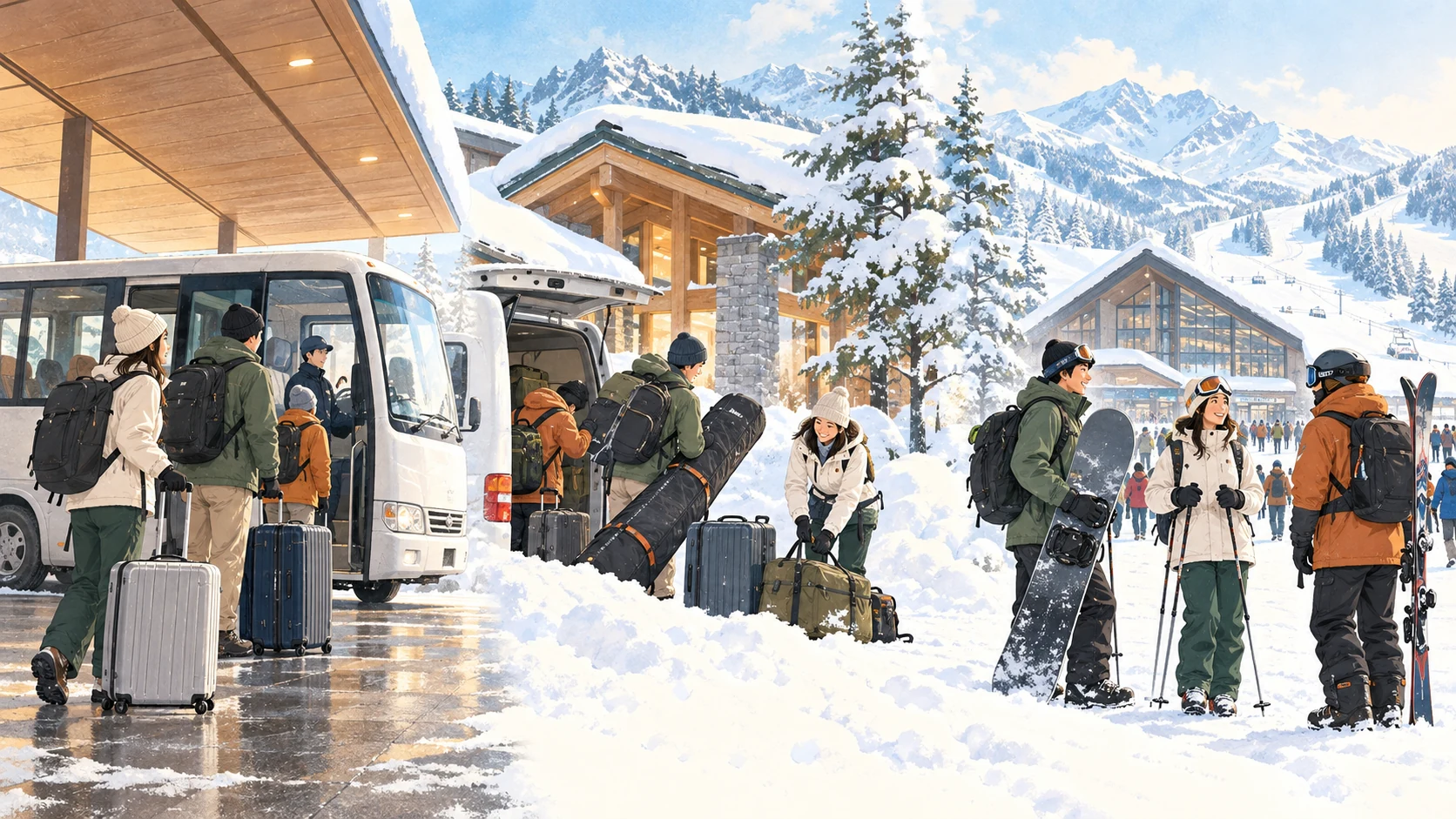
Driving offers flexibility between accommodation bases only when the driver has snow experience and the rental, tires, roads and parking are established. A map’s shortest time excludes clearing snow, slower icy driving and loading ski equipment. Reaching the hotel does not prove the next morning’s trip to the opposite base will fit the same estimate. If nobody has winter driving experience, compare reserved transfers before handing the day’s risk to whichever companion takes a turn at the wheel.
The north and south parking fees and entry-time rules list free weekday parking in the FAQ. On weekends and public holidays, southern areas B–D are free and A costs ¥1,000; the north costs ¥1,000, with applicable exemptions on presentation of a season pass. Southern entry after 14:00 is separately listed as free. However, the main northern section on the same page says parking is free on weekdays, weekends and public holidays from March 26, without specifying a year. Distinguish that statement from the FAQ’s general charges; it cannot be taken as the parking rule throughout 2026/27. Confirm your visit date with the resort before departure. These conditions do not guarantee available spaces. Do not automatically carry hotel parking privileges to the opposite ski base, particularly when rental cars, non-guests and season-pass eligibility overlap; ask which conditions apply.
Arrive with spare time, keeping equipment and luggage from obstructing the driver’s view. On departure day, clear the vehicle and gear and check expressways and onward transport before leaving, rather than skiing until the last moment and only then estimating departure. If weather has already substantially altered resort operations, reconsider long-distance travel too. Resting or changing plans is available; there is no need to add journeys simply to use a rental car fully every day.
Bandaisan Onsen Hotel: check extra beds in maisonettes and five-person rooms
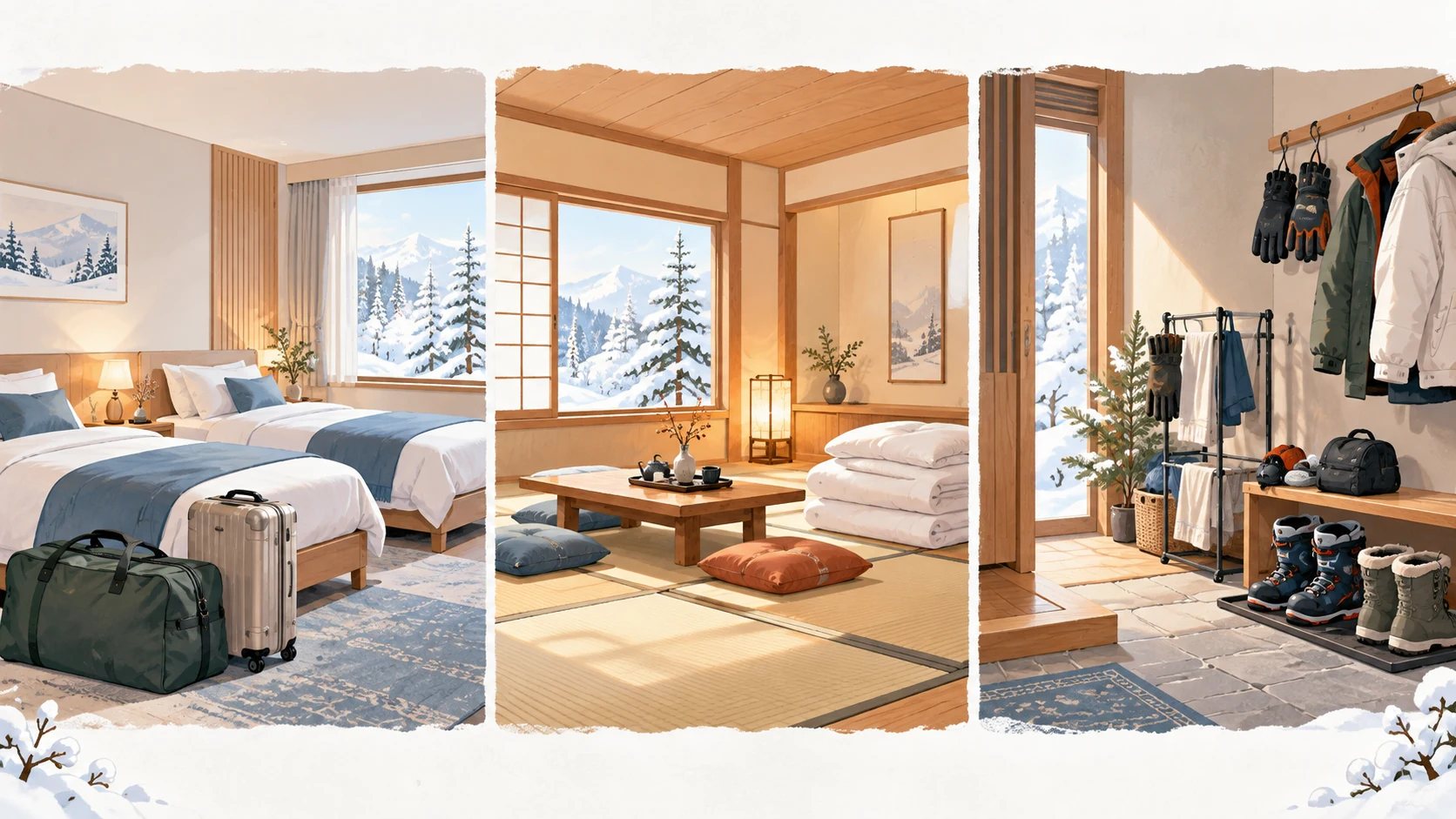
Bandaisan Onsen Hotel’s named room specifications list the Maisonette Room at 52 square meters for up to four, with living and sleeping areas on separate levels; the fourth guest uses a sofa bed. The Semi Suite is 66 square meters for up to five, also split-level, with sofa beds used from the fourth guest onward. Separate spaces can help, but a larger area is not automatically better for older travelers, small children or anyone avoiding stairs at night.
The Aizu Modern Suite measures 104 square meters for up to five, with the fifth person again on a sofa bed. For three to five occupants, write down where each will sleep. Beds, sofa beds and daytime living space affect each other; area divided by guest count is not the space available for open suitcases. A listed bathtub and shower do not make the room a natural onsen room. Confirm private hot-spring requirements separately with the hotel.
Detailed room pages allow children aged six and under to share a bed, at one child per adult, while the site’s basic information describes the overall limit differently. Use the more specific room rules to confirm family occupancy rather than selecting the most generous sentence and fitting every child within capacity yourself. Bed-sharing eligibility does not mean free meals, supplies, lessons or full-mountain passes. List each family charge in the same reservation confirmation to compare the real difference between room categories.
Winter guest benefits: a ¥5,500 pass is not an all-inclusive stay
Bandaisan Onsen Hotel’s 2026/27 winter guest offer runs from December 12, 2026 to April 4, 2027, listing an adult day pass reduced from ¥6,500 to ¥5,500 and adult hands-free rental from ¥13,000 to ¥10,400. These are individual eligibility-based benefits; they do not mean all tickets and equipment are already included in a room payment. When comparing an online travel package, establish what its quoted price already contains so you do not buy the same items again at the resort.
Guests of elementary school age and younger can borrow clothing and equipment and use beginner lifts free, with sleds also available. “Beginner lifts” are not a full-mountain day pass. Adults’ free First Ride has day-ticket and guest-proof arrangements; it does not authorize entry on days the resort is closed. Where family members need different products, first list their actual skiing areas, then ask which benefit applies. A children-ski-free headline cannot establish zero expenditure for everyone.
The season’s checkout and meal-exchange arrangements list 14:00 checkout, unlike the hotel’s usual 11:00 basic information; confirm whether your reservation qualifies. The large public bath can be used after checkout, with towels charged separately. An included breakfast can be exchanged for a resort lunch: one meal moves elsewhere, rather than two extra meals appearing on the same day. Winter breakfast is described as Japanese or Western set plates, not a buffet. Do not turn dinner-buffet details or old photographs into a promise of daily buffet breakfast.
Nekoma Rikyu: choose double, triple and large Japanese-style rooms separately
Urabandai Lake Resort’s Geihinkan Nekoma Rikyu can suit travelers combining lakeside rest with northern skiing. It is not the southern Bandaisan Onsen Hotel, and sharing the word “Nekoma” with NEKOMA Mountain does not mean it is directly connected to the slopes. Accept the unconfirmed new-season northern bus timetable before deciding whether the rooms justify extra indoor time. This rhythm may not suit a family rushing to the first children’s lesson in the south every morning.
Nekoma Rikyu’s room sizes and capacities list Standard Twin at 36 square meters for up to two, and Superior Twin at 41 square meters for up to three. Three adults should choose an actual three-person category and confirm its third bed, rather than imagine an extra bed in a two-person room. The Premium Japanese Suite, 139 square meters with futons for up to eight, offers a different layout and sleeping style. Its photographs do not depict the standard twin’s actual configuration.
Distinguish the main Goshiki-no-Mori building from Geihinkan Nekoma Rikyu when reserving; even bathing rights differ. Use Nekoma Rikyu’s official introduction and embedded video to understand the guest building’s positioning, then return to the named rooms to choose. An introductory video does not establish availability on your date, the third bed or a transport timetable. Non-skiers can plan rest and meals in the hotel instead of crossing the snowy lake district solely to have an activity.
Lakeside baths and cancellation: a room bathroom is not an onsen
Nekoma Rikyu’s accommodation, bathing and cancellation FAQ explicitly says all rooms have bathrooms, but the water in them is not hot-spring water. Bathrooms and toilets are separate except in the Lake View Suite. Natural onsen bathing means checking the public baths, rather than booking an “onsen room” on sight of a bathtub. If you cannot use communal baths, confirm alternatives before booking, instead of discovering on arrival that the room does not meet your expectations.
The Niji-no-Mori Onsen reserved for Nekoma Rikyu guests lists hours of 6:00–12:00 and 15:00–23:00, with final entry at 11:00 and 22:00 respectively. These guests may also use the main Goshiki-no-Mori baths, whose hours are listed separately. These are not one entrance and one schedule; the benefit does not work in reverse to grant every main-building guest access to the guest-building bath. Put returning to the hotel, bathing and dinner in the same evening plan.
The bed-sharing and general cancellation rules allow children aged three and under to share a bed free, without supplies. Cancellation is listed at 20% from seven to two days before arrival, 50% the day before, and 100% on the day or for no-shows. These are general website conditions; check whether your selected plan or booking channel differs. Confirm bed-sharing numbers and meals, and contact the property about weather disruption. An unsettled bus timetable is not an automatic extension of free cancellation to arrival day.
Listel Inawashiro: the slope outside is not NEKOMA
Listel Inawashiro’s Wing Tower can appeal to travelers wanting more hotel-based rest, dining and nearby activities, but its adjacent ski area is Ski Fantasia. “A ski resort outside the hotel” does not mean NEKOMA’s northern or southern base. If NEKOMA lessons or full-mountain skiing are the purpose, establish transport between facilities separately. Listel’s own lift tickets, rental or children’s offers cannot simply be taken to another resort.
Wing Tower’s Deluxe Twin and Japanese-Western room information describes Deluxe Twin at about 37.57 square meters, with two beds 120 centimeters wide and two-person capacity; three need an arranged triple room or extra bed. Oriental Twin combines twin beds with a six-tatami Japanese area, with futons from the third guest onward that guests set out themselves. Read room descriptions and occupancy fields together. For five, obtain explicit confirmation of room category and futon numbers rather than extrapolating from a twin-bed photograph.
Listel’s station-shuttle reservation rules require booking by 17:00 the preceding day; it does not run without reservations or on hotel-closure days. The page’s winter timetable still ends March 31, 2026, so it is not a confirmed new-season schedule. Its building differences and bathing-tax guidance separately says ordinary room prices generally exclude a ¥150 per-person, per-night bathing tax unless the plan explicitly includes it. Do not apply this hotel’s charge to every property in Bandai or Kitashiobara.
Aizuwakamatsu Washington: a city base comes with a commute
If companions want independent daytime city activities, compare Aizuwakamatsu Washington Hotel instead of accommodating everyone beside the slopes. The hotel’s official station-access information gives about three minutes on foot from Aizuwakamatsu Station. Near the station does not mean near the south base: the resort’s Aizuwakamatsu route still takes about forty-five minutes each way. Two ski days from a city base mean four commuting legs, with the final departure checked against lessons and equipment returns.
Washington’s room areas and bed widths give Standard Twin at 17.2 square meters with two beds 122 centimeters wide; Standard Double is 14.6 square meters with one bed 140 centimeters wide. Double and twin rooms differ substantially from mountain rooms of more than thirty square meters in suitcase space. If each traveler has a large suitcase and ski bag, ask about storage. Two-person occupancy does not make room sizes equivalent.
Washington’s cancellation terms and special-event exceptions list ordinary individual reservations at 20% the day before, 80% on the day and 100% for no-shows. Hotel-designated event periods may instead charge 50% from sixty to eight days before arrival and 100% from seven days before. That begins much earlier; groups of fifteen or more have separate rules too. Before booking consecutive winter nights, establish whether the dates fall into an event period. Do not assess the whole trip’s risk solely by ordinary next-day penalties.
Higashiyama Onsen’s Mukaitaki: leave the final evening for a ryokan dinner
For a Higashiyama Onsen night after skiing, investigate the official Aizu Higashiyama Mukaitaki property information. Identify the Aizu ryokan at mukaitaki.com rather than confusing it with another similarly named Mukaitaki elsewhere in Fukushima. It suits time deliberately reserved for dinner and bathing; a fixed direct NEKOMA shuttle has not been established. If there is another mountain lesson the next day, confirm that additional journey first.
Mukaitaki’s Okigaru plan room and current price table covers June 1, 2026 to September 30, 2027. It shows adult one-night, two-meal prices of ¥27,850 on ordinary weekdays, ¥30,050 before holidays and ¥33,350 in specified peak periods, labeled service and tax inclusive. The plan has an in-room washlet toilet, no room bathroom and no courtyard view. A lower-priced plan does not promise a courtyard-facing room or private room onsen. Single occupancy separately adds ¥7,700 per room per night.
Mukaitaki’s reservation plans and family-bath explanation describe free private use of family baths. That is private use of a shared facility, rather than a private bath inside your booked room. The confirmation and individual plan establish room, meals and price; the general Okigaru plan does not guarantee a particular courtyard room. For a first ryokan stay, review how to interpret two-meal plans and room bathrooms, then arrange arrival before dinner.
Meals need to fit your base and the time you stop skiing
The hotel’s winter breakfast and meal-plan introduction describes Western plates and Japanese Aizu wappa-rice set plates, explicitly not a buffet. Two- and three-night ski packages separately describe dinner buffets and breakfasts. Check the meals included in the actual plan, rather than combining room names, restaurant photographs and discount headlines into a self-made all-inclusive offer. If breakfast can be exchanged for a resort lunch, decide whether to forgo the hotel breakfast before choosing an early start.
For Nekoma Rikyu or Listel, return to the booked building, plan and meal times. Several restaurants under one brand do not establish that each opens daily or every meal is included. Discuss your dietary needs, what the provider can accommodate and notification deadlines before booking, rather than asking for dinner when the last bus is about to leave. A ski-area lunch restaurant is not automatically an evening option reachable on foot from anywhere around the lakes.
Mukaitaki’s two-meal plan can provide a restful final part of the trip, but that is not the evening to ski until closing and only then start traveling to Higashiyama. With a city hotel, return equipment and reach the city before finding dinner. Night skiing is not automatically included after an ordinary day pass. For a particular cuisine, vegetarian food or allergy handling, tell the provider the numbers and needs before reserving meals, confirm it can help, and rely on its reply for daily menus and arrangements.
New accommodation and night skiing: confirm announced plans in order
For a new Fukushima ski hotel, note the south-side BunkLodge NEKOMA announcement for 2026/27. The official introduction mentions a drying room, tuning area and lounge, making it a candidate for ski-focused accommodation research. This guide does not have complete room capacities, prices and cancellation conditions, so does not recommend it on the same comparative footing as the named rooms above. An opening announcement does not mean every date is bookable; “affordable” publicity cannot establish a per-person price.
The new-season announcement about southern evening dining also says Bandai Shokudo becomes Beerhouse Matatabi in the evening, an option to investigate during grooming breaks or after skiing. This is an announced arrangement, rather than a daily dinner schedule established here. From the north or Aizuwakamatsu, check whether transport home remains after the meal before making evening plans. A restaurant being within the resort does not make a cross-mountain or cross-city return an accompanying service.
The night-ski page and calendar link describe 16:30–20:00 around the southern Alts Express area, a ¥2,500 ticket (free for preschool children), or ¥1,000 as an addition to a qualifying same-day day or afternoon pass. However, the page’s dates still show 2026, rather than a clearly confirmed 2027 calendar. This guide does not advance the year or guarantee any particular Saturday this season. If night skiing determines your hotel choice, obtain confirmation for the specific date and separately check the evening return.
Goshikinuma in winter: a closed lift is not a signal to hike alone
Urabandai stays often bring Goshikinuma into the plan, but winter is not the time to follow a green-season account casually along the whole nature trail. The tourism association’s winter Goshikinuma equipment and guide advice says snow may bury signs and paths; snow boots or tall boots may be insufficient, and first-time visitors are advised to join guided activities. Its late-January to early-March viewing period is a usual-season reference, not a snow or access guarantee for a particular week in 2027.
Kitashiobara Village’s 2026 nature-trail restrictions record partial easing from July 25, with specified sections usable from 9:00 to 16:00, plus bear warnings and advice against going alone. This dated restriction information does not establish the same conditions throughout the new winter. Check current roads, trails and wildlife notices when booking an activity and again before setting out. “Partially reopened” does not describe every area.
If wind and snow have stopped lifts, walking in the forest may also be less suitable. Consider resting at the hotel, adjusting the next ski day, or heading to a city only when transport and a return are feasible. A guided Goshikinuma outing belongs in suitable weather with appropriate equipment and a confirmed departure. Do not turn a winter activity requiring specialist judgment into a universal rain-or-snow backup merely to fill every day of a trip.
On storm days: operations first, transport next, sightseeing later
Check morning lift and run operations first, then buses, roads and messages from your school, before deciding whether the original skiing plan remains workable. If any leg fails, rebuild the day rather than combining the most optimistic line from several websites into an assumption that it should be fine. If a lesson is canceled after equipment has been collected, ask each provider directly about the response. Services within one group do not necessarily issue coordinated automatic refunds.
Agree in advance where to meet during closures, who keeps the bags and how to contact the hotel. More capable adults should not venture alone into closed terrain. When the connecting chair or return routes change, return to the original base or follow staff instructions. If your vehicle requires reservations, check the new departure has seats before canceling the old one. Explain the actual problem to the accommodation and operator instead of finding the replacement full only after cancellation.
At least one adjustable or cancelable block of time belongs in the budget. Disruption may make an extra hotel night or an earlier descent preferable to chasing the final long-distance train, but price, availability and refunds need separate confirmation. This guide does not convert weather risks into a safety guarantee or infer coverage from an insurance product’s name. Read your own policy’s terms for activities, delay and cancellation if relying on insurance.
Three nights in the south: settle in, then allow two full practice days
Two adults using a southern base can dedicate day one to arrival, confirming guest benefits, collecting or reserving the following day’s equipment, and finding restaurants and pickup points. Do not assume a full ski day: a late bus may leave little use for a full-mountain ticket. Confirm the next day’s school meeting point and weather that evening. Settle the pass, rental and breakfast-for-lunch choices before morning, avoiding simultaneous queues at three counters.
Use day two for an introductory lesson and practice on the accommodation side, deciding after lunch whether energy permits more. There is no need to cross the mountain on the first day. On day three, continue in the same area or consider south–north movement if ability and operations suit it. With children, establish where everyone can be at the same time. For only two complete ski days, compare two day passes or products matching those days; three hotel nights do not automatically become three ski days.
Leave day four for equipment returns, luggage, bathing and transport. A seasonal benefit such as 14:00 checkout still depends on your specific booking. Work backward from the departure needed for a long-distance train or flight, keeping “one more run” from consuming the whole connection buffer. This three-night plan is adjustable. It neither guarantees skiing on all four days nor presents buses not checked individually as a fixed timetable.
Late April and May: treat the northern area as a different trip
After the south’s planned April 4 finish, reconfirm accommodation, rentals, lessons and shuttles if the north continues according to snow conditions. January’s routine of staying south and stepping out onto the slopes no longer transfers directly. Bandaisan Onsen Hotel’s winter benefits and the Koriyama route each have their own April 4 boundary too. A nominally all-mountain day pass does not keep every northern and southern approach operating. This is an easily missed spring-planning gap.
For spring skiing alone, ask whether northern-base rentals and lessons are available on your date, then establish actual return transport to the accommodation. A lakeside hotel may be better aligned with the destination, but proximity does not replace departure confirmation. Drivers must also check roads and parking. May 9 is only the north’s planned closing date. Accept earlier snow-related changes; owning five days of tickets cannot guarantee every remaining portion can be used in the final few days.
Spring may split skiers’ and non-skiers’ priorities: an early mountain start for some, a later breakfast, lake views and bathing for others. Separating daytime plans can work better than making non-skiers wait at the base merely to share a vehicle. For green-season walking, check remaining snow and trail openings. April does not restore summer conditions everywhere. Consult winter and green-season information within their own periods instead of interchanging them by seasonal name.
With toddlers or non-skiers, draw two daytime routes first
A whole family benefits from slope-side accommodation when each person has suitable daytime activities at the same base. A toddler lesson lasting one hundred and five minutes still leaves the rest of the day for parents to arrange. Dressing, toilets, food and rest before and after class all count. If one adult wants the whole mountain while another supervises snow play, discuss turns and meeting times first. That is easier than discovering an unequal day’s workload after arrival.
Older non-skiers may care more about beds, an in-room toilet, stairs and bathing arrangements. A large maisonette is not necessarily preferable to a smaller single-level room, and access to public baths does not mean natural hot-spring water in the room. Nekoma Rikyu’s accessible-room explanation discusses wheelchair movement inside the building but also says there are no fully accessible rooms and assistance is needed inside rooms. Obtain a specific reply for actual needs; wheelchair movement alone is not a guarantee of an accessible whole journey.
If city activities matter more than skiing, concentrate skiing into one or two complete days and use Aizuwakamatsu or Higashiyama Onsen for other nights. That adds a transfer but may reduce long waits for non-skiers. Conversely, a slightly cheaper station hotel may not help a child attending lessons in the south daily. Daily fares, timetable limits and fatigue are costs too. Compare the family’s actual division of activities rather than dividing only the room rate by guest count.
Recalculate a four-day, three-night budget for two adults
This example has two adults sharing one room for three nights and skiing two full days, using Bandaisan Onsen Hotel guest tickets and hands-free rental benefits. The room input of ¥24,000 per room per night and a separate ¥4,000 meal allowance per person per day are hypothetical, not available room or restaurant quotes. If the actual plan includes breakfast or two meals, remove the matching meal costs. Do not use a meal-inclusive room price and add every meal again.
Accommodation is ¥24,000 × 3 = ¥72,000; day passes are ¥5,500 × 2 people × 2 days = ¥22,000. Conservatively buying separate daily guest hands-free packages gives ¥10,400 × 2 × 2 = ¥41,600, without assuming a continuous-rental discount. Koriyama return travel is ¥1,800 × 2 people × 2 directions = ¥7,200. Meals are ¥4,000 × 2 people × 4 days = ¥32,000. Total: ¥174,800, or ¥87,400 per person, plus ¥1,000 available for two IC-card deposits, excluded from net cost if properly refunded that season.
This excludes international travel, long-distance rail, unconfirmed taxes, lessons, insurance and unplanned transfers. It does not promise that every input combines into one bookable package. Put your actual room, meal and rental quotes into the item-by-item Japanese travel budget method before comparing early purchase with guest rates. A family of four cannot simply double this adult example: children’s tickets, free rentals, bed-sharing and meal conditions each need their own calculation.
| Item | Calculation | Two-person yen amount |
|---|---|---|
| Room input, same room for 3 nights | 24,000 × 3 | 72,000 |
| Guest day passes | 5,500 × 2 people × 2 days | 22,000 |
| Guest hands-free package bought separately each day | 10,400 × 2 people × 2 days | 41,600 |
| Koriyama return bus | 1,800 × 2 people × 2 directions | 7,200 |
| Separate meal input; deduct included meals | 4,000 × 2 people × 4 days | 32,000 |
| Net cost of these example items | 72,000 + 22,000 + 41,600 + 7,200 + 32,000 | 174,800 |
| Example per person | 174,800 ÷ 2 | 87,400 |
| Additional refundable IC deposits, not net cost | 500 × 2 | 1,000 |
Secure a room you can reach before committing to nonrefundable tickets
Before booking, ask whether the room accommodates your group, whether you can reach it on the date and whether there is still a worthwhile stay if a ski day is lost. Check the plan’s cancellation and amendment terms next, then buy matching days of tickets and lessons. With the northern shuttle unsettled, investigate cancelable rooms while waiting to establish transport. Do not let the cheap ticket purchased last force the whole family into an unsuitable room or arrival time.
Cancellation percentages are not interchangeable between hotels. Listel Wing Tower’s accommodation cancellation table gives general reservations for one to fourteen guests: no-show 100%, arrival day 80%, the day before 50%, and two to four days before 20%, with special agreements potentially taking precedence. This differs from Nekoma Rikyu’s 50% the day before and Washington’s ordinary 20% the day before. Group rules start earlier. Read the specific transaction terms for packages and offers rather than treating a general table as a promise for every product.
Keep separate confirmations for rooms, lessons, rental, buses and lift tickets, noting the date and time used for each cancellation deadline. If transport changes, contact the accommodation and providers about rescheduling before canceling. One hotel’s free-cancellation policy does not establish another’s. Nor should you wait until a no-show to explain bad weather. Early communication does not guarantee waived charges, but lets each provider respond to the actual order.
One base or a final hotel change: weigh luggage against dinner
For consecutive lessons at the same resort, first investigate staying in one base, saving time repacking wet clothing, moving bags and finding rental counters. A final non-ski night gives more reason to move to Higashiyama Onsen or a city: the focus becomes a ryokan dinner, room rest or the following long-distance departure rather than collecting another hotel. At each change, ask where bags can stay after checkout, whether wet equipment can be stored and when the next room becomes available.
Lake Resort and Listel both sit within an Inawashiro–Urabandai trip, but their buildings, station transfers and relationships to ski areas differ. Washington and Mukaitaki likewise offer distinct city and onsen rhythms. Their inclusion in one Bandai accommodation guide is not a five-night hotel-hopping itinerary. Secure the two core ski days, then choose at most one later stay that adds a different experience. That is more manageable than accumulating property names.
If other Tohoku cities are involved, use the Sendai and Yamagata guide to onsen stays and seasonal itineraries to investigate the neighboring part of the trip, then return to Bandai’s arrival and departure directions. This is an itinerary reference, not a claim to have researched every Tohoku ski area or Fukushima onsen. Allowing enough full days for each destination usually works better than expecting skiing, lakeside hiking and an onsen dinner on the same day.
Before departure, check one winter plan you can actually follow
Put the date-specific north and south seasons, operating lifts, rental counter, lesson meeting point, hotel vehicle and dinner in one list. Each item should answer where, when, whether it needs booking and who provides it, rather than merely retain a webpage title. Cross-area movements, unconfirmed northern buses, old night-ski years and older hotel winter timetables need new explicit information before becoming irreplaceable commitments.
Reconfirm children’s birthdates and ticket categories, the third person’s bed, whether room-bath water is onsen water, included towels and meals, and the relevant cancellation contacts. Keep printed or offline confirmations so a weak phone signal does not hide hotel and bus information. This turns small mismatches that become harder in snow into questions that can be resolved in advance.
The best Bandai base lets skiers begin smoothly, non-skiers keep their own rhythm and everyone retain a way back when weather changes. Filter by named rooms and current-season conditions before comparing price and views. If a service is not yet announced, leave it unresolved instead of filling the gap with last year’s data. NEKOMA’s two sides and nearby onsen can share a trip, but every connecting leg needs a workable reason and arrangement.
A few useful answers
How do NEKOMA Mountain, Nekoma ski resort and Alts Bandai relate?
Plan with today’s north and south areas: north corresponds to former Nekoma and south to former Alts Bandai. Use current base names for accommodation, rental and lessons. The connecting chair is not a guaranteed all-day hotel shuttle.
Do both sides stay open into May in 2026/27?
No. North is scheduled for November 28, 2026–May 9, 2027; south for December 12, 2026–April 4, 2027, subject to snow. Planned northern skiing in May does not keep southern runs, hotel benefits or the Koriyama bus available.
What do general, beginner and hotel-guest day passes cost?
The listed adult general day pass is ¥6,500; beginner-only is ¥2,500, limited to the south First Chair and north Friendly Cat Express. Bandaisan Onsen Hotel’s eligible winter guest pass is ¥5,500. Eligibility and scope differ; the ordinary pass excludes First Ride and night skiing. Check the selected product before paying.
Must super-early multi-day tickets be used consecutively?
The 26/27 super-early three- and five-day products allow selected dates during the season, without consecutive use; adult prices are ¥11,700 and ¥19,000. That does not establish permission to split one product among different people on the same day, cancel or transfer it. Read the official sales process.
Are children’s skiing, rentals and snow play all free?
No. Free preschool lift tickets ordinarily still require an IC card and ¥500 deposit. Bandaisan Onsen Hotel guests of elementary school age and younger have free clothing, equipment and beginner-lift benefits, but accessories are specially priced, not all free, and a full-mountain pass is not included. Southern snow play, northern sleds and tubing have separate conditions.
Can a three-year-old take snowboard lessons or a Chinese-language children’s class?
South-side ski LV1 has an ages-three-to-four class; snowboard LV1 is ages four to six. Both last 105 minutes and are taught in Japanese. A separate private snowboard lesson lists ages three and over, subject to requested content, unlike the introductory group. The international-school link mentions Chinese and other languages, but confirm date, age, ability and instructor language. The lowest age does not qualify a child for every class.
Must the Koriyama bus to the south be reserved?
Yes. December 12, 2026–April 4, 2027 service lists adult one-way ¥1,800 and elementary school ¥900; preschool children without a seat are free. Reservations are accepted up to fifteen minutes before departure, without telephone bookings, subject to seats. The hotel separately says December 12 runs from Koriyama only and April 4 from the hotel only.
Is Nekoma Rikyu’s free north-side shuttle already timetabled?
At the research date, the resort had announced plans for free northern buses from major hotels, with the operating period undecided and departures still to confirm. The free Inawashiro Station–Lake Resort vehicle is another service, normally without reservations except for groups of ten or more. It does not establish a particular early bus to the slopes.
Is Listel’s hotel-front slope NEKOMA?
No. Listel faces its own Ski Fantasia. Establish NEKOMA transport and tickets separately. Its station shuttle requires booking by 17:00 the previous day, but the official winter table still ends March 31, 2026; that is not a confirmed new-season timetable.
Does a room bathroom at Nekoma Rikyu or Mukaitaki mean a private onsen?
Do not infer that. Nekoma Rikyu explicitly says room-bath water is not hot-spring water. Mukaitaki’s Okigaru plan has an in-room toilet but no room bathroom, with privately usable shared family baths instead. Check room, building and private-use arrangements individually.
Can I put 2027 night skiing and winter Goshikinuma straight into the plan?
The night-ski page still carries older 2026 dates; this guide does not convert them into confirmed 2027 openings. Winter snow can obscure Goshikinuma paths. First-time visitors should investigate guides, equipment and current restrictions, rather than turn a storm-related lift closure into independent forest hiking.
How much should two adults allow for three nights and two ski days?
Using a hypothetical ¥24,000 per room per night and ¥4,000 per person per day for meals, plus guest passes, separate daily hands-free rentals and Koriyama return buses, the example totals ¥174,800 for two, with another ¥1,000 available as IC deposits. Room and meal inputs are not bookable quotes; deduct meals already included. Long-distance travel, lessons, taxes and other exclusions remain additional.
Check with the source
Schedules, availability and rules can change. These official sources are the place to confirm details before you book.
- NEKOMA Mountain: 2026/27 north/south seasons and resort scale
- NEKOMA: connecting lifts, return routes and boarding rules
- NEKOMA: seasonal ticket products, IC deposits and snow play
- NEKOMA: rental combinations and older operating-hour boundaries
- NEKOMA: lesson ages, languages, courses and reservations
- NEKOMA: Koriyama, Aizuwakamatsu and northern transfers
- Bandaisan Onsen Hotel: station access and first/last-day directions
- Bandaisan Onsen Hotel: rooms, bed-sharing and basic information
- Bandaisan Onsen Hotel: 2026/27 winter guest benefits
- Nekoma Rikyu: official guest-building introduction and adopted video
- Nekoma Rikyu: named room areas and capacities
- Nekoma Rikyu: station transfers and timetable conditions
- Nekoma Rikyu: bed-sharing, baths, transfers and cancellation
- Listel Inawashiro: Wing Tower rooms and Royal Suite video
- Listel Inawashiro: shuttle booking and timetable year
- Listel Inawashiro: buildings, facilities and bathing tax
- Listel Wing Tower: accommodation agreement and cancellation table
- Aizuwakamatsu Washington: station walking location
- Aizuwakamatsu Washington: room areas and bed widths
- Aizuwakamatsu Washington: cancellation and special-event exceptions
- Aizu Higashiyama Onsen Mukaitaki: official property identity
- Mukaitaki: current Okigaru plan prices and in-room facilities
- Mukaitaki: plans, family baths and reservation distinctions
- NEKOMA: 2026/27 new accommodation and evening dining announcement
- NEKOMA: night-ski products and year requiring clarification
- Urabandai Tourism Association: winter Goshikinuma equipment and guides
- Kitashiobara Village: 2026 Goshikinuma nature-trail restrictions