Explore royal worship through Ufugui’s naming ceremony, Yuinchi’s abundance, sacred-water jars and Kudaka’s white sand. Includes Sangui finds, conservation, restrictions from November 2026 and a half-day from Naha.
- Region & Focus
- Nanjo
- Reading Scope
- 35 min read · 15 chapters · 4 Q&As
- Official Verification
- 11 official sources checkedUpdated 22 November 2026
- Key Topics
- ItinerariesOkinawa
Chapter Route Map (tap any stop)
- From November 2026, change the plan: full restrictions beyond Ujo-guchi
- Names of worship places preserve the order of royal rituals
- Kings visited; the Kikoe Okimi assumed a religious office here
- Oaraori: from rituals at Shuri to an overnight vigil at Chinen
- Ufugui and Yuinchi: royal vocabulary in the forest
- Sangui’s rocks and nearby Chono-hana
- Two jars collect sacred water, and its quantity carries omens
- Kudaka’s white sand brings maritime geography into the utaki
- Gold, jade, glass and celadon underground provide another kind of evidence
- World Heritage in 2000: protecting a group of cultural assets still in use
- Conserving the forest and managing wear on the approach
- A normal opening-day half-day: calculate ticket office and entrance separately
- ¥600 admission, seasonal hours and the free works period
- Naha return travel: direct bus 338 and the 500-metre walk
- Stone paving, slopes and prayer space determine who can walk the route
- Quick Q&A
Sefa Utaki centres on worship places, rock faces, sacred water and forest. The Kikoe Okimi took office here, and white sand from Kudaka Island was brought into its state ritual ground. Choose dates before planning to enter Ufugui, Yuinchi and the Sangui area: entry beyond Ujo-guchi is fully restricted from 2 November 2026, scheduled until 5 January the following year. For a half-day focused on the worship sites, visit after those restrictions are lifted.
From November 2026, change the plan: full restrictions beyond Ujo-guchi
If you want to see Ufugui, Yuinchi and Sangui, put your visit date before the place names. The operator’s announcement of 15 October 2026 states that drainage works will fully restrict entry beyond Ujo-guchi from 2 November, scheduled until 5 January the following year. Admission is free during this period. If your aim is to enter the forest and understand the worship sites, arrange the Nanjo trip after the works restrictions are lifted. Restrictions from November 2026
The same announcement describes the preceding stage: until 1 November, the work area was between the three-way junction and Yuinchi, with normal admission charges. Late-October visitors needed to follow the permitted route and avoid that section. For visits from 2 November, remove the entire worship-site visit beyond Ujo-guchi from the day’s plan.
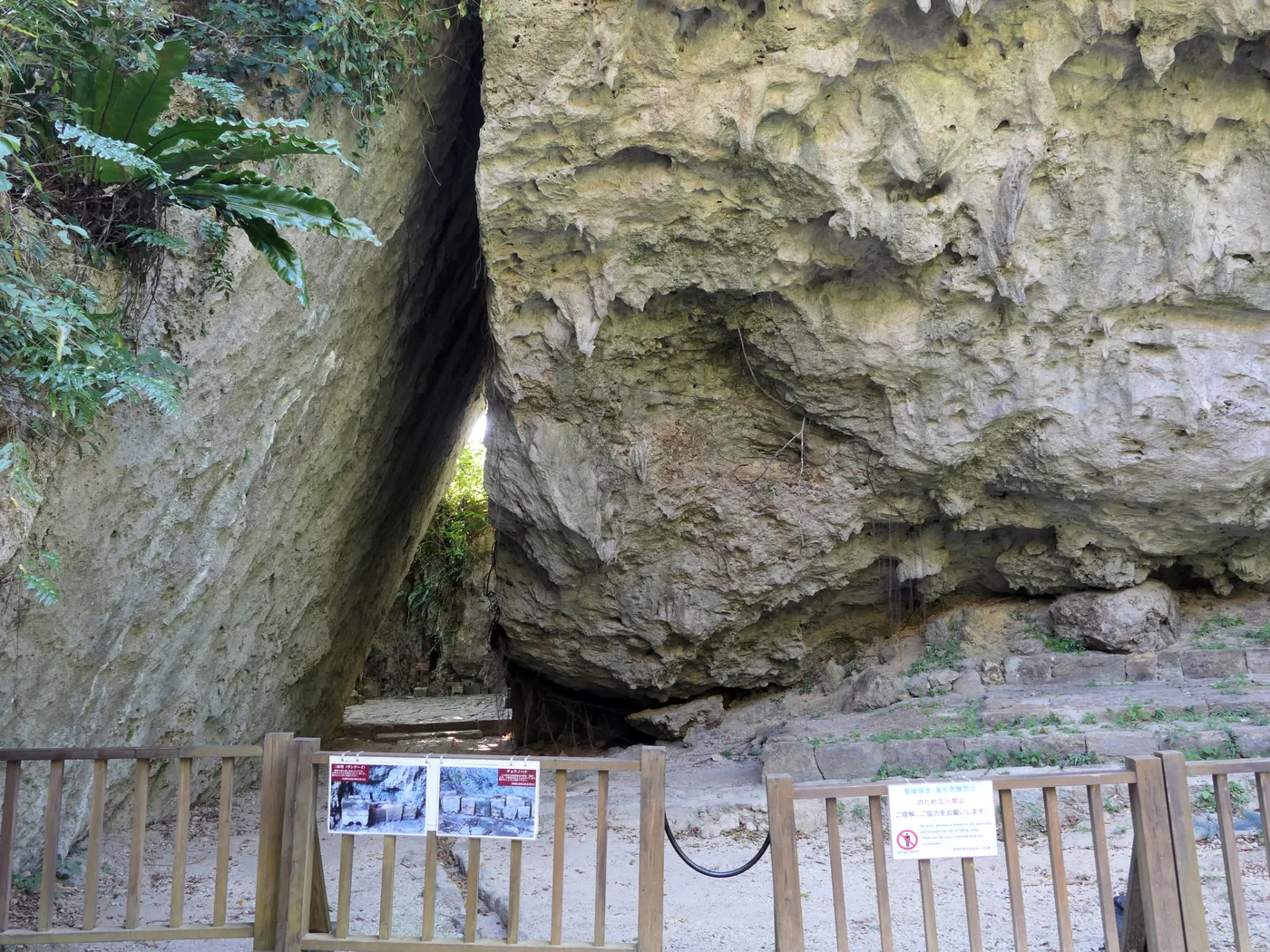
Sangui has a separate boundary: ordinary worshippers and visitors cannot go beyond its entrance. Nanjo City’s announcement in February this year lifted part of an earlier works restriction but retained the ban on entering Sangui itself. The operator’s current guidance maintains it. The completion of earlier works, currently walkable areas and Sangui’s own restriction are addressed by separate notices.
This half-day makes Sefa Utaki the only main cultural visit. From Naha, allow separately for intercity transport, the walk from ticket office to entrance, time inside and lunch. During restrictions, first decide whether a special journey to Ujo-guchi still serves your purpose. Shuri Castle’s Seiden and Shikinaen’s Udun are prominent buildings; Sefa’s substance is spread among rock faces, worship places, water and trees. That difference is where the visit begins.
Explore royal worship through Ufugui’s naming ceremony, Yuinchi’s abundance, sacred-water jars and Kudaka’s white sand. Includes Sangui finds, conservation, restrictions from November 2026 and a half-day from Naha.
Names of worship places preserve the order of royal rituals
Utaki is a collective term for sacred places in the Nansei Islands; this site is pronounced Sefa Utaki. The operator introduces it as the Ryukyu Kingdom’s highest sacred site and describes six inner sacred places called ibi. Kings visited them to pray for national prosperity and peace, abundant crops and safe navigation. You are identifying a group of places with names, uses and ritual relationships. The operator’s explanation of Sefa Utaki and its terms
The Agency for Cultural Affairs lists Ufugui, Yuinchi, Sangui and Chono-hana among the worship places. Ufugui, Yuinchi and Sangui also occur as names inside Shuri Castle’s Seiden, which the agency treats as evidence of close links with royal power. Palace names connected to forest ritual grounds offer a more specific reading than an unusually shaped rock. The two settings had their own uses, and the names preserve the relationship. Agency for Cultural Affairs: Sefa Utaki
Begin with the meaning of a worship place: people pray at a specific location, where rock, open ground and surroundings together form religious space. Looking for the main hall and images of a mainland Buddhist temple, or the main sanctuary and worship hall of a Shinto shrine, can obscure these named places. Sefa’s interpretation concerns who came where, which rituals they performed and how the sacred area continued in use.
Other Ryukyu Kingdom heritage sites have different roles. Sonohyan Utaki’s stone gate explains prayers for a king’s safe departure, while Shikinaen relates to royal recreation and receiving investiture envoys. Sefa served state rituals and the inauguration of the Kikoe Okimi. Begin with that role to understand the journey from Shuri to Chinen, and why objects, water and a distant island enter one ritual system.
An introduction to Sefa Utaki included in Nanjo City Culture Division’s official video library, to accompany this section’s place names and Ryukyuan sacred-site background.
Kings visited; the Kikoe Okimi assumed a religious office here
Both the king and the Kikoe Okimi appear in Sefa’s history, with different roles. The king was the kingdom’s highest ruler; Kikoe Okimi was the title of the highest-ranking priestess in Ryukyuan belief. The operator explains it as the most renowned priestess. Royal women, including kings’ sisters, held the office and were regarded as religious protectors of the king and the whole kingdom.
The operator traces the office from the first holder in 1470 to the fifteenth in 1875, spanning more than four centuries. Distinguish the title from individual women: it was an office transmitted across generations. Nanjo City lists their prayers as prosperity for king and state, plentiful crops and safe navigation, echoing the national concerns of royal visits.
These prayers had concrete historical settings. Safe navigation appears in the operator’s account of royal prayers, and traded goods in Nanjo’s explanation of Yuinchi. Grain and abundance concerned the livelihoods of state and people. Read those terms closely and Sefa extends beyond an image of individuals seeking good fortune: it once carried collective wishes for the kingdom’s stability and prosperity.
The Agency for Cultural Affairs notes records of royal visits in the first half of the 15th century. A creation story explains the sacred site differently: Nanjo City identifies Sefa as one of the utaki created by the Ryukyuan creator deity Amamikiyo, also called Amamiku. Royal records trace institutions and actions; local myth explains the site’s place in belief.
Oaraori: from rituals at Shuri to an overnight vigil at Chinen
The Kikoe Okimi’s inauguration ceremony is called Oaraori in Nanjo City’s reading and Oarauri in the operator’s. Both readings refer to the same ceremony. Remember its connection with a journey: after rituals in Shuri, the procession passed important places en route before entering Sefa Utaki in Chinen.
Nanjo City’s 2020 cultural feature describes the sequence: the procession descended from Shuri to Chinen, kept an overnight vigil at Sefa Utaki and received a naming rite, onazuke, and spiritual power called okimi-seji. This is the city’s account of the inauguration. Knowing that the open ground before the rocks took part in a ritual spanning places, day and night connects a daytime visit with the kingdom’s highest priestly office. Nanjo City: Sefa Utaki and us
The operator also describes ubiinadi, the application of sacred water to the forehead. It explains this as the Kikoe Okimi receiving divine spirit and becoming a being equal in status to a deity. The use of water extends the rite from procession and place to the body. Such specific acts conveyed the religious office through the sequence after departure from Shuri.
The procession photograph in Nanjo’s feature is labelled as a 2016 re-enactment involving citizens. When travel materials show such processions, read their date and event identity before comparing them with the royal-period account. A modern re-enactment retells history; an ordinary visit encounters the rite through named worship places and interpretation.
Ufugui and Yuinchi: royal vocabulary in the forest
Nanjo explains Ufugui as meaning a great hall or first reception room. The naming rite within the inauguration took place here. Name, spatial status and ritual action therefore correspond. Follow the name with its role in the inauguration to understand the worship place beyond the shape of its rock.
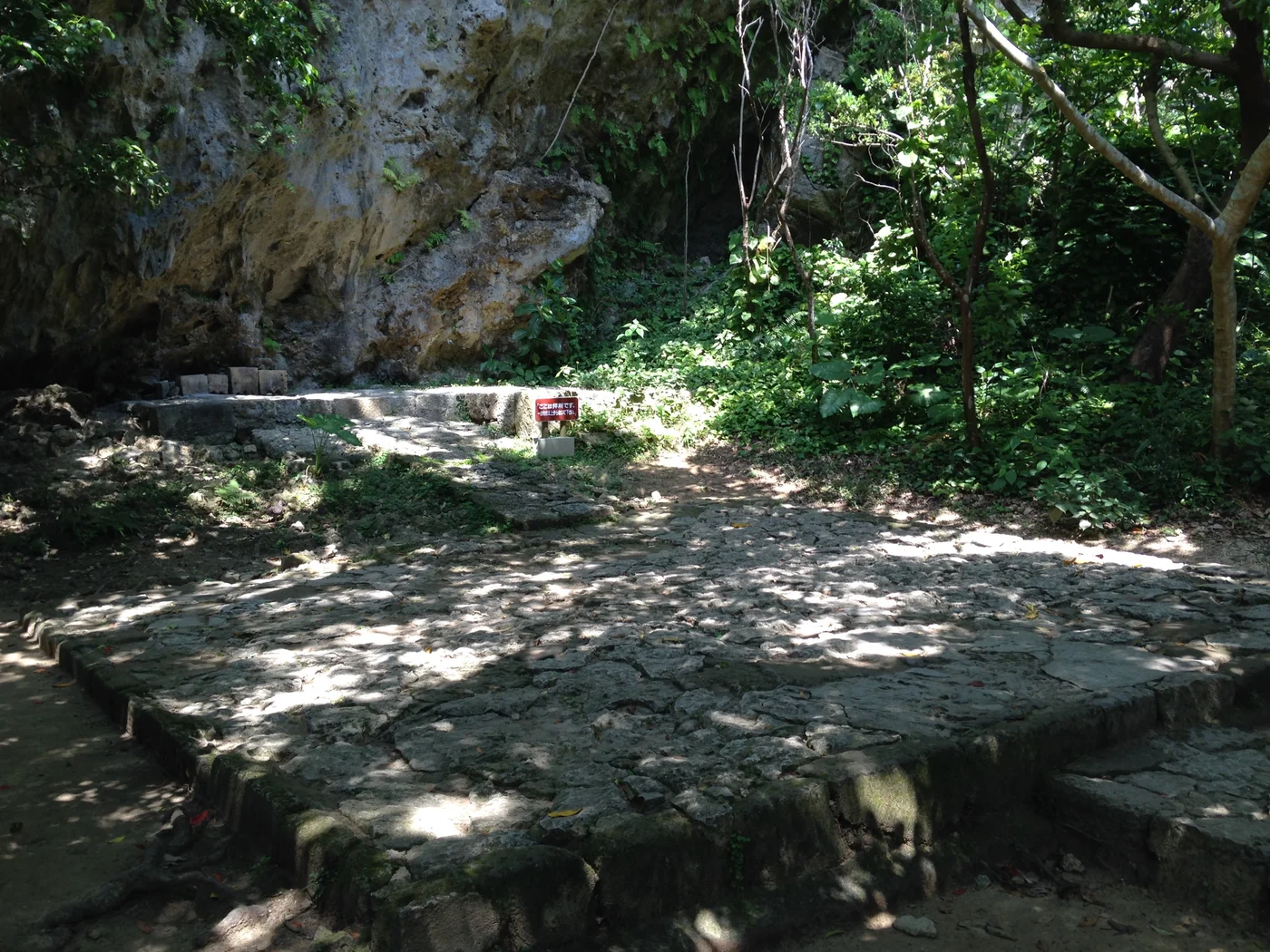
Nanjo explains Yuinchi through a royal-government term for a kitchen. It then places the name in the context of flourishing Ryukyuan trade, interpreting the place as filled with abundance where goods from around the world gathered. A familiar domestic word enters a state ritual vision of plenty. Read Yuinchi through supplies and abundance.
The Agency for Cultural Affairs records the shared names with Shuri’s Seiden; Nanjo adds the great hall, kitchen and uses of each worship place. Together they lead from court vocabulary to state worship in the forest.
Sangui’s rocks and nearby Chono-hana
Sangui is the local reading of the place name. Nanjo’s cultural feature draws attention to the worship sites themselves: several incense burners on the great rock ahead, and a burner for the worship place Chono-hana on the right. These two names identify distinct prayer positions within a small area, opening the general name Sangui into more detailed ritual places.
The Agency for Cultural Affairs lists Chono-hana alongside Ufugui, Yuinchi and Sangui. Keep it as a separate name in your notes. It also has its own find location in archaeological records. Sangui can thus be read beyond the outline of the rock opening, through incense burners, named worship places and ritual objects left there.
Although Sangui’s interior is closed, this knowledge helps interpret space visible from outside. Management boundaries determine where visitors may walk; cultural records explain names and uses. Read the relationships before entry to connect visible parts with the whole. Guided visits follow the same restrictions: the operator explicitly states that a guide does not permit entry to Sangui, altars or other prohibited areas.
The Agency for Cultural Affairs records that men were barred from the sacred site before the war, while today people of all genders and ages come to worship. Historical gender qualifications and today’s area-based boundaries are different arrangements. Modern visitors follow current entrances, routes and restricted areas. This change helps explain both its former religious order and its present opening to general visitors.
Two jars collect sacred water, and its quantity carries omens
Nanjo describes the Shikiyodayuru Amaganubi and Amadayuru Ashikanubi jars as collecting sacred water dripping from two stalactites, with omens read from the amount of water. The long names can be difficult to retain. Start with two dripping points, two collecting vessels and interpretation of water quantity to grasp the main relationship.
Connect each name with that use, leave vessels and collecting points in place, and read the explanations from the permitted route.
Water at Shikinaen’s Ikutokusen relates to the pond’s supply and inscriptions by investiture envoys. Sefa’s accounts separately discuss jars collecting drips, divination by quantity and water applied during inauguration. If visiting both on an Okinawan cultural trip, retain this distinction. Water can explain the composition of a reception garden in one place and vessels for omens and acts of spiritual empowerment in another.
Kudaka’s white sand brings maritime geography into the utaki
Kudaka Island enters Sefa’s explanation through a material that was transported: white sand. The operator records that sacred white sand was specially brought from Kudaka, the “island of the gods”, and spread in the utaki for Ryukyu state ceremonies. The relationship is physical: sand crossed the sea and became part of the ritual ground.
The operator’s glossary also places Kudaka within Amamikiyo’s creation tradition: the first island made after the deity descended from heaven, regarded as the birthplace of the five grains. Within local belief, these accounts give the sand’s source a religious meaning. Royal prayers for plentiful crops connect here with a named island.
Royal pilgrimage also linked the places. The operator records that successive Ryukyu kings maintained visits to Kudaka every two years until the 17th century. Sefa’s six ibi received national prayers, while Kudaka had its own ceremonies and royal-visit history. Royal movement and the transport of sand joined island and mainland ritual ground in one religious geography.
Sefa Utaki is also a stop on Agari-umai, the eastern pilgrimage. The operator explains that Ozato, Sashiki, Chinen and Tamagusuku east of Shuri were known as the four eastern districts, or the eastern region. Pilgrimage to sacred places associated with the creator deity took its name from this. Movement from Shuri to Chinen can be read as both direction and religious pilgrimage, placing Sefa in a wider network.
For this half-day, retain Kudaka as a geographical clue to white sand and creation traditions. Give an actual island visit a separate full itinerary, including departure from your accommodation, return island transport and local visits. Rushing both utaki and island fragments both stays with travel. First understand at Sefa why the sand came, then make the island a later, focused trip.
Gold, jade, glass and celadon underground provide another kind of evidence
Sefa’s royal relationship also survives in excavated objects. The Agency for Cultural Affairs registers the “Objects excavated from Sefa Utaki, Okinawa Prefecture” as an archaeological group, designated a national Important Cultural Property on 22 June 2001. This is the objects’ status, separate from the site’s Historic Site and World Heritage identities. Protection covers both place and remains. Agency for Cultural Affairs: excavated objects from Sefa Utaki
The agency records find locations precisely. The upper layer at Ibinume yielded three gold, three jade and three glass magatama beads, nine in total; six southern Chinese celadon bowls; three Longquan celadon dishes; and 506 old coins laid in a circle. Material, form, quantity and arrangement remain recorded with their location, preserving the group’s associations.
The same bead form in gold, jade and glass directs attention to material as well as shape. Celadon vessels have identifiable forms and origins, while numerous coins were found laid in a circle. Remember the combination: ritual history leaves sets of objects and ways of placing them, a richer clue than simply “gold was found here”.
The lower layer contained a Chinese plate and 28 old coins. Nearby Chono-hana yielded nine gold ritual charm coins. The agency lists those separately from ordinary old coins in the upper and lower layers. Chono-hana reappears through an archaeological location corresponding to the named worship place and incense burner discussed earlier. Space and excavation records connect.
The 506 and 28 old coins belong to different layers, totalling 534. Recording them separately retains their underground positions. The agency notes that the upper layer includes new Kanei Tsuho coins first minted in 1697. The deposition of this group therefore cannot be earlier than the late 17th century. A small coin constrains the dating of the whole group.
Take this method into other cultural visits: an object’s manufacturing date limits the earliest possible date of its burial. 1697 concerns the upper group of finds. Sefa’s creation tradition and records of royal visits address longer histories through different materials. Use each piece of evidence for its own question to obtain a more specific chronology than a vague “thousand-year-old sacred site”.
World Heritage in 2000: protecting a group of cultural assets still in use
Sefa Utaki entered the World Heritage List in 2000 as one of nine assets in the Gusuku Sites and Related Properties of the Kingdom of Ryukyu. The operator’s account stresses nature worship, religious rituals and festivals still performed, and the assets’ continuing place in residents’ lives and thought. Ongoing prayer is part of this sacred site’s cultural value.
Protection developed in stages. Nanjo’s chronology begins with ownership passing to Chinen Village in 1906, followed by Ryukyu Government designation as a Historic Site and Place of Scenic Beauty in 1955, Japanese national Historic Site status in 1972 and World Heritage inscription in 2000. Sangui’s excavated objects followed as Important Cultural Properties in 2001. Each date concerns how preservation systems recognised rocks, woodland and ritual objects within different protective scopes.
The opening of Midori no Yakata Sefa in 2007 and the introduction of paid public access mark another transition in the city’s timeline. Visitor admission meets a sacred place long used by believers. Tickets, entrance management, rest days and protective works are practical parts of a visit. Understanding their background places service facilities within the history of conservation.
Conserving the forest and managing wear on the approach
The forest also has a conservation history. Nanjo’s 2020 feature interviews Hideko Oshiro, a local cultural-property specialist involved in the World Heritage work. She describes three years of vegetation and ecosystem surveys during improvements, distinguishing original trees from post-war growth and restoring the earlier planting as far as possible. Trees were part of specific conservation work, rather than background outside it.
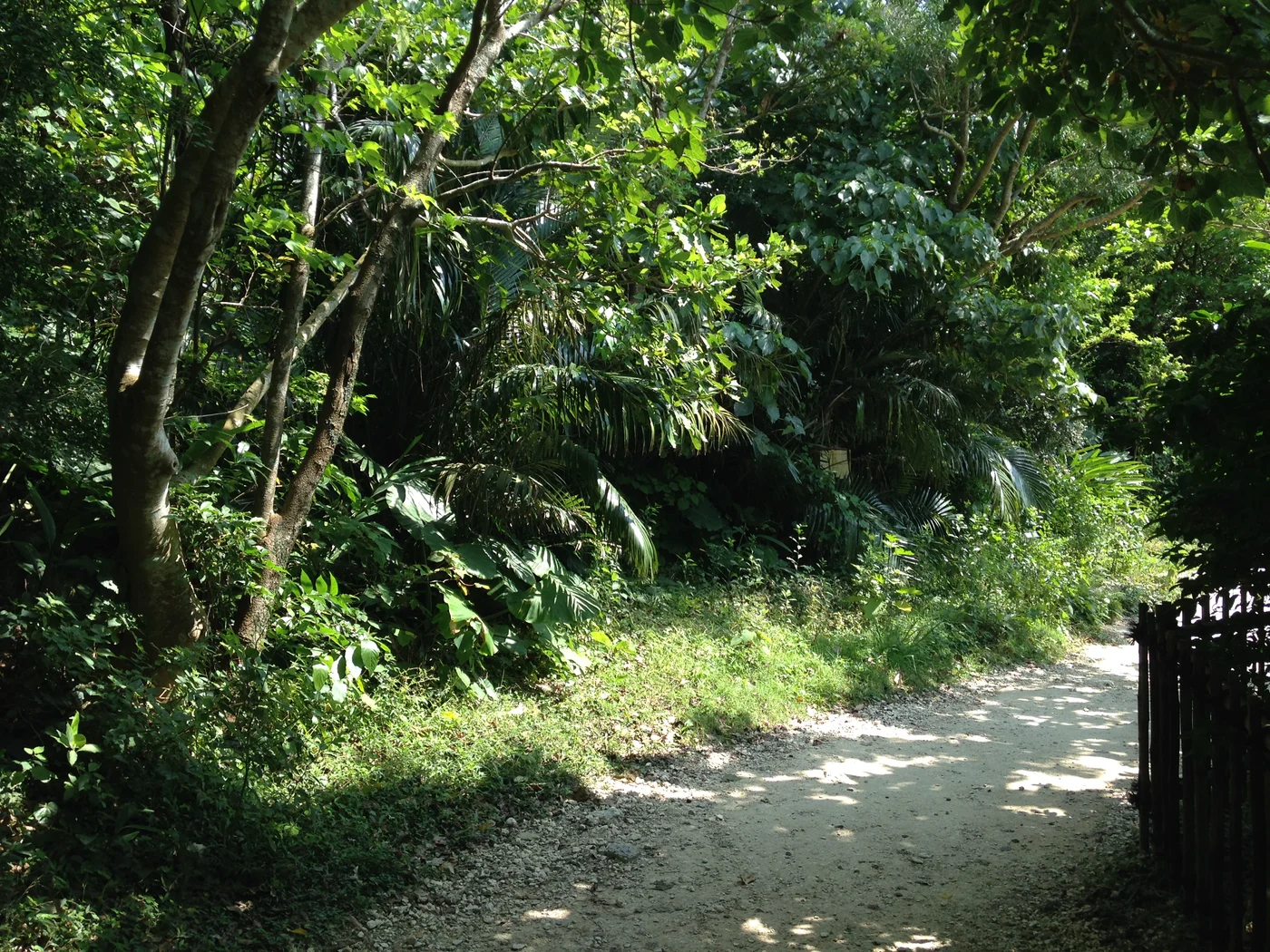
Because natural objects of worship form part of the site’s value, managing trees involves deciding which environment to retain. The interview describes both felling and identifying earlier and later vegetation, showing detailed choices. Visitors see a sacred site under continuing management, with people investigating and maintaining the relationship between rock and woodland.
The same feature records 438,000 visits in financial year 2012, holiday traffic affecting residents, wear on stone paths, pressure on nature and complaints from worshippers about some visitor behaviour. These were concrete management problems at the time. They help explain today’s walk from the local products centre to the entrance.
The management timeline lists the introduction of rest days in 2012 and relocation of parking and ticket sales to Nanjo City Local Products Centre in 2013. Separating parking, tickets and sacred entrance keeps vehicles outside and makes the final approach a walk. The itinerary must include this distance, while neighbourhood traffic and sacred-site visits gain separate space.
Current rest days are the first to third days of the fifth and tenth lunar months, six days annually, when nobody may enter the utaki. The operator explains them through quiet for the sacred site and nature protection. Lunar dates correspond to different Gregorian dates each year. Read rest days separately from construction restrictions: one follows the lunar calendar, the other limits areas for current works. Opening hours and rest days
A normal opening-day half-day: calculate ticket office and entrance separately
From Naha, leave a morning for Sefa and lunch afterwards. The operator estimates a normal visit at 50–60 minutes, including the journey from ticket office to entrance. Add time for explanations or a guide. The half-day also includes return travel, waiting and food, making Sefa a suitable main stop with few extra ticketed attractions.
The ticket office is beside Nanjo City Local Products Centre, about 500 metres or seven to ten minutes on foot from the entrance at Midori no Yakata Sefa. The operator states that tickets are not sold at the entrance. On normal paid days, buy at the products centre before walking along the road. Navigate to the centre and ticket office to put parking, purchase and entry in order. Access, parking and entrance location
The map page estimates ten to fifteen minutes from entrance to Sangui and about 30 minutes within the utaki. These show the general walking scale. Apply the current works area and Sangui interior ban described above to the actual route. From 2 November, full restrictions beyond Ujo-guchi reduce the visit to the entrance area; reassign time originally intended for inner worship places.
During normal opening, the operator’s specialist guides explain myth, royal history and spiritual culture. The reserved tour takes about 60 minutes along roughly one kilometre of stone approach. The basic fee for one or two people is ¥2,000; for three to 19, it is ¥1,000 per person. The booking section requires reservations by 17:00 two days before. Check in 15 minutes early at the ticket window beside the products centre. Official guided-tour booking information
¥600 admission, seasonal hours and the free works period
The current fee page read on 30 October 2026 lists ¥600 for senior high school pupils and older, ¥300 for primary and junior high school pupils, and free entry for children aged six and under. Adult groups of 20 or more pay ¥500 each. Two adults and one primary school child pay ¥1,500 normally. The homepage dates the change to 1 October 2026; the ¥300 adult price in older articles is the previous rate. Current admission fees
The notice explicitly makes admission free during the works restrictions starting 2 November. Access during that period ends at Ujo-guchi. Consider price together with what can be visited before deciding whether to make the journey. If Sangui and the other worship places are the goal, moving the date until after restrictions are lifted better serves that purpose.
Normal hours have two seasons. March–October: 09:00–18:00, ticket sales end 17:15 and last entry is 17:30. November–February: 09:00–17:30, ticket sales end 16:45 and last entry is 17:00. The 15-minute gap between ticket and entry deadlines reflects the walk from products centre to entrance.
Arrive in the morning for more reading time if you want lunch back in Naha. For an afternoon departure from Naha, calculate transport to the ticket office plus the 500-metre walk. A delay can affect both purchase and entry. During works, shorten the stay according to restricted access and leave the spare half-day time for a Nanjo meal or return to town.
Naha return travel: direct bus 338 and the 500-metre walk
Without a car, start at Naha Bus Terminal. The operator lists Toyo Bus 338, the Sefa Utaki Line, from stand seven, taking about 60 minutes to Sefa Utaki Iriguchi. Walk from Asahibashi Station to the terminal and identify the full route name and direction. The ticket office is in the car park facing the stop; buy there before walking towards Midori no Yakata.
Use Sefa Utaki Iriguchi for the return too. Choose a Naha-bound departure for your visit date before deciding when to leave the utaki entrance. After the forest, allow for walking back towards the ticket office, reaching the return stop and waiting. The operator links routes and full timetables to Toyo Bus’s website. Save both outward and return services before departure to define the time actually available.
Drivers should navigate to designated parking at Nanjo City Local Products Centre and walk in from there. The operator estimates about 50 minutes and 30 kilometres from Naha Airport, a journey with a specific starting point. Recalculate from accommodation on Kokusai-dori, in Shuri or on the west coast. If already staying in Naha, remain there for this cultural half-day to avoid moving accommodation and luggage.
Stone paving, slopes and prayer space determine who can walk the route
The utaki has slippery stone paving, steep slopes and steps. The operator explicitly excludes wheelchairs and pushchairs. This directly affects a family’s ability to visit inside. A traveller who must use a wheelchair continuously should not plan on reaching Sangui; with young children, account for adults’ ability to carry them and negotiate steps. Guided tours also require normal walking and stair-climbing ability.
Wear shoes suitable for wet stone, take rain protection when needed and use toilets at the products centre or outside the entrance before entry. There are no toilets along the guided route. The operator permits drinking water in bottles with screw caps for heat protection; eat outside the sacred area. Complete these preparations before entering so that attention can stay on names, objects and interpretation.
People still come here for faith, and Nanjo treats continuing use as part of its preservation value. Give worshippers quiet and room to pass. Leave altars, burners and jars in place; take no plants, animals or stones away. Turn back at management boundaries and allow for the final 500-metre walk and return transport. Afterwards, Nanjo’s cultural feature offers more on the Kikoe Okimi, water and excavated objects, now connected with places you can identify.
A visitor-etiquette video listed in Nanjo City’s 2020 cultural feature, to accompany this section’s preparations for prayer spaces and protecting ritual objects.
A few useful answers
Can I visit Sefa Utaki from November 2026?
From 2 November 2026, drainage works limit visits to the gate of the sacred grounds. Admission up to the gate is free while the restriction is in place, with 5 January 2027 as the planned end date. The interior of Sangui remains out of bounds, including on guided tours.
How do I get to Sefa Utaki by bus from Naha?
Take Toyo Bus 338 from stand 7 at Naha Bus Terminal. It takes around an hour to reach the Sefa Utaki Iriguchi stop. The ticket office is in the car park by the stop, around 500 metres on foot from the entrance.
What is the admission charge for Sefa Utaki, and how long does a visit take?
On regular paid days, the charge is ¥600 for upper secondary pupils and adults and ¥300 for primary and lower secondary pupils. Allow 50 to 60 minutes for a typical visit, including the walk from the ticket office to the entrance.
What ceremonies were held at Sefa Utaki in the Ryukyu Kingdom?
The king paid visits to the places of worship at Sefa Utaki, the most sacred site in the kingdom. The Kikoe Okimi, its highest-ranking priestess, was installed here, with the naming rite held at Ufugui.
Official information and references
Sources used in this guide.
- Sefa Utaki operator: restrictions beyond Ujo-guchi from 2 November 2026
- Sefa Utaki operator: utaki, Kikoe Okimi, eastern pilgrimage and inauguration
- Agency for Cultural Affairs: Sefa Utaki and royal rituals
- Nanjo City: 2020 cultural feature, worship places and conservation history
- Agency for Cultural Affairs: objects excavated from Sefa Utaki, Okinawa
- Sefa Utaki operator: opening hours and rest days
- Sefa Utaki operator: access, parking, tickets and entrance
- Sefa Utaki operator: guided-tour bookings and walking requirements
- Sefa Utaki operator: current admission fees
- Sefa Utaki operator: normal visit estimates on the map page
- Nanjo City: partial works completion in February 2026 and Sangui interior restriction