Travel from Okayama Station to Korakuen’s main gate, walk past Sawa-no-ike Pond, Ryuten and Chishio-no-mori, then cross Tsukimi Bridge to Okayama Castle and the Asahi River. Includes the ¥800 combined ticket, senior and student fares, lunch and wet-weather choices for families.
- Region & Focus
- Chugoku and ShikokuAttractions
- Reading Scope
- 30 min read · 21 chapters · 3 Q&As
- Official Verification
- 20 official sources checkedUpdated 27 October 2026
- Key Topics
- ItinerariesTravel budgetFood
Chapter Route Map (tap any stop)
- Keep the day between the castle and garden
- From Okayama Station: distinguish the two buses and Shiroshita tram stop
- Match your entrance and collection point before using the south gate
- Tickets: ¥800 for both as an adult, with different choices for students and older visitors
- The garden opens earlier than the castle
- Start with the open view by Enyo-tei, then approach the water
- Yuishinzan and Ryuten: height and running water change the pace
- Chishio-no-mori: spend time beneath the trees
- Nishiki-ga-oka and Kayo-no-ike for a longer walk
- Tea fields and Seiden: another side of the garden, best seen by day
- Your lunch location determines your exit
- Cross Tsukimi Bridge and see the castle from both banks
- Allow an hour for castle exhibitions and save energy for the top-floor stairs
- Coffee inside, lunch outside: plan each break
- Return borrowed equipment where you collected it
- A shorter family route: pond, Ryuten and the castle exterior
- Change the order in rain; reduce outdoor stops in heavy rain
- Autumn leaves run from mid-November to early December; illuminations follow separate dates
- Autumn Fantasy Garden 2026: starts at 17:00, last entry at 20:00
- Castle evenings: the keep opens late from 20 November, projections from the 21st
- Return to the station, or save Kurashiki for another day
- Quick Q&A
Spend the morning at Korakuen, have lunch outside the south gate or near the castle, then visit Okayama Castle in the afternoon. Add a walk along the Asahi River if you have the energy. Enter through the main gate, leave through the south gate and cross Tsukimi Bridge for a route that connects the two main sights. Adults visiting both the garden and keep should choose the ¥800 combined ticket; visitors aged 65 or over and senior high school students save by buying separately. If you use a pushchair or borrowed equipment, choose your exit around the return point. The castle lift only reaches 4F.
Keep the day between the castle and garden
For a first visit to Okayama, put Okayama Korakuen and Okayama Castle on the same day, with time for lunch and the riverbank. They face each other across the Asahi River and are easy to connect on foot. There is no need to return to the station between them. Allow more of the morning for plants and ponds, or keep the afternoon for the keep if you prefer Sengoku-period history and exhibitions. Treat the riverside walk as the final, optional part.
An arrival at the garden around 09:00, lunch around 11:30, the keep at 13:00 and departure from the castle area after 15:00 is a suggested schedule with breaks. If you reach Okayama at midday, allow an hour and a half for the garden and an hour inside the castle, with food between them. Avoid buying every ticket first and then rushing to fill the remaining time. Each attraction has its own last admission time. If you arrive late, start with the one that matters most to you.
Okayama and Kurashiki are easiest to arrange over two days: garden, castle and riverbank in Okayama, then museums and old streets in Kurashiki. To see both cities in one day, reduce Okayama to one main attraction before continuing to Kurashiki. Full visits to both leave less time for food and exhibitions. Use the Kurashiki Bikan Historical Quarter guide to decide how much of another day to allow.
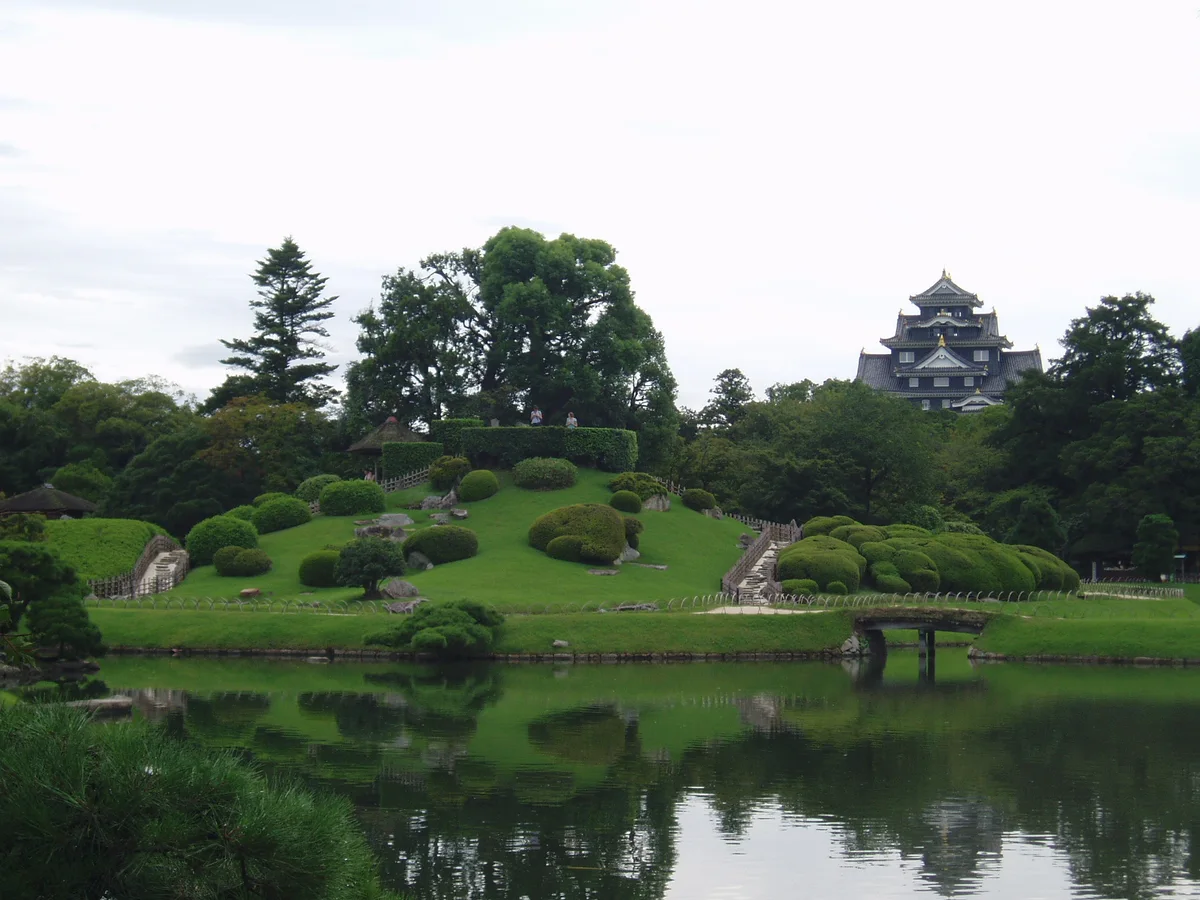
Travel from Okayama Station to Korakuen’s main gate, walk past Sawa-no-ike Pond, Ryuten and Chishio-no-mori, then cross Tsukimi Bridge to Okayama Castle and the Asahi River. Includes the ¥800 combined ticket, senior and student fares, lunch and wet-weather choices for families.
From Okayama Station: distinguish the two buses and Shiroshita tram stop
The Korakuen access page lists two services from stand 1 at the east-side bus terminal, outside the JR Okayama Station Korakuen Exit. Take an Okaden bus towards Fujiwara Danchi for about 10–15 minutes and get off at Korakuen-mae. Uno Bus’s Korakuen Bus takes about 10 minutes to Okayama Korakuen. These similar stop names belong to different operators. Save the operator as well as the stop when checking timetables and return boarding points.
Uno Bus’s operating page for the Okayama Korakuen stop gives a one-way fare of ¥120, paid on leaving. Children and people who meet the disability certificate conditions pay ¥60. Hareca, Hareca Half and credit cards are accepted. These terms apply to Uno’s Korakuen Bus; check Okaden for fares and rules on its Fujiwara Danchi route. Read the destination on the bus and confirm that it serves your stop before boarding. Sharing stand 1 does not make them the same service.
For the tram, take a Higashiyama-bound service from Okayama Station to Shiroshita tram stop. The garden lists about four minutes on board and a further ten minutes on foot; walking all the way from the station takes about 25 minutes. The tram offers a view of the city streets, while the bus reduces the walk to the gate. Choose the bus to save your legs for the garden. If you have lunch near Shiroshita or plan to visit the castle first, continue from the tram stop rather than returning to the station.
Match your entrance and collection point before using the south gate
The Korakuen main gate suits arrivals from the buses and car park. It also has the information desk, luggage storage and free equipment loans. Pick up the garden’s official 2026 map after entry to locate Chishio-no-mori, Sawa-no-ike and both gates. Use your phone to reach the main gate, then use the garden map for the smaller paths. A navigation pin in the middle of the whole garden can leave you outside searching for an entrance.
The south gate faces Okayama Castle. Leave here and walk towards Tsukimi Bridge to continue to the castle without returning to the main gate. Borrowed wheelchairs, pushchairs and stored luggage still need to be dealt with at their original location. If you left bags at the main gate, make a loop within the garden and collect them there, then decide whether to walk to the castle or return to the station. A closer south gate should not create another return walk.
The garden car park has 570 spaces for ordinary cars and charges ¥100 per 40 minutes. Reservations are not available. The garden also says right turns into the car park from Tsurumi Bridge may be restricted at busy times. Parking is for visitors to Korakuen and the prefectural museum. If this is your only central Okayama stop and you are staying near the station, public transport avoids finding a space and collecting the car later. Compare a hire-car day with a city day if you are continuing to mountain areas elsewhere in the prefecture.
Tickets: ¥800 for both as an adult, with different choices for students and older visitors
The admission guide updated in April 2026 lists general admission at ¥500 and admission for people aged 65 or over at ¥200. The trial of free entry for senior high school students and younger visitors runs until 31 March 2027. Senior high school students need a student handbook or other proof. The adult combined ticket for Korakuen and Okayama Castle keep is ¥800. Separate adult tickets cost ¥500 each, or ¥1,000 in total, so choose the combined ticket when you will visit both. Losing a ticket stub invalidates it; keep the unused part safe after your first visit.
There is no combined ticket specifically for people aged 65 or over. An older visitor from overseas pays ¥200 for Korakuen and the general ¥500 castle admission, a total of ¥700. This is cheaper than an ¥800 adult combined ticket. The castle’s free admission for people aged 65 or over applies to specified groups, including Okayama city residents. The garden’s age discount does not carry over to the castle. List the tickets needed by adults, older visitors and students before the family queues. Everyone need not buy the same type.
Senior high school students also need a different choice. Korakuen is free during the trial, but the castle’s free entry only covers junior high school students and younger children. Senior high school students pay the general keep admission. Bring proof for the garden and buy only the castle ticket needed. The main and south gate counters and ticket machines accept cash, credit cards, transport electronic money and some mobile payments. Korakuen’s admission page says online ticket sales are not available. Plan to buy on site, and distinguish third-party experiences from the garden’s own admission tickets.
The garden opens earlier than the castle
Daytime opening at the Korakuen main gate has two seasons: 07:30–18:00 from 20 March to 30 September, with last entry at 17:45; and 08:00–17:00 from 1 October to 19 March, with last entry at 16:45. The garden opens every day, with extensions on event dates. In spring and summer, enter earlier to finish the main outdoor route before noon and spend the hotter hours at lunch or inside the castle. Bring a light layer you can put in your bag on autumn and winter mornings.
Okayama Castle keep normally opens 09:00–17:30, with last admission at 17:00. It closes from 29 to 31 December. You can use the garden’s earlier start when visiting both on one day, but need not lose breakfast or sleep to arrive at 07:30. If you have just two morning hours, walk through part of the garden before going to the castle after 09:00. Afternoon arrivals should put both closing times on the same schedule.
Entering the keep at 17:00 leaves only half an hour before normal closing. Entering the garden at 16:45 in autumn or winter leaves fifteen minutes. These cut-offs tell you whether entry is possible, rather than when to aim to arrive. Families with pushchairs or older relatives should allow time for toilets, folding umbrellas and reaching the actual ticket counter. That is more useful than timing every transport leg to the minute.
Start with the open view by Enyo-tei, then approach the water
After the main gate, start around Enyo-tei and look across the lawns and pond to get your bearings. It once served as the lord’s living quarters in the garden. The present building was reconstructed after wartime destruction. A normal garden visit covers its exterior and setting; special interior openings are separate events. Look across the open space before entering the trees. On returning to the pond, you can recognise the tree belts you passed, rather than remembering only a series of Japanese signs.
Sawa-no-ike Pond forms the main waterscape. Different banks put pine branches, lawns or autumn leaves in the foreground, while the islands overlap or separate. Walk the open banks in daylight to change viewpoints. Start with the wider view, then look closely at the water’s edge. Photographers and slower walkers need not stop together at every spot. Agree to meet at the next clearly identified building to keep the walk flowing.
Construction began in 1687, when Okayama lord Ikeda Tsunamasa instructed his retainer Tsuda Nagatada to build the garden. It was largely complete in 1700, with later changes by successive lords. Paths and channels link the buildings, ponds and artificial hills of this strolling garden. As you move, the same water gains a different foreground. For an hour-long visit, choose the pond banks and Chishio-no-mori. Add Ryuten, Yuishinzan and the productive landscapes at the garden’s edge if you want to understand more of its changes.
Korakuen’s official video introduces garden panoramas, the seasons and its history, adding context to the spatial relationship between Enyo-tei, the ponds and paths.
Yuishinzan and Ryuten: height and running water change the pace
Yuishinzan is an artificial hill added under Tsugumasa, the son of Ikeda Tsunamasa. It gives the formerly flatter garden an elevated viewpoint. If slopes and steps suit you, visit midway through the daytime walk: first see the ponds and buildings from ground level, then compare their arrangement from above. Relatives using wheelchairs or avoiding slopes can follow the accessible map around the foot. Those who climb can return to meet them. The whole family need not climb for the same view.
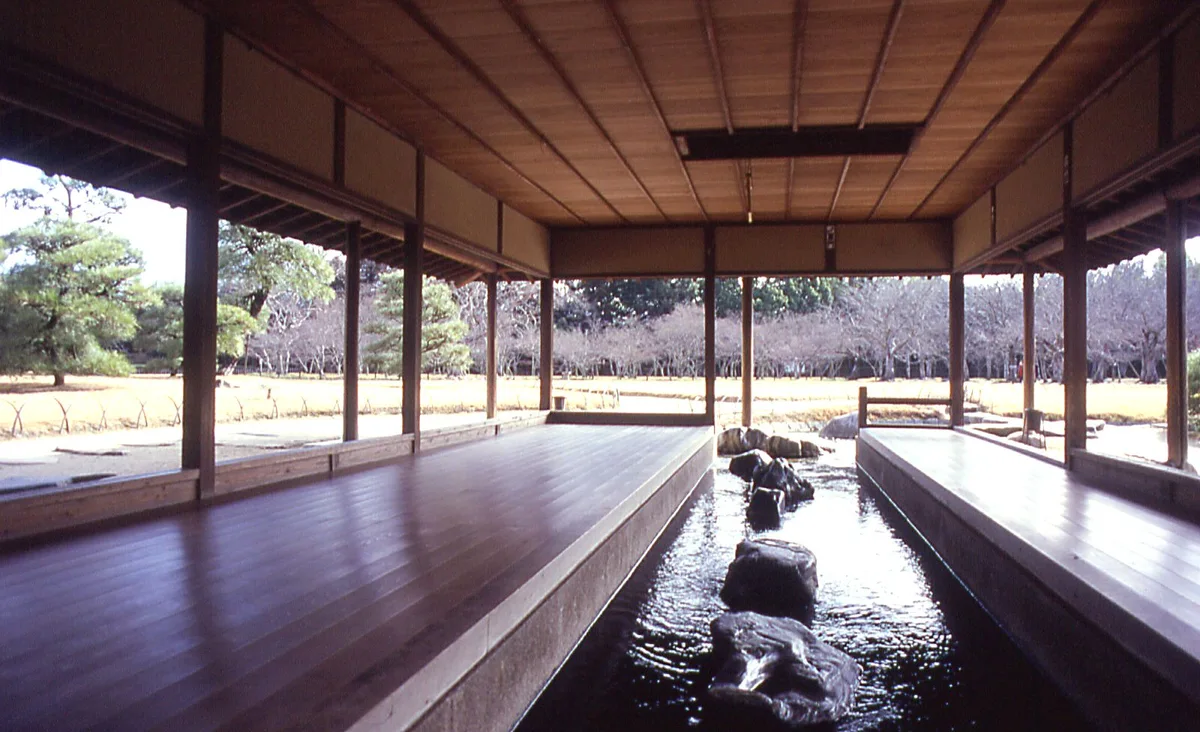
Nearby Ryuten draws attention to water. A channel runs through the centre of this building, with unusual stones of different colours in the water. It once provided a resting place for the lord and his guests. Look first at how the water enters and leaves, then at the relationship between the stones and timber structure. This makes it easier to remember than treating it as another teahouse. Ryuten is the name of a historic building; use a teahouse with business information for meals or tea.
Yuishinzan and Ryuten allow different lengths of stop. Photographers may spend more time looking for angles near the hill, while older visitors can focus on the water at ground level before sitting in a teahouse. Put this part after Chishio-no-mori to add terrain and sound to the autumn colours. It also makes the areas easier to distinguish by the end of the circuit. There is no need to spend the same time at every stop.
Chishio-no-mori: spend time beneath the trees
Chishio-no-mori is a principal autumn-leaf area, with about 100 maple trees. Its Japanese reading is Chishio-no-mori; Chinese texts also call it Chishio Grove. The garden explains that “Chishio” refers to repeated dipping in the dyeing process, and that the name dates from the garden’s creation. Compared with the pond, the view becomes closer: branching trunks, varying branch heights and overlapping leaves. You need not keep searching for a view of the whole garden.
Once on this path, let people behind pass before stopping where you will not block the route. Look at the autumn leaves in two stages: up at the branches against the sky, then down towards the lower leaves. Gaps through the grove also bring the tree colours and brighter parts of the garden into one view. Alternating close detail with distant views suits a slow walk. Rushing to photograph every tree can make it harder to see changes across the grove.
Approaching from the plum and cherry groves, notice how the planting changes along the path. Ask children to find differences in leaf shapes, fallen leaves and bark, rather than simply telling them there are more maples at the next stop. Stay on open paths; fallen leaves provide plenty to observe. The garden prohibits entry to restricted areas, running and throwing stones into ponds. Keep family activities to looking and finding, without crossing roots or stepping into planting beds.
Nishiki-ga-oka and Kayo-no-ike for a longer walk
Nishiki-ga-oka was designed for spring cherry blossom and the autumn colours of both cherry and maple leaves. The garden restored this planting idea using old plans, giving it a different character from the maple-dominated Chishio-no-mori. After close views in the grove, look here at tree shapes, buildings among the trees and the surrounding space. If one side is showing good colour, allow time to stop rather than leaving simply to complete another side route.
Kayo-no-ike Pond is known for Daimyo lotus in summer. In autumn, watch water flow through the rock arrangement into the pond, beside reflections of the trees around Nishiki-ga-oka. Listen first, then find where the water appears. This gives the stop a purpose even without a camera. In late autumn, lower the camera to put rocks and water in the foreground with trees beyond. These water details distinguish this part from the maple grove.
Add Renchi-ken to the daytime circuit for more historic architecture. One of the garden’s few buildings to survive wartime destruction, it retains its appearance after repairs following the 1934 flood. Nearby stone bridges and the small island opposite also keep their older layout. From the surrounding paths, compare the pond, pines and differences in level between the stream and pond with the open view at Enyo-tei. Each building faces a deliberately chosen scene.
Tea fields and Seiden: another side of the garden, best seen by day
Alongside its wide lawns, Korakuen retains productive landscapes such as the tea field and Seiden rice field. The tea field has occupied this position since the garden was built, and once supplied tea leaves for the lord’s daily use. Seiden preserves a trace of former farmland within the garden. Compare the orderly planting with the freer woodland scenery to see how different uses occupy the same garden.
The tea-picking festival in May and rice-planting festival in June give these landscapes a seasonal timetable. With children, start with “Why is there a field in a garden?” to add a question beyond autumn leaves. History enthusiasts can compare old garden plans with today’s lawns and the former extent of the fields. Visit this part by day. At night, spend time on that year’s illuminated route rather than trying to inspect every plant missed in daylight.
Your lunch location determines your exit
For a break inside the garden, try Fukuda Chaya or Sazanami Chaya. The garden’s teahouse guide places Sazanami Chaya beside Renchi-ken and lists heating and air conditioning, making it a useful later tea stop. Fukuda Chaya offers a matcha break. If you need a substantial lunch, or children need a fixed mealtime, treat the meal as a separate stop. Save the location before choosing the main or south gate.
Outside the south gate towards Tsukimi Bridge are Shiromi Chaya and Hekisuien. The garden describes hand-stretched udon and other dishes at Shiromi Chaya. Hekisuien serves noodles, rice dishes and drinks about 30 metres to the right outside the south gate. This area suits lunch after the morning garden visit and before crossing to the castle. For a fuller seated family meal, also consider Shikisai.
Choose food and prices from the day’s menu. Ask before sitting down about allergies, vegetarian food or meals for young children. Separate tea breaks from full meals so children do not have to get through the afternoon on snacks. If eating later, bring drinking water before entering and have lunch after leaving, rather than going out to search for a restaurant and then returning to the garden.
You can also finish the castle visit before heading towards Omotecho Shopping Street for food and then returning to Okayama Station. This suits a late breakfast or a morning without a seated break. If you are hungry at 11:00, eat near the garden gates. Choose lunch around your location and walking pace; avoid repeatedly crossing the Asahi River for one restaurant.
Cross Tsukimi Bridge and see the castle from both banks
Leave Korakuen’s south gate, walk towards Tsukimi Bridge and continue to Ujo Park on the opposite bank. The bridge shows how the castle, river and riverside trees sit together. Take photographs from a suitable space at the end of the bridge, and put your phone away while crossing.
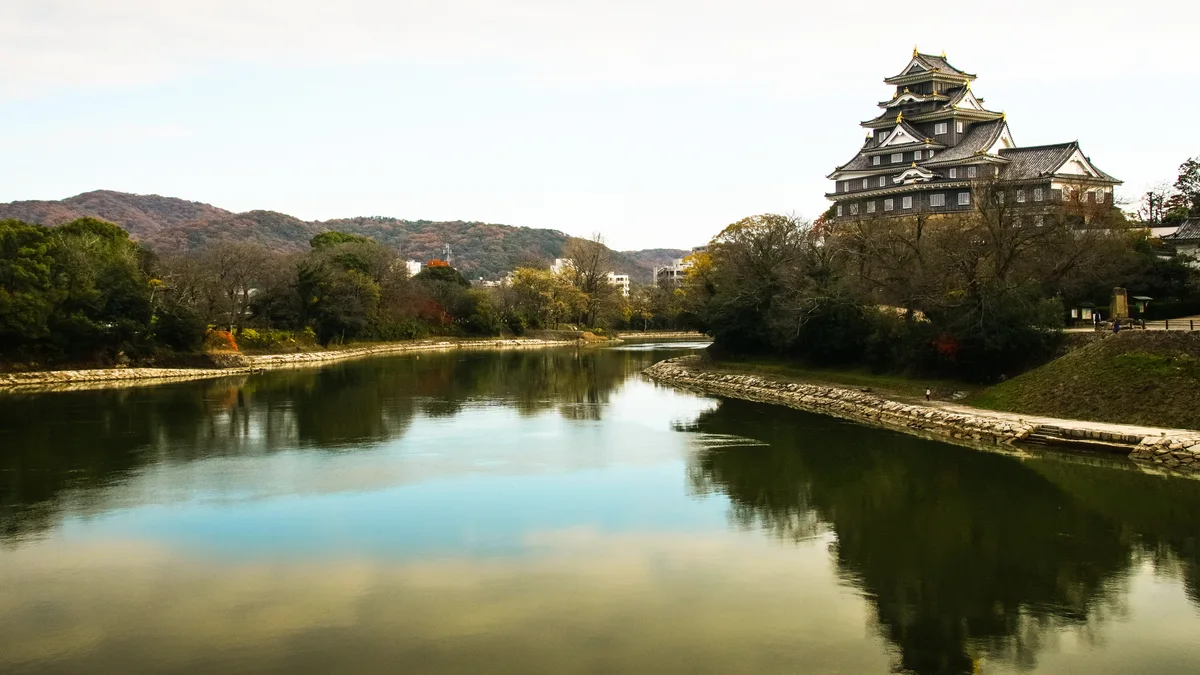
Decide separately on a riverside walk and the castle exhibitions. If you mainly want to see the black keep and stone walls, walk through Ujo Park and along the water before deciding whether to buy a castle ticket. If you will enter the keep, allow at least an hour inside and take outdoor photographs before or after. Steps still separate the riverbank from the keep entrance. Set navigation to the entrance of the Okayama Castle keep and include that walk in your arrival time.
In rain or high water, use the bridge and open upper-level roads rather than paths close to the water. Keep young children between accompanying adults and find a wide place before stopping to look. Observe waterbirds from the bank; avoid chasing games by the river. In heat, cold or strong wind, reduce the riverside section to the bridge crossing. Lunch and the return journey can then follow the original plan.
Allow an hour for castle exhibitions and save energy for the top-floor stairs
Inside Okayama Castle keep are exhibition spaces. The castle FAQ says most visitors spend about 50–60 minutes, or about an hour and a half for a closer visit. Put this after lunch if companions want to read displays or take photographs. Use the internal guide to understand the floors, then divide time by the subjects that interest you rather than spending equally on each level.
The lift runs from B1 to 4F, using the castle’s floor labels. Stairs connect 5F and 6F. If you want the top-floor city view, tackle the stairs while you have energy. Older relatives or people avoiding stairs can visit the lift-accessible exhibitions. The castle states that the outside route to the keep has steps only. Wheelchair users need separate plans for reaching the building and moving inside it.
Pushchairs are allowed, but adults must handle them on the approach steps. Entry with them may also be restricted when the building is crowded; reception can help store them temporarily. A sole adult with a young child may find a baby carrier, less luggage or an exterior castle walk easier than trying to lift both child and pushchair at the steps. With several adults, agree who will look after the child and who will carry equipment before approaching.
Basement level 1 has lockers requiring a ¥100 coin, returned when the locker is opened. They follow normal opening hours, 09:00–17:30. Reception handles larger bags; Ujo Park has no lockers. Allow a return to the building if you store bags before an outdoor walk. Photography is permitted in some areas. Follow no-photography signs, avoid flash, tripods and selfie sticks, and do not stop on stairs to use your phone.
Coffee inside, lunch outside: plan each break
Ujo Cafe on the keep’s 1F (ground floor) offers a break between exhibitions. Eating and drinking inside the castle is limited to the cafe space and to items bought there. Eat packed lunches or takeaway food at a suitable place outside. If you ate before entry, place the coffee break later in the visit so searching for a seat does not interrupt the exhibitions.
For families, combine lunch with toilets and adjusting children’s clothing before continuing to the keep or riverbank. If someone will not enter the keep, meet for lunch outside and split up afterwards. Do not choose a meeting point inside the paid area.
Return borrowed equipment where you collected it
The garden’s loan service offers free wheelchairs and pushchairs. Borrow a wheelchair at the main gate or car park entrance and return it to the same place. Pushchairs are borrowed and returned at the main gate. Families using these services should plan a loop from and back to the main gate, then continue to the castle after returning the equipment. With your own equipment, follow the accessible map and omit unsuitable sections such as Yuishinzan’s slopes and steps. The level pond banks and woodland still cover major sights.
Lockers north of the main gate ticket office cost ¥300, ¥200 and ¥100 for large, medium and small sizes. Bags too large for them can be left at the admission counter. This helps if you visit directly after reaching Okayama, but collection brings you back to the same entrance. Leave bags at your accommodation or station if you want to continue one way through the south gate to the castle and then the station. If bags are already at the main gate, include the return in your route.
A separate accessible garden map is available to download. At night, follow the lighting and the route open that evening. One companion can check directions while another watches the ground, instead of everyone looking at phones. Stop in a wider area for rests and wait for photographers to rejoin before moving on. Do not leave equipment waiting at narrow bends.
A shorter family route: pond, Ryuten and the castle exterior
With preschool children, begin by Sawa-no-ike Pond, watch the water at Ryuten, then walk through some shade before a break. Add Chishio-no-mori or the tea field only if the children want to continue. If they are tired, return by the same route to the main gate to hand back a borrowed pushchair. The broad lawns form part of the scenery. Follow signs showing where access is allowed rather than treating all the grass as a play park.
With your own pushchair, use it in the garden in the morning and see the keep and stone walls from outside in the afternoon to reduce carrying. Families wanting to enter the keep can plan a nap around lunch and decide after the child wakes. Two adults can split briefly, with one staying with the child and the other visiting the exhibitions. Agree a clear meeting place and time outside the building.
Garden rules prohibit running, balls, badminton, balloons and other play equipment, feeding the red-crowned cranes, throwing stones into ponds and entering restricted areas. Instead, look for leaf shapes, follow the direction of water or identify bridges. Spending longer at one place helps children continue more readily than constantly naming the next stop. Plan toilets after entry and before leaving, and keep water and hats within reach.
Change the order in rain; reduce outdoor stops in heavy rain
In light rain, wear shoes with good grip and use rain gear that packs away. Keep to the pond banks and level main paths, omitting Yuishinzan’s slopes and steps. An umbrella takes one hand, so a companion can check the map for a pushchair or wheelchair user. Fold wet umbrellas near a teahouse or entrance before handling phones. Finish one waterside section you want to see, then leave. Lunch and the keep exhibitions can give the rest of the day a clear focus.
In persistent rain or strong wind, put Okayama Castle in the morning and decide whether to enter according to how well the approach steps suit your group. Reaching the keep still requires an outdoor walk from the transport stop, followed by steps. If the surface is slippery or a young child is uncomfortable, return to the city for food and rest. Do not add a long riverside walk that afternoon.
For an indoor alternative, choose either Okayama Prefectural Museum of Art or Okayama Orient Museum according to its current exhibition, opening days and admission that day. Both lie in the cultural area between Shiroshita and the station, making them useful replacements for outdoor time. Check the prefectural museum or Orient Museum closures and exhibitions before walking there. If closed, finish with lunch and the station area, saving energy for the next day.
Autumn leaves run from mid-November to early December; illuminations follow separate dates
The garden flower calendar lists autumn foliage from mid-November to early December. About 250 maples grow across the garden, with cherry trees, ginkgoes and other autumn colour. Chishio-no-mori and Yuishinzan are highlighted maple areas. Early-November visitors can enjoy the garden and other autumn plants. For a maple-focused trip, put a flexible city garden day in the second half of the month. Early December remains within the foliage season, but the 2026 evening event ends on 29 November, so choose a daytime route then.
The same garden offers different scales of view. Chishio-no-mori brings branches and leaves close overhead; Sawa-no-ike combines water, the far bank and distant colours. Around Yuishinzan, maples sit within the terrain. Open waterscapes remain worth a stop before peak colour. After some leaves have fallen, branching shapes and leaves on the ground give the woodland its late-autumn character.
The flower calendar also lists sasanqua camellias from late October to late January and winter camellias from early November to late February. Look for pink or white flowers on hedges near the south gate and plum grove in late autumn. Daimyo lotus at Kayo-no-ike in summer, Japanese irises in June and spring plum blossom belong to other seasonal visits.
Autumn Fantasy Garden 2026: starts at 17:00, last entry at 20:00
The garden’s 2026 Fantasy Garden announcement lists the autumn event from Friday 20 to Sunday 29 November, 17:00–20:30, with last admission at 20:00. Normal garden admission applies at night: ¥500 general admission and ¥200 for ages 65 or over, with the current free-entry conditions for senior high school students and younger visitors. If attending only at night, eat in the city or western outer garden first and enter soon after the start. This leaves much more walking time than arriving just before last entry.
Okayama Prefecture’s 2026 autumn programme lists lighting and Japanese umbrellas in Chishio-no-mori, plus “Moonlit maples: a path of light leading to the castle” beside Gojusantsugi Koshikake Chaya. Use these as two main evening stops and connect them with the map of open routes provided on the night. Daylight shows leaf colours and garden layout; evening reveals how lighting picks out branches, ground or buildings. For a comparison, photograph in similar directions without trying to repeat every daytime viewpoint.
Buy tickets, use the toilets and gather your group at the gate before heading to the lights. Evening photography often takes longer than walking. With older relatives or children, choose Chishio-no-mori and one pondside section. Entry at 20:00 leaves only half an hour, including the walk to the exit. If you reach Okayama late, finish with dinner and a city walk, then choose another evening to enter earlier rather than hurrying your companions.
Castle evenings: the keep opens late from 20 November, projections from the 21st
The castle’s 2026 collaboration announcement lists evening keep opening until 20:30 from 20 to 29 November, with last entry at 20:00. Projections on the stone walls run 17:00–20:30 from 21 to 29 November. Visit the garden and keep at night on 20 November, or choose the 21st onwards for the projections. To visit both in one evening, see the keep first, eat, then enter the garden, allowing time for food and the bridge crossing.
Viewing the collaboration’s outdoor display is free; the keep still needs a ticket. A garden ticket is enough if you only want the garden and the castle’s exterior night views. Re-entry to the keep is not allowed during the collaboration, so visitors who saw the exhibitions that afternoon can stay outside for projections or return to the city for dinner. Follow the garden’s open evening route. Chishio-no-mori and one pondside section make a full evening stop without revisiting every daytime side path in the dark.
Return to the station, or save Kurashiki for another day
Choose your return from where you finish. Take a bus outside the main gate to the Okayama Station Korakuen Exit, or leave the castle area via Shiroshita tram stop or a walk through the city. Save the outward bus stop, return boarding direction and last departure together. Searching only after an autumn evening event can lengthen the wait.
If leaving by Shinkansen that day, allow time after returning to collect bags, buy food and enter the station. Bags at Korakuen’s main gate require a return there. If they are at Okayama Station, finish near Shiroshita or Omotecho without crossing the bridge again. Drivers should likewise return to their original car park. Keep the final riverside walk on that bank to avoid increasing the walk back to the car.
On a Sanyo trip, Okayama fits well around Shinkansen travel, with a separate daytime visit to Kurashiki’s museums and canal and a full day for Hiroshima’s central sights and meals. For travel west, continue with the Hiroshima city transport and food guide. If you are staying two nights in Okayama, let the second day in Kurashiki start at an easy pace. Dinner near the station is enough to finish the first evening.
A few useful answers
How much is the Korakuen and Okayama Castle combined ticket?
¥800 for adults. General tickets cost ¥500 each, so visiting both saves ¥200. Visitors aged 65 or over pay ¥200 for Korakuen and ¥500 for the castle separately, a total of ¥700.
Are both Korakuen and Okayama Castle free for children?
Korakuen’s trial of free entry for senior high school students and younger visitors runs until 31 March 2027. Senior high school students need proof. Okayama Castle is free for junior high school students and younger children; senior high school students buy the ¥500 general ticket.
Can we visit both in one day with a pushchair?
Use the accessible map for level garden paths. Return a borrowed pushchair to the main gate. The approach to the castle keep has steps; the indoor lift reaches 4F, with stairs to 5F and 6F.
Official information and references
Sources used in this guide.
- Korakuen: current admission, combined tickets, student discounts and annual passes
- Korakuen: transport and parking
- Korakuen: garden features
- Korakuen: flower calendar and autumn foliage season
- Korakuen: history and changes to the garden
- Korakuen: luggage storage, wheelchairs and pushchairs
- Korakuen: visitor rules
- Korakuen: teahouse guide
- Fantasy Garden 2026 dates and times
- Okayama Castle: visitor guide and keep admission
- Okayama Castle: 2026 collaboration, evening opening and re-entry rules
- Korakuen: 2026 official garden map
- Korakuen: accessible garden map
- Okayama Castle: FAQ on pushchairs, wheelchairs, steps and visit duration
- Okayama Castle: April 2026 admission changes
- Okayama Prefectural Museum of Art
- Okayama Orient Museum
- Uno Bus: direct Korakuen bus, fares and timetable
- Okayama Prefecture: Autumn Fantasy Garden 2026 programme
- Okayama Castle: Ujo Cafe location and opening hours