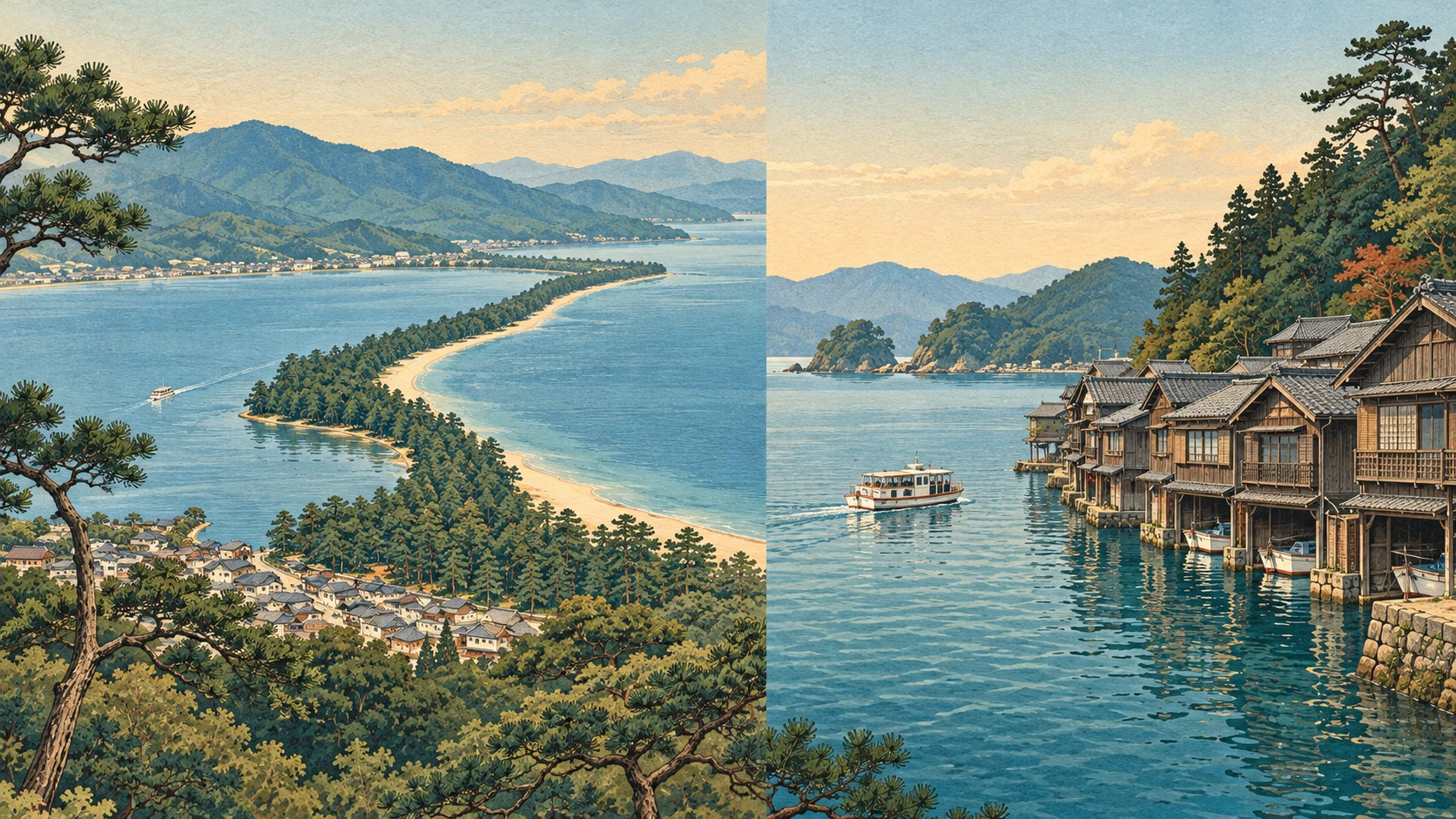
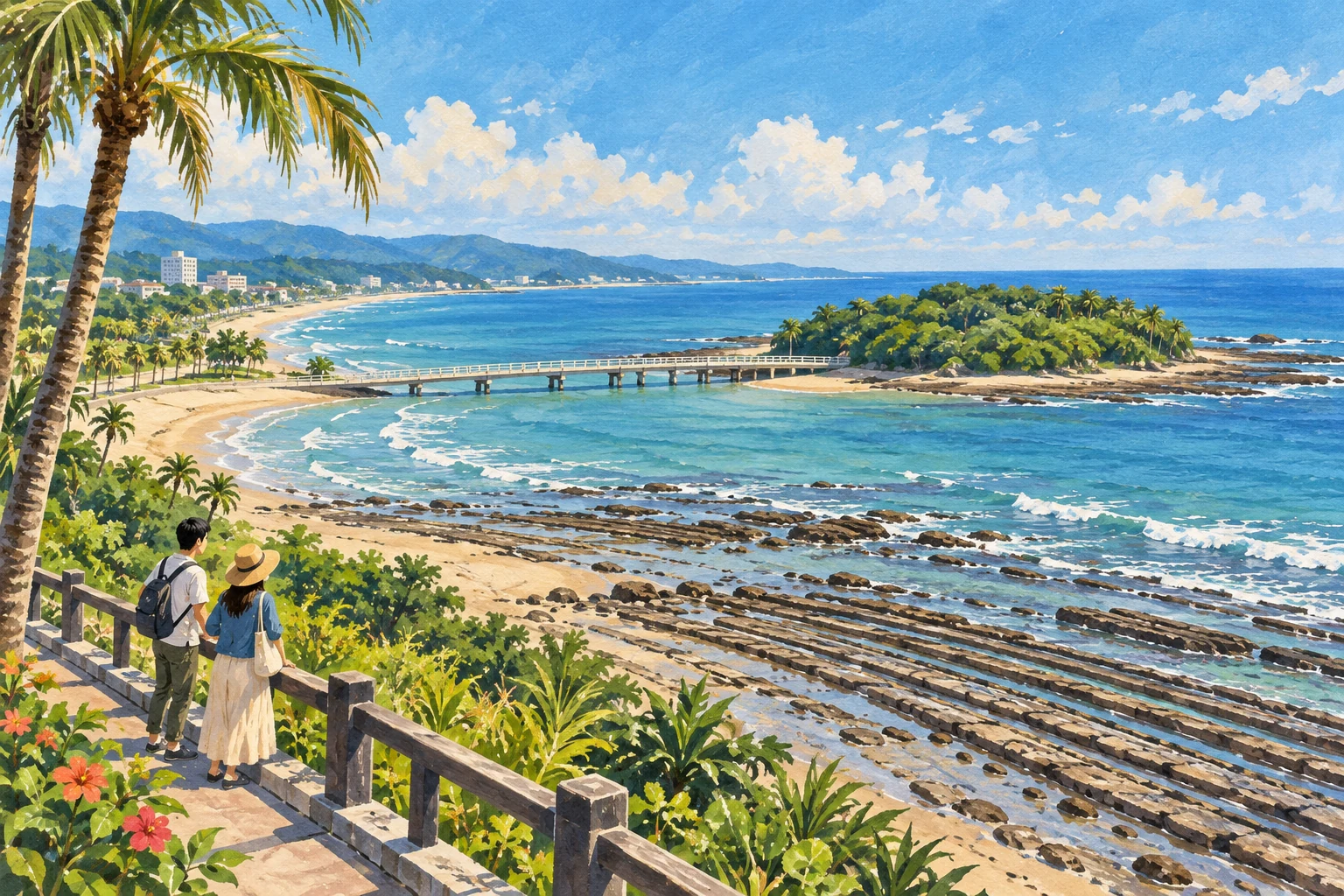
The Nichinan Coast rewards time beside the sea, but a single coastal road on the map does not make it a city route where you can hop on and off whenever you like. On a first visit, choose Aoshima and Udo Shrine, then decide whether your third priority is the moai statues or Obi castle town. Without a car, choose the return journey before choosing how long to stay. This guide puts buses, walks from parking areas, accommodation and weather into the same plan, so both a coastal day trip and a slower two- or three-day visit are workable.
Choose the trip length: three priorities in a day, more room over two or three days
With one full day and a wish to see Miyazaki's most recognisable coastal scenery, make Aoshima and Udo Shrine your two anchors, then choose either Sun Messe Nichinan or Obi. The former is a hillside park with moai statues and sea views; the latter is a castle town inland. Both deserve time, but they offer different experiences. Driving makes adjustments easier, while still requiring time to park, walk shrine approaches, eat and return.
Without a car, a half-day in Aoshima is the simplest option. Combining Aoshima with Udo Shrine requires checking particular bus services. For a proper visit to Aoshima, Udo, Sun Messe Nichinan and Obi, plan two or three daylight days and accept that one day may focus on just one area. The suggested visit lengths here are planning judgments, not attraction rules or promises about your walking speed. Older travellers, young children, photography and meals can all add time.
Information was checked through 2026-10-22. The first points to know are a landslide closure on the municipal Udo Sangu road, Miyazaki Kotsu's new October timetable and fares, and additional Sun Messe Nichinan closures beyond Wednesdays. The dates of the information are retained below. If you travel on another date, update these three items before using the itinerary; this guide is not a live service guarantee.
Understand the map: Aoshima is north, while Obi means turning inland
Heading south from Miyazaki City, a common coastal sequence is Aoshima, Horikiri Pass and Roadside Station Phoenix, Sun Messe Nichinan, then Udo Shrine before continuing toward central Nichinan. Obi requires a different rhythm of castle-town walking away from the coastal sights. Cape Toi lies farther south in Kushima and needs separate time. Being in the same prefecture does not make places convenient additions; Takachiho and the Nichinan Coast should not be packed into opposite ends of one day either.
For the third stop, ask your companions whether they want moai and sea views in an open park or stone-walled streets, historic houses and museums. Enjoying photography but disliking long uphill walks does not automatically make Sun Messe the right choice. Equally, an interest in history is hard to satisfy with only thirty minutes in Obi. Discussing what you actually want to do is more useful than following a popularity ranking.
If you also plan Kagoshima, Kirishima or Ibusuki, treat the Miyazaki coast as a separate overnight part of the trip rather than an extra attraction within a Kagoshima city day. Keep room for intercity travel and check-in before adding a short Aoshima walk. For a first trip with several transport legs, use the booking and arrival sequence for a first Japan trip to establish each day's real start and finish.
| Area | Main experience | Suggested allowance |
|---|---|---|
| Aoshima | Shrine, coastal rocks, botanical garden and a meal | A half-day is more relaxed |
| Udo Shrine | Cave sanctuary, coastal approach and prayers | Allow roughly 90–120 minutes or more from parking, including the return walk |
| Sun Messe Nichinan | Moai, hillside viewpoints and park walks | About 90–120 minutes; bus travellers also need the uphill and downhill walk |
| Obi | Castle ruins, museums, streets and local food | At least a half-day makes choosing easier |
From Miyazaki Airport: decide between the city, Aoshima and the rental office
Miyazaki Airport's transport guidance gives about 10–15 minutes by JR to central Miyazaki and 20–30 minutes by bus. These are indicative times on the vehicle, excluding disembarkation, immigration, baggage collection, waiting and the walk to your hotel. For a late arrival, staying in the city and starting the coast the next day is often more dependable than chasing a southbound bus with luggage.
There are local buses from the airport toward Nichinan, but not every city bus goes to Aoshima, and there is no direct bus to Udo at every hour. If taking the train to Aoshima, check the entire connection with JR. A train toward Miyazaki from the airport and a Nichinan Line train toward Aoshima are not necessarily the same through service just because of platform names. The airport's rail page links to station timetables and service information; search all the way to Aoshima or Obi.
Allow time to collect a rental car as well. The airport explains that its Level 1 service counter can contact the pickup service for a booked vehicle; that does not mean the car is parked beside the arrivals exit. Confirm the office address, last pickup and return times, fuel requirements, luggage space and documents for every driver. After returning the car, a shuttle to the terminal may still be necessary. Using the flight departure time as the car-return deadline misses a whole sequence of required steps.
Coastal buses: find the column that actually stops at Udo
Miyazaki Kotsu's timetable revised on 2026-10-01 includes both shorter Aoshima routes and Nichinan services. On weekdays, southbound departures from Miyazaki Station that actually show a Udo Shrine stop are 9:40, 11:10, 13:30 and 15:20. Saturdays, Sundays and Japanese national holidays list only the first three. These are the services shown in that version, not a year-round timetable. Looking only at the many entries on the Aoshima row greatly overstates the flexibility of travel to Udo.
The same table includes buses using Horikiri Tunnel and skipping some viewpoints or Udo Shrine. Check the destination, route and whether the actual stop cell contains a time; an arrow does not mean you can get off there. Before boarding, saying “鵜戸神宮” or “サンメッセ日南” is clearer than merely asking whether the bus goes toward Nichinan. Miyazaki Station, Miyako City and Miyazaki Airport are different boarding points, so their departure times are not interchangeable.
Check northbound services first too. In this version, weekday departures from Udo Shrine are 8:32, 11:02, 13:02, 15:27 and 16:32; the 13:02 does not run on weekends or holidays. Missing a bus may cost hours rather than a wait until the next hour. Choose a main return and an earlier fallback before leaving. For cancellations or road-related changes, consult Miyazaki Kotsu's current route timetables and notices instead of deciding to continue south on the strength of an old screenshot.
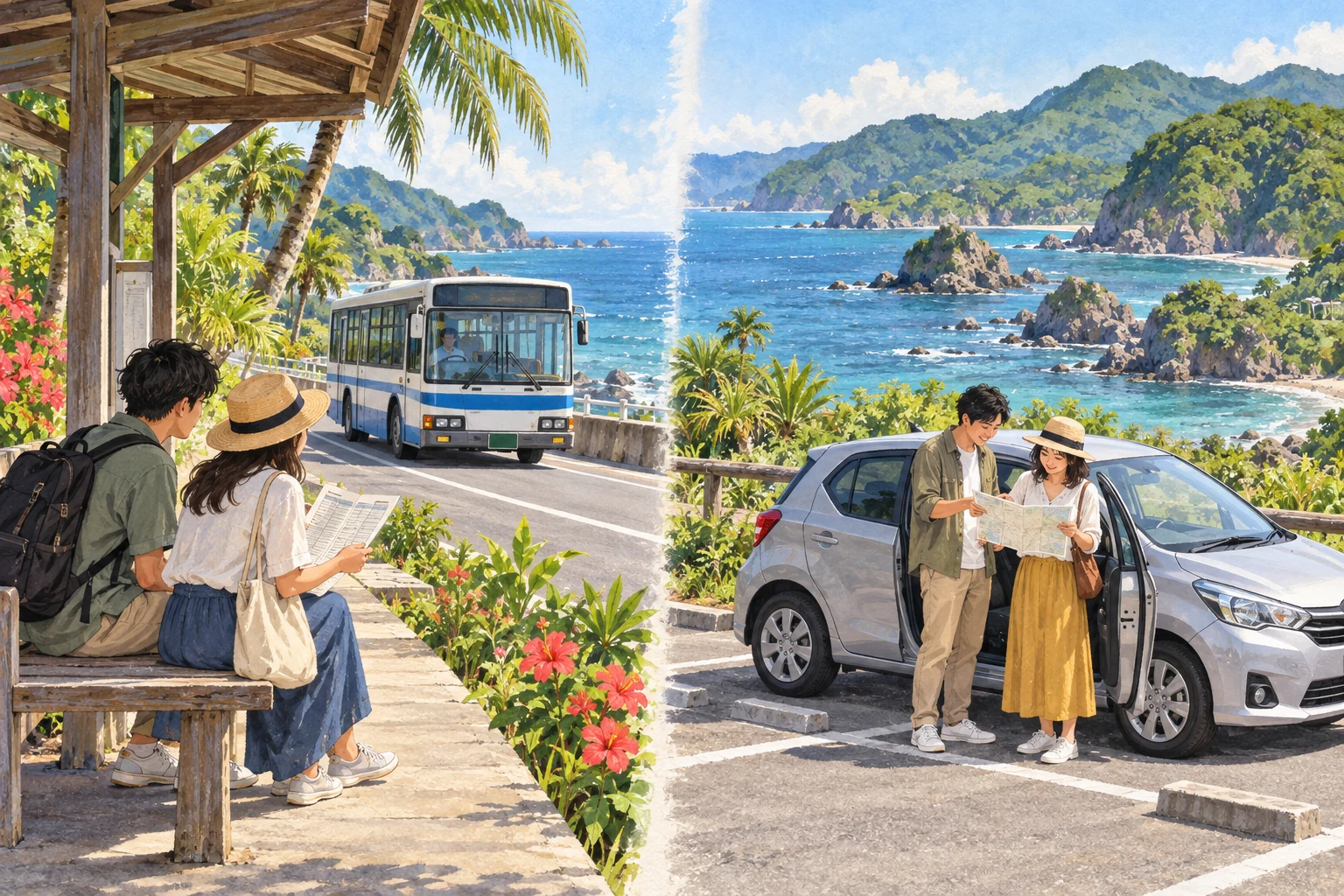
A car-free day example: Udo first on a weekday, then Aoshima
This example uses the weekday timetable above, assumes normal service and starts with you already staying in Miyazaki City. Leave Miyazaki Station at 9:40 and arrive at Udo Shrine bus stop at 11:07. Complete the approach, worship and a short rest, then take the 13:02 northbound service, reaching Aoshima at 13:36. The interval is 1 hour 55 minutes, including the walk after alighting; it is not all time at the sanctuary. If your group cannot comfortably finish within that window, change transport or reduce the destinations.
Keep Aoshima Shrine, coastal observation, the botanical garden and food in the same area during the afternoon. Compare JR and buses afresh for the return to Miyazaki, rather than going south again to fit in the moai. This order deals first with Udo's sparse services, then leaves you in Aoshima, where there are more transport choices. You still need that day's last services and the location of your accommodation; do not wait until noticing sunset colours to start looking for a ride.
Do not copy the 13:02 connection onto a weekend. An alternative is Aoshima in the morning, the 12:03 southbound bus arriving at Udo at 12:37, and a return planned around 15:27. Check whether meals, waiting and walking fit. If that wait feels excessive, choose Aoshima alone or a private vehicle with confirmed dates and pickup. A timetable neither reserves your seat nor guarantees a later connection after road delays.
One-day bus passes: the foreign-visitor pass is not necessarily cheaper
Miyazaki Kotsu's network one-day pass currently lists an adult fare of 2,500 yen and a child fare of 1,250 yen, with the child category labelled elementary-school age and younger. A 2,200-yen student pass has specified eligibility and student-ID requirements. Ordinary routes are covered, while exclusions include inter-prefectural highway and express buses, the Miyazaki–Takachiho route and community buses. The pass does not include JR, taxis or admission charges, and unlimited rides do not create more bus services.
The operator compares the pass with a regular Miyazaki Station–Obi return fare of 4,480 yen, a saving of 1,980 yen for an adult. That example has a defined route; it does not mean any two stops pay for the pass. For an Aoshima return, or a morning JR trip followed by one short bus ride, add up the actual one-way bus fares first. Passes are not sold on board: choose a counter, convenience store or officially listed mobile purchase method before leaving, and read payment and refund rules. Convenience-store tickets cannot be refunded after issue. Unused paper tickets with no date circled have deadline conditions; if a date has been circled, refund procedures must be completed no later than the previous day. The counter fee is 110 yen, while mobile tickets have their own purchase terms.
VISIT MIYAZAKI BUS PASS also currently costs 2,500 yen and includes multilingual information. It is for overseas visitors and international students meeting the rules. Ordinary visitors must show a passport and return-flight ticket or an alternative itinerary when buying; students must show a residence card with a Miyazaki address and “Student” residence status. The pass is valid for one month from issue, with travel limited to the single date entered. A foreign passport alone does not establish eligibility for a long-term resident. Do not reuse the old 2,000-yen price.
The JR-and-bus pass, transport IC cards and Umisachi Yamasachi are separate
JR Kyushu's current MaaS product page lists the “JR&宮交バス 日南1デーパス” at 3,600 yen for adults and 1,800 yen for children. The rail component is a return journey on local and rapid trains within specified sections: Miyazaki–Minami-Miyazaki, Minami-Miyazaki–Aburatsu and Tayoshi–Miyazaki Airport. The bus component allows unlimited rides on specified routes from Miyazaki Station to Obi and from Obi to the 幸島入口 stop, with additional local benefits. This differs from older information claiming coverage to Nango, unlimited JR travel and an adult price of 2,300 yen.
If you want a coastal bus outward and a JR return from Obi, the words “1Day” alone do not establish that every combination is covered. Before buying, confirm the sections, travel date, how the JR return entitlement works and intermediate-stop rules on the purchase screen. Compare that with a bus pass plus a separate rail ticket. The description specifies local and rapid trains; do not assume a sightseeing limited express is included. Ask the seller about combinations you cannot establish.
JR Kyushu's SUGOCA area map now includes Aoshima in the Miyazaki area, but it does not mark the whole Nichinan Line to Obi, Aburatsu and Nango as covered. Being able to tap in and out at Aoshima does not mean you can do so at every station farther south. Buy the right ticket before leaving the applicable area rather than trying to fix it at a station without the necessary equipment. Rail and bus ticket coverage must be checked separately.
If you want Umisachi Yamasachi, make room for the train itself
JR Kyushu's official Umisachi Yamasachi page states that this sightseeing limited express currently has reserved seats throughout. Reserve before boarding; seats cannot be assigned on board. It runs on specified dates, not every day like an ordinary Nichinan Line service. If its wood-lined interior and scenery appeal to you, make the ride a main experience and fit Obi or Nango around it, rather than filling the day with shrines and moai and squeezing in a train afterward.
The timetable revised on 2026-03-14 shows Miyazaki departure at 9:43 and Nango arrival at 11:32; the return leaves Nango at 14:00 and reaches Miyazaki at 15:35. The outward service lists a Miyazaki Airport stop, while the return has a different stopping pattern, so do not assume both directions serve the airport. The official adult one-way Miyazaki–Nango example of 3,140 yen combines the base fare with a regular-season reserved-seat limited-express charge. The reserved-seat charge varies by travel date. Check the price for your own section if riding only part of the route.
When comparing an ordinary Nichinan Line train with the sightseeing limited express in the same search, check destination, ticket type and seat availability, not just an attractive train name. For a rail pass, establish its area and reservation rules first. The route-based approach to choosing Japan rail tickets is useful here; do not add unnecessary backtracking simply to make sure you use a pass.
Driving gives flexibility; navigation time is not sightseeing time
For two or three people or more, with someone able to drive legally and comfortably and a wish to adjust coastal stops, a car usually makes three priorities in a day easier. Compare the whole rental, protection plan, fuel, parking and any one-way return fee. Dividing only the rental charge by the group size and comparing it with one bus ticket leaves costs out. Actual rates depend on date, vehicle and plan; example amounts here are not guaranteed quotes.
A workable route means entering lawful parking areas one by one in navigation. At Aoshima you walk from parking on the mainland; Udo currently has a closure; Sun Messe has slopes after parking; and Obi is best explored on foot after leaving the car in tourist parking. A sea view beside the road does not make stopping lawful. Drivers should park before getting out to take photographs, without leaving passengers waiting at junctions, bends or entrances.
Include breaks after older travellers or children complete a walk when setting the day's limit. A meal of chicken nanban, Miyazaki beef or seafood should not be reduced to ten minutes inside the car. Dinner is better placed at your overnight base once you have arrived. If the car must be returned that evening, choose a third stop you can shorten, put the essential shrine earlier and decide in advance which stop to drop if delayed.
Aoshima Shrine: cross the bridge and approach before deciding to circle the island
Aoshima's shrine, coast and botanical garden are close together, so each activity does not require another ride. From Aoshima Station, walk through the streets toward the shore and Yayoi Bridge, cross to worship, then decide how much farther to walk beside the sea according to your energy. The prefecture's public-transport example estimates about 15 minutes from station to shrine. For rock photographs, the Motomiya sanctuary, rests and food, a half-day around Aoshima is more comfortable than treating it as a one-hour connection gap.
Aoshima Shrine's notice gives usual worship hours as 6:00 to sunset. Amulets and goshuin seals are available from 8:00 in summer or 8:30 in winter until 17:00, with separate New Year arrangements. Arriving early for worship does not mean the amulet office is open. Equally, a bright evening sky does not establish access after sunset. If receiving a goshuin matters to you, put the office first and the coastal stop afterward.
Miyazaki City's Aoshima introduction describes rituals behind the main hall, including throwing an unglazed clay dish and tying paper prayer cords. These are acts of faith and worship, without guaranteed outcomes. Follow the rules and items offered on site if participating, and keep the approach clear for others. If you simply want the island and sea, a short shrine visit followed by an unhurried walk is already a complete visit; you need not try every paid prayer activity.
The Devil's Washboard: low tide helps observation, waves determine access
The prefecture's explanation of the Devil's Washboard describes alternating sandstone and mudstone around Aoshima, uplifted and eroded by waves into regular ridges. A larger area is exposed at low tide. Checking local tides for your travel day helps choose an observation time, but a tide table is not a wave forecast and does not guarantee that walking on the rocks is suitable at low tide. Do not keep moving outward for a photograph as the tide rises.
For most first-time visitors, views from the bridge and shore are enough to understand the formations; stepping onto the rock platform need not be a goal. Official guidance warns that wet and mossy areas are slippery. Shoes with grip suited to walking are more useful than thin-soled sandals chosen for photographs. Young children, people with reduced mobility and anyone unfamiliar with the seaside can focus on shore views, avoiding simultaneous constraints from waves, uneven levels and the route back.
If low tide falls late at night or after your return departure, accept a different view of the coast instead of sacrificing buses and accommodation to wait for it. Secure hats, phones and rain gear in strong sea winds and respect closures. Someone standing close to the water in a photograph is no evidence of conditions that day. Staying in Aoshima can give you another observation window the following morning, still subject to waves and wind.
For a starting point, open Miyazaki Coast Guard Office's marine information one or two days before departure. Check the dates, times and water levels under Aburatsu's “潮汐情報” and whether they cover your travel day. Aburatsu is a nearby tidal reference, not an on-site Aoshima measurement. A lower tide does not guarantee access to the rock surface; assess waves and permitted access when you arrive.
The botanical garden and a coastal break round out an Aoshima half-day
Miyako Botanic Garden Aoshima lies on Aoshima's western shore and makes a stop after the shrine without a long transfer. Miyazaki City's official garden page currently lists free admission to the grounds and buildings. Grounds open 8:30–17:00, and the large greenhouse and tropical fruit greenhouse 9:00–17:00. Do not repeat an old fixed 200-yen charge for the large greenhouse. Year-round outdoor grounds also do not mean every indoor space opens daily.
The large greenhouse normally closes Tuesdays and the tropical fruit greenhouse Wednesdays, with national-holiday exceptions; the cafe has its own closing days. If relying on a greenhouse for rain, establish which one is open before deciding to go. There are still outdoor sections between the garden and shrine. Light rain may call for a different order, while strong wind and heavy rain are not a reason to persist with the coast simply because a greenhouse exists.
Free time in Aoshima can become a proper meal, a rest beside an open part of the coast or time with the plants instead of another distant attraction. That also gives companions who do not join rituals, have different stamina or need different food their own choices. For surfing or another water activity, separately check the operator's meeting point, age limits, equipment and cancellation terms. Seeing a beach does not make entering the water an automatic continuation of sightseeing.
Udo Shrine parking and the closure: avoid navigating to the nearest lots for now
Nichinan City's traffic restriction notice of 2026-09-07 says heavy rain on 09-04 caused a landslide, completely closing the municipal Udo Sangu road beyond Udo Fishing Port, with no reopening date established. It directs vehicles along the prefectural Udo Jingu road to the tourist parking area, then an approximately 15-minute walk to the main sanctuary. This restriction was still published on the check date; an old recommendation to drive as close as possible to the first or second lot is not current navigation advice.
About 15 minutes is the city's one-way walking estimate, excluding finding a space, photography, worship, prayers and rests. It does not promise the same pace for everyone. Before booking transport, slower walkers and people using mobility aids should ask the shrine or a tourism contact about that day's accessible route and steps. A parking-area name does not establish an accessible entrance. Nor should an unconfirmed close drop-off be treated as something any taxi can provide.
Follow restriction signs and staff instructions on arrival. A road remaining visible on an old map does not establish reopening. The road closure and suspension of worship across the entire shrine are different situations: the notice supplies an alternative way to arrive, so it does not support saying the whole shrine is closed. If the road reopens, check parking and routes again rather than retaining this temporary arrangement indefinitely.
This municipal restriction is separate from National Route 220. The road office's notice of 09-19 lifted rain-triggered preventive closures on the 小内海–伊比井 and 宮浦–風田 sections. An older national-road notice does not establish that the whole coast remains cut off, and its lifting does not mean the Udo municipal road has been repaired. Check the latest roads and buses on your departure day.
Time at Udo Shrine: include the cave sanctuary and the steps both ways
Udo Shrine's distinctive vermilion sanctuary sits in a cave beside the sea. A visit includes a coastal approach and steps, rather than a flat square immediately after parking. Nichinan City's tourism association lists ordinary hours of 6:00–18:00, with possible differences around New Year. Miyazaki City's tourism information lists ordinary worship as admission-free, with prayer items and purchases separate. Allow at least 90–120 minutes from parking or alighting, and more for a slow walk, a goshuin queue, photographs or rests. This is a planning allowance, not an official prescribed visit length.
Undama throwing is a representative prayer activity here. The tourism association explains that men usually throw with their left hand and women with their right, aiming at the target on Turtle Rock. A successful throw is regarded as an auspicious sign for a prayer. Participation is optional; prices and distribution follow the on-site notice, and the prayer does not guarantee an outcome.
The sanctuary cave and Ochichi-iwa rock relate to local mythology and beliefs around safe childbirth and child-rearing. If interested in history and faith, allow time for explanations and worship here. Even if your priority is the sea view, respect worshippers and photography rules. Slow down on a wet approach and keep children from chasing near railings. Knowing when to start walking back to the bus stop is better than discovering at the cave that the next bus is almost due.
Sun Messe Nichinan: admission, closing days and the moai choice
The Japanese name is サンメッセ日南; searching for Sun Messe Nichinan will also find it. Choose it if seven moai replicas, sea views and hillside walking are a main interest. The park's introduction explains the replicas and permission from the Rapa Nui Council of Elders. With the Pacific behind them, the visit is about the whole row of statues and coastal views from different heights. Include movement within the park even when your main wish is a close look at the moai.
The park's visitor information lists 1,000 yen for adults, 700 yen for junior- and senior-high-school students, and 500 yen for children aged 4 and older. Hours are 9:30–17:00, last admission 16:30. Choose categories by the actual ages and school stages, without importing the bus pass's elementary-school categories. Allow 90–120 minutes for a visit, plus more for food or higher viewpoints. Last admission is not an ideal arrival time: entry at 16:30 will not give you an extra two hours.
The normal closing day is Wednesday, with different arrangements around New Year, Golden Week, Obon and national holidays. The 2026 closure-adjustment notice also lists additional closures including 2026-12-22 and 2027-01-19. Check the calendar before booking transport or accommodation, particularly with only one available day. If closed, extend Obi or Aoshima instead of making the same journey solely for a photograph outside the gate.
Slopes and transport inside Sun Messe: road-driving documents may not qualify
The park is on a hillside, with a walk between the public bus stop and entrance. The prefecture's public-transport guide estimates about 15 minutes from the “サンメッセ日南” stop, one way; allow the return too. The park's access page estimates about 30 minutes by bus from Aoshima or 1 hour 20 minutes from Miyazaki Station, excluding waiting and walks beyond the stops. Treating a navigation driving time as the time to reach the moai understates this visit.
The self-driven Round Car seats five, with infants included in that limit. It currently costs 1,000 yen per 30 minutes and 500 yen per additional 30 minutes, payable in cash. The park's instructions explicitly require a Japanese ordinary driver's licence, and the vehicle cannot reach the moai plaza. Rental may also stop in rain. Visitors holding a Taiwanese licence with a translation or other driving documents must not assume they meet this separate park requirement; plan to walk unless the park confirms otherwise.
The park also lists a free internal bus only on rainy days, running about every 30 minutes between the restaurant and moai plaza. This conditional service is not a daily uphill shuttle and does not bring you in from the public bus stop. Families with wheelchairs, strollers or limited walking stamina should confirm access to the particular sections they need. If the moai are the main purpose, the availability of a rental vehicle does not remove the need to establish how to reach the plaza.
Horikiri Pass and Roadside Station Phoenix: an easy driving break, a bus-frequency trade-off
The prefecture's Roadside Station Phoenix page places it about 1 kilometre south of Horikiri Pass, overlooking the coast's wave-like rocks, with parking, toilets and a local-products shop. The shop opens 9:00–17:00. Drivers can make this a brief break for water, toilets and a view before continuing; stopping at every viewpoint is unnecessary.
By bus, first decide whether getting off here is worth losing another attraction. Coastal services stop at the roadside station, but this is not a hop-on, hop-off sightseeing loop. A twenty-minute stop can mean a long wait for the next bus. With one day, viewing this stretch from the window and keeping visits for Aoshima or Udo is usually easier to complete. Walking hurriedly along the road to the next stop to reduce the wait should not be the default plan.
An open products shop does not mean all food service continues until closing or that every dietary need can be met here. If a long shrine approach follows in the afternoon, establish lunch rather than buying only a sweet snack. Use designated viewpoints for coastal photographs and shorten the stop in high wind. A break should restore your energy, not delay the whole second half of the day.
Give Obi a half-day: choose the castle ruins, museums and streets separately
Obi suits an interest in wooden buildings, stone walls and local life. It is more than a stop to park and buy snacks before returning to Miyazaki, and you need not buy entry to every building for a worthwhile visit. On a first trip, organise your route around the tourist parking area, choose the ruins and one or two museums you care about, then leave the rest for streets and food. For Jutaro Komura displays, castle-town architecture and the castle's cedar grove, a half-day is more reasonable than the final hour before sunset.
The Obi Castle Town Preservation Association's access page gives about 15 minutes on foot from JR Obi Station to the sightseeing area. Tourist parking is free for ordinary passenger cars, with separate charges for medium-sized buses and larger vehicles. JR can handle travel between Obi and Miyazaki, but the station is not the castle gate. Before leaving, allow time for the walk, toilets and finding your platform rather than placing museum closing immediately beside train departure.
Check opening hours and closures for each building. The association currently lists the former Genjiro Takahashi residence as closed since 2023-08-01; its name in an old common-ticket photograph does not make it visitable. If arriving late, confirm last entry before choosing a museum. Street walks do not use the same admission ticket, but shops may already be shut; do not expect Obi to be a lively shopping street at every hour.
Obi admission and food vouchers: choose the buildings first
The association's current price page lists individual admission at 300 yen for adults, 200 yen for high-school and university students, and 100 yen for elementary- and junior-high-school students. A six-building common ticket costs 800, 600 and 350 yen respectively. Walking streets and the surroundings of the ruins is separate from paid museum entry. For an adult, two individual entries cost 600 yen; three cost 900 yen, exceeding the 800-yen common ticket. Choose according to which buildings you want and which are open.
Ayumi-chan Map, あゆみちゃんマップ, is a different product. The 1,000-yen version includes five merchandise vouchers and entry to the former Yamamoto residence (旧山本猪平家) and Merchant Museum. The six-building version also includes five vouchers and costs 1,600 yen for adults, 1,400 yen for high-school and university students, and 1,150 yen for elementary- and junior-high-school students. These are not charges to add a second time on top of the common ticket, nor do they make any meal at every shop free.
To try obi-ten fish cakes and thick tamagoyaki, first check participating shops, that day's opening and the items available in exchange. Then decide whether five vouchers suit you. Sharing with companions must follow shop rules; do not assume any dish can be split or exchanged. A full lunch and small voucher items serve different purposes. Direct purchases may suit just one or two tastes better; if you want to explore more streets looking for participating shops, the map adds a reason to walk.
Where to stay: Miyazaki City, Aoshima and Obi each involve trade-offs
The Miyazaki Station area suits rail, airport or onward intercity journeys. Around Tachibana-dori, compare dinner options and the actual bus stop first. These areas do not share one doorstep: on a booking map, check the route to your boarding point rather than just an address in Miyazaki City. Without a car, one city base usually lets you leave large bags at your accommodation and make a day trip to the coast.
Aoshima suits time beside the sea, another look at the coast the next morning or a stay where resting at the hotel is part of the trip. In exchange, arrange nighttime transport, dinner and the next morning's southbound connection. Not every hotel labelled Aoshima is walkable from the JR station or the same bus stop. For a dinner-inclusive rate, check arrival and the last meal time together, rather than discovering while waiting at Udo that you cannot get back in time.
Obi or central Nichinan suits a proper castle-town visit, continuing south the next day or avoiding a same-day return to Miyazaki. Check transport from the property to Obi Station, Aburatsu Station or the stated bus stop. “Accommodation in Nichinan” does not mean beside Obi Castle. Changing hotels daily may reduce some backtracking but adds luggage storage, check-in and dinner arrangements. Two nights in one base is not necessarily worse than moving.
| Base | Better suited to | Confirm separately |
|---|---|---|
| Central Miyazaki | Car-free day trips, several rail legs, airport arrivals and departures | Actual bus stop, late-arrival luggage storage, station distance |
| Aoshima | A slower seaside stay, morning walks, hotel time | Dinner, nighttime transport, early southbound buses |
| Obi / Nichinan | A castle-town half-day, continuing south, less backtracking | Property-to-station distance, pickup, car-return arrangements |
Booking and cancellation: compare the whole trip, not just a nightly starting price
Enter the actual group size, children's ages, beds and meals before comparing accommodation totals. “Sleeps four” may include extra beds, Japanese bedding or an infant sharing a bed. A room near the sea does not necessarily guarantee a direct sea view. Occupancy, pickup and cancellation conditions belong to the particular booked plan. Keep its actual terms if the room configuration matters; another property under the same brand is not a substitute.
Drivers should include parking charges, access restrictions and charging needs. Without a car, confirm whether pickup requires booking, which station it serves, whether late arrivals are covered and whether bags can be stored on departure day. A hotel offering pickup does not mean it collects people from Udo Shrine at any time. Check when stored bags can be retrieved too, or the coastal trip may end with another extra journey.
In bad weather, bus suspension, rental cancellation and accommodation cancellation concern separate orders and may not all be fee-free. Before leaving, record each deadline, contact and required documentation. Contact the supplier after a service change before deciding to change accommodation or cancel. Use fixed and adjustable costs in a Japan travel budget to separate nonrefundable items, rather than continuing an unsuitable trip to recover money already spent.
A driving day: choose either sea views or the castle town
For the sea-view version, start at Aoshima with worship and a shore walk, continue south to Sun Messe Nichinan, then visit Udo Shrine after lunch and a break. Return to Miyazaki or Aoshima according to that day's road restrictions. Roadside Station Phoenix can be a short break rather than another compulsory sight. If an early Udo visit matters more, change the order; the point is a real seated rest between the walking park and shrine approach.
For the castle-town version, choose Aoshima, Udo and Obi and omit Sun Messe. Reserve daylight for Obi's paid buildings and streets, then work backward to the Udo departure time. Adding photo stops all morning can mean the shops are already closing by the time you reach Obi. This version suits travellers who value history and food above the moai; there is no need to backtrack to the coast for one more photograph.
If you want all four areas, add days or accept that one will be only a brief stop. A drive that can be completed on a map does not give every stop a full experience. Arrival and departure days are especially unlike ordinary full days: airport procedures, car returns and luggage reduce usable time. Write down the one stop you most want, then choose the others according to stamina, weather and transport.
Two or three car-free days: separate Aoshima, coastal buses and Obi
With two daylight days, combine Aoshima and Udo on one, then choose Sun Messe Nichinan or Obi on the second. Each day then has a clear purpose without shrinking every visit to collect four names. For Obi, compare JR and bus journeys both ways and put the castle town and lunch in the middle. For Sun Messe, check closing days and the return first, then decide whether there is room for Aoshima that morning.
For all four areas, three daylight days make adjustment easier: a half-day for Aoshima, one day for Udo and the coastal park as bus connections permit, and another half- to full day for Obi. Udo and Sun Messe may be near each other, but services between their stops still depend on that day's timetable. Short geographical distance does not guarantee a convenient connection. If the current table creates unreasonable waits, split the days or reserve a confirmed taxi for that particular leg.
The prefecture also offers a one-night, two-day public-transport example linking Aoshima, Udo, Obi and Sun Messe. This is a route concept, and the page itself says to check the latest timetable. You can borrow the idea of staying in Nichinan to reduce backtracking, without treating approximate journey minutes as services that definitely connect now. Rebuild the timing backward once accommodation, dinner or a return journey is fixed.
Distinguish local route buses from scheduled sightseeing tours. Miyazaki Kotsu's “Nichinan Coast and Kyushu's Little Kyoto, Obi” sightseeing bus ended operations on 2026-05-01. An old package itinerary is not a currently available fallback. For organised transport, find a service with confirmed travel dates, meeting points and inclusions.
Choosing a season: check rain, wind and the daylight window
Spring and autumn usually make long walks easier to arrange, but a subtropical image is no weather guarantee. Miyazaki's geography and sea bring both plentiful sunshine and substantial rain. Miyazaki Local Meteorological Office provides forecasts, warnings and disaster information. Check the southern coast you will actually visit, rather than substituting the forecast for Fukuoka or central Kagoshima for all southern Kyushu.
Around the rainy season and during summer–autumn typhoon impacts, keep alternatives for coastal roads, outdoor parks and service changes. A sunny day can still have swell; no rain does not mean little wind. Summer exposure, hillside walks and bus waits also build fatigue. Arrange water, a hat, sun protection and a restful middle stop, and shorten the most exposed visits. Do not make an unrefundable booking on the assumption that one particular month is always sunny.
Winter still allows sea views and shrine visits, but sea wind, morning–evening temperature changes and shorter days affect the order. Bring a wind-blocking layer, do outdoor walks that need light first, and eat afterward. Arriving at dusk does not mean a shrine or museum will still admit you. For professional baseball spring training, holidays or local events, check accommodation and transport for exact dates; a high- or low-season label is not that night's room rate.
Changing plans for rain: reorder in light rain, reduce travel in severe weather
In ordinary light rain with transport running, move Aoshima's open greenhouses, Obi's museums and indoor meals into the wetter periods, then shorten coastal walking as conditions dictate. Travel between them still includes outdoor stretches; this is not a fully sheltered wet-weather route. Choose footwear and rain gear for steps. Umbrellas may be difficult in strong coastal wind, and if you need to hold a child or mobility aid, reduce slopes and steps further.
With strong coastal wind, high waves or road restrictions, an indoor day back in Miyazaki City is more practical. Miyazaki Prefectural Museum's permanent displays cover nature and history. The museum's listing with the Japanese Association of Museums gives free permanent-exhibition admission, 9:00–17:00, with entry by 16:30. Closures include Tuesdays, days following holidays and collection-work periods, so confirm the current museum calendar. It is an alternative day, not somewhere you must risk travelling to during a storm.
Check warnings and transport before leaving, then ask your accommodation about open places nearby that can be reached safely. If services are suspended, do not assume a taxi can bypass the same road closure, or walk into a closed old approach. After conditions improve, establish that roads and services have actually resumed: rain stopping and a landslide being cleared happen at different times.
Budgeting: distinguish official prices from amounts you set yourself
For one adult's coastal day, if the bus plan suits a 2,500-yen one-day pass and includes 1,000-yen Sun Messe admission, known transport and entry total 3,500 yen. Adding your own 2,000-yen food allowance makes a planning subtotal of 5,500 yen. Food is your budget input, not a quoted restaurant set meal. This excludes accommodation, other airport transport, prayers, souvenirs, internal vehicles and unexpected taxis.
For two adults doing two bus days and one overnight, buying a pass on both days gives transport of 10,000 yen. Add 2,000 yen for two Sun Messe entries, 1,600 yen for two Obi six-building tickets, a self-set 8,000 yen for two people's food over two days, and an assumed double room at 14,000 yen: the total is 35,600 yen. The 14,000-yen room is an arithmetic input, not a market average or a checked bookable plan. The cost example also does not guarantee a comfortable two-day itinerary covering every sight.
If your actual trip is an Aoshima half-day plus one day in Obi, you may not need a bus pass on both days. Recalculate if switching to JR. For families, apply the bus's elementary-school categories, Sun Messe's age-4 and school-stage rules, and the hotel's beds-and-meals terms separately. Record definite spending using the categories in a Japan travel budget, then keep an allowance for a transport change instead of claiming one daily amount includes everything.
| Item | Adult or standard price | An easily missed condition |
|---|---|---|
| Miyako ordinary one-day bus pass | 2,500 | Excludes JR, some routes and community buses |
| VISIT MIYAZAKI BUS PASS | 2,500 | Purchase eligibility, passport and return itinerary |
| JR & Miyako Bus Nichinan 1-Day Pass | 3,600 | Specified local/rapid JR return journey, not unlimited travel across the whole line |
| Sun Messe Nichinan | 1,000 | Round Car costs extra; check closing dates |
| Obi six-building common ticket | 800 | Check building closures; no food vouchers included |
| Obi six buildings plus five merchandise vouchers | 1,600 | Use at participating shops for specified items |
Older travellers and families: compare the route after getting off
With older people, young children or a wheelchair, establish how long each person can walk continuously, whether they can manage steps and whether naps or fixed meal times are needed. Aoshima can keep the trip in one area; Udo has approaches, steps and current traffic restrictions; Sun Messe is hilly; and some paid buildings in Obi are not accessible facilities. A car reaching a parking area and a person reaching the main sight are separate questions.
A stroller reduces effort on level ground but may need carrying on steps, so one piece of equipment cannot solve the whole route. Arrange places to take turns resting. If necessary, some companions can do the longer walk while others rest somewhere confirmed suitable for waiting. If everyone wants the same sight together, prioritize a route the whole group can complete rather than persuading someone at the entrance to remain in the car.
For a private vehicle, explain group size, children's ages, mobility-aid dimensions, large bags and the current Udo restriction. Ask for confirmed boarding, drop-off and waiting arrangements. A product called a day tour does not automatically include child seats, wheelchair lifting assistance, admission or lunch. A concrete answer on mobility needs is more useful in judging the value than a list of five attractions.
Does Cape Toi need another day? Decide where you will return first
Cape Toi suits a trip centred on grasslands, a headland and Misaki horses, rather than another short stop just beyond Udo. The prefecture's Cape Toi access guide gives about an hour's drive from Nichinan-Togo Interchange, or about 40 minutes by community bus from JR Kushima Station to the PAKALAPAKA area without a car. The lighthouse requires another leg after arrival. Starting in Aoshima or Miyazaki City means adding the earlier journey too.
Drivers can consider staying in Nichinan or Kushima and dedicating the next day to the south, then returning or continuing according to the next overnight base. Without a car, check the Kushima community bus and JR connection first, including getting back from the cape to the station. Miyako's ordinary one-day pass excludes community buses, so do not assume it covers this leg. The lighthouse, visitor facility and entrance have their own hours; access to the cape does not guarantee that every facility can still be visited.
There is also announced construction for travel toward Nango and Kushima. JR Kyushu's Nichinan Line notice lists 2026-11-16 to 11-20, 2027-01-18 to 01-22, 02-01 to 02-05 and 02-08 to 02-12 for suspension of specified daytime trains between Aburatsu and Shibushi, without replacement buses. This is neither suspension of the entire Miyazaki–Aoshima line nor one continuous closure from November to February. If your dates overlap, check the affected trains and rebuild southbound and return journeys, rather than preparing only Kushima's community-bus timetable.
Kushima City's Misaki horse guidance explicitly forbids approaching to touch or feed them, with particular distance needed while young are being raised. Let the horses move freely. Neither drivers nor walkers should obstruct them for a group photograph, and an animal not standing in the ideal place is no reason to pursue it. With only the half-day before departure left, save Cape Toi for another visit instead of compressing a long return against a flight.
Before leaving: keep returns, road notices and closing times together
Save three things on your phone: your travel day's outward and return bus or JR services, the current Udo road notice, and opening days for Sun Messe or your chosen Obi buildings. Put the accommodation address, car-return location and flight check-in requirements in the same itinerary. Offline screenshots help with unreliable internet, but label the date checked. An old timetable is historical reference, not grounds to overrule that day's stop notice or service announcement.
At every stop, establish how you will leave before you begin walking. If the first leg is already late, keep the return and most important sight, and drop replaceable short stops. The last service should not be the routine plan with no margin. Driving also needs an end time, especially for an evening car return, dinner-inclusive accommodation or an early flight the next day.
The Nichinan Coast can be one relaxed Aoshima afternoon or three days dividing shrines, moai and the castle town. Fit transport to what you want to do, then adjust the area to weather and energy, so the sea does not become only scenery through a vehicle window. Completing the two or three experiences you care about is often more worthwhile than collecting every place name along the same road.
A few useful answers
Can I visit the Nichinan Coast without driving?
Yes. Aoshima has JR and buses; Udo and Sun Messe Nichinan require coastal route buses, while Obi can also use JR separately. Plan the return first. Two days still involve choices; three daylight days give more room for all four areas.
Can Aoshima, Udo, the moai and Obi all fit in one day?
Driving may make the journeys possible, but visits are easily squeezed. The usual recommendation is Aoshima and Udo plus either Sun Messe or Obi. Without a car, let the date-specific timetable decide; four areas are not a standard day itinerary.
How close can I currently drive to Udo Shrine?
On the 2026-10-22 check, Nichinan City still published an indefinite landslide closure on the municipal Udo Sangu road. It directed vehicles via the prefectural road to tourist parking, followed by about 15 minutes on foot to the sanctuary. Recheck restrictions before travel rather than navigating to close parking from an old guide.
How much time should I allow at Udo Shrine?
Allow at least 90–120 minutes from parking or alighting for the approach both ways, worship and a short rest. Add time for slower walking, prayers or queues. This is a planning allowance, not an official rule; bus travellers must still establish the return first.
Does the Miyazaki one-day bus pass still cost 2,000 yen?
The current adult ordinary Miyako one-day pass and VISIT MIYAZAKI BUS PASS are both 2,500 yen. The ordinary child pass is 1,250 yen; VISIT has separate eligibility and document requirements. Do not use old prices or assume any two stops repay the pass.
Does the Nichinan 1-Day Pass include unlimited JR travel to Nango?
JR Kyushu's current product lists 3,600 yen for adults and 1,800 yen for children. JR is a return journey within specified local/rapid sections, with Aburatsu as the southern endpoint, plus unlimited specified Miyako buses. This differs from old unlimited-JR information to Nango; check current conditions before buying.
Is Sun Messe always open on days other than Wednesday?
No. Additional closures include 2026-12-22 and 2027-01-19. Usual hours are 9:30–17:00 with last admission at 16:30. Check the operating calendar before booking transport.
Can the vehicles inside Sun Messe remove all uphill walking?
Do not assume so. A Round Car requires a Japanese ordinary driver's licence and cannot reach the moai plaza; rental may stop in rain. The free internal bus operates only on rainy days and is not a shuttle from the public bus stop.
Does Aoshima's large greenhouse cost extra?
Miyazaki City's current official page lists free garden and building entry. The large greenhouse normally closes Tuesdays and the tropical fruit greenhouse Wednesdays, with national-holiday exceptions. Distinguish outdoor grounds from each greenhouse's opening days.
Does Obi's 800-yen common ticket include five food vouchers?
No. The adult 800-yen ticket is for six buildings. The Ayumi-chan Map combining six buildings and five merchandise vouchers costs 1,600 yen for adults; another version offers two buildings and five vouchers for 1,000 yen.
Is the Nichinan Coast still suitable in rain?
In light rain with transport running, shorten outdoor visits and use open greenhouses or museums. With strong wind, high waves, heavy rain or road restrictions, reduce travel and choose indoor city activities or rest. Rain stopping does not mean roads have reopened.
Can I board Umisachi Yamasachi and arrange a reserved seat on the train?
The official guidance says all seats are currently reserved and must be assigned before boarding, not on board. Check operating dates too. Outward and return stopping patterns differ, so do not assume both directions stop at Miyazaki Airport.
Check with the source
Schedules, availability and rules can change. These official sources are the place to confirm details before you book.
- Miyazaki Airport | Transport, rental pickup and FAQs
- Miyazaki Airport | Rail access and timetable links
- Miyazaki Kotsu | Route timetable index
- Miyazaki Kotsu | Aoshima and Nichinan timetable revised 2026-10-01
- Miyazaki Kotsu | Network one-day pass prices and conditions
- Miyazaki Kotsu | VISIT MIYAZAKI BUS PASS
- Miyazaki Kotsu | October 2026 fare adjustment
- JR Kyushu | Current MaaS digital tickets
- JR Kyushu | SUGOCA coverage map
- JR Kyushu | Umisachi Yamasachi times, dates and reserved seats
- Aoshima Shrine | Worship and amulet-office hours
- Miyazaki City Tourism Association | Aoshima Shrine and nearby activities
- Miyazaki Prefecture Tourism Association | Devil's Washboard geology and walking advice
- Miyazaki City Tourism Association | Aoshima garden hours and free entry
- Nichinan City | Udo Sangu road closure and alternative access
- Nichinan City Tourism Association | Udo Shrine and undama
- Sun Messe Nichinan | Visitor information, vehicles and rainy-day bus
- Sun Messe Nichinan | Additional closure dates
- Sun Messe Nichinan | Access and public bus stop
- Sun Messe Nichinan | Background to the moai replicas
- Miyazaki Prefecture | Roadside Station Phoenix facilities and location
- Obi Castle Town Preservation Association | Station walk and parking
- Obi Castle Town Preservation Association | Individual and common tickets
- Obi Castle Town Preservation Association | Ayumi-chan Map and closures
- Miyazaki Prefecture Tourism Association | Aoshima and Nichinan public-transport example
- Miyazaki Local Meteorological Office | Forecasts, warnings and disaster information
- Japanese Association of Museums | Miyazaki Prefectural Museum
- Miyazaki Prefecture Tourism Association | Cape Toi transport and facilities
- Kushima City | Misaki horse observation rules
- Miyazaki City Tourism Association | Udo Shrine admission
- Kyushu Regional Development Bureau | Route 220 restrictions partly lifted on 2026-09-19
- JR Kyushu | Specified-date Nichinan Line closures from Aburatsu to Shibushi
- Miyazaki Kotsu | Scheduled sightseeing bus discontinued
- Miyazaki Coast Guard Office | Aburatsu tides and marine information