One of Kyoto's oldest shrines, Matsunoo Taisha has been revered as Japan's premier deity of sake brewing since the late Muromachi period. Its grounds feature Mirei Shigemori's final masterwork, the Three Gardens of Shofuen, the Reiki-no-Taki waterfall and Kame-no-I sacred spring, plus the Important Cultural Property main hall built in 1397. Combined entry to the gardens and Statue Hall is ¥500 for adults, steps from Hankyu Matsunoo-taisha Station on Arashiyama's western edge.
- Region & Focus
- KyotoShrines and temples
- Reading Scope
- 13 min read · 6 chapters · 4 Q&As
- Official Verification
- 13 official sources checkedUpdated 20 November 2026
- Key Topics
- SeasonsItinerariesKyoto, Osaka & Kansai
Chapter Route Map (tap any stop)
- Shrine Foundations: Founded in 701 as Guardian of the Imperial Capital
- The Three Gardens of Shofuen: Mirei Shigemori's Final Masterwork
- Reiki-no-Taki and Kame-no-I: From Era-Name Legend to the Mother Water of Sake
- Japan's Premier Sake-Brewing Deity: True Context and Brewers' Devotion
- The Statue Hall: Early Heian Important Cultural Property Sculptures
- Getting There and Linking Arashiyama's Western Gateway
- Quick Q&A
Standing just west of Togetsukyo Bridge in Arashiyama, Matsunoo Taisha is often left as a blank space on Kyoto itineraries. Founded in 701 (Taiho 1) when Hata no Imiki Tori erected the shrine buildings by imperial decree of Emperor Monmu, it ranks among Kyoto's oldest shrines. After the capital moved to Heian-kyo, it stood alongside Kamo Shrine as a guardian of the imperial city, a pairing still echoed in the shrine's official history: 'the austere deity of Kamo, the fierce spirit of Matsunoo'. It is also the spiritual anchor of Japan's brewing world: revered since the late Muromachi period as Japan's premier deity of sake brewing, it draws sake, miso, soy sauce and vinegar makers from across the country. Inside the precinct lie the Three Gardens of Shofuen, the final masterwork of renowned landscape designer Mirei Shigemori; a Statue Hall housing early Heian Important Cultural Property sculptures; and the Kame-no-I spring beside Reiki-no-Taki waterfall, where locals and brewers gather water as soon as the gates open. This guide sets out the current garden hours and admission fees, the true context behind its sake-deity worship, annual festivals and transport links, making a compelling case for adding Arashiyama's western gateway to your route while clearing up common online misnomers: 'Sanzenza Stone Garden', 'Upper Shrine' and 'Shofu Festival' are not official names, so this guide sticks strictly to the shrine's formal terminology.
Shrine Foundations: Founded in 701 as Guardian of the Imperial Capital
Matsunoo Taisha's official history dates back to 701 (Taiho 1) under Emperor Monmu. Acting on imperial command, Hata no Imiki Tori built the shrine on its present site at the foot of Mount Matsuo, bringing down the deity previously worshipped at a sacred mountain rock outcrop (iwakura). The Hata clan, an influential immigrant lineage, cleared wasteland and engineered irrigation works around Kadono and Arashiyama, turning the basin into fertile rice paddies and brewing heartland. After Emperor Kanmu established the capital at Heian-kyo, Matsunoo Taisha and Kamo Shrine were paired as guardians of the imperial city; the couplet 'the austere deity of Kamo, the fierce spirit of Matsunoo' remains a classic opening line in Kyoto shrine history. Listed in the Engishiki as a Myojin Taisha and ranked fourth among the Twenty-Two Shrines, it was further designated fourth in the nation among Kanpei Taisha (Imperial Shrines of the First Rank) in 1871 (Meiji 4).
Many travellers wonder why it is called a 'Taisha' (Grand Shrine) rather than a regular 'Jinja'. The reason is straightforward: in 1950 (Showa 25), the shrine changed its name from Matsunoo Jinja to Matsunoo Taisha to avoid confusion with shrines of the same name elsewhere in Japan. Describing itself officially as 'one of Kyoto's oldest shrines since the Heian period', its sacred virtues cover land reclamation, flood control, civil engineering, architecture, commerce, culture, longevity, safe travel and safe childbirth—a list that mirrors the Hata clan's broad mastery of infrastructure and makes Matsunoo Taisha the tutelary shrine for roughly 100,000 households across western Kyoto (Rakusai).
A visit divides neatly into free and ticketed areas. Entering the grounds to worship along the axis from the red torii and two-storey Romon gate to the worship hall (Haiden) is completely free, and the shrine sets no single opening or closing hours for the outer gates; local residents walk in at daybreak to pray, and people arrive with buckets to draw water from Kame-no-I first thing in the morning. Paid admission applies only to the combined ticket for the Three Gardens of Shofuen and the Statue Hall, which operate on fixed hours. Separating the free shrine precinct from the ¥500 garden and museum circuit makes planning your schedule much cleaner.
Two principal deities are enshrined here: Oyamakui-no-Kami (also called Yamasue-no-Onushi-no-Kami in the Kojiki, sharing the same divine nature as Hiyoshi Taisha) and Ichikishimahime-no-Mikoto (one of the three Munakata goddesses of maritime protection, invited in antiquity owing to the Hata clan's sea trade with the Korean peninsula). The shrine's English guide also notes Tsukiyomi-no-Mikoto, who is enshrined at the auxiliary Tsukiyomi Jinja within the grounds—home to the Tsukinobe-ishi stone associated with safe childbirth and a key stop on the Kyoto Five Shrines pilgrimage.
The promotions in divine rank recorded in the shrine's history show just how heavily the imperial court relied on this ancient sanctuary: Junior Third Rank during Emperor Ninmyo's Jowa era (834-847), Senior Second Rank in 852 (Ninju 2) under Emperor Montoku, and Senior First Rank in 859 (Jogan 1) under Emperor Seiwa, followed later by the First Order of Merit. Three successive emperors raising its rank amounted to direct court endorsement of the Hata clan's cult, later codified by its Engishiki Myojin Taisha status and fourth-place ranking among the Twenty-Two Shrines. None of these titles are carved onto the torii beams as you walk under them, yet knowing the context makes the monumental scale of the Romon gate and main hall immediately clear.
Its fourth-place national ranking as a Kanpei Taisha endured from 1871 until the post-war Shinto Directive abolished the state shrine hierarchy. After adopting the name Matsunoo Taisha in 1950 and reorganising as an independent religious corporation, much of the architectural restoration and modern garden layout seen today took shape during that mid-century renewal. Viewing the Heian-era court legacy alongside its Showa-era spatial redesign brings the full story of today's shrine into focus.
You cannot understand Matsunoo Taisha without the Hata clan. Crossing from the Asian mainland, the clan introduced sericulture, weaving, major hydraulic engineering and brewing techniques to the Kyoto basin, leaving their mark on Kadono's farmland, the reservoir-like Oi weir in Arashiyama and the early mountain worship on Mount Matsuo. Stepping into the Hata clan's ancestral shrine feels like opening the first chapter of Kyoto basin's development, with the deities' patronage over reclamation, water control, civil works and building serving as its religious reflection.
Timing your visit is straightforward: allow 30 minutes for the free shrine precinct, an hour for the Three Gardens of Shofuen and Statue Hall, and another 30 minutes if you browse the Sake Museum in detail—roughly two hours in total, or one brisk hour for the highlights. Unlike sprawling complexes such as Tofuku-ji or Kiyomizu-dera, Matsunoo Taisha excels through compression: a masterwork garden, a museum of Important Cultural Property statues, a sacred spring and a medieval main hall all sit within a five-minute walk, making it a compact yet rewarding stop in Arashiyama.
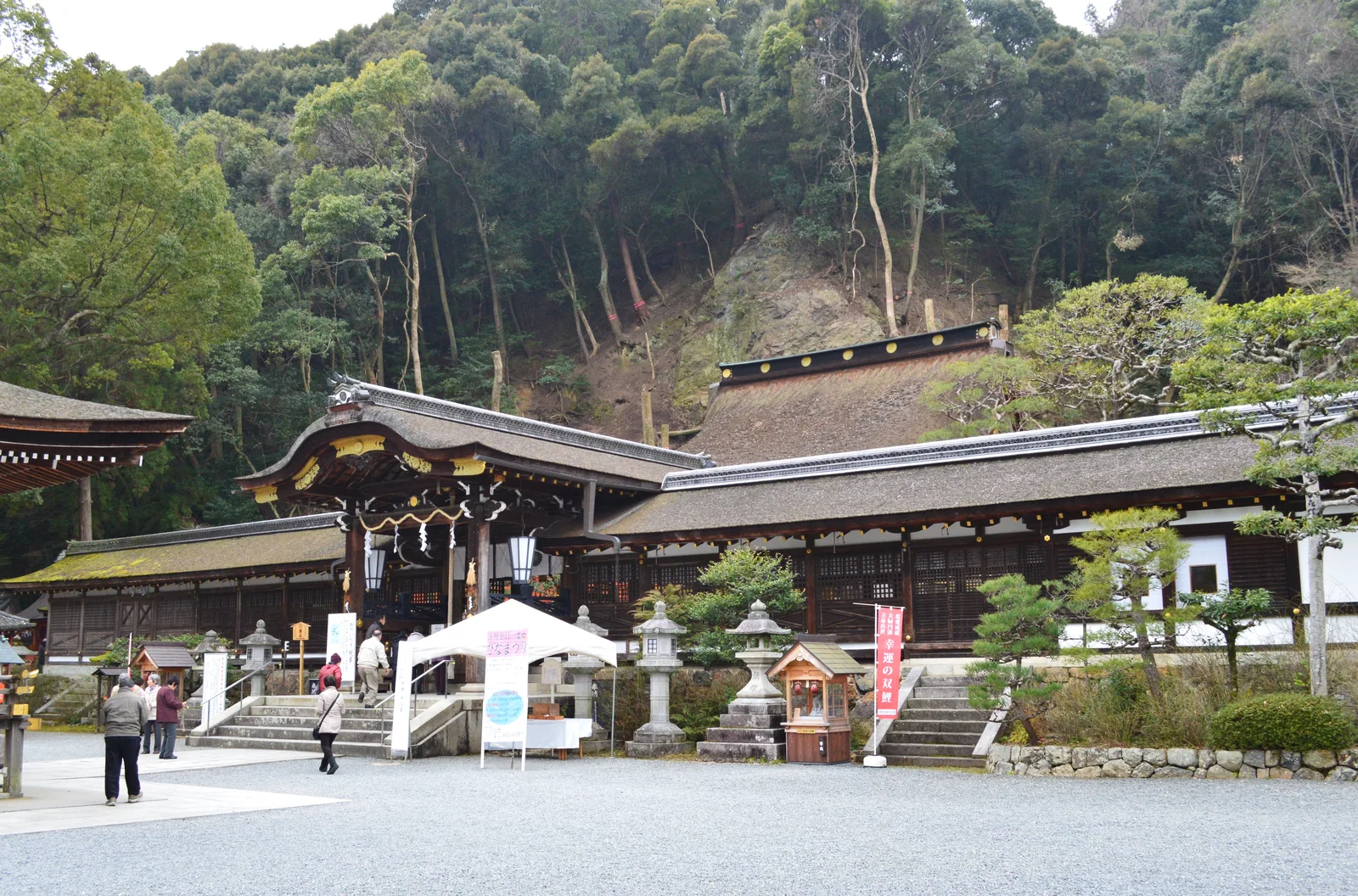
One of Kyoto's oldest shrines, Matsunoo Taisha has been revered as Japan's premier deity of sake brewing since the late Muromachi period. Its grounds feature Mirei Shigemori's final masterwork, the Three Gardens of Shofuen, the Reiki-no-Taki waterfall and Kame-no-I sacred spring, plus the Important Cultural Property main hall built in 1397. Combined entry to the gardens and Statue Hall is ¥500 for adults, steps from Hankyu Matsunoo-taisha Station on Arashiyama's western edge.
The Three Gardens of Shofuen: Mirei Shigemori's Final Masterwork
Completed in 1975 (Showa 50), the Three Gardens of Shofuen hold a major place in modern Japanese landscape history. They represent the final, wholehearted creation of garden master Mirei Shigemori (1896-1975), built over a full year at a total cost of ¥100 million using more than 200 pieces of blue chlorite schist from Shikoku's Yoshino River. The shrine describes the ensemble as 'a representative modern garden of the Showa era'. With Shigemori's work at Tofuku-ji and Ryoan-ji already famous among Kyoto garden enthusiasts, Shofuen is a natural must-see for landscape aficionados.
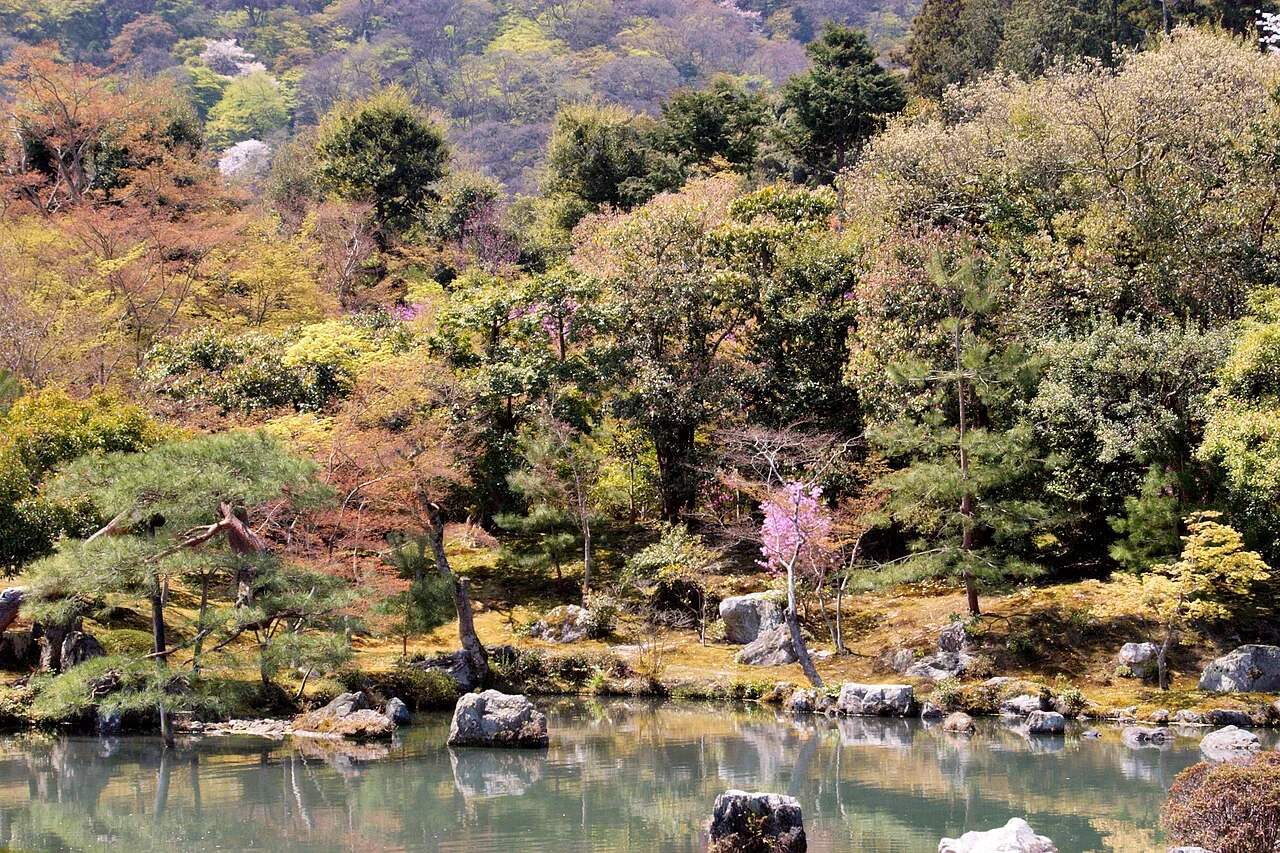
Each of the three gardens speaks the visual language of a distinct era. Joko-no-Niwa (Garden of Antiquity) recreates ancient iwakura rock worship on Mount Matsuo: two central boulders represent the male and female deities, dwarf bamboo suggests high mountain slopes, and surrounding stones symbolise attendant spirits. Kyokusui-no-Niwa (Winding Stream Garden) evokes the aristocratic poetry-and-sake banquets of the Heian court; the shrine praises its 'eight-sided beauty from whichever direction you view it', as the composition works from every angle. Horai-no-Niwa (Garden of Eternal Youth) adopts the Kamakura-period strolling pond style, its pond shaped like a crane in flight to honour Minamoto no Yoritomo's historical offering of ten sacred horses and 100 ryo of gold.
A single combined ticket covers both the gardens and the Statue Hall. Hours are 9:00-16:00 on weekdays and Saturdays, extending to 9:00-16:30 on Sundays and national holidays. Admission is ¥500 for adults, ¥400 for students and ¥300 for children. Groups of 30 or more who book ahead by telephone or fax pay ¥350, ¥300 or ¥200 respectively and receive a priest-led tour of the gardens and Statue Hall plus free coach parking (priest-guided tours are unavailable from New Year's Day to 7 January and on festival days).
Online articles frequently mislabel this area as the 'Sanzenza Stone Garden', a name that appears nowhere on the shrine's official garden pages; the three gardens are formally named Joko, Kyokusui and Horai. Likewise, 'Upper Shrine' (Jogu) is not an official facility name here. Sticking to the shrine's own terminology when taking notes prevents mixing up garden names from completely different temples and shrines.
Knowing a little about the Heian winding-stream banquet brings Kyokusui-no-Niwa to life. Court nobles once floated sake cups down a meandering channel, composing poems before a cup drifted past them; Shigemori translated that courtly pastime into a rhythm of stone and water designed to compose cleanly from all four sides. Walking through Joko, Kyokusui and Horai in sequence traces ancient rock worship, Heian elegance and Kamakura strolling-garden design—the master distilling the arc of Japanese garden history into three linked courtyards in the final year of his life.
The garden entrance sits beside the shrine office (Shamusho). After buying a ticket, you follow a one-way route through all three gardens of Shofuen, on towards Reiki-no-Taki and Kame-no-I, and finish at the Statue Hall and Sake Museum without doubling back. In wet weather the stone surfaces—especially the smooth Shikoku blue stones—turn slippery, so take your time if carrying an umbrella. Though compact in footprint, the shifting angles of rocks and pond edges reward at least an hour, or two if you plan to shoot photography at leisure.
The closing Horai-no-Niwa centres visually on its crane-shaped pond: cranes stand for longevity and paradise in traditional garden symbolism, and the strolling path reveals a fresh composition at every turn while weaving Minamoto no Yoritomo's samurai patronage into an ancient Kyoto shrine. Specialists admire how Shigemori reinterpreted classical forms through modernist stonework, while casual visitors feel the quiet drama of the three courts intuitively—the hallmark of a great garden.
The name 'Shofuen' draws on a classic poetic motif of wind sighing through pines, and standing inside the three courtyards you really can hear pine breezes sweeping down from Mount Matsuo. The phantom 'Shofu Festival' circulating online is simply a garbled spin-off from the garden's name; the shrine's true annual festival is the Reisai (2 April, called Matsuo Matsuri in English). Keep Shofuen for the gardens and Reisai for the festival, and your notes will stay accurate.
Reiki-no-Taki and Kame-no-I: From Era-Name Legend to the Mother Water of Sake
Round the back of the shrine office, a perennial waterfall named Reiki-no-Taki (Sacred Tortoise Waterfall) pours along the Mitarashi River. Its name ties directly to a chronicle-recorded marvel: in the eighth month of 714 (Wado 7), a sacred tortoise bearing seven-star markings appeared in this valley, prompting the imperial court to change the era name to 'Reiki' and release the tortoise back into the stream. Matsunoo Taisha features this episode in its own precinct guide—a rare case in Kyoto where a shrine garden waterfall is directly linked to an official Japanese era name.
Emerging just in front of the falls is the sacred spring 'Kame-no-I' (Tortoise Well). According to shrine records, brewers have long prized this spring as 'sake no motomizu' (the mother water of sake), taking it back to blend into their brewing water, while popular tradition hails it as water of longevity and renewal (yomigaeri). Every morning as soon as the gates open, neighbourhood residents come to fill containers for everyday drinking and cooking, tea ceremony and calligraphy. Note that the official names are Kame-no-I and Reiki-no-Taki; referring to it online as 'Kame-ike' (Tortoise Pond) is inaccurate.
This spring is the physical anchor of Matsunoo Taisha's identity as a sake deity. The Hata clan were famed brewers—several clan members even carried the character for 'sake' in their names—and the sweet, reliable spring water off Mount Matsuo sustained that craft. Reading the story in front of Reiki-no-Taki before looking back across the gardens and halls ties the entire shrine's brewing heritage together.
Both Reiki-no-Taki and Kame-no-I lie inside the ticketed garden zone. Morning light slants softly into the waterfall gorge from the east, offering the gentlest conditions for photography. Following Joko, Kyokusui and Horai to the full view of the crane pond, then finishing at the falls and spring, fits comfortably into an hour; winter snow over blue schist or late-autumn maple foliage adds striking contrast.
Wado and Reiki were consecutive early Nara-period era names, binding the eighth-month tortoise legend of 714 directly to Japan's imperial calendar. The Mitarashi River flowing behind the main halls shares its name and purification heritage with Kyoto's broader Mitarashi water traditions; far from mere scenery, water runs through the shrine's entire narrative. The shrine notes that Reiki-no-Taki 'never runs dry in any season', and because the spring stays unfrozen even in midwinter, it has become a quiet favourite among Kyoto photographers.
Kame-no-I remains very much part of living Kyoto. Enter soon after opening and you are likely to meet locals carrying jugs for home tea and rice, alongside tea practitioners and calligraphers who care deeply about water quality, all sharing the same spring that supplies brewers' starter water. Rather than a relic behind glass, it is a working neighbourhood spring.
From the imperial era-name myth of the sacred tortoise to everyday water drawn for longevity, renewal and brewing, a single mountain stream spans both legend and the cup in your hand. The shrine places no ban on visitors tasting or drawing water from Kame-no-I; cupping a sip of cool mountain water as the locals do in the morning connects your visit directly to a spring flowing since 714.
Japan's Premier Sake-Brewing Deity: True Context and Brewers' Devotion
When describing Matsunoo Taisha's role as a sake god, it pays to stick to official phrasing. Since the late Muromachi period, the Hata clan's deep brewing roots have earned it the title 'Nihon Daiichi Shuzoshin' (Japan's Premier Deity of Sake Brewing), while the shrine's current virtues page calls it the 'Ancestral Deity of Brewing' (Jozo Soshin), drawing sake makers as well as miso, soy sauce and vinegar producers from across Japan. Blog posts often write 'Japan's oldest sake god', a phrase absent from both the Japanese and English official websites; 'Japan's premier deity of sake brewing' or 'ancestral deity of brewing' is far more accurate.
Modern devotion is visible everywhere you look. Rows of sake casks donated by breweries nationwide flank the worship hall, and the neighbouring 'Osake no Shiryokan' (Sake Museum) hangs a traditional cedar-ball sugidama over its doorway, with permanent exhibits tracing Matsunoo Taisha's ties to sake, drinking culture and brewing-process films. Entry to the Sake Museum and Statue Hall is included in the garden ticket, so one ¥500 pass covers the gardens, Important Cultural Property statues and brewing exhibition.
Two dates on the annual calendar matter most to the fermentation industry: the Chuyu-sai (Brewing Thanksgiving Festival) on 17 April and the Jou-sai (Brewing Prayer Festival) on 1 November, when brewers and fermenters travel to Kyoto in numbers. The shrine's grandest spectacle, however, is the Reisai (Matsuo Matsuri) on 2 April: the English website notes that six large portable shrines (mikoshi) cross the Katsura River before returning three weeks later in the Kanko-sai ('Okaeri'). If you are in Kyoto in April, timing a visit around the Reisai and Kanko-sai shows the shrine at its liveliest.
Beyond brewing, Matsunoo Taisha has served as western Kyoto's primary prayer centre since becoming a Taisha in 1950. Prayer rituals are accepted daily from 9:00 to 16:00, peaking between New Year's Day and Setsubun on 3 February for yakuyoke (warding off misfortune) and safety blessings. According to the shrine's published 2027 yakudoshi chart—calculated in traditional Japanese kazoedoshi age—unlucky years fall at ages 24, 25 and 26 (pre-, peak and post-yakudoshi) and 41 to 43 for men, and ages 18, 19, 20, 32 to 34 and 36 to 38 for women, plus age 61 (kanreki). Hatsumiyamairi, Shichi-Go-San, Jusan-mairi and longevity blessings are offered year-round.
During major festivals, the prayer reception desk may relocate temporarily to the shrine office. Because yakudoshi tables update annually and use kazoedoshi counting, international visitors should note that this traditional tally typically sits one or two years higher than standard age. Throughout the month from New Year's Day to 3 February, streams of Rakusai residents arrive for blessings, filling the precinct with festive new-year atmosphere.
April's calendar extends well past the Reisai and Chuyu-sai. From 10 April to 5 May, the Yamabuki Festival turns the garden banks bright yellow with Japanese kerria blossoms—among spring's signature garden flowers in Japan—making April the liveliest month of the year. The Children's Day Tango Festival on 5 May and the Kanko-sai procession on 17 May keep the momentum going for another fortnight, so any late-April trip to Arashiyama is likely to catch either blossoms or ceremonial pageantry.
After taking in the towering stacks of donated sake casks and the spherical sugidama outside the Sake Museum (the traditional marker announcing newly pressed sake), you can easily build a Kyoto sake trail around your trip: visit Matsunoo Taisha in the morning, then continue to the Fushimi sake district or nearby Arashiyama tastings in the afternoon or next day, linking souvenirs directly to Kyoto's brewing history.
The Statue Hall: Early Heian Important Cultural Property Sculptures
Included in the ¥500 garden ticket, the Statue Hall displays 21 Shinto statues. Its three centrepieces are life-size seated figures carved from single blocks of wood in the early Heian period: an elder male deity (Oyamakui-no-Kami), a female deity (Ichikishimahime-no-Mikoto) and a prime-aged male deity (Miko-gami). All three are designated National Important Cultural Properties, hailed by the shrine as 'the oldest and finest among Japan's Shinto sculpture', with their dating and status formally confirmed by a 2010 (Heisei 22) academic survey.
The remaining 18 works span from the late Heian to Kamakura periods, including the oldest dated inscription statue marked 'Koji 2 (1143)' and a 'Smiling Visage' (Shoso-no-Zo) figure regarded as a precursor to the Noh theatre 'Okina' mask—allowing you to trace Shinto woodcarving through to classical stage masks inside a single gallery. Statue Hall hours match Shofuen: 9:00-16:00 (until 16:30 on Sundays and public holidays).
To explore the precinct in the clearest order, follow the shrine's own recommended route ('haikan no pointo'). Start in the free area at the worship hall and the Muromachi-period main hall (built in 1397, Important Cultural Property) to admire its one-of-a-kind Matsuo-zukuri roof profile; next, buy a ticket for the Three Gardens of Shofuen, following the path to Reiki-no-Taki and Kame-no-I; and finish in the Statue Hall and Sake Museum. Together, these three stages take roughly two hours at a relaxed pace.
The other historic structures reflect different eras as well. While the original build dates of the worship hall and Romon gate are unrecorded, their present appearance stems from major restoration in 1878 (Meiji 11), with two guardian Zuishin statues flanking the approach inside the Romon and the red torii standing partway down the path in the waki-kanjo position. Together, the Matsuo-zukuri main hall, restored Romon, red torii and modern gardens represent four distinct periods; looking back towards the Romon from the red torii gives the deepest architectural perspective, whereas viewing the main hall's distinctive roofline requires stepping inside the garden side.
The 2010 scholarly survey did more than verify the age and identities of the three single-block seated figures—it also pinned down the 1143 Koji-era statue within Japan's sculptural lineage. Looking closely at the main trio's expressions reveals the serene composure of the elder male god, the poised dignity of the goddess and the vigour of the younger male deity, showcasing early Heian skill in humanising the divine, while the Smiling Visage quietly bridges sacred sculpture and the Noh mask Okina.
Getting There and Linking Arashiyama's Western Gateway
Arriving by train is the simplest option: ride the Hankyu Arashiyama Line to Matsunoo-taisha Station (station code HK-97; ticket gates open 7:00-22:00). Following the shrine's official access example from JR Kyoto Station, take the underground (Kyoto Municipal Subway) to Shijo-Karasuma, transfer to the Hankyu Kyoto Line to Katsura, and change to the Hankyu Arashiyama Line—around 40 minutes door to door. Alternatively, board a Kyoto City Bus bound for Arashiyama or Daikaku-ji, or a Kyoto Bus towards Kokedera, from JR Kyoto Station and alight at 'Matsunoo Taisha-mae' for a similar 40-minute journey.
Neither Hankyu Railway nor Matsunoo Taisha's website publishes an exact walking time in minutes, yet you can spot the great torii right from the Arashiyama Line platform; exiting the station puts you at the shrine entrance in just a few minutes on foot.
In a wider Kyoto itinerary, Matsunoo Taisha makes the most sense as Arashiyama's western gateway just across Togetsukyo Bridge. Situated in Miyacho on the bridge's west side, it connects to central Arashiyama by a short walk (the shrine website omits an exact minute figure, though the distance is brief on foot). Placing it first or last on an Arashiyama day neatly sidesteps midday crowds on Togetsukyo Bridge. Even the history lines up: the Hata clan excavated the Hozu Gorge and built the Oi weir slightly upstream of the bridge, so Arashiyama's hydraulic past and Matsunoo Taisha's worship come from the same chapter.
Rising behind the shrine to the west is Mount Matsuo (also called Mount Wakeikazuchi), spanning roughly 120,000 tsubo across seven valleys and protected under scenic-zone and ancient-capital preservation laws. Although the mountain's iwakura rock outcrop was the original worship site before any shrine halls stood below, severe fallen timber and landslides caused by Typhoon No. 21 in September 2018 led the shrine to announce the permanent abolition of 'Iwakura Tohai' (mountain rock pilgrimage), discontinuing entry registration and offerings. Today, visitors experience that mountain faith symbolically through the rockwork of Joko-no-Niwa in Shofuen, leaving the mountainside itself to recover.
Each season brings an extra draw: the Yamabuki Festival from 10 April to 5 May, the Moon-Viewing Festival in September, and lively Shichi-Go-San family visits from October to December, plus a permanent four-seasons photography exhibition by Katsuhiko Mizuno beside the Statue Hall showing the shrine across spring, summer, autumn and winter. Heading east afterwards leads straight into Arashiyama's bamboo groves and Tenryu-ji, while sake enthusiasts can head south to Fushimi to round out a full Kyoto brewing itinerary.
Comparing Matsunoo Taisha with Kamo Shrine underscores its stature in Kyoto: both were ancient guardians of the imperial capital rooted in powerful clans (the Kamo and Hata), one guarding the Kamo River's north-east and the other the foot of Arashiyama, bracketing Heian-kyo between them—just as April's Matsuo Matsuri (Reisai) echoes Kamo's Aoi Matsuri across the city. One transport myth worth flagging: online posts occasionally mention a 'Randen Matsunoo-taisha-mae Station', which does not exist and appears nowhere on the shrine's access page; coming from Arashiyama, take the Hankyu Arashiyama Line or simply walk.
Two easy itineraries make Arashiyama's western edge flow smoothly. Early risers can take the Hankyu train to Matsunoo-taisha Station, spend two unhurried hours seeing the halls, three gardens and Statue Hall, then walk east into Arashiyama for the bamboo grove, Tenryu-ji and Togetsukyo Bridge before departing on the Hankyu or Randen lines. Late starters can reverse the order—arriving at peaceful Matsunoo Taisha in the afternoon once Arashiyama's tour buses peak, and watching late-day light settle over Mount Matsuo from the gardens. Dining and lodging options are far thinner around the western gateway than in central Arashiyama, so plan meals and stays back across the river.
Keep a few core facts handy before setting out to steer clear of outdated tips: the main shrine grounds are free with no fixed closing gate hours; the combined garden and Statue Hall ticket is ¥500 (9:00-16:00 weekdays and Saturdays, until 16:30 Sundays and holidays); Hankyu Matsunoo-taisha Station sits right outside the shrine about 40 minutes from Kyoto Station; the official names are 'Japan's Premier Deity of Sake Brewing / Ancestral Deity of Brewing', 'Three Gardens of Shofuen' and 'Kame-no-I'; and mountain iwakura climbs have been permanently discontinued, while 'Shofu Festival' and 'Sanzenza Stone Garden' do not exist.
A few useful answers
How much does entry to Matsunoo Taisha's gardens cost, and what are the opening hours?
A combined ticket covers both the Three Gardens of Shofuen and the Statue Hall: ¥500 for adults, ¥400 for students and ¥300 for children (discounted to ¥350, ¥300 and ¥200 for pre-booked groups of 30 or more). Opening hours are 9:00-16:00 on weekdays and Saturdays, and 9:00-16:30 on Sundays and national holidays. Visiting the free precinct along the red torii, Romon gate and worship hall costs nothing, and the shrine does not set fixed opening or closing hours for those grounds.
Why is Matsunoo Taisha revered as a sake deity, and what traditions should visitors note?
Rooted in the Hata clan's generations-old brewing craft, the shrine has been honoured since the late Muromachi period as 'Japan's Premier Deity of Sake Brewing' (Nihon Daiichi Shuzoshin), and its official virtues page calls it the 'Ancestral Deity of Brewing', drawing sake, miso, soy sauce and vinegar makers nationwide (the common online claim 'Japan's oldest sake god' is not official terminology). The Kame-no-I spring inside the grounds has long served as 'mother water of sake', while the Chuyu-sai (Brewing Thanksgiving Festival) on 17 April and Jou-sai (Brewing Prayer Festival) on 1 November are the main pilgrimage days for brewers.
How do I get to Matsunoo Taisha from Kyoto Station or Arashiyama?
Take the Hankyu Arashiyama Line directly to Matsunoo-taisha Station; from JR Kyoto Station, riding the underground (Kyoto Municipal Subway) via Shijo-Karasuma to the Hankyu Kyoto Line at Katsura and transferring to the Arashiyama Line takes around 40 minutes. Alternatively, take a Kyoto City Bus or a Kyoto Bus bound for Kokedera from Kyoto Station to 'Matsunoo Taisha-mae', also roughly 40 minutes. Located just west of Togetsukyo Bridge, it links easily with Arashiyama on foot. Note that the Randen tram has no station at Matsunoo Taisha despite erroneous online references.
Can you climb Mount Matsuo to see the iwakura sacred rocks?
Although the iwakura rock outcrop on Mount Matsuo (Mount Wakeikazuchi) was the shrine's original worship site before the halls were built, severe fallen trees and landslides from Typhoon No. 21 in September 2018 led the shrine to permanently abolish 'Iwakura Tohai' mountain climbs, ending entry registration and offerings. Today, visitors can appreciate that rock-worship heritage in Joko-no-Niwa within the Three Gardens of Shofuen, keeping their visit within the main precinct and gardens.
Official information and references
Sources used in this guide.
- Matsunoo Taisha | Information (Address, Telephone & News)
- Matsunoo Taisha | History & Origins (Founded 701, Hata Clan, Japan's Premier Deity of Sake Brewing, Kanpei Taisha)
- Matsunoo Taisha | Enshrined Deities (Oyamakui-no-Kami, Ichikishimahime-no-Mikoto, Tsukiyomi-no-Mikoto)
- Matsunoo Taisha | Divine Virtues (Ancestral Deity of Brewing, One of Kyoto's Oldest Shrines, Guardian of Rakusai)
- Matsunoo Taisha | Garden Admission (Three Gardens of Shofuen, Reiki-no-Taki, Kame-no-I, Hours & Fees)
- Matsunoo Taisha | Iwakura (Notice of Permanent Abolition of Mountain Climbs After Typhoon No. 21)
- Matsunoo Taisha | Statue Hall (21 Statues, 3 Early Heian Important Cultural Properties, 2010 Survey)
- Matsunoo Taisha | Sake Museum (Permanent Exhibition & Sugidama)
- Matsunoo Taisha | Access & Group Visits (Hankyu Matsunoo-taisha Station, City Bus Matsunoo Taisha-mae, Approx. 40 Mins from Kyoto Station)
- Matsunoo Taisha | Annual Festival Calendar (Reisai 2 April, Chuyu-sai 17 April, Jou-sai 1 November, Yamabuki Festival)
- Matsunoo Taisha | Yakuyoke, Celebrations & Longevity Prayers (Reception 9:00-16:00, 2027 Yakudoshi Chart)
- Matsunoo Taisha English Page | Matsuo-zukuri Roof, 1397 Main Hall, Six Mikoshi Crossing Katsura River
- Matsunoo Taisha | Tsukiyomi Shrine (Tsukinobe-ishi Stone, Safe Childbirth Origins, Kyoto Five Shrines)