Kennin-ji 2027 ticket prices, routes from Gion-Shijo Station, and where to find the Wind God and Thunder God screen and Twin Dragons ceiling. Plan the three Zen gardens, autumn night openings and a Kyoto National Museum pairing.
- Region & Focus
- KyotoShrines and temples
- Reading Scope
- 24 min read · 9 chapters · 7 Q&As
- Official Verification
- 29 official sources checkedUpdated 22 November 2026 at 00:00 GMT+8
- Key Topics
- First tripItinerariesRail travel
Chapter Route Map (tap any stop)
- Tickets, last entry and group bookings
- Getting there from Gion-Shijo, Kyoto-Kawaramachi and Kyoto Station
- Wind God and Thunder God in the Honbo; two dragon paintings in separate halls
- Three Zen gardens along the same covered veranda
- Choosing between 2026 late-autumn night openings and sub-temples
- Zazen meditation, sutra copying and tea-culture links down to Shichijo
- Light, pacing and wet-weather trade-offs on the day
- Where to walk next depending on your afternoon
- Where to stay: Gion, Kawaramachi or Kyoto Station
- Quick Q&A
Kennin-ji sits at the southern end of Hanamikoji Street in Kyoto's Gion district. For a first visit, allow 60 to 90 minutes: enter through the Honbo (abbot's quarters) to see the high-definition replica of Tawaraya Sotatsu's Wind God and Thunder God folding screens, follow the Hojo veranda past the Zen gardens, and finish in the Hatto (Dharma Hall) beneath Koizumi Junsaku's Twin Dragons ceiling painting. General admission runs from 10:00 to 17:00, with last entry at 16:30. Adult tickets cost ¥800 until the end of 2026, rising to ¥1,000 on 1 January 2027. Stepping back out through the North Gate links straight into Gion Shirakawa, while Yasaka Pagoda and Kiyomizu-dera lie uphill through Higashiyama for the afternoon.
Tickets, last entry and group bookings
Set map navigation to "Kennin-ji Haikan Uketsuke" (ticket reception) or "Kennin-ji Honbo". Walking to the south end of Hanamikoji Street brings you to the North Gate, from which it is still a short walk inside the grounds to the ticket desk; arriving from Higashiyama-Yasui, follow the signs for the Honbo first. The Hatto, visible from afar as the hall housing the Twin Dragons, is not the entrance—admission still begins at the Honbo. Plan your schedule around the ticket desk cutoff: last entry is 16:30, while closing time is 17:00. If you need to meet someone else later or collect left luggage, avoid leaving both until five minutes before reception closes.
Through 31 December 2026, standard adult admission is ¥800. From 1 January 2027, adult admission rises to ¥1,000, while primary, junior high and senior high school students remain ¥500 and pre-school children enter free. University students pay the adult rate. Two adults with one primary-school child total ¥2,100 before the revision and ¥2,500 afterwards. The temple also states that visitors holding a disability certificate enter free while accompanying carers pay admission, and primary-school children or younger must be accompanied by an adult.
Standard daytime visits require no advance booking—simply buy tickets at the Honbo counter. Groups of 15 or more must apply by fax or email at least ten days ahead, noting any request for a guided explanation on the same application. Primary-school groups must likewise get in touch ten days in advance and be accompanied by teachers or parents, with group leaders and accompanying adults charged the standard rate. These rules are separate from private group Zazen meditation sessions, whose timeslots, capacities and itineraries are listed on the temple's experience page. If friends are arriving separately, meet in the wider open area just inside the North Gate before walking together to the Honbo, keeping the gateway and ticket queue clear.
If you only reach Gion around 16:00, either move Kennin-ji to the following morning or follow a streamlined route on the day: head straight for the screens, follow the one-way path to the Hatto, and pause longer at just one garden. On weekdays with flexible lunch plans, book lunch for after the temple rather than before. When a tour group enters the screen room or the connecting corridor to the Hatto, unhurried timing lets you step aside and wait for them to move through. Travelling in a group of your own, it is easiest to view the paintings individually and regroup at the exit so anyone lingering around the full garden circuit does not hold up the rest.
| Ticket type | Until 31 December 2026 | From 1 January 2027 |
|---|---|---|
| Adult (general) | ¥800 | ¥1,000 |
| Primary, junior high & high school | ¥500 | ¥500 |
| Pre-school children | Free | Free |
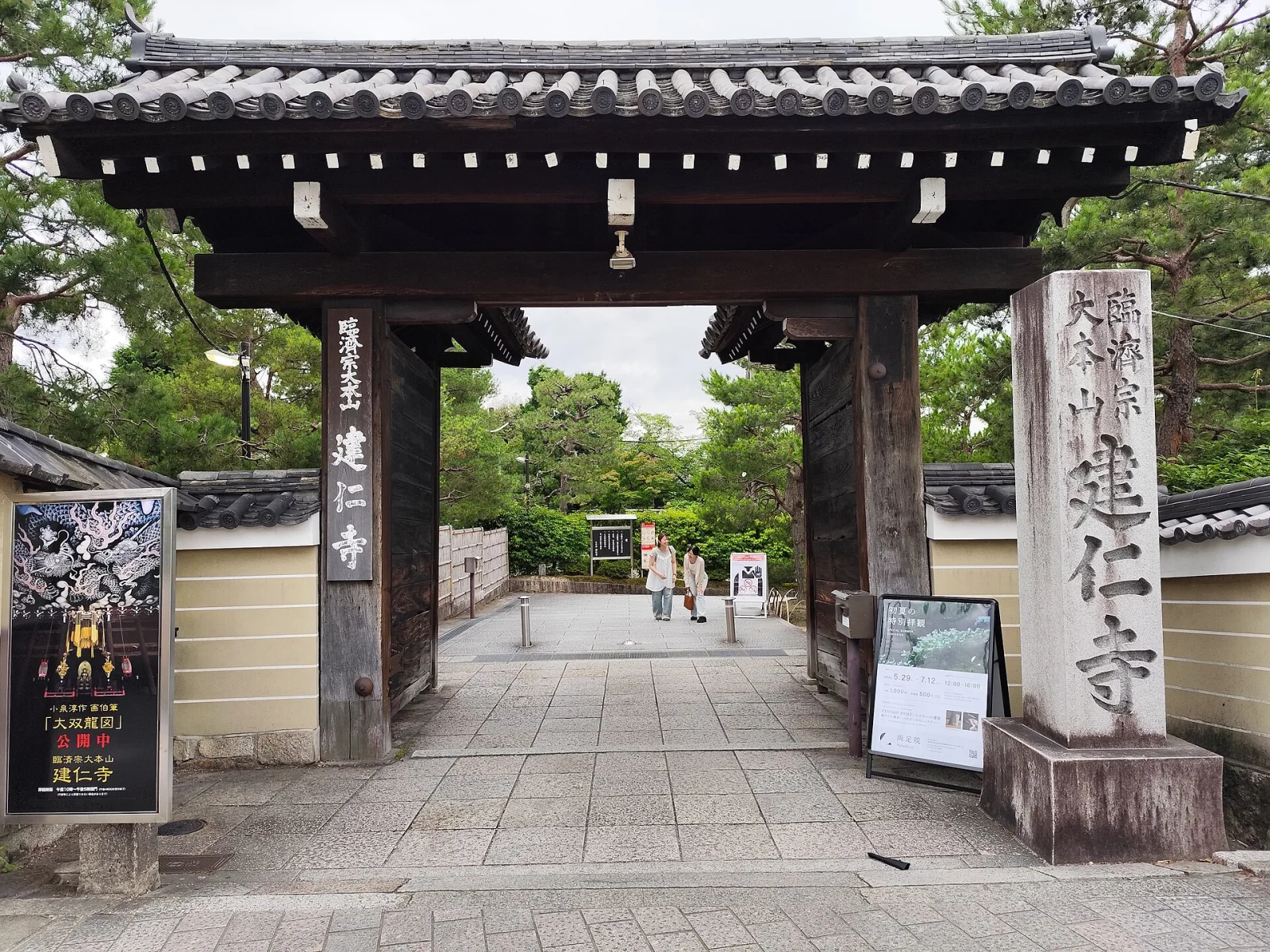
Kennin-ji 2027 ticket prices, routes from Gion-Shijo Station, and where to find the Wind God and Thunder God screen and Twin Dragons ceiling. Plan the three Zen gardens, autumn night openings and a Kyoto National Museum pairing.
Getting there from Gion-Shijo, Kyoto-Kawaramachi and Kyoto Station
On the Keihan Line, get off at Gion-Shijo Station and take Exit 6 towards the Minami-za theatre. At street level, walk east along Shijo-dori towards Yasaka Shrine, turn right into Hanamikoji Street, and follow it straight to Kennin-ji's North Gate. The temple estimates a 7-minute walk from Gion-Shijo Station. Travellers with a pushchair or anyone avoiding stairs can follow the lift route marked on the Keihan station map underground before heading along Shijo-dori to Hanamikoji. When arranging a meet-up, write out "Keihan Gion-Shijo" in full, as there is also a Hankyu station across the river with Shijo in its name.
Coming from Osaka-Umeda, Takatsuki or staying near Karasuma in Kyoto, alight at Hankyu Kyoto-Kawaramachi Station. Head for the East Ticket Gate and come up via Exit 1A, then cross Shijo Ohashi Bridge along Shijo-dori past the Minami-za to Hanamikoji. The temple estimates a 10-minute walk from the Hankyu station. In wet weather, use the underground passages as far as possible and only put up umbrellas once you surface to cross the bridge. If you plan to browse Kawaramachi's department stores or dine on the west bank of the Kamo River afterwards, head back west across the bridge on your return. From Yodoyabashi or Kitahama in Osaka, the Keihan Line takes you straight to Gion-Shijo without crossing the bridge.
Staying near JR Kyoto Station, leave via the Central Exit and board Kyoto City Bus 206 from bay D2, bound for Kiyomizu-dera and Gion; get off at Higashiyama-Yasui and walk west for about 5 minutes to the temple. Because route 206 is a loop service, buses from Kyoto Station also run in the opposite direction towards Kyoto Aquarium and Senbon-dori, so check for the "Kiyomizu-dera / Gion" side before boarding. The flat fare is ¥230 for adults and ¥120 for children, payable with transport IC cards. City buses run along Higashiyama-dori, so on autumn foliage weekends heavy boarding at Gojozaka and Kiyomizu-michi adds queue time to map estimates; if you are already around Kawaramachi or Sanjo-Keihan, walking or taking the Keihan Line one stop is usually quicker than backtracking to Kyoto Station for a bus.
If you are based at Kyoto Station and prefer trains, take the JR Nara Line one stop to Tofukuji and transfer to the Keihan Line bound for Sanjo or Demachiyanagi, getting off at Gion-Shijo. This involves passing through ticket barriers for two railway operators, making it best suited to days with long bus queues at Kyoto Station or a timed booking later in the day. Heading on to Fushimi Inari afterwards, board an Osaka-bound Keihan train from Gion-Shijo that stops at Fushimi-Inari, turning the transfer between temple and shrine into a single rail hop. If you have just arrived at Kyoto Station with suitcases, drop large bags at your accommodation first so an afternoon link to Keihan Shichijo or back to Kyoto Station stays unencumbered.
Getting off at Higashiyama-Yasui pairs neatly with visiting Kennin-ji after Kodai-ji or Yasaka Pagoda. Walking back towards the bus stop on Higashiyama-dori and cutting west is more direct than routing via the northern end of Hanamikoji. Approaching from the south, passing the Chokushimon (Imperial Envoy Gate) and the Sanmon gate (bearing the "Bokakuro" plaque) places you right on the temple's north-south axis leading to the Hatto and Honbo. Visitors entering from the North Gate can equally view the Sanmon from outside on their way out rather than circling the compound before buying a ticket. The temple's paid car park near the North Gate is restricted to standard passenger cars and charges ¥300 per 20 minutes on weekdays and ¥300 per 15 minutes on weekends and public holidays between 08:00 and 20:00—that is ¥900 or ¥1,200 an hour, so anyone continuing through Gion and Kiyomizu is better off leaving the car at their hotel.
Wind God and Thunder God in the Honbo; two dragon paintings in separate halls
The Wind God and Thunder God folding screens are a pair of two-panel gold-leaf screens by Tawaraya Sotatsu, active from the Momoyama to the early Edo period. Using a rich gold-foil ground, Sotatsu pushes both deities towards the outer edges: Fujin on the right shoulders his billowing wind bag, while Raijin on the left is ringed by drums. Step back far enough to take in both screens at once before studying each figure's stance and the small wisps of ink cloud beneath their feet. Flat photographs show the drums and wind bag clearly enough, yet standing in front of the actual folds reveals how the broad expanse of gold shifts from bright to dark with the angle of the panels. When the room is busy, start viewing from the side to keep the walkway clear until space opens up in front.
Kennin-ji displays a high-definition replica of the screens. The National Treasure original belongs to Kennin-ji and is entrusted to the Kyoto National Museum, where it goes on view only in rotating exhibitions. Before buying a museum ticket specifically for the original, check the current exhibition gallery list for the entry matching "Wind God and Thunder God Screens" (Fujin Raijin-zu Byobu) by Tawaraya Sotatsu from Kennin-ji: the museum's masterpiece pages are permanent catalogue notes, whereas only the current exhibition checklist confirms what is actually hanging. If the exhibition is split into first and second halves, match your train bookings to the exact display dates. Other Kyoto museums hold later versions painted by subsequent artists, so check both artist and lender credits when seeking the original.
Moving into the Hojo (abbot's hall), another painting often referred to as a "Dragon Mural" is Kaiho Yusho's Cloud Dragon (Unryu-zu), a Momoyama-period sliding-door work displayed here in replica. Trace the dragon horizontally across the panels as it weaves in and out of clouds, where the densest black ink meets bare unpainted paper so the composition feels as though it unfolds across the entire room. When a museum mounts these panels flat on a gallery wall, you can lean in for brushwork detail; inside the Hojo, imagining them as working room partitions, it pays to step back and watch how the design carries across adjacent sliding doors. Other Yusho works in the Hojo—including Seven Sages of the Bamboo Grove and Flowers and Birds—make an instructive contrast between rooms.
Overhead on the ceiling of the Hatto (Dharma Hall) is Koizumi Junsaku's Twin Dragons (Soryu-zu), painted to mark Kennin-ji's 800th anniversary and completed in 2002, replacing what had previously been a plain unpainted timber ceiling. Stepping out of the Hojo and along the covered walkway into the Hatto shifts your gaze abruptly from horizontal garden lines up to the rafters. The canvas measures roughly 11.4 metres by 15.7 metres. Spot the two heads first—one dragon opens its jaws while clutching a sacred jewel in its foreclaw, the other keeps its mouth closed—then follow their coiling bodies, claws and ink clouds, shifting a step along permitted areas to see how the front and rear halves connect. The painting far exceeds a phone camera's frame, and crowding into the dead centre often hides the sweep of the ceiling; standing clear of the aisle gives you more angles to trace both dragons at leisure. With the seated Shaka Nyorai statue at the front of the hall and the timber pillars framing the space, you can see how the ceiling painting anchors the entire interior.
Three Zen gardens along the same covered veranda
Daiouen is the dry landscape (karesansui) garden in front of the Hojo. Broad raked white gravel is punctuated by rock groupings and greenery that create layered height, in a layout attributed by the temple to Kato Kumakichi around the early Showa era. Standing on the Hojo side, first look along the veranda down the garden's long edge so the gravel ripples sit low in your field of view while the stones and trees gather further back. Walk a few paces and glance back: the empty foreground lifts your eye towards the rear rock arrangements. If a companion is new to Zen gardens, invite them to start from the widest vantage point; once they compare its scale with Choon-tei later, the contrast between the two gardens becomes immediately clear.
Choon-tei ("Garden of the Sound of the Tide") lies in the Honbo courtyard, centred on a Sanzon-seki (three-stone triad) with a Zazen meditation stone on the east side, surrounded by maple trees and moss. The temple describes it as a garden designed to be viewed from any of its four sides. Turning a corner along the veranda reveals rocks and moss beds that were hidden behind tree trunks from the previous angle. In autumn, follow the colour between the maple branches to the deepest point of the view; in early summer, notice how the shaded faces of the stones play against fresh green moss. When busy, avoid crowding directly opposite the three-stone triad—continue along the open corridor to the next side and put your phone away to read how the garden sits enclosed at the centre of the buildings.
The Maru-Sankaku-Shikaku Garden—marked simply by a circle, a triangle and a square on the signposts—associates the square, circle and triangle, according to the temple, with earth, water and fire. Pause indoors to notice how each shape emerges at different viewing distances, as some outlines only snap into focus when you trace the stone edges. Where seating is permitted alongside Choon-tei, sit for a few minutes before following the route to the remaining gardens. With time in hand, also look up at the Hojo roof: moved here in 1599 from Ankoku-ji in Aki Province, its shingle-layered kokera-buki roof has been restored, and the sweep of the eaves looks strikingly different from the veranda versus from outside.
Anyone preferring less walking can view the main indoor paintings in one stretch, rest where sitting is allowed, and then tackle the next garden. With children, one clear treasure-hunt task is enough—spotting which dragon in the Hatto has its mouth open, or matching the three geometric symbols on the garden nameplate. Follow the directional and pause signs inside the buildings, as all gardens are viewed strictly from the verandas and rooms rather than walked through. During the June rainy season or after heavy downpours, the forecourt gravel and wooden entrance boards can feel damp underfoot; wear easy slip-on shoes and pack dry socks so you are not holding up companions while changing at the doorway.
Choosing between 2026 late-autumn night openings and sub-temples
JR Central's private evening special opening at Kennin-ji runs from 20 November to 6 December 2026, from 17:30 to 19:30 (last entry 18:50 JST), listed at ¥2,400 on the EX Tabi-saki booking page. The illumination centres on Choon-tei and Daiouen. Choose the night ticket for atmospheric lighting, or make the daytime Honbo visit your priority if it is your first trip and you want to read the screens, architecture and garden layout clearly. If you spend the afternoon in Higashiyama and return for the evening slot, leave a break for dinner in Gion and walk back down Hanamikoji to the North Gate rather than navigating unfamiliar lanes in the dark. Note the distinction when booking: 18:50 is the admission cutoff, while 19:30 is when the grounds close.
Surrounding Kennin-ji are independent sub-temples (tatchu). From 21 November to 6 December 2026, Shoden Eigen-in opens its autumn garden and reconstructed "Jo-an" teahouse from 10:00 to 16:30 (last entry 16:00), with general admission listed at ¥1,000. To pair both in one afternoon, visit Shoden Eigen-in first before its earlier cutoff, then save the final window for Kennin-ji's Honbo. Going in the morning, start at Kennin-ji's main gardens and walk over to Shoden Eigen-in afterwards with unhurried time to take in the teahouse and its connection to Oda Urakusai. Keep in mind that the Jo-an on site is a reconstruction, and sub-temple gardens require separate tickets and entrances from the Honbo's three gardens.
Ryosoku-in—written with the simplified Japanese kanji on directional boards—is famous in early summer for its hangesho (lizard's tail) plants whose leaves turn white in bloom, offering a very different palette from autumn maple season. Its official calendar splits entry into reservation-only slots, general public openings and private-charter openings, so confirm which category applies on your date before planning your timings. Garden tickets, Zazen meditation and Kennin-ji's Honbo all operate with separate entrances and bookings. Nearby Reido-in is an active training hall of the Kennin-ji school and is normally closed to the public; when walking past sub-temple gates along the lane, skip any gate lacking admission signage rather than mistaking wall posters for an open entrance.
The sub-temples also trace the temple's layered history. Founded in 1202 under the patronage of the second Kamakura shogun Minamoto no Yoriie with Eisai as founding abbot, Kennin-ji took its name from the era name of that year and originally taught Tendai, Esoteric Buddhism and Zen side by side before becoming a dedicated Rinzai Zen monastery under its eleventh abbot, Rankei Doryu. If that early history appeals, walk east of the North Gate to Seirai-in, founded in memory of Rankei Doryu. When open, Seirai-in showcases Chen Man's White Dragon ceiling painting in its Hojo alongside the "Gabi Joun" rock garden featuring boulders from Mount Emei in Sichuan. Like the Honbo's Twin Dragons, it centres on a ceiling dragon, though artist, dedication and hall are distinct—look for the "Seiraiin" nameplate when checking the entrance.
Back on the central axis, the gates themselves tell how the monastery was rebuilt over centuries. The south-facing Chokushimon is among the oldest surviving structures listed by the temple and bears arrow marks on its pillars and doors, earning it the nickname "Yanonemon" (Arrow-Mark Gate). The Sanmon gate was relocated in 1923 from Annei-ji in Shizuoka, its "Bokakuro" plaque evoking the Imperial Palace, while the timber frame of the Hatto dates from its ridge-raising in 1765. Setting those three dates alongside the Hojo's 1599 roof from Aki helps place "Kyoto's oldest Zen temple" into clear historical layers. If you only have time for a brief stroll through the grounds, follow the north-south axis past these exteriors and save your energy for the paintings and gardens inside the Honbo.
Zazen meditation, sutra copying and tea-culture links down to Shichijo
Individual visitors can join Kennin-ji's Senko-kai morning Zazen session, held on the second Sunday of most months from 07:30 in the Hojo, free and without booking. A typical session comprises two 20-minute rounds of seated meditation followed by sutra chanting and a dharma talk, finishing around 09:30. In July it switches to the Dawn Zazen session on the Friday to Sunday of the second week starting at 06:30, and August is in recess; the temple also notes that the 13 December 2026 session begins at 07:30 as usual without the chief abbot's dharma talk. Since Senko-kai is strictly a meditation gathering, leave a window for breakfast afterwards and buy a general Honbo ticket from 10:00 if you wish to see the screens and gardens. Groups of ten or more must use the separate group experience application.
Sutra copying (shakyo) uses Heart Sutra paper and brushes provided at the Honbo counter, with on-the-day sign-up only. On open weekdays, registration runs in two short 15-minute windows—10:30 to 10:45 and 13:30 to 13:45—capped at the first 10 applicants per session, taking roughly an hour at an offering fee of ¥3,000. Primary-school children and younger cannot participate, and junior high students require an adult guardian. Over the New Year period, note the suspension from 26 December 2026 to 17 January 2027, as well as a full pause from 1 November to 6 December 2026. When travelling in a group on a weekday, those joining shakyo can take the session while companions tour the gardens as usual, meeting up afterwards for lunch or at the gate later in the afternoon so nobody has to wait around.
Kennin-ji links its founder Eisai directly to the spread of tea drinking in Japan, marked on the grounds by the Tea Monument and the "Heisei Tea Garden" planted in tribute to that legacy. On the north-west side of the Hojo stands Toyobo, a compact rustic-style teahouse traditionally associated with Toyotomi Hideyoshi's 1587 Grand Kitano Tea Gathering and hosted by Toyobo Chosei, a disciple of Sen no Rikyu. Looking from the garden edge, seeing its low eaves beside the sweeping Hojo roof reveals the stark difference in scale between an intimate tea room and a formal monastic hall. The temple's annual calendar also details its traditional Yotsugashira Chakai ceremony, where four principal guests receive tea simultaneously. For everyday travellers, save an actual tea stop for Gion or Kawaramachi after leaving the grounds, or set aside a separate half-day for Uji and its tea street if tea-producing regions interest you.
From 22 December 2026 to 22 March 2027, the Kyoto National Museum presents the thematic exhibition "Utensils and Procedures of Chanoyu" (Tea Ceremony), highlighting tea wares alongside the boxes, pouches and accessories used to preserve and pass them down. To pair both in one day, view Kennin-ji's teahouse exterior in the morning, have lunch, then ride the Keihan Line from Gion-Shijo one stop to Shichijo and walk east for about 7 minutes to the museum. The museum closes completely from 28 December 2026 to 1 January 2027, and normally closes on Mondays during the exhibition—remaining open on Monday 11 January and Monday 22 March 2027, and closing on Tuesday 12 January instead. If your Kyoto dates over New Year are fixed, mark those exceptions in your calendar before deciding which day to head down to Shichijo.
Light, pacing and wet-weather trade-offs on the day
In April, if your priority in Higashiyama is cherry blossom along Gion Shirakawa, walk the canal early in the morning before entering Kennin-ji at 10:00, looping back via Hanamikoji so the riverbanks come first and the veranda gardens follow. Early summer favours a garden-led morning: inspect the gravel, stones and moss of the Honbo's three gardens, add Ryosoku-in's hangesho if open, and skip the uphill hike through Higashiyama. Save Shirakawa after dusk for north of Shijo-dori once you leave the temple, keeping daylight hours for the artworks. Note that tea ceremonies and memorial services occasionally close the grounds: the Kyoto City Tourism calendar lists 19–20 April and 4–5 June as closure dates alongside specific memorial days, so switch to Shirakawa and the Kamo River or swap to another day of your trip if your dates coincide.
On November weekends, use Kyoto City's Tourism Comfort Map to check crowd levels separately for Hanamikoji and the Kiyomizuzaka-to-Nene-no-Michi corridor. To beat the heaviest Higashiyama crowds, make Kennin-ji your first stop at opening, then decide whether to cross towards Kawaramachi for lunch or stroll along the Kamo River. If Kiyomizu-dera is also high on your list, reverse the sequence on another morning by walking downhill from Kiyomizu-dera past Yasaka Pagoda and Kodai-ji. When linking both areas in one day, place lunch at the midpoint rather than at the top of the slope, or an extra garden stop will eat into mealtime. On 9 December 2026, Hosokawa Morihiro's Eight Views of Xiaoxiang sliding-door paintings are off display all day for building works, so choose another day if those screens are your main reason for visiting.
In light rain, trim the outdoor stroll and spend most of your time under the Honbo's covered verandas viewing the screens and courtyards. Temple rules explicitly allow staff to refuse entry if your clothes or socks are soaked through, both to protect the timber floors and to prevent slips. In a heavy downpour, wait it out indoors in Kawaramachi's arcades and shops until dry, or push the daytime Honbo visit to the next morning. For an immediate rainy-day alternative, take the Keihan Line down to Shichijo whenever the Kyoto National Museum has indoor galleries open—bear in mind that from 24 March to 18 April 2027 the museum opens only its gardens and outdoor displays, ruling it out as wet-weather cover during those weeks. In winter, open-veranda garden viewing involves plenty of standing still, so wear warm socks and an insulating layer suitable for indoors so older companions can sit comfortably.
Finish any takeaway coffee before entering the grounds: eating and drinking are banned throughout Kennin-ji, open-cup drinks may not be brought inside, and there are no rubbish bins on site. Hand-held smartphone or camera photos of the gardens and artworks are permitted while standing in designated zones, whereas video recording, tripods, selfie sticks, gimbals, action cameras, drones and posed portraits or group shots—including kimono or themed costume shoots—are strictly prohibited. Friends booked for a kimono photoshoot should arrange those portraits at permitted streetside or studio locations outside the temple and keep Kennin-ji focused on the art. Because the contrast between shaded corridors and bright courtyards is stark, change angle or lower the camera rather than resting a phone on railings or wooden floorboards.
Where to walk next depending on your afternoon
Stepping out of the North Gate back onto Hanamikoji and crossing Shijo-dori towards Gion Shirakawa and Tatsumi Bridge keeps the walk flat and easy. If anyone in your group wants dinner on the west side later, cut back from Shirakawa over Shijo Ohashi Bridge or stroll north along the Kamo River towards Sanjo and Kawaramachi. This option suits travellers keen on machiya timber facades, independent shops and an earlier return to the hotel. Remember that Hanamikoji is a working residential and business thoroughfare: pass by side alleys marked "Private Road" (Shido) or "No Entry" (Tachiiri Kinshi), and leave shop thresholds and eaves clear for staff and guests. Never chase or photograph geiko and maiko without permission or stop in the roadway for shots; if a crowd gathers around Tatsumi Bridge, walk one block further along Shirakawa before pausing.
For a classic Higashiyama route, leave towards Higashiyama-Yasui, cross Higashiyama-dori onto Yasaka-dori towards Yasaka Pagoda, and then decide whether to climb Ninenzaka and Sannenzaka to Kiyomizu-dera. With a pushchair, older relatives or rain-slick stone underfoot, turn back at the wider stretch of Yasaka-dori and head north to Yasaka Shrine and Shijo-dori rather than forcing the narrow steps. Those with time and energy to reach the Kiyomizu wooden stage can plan entry times and the downhill exit using the Kiyomizu-dera and Higashiyama walking route. In 2026, Kiyomizu-dera's autumn night illumination runs from 21 to 30 November, opening at 17:30 with last entry at 21:00 and closing at 21:30, no booking required. Choosing just one evening opening in late autumn, pick Kennin-ji to study illuminated gardens at close range from a covered veranda, or Kiyomizu-dera for sweeping views above red maples.
If sliding-door paintings are your focus, Kyoto National Museum's Masterworks Gallery features "Fusuma Paintings of Kennin-ji" from 9 February to 22 March 2027, listing four of the eight panels of Kaiho Yusho's Cloud Dragon, three of the sixteen panels of Seven Sages of the Bamboo Grove, and three of the eight panels of Landscape. Seeing both sets side by side highlights how the heavy ink of Cloud Dragon once spanned original door frames before shifting to the economy of line in the robes and postures of the Seven Sages. This makes a "Honbo Hojo plus Shichijo museum" pairing especially rewarding: fix in mind how much horizontal wall the dragons occupy in the Hojo during the morning, then inspect the original brushwork and aged paper tone up close at the museum in the afternoon. If you want longer at the museum, start there in the morning and return to Kennin-ji in the afternoon before the Honbo ticket cutoff, stopping for lunch near either Shichijo or Gion.
If you only have time for one Zen temple in Kyoto, pick Kennin-ji when staying in Gion or Kawaramachi and pairing it with half a day in Higashiyama; if you are already dedicating a full day to Arashiyama's riverbanks and bamboo grove, Tenryu-ji's Sogenchi Pond Garden and mountain backdrop sit right alongside it. Tenryu-ji's Hatto features Matazo Kayama's 1997 circular single-dragon Cloud Dragon ceiling (¥500 separate Hatto fee, normally open weekends and Japanese public holidays, plus daily during special viewing periods—open daily through 6 December 2026 and closed on 2 January 2027). Use that calendar to decide whether to split the two temples across different days so you can compare both modern dragon ceilings, or keep your Arashiyama hours focused purely on Sogenchi Garden. On a separate day in Okazaki, Nanzen-ji's Sanmon gate and Suirokaku aqueduct offer an outdoor architectural walk along the canal instead.
Where to stay: Gion, Kawaramachi or Kyoto Station
Staying in Gion makes it easy to enter the Honbo early and pop back to your hotel to rest before an autumn evening illumination. Kawaramachi suits groups who split up during the day, reunite downtown for dinner and rely on the Hankyu Line to and from Osaka. When comparing hotel maps, look at the first major crossing you must clear: staying east of the Kamo River puts Hanamikoji on your doorstep, whereas the west bank means crossing Shijo Ohashi Bridge past the Minami-za. Hotels closer to Sanjo let you walk through Shirakawa on your way to the temple in the morning, then take the Keihan Line from Gion-Shijo or stroll back along the river afterwards. If you plan to link Kennin-ji with another Higashiyama temple, schedule that for a day when you can walk straight out to the gates and leave Kawaramachi or Gion for evening dining.
Around Kyoto Station works best if you are catching an early Shinkansen the next morning or managing luggage drop-offs and pick-ups on the same day. The practical difference shows most clearly on the return leg: take bus 206 to Higashiyama-Yasui in the morning, and if bus queues spill onto the pavement later, take the Keihan Line to Tofukuji and transfer back to JR. Travellers heading onward to Osaka after an evening opening can ride straight south from Gion-Shijo on the Keihan Line, or route back to whichever JR or Hankyu station matches their line. If you still have large bags to collect that evening, dine on the same side of the river where your luggage is stored and finish your walk on that bank to avoid an extra bridge crossing.
A few useful answers
How much are Kennin-ji tickets and what is the last entry time?
Until 31 December 2026, adult admission is ¥800, rising to ¥1,000 from 1 January 2027. Primary to senior high school students pay ¥500 and pre-school children enter free. General visiting hours run from 10:00 to 17:00, with last entry at 16:30.
Where is the original Wind God and Thunder God folding screen kept?
The National Treasure original belongs to Kennin-ji and is deposited at the Kyoto National Museum, where it goes on view only during rotating exhibitions. Kennin-ji's Honbo displays a high-definition replica of Tawaraya Sotatsu's work.
Which buildings house the Twin Dragons and Cloud Dragon paintings?
Koizumi Junsaku's Twin Dragons covers the ceiling of the Hatto (Dharma Hall), while Kaiho Yusho's Cloud Dragon comprises sliding-door paintings in the Hojo shown in replica inside the temple. General admission enters through the Honbo.
Which exit should I use from Gion-Shijo Station?
Take Exit 6 at Keihan Gion-Shijo Station towards the Minami-za theatre, walk east along Shijo-dori at street level, and turn right down Hanamikoji Street to the North Gate. The temple estimates roughly a 7-minute walk.
Can I visit Kennin-ji in the rain or wear a kimono for photos?
Staff may refuse admission if your clothing or socks are soaked through. Photo shoots in kimono or other themed outfits are prohibited. Hand-held standing shots of the gardens and artworks are allowed under temple rules, but video, tripods, selfie sticks and posed group or portrait photos are banned.
Do I need to book the 2026 autumn night opening in advance?
Yes. JR Central's private evening special opening runs from 20 November to 6 December 2026 via the EX Tabi-saki booking page, listed at ¥2,400. Entry is from 17:30 to 19:30, with last check-in at 18:50.
How long should I allow for Kennin-ji?
Allow 60 to 90 minutes on a first visit to see the Honbo screens, the Hojo gardens and the Hatto's Twin Dragons. If adding sub-temples, Zazen meditation or sutra copying, work backwards from each separate opening and registration window.
Official information and references
Sources used in this guide.
- Kennin-ji Temple | Admission, Opening Hours and Access
- Kennin-ji Temple | Ticket Price Revision from 1 January 2027
- Kennin-ji Temple | Grounds Map, Gardens, Sub-temples and Visiting Rules
- Kennin-ji Temple | Wind God and Thunder God Screens, Twin Dragons and Kaiho Yusho Murals
- Kennin-ji Temple | Photography Rules
- Kennin-ji Temple | Wet-Weather Admission Policy
- Kennin-ji Temple | November 2026 Notices (December Zazen and Artwork Closures)
- Kennin-ji Temple | Zazen Meditation and Sutra Copying Schedule
- Kennin-ji Temple | 2026–2027 Sutra Copying Suspension Dates
- Kennin-ji Temple | Annual Calendar and Yotsugashira Chakai Ceremony
- JR Central | 2026 Autumn Special Night Viewing at Kennin-ji
- Shoden Eigen-in | 2026 Autumn Special Garden Opening
- Ryosoku-in | Garden Openings and Reservation Guide
- Seirai-in | White Dragon Painting and Gabi Joun Garden
- Kyoto National Museum | Wind God and Thunder God Screens by Tawaraya Sotatsu
- Kyoto National Museum | 2027 Kennin-ji Fusuma Paintings Exhibition Checklist
- Kyoto National Museum | Chanoyu Tea Utensils Feature Exhibition and New Year Closures
- Kyoto National Museum | March 2027 Opening and Exhibition Calendar
- Kyoto National Museum | Access and Shichijo Station
- Keihan Electric Railway | Gion-Shijo Station Map
- Hankyu Railway | Kyoto-Kawaramachi Station Map
- Kyoto City Transport Bureau | Bus Route 206 and Higashiyama-Yasui Stop
- Kyoto City Transport Bureau | City Bus Flat-Fare Zone
- Kyoto City Tourism Association | Gion-Kiyomizu Crowd Map and Visiting Etiquette
- Kyoto City | Respecting Private Lanes and Photography Etiquette
- Kyoto City Tourism Association | 2026 Kiyomizu-dera Autumn Night Illumination
- Kiyomizu-dera | Special Night Viewing Schedule
- Tenryu-ji | Hatto Cloud Dragon Opening Dates and Tickets
- Kyoto City Tourism Association | Kennin-ji Opening Hours and Routine Closures