Choose a ski day, old-town day, or forest bath first, then connect sleeping places, lessons, hire, bathing rights, and seasonal transport for two usable nights in Karuizawa.
Choose the main activity before choosing your hotel
To choose where to stay in Karuizawa, first decide whether you most want time for skiing, a forest hot spring, or the old town and shopping. The south side of the station, Kyu-Karuizawa, and the Hoshino/Naka-Karuizawa area involve different routes. Squeezing all three into a short afternoon often uses up time waiting for transport and retrieving luggage. Planning one main activity each day helps you make better use of a two-night stay.
This guide uses official information available on 22 October 2026, separating current rooms, 2026–2027 ski products, and future facilities that are not operating yet. All amounts are in yen; hypothetical budgets are identified, and a search engine's lowest room price is not treated as available on every date. Hotel comparisons use named categories, sleeping arrangements, and bathing rights, without claiming firsthand hotel ratings.
If you are first connecting a Nagano stay with Tokyo, use the Japan planning guide organised around nights and main activities to decide on one or two nights, then choose a base. Skiers should check lesson starting dates and transport first; autumn visitors need walking time and weather flexibility. Choosing the hotel afterward is easier than booking a cheap room and forcing every attraction around it.
The south exit, old town, and Naka-Karuizawa involve different arrivals
Being near Karuizawa Station does not put every destination two minutes from the exit. The south side leads towards Prince Shopping Plaza and the ski resort; the north side leads towards the old town and Kumoba Pond. Hoshino requires a local bus, or arrival at Naka-Karuizawa followed by walking or a taxi. Save the hotel entrance and station exit, rather than one map pin labelled Karuizawa.
From Tokyo or Ueno, start with Asama services that stop at Karuizawa. JR East’s October 2026 stopping schedule for Asama 601 lists 22 October departures of 06:52 from Tokyo and 06:58 from Ueno, arriving at Karuizawa at 08:04: 72 minutes from Tokyo or 66 from Ueno. This is a named example with stops and an operating date to check. Recheck other dates rather than extending the same times across the 2027 ski season; not every Hokuriku Shinkansen stops at Karuizawa.
For a transport budget, use the Hokuriku Shinkansen e-ticket ordinary reserved-seat fare table applying to purchases from 14 March 2026. A normal-period Tokyo–Karuizawa adult single is ¥5,930, comprising ¥2,750 basic fare and ¥3,180 reserved-seat limited-express charge. The child total is ¥2,960, comprising ¥1,370 and ¥1,590 respectively. Child amounts follow the rounding rules for each component; do not simply halve the adult total. These are e-ticket ordinary reserved-seat prices, not paper tickets, non-reserved seats, Green Car or early-booking discounts. The adult reserved-seat limited-express charge increases by ¥200 in busy periods or ¥400 in the busiest periods and falls by ¥200 in quiet periods; child adjustments are +¥100, +¥200 and −¥100. Confirm the travel date and actual purchase display.
Calculate children’s rail categories separately too. JR East’s adult and child rules define adults as age 12 and above and children as six to under twelve. Exceptions apply to a six-year-old not yet at elementary school and a twelve-year-old still at elementary school, but the elementary-school definition is limited to schools established under Japan’s School Education Act. Do not apply overseas school stages automatically. An under-six occupying a reserved seat independently still needs a child basic-fare ticket and reserved-seat limited-express ticket. Budget for that seat if you want the child seated throughout.
A Shinkansen e-ticket requires a completed reservation and the corresponding transport IC card linked for each traveller; a child uses a child card. Ordinary stored IC balance alone does not reserve an express seat. The product covers only the selected Shinkansen segment, not JR conventional trains connecting to Tokyo or Ueno Station, nor the Tokyo city-zone or other specified city-zone validity that may apply to paper tickets. Add the journey from your accommodation to the Shinkansen station before comparing ticket types; town buses are separate too.
For an intercity journey, trace the entire luggage route: your previous hotel, station, train, storage or pick-up, and room door. If breakfast is in Tokyo and a lesson is booked that afternoon, train time is not the whole transfer. Recalculate passes with the comparison of rail passes and single tickets by actual journey. Two nights can also mean one less trip through the station carrying equipment.
A car is optional; an unlimited supply of taxis is not
Without driving, concentrate each day in one area: skiing or shopping south of the station, the old town and Kumoba to the north, and a confirmed half day in Hoshino. This is a planning method, not a promise that any two points are walkable. Rain, snow, shopping bags, or a toddler may reduce the distance you want to walk. Keep an activity that can be dropped.
The tourism association warns that the town has limited taxis, with possible waits at busy times. For a booked lesson, dinner at your hotel, or a return shinkansen, allow waiting time: a ten-minute drive on a map does not justify calling ten minutes before arrival is due. If your hotel offers transportation, check the meeting point, eligible passengers, and departures. It is not a free public bus open to anyone at any time.
The Hoshino directions for buses, trains, and winter arrival identify stop 1 outside Karuizawa's north exit, checking the display for Hoshino Onsen Tombo-no-yu, with an estimate of around 20 minutes. Not every bus at that stop goes there. From Naka-Karuizawa, compare approximately 17 minutes on foot or 5 by taxi, adding your way to the boarding point and actual waiting.
Three days and two nights: a ski day and a town day
For a ski-focused stay, arrive on the first day, leave your bags, and confirm equipment and lesson meeting arrangements. Use the afternoon for a short shopping trip or rest nearby. Give the second full day to lessons and practice, then choose the old town, Kumoba, or a direct return on day three according to the weather. A first lesson squeezed just after arrival makes every small train, hire, and changing delay stressful.
Without skiing, leave day one for Kyu-Karuizawa and a bakery, day two for Hoshino walks and bathing, and day three for south-exit shopping before leaving. Shiraito Falls needs a separate mountain-bus and return check; it does not belong at the end of every day simply because it is in Karuizawa. One removable activity each day handles the weather better than six fixed photo stops.
With just two days and one night, keep two of those areas. Beginning skiers need time to change, rest, and pack equipment; a distant attraction after class may serve the trip less well than a little more practice. The following sections separate accommodation, products, and taxes so you can insert your dates and companions' requirements, rather than copy one timetable for everyone.
Compare the southern resort, old town, and Hoshino as bases
The southern resort suits Prince skiing, shopping, and more time in the hotel. The old-town direction suits an early bakery, street wandering, and Kumoba. Hoshino suits forest walks, food, and Tombo-no-yu on the same day. These are itinerary bases, not a promise that every hotel includes those facilities, or that every room has a hot spring or view.
When comparing Karuizawa hotels or where to stay, write down the route from your room door to your main activity. In a large resort, shuttle stops, hire counters, restaurants, and rooms may be separated. North-side stays still require a way to take luggage to the hotel. Nearby map icons cannot replace the actual building, exit, road, and seasonal conditions.
For a group, confirm everyone's sleeping place before comparing floor area and price. Two main beds, extra beds, a sofa bed, and sharing are different arrangements; maximum occupancy does not promise equally wide beds. For an onsen hotel, check whether your booked building has access, the bathing tax, paid use, and hours. A photograph of a hot spring alone does not establish those rights.
| Base | Main activities | Before booking |
|---|---|---|
| South of the station and Prince resort | Skiing, shopping, and hotel time | East/West and building, seasonal shuttle, hire, and bath rights |
| Old-town direction and KIKYO | Bakeries, old streets, and Kumoba | Hotel entrance, luggage, bus, and final walk in rain or snow |
| Naka-Karuizawa, Hoshino, and BEB5 | Forest walks, dining, and Tombo-no-yu | Return bus, luggage storage, and guest-shuttle eligibility |
KIKYO: a balcony room for three near the old-town walks
For an old-town base combining the streets and Kumoba in one day, compare Kyu-Karuizawa KIKYO's Deluxe Room with balcony. The named specifications for KIKYO's balcony Deluxe list 41–48 square metres, capacity 3, and beds of 110 × 196 or 122 × 196 cm depending on configuration. Ask how the third person sleeps instead of assuming three equal beds. Only some rooms face the nearby forest; a courtyard view is not guaranteed for every room.
The KIKYO station-access information entry can help locate arrival directions. When booking, ask how to reserve guest pick-up, which exit is the meeting point, and which times are available. Hotel transportation is not an on-demand ride between town attractions. If you explore the old street first, confirm storage and the actual meeting point. The room page also states there is no onsen: the communal bath uses heated water. Arrange natural thermal bathing separately.
The KIKYO notices on sharing beds, meals, and maintenance change new reservations accepted from 1 July 2026, for stays from 1 October 2026: children 12 and under may stay free sharing an adult's bed. Their meals are not included, and a separate bed means entering the child as an adult. Earlier bookings have older rules. Full closure runs from 11:00 on 12 January to 15:00 on 13 January 2027, followed by partial building closures through 29 January. Check these dates alongside ski plans.
BEB5: an elevated twin platform and lower sofa in Hoshino
The Japanese BEB5 Karuizawa room page for YAGURA lists 19.8 square metres for 1–3 people: two upper beds of 200 × 95 cm and a lower sofa bed of 200 × 148 cm used only with 3 occupants, with sheets supplied. It suits guests comfortable with different sleeping levels who want more Hoshino walking time. For beds on one level, compare the 19.8-square-metre Twin for 1–2, with two 200 × 110 cm beds.
Look at the raised-bed diagram before booking, especially with young children, anyone who gets up at night, or someone who cannot easily use steps. Maximum occupancy alone does not show suitability. BEB5 estimates 15 minutes on foot or 5 by taxi from Naka-Karuizawa and explicitly has no station pick-up. Check local circulating-bus eligibility and routes separately; do not apply another Hoshino hotel's guest vehicle or Prince shuttle. Standard check-in is 15:00 and checkout 11:00, subject to your plan.
The Hoshino explanation of BEB stays and Tombo-no-yu offers guests a special admission price, not necessarily unlimited free bathing included in the room. Ask about valid times, proof, towels, and the amount due, without reusing a discount from an older year. This base buys more time around Hoshino. If you want the earliest ski lesson daily, compare the whole trip with southern Prince rooms and choose convenience you will actually use.
Prince East: twin rooms have different capacities and extra beds
The current Japanese East room list gives the Deluxe Twin as 42 square metres for 2 and the Superior Twin as 32 for 2. The Forest Corner Twin also has 42 square metres but accepts up to 4, with extra beds for the third and fourth guests. Equal floor area does not mean equal occupancy, and a two-bed photograph cannot authorise four adults.
The Forest Twin has 32 square metres for up to 3, with an extra bed for the third; Accessible is 42 square metres for 2. Families wanting separate bedding for a child should price the actual sleeping arrangement, not divide a double rate and assume another person only adds breakfast. For accessibility, confirm bathroom, routes, and loan equipment against your needs.
When comparing Prince hotels, save East or West, the full room name, meals, and cancellation conditions, rather than just matching the words twin room across platforms. The East questions about children, facilities, and stays provide a checking point, but your own plan controls. A room accepting three does not automatically include the third person's breakfast, bath access, or every activity.
Prince West: compare indoor area separately from the terrace
The West list of named rooms and cottages gives Junior Suite as 43 square metres for up to 3. Deluxe Terrace Twin has 39 indoors plus a 6-square-metre terrace, for up to 4 using two main and two pullout beds. Adding them to 45 square metres must preserve that the terrace is outdoors; it is not directly equivalent to a room with 45 square metres inside.
The Universal room also has 39 square metres indoors plus 6 outdoors, but capacity is 2. West Twin is 24 square metres for up to 3, one on a sofa bed. If you want space to open bags, let a child nap, or allow an older relative to rest early, map each sleeping place and ask about remaining passage space after extra beds, instead of using area as a substitute for layout.
Include the paths you will repeat daily. The official West arrival directions from the south exit estimate 13 minutes on foot or 2 by taxi; equipment, rain, snow, and children can change the experience. If you expect to leave bags immediately after getting off the train, check transportation. The nearby shopping plaza does not put every guest building beside the station.
West cottages: group space does not mean a kitchen
West Cottage A is 47.4 square metres for 4 and explicitly has no air conditioning. Cottage D is 52 for 4, with two twin bedrooms each with an integrated bathroom. E is 74.8 for 6, and F is 95 for 8. Check cooling, heating, bathroom distribution, and capacity for the category; one cottage's equipment is not a standard shared by the whole range.
The West FAQ on cottage equipment says ordinary cottages do not permit cooking: there is a sink but no stove, and fire is prohibited. Supermarket shopping can supply simple meals, but do not plan hot pot indoors and then ask on arrival for an induction burner. If cooking is central to a group stay, choose a product explicitly allowing it and listing equipment instead of inferring a kitchen from cottage.
With children or older relatives, ask about the entire route to restaurants, baths, and shuttle stops. More area can provide separate sleeping spaces but also mean dressing for outdoor trips several times a day. Include that trade-off in price comparisons. Unconfirmed air conditioning, bed rails, baby items, and snow-day pick-up do not become reserved simply because you wrote a request in the booking notes.
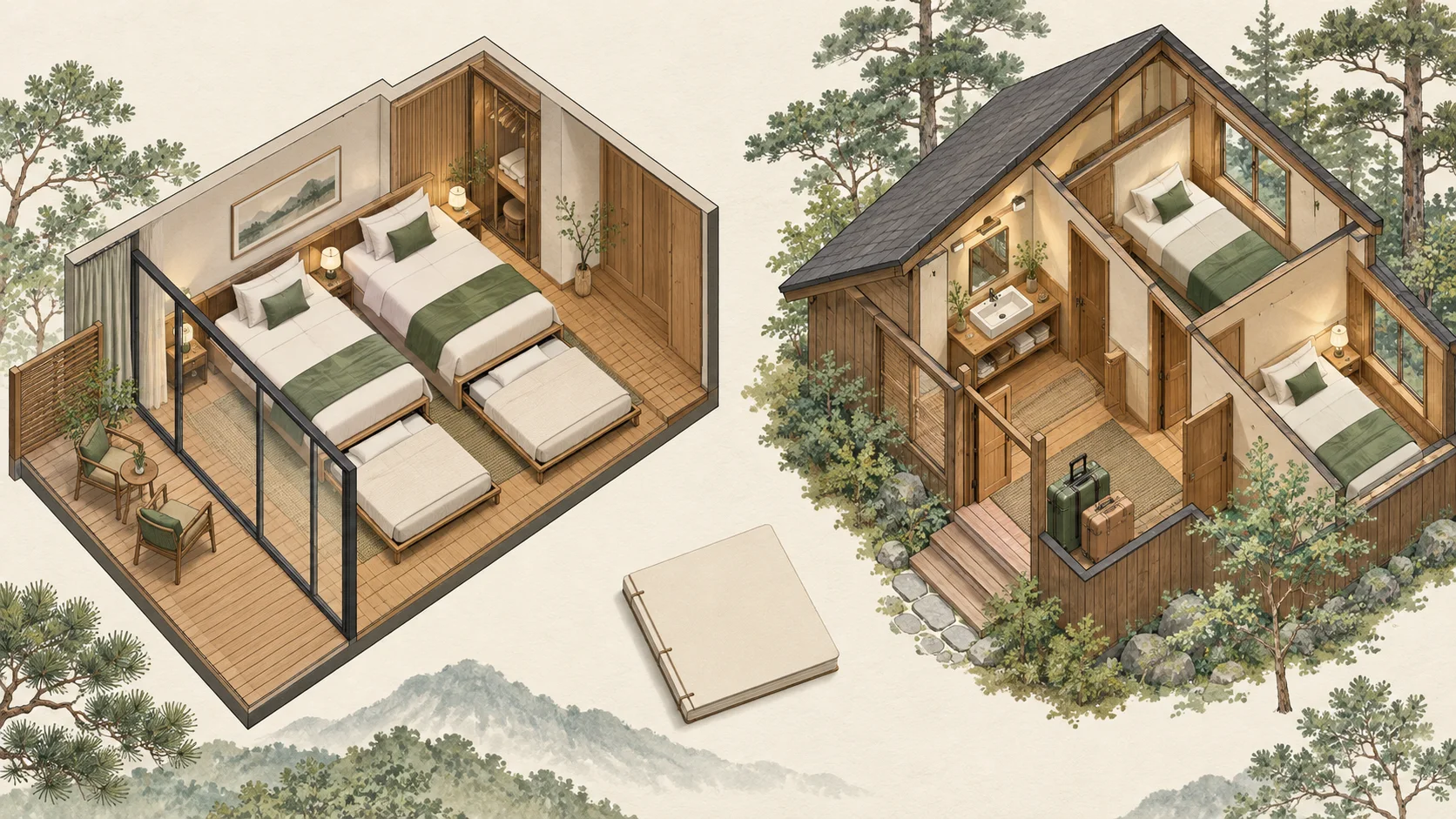
The new 2027 property is not open this winter
Searching East cottages may show pages from different periods. The current East homepage with renovation and new-facility notices and older announcements already contain different construction schedules. The latest public information gives 30 July 2027 as the planned opening of Villa Prince Karuizawa Higashi-no-Mori. This is a separate future property, not cottages already open for the winter of 2026–2027.
The official presentation of the new facility describes hot springs in every unit, some room types with ski access, kitchens, and consecutive-night conditions. Keep those features within that new product. Existing ordinary West cottages still prohibit cooking; future kitchens do not change them. Current East or West communal-bath rights likewise cannot be inferred from the new brand's advertising.
As of 21 October 2026, general reservations are announced to start on 9 November, rather than room prices already being verifiable in today's public inventory. For future dates, identify the full brand, planned opening, and actual booking status. For skiing this winter, first compare named rooms already operating. A beautiful rendering of a new building should not replace a feasible stay date.
FOREST and MOMIJI: bath rights depend on your building
The East FOREST HOT-SPRING eligibility page includes specified guests such as those staying in the East main building, with a bathing tax of ¥150. The West main building and ordinary cottages cannot simply use it. Hours are 6:00–23:00, last admission 22:30; it cannot be used before check-in, and use after checkout before 15:00 that day has a ¥2,000 per-person, per-visit rule. Free facility use and tax exemption are different questions.
The West MOMIJI HOT-SPRING categories and charges allow specified guests such as those staying in the West main building to use it free, separately listing ¥150 bathing tax; East is not eligible. Ordinary West cottages are not completely barred: adults pay ¥2,000 per visit, children 3 to under 12 pay ¥1,850, with reception 6:00–19:00. Seibu Prince Global Rewards Diamond members staying in West cottages can, under the rules, pay only the ¥150 bathing tax.
Before booking, ask which bath your full room category may use, at what times, and at what cost each visit. If the cottage paid-use item does not explicitly separate tax, do not add another ¥150 yourself as the final total. The site's video introduces the space; actual equipment, eligibility, and collection on your day still depend on current conditions and the booking confirmation.
Bed sharing, breakfast, and bathing use different child rules
Current East and West FAQs charge the adult rate from age 6; children under 6 have no room charge without an extra bed, while extra bedding costs more. This differs from free ski lifts through elementary school. A six-year-old may qualify for a free ski ticket but already pay as an adult in the hotel. Enter each person's actual age, bedding, and meals to establish the family total.
The East explanation of children's breakfast limits free breakfast under 6 to 1 April 2026–31 March 2027, with restaurant conditions. Do not turn it into permanent free meals everywhere. Bed sharing also depends on bed type, adults, and arrangements accepted by the hotel. A wide-looking bed cannot override official occupancy.
Communal baths have hygiene and accompaniment requirements. FOREST excludes people wearing nappies and separates male and female bathing from age 7. Ask in advance about alternatives for toddlers or other needs. Families wanting a private space together can first read the differences between in-room baths, reservable baths, and ryokan meals, then choose a category explicitly providing it. Public-bath photographs do not prove a private bath exists.
Prince shuttle dates matter more than memorising an old departure
The specific East arrival page estimates about 10 minutes on foot from the south exit, compared with around 13 for West; taxi estimates are about 2 minutes each. Some promotional pages summarise the entire resort with shorter walks. For check-in, prioritise the named hotel's directions and allow extra time to find the exit, handle bags, and wait.
The Prince resort pick-up timetable entry currently specifies 1 April–31 October 2026. It cannot establish a fixed winter service after November begins. Named access pages also warn of seasonal and route changes. For an early lesson or evening return, download the version for your dates and check the south-exit stop, building, and last service, instead of trusting an old departure time.
For day skiing, check a separate shuttle. The ski area’s official access page gives about ten minutes on foot or two by taxi from Karuizawa Station South Exit, plus a free return shuttle between that exit and the ski area without reservations. Its destination is the ski area, not proof of an East, West or Hoshino guest-only vehicle. Identify the entrance you need before deciding whether to walk with ski equipment or wait.
The 2026–2027 ski shuttle timetable has three periods. 31 October–29 November 2026 operates only on Saturdays, Sundays and Japanese public holidays, with the first South Exit departure at 08:15 and last return from the ski area at 17:00. 5–18 December has a first South Exit departure at 07:40 and last return at 17:20. 19 December–31 March 2027 has first departure at 07:40 and last return at 17:40. The published table lists no services on ordinary weekdays in the first period or on 30 November–4 December. Do not assume a free shuttle on those dates. Consider walking or a taxi according to snow and luggage, or check for an updated ski-area announcement.
Weather or timetable revisions may change the shuttle. For a booked lesson, work backward from reporting time through equipment hire, changing and waiting. For example, the train’s 08:04 arrival above does not guarantee the 08:15 shuttle. The roughly ten-minute walk also excludes exit-finding, storage and getting ready. Allow more transfer time with children or bulky equipment so arrival does not require a sprint.
The 2026–2027 opening does not open every area at once
The Karuizawa Prince Hotel Ski Resort seasonal portal announces planned Ski Centre and East dates of 31 October 2026–31 March 2027, with West planned for 19 December–22 March. Snow and trail conditions may alter the open areas. Early-season visitors should not assume restaurants, play areas, trails, and every lesson already match high-season operations.
The resort layout and trail map shows 14 trails, including 8 beginner runs. That is facility configuration, not a promise that all 14 open on the first day. Ask which beginner area is usable and where lessons meet. Even experienced companions should not use the total trail count to guarantee access to all routes.
A snow-status widget with an older date is not evidence for your departure day. Check operating notices, open areas, and whether lessons run, then follow staff directions on arrival. For a first Japan ski trip or skiing near Tokyo, knowing where to learn today, how to rest, and how to return to your room is more useful than only remembering the earliest opening date.
Four lift-price bands: check the date calendar before paying
The current lift-ticket prices and specified-date calendar separates early, regular, Top, High Top, and spring periods, forming four price groups. Adult ordinary on-site day tickets are ¥8,000, ¥10,000, ¥12,000, and ¥13,000; early and spring both cost ¥8,000. When comparing dates for two nights, identify the band rather than assume every weekday is cheaper.
Early season is 31 October–18 December 2026. The broad regular period is 19 December–22 March 2027, with designated Top and High Top dates overlaid; spring is 23–31 March. Keep the year when a period crosses New Year. Some official weekday labels conflict with the numerical dates. Use the complete calendar date here instead of copying an incorrect weekday into a leave plan.
For the same band, advance Web and on-site SPGR-member day prices are generally ¥500 below the ordinary on-site price. The afternoon ticket is ¥1,000 below the corresponding ordinary day ticket but starts at 12:00, with sales from 11:30. It will not serve a morning lesson. A regular Web adult day at ¥9,500 and High Top Web at ¥12,500 differ by ¥3,000, or ¥6,000 for two adults, worth comparing before booking rooms.
| Date band | Ordinary on-site day | Web day | Ordinary on-site afternoon |
|---|---|---|---|
| Early and spring | ¥8,000 | ¥7,500 | ¥7,000 |
| Regular excluding specified peak dates | ¥10,000 | ¥9,500 | ¥9,000 |
| Specified Top dates | ¥12,000 | ¥11,500 | ¥11,000 |
| Specified High Top dates | ¥13,000 | ¥12,500 | ¥12,000 |
Check peak dates individually and respect the afternoon start
For example, High Top lists 29 December 2026–3 January 2027, 9–11 January, and 6–7, 11–14, and 20–23 February. Top also includes 26–28 December, 4 January, and multiple further dates in January, February, and March. These are this season's designated dates, not every weekend of a month or last year's calendar shifted forward.
Early season generally lists 8:30–16:30; other periods list 8:00–17:00. Ordinary ticket sales also stop 30 minutes before closing. For half a day's practice, exclude renting, changing, and buying tickets from usable snow time. Afternoon admission starts at 12:00; having bought the ticket does not permit a lift ride an hour early. Actual opening still follows the day's notices.
The official ticket page sets explicit limits on changes, cancellation, and refunds after purchase. Read them before paying. They concern that resort ticket, not your hotel's refundable rate or each school's cancellation policy. If dates are uncertain, compare a slightly dearer flexible stay with a cheap nonrefundable option before buying restricted tickets, keeping the commitments across the journey compatible.
Free ski lifts for elementary-age children do not mean a free day
This season's ski-lift rules offer free tickets through elementary-school age, but advance Web issuance carries a ¥100 fee. A child ticket already issued for the season can be reused in the same season under the rules, so ¥100 is not a mandatory daily ticket price. Preschool children cannot ride alone. Eligible children still need the correct ticket and must follow accompaniment and use requirements.
Free lifts do not include lessons, snow clothing, skis and boots, helmets, or other paid activities. For example, children's Web equipment at ¥6,200 plus clothing at ¥4,200 already totals ¥10,400. Add a ¥700 helmet and it becomes ¥11,100 before lessons. Writing zero in a child's budget column can omit the most important learning and warm equipment.
Different products redefine a child. Free ski lifts through elementary school do not make sightseeing lifts free, and do not change the hotel's adult-rate threshold of 6. Record each traveller's age, lessons, snow-play-only plans, and separate bedding, then calculate according to each service. This is easier to verify than a family total that appears to include everything.
A sightseeing lift uses a separate ticket and a separate season
Non-skiers can compare the East high-speed lift sightseeing round trip. Its stated period is 19 December 2026–31 March 2027, 9:00–16:00, with the last descent at 16:00. Ordinary adults pay ¥3,000, ages 4 through elementary school ¥2,000, and ages 3 and under are free; member prices are ¥2,500 and ¥1,500. Do not apply this product to the 31 October ski opening.
Sightseeing needs its own ticket. An ordinary ski-lift ticket does not substitute, and sightseeing passengers cannot wear sliding equipment. If one person practices skiing and another only wants the view, check products, ascent, descent, and meeting point separately. Do not buy two similarly named day tickets and expect to exchange them at the entrance.
Two adults and one elementary-school child at ordinary sightseeing rates cost ¥3,000 × 2 + ¥2,000 = ¥8,000. This is a ticket example only, without transport, food, or equipment. In poor viewing weather, shopping or indoor rest are alternatives. Keeping a backup without advance payment is more useful than going uphill merely to reproduce a planned photograph.
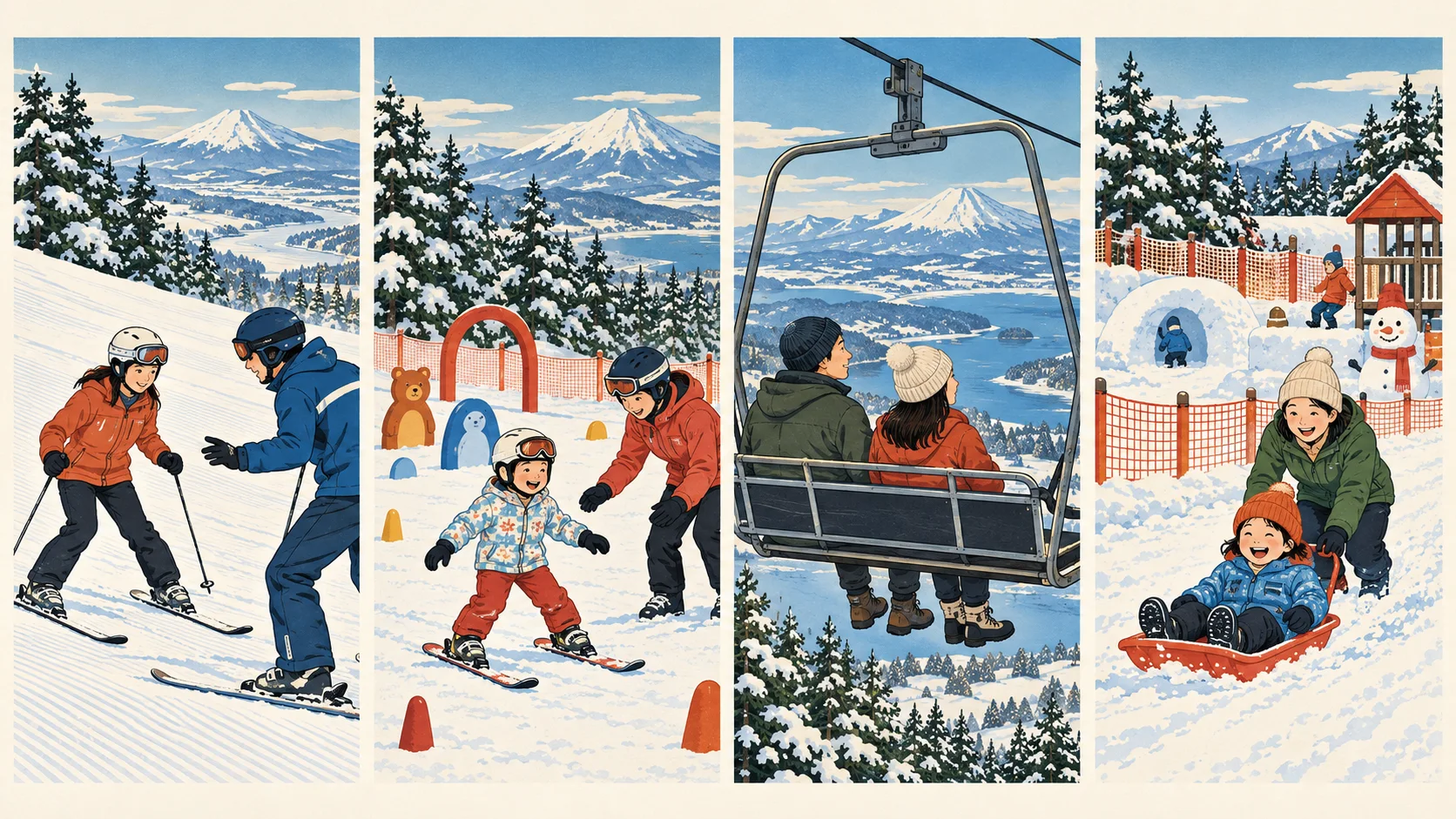
Equipment, snow clothing, and small warm accessories are separate
The official seasonal hire list charges separately for skis, boots, and poles or snowboard and boots, and for a jacket-and-trousers clothing set. On-site adults pay ¥7,500 and ¥5,500; children ¥6,500 and ¥4,500. Web prices are ¥7,200 and ¥5,200 for adults, ¥6,200 and ¥4,200 for children. Identify which set is meant instead of treating board-and-boot hire as everything needed from head to toe.
Adult Web equipment and clothing total ¥12,400, saving ¥600 against ¥13,000 on-site. Children's Web ¥10,400 versus ¥11,000 also saves ¥600. Helmets are another ¥700; gloves, goggles, and hats are not rented, so bring or buy them. Check sizes, collection, return, and loss or damage rules. A listing for children's hire does not guarantee every size in stock.
A dedicated hotel-guest hire counter does not mean equipment is free with the room. Individual items also do not necessarily follow Web-prepayment rules. If a lesson includes specific teaching equipment, ask how long it is available, where it can be used, and whether it must be returned afterward. Avoid paying twice for the same purpose or discovering after class that you have no equipment to keep practising.
Lessons: starting dates, languages, ages, and equipment inclusions
The ski and snowboard schools listed by the resort do not begin together. Karuizawa Ski School lists 1 December 2026; RITMO begins 31 October but runs private lessons only through 18 December, inclusive. An open ski resort does not establish that every school offers the same group class. Choose your date, then ask about language and level.
Pandaruman lists ages 3–9 and boot sizes 15–23 cm, from 1 December to 22 March, with private lessons through 18 December, inclusive. Included teaching skis and boots, helmets, and a dedicated practice slope belong to the lesson, not all-day hire or a general lift pass. Age alone is insufficient: check size, teaching language, accompaniment, and drop-off and pick-up arrangements.
Lion lists Japanese and English snowboard instruction from age 4, private lessons for preschoolers, and advance booking during specified early periods; tickets and hire remain separate. Chinese-language lessons also vary by school and conditions. Do not apply one school's minimum age, duration, or language guarantee to another. Send the number of people, ages, experience, and desired date and have the plan confirmed item by item.
Family snow play and proper ski trails require separate areas
The official family-area introduction distinguishes beginner Debut Park from Snowman Park, offering activities such as sledging. Sledges are not equipment for free use on ordinary beginner ski trails. Visitors only playing in snow should use the corresponding area; learners follow their lesson's practice-slope instructions, rather than mixing activities in one route.
The East and West Snowman areas carry Karuizawa Prince Hotel guest restrictions; they are not freely interchangeable with the day-visitor area. Opening also depends on snow, hours, and operations. The 31 October ski opening does not open every family park that day. If a child mainly wants snow play, check what is actually usable on your date before adding a hotel night for a particular facility.
Split family play into two short sessions with food, dry gloves, and a rest between. That is a family scheduling choice, not a requirement to complete a full day. A non-skiing caregiver should know toilets, indoor rest, and meeting points so a tired child can return to a simpler plan. A successful first ski trip need not be measured in lift rides or photographed snow depth.
Ski parking and shopping parking use their own charges
The resort's day-access and parking rules list ordinary parking at ¥1,000 on weekdays and ¥2,000 on weekends and holidays; 28 December–4 January uses holiday treatment. Premium spaces have different prices. The page also has seasonal notes outside ski operations: near opening, check the actual conditions, not a price sentence selected solely by month.
Driving removes some waiting but adds snowy roads, vehicle preparation, and parking decisions. Hoshino advises winter tyres or chains roughly from mid-December to mid-March and avoiding ordinary tyres. This is not a weather guarantee; check actual roads and operating notices on departure day. Without appropriate experience or equipment, trains plus confirmed transportation may be easier.
If skiing and shopping on the same day, identify the operator of your parking area, whether you can walk between activities, and when the car must move. Do not mix ski charges with shopping benefits. Getting into the car is not arrival at the station or highway: changing clothes, loading equipment, and finding the space take time. To catch a fixed train after skiing, finish early enough to complete them.
Old-town bakeries: decide where to eat before buying everything
The tourism association's Kyu-Karuizawa Ginza Street introduction describes around 750 metres of bakeries, cafés, souvenirs, and takeaway food. Leave part of a morning to walk and sit down rather than turn every famous shop into another full breakfast. In winter or low season, check each intended shop's actual opening day; a trading street does not make all businesses open identical hours daily.
The French Bakery website with products and shop information lists 8:00–17:00, normally closed Thursdays, with a separate no-closure summer period. Identify the name and size of a particular product: a large French loaf at ¥432 and six bread rolls at ¥486 are different items, not close prices for the same loaf. Stock and sellouts still depend on the day.
With hotel breakfast included, choose one bakery for bread for the next day's journey rather than eat a second full breakfast to collect a list. Ask about seating, hot food, or dietary needs; takeaway bread in stock does not promise a dine-in meal. Free time lets you decide the length by weather and appetite instead of continuously chasing unconfirmed opening times.
Asanoya: seating and a hot-food menu are different things
The Asanoya official store list gives the Kyudo Honten address and seasonal information. Its linked updated Karuizawa store announcement retains an older publication date but includes later updates, stating that the dine-in menu is suspended from 17 October. Read the announcement body rather than rely only on weekend restaurant hours in the list.
The notice still allows bread and drinks bought in the shop to be enjoyed in the seating area. A suspended menu therefore does not mean no seating, but it does not mean the previous hot dishes are still available either. This guide does not predict a restart date absent from the notice. For a breakfast set or lunch, check before leaving and keep buying bread or using another restaurant as options.
With several travellers, agree a meal window instead of adding every bakery each person finds. Separate purchases to take to the hotel, food to eat now, and shops to browse; that helps manage bags and waits. Before a longer walk to Kumoba or a different area, deal with food and toilets. Constant shopping without an actual rest is usually less comfortable.
Kumoba autumn colours: use current images, not a guaranteed red date
The town's Kumoba visiting and live-camera entry helps check current scenery and access. The timing of changing leaves varies with year and weather. Last year's most beautiful day is not automatically this year's best date, and a camera only shows its captured moment, not your stay next week. If booking early, choose a walk you would enjoy before peak colour or after leaf fall too.
The town warns there is no nearby parking to rely on directly and encourages walking and public transport. Drivers should park legally first and plan the last part, rather than follow navigation into pond-side lanes looking for roadside parking. Without a car, combine the old town and pond in one day, adjusting the walking to your group instead of crossing areas again for one photograph.
Wet ground, fallen leaves, and crowds affect the pace. Leave a window in which you can turn back. Give way when taking pictures instead of blocking a narrow path for a reflection. If the colour disappoints, shift attention to trees and waterside walking, then get a warm drink. The day's value does not have to depend entirely on the search phrase best autumn foliage.
Autumn timing differs by elevation, town, and larch trees
The tourism walking booklet's typical autumn explanation distinguishes higher trees beginning to change in mid-September, usually stronger in mid-October, from lower town colours in late October. Larches around middle slopes and town turn yellow later. This is a recurring seasonal reference, not a forecast of full red on a particular day in 2026. Narrow dates by high-elevation red or town yellow, then use current notices and cameras; all Karuizawa does not peak together.
For two autumn days, use the first for Kumoba and Kyu-Karuizawa, the second for forest and stream-side walks in Hoshino followed by Tombo-no-yu. Leave Shiraito for a day with checked mountain-road transport both ways. The tourism description of Kumoba's walking path lists around 1 km by the pond. Add photography, your pace, and access rather than convert distance into a fixed number of minutes everyone must achieve.
Late autumn can still include a short walk and a warm drink. The booklet describes leaf fall and an early-winter atmosphere in town by mid-November. If combining foliage with early skiing from late October, check leaves, ski openings, and clothing separately. Foliage lovers need not keep delaying it just to ski too; learners should not expect a red-leaf image to describe the entire ski season.
Kumoba's 2026 autumn buses and Hoshino's seasonal library
The town's Kumoba bus and final-walk directions list a paid bus from Karuizawa Station to Roppontsuji/Kumoba-ike, then about 3 minutes on foot. The additional autumn services for 2026 run 10 October–23 November, with 8 added departures daily, a published ¥220 station-to-stop fare, and specified intermediate stops. This is a seasonal addition, not a year-round interval. At ¥220 each way, two adults pay ¥880 return; child fares and other sections follow the operator.
The Hoshino 2026 Autumn Library announcement lists 10 October–15 November, 10:00–17:00, around spaces including the square beside Tombo-no-yu, with bookshelves and benches by the stream. Rain cancels the activity. The mobile bookshop has Friday, Saturday, Sunday, and holiday dates with exclusions, 10:00–16:00, not daily attendance throughout the event's hours. Check weather and the announcement before placing reading before or after a bath.
This autumn plan does not require constant changes of vehicle. Leave your hotel or legal bag storage lightly packed, check the return, then walk Kumoba and the old street; use a separate day for Hoshino. KIKYO guests can arrange their north-side access first; BEB5 guests can leave a nearby evening for local activity. Southern guests can also use buses but should collect luggage earlier. Neither base guarantees leaf colour. Confirmable rooms, transport, and event dates create time to walk slowly.
Shiraito Falls needs a mountain-bus plan, starting with the return
The Shiraito Falls operator's access directions name stop 2 outside Karuizawa's north exit and around 25 minutes by bus to Shiraito-no-taki. Continuing towards Kusatsu is a separate, longer leg. These are general estimates: add waiting, traffic, and the last walk from the stop. Two places appearing north on a map do not make the falls a five-minute extension of the old street.
Shiraito Highland Way, containing the falls, is a toll road of around 10 km. Buses, driving, and time on foot each need different plans. This guide does not quote unverified current fares or treat summer/autumn timetables as fixed winter services. Find your date and return through the official access page before deciding how long to stay, especially rather than dismissing the last bus as optional.
For an onward overnight stay in Kusatsu, this leg can inform the route, but include luggage, ryokan dinner, and actual stops. With only a short afternoon and plans for the old town, leaving the falls for another trip may work better. Continue with the Kusatsu guide to overnight stays, terminal pick-ups, and seasonal transport, rather than infer a complete workable day from straight-line distance.
Hoshino: Harunire Terrace and bathing can share a day
The official Harunire Terrace introduction and shop links help identify stream-side shops and food before choosing one or two places you actually want. Hoshino Onsen, the terrace, and nearby facilities can form half a day, but each shop and bath has separate hours. General access to an area does not replace individual business hours or bookings, and part of the route remains outdoors in rain.
You can arrive for lunch, walk, then bathe, or bathe first and find a drink afterward, depending on habits and available hours. Ask the relevant shop about a fixed meal time, high chair, or dietary requirement. Many shops do not mean seats for any group at any hour. Decide the return bus and bag-collection location first, then leave the remaining time for walking.
The Hoshino luggage and accessibility guidance explicitly says there is no luggage-storage service or visitor lockers to rely on in the area. Use appropriate storage at Karuizawa or Naka-Karuizawa Station. P1–P3 have corresponding spaces and slopes, some facilities have accessible toilets, but wheelchair hire is not available. Check the whole route if you need assistance; one ramp does not make every corner equally accessible.
Tombo-no-yu prices vary by season; check towels and reentry too
The current Hoshino Onsen Tombo-no-yu instructions list 10:00–22:00, last reception 21:15. April–November and 29 December–3 January cost ¥1,550 for adults and ¥1,050 for children 3 through elementary school. Other December–March dates cost ¥1,350 and ¥800. Winter does not always mean the lower price: New Year belongs to the higher band.
Two adults and one elementary-school child cost ¥1,550 × 2 + ¥1,050 = ¥4,150 in the higher band, or ¥1,350 × 2 + ¥800 = ¥3,500 on other winter dates, a ¥650 difference. Towel items include ¥350 hire and ¥200 purchase; identify which you need. These calculations compare listed items, not an assumption that every accommodation plan includes free bathing.
There is a same-day repeat-bathing rule within 4 hours of admission. Follow the on-site process for a break, rather than treating one purchase as unconditional unlimited entry all day. Below is the official Hoshino Chinese-language bathing tutorial adopted by the website, explaining the general process. Current prices, tattoo rules, and opening notices still belong to this facility's instructions. Stay in the base you like and arrive by confirmed transport; a Hoshino hotel is not automatically required.
Tombo-no-yu tattoo and infant rules differ from hotel baths
Tombo-no-yu currently permits tattoos fully covered by its specified 10 × 8 cm stickers, with at most 8 needed to cover everything. This is not unrestricted admission for anyone with tattoos. If yours exceed that or you are unsure, ask first; another bath's policy cannot be demanded at the entrance. Each bath has its own rules to read.
The facility separates male and female bathing from age 7. People wearing nappies use baby tubs or other specified methods, unlike FOREST's exclusion of nappy wearers. With a toddler, confirm the exact facility, accompanying caregiver, and usable equipment, not a broad conclusion that Hoshino works for families. A child ticket category cannot replace hygiene requirements.
Prepare dry clothes, towels, and return transport before bathing instead of emerging with wet items to wait for an unchecked bus. If a companion will not bathe, agree separate activities and a meeting place. A person without admission cannot simply use paid indoor areas as a long-stay waiting room. Asking about each service is more reliable for family planning than guessing from promotional photographs.
Stone Church visits must fit around actual ceremonies
The Stone Church Uchimura Kanzo Memorial visiting guidance lists 10:00–17:00, closed to visits during weddings and other activities, with staff directions followed. It can join a walk towards Hoshino but should not become a rigid promise to arrive at a precise minute and finish in five. The building remains in use, and its activities come first.
The official guidance also excludes visits by large groups arriving in chartered buses. Independent travellers still follow the day's access and rules. This guide concerns visiting, not unverified wedding prices, packages, or booking slots. Searches for a Stone Church wedding and its exterior can refer to different needs: a tourist visit and a formal ceremony service are different products.
If entry is unavailable, switch to an open local walk or rest rather than wait at the gate until the return plan fails. Photos and official videos introduce the space, not guarantee the same light or angle on your date. Follow photography and circulation instructions and respect people using the site; this makes a short stop work better within the whole journey.
Prince Shopping Plaza is close to the exit, not quick to finish
The shopping plaza's station-arrival directions estimate 3 minutes on foot from the south exit. It fits a departure day or a short arrival window, but that is the distance to the shopping area, not the time to cover stores, find items, try them on, pay, and retrieve bags. With a fixed train, first set when to leave the stores, then limit your shopping area accordingly.
The plaza website's daily hours and store information are specific to the corresponding dates and notices; they do not establish identical opening hours every day of the year. For a brand, discount campaign, or restaurant, check the relevant page. This guide does not guarantee your size, coupons, or discounts; an outlet-sale search result does not establish every store's participation.
If two travellers shop separately, agree a meeting point and latest return to luggage so you can reunite even with a dead phone. Shopping bags affect later walks and ski days. Heavy shoppers can leave this for the final half day instead of carrying new luggage throughout two nights. Rain can mean more store time, but connections between zones may still be outdoors.
Two free shopping-parking hours do not combine with ski parking
The plaza's parking charges and payment rules list 2 hours free from entry, then ¥100 per hour, with cash payment. Purchases reaching ¥30,000 have a full-day-free validation procedure under store and validation conditions. Keep the parking ticket and receipts. Buying something does not automatically exempt you from parking charges, and not every purchase amount qualifies for a whole free day.
For 4 hours at the ordinary rate, the first 2 are free and the next 2 × ¥100 total ¥200. Even exactly reaching the shopping threshold requires validation, not just showing bags at the exit machine. This is the shopping plaza's example, not credit against ordinary or Premium ski parking. A ski parking ticket likewise does not establish free shopping parking.
Photograph your parking area and return route before shopping so the last ten minutes do not go on finding the car. If dropping someone at the station, allow loading bags, payment, leaving, and road congestion. A large shopping area's convenience depends on leaving calmly before your return journey; free hours need not turn intended rest into a rush.
Karuizawa's 2026 lodging tax already includes the prefectural share
The town's graduated accommodation-tax table took effect 1 June 2026. From 1 June 2026–31 May 2029, a per-person, per-night lodging basis without meals below ¥6,000 is exempt; ¥6,000 to under ¥10,000 totals ¥200, ¥10,000 to under ¥100,000 totals ¥250, and ¥100,000 or more totals ¥700. These totals already include Nagano's ¥100 share. Do not add it again.
For example, a ¥12,000 per-person, per-night basis without meals falls in the ¥250 band. Two adults for two nights pay ¥250 × 2 × 2 = ¥1,000. If thermal bathing also incurs a bathing tax, that is separate; check the order and payment breakdown to see whether it was collected. The two names mean different taxes: do not omit one or duplicate them without looking.
The next ¥300, ¥350, and ¥800 amounts begin only 1 June 2029, not on a 2026 stay. The town's guest questions on calculations and exemptions also say children are not automatically exempt by age: use their actual per-person, per-night basis. Students on an ordinary family trip cannot simply apply school education or research exemptions requiring documents.
| Lodging without meals plus applicable service basis | Town | Prefecture | Total |
|---|---|---|---|
| Below ¥6,000 | Exempt | Exempt | ¥0 |
| ¥6,000 to under ¥10,000 | ¥100 | ¥100 | ¥200 |
| ¥10,000 to under ¥100,000 | ¥150 | ¥100 | ¥250 |
| ¥100,000 or more | ¥600 | ¥100 | ¥700 |
Ask for the taxable breakdown rather than divide a platform total
The town includes accommodation without meals and its service charge in the basis, excluding consumption tax, bathing tax, food, and other non-lodging services. For a plan with breakfast, dinner, and activities, dividing the card total by two people does not guarantee the tax band. The accommodation taking payment should confirm the formal split for that product. Save the breakdown when comparing platforms.
Suppose the hotel explicitly lists ¥5,900 lodging and ¥200 lodging service per person per night: together they make ¥6,100. Looking only at a room line below ¥6,000 does not establish exemption. This demonstrates a known composition, not a tax ruling for any real booking. If a child pays only for food, or bedding and packages have different classifications, ask the hotel about the actual product.
For prepaid bookings, check included taxes and those collected locally, then compare actual nights and guests before checkout. Keep confirmation and payment breakdown together rather than dispute the desk charge using another city's rule. Continue planning with the Japan budget categories for transport, accommodation, and daily spending, keeping likely costs instead of deleting small items to make a total look better.
Two adults' ski-day budget: equipment first, lessons separately
On a regular date outside Top and High Top, two Web adult day passes at ¥9,500 total ¥19,000. Equipment and clothing at ¥12,400 each total ¥24,800; two ¥700 helmets add ¥1,400. Those three items total ¥45,200. This is a ticket-and-hire illustration, excluding lessons, transport, food, warm accessories, and accommodation, without promising the same stock on every date.
Switching to early Web day passes at ¥7,500 makes tickets ¥15,000 and the otherwise identical total ¥41,200, ¥4,000 below regular. Open areas and bookable lessons may differ, so compare more than savings. High Top Web at ¥12,500 makes two tickets ¥25,000 and brings the total with the same hire and helmets to ¥51,200, ¥6,000 above regular. Date and usable content belong in the same decision.
With children, list hire, lessons, free-ticket collection, and fees individually instead of dividing the adults' total among everyone as a family average. Deduct only equipment genuinely duplicated by the lesson before adding its quote. To reduce the budget, adjust unnecessary shopping or duration, not correctly sized equipment, warmth, or sufficient rest for a child.
Keep nearby alternatives for changing weather or energy
When ski weather does not suit you, ask the school, resort, and ticket provider what actually happens. Do not assume a full refund or a change to any date. Shopping, baths, and the old town have their own transport and hours. Start with the easiest confirmed usable alternative, then decide whether you can cross areas. Half a day without skiing need not become a rush of extra paid activities.
Rain on a foliage day can mean a shorter Kumoba walk and more time in a shop or hotel. Store large bags before bathing in Hoshino. If companions split up, agree a clear meeting point and communication. Unscheduled time is not a waste of what you pay for the hotel: it accommodates different energy levels, interests, and weather without everyone completing the same checklist.
The final day before changing cities is better kept conservative: retrieve bags and confirm the train, matching shopping volume to what you can carry. For an onward Kusatsu, Nagano city, or another ski resort, check that leg's own transport and accommodation. Prince child tickets, baths, and hire cannot be transferred elsewhere. Connect the things actually confirmed to produce a route you can use.
Final checks: room, date, product, and the way back
For rooms, check the full brand, building, nights, capacity, and each sleeping place, then meals, bath rights, accommodation tax, and cancellation. For skiing, check the date band, lesson language and reporting time, and what to bring or rent. Sightseeing lifts, snow-play parks, and ordinary ski passes each need the right product. Save these lists separately so using a service does not mean guessing through a long string of travel screenshots.
For transport, save your station exit, shuttle validity, return bus, and luggage location, then check operational changes before departure. Official photos, videos, and cameras introduce appearances; current rooms, meals, snow, and available places still depend on the particular product. If no official text supports a free entitlement, ask rather than use someone else's old experience as a guarantee.
This guide covers Karuizawa town and Prince ski choices, not every Japanese ski resort or Nagano hotel. Once you know the main activity, usable dates, and base, remove unnecessary detours. Leave time to eat, rest in your room, or practise a move you have just learned. That is the usable travel time an overnight stay or two can add.
A few useful answers
Where should first-time Karuizawa visitors stay?
For skiing and shopping, compare the southern resort. For old streets and Kumoba, compare the north. For Hoshino walks and baths, check Naka-Karuizawa and local buses, then confirm the actual hotel building and luggage arrangements.
Can East and West guests use all Prince hot springs?
No. Specified current East guests use FOREST, specified West guests use MOMIJI, and ordinary West cottages have separate paid MOMIJI rules. Future 2027 brand benefits do not apply automatically to current stays.
Can you cook in a West cottage?
The ordinary-cottage FAQ lists a sink without a stove, prohibits cooking, and bans fire. Kitchens in the future 2027 property belong to a separate product.
Do all ski lessons start on 31 October 2026?
No. Schools have different dates and formats: some begin 1 December, some offer private lessons only in early season. Opening also does not promise all 14 trails and snow-play areas on the first day.
What still costs money with a free elementary-age ski ticket?
Collect the child ticket under the season's rules. Advance Web issuance has a ¥100 fee, not a mandatory daily charge. Equipment hire, clothing, helmets, lessons, and other activities remain separate; hotel age rules differ.
Does a ski day pass cover the sightseeing lift?
No. The East high-speed sightseeing return needs a dedicated ticket: 19 December 2026–31 March 2027, 9:00–16:00, ordinary adult ¥3,000 and ages 4 through elementary school ¥2,000. Free-child ski rules do not transfer.
Does equipment hire include clothing, gloves, and goggles?
No. Equipment and clothing are charged separately, with helmets extra. Gloves, goggles, and hats are not rented: bring or buy them. Lesson equipment inclusions depend on the specific plan.
Must you stay at a Hoshino hotel to use Tombo-no-yu?
You can compare day bathing under current admission fees and rules. That does not open guest-only transportation to everyone; check local buses or other access separately.
Are all tattoos allowed at Tombo-no-yu?
No. Current rules require complete coverage using the specified 10 × 8 cm stickers, at most 8. For larger areas or uncertainty, ask first instead of applying another bath's policy.
Can you drive straight to Kumoba and park beside the pond?
The town warns there is no nearby parking to rely on and encourages walking and public transport. Park legally and plan the final section. Live images also do not guarantee autumn progress on a future date.
Do you add Nagano's ¥100 to the 2026 lodging-tax total?
No. The official ¥200, ¥250, and ¥700 totals already include that ¥100. A per-person, per-night basis without meals below ¥6,000 is exempt. Children follow actual charges and rules, not automatic age exemption.
Can the old Prince shuttle schedule be used for winter 2026?
The current Pickup page specifies 1 April–31 October 2026, so it does not establish fixed winter times from November. Use the edition for your date to check boarding, building, eligibility, and return.
Check with the source
Schedules, availability and rules can change. These official sources are the place to confirm details before you book.
- Karuizawa Tourism: access and transport operators
- Hoshino: buses, rail, luggage, and winter arrival
- Prince East: current room types and occupancy
- Prince East: children and facilities FAQ
- Prince West: rooms and cottage layouts
- Prince West: station south-exit access
- Prince West: cottage facilities and stay rules
- Prince East: renovations and new-brand information
- Prince Hotels: new property planned for July 2027
- Prince East: FOREST HOT-SPRING conditions
- Prince West: MOMIJI HOT-SPRING eligibility and charges
- Prince East: specific walking and pick-up directions
- Prince Hotels: shuttle validity and timetable entry
- Prince Ski Resort: 2026–2027 operations
- Prince Ski Resort: trail and facility map
- Prince Ski Resort: lift dates and prices
- Prince Ski Resort: hire items and prices
- Prince Ski Resort: schools, dates, and lesson conditions
- Prince Ski Resort: family snow-play eligibility
- Prince Ski Resort: day access and parking
- Karuizawa Tourism: Kyu-Karuizawa Ginza
- French Bakery: products and hours
- Asanoya: shop locations and seasonal information
- Asanoya: updated Karuizawa store notice
- Karuizawa Town: Kumoba access and live camera
- Shiraito Highland Way: waterfall access
- Hoshino: Harunire Terrace and shops
- Hoshino: luggage, accessibility, and facility guidance
- Hoshino: Tombo-no-yu prices and bathing rules
- Stone Church: visiting hours and restrictions
- Prince Shopping Plaza: station south-exit arrival
- Prince Shopping Plaza: daily hours and shops
- Prince Shopping Plaza: parking charges and validation
- Karuizawa Town: lodging-tax periods and bands
- Karuizawa Town: guest tax basis and exemption FAQ
- Kyu-Karuizawa KIKYO: balcony Deluxe specifications
- Kyu-Karuizawa KIKYO: station-access information entry
- Kyu-Karuizawa KIKYO: bed sharing and maintenance
- Hoshino BEB5: YAGURA, Twin, and arrival
- Hoshino: scope of BEB guests' bath discount
- Karuizawa Tourism: walking booklet and typical seasons
- Karuizawa Tourism: approximately 1 km Kumoba walk
- Karuizawa Town: Kumoba bus and final 3-minute walk
- Karuizawa Town: 2026 autumn bus at ¥220
- Hoshino: 2026 Autumn Library dates and rain cancellation
- JR East | Asama 601 stops and operating dates in October 2026
- JR East Eki-net | Shinkansen e-ticket use and IC-card conditions
- JR East Eki-net | Hokuriku Shinkansen e-ticket ordinary reserved-seat normal-period fares for purchases from 14 March 2026
- JR East | Adult, child and young-child ticket rules
- Karuizawa Prince Hotel Ski Resort | 2026–2027 free ski shuttle timetable