Compare public baths, short walks and named inns in Kaga Onsen. Choose one or two nights around beds, futons, in-room baths, children’s meals and transfers from Kagaonsen Station or Komatsu Airport.
- Region & Focus
- ChubuAccommodation
- Reading Scope
- 29 min read · 18 chapters · 7 Q&As
- Official Verification
- 15 official sources checkedUpdated 30 October 2026
- Key Topics
- Where to stayItinerariesBooking
Chapter Route Map (tap any stop)
- Give your afternoon to one hot-spring district
- Yamashiro’s two baths: wash at Soyu, soak and see the building at Kosoyu
- Keep Yamashiro walks around Yu no Kuruwa; split the two baths if useful
- Yunokuni Tensyo: what two beds and two Japanese rooms provide
- Tensyo children’s meals: plan the child’s own dinner and breakfast
- Tensyo transfers: meet south of the station; booking differs by direction
- Walk Yamanaka’s hot-spring street first; treat Kakusenkei separately
- Kikunoyu’s deep baths affect family supervision
- Kissho Yamanaka: futons or an in-room hot spring for the same three guests
- A free 50-minute private bath or a room bath all evening
- Kissho children’s meals, bedding and restaurants: fit the child’s routine
- Kissho autumn and winter transfers: five station pickups, two airport pickups
- A short Katayamazu route: lakeside returns and alternating bath views
- Kasuikyo lake-facing rooms: twin beds, Japanese rooms and open-air baths
- Kasuikyo dinner by 19:00 and breakfast from 7:00 shape both transfers
- One-night plans: connect one outing with the inn’s meals
- Two nights in one district give the second day room to breathe
- Compare cancellation terms, then connect the actual return journey
- Quick Q&A
For one night in Kaga Onsen, choose an afternoon you can use well. Yamashiro brings Soyu, Kosoyu and the Yu no Kuruwa centre together. Yamanaka offers a hot-spring street leading to bridges, with Kakusenkei Gorge an option according to walking ability. Katayamazu links Lake Shibayama’s shore, a public bath and lake-facing rooms. All three offer hot springs. The difference is what you do outside the inn and how much walking and waiting for transport you want. When coming from Kanazawa, an afternoon arrival usually gives more value than reaching the inn just before dinner.
Give your afternoon to one hot-spring district
Choose Yamashiro first if public baths are the main activity. Soyu and Kosoyu offer different bathing experiences, with walks around Yu no Kuruwa. Visitors arriving in the afternoon and leaving next morning can combine public baths and an inn in one night. If companions care little for historic bathhouse architecture and mainly want room time, put bedding and the room’s bath ahead of the district’s fame.
Yamanaka rewards a longer daytime visit. The hot-spring street from Kikunoyu towards Korogi Bridge is about 600 metres. Kakusenkei covers about 1.3 kilometres of gorge between Korogi and Kurotani bridges. The street focuses on shops and bridge approaches; the gorge has a separate walking trail. A couple keen to walk and a family with a toddler may choose different distances even at the same inn.
Katayamazu suits making the water view part of the stay. Its public Soyu has lake-side and woodland-side baths, and Kasuikyo rooms face the lake. Poor walking weather can still leave a useful indoor stay. Transfers between districts add waits, luggage collection and another check-in. Choose one district for one night; for a second, decide whether you want a gorge day, a different room or rest in the same place.

Compare public baths, short walks and named inns in Kaga Onsen. Choose one or two nights around beds, futons, in-room baths, children’s meals and transfers from Kagaonsen Station or Komatsu Airport.
Yamashiro’s two baths: wash at Soyu, soak and see the building at Kosoyu
The Yamashiro Onsen tourism association’s bath information makes the distinction clear. Soyu offers washing and bathing for JPY 500 per adult. Kosoyu recreates a Meiji-era bathhouse exterior, interior and Kutani tiles, for JPY 700 per adult. Kosoyu has no taps or showers and prohibits soap and shampoo. Visit for soaking and the space itself. Use Soyu or your hotel bathroom to wash off a day’s sweat or shampoo children’s hair.
An adult combined ticket costs JPY 1,000, saving JPY 200 against JPY 1,200 for separate entries. For two adults, that is JPY 2,000 versus JPY 2,400. Ages six to under twelve pay JPY 150 at Soyu and JPY 280 at Kosoyu; ages three to under six pay JPY 70 and JPY 140. Under-threes are free. Two adults and a five-year-old buying separate single entries to both pay JPY 2,610. If you only want one bath, buy that ticket rather than add a soak to use a combined pass.
Soyu normally opens 6:00–22:00. Kosoyu normally has the same hours, changing to 7:00–21:00 from December to February. On the fourth Wednesday each month, both open at noon. Soyu does not provide free toiletries. Washing supplies and small towels are sold on site, bath towels can be hired and hairdryers cost extra. Operating information was checked through 30 October 2026; Yamashiro prices use the bands effective from 1 April 2026.
Keep Yamashiro walks around Yu no Kuruwa; split the two baths if useful
A short route starts at Soyu, continues to Kosoyu and looks around the inns, shops and streets of Yu no Kuruwa surrounding the baths. It returns to one centre without a distant endpoint. With only an afternoon, use your preferred bath first, then decide on another loop rather than buy both entries and chase the clock. You can also split the baths between arrival afternoon and the next morning using separate single tickets. Wash and bathe at Soyu on day one, then buy Kosoyu entry next morning to focus on its space. For an early shuttle, visit both on arrival day and leave morning for breakfast and check-out. Kosoyu opens at 7:00 in winter, so early departures should not rely on it as a last stop. On the fourth Wednesday morning, eat and store luggage before bathing after noon.
In heavier rain, reduce the route to one bath and a short stretch of Yu no Kuruwa. Keep Kosoyu if architecture and tiles are your purpose, and wash at the inn. Keep Soyu if the family needs a wash. Either choice preserves the reason for coming. For an inn on the outskirts, plan the return from its actual location; a Yamashiro address does not put its door beside the baths.
Yunokuni Tensyo: what two beds and two Japanese rooms provide
Yunokuni Tensyo offers a concrete Yamashiro comparison. The Hakuun wing’s Grand Family Room with bedroom has two Japanese rooms and twin beds. Mattresses measure 1,000 by 1,950 mm, with a bed height of 440 mm. This lets you separate people needing beds from those using Japanese rooms. Separate spaces also help when grandparents sleep early and children finish getting ready later, rather than everyone sharing one sleeping area.
The Tensyo wing’s standard Japanese Suite with terrace offers about 77–90 square metres, a main room of 12.5–15 tatami, a second room of 4.5–6 tatami, a living area, indoor bathroom and terrace. It adds space to sit separately, open luggage and spend time indoors. Prioritise the twin-bed family room if fixed beds matter. Consider the suite if Japanese-style living and a larger daytime rest area suit you.
Tensyo children’s meals: plan the child’s own dinner and breakfast
The Tensyo dining page lists Child A meals for primary-school children at 70% of the adult charge and Child B for younger children at 50%, with extra children’s meals for categories C and D. For a five-year-old needing dinner and breakfast, compare combinations with children’s meals rather than treat two adult kaiseki dinners as food for three. Twin beds versus Japanese rooms and the child’s meals are separate choices. Extra dinner and breakfast meals cost JPY 2,750 each, except 31 December–2 January, when dinner is JPY 6,600 and breakfast JPY 3,300. Porridge, udon, gratin and omelette rice are also listed extras. Families needing two full children’s meals can compare Child B with alternatives; lighter eaters can compare the actual extras. Keep the same five-year-old and two-meal needs when comparing all three inns.
Adult dining includes the basic Hakuun meal, upgraded Tensyo meal and seasonal dishes, with the current menu period covering October 2026–March 2027. Prioritise upgrades clearly: room type for beds, the child package for their meals, then adult dining. Separating these avoids accepting an unsuitable sleeping layout for a more elaborate dinner photograph.
Tensyo transfers: meet south of the station; booking differs by direction
Tensyo’s free transfer from Kagaonsen Station takes about 15 minutes. Departures are 14:30, 15:15, 16:00, 16:45 and 17:30, requested when booking or by 18:00 the previous day. Without a request, no pickup is arranged. Meet in the south station square at Onsen Chuo Exit and report to the flag-carrying staff. Allow time from train arrival through the gates to the shuttle parking area; train arrival is not bus departure.
The scheduled 14:30 departure implies arrival around 14:45, leaving time for luggage, rest and central Yamashiro baths. The 17:30 departure implies about 17:45 arrival, making the day mainly about the inn and dinner. For both baths and a Yu no Kuruwa walk, choose an earlier train and transfer or move some activity to day two. The booked transfer gets the family and luggage to the door without dragging cases around bathhouses first.
Return departures are 8:30, 9:30 and 10:30. No reservation is needed, but arrive at the main entrance five minutes early. At about 15 minutes, the 10:30 service reaches the station around 10:45; add time for station entry and finding the platform. The hotel notes that the third departure is planned to move to 10:45 from 1 April 2027. Use the matching schedule for spring travel.
The access page also gives an airport route: local bus from Komatsu Airport via Komatsu Station, rail to Kagaonsen, then the hotel shuttle. Connect all these stages before the pickup to see how much of your arrival afternoon remains.
Walk Yamanaka’s hot-spring street first; treat Kakusenkei separately
Yamanaka lets you choose between town and gorge within one day. Start at Kikunoyu, follow Yuge Kaido towards Korogi Bridge and return along the street. The tourism association gives about 600 metres, with Yamanaka lacquerware, Kutani shops, food and cafés, no utility poles and wider pavements. This out-and-back keeps shops and a bridge view in a short family walk.
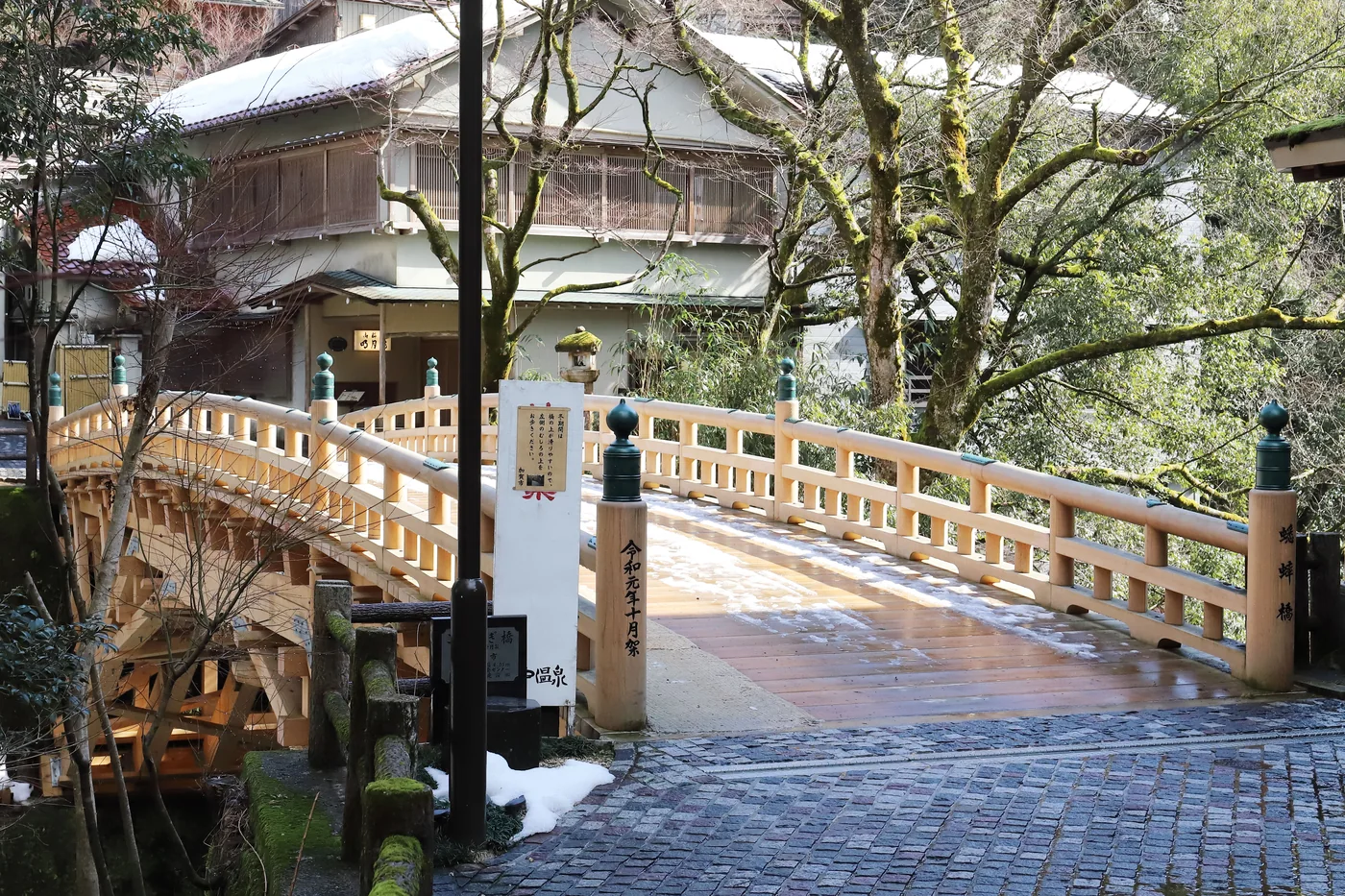
Kakusenkei’s 1.3 kilometres describes the gorge from Korogi to Kurotani Bridge. Add your accommodation approach, entrances, exits and return. Make the trail your main outing for streams, rocks and different bridges. With a pushchair, concern about slippery paths or a wish to avoid changes in level, choose streets and bridge decks first. Adding 600 metres and 1.3 kilometres does not mean a 1.9-kilometre route returns you to your own inn.
Hasebe Shrine stands up a slope off Yuge Kaido; Mugen-an is uphill after crossing Korogi Bridge. Omit both if avoiding slopes is the priority, retaining Kikunoyu, the street and a turn at the bridge. In rain or poor winter footing, return on the same street and save the gorge trail for a suitable day. Late arrivals can look from the bridge and return to use their room.
A Yamanaka Onsen introduction published in 2017, divided into spring, summer, autumn and winter, covering hot springs, natural scenery and traditional culture.
Kikunoyu’s deep baths affect family supervision
Yamanaka’s public Kikunoyu has separate men’s and women’s buildings. The men’s bath has substantial Tenpyo-style architecture and a pool about waist deep. The women’s bath has deeper and shallower sections and adjoins Yamanakaza. For two adults with a young child, depth and the accompanying parent affect the visit more than exterior photographs. Children cannot treat the whole pool as shallow walking water, and adults need time to supervise.

The tourism association’s current description lists 7:00–22:00 opening, closed on the second and fourth Tuesdays, with additional maintenance closures. Adult entry is JPY 500. The association also lists half-price arrangements for guests of member inns. Obtain the applicable guest arrangement at your inn before bathing, rather than simply buy standard admission. If you mainly want the streets and have booked an in-room hot spring, include Kikunoyu as a walking stop and bathe at the inn. Public-bath enthusiasts can bathe first and walk afterwards, avoiding starting to change when little return time remains. On second or fourth Tuesdays, the inn’s own baths matter more, with the street and bridge as the outing.
Kissho Yamanaka: futons or an in-room hot spring for the same three guests
Kissho Yamanaka offers clear room comparisons. The room named 寛 is a stream-side 10-tatami Japanese room for four, with futons and an indoor bathroom. The room named 楽 is a stream-side 10–12.5-tatami room for four to five, also with futons, and a unit bathroom. Two adults and a five-year-old each needing bedding can start with these Japanese rooms and child-bedding packages rather than move straight to the largest suite.
For a private room hot spring, Hana offers 10–12.5 tatami, capacity four, futons and a view bath fed by continuously flowing spring water. Miyabi is an 88-square-metre special Japanese-Western room for four, with a 1,800 mm-wide king bed and a continuously flowing view hot spring. Couples prioritising a fixed bed can start with Miyabi. For three separate sleeping places, Hana’s futons and child-bedding package map more directly to the need.
Hana and Miyabi upgrades buy a room hot spring plus listed benefits such as special transfers and minibar service.
Rooms without their own hot spring still have access to hotel baths and private-hire options. If adults want one soak but the child mainly wants shops, a standard Japanese room leaves money for other needs. If routines make it hard for everyone to leave together, Hana’s room bath is useful, especially for an afternoon arrival with no long evening outing.
A free 50-minute private bath or a room bath all evening
Kissho Yamanaka’s FAQ lists cypress, rock and stone private baths, the stone one being accessible. Slots are allocated first come on the day, with one free 50-minute use. A standard room plus this option suits guests happy to take an available slot and needing one private soak. Arrange the slot after arrival, then fit street walks around it.
An in-room hot spring removes the need to leave together, walk to a private bath and fit a 50-minute slot. Adults taking turns caring for a child may use that convenience more than extra tatami space. If spending the whole day in the gorge and using a private bath once at night, the room bath sees less use. With two nights and a second afternoon resting indoors, it offers more. Order your privacy budget by need: a standard room and same-day private bath for one session; Hana or Miyabi for flexible returns around a child; bedding and meals first if adults simply use the large baths separately.
Kissho children’s meals, bedding and restaurants: fit the child’s routine
Kissho Yamanaka checks in at 14:00 and out at 11:00. For ages three to five, it offers a child-meal-and-bedding category and another without dinner but with breakfast and bedding. Ages zero to two have a no-meal, no-bedding category. Preschool children may share bedding; primary-school children receive separate bedding. For two adults and a five-year-old needing both meals and their own bedding, compare the full three-to-five category. No meals and no bedding is a different product, not a cheaper equivalent.
All meals are served in dining venues. Benihana lists 17:30–21:30, while Aotake teppanyaki and Chihiro Kaga dining list 18:00–22:00. Seating is discussed on arrival day; breakfast begins at 7:30. With an early-sleeping child, arrive in the afternoon, rest and arrange dinner rather than reach reception after shopping until evening. Hana and Miyabi also use a different breakfast venue, listed as Chihiro on the room comparison page.
If dinner at the inn is the evening priority, choose either Kikunoyu or a bridge walk that afternoon. Leave a full gorge walk for the next day or the day between two nights. Luggage can be stored before check-in and after check-out. Allow time to return for it before taking the shuttle; do not calculate the station journey straight from the bridge.
Kissho autumn and winter transfers: five station pickups, two airport pickups
The 1 October 2026–31 March 2027 Kissho Yamanaka timetable lists Kagaonsen departures at 13:30, 14:50, 15:50, 16:50 and 17:50, taking about 25 minutes. Station transfers must be booked by the day before the stay and do not run without reservations. The first arrives at 13:55, close to 14:00 check-in; the last arrives at 18:15. That changes usable walking time by more than four hours.
Morning station returns are 8:45–9:15, 9:45–10:15 and 10:45–11:15. For an outing after check-out, there are also 12:40–13:10, 13:55–14:25 and later afternoon services. Choose station arrival before your train rather than calculate platform departure from check-out time. Transfers also call at sister inn Kagari Kisshotei, so use your accommodation’s full name when booking and boarding.
Komatsu Airport pickups leave at 11:45 and arrive at 12:30, or leave at 13:50 and arrive at 14:35. The only airport return leaves Kissho Yamanaka at 12:55 and arrives at 13:35. Book by three days before the stay. These hotel transfers suit flights and waiting times that fit. Arrange other transport for an earlier airport arrival; multiple station shuttles do not mean multiple airport services.
Hana and Miyabi also offer individual transfers booked first come by three days ahead. For families needing a direct station or airport link, this is another feature to compare alongside the room hot spring.
A short Katayamazu route: lakeside returns and alternating bath views
Start with the lake view at Soyu, then walk to Yunomoto Park and Ukimido before returning to the hot-spring streets. A floating bridge links Ukimido to the park. For a short walk, reach the park and decide whether to cross according to wind and walking ability. The association’s approximately seven-kilometre lake circuit is a longer outing, separate from a short walk outside the inn.

The Katayamazu Soyu rotation gives women the Lake Bath and men the Forest Bath on odd-numbered dates, reversing on even-numbered dates. the Lake Bath faces the lake, while the Forest Bath looks into woodland. A man and woman visiting together see different scenery that day. Visits on an odd and even date let each try the other side. The 31st followed by the 1st are both odd, so an overnight stay across that month-end retains the same side. Use actual dates.
Soyu opens 6:00–22:00, with adult admission JPY 500 and occasional closures. Towels and shampoo supplies are sold in the shop. In poor weather, shorten the route to Soyu and a nearby shore section, keeping views from the room or bath. Aizenji is uphill; if avoiding slopes, retain the lake and park and omit the temple approach.
Kasuikyo lake-facing rooms: twin beds, Japanese rooms and open-air baths
APA Resort Kasuikyo offers another family comparison. Its lakeside standard Japanese room has 10 tatami plus a window-side seating area, for one to five guests. The standard Japanese-Western room has the same capacity, 10 tatami, living and window-side areas, and two 120 cm-wide beds. Two adults and a five-year-old wanting fixed adult beds can start here. Families comfortable with Japanese sleeping can compare a standard Japanese room and child bedding. The Superior Japanese-Western room has a smaller 4.5-tatami area, twin beds, living area and balcony, also for one to five with 120 cm-wide beds. Do not rank it solely by tatami size: its living area and balcony differ. Three-generation groups wanting two rooms can consider Japanese-Western rooms renovated in 2025. Connecting use requires separate bookings for two rooms and advance contact.
For a room open-air bath, look at the dedicated top-floor categories. The eighth floor has a 10-tatami Japanese room with terrace and open-air bath, or a Japanese-Western suite with 7.5 tatami, twin bedroom, shower and open-air bath. Choose for using your own bath and watching the lake from the room, rather than simply for a higher floor.
Kasuikyo dinner by 19:00 and breakfast from 7:00 shape both transfers
Kasuikyo checks in at 15:00 and out at 10:00. Dinner must start by 19:00; contact the hotel for arrivals after 18:00, as lateness also affects meals available. The hotel assigns dining locations, including private Japanese dining rooms and banquet rooms. Children’s meals can be chosen when booking. The site lists an infant meal for ages one to five and a child meal for about age five through upper primary school. Five sits in both ranges, so choose by appetite and content and include separate bedding in the booking count.
Breakfast is normally a buffet from 7:00 to 9:00, with set meals on some dates. Two-meal guests in top-floor open-air-bath rooms have another breakfast choice. Taking the 8:00 station return puts breakfast, packing and check-out into the earliest period; 9:30 or 10:00 gives more room. The hotel lists Ukimido as about ten minutes on foot, via a footbath park. Walk there on arrival afternoon and return for dinner rather than squeeze it in before check-out.
Kagaonsen pickups run from 14:30 to 18:00 on the hour and half-hour, by reservation in advance or by telephone that day. Returns run every half-hour from 8:00 to 10:30, requested at reception. The hotel explicitly has no airport transfer. Include separate airport-to-station or hotel transport for Komatsu flights. Kissho Yamanaka’s two airport pickups are not a service shared by both hotels.
One-night plans: connect one outing with the inn’s meals
For Yamashiro, use Tensyo’s 14:30 station pickup as an arrival anchor. Store luggage, choose Soyu or Kosoyu and take a short Yu no Kuruwa walk before returning for the evening. Leave on the 9:30 or 10:30 station shuttle next morning. For both baths, arrive earlier or reduce street stops. With the 17:30 pickup, use the inn on arrival day and move public bathing to available morning time.
In Yamanaka, Kissho’s 13:30 pickup arrives at 13:55 for 14:00 check-in. Spend the afternoon on Kikunoyu, Yuge Kaido and the street route to Korogi Bridge. For the gorge, omit the public bath or lengthy shopping and give daylight to the trail. The 10:45 departure reaching the station at 11:15 leaves breakfast and packing at the inn. For post-check-out exploring, store bags, use a later shuttle and move the train accordingly.
In Katayamazu, take an afternoon Kasuikyo transfer, leave bags and walk via the footbath park to Ukimido. Choose either public Soyu or hotel bathing as the afternoon focus, then return before dinner. Add a second Soyu visit next morning only if the dates switch parity and you want the other side. Return, pack and take your requested shuttle. Omit the second bath if you prefer a lie-in and an unhurried breakfast.
Two nights in one district give the second day room to breathe
Yamanaka gives a clear use for a second night: check in and walk the street on day one, make the gorge the main outing on day two, then use a private or room bath. If Kikunoyu is closed, rain falls or walking proves too much, split the street and bridge into shorter outings. There is no need to do everything on arrival. If one inn dinner and a soak are the main purpose, one night can fulfil it; keep a second for a daytime stay you actually want.
Two Katayamazu nights suit people who enjoy lake views and sitting in the hotel. Kasuikyo lists large-bath cleaning from 10:00 to about 14:00 for consecutive-stay guests. Use midday for a lakeside walk or lunch, then return to the baths. This affects families expecting a shared bath before a nap. Compare room open-air-bath types for private use. An extra night does not mean shared baths are available all day.
Two Yamashiro nights let you split Soyu and Kosoyu and add room rest. If the baths and streets hold less interest, return to Kanazawa or move to the next city for night two. Changing districts adds packing, check-out and arrival. To compare two towns, choose two districts over two nights rather than squeeze all three into brief baths. The Kanazawa two-day itinerary still needs its own city daylight. Set aside the hot-spring afternoon within the full trip.
Compare cancellation terms, then connect the actual return journey
Kissho Yamanaka’s general official cancellation rules charge 30% three to two days before arrival, 50% the previous day and 100% on the day or for no-shows. For Golden Week, Obon and New Year periods, a 20% charge applies ten to four days before. Kasuikyo’s FAQ lists no charge for general accommodation cancelled the previous day and 100% on the day; transport packages, travel agents and groups follow their own rules. The cost of flexibility differs, so compare the exact plan terms while flights and city dates are still changing.
For a station shuttle, allow ticket collection, station entry and platform access after the hotel vehicle arrives. For Kissho’s airport return, connect the 13:35 Komatsu arrival to flight check-in. An early flight should determine the previous night’s location through available morning transport, rather than force breakfast into a prepaid two-meal stay afterwards. Comparing return departures also shows how much hotel time an early or late exit gives up.
A few useful answers
Which district should I choose for one night?
Choose Yamashiro for public baths and a short Yu no Kuruwa walk; Yamanaka for the hot-spring street with Kakusenkei added according to walking ability; Katayamazu for lakeside time and a lake-facing room. Choose one district, arrive in the afternoon and add one outing.
Can I wash my hair and body at both Yamashiro baths?
Kosoyu has no taps or showers and prohibits soap and shampoo. Wash at Soyu or your inn. Kosoyu is for soaking and appreciating the bathhouse.
Which Yamashiro bath ticket should I buy?
Adult entry is JPY 500 at Soyu and JPY 700 at Kosoyu, with an adult combined ticket at JPY 1,000. Buy one entry for one bath. The arrival-day and next-morning plan here uses separate single tickets.
Does one night let me see both Katayamazu Soyu bath views?
On odd dates, the Lake Bath is for women and the Forest Bath for men; even dates reverse this. Two visits on dates of different parity switch sides. The 31st and following 1st are both odd, retaining the same side.
Must I book Kissho Yamanaka’s Komatsu Airport transfer?
Book by three days before the stay. From 1 October 2026 to 31 March 2027, pickups leave the airport at 11:45 or 13:50. The return leaves the hotel at 12:55 and arrives at 13:35. Station transfers have a separate schedule and must be booked by the previous day.
Does Kasuikyo have an airport transfer?
The hotel says it does not. Reserved Kagaonsen pickups run every half-hour from 14:30 to 18:00. Returns run every half-hour from 8:00 to 10:30 and are requested at reception.
Can I use the large baths all day on a two-night stay?
Each inn has its own cleaning and opening arrangements. Kasuikyo lists cleaning from 10:00 to about 14:00 for consecutive-stay guests, leaving midday for a walk or lunch. For bathing on your own schedule, compare the exact room-bath type.
Official information and references
Sources used in this guide.
- Yamashiro Onsen Tourism Association: Soyu and Kosoyu prices and washing rules
- Yunokuni Tensyo: standard Japanese Suite
- Yunokuni Tensyo: Grand Family Room with bedroom
- Yunokuni Tensyo: current dining, children’s meals and extras
- Yunokuni Tensyo: station meeting point, return transfers and access
- Yamanaka Onsen Tourism Association: Kikunoyu, streets and Kakusenkei
- Kissho Yamanaka: rooms, bedding, baths and benefits
- Kissho Yamanaka: children’s meals and bedding, private baths, dining and cancellation
- Kissho Yamanaka: autumn and winter 2026–27 transfers
- Katayamazu Soyu: bath rotation and opening hours
- Katayamazu Onsen Tourism Association: lakeside, parks, Soyu and surroundings
- APA Resort Kasuikyo: rooms, beds, occupancy and breakfast
- APA Resort Kasuikyo: meals, transfers, cleaning and cancellation
- Yamanaka Onsen Tourism Association: official homepage and four-season film
- YouTube: Yamanaka Onsen through the seasons, published in 2017