Where to spend the night depends on how late you want to stay at the temples. For daytime Konjikido and Pure Land gardens, travel lightly from Ichinoseki. For Momiji Ginga, settle descent transport and dinner before choosing Hiraizumi or a station hotel. Separate trains, the loop bus and ryokan shuttles so the evening does not end with an impossible return or a missed meal.
Choose your evening before deciding whether to stay in Hiraizumi
Hiraizumi is in Iwate Prefecture; nearby Ichinoseki is the shinkansen connection and another accommodation base. The difficulty of a Hiraizumi itinerary is that daytime temples, evening foliage and a ryokan dinner each have their own hours. For Chusonji’s Konjikido and Motsuji’s Pure Land garden, a day trip from Ichinoseki can cover the main visits. An overnight for the lights buys more evening time, rather than twice as many attractions. Before booking, write down the latest time you want to leave the temple, then find a hotel and transport that fit.
Ichinoseki suits a shinkansen connection, an early departure or leaving large bags before visiting Hiraizumi. A rural onsen ryokan within Hiraizumi can add dinner, bathing and countryside, but being in the same municipality does not put it beside the station. Some properties still require a booked shuttle. With only one night, allow time for carrying and collecting bags and waiting for a vehicle before comparing room prices. A cheaper room may increase the whole trip’s cost if it adds two taxi journeys.
This guide uses official public information consulted on 21 October 2026; amounts are Japanese yen. Sample routes and food allowances are editorial planning, without claiming a personally walked route, live room rates or guaranteed departures. For a first Tohoku visit, use the duration and booking order for a first Japan trip to settle arrival and departure cities, then fit a day or night in Hiraizumi around transport you already intend to take.
Understand the World Heritage landscape through a hall and a garden
Hiraizumi’s World Heritage value includes relationships between temples, gardens and archaeological remains. The tourist association’s component list identifies Chusonji, Motsuji, Kanjizaio-in and Muryoko-in remains and Mount Kinkeisan, with inscription in 2011. A first visit need not collect all five like stamps. Look first at Chusonji’s craftsmanship, then how Motsuji arranges water, stones and mountain scenery. That already offers two ways to understand the landscape rather than merely count completed stops.
UNESCO’s explanation of Hiraizumi’s Pure Land landscape relates Buddhist thought and Japanese views of nature to the placement of temples, ponds, trees and mountains. It also gives a way to read Motsuji’s open spaces and remains: lacking a complete great hall in front of you does not mean lacking something to see. Find the pond edge and foundation stones, then imagine the relationship between architecture and garden. That explains preservation better than only photographing the entrance.
With time for only two temples, keep Kanjizaio-in for a short walk near Motsuji and add Muryoko-in only with spare energy and transport time. The association places the former immediately east of Motsuji and says the latter no longer has its original halls. Do not picture another complete temple with interiors open to visit, or sacrifice already paid Konjikido and garden time just to finish the World Heritage component list.
From Tokyo, Sendai or Morioka, check the Ichinoseki connection first
Use the station names Ichinoseki, written “一ノ関,” and Hiraizumi, “平泉,” in rail searches. Check that Japanese spelling when selecting the shinkansen station. Hiraizumi Station is on the JR Tohoku Main Line. From Tokyo, Sendai or Morioka, normally start with a shinkansen that actually stops at Ichinoseki, then connect to a local train. Passing through Tohoku is not enough. Check the chosen departure’s stops and reserved-seat conditions, and choose accommodation around the actual arrival.
Chusonji’s published access estimates give about two hours twenty minutes from Tokyo to Ichinoseki, 32 minutes from Sendai and 43 from Morioka, with around nine minutes from Ichinoseki to Hiraizumi. The tourist association separately gives approximately eight minutes for the local section. These are estimates from different pages, without a guaranteed connection. Allow waiting and platform changes for the actual date; shinkansen running time plus nine minutes is not the complete journey from Tokyo to the temple.
Long-distance fares depend on origin, train and seat product, so this guide does not set one Tokyo price. To compare individual tickets with passes, list the sections you will really ride and check eligibility and covered trains. The journey-by-journey method for comparing Japan rail tickets helps calculate the choice. With only a short Hiraizumi stop, do not force distant attractions into the route to recover a pass price and lose the temple time to travel.
Leave luggage somewhere your return route will pass
There are no coin lockers within Chusonji’s hillside grounds: the temple’s luggage and visiting FAQ states the limitation and suggests Hiraizumi Station lockers. If returning to an Ichinoseki hotel that night, leaving a large case there and taking a small bag is usually more convenient than dragging it through to Hiraizumi. Locker size, payment and availability need checking on site. A locker symbol on a map does not establish that a large case will fit or a compartment will be free.
When changing to a Hiraizumi ryokan, first ask whether it accepts bags before check-in and whether baggage handling and a shuttle need separate bookings. Some properties are another drive from the station: visiting the hills just to drop a case, then returning to the temples, adds time. Draw arrival, collection and evening check-in as one route. If it doubles back, compare station storage or an arrangement confirmed with the property instead of assuming storage includes free transport.
Matsunoka Ichinoseki’s services before and after the stay include luggage storage and help calling a taxi. Kamenoi limits storage before check-in or after checkout to the same day and excludes some contents. These are accommodation service conditions, without indefinite storage or permission to hand valuables to any counter. Keep documents, medicines, rain protection and enough battery with you. Collect cases early enough for the next train’s boarding requirements.
Runrun is a one-way loop with specific operating dates
The Runrun circular bus links Hiraizumi Station, Motsuji, Yukyu no Yu, the cultural heritage centre, Chusonji, Takadachi Gikeido, Muryoko-in remains and the Michi-no-Eki Hiraizumi roadside service area before returning to the railway station. Iwate Kenkotsu’s 2026 operating conditions specify Saturdays, Sundays and national holidays between 11 April and 29 November, with daily operation during the 13–16 August exception. A weekday itinerary cannot simply copy the weekend loop.
Stop order changes journey time. In the same circuit, Motsuji comes before Chusonji, so station-to-temple and temple-to-station are not symmetric calculations. Mark where you intend to board and leave, then read the appropriate timetable column or row. From Motsuji to Chusonji, use the direction of the loop. To go back from Chusonji to Motsuji, compare walking, another bus or reconnecting at the station. Straight-line distance between the temples is not a bus travel time.
On nonoperating days, consult the weekday and holiday timetable links for the Ichinoseki–Hiraizumi line. The company specifically distinguishes regular-bus fares from Runrun and excludes the regular line from the loop’s one-day pass. When searching for a “Hiraizumi bus day pass,” identify the product and route first. Two services stopping at the same place do not make their tickets interchangeable.
Whether a bus day pass pays off depends on actual boardings
Runrun costs ¥200 per adult ride or ¥100 for children, with a ¥550 one-day pass; the operator also lists transport IC-card use. Two adult rides total ¥400, ¥150 below the pass; three total ¥600, only ¥50 above it. Remove the sections you intend to walk, then count paid boardings. That calculation means more than deciding a pass is essential simply because you will visit two temples.
Pass outlets include Hiraizumi Rest House, Monzen Chokubai Ayame in Motsuji’s parking area and the Runrun bus itself. Compare the loop tickets and their sales points. If a third boarding remains uncertain, keep the flexibility of paying separately. With children, check their product and age eligibility too; the adult break-even point at three rides does not automatically apply to every family member.
Travellers needing an accessible vehicle should contact the Ichinoseki office first. The operator says the loop normally uses a bus with a ramp, but the vehicle can change. Photos and general equipment notes cannot guarantee boarding on the actual departure. IC payment also does not replace checking the balance and keeping backup cash. For other local routes across Tohoku, use a budget separating small fares and cash reserves instead of counting only long-distance rail tickets.
| Actual boardings | Single-fare total | Against the ¥550 day pass |
|---|---|---|
| One | ¥200 | Singles cost ¥350 less |
| Two | ¥400 | Singles cost ¥150 less |
| Three | ¥600 | Pass costs ¥50 less |
| Four | ¥800 | Pass costs ¥250 less |
The last Runrun call at Chusonji is before the lights begin
In Iwate Kenkotsu’s current Runrun table, the final loop leaves Hiraizumi Station at 16:15, stops at Chusonji at 16:25 and reaches the station again at 16:35. Momiji Ginga 2026 only begins lighting up at 16:30. This daytime table therefore cannot provide a return after watching the illuminated foliage. Check the last call at Chusonji’s bus stop, which is more useful than remembering only 16:15 at the station and avoids waiting in the wrong direction for a bus that has already passed.
To remain into the evening, first check whether the regular Ichinoseki–Hiraizumi line has a departure matching your date and destination, then ask a taxi operator about a reservation. The tourist association’s local transport contacts include Kennan Taxi and other options. This guide has not confirmed an evening car for a specific date, so it does not promise a fare or wait in minutes. Give passenger numbers, bags, pickup point and expected descent time, and keep the lights in the route after confirmation.
Without a confirmed return, make it a daytime visit or descend early for a departure you have checked. One night photograph need not undermine the journey to the hotel. Even within Hiraizumi municipality, check the property’s actual entrance location: the same municipality does not establish a walkable route after dark. Rural lighting and roads differ from station shopping streets, and a ten-minute drive in a listing does not become an easy after-dinner stroll.
Order the two temples around energy and daylight
For the harder uphill section while fresh, visit Chusonji in the morning and walk Motsuji’s garden after lunch. To start with a flatter pondside path, walk from the station to Motsuji and continue to Chusonji according to available buses. Both orders work; the difference is when companions have energy and whether the afternoon includes waiting for illuminated foliage. Put the temple you most want in the half-day with enough strength, instead of claiming one universal order always has fewer people.
Motsuji’s FAQ gives roughly ten minutes on foot from Hiraizumi Station; its access page separately lists 0.7 kilometres and about seven minutes. From Chusonji’s approach entrance to Motsuji, it gives around 25 minutes walking. Plan the first section at approximately seven to ten minutes, then add road crossings, navigation and rests. The official walking estimates between temples and station concern movement, without photos inside the grounds or the complete climb up Tsukimizaka.
On a first itinerary, preserve two temples and a seated lunch between them; Takadachi Gikeido or other remains can be optional additions. If rain grows heavier or a child gets tired, remove the extra sites and keep the main aim. For another cultural walk, compare how to shorten Nara according to walking distance. The method travels, while each place’s slopes, admission and bus conditions still need their own checks.
Chusonji transport reaches the hillside; Tsukimizaka remains a walk
Chusonji time is more than station-to-bus-stop travel. The temple’s official guided walk begins at the foot, passes Tsukimizaka and reaches Konjikido, usually in one to one and a half hours; its FAQ suggests around one to two for an ordinary visit. To include tickets, exhibits and uphill rests, allow two to three hours as a planning buffer, shortening according to the group. This is planning time rather than a requirement to stay three hours, excluding lunch or waiting for the lights.
Arriving at the “Chusonji” bus stop below does not provide a step-free shuttle directly to Konjikido’s door. Tsukimizaka is part of the approach, and seeing old cedars and halls along it requires walking. The temple’s parking suggestion for visitors with limited mobility separately mentions Sakanoue. If a companion cannot climb the whole way, ask about an appropriate approach and accessible sections beforehand, rather than discovering the remaining walk at the stop.
For more historical explanation, see applications and duration for Chusonji’s official guides. Its rate table is labelled as of 1 February 2024, listing ¥3,800 for a general group of one to ten. This guide does not treat an older label as a confirmed quote for your date. Recheck language, numbers, route and cost when booking. Having someone lead the way does not automatically include admission, transfers or accessibility support.
Konjikido tickets: distinguish ordinary admission and the special opening
Chusonji’s ordinary ticket covers Sankonzo, Konjikido, Kyozo and the old protective building: ¥1,000 for adults, ¥700 for high-school students, ¥500 for junior-high students and ¥300 for primary-school students. These are the Japanese school-stage categories in the current visiting and ticket information; a high-school ticket does not mean everybody under eighteen. Families and students from another system should explain age and school stage, with eligibility settled at the ticket counter.
Before Konjikido, understand its craftsmanship and construction. Chusonji’s account of the hall’s origins and decorative work records its construction in 1124 and gives things to look for in gold leaf, mother-of-pearl inlay and the arrangement of Buddhist images. Reading first gives more to observe than copying the same online camera angle. Photography and access follow local rules; permission on the outside approach does not establish permission inside exhibits.
At purchase, confirm what the ticket actually includes, especially the optional special opening of normally hidden Buddhist images in 2026. Do not buy ordinary admission and assume the separate image ticket then allows reentry to every exhibition. Also distinguish strolling the broader grounds from each paid facility. Saying “ordinary Konjikido and Sankonzo” or “also the special images” at the counter helps avoid mistakes more than only asking for the cheapest price.
The 2026 special opening and winter hours have separate boundaries
Chusonji announced the special images opening for 17 July–15 November 2026. Adult ordinary admission at ¥1,000 plus the separate ¥700 image ticket totals ¥1,700; a ¥1,600 combined ticket saves ¥100. Against ordinary admission alone, the combined ticket adds ¥600. The special-opening dates and ticket types expressly exclude Konjikido and Sankonzo from the image-only ticket. After the period, do not present the extra visit as permanently available.
Ordinary visiting hours are 08:30–17:00 from 1 March through 3 November, then 08:30–16:30 from 4 November to the end of February; ticket sales close ten minutes earlier. The FAQ warns that buying in the final ten minutes may leave only Konjikido, without Sankonzo. “Still sold before 16:50” therefore does not guarantee completing the whole visit. Afternoon arrivals should work backward through desired exhibitions and the uphill approach.
For a November foliage evening, note the 4 November boundary particularly. Even while Momiji Ginga continues, ordinary exhibits now close half an hour earlier. Finish visiting the paid interiors before waiting for the lights, so that outside photos do not replace the Konjikido visit that brought you here. When checking the practical limits on buying near closing, include companions’ walking speed rather than assuming everyone can hurry up the hill.
Chusonji autumn leaves: event dates do not guarantee leaf colour
The official Momiji Ginga 2026 announcement gives 24 October–8 November, 16:30–18:30, within Chusonji’s grounds. The temple’s autumn events for that year describe lighting starting around 16:30 and stalls from local cafes. Use the dates to plan your route, without guaranteeing a completely red hillside every day. Weather, species and position change the progress of colour; check the temple’s latest notices before departure.
For places to look, see the tourist association’s autumn locations in Hiraizumi. Tsukimizaka’s old cedars contrast with trees turning colour, with maples on the approach from Dainichido toward Konjikido and around Kyozo too. Choose a stretch you find interesting and can walk, instead of repeatedly retracing steps to find the exact leaf from a photograph. Before everything turns red, wooden halls, dark cedar greenery and garden lines remain part of the visit.
“Momiji Ginga” is Chusonji’s approach-illumination name, not a train ticket. Online information still includes 2025 events; an old event’s dates cannot be reused simply by replacing the year. This guide describes the announced 2026 edition. For a later year, check a new announcement; without one, keep daytime temples as a conservative plan. If a wider Tohoku foliage trip crosses mountains and lowlands, use seasonal planning around elevation and weather to preserve flexibility to reorder days.
For the illuminated evening, arrange dinner and descent together
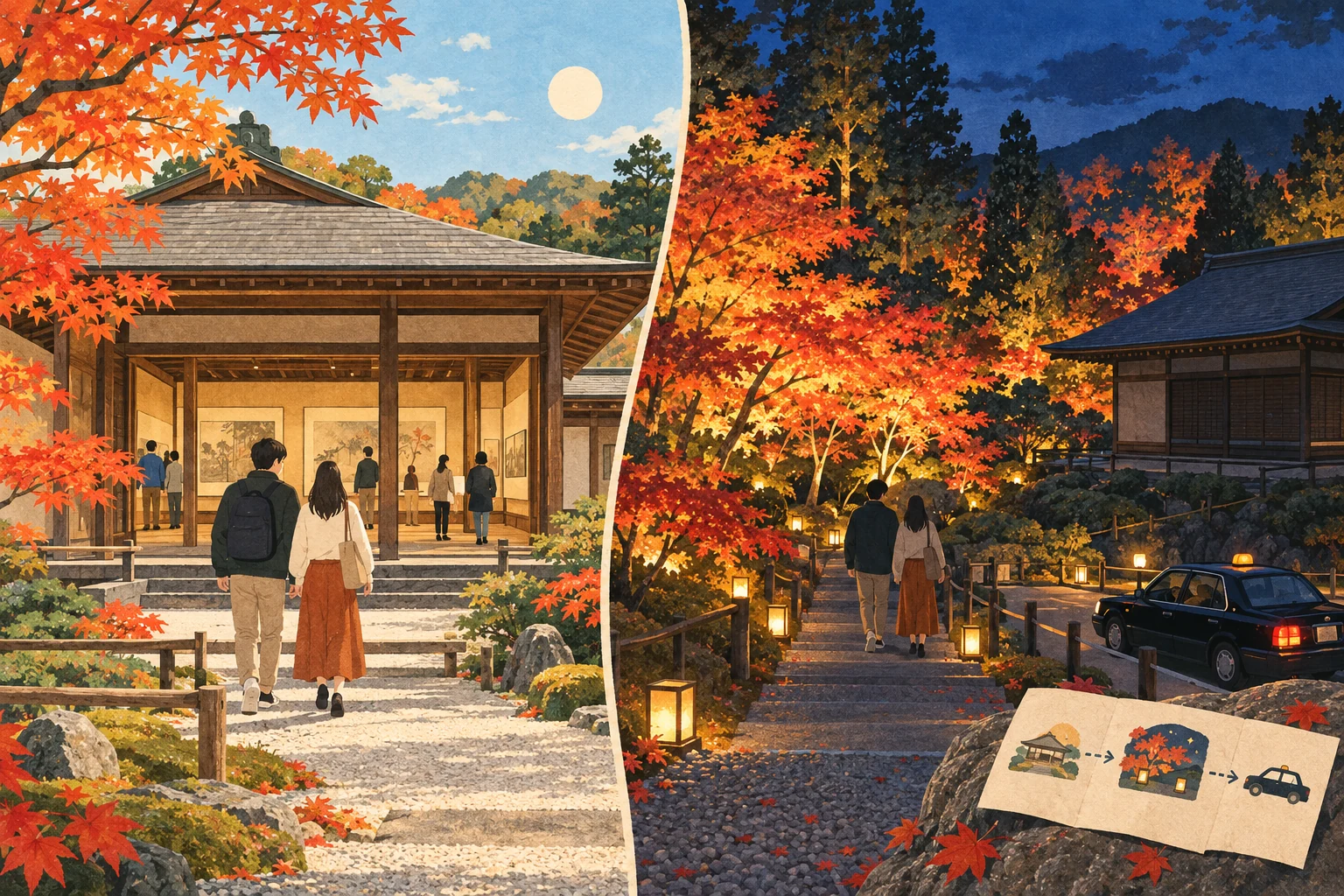
The evening version can put Chusonji in the afternoon, but finish viewing the paid exhibits first instead of beginning the climb at 16:30. One planning sequence is enough uphill and exhibition time, a rest, then a short section of lights. If a pickup is confirmed, descend early to the agreed meeting place. Staying to the 18:30 finish is not a contest. When companions feel cold or walk unsteadily, a shorter evening can preserve the main reason for the trip.
A ryokan dinner often comes earlier than expected. Kamenoi Ichinoseki’s FAQ generally sets 18:00 as latest check-in, with exceptions for some room-only plans and contact required for lateness. Shizukatei’s FAQ generally asks for arrival by 19:30, with specified dinner start times. These conditions may clash with finishing the lights at 18:30 before descending. Ask whether dinner is included, when you must arrive and what happens if delayed before choosing a plan. A later check-in elsewhere on a website does not settle meal rights.
The Momiji Ginga short film embedded by Chusonji introduces the illuminated approach; current-year dates and ticket conditions still come from written announcements. The film’s crowds, foliage and scenes do not guarantee your evening or imply extended opening for every hall. If waiting for lights is unsuitable, bring dinner and bathing forward and visit the second temple refreshed next day, rather than forcing another evening event into the stay.
How long to spend at Motsuji: leave time for the pond and stones
Motsuji’s FAQ estimates thirty to forty minutes for a leisurely garden visit; for photos, reading and rests, you can allow sixty to ninety minutes. Extra time follows individual pace, without a temple requirement or an automatic half-day commitment. When walking from the station, separate the approach from the garden visit. If continuing to Chusonji that afternoon, check the next transport before leaving instead of assuming a bus will depart whenever you arrive.
Motsuji’s grounds guide points out Oizumi-ga-ike’s pebble shore, standing stones and the yarimizu stream bringing water in. Follow how stones form the shoreline, then the reflection of trees. Wind changes reflections, so there is no need to wait indefinitely at one spot. Beyond pond photographs, foundation stones and remains help explain the earlier buildings’ relationship with the garden. Stay on open paths, without entering stone arrangements or closed sections for a better angle.
The short film about the seasons on Motsuji’s site complements an introduction to the garden; departure still calls for current visiting and event details. For an older companion choosing only one gentler temple, the FAQ says there are no steep slopes. It also lists the treasure museum’s lift and multipurpose toilets. That is more accurate than saying every Hiraizumi temple requires mountain climbing. Confirm personal walking range, wheelchair dimensions and where assistance is needed with the temple beforehand.
Motsuji admission and November’s second change of closing time
Motsuji’s individual admission, using Japanese school-stage categories, is ¥700 for adults, ¥400 for high-school students and ¥200 for primary-school and junior-high students. Normal 08:30–17:00 hours become 08:30–16:30 from 5 November through 4 March. Check Motsuji’s current visiting fees and transport information. Its shorter hours start 5 November, while Chusonji’s start 4 November: the one-day difference means the same itinerary column cannot be copied between temples.
Ordinary tickets at both temples total ¥1,700 per adult, ¥1,100 per high-school student, ¥700 per junior-high student and ¥500 per primary-school pupil. These totals exclude special images, amulets, goshuin, parking and buses. List family members by actual school stage, then add the experiences each needs. Do not multiply an adult total by every person without separating categories. Savings should come from genuinely unwanted items rather than assuming children enter everywhere free.
For disability-document discounts, Motsuji’s FAQ specifies eligible booklets and one accompanying person. Bring the information to the counter and ask about applicability. Japanese booklet categories do not automatically match documents issued in every other country, and this guide does not guarantee half price for all overseas documents. Use Motsuji’s discount and accessibility answers to prepare questions and confirm which documents are accepted, instead of locking an unaccepted discount into an inflexible budget.
Motsuji’s 2026 autumn festival and amulets have their own dates
Motsuji’s 2026 foliage festival runs 26 October–15 November according to its announcement, differing from Chusonji’s Momiji Ginga period. Motsuji’s autumn event notice also lists the Autumn Fujiwara Festival for 1–3 November and an Ennen dance at 11:00 on 3 November on the stage in front of the main hall. If a performance is the main purpose, confirm current programming and possible changes before adding another temple. Simultaneous events at different venues cannot all be compulsory stops.
For a Motsuji amulet, note the announced autumn lace maple-leaf momiji-mamori, ¥1,000 each at the gate counter. Sales are separately listed for 25 September–15 November, ending when planned stock sells out. The sales period starts earlier than the festival, so “the festival has not started” does not necessarily mean none are for sale. Conversely, visiting within the period does not guarantee stock. Ask the temple before departure if this is the main purpose.
For Motsuji goshuin, the grounds guide says to leave your stamp book at the counter just inside the gate when starting the visit, then collect it according to instructions. Chusonji’s FAQ separately lists three year-round counters at the main hall, Sankonzo and Konjikido; other subtemples have their own circumstances. These are separate places, so do not transfer one temple’s process to another. Amulets also need no universal “must-buy” list: choose something whose meaning and purpose you understand.
Keep shorter versions for rain, early foliage and winter
In rain, assess the ground and companions’ energy before deciding on Tsukimizaka. Keeping Konjikido and a section of garden is more reasonable than squeezing every ruin into a cold, wet day. Carry rain protection you can pack away and follow on-site rules for wet items before entering buildings. When temple access is restricted, use permitted sections or shorten the visit. Check the forecast the previous night and departure morning; sunny accommodation photos do not replace it.
Motsuji still lists ordinary visiting hours in winter, but Runrun is not year-round: research regular buses, stops and available taxis again. In snow or ice, less walking may help more than switching to a bicycle. The association says its listed bicycle rental closes in rain and winter. Treating electric bikes as a year-round answer misses the weather conditions that most need attention.
For driving to Shizukatei, note the ryokan’s winter-road and vehicle advice: around November to March, roads can ice over and winter tyres are recommended. Actual rental arrangements, road conditions and driving ability need separate checks; this guide does not decide whether an individual car can pass. Without snow-driving experience, favour a confirmed shuttle or station accommodation and shorter winter walks, instead of moving the entire autumn driving route into winter.
With older travellers or a wheelchair, ask about the final two hundred metres
Chusonji’s site gives about 850 metres from the first car park to the main hall, 700 from the second and 240 from Sakanoue. Parking for an ordinary car costs ¥400 at the first two or ¥500 at Sakanoue. Car park positions and walking distances help compare approaches, but closer does not guarantee flat access or a space. Ask how far a vehicle can get and where steps occur before choosing the hall. A parking location is not an accessibility guarantee.
Motsuji can be a garden walk with rests. The temple lists wheelchair loans in limited numbers, and the treasure museum’s multipurpose toilet has nappy-changing facilities. For a companion needing a wheelchair and toilet assistance, check loan and care arrangements before choosing the visit’s length. Boarding a bus, reaching the ticket counter and completing the garden are three different tasks. Each part needs an answer for the itinerary to work.
With a pushchair, ask more than whether it may enter: decide who pushes uphill, helps downhill and whether rain should shorten the route. A family can arrange someone to stay with a resting member while others visit paid exhibits and return to the same meeting point. For a ryokan room with support features, first read the meal and bathing questions for a first ryokan stay, then give the property wheelchair dimensions, bed height and assistance needs specifically.
A day-trip example: uphill in the morning, room for the garden later
For a daytime trip, allow roughly two to three morning hours for Chusonji’s priority exhibits, have lunch, then give Motsuji sixty to ninety minutes. These are suggested time blocks, without a promise of any particular train or bus. Work backward from the booked return shinkansen: allow Hiraizumi to Ichinoseki, bag collection and interchange, then fit the temples. If the remaining time is insufficient, remove extra attractions first.
On a weekday, check the Ichinoseki–Hiraizumi line and the walking sections between temples; at weekends, compare Runrun’s stop order to decide boardings. Do not circle repeatedly to use up a day pass and delay lunch and visits. If energy falls in the afternoon, walk only the pond edge you most want in Motsuji and return as planned. The spare time protects companions and already purchased return tickets from an overly dense list.
Eat near the temples or carry an easy backup, following local rules on where food is allowed rather than treating every garden bench as a picnic area. A named Ichinoseki regional meal can go on arrival day or the next lunch, avoiding two returns for one meal. If other cities have intensive walking days, use Kyoto’s approach to keeping rests within time blocks: hold the main purpose first, then decide whether another stop fits.
Two days and a night: do not give the same evening to temple and hotel
From an Ichinoseki station hotel, you can leave bags, visit Chusonji on day one and return for dinner and sleep near the station. Visit Motsuji lightly packed next day, or put both temples on day one and save the second for an Ichinoseki lunch. The extra local-train ride lets you avoid moving luggage and makes an early shinkansen departure easier. Compare actual services; an overnight does not automatically make the trip more relaxed than a day visit.
For Momiji Ginga as the first night’s focus, confirm descent transport and a dinner plan first, then keep Motsuji for the warmer daytime next day. If the onsen property only has a shuttle around 16:00, choose between taking it back for dinner or staying for the lights and paying for another journey. Without agreement, a late meal held for you, a waiting shuttle or free time changes are not established rights.
If countryside dinner and bathing are the main attraction, finish one temple and check in early, visiting the second next day. That often serves the paid ryokan stay better than packing both temples and lights into the first evening. More time in the room lets you unpack, sit down and bathe without rushing. When plans are uncertain, choose clearly stated cancellation conditions. Keep a removable walk in both days instead of treating rain as the failure of the entire trip.
Accommodation bases: station, municipality and hillside are different choices
Start with return arrangements: Ichinoseki Station favours shinkansen and bags; Hiraizumi municipality favours temples and rural stays; an onsen hotel west of Ichinoseki has its own travel and dinner times. This guide compares Matsunoka Ichinoseki, Shizukatei and Kamenoi Ichinoseki as named examples of those tradeoffs. It uses official room and service details, without stay ratings, a personal sleep test or live availability. They are not ranked as the best hotels.
For accommodation near Chusonji, place the actual address on a map: is it beside Ichinoseki Station, near Hiraizumi Station or a rural ryokan another ten-minute drive away? Walking to restaurants and having a hotel shuttle are different conditions. If you need shopping at night, look at surrounding businesses rather than only the distance in kilometres to Chusonji.
Compare all three for the same date and numbers of adults and children, meals, number of rooms and cancellation conditions. A solo night and a per-person price in a double cannot be directly subtracted; tatami area is not guest capacity either. Use accommodation budgeting that combines rooms, meals and extra transfers, return to each property’s booking page to confirm the total, and only then decide whether to upgrade.
| Property and location | Named rooms to compare | Main tradeoff |
|---|---|---|
| Matsunoka Ichinoseki / by Ichinoseki Station | Twin 20 m² for two; Family 27 m² for four | Easier bags and shinkansen connection; hotel dinner suspended |
| Shizukatei / rural Nagakura, Hiraizumi | Ten-tatami Japanese room; electric-bed Western room | No room bathing facilities; confirm booked shuttle, dinner and cash |
| Kamenoi Ichinoseki / western hillside | Western Twin with bath 37 m², up to three | Room tub uses ordinary hot water; hot spring in communal baths; reserved shuttle |
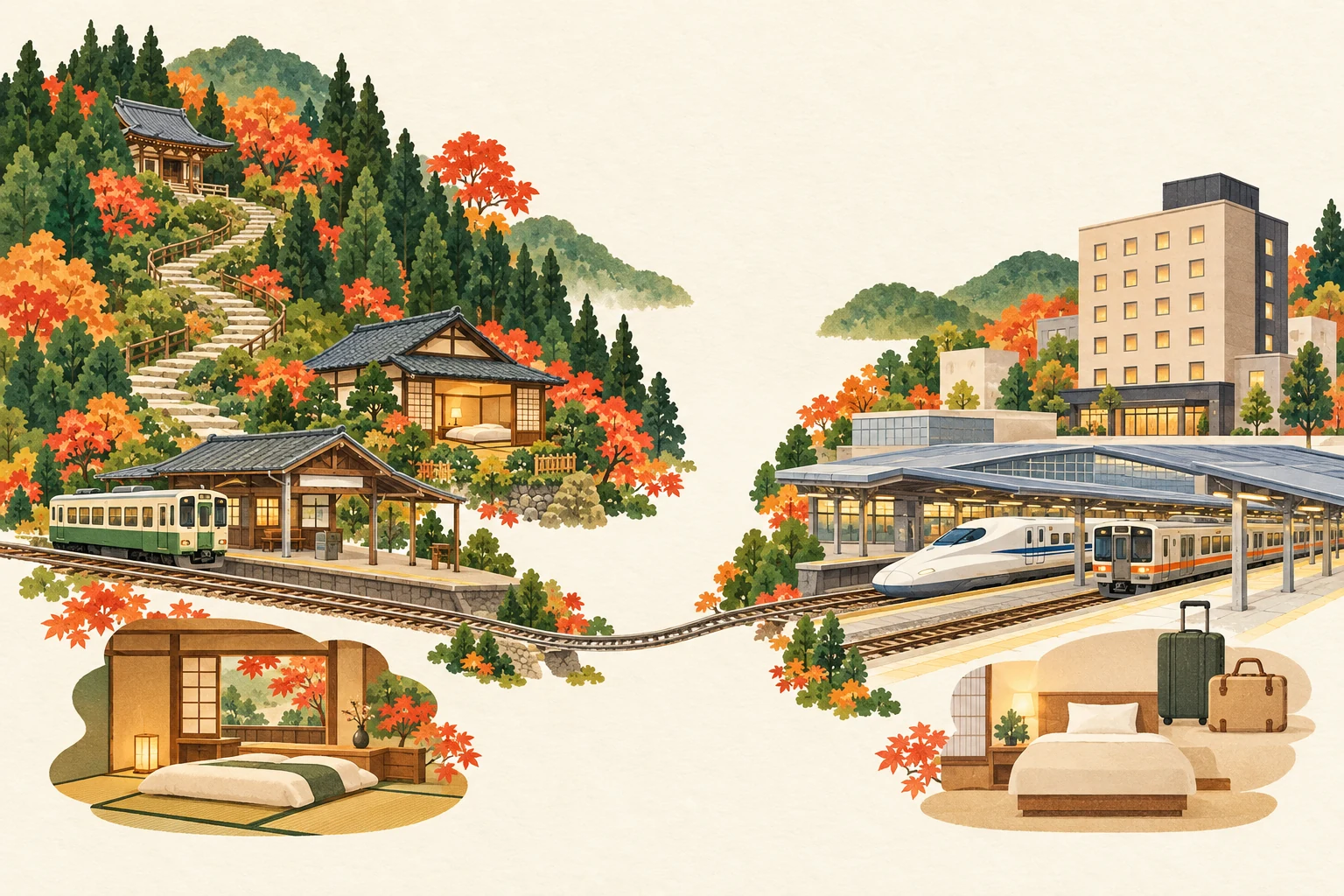
Matsunoka Ichinoseki: Twin and Family differences are in the specifications
Hotel Matsunoka Ichinoseki’s room page lists Twin Room at approximately 20 m² for two, with 120-centimetre bed widths, and Deluxe Twin at about 26–27 m², also for two. Additional area does not authorise another adult: follow capacity and extra-bed conditions when booking. Friends wanting one bed each and a couple sharing need the right category. A chair in a photograph does not establish a third bed.
For four travellers, check Family Room: the site lists 27 m², capacity four and 120-centimetre bed width. This guide adopts the area and stated capacity, without turning a width into “four permanent beds” or “children free.” Enter actual ages and numbers, confirm bedding and breakfast charges, then compare two Twin rooms with one Family Room. For non-smoking accommodation, select an explicit label; the FAQ does not describe all room categories as entirely non-smoking.
For a solo traveller, Single Room is about 13–14 m², capacity one, with a 120-centimetre bed, suitable when station access and early departure matter. Think about how much floor you need to open a large case. With an early train, instead of another baggage move solely for a bigger room, you could keep the budget for dinner or reliable transport. Comfort remains personal; a mattress brand does not replace an actual sleep assessment in this guide.
Station-hotel breakfast, late arrivals and cancellation need separate checks
Matsunoka Ichinoseki’s FAQ gives approximately one minute on foot from Ichinoseki Station, 15:00 check-in and 10:00 checkout, with breakfast in the ground-floor Akarenga restaurant 06:30–09:30. Inclusion depends on the chosen plan. For a very early train, do not buy breakfast first and discover too late that you cannot eat it. Work backward through dining, bags and platform time to see whether the early service actually helps.
The same page explicitly suspends dinner service for the time being. An in-house restaurant therefore does not settle dinner after illuminated foliage. Arrange a station-area restaurant with checked last orders or food you can take back. Changed arrival time should be communicated by phone, separately from having completed an online booking. When asking reception for a taxi, specify that night’s outward or return journey so it is not mistaken for next morning’s station ride.
The general official cancellation terms are 20% the previous day, 50% on the day and 100% for a no-show; compare the actual purchased channel and plan. Parking for an ordinary car costs an additional ¥600 per vehicle per night, with around thirty spaces, so a station hotel does not imply free parking. The parking and large-vehicle details and FAQ do not use identical reservation wording for every vehicle type. Ask the property directly and obtain confirmation before counting a space into the trip.
Shizukatei: explain needs for ten tatami or an electric-bed room
When researching Shizukatei, check the Japanese name “そば庵しづか亭” and Nagakura address in Hiraizumi, rather than relying on a translated name. The official room introduction lists ten-tatami Japanese rooms and a Western room with an electrically reclining bed. The Western layout considers guests needing support; back, leg section and bed height are adjustable. Discuss specific requirements beforehand instead of assuming a note saying “accessible please” has completed every arrangement.
Japanese rooms have a toilet and washbasin, but the property’s answer about room bathing facilities expressly says there are no rooms with in-room bathing facilities or an open-air bath; hot-spring bathing is in the communal facilities. That will not meet a wish to soak inside your own room. Western rooms are few, and the FAQ asks consideration for guests who truly need them, such as wheelchair users. If you merely want a bed, ask about a simple additional bed or another arrangement rather than treating the support room as a guaranteed upgrade.
Dinner is generally served in the room, with breakfast in a dining area or the room according to plan; actual occupancy and bedding still govern using ten tatami. Request soft meals, allergy adjustments, assisted bathing or private use of the upstairs bath before booking instead of demanding immediate provision on arrival. The property also says it is not completely barrier-free. Lift access and handrails to guest rooms do not make every common area independently passable.
Shizukatei’s last shuttle cannot also be the return after all the lights
Shizukatei’s shuttle announcement lists Hiraizumi Station departures at 14:30 and 16:40, with the property’s return trips at 09:00 and 10:00 next morning. Telephone reservations are required by the previous day. Pickup at Chusonji or Motsuji can be discussed, with place and time settled by the property’s confirmation. The 16:40 departure is near the beginning of Momiji Ginga. You cannot watch the full illumination and count that same vehicle as your return.
The FAQ generally requests check-in by 19:30, while room and basic-information pages also show 15:00–22:00 or latest 22:00. Do not select the later statement yourself as a guarantee. For dinner or lights, ask directly about latest arrival and meal provision before booking. Dinner starts can be 18:00, 18:30 or 19:00, with a limit on meal service capacity. Without agreement, missing the time does not establish that the entire dinner can move later.
For on-site payment, the property’s basic information and conditions state cash and no on-site cards; the FAQ also allows an advance bank transfer or booking through a travel site accepting cards. Adults have an additional ¥150 bathing tax each, so two need ¥300 unless already included in the order. There is no convenience store nearby. Buy necessities before boarding the shuttle rather than expecting the same nearby shopping as a station hotel.
Kamenoi Ichinoseki: a Twin with bath differs from Japanese Standard Twin
Kamenoi Ichinoseki’s named room categories list the Western Twin with bath at approximately 37 m² for up to three, with bathroom and toilet separate. The Japanese Standard Twin is about 30 m² for up to two. Both contain “Twin,” while area, capacity and bath conditions differ. Compare the full Japanese room name, without assuming two search listings with “twin” are exactly the same product.
Families can compare the Japanese-Western room with bath, about 54 m² for up to five, combining two beds and six tatami. The room with accessibility features is approximately 52 m² for up to four, listed with two beds, two futon sets and care equipment. Capacity gives an upper limit, not the same price for every party or identical bedding formats. Enter children’s ages, required meals and beds and check the plan, instead of adding people only on arrival.
The property is on elevated ground west of central Ichinoseki, rather than a station hotel reached immediately after leaving the train. The room page describes it as being around eight kilometres west of the city centre. For hot springs and countryside, treat it as a separate part of the stay. If a very early shinkansen is essential next day, confirm departure arrangements first. “Ichinoseki” in the name does not place the platform a few minutes’ walk after breakfast.
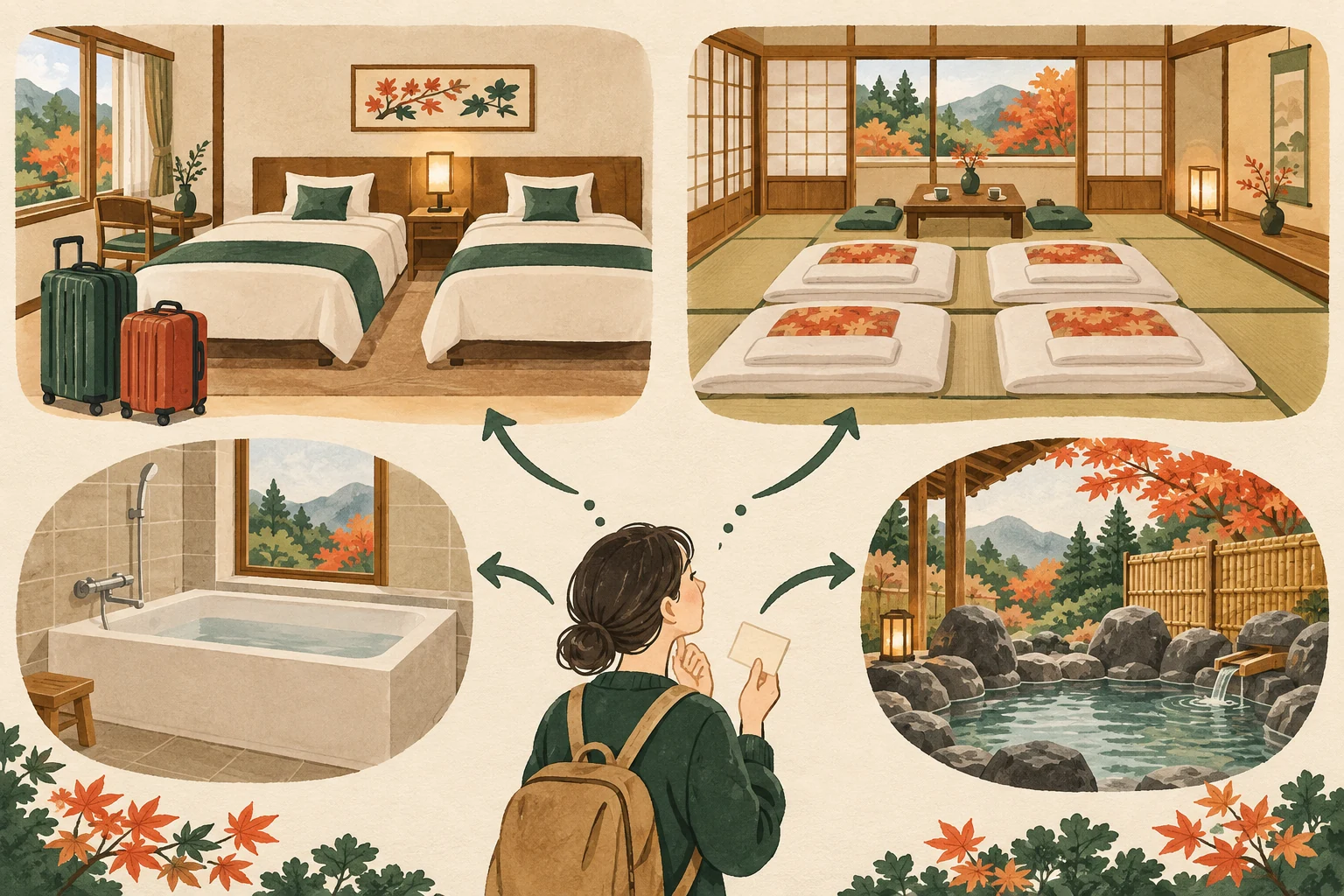
Kamenoi’s hot spring is in the communal baths; room tubs use ordinary hot water
Kamenoi Ichinoseki’s room-bath FAQ says Western and Japanese-Western rooms with bathing facilities use mayu, ordinary heated water. The hot spring is in the communal indoor and open-air baths. That matters when seeking private thermal bathing. The hotel name or an in-room tub does not establish a private-onsen room, and the communal bath’s scenery cannot be assumed for every guest room.
Horyu Onsen’s bathing hours and day visits list 12:00–24:00 and 05:00–09:00 for overnight guests. Day admission separately runs 12:00–21:00, last day-bath admission at 20:00, ¥800 for adults or ¥500 for primary-school pupils, with holiday and maintenance changes possible. Overnight and day guests do not have identical rights. To bathe after temples without staying, confirm acceptance that day, towels and transport instead of buying return tickets and waiting until arrival to ask.
General cancellation charges are 20% ten to four days before, 50% three days before through the previous day, 80% on the day and 100% for a no-show; travel websites and agencies follow their own rules. The FAQ generally sets 18:00 latest check-in, excluding some room-only plans and requiring contact if late. Dinner hours separately run 17:30–21:00, last orders 20:00. A restaurant open to nine does not authorise unannounced arrival at nine; confirm both conditions when booking.
Calculate Kamenoi’s shuttle together with the next morning’s departure
Kamenoi Ichinoseki’s access page lists free shuttles from Ichinoseki Station’s west exit at 15:00 and 16:00, taking around twenty minutes; returns leave the hotel at 09:00 and 10:00, all by reservation. This fits finishing temples earlier, without providing transport after Momiji Ginga ends at 18:30. If staying for the lights, confirm another way to the hotel and dinner compatibility. A free shuttle is not an all-evening on-demand service.
After a regular bus to “Kamenoi Hotel Ichinoseki Iriguchi,” the site still lists about ten minutes walking, unlike a shuttle direct to the property. With big bags, rain or limited mobility, assess this final stretch and ask about help approaching. If next morning’s shinkansen departs too early for the shuttle connection, arrange other transport or choose the station base. Do not discover over breakfast that the first return is too late.
The access page gives around five minutes by car or thirty walking to Genbikei. Geibikei is another gorge, not a second entrance to the same valley. A Hiraizumi–Genbikei–hotel combination needs actual-route research, while Geibikei needs its own travel and activity time. If the two temples remain the focus, do not add both gorges to the same short break. Another night does not automatically shorten the distances between them.
Ichinoseki lunch: leave mochi cuisine for a service you can confirm
For local food, research the Sekinoichi brewery’s Kuramoto Restaurant Sekinoichi; its official introduction includes mochi dishes and hatto made from hand-stretched wheat dough. The restaurant’s main page gives lunch 11:00–15:00, normally closed Tuesdays and Wednesdays with a holiday exception. The same site’s complex map still gives 11:00–21:00, while the main page retains older holiday notices. This guide therefore treats it as a lunch candidate; confirm actual operating days and dinner acceptance directly.
Reservation instructions request three business days’ notice. A same-day online submission may not be seen immediately, so check for a reply. This belongs in arrival preparation, instead of searching after the lights finish. Without a confirmed table, keep an acceptable second choice; having a booking form is not a completed reservation. Check current menus for prices and seasonal contents, without treating an old PDF’s set-meal price as a current quote.
Mochi comes with various flavours and sauces. For allergies, restrictions or easier-to-swallow food, ask about ingredients and possible adjustments beforehand; Japanese regional cuisine is not automatically vegetarian. Drivers should separate drinking and driving. If the ryokan includes dinner, choose lunch according to appetite instead of forcing every regional snack into the interval. Let the meal break support the day’s walking pace.
A budget you can recalculate: temples first, then your own transport
For one adult’s ordinary visits, Chusonji ¥1,000 plus Motsuji ¥700 equals ¥1,700. Two Runrun rides add ¥400, giving ¥2,100. Three single rides give ¥2,300; choosing the ¥550 day pass gives ¥2,250. These exclude Ichinoseki–Hiraizumi rail, long-distance trains, food, accommodation, amulets and an evening taxi, and apply only on a day the loop actually runs.
Ordinary admission and two loop rides each for two adults cost ¥4,200. If you hypothetically allow ¥1,500 for lunch and ¥500 for a drink and snack per person, add ¥4,000: the local daytime example becomes ¥8,200. This is an editorial spending allowance rather than any restaurant’s set meal. Switching both adults to the combined special-image ticket adds ¥600 each, ¥1,200 total, making ¥9,400. Long-distance travel and accommodation remain excluded.
For an overnight, add the actual booking total, meals not included, separate taxes and extra journeys. For example, Shizukatei’s bathing tax for two adults, if still outside the order, requires ¥150 each or ¥300 more; taxis need the operator’s confirmed quote. Do not enter an undated lowest room price merely to make the table look cheap. Japan budgeting with daily and whole-trip accounts helps separate fixed costs from adjustable food and shopping.
| Item | Calculation | For two |
|---|---|---|
| Ordinary temple tickets | (1,000 + 700) × 2 | ¥3,400 |
| Two loop rides each | 200 × 2 rides × 2 people | ¥800 |
| Lunch and snack allowance | (1,500 + 500) × 2 | ¥4,000 |
| Daytime example total | 3,400 + 800 + 4,000 | ¥8,200 |
| Both choose the combined special-image ticket | 8,200 + (1,600 − 1,000) × 2 | ¥9,400 |
Before departure, complete the route with actual bookings
After booking accommodation, save the full room name, guests, meals, latest arrival, cancellation deadline and payment method offline. Record the shuttle station, exit, time and confirmation separately. Search snippets do not equal an order, particularly with different categories and sales channels for one hotel. If transport or food remains unconfirmed, mark the lights as optional so daytime visits to both temples still work independently.
The previous evening, revisit temple notices and operator tables for the date, then check weather again in the morning. Late-October and November events are not the year-round norm. On reaching Hiraizumi, confirm the return station and bag collection before visiting. If a companion feels unwell or cannot walk as far, retain known transport and shorten the attractions. Accommodation should supply rest and flexibility, without turning the whole day into a rush to meet a shuttle.
On a longer Tohoku trip, Hiraizumi can be a daytime visit or a stay with dinner and a rural morning. First connect preceding and following cities through actual long-distance rail stops and ticket conditions, then choose Ichinoseki Station or Hiraizumi onsen. If no usable alternative is confirmed for the evening, keep daytime temples. A useful itinerary lets companions finish the route, use the tickets purchased and return to their room at the agreed time.
A few useful answers
Should I stay in Hiraizumi or beside Ichinoseki Station?
Start with the evening and next destination. For an early shinkansen, large bags or no illuminated foliage, compare Ichinoseki Station first. For a ryokan dinner and hot springs, research rural Hiraizumi accommodation, confirming shuttles, latest arrival and return transport.
Can I visit Chusonji and Motsuji in a day?
Keep the two temples as the main aim, allowing separately for the climb, exhibits, garden and lunch. Lights or extra remains require rechecking transport and closing times for that day, without making every attraction compulsory.
When is Momiji Ginga 2026?
Chusonji announced 24 October–8 November 2026, 16:30–18:30. These are event times rather than guarantees of leaf colour or weather. Other years need their own new announcements.
Is Momiji Ginga a train?
No. Here it is Chusonji’s approach-illumination event, without train services or a rail ticket. Buses, trains and taxis need separate checks.
Does Runrun return to Hiraizumi Station after the lights?
Not with the checked loop table. The last Chusonji stop is 16:25, reaching the station 16:35, before Momiji Ginga finishes. Staying for the lights requires another confirmed regular service or booked transport.
Does Runrun operate on weekdays?
Between 11 April and 29 November 2026, normally only Saturdays, Sundays and national holidays, except daily operation 13–16 August. The regular Ichinoseki–Hiraizumi line has a separate timetable and does not accept the Runrun day pass.
What is the combined adult admission for the two temples?
Ordinary Chusonji admission of ¥1,000 plus Motsuji ¥700 totals ¥1,700. Special images, transport and religious items cost extra. Chusonji’s 2026 combined ticket with the special images is ¥1,600; with Motsuji, adult admission totals ¥2,300.
When do Chusonji and Motsuji close in November?
From 4 November, ordinary Chusonji visits end 16:30, with ticket sales ten minutes earlier; Motsuji changes to 16:30 from 5 November. Buying in Chusonji’s final ten minutes may leave insufficient time for Sankonzo. Illumination does not extend exhibit hours.
Does Motsuji need half a day?
Not automatically. Its FAQ estimates thirty to forty minutes for a leisurely garden look. Allow sixty to ninety for photos, reading and rest if desired, plus the walk from the station separately.
Does a tub in the room mean a private hot spring?
Not necessarily. Shizukatei has no rooms with bathing facilities. Kamenoi Ichinoseki’s FAQ says room tubs use ordinary heated water, with hot springs in communal indoor and outdoor baths. Check the full category and official description rather than infer from the hotel name.
Can I take a large case uphill and store it at Chusonji?
The temple expressly says there are no coin lockers within its hillside grounds and recommends Hiraizumi Station. If returning to Ichinoseki, ask your accommodation about storage first. Size, availability and collection times need their own checks.
Do Motsuji’s 2026 foliage festival and maple amulet sales share dates?
No. The festival is announced for 26 October–15 November; the ¥1,000 amulet is listed for 25 September–15 November, ending when stock sells out. Visiting within the period does not guarantee a purchase.
Check with the source
Schedules, availability and rules can change. These official sources are the place to confirm details before you book.
- Chusonji | Visiting information and official film
- Chusonji | Hours, luggage and goshuin FAQ
- Chusonji | Transport and parking
- Chusonji | Official guide applications
- Chusonji | Autumn 2026 events and Momiji Ginga
- Chusonji | Special images opening for the 900th anniversary
- Chusonji | Ticket types and seasonal hours
- Chusonji | Konjikido craftsmanship and construction
- Motsuji | Garden and official film
- Motsuji | Admission, opening and transport
- Motsuji | Garden duration, walks and accessibility FAQ
- Motsuji | Garden, remains and goshuin route
- Motsuji | 2026 foliage festival and autumn amulet
- Iwate Kenkotsu | Runrun 2026 timetable and tickets
- Iwate Kenkotsu | Regular Ichinoseki and Hiraizumi routes
- Hiraizumi Tourism Association | Station and attraction travel estimates
- Hiraizumi Tourism Association | Bicycles, taxis and route buses
- Hiraizumi Tourism Association | Five World Heritage components
- Hiraizumi Tourism Association | Autumn temple scenery
- UNESCO | Hiraizumi Pure Land temples, gardens and archaeological sites
- Hotel Matsunoka Ichinoseki | Named room specifications
- Hotel Matsunoka Ichinoseki | Breakfast, storage, cancellation and dinner FAQ
- Hotel Matsunoka Ichinoseki | Address and parking conditions
- Shizukatei | Ten-tatami Japanese room and electric-bed Western room
- Shizukatei | Bathing, dining, payment and arrival FAQ
- Shizukatei | Reserved shuttle announcement
- Shizukatei | Basic information, bathing tax and conditions
- Kamenoi Ichinoseki | Named rooms, capacity and bathrooms
- Kamenoi Ichinoseki | Horyu Onsen and day bathing
- Kamenoi Ichinoseki | Reserved shuttles and attraction access
- Kamenoi Ichinoseki | Check-in, cancellation, meals and ordinary-water FAQ
- Sekinoichi | Kuramoto Restaurant and mochi cuisine
- Sekinoichi | Complex map and facility information