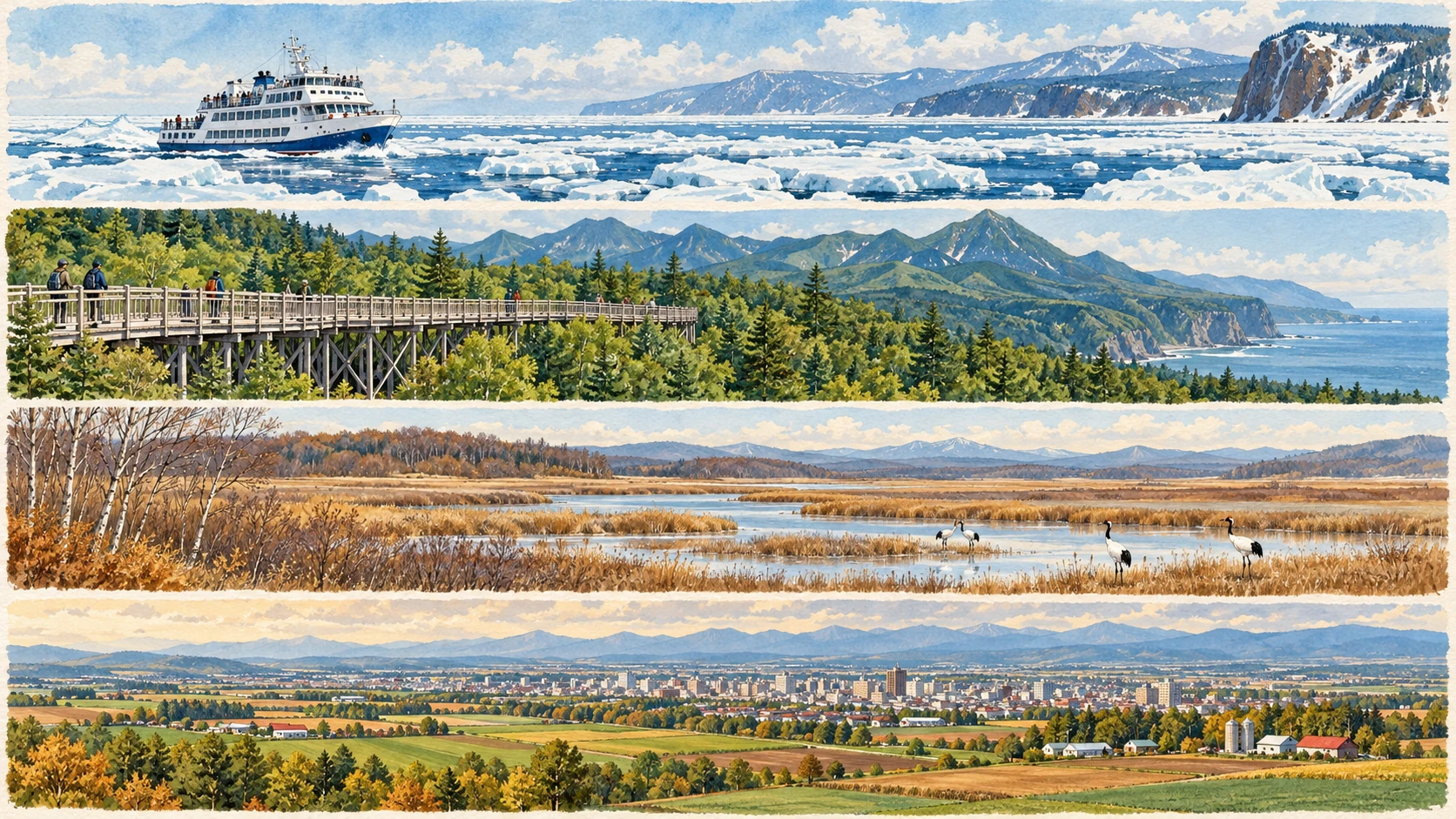
Start with three days in one area, treating drift ice, Shiretoko trails, wetlands, and Tokachi as different trips. Seasonal services, named room categories, and the journey back shape a comfortable visit more than a list of sights.
Eastern Hokkaido: choose the coast, wetlands, or Tokachi first
Eastern Hokkaido is difficult to plan because its attractions are separated by real travel days. Abashiri's drift-ice boat, the Shiretoko Five Lakes reached from Utoro, Kushiro's wetlands, and Obihiro's sweets can each be the focus of a trip. Squeezing all of them into three days can leave little besides stations, car parks, and a rush to dinner. Choose the seasonal landscape you most want to see, then fit in your accommodation, arrival airport, and journey home before adding stops.
For a first independent trip, start with three days in one area: Abashiri, Shiretoko, Kushiro, or Obihiro. Combining Kushiro and Lake Akan needs additional transfer time and an overnight stay by the lake. Linking Abashiri, Shiretoko, Kushiro, and Tokachi calls for a longer journey divided into stages. The itineraries here illustrate choices; road-time estimates and last year's bus schedules are not treated as connections you have already secured.
This guide uses official information available on October 22, 2026. Winter ice, summer and autumn cruises, garden closures, and road restrictions have separate calendars. If your trip also includes Sapporo, plan your city stay in Sapporo and Otaru first, then count the days needed to reach eastern Hokkaido separately. The long journey out and back should not disappear into sightseeing time.
Four accommodation bases: start with where you will go after leaving the hotel
Abashiri Station is useful for arriving with luggage by rail and connecting onward to the harbour or museums. Staying near Lake Abashiri makes dinner, hot springs, and time inside the hotel part of the stay. When looking for a hotel for a drift-ice cruise, distinguish the station, city, and lake. Having Abashiri in the name does not mean a property is within walking distance of the pier.
Shiretoko-Shari is a rail-to-bus interchange, while Utoro is closer to activities on Shiretoko's western coast. Rausu is on the other side; crossing Shiretoko Pass depends on the road, not the straight-line distance shown by a booking site. Kushiro city works for meals and wetland trips, while Akan Onsen groups lake cruises, Ainu culture, and bathing together. Travelling between them still requires a real bus or car journey.
Obihiro city lets you group pork bowls, sweets, and horse racing relatively closely. At Tokachigawa Onsen, dinner and bathing become central to the overnight stay. Nakasatsunai, Kofuku Station, and the gardens have their own access and operating seasons. Write down the next morning's first destination and that evening's meal location before comparing rates; this usually reduces backtracking more effectively than sorting by hotel category alone.
| Base | Main travel focus | Ask before booking |
|---|---|---|
| Abashiri Station or city | Drift-ice boats, museums, rail transfers | Port journeys and check-in |
| Around Lake Abashiri | Hotel dinner, hot springs, lake stay | Seasonal transfers and in-room bath type |
| Shari / Utoro | Shiretoko connections / west-coast lakes and cruises | Return services, roads, and season |
| Kushiro city / Lake Akan | Wetland transport / lake cruises, Ainu culture, hot springs | Bus endpoint, dinner, and nights |
| Obihiro city / Tokachigawa | Station food / rest at an onsen hotel | Evening return, meals, and bathing benefits |
Winter ice and summer or autumn Shiretoko need different calendars
Abashiri's drift-ice boat is not a year-round icebreaker, nor is it the same product as Shiretoko's summer and autumn sightseeing cruises. Lake Akan's conventional autumn cruise timetable is separate from winter activities on the frozen lake. Gardens and farm cafés can finish their season early in late autumn. Winter alternatives to summer boardwalks often require different guides and equipment; a summer walking map does not authorize independent entry.
Late October is an especially confusing boundary. Some Shiretoko routes have finished, mountain roads begin nighttime restrictions, and gardens or cafés may have only a few more weeks open. For an autumn departure, replace “open until this month” with an exact date. Consider the last bus back, the beginning of dinner service, and whether you can finish outdoor activities before dark at the same time.
If you have not chosen a month, use the seasonal choices for a Japan trip to pick ice, walking, a lake cruise, or gardens as the main purpose, then check each operator's calendar for that year. Coastal ice, cranes, foliage, and waves change. A reservation can secure a service, but it cannot guarantee that nature will produce a particular scene on a particular date.
Without a car, connect the airport and station before the final leg
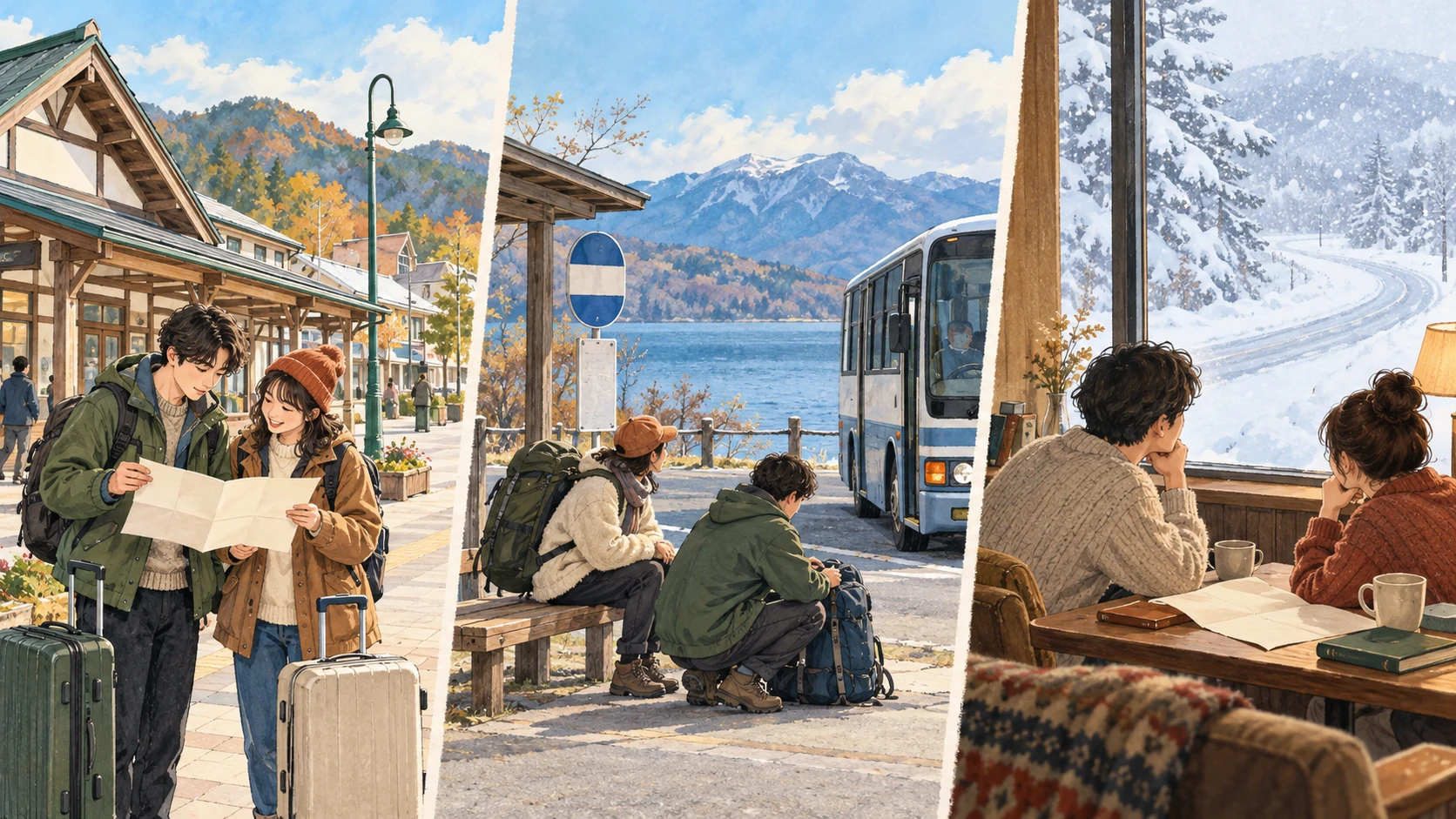
Eastern Hokkaido is possible without driving, but begin with individual transport services rather than drawing a line between attractions first. Memanbetsu naturally connects with the Abashiri area, Kushiro Airport with Kushiro and Akan, and Obihiro has its own airport and city access. Your choice also depends on landing time, the last bus, and the hotel's location, not just the difference in airfares.
The drift-ice boat's harbour access information links to connections from the airport and Abashiri Station. Before booking accommodation, write down airport-to-city, station-to-pier, and disembarkation-to-hotel separately. A route serving the harbour does not mean every flight connects or that every season uses the same stops. Large suitcases should not follow you from one walking trail to another either.
If you enter Obihiro or Kushiro by train from Sapporo, look up the full journey and transfers for your date before assessing a pass. Comparing rail passes against the journeys you will actually take provides a calculation method. The last leg to a lakeside hotel, park entrance, or harbour still needs its own bus, pickup, or taxi arrangement. Buying a rail pass does not resolve that part.
Abashiri drift-ice cruises: separate the large Aurora from the small boat
The prices and sailing times for the two boats list the large Aurora at ¥7,000 for adults from junior high school age and ¥3,500 for elementary-school children, with a trip of about one hour. The small Aurora 3 costs ¥9,800 and ¥4,900, takes around two hours, and has operation planned in March. Seating, space, duration, and what happens without ice differ, so price alone is not a good basis for choosing.
For two adults and one elementary-school child, basic tickets total ¥17,500 on the large boat and ¥24,500 on the small one: a ¥7,000 difference. This compares boat tickets for the same group, excluding harbour transport, accommodation, and separately charged special seats. The large boat's free preschool-child category cannot automatically be applied to other companies' boats or guided activities.
When there is no drift ice, the large boat may switch to a Cape Notoro sightseeing cruise; the small boat is cancelled according to the operator's explanation. For Abashiri ice forecasts or updates, check actual conditions and operating notices near departure. Reserving a January or February sailing does not buy a guarantee of seeing ice. Leave room for an alternative you would still be happy to take.
Booking for 2027: “not yet open” does not mean “sold out”
The operator's 2027 booking announcement says telephone reservations start October 15, 2026, with online booking planned for early November 2026; system conditions may affect the online opening date. Not finding dates online in October does not prove there is no season or that every sailing is full. Your booking is the one the operator has actually confirmed.
The company asks you to book only your first choice, rather than holding several backup sailings against bad weather. To gain flexibility for the ice, you can spend another night in Abashiri and use the other day for museums or the city. That flexibility should come from accommodation and time left open, not from occupying several tickets you will not use.
The check-in and cancelled-sailing procedures say to complete boarding formalities no later than 20 minutes before departure; allow for ticketing deadlines and reaching the boarding point too. The operating decision is usually made around an hour before departure but can change at the last moment, without individual calls to every booked passenger. Check the day's status yourself. If you prepaid by credit card through a partner booking website and the sailing is cancelled, the operator handles the cancellation and the refund follows later according to the credit card company's billing schedule; no telephone call is not proof that the boat will sail.
Seating, stairs, and warm clothing matter as well as the ticket
A general ticket on the large boat does not give every passenger a fixed seat. Vessel capacity and the number of seats are different. If someone cannot stand for long, ask the operator what arrangement is feasible before choosing a sailing. Special seats have a separate sales process and should not be assumed included when booking a hotel. Wheelchair areas and stair restrictions also need checking by boat type.
Wind and cold at sea feel different from walking around town. Bring layers, a windproof outer layer, gloves, and shoes with grip. Keep your hands warm when taking photographs on deck and return inside to rest if you feel unwell. Do not lean beyond the rail to photograph floating ice or block other passengers' walkways with equipment.
The introduction used on the official Abashiri Aurora website helps explain the boat and the setting for drift-ice tourism. The amount of ice in a video is not a forecast for your departure. Consider marine conditions, possible substitute routes, and time to check in and disembark comfortably, rather than choosing a date solely from promotional photographs.
Abashiri alternatives: the prison museum and ice museum serve different purposes
Abashiri Prison Museum's visitor information lists adults ¥1,500, high-school students ¥1,000, and elementary and junior-high students ¥750. Hours are 9:00–17:00, last admission 16:00, with closure on December 31 and January 1. This is a museum of historic buildings, not an active prison offering accommodation. Moving between buildings includes outdoor sections, so it is not a completely weatherproof indoor alternative.
The ice museum's current Japanese visitor page lists adults ¥990, high-school students ¥880, and elementary and junior-high students ¥770. May–October hours are 8:30–18:00; November–April are 9:00–16:30. December 29–January 5 has a separate 10:00–15:00 schedule, with admission closing 30 minutes before the end. The free Tentozan observation deck does not make the paid exhibitions free.
Two adults and an elementary-school child pay ¥3,750 at the prison museum or ¥2,750 at the ice museum, plus transport. Abashiri Station is still a journey away from the prison museum, and the airport is not a seamless direct transfer point to it. If a boat is cancelled, check available transport and closing times first. One complete alternative is more useful than rushing between both museums.
Abashiri hotels: compare station convenience and a lakeside stay separately
Route Inn Abashiri Ekimae's official room and access information places it about a minute's walk from the station, with general check-in at 15:00 and checkout at 10:00. Twin beds are 120 cm wide and 196 cm long. For travellers arriving by rail with luggage, the station location reduces arrival-day carrying. Its shared bath should not be described as a private natural onsen in every guest room.
Staying at the station does not mean the boat company collects you at the door. Ask separately about the pier meeting point, breakfast, and luggage storage after checkout, especially before an early sailing the following morning. Read prices by date, party size, and meals. A minimum rate returned for one night is not a fixed price for the entire winter.
For a lakeside comparison, Hokuten no Oka's named annex rooms include the 37 m² 洋座室 and a 24 m² western-style twin, both with two single beds, a capacity of two, and a shower. A larger room or an onsen hotel's name does not guarantee space for a third guest or a private hot spring. With children, establish capacity and bed-sharing rules before choosing from photographs.
Hokuten no Oka transfers and cancellation: read the applicable season
Hokuten no Oka's transfer conditions date the Memanbetsu Airport service to check-ins from April 1, 2026, through checkouts on December 31, 2026. Book by 20:00 the previous day; pickup hours are 13:30–19:30 and hotel departures 8:00–11:00, subject to coordination. Advance-contact pickup at Yobito Ekimae bus stop is listed separately as year-round. The winter Hokuten Liner says the season has ended, so this does not confirm a free 2027 transfer from the station or terminal.
The hotel's room, dining, and cancellation questions explain that its natural spring uses added water and heating, while rooms with open-air baths are specific categories, not automatically the two shower-only annex rooms above. Dinner venues depend on the plan, and meals are not served in guest rooms. Before booking a late bus arrival, establish whether you can reach the hotel during dinner service.
General cancellation charges before arrival are 10% at 14–8 days, 30% at 7–2 days, 50% the previous day, and 100% on the day or for a no-show; individual travel-product terms take priority. Uncertain winter transport does not combine the hotel and transport contracts. A cancelled cruise does not necessarily make a separate lakeside room free to cancel.
Shiretoko transport: Shari, Utoro, and Rausu are not one stop
The approach to the Five Lakes commonly starts at Shari Bus Terminal near Shiretoko-Shari Station, continuing through Utoro and Shiretoko Nature Center. Shari Bus's official Shiretoko Line product specifies valid sections, showing the electronic ticket when getting off, unreserved seats, and the possibility of waiting for the next bus if full. An online purchase does not reserve a seat on one departure or guarantee a connection to a separately booked guide.
Large luggage can go in the hold under this route's rules, but bicycles are not accepted. One preschool child aged six or younger per adult travels free, as do infants under one; additional young children beyond the accompanying adults' number are charged under the rules. This is not a universal policy for all Hokkaido buses. Wait for the driver to check your electronic ticket before pressing its use button.
Abashiri–Shiretoko, Kushiro–Shiretoko, and Akan–Shiretoko each require a complete route check. There is no identical year-round direct timetable. The dated summer 2026 access reminder also distinguishes the Shiretoko and Rausu lines. Shari helps with onward rail connections and Utoro with western-coast activities, but the station-to-hotel leg still needs its own arrangement.
The Five Lakes elevated boardwalk: understand the distance and scope first
The official elevated-boardwalk questions give 800 m one way, 1.6 km out and back, around 40 minutes, and free access during the opening season, with views of the first lake. This is different from the long ground-level circuit. Taking the boardwalk does not mean you have visited all five lakes, and ground-tour fees should not be added to every boardwalk visitor's budget.
Forty minutes is a walking reference, not the full visit. Add arrival, parking or getting off the bus, toilets, and waiting for companions. Families and older travellers can treat the first lake as a complete destination rather than having to add the big loop. A railing and a set route do not remove the need to follow local closure notices.
When looking up the Five Lakes in winter or bear information, first check whether general access is permitted that day and whether a specific winter guided activity is required. The 800 m described here is not a promise that you may independently follow the same route in winter. Snow-season activities, road access, and equipment need their own current product and management information.
Ground trails: a guide from May 10 to July 31, a briefing in other open periods
The ground-trail rules by period require a registered guided tour from May 10 through July 31, the brown-bear activity period. From opening through May 9, and August 1 through closure, entry follows the vegetation-protection briefing rules: about ten minutes, ¥450 from age twelve and ¥200 for ages zero through eleven. Paying for parking alone does not permit direct entry to the forest.
The large loop is about three kilometers with a guided visit of around three hours; the small loop is about 1.6 km with a guided visit of one hour 45 minutes. These include explanations and differ from independent walking times during the vegetation-protection period. Bear-season prices and admission vary by route, age, and guide company. Check whether a child is eligible before judging only by distance.
The vegetation-period briefing totals ¥1,100 for two adults and a child aged zero through eleven; this is not the bear-season tour price. Do not feed animals or leave the path, and store food and drinks as the rules require. Water, tea, and other beverages have different restrictions. A bear-related closure still applies after payment or reservation; it does not leave the gate open for booked visitors.
Shiretoko cruises: route length, season end, and expectations of seeing bears
The Shiretoko sightseeing boats' route and price page separates Kamuiwakka, Rusha, and Cape Shiretoko. Adult fares are ¥5,000, ¥8,000, and ¥10,000; elementary-school fares are ¥2,500, ¥4,000, and ¥5,000. That page gives approximately 90 minutes, two hours 15 minutes, and four hours respectively. Decide how long your group can spend at sea before choosing a departure.
The routes do not end their seasons together. Cape Shiretoko is generally planned through October 15, Kamuiwakka through October 25 provisionally, and Rusha has seasonal and afternoon-service adjustments. Another route continuing does not make a finished long cruise available. Some journey lengths also differ between the operator's pages. Confirm with your booking and notices and avoid an extremely short onward connection.
The operator's sea-condition and wildlife questions explicitly say wildlife sightings are not guaranteed, cancellation can be decided close to departure, and booked passengers are not contacted individually. The tourism association's safety introduction helps explain preparation but cannot replace the captain's decision that day. If a child is prone to seasickness, choose an acceptable duration and refund terms rather than booking the longest route solely to see bears.
Road closures: identify the gate and endpoints, not just “winter closure”
The 2026 Shiretoko Pass notice gives nighttime closure from October 23 through November 3, 16:00–9:00 the following day, and full closure from 16:00 on November 4 through late April 2027 provisionally. The current-season pass-road reminder also warns that daytime restrictions can occur in bad weather. Do not wait until after crossing to find that night's hotel, or treat a return journey to Rausu as a short trip with a fixed duration.
A separate Hokkaido road authority closure notice covers the Five Lakes gate to the Mount Iozan trailhead, from 10:00 on October 1, 2026, to 9:00 on June 1, 2027, including walking. It does not close the whole access road to the Five Lakes or replace the lakes' own entrance-opening information.
Drivers should check endpoints, dates, and daytime permission before adding another stop; non-drivers must also check whether buses run that season. An open road and an available service are different things. Without winter-driving experience, reduce base changes and concentrate on activities accessible from your accommodation. Mountain roads are not a place to recover a late itinerary by driving faster.
Shiretoko hotels: a Kitakobushi twin for four does not mean four beds
Kitakobushi's Sea View Twin has at least 36 m², a maximum capacity of four, and a shower. It can be in the main or west building, without a choice of building. Capacity means admitted guests, not four permanent beds or a private onsen in that category. If you need a third or fourth sleeping space, check how it is actually prepared in the booking.
The hotel's child and bathing questions say guests aged six through eleven pay 70% of the adult rate, those aged zero through five pay ¥6,000 per person per night before tax, and those aged twelve and up pay the adult rate. Young children's bedding is generally excluded but can be arranged in advance. There is no shared family or private-use bath bookable separately. For private family bathing, find a category explicitly providing its own bath rather than inferring one from public-bath photographs.
Kitakobushi's general cancellation table for groups of up to one hundred people lists 20% in each of the separate columns for 14 and 8 days before the stay, 80% the previous day, 50% at two through seven days, and 100% on the day or for a no-show; an individual contract may differ. If cruise, guide, and hotel are separate bookings, put each penalty-start date on one calendar. A hotel operating normally while the boat is cancelled by waves does not automatically waive charges under the separate hotel booking.
Staying in Shari for connections: read twin capacity and child bed-sharing together
If rail connections matter, compare Route Inn Grantia Shiretoko-Shari Ekimae's twin-room rules. Official beds measure 120 by 190 cm. Rates vary with season, plan, and weekday, with breakfast benefits for official-site bookings. This is a different service from a coastal Utoro resort, so decide where you need to start the next day before comparing rooms and meals.
The hotel lists twin rooms for two. For children in addition to the two guests, the hotel lists ¥2,000 for elementary-school children with breakfast, and no charge for preschoolers. Give the ages and number of children below junior high when booking and read the hotel's reply for details. This does not mean unlimited children stay free or that a third bed can always be installed.
Reaching the lakes from Shari still means passing through Utoro and other stops. A morning-out, evening-back trip depends on seasonal return services and activity check-in. If you will cruise and walk from Utoro on two consecutive days, staying there may be more comfortable than repeating the Shari journey. Test the connections before treating a lower room rate as a real saving; it can add missed-connection risk instead.
Kushiro wetlands: choose the city observatory, Onnenai, or Hosooka first
The wetlands are not a park you can see in full immediately outside Kushiro Station. The official Kushiro walking-route comparison lists a roughly 2.5 km loop beside the city wetland observatory, a roughly 2.6 km Onnenai boardwalk with a shorter option, and a roughly 500 m forest path from Hosooka Visitors Lounge to its viewpoint. Their starting points are dispersed, not different exits at one bus stop.
For relatively gentle walking, check Onnenai's conditions and transport that day. For a broad view of wetland terrain, compare the city observatory and Hosooka. The city's clockwise route to the satellite viewpoint and back has an official reference of 45 minutes to one hour, different from the effort of the full loop. Ice, snow, and temporary closures also change how far you can walk.
Without a car, choose one entrance with a clear journey out and back, including waiting time outdoors. A wetland canoe trip requires its own guide, weather, equipment, meeting point, and finish arrangements; boardwalk access and walking times cannot be reused for it. If you choose paddling, drop the viewpoint on the opposite side that day and leave time for check-in and changing clothes.
Wetland trains: Norokko has ended; the winter SL has separate operating days
Before searching for the Kushiro wetland train, distinguish the services. JR Hokkaido's final Norokko operating announcement gives October 4, 2026, as the end of regular service, October 9 for the final Kawayu Onsen route, and October 10 for the final Kushiro–Toro operation. Old autumn visitor pages or ticket photographs are not proof of a train you can book in November.
The official SL Fuyu-no-Shitsugen train introduction describes Kushiro–Shibecha, winter-only rather than year-round, with possible rolling-stock changes. For winter 2027, look up JR announcements and available seats for your actual date. A winter 2026 calendar cannot be used merely by replacing its year.
Looking at wetlands from a train and getting out to walk are also different activities. A round-trip booking does not reach every viewpoint. To leave the train partway, check ordinary services, the walking entrance, and the next departure separately instead of deciding spontaneously from the window. With only three days, prioritizing a special train or one complete walking route helps avoid reducing the time for both.
Winter crane watching: stay at the observation site rather than chasing a photograph
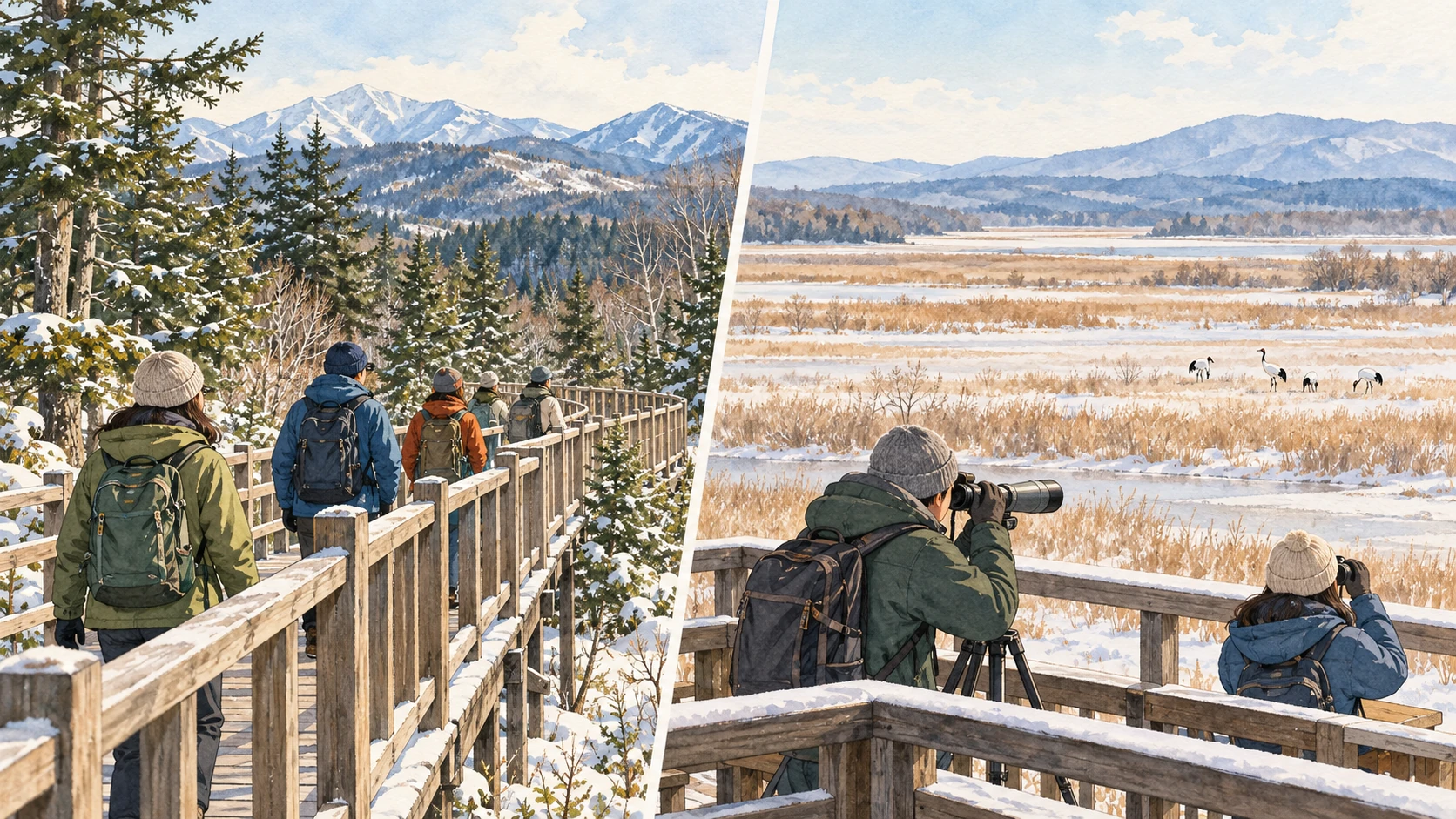
Otowa Bridge is one place to observe cranes at their winter dawn roost. The Tsurui tourism association's Otowa description asks visitors to watch quietly without disturbing them. Early travel involves darkness, low temperatures, parking, and a way back. If you lack a car or experience on ice, find a guide with clear meeting, clothing, and cancellation arrangements. Daytime urban transport is not proof of access before dawn.
The local crane-watching rules reproduced in Tsurui Village's 2024 official meeting materials (PDF, p. 57) prohibit feeding, flash, entering restricted areas, drones, and observation or photography directed at homes, and require designated parking. Winter observation sites also restrict shouting, running, and other disturbance. Rules apply to particular areas and seasons; permission for general photography elsewhere does not mean that the same arrangements apply at every feeding site or bridge. Use this archived rule sheet to prepare for your visit, and check the latest notices at the site.
A telephoto lens helps you observe from farther away, but does not authorize crossing a fence. Feeding times and sunrise are not a reserved service guaranteeing birds in front of the camera. Wildlife moves; waiting quietly without the ideal photograph is part of observing nature too. Let companions return indoors early to warm up rather than insisting that everyone stay until the photograph works.
Kushiro hotels: separate a third bed from a four-bed family room
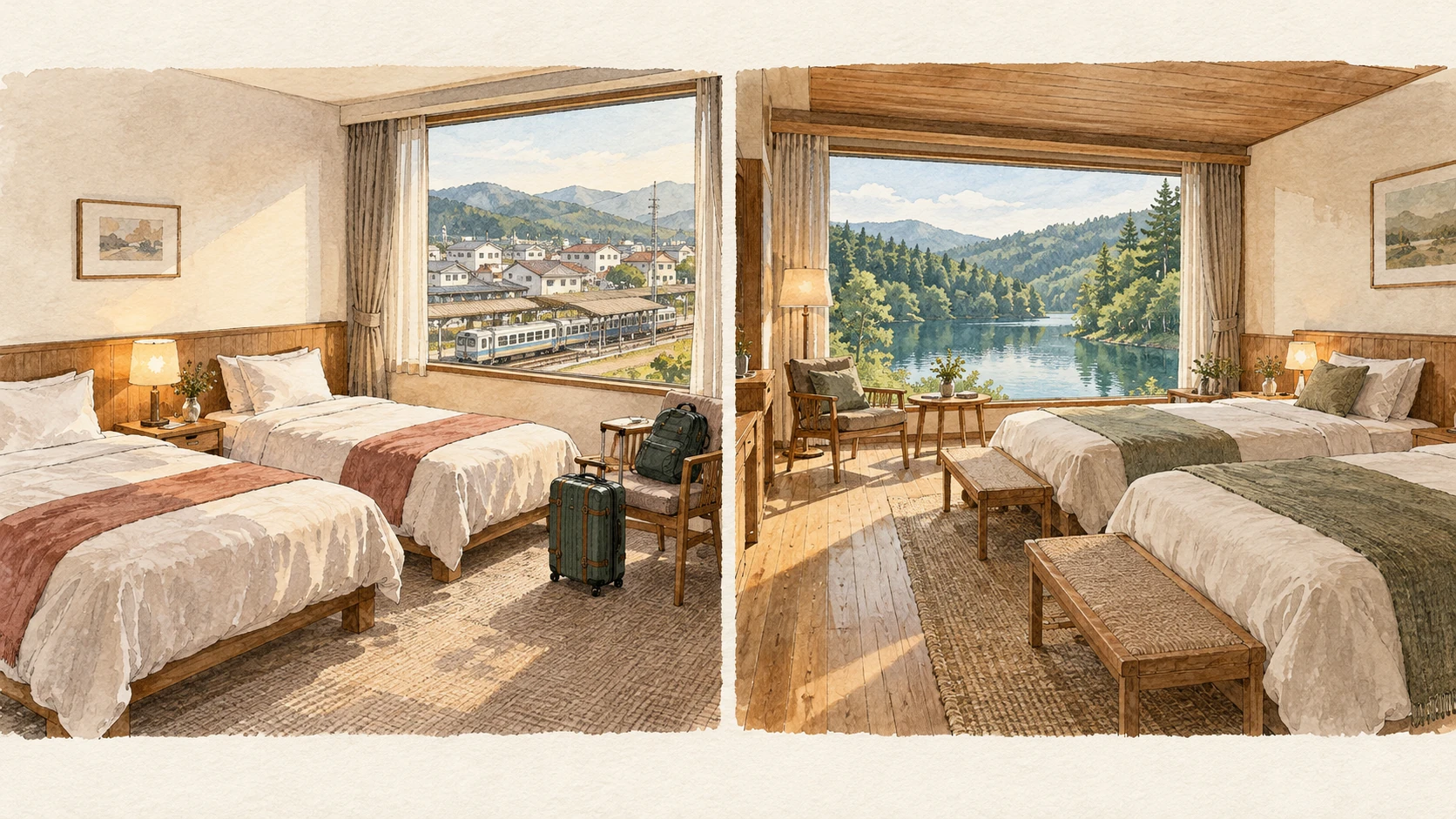
Kushiro Prince Hotel's named room categories illustrate family-booking differences. A standard twin on general floors is 23.08 m² with 110-by-195 cm beds and capacity for one to three, using an extra bed for the third person. The same-size twin on high floors allows one to two. Both being called Twin does not mean both admit three guests.
For four people wanting a bed each, separately compare the 48.43 m² Force family room, officially listed with four beds and a capacity of four. Choosing that room or two twins also involves space after opening luggage, whether people need to rest separately, and same-floor requests. A single date's search rate does not establish which is always cheaper, nor are adjacent rooms promised.
The Prince's stay and child questions give general check-in at 14:00 and checkout at 11:00, with plan exceptions. Preschool children may share existing bedding under the rules; elementary-school age and above are treated as adults. Cancellation starting dates differ for individuals and groups, with actual percentages read in the booking. Do not transfer another hot-spring hotel's child discount, free breakfast, or bathing facilities to this city property.
Kushiro to Lake Akan: the regular bus and Airport Liner are separate services
The lake transport information linked by Akan Bus separates regular route 30 from the Akan Airport Liner. The regular service needs no reservation and ends at Akan Bus Center, without calling at each hotel. The Airport Liner allows advance online reservations, has limited seats, and stops at selected hot-spring hotels. Choose the service before checking your stop so you can allow time to take luggage to reception.
That page lists one-way fares from Kushiro Station to Lake Akan at ¥2,750 for adults and ¥1,380 for children; the ordinary airport bus is ¥2,190 and ¥1,100, and the airport Liner ¥2,700 and ¥1,350. For two adults and one child paying the child fare, the ordinary station service costs ¥6,880 one way, versus ¥6,750 for the airport Liner. Compare starting points and stops too: these are not interchangeable discounts on the same journey.
Akan Bus's 2026 notices also advise of fare changes on selected routes from October 1 and the withdrawal of the local-bus one-day pass. Old tickets cannot simply be reused. Recheck the route and ticket valid for your travel date when reading an older trip report or seeing a pass photograph. Travel around the lake region can take more than the half-day first imagined; avoid adding a distant wetland activity on arrival day.
Lake Akan cruise: the 85 minutes include a short island visit
Akan Kisen's sightseeing cruise covers roughly 18 km in 85 minutes, including about 15 minutes at the Marimo Exhibition and Observation Center. Adults pay ¥2,700 and children ¥1,390 following the March 15, 2026 fare change. The adult total combines ¥2,280 for the boat and ¥420 for the centre; this is a fixed combined charge rather than a surprise to discover on reaching the island.
Two adults and one child pay ¥6,790 for that combination. The operator's carriage and child-fare rules distinguish elementary-school children, free allowances for accompanied young children, and requirements for a separate seat. A young child's free boat fare does not establish free admission to every island exhibit or every package. Ask the seller to confirm the amount payable for a preschool child.
Late-autumn departures differ from summer. The official page gives 15:00 as the last departure from October 21 through November 10, and 9:00, 11:00, 13:00, and 15:00 from November 11 through 30. Departure and arrival times at the different piers vary by five minutes. Check in at your actual pier and check weather and operating notices. Do not reuse this cruise timetable for frozen-lake activities or assume a short island stop permits staying until the next boat.
Marimo and the Bokke trail: respect protected habitat and hot mud
Learn about Lake Akan's marimo through the exhibition centre and visitor centre rather than expecting to see wild spheres through the water as soon as the boat departs. The Lake Akan visitor centre's nature and trail questions explain protected habitat and private or restricted shore areas. Do not go onto the northern shore on your own to observe or photograph marimo, and do not collect or move natural objects.
The Bokke walking trail is listed at about 1.5 km and 45 minutes, running behind the visitor centre toward the hot-mud shore area and connecting toward the boat facilities. Mud can reach roughly 97°C, and entering fenced areas is prohibited. Less snow over geothermal ground is not a safe reason to step across. When walking with children, check where everyone can stand before stopping for photographs.
Bears, fallen trees, and surface conditions can close trails, while winter does not mean the whole route is cleared of snow. Check ordinary walking, snowshoe activities, and guiding separately; 45 minutes is not a promise for every season or fitness level. Ask the visitor centre which areas are open that day. If conditions are unsuitable, use the time for indoor exhibits and the hot-spring town.
Ainu culture at Lake Akan: choose the programme before scheduling your visit
A cultural visit to Lake Akan Ainu Kotan needs more planning than assuming a performance will fit after dinner. Ikor theatre's programme introduction separates traditional dance, Full Moon Rimse, and Lost Kamuy. Traditional dance costs ¥1,500 from junior-high age and ¥700 for elementary-school children; each of the other two programmes costs ¥2,200 for adults and ¥700 for elementary-school children. Check the programme name rather than applying one price to all performances.
The official traditional-dance performance page lists roughly 30 minutes with no reservation required: 11:00, 13:30, and 20:00 from May through October, but only 20:00 from November through April, with possible changes. Those are traditional-dance times, not a shared schedule for the other productions. In winter, confirm dinner can finish before leaving instead of discovering at the theatre that only an evening performance is offered.
Two adults and an elementary-school child pay ¥3,700 for traditional dance or ¥5,100 for either of the other programmes, a ¥1,400 difference. Choose by subject and companions' attention spans rather than treating every production as essential on the same evening. Follow local photography, recording, and entry rules, respecting the performers and community instead of presenting their culture as an exotic backdrop.
Lake Akan hot-spring hotels: an in-room spring bath is different from a family bath
Akan Yuku no Sato Tsuruga's room and bathing questions identify particular annex rooms with open-air baths, Japanese-Western special rooms with view baths, hot-spring view special rooms, and certain suites as having in-room spring water. Other rooms use ordinary heated water in their bathtubs. The hotel name or a bathtub photograph cannot replace the actual booked room category; lake views also apply only to specified rooms.
If an in-room bath is unnecessary, ask about Hanatachibana-no-Yu, the family bath on Level 8 (8F): telephone reservations, 75 minutes for ¥2,200 per private session, charged by the session rather than the number of people. The website also describes priority arrangements for certain guests unable to use the large shared baths. Two ordinary paid sessions cost ¥4,400, but slots must be available; they are not something you can add at any time after arrival.
General check-in is 15:00 and checkout 10:00, while the Miyabi annex lists 14:00 and 11:00, subject to the booked plan. There is no universal promise of a free hotel-arrival shuttle. Assistance described from the hotel to Akan Bus Center does not prove collection at a station or airport in the opposite direction. For a first dinner-and-breakfast stay, use our guide to ryokan dinner and arrival times to confirm transport and meals together.
Accommodation tax, bathing tax, and cancellation charges need separate lines
The current Hokkaido accommodation tax, introduced in April 2026, uses the accommodation charge per person per night: ¥100 below ¥20,000, ¥200 from ¥20,000 to below ¥50,000, and ¥500 from ¥50,000. This is the prefectural tax, not necessarily the only local charge. The property applies the tax base, exemptions, and meal-package allocation under the rules; do not automatically use a full meal-inclusive package price as the taxable room charge.
Kushiro City's official accommodation-tax explanation adds ¥200 in city tax, making the combined prefectural and city charges ¥300, ¥400, or ¥700 per person per night in the corresponding bands. Two adults in the same band pay ¥600, ¥800, or ¥1,400 for one night, separately from bathing tax. Lake Akan accommodation within Kushiro City also follows the applicable location's rules, despite being far from downtown.
Read each hot-spring plan's bathing tax, child charges, and cancellation terms. Tsuruga's general schedule, for example, is 10% from 14 to eight days before, 30% from seven to two days, 50% the previous day, and 100% on the day or for a no-show; special plans can differ. Use our itemised Japan accommodation and transport budget to separate deposits, taxes paid locally, and cancellation exposure instead of retaining only the platform's headline room price.
Obihiro food: station pork bowls and sweets with separate shop hours
For a relaxed Obihiro food plan, choose one pork-bowl meal and one sweet shop rather than taking a different long detour each day to follow search rankings. Butahage's official Obihiro main-store page lists hours in JR Obihiro Station's Esta West building as 10:00–15:00, with last orders at 14:45, and 16:00–19:30, with last orders at 19:00. It closes Thursdays and on Esta West's designated closing days; last-order times may also change with demand. Service is not continuous throughout the day. If your train arrives close to 15:00, eat elsewhere first or wait for dinner service. The tourism association page separately lists a third-Wednesday closure, so the two pages differ; confirm that day’s opening with the operator before setting out.
Rokkatei Obihiro's store notice separates the shop and tearoom. The shop opens 9:00–18:00 in October and 10:00–18:00 from November 1. The tearoom opens 10:30–17:00 with last orders at 16:30 in October, then 11:00–16:30 with last orders at 16:00 from November; the tearoom closes Wednesdays. An open shop does not mean you can still sit down to order, and the tearoom closure does not mean the entire building closes every Wednesday.
Takeout sweets can fit between visits, while a seated meal needs time for queues and opening hours. Read the menu for current prices, limited products, and sold-out items. If you have a hotel dinner at Tokachigawa Onsen that evening, keeping lunch in town is enough. Do not miss a reserved transfer or meal just to add another restaurant.
Pancho or Butahage: check opening days, then price one meal
For another pork-bowl restaurant near the station, Ganso Butadon Pancho's listing from Obihiro's tourism association gives its address as Nishi 1-jo Minami 11-chome 19, hours of 11:00–19:00, and closures on Mondays and the first and third Tuesdays. It has no dedicated parking and does not accept credit cards. Choose it for a meal at a pork-bowl specialist, or choose Butahage inside the station to fit your rail journey. Their regular closing days differ, but temporary closures still need checking; neither is an always-available fallback for the other.
Pancho's menu levels rise through Matsu, Take, Ume, and Hana. The association lists respective prices of ¥1,050, ¥1,150, ¥1,250, and ¥1,450, with wakame seaweed soup at ¥180 and nameko mushroom soup at ¥200 charged separately. The order of the names differs from the Matsu–Take–Ume ranking some diners know, so check the price and portion description before ordering. This source does not specify the number of meat slices in each bowl, and this guide does not infer them from online photographs. Nor should you assume a half-price meal for a child without checking the menu.
For example, three people ordering one Matsu, one Take, and one Ume, each with wakame soup, would pay ¥3,990 at the listed prices. This is an example for those specified dishes, excluding drinks and transport, and does not mean those three bowls suit everyone's appetite. If you plan dessert after lunch, order an amount you can finish. If catching a train, allow for the queue. The tourism association also lists takeaway, but confirm whether orders are being accepted and the pick-up time with the restaurant; takeaway does not imply no waiting.
| Dish | Listed price in yen | What to check when ordering |
|---|---|---|
| Matsu | 1,050 | Lowest starting price of the four levels |
| Take | 1,150 | Check the portion on the restaurant's menu |
| Ume | 1,250 | Do not reverse the menu's name order |
| Hana | 1,450 | Meat-slice count is not inferred from photographs |
| Wakame soup / nameko mushroom soup | 180 / 200 | Ordered separately; not included in the pork-bowl prices above |
Ryugetsu Odori Main Store or Sweetpia Garden: a shopping walk or a factory half-day
If you only want Ryugetsu gifts before leaving by train that afternoon, start with the official Odori Main Store listing: Odori Minami 8-chome 15, Obihiro, open 8:30–19:00 and about seven minutes on foot from Obihiro Station. This town-centre option can go before or after a pork-bowl meal. Choose the products you want here and at Rokkatei's main store without adding the out-of-town factory as another compulsory stop just to buy one Sanporoku cake. A shop being called the main store does not mean it offers a factory visit.
Sweetpia Garden in Otofuke suits a visit with time set aside for the factory, shop, or cafe. From 20 April to 3 November 2026, the shop opens 9:00–18:00 and the cafe closes at 17:00. From 4 November 2026 to 18 April 2027, the shop closes at 17:00 and the cafe at 16:30; factory viewing ends at 16:00 in both seasons. Year-end hours are shorter on certain dates. On 1 January, the shop opens 10:00–17:00, while the cafe and factory viewing are closed. Factory viewing is free and ordinary visits do not need a reservation, but visible production depends on that day's operations. This is separate from hands-on workshops, whose booking arrangements need checking.
Transport is the most practical difference between the two shops. Ryugetsu's FAQ says Sweetpia has no direct bus. A taxi from Obihiro Station covers about eight kilometres in 15–20 minutes; the nearest local bus stop, Ryokuyodai Kitaku, still leaves about a 20-minute walk, with no pavement along parts of the route. These are the operator's reference times, not a transport booking. With a pushchair, in snow, or during a short gap in your schedule, the town-centre shop is easier to fit in. If choosing the factory, confirm both outward and return transport and do not miss your ride while waiting for a limited product.
| Location | Best suited to | Hours and transport conditions |
|---|---|---|
| Odori Main Store | Shopping in town and a walk after a meal | 8:30–19:00; the official site gives about 7 minutes on foot from Obihiro Station |
| Sweetpia Garden | Factory viewing, shopping, and the cafe | Factory viewing until 16:00; shop and cafe hours vary by season and over New Year |
| Sweetpia's limited cake offcuts | An optional purchase when time allows | One portion per person, cash only; quantities and flavours vary daily, with no purchase guarantee |
Check Sanporoku's best-before dates as well as flavours; offcuts are not a guaranteed bargain
Choose Sanporoku by when you will eat it after taking it home, rather than package size alone. On the check date, Ryugetsu's website lists one pumpkin Sanporoku log cut into ten pieces at ¥800 including tax, with an approximate 21-day best-before period, and one salted-butter Sanporoku log cut into ten pieces at ¥780 including tax, with about 30 days. Pumpkin is seasonal: the current online ordering period runs until 23:59 on 4 November, with delivery through 8 November, and may end early. These are the online product details checked; they do not guarantee that every physical shop has the same product or stock on your visit day.
One of each costs ¥1,580 in goods, excluding delivery charges. Compare the named one-log, ten-piece products separately from smaller portions and gift boxes; the Sanporoku name alone does not establish a single price. The official site explains that the stated best-before periods are measured at dispatch and may be shorter in some circumstances. They do not restart as 21 or 30 days when you buy the cake. Buying during the last few days of your trip and planning gifts around the actual package's date and storage instructions is more reliable than counting backward from a website figure. Labels for ambient delivery or refrigerated summer delivery also do not guarantee that food can safely remain in a hot car for a long time.
Sweetpia's Sanporoku offcuts are supplied in limited quantities according to daily production and go on sale when the shop opens. Adults and children are each limited to one portion. The special counter takes cash only, issues no numbered tickets, and sells in queue order until stocks run out; the queue may already account for all available stock before opening. The official purchasing instructions promise no arrival time that guarantees a purchase. Do not spend an unbudgeted extra taxi fare simply to save on sweets. If buying at the airport instead, check the actual outlet and its range; a statement that Ryugetsu products are sold there does not mean the complete range is stocked.
Banei racing: separate race dates from suspended shuttle information
Banei Tokachi's official questions say racing usually takes place on Saturdays, Sundays, and Mondays, subject to the actual seasonal calendar. It is not a park where horses pull racing sleds every hour every day. If racing is your priority, choose accommodation after checking dates, then fit gardens and meals around it rather than checking the calendar after booking every connection.
The beginning of the page lists current entry as free, while later passages retain historic charges and temporary free-entry information. Reconfirm the current admission notice and allow separately for betting and food. Watching and wagering are different choices: you do not need to place a bet to experience a race. With children, also follow permitted-area and photography rules.
The questions page still shows old free evening-shuttle times, immediately followed by a suspension notice. Those numbers are not a guaranteed ride back to the station tonight. For evening races, arrange ordinary transport or a taxi separately. If you have booked dinner at Tokachigawa, choose one evening priority rather than promising both the final race and a punctual hotel meal.
Manabe Garden: October and November close earlier than summer
Manabe Garden's 2026 opening announcement gives April 25 through November 23. Its visitor guide lists October hours of 8:30–16:30 and November hours of 8:30–15:30, with admission at ¥1,200 for adults and ¥200 for elementary- and junior-high-school children. An autumn search result mentioning summer's 17:30 closing time cannot be used to schedule your last stop; return to the rule for the actual month.
Two adults and one elementary-school child pay ¥2,600. The garden is known for conifers and landscaping; being in Tokachi does not mean expansive fields of flowers bloom all year. Some buildings are not open inside, and photographs must follow the visitor route. An attractive composition does not permit entering a building, lawn, or closed area for a different angle.
For an unhurried walk, reserve an earlier afternoon for the garden and fit city shopping around it. In November especially, a late lunch followed by a rush to final admission is unwise. Ask directly about autumn and winter ticketing cutoffs and closing requirements rather than deriving them from summer hours. Leave enough time both to finish the walk and to get back.
A Tokachigawa room-price example: the specified Christmas 2026 plan only
Daiichi Hotel's Christmas 2026 accommodation plan provides a date-specific price example: stays December 1–25, 2026, with a product limit of two parties per day. The Hosyutei Deluxe room is 40 m², for one to three people, with two beds and a sofa bed. The member price starts at ¥47,975 per person based on two people sharing, including one night and two meals; it is not a year-round fixed rate for every room category.
On that basis, two adults start at ¥95,950 combined, still subject to actual date, plan, and taxes. Two parties per day is a published product limit, not evidence that two rooms are currently available. Hosyutei rooms list an in-room open-air Moor spring bath and balcony. Those benefits do not extend to every standard Toyotei room, nor does capacity for three mean three permanent single beds.
This plan lists check-in from 15:00 to 18:00 and checkout at 11:00, with school-age children and above eligible and preschool arrangements requiring contact. Cancellation is 20% seven days before, 50% three days before, 80% the previous day, and 100% on the day. These conditions belong to this plan, not every Daiichi booking. Families planning Christmas should confirm whether the children can be accommodated before discussing extra beds and dinner or paying the lowest advertised starting price.
| Hotel / room | Published specifications | Confirm separately |
|---|---|---|
| Hokuten no Oka annex Western twin | 24 m², two single beds, capacity 2, shower | Children; no assumed third bed or in-room spring |
| Kitakobushi Sea View Twin | From 36 m², up to 4 people, shower | Additional sleeping arrangements; building not selectable |
| Kushiro Prince standard twin, general floors | 23.08 m², capacity 1–3 | Third-person extra bed; high-floor version lists 1–2 |
| Daiichi Hotel Hosyutei Deluxe | 40 m², capacity 1–3, two beds plus sofa bed | Specified Christmas plan, children, and actual rate |
Toyotei and Hosyutei: check private baths and ordinary-bus benefits separately
Toyotei's official room page distinguishes premium Western rooms with a spring-water view bath, Japanese rooms with an open-air spring bath, river-side twins, and standard Western rooms. Standard Western rooms list two beds; not every room has a natural hot-spring bath. If you need private bathing, twin beds, or children sharing the room, confirm all three conditions in the room category rather than relying on a photograph of the hotel's shared baths.
Daiichi Hotel's public-transport page describes ordinary buses from Obihiro Station, boarding at terminal stop 6, with Daiichi Hotel bus stop close to the Toyotei entrance. But its free round-trip offer for staying guests is dated April 1, 2025 through March 31, 2026. That is no longer a benefit guaranteed as of this guide's update. Ask whether a current offer and procedure exist before riding; an old ¥1,000 round-trip charge is not a current fare either.
An ordinary-bus promotion also differs from a private hotel shuttle. Dinner in Obihiro or evening racing followed by a return to the hotel still needs each bus checked; booking an onsen does not provide transport on demand. For two meals and an in-room bath, remaining at the property after arrival may suit you better. If city nightlife is the priority, a station-area stay usually makes evening transport easier to arrange.
Kofuku Station: the former railway attraction is not the bus stop
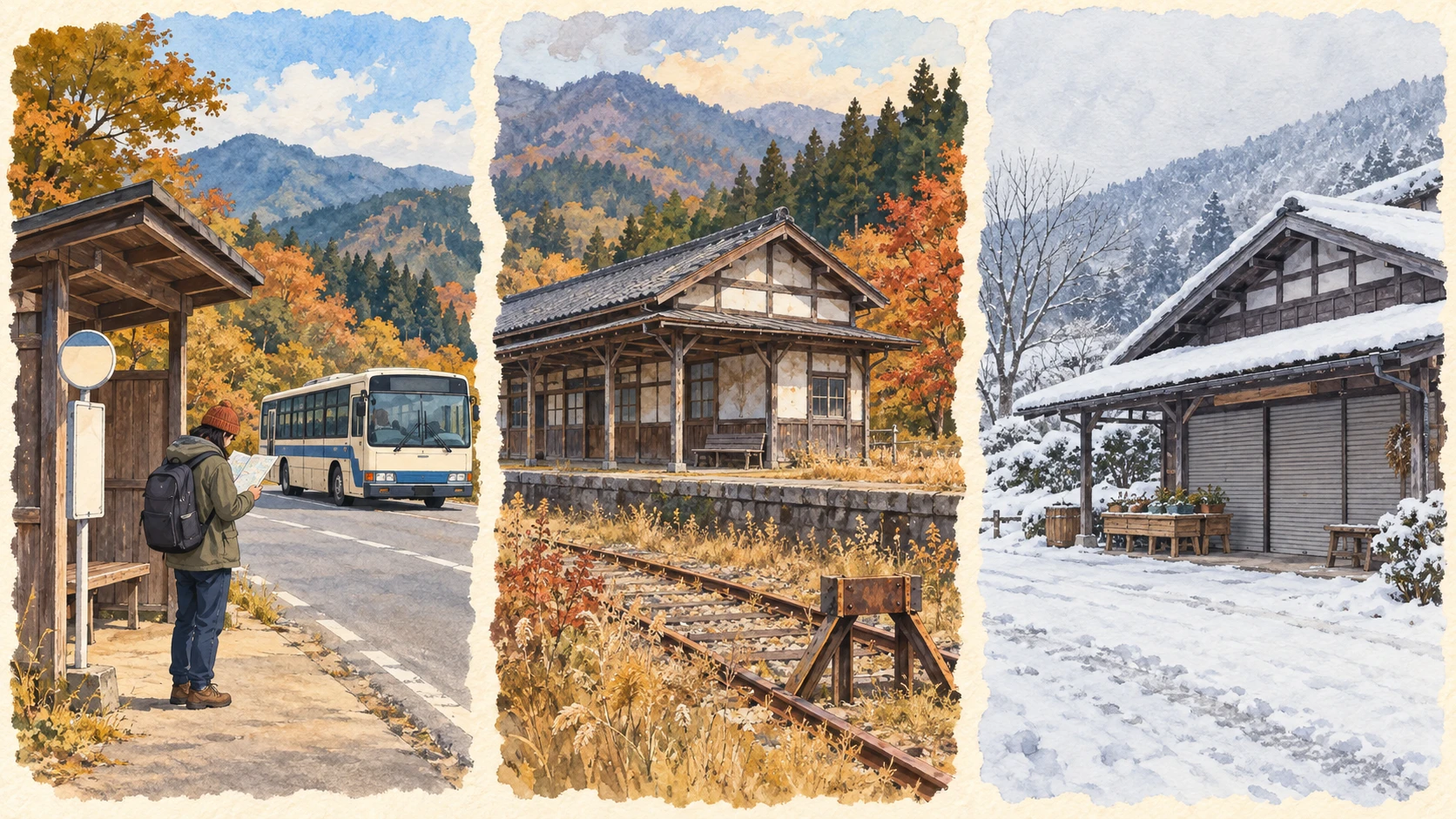
Obihiro City's Kofuku Station access page gives roughly 40–50 minutes by a bus toward Hiroo from the city, then about five minutes on foot after getting off at Kofuku. The airport has other options such as taxis. When searching for Kofuku Station's location, distinguish the old station attraction from the bus stop. It is neither a rail interchange for continuing to Lake Akan nor a downtown walking sight.
Before riding there without a car, check the return bus rather than photographing the platform and then discovering a long wait. If your companions mainly want to see the old platform and take a group photograph, treat it as one choice within a half-day. You need not add every Tokachi attraction as supposedly on the way; a nearby road does not establish a useful public-bus connection.
Kofuku Station and Hanabatake Farm are often searched together, but their final connecting leg still needs arranging. Being around Obihiro does not make the two walkable. For Nakasatsunai on the same day, first decide whether a rental car, taxi, or published tourist service works on your dates. With no reliable return, choose one place and retain time for a meal back in town.
A half-day return to Kofuku Station: calculate usable time from a specific weekday pair of buses
Using Monday, 26 October 2026, as a planning example, Tokachi Bus's weekday timetable for Route 60, the Hiroo Line, allows departure from Obihiro Station Bus Terminal's stop 11 at 10:05, reaching the Kofuku stop at 10:56. Return toward Obihiro from Kofuku at 12:25 and reach Obihiro Station Bus Terminal at 13:20; the timetable lists arrival at stop 6. The outward ride takes 51 minutes and the return 55 minutes, leaving 89 minutes between the two buses at Kofuku. This example is assembled from the current timetable, not a reserved trip or a sightseeing pass valid unchanged year-round.
Using the city's approximate five-minute walk each way means ten minutes walking in total. Allow another ten minutes to return early and wait at the bus stop, leaving about 69 minutes at the former station. Five minutes is a walking estimate; 69 minutes is a calculation based on explicit assumptions. Snow, photographs, your companions' pace, or going the wrong way all reduce that margin. Locate the return stop when you arrive, before walking to the old platform. The available time suits looking around the station and taking photographs, without squeezing in a full sit-down lunch.
Tokachi Bus also has a notice reducing weekday services from 13 October. For Route 60 it lists cancellation of the 14:30 departure from Obihiro Station toward Hiroo and the 18:24 departure from Hiroo Office toward Obihiro. The 10:05 outward service and the 12:25 return from Kofuku used above are not those cancelled runs. Check weekends, public holidays, event diversions, and the New Year period separately; do not reuse this weekday example for the 25 October marathon day. Look up the fare for your travel date and boarding and alighting stops on the official site, rather than substituting an old day-pass price or an unverified package fare.
| Step | Time / duration | Conditions |
|---|---|---|
| Obihiro Station terminal stop 11 → Kofuku | 10:05 → 10:56; 51 minutes | Route 60 toward Hiroo |
| Estimated time at the former Kofuku Station | About 69 minutes | 89 minutes minus 10 minutes walking and 10 minutes waiting early |
| Kofuku → Obihiro Station terminal stop 6 | 12:25 → 13:20; 55 minutes | Toward Obihiro; follow the actual stop signage and that day's notices |
Nakasatsunai Art Village and Hanabatake Farm have different season endings
The Nakasatsunai Tourism Association's 2026 information lists Nakasatsunai Art Village as open April 29–October 31, 2026, with October hours of 10:00–15:00. From Tuesday through Friday, opening is mainly for museums and gardens; Poroshiri restaurant operates Saturdays, Sundays, Mondays, and holidays, 11:00–15:00 with last orders at 14:30. The grounds being open does not provide the same dining service every day.
Some Art Village areas are free, while the specified garden and Masami Mano exhibition combination costs ¥1,000 for adults and ¥500 for elementary- and junior-high-school children. Rokka no Mori is a separate facility; check its official opening information for your visit date. Photographs of green space, viewing art, and eating lunch involve different facilities and that day's openings, not an imagined all-inclusive Rokkatei grounds ticket.
Before adding Hanabatake Farm Cafe to your itinerary, ask the business to confirm opening dates, winter closures, hours and last orders for your visit. For the Tokachi Hanabatake Farm shop on the same site, confirm winter closure dates and opening hours separately; do not infer them from the Cafe's arrangements. If you want to buy sweets in November, ask the business first whether the shop will open that day. Check the individual notices for other branches, such as New Chitose Airport, too.
From Kofuku Station to Hanabatake Farm: arrange both directions before combining them
The official Route 60 Hiroo Line map lists stops including Kofuku, Nakasatsunai, and Nakasatsunai Art Village, but the route does not run to the Hanabatake Farm shop's door. Hanabatake's official site places its Tokachi shop at Motosatsunai Higashi 4-sen 311-6, Nakasatsunai Village, about 50 minutes by car from Obihiro Station or 20 minutes from Obihiro Airport. These are driving estimates from those two starting points, not walking times after alighting at Kofuku. If using the bus without an onward transfer, visit Kofuku Station and return to Obihiro, leaving the farm for another day.
To combine both places on one day, a rental car or prebooked taxi makes the final leg easier to define. The Obihiro Individual Taxi Association's Kofuku–Hanabatake Farm sightseeing route lists five stops: Aikoku Station, Kofuku Station, Rokka no Mori, Nakasatsunai Art Village, and Hanabatake Farm. It is listed as about three hours 20 minutes, ¥22,500, available April–October, with facility fees extra. This is the published price for the complete sightseeing route, not a one-way Kofuku-to-farm fare or a quotation that still applies after you remove stops yourself. Ask the operator to confirm each stop's opening, the route and the price for your actual date.
When requesting a quotation, supply your date, party size, children and luggage, pick-up location, intended time at each of the two places, and whether you finish at Obihiro Station or the airport. Ask about waiting charges, cancellation, and the latest return. The association's number is 0155-48-5141. The page lists radio-dispatch hours of 8:00–19:00 Monday–Friday and 14:00–19:00 Saturday, closed Sundays and public holidays. That does not mean every individual driver is off duty then, but neither should you assume that a taxi will always be available after you arrive in the countryside. If the Tokachi shop is already closed for winter, shop in town or check other branches instead of detouring to a closed site for the same brand.
Three days in Abashiri: leave a daytime slot adjustable around drift ice
A winter three-day Abashiri stay can use day one for arrival, check-in, and understanding the port journey; day two for your first-choice drift-ice sailing; and day three for a museum or city stop before departing. Space around the sailing helps, but does not guarantee another booking after cancellation. Full boats, suspended departures, and an absence of drift ice remain possible.
If day two's sailing is cancelled, check available transport and opening hours before choosing either the Prison Museum or the Drift Ice Museum for a complete visit. Guests staying by the lake should retain time to return for hotel dinner rather than detouring to Shiretoko and back that evening just to fill the itinerary. If the boat sails without ice, judge the alternative route by your expectations; a view that differs from your expectations does not in itself establish that a refund for a cancelled sailing applies.
Spending all three days in Abashiri means less luggage handling and a fuller local stay. If Utoro is essential, add accommodation and a transfer day, then secure transport between the bases before deciding their order. In winter especially, a closed Shiretoko Pass means Rausu on the other side of the map is not an impromptu shortcut toward Kushiro.
Three days in Shiretoko: give the lakes and boat separate main activity slots
During summer or autumn with the relevant services operating, three days in Utoro can mean arrival and check-in on day one, the Five Lakes as day two's main activity, then a cruise of suitable length before leaving on day three. If day three needs a long connection or flight, move the boat to day two and reduce the ground-trail loop accordingly. A three-hour guided walk, four-hour cruise, and regional transfer cannot all be promised on one morning.
One main activity requiring check-in or subject to weather each day is easier to replace. When a sailing is cancelled, use current road and park notices to find a short visit that is open and reachable. If bears close the lakes, do not enter the forest by a side path. A fallback must respect that day's restrictions, rather than attempting a prohibited route from another entrance.
Choosing Shari or Utoro changes the three-day plan too. Shari helps with the next rail journey; Utoro helps with early west-coast activities. Each has costs, and no hotel removes every connection. Before booking, write down the final arrival service on day one and the first departure leg on day three. If they do not connect, change the overnight transfer base rather than pressing a driver or guide to make the itinerary work on the day.
Three days in Kushiro, with extra nights for Lake Akan's different pace
For three days in Kushiro alone, use day one for city arrival and meals, day two for one side of the wetlands, and day three for a seasonal train, cultural visit, or indoor stop that fits actual services before departure. If winter cranes are the priority, give birdwatching a complete activity slot and drop the viewpoint on the opposite side. Rest after an early start too; standing in the cold has a physical cost.
To include Lake Akan comfortably, add lakeside nights and transfer time, grouping the cruise, Ainu programme, and hotel dinner into the same lake stay. The regular bus from Kushiro is not a short city ride. Arriving, cruising, walking, bathing, dining, and rushing back can reduce everything to check-ins. An overnight stay also makes it easier to adjust a walk to the weather.
A reservable seasonal travel product between regions does not establish the same direct times and stops on ordinary services all year. To continue toward Shiretoko, read your date's product and meeting point instead of combining a summer and winter itinerary into a year-round bus. Promise only confirmed stops on that regional transfer day; without operating evidence, keep it as a travel day.
Three days in Obihiro and Tokachi: choose city, garden, and hot-spring priorities
Three Obihiro days can start with station-area pork bowls and sweets, use day two for one seasonal garden or Kofuku Station, then leave on day three as transport permits. If racing matches your dates, substitute it for one evening. This leaves room for meals and the city, rather than making Manabe Garden, Nakasatsunai Art Village, Hanabatake Farm, and Kofuku Station a single day's mandatory checklist.
For a Tokachigawa Onsen stay, set aside one day for arrival, resting in the room, and hotel dinner, then return to town another day. An attractive Hosyutei in-room bath is little reason to arrive at the last moment before dinner. The time bought with an expensive two-meal stay is squeezed if all of it goes into catching buses. Early starts matter especially when late-autumn attractions close sooner.
Tokachi's agricultural sights are dispersed. Easy driving does not mean frequent public transport on every leg. Without a car, select one place with a complete confirmed outward and return journey, leaving others for another visit. To continue toward Asahikawa, Biei, or Furano, separately consult our central Hokkaido base and transfer guide and account separately for the time spent crossing regions. Three days in Tokachi cannot cover the whole of inland Hokkaido.
A longer eight-day route: choose two or three areas rather than collecting all of the east
To connect Abashiri, Shiretoko, Kushiro, and Tokachi, accept that each change of base involves luggage and timetable checks. Even eight days may not suit all four areas. Summer or autumn could pair Abashiri and Shiretoko in the north, then Kushiro and Lake Akan. Winter could pair Abashiri drift ice with Kushiro birdwatching, with transfers and reservable products checked for the actual dates. If Obihiro is a main objective, substitute it for the northern part rather than continuing to add places.
One longer accommodation example puts the first two nights in Abashiri, two in Utoro, then uses a transfer day toward Kushiro before two final nights in Kushiro or Lake Akan and departure. This is an allocation of nights, not a guaranteed seamless direct bus that day. Without workable regional transport on your date, add an intermediate night, change arrival or departure points, or drop an area. Shorter activity check-ins cannot bridge a missing connection.
With children or older relatives, fewer hotel changes also reduce luggage handling, meal arrangements, and room confirmations. On a first eastern Hokkaido visit, completing two areas usually protects more sightseeing time than changing hotels nightly. If the budget is tight, first remove the most distant leg, retaining an unhurried trail and one suitable hotel night rather than reducing every area to a roadside photograph.
Compare ticket prices for the same party to see the real choices
The following single-activity examples use two adults and one elementary-school child: ¥17,500 for Abashiri's large drift-ice boat, ¥6,790 for the Lake Akan cruise with exhibition centre, ¥3,700 for traditional dance, and ¥2,600 for Manabe Garden. These belong to different areas and seasons. The table explains the scale of costs, not a recommendation to do them all in one day; regional transport and hotels are excluded.
The Lake Akan cruise plus traditional dance totals ¥10,490 for that party. Adding the ¥6,880 one-way ordinary bus from the station makes ¥17,370 for the three items. Return transport, accommodation, meals, and taxes remain additional. Ask whether you would rather stay an extra night or add a paid activity, instead of summing every advertised minimum and assuming the result covers the trip.
Child definitions differ between products: boat tickets often use elementary-school status, the Five Lakes lecture uses age, and hotels may use age six, school stage, or bedding needs. Write down each child's age, school stage, and requirements for a bed and meals before booking. This is more reliable than arguing at reception that children should pay half. Retain confirmation emails so transport changes are easier to recalculate too.
| Item | Total yen | Excluded |
|---|---|---|
| Abashiri large drift-ice boat | 17,500 | Transport, special seating, accommodation |
| Lake Akan cruise with exhibition centre | 6,790 | Transport to lake, other activities |
| Ainu traditional dance | 3,700 | Other programmes, transport |
| Manabe Garden | 2,600 | Meals and transport to garden |
Final booking checks: secure the irreplaceable activity and leave weather room
Before submitting bookings, confirm that the activity you most want operates on your dates, then its arrival point, check-in, and cancellation terms. Book accommodation that lets you reach it punctually. Drift-ice boats, Five Lakes guides, seasonal trains, and limited hotel dinners each have conditions that cannot substitute for one another. If the key activity has no feasible date, adjust the trip first rather than filling the same area with other sights to conceal the gap.
Recheck roads, sailings, attraction closures, and seasonal buses one week before travel, then weather and operating notices the previous day. Keep cancellation deadlines, contact details, and onward transport accessible offline, with a fallback possible from the same accommodation base. These checks do not remove delays, but they clarify which part to retain when cutting plans at short notice.
After a cancelled sailing or road closure, first contact the next affected accommodation and activity to ask about changes, charges, and arrival deadlines, then decide where else to go. Keep the original payment channel, order number, and replies together so the same refund is not processed twice through different platforms. Before adding a new booking, also check luggage carriage on the replacement transport and whether dinner remains reachable.
A few useful answers
Can I visit Abashiri, Shiretoko, Kushiro, and Obihiro in three days?
It is not recommended. Choose one area for three days; adding Lake Akan to Kushiro also needs transfer time and lakeside nights. Regional travel involves actual services, luggage, and check-in, not just map distances.
When can I book an Abashiri drift-ice boat for 2027?
The operator announced telephone bookings from October 15, 2026, with online opening planned for early November 2026, subject to system changes. Book your first choice only; the operator confirms current opening and reservations.
What happens if there is no drift ice on the Abashiri cruise?
The large Aurora may use an alternative Cape Notoro sightseeing route; the small boat is cancelled under the website’s description. No ice differs from a weather-cancelled sailing. Refunds for prepaid cancelled departures follow the original purchase channel.
Do I need a guide for the elevated Shiretoko Five Lakes boardwalk?
During its open season, the elevated boardwalk is free, 800 m one way, and separate from the ground trails. Ground trails require a registered guided tour May 10–July 31 and the specified lecture during other open periods. Check winter entry separately.
Can I drive from Utoro over Shiretoko Pass to Rausu in winter?
A full closure is planned from 16:00 on November 4, 2026 until late April 2027. October 23–November 3 has nighttime restrictions, and daytime closures remain possible. An open road does not itself establish a seasonal bus.
Can I take the Norokko wetland train in November 2026?
Do not plan from an old seasonal calendar. JR announced regular operations ending October 4, 2026, with final trips October 9 and 10. SL Fuyu-no-Shitsugen is a separate winter-only train whose operating days need checking.
Does the bus from Kushiro to Lake Akan stop at every hotel?
Regular Akan route 30 ends at Akan Bus Center and does not call at the hotels. The Akan Airport Liner is a different reservable airport service stopping at selected hotels; check its fares and each direction’s times separately.
How long is the Lake Akan cruise, and how do I see marimo?
The ordinary cruise is about 85 minutes, including roughly 15 minutes at the exhibition and observation centre. Learn about marimo through conservation and exhibits; wild spheres are not guaranteed visible directly from the boat, and protected habitat cannot be entered independently.
Do all Lake Akan or Shiretoko onsen hotels have private baths?
No. An in-room spring bath, ordinary bathtub, large shared bath, and separately reserved family bath differ. Tsuruga provides in-room spring water in specified categories and also has a reservable family bath; Kitakobushi has no separately bookable shared family or private bath.
Can I decide on Obihiro food and racing on the day?
Restaurants have last-order and closing days. Racing is usually Saturday, Sunday, and Monday but follows the actual calendar. The old evening shuttle is marked suspended, so it cannot guarantee a return to the station after racing.
Can I visit Manabe Garden and Tokachi Hanabatake Farm in November?
Manabe Garden's 2026 season is scheduled through 23 November, with November hours of 8:30–15:30. Hanabatake Farm Cafe announces winter closure from 4 November, with reopening planned for late April 2027. Confirm the Tokachi shop's winter closure dates and opening hours with the business separately. Check each branch in other cities separately too; the Cafe's closure date does not apply automatically.
How do Hokkaido and Kushiro accommodation taxes combine?
The prefectural tax is ¥100, ¥200, or ¥500 according to the accommodation charge per person per night. Kushiro City adds ¥200, making ¥300, ¥400, or ¥700. Bathing tax is separate; confirm package tax bases and exemptions with the property.
Check with the source
Schedules, availability and rules can change. These official sources are the place to confirm details before you book.
- Abashiri boat operator: port access
- Abashiri Aurora: fares and timetable
- Abashiri boat operator: 2027 booking progress
- Abashiri boat operator: boarding questions
- Official Abashiri Aurora website
- Abashiri Prison Museum: visitor information
- Okhotsk Drift Ice Museum: visitor information
- Route Inn Abashiri Ekimae: rooms and access
- Hokuten no Oka: annex rooms
- Hokuten no Oka: access and transfers
- Hokuten no Oka: stay questions
- Shari Bus: Shiretoko e-tickets and conditions
- Kitakobushi: summer 2026 transport
- Shiretoko Five Lakes: common questions
- Shiretoko Five Lakes: ground-trail rules
- Shiretoko Aurora: routes and fares
- Shiretoko boat operator: sea conditions and boarding questions
- Kitakobushi: Shiretoko Pass restrictions in 2026
- Hokkaido Okhotsk bureau: specified road closure
- Kitakobushi: Sea View Twin
- Kitakobushi: children and bathing questions
- Kitakobushi: cancellation policy
- Route Inn Grantia Shiretoko-Shari Ekimae: rooms and children
- Official Kushiro tourism: wetland walking-route comparison
- JR Hokkaido: final Norokko operating announcement
- JR Hokkaido: SL Fuyu-no-Shitsugen introduction
- Tsurui tourism association: Otowa Bridge
- Tsurui Village: winter crane-watching rules in 2024 official meeting materials (PDF, p. 57)
- Kushiro Prince Hotel: rooms
- Kushiro Prince Hotel: stay questions
- Akan Bus website link: airport and Lake Akan transport
- Akan Bus: seasonal operations and ticket notices
- Akan Kisen: cruise duration and fares
- Akan Kisen: carriage and child-fare rules
- Lake Akan visitor centre: trails and nature questions
- Lake Akan visitor centre: Bokke trail
- Lake Akan Ainu theatre: programme fares
- Lake Akan Ainu theatre: traditional dance
- Akan Yuku no Sato Tsuruga: in-room baths, family baths, and stay questions
- Hokkaido government: accommodation tax
- Kushiro City: 2026 accommodation tax
- Obihiro tourism association: Butahage pork bowls
- Rokkatei: Obihiro main-store opening notice
- Banei Tokachi: admission and transport questions
- Manabe Garden: 2026 season dates
- Manabe Garden: monthly hours and tickets
- Tokachigawa Onsen Daiichi Hotel: Christmas 2026 accommodation
- Daiichi Hotel Toyotei: rooms
- Daiichi Hotel: access and dated promotions
- Obihiro City: Kofuku Station access
- Rokkatei: Art Village and Rokka no Mori notices
- Hanabatake Farm: Cafe hours and winter closure
- Official Shiretoko Shari tourism association website
- Butahage: current hours at the Obihiro main store
- Obihiro Tourism Association: Ganso Butadon Pancho's menu and closing days
- Ryugetsu: official Odori Main Store details
- Ryugetsu: Sweetpia Garden hours, factory viewing, and buying cake offcuts
- Ryugetsu: factory, transport, and airport-sales FAQ
- Ryugetsu: pumpkin Sanporoku, ten-piece product details
- Ryugetsu: salted-butter Sanporoku, ten-piece product details
- Tokachi Bus: Route 60 Hiroo Line weekday timetable
- Tokachi Bus: reduced weekday services from 13 October 2026
- Tokachi Bus: Route 60 Hiroo Line route map
- Hanabatake Farm: Tokachi shop information
- Obihiro Individual Taxi Association: Kofuku–Hanabatake Farm sightseeing route