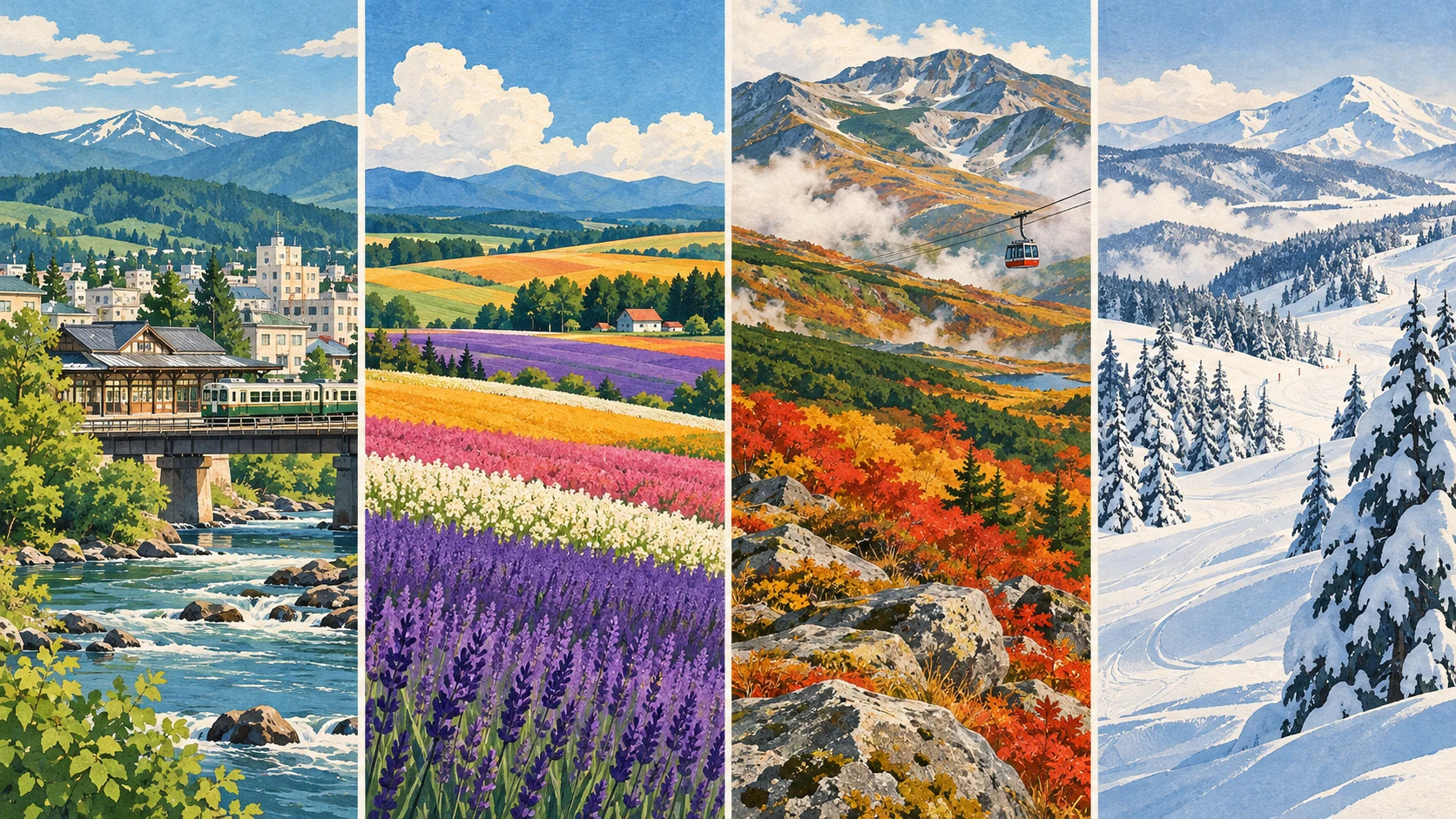
Choose the season and overnight bases first, then give flowers, wildlife, mountain views and skiing enough separate days. Departures, opening dates and dinner matter more than straight lines on a map.
Asahikawa, Furano, Biei or TOMAMU: choose the purpose first
A first trip through central Hokkaido can easily become a list of the zoo, lavender, Blue Pond, autumn ropeways and an ice village. These places belong to a city, agricultural hills, high mountains and a resort, with different seasons. Choose flowers, animals, mountain views or skiing as the main purpose; then let accommodation and the return journey determine what else fits, rather than scheduling directly from distances on a map.
Without a car, start timetable searches at Asahikawa Station and Furano Station. For skiing, investigate accommodation and transfers at Kitanomine, Shin Furano Prince or TOMAMU separately. Biei Station still leaves a final journey to the fields and pond; TOMAMU is not a little railway stop beside central Furano. Every change of base means recalculating luggage handling, dinner and check-in.
This guide retains the transport, fare and activity information checked on 22 October 2026, with an additional check on 23 October of the Hokkaido powder belt’s geography and snow quality. This collective name covers snow areas extending roughly 200 kilometres north to south through central Hokkaido, including Kamui in Asahikawa, Kurodake at Sounkyo, Furano and TOMAMU. Low inland humidity and severe cold favour dry powder, but snowfall, wind direction and snow cover vary between areas: choose a resort according to that day’s snow conditions and open runs. The “powder belt” does not guarantee fresh snow every day or mean that its resorts are connected. Unpublished services for the coming year, flower conditions and snow cover are not guaranteed. If Sapporo is also on your route, give Sapporo and Otaru their own city stay before choosing how many nights to add in central Hokkaido. The journeys there and back have a cost in both money and time.
What does each of the four bases solve?
Asahikawa brings city meals, Asahiyama Zoo and some bus outings together. Central Furano connects to trains and restaurants, but the slopes and Ningle Terrace still require travel. Biei suits a slower approach to the hills and Shirogane area, provided rural connections are settled first. Treat TOMAMU as its own resort stay, with winter activities and railway arrival and departure.
Before comparing room photos, establish where you will eat dinner, when the last bus leaves and whether luggage storage is available. With children, ski equipment or large bags, two nights together often take less effort than moving daily. On a short holiday, choose two bases rather than one night in every town. The table gives planning priorities, not services promised by every property.
“Where to stay in Hokkaido” covers much more than this guide. These are four central-Hokkaido approaches; Sapporo, Hakodate and other onsen areas need separate decisions. If continuing south, compare Hakodate’s city and seasonal night plans first and reserve a distinct long-distance travel day. The rhythm of one day here does not transfer unchanged to the whole island.
| Base | Main uses | Confirm before booking |
|---|---|---|
| Central Asahikawa | Zoo, city gardens, food and some mountain buses | Walk from the station and actual return departures |
| Central Furano or ski area | Summer fields or a Furano skiing stay | Whether the address is station-side, Kitanomine or Shin Prince |
| Biei and Shirogane | Separate time for hills, Blue Pond and falls | Rural buses, dinner and the nighttime return |
| TOMAMU resort | Resort skiing, frost terrace and Ice Village | Room, activity dates, station transfers and departure-day arrangements |
Use flowers, autumn leaves and snow to rule out the wrong dates
Furano lavender, Asahidake and Sounkyo autumn colours, winter powder and Blue Pond illumination do not share one best month. For summer flowers, check species and harvests; for autumn mountains, check snow at altitude and maintenance; for an ice village, check formation and actual openings. Choosing dates from one photograph can mean arriving after the scene has already changed season.
Furano Tourism Association’s flowering advice distinguishes the appearance of lavender colour, the usual peak and late varieties. Colour generally begins in late June, early to mid-July attracts most attention, late varieties may last into late July, and harvesting may already occur in August. Climate and farm management change that planning range. Other August flowers do not mean an entire purple lavender field remains.
Even along Hokkaido’s powder-snow travel corridor, check each ski area’s own calendar. Snow on a mountain may first affect viewing paths and roads; ski areas need enough cover and preparation before opening. Build a plan around one confirmed activity, an indoor or city alternative nearby and accommodation you can cancel, rather than fixing every day to a particular promised view.
Asahikawa Airport: match your travel date to the timetable version
Asahikawa Airport’s published bus connections have different timetables by date; for late October 2026, the page already separates services through 24 October from those starting 25 October. Enter your arrival date first, then allow for landing, baggage collection, reaching the stop and buying a ticket. The first bus in an earlier season’s search result is not automatically a connection for a new flight. A representative adult airport-to-city fare is ¥750.
If staying in Asahikawa on the first night, leave luggage before exploring. If staying in Furano, first look for a suitable Lavender Bus instead of detouring through Asahikawa simply to reach a larger station. Airport and ordinary local services can differ in payment, luggage and stops. With a ski bag or pushchair, confirm the actual service rather than relying on an identical destination name.
Work backward on departure day: set the airport arrival margin, then choose checkout, breakfast and the final connection. Mountain snow, road incidents or a late bus can upset the sequence; no fixed number of buffer minutes here is a guarantee. For an early flight, slower travellers or many bags, staying somewhere with easier transfers the previous night is more sensible than adding a distant attraction before flying.
Lavender Bus: distinguish the Asahikawa, Biei and Furano fare sections
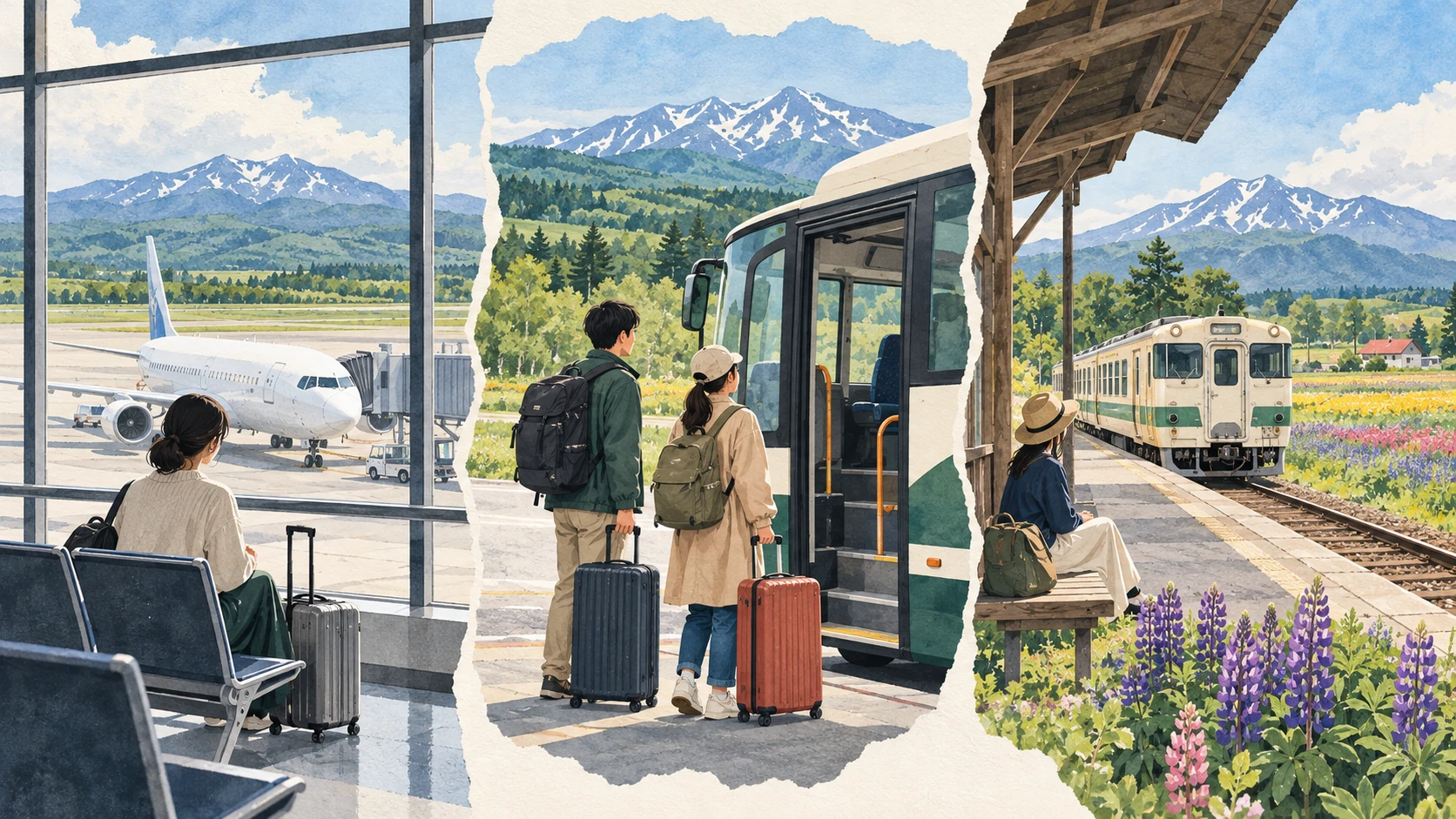
Furano Bus’s Lavender route page connects Asahikawa, the airport, Biei, Furano and Shin Furano Prince through different stopping sections. Ordinary service does not take reservations or guarantee connections with flights or JR trains. The operator instructs passengers to take a numbered ticket on boarding and pay on leaving. Prepare an accepted payment method; do not assume your own transport card works throughout.
The Asahikawa Line fare matrix is dated 1 October 2025: fares from Asahikawa Airport are ¥370 to the “Biei” (美瑛) bus stop, ¥380 to JR Biei Station (美瑛駅), ¥790 to Furano Station and ¥940 to Shin Furano Prince. This is the 2025 version, not a newly announced 2026 fare revision or a guarantee that fares remain unchanged in 2026; check the operator’s route page for the latest table before travel. This operator’s child-fare policy halves the adult fare for eligible children, rounding the half fare up to a multiple of ¥10: the ¥790 airport–Furano Station fare gives ¥400, while the ¥370 fare to the “Biei” bus stop gives ¥190. School-status exceptions also affect eligibility, so age alone does not determine the fare category.
A bus passing several places does not necessarily let you get off for photographs at each and continue conveniently. Choose one main stop, then check whether another service remains, which side the stop uses and where bags can go. A station may offer somewhere indoors to wait, while a rural stop may not. In cold weather or rain, removing one boarding and alighting can substantially reduce fatigue.
The seasonal train has finished: Lavender-Farm Station is not permanent
Furano Tourism Association’s 2026 railway announcement and its linked JR Hokkaido leaflet for that year state that the current Furano–Biei Norokko rolling stock made its final run on 23 September 2026. That year’s trains were all reserved seating and operated to a calendar. On 22 October they cannot be put into the coming week’s itinerary, and these materials do not establish a return of the same service in 2027.
Travelling without a car does not require a seasonal sightseeing train. The ordinary Furano Line remains a starting point for Asahikawa, Biei, Nakafurano and Furano connections, but fields and hotels need their own onward journey. Temporary Lavender-Farm Station operates only in its designated season. Do not follow the “seven-minute walk” on winter or nonoperating dates; the permanent Nakafurano Station is a different walking distance away.
If considering a rail pass, list actual sections, dates and reserved-seat requirements before reading how to calculate Japanese rail-ticket value. A Hokkaido itinerary does not automatically include every bus, ropeway, resort shuttle and vehicle inside an attraction. Check routes, seat categories and activation dates individually. Money saved on a pass cannot compensate for an onward stop you cannot actually reach.
Without a car, one main stop can be enough for the day
The real issue behind Asahikawa transport and a car-free Furano trip is the final connection. From Asahikawa, make the zoo the main outing; from Furano or Biei, choose one garden plus time in town. Rural bus stops do not behave like a dense city subway. Lunch, toilets, weather and finding the right stop all take time, and extra photographs do not create extra departures.
Write down four things: outward service, return service, time needed at the destination and the alternative if you miss a bus. If the alternative is an expensive taxi that may not be available, move your departure earlier. For a private car service or day tour, check the actual pickup point, luggage and cancellation terms. A tour being listed for sale is not proof it will operate that day.
Driving has its own trade-offs. It can simplify some summer connections, but winter adds snow, ice, darkness and the need for cleared parking. Without snow-driving experience, start with bases reachable by train or hotel transfer. This guide does not guarantee winter road conditions across Hokkaido, and a route that can be drawn on a map is not a recommendation to hurry along mountain roads at night.
Asahiyama Zoo: check admission, seasonal hours and closures together
Asahiyama Zoo’s official admission and opening information lists ordinary adult admission at ¥1,000, with junior high school students and younger free. The ¥700 resident adult rate does not apply to every visitor. An annual pass is ¥1,400 for a year from first use. A separate ¥1,000 overnight ticket has requirements including an Asahikawa-city overnight stay; it runs from noon on the first day to noon the next, not any continuous 48 hours.
From 16 October to 3 November 2026, opening is 9:30–16:30 with last entry at 16:00. The zoo closes 4–10 November, then winter hours from 11 November are 10:30–15:30, last entry 15:00. It also closes 30 December–1 January; winter hours resume 2 January–7 April 2027. Even matching months can have different annual calendars: do not move spring 2027 dates into 2026.
With children, choose a few animals to observe and places to rest instead of treating every building as a checkpoint. Winter opening is short, and coming directly from the airport adds luggage and buses. Near last entry, an earlier visit the next day is usually better than rushing after buying admission. Check the relevant monthly event calendar for special activities; admission does not mean every event will run.
Zoo buses: today’s ¥670 is different from the old ¥500
Asahikawa Denkikidou’s current zoo-route page lists adult ¥670 and child ¥340 from Asahikawa Station after the 1 September 2026 revision. Start with applicable departures on routes 41, 47 and others at station bus stop 6. An older summer PDF showing ¥500 and ¥250 must not replace the current fares. Two adults and one fare-paying child cost ¥1,680 one way, or ¥3,360 return.
The page’s summer timetable currently runs through November 3: examples include route 47 at 9:10 arriving 9:49 and route 41 at 9:40 arriving 10:22, subject to operating dates and destination. Direct airport route 78 is ¥840 adult and ¥420 child, with conditions including specified weekends and holidays. Compare the city’s zoo access information too; it is not a daily winter promise or a bus waiting after every flight.
The operator’s winter-bus notice published 21 October 2026 still gives 11 November 2025–7 April 2026 in its body, so this guide does not treat it as the new winter timetable. Check accepted cards such as Asaca and DoCARD under the operator’s actual rules; the familiarity of Suica or ICOCA elsewhere in Japan does not establish acceptance. Recheck before departure if the new winter schedule remains unclear.
Winter opening does not guarantee a penguin walk
When looking up the Asahiyama Zoo penguin-walk schedule, first identify the winter concerned. The official news archive still contains dates from late 2025 to spring 2026. Those cannot promise a 2026/2027 start date, number of daily walks or fixed time. Animals’ condition, snow on the ground and weather can also change the activity. A winter admission ticket is not a guaranteed penguin-walk ticket.
The zoo’s current-year news and penguin-walk announcements provide a better basis for departure than a search snippet or an old social-media screenshot. Until information for the new winter appears, plan an ordinary winter visit with exhibits you would enjoy even without the walk. If someone is coming solely for one activity, confirm the official announcement before buying transport and accommodation that are difficult to cancel.
Leave quiet time to watch animals; what appears depends on them rather than a prescribed number of minutes. When an exhibit pauses or becomes crowded, try another area, rest indoors and decide whether to return. Do not knock on glass, shout or cross barriers to obtain a photograph. The official film introduces the zoo’s way of showing living animals; notices inside govern that day’s activities.
Use the official film for observation, and respect filming rules
Asahiyama Zoo’s visiting and image-use rules prohibit feeding, flash and crossing barriers. All livestreaming is prohibited in principle, as is filming for commercial purposes, including monetisation. Personal souvenir images do not establish permission for a commercial channel or revenue-generating shoot. Ask the zoo beforehand if that is your purpose, rather than deciding to livestream at the entrance.
The official promotional film below can introduce exhibits and ways of observing animals before arrival. It is not evidence of winter 2026 events, prices or animal appearance times. Footage may belong to another season; judge dates and charges through their respective official pages. Attractive snow scenes do not show that the coming week already has enough ground cover for a penguin walk.
With children, discuss which movements they would like to observe, then let them take their time observing on arrival. For wheelchair, pushchair or less-steep access, ask the zoo about current surfaces and seasonal services before departure. This guide has not treated a promotional video as an accessibility test, nor does it claim every facility or entrance is equally easy to use in snow.
Kitasaito Garden: leave time for a walk beside Asahikawa Station
The managing association’s introduction to Asahikawa Kitasaito Garden describes an approximately 12-hectare city garden connected to the station. It suits a gap after arrival, after checkout or when mountain weather is unsuitable, unlike a distant farm requiring another ride. Seasons, snow and maintenance change the outdoor landscape. Summer flower-bed photographs do not guarantee the same colours in late autumn.
The garden centre’s visitor guide distinguishes outdoor areas from indoor opening hours: May–October 9:00–18:00, November–April 9:00–17:00. The centre closes Mondays, with the subsequent-weekday rule applying around holidays, and 30 December–4 January. Being able to walk in the park does not mean indoor toilets, storage or the service desk are available at every hour.
Settle luggage storage and tickets before deciding how far to walk before a train. Shorten the route if weather worsens rather than missing departure to finish a circuit. Visitors must take rubbish away, and camping and drone use are restricted. This is a place to rest and enjoy the waterfront, not a station-side promise of overnight stays, prolonged luggage storage or unrestricted camping on the grass.
Asahikawa Ramen Village: allow for the journey and the queue
Asahikawa Ramen Village’s official shop information lists eight establishments and overall hours of 11:00–20:00, though individual shops may shorten hours or change them temporarily. The village is in the Nagayama area, not a row of restaurants immediately outside Asahikawa Station. After a long ride with large bags, compare eating near the station with the additional time needed to reach the village.
Free entry and parking do not mean free meals, or seats available in all eight shops. Choose one or two places and check that day’s hours. Anyone avoiding pork, needing allergen information or eating vegetarian should ask about broth and shared kitchen arrangements directly. A dish name alone does not establish dietary suitability, and this guide does not guarantee every shop can customise a meal.
Combining Ramen Village and the Otokoyama area into one outing beyond the centre is easier to understand than returning from the zoo to the station and doubling back for noodles. Still check each leg: an operator’s driving estimate is not a walking or bus time. If continuing to Furano afterward, identify the actual boarding station before deciding how long to remain in a queue.
Without a car, split the route into Asahikawa Station → JR Minami-Nagayama Station → a walk to Ramen Village. In Asahikawa Station’s directional timetables, choose the Sekihoku Main Line toward Kamikawa and Abashiri, then find a local train that stops at Minami-Nagayama. Do not confuse it with Nagayama Station on the Soya Main Line. From the station, use Ramen Village inside the Powers shopping complex, at 119-48 Nagayama 11-jo 4-chome, as your walking destination. The Hokkaido Tourism Organization gives a walk of about seven minutes from Minami-Nagayama Station. That official estimate excludes restaurant queues and is not a measured guarantee for snowy winter conditions. Allow more time with luggage, snow or ice, and reduce the itinerary if walking conditions are unsuitable.
Check Minami-Nagayama Station’s timetable toward Asahikawa before deciding when to have lunch. In the Sekihoku Main Line outbound timetable and inbound timetable for 22 October 2026, for example, the local train leaving Asahikawa at 13:48 stops at Minami-Nagayama, and a return train leaves Minami-Nagayama at 15:58 and reaches Asahikawa at 16:08. First confirm that your chosen restaurant serves a later lunch, then assess whether this pairing works for you. On that same date, the next local train toward Asahikawa after the 09:37 departure from Minami-Nagayama is not until 15:58. Arriving early does not mean you can return to the city whenever you like at midday. These are examples for one specified date, not a daily or winter-long service promise. Recheck your travel date, station stops and operating status before departure, and work backward from your chosen return train to allow for leaving the restaurant, queues and the walk through any snow. If Furano comes next, check the connection at Asahikawa separately; reaching Asahikawa Station does not complete that onward transfer.
Choosing at Asahikawa Ramen Village: compare named shops, menu dates and portions
Choose the broth you want before treating all eight shops as a must-eat ranking. The village's individual shop introductions describe Aoba's broth blending ingredients from the sea and land, Ittetsu-an's fish and pork-bone stock, and Tenkin's pork-bone and chicken-bone stock separately. The distinctions here follow the shops' descriptions and help you narrow the choice by ingredients. Your preferred broth, which shop is open that day, and whether everyone can eat its ingredients are more useful for choosing a first bowl than a claim that one shop is “the best rated.” These are the Ramen Village branches: do not apply a main shop's address, opening days or prices to them.
For a meal estimate, Isshin's currently linked July 2026 menu, with tax included, lists soy-sauce and salt ramen at ¥950 each, miso at ¥1,000, and a small portion at ¥100 less. Two adults ordering one soy-sauce and one miso ramen, plus a small soy-sauce ramen, would pay ¥950 + ¥1,000 + ¥850 = ¥2,800. This is an example for three specified bowls, excluding side dishes and drinks. A small portion is a size option, not an automatic age-based child discount; it also does not establish that three people may share a single bowl. Check the prices and ordering rules at the shop.
The same official site retains older menus. Ittetsu-an's branch menu is dated October 2019, for example, so it can introduce the dishes but does not establish ¥850 as a 2026 price. Salt-flavoured ramen does not mean a broth without pork bones, fish or other allergens. If avoiding a particular meat, needing vegetarian food or managing a serious allergy, ask separately about the broth, noodles, toppings and shared utensils. If the shop cannot confirm them, choose a meal whose ingredients and preparation can be explained clearly.
Otokoyama’s museum and SAKE PARK: distinguish the old and new spaces
Otokoyama’s official museum explanation says the old building’s second and third floors still display brewing history and tools, while tasting and sales previously on the first floor have moved to the new SAKE PARK. Do not copy a route from an old trip report describing free tasting downstairs. Confirm the museum, outdoor plaza, new shop and café as separate parts of the visit.
OTOKOYAMA SAKE PARK’s current visitor information lists 9:00–17:00 opening, with tasting and the café until 16:30. It closes 31 December and 1–3 January. Entry is free without reservations; paid tasting and purchases are separate. The bus stop at Nagayama 2-jo 6-chome leaves an approximately two-minute walk. Drivers should check parking and roads too: a suburban place name does not make it a short station-side walk.
Non-drinkers can visit the museum, enjoy the outdoor design or choose nonalcoholic drinks. Adults should supervise children according to playground rules. Drivers and underage visitors should not plan alcohol tasting. A historic name associated with the water is not evidence of health benefits; this guide makes no longevity claims. Ask the shop about current conditions for shipping alcohol or tax-free shopping if those services matter.
Ueno Farm: the 2026 season ended 18 October
Ueno Farm’s gardening differs from mountain autumn foliage and suits a visit focused on planting design itself. The farm’s 2026 visitor guide gives 17 April–18 October, 10:00–17:00, with admission ¥1,200 for high school students and older, ¥500 for junior high school students and free for primary school children and younger. The season had ended at this update. It is not a late-October rainy-day or ropeway-closure alternative.
The official page also says the garden and café close in winter. That does not confirm the 2027 calendar: “similar every year” is not an announced opening. For a future gardening trip, check the new calendar, plants and transport before deciding how many Asahikawa nights to book. The name Ueno does not connect this farm to Tokyo’s Ueno or another place with the same name.
Walking around a garden takes time, so compare the return journey and meaningful time inside, not admission alone. For less walking or a pushchair, ask about seasonal surfaces and resting places; entrance information does not establish that the whole garden is step-free. In a closed month, confirmed city facilities save more effort than reaching the gate and only then changing the day’s plan.
Farm Tomita lavender: check varieties, not simply “July”
Farm Tomita’s flower-field layout separates plots, varieties and greenhouses: the entire farm does not show identical colours in the same week. For lavender photographs, match the flowering period to current bloom reports; for multicoloured fields, check other seasonal species. Harvesting, pruning and weather change the scene, so a photograph from a previous peak does not guarantee this year’s visit will look the same.
The farm homepage’s daily hours and flower reports showed information including 9:30–16:30 for 22 October 2026. That applies to that day, not universally to summer, winter or the whole year. Some flowers approach their end in late autumn, so the bloom is a condition of the plan. If lavender is the purpose, an open farm does not mean purple fields are still there.
With older relatives or children, choose one or two plots and somewhere to rest, balancing walking and the ride with their energy. Stay on permitted paths for photographs; do not enter flower beds, farmland or obstruct working vehicles. Nakafurano and Furano are different stations, and a property named Furano may still be far from the farm. Check the address and bus stop before promising an early arrival.
Farm Tomita: three ways to cover the final stretch
Farm Tomita’s official access page gives approximately 25 minutes on foot from Nakafurano Station. Seasonal Lavender-Farm Station is about seven minutes away, but only with an operating train and stopping date. These walking estimates refer to different stations. Do not retain only the attractive shorter figure in a year-round summary. Large bags, strong sun, rain or snow can also make the walk harder.
With the Lavender Bus, investigate a Nakafurano-area stop and the remaining walk. The operator’s airport-to-Nakafurano reference is about 48 minutes, subject to the service you actually take. Driving still needs parking and peak-season entrance waits; an ideal driving estimate is not the whole journey to a flower plot. If arrival also involves collecting baggage or a rental car, avoid filling that day with many extra gardens.
Lavender East is a separate field, listed about four kilometres or seven minutes’ drive from the main farm, not just around a corner inside it. Without a car, establish whether a suitable connection actually exists rather than describing both as one short walk. For half a day, lingering at one field, drinking water and enjoying the flowers makes more sense than spending the afternoon travelling to complete a list.
Shikisai no Oka: admission, parking and rides are separate purchases
Shikisai no Oka’s visitor guide lists July–September admission of ¥800 for high school and older, ¥500 for elementary and junior high, and free preschool entry. Ordinary-car parking is ¥500 cash during June–September. From October 2026, admission and parking become free; tractor buses, carts and the alpaca area do not all become free with them. Separate season, age and activity when comparing costs.
The garden’s 2026 peak-season revision notice establishes the boundary between old and new prices. Combining an old trip report’s admission with new parking can produce a total that never existed. The approximately 15-minute tractor-bus ride costs ¥500 for high school and older, ¥300 for elementary and junior high, with preschoolers free. This internal Norokko is not JR’s seasonal train; rail passes and train closure dates do not determine its operation.
The garden’s access information gives about 25 minutes on foot from unstaffed Bibaushi Station. Sightseeing buses also have seasonal and timetable limits; they are not always waiting at the entrance. October’s general closing time is 17:00, other months have their own table, and the alpaca area may finish earlier. Four-person vehicles have licence and use conditions. Keep photographs to designated routes rather than entering fields.
Shirogane Blue Pond: settle transport before expecting a particular blue
Biei Tourism Association’s Shirogane Blue Pond page provides facilities, access and management information. The pond is not a swimming pool with the same blue in every month and weather condition. Light, water conditions, ice, snow and viewpoint alter its appearance. Winter may cover it with snow, so the official summer film does not guarantee that the same exposed blue water will be visible in winter.
The current facility page lists parking at ¥1,000 for an ordinary car, ¥6,000 for a vehicle exceeding six metres in length, and ¥300 for a motorcycle. The old ¥500 parking charge is not the current figure. Parking and admission are different concepts, and one payment does not include other attractions’ parking. Without a car, check the actual Biei–Shirogane bus, alighting stop and return service, not just an outward screenshot.
For a daylight visit, allow separate time for the pond and the adjacent Shirogane area. To add illumination, solve the journey home after dark and warm waiting arrangements first. Do not cross fences or enter restricted areas; drone use needs its own official-rule checks. A landscape introduction does not authorize walking on ice, swimming or entering the edge of the water.
Blue Pond illumination 2026/2027: 21:00 is not the last bus
Biei’s official illumination schedule for this season runs 22 October 2026–21 April 2027. Starting times are 17:00 in October–November, 16:30 in December, 17:00 in January, 17:30 in February, 18:00 in March and 18:30 in April, all ending at 21:00. A sequence lasts roughly 15 minutes; snow and ice can change the presentation. With new dates announced, last season’s end date should not remain in the plan.
The generic facility page separately lists daytime parking hours by month, including 7:00–19:00 in May–October. That does not establish identical access after 19:00 on an October illumination night. Confirm that night’s entrance and parking arrangements. Non-drivers especially need a dependable return service: the lights’ closing time is neither the last bus departure nor a guarantee that a taxi will be immediately available.
The film below is Biei Tourism Association’s Blue Pond introduction, useful for understanding the landscape and paths, not footage of this season’s illumination. To see both day and night, establish where to eat, warm up and leave bags between visits. If those questions remain unresolved, choose one time of day rather than waiting at a rural stop for hours merely to obtain two kinds of photograph.
If you are staying in Biei and want to see one illumination sequence using ordinary buses, Monday, 26 October 2026 provides a planning example. Following the stop photographs in Dohoku Bus's timetable revision effective 1 October 2026, use the side of Biei-ekimae marked for Shirogane and the Blue Pond (白金・青い池行き). Take route 39 at 15:34 and get off at Shirogane Aoiike Iriguchi (白金青い池入口) at 15:56. After the lights begin at 17:00, take the Biei-bound route 42 from the stop of the same name at 18:05, arriving at Biei-ekimae at 18:30. The published one-way fare is ¥800; two journeys at that fare total ¥1,600 (¥800 × 2). In the current timetable, 18:05 is the last return and terminates at Biei; it does not continue directly to Asahikawa. If staying in Asahikawa, check a separate JR connection after 18:30. This example involves about two hours outdoors. Identify the return stop before entering the path. A reminder to leave the pond at 17:40 would allow 25 minutes for walking back and waiting. That is a planning allowance, not an official guaranteed walking time; leave earlier in snow or if anyone walks more slowly.
The same timetable's 17:15 departure from Biei, reaching the pond entrance at 17:37, appears to reduce outdoor waiting. However, only 28 minutes remain until the 18:05 return, before allowing for the path in both directions and waiting at the stop. It is not a dependable way to see a full 15-minute sequence. Compare this season's illumination times with the last bus: October–November and January start at 17:00, and December at 16:30, allowing more room for an evening bus visit. February's 17:30 start leaves only 35 minutes before the bus; arrange return transport if you want a leisurely visit. In March, the lights begin at 18:00, leaving five minutes, less than a full sequence. In April, the 18:30 start is 25 minutes after the bus has left. These conclusions use the October 2026 timetable and do not guarantee that the services will remain unchanged through spring 2027. Check New Year arrangements, later timetable revisions and cancellations separately. If the return journey does not work, visit by day; lights continuing until 21:00 do not mean buses run that late.
For a winter tour, start with Biei Tourism Association’s bus guide, which names it as the organiser of Biei View Bus. Hokkaido Tourism Organization’s winter model course describes an evening illumination circuit from Shiki-no-Johokan beside Biei Station to the Blue Pond and Shirahige Falls, while directing travellers to the official operating schedule. Before choosing a product, confirm your travel date, outward and return times, meeting point, minimum party size, booking deadline, cancellation and bad-weather arrangements in that product’s terms or the organiser’s reply; conditions from another season do not establish these details. For a later return, inquire about a return charter through Biei Hire's reservation inquiry form or at 0166-92-1181. Give the date, party size, pickup time in Biei, intended time at the pond and return destination. The website says form replies take three to four business days and warns that all vehicles may be out on jobs. Submitting a form is not a confirmed booking. Before planning the evening, obtain the pickup location, outward and return times, total price including waiting and parking, cancellation charges and bad-weather arrangements; the provider's reply determines these conditions. Without confirmation of a vehicle and return journey, or if the illumination is cancelled or the road closed that day, do not take the outbound bus and gamble on finding a taxi there. Keep the visit in daylight or cancel that evening at the pond.
Shirahige Falls is nearby, with its own entrance and parking
Shirahige Falls’ official access information gives about 30 minutes by Dohoku Bus from Biei Station, followed by roughly three minutes on foot from Shirogane Onsen stop; the driving estimate is also about 30 minutes. The pond has separate stops, walking access and parking. List both destinations individually instead of assuming the end of the pond path naturally brings you to the waterfall.
The falls can be viewed from a bridge, with public parking and toilet information at Shirogane Tourist Center. Do not apply Blue Pond’s parking charge here. Official illumination information lists Shirahige Falls from sunset to 21:00 year-round, still subject to local restrictions, paths and the bridge surface. Flowing water in winter does not mean an ice-free bridge; dress and adjust the length of the visit to the weather.
If continuing to mountain accommodation, avoid beginning a long journey only after both night views. Confirm dinner, check-in and transfers with your Shirogane Onsen property first. If you are not staying overnight, do not assume every hotel lobby or bath accepts casual visitors. For a family, reaching accommodation for dinner before dark will often serve the trip better than sacrificing rest for one more illuminated scene.
Asahidake: a ropeway ride is not a completed hiking route
Higashikawa Tourism Association’s Asahidake introduction distinguishes the rise from about 1,100 to 1,600 metres; approximately ten minutes one way refers only to the ride. Walking beyond the upper station, snow, gradients and wind are separate matters. Ropeway operation does not mean all paths are suitable for every age or any pair of shoes, or that every visitor should complete them.
Asahidake Ropeway’s fares and annual calendar list adult return ¥3,500 and one-way ¥2,200 in June–October, versus return ¥2,800 and one-way ¥1,700 in November–May. Child return ¥1,750 and one-way ¥1,100 remain the same in both seasons; do not halve winter adult fares to invent the child price. One preschool child per adult can ride free; ask the operator about additional children and eligibility boundaries.
For autumn colours at Asahidake in Daisetsuzan, consider elevation, foliage and snowfall together instead of using lowland leaf-viewing months alone. September often draws attention, but the leaves differ annually; in October, ask about high-altitude snow and appropriate paths first. If views are the goal, stay within a range from which you can return safely. Sightseeing need not become a summit attempt to make a trip look complete.
The Sugatami Pond loop starts and finishes at Sugatami Station, the upper ropeway station, not the car park at the mountain's base. The Asahidake Visitor Centre's Sugatami Pond trail map shows a route from the station through the First and Third Viewpoints to Meoto-ike and the Fourth Viewpoint, then to Sugatami Viewpoint overlooking the pond, before following the loop back to the station. The full circuit is about 1.7 km; the map gives roughly one to one and a half hours. That is a trail-time estimate, to which you must add the ropeway, waiting and breaks. Trails branching toward Asahidake's summit, Susoaidaira or down via Tennyonohara are outside this short loop. Do not add them spontaneously merely because the junction is nearby.
This loop depends on the season and conditions on the day. The ropeway operator's walking-course introduction lists June to mid-October and about one hour. Like the visitor centre map's one to one and a half hours, that is an estimate, not a guarantee that the whole loop is walkable every day. The map also shows rocky ground, climbs, descents and steps. Bring hiking boots or thick-soled shoes and an outer layer that keeps out rain and wind, and ask at Sugatami Station about snow and accessible areas first. If you only want mountain views, use the area by the station that is permitted that day. To walk around the pond, confirm the condition of the entire route and the time needed to return; a running ropeway does not establish that the loop is suitable.
In October especially, do not plan directly from summer walking times. The visitor centre's 3 October 2026 report on the previous day's conditions already described ice on sections of the trail and steps toward Sugatami Pond, with snow hiding the path. It advises turning back if inadequately equipped and staying around the station in snowfall, and says a summit attempt requires full winter-mountaineering equipment. At 15:00 on 22 October, the ropeway website's Sugatami Station report also recorded snow, −7°C, wind at 15 metres per second and poor visibility. That is a record of conditions at that moment, not a future forecast. Cancel the loop if snow obscures the trail, ice develops or you cannot identify the route; do not press on merely to complete 1.7 km. If even the area outside the station is unsuitable, follow local instructions to go inside or descend.
Asahidake maintenance and buses: the last arrival is not a sightseeing start
Asahidake’s available 2026 calendar lists a maintenance suspension 16 November–10 December, with scheduled service resuming 11 December; strong wind can cause additional suspensions. The 21 October operating update available during research gave 9:00–16:00 and a last ascent at 15:40. That dated announcement does not guarantee operation on 22 October or every future day. With the website sometimes difficult to reach, confirm again before departure.
Asahikawa Denkikidou’s Asahidake connection table currently lists station-to-Asahidake adult ¥2,300 and airport-to-Asahidake ¥1,650. Station departures include 7:15, 9:15, 12:15 and 14:15; the last arrives at Asahidake at 16:03. Even if it reaches the mountain base successfully, that arrival is later than the October last ascent above. It is not a sensible starting service for a same-day mountain-view outing.
Staying at Asahidake and visiting for a day require different plans. Overnight guests need dinner, check-in and hotel pickup from the stop; day visitors need time to descend and return to the city. Winter mountain skiing is also different from a groomed beginner resort. Learners should choose suitable lessons and open runs first. This guide supplies no backcountry snow route, and a ropeway ticket replaces neither equipment, a guide nor rescue arrangements.
Sounkyo and Kurodake: another mountain base, not Asahidake’s next platform
Kurodake Ropeway’s official website lists roughly seven minutes from Sounkyo to the fifth station. Adults, including junior high students and older, pay a return fare of ¥3,000 or a one-way fare of ¥1,800; primary school children pay a return fare of ¥1,500 or a one-way fare of ¥900. These are current fares, with a separate increase announced for June 2027. Do not extend them indefinitely. The upper chairlift has separate seasons and tickets; a summer ropeway-and-chair combination is not a winter all-inclusive pass.
The 16 October–8 November 2026 schedule is 8:00–16:00, with the last ascent 40 minutes before closing; maintenance runs 9–30 November. The summer chairlift ended 15 October. The official live status on 22 October showed strong-wind suspension and snow higher up. That describes the day, not a future weather forecast. Read the live closure information on the same page as the autumn photographs.
Dohoku Bus’s official Sounkyo ticket page lists Asahikawa–Sounkyo one-way adult ¥2,140 and child ¥1,070; confirm that day’s actual stops and timing separately. Asahidake and Kurodake have different mountain bases. Sharing the Daisetsuzan name does not make their ropeways a natural half-day combination. For both, check transport to and from each side, available time and accommodation separately; do not assume the two ropeways form a confirmed half-day connection.
When mountains are windy or snowy, change the day’s main purpose
The most useful mountain alternative is often deciding to remain in town before departure, rather than forcing another mountain into the plan after reaching the base. Nearby high ground may share the weather that stopped the ropeway. If visibility deteriorates after ascending, assess the return first instead of prioritising a photograph. Consider forecasts, actual operations and personal energy together, shortening the outing when any one is unsuitable.
Asahikawa’s museum, ramen and confirmed city facilities can replace part of the outing. Ueno Farm, however, ended 18 October and is not a year-round fallback; Kitasaito Garden’s centre also has closing days. Check the alternative’s opening, transport and meals beforehand, so a change does not leave you dragging luggage around the station while searching for information from scratch.
For autumn foliage and first snow, start with seasonal trade-offs and clothing in Japan, then adjust for Daisetsuzan’s elevation. Clear skies and low cloud call for different visits. Even when the ropeway runs, the surface outside the station can be icy. For paths, use the day’s announcements and your own equipment, rather than deciding passability from a landscape image.
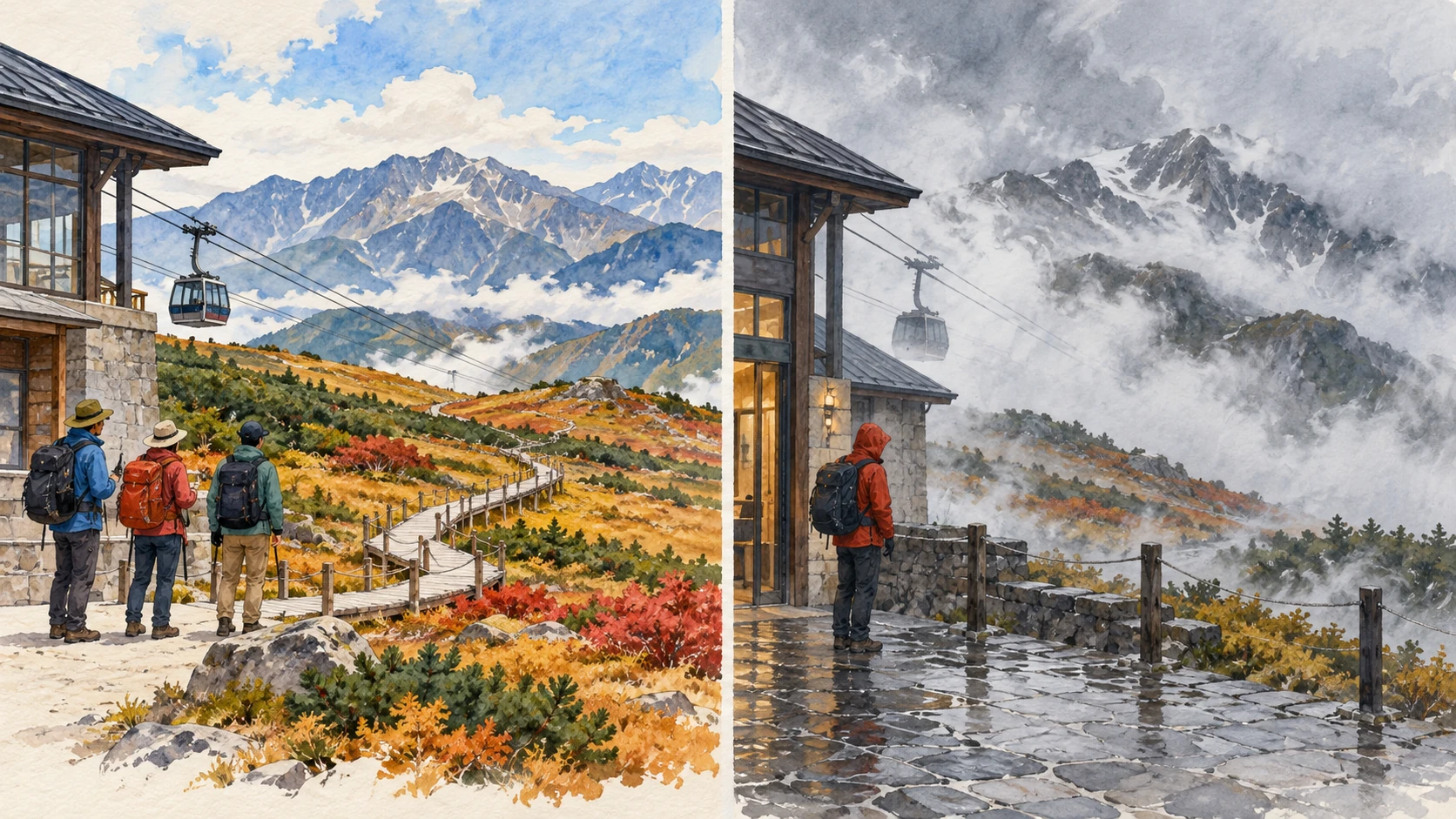
Furano skiing: the new fares distinguish early, main and spring seasons
Furano Ski Resort’s 2026/2027 lift-price page gives a planned 28 November–5 May season. Ordinary adult day tickets are ¥7,500 in early season 28 November–4 December, ¥9,000 in the main season 5 December–22 March, and ¥7,500 in spring 23 March–5 May. Membership and accommodation offers have separate qualifications; the lowest row is not the price available to every visitor.
Check the operating periods of the Furano and Kitanomine areas separately. Published season dates do not mean every lift in both areas runs from the first day to the last. Snow, weather and preparation also affect actual operation. First-time skiers should establish instructor language, meeting point, usable slopes and rental before choosing Kitanomine or the Shin Furano Prince area.
Elementary school children and younger ride lifts free but must collect a free card at the ticket office, not walk straight through the gate. Preschoolers also require a guardian. Rentals, lessons, meals and accommodation do not become free. Senior tickets for ages sixty and over require age evidence. Calculate companions separately: multiplying an adult ticket by the headcount can miss a family’s substantial instruction and equipment costs.
Four hours, night skiing and sightseeing buy different rights
A main-season ordinary adult four-hour ticket is ¥8,200, timed from the first gate passage. Against the ¥9,000 day ticket, the difference is ¥800. Four hours may suit morning practice, but do not squeeze paid instruction, lunch and rental returns too tightly to save ¥800. Two ordinary adult main-season day tickets cost ¥18,000 before equipment, instruction or accommodation.
Night-ski prices and closing times differ between weekdays, weekends and the year-end/New Year period. Whether daytime tickets cover the evening also depends on the product. A non-skier’s return sightseeing ticket is ¥3,700, different from a pass for repeated ski-lift use. A companion wanting mountain photographs is not necessarily equipped to enter a ski run in ordinary shoes, and need not first buy a full ski-day ticket.
The table compares only the ordinary adult products used here. Check membership, packages, seniors and children separately on the official page. For a room plan advertising lift tickets, check the use date, exchange point, any deposit and what happens to the ticket if accommodation is cancelled. Simply staying near the slopes does not automatically include lifts and equipment.
| Product | Charge | Main condition |
|---|---|---|
| Main-season day | ¥9,000 | 5 December 2026–22 March 2027 |
| Main-season four-hour | ¥8,200 | Four hours from first gate passage |
| Weekday night skiing | ¥3,100 | Scheduled 16:00–18:00, subject to operations |
| Weekend and designated year-end/New Year night skiing | ¥3,900 | Scheduled 16:00–19:30; check eligible dates |
| Non-skiing return sightseeing | ¥3,700 | Sightseeing travel, not a ski-day pass |
Ningle Terrace: visiting the cabins does not require a Prince stay
Shin Furano Prince’s official Ningle Terrace introduction lists approximately 15 woodland cabins and free entry. Summer hours are 11:00–19:45 and winter 12:00–20:45, with individual shop closures, temporary changes and weather limits possible. Allow an unhurried visit, rather than assuming every shop opens and every path always has identical lighting.
The hotel gives approximately two minutes’ walk from Shin Furano Prince, not two minutes from Furano Station. City-centre guests need buses to the hotel area and a return plan. If the last departure is gone after viewing the lights, transport must already be confirmed. Winter sunset is early: good photographic light need not mean the latest hour, nor should an empty-looking scene justify staying until returning becomes difficult.
An old PDF about maintenance closure in November 2025 remains online. It does not establish closure on the same dates in 2026. For a particular craftsperson or product, ask the shop or site before departure. Free entry does not promise stock, shipping or year-round opening. If companions feel the cold, agree on a visit length and meeting point, keeping somewhere genuinely warm available.
Dormy Inn Asahikawa: weigh its communal onsen against the station walk
Dormy Inn Asahikawa’s access page lists approximately 15 minutes on foot from the station, not a hotel immediately outside the exit. Parking is ¥1,000 per night, first come, first served, with partner parking a few minutes away if full. With large bags or ice, compare the extra walk against station-front accommodation; an Asahikawa name does not make every hotel equally convenient.
The hotel’s room table lists a 15-square-metre Double, Queen about 16.8, Twin 22 and a 31-square-metre Japanese-Western room accommodating four. Capacity for four does not mean four fixed beds. The natural-hot-spring description concerns the shared large bath, not a private natural onsen in every room. For shared rooms, separate beds or avoiding communal baths, confirm the actual room category.
The hotel’s children and luggage FAQ sets age and bed-number limits on bed-sharing. Children aged three through primary school are subject to rules including a charge of ¥3,000 per person; ages zero to two are not an unlimited free allowance. Storage before check-in or after checkout requires the hotel’s advance agreement. A separate provision allows bags until an already-booked return stay several days later; postponement or cancellation may lead to return shipping with charges payable by the recipient. It is not unrestricted free warehousing. Cancellation depends on the booked plan, not a universal percentage.
JR Inn Asahikawa: the 17, 24 and 27 m² rooms serve different needs
If your Asahikawa hotel shortlist is mainly about catching transport the next morning, compare JR Inn Asahikawa with the Dormy Inn described here. JR Inn's room specifications list the Economy Twin at 17 m² for one or two guests, with 110 cm-wide beds and a shower; the regular Twin is 24 m² for one or two, with 120 cm-wide beds and a bathtub. If you want separate beds and a bath in the room, compare the latter category rather than assuming all rooms called Twin have the same facilities.
Three travellers who each need a sleeping place can consider the Large Twin: 27 m² for one to three guests, with two 120 × 195 cm beds and a sofa bed for the third person. That is a separate question from adding a young child who shares an existing bed. The room page also says its photographs and floor plans are examples and layouts may vary. With large luggage, a need for fixed beds or someone who cannot comfortably use a sofa bed, confirm the actual arrangement on the booking and compare the total for two rooms, rather than only a single room's starting price.
The hotel's published walking route leaves Asahikawa Station through the west ticket gate, goes out of the north exit to the station-square entrance of AEON Mall, and then takes the hotel's dedicated lift to the fifth floor. That gives you a more useful luggage route than “beside the station” and does not mean the entire walk is indoors. The hotel FAQ also says it does not serve dinner; mall restaurants have their own hours. If arriving late, check which entrance and food options will still be available instead of treating the mall and hotel as one round-the-clock service.
| Room type | Area and occupancy | Main sleeping places | In-room bathing |
|---|---|---|---|
| Economy Twin | 17 m²; one or two guests | Two 110 × 195 cm beds | Shower |
| Twin | 24 m²; one or two guests | Two 120 × 195 cm beds | Bathtub |
| Large Twin | 27 m²; one to three guests | Two 120 × 195 cm beds; sofa bed for the third guest | Bathtub |
JR Inn's child, late-arrival and cancellation rules need more than the English summary
The Japanese JR Inn Asahikawa FAQ generally allows up to one preschool child to share an existing bed per adult; a child using a bed of their own, and children attending primary school or above, pay the adult rate. The English FAQ describes bed-sharing through age six, using age rather than the Japanese page's school-stage distinction. If a six-year-old has already started primary school, or your family has several young children, give the hotel their ages, school stages, bed requirements and total party size. Do not assume every six-year-old stays free because of the English wording. Booking platforms may also have their own rate-plan conditions.
Check-in is 15:00 and check-out 10:00. Guests should generally check in before 24:00 and contact the hotel in advance if arriving after midnight. The Japanese FAQ also requires notice if you will be two hours or more later than the arrival time entered on your reservation; without contact the booking may be cancelled. The accommodation terms separately allow the hotel to treat a booking as cancelled if no arrival time was declared and the guest has not arrived by 22:00. Tell the hotel your actual expected time rather than reading 24:00 as a guarantee that no contact is necessary. Luggage storage before check-in or after check-out is limited to the respective arrival or departure day, not a promise to keep bags free while you spend three nights in Biei. These conditions can determine whether to stay in Asahikawa on the first night or continue towards the mountains.
For standard cancellation charges, read the accommodation-terms table revised in April 2026. For ordinary reservations of nine rooms or fewer, it lists 20% three days before, 50% the previous day, 80% on the day and 100% for a no-show, calculated on the basic room charge. Nine refers to rooms, not people. Reservations of ten or more rooms have separate group rules, and individual agreements take precedence. Confirm intervals that are not individually listed against your booked rate plan instead of inventing a free-cancellation deadline. If booking through an agent or platform, cancel through the original purchase channel.
Furano Station or Kitanomine: start with La Vista's actual room occupancy
For a hotel near Furano Station, compare La Vista Furano Hills with Kitanomine and Shin Furano Prince as three different starting points. The hotel's access page gives a walk of about three minutes from Furano Station, useful for leaving luggage before exploring town and the surrounding area around that day's services. It is not accommodation at the ski-area entrance. If taking lessons every day, add back the morning journey, ski equipment and return transport costs before deciding whether convenient station-area dining offsets the extra travel.
The La Vista Furano room list gives Queen and Hollywood Twin rooms at approximately 18.0–18.6 m² for two guests each; Superior Twin rooms are approximately 24.1–25.8 m² for three, and Deluxe Twin rooms are 36.6 m² for three. A Force Room of the same 36.6 m² is listed for four, so a family of three or four needs to check the room category and sleeping arrangement, not just its floor area. If a child needs an extra bed, adults will not share, or an older traveller cannot use an additional bed type comfortably, confirm the layout before booking. A three-person room does not necessarily contain three fixed single beds.
The accommodation FAQ's bed-sharing and cancellation rules allow one child aged zero to two per bed to share free; from age three through primary school, sharing costs ¥3,000 per child per night, limited to one child per bed. A separate bed or bedding incurs the adult charge, as do junior-high-school pupils and older guests. The standard cancellation table for one to five people uses the basic accommodation charge: 50% the day before and 100% on the day or for a no-show. Property-specific or rate-plan conditions take precedence where stated. A bed-sharing fee does not mean breakfast is included, and a stated room occupancy does not allow any number of extra children. Give the hotel the complete party details to obtain a usable quote.
La Vista Furano breakfast and dinner: price them separately and allow time for each
For breakfast at La Vista Furano Hills, check both whether your rate includes it and the actual serving window. The hotel's dining page lists breakfast in the restaurant on 1F (ground floor) from 6:30 to 9:30, with last entry at 9:00. Tax-inclusive prices are ¥3,000 per adult, ¥1,600 per primary-school pupil and ¥1,200 per preschool child aged three or older; breakfast is for staying guests only. Two adults, a ten-year-old primary-school pupil and a four-year-old would pay ¥8,800 if buying this breakfast separately for everyone. Do not add it again to a rate that already includes it. Children under three are not listed in this price band, so do not infer their charge from the omission.
Dinner requires a reservation and is listed from 18:00 to 21:00, with last orders at 20:30. The tax-inclusive options are the Ginsai Course at ¥6,600, Bistro Course at ¥5,500 and Pasta Set at ¥2,750. These are separate dining choices, not a promise that every accommodation package includes a free choice among them or that seats are available on every date. If you want dinner at the hotel, check operation, reservations and suitable orders for accompanying children before deciding how late to return from Biei or Kitanomine.
Breakfast-buffet and seafood photographs can help you decide whether to eat at the hotel, but they do not guarantee the same dishes every day. An early departure may not suit a full breakfast. Equally, if you want to enjoy a breakfast you have paid for, leave enough time afterwards to check out, collect luggage and reach the actual bus stop. Use the method of comparing room, meal and transport costs separately to assess complete packages with and without meals, rather than treating the lowest room-rate cell as the family's total.
Naturwald in Kitanomine: look beyond the family-room name to transfers and dinner deadlines
If you want to spend the night in Kitanomine, Hotel Naturwald Furano is a named option to compare. Its room specifications list Family Twin rooms at 22 m² for one or two guests; the word Family does not automatically accommodate four people who need beds. The Standard category is listed at 18–22 m² for one to four, but the actual arrangement still needs to be specified. Japanese-style rooms of ten tatami mats are listed for two to four, as are the two 50 m² Owl Floor room types. If you need four sleeping places, ask how the chosen category is made up instead of assuming any room can take extra guests because of the highest listed occupancy.
The Kitanomine arrival directions treat the journey from Furano Station as a vehicle transfer, and the hotel FAQ explicitly says there is no shuttle service; it gives about ten minutes by car from the station as a guide. Before arranging a bus or taxi, check the seasonal timetable, actual stop, luggage and return journey. An airport route having once passed nearby does not prove a bus is available at every arrival time. The FAQ lists check-in at 15:00 and check-out at 10:00. Guests with dinner should call if arriving after 18:00, and those without dinner if arriving at or after 20:00. Final check-in at 22:00 does not mean dinner will be held until 22:00.
The same FAQ says children sharing beds do not pay an accommodation charge, while meals are extra, and lists breakfast for preschool children at ¥660 including tax. That answer does not give a complete set of bed-sharing age and occupancy limits. Confirm the children's details and your rate plan rather than extending it to unlimited young children or free stays for all primary-school pupils. The official pages also disagree on cancellation: the FAQ lists 20% seven to two days before, 50% the day before, and 100% on the day or for a no-show without contact; the room page lists 10% from five days before and 100% the day before or on the day. Both say individual plans may have different rules. Use the terms for your actual booking and confirmation from the hotel, rather than selecting the cheaper table or inferring a free-cancellation deadline. Cancel online reservations through the original website. Once you choose Kitanomine, settle that night's transport and meals before adding daytime sights, so family facilities do not obscure the hardest connection.
Highland Furano: quieter surroundings require more onward planning
Highland Furano’s room page distinguishes Twins for two to three, Japanese rooms for four and an accessible room for two people, with a sofa bed potentially used for a third guest in a Twin. Ordinary rooms do not have a private bathroom; guests use communal baths. That directly affects small children, people needing bathing assistance or those uncomfortable with shared facilities. “Onsen hotel” alone does not describe this important condition.
The hotel’s location information gives approximately 14 minutes’ drive from Furano Station and parking. It is not a property reached with a few steps from the station while pulling a suitcase. Arrange nearby meals and nighttime transport first; breakfast may be buffet or a Japanese set meal rather than a guest-selected choice. Quiet surroundings mean accepting fewer walkable restaurants and less convenient spontaneous outings.
The hotel’s current whole-property maintenance notice gives 1–20 November 2026 closure; it cannot be accommodation backup during those dates. Ordinary check-in is 15:00–23:00 and checkout 10:00. Also note that credit-card settlement is unavailable 20:30–7:30 the next morning. An early departure needs advance payment arrangements, not a discovery at reception that makes you miss a connection.
Shin Furano Prince: count the beds and choose the ski-area starting point
Shin Furano Prince’s room specifications list a Standard Twin around 28 square metres with two 110-by-195-centimetre beds and an extra-bed arrangement for a third guest. The approximately 33-square-metre Double has one 183-by-203-centimetre bed. Companions needing two beds should not select a Double just because it is larger. Three guests should check the actual extra bed and space remaining when bags are open.
The hotel’s access guide places it about six kilometres from Furano Station, with a bus reference of about 17 minutes: that is different from a station-front stay. For airport buses, return to Furano Bus’s current timetable rather than an old hotel summary. Write the full Shin Furano Prince name into the plan to avoid confusing it with similarly named facilities.
This side suits starting with the Furano area and facilities near the hotel, still subject to the season’s lifts, lesson meeting points and open runs. Anyone preferring Kitanomine’s food and streets should compare accommodation there separately; the two areas are not freely interchangeable immediately outside one hotel. Non-skiers need daytime activities, meals and room-access times too, rather than having everyone’s holiday tied to one lift pass.
Compare capacity, beds, baths and location as separate hotel fields
When choosing Asahikawa accommodation or Furano hotels, state the real requirements first: separate beds, a private bathroom, dinner on foot or ski transfers. Each property has strengths, but one hotel’s bath, another’s station distance and a third’s price do not create a real ideal hotel. Availability, rates and cancellation terms belong to a specific plan on your actual dates.
The table summarises representative conditions confirmed on official pages, not a fixed room-price ranking. Even the same room name can carry different meal, bed-sharing and cancellation arrangements. If unfamiliar with communal baths, read first-time onsen and ryokan booking decisions before asking about tattoos, children or family assistance. This guide promises no hotel exception on your behalf.
Consecutive nights reduce packing, but returning long distances to the same place every day may put the saved time back onto a vehicle. Choose two or three nights around the main activity, then one worthwhile base change. Prioritise transport the night before departure. Breakfast start, last dinner admission and post-checkout storage can affect the whole day more than a few extra square metres.
| Property | Confirmed representative room or facility | Key check |
|---|---|---|
| Dormy Inn Asahikawa | Twin 22 m²; shared natural onsen | About 15 minutes from station, bed-sharing and parking |
| Highland Furano | Twin for two to three; no private room bathroom | Final connection, food and whole-property closure 1–20 November 2026 |
| Shin Furano Prince | Twin 28 m²; Standard Double has one large bed | Ski area, third-person bed and buses |
| TOMAMU accommodation | Resort station transfers; Tower/Risonare room categories separate | Capacity, bed-sharing count, reserved return shuttle and plan limits |
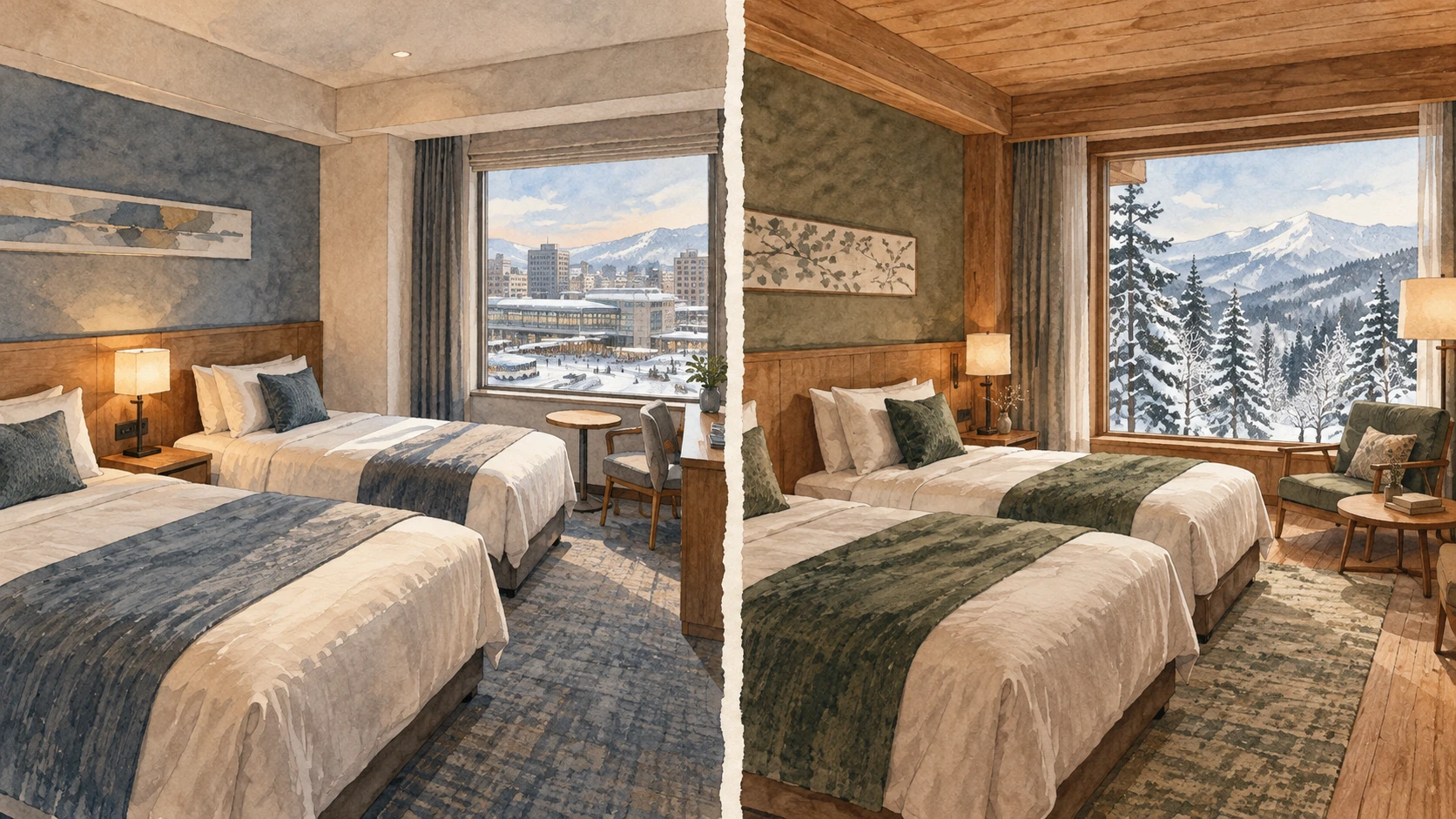
Reaching TOMAMU: settle the railway transfer, not a supposed next-door train
Hoshino Resorts TOMAMU’s winter access page explains limited-express travel from Sapporo and the usual change at Minami-Chitose when travelling from New Chitose Airport. TOKACHI and OZORA have been all-reserved seating since March 2024, and Tomamu Station has no ordinary ticket counter. Arrange tickets and seats beforehand. Free transfers meet arriving trains, taking about five minutes to The Tower and ten to Risonare, subject to that day’s service.
The return station shuttle requires a reservation at reception. Do not turn train-matched pickup on arrival into a walk-up promise in both directions. Day visitors should confirm which transfers and facility hours apply; a free bus does not make every activity free. With bags, a train change or a flight on departure day, settle the return shuttle and reserved seat before adding one final activity.
Rail service on the Nemuro Line’s Furano–Shintoku section ended in April 2024. For Furano or Asahikawa to TOMAMU, the official rail suggestion goes via Sapporo and takes about four to five hours, not a short direct ride implied by proximity on a map. Summer driving estimates are not winter guarantees either. To ski both resorts, treat changing base as a travel day rather than assuming a full ski day after checkout.
TOMAMU family stays: bed-sharing through age six and plan-specific cancellation
The resort accommodation FAQ gives check-in at 15:00 and checkout at 11:00. Some facilities can be used beforehand or on departure day; that does not allow early room entry or unlimited late checkout. Children aged six and under may share beds subject to conditions and room-capacity-related limits; six is included. Confirm charges under the actual room and plan. An unlimited number of children cannot be added to one room.
The official general cancellation explanation lists 10% at 21–4 days before arrival, 100% at 3–1 days and 100% on the day. Activities, special offers and third-party bookings may have different rules. Do not apply one plan’s terms to the whole resort, or infer a guaranteed final free-cancellation date from an unlisted interval. The booking’s deadlines, calculation and Japan time govern the decision.
For a family booking, separate lessons, Ice Village, meals and children’s naps, ensuring an adult accompanying non-skiers has somewhere to go. Ask the property beforehand for cots, special diets or accessible rooms. Capacity information here is not an accommodation promise for every category. In severe cold or a cancelled activity, consecutive nights with a room to return to are easier to adjust than intercity commuting.
Terrace of Frost Tree: published dates do not guarantee frost
TOMAMU’s Terrace of Frost Tree schedule is 1 December 2026–5 April 2027, with tickets ¥2,500 for ages twelve and over and ¥1,600 for ages seven to eleven. Applicable ski-lift passes have their own boarding conditions. This is a sightseeing and transport arrangement, not a guarantee of frost-covered trees, diamond dust or clear distant views. Previous winters’ appearance rates do not establish your probability on a specific day.
General operating times vary by date. For 1–25 December, for example, opening is 9:00, last ascent 15:00 and last descent 15:30, with some later periods extended. The official page separately offers limited early-morning activities and reserved high tea. Do not extract “7:45” and tell all sightseeing visitors they can ascend early throughout the season. Without that reserved service, check the day’s ordinary admission hours.
Non-skiers can treat the terrace as a separate outing. Prepare insulation, wind protection and footwear that resists slipping; an enclosed gondola does not eliminate outdoor clothing needs. Shorten the stop if the upper station is cold, windy or obscured. For high tea or another product, book against the actual party size, advance deadline and cancellation rules rather than describing it as included in an ordinary gondola ticket.
Ice Village: 20 December is a planned start, not every dome’s completion
TOMAMU’s Ice Village announcement for this season gives a planned 20 December 2026–10 March 2027 season, 17:00–22:00, last admission 21:30. Ages seven and over pay ¥600 including tax. Tower and Risonare guests have free-entry conditions, with some plans excluded. Actual ice domes depend on cold and construction progress; the first day is not a guarantee that every facility is complete.
Facilities such as the Ice Chapel have much shorter opening periods: this season’s chapel is 20 January–14 February 2027. Ice accommodation, tea and other experiences have separate bookings, prices and hours. Anyone searching for a Tomamu Ice Village hotel should distinguish ordinary resort accommodation from an additional ice-room experience. A standard hotel stay does not automatically mean sleeping inside an ice dome.
Eat first, arrange the return to your accommodation and keep children warm before choosing nighttime areas to visit. Moving on snow and ice is slower than level ground, and queues can make everyone colder. There is no need to begin at last admission. Non-guests especially must check whether trains and shuttles still connect; a 22:00 closing does not extend public transport for every visitor.
TOMAMU lift passes: compare online, counter and guest prices separately
TOMAMU’s 2026/2027 lift-ticket table lists ordinary adult day tickets online at ¥9,200 versus ¥9,500 at the counter; ages seven to eleven are ¥7,200 online or ¥7,500 at the counter. Furano’s ¥9,000 cannot be imported here. Early 1–20 December and spring 29 March–5 April products separately cost adult ¥5,000 and child ¥2,500. Only some lifts operate in early April.
The ordinary adult four-hour pass is ¥7,200 online or ¥7,500 at the counter, timed continuously from gate passage. Ages six and under are free but require a guardian and notification at the ticket desk. Tower and Risonare guests have separate prices and exchange conditions. Hokkaido resident products require proof of eligibility; their rate is not a minimum available to every international visitor.
The website’s online-purchase rules say no refunds, cancellations or changes after purchase, and recommend buying on the day of use. If weather, lessons or health remain unsettled, buying early for preparedness can leave an unusable nonrefundable ticket. Return sightseeing gondola rides and ski-day passes are different products. A companion buying only the Terrace of Frost Tree need not purchase an entire day’s skiing.
| Product | Representative charge | Comparison condition |
|---|---|---|
| Ordinary adult day ticket | Online¥9,200 / counter¥9,500 | Online adult tickets: ages 12 and over; regular counter adult tickets: ages 12–59, with separate senior tickets for ages 60 and over; excludes early/spring special-price comparison |
| Ordinary age-seven-to-eleven day ticket | Online¥7,200 / counter¥7,500 | Ages 6 and under follow free-entry and guardian rules |
| Ordinary adult four-hour | Online¥7,200 / counter¥7,500 | Four continuous hours from first gate passage |
| Adult full-day full rental package | ¥18,000 | Clothing included, not only skis and boots |
| Adult group lesson Period A, ages 13 and over | ¥8,800 / 120 minutes | 12 December 2026–28 February 2027; language varies by discipline |
TOMAMU rental and lessons: language, age and package contents first
TOMAMU’s current-season rental list gives an adult full-day ski package at ¥18,000, including skis, boots, poles, clothing and specified accessories. A skis-boots-poles three-piece set is ¥8,500 for a day. The ¥9,500 difference matters: the three-piece price is not the entire expense for someone with no equipment. Snowboarding has its own packages; check sizes, collection, return points and multi-day terms separately.
The official lesson table lists adult groups for ages thirteen and over, 120 minutes and four to six people. Period A, 12 December 2026–28 February 2027, is ¥8,800; Period B is ¥7,800. Adult group skiing offers English and Japanese, group snowboarding Japanese; ages-four-to-six groups also list Japanese. A general introduction mentioning three languages does not establish Chinese instruction for every age and discipline.
For one eligible adult taking an ordinary-price online day ticket, a full rental package and a Period A group lesson, ¥9,200 plus ¥18,000 plus ¥8,800 totals ¥36,000 before food and accommodation. Own clothing, guest offers or other lessons change that figure. Confirm availability, language and meeting point before buying components. A private lesson’s capacity of five does not mean its displayed price already covers five people.
TOMAMU snow activities: family opening dates do not all match
TOMAMU’s beginner and family activity page distinguishes first-snow arrangements planned 1 December 2026–5 April 2027, some snow-play products beginning 12 December, and activities from late December to late March. The resort’s winter opening does not open every children’s activity or run simultaneously. Snow cover, ages and reservations still affect the actual options.
For a child’s first ski trip, confirm lesson age acceptance, language, meeting point, rental sizes and how adults hand over supervision before choosing nights. Sledding or snow play needs a budget under its own rules. Compare Furano and TOMAMU using each resort’s passes and rentals, and check qualifications separately for any cross-resort product rather than assuming one rule applies to both.
Sapporo-based skiers have other nearby choices; this guide focuses on fitting TOMAMU into central-Hokkaido bases. For a short trip mainly in Sapporo, weigh whether moving accommodation is worthwhile. If staying in the resort, spread skiing, rest and the evening Ice Village across two or three days instead of packing an expensive day so tightly that lunch disappears.
A five-day summer example: two bases and time for the fields
Five days is an adjustable structure, not a package guaranteeing every connection. Day one goes from the airport to Asahikawa, with Kitasaito Garden and city meals after storage or check-in. Day two centres on the zoo, adding a suburban stop only if energy allows. Arrival delays and tired children can then be handled in town instead of a long-distance chase to fields immediately after landing.
Change to Furano or Biei on day three, leave bags and choose one main garden. On day four, use actual flowering to select Farm Tomita or Shikisai no Oka rather than reducing both to brief alighting stops for two photographs. On day five, plan your airport return around the flight and bus schedules. For an early flight, move somewhere with easier access the night before; slower travellers can replace a second garden with rest in town.
This summer structure deliberately leaves out TOMAMU, Asahidake and Kurodake. Adding a mountain needs another suitable day or removal of an existing theme, plus a weather alternative. If the season’s tourist train has finished, check ordinary trains and buses rather than leaving a blank timetable to solve on arrival. A worthwhile trip is not measured by the number of different place names on its list.
A four-day autumn example: one mountain and a movable backup day
For four days based in Asahikawa, keep day one in town. Choose either Asahidake or Sounkyo/Kurodake on day two or three according to weather, with the other day for the zoo or city. Avoid committing the mountain day far ahead to numerous nonrefundable extras. If maintenance closes the mountain, remove it instead of pretending a ropeway can operate because a hotel is already booked.
For a mountain-base stay, connect arrival, dinner and the next day’s descent clearly. Accommodation does not increase bus frequency. Autumn leaves and snow higher up can coexist; October clothing cannot rely on lowland temperatures alone. In late October 2026 Ueno Farm is already closed, while early November brings the zoo’s seasonal closure. Choose backups after checking dates to avoid finding both options shut.
If Blue Pond illumination is the real purpose, consider Biei or Shirogane accommodation with dinner and nighttime transport agreed beforehand. Another mountain ropeway need not be squeezed into the same day. Day and night offer different views, but the outing is complete only when you can return safely. Even with a rental car, assess darkness, mountain roads and parking rather than relying solely on navigation’s shortest time.
A six-day winter example: stay at one ski base instead of splitting short sessions
In six days, give arrival and departure their own portions and stay three or four nights at one ski base between them. For Furano, prioritise actual lessons and transport in Furano or Kitanomine, with Ningle Terrace on a rest day. For TOMAMU, spread skiing, the frost terrace and Ice Village so someone returning early to the room one evening does not miss every other activity.
For city dining and evening options, stay in Asahikawa and separately plan return transport to Kamui Ski Links; the 2026–27 bus timetable still needs to be checked. To ski the same resort on consecutive days, choose Furano’s Kitanomine area or accommodation near Shin Furano Prince Hotel, matching your stay to the lesson meeting point. For skiing, snow play and Ice Village within one village, stay several nights at TOMAMU. Assess Asahidake separately in light of mountain-skiing equipment needs and the risks of getting lost and avalanches; sharing the powder-belt name is no reason to treat it as a resort for beginner practice. If you want to include Furano and TOMAMU in the same trip, first compare the time and cost of staying at one base with changing accommodation partway through. Check routes, connections and journey times for your travel dates, and allow extra time to move luggage and return rental equipment. If only one person drives and skis until exhausted each day, a long snowy road at night is not an appropriate automatic finish to the day.
Non-skiing family members still need their own budget, activities and rest. Even if a booked plan provides free bed-sharing, or a child has free lift access, the whole trip is not free. Winter often needs more dry clothing, shoe changes and indoor time; bed arrangements, laundry and meal convenience directly affect the stay. Book a flexible framework, filling details once new-season services and openings are confirmed.
Separate transport, admission and accommodation to see the real budget
Compare tickets and itineraries by listing each person’s essential transport first, then admission you will actually use, and accommodation, food, rentals and lessons separately. Paid sightseeing and ski-day tickets serve different purposes; an unsuitable product is not a saving however cheap it is. Calculate each family age category individually, without applying one attraction’s half-fare rule across Hokkaido.
The table contains recalculable examples from this guide, not ticket bundles or complete day-tour prices. Return zoo buses for two adults and one child cost ¥3,360; two adult admissions add ¥2,000, totalling ¥5,360 before food. This assumes the child qualifies for both free zoo admission and a fare-paying bus-child category. Recalculate other ages, shared discount products or starting points.
For wider choices, read the breakdown of independent-travel costs in Japan, then add Hokkaido’s long connections and winter equipment. Leave unpublished next-year prices pending rather than using old fares to fabricate a precise-looking total. Before every ticket purchase, identify the exact journey, day and companion for which it can actually be used.
| Situation | Calculation | Subtotal |
|---|---|---|
| Station–zoo return for two adults and one paying child | (670×2+340)×2 | ¥3,360 |
| Above plus two adult admissions; child eligible for free entry | 3,360+1,000×2 | ¥5,360 |
| Two ordinary adult Furano main-season day tickets | 9,000×2 | ¥18,000 |
| Frost terrace for one adult and one child aged seven to eleven | 2,500+1,600 | ¥4,100 |
| Two Asahidake adult return tickets June–October | 3,500×2 | ¥7,000 |
A few useful answers
Should a first Asahikawa, Furano and Biei trip use one hotel?
Choose bases around the main activities. Asahikawa suits the zoo and city connections; Furano suits fields or skiing; Biei needs rural transport checked first. On a short trip choose two bases rather than changing hotels daily. TOMAMU needs its own travel and overnight time.
Which November 2026 dates is Asahiyama Zoo closed?
The official calendar lists 4–10 November closure. Winter opening starts 11 November, 10:30–15:30 with last entry 15:00. 30 December–1 January is another closure. Check zoo announcements for special or temporary changes.
Is the bus from Asahikawa Station to the zoo still ¥500?
The current operator page explicitly lists one-way adult ¥670 and child ¥340 after 1 September 2026. Old PDF fares of ¥500 and ¥250 are not current; the summer departures described here do not guarantee the winter timetable.
Is the 2026/2027 penguin-walk schedule confirmed?
This guide does not treat an older winter’s announcement as confirmation of the new season. Winter opening is not the start of the walk. Use the relevant year’s zoo news and the day’s conditions for dates, times and whether it takes place.
Can I reach Farm Tomita and Shikisai no Oka without driving?
Start with rail and seasonal buses, but the final legs differ. Farm Tomita is about 25 minutes on foot from permanent Nakafurano Station; temporary Lavender-Farm Station applies only on specified operating dates. Shikisai no Oka is about 25 minutes on foot from Bibaushi Station. Establish the return first.
Can I take the 2026 Furano–Biei Norokko in October?
The current rolling stock’s last operating date that year was 23 September 2026, so it cannot be scheduled in October. An old leaflet does not establish 2027 services. Check ordinary Furano Line trains and buses you can actually take.
What are Blue Pond parking charges and 2026/2027 illumination dates?
The official facility page lists ¥1,000 for an ordinary car. This season’s illumination is 22 October 2026–21 April 2027, with different monthly starting times and all sessions ending 21:00. Confirm nighttime entrances, parking and return transport separately.
Can Asahidake and Sounkyo/Kurodake be one half-day stop?
They have different mountain bases, not a direct transfer between ropeway platforms. Choose one first and keep a weather backup. Asahidake has maintenance 16 November–10 December and Kurodake 9–30 November 2026.
Does an onsen hotel mean a private hot spring in every room?
No. Dormy Inn Asahikawa’s natural onsen is a shared large bath, and Highland Furano ordinary rooms have no private bathroom. Room capacity is not a fixed-bed count. Confirm the actual category, bed-sharing and meals.
How much is Furano’s 2026/2027 main-season adult day ticket?
The ordinary adult main-season day ticket is ¥9,000 for 5 December 2026–22 March 2027. Early and spring seasons have different fares. Rentals, lessons and accommodation are separate, and primary school children and younger still need a card for free lifts.
Is there a short direct train from Furano to TOMAMU?
No. Railway service on the Furano–Shintoku section ended in April 2024. For Furano and Asahikawa arrivals, the resort’s official page shows rail travel via Sapporo. Reserve a travel day for changing bases instead of estimating from straight-line distance.
Do Ice Village and Terrace of Frost Tree open together?
No. Terrace of Frost Tree is planned 1 December 2026–5 April 2027; Ice Village 20 December 2026–10 March 2027. Actual ice domes depend on formation and weather. Check each activity’s tickets, reservations and return journey separately.
Check with the source
Schedules, availability and rules can change. These official sources are the place to confirm details before you book.
- Asahikawa Airport: bus connections and applicable periods
- Asahikawa Denkikidou: airport and Asahidake bus connections
- Furano Bus: Lavender Bus and local routes
- Furano Bus: currently linked October 2025 Asahikawa fare matrix
- Furano Tourism Association: 2026 Furano–Biei seasonal trains
- JR Hokkaido 2026 train leaflet linked by the tourism association
- Asahiyama Zoo: opening dates, hours and admission
- Asahiyama Zoo: November 2026 calendar
- Asahikawa Denkikidou: zoo routes and direct airport services
- Asahikawa City: access to Asahiyama Zoo
- Asahiyama Zoo: current-year news and penguin walks
- Asahiyama Zoo: visitor rules and official promotional film
- Asahikawa Park Association: Kitasaito Garden
- Kitasaito Garden: visitor centre and use rules
- Asahikawa Ramen Village: shops and opening information
- Otokoyama: brewery museum and new park explanation
- Otokoyama: current SAKE PARK visitor guide
- Ueno Farm: 2026 visitor guide
- Furano Tourism Association: flowers and travel questions
- Farm Tomita: daily hours and flower updates
- Farm Tomita: field layout and flower varieties
- Farm Tomita: walking, rail, bus and airport access
- Shikisai no Oka: hours, admission and internal vehicles
- Shikisai no Oka: 2026 peak-season fee revision
- Shikisai no Oka: access and the walk from Bibaushi
- Biei Tourism Association: Blue Pond and official introduction film
- Biei Tourism Association: 2026/2027 Blue Pond illumination
- Biei Tourism Association: Shirahige Falls access and parking
- Asahidake Ropeway: operations, prices and annual calendar
- Higashikawa Tourism Association: Asahidake terrain and seasons
- Sounkyo Kurodake Ropeway: operations, prices and maintenance
- Dohoku Bus official sales: Asahikawa–Sounkyo
- Furano Ski Resort: 2026/2027 lift tickets
- Shin Furano Prince: Ningle Terrace
- Dormy Inn Asahikawa: room categories, areas and capacities
- Dormy Inn Asahikawa: location and parking
- Dormy Inn Asahikawa: shared natural-hot-spring baths
- Dormy Inn Asahikawa: children, luggage and cancellation FAQ
- Highland Furano: rooms and communal baths
- Highland Furano: location and access
- Highland Furano: November 2026 whole-property maintenance
- Shin Furano Prince: beds and room capacities
- Shin Furano Prince: station and airport access
- Hoshino Resorts TOMAMU: winter access, station shuttles and railway conditions
- Hoshino Resorts TOMAMU: stays, children and cancellation
- Hoshino Resorts TOMAMU: 2026/2027 Terrace of Frost Tree
- Hoshino Resorts TOMAMU: 2026/2027 Ice Village
- Hoshino Resorts TOMAMU: beginner and family winter-activity dates
- Asahikawa Denkikidou: October 2026 winter notice whose body still uses old-year dates
- Hoshino Resorts TOMAMU: 2026/2027 lift tickets and purchase restrictions
- Hoshino Resorts TOMAMU: 2026/2027 full and three-piece rental packages
- Hoshino Resorts TOMAMU: 2026/2027 lesson languages, ages and charges
- Furano Bus: child ages, school-status exceptions and half-fare rounding
- Asahikawa Ramen Village: permanent shops and individual menu links
- Isshin at Asahikawa Ramen Village: July 2026 tax-inclusive menu
- Ittetsu-an at Asahikawa Ramen Village: old October 2019 menu
- JR Inn Asahikawa: room areas, beds and occupancies
- JR Inn Asahikawa: walking route from the station
- JR Inn Asahikawa: Japanese FAQ on children, luggage and check-in
- JR Inn Asahikawa: English FAQ on child ages and check-in
- JR Inn Asahikawa: accommodation terms revised in April 2026
- La Vista Furano Hills: access from Furano Station
- La Vista Furano Hills: room areas and occupancies
- Dormy Inn accommodation FAQ: bed-sharing, children and cancellation
- La Vista Furano Hills: breakfast and dinner prices and reservations
- Naturwald Furano: room specifications and its published cancellation table
- Naturwald Furano: access to Kitanomine
- Naturwald Furano: transfers, children's meals and its published cancellation table
- Dohoku Bus: Shirogane and Biei–Shirogane timetable revision from 1 October 2026
- Biei Tourism Association: October 2026 bus timetable revision notice
- Biei Town: Blue Pond and Shirahige Falls illumination, 2026–2027
- Biei Tourism Association: bus guide and Biei View Bus organiser
- Biei Hire: reservation inquiries
- Biei Hire: contact and operating information
- Asahidake Visitor Centre: Sugatami Pond loop map, walking times and mountain-trail junctions
- Asahidake Visitor Centre: snow and trail conditions around Sugatami Station on 2 October 2026, published 3 October
- JR Hokkaido | Asahikawa and Minami-Nagayama station information and directional timetables
- Hokkaido Tourism Organization | Asahikawa Ramen Village location and walk from Minami-Nagayama
- JR Hokkaido timetable search | Sekihoku Main Line outbound, 22 October 2026
- JR Hokkaido timetable search | Sekihoku Main Line inbound, 22 October 2026
- Hokkaido Powder Belt Promotion Council: geography, inland snow quality and choosing a resort for daily conditions
- Kamui Ski Links: travel to and from Asahikawa (bus page still lists 2025–26; recheck the new season)
- Higashikawa Town and Higashikawa Tourism Association: Asahidake winter safety map, getting lost while skiing and avalanche precautions
- Hokkaido Tourism Organization: winter Asahikawa and Biei model course