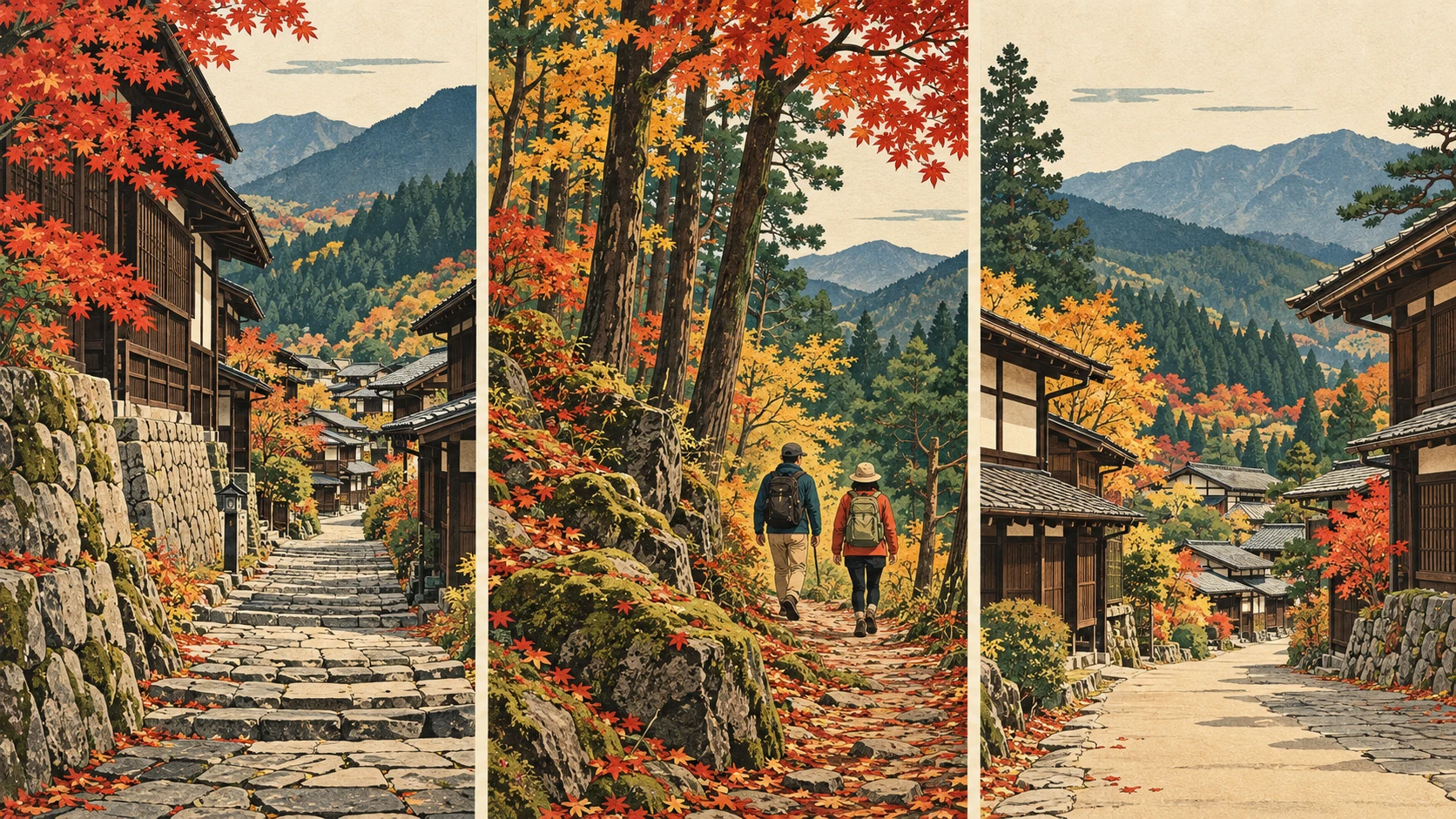
Choose village streets, the nine-kilometer trail, and an overnight stay separately, then use current buses, luggage deadlines, and your fitness to build a trip you can finish.
Tsumago and Magome: choose between village streets and the nine-kilometer walk
Tsumago and Magome fit naturally into one trip, but not everyone needs to walk the entire old road between them. If you enjoy wooden streetscapes, tea stops, and museums, use buses to connect the two post towns. If the forest trail is your priority, reserve most of the daylight for the roughly nine-kilometer link. When companions have different expectations, agree on a meeting place before setting out rather than deciding to split up halfway through the hills. This guide focuses on walking from Magome to Tsumago, with alternatives that skip the mountain trail or include an overnight stay.
The return service, daylight, and luggage determine what works, not just the number of attractions on a map. Find an acceptable return first, then fit in the three-hour walking reference, photographs, lunch, bathroom stops, and time in both towns. If everything will not fit, remove an activity or add a night. On a first independent trip to Japan, use the approach of separating travel days from full sightseeing days to organize your wider itinerary before deciding how much walking belongs in this day in Kiso.
Information was checked on October 22, 2026. Current bus fares, the 2026 luggage-transfer season, and the particular autumn-foliage observation have separate limits; none is rewritten as an annual promise. Accommodation descriptions likewise reflect the operating status and facilities that could be confirmed. Cost examples include only the listed items. Add JR tickets, meals, and accommodation for your dates so that a Magome–Tsumago day trip becomes a workable plan rather than a string of place names.
Nakatsugawa and Nagiso are different gateways across a prefectural boundary
Magome is on the Nakatsugawa, Gifu side; Tsumago is in Nagiso, Nagano. When combining trains and buses, remember two practical gateways: Nakatsugawa Station for Magome and Nagiso Station for Tsumago. They are not two exits from the same station. Sharing the Kiso travel region does not make accommodation taxes, municipal buses, or tourist information-center rules identical. A one-way walk can enter at one end and leave at the other, avoiding some backtracking.
From Nagoya, check trains for your travel date before matching local buses. Distinguish local, rapid, and limited-express services and their stopping patterns; a search result vaguely saying Kiso is not enough to choose a train. This guide does not assign one fixed JR service for every date. Combine it with planning a Nagoya stay and trips into the surrounding area, putting your city hotel, departure time, and transfer margin on the same schedule.
If you sleep in Tsumago, you can arrive at Nagiso, go to your accommodation first, and walk the following day. If you are already staying in Magome, an early departure with a light pack also makes sense. Choose your base by asking whether you prefer quiet post-town streets at dusk or a city return with more restaurants and trains. Village accommodation offers a slower morning and evening, but dinner and arrival times usually need earlier confirmation. It does not simply operate as an extension of a city hotel.
Magome to Tsumago is often easier to arrange, but it still crosses Magome Pass
Walking from Magome to Tsumago puts the shorter, steeper climb near the beginning, followed by the descent toward Tsumago. That does not make the whole route downhill. Tsumago tourism association's walking guidance distinguishes the slopes to the pass: the Magome side is shorter and steeper, while the Tsumago side is longer and gentler. For knees that dislike prolonged descents, the reverse direction is not necessarily worse. Decide using fitness, connections, and your final overnight base.
Magome Pass is roughly 790 meters above sea level. The route described by Magome's tourism association includes forest, stone paving, stream valleys, and settlements; it is not one flat shopping street. Ichikokutochi Teahouse and Otaki and Metaki waterfalls help explain the landscapes along the way, but every name need not become a mandatory photo stop. More photographs and rests mean more total time, and wet stone after rain is especially unsuitable for rushing.
Once you choose a direction, save the starting information center, accommodation address, finishing bus stop, and alternative return on an offline map. Someone interested only in the streets can take a bus and meet you at the finish, provided each person has usable fare money or tickets and a way to communicate. Do not bring an unwilling walker onto a stretch without a convenient exit merely to start together. Changing plans at the village entrance is usually easier than finding a vehicle halfway through the trail.
Nine kilometers and three hours are a reference: finish the hills before dark
Magome's tourism association summarizes the walk between the towns as about nine kilometers and three hours, while Tajimaya's introduction says approximately eight kilometers. The measurement boundaries are not fully compared, so this guide does not assume a cause for the difference. For transport planning, use the more generous nine-kilometer, three-hour reference, then add rest, street visits, and waiting time. If your usual exercise is an hour of city walking, assess whether you can keep going on a mountain path instead of treating three hours as a promise.
The official walking page warns that the route has no streetlights and recommends starting no later than 15:00 in summer and 14:00 in winter. This is advice against leaving too late, not a guarantee that starting at 14:00 in any season gets you onto your chosen bus. In autumn, finish early enough for the day's light, weather, and your pace. If the morning runs late, visit the towns or choose a short section rather than squeezing all nine kilometers into the afternoon.
The video below, published by Nakatsugawa City and adopted by Magome's tourism website, offers an introduction to the Nakasendo. It does not replace current trail information. Before leaving, ask the information center about access notices, follow signs, and change course for closures or staff instructions. Bring drinking water and rain protection that is easy to put on and remove, and preserve a full daylight window. This route is better enjoyed with that margin than with constant checks of the remaining minutes.
Nakatsugawa to Magome: check weekday versus holiday schedules and the 800-yen fare
Kitaena Kotsu's Magome Line is the direct local bus from Nakatsugawa Station to Magome. The operator's timetable directory separates weekdays from Saturdays, Sundays, and public holidays. The consulted weekday Magome Line PDF gives a planning example of Nakatsugawa 9:55–Magome 10:20, with other services at 10:45–11:10 and 11:15–11:40. These belong to a specified weekday version. Do not insert them into a weekend itinerary or assume the bus will wait for your delayed train.
The current Magome Line fare matrix lists 800 yen for an adult at the intersection of Nakatsugawa Station and Magome, with a revision date of March 8, 2025. If an older guide quotes another amount, return to the table currently linked by the operator and check your actual boarding and alighting stops. Nagiso's 300-yen municipal-zone fare does not apply here: these are different routes and pricing systems.
To catch the 9:55 bus, allow time after the train to find the stop, use the restroom, and queue. If the service is busy, arriving late does not automatically secure a seat because you already hold an onward rail ticket. With large bags, check how they can be placed on board. Whether you can complete the Magome luggage handover before its 11:30 deadline determines whether a light-pack walk works that day.
Nagiso to Tsumago or Magome: the summer extra column is not an October service
Arriving at Nagiso Station, you can go first to Tsumago or take the Magome Line to the walking start. The Magome Line timetable dated April 1, 2026 gives Nagiso 10:10, Tsumago 10:17, and Magome 10:45; other Nagiso departure columns include 12:40, 14:15, and 16:35. The later you arrive for a full walk, the more activities you must remove. An afternoon bus into the hills does not by itself make the entire walk sensible that afternoon.
There is also a starred column departing Nagiso at 8:40 and arriving at Magome at 9:15. Its note limits operation to April 25–May 6 and July 25–August 23. It is not an early bus available every day in October 2026. Read column notes before copying times, then check the origin and direction. Mixing outbound, return, and seasonal extras because they share a route name can leave you waiting for a bus that never runs that day.
Tsumago tourism's access page links to a bus demonstration published by the 世界共生学部 faculty of Nagoya University of Foreign Studies. Its actual publisher is identified below; it is useful for becoming familiar with boarding and alighting. Whether to take a numbered slip, how to pay, and how to show a mobile ticket depend on the particular service and operator instructions. One demonstration is not a universal rule for every route. Use the current municipal bus page and timetable for fares and operating periods.
Municipal fares from 2026: 300 yen within a zone, 1,000 across to Magome
Nagiso's current municipal bus notice sets fares revised from April 1, 2026: specified municipal sections of the Tsumago and Hogami lines cost 300 yen for adults, 100 for the elementary-school category in Japan's school system, and nothing for preschool children. On the Magome Line, those amounts also apply when remaining entirely within the Nagiso–一石 municipal section or entirely within the outer Magome Pass–Magome section. Your boarding and alighting points matter, not just the bus's appearance or route name.
Crossing the inner and outer zones, such as Nagiso or Tsumago to Magome, costs 1,000 yen per adult and 500 per elementary-school pupil; preschool children remain free. Families should not assume all child fares are half an adult fare: the within-zone 100 is not half of 300. Only the cross-zone pair is 500 and 1,000. The table summarizes this municipal notice. Kitaena Kotsu's 800-yen Nakatsugawa–Magome fare is separate and is not calculated from the municipal child-fare scale.
For example, riding Nagiso–Magome, walking to Tsumago, and riding back to Nagiso costs an adult 1,000 plus 300, or 1,300 yen in buses. Two adults total 2,600, excluding JR, luggage, and food. Entering via Nakatsugawa for Magome and leaving Tsumago via Nagiso instead costs 800 plus 300, or 1,100 per adult in local buses. Because the rail endpoints differ, compare the whole day's transport. A 200-yen local difference alone does not prove the entire journey is cheaper.
| Section and operator | Adult | Elementary-school category (Japanese school system) | Limits |
|---|---|---|---|
| Municipal bus: specified sections such as Nagiso–Tsumago | 300 | 100 | Preschool children free |
| Municipal Magome Line: inner zone only or outer zone only | 300 | 100 | Boarding and alighting determine whether zones are crossed |
| Municipal Magome Line: inner zone across to Magome Pass/Magome | 1,000 | 500 | Preschool children free |
| Kitaena Kotsu: Nakatsugawa Station–Magome | 800 | Check operator conditions | Municipal child-fare rules do not apply |
A weekday one-way example: Magome at 10:20, leaving Tsumago at 15:26
If the weekday timetable above applies and weather and trail conditions allow, take Nakatsugawa 9:55–Magome 10:20. Use roughly the first half-hour for luggage, the restroom, and a short look at the starting streets, then begin the main walk around 10:50. The three-hour reference plus a self-allocated 40 minutes of rest gives a Tsumago arrival around 14:30. The 10:50 start, 40 minutes, and 14:30 arrival are scheduling assumptions, not an officially guaranteed walking tour or everyone's pace.
The 2026 municipal table shows the Magome 15:00 bus at Tsumago 15:26 and Nagiso 15:35. From 14:30 to 15:26 is only 56 minutes, best used for collecting bags, checking the stop, and a little street time. It does not comfortably fit a full seated lunch, an unhurried museum visit, and every shop. Prepare food before departure, reach the start earlier, or stay overnight rather than compressing every stop into ten minutes.
The same table has later returns, but do not automatically make the last bus your main plan. Set a reminder for an earlier one and shorten activities if your pace drops or the weather worsens. After reaching Nagiso at 15:35, allow separate waiting and delay margins for the train, and make sure bags have already been collected within the information center's hours. To reduce first-time connection anxiety, use the guide to Japanese rail-ticket and transfer decisions to clarify each stage's responsibilities and limits.
Autumn direct buses from Nagoya: useful for the towns, not a local shuttle
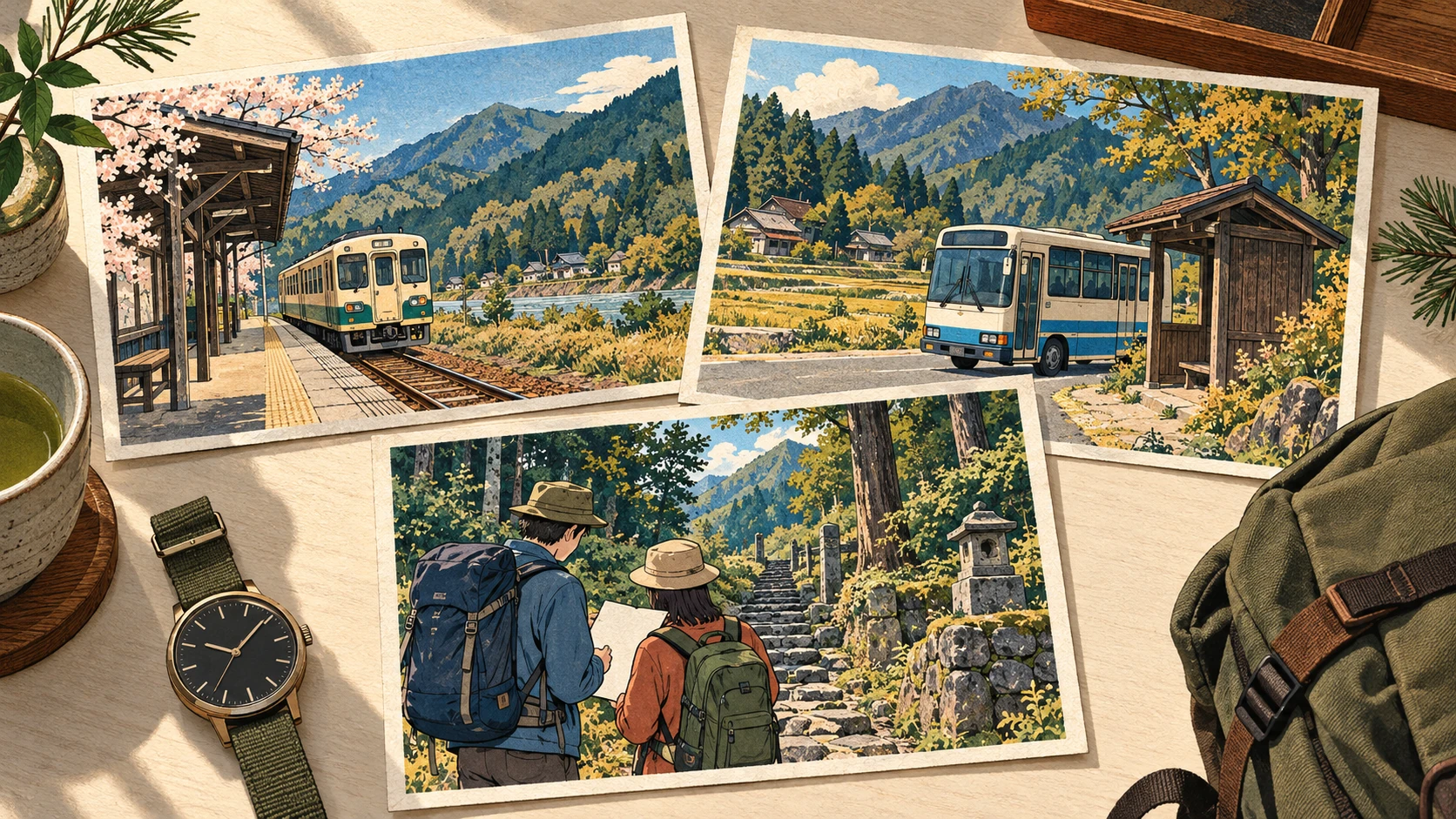
A reservation-only direct option operates in autumn 2026. Tsumago's seasonal operation notice lists daily service from October 17 to November 29, with a 3,000-yen adult one-way fare from Nagoya to Magome or Tsumago, jointly operated by Meitetsu Bus and Tono Tetsudo. It cannot be used solely for the short Magome–Tsumago section. It therefore does not replace any local bus you need between the towns after your walk.
Meitetsu's timetable and booking terms show Meitetsu Bus Center 9:20, Magome arrival 11:10, continuation after the stop at 13:05, and Tsumago arrival 13:30. The return leaves Tsumago at 15:20 and Magome at 15:45. This suits street sightseeing. For the complete nine-kilometer walk, the four hours ten minutes from 11:10 to 15:20 are not all usable trail time: luggage, lunch, reaching the finish, and waiting for the bus also belong in that window, leaving limited margin.
When checked, the same official page displayed the Nagoya return arrival as both 17:20 and 17:30. This guide does not choose one on the operator's behalf. Confirm your service when booking, allow for congestion, and avoid tightly timed nonrefundable onward transport. For an online reservation, complete the ticket purchase within three days, including the booking day; otherwise the reservation expires. Two adult one-way fares total 6,000 yen; this is not presented as a round-trip discount. Do not carry this season's dates straight over to 2027 or another season.
The 2,700-yen two-day pass: price your actual rides before buying
Kitaena Kotsu's introduction to the Magome–Tsumago pass covers specified local buses and links to RYDE and Jorudan sales channels. Jorudan's eligible-route list and ticket conditions include Kitaena's Magome and Sakashita lines, Nagiso's Magome and Tsumago lines, and the Nagiso–Tsumago section of the Hogami Line. JR is not included, nor is this a pass for the autumn direct bus from Nagoya. Value must be calculated from the eligible sections you will actually ride.
The current adult price is 2,700 yen, valid on the first day of use and the following day, not any continuous 48-hour period. If you only ride Nakatsugawa–Magome, walk to Tsumago, and ride out to Nagiso, the verified adult local-bus total is 1,100. Buying a 2,700-yen pass is not cheaper merely because it says two days. Conversely, actually making return trips within validity on Nakatsugawa–Magome at 800 each way and Magome–Tsumago at 1,000 each way totals 3,600 separately, a nominal 900-yen difference. First confirm the services and whether that travel pattern is worth doing.
Jorudan says there is no child version, so an adult pass must be purchased; compare separately with ordinary child fares. That channel permits refunds within validity only while the ticket remains unactivated and unused, with a 100-yen fee per ticket; used tickets are not refunded. If a dead phone prevents display, ordinary fare must be paid. Group purchases require boarding and alighting with the ticket holder, rather than separating after buying on one phone. RYDE's current sales listing runs to March 31, 2027. Check the current conditions of the platform you choose when buying.
Luggage transfer: hand over in the morning and collect in the afternoon
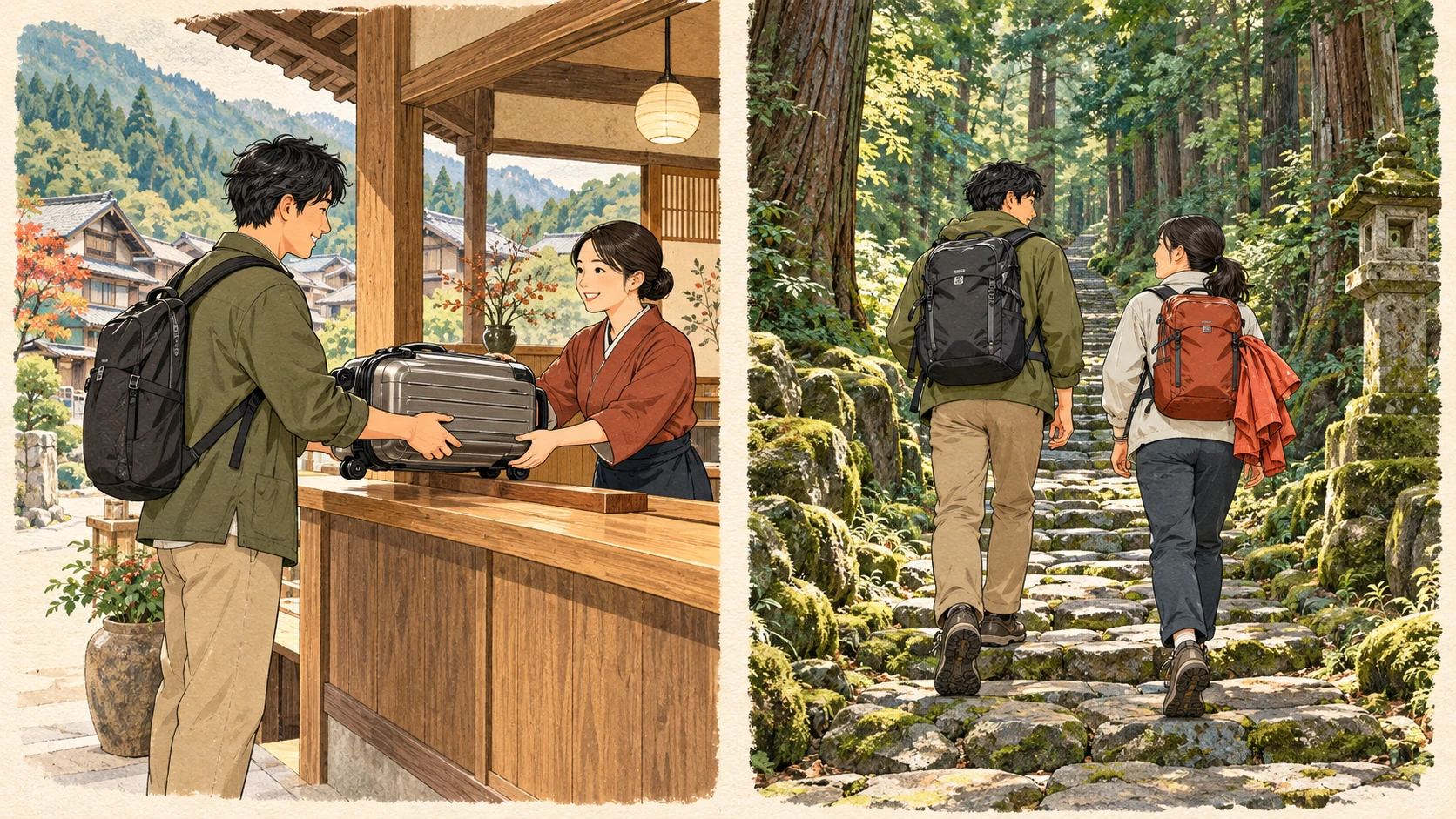
The 2026 luggage handover and collection rules list March 20–November 30 operation, drop-off 8:30–11:30, collection 13:00–17:00, and 1,000 yen per piece. Listed points include Magome Tourist Information Center, Magome-juku BASE, Tsumago Tourist Information Center, and inns in Otsumago. This does not make every hotel, station, or arbitrary roadside location a receiving point. At handover, confirm the exact destination counter and keep identifying transfer information.
Two people with one bag each normally pay 2,000 yen for the service, separately from their bus fares. Keep your phone, documents, necessary medicine, tickets or money, water, rain protection, and the day's warm layers in your daypack. Do not send away things needed on the trail. Transfer availability does not mean you may collect leisurely after 17:00. If a museum or meal is planned first, make bag collection the priority on arrival, then enjoy the remaining street time.
The notice also lists an exceptional transfer outside normal acceptance hours: within 8:30–17:00, one trip costs 4,500 yen for up to three pieces, with 1,000 per additional piece from the fourth. Four pieces therefore cost 5,500. This differs from the ordinary 1,000-per-piece rate. Contact the service in advance; it is not a guaranteed immediate rescue after missing the morning deadline. For 2027 or travel from December onward, wait for or ask about new arrangements instead of automatically reusing the 2026 notice.
Two days with one night: give the streets, museum, and forest their own time
If quieter post-town streets at dusk matter most, split the walk and detailed town exploration across two days. Walk Magome–Tsumago on the first day, collect bags in the afternoon, check in, and eat on the accommodation's schedule. Visit the museum, tea shops, and missed corners the following day, then leave through Nagiso. The advantage is not squeezing in another sight: it is freeing your mountain pace from restaurant last orders and museum last admission.
For a Magome overnight, spend the first day exploring Magome properly, eat at the agreed accommodation time, and set out toward Tsumago next morning. An earlier start preserves finishing-town activities, but ordinary luggage acceptance begins at 8:30. Do not assume your hotel will arrange it the previous evening because you want to hike at dawn. Ask whether a handover from your accommodation is possible, or bring only what you can carry. A two-day visit still needs a practical luggage plan.
The table separates a day of streets, a day of complete walking, and two days with one night. These are editorial scheduling suggestions, not official package tours or products with transport included. Put check-in limits, dinner, checkout, luggage, and the city return side by side when booking. If one does not connect, change the order first. Do not pay all nonrefundable costs only to discover that the remaining old road must be walked in darkness after dinner.
| Style | Daytime focus | Luggage and base | Check first |
|---|---|---|---|
| One day of town streets | Both towns, food, buses between them | Keep your existing city base if preferred | The day's buses and shop hours |
| One-way walking day | Nine kilometers plus rests; moderate town time at the finish | Specified luggage transfer or a light pack | Return, 11:30 drop-off, 17:00 collection |
| Two days, one night | Trail, museum, and streets split over two days | Magome or Tsumago according to direction | Accommodation meals, check-in, luggage handover |
Tajimaya in Magome: private Japanese rooms, two meals, and dinner at 18:00
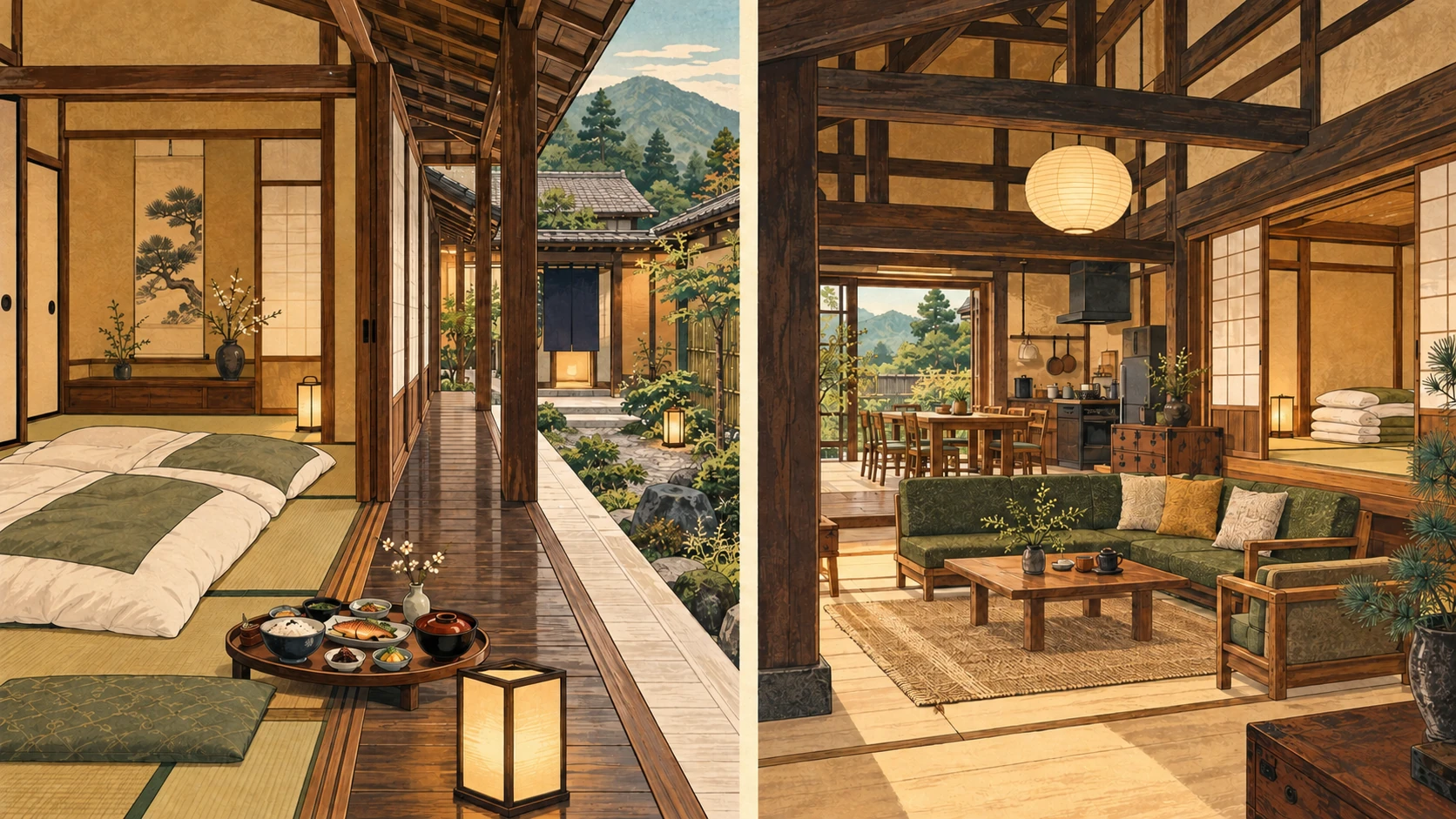
For a traditional Japanese room in Magome, Tajimaya's current dinner-and-breakfast plans list private Japanese-style guest rooms, TV, air conditioning, external locks, and Wi-Fi, with no smoking indoors. There are single-person and two-to-five-person plans; more than five must inquire. These indicate booking options for solo guests or families, but a displayed plan does not prove availability on your chosen dates. Check prices and cancellation terms for those dates rather than treating an old search result as a standard room rate.
The website lists dinner at 18:00, breakfast at 7:30, check-in at 15:00, and checkout at 10:00. For walkers, 18:00 shapes the first day more than the number of tatami mats. If you arrive by bus in the afternoon, settle in and walk tomorrow instead of racing nine kilometers before dinner. Contact the accommodation early if transport delays may make you late, and confirm how dinner will be handled. A small inn should not be expected to keep serving throughout the day like a city restaurant.
Private describes the use of the guest room; it does not establish an en-suite bathroom, an onsen, or a reservable private bath available whenever you want. If shared bathrooms are uncomfortable, you need a raised bed, or nighttime toilet access matters, ask about equipment and circulation before booking. Use the meal and bathing questions for a first Japanese-style stay to prepare. Clarifying needs and choosing the suitable plan prevents more inconvenience than relying on room photographs alone.
Ue-Chojiya in Tsumago: ground-floor use and a kitchen, but no meals
Ue-Chojiya's accommodation description presents an exclusive-use traditional house near Tsumago's Masugata bend, with a 12-tatami living room, four additional rooms, and Wi-Fi for family or friends. Check the owner's floor-access and facility rules for the actual space: accommodation uses the first floor only; the second floor is closed. A whole-house rental description does not mean access to every level, and the room count cannot be converted directly into guest capacity.
Facilities listed include a kitchen, refrigerator, induction cooktop, microwave, rice cooker, basic utensils and seasonings, a bathing room, and a free on-site washing machine. The page explicitly says no meals are provided and asks guests to prepare in advance. This suits people willing to arrange food and their own daily rhythm. If arriving after an afternoon walk, sort out shopping and access beforehand rather than assuming all shops remain open until dinner. The kitchen is useful when you have already obtained what you intend to cook or eat.
Smoking and open flames are prohibited, and the displayed irori hearth in the living room cannot be used. Leave suitcases in the entrance area or lift them when bringing them inside; do not roll them over tatami. Complete soundproofing, step-free access, baby equipment, or a fixed bed type must be confirmed with the owner, not inferred from traditional-house photographs. These are not footnotes to the style: they are practical conditions that determine whether your whole party can settle in comfortably.
Fujioto's accommodation suspension and lunch arrangements: checked October 22, 2026
Searching for Tsumago accommodation often brings up Fujioto's old reviews, garden photographs, and room pages. When checked on October 22, 2026, the notice on Fujioto's home page stated that overnight operations had been suspended since June 1, 2024, with reopening still undecided; it said lunch service was continuing. A room-description page remaining online does not mean accommodation has reopened. This guide therefore does not list Fujioto as confirmed to have reopened for overnight bookings or turn past awards into evidence of present room sales.
If considering lunch, confirm opening on the day, arrangements for individuals or groups, and whether a reservation is needed. Suspended accommodation and continuing lunch are different facts. Not staying there does not mean the dining operation is closed, and obtaining a lunch reservation does not mean you can sleep there. Keep it as a meal option to confirm, with another restaurant or carried food available, so that one uncertain lunch does not dictate your pace over the entire trail.
This is also a way to evaluate accommodation information: read the official home page and latest notices first, then plans, dates, and facilities, and only then older guest accounts. If the home page, booking platform, and old articles disagree, ask the business directly instead of inferring operating status from something still being searchable. Checking a named property to this level makes the accommodation choice serve the route you intend to take.
Tsumago accommodation tax: compare the room-only price before consumption tax with 6,000 yen
Nagano's published accommodation-tax system covers ryokan, hotels, simple lodgings, and applicable private rentals. The exemption is for a room-only charge below 6,000 yen per person per night, excluding consumption tax; do not compare a whole two-meal bill directly with the threshold. During the initial three years, June 1, 2026–May 31, 2029, the amount is 200 yen; after that, the stated amount is 300 yen. Municipalities with special taxation require their own rules to be checked.
Suppose two adults stay two nights in Tsumago and each person's taxable charge reaches the threshold on both nights. In this initial 200-yen period, the calculation is 200 times two people times two nights, totaling 800. This is a calculation with stated assumptions, not a tax determination for any actual room price. Ask the property to explain the meal split, collection method, and whether the displayed total already includes tax. A price near the threshold is particularly unsuitable for estimating room-only charges yourself from a meal-inclusive plan.
Magome is in Gifu, so do not automatically add Nagano's 200 yen to a Magome inn bill. Check the current system at the actual location and the property's invoice. When spending a night in each town, confirm them separately rather than applying one Kiso accommodation rate. Use the budgeting approach that separates accommodation, transport, and small local expenses to keep known tax charges distinct from your own room-price assumptions.
Food stops: use the 2026 dining map rather than relying on a mountain lunch
On September 16, 2026, Tsumago's tourism association announced where to obtain its new dining map, covering opening days and hours, English, and vegan and gluten-free information. Copies are available at the information center or participating shops. Pick one up at the Tsumago center or a distributing business and choose lunch according to that day's opening, rather than an old blog's times. The map helps with selection, but allergies and dietary needs still require staff confirmation: an icon does not establish a kitchen free of cross-contact.
Local foods shown in the official dining directory include Wachinoya's oyaki, Kojitsu Coffee's buckwheat galette, and Ebiya's kuri-kinton. They offer different snack or meal options, without this guide claiming unverified daily stock, prices per serving, or opening hours for every shop. Set aside dedicated town time if you want to eat slowly. That is more suitable than walking through the forest expecting a shop to be waiting around every bend.
The official hiking page warns that purchases along the route are limited. Prepare drinking water and enough food to bridge your meals before entering the hills. If you reach Tsumago in the afternoon with less than an hour, collect bags and check the stop before deciding whether a seated order fits. If staying overnight, save a desired shop for tomorrow. You can still enjoy eating as you explore without allowing a must-try list to jeopardize the day's only acceptable return.
Honjin is free; Okuya and the history museum charge admission under current rules
Nagiso Municipal Museum's current admission information lists Wakihonjin Okuya and the History Museum at 800 yen for adults and 400 for the elementary and junior-high-school categories in Japan's school system. Tsumago-juku Honjin is open free. Do not add an old separate Honjin price to the current system. Two adults in the paid section cost 1,600; one adult and an eligible child cost 1,200. Museum child categories are calculated separately from accommodation and bus definitions.
Opening is 9:00–17:00, with last admission at 16:45. Closure is the second and fourth Thursday of each month, except when these are national holidays, plus December 29–January 3. Apply those rules to your travel date rather than relying on an open label on a map. For a New Year trip, compare the closure period with your accommodation dates first. Even on an open day, 16:45 is not a starting point that leaves more than an hour for leisurely viewing.
When you arrive from the trail in the afternoon, assess your return and energy before entering. If you want to understand wooden construction, post-town functions, and everyday history, a morning visit after an overnight stay gives more room. A short town visit can instead use free Honjin and the streets, without rushed ticket buying simply to complete a list. Follow each facility's rules on photographs, shoes, and circulation. Habits at other sights do not establish free entry into every old house.
Preserved streets are still a neighborhood where people live
Tsumago's preservation history explains its 1976 selection as an Important Preservation District for Groups of Traditional Buildings and residents' continuing care for the post town, surrounding nature, and roadscape. It is not an enclosed exhibition assembled by moving old houses in. Homes, shops, and public passages have different boundaries. When photographing wooden window grids or long corridors, observe from a publicly accessible position first. An open door does not invite you into someone's entrance, and working residents are not photo props.
The official introduction places Tsumago 42nd among Nakasendo post towns counted from Edo and describes the principles of not selling, not renting, and not demolishing that protect its setting. This context helps show how houses, streets, wooded hills, and residents' lives connect. You need not memorize every date to walk slowly. If preservation systems or early-modern transport interest you, add the museum so that street observations and exhibition material complement one another.
Keep places that others need to pass through clear. Tripods, umbrellas, and bags should not block corners or shop doors. For a rest, find available seating or an open business and dispose of shopping and food waste properly. Respecting living space does not make travel less interesting. It helps you notice how eaves, stone walls, water channels, and mountain slopes form the town, rather than merely joining a line for the same popular camera angle.
Tsumago autumn leaves: October 18, 2026 still showed the start of color change
Tsumago's official 2026 autumn-color page recorded Magome Pass, Otsumago, and Tsumago's streets as beginning to change color on October 18. This is a dated observation, not evidence that the hills were red throughout October. Before departure, see whether that page has been updated and consider cloud, rain, and walking conditions together. That helps decide whether the day suits the old road or more time in the town streets.
The pass, settlements, and street trees on one route may change at different speeds. For an autumn Tsumago–Magome hike, first choose a date and time that allow a good walk, read the latest observations before leaving, and let foliage be one part of the trip. If you can take vacation in only one particular week, do not make transport and lodging completely inflexible for an unverified peak-color date. Wooden streets, forest, and local food can all contribute to the visit.
When photographing leaves, watch the stone underfoot and people behind you. Do not stop in the middle of a narrow section or leave the permitted route for a shot. To compare seasonal rhythms elsewhere, use Japan's travel seasons by region and month. It helps you choose a style of trip; foliage on your actual day in Kiso still depends on current local observations and weather.
Spring, summer, and winter: autumn services are not year-round promises
Spring and summer visits can focus on forest, streams, and post towns, but earlier rain still affects the ground. Sunshine on departure morning is not the only consideration. The Tsumago tourism association warns that some stone paving becomes slippery after rain. Check footwear grip and whether rain gear works for walking, then ask locally about the trail. If mountain walking is unusual for you, test your pack and shoes beforehand on an ordinary walk with climbs and descents to understand your pace.
Winter requires a fresh assessment of the hills and transport, not simply adding a jacket to an autumn photograph. Frost, snow, ice, daylight, and adequate equipment all affect whether walking is safe. This guide's three-hour example is not a snow-walking reference. If conditions are unsuitable, open town streets and applicable bus services still make a complete post-town visit. Finishing a particular trail is not a prerequisite for having been here.
Ordinary 2026 luggage transfer is announced only through November 30, and starred extra municipal buses have specified periods. Check services again for 2027, December, or later dates instead of automatically extending either arrangement. If accommodation is already booked but the route must be shortened, tell the property your arrival plans early and explore near the same base. That preserves the overnight and street experience while reducing the uncertainty of repeated transfers in bad weather.
Bear-bell rental: ask about today's trail conditions first
Tsumago's walking notice warns that bears may also enter inhabited areas, asks walkers to seek information from tourism businesses or the association, and recommends a bell that makes sound. This is preparation, not a guarantee that a bell prevents an encounter. Nor does a webpage without a new alert establish no risk anywhere on the route that day. Ask about local conditions first and adjust for warnings and access restrictions.
Current bear-bell rental instructions at the two information centers require 2,100 yen at collection, refund 2,000 at return, and leave an actual rental cost of 100. Bells may be borrowed and returned at either Tsumago or Magome. Two people renting one each need 4,200 initially, receive 4,000 back, and spend 200 net. Separate refundable deposits from actual rental expense so that arriving with only 100 does not prevent you borrowing one.
For broader information, start with Nagano's bear notices and guidance directory, then confirm locally what relates to your trail. This guide provides neither live sighting distribution nor a safety judgment for a particular day. If a companion is already anxious about wildlife or trail conditions, switch to buses and town walks. Make sure everyone understands the reason for changing and where to meet.
Children, older travelers, and wheelchairs: assess the trail separately from the towns
Magome's official walking page states that children aged three and under must be carried and that the mountain route is unsuitable for wheelchairs and strollers. This concerns the walking trail, not a declaration that the entire town or every building is off limits. With children, assess whether adults can care for them on slopes, stone, and a long walk. If you need a stroller, focus on streets where access can be confirmed and connect the towns with applicable buses.
An older companion who walks well on level ground but tires on descents can choose a shorter section after checking locally that it is suitable or explore one town slowly. Ask about seats, toilets, and entrance steps rather than relying only on total distance. Wheelchair users should directly confirm that day's usable routes and assistance with facilities and transport operators. Connected lines on a map do not prove step-free access throughout.
Check child eligibility item by item: Nagiso's ordinary buses distinguish elementary-school and preschool children; museum child admission includes elementary and junior-high pupils; the Jorudan pass currently has no child version. One blanket half-price-child rule cannot replace these definitions. If the party separates, each subgroup needs an adult, tickets it can display, and contact arrangements. When tickets are on one phone, confirm compliance with the requirement to board and alight together first.
Rain or an unfinished walk: switch early rather than chasing a bus downhill
If rain, footwear, or energy are unsuitable at the start, replace the nine kilometers with street activities in the towns. Check whether Honjin and the museum are open, find operating restaurants and shops, and use current bus schedules. This alternative still reveals post-town architecture and life. If the day suits only one place, choose the end most convenient for transport, bag collection, and accommodation. Do not add a transfer merely to complete both names.
If progress is slower than expected, check the remaining route and transport from a safe, identifiable place rather than speeding down a slippery descent to catch a bus. Whether an intermediate stop can be used and an applicable service exists depends on the actual stop and direction. A bus symbol on a map is not an exit available at any time. Save official information-center and accommodation contact channels before leaving so that you can explain your location if necessary.
After missing the intended bus, check the next one and the luggage deadline first, contacting your accommodation about later arrival if needed. Dispatch availability, waiting time, and cost must be confirmed by the taxi company; this guide does not promise an instant backup. Effective margin is usually created earlier: start sooner, choose an earlier return, remove one museum, or divide the towns over two days so that the trip does not rely on the final minute.
Budget examples: add local buses, bags, bell rental, and admission separately
For an adult entering Magome through Nakatsugawa, walking to Tsumago, and leaving via Nagiso, local buses cost 800 plus 300, or 1,100 yen. Add one transferred bag at 1,000 for 2,100; add the net 100-yen bell rental and 800-yen paid museum section for 3,000. This museum-inclusive example suits a plan with time for admission. It does not require the earlier day-trip example returning at 15:26 to include the museum too. Two people choosing the same items total 6,000.
The initial bell payment of 2,100 contains a refundable 2,000. For the same person and items above, cash needed before refund therefore totals 5,000; only after returning the bell is net spending 3,000. Distinguish deposit cash flow from final expenses. JR, food, accommodation, and possible taxes still need funding. The table shows one and two people under identical assumptions so that you can remove unneeded items, without inserting an unknown room rate to make a fixed total.
Using the 2,700-yen two-day pass instead, then adding a 1,000-yen bag, net bell cost of 100, and admission of 800 gives 4,600 per person or 9,200 for two, still excluding JR, food, and lodging. This line is useful for comparison only if you actually need the included routes. A one-way walker should not mistake a more expensive ticket for transport savings. Full costs also depend on accommodation and meal choices: settle the trip's structure first, then assign your acceptable ceiling to each item.
| Assumption | One person | Two with identical choices | Conditions |
|---|---|---|---|
| Nakatsugawa entry, Tsumago exit through Nagiso: local buses | 1,100 | 2,200 | 800 + 300 |
| Those buses plus one bag per person | 2,100 | 4,200 | Add 1,000 |
| Buses, bag, net bell rental, paid museum section | 3,000 | 6,000 | Add 100 and 800; allow visiting time |
| Two-day pass, bag, net bell rental, paid museum section | 4,600 | 9,200 | 2,700 + 1,000 + 100 + 800; first assess pass value |
Booking order: secure the return before accommodation, luggage, and tickets
List the travel date, departure city, whether you want the full walk, and where the day ends overnight. Check that date's outbound and return times and access information. Once the return works, arrange arrival at the start and place luggage, walking, rests, and finishing activities around it. If the itinerary holds together, book matching accommodation and transport. This exposes practical conflicts early, such as a favorite inn whose dinner you cannot reach after walking or a cheap return without a connection from the final local bus.
Confirm arrival deadlines, dinner and breakfast, beds or futons, bathroom use, accompanying children, and food requirements with your accommodation. Confirm bag numbers, handover points, collection hours, and operating dates with the luggage service. For a mobile pass, install the required app, establish the holder and group-use rules, preserve battery, and prepare ordinary fare money if needed. These tasks can be completed one by one before departure, leaving attention for the streets and forest on the day.
Make a short final check that morning: local weather, official access information, whether the timetable applies, whether bags are handed over, and whether essentials are with you. Set reminders for the return and bag deadline, and agree when to decide on shortening the day. This checklist supports informed adjustments, not identical itineraries for everyone. Different travel preferences also mean different tolerances for walking and stops.
Combining Nagoya and Narai: nine kilometers do not represent all of Kisoji
From the same Nagoya hotel, Tsumago and Magome can be a self-contained day between city activities, avoiding daily room changes with a large suitcase. If post-town mornings and evenings appeal, move one night to Magome or Tsumago and leave through the opposite end. Both choices work. The difference is whether you want your time in city dinners and easy rail connections or a slower night among wooden streets.
To add Narai-juku, treat it as another destination and check its trains, connections, and stay separately. Do not draw it inside this guide's nine-kilometer Tsumago–Magome walk. This is neither a complete Narai transport-and-accommodation comparison nor a multiday guide to the entire Nakasendo. To enjoy all three towns properly, list each one's transport and accommodation, then decide how many days you need. Three names are not automatically one short walking route.
Return to the first choice: if you want autumn leaves, forest, and a well-paced walk, protect daylight and the return first. If you want streets, food, and preservation culture, allow longer in the towns; buses are a reasonable choice too. The fares, dates, official links, and calculations here turn preferences into executable arrangements. Check current notices and set out with room to spare so that Tsumago and Magome become a stop worth slowing down for.
A few useful answers
Must a Tsumago and Magome day trip include hiking?
No. Focus on town streets and connect them by local bus if preferred. For the full nine-kilometer walk, use about three hours as a starting point, then add rest, luggage, and waiting time.
Is Magome to Tsumago downhill all the way?
No. Both directions cross Magome Pass. The Magome climb is shorter and steeper; the Tsumago side is longer and gentler. Choose using fitness, accommodation, and transport.
Is this Nakasendo section eight or nine kilometers?
Sources give approximately eight and nine kilometers. Magome's tourism association uses about nine kilometers and three hours. This guide adopts the more generous reference and adds rest and street time, without guaranteeing an individual's finishing time.
When can bags be handed over in 2026?
The ordinary service is announced for March 20–November 30, drop-off 8:30–11:30, collection 13:00–17:00, at 1,000 yen per piece. Confirm designated points and exceptional transfers outside normal acceptance separately.
Are Nakatsugawa–Magome and Nagiso–Magome the same fare?
No. Kitaena's current adult Nakatsugawa Station–Magome fare is 800. Crossing municipal zones to Magome in 2026 is 1,000; Tsumago–Nagiso within the municipal zone is 300. Do not interchange them.
Is the 2,700-yen two-day pass always cheaper?
The one-way local-bus approach through Nakatsugawa and exit from Tsumago via Nagiso totals 1,100 per adult, so a 2,700-yen pass may be unnecessary. It covers specified buses on the first day and the following day, not JR or the Nagoya direct bus. The Jorudan version has no child ticket.
Can Fujioto currently be booked overnight?
When checked on October 22, 2026, the official notice stated that overnight stays had been suspended since June 1, 2024, with reopening still undecided; lunch service was continuing at that time. Old room pages and reviews do not establish resumed accommodation reservations.
Does Tajimaya's private room mean every room has a private onsen?
No. It describes the Japanese guest room, not proof of a private bathroom or hot spring. The site lists dinner 18:00, breakfast 7:30, check-in 15:00, and checkout 10:00. Ask the inn separately about baths and room needs.
Does late October 2026 guarantee peak foliage in Tsumago?
No. The official October 18 observation recorded the start of color change at Magome Pass, Otsumago, and in the town. Check later updates and local weather. This is not a 2027 forecast.
Can wheelchairs and strollers use the whole old trail?
Magome's official page considers the trail unsuitable for both and says children aged three and under must be carried. Check town streets and individual facilities separately; buses can connect the towns.
What do Honjin, Okuya, and the history museum cost?
Current municipal information lists Honjin as free, and Wakihonjin Okuya plus the History Museum at 800 for adults and 400 for the elementary and junior-high-school categories in Japan's school system. Hours are 9:00–17:00, last admission 16:45. Compare closures with your date.
Can these transport and luggage arrangements be copied into winter or 2027?
Not automatically. Ordinary 2026 luggage service, seasonal extra buses, and Nagoya's autumn direct bus each have applicable periods. Recheck other dates and do not use snow-free walking times as a snow-route safety assessment.
Check with the source
Schedules, availability and rules can change. These official sources are the place to confirm details before you book.
- Tsumago tourism: walking, 2026 luggage transfer, and bear bells
- Magome tourism: Nakasendo walking route and precautions
- Kitaena Kotsu: weekday and holiday timetables
- Kitaena Kotsu: Magome fare matrix revised March 2025
- Nagiso: Magome Line timetable from April 2026
- Nagiso: 2026 bus fares and operation
- Tsumago tourism: autumn 2026 direct bus from Nagoya
- Meitetsu Bus: Nagoya–Magome–Tsumago times and reservations
- Kitaena Kotsu: pass introduction and purchase channels
- Jorudan: Magome–Tsumago two-day routes and terms
- Tajimaya: private Japanese rooms, two meals, and meal times
- Ue-Chojiya: traditional-house accommodation in Tsumago
- Ue-Chojiya: first-floor access, kitchen, bath, and house rules
- Fujioto: suspended accommodation and continuing lunch notice
- Nagano: accommodation tax, exemption, and initial amount
- Tsumago tourism: 2026 dining-map announcement
- Tsumago tourism: restaurants and local foods
- Nagiso: Honjin, Wakihonjin Okuya, and History Museum
- Tsumago tourism: preservation history and residents' principles
- Tsumago tourism: autumn observation on October 18, 2026
- Nagano: bear notices and prevention information
- RYDE PASS: two-day price, validity, and sales period
- Kitaena Kotsu: weekday Magome Line PDF timetable
- Tsumago tourism: access and bus demonstration published by the 世界共生学部 faculty of Nagoya University of Foreign Studies