Choose where to sleep each night before buying tickets for ferry services that genuinely connect. Compare Ishigaki's port-side hotels, coastal resorts and overnight Iriomote stays through bed layouts, children's charges and cancellation terms, then build in ferries, disruption alternatives and a family budget. Four days and three nights need not sacrifice time ashore for an island count.
Ishigaki and the Yaeyama Islands: choose one island before adding overnight stays
The first decision for an independent Ishigaki trip is where you will sleep each night, rather than how many islands you can fit in. A hotel near the port makes luggage handling and ferry departures easier; a coastal resort suits afternoons spent at the hotel; staying on Iriomote reduces repeated journeys to its ports. For a first visit, four days and three nights can work with one Ishigaki base, one day on Taketomi, and one day exploring Ishigaki by land. If Iriomote's forests are your priority, add nights and stay there instead of squeezing each island into half a day.
This guide uses official information available on October 22, 2026. Yubu Island's current notice closes the attraction from October 21 with no reopening date; Taketomi's bus and the Nakama River cruise also have typhoon-related suspensions. Every normal-service plan below therefore depends on confirming that the relevant service has resumed. Ferries, activities, and rooms are separate bookings: a canceled sailing does not automatically waive charges on the others. For different travel dates, update flight and ferry schedules and hotel cancellation deadlines before applying the same planning approach.
Okinawa's main island and the Yaeyamas also need separate planning. Ishigaki Airport's route-by-route flight schedules include Naha, but a worthwhile day return depends on your actual flights, airport transfers, and intended activities, not flight time alone. If this is your first time arranging Japanese transport independently, use the booking and arrival sequence for a first Japan trip to treat Ishigaki Airport, the outlying-island ferry terminal, and the final transfer on your destination island as three separate journeys.
Where to stay: Ishigaki port, the coast, or Iriomote
Before comparing Ishigaki hotels, mark your planned ferry days on the calendar. With departures from Ishigaki's outlying-island terminal on two consecutive days, a port-side base usually makes breakfast, ticket collection, and returning to your room easier. A coastal resort becomes more relevant when you have just one island day and want the rest of your stay by the sea. These are itinerary trade-offs: port hotels are not necessarily cheaper, coastal rooms do not all guarantee sea views, and the highest review score does not identify the best choice for every family.
For Iriomote accommodation, first ask which port the hotel serves. Ohara and Uehara are in different parts of the island, with different activity departure points, transfers, and alternatives when northerly winds stop sailings. For a Nakama River cruise, start by looking around Ohara. For Iriomote Hotel and western-island activities, consider Uehara and the time a necessary detour could add. A difference in room price may be smaller than the cost of changing vehicles at short notice, missing an activity slot, or moving luggage one extra time.
Before booking, list the total party size, every child's age, the number of properly made-up sleeping places needed, and whether breakfast and dinner are included. “Up to four guests” can include extra beds or a daybed; it does not promise four separate single beds. “Children stay free” may cover only the room charge for a child sharing existing bedding. Compare the complete booking using a Japan budget split into fixed and adjustable costs, rather than relying on the lowest nightly price shown in search results.
| Base | Best suited to | Check before booking |
|---|---|---|
| Around Ishigaki port | Repeated ferries, less luggage moving, travel without a car | Walk to the check-in counter, breakfast timing and luggage-collection deadline |
| Ishigaki coastal resort | Hotel time, family rest and only one outlying-island day | Airport transfers may not serve the port; verify extra beds and meals |
| Iriomote | Forest or island activities with an overnight stay fitted around ferries | Designated port, cancellation alternatives, activity meeting point and return buffer |
Airport to ferry terminal: Route 55 and payment cards
After landing, identify whether you need Ishigaki port, a coastal hotel, or a rental-car office. Ishigaki Airport's official bus and taxi guide lists several routes; reaching Kabira may involve a bus toward Yonehara or a change at the bus terminal. An airport bus does not place every hotel on the same route. With young children or bulky luggage, include disembarking, baggage collection, waiting, the walk after getting off, and ferry check-in. Avoid connecting a tight sailing directly to your aircraft's scheduled landing time.
Karry Kanko's payment instructions for the direct Route 55 bus give one-way fares of ¥550 for adults and ¥280 for children. Payment is made in advance, using cash or supported contactless bank cards; transport IC cards and QR payments are not accepted. Tapping a bank card is a different system from ICOCA or Suica, even if both involve holding a card near a reader. Prepare change as required locally, and keep another payment method available for a return trip with a different operator. These fares should not be applied to other bus routes.
For a taxi, the airport website estimates roughly 25 minutes and ¥3,500 to Ishigaki's outlying-island ferry terminal, or about 30 minutes and ¥4,300 to Fusaki, using a standard vehicle. These are variable route-and-traffic estimates, not reserved quotations. Three people with luggage should also check vehicle size and luggage capacity. Without a car, combine a port-side hotel with island excursions and choose verified return buses, a private vehicle, or a tour for outlying viewpoints. You need not pay for an unused rental car on ferry days just to have one throughout the trip.
At the terminal: identify your ferry operator before using a QR ticket
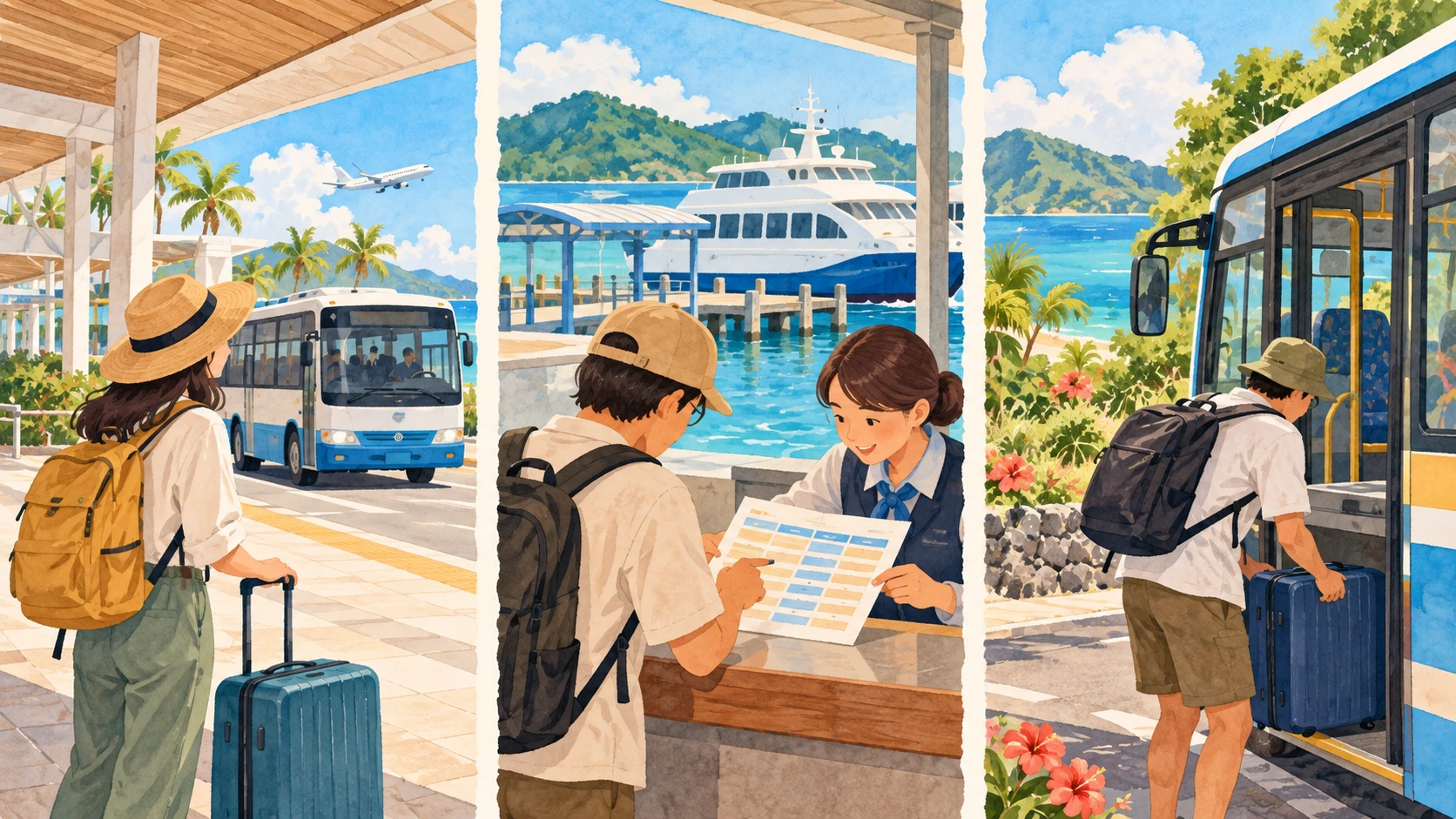
Ishigaki port has different ferry companies, counters, and departures. The shared-ticket arrangement between Anei Kanko and Yaeyama Kanko Ferry ended on September 30, 2020. A ticket from one company cannot simply be used on the other's next boat. Anei Kanko's booking and boarding FAQ distinguishes online reservations, counter-issued tickets, and boarding rules. A travel-agency package, a separately purchased scheduled ferry ticket, and a hotel offer may also have different points of contact for changes.
Anei's online bookings generally close at 18:00 the previous day. For a QR ticket valid for direct boarding, reach the boarding area 10 minutes before departure; passengers needing counter processing should complete it 15 minutes before departure. On a first visit, arriving at the terminal at least 30 minutes ahead gives time to find the counter, use the restroom, and confirm the boarding point. That recommended buffer does not reserve a seat or replace the meeting instructions on your order. Follow any earlier requirement for busy dates, groups, or activity packages.
For boat-to-boat connections, Anei's FAQ requires at least 30 minutes. Being at the same port on a map does not mean you can step straight off one sailing onto another. Boats can be delayed, intermediate stops can differ, and some ports require another ticket collection. Return-ticket validity is not a seat reservation either: Anei's return portion can be used within 14 days starting with the outward journey, but the intended sailing and its operating status still need checking. Holding a return ticket does not make the day's final departure a guaranteed fallback.
Ishigaki ferry fares: compare the destination port as well as journey time
The table gives ordinary fares listed on Anei's route pages, including the fuel-price adjustment charged at the time. Do not add the same adjustment a second time after checkout. For scheduled ferries, adults are junior-high-school students and older; children are elementary-school pupils. The current Taketomi route fares provide a short-distance starting point, while the Ohara route's one-way and return prices should be considered alongside eastern-Iriomote activities. Fares can change, so confirm the total for your actual departure date before paying.
Uehara's crossing and intermediate-stop information estimates 45–55 minutes direct, or 70–80 minutes via Hatoma; the Kohama route page gives about 25–30 minutes. Taketomi's route introduction estimates 15–20 minutes, whereas the current winter timetable PDF gives 10–15 minutes. The Ohara page and seasonal timetable also differ slightly. These are estimates on different pages from the operator, not grounds for taking the shortest figure as your total journey to an attraction. With children or anyone prone to seasickness, consider direct versus stopping services and sea conditions before choosing a departure.
A cheaper Ohara ticket does not entitle someone staying near Uehara to free transport across Iriomote. Replacement buses may require a Uehara-route ticket and a separate bus voucher; hotels may collect from Ohara only under specific conditions. Kohama, Kuroshima, Hatoma, and Hateruma each have their own reasons to visit. On a first trip, start by comparing Ishigaki, Taketomi, and Iriomote, then add another island only for an activity you actually want. An overnight stay elsewhere also needs its own accommodation, dinner, and return-transport arrangements.
| Port from Ishigaki | Adult one-way / round-trip | Elementary-school pupil one-way / round-trip |
|---|---|---|
| Taketomi | 970 / 1,880 | 510 / 990 |
| Ohara, Iriomote | 2,520 / 4,880 | 1,290 / 2,500 |
| Uehara, Iriomote | 3,290 / 6,370 | 1,650 / 3,200 |
| Kohama | 1,720 / 3,340 | 870 / 1,680 |
Family tickets: school stage, age, and a separate seat are different tests
There is no single child-fare age rule across the Yaeyamas. Anei's scheduled ferries charge the child fare to elementary-school pupils. A preschool child accompanied by an adult can travel free when the conditions are met, including one child per adult and sitting on the adult's lap; a child needing a separate seat requires a child ticket. Activity packages often use ages 6–11 for children and 12 and over for adults. Those are different product categories and cannot replace the scheduled ferry's school-stage rule, nor make every preschool child in a party free.
A 12-year-old still attending elementary school may therefore fall into different categories for a ferry and an age-priced activity. A 10-year-old who needs a hotel bed cannot stay free simply because the property offers free stays for young children sharing existing bedding. Enter actual ages and school stages on each booking, and keep the written child conditions as well as the final amount. If bringing a stroller, check folding requirements, bus luggage restrictions, and steps at activity boats. Welcoming children does not establish step-free access throughout the trip.
Traveling with young children also calls for meal, clothing-change, and waiting time. A simple day combining Taketomi's village and shore can work, while Iriomote's longer ferry crossing, cross-island bus, and activity check-in may make a same-day return for a flight unsuitable. Set a tolerable length for each travel stage before choosing attractions; it is easier than dropping a paid activity later. The family-budget example near the end deliberately leaves accommodation, meals, and activities as separate items to verify.
Canceled ferries: Anei and Yaeyama Kanko handle e-tickets differently
Anei's FAQ states that a prepaid reservation is automatically canceled and refunded when its sailing is canceled for weather, and its QR ticket becomes invalid. If the Uehara route is canceled and you want to travel via Ohara, go to the counter to buy a new ticket and arrange the necessary bus voucher; do not attempt to board using the invalid QR code. Choosing not to travel without canceling is not the same as being entitled to a refund. Use My Page by the previous day or the operator's procedure on the day; for a travel-agency order, contact the original seller first.
By contrast, Yaeyama Kanko Ferry's Uehara cancellation page explains that Uehara e-tickets are not all canceled automatically because access remains possible via Ohara and a connecting bus. To take that alternative, present that company's Uehara ticket at its counter and collect a bus voucher. If you decide not to go, contact the operator to cancel under its rules. The destination can be the same while the order's status is different. A refund description in someone else's trip report cannot safely be applied to every ferry ticket.
Northerly winds stopping Uehara sailings do not mean every port on Iriomote is closed, nor that Ohara must be operating normally. Confirm the route with your own ferry company, then ask the hotel and activity provider whether they can still receive you, which port they serve, and the latest acceptable arrival time. Keep an offline copy of all three contacts—ferry, room, and activity—and read their separate conditions before canceling. An automatic ferry refund does not also cancel your accommodation booking.
Anei's winter Uehara replacement bus: only specified connections
Anei's replacement-bus timetable for October 1, 2026–March 31, 2027 is a special arrangement when Uehara sailings are canceled, not a year-round, turn-up-and-ride island bus. The listed boats leaving Ishigaki at 7:30 or 16:00 connect with buses from Ohara at 8:30 or 17:00, respectively. In the return direction, buses leave Uehara at 7:20 or 15:50 to connect with Ohara boats at 8:30 or 17:00. These pairings depend on the Uehara cancellation and that day's notice; they cannot be substituted with any later arrival into Ohara.
Use the Uehara-route fare and obtain the separate dedicated bus voucher: a ferry ticket alone is insufficient. Arrange the outward voucher at the Ishigaki counter and the return voucher at Uehara as instructed. Boarding is first come, capacity is limited, and the bus may not carry Anei's livery. Families with large luggage, a fixed activity start, or difficulty waiting should ask the operator and hotel in advance about reservable alternatives. A connection drawn on the timetable does not guarantee that every passenger can board the bus.
The ferry company's ordinary Uehara–Shirahama connecting bus also ended on May 31, 2026; it no longer runs under the old arrangement from June 1. Older advice that a ferry ticket includes a free ride to Shirahama should not be used for a new Iriomote stay. A cancellation-replacement bus, a hotel shuttle, and a regular local bus are three different services. When checking transfers, give the ferry company, port, arriving sailing, hotel name, and date, rather than asking only whether there is a free bus.
Yaeyama Kanko's alternative has its own dates and vouchers
Yaeyama Kanko estimates about 50 minutes by boat from Ishigaki to Ohara and about 60 minutes by bus from Ohara to Uehara, plus waiting. This is not an express connection guaranteed to complete every transfer in 110 minutes, and Anei's two bus pairings cannot be applied to it. The page gives an alternative-service period of October 2026–February 2027, unlike Anei's timetable ending March 31. Travelers in March cannot assume this operator continues simply because another company has a March schedule.
Passengers continuing on this company's bus should buy a Uehara ticket and collect the voucher at the designated counter, rather than buying a cheaper Ohara ticket first. Once the bus reaches the west, check whether your hotel is within its service area and where to change to a hotel vehicle. Some hotels collect directly from Ohara when Uehara sailings are canceled, in which case the ferry company's bus may be unnecessary. Checking with the accommodation first helps prevent both passengers and luggage from boarding the wrong vehicle and having to backtrack.
Staying on Iriomote in winter requires accepting changing weather and travel time, not guessing which day will definitely have cancellations. Uehara is exposed to northerly seas; Ohara is relatively sheltered, but both require same-day operating checks. If an international flight, domestic flight, or important commitment cannot move, spending the last night back on Ishigaki adds a buffer. It reduces the need to start departure day with a ferry, while providing no guarantee that weather will leave the airport's flights unaffected.
Is an island-hopping pass worthwhile? Compare fuel charges correctly
The island-hopping pass information still linked from Anei's current FAQ was published on October 15, 2022. Excluding Hateruma, three-, four-, and five-day passes are ¥6,800, ¥7,800, and ¥8,800 for adults, or ¥3,400, ¥3,900, and ¥4,400 for children. Versions including Hateruma cost adults ¥12,000, ¥13,000, and ¥14,000. These cover consecutive days on Anei's scheduled high-speed passenger boats, exclude passenger-and-cargo services, and are not shared passes for both ferry companies. Check whether they are still being sold on these terms before buying.
The easy-to-miss difference is fuel: pass holders pay the adjustment separately for each traveled sector, while the ordinary fares above already include it. An adult Taketomi return at ¥1,880 plus an Ohara return at ¥4,880 totals ¥6,760—already ¥40 below the three-day pass's ¥6,800 base price, before the pass's extra fuel charges. Adding a Kohama return at ¥3,340 takes ordinary tickets to ¥10,100. That is a reason to compare actual dates and every surcharge, rather than assuming “unlimited” must save money.
The pass is sold only at Anei's counter in Ishigaki's outlying-island terminal, and each sector still needs a boarding ticket; the pass alone does not let you board. Once one route has been used it cannot be refunded, and a desired journey being full or canceled for weather does not guarantee money back. Do not add an unwanted island just to make the pass appear worthwhile. With only one island day during four days and three nights, individual tickets can leave the rest of the trip more flexible.
A port-side room example: Miyahira's third sleeping place is a sofa bed
Hotel Miyahira is a named option for comparing port-side stays. The East Wing Superior Twin configured for three guests measures 24 m² and accommodates one to three people, with two 110 × 200 cm beds and a 95 × 200 cm sofa bed for the third person. These are not three equally wide standard beds. Three adults concerned about bed width should compare an actual three-bed room when booking, rather than filtering only by capacity. A port-side address also does not guarantee that a particular room has a sea view.
Compare room space together with luggage and the children's sleeping arrangements. Two adults and a 10-year-old needing a separate sleeping place should request a three-person rate with bedding provided. For a preschool child sharing existing bedding, still ask how many children that plan permits and how meals and amenities are handled. Do not transfer another hotel's age 0–6 offer to Miyahira, or infer from a sofa in a photograph that an extra bed is always possible. Use the named room's bed description and the actual booking terms.
The benefit of staying near the port should show up in time you will actually use: one less taxi before sailing, somewhere to put a small bag after returning, or dinner in town. If every day is spent on the coast without any ferry plans, paying for the port location may offer little benefit. Decide which two days need the terminal, then compare total prices for the same dates, meals, and cancellation conditions. This helps judge the location's value without treating the choices here as a ranking of rooms currently available to book.
Miyahira luggage and baths: checkout changes facility access
Miyahira's official check-in and facilities FAQ gives standard check-in at 15:00 and checkout at 11:00, subject to the selected plan; contact the hotel if arriving after 20:00. Luggage can be stored before check-in and after checkout, but post-checkout bags must be collected that same day. This does not establish free storage for all your suitcases while you spend two nights on Iriomote. For split stays, explain your return date, number of bags, and any refrigerated items or valuables, and obtain the hotel's agreement before deciding what to take to the island.
The hotel has no free shuttle: airport journeys need verified public transport or a taxi. Misaki no Yu's official hours are 6:00–10:00 and 14:00–23:00 for staying guests, with no continued day-use access after checkout. A communal bath does not establish an in-room hot spring or natural hot-spring water. The pool is listed as open 9:00–17:00, with no lifeguard. Children require a guardian's supervision; do not leave them beside the pool while attending to other matters.
On a longer stay, put laundry on an evening without an early ferry the next day. The official charges are ¥300 per wash and ¥100 per 30 minutes of drying, making a wash plus one hour of drying ¥500. Actual drying time depends on the load and fabric. Read your selected plan for room charges, children's meals, and cancellation fees. Keep the dates, party size, meals, beds, payment deadline, and cancellation calculation together in the confirmation, without filling gaps using another property's percentages.
Fusaki family rooms: four with bedding differs from children sharing beds
Fusaki's Superior Twin room details describe 36 m² rooms in the North and South areas, usually with two 120 × 205 cm beds. From the third guest, a 100 × 195 cm extra bed or 90 × 195 cm sofa bed may be used. Configurations for two to four are not identical throughout the property: accommodation for four guests, excluding young children sharing existing bedding, is limited to the South area's second floor. For four made-up sleeping places, check the four-person plan and its specified setup; do not book for two and expect two more beds to be added on arrival.
Fusaki's rules for young children sharing bedding and having breakfast cover children aged 0–6 who are still preschoolers: the room charge can be waived when they use no separate bedding. Free breakfast also requires the accompanying adults' booked plan to include breakfast. Flight-and-hotel packages use separate age rules, so room-only conditions cannot automatically be applied. Ask ahead about pushing beds together or protective equipment. Requests for a floor or connecting rooms do not make a standard booking a guarantee; select a plan explicitly guaranteeing a connection if you need one.
The room page lists a bathtub or shower room, which does not mean every Superior Twin has the same bathroom, let alone an in-room hot spring. Alongside square meters, compare extra-bed width, bathroom needs, nap time, and whether breakfast is included. A family spending the day on ferries may make little use of coastal resort facilities. If the afternoon is reserved for the hotel, fewer trips into town can instead make transport costs and time to rest part of the reason for choosing the room.
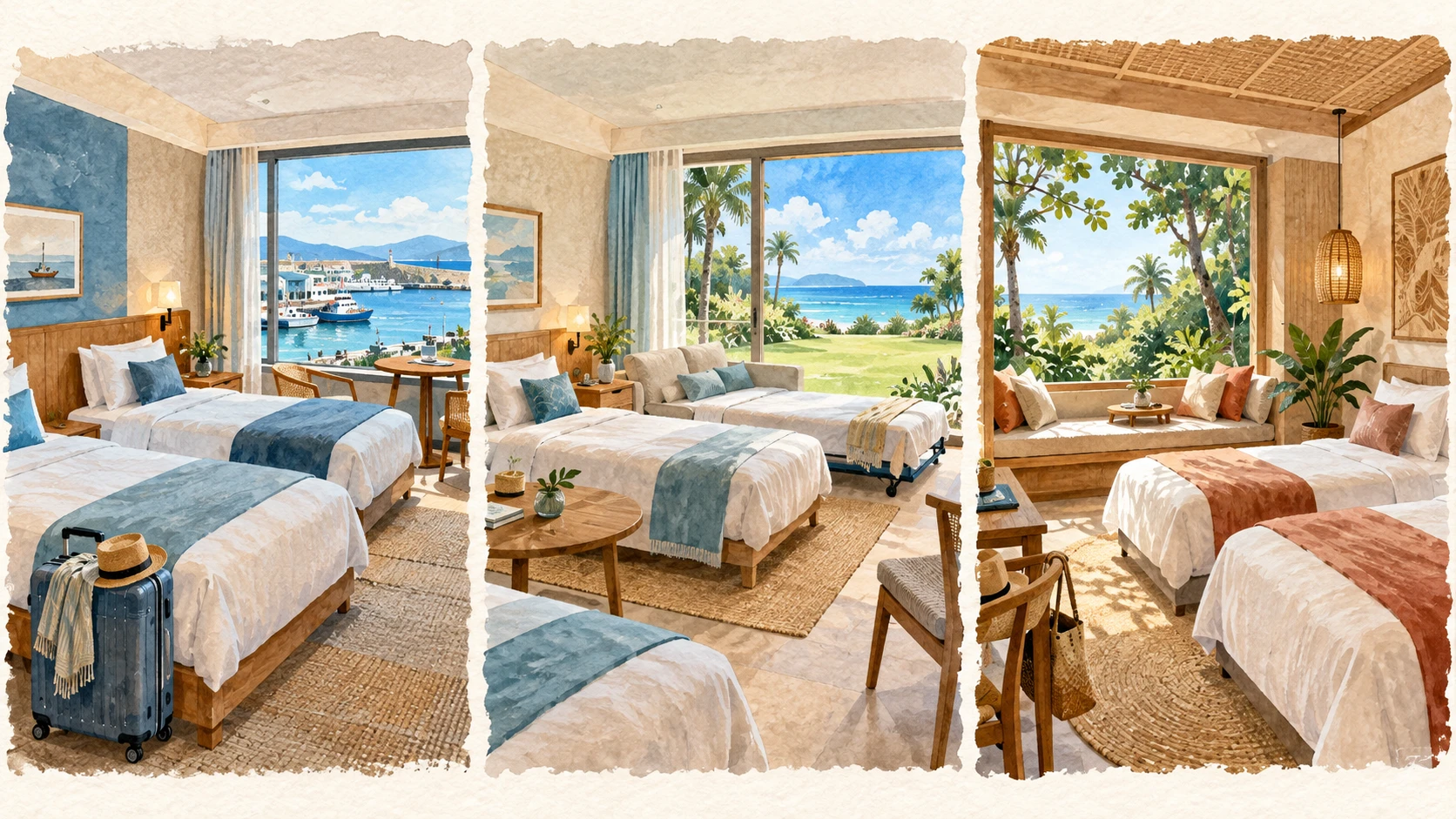
| Room | Area and basic capacity | Sleeping places and qualifications |
|---|---|---|
| Miyahira East Wing Superior Twin for three | 24 m²; 1–3 guests | Two 110 × 200 cm beds; a 95 × 200 cm sofa bed for the third guest |
| Fusaki Superior Twin | 36 m²; 2–3 or 2–4 depending on area | Two 120 × 205 cm beds, then an extra bed or sofa bed; four with bedding limited to South, second floor |
| Iriomote Hotel Deluxe Twin | 54 m²; basic capacity 1–4 | Two 130 × 200 cm beds; the third and fourth guests use bedding on the same 200 × 180 cm daybed |
A free airport shuttle is not a free ride to the ferry port
Fusaki's current airport-shuttle information describes a free service for hotel guests, without reservations and on a first-come basis. A full bus may mean waiting for the next one or taking a taxi, and delayed flights are not guaranteed a waiting vehicle. This service connects airport and hotel; it does not take guests free to every attraction or Ishigaki port. The website has also announced the withdrawal of transfers toward Art Hotel, so older trip reports cannot establish that section as a usable town shuttle.
Check temporary notices as well as the standard timetable. For October 22, 2026, the notice identifies 14:10 from the hotel and 14:55 from the airport as the final departures, with service stopping afterward; October 23 is suspended all day. The current suspension overrides the ordinary schedule, which cannot establish normal operation on those dates. A separate period timetable is listed from October 25, but subsequent notices still apply. Ask the hotel first if your flight arrives later, rather than waiting at the airport for a bus already withdrawn.
For a Taketomi day, list the journey from hotel to port and back separately, including cost and time. Families who need another ride back after the ferry, or whose children tire easily, could keep dinner at the hotel or put the island day within a port-side stay. Two hotels can address different needs, but add packing, check-in, and checkout. With only three nights, consider whether the benefit of changing rooms outweighs another move, rather than splitting the stay simply to experience two room styles.
Fusaki cancellation charges and typhoon exceptions: call before canceling
The ICONIA Type C accommodation terms linked from Fusaki's website list these cancellation-table entries for parties of up to 14: no-show 100%, same day 80%, one, two, and three days before 50% each, and 10 days before 20%, calculated against the basic accommodation charge. These are the table's explicit columns. Confirm other intervals and special plans against your booking and the hotel's response, rather than inventing a more generous cancellation calendar. Groups of 15 or more have different rules.
Using a hypothetical basic accommodation charge of ¥40,000, 50% is ¥20,000 and 80% is ¥32,000; these calculations are not room quotations for any date. Shortening a stay also involves a rule based on the first day, so deleting remaining nights does not establish zero charges. Keep the chosen plan's terms, the deadline for notice to arrive, the definition of the basic charge, and any separate flight-package or travel-agency agreement. Account for potential cancellation costs before payment.
Fusaki's typhoon cancellation notice covers circumstances including an airline's announced typhoon cancellation or change-fee waiver, and Ishigaki–Yaeyama ferry cancellations preventing a return from an outlying island, but requires contacting the hotel first. Canceling without contact may incur ordinary charges; canceling based only on your own weather judgment before an announcement is not covered on the same terms. For flight packages, travel-agency orders, or overseas platforms, contact the original booking provider. The word “typhoon” does not promise free refunds across every platform, room, and additional service.
Iriomote Hotel: a large daybed is not four separate beds
For an overnight stay, compare the Deluxe Twin at Iriomote Hotel by Hoshino Resorts: 54 m², a basic capacity of one to four, and two 200 × 130 cm beds. For a third guest, one sleeping place is prepared on a 200 × 180 cm daybed; with four guests, that same daybed is made up for two. Three friends each wanting a separate single bed should distinguish this from a three-bed room. Ask about specific bed types and dimensions for mobility or sleeping needs, rather than using floor area alone as a measure of comfort.
The website also waives room charges for children aged 0–6 sharing existing bedding, and separately explains allowances for such children. Do not treat the basic one-to-four capacity automatically as the total including every young child, or calculate from it that eight people must be allowed. Enter every adult and child's age in the actual booking process and confirm charges for bedding, occupancy, and meals. The Deluxe Twin has a bathtub and separated bathroom areas, which describes room facilities rather than proving a private or natural hot spring.
Standard check-in is 15:00 and checkout 11:00. Staying overnight lets you distribute activities and rest, not cover every forest attraction in one night. A western base works best with nearby activities and the appropriate meeting port; Ohara, the Nakama River, and Yubu in the east need additional transfer time. Ask before booking if you need meals in the room, an early packed meal, or allergy arrangements. Calling a property a resort does not establish all-day food service or reservation-free access to every restaurant.
Iriomote hotel transfers: conditional Ohara pickup and conflicting dates
Iriomote Hotel's official access page describes an unreserved free transfer of about 10 minutes from Uehara. The roughly 60-minute transfer from Ohara is provided only when all Uehara-route sailings are canceled. Choosing Ohara yourself on a normal day does not entitle you to pickup there. Confirm the hotel's arrangement before deciding between its vehicle and the ferry company's replacement bus, so each provider does not assume the other is responsible. Allow for waiting as well; driving time is not the complete journey from port to room.
The access-page download label currently says October 1, 2026–January 4, 2027, but both the Uehara shuttle PDF and Ohara shuttle PDF have first-page headings giving October 1, 2026–February 28, 2027. These periods disagree. For travel from January 5 onward, ask the hotel which timetable applies rather than treating the longer period as a guarantee. The PDFs also require meeting 10 minutes before departure. If boats are canceled or delayed, reconfirm the day's collection point and vehicle.
Hoshino's special grounds for waiving cancellation charges address circumstances such as special warnings and qualifying transport suspensions. Ordinary rates remain subject to the chosen plan, including some nonrefundable offers. The hotel separately advertises a typhoon assurance for official-website bookings, for stays in the period starting May 31, 2026 through checkout on December 1. It cannot be extended to all booking platforms or later winter orders. If Uehara boats stop but Ohara still provides access, ask whether the hotel waiver applies; a ferry refund is not the hotel's consent.
A day on Taketomi: preserve the return journey before filling the day
Taketomi makes a manageable first Yaeyama island day, but a short crossing still needs planning. Anei's October 1, 2026–March 31, 2027 timetable PDF lists a 9:00 departure from Ishigaki and return options from Taketomi including 15:50 and 16:50, as examples when services operate normally. Do not insert another company's 16:00 sailing into this ticket's itinerary. Confirm both directions and the booked operator before deciding how long to stay; a later departure is an alternative only after checking operation and space, not a guaranteed seat.
Taketomi's local-bus guide lists ¥300 per adult and ¥150 per elementary-school pupil per ride. To board away from the port, call 15 minutes before the time shown at the stop. This is not a sightseeing bus to remain on for an uninterrupted island circuit. Wet clothing is not allowed, strollers must fold, and there is no external luggage compartment. The page also currently announces suspension on October 21–23 and uncertainty for the 24th. Check resumption first rather than turning up expecting the normal timetable to apply.
Walking is another option, but different routes must not be treated as one. The tourism association's FAQ estimates about 15 minutes from port to village and 40 minutes to Kondoi; the bus operator warns that beach-to-port walks can take 50–60 minutes depending on the route. Add time for wrong turns, weather, and energy levels. For village and shore, choose a main stop and work backward from the return ferry. With children, avoid making the final beach bus your only route back. Before leaving, confirm the correct stop name and direction, with time for waiting and a restroom stop.
Two different buffalo carts: Taketomi village and Yubu's water crossing
Taketomi Kanko Center's buffalo-cart ride takes place in Taketomi village. It is not Yubu's water-crossing cart beside Iriomote. The center's official buffalo-cart information states that only cashless payment is accepted, not cash, and that the operator provides a free Taketomi-port transfer for its cart customers. That transfer is not a free public bus for all tourists. Its payment policy cannot be inferred from ferry or terminal rules either; prepare a payment method accepted by this operator before buying.
If you only want a walk, there is no need to buy an unwanted activity to obtain transport: consider a verified local bus, bicycle, or walking route. Equally, a transfer does not prove step-free access in the vehicle, boarding, or the entire visit for an older traveler with mobility needs; ask the provider. According to Taketomi Kanko Center's operating notices, island ceremonies, bad weather, or canceled scheduled ferries from Ishigaki can cause closure. Confirm the activity together with sailings, rather than assuming land services operate independently once ferry tickets are held.
Reaching Yubu first requires going to Iriomote and completing a road transfer; it is not an extra walk from Taketomi village. Write the island, activity, meeting point, and required port in full when booking, and check that the order's photographs match the experience you mean. Choosing one of Taketomi or Iriomote in a day usually leaves a fuller visit. If both cart experiences matter, use separate days instead of joining two “buffalo cart” search terms into one half-day itinerary.
Kondoi, Kaiji, and West Pier: different boundaries on the shore
Taketomi Town Tourism Association's beach FAQ identifies Kondoi as the island's swimming beach while warning that it has no lifeguard. Shallow-looking water and a calm appearance do not make it suitable for a young child to enter alone. Consider local sea conditions, your ability to supervise, and instructions that day. Photography or resting can remain shore-based; a “family beach” label is not a promise of rescue cover or safety at every tide. Do not force a swim into rainy or windy weather.
The official description of Kaiji's star-sand beach warns about fast currents and care when swimming. In this itinerary it is better treated as a shore walk, rather than a guaranteed snorkeling slot. Leave star sand, shells, and coral in place, and do not stand on coral or chase wildlife for photographs. For a water activity, choose a separate product with explicit safety conditions and a same-day assessment. Renting equipment does not establish that any stretch of coast is suitable for entering independently.
The notice prohibiting entry to the tip of West Pier remains publicly available from the tourism association, with a photograph showing a chain and no-entry sign across the slippery end. This boundary applies to the pier's tip: it does not close the whole coast, but older photographs do not justify crossing it for a sunset view. Follow the controls on site. Sunset photography also needs a return-ferry plan; staying late requires real accommodation and dinner arrangements in advance, rather than treating a missed last boat as an overnight plan.
Eastern or western Iriomote: choose the port from the activity
Plan Iriomote by working backward from the activity's meeting point. Around Ohara, compare a Nakama River cruise and road access toward Yubu; for a Uehara-side stay, start with local hotels and activities. You need not choose only east or west for an entire visit. The point is to avoid using a single 45-minute crossing to ignore a further road journey of roughly an hour, waiting, and check-in. With just one day on a first trip, one main activity is more dependable than racing across both areas for three meeting times.
Searches for a rental car, lunch, or nearby sights at Uehara also need actual opening and transfer checks. “Services nearby” does not replace a completed booking. For a meal, car rental, or fishing activity, confirm your date, meeting point, and acceptable cancellation terms. If renting a vehicle, tell the office how pickup and return would work if a canceled Uehara sailing sends you via Ohara. Put child seats, the final return deadline, and handling of a delayed ferry into the confirmation too.
An eastern day must not rely on currently closed Yubu or the suspended upstream-boardwalk cruise as fixed highlights. Even after normal service resumes, check cruise times before connecting road journeys. Without verified transport in both directions, do not reduce spare time to the driving minutes shown on paper. Staying overnight offers flexibility but cannot reopen a weather-canceled activity simply because the hotel is nearby. Keep an alternative for resting indoors or changing the date.
Yubu Island's buffalo cart: currently closed, with normal-service details separate
Yubu Island's official closure notice from October 21 explicitly leaves the reopening date undecided. It cannot currently be treated as an available activity. Wait for an official resumption notice before arranging the day's transport and booking; product photographs remaining on a ticket-information page do not prove that service has resumed. The prices and times below are normal-service comparison information, not an operating guarantee for October 22, 2026 or any later date.
Yubu's official admission and buffalo-cart guide lists the cart crossing plus admission at ¥2,000 for adults—junior-high-school students and older—and ¥1,000 for elementary-school pupils, with preschoolers free. Normal hours are 9:15–16:30, last admission 15:45, subject to tide-related and other changes. Reserved passengers still need to check in at Iriomote's Tabibito no Eki 10 minutes before their specified departure. The crossing takes about 10–15 minutes each way; allow about an hour to walk around, or 1½–2 hours with a meal. Those figures exclude the road journey from port to meeting point.
Yubu's answer about access from Ohara port gives roughly 20 minutes as a taxi reference, but also warns that there have been almost no island taxis since April 2023. A walk-up taxi at the port is therefore not a reliable default. Verify current local-bus times, a reserved rental car, or an operator transfer separately. A 2020 bus timetable in an old official link is not a 2026 connection. Until road transport is arranged, avoid buying an activity slot that requires punctual attendance but that you have no confirmed way to reach.
Nakama River cruises: mangroves and the upstream boardwalk are separate products
Iriomote Kotsu's current Nakama River cruise information lists a 50–60-minute mangrove course at ¥3,500 for adults and ¥1,750 for children. The separate 80–90-minute Sakishima-suounoki course costs ¥4,500 and ¥2,250, but is currently suspended while a damaged boardwalk undergoes safety checks. Do not describe that longer course's giant tree and shore visit as something included in the short-course ticket. Confirm the product's child ages, seating, and conditions for anyone needing assistance, rather than borrowing the scheduled ferry's school-stage categories.
The operator's update at 12:00 on October 22, 2026 lists full-day cancellations for October 22 and 23, a possible suspension on the 24th, and another update planned around 13:00 on the 23rd. Normal bookings are online only, not by telephone. Walk-up travel may be possible only if space remains, and groups of 10 or more must book. Check-in is at Shop Jugon (ショップじゅごん) beside Ohara port; there is no restroom on the boat, so use one beforehand. A river cruise cannot serve as backup entertainment when weather has stopped it too.
Watching mangroves from a boat demands different effort from forest hiking and can help assess your companions' physical needs, but heavy rain, strong wind, or low tide can still cause changes or cancellations. If you want a particular giant tree, a shore landing, or access assistance, ask what the current course actually provides rather than inferring it from promotional photographs. On a normal operating day, leave meeting, restroom, and waiting time around the cruise before considering a second activity. Every gap need not become another tight connection.
Iriomote's forest and village rules: permits apply to designated areas
Iriomote's ecotourism explanation of designated natural areas identifies places including the Hinai River, Nishida River, Mount Komi, Mount Tedou, and the Urauchi headwaters as requiring prior permission. These rules concern specified natural areas. They do not mean everyone arriving on Iriomote, staying at a hotel, or taking a cruise needs the same island-entry permit. Before choosing a waterfall, jungle, or river-walking activity, ask a legally operating provider about the required permits, qualified leaders, ages, and equipment, then decide whether it suits your party.
Iriomote's manners handbook includes reminders about residents' lives: do not enter homes, schools, sacred utaki sites, or graves without permission; do not photograph residents and children indiscriminately; ask about ceremony rules. Swimwear or soaking-wet clothing in restaurants and buses can affect daily life and later passengers too. Red-roofed villages and forests are not scenery existing only for visitors. Remain on public roads and permitted routes, and check where you are standing before taking a picture; it is easier than trying to justify an intrusion afterward.
Taketomi Town Tourism Association's island-safety advice recommends a guide for Iriomote's jungle and notes that many areas lack mobile reception. A downloaded map alone is not sufficient preparation for independent traversal. Under the natural-area usage rules, do not remove natural objects, feed wildlife, damage coral, or camp where it is not permitted. Clean mud and seeds from footwear, take rubbish away, and reschedule as instructed locally. Canceling a forest activity in poor weather does not make an unguided alternative route safer.
Kabira Bay glass-bottom boats: see underwater while staying aboard
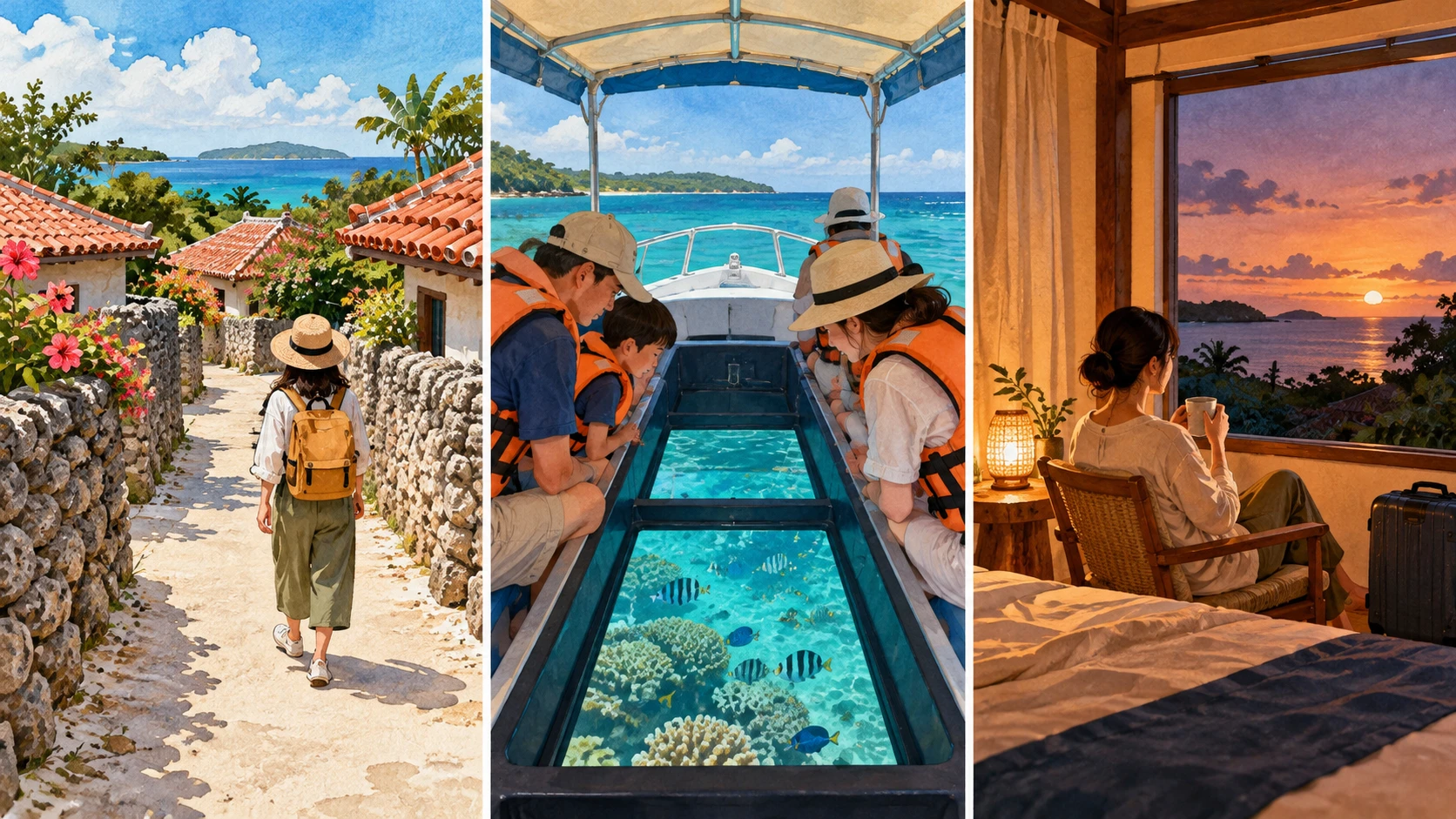
Kabira Bay on Ishigaki can combine a shore viewpoint with a glass-bottom boat, without turning every sea view into a snorkeling activity. BLUE CORAL's official Kabira Bay boat introduction lists a roughly 25-minute trip, starting at ¥2,300 for adults and ¥1,200 for children aged 4–11. These are starting prices, not a fixed total for every date or purchase method. The child category is age-based, unlike Anei's elementary-school ferry rule; check the ticket category afresh for a 12-year-old.
A glass-bottom boat is intended for viewing underwater from inside the boat; the activity does not require entering the sea yourself. Water color, waves, visibility, and wildlife vary from day to day. Official photographs cannot guarantee a turtle or a particular coral on your departure. Anyone prone to seasickness, needing boarding assistance, or bringing a young child should ask about restrictions and suitability that day. If the trip is canceled, do not enter unfamiliar coastal waters independently just to replace the water activity on your itinerary.
Put Kabira Bay within an Ishigaki land day, keeping boating, parking or buses, and lunch in one area. That is easier to manage than Taketomi in the morning, Kabira in the afternoon, and a rush to the northern lighthouse. If a shore view is all you want, buying a boat ticket is optional; keep the time for a leisurely lunch or an earlier return to your room. The value of the day lies in a pace your companions enjoy and room to respond to sea conditions, rather than reproducing every promotional photograph.
With or without a car: choose western Kabira or the northern viewpoints first
Ishigaki's tourism association introduction to island landscapes lists Kabira Bay, Tamatorizaki Observatory, Oganzaki, and Hirakubozaki Lighthouse. Use it to choose scenery, not as a timetable proving everything fits into half a day. If heading west toward Kabira, group other stops in that direction. For Tamatorizaki and Hirakubo, leave a more substantial daylight block. Include lunch, parking, breaks, and the journey back to the hotel; do not link a ferry you cannot miss to the shortest driving estimate on a rental-car navigation screen.
Without a car, combine a port-side stay, a Taketomi day, and a Kabira day with verified buses. The airport guide identifies access to Kabira Park via routes toward Yonehara or a change at the terminal, but whether your outward and return services connect still needs the day's timetable. A line on a map does not establish a ride back after sunset. For car or motorcycle rental, separately verify a legitimate provider and the applicability of your license and insurance. Check attraction access for the date too; having a vehicle does not guarantee entry everywhere.
With a young child in a rental car, ask about a suitable seat, pickup and return locations, the final shuttle, and refueling. Calculate separately whether you need to keep the vehicle on island-excursion days. Without a car, do not fill a gap in the return from a northern viewpoint with an assumption that a taxi will certainly be available. These route suggestions reduce backtracking; they are not an invitation to drive tired to complete an island circuit. Flexible stops still require a complete return plan and enough daylight.
Ishigaki in winter or rain: changing activities does not remove rough seas
The official Ishigaki tourism climate guide warns that northerly winds in January and February can make conditions feel colder than the temperature suggests, with a jacket useful on overcast, rainy days. March and April can bring sudden wind changes, and summer and autumn are affected by typhoons. These are seasonal preparation pointers, not a forecast for a particular day in 2027. Winter can still suit shore views, village walks, or hotel time, but Uehara sailings and water activities need greater flexibility. A southern island is not reliably windless year-round.
Distinguish ordinary light rain from a typhoon alert. In normal rain, confirmed town dining, shopping, or hotel rest can slow the pace. With strong winds, large coastal waves, or suspended transport, do not head to a pier, cape, or remote beach to watch waves instead. An indoor terminal waiting area also does not promise that a boat will sail. Read the latest weather, ferry, activity-provider, and accommodation messages before deciding to move, rather than arriving at a closed terminal before looking for the first notice.
Island-safety advice notes that swell and strong wind can persist for two or three days around a typhoon's approach and passage; the center moving away does not automatically restore a water itinerary. Pack waterproof storage, regular medication, and offline contact details. Follow hotel and local instructions for food and supplies rather than hoarding. Japan's seasonal weather and itinerary-adjustment guide can help frame the season, but use local Yaeyama notices immediately before travel instead of relying on a nationwide seasonal average.
Four days and three nights: one Taketomi day and one Ishigaki land day
A four-day, three-night Ishigaki stay can use day one for arrival, checking in, dinner, and supplies, without prepaying an island activity tightly after landing. On day two, visit Taketomi when sailings and seats are confirmed, choosing the village and one shore stop. On day three, choose the Kabira side or northern landscapes and leave hotel-rest time. Depart according to your flight on day four. This avoids moving hotels or taking a ferry every day, and the order can change with the actual weather.
For Taketomi, the winter Anei combination described above—9:00 out and 15:50 back—is a reference. The 16:50 return is a later option only after checking operation and space, not the sole fallback. On a land day by bus, check the return before setting the length of a stop; with a rental car, collection, return, and airport transfers also take time. Keeping one of the two days relatively adjustable may help when seas disrupt boats, but swapping days cannot automatically restore suspended services on land.
This plan does not cover Iriomote, Taketomi, Kabira, every beach, and all the island's lighthouses at once. It does give each day a clear purpose. If an Iriomote forest activity matters most, replace the third day's land outing with a confirmed Iriomote product and accept another long travel day. If relaxing at a coastal hotel matters most, reduce cross-island journeys. Use a seasonal approach to choosing Japan activities to select one priority and arrange the remaining time around it, instead of treating a popular online list as compulsory homework.
Five days and four nights with Iriomote: separate activity and return days
For a genuine Iriomote stay, consider the first night on Ishigaki, the second and third on Iriomote, and the fourth back on Ishigaki. Travel to the island on day two according to hotel transfers and actual sailings; keep day three for a confirmed activity in the same area; allow time to return on day four before flying on day five. This is a route-buffer example, not a guarantee of getting away on time after consecutive canceled days. If your dates cannot move at all, reassess whether an outlying-island overnight suits the trip.
Before moving, ask both hotels whether they will store large luggage under their respective rules. Miyahira's standard post-checkout arrangement requires collection the same day; it is not automatically free overnight storage. Take what you actually need to Iriomote, keeping medication, valuables, and next-day essentials with you. If you book an activity before confirming pickup arrangements for your accommodation, you may discover that the meeting port is on the other side. Include the hotel name, activity, ferry operator, and dates in the same inquiry to identify such mismatches early.
An overnight on Taketomi likewise needs a real place to stay, meals, and evening transfer arrangements before you commit to sunset. Ask the selected property about its room, food, and cancellation conditions instead of applying an Iriomote hotel's child or shuttle rules to Taketomi. Establish that you truly have both a bed and dinner before adding a late stay. Starting with the booking priorities for a first independent Japan trip, secure rooms and activities that cannot move easily, then buy transport matching their dates and ports to reduce conflicts.
Family transport budget: two adults and a 10-year-old elementary-school pupil
This example uses two adults and one 10-year-old elementary-school pupil, with all amounts in yen and ordinary ferries including the fuel adjustment above. A one-way Route 55 trip is 550 × 2 + 280 = ¥1,380, or ¥2,760 for two directions. Taketomi returns are 1,880 × 2 + 990 = ¥4,750. Together that is ¥7,510, excluding the island bus, accommodation, meals, and activities. Two local-bus rides each on Taketomi add ¥1,500 at normal fares, bringing the transport subtotal to ¥9,010, provided service has resumed on the date.
For Iriomote, calculate the port actually needed: Ohara returns are 4,880 × 2 + 2,500 = ¥12,260; Uehara returns are 6,370 × 2 + 3,200 = ¥15,940, a difference of ¥3,680. That gap does not justify buying the wrong ticket and demanding a free cross-island transfer. If your children's ages or school stages differ, recalculate each product under its own rules. Activity starting prices, young children sharing hotel bedding, and breakfast inclusions cannot all be represented by this one 10-year-old's example.
Then add accommodation totals for the selected dates, meals, rental vehicles or taxis, insurance, and cancellation costs you can afford. Kabira's glass-bottom boat has a starting price, and hotel charges depend on room and plan. Filling these gaps with an apparently precise all-inclusive four-day figure would be misleading. Use an item-by-item Japan travel budget to separate known fixed costs from amounts still to confirm. That makes the added cost of another island, four made-up sleeping places, or a taxi easier to assess.
| Item | Calculation | Family subtotal |
|---|---|---|
| Route 55 airport bus, both directions | (550 × 2 + 280) × 2 | 2,760 |
| Ordinary Taketomi return tickets | 1,880 × 2 + 990 | 4,750 |
| Airport buses plus Taketomi boats | 2,760 + 4,750 | 7,510 |
| Two local-bus rides each on Taketomi | (300 × 2 + 150) × 2 | 1,500 |
| Previous transport plus two island-bus rides each | 7,510 + 1,500 | 9,010 |
Before paying: check dates, ports, sleeping places, and cancellation contacts
Put every booking on one calendar before paying: flights and arrival times, ferry company and port, hotel pickup conditions, activity meeting point, bed configuration, and children's ages. Arrange return journeys requiring reservations early. Timetables for different seasons—even from the same company—and different companies' e-tickets are not freely interchangeable. If a stage still relies on “we will work it out there,” identify its effect on later accommodation and flights before deciding to keep it.
Write down the cancellation method too. Anei's weather-canceled prepaid QR booking differs from Yaeyama Kanko's Uehara alternative-route e-ticket rules, and hotel typhoon waivers have their own conditions and contact procedures. Read first, then cancel; pressing one platform's button does not notify every supplier. The accommodation total should include the actual beds and meals you need. Keep the applicable child category with each ferry and activity ticket so everyone understands what the budget buys.
Finally, keep the trip to what can actually be completed. Four days and three nights based on Ishigaki allow a considered choice of one outlying island. Adding Iriomote nights trades more time for activities and transfers. When closures, cancellations, or conflicting dates appear, return to the parts confirmed as possible instead of filling the gap with another unresearched island. Knowing which stage awaits an update and which payment carries cancellation costs is more useful than a promise to see all the Yaeyamas in one trip.
A few useful answers
Should I stay near Ishigaki's ferry terminal or on the coast?
Start with the port if taking repeated ferries and minimizing luggage moves; compare coastal resorts if most time will be spent at the hotel. An airport shuttle is not a port transfer, so calculate the port journey and cost separately.
Can four days and three nights include both Taketomi and Iriomote?
When services operate normally, they can go on separate days, but that creates two transport days. For a first visit, consider one island day and one Ishigaki land day. If Iriomote is the priority, remove other stops or add nights, rather than compressing all islands into half a day.
Can I visit Ishigaki on a day return from Naha?
Ishigaki Airport lists Naha flights. Whether a day return is worthwhile depends on your flights, airport transfers and intended activities. Flight duration alone does not guarantee a ferry connection, and not every date can be dismissed as impossible.
Does the Route 55 airport bus accept ICOCA or Suica?
Karry Kanko's Route 55 does not accept transport IC cards or QR payments. It accepts cash or supported contactless bank cards. Bank-card contactless and transport IC are different systems; check other bus operators separately.
Can Anei and Yaeyama Kanko ferry tickets be used interchangeably?
The shared-ticket scheme has ended, so travel with the company whose ticket you bought. Their Uehara cancellation e-ticket rules, replacement buses and voucher collection also differ and cannot be substituted.
Does a canceled Uehara route mean Iriomote is inaccessible?
Not necessarily: Ohara and alternative road transport may remain available, depending on your operator, specified connections and hotel pickup conditions. Ohara is not guaranteed to run normally all day either. Buy the tickets required for the Uehara alternative; a cheaper Ohara ticket does not create a right to the transfer.
Does Iriomote Hotel collect from Ohara every day?
The official information says Ohara collection is provided only when all Uehara-route sailings are canceled; Uehara is the usual port. The download label and PDF periods disagree, so ask the hotel for the applicable timetable for travel from January 5, 2027 onward.
Does Fusaki's free stay for young children include breakfast?
Preschool children aged 0–6 can avoid the room charge when sharing existing bedding without separate bedding. Free breakfast requires the adults' plan to include breakfast. Flight-and-hotel packages have separate age rules, and all occupancy and bedding arrangements still need confirmation.
Is a Yaeyama island-hopping pass always cheaper?
No. Anei's pass covers consecutive days and adds fuel adjustments for each sector, while ordinary fares include fuel. Adult ordinary returns to Taketomi and Ohara total ¥6,760, below the three-day pass's ¥6,800 base price.
Are Yubu Island and the Nakama River cruise open now?
This guide was checked on October 22, 2026. Yubu is closed from October 21 with reopening undecided; Nakama sailings are scheduled to stop all day on October 22–23, with the 24th also possibly affected. The upstream-boardwalk course is separately suspended for damage. Read newer resumption notices before traveling.
Does everyone visiting Iriomote need an island-entry permit?
No. Prior permission applies to designated natural sightseeing areas, not one common permit for everyone arriving, staying or taking a boat. Forest activities still need a compliant guide and checks on activity ages, route and weather.
Is an Iriomote last night sensible before a flight the next day?
It adds a ferry and land connection that must happen first, so cancellations can disrupt what follows. A last night back on Ishigaki can add a buffer, but does not guarantee flights are unaffected by weather. With completely inflexible timing, reassess an outlying-island overnight.
Check with the source
Schedules, availability and rules can change. These official sources are the place to confirm details before you book.
- Painushima Ishigaki Airport | route timetables and update limits
- Ishigaki Airport | buses, taxi times and estimated fares
- Karry Kanko | direct Route 55 fares and payment
- Anei Kanko | October 2026–March 2027 ferry timetable PDF
- Anei Kanko | booking, preschool children, refunds and boarding FAQ
- Anei Kanko | Taketomi fares and crossing times
- Anei Kanko | Ohara fares and crossing times
- Anei Kanko | Uehara fares, stops and bus changes
- Anei Kanko | Kohama fares and crossing times
- Anei Kanko | winter replacement bus when Uehara is canceled
- Yaeyama Kanko Ferry | Uehara cancellation transfers and e-tickets
- Anei Kanko | island-hopping pass and additional fuel charges
- Hotel Miyahira | East Wing room for three guests
- Hotel Miyahira | check-in, luggage and facilities FAQ
- Hotel Miyahira | Yaeyama and hotel films on the official website
- Fusaki Beach Resort | Superior Twin areas and beds
- Fusaki Beach Resort | young children sharing bedding and breakfast
- Fusaki Beach Resort | shuttle and temporary suspensions
- ICONIA | Type C accommodation terms linked by Fusaki
- Fusaki Beach Resort | typhoon cancellation conditions and contact sequence
- Iriomote Hotel by Hoshino Resorts | rooms, children and special terms
- Iriomote Hotel | conditions for Uehara and Ohara transfers
- Iriomote Hotel | downloadable Uehara shuttle PDF
- Iriomote Hotel | downloadable Ohara shuttle PDF
- Hoshino Resorts | special grounds for cancellation-fee waivers
- Taketomi Kotsu | local bus, reservations, fares and suspensions
- Taketomi Kanko Center | buffalo-cart payments and customer transfers
- Taketomi Town Tourism Association | beaches, walking and rental FAQ
- Taketomi Town Tourism Association | West Pier tip no-entry notice
- Taketomi Town Tourism Association | Kaiji Beach and current warning
- Yubu Island | buffalo cart, admission and meeting point
- Yubu Island | port access and taxi limitations
- Yubu Island | closure from October 21, 2026
- Iriomote Kotsu | Nakama River courses and current cancellations
- Iriomote Ecotourism | natural-area conduct and safety rules
- Iriomote Ecotourism | 2025 Japanese manners handbook
- Taketomi Town Tourism Association | nature, weather and sea safety
- BLUE CORAL | Kabira Bay glass-bottom boat starting fares and ages
- Ishigaki City Tourism Association | seasonal climate
- Ishigaki City Tourism Association | landscapes and areas
- Iriomote Ecotourism | designated natural areas, prior permits and guiding qualifications
- Taketomi Kanko Center | ceremonies, weather and ferry-related closures